
Life, 1888-12-27 · page 8 of 43
Life — December 27, 1888 — page 8: what you’re looking at
What you’re looking at
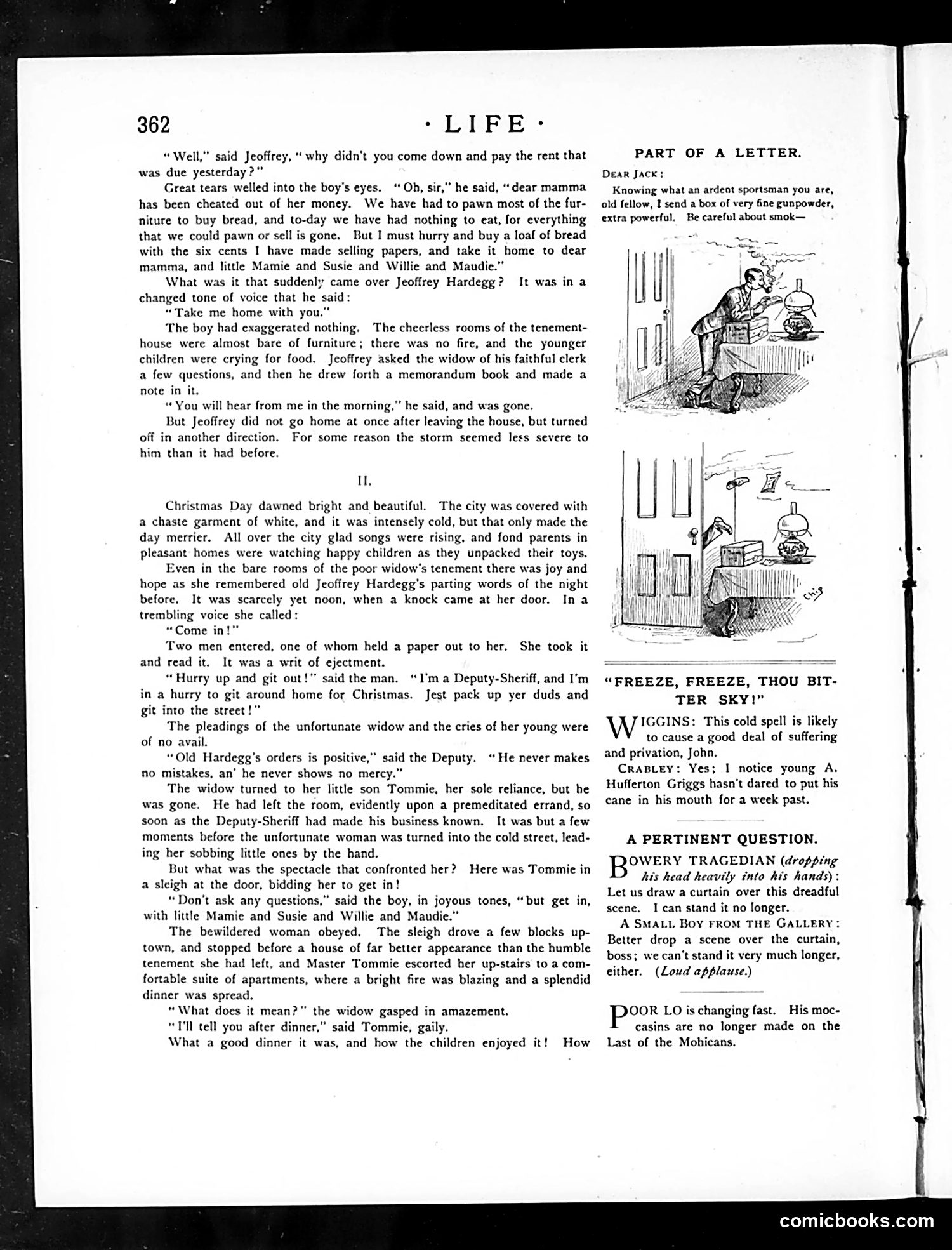
This page contains a serialized story (section II) about Christmas charity, not a political cartoon. The narrative describes a poor widow's tenement receiving an unexpected visit from a Deputy-Sheriff enforcing rent collection on Christmas Day. The plot twist: the sheriff escorts her and her children to a comfortable apartment with a "bright fire" and "splendid dinner." The three small illustrations on the right show domestic scenes—likely depicting the story's key moments. Below the main narrative are three brief comic snippets ("Part of a Letter," "Freeze, Freeze, Thou Bitter Sky," "A Pertinent Question," and "Poor Lo"), which appear to be unrelated humorous observations about winter weather, social discomfort, and Native Americans ("Poor Lo" being period slang for Indigenous peoples).
📄 Transcribed text from this page (OCR, searchable)
Machine-transcribed from the original scan — historical spelling and the odd misread are preserved.
362 ‘LIFE: “Well,” said Jeoffrey, “ why didn’t you come down and pay the rent that was due yesterday?” Great tears welled into the boy's eyes. “Oh, sir,” he said, “dear mamma has been cheated out of her money. We have had to pawn most of the fur- niture to buy bread, and to-day we have had nothing to eat, for everything that we could pawn or sell is gone. But I must hurry and buy a loaf of bread with the six cents I have made selling papers, and take it home to dear mamma, and little Mamie and Susie and Willie and Maudie.” What was it that suddenly came over Jeoffrey Hardegg ? changed tone of voice that he said: “Take me home with you.” The boy had exaggerated nothing. The cheerless rooms of the tenement- house were almost bare of furniture; there was no fire, and the younger children were crying for food. Jeoffrey asked the widow of his faithful clerk a few questions, and then he drew forth a memorandum book and made a note in it. “You will hear from me in the morning,” he said, and was gone. But Jeofirey did not go home at once after leaving the house, but turned off in another direction. For some reason the storm seemed less severe to him than it had before. It was in a Il, Christmas Day dawned bright and beautiful. The city was covered with a chaste garment of white, and it was intensely cold, but that only made the day merrier, All over the city glad songs were rising, and fond parents in pleasant homes were watching happy children as they unpacked their toys. Even in the bare rooms of the poor widow's tenement there was joy and hope as she remembered old Jeoffrey Hardegg's parting words of the night before. It was scarcely yet noon, when a knock came at her door. In a trembling voice she called: “Come in!” Two men entered, one of whom held a paper out to her. She took it and read it. It was a writ of ejectment. “Hurry up and git out!" said the man. “I'm a Deputy-Sheriff, and I'm in a hurry to git around home for Christmas. Jest pack up yer duds and git into the street!" The pleadings of the unfortunate widow and the cries of her young were of no avail. “Old Hardegg’s orders is positive,” said the Deputy. no mistakes, an’ he never shows no mercy.” The widow turned to her little son Tommie, her sole reliance, but he was gone. He had left the room, evidently upon a premeditated errand, so soon as the Deputy-Sheriff had made his business known. It was but a few moments before the unfortunate woman was turned into the cold street, lead- ing her sobbing little ones by the hand. But what was the spectacle that confronted her? Here was Tommie in a sleigh at the door, bidding her to get in! “Don’t ask any questions,” said the boy, in joyous tones, “but get in, with little Mamie and Susie and Willie and Maudie.” The bewildered woman obeyed. The sleigh drove a few blocks up- town, and stopped before a house of far better appearance than the humble tenement she had left, and Master Tommie escorted her up-stairs to a com- fortable suite of apartments, where a bright fire was blazing and a splendid dinner was spread. “What does it mean?" the widow gasped in amazement. “T'll tell you after dinner,” said Tommie, gaily. What a good dinner it was, and how the children enjoyed it! “He never makes How PART OF A LETTER. Dear Jack: Knowing what an ardent sportsman you are, old fellow, I send a box of very fine gunpowder, extra powerful. Be careful about smok— “FREEZE, FREEZE, THOU BIT- TER SKY!" IGGINS: This cold spell is likely to cause a good deal of suffering and privation, John. CRABLEY: Yes; I notice young A. Hufferton Griggs hasn't dared to put his cane in his mouth for a week past. A PERTINENT QUESTION. OWERY TRAGEDIAN (dropping his head heavily into his hands): Let us draw a curtain over this dreadful scene. I can stand it no longer. A SMALL Boy FROM THE GALLERY: Better drop a scene over the curtain, boss; we can’t stand it very much longer, either. (Loud applause.) OOR LO is changing fast. His moc- casins are no longer made on the Last of the Mohicans. comicbooks.com