
Life, 1888-12-27 · page 9 of 43
Life — December 27, 1888 — page 9: what you’re looking at
What you’re looking at
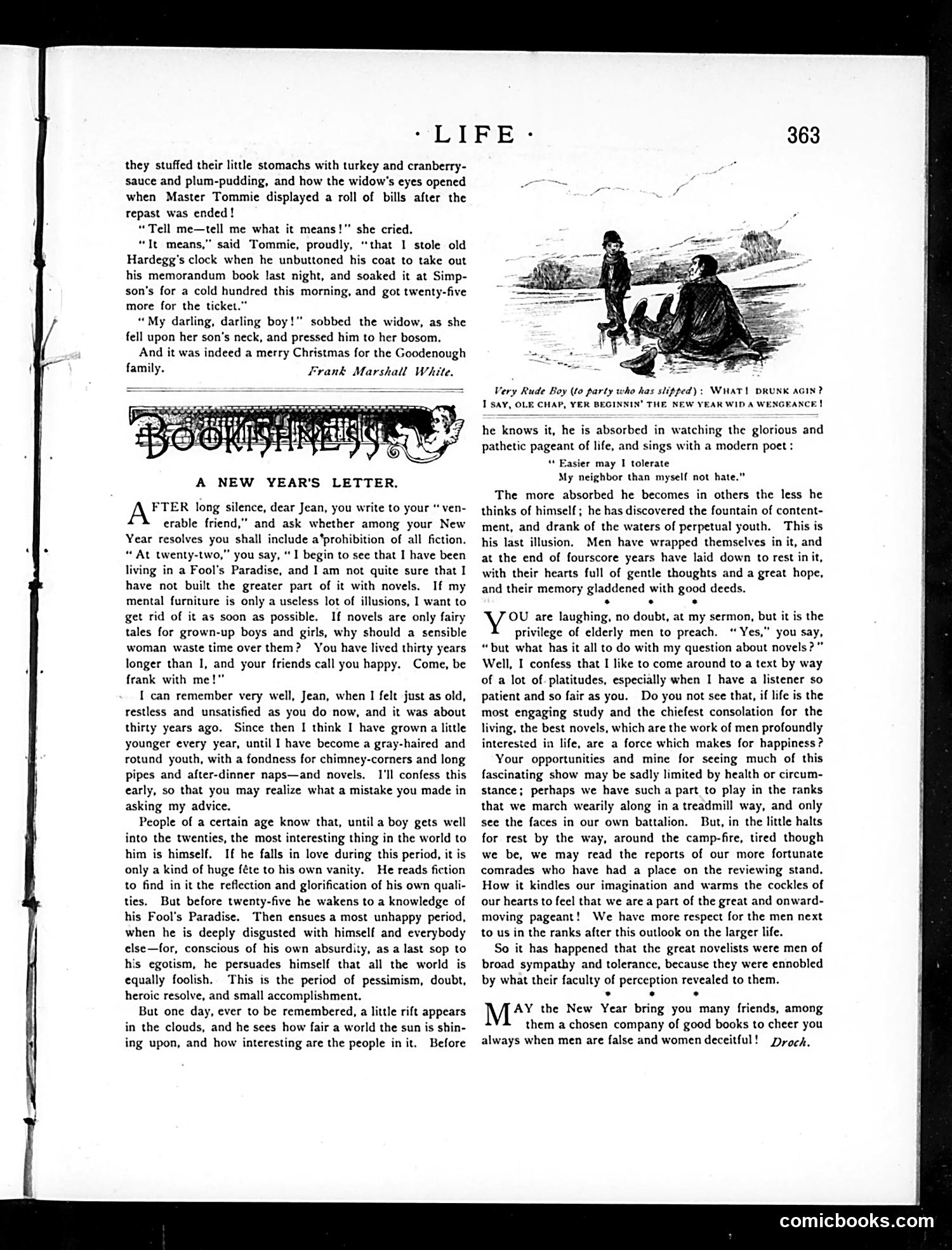
This page contains a Christmas story excerpt by Frank Marshall White (visible at bottom left) and a New Year's letter titled "Bookishness" addressing fiction reading habits. The small illustration shows two figures in a winter landscape, likely from the Christmas narrative. The main content critiques reading habits and intellectualism. The letter argues that novels—dismissed as frivolous—actually offer valuable insight into human nature and moral development. It defends fiction against those who consider it a waste of time, suggesting that serious literature provides "the most engaging study and the chiefest consolation for the living." This reflects early 20th-century debates about literature's cultural value and whether entertainment reading was intellectually legitimate—a class-conscious concern of the era.
📄 Transcribed text from this page (OCR, searchable)
Machine-transcribed from the original scan — historical spelling and the odd misread are preserved.
“LIFE: they stuffed their little stomachs with turkey and cranberry- sauce and plum-pudding, and how the widow's eyes opened when Master Tommie displayed a roll of bills after the Tepast was ended! “Tell me—tell me what it means!" she cried. “It means,” said Tommie, proudly, “that I stole old Hardegg’s clock when he unbuttoned his coat to take out his memorandum book last night, and soaked it at Simp- son's for a cold hundred this morning, and got twenty-five more for the ticket.” “My darling, darling boy!" sobbed the widow, as she fell upon her son's neck, and pressed him to her bosom. And it was indeed a merry Christmas for the Goodenough Frank Marshall White. A NEW YEAR'S LETTER. FTER long silence, dear Jean, you write to your “ ven- erable friend,” and ask whether among your New Year resolves you shall include a‘prohibition of all fiction. “ At twenty-two,” you say, “I begin to see that I have been living in a Fool's Paradise, and I am not quite sure that I have not built the greater part of it with novels. If my mental furniture is only a useless lot of illusions, I want to get rid of it as soon as possible. If novels are only fairy tales for grown-up boys and girls, why should a sensible woman waste time over them? You have lived thirty years longer than I, and your friends call you happy. Come, be frank with me!" I can remember very well, Jean, when I felt just as old, restless and unsatisfied as you do now, and it was about thirty years ago. Since then I think I have grown a little younger every year, until I have become a gray-haired and rotund youth, with a fondness for chimney-corners and long pipes and after-dinner naps—and novels. I'll confess this early, so that you may realize what a mistake you made in asking my advice. People of a certain age know that, until a boy gets well into the twenties, the most interesting thing in the world to him is himself. If he falls in love during this period, it is only a kind of huge féte to his own vanity. He reads fiction to find in it the reflection and glorification of his own quali- ties. But before twenty-five he wakens to a knowledge of his Fool’s Paradise. Then ensues a most unhappy period, when he is deeply disgusted with himself and everybody else—for, conscious of his own absurdity, as a last sop to his egotism, he persuades himself that all the world is equally foolish. This is the period of pessimism, doubt, heroic resolve, and small accomplishment. But one day, ever to be remembered, a little rift appears in the clouds, and he sees how fair a world the sun is shin- ing upon, and how interesting are the people in it. Before Very Rude Boy (to party who has slipped): WUAT! DRUNK AGIN? I SAY, OLE CHAP, YER BEGINSIN' THE NEW YEAR WID A WENGEANCE he knows it, he is absorbed in watching the glorious and pathetic pageant of life, and sings with a modern poet : “ Easier may I tolerate My neighbor than myself not hate.” The more absorbed he becomes in others the less he thinks of himself; he has discovered the fountain of content- ment, and drank of the waters of perpetual youth. This is his last illusion. Men have wrapped themselves in it, and at the end of fourscore years have laid down to rest init, with their hearts full of gentle thoughts and a great hope, and their memory gladdened with good deeds. . . . OU are laughing, no doubt, at my sermon, but it is the privilege of elderly men to preach. “ Yes,” you say, “but what has it all to do with my question about novels?” Well, I confess that I like to come around to a text by way of a lot of. platitudes, especially when I have a listener so patient and so fair as you. Do you not see that, if life is the most engaging study and the chiefest consolation for the living, the best novels, which are the work of men profoundly interested in life, are a force which makes for happiness? Your opportunities and mine for seeing much of this fascinating show may be sadly limited by health or circum- stance; perhaps we have such a part to play in the ranks that we march wearily along in a treadmill way, and only see the faces in our own battalion. But, in the little halts for rest by the way, around the camp-fire, tired though we be, we may read the reports of our more fortunate comrades who have had a place on the reviewing stand. How it kindles our imagination and warms the cockles of our hearts to feel that we are a part of the great and onward- moving pageant! We have more respect for the men next to us in the ranks after this outlook on the larger life. So it has happened that the great novelists were men of broad sympathy and tolerance, because they were ennobled by what their faculty of perception revealed to them. . . . M** the New Year bring you many friends, among them a chosen company of good books to cheer you always when men are false and women deceitful! Dyoch. comicbooks.com