
Life, 1888-12-27 · page 4 of 43
Life — December 27, 1888 — page 4: what you’re looking at
What you’re looking at
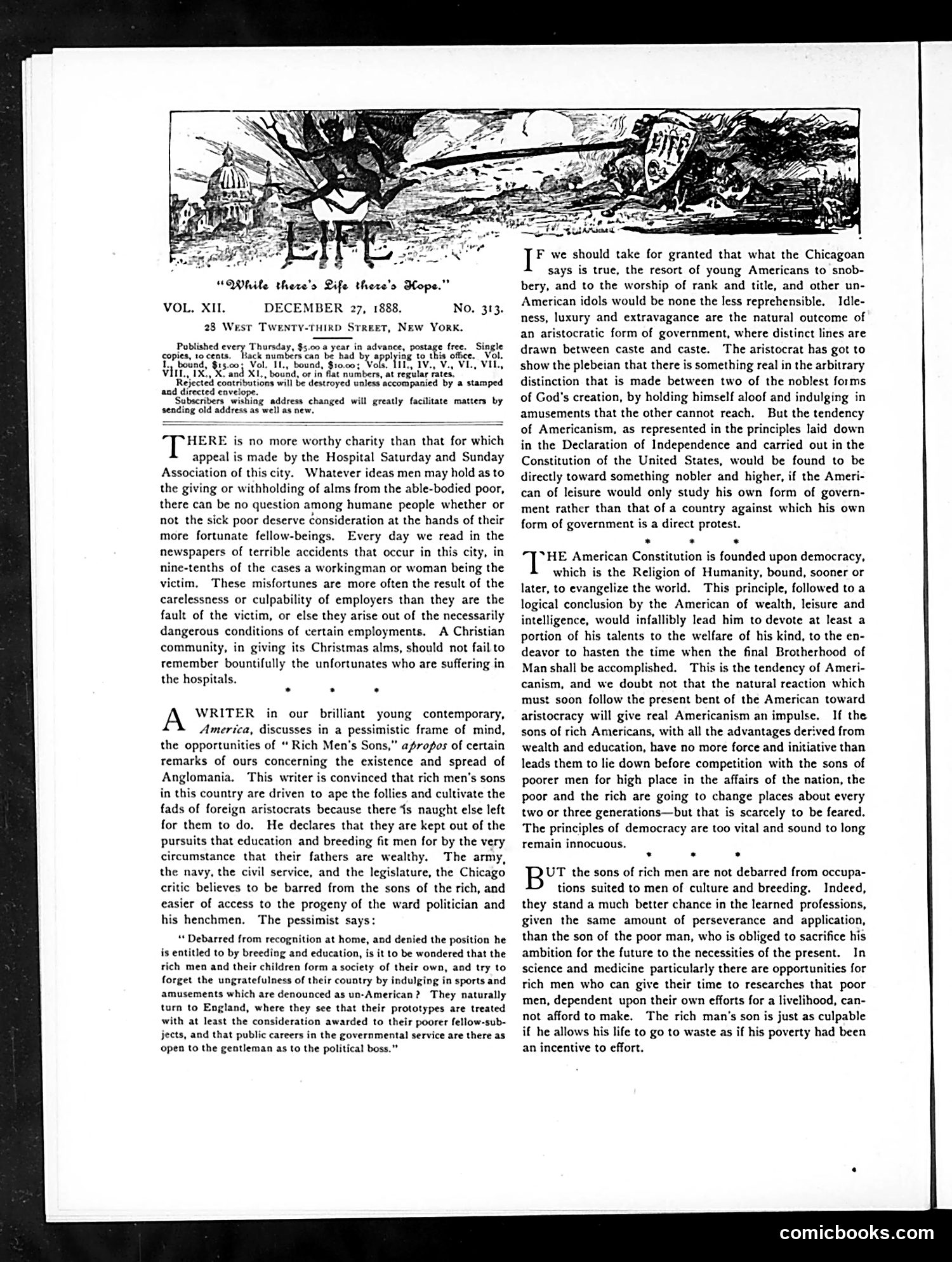
The cartoon at top shows a figure labeled "Life" sitting beneath a tree, with the caption "While there's Life there's Hope." The accompanying editorial discusses American aristocracy and social inequality. The text critiques wealthy Americans who adopt European aristocratic pretensions rather than embracing democratic principles. It argues that the Constitution's foundation in democracy should inspire Americans toward noble pursuits benefiting humanity, not toward leisure and snobbery. The piece specifically attacks rich men's sons who waste opportunities through indolence, contrasting them unfavorably with poor men's sons who must work hard. It warns that unchecked aristocratic tendencies among America's wealthy elite threaten the nation's democratic values. The overall message: American democracy is imperiled when the rich abandon civic responsibility for European-style aristocratic excess.
📄 Transcribed text from this page (OCR, searchable)
Machine-transcribed from the original scan — historical spelling and the odd misread are preserved.
“Mile there's Life there's Hope.” VOL. XII. DECEMBER 27, 1888. 23 West Twent Published every Thursday, $5.00 a year in advance, ¢ free. Single copies, ro cents. Tack numbers can be had by applying to th office. Vol. Ly bound, $15.00; Vol. II., bound, $10.00; vale tt eM ie Vins Clie Vokes VIIL., 1X., Xo and XI. bound, or in flat numbers, at regular fates. Rejected contributions will be destroyed unless accompanied by a stamped and directed envelope. Subscribers wishing address changed will greatly facilitate matters by sending old address as well as new, No. 313. rHinD Street, New York. HERE is no more worthy charity than that for which appeal is made by the Hospital Saturday and Sunday Association of this city. Whatever ideas men may hold as to the giving or withholding of alms from the able-bodied poor, there can be no question among humane people whether or not the sick poor deserve consideration at the hands of their more fortunate fellow-beings. Every day we read in the newspapers of terrible accidents that occur in this city, in nine-tenths of the cases a workingman or woman being the victim, These misfortunes are more often the result of the carelessness or culpability of employers than they are the fault of the victim, or else they arise out of the necessarily dangerous conditions of certain employments. A Christian community, in giving its Christmas alms, should not fail to remember bountifully the unfortunates who are suffering in the hospitals. WRITER in our brilliant young contemporary, America, discusses in a pessimistic frame of mind, the opportunities of “ Rich Men's Sons,” apropos of certain remarks of ours concerning the existence and spread of Anglomania. This writer is convinced that rich men’s sons in this country are driven to ape the follies and cultivate the fads of foreign aristocrats because there 1s naught else left for them to do. He declares that they are kept out of the pursuits that education and breeding fit men for by the very circumstance that their fathers are wealthy. The army, the navy, the civil service, and the legislature, the Chicago critic believes to be barred from the sons of the rich, and easier of access to the progeny of the ward politician and his henchmen. The pessimist says: “ Debarred from recognition at home, and denied the position he is entitled to by breeding and education, is it to be wondered that the rich men and their children form a society of their own, and try to forget the ungratefulness of their country by indulging in sports and amusements which are denounced as un-American? They naturally turn to England, where they see that their prototypes are treated with at least the consideration awarded to their poorer fellow-sub- jects, and that public careers in the governmental service are there as open to the gentleman as to the political boss.” F we should take for granted that what the Chicagoan says is true, the resort of young Americans to snob- bery, and to the worship of rank and title, and other un- American idols would be none the less reprehensible. Idle- ness, luxury and extravagance are the natural outcome of an aristocratic form of government, where distinct lines are drawn between caste and caste. The aristocrat has got to show the plebeian that there is something real in the arbitrary distinction that is made between two of the noblest forms of God's creation, by holding himself aloof and indulging in amusements that the other cannot reach. But the tendency of Americanism, as represented in the principles laid down in the Declaration of Independence and carried out in the Constitution of the United States, would be found to be directly toward something nobler and higher, if the Ameri- can of leisure would only study his own form of govern- ment rather than that of a country against which his own form of government is a direct protest. . . . Te American Constitution is founded upon democracy, which is the Religion of Humanity, bound, sooner or later, to evangelize the world. This principle, followed to a logical conclusion by the American of wealth, leisure and intelligence, would infallibly lead him to devote at least a portion of his talents to the welfare of his kind, to the en- deavor to hasten the time when the final Brotherhood of Man shall be accomplished. This is the tendency of Ameri- canism, and we doubt not that the natural reaction which must soon follow the present bent of the American toward aristocracy will give real Americanism an impulse. If the sons of rich Americans, with all the advantages derived from wealth and education, have no more force and initiative than leads them to lie down before competition with the sons of poorer men for high place in the affairs of the nation, the poor and the rich are going to change places about every two or three generations—but that is scarcely to be feared. The principles of democracy are too vital and sound to long remain innocuous. . . UT the sons of rich men are not debarred from occupa- tions suited to men of culture and breeding. Indeed, they stand a much better chance in the learned professions, given the same amount of perseverance and application, than the son of the poor man, who is obliged to sacrifice his ambition for the future to the necessities of the present. In science and medicine particularly there are opportunities for rich men who can give their time to researches that poor men, dependent upon their own efforts for a livelihood, can- not afford to make. The rich man’s son is just as culpable if he allows his life to go to waste as if his poverty had been an incentive to effort. comicbooks.com