A complete issue · 37 pages · 1937
Judge — March 1937
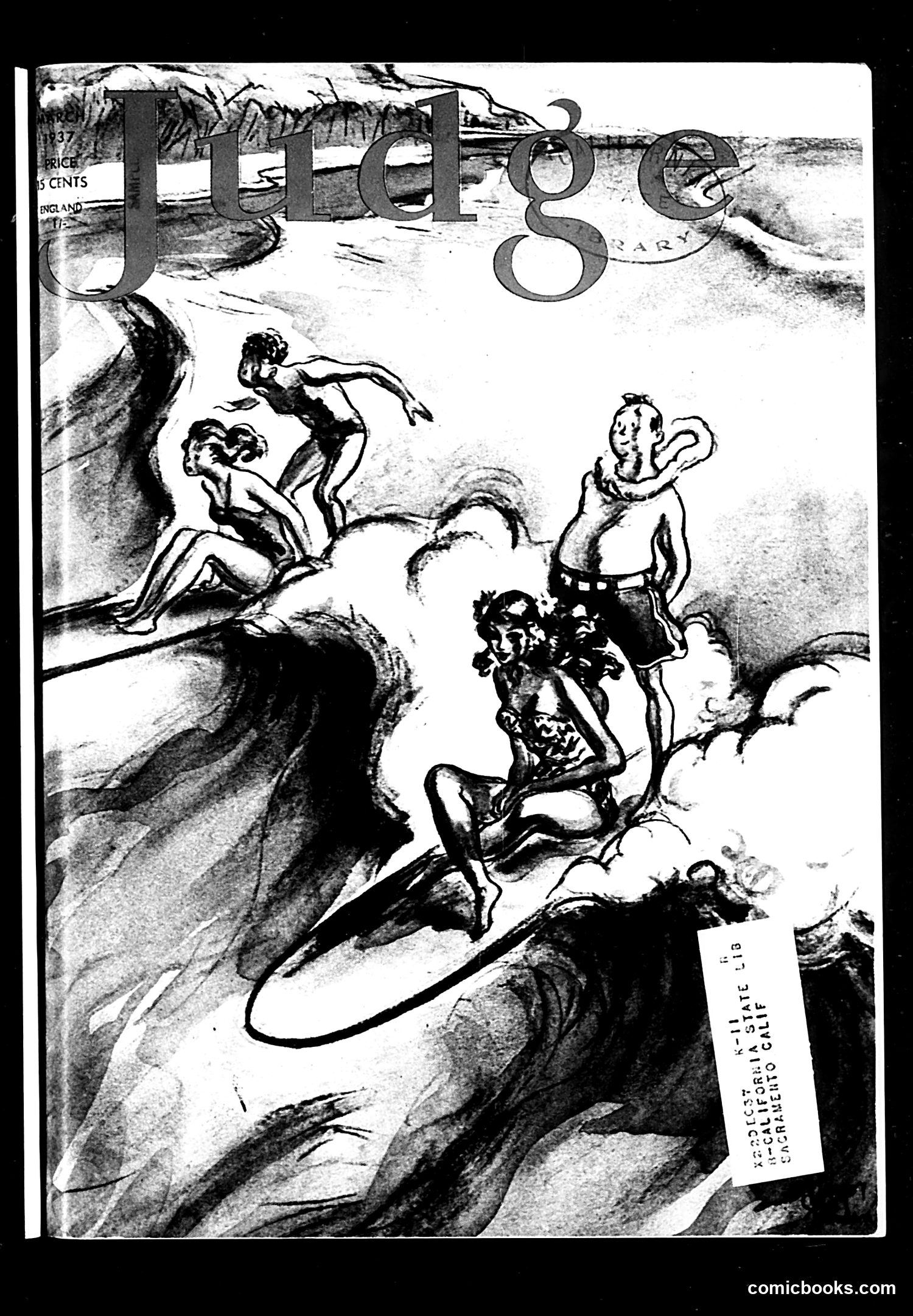
# Judge Magazine Cartoon Analysis This appears to be a cover illustration from *Judge* magazine depicting a beach or seaside scene with multiple figures in swimming attire engaged in various activities on rocky terrain. The large decorative text reading "Judge" dominates the upper portion. The cartoon likely satirizes leisure activities or beach culture of the era in which it was published. Without clearer identifying features, specific caricatures, or readable contextual text visible in this reproduction, I cannot definitively identify which political figures or social issues are being referenced. The sketchy art style and composition suggest social commentary on contemporary behavior, but the specific satirical point remains unclear from this image alone.

# Analysis This page is primarily **advertising**, not editorial content or satire. It promotes Max Eastman's book "Enjoyment of Laughter" and solicits memberships to the Judge Laugh Club. The advertisement features testimonials from prominent humorists (Fred Allen, Rube Goldberg, P.G. Wodehouse) endorsing the book's insights into why people laugh. The pitch emphasizes that Judge magazine—described as "America's biggest humor magazine"—now offers members a two-year subscription plus Eastman's book for $5.25 (retail $3.75 combined). This appears to be a **membership drive** capitalizing on the book's popularity and Judge's editorial authority on humor. The content is commercial rather than satirical, aimed at building the magazine's subscriber base during what was likely the mid-20th century.
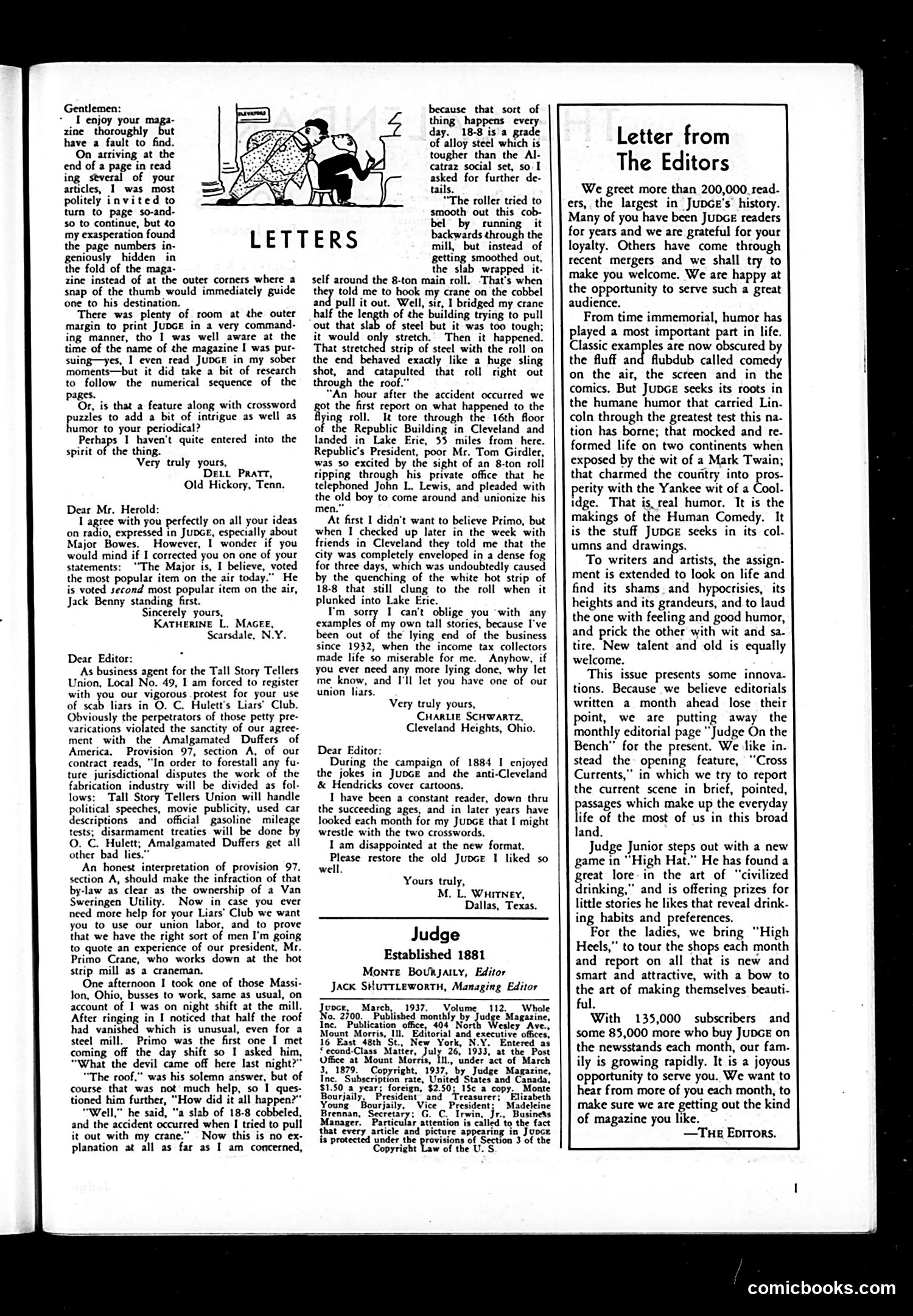
# Analysis of Judge Magazine Cartoon The main cartoon depicts a man being crushed or flattened by a large roll of steel, with sound effects suggesting impact. According to the accompanying letter from "Old Hickory, Iowa," this illustrates an industrial accident involving sheet metal at a mill. The letter describes a coil of 18.8-gauge steel alloy that escaped control during processing at a mill, striking a worker and causing serious injury. The narrative details the metal "catapulted" through the roof after hitting the injured man. This appears to be **satirical commentary on industrial workplace safety hazards** during what seems to be the early 20th century manufacturing era—a period marked by frequent, often-fatal factory accidents with minimal worker protections or regulations. The cartoon uses dark humor to highlight the brutal realities of industrial labor.
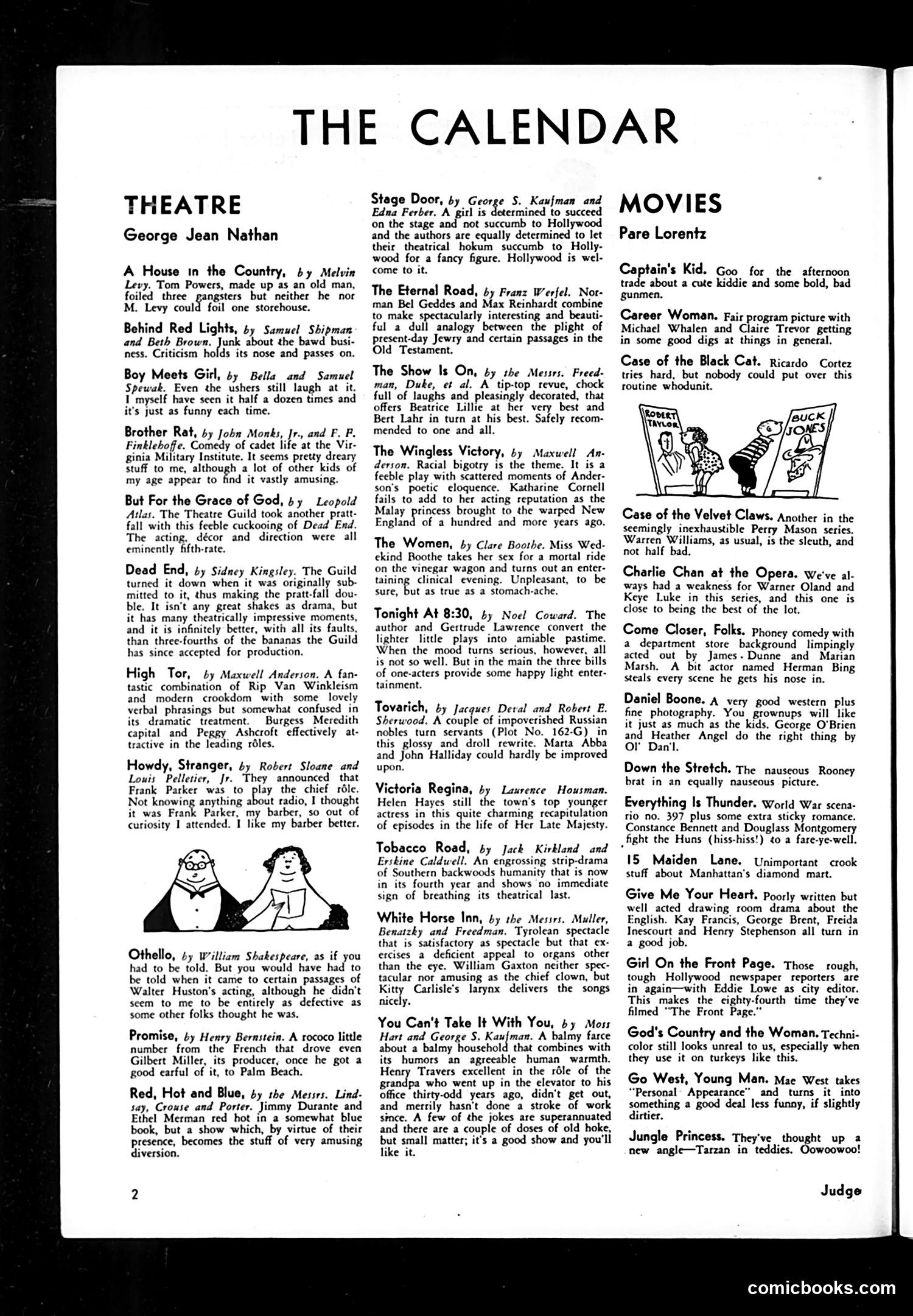
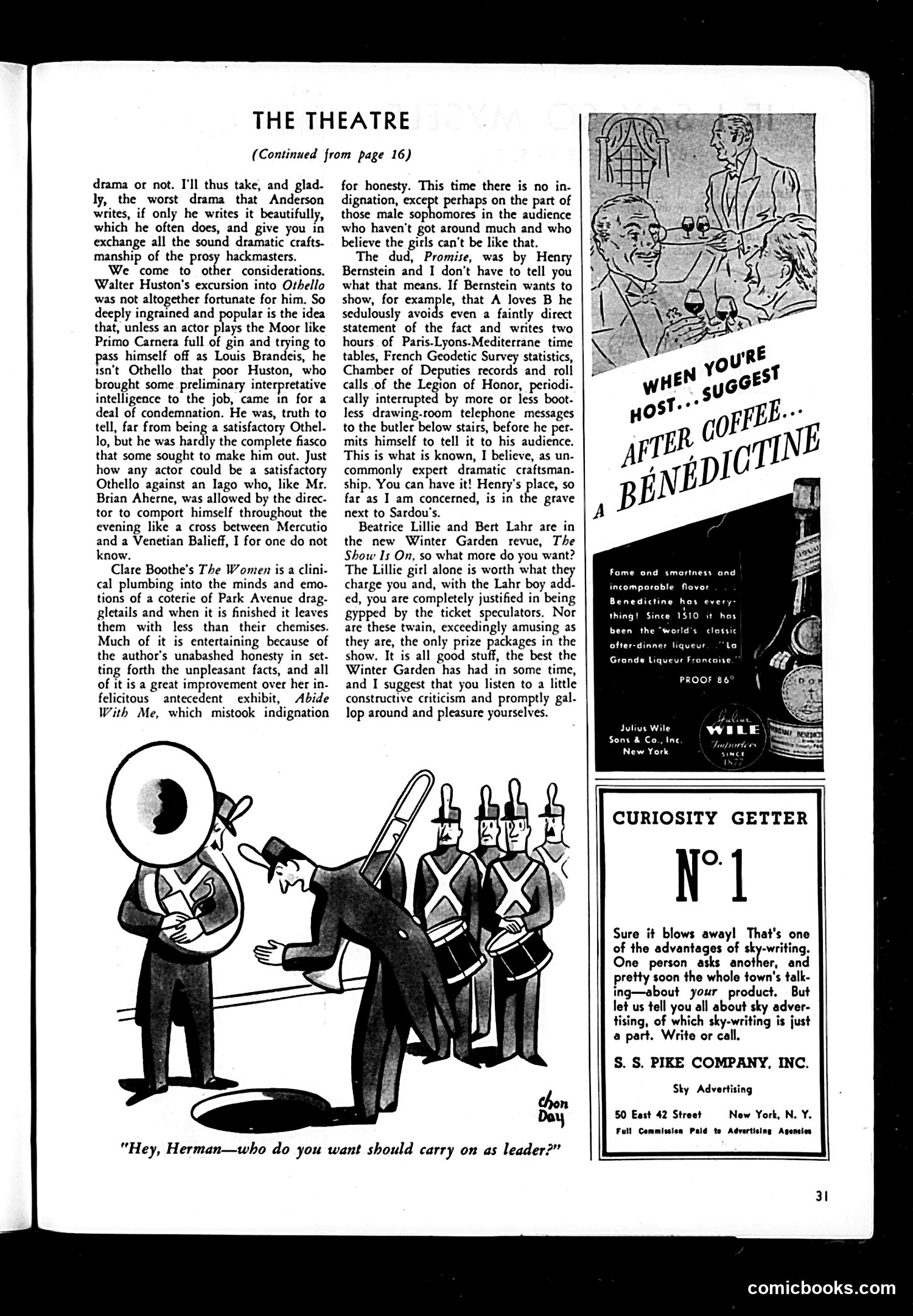
# "The Calendar" Page Analysis This page from Judge magazine presents theater and movie reviews rather than political satire. The content includes critiques of Broadway plays (like Shakespeare's *Othello* and *Promise*) and Hollywood films (ranging from *Captain's Kid* to *Jungle Princess*). Two small cartoon illustrations appear: one showing two rotund figures in what appears to be a humorous domestic scene, and another depicting a woman reading while a man gestures—likely illustrating comedic situations referenced in the reviews. The reviews themselves use satirical commentary typical of Judge's style, offering witty critiques of performances and plots. Rather than political commentary, the satire targets theatrical and cinematic quality, performers' abilities, and plot devices—standard entertainment criticism of the era.
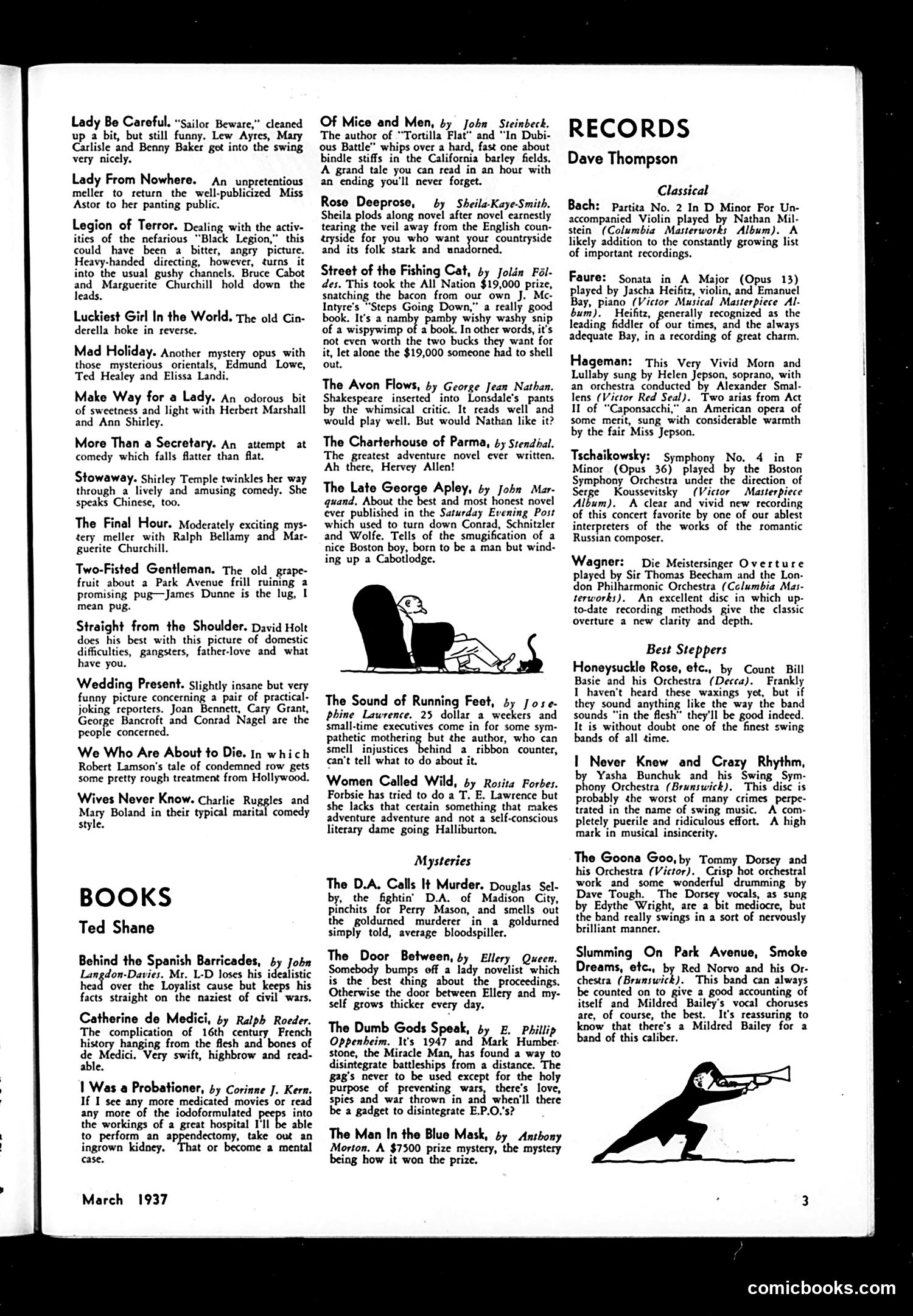
# Analysis of Judge Magazine, March 1937 This page is primarily a **book and music review section** rather than political satire. It contains critical reviews of contemporary novels, mysteries, and classical music recordings by critics including Dave Thompson. The page includes two small **cartoon illustrations**: one showing a figure in a chair with what appears to be a cat or small animal, and another at the bottom right depicting a stylized figure in a dynamic pose. However, these illustrations lack sufficient detail or context in the image to identify specific caricatures or political references. The content focuses on entertainment criticism—discussing works by authors like John Steinbeck and George Jean Nathan—reflecting Judge's role as a general-interest satirical magazine covering culture and entertainment alongside political commentary. Without clearer cartoon imagery or accompanying political headlines, the satirical intent of these illustrations remains unclear.
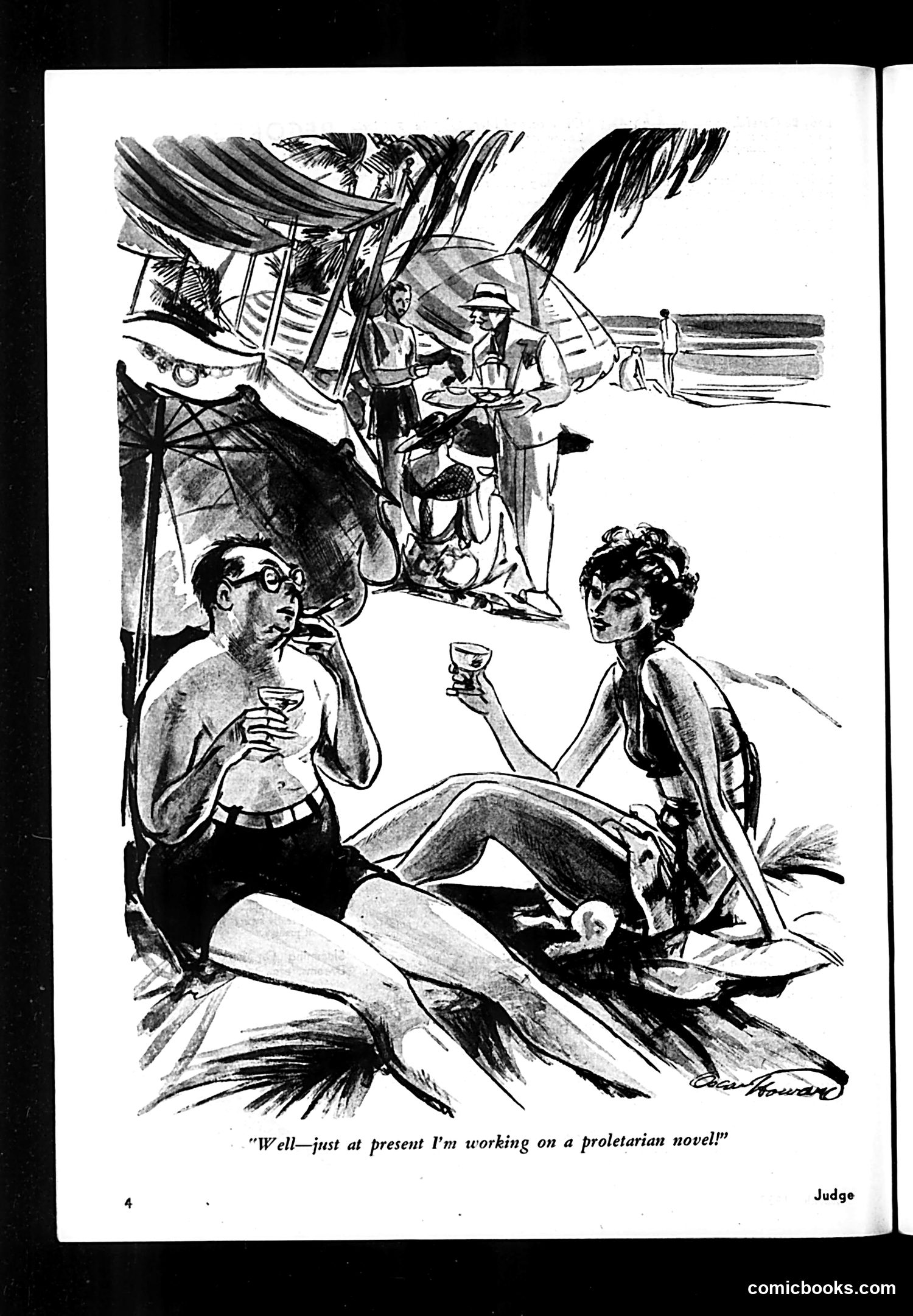
# Analysis of Judge Magazine Cartoon This cartoon satirizes intellectual pretension during what appears to be the interwar period. Two sunbathers at a tropical beach are having drinks when one claims to be "working on a proletarian novel." The humor targets writers who adopted radical, working-class literary themes while enjoying leisurely, bourgeois lifestyles—lounging in paradise rather than actually experiencing proletarian life. The contrast between the speaker's claim of writing about the working class and his obvious wealth and leisure exemplifies hypocrisy common among intellectuals of that era. The tropical resort setting with servants in the background reinforces this irony. "Judge" magazine frequently mocked such pretension among the cultural elite who romanticized socialism while maintaining comfortable, privileged existences.
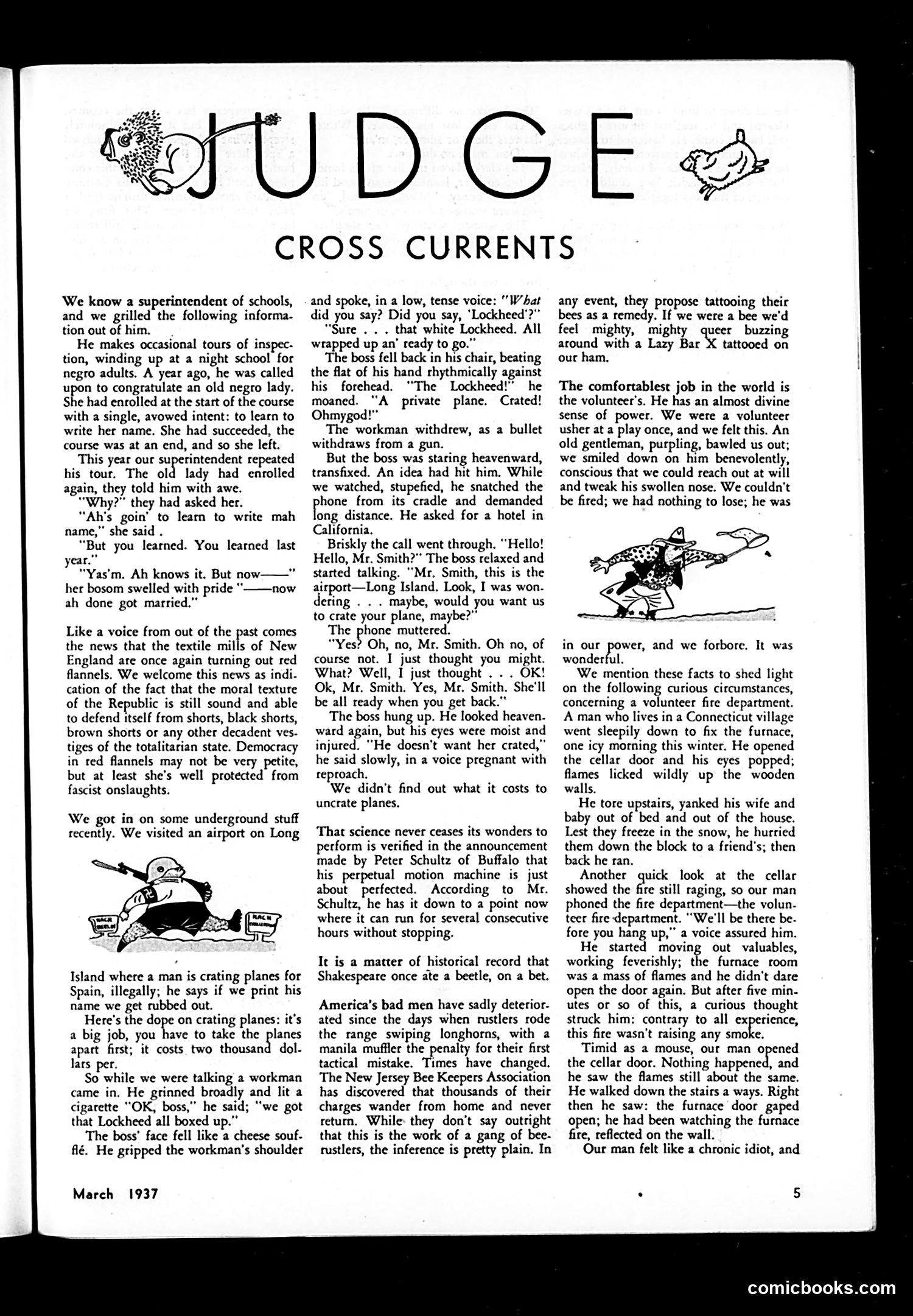
# Judge Magazine "Cross Currents" - March 1937 This satirical column discusses several contemporary issues through anecdotes: 1. **School segregation**: A superintendent's tour of a "negro school" is criticized implicitly through the narrative's matter-of-fact tone about racial divisions in education. 2. **Aviation/Lockheed plane incident**: A humorous story about a workman's encounter with a boss and a plane called "Lockheed," likely referencing the growing aviation industry and class tensions between management and workers. 3. **Perpetual motion machine**: A satirical jab at Peter Schultz of Buffalo's claims about a perpetual motion device—mocking pseudoscientific claims popular during the Depression era. 4. **Labor issues**: References to bee-keeping as a remedy and New Jersey Bee Keepers Association discovering charges on beekeepers suggest labor organizing and worker grievances of the 1930s. The overall tone mocks bureaucratic absurdity and dubious claims of the era.
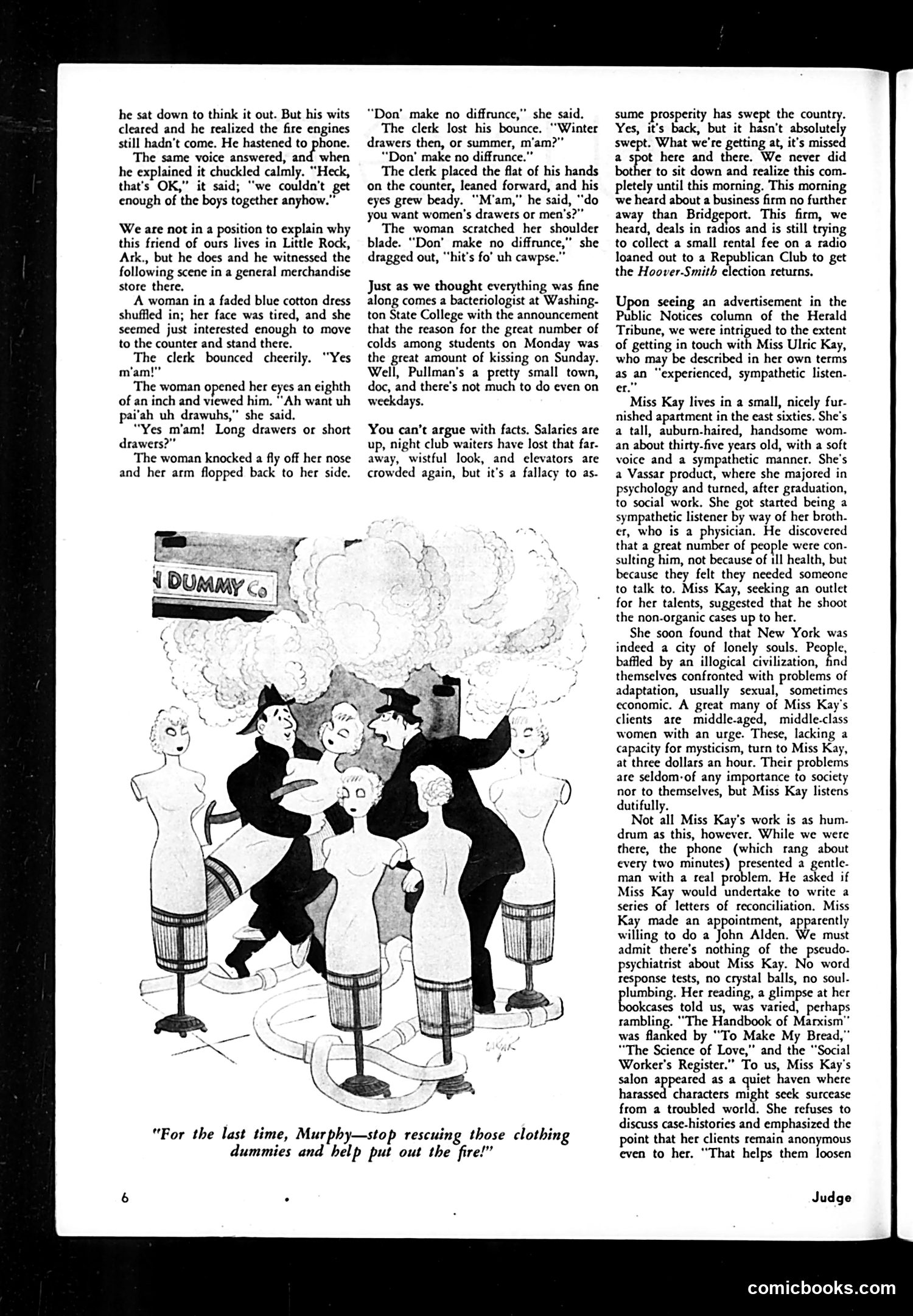
# Analysis of Judge Magazine Page This page satirizes the New York social services sector, specifically critiquing "Miss Kay," a sympathetic listener who runs a salon addressing clients' emotional and personal problems. The text describes her practice as quasi-therapeutic work—helping middle-class, middle-aged women with relationship issues for three dollars per hour. The cartoon illustrates the absurdity: suited men frantically rescue clothed department store mannequins from a fire labeled "DUMMY CO." The visual pun equates Miss Kay's clients with dummies—suggesting her counsel is directed at superficial or intellectually empty people seeking validation rather than genuine psychiatric help. The satire mocks both the clients and the pseudo-psychological counseling trend itself as frivolous urban pretension.
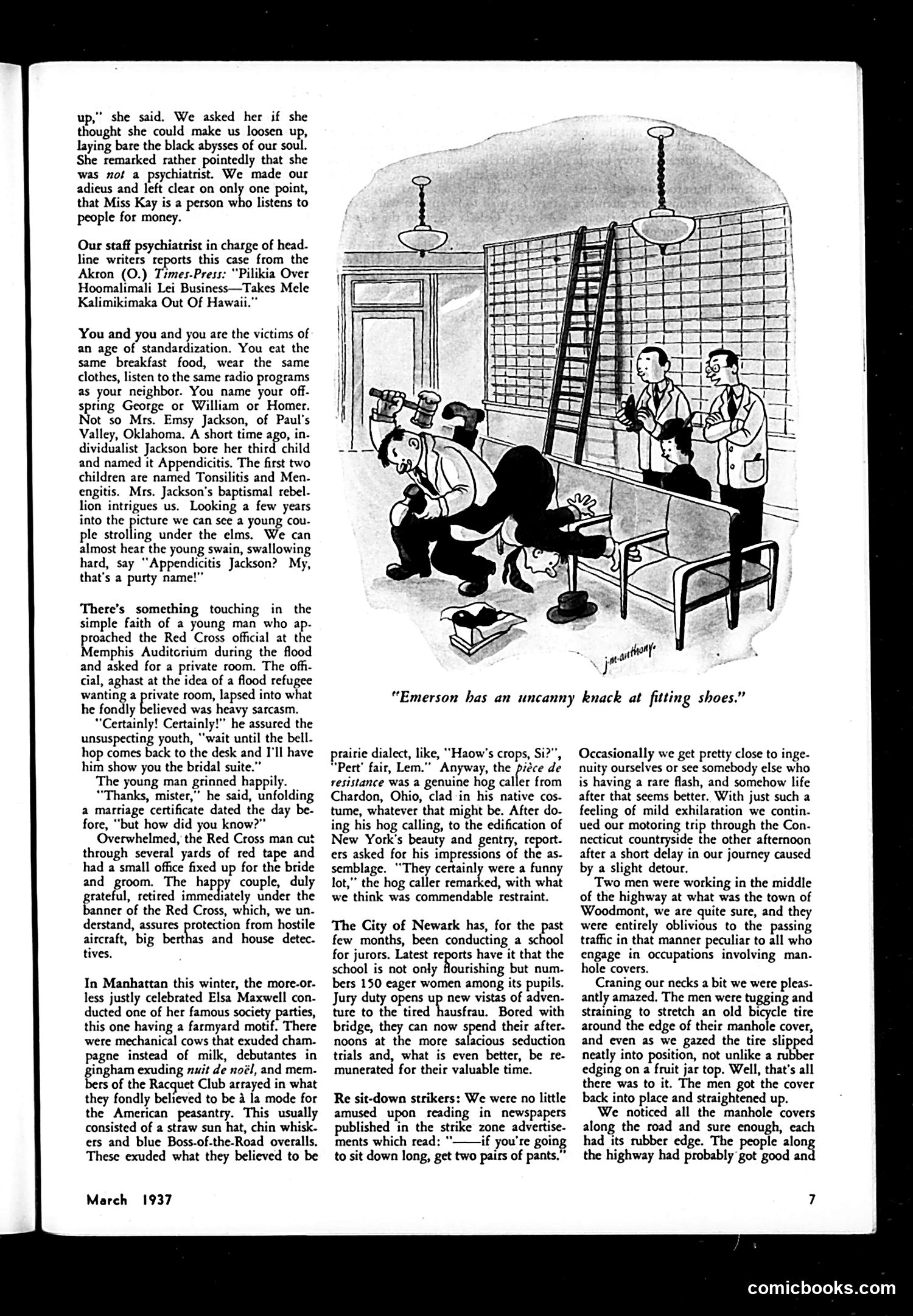
# Analysis of Judge Magazine Page (March 1937) The main cartoon depicts men in suits examining shoes, captioned "Emerson has an uncanny knack at fitting shoes." This appears to be workplace satire about a shoe-fitting expert or salesman. The surrounding text discusses various social observations from 1937: standardization of American life (identical breakfasts, clothes, radio programs), a Red Cross official's heavy sarcasm during Memphis flood relief, and a Newark school conducting sit-down strikes among its female students. The page satirizes mid-Depression era social conformity and labor unrest. References to "sit-down strikers" and mentions of "pants" suggest commentary on contemporary labor disputes. The tone is gently mocking of American mass culture and workplace absurdities rather than sharply political. Without clearer context, the specific "Emerson" reference remains unclear.
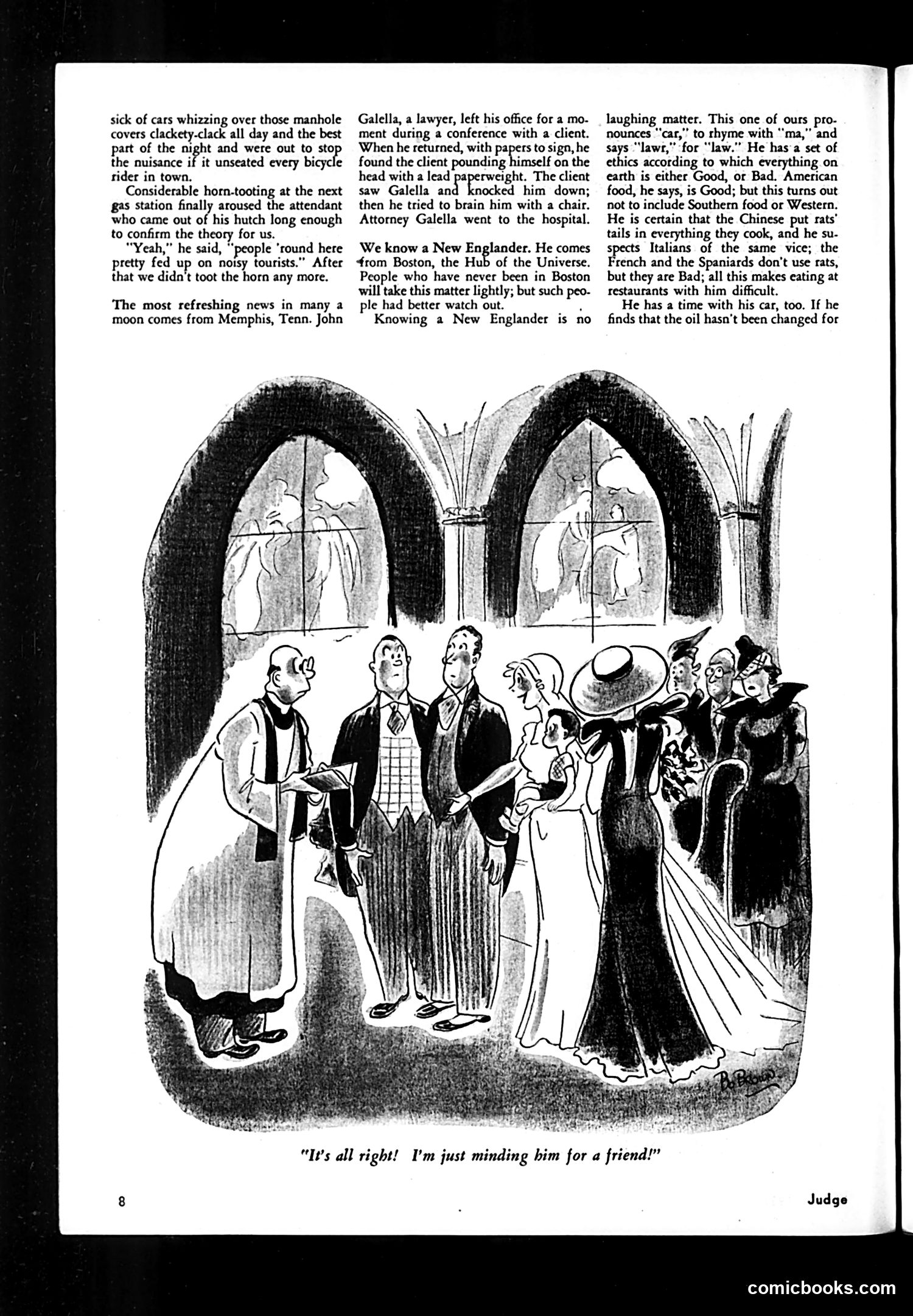
# Cartoon Analysis This is a single-panel cartoon from Judge magazine depicting a scene inside a church or cathedral (indicated by the Gothic arches). A woman in an elegant dress is introducing a disheveled, poorly-dressed man to other well-dressed parishioners, with the caption: "It's all right! I'm just minding him for a friend!" **The satire**: The joke plays on class distinctions and social embarrassment. The woman is attempting to excuse the man's obviously unsuitable appearance and presence among the church's respectable attendees by claiming temporary responsibility—implying she's merely "babysitting" him rather than that he actually belongs in such refined company. The humor derives from the awkwardness of bringing an underdressed person into an exclusive social setting, and the woman's somewhat defensive explanation that reveals her awareness of the social impropriety. It satirizes both class consciousness and the sometimes absurd social conventions of the era that Judge's readers would have recognized.
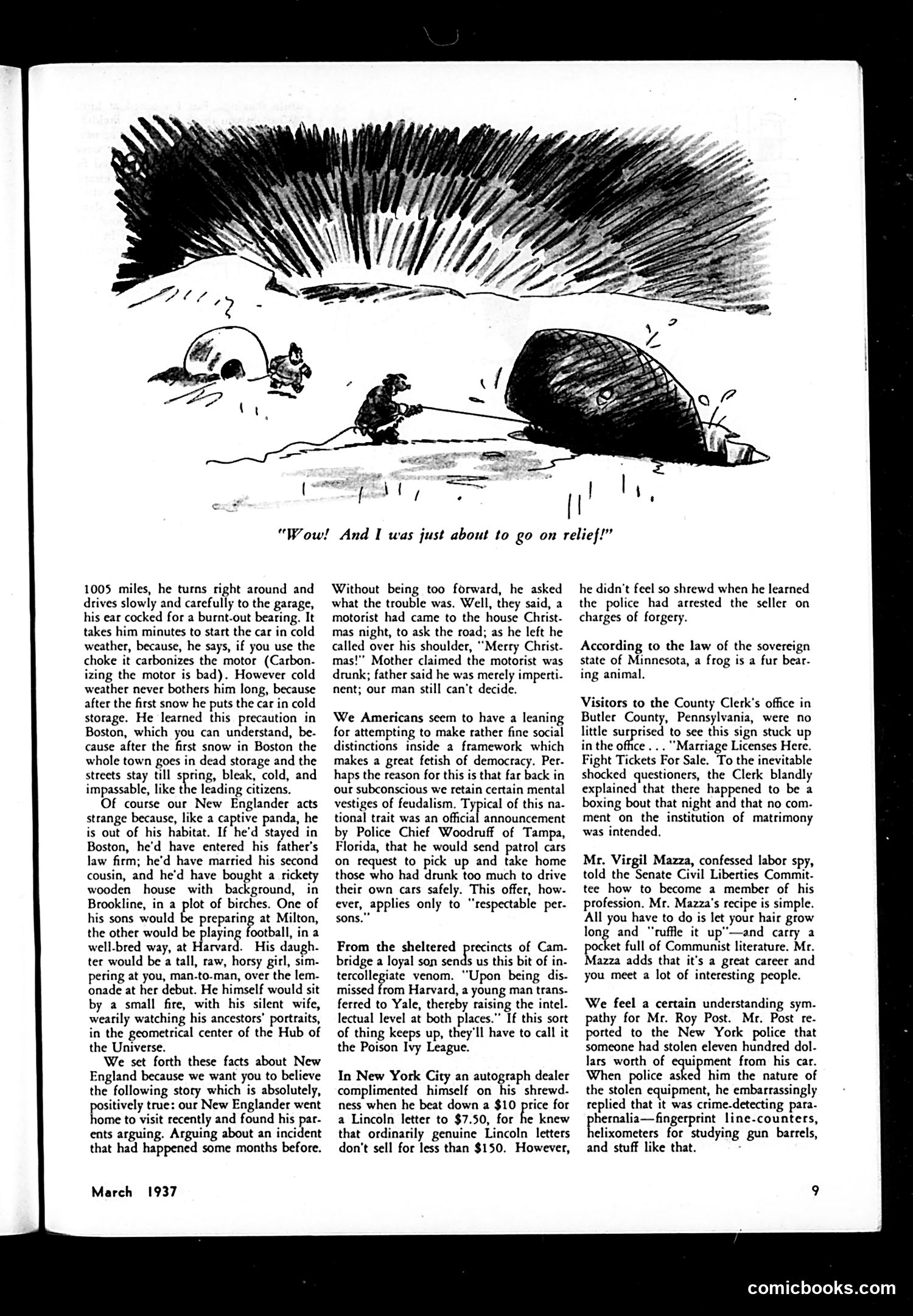
# Cartoon Analysis: Judge Magazine, March 1937 **The Main Cartoon** depicts a small figure being pulled by an enormous beetle or insect, with the caption "Wow! And I was just about to go on relief!" The joke references the Great Depression context (1937). The figure expects hardship and government relief assistance, but instead gets absurdly yanked away by this creature—suggesting life's unpredictable interruptions supersede even unemployment worries. It's dark Depression-era humor. **The Surrounding Text** consists of satirical anecdotes mocking American social pretensions: - A New England family argues for months over whether a holiday visitor was merely "impertinent" versus "drunk"—conflating class distinctions with sobriety judgments - Tampa police offer drunk-driving assistance only to "respectable persons"—highlighting hypocritical class-based "democracy" - A Yale/Harvard rivalry joke about intellectual levels - An autograph dealer conned into buying a forged Lincoln letter The overall theme critiques how Americans maintain feudal-style class consciousness while professing democratic values—a pointed 1930s social observation.
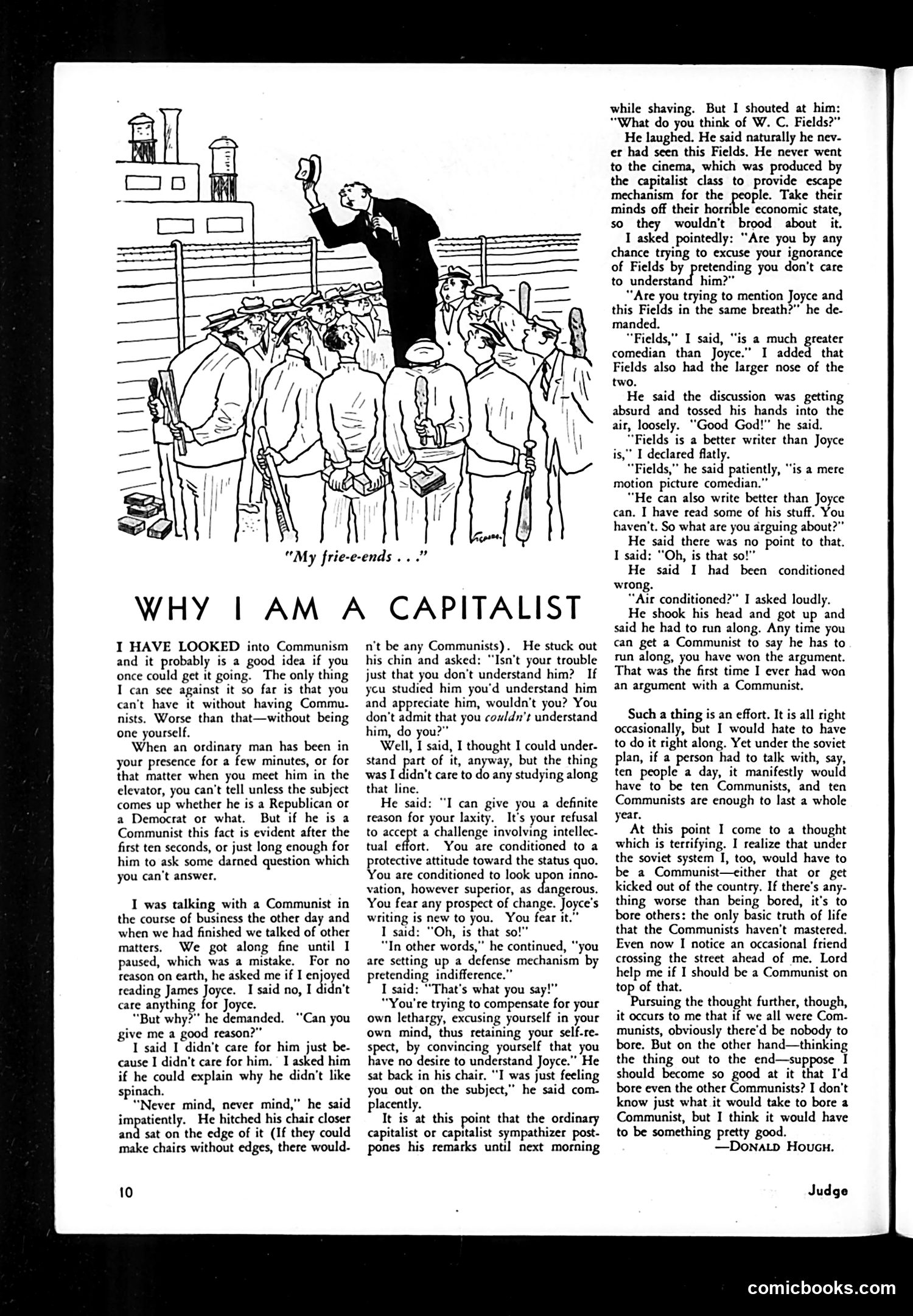
# What This Page Means This is a satirical essay by Donald Hough mocking Communist ideology and arguing for capitalism—presented as humor in Judge magazine. The cartoon shows a Communist speaker addressing a crowd with missionary zeal. The essay describes the author's encounter with an aggressive Communist acquaintance who interrogates him about not liking James Joyce, insisting his disinterest stems from capitalist conditioning and fear of intellectual challenge. The satire's point: Communists are portrayed as obnoxiously dogmatic, using pseudo-intellectual arguments to browbeat ordinary people. They demand constant ideological justification while refusing to engage honestly. The author's punchline—turning the Communist's own logic against him by questioning his ignorance of comedian W.C. Fields—exposes the hypocrisy and exhausting pedantry of Communist discourse. The essay argues capitalism, despite its flaws, is preferable to communism because it allows people to simply *exist* without constant ideological performance.