
Judge, 1937-03 · page 5 of 37
Judge — March 1937 — page 5: what you’re looking at
What you’re looking at
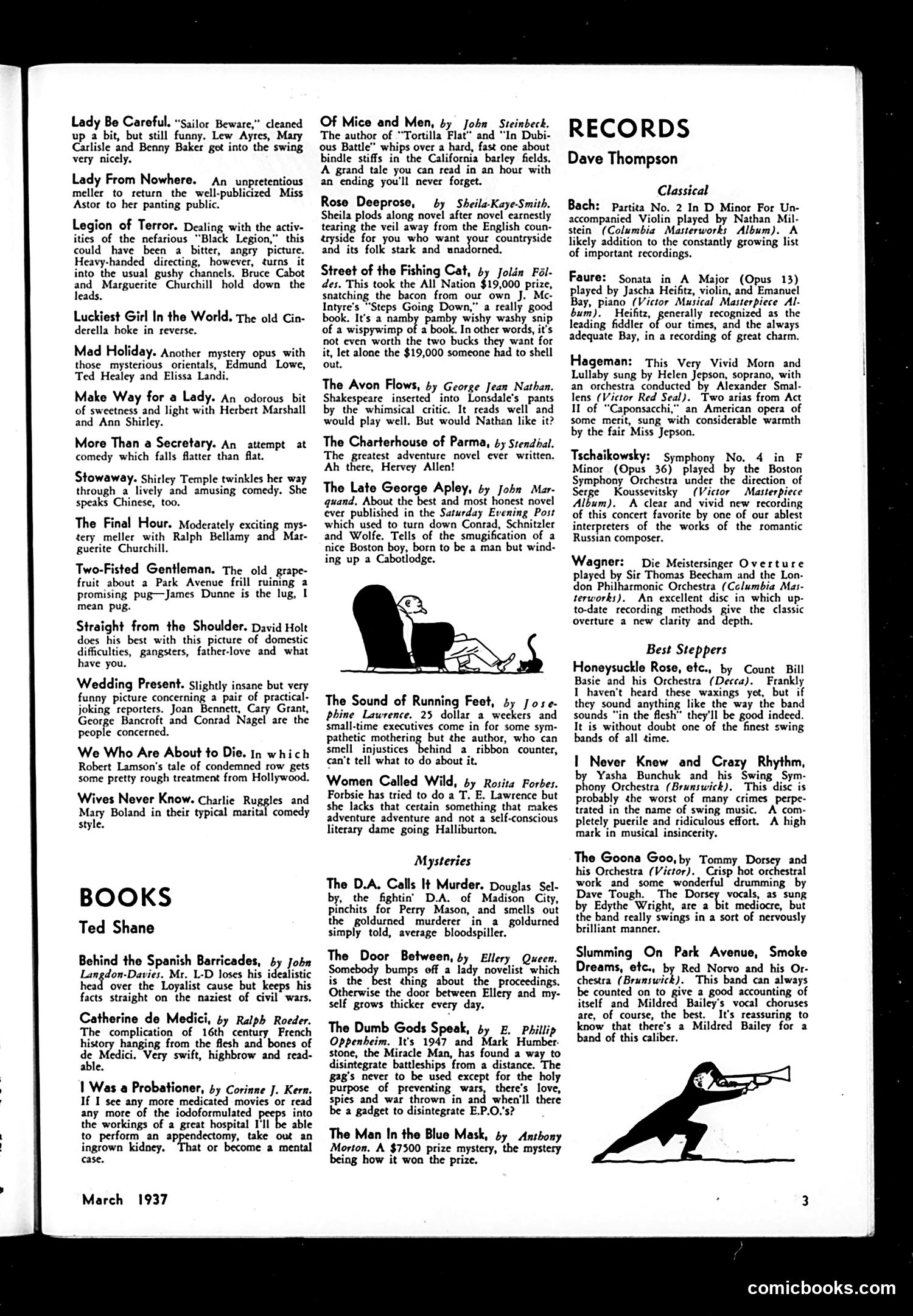
# Analysis of Judge Magazine, March 1937 This page is primarily a **book and music review section** rather than political satire. It contains critical reviews of contemporary novels, mysteries, and classical music recordings by critics including Dave Thompson. The page includes two small **cartoon illustrations**: one showing a figure in a chair with what appears to be a cat or small animal, and another at the bottom right depicting a stylized figure in a dynamic pose. However, these illustrations lack sufficient detail or context in the image to identify specific caricatures or political references. The content focuses on entertainment criticism—discussing works by authors like John Steinbeck and George Jean Nathan—reflecting Judge's role as a general-interest satirical magazine covering culture and entertainment alongside political commentary. Without clearer cartoon imagery or accompanying political headlines, the satirical intent of these illustrations remains unclear.
📄 Transcribed text from this page (OCR, searchable)
Machine-transcribed from the original scan — historical spelling and the odd misread are preserved.
Lady Be Careful. “sailor Beware,” cleaned up a bit, but still funny. Lew Ayres, Mary Carlisle and Benny Baker got into the swing very nicely. Lady From Nowhere. An unpretentious meller to return the well-publicized Miss Astor to her panting public, Legion of Terror. Dealing with the activ- ities of the nefarious “Black Legion,” this could have been a bitter, angry picture. Heavy-handed directing, however, turns it into the usual gushy channels. Bruce Cabot god Marguerite Churchill hold down the leads, Luckiest Girl In the World. The old Cin- derella hoke in reverse. Mad Holiday. Another mystery opus with those mysterious orientals, Edmund Lowe, Ted Healey and Elissa Landi. Make Way for a Lady. An odorous bit of sweetness and light with Herbert Marshall and Ann Shirley. More Than a Secretary. An attempt at comedy which falls flatter than flat. Stowaway. Shirley Temple twinkles her way through a lively and amusing comedy. She speaks Chinese, too. The Final Hour. Moderately exciting mys- tery meller with Ralph Bellamy and Mar- guerite Churchill. Two-Fisted Gentleman. The old grape- fruit about a Park Avenue frill ruining a promising pug—James Dunne is the lug, I mean pug. Straight from the Shoulder. David Holt does his best with this picture of domestic difficulties, gangsters, father-love and what have you. Wedding Present. slightly insane but very funny picture concerning a pair of practical- joking reporters. Joan Bennett, Cary Grant, George Bancroft and Conrad Nagel are the people concerned. We Who Are About to Die. In which Robert Lamson’s tale of condemned row gets some pretty rough treatment from Hollywood. Wives Never Know. Charlie Ruggles and Mary Boland in their typical marital comedy style, BOOKS Ted Shane Behind the Spanish Barricades, by Jobn Langdon-Davies. Mr. L-D loses his idealistic head over the Loyalist cause but keeps his facts straight on the naziest of civil wars. Catherine de Medici, by Ralph Roeder. The complication of 16th century French history hanging from the flesh and bones of de Medici. ‘Very swift, highbrow and read- able. | Was a Probationer, by Corinne J. Kern. If I see any more medicated movies or read any more of the iodoformulated s into the workings of a great hospital I'll be able to perform an appendectomy, take out an ingrown kidney. it or become a mental case. March 1937 Of Mice and Men, ty John Steinbeck. The author of “Tortilla Flat” and “In Dubi- ous Battle” whips over a hard, fast one about bindle stiffs in the California barley fields. A grand tale you can read in an hour with an ending you'll never forget. Rose Deeprose, by Sheila-Kaye-Smith. Sheila plods along novel after novel earnestly tearing the veil away from the English coun- tryside for you who want your countryside and its folk stark and unadorned. Street of the Fishing Cat, by Jolin Fal- des. This took the All Nation 419,000 prize, snatching the bacon from our own J. Mc- Intyre's “Steps Going Down,” a really good book. It's a namby pamby wishy washy snip of a wispywimp be book. In other words, it’s not even worth the two bucks they want for it, let alone the $19,000 someone had to shell out. The Avon Flows, by George Jean Nathan. Shakespeare inserted into Lonsdale’s pants by the whimsical critic. It reads well and would play well. But would Nathan like it? The Charterhouse of Parma, by Stendial. The greatest adventure novel ever written. Ah there, Hervey Allen! The Late George Apley, by john Mar- quand, About the best and most honest novel ever published in the Saturday Evening Post which used to turn down Conrad, Schnitzler and Wolfe. Tells of the smugification of a nice Boston boy, born to be a man but wind- ing up a Cabotlodge. The Sound of Running Feet, by Jose- phine Lawrence. 25 dollar a weekers and small-time executives come in for some sym- pathetic mothering but the author, who can smell injustices behind a ribbon counter, can't tell what to do about it. Women Called Wild, by Rosita Forbes. Forbsie has tried to do a T. E. Lawrence but she lacks that certain something that makes adventure adventure and not a self-conscious literary dame going Halliburton. Mysteries The D.A. Calls It Murder. Douglas Sel- by, the fightin’ D.A. of Madison City, pinchits for Perry Mason, and smells out the goldurned murderer in a goldurned simply told, average bloodspiller. The Door Between, by Ellery Queen. Somebody bumps off a lady novelist which is the t thing about the proceedings. Otherwise the door between Ellery and my- self grows thicker every day. The Dumb Gods Speak, sy £. Phillip Oppenheim. It's 1947 and Mark Humber: stone, the Miracle Man, has found a way to disintegrate battleships from a distance. The Bag’s never to be used except for the holy purpose of preventing wars, there's love, spies and war thrown in and when'll there be a gadget to disintegrate E.P.O.’s? The Man In the Blue Mask, sy Anthony Morton. A $7500 prize mystery, the mystery being how it won the prize. RECORDS Dave Thompson Classical Bach: Partita No. 2 In D Minor For Un- accompanied Violin played by Nathan Mil- stein (Columbia Masterworks Album). A likely addition to the constantly growing list of important recordings. Faure: Sonata in A Major (Opus 13) played by Jascha Heifitz, violin, and Emanuel Bay, piano (Victor Musical Masterpiece Al- bum). Heifitz, generally recognized as the leading fiddler Sf our times, and the always adequate Bay, in a recording of great charm. Hageman: This Very Vivid Morn and Lullaby sung by Helen Jepson, soprano, with an orchestra conducted by Alexander Smal- lens (Victor Red Seal). Two arias from Act Il of “Caponsacchi,” an American opera of some merit, sung with considerable warmth by the fair Miss Jepson. Tschaikowsky: Symphony No. 4 in F Minor (Opus 36) played by the Boston Symphony Orchestra under the direction of Ser, Koussevitsky (Victor Masterpiece Album). A clear and vivid new recording of this concert favorite by one of our ablest interpreters of the works of the romantic Russian composer. Wagner: Die Meistersinger Overture played by Sir Thomas Beecham and the Lon- don Philharmonic Orchestra (Columbia Mas- terworks). An excellent disc in which up- to-date recording methods give the classic overture a new clarity and depth. Best Steppers Honeysuckle Rose, etc., by Count Bill Basie and his Orchestra (Decca). Frankly I haven't heard these waxings yet, but if they sound anything like the way the band sounds “in the flesh” they'll be good indeed. It is without doubt one of the finest swing bands of all time. | Never Knew and Crazy Rhythm, by Yasha Bunchuk and his Swing Sym- phony Orchestra (Brunswick). This disc is probably the worst of many crimes perpe- trated in the name of swing music. A com- pletely puerile and ridiculous effort. A high mark in musical insincerity. The Goona Goo, by Tommy Dorsey and his Orchestra (Victor). Crisp hot orchestral work and some wonderful drumming by Dave Tough. The Do: vocals, as sung by Edythe Wright, are a bit mediocre, but the band really swings in a sort of nervously brilliant manner. Slumming On Park Avenue, Smoke Dreams, etc., by Red Norvo and his Or- chestra (Brunswick). This band can always be counted on to ai a good accounting of itself and Mildred Bailey's vocal choruses are, of course, the best. It's reassuring to know that there's a Mildred Bailey for a band of this caliber. comicbooks.com