
Judge, 1937-03 · page 20 of 37
Judge — March 1937 — page 20: what you’re looking at
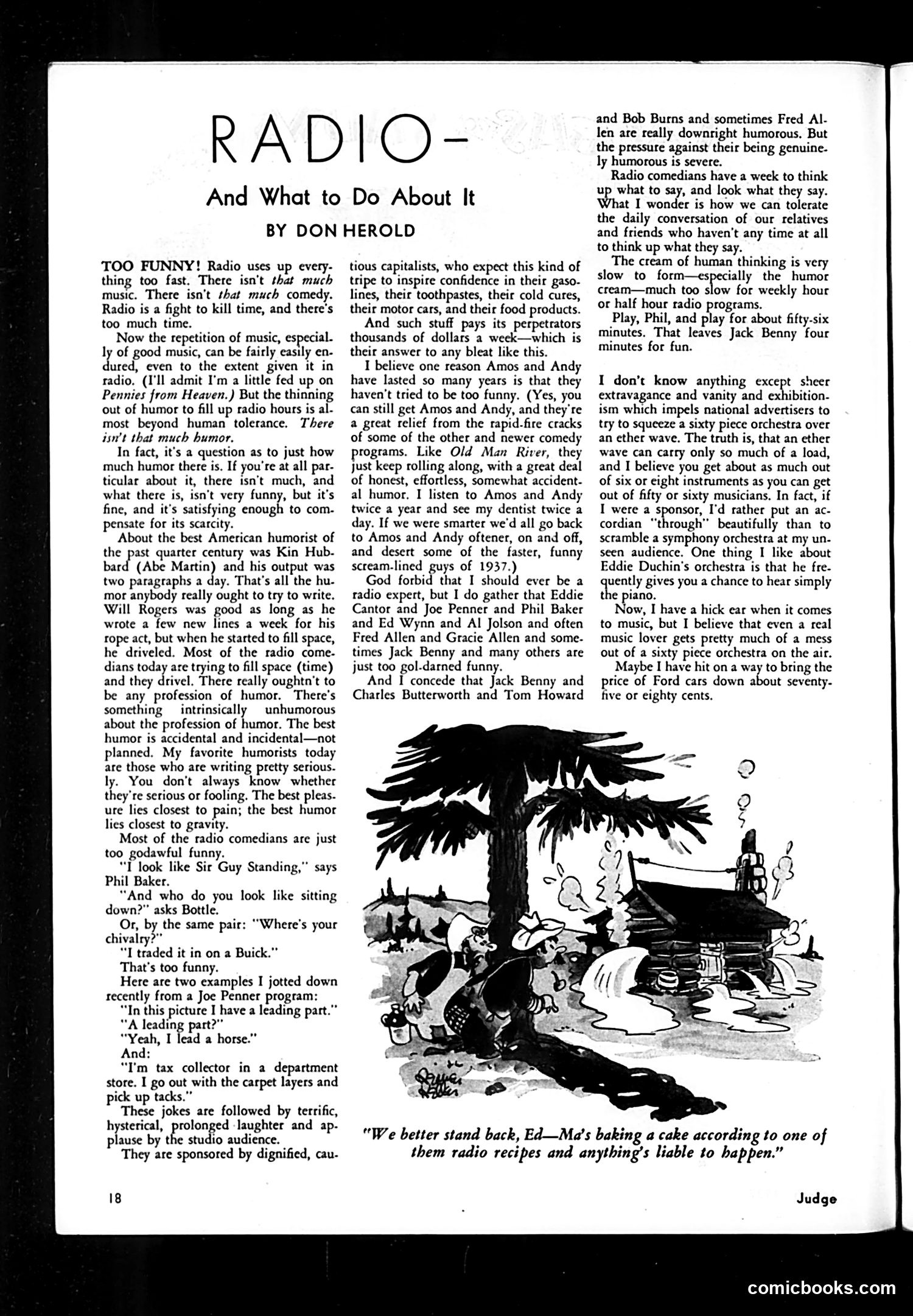
A restored page from Judge, 1937-03. Page through the whole issue in the reader above.
📄 Transcribed text from this page (OCR, searchable)
Machine-transcribed from the original scan — historical spelling and the odd misread are preserved.
RADIO- And What to Do About It BY DON HEROLD TOO FUNNY! Radio uses up every- thing too fast, There isn't that much music. There isn't that much comedy. Radio is a fight to kill time, and there's too much time. Now the repetition of music, especial. ly of good music, can be fairly easily en- dined even to the extent given it in radio. (I'll admit I'm a little fed up on Pennies from Heaven.) But the thinning out of humor to fill up radio hours is al- most beyond human tolerance. There isn’t that much humor. In fact, it's a question as to just how much humor there is. If you're at all par- ticular about it, there isn’t much, and what there is, isn't very funny, but it’s fine, and it’s satisfying enough to com. ensate for its scarcity. About the best American humorist of he pe quarter century was Kin Hub- bard (Abe Martin) and his output was two paragraphs a day. That's all the hu- mor anybody really ought to try to write. Will Rogers was good as long as he wrote a few new lines a week for his rope act, but when he started to fill space, he driveled. Most of the radio come- dians today are trying to fill space (time) and they drivel. There really oughtn’t to be any profession of humor. There's something intrinsically | unhumorous about the profession of humor. The best humor is accidental and incidental—not planned. My favorite humorists today are those who are writing pretty serious. ly. You don’t always know whether they're serious or fooling. The best pleas. ure lies closest to pain; the best humor lies closest to gravity. Most of the radio comedians are just too godawful funny. “IT look like Sir Guy Standing,” says Phil Baker. “And who do you look like sitting down?” asks Bottle. Or, by the same pair: “Where's your chivalry?” “I traded it in on a Buick.” That's too funny. Here are two examples I jotted down recently from a Joe Penner program: “In this picture I have a leading part.” “A leading part?” “Yeah, I lead a horse.” And: “I'm tax collector in a department store. I go out with the carpet layers and pick up tacks.” These jokes are followed by terrific, hysterical, proton ed laughter and ap. plause by the studio audience. They are sponsored by dignified, cau- 18 tious capitalists, who expect this kind of tripe to inspire confidence in their gaso- lines, their toothpastes, their cold cures, their motor cars, and their food products. And such stuff pays its perpetrators thousands of dollars a week—which is their answer to any bleat like this. I believe one reason Amos and Andy have lasted so many years is that they haven't tried to be too funny. (Yes, you can still get Amos and Andy, and they're a great relief from the rapid-fire cracks of some of the other and newer comedy programs. Like Old Man River, they just keep rolling along, with a great deal of honest, effortless, somewhat accident- al humor. I listen to Amos and Andy twice a year and see my dentist twice a day. If we were smarter we'd all go back to Amos and Andy oftener, on and off, and desert some of the faster, funny scream-lined guys of 1937.) God forbid that I should ever be a radio expert, but I do gather that Eddie Cantor and Joe Penner and Phil Baker and Ed Wynn and Al Jolson and often Fred Allen and Gracie Allen and some- times Jack Benny and many others are just too gol-darned funny. And I concede that Jack Benny and Charles Butterworth and Tom Howard and Bob Burns and sometimes Fred Al- len are really downright humorous. But the pressure against their being genuine. ly humorous is severe. Radio comedians have a week to think what to say, and look what they say. it I wonder is how we can tolerate the daily conversation of our relatives and friends who haven't any time at all to think up what they say. The cream of human thinking is very slow to form—especially the humor cream—much too slow for weekly hour or half hour radio programs. Play, Phil, and play for about fifty-six minutes, That leaves Jack Benny four minutes for fun. I don’t know anything except sheer extravagance and vanity and exhibition. ism which impels national advertisers to try to squeeze a sixty piece orchestra over an ether wave. The truth is, that an ether wave can carry only so much of a load, and I believe you get about as much out of six or eight instruments as you can get out of fifty or sixty musicians, In fact, if I were a sponsor, I'd rather put an ac- cordian “through” beautifully than to scramble a symphony orchestra at my un- seen audience. One thing I like about Eddie Duchin’s orchestra is that he fre- uently gives you a chance to hear simply the piano. Now, I have a hick ear when it comes to music, but I believe that even a real music lover gets pretty much of a mess out of a sixty piece orchestra on the air. Maybe I have hit on a way to bring the price of Ford cars down about seventy- five or eighty cents. "We better stand back, Ed—Ma's baking a cake according to one of them radio recipes and anything's liable to happen.” Judge comicbooks.com