
Judge, 1937-03 · page 8 of 37
Judge — March 1937 — page 8: what you’re looking at
What you’re looking at
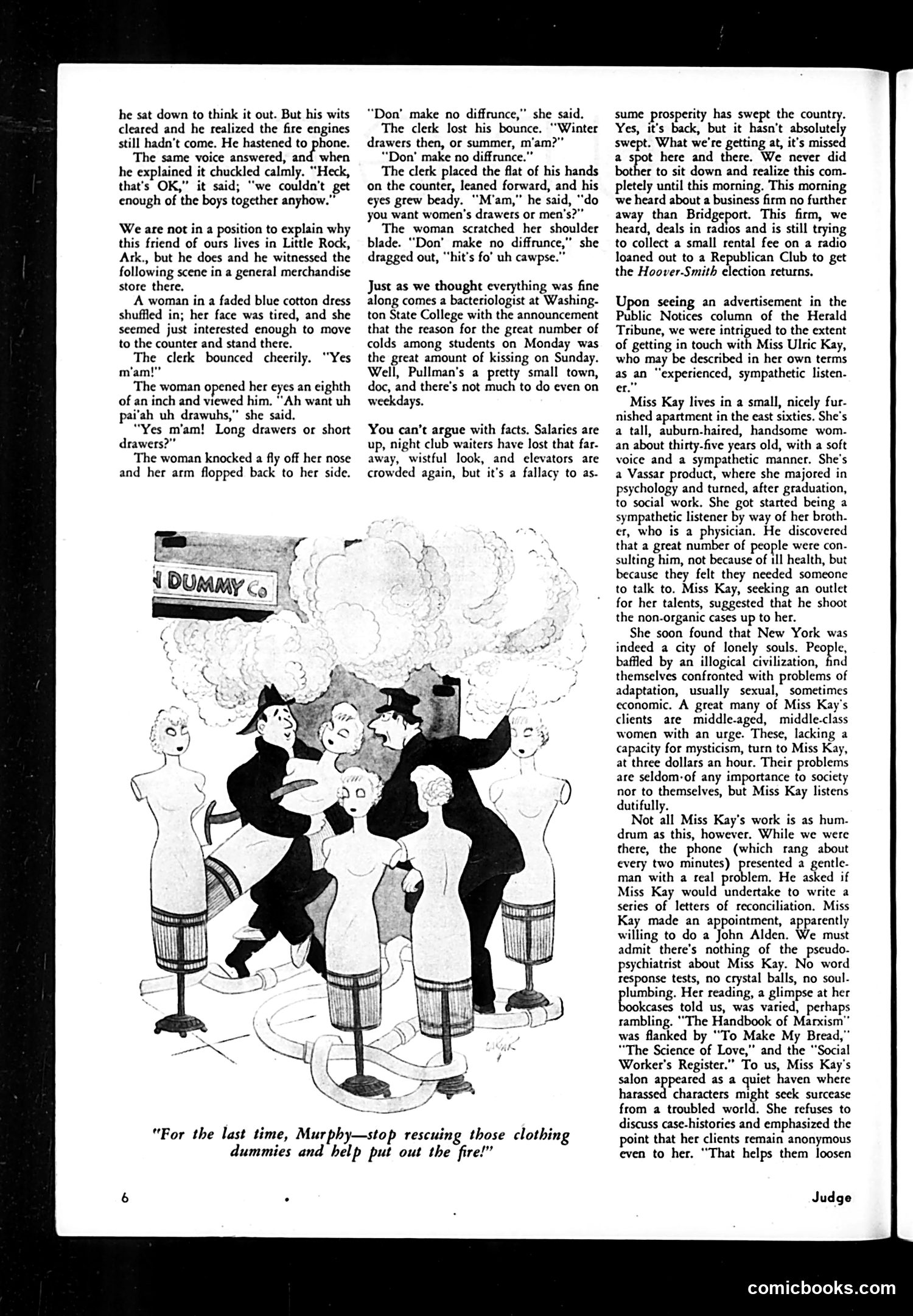
# Analysis of Judge Magazine Page This page satirizes the New York social services sector, specifically critiquing "Miss Kay," a sympathetic listener who runs a salon addressing clients' emotional and personal problems. The text describes her practice as quasi-therapeutic work—helping middle-class, middle-aged women with relationship issues for three dollars per hour. The cartoon illustrates the absurdity: suited men frantically rescue clothed department store mannequins from a fire labeled "DUMMY CO." The visual pun equates Miss Kay's clients with dummies—suggesting her counsel is directed at superficial or intellectually empty people seeking validation rather than genuine psychiatric help. The satire mocks both the clients and the pseudo-psychological counseling trend itself as frivolous urban pretension.
📄 Transcribed text from this page (OCR, searchable)
Machine-transcribed from the original scan — historical spelling and the odd misread are preserved.
he sat down to think it out. But his wits cleared and he realized the fire engines still hadn't come. He hastened to phone. The same voice answered, and when he explained it chuckled calmly. “Heck, that's OK,” it said; “we couldn't get enough of the boys together anyhow.” We are not in a position to explain why this friend of ours lives in Little Rock, Ark., but he does and he witnessed the following scene in a general merchandise store there, A woman in a faded blue cotton dress shuffled in; her face was tired, and she seemed just interested enough to move to the counter and stand there. The clerk bounced cheerily. “Yes m’am!” The woman opened her eyes an eighth of an inch and viewed him. “Ah want uh pai’ah uh drawuhs,” she said. “Yes m'am! Long drawers or short drawers?” The woman knocked a fly off her nose and her arm flopped back to her side. “Don’ make no diffrunce,” she said. The clerk lost his bounce. “Winter drawers then, or summer, m'am?” “Don’ make no diffrunce.” The clerk placed the flat of his hands on the counter, leaned forward, and his eyes grew beady. “M’am,” he said, “do you want women’s drawers or men’s?” The woman scratched her shoulder blade. “Don’ make no diffrunce,” she dragged out, “hit’s fo’ uh cawpse.”” Just as we thought everything was fine along comes a bacteriologist at Washing- ton State College with the announcement that the reason for the great number of colds among students on Monday was the great amount of kissing on Sunday. Well, Pullman's a pretty small town, doc, and there’s not much to do even on weekdays. You can’t argue with facts. Salaries are up, night club waiters have lost that far- away, wistful look, and elevators are crowded again, but it's a fallacy to as- "For the last time, Murphy—stop rescuing those clothing dummies and help put out the fire!” sume prosperity has swept the country. Yes, it's back, but it hasn’t absolutely swept. What we're getting at, it's missed a spot here and there. We never did bother to sit down and realize this com- pletely until this morning. This morning we heard about a business firm no further away than Bridgeport. This firm, we heard, deals in radios and is still trying to collect a small rental fee on a radio loaned out to a Republican Club to get the Hoover-Smith election returns. Upon seeing an advertisement in the Public Notices column of the Herald Tribune, we were intrigued to the extent of getting in touch with Miss Ulric Kay, who may be described in her own terms as an “experienced, sympathetic listen- er.” Miss Kay lives in a small, nicely fur- nished apartment in the east sixties. She's a tall, auburn-haired, handsome wom. an about thirty-five years old, with a soft voice and a sympathetic manner. She's a Vassar product, where she majored in psychology and turned, after graduation, to social work. She got started being a sympathetic listener by way of her broth. er, who is a physician. He discovered that a great number of people were con- sulting him, not because of ill health, but because they felt they needed someone to talk to. Miss Kay, seeking an outlet for her talents, suggested that he shoot the non-organic cases up to her. She soon found that New York was indeed a city of lonely souls. People, baffled by an illogical civilization, find themselves confronted with problems of adaptation, usually sexual, sometimes economic. A great many of Miss Kay's clients are middle-aged, middle-class women with an urge. These, lacking a Capacity for mysticism, turn to Miss Kay, at three dollars an hour. Their problems are seldom-of any importance to society nor to themselves, but Miss Kay listens dutifully. Not all Miss Kay’s work is as hum. drum as this, however. While we were there, the phone (which rang about every two minutes) presented a gentle. man with a real problem. He asked if Miss Kay would undertake to write a series of letters of reconciliation, Miss Kay made an appointment, apparently willing to do a John Alden. We must admit there's nothing of the pseudo. psychiatrist about Miss Kay. No word response tests, no crystal balls, no soul- lumbing. Her reading, a glimpse at her kcases told us, was varied, perhaps rambling. “The Handbook of Marxism” was flanked by ‘To Make My Bread,” “The Science of Love,’ and the “Social Worker's Register.” To us, Miss Kay's salon appeared as a quiet haven where harassed characters might seek surcease from a troubled world. She refuses to discuss case-histories and emphasized the point that her clients remain anonymous even to her. “That helps them loosen Judge comicbooks.com