
Judge, 1937-03 · page 24 of 37
Judge — March 1937 — page 24: what you’re looking at
A restored page from Judge, 1937-03. Page through the whole issue in the reader above.
📄 Transcribed text from this page (OCR, searchable)
Machine-transcribed from the original scan — historical spelling and the odd misread are preserved.
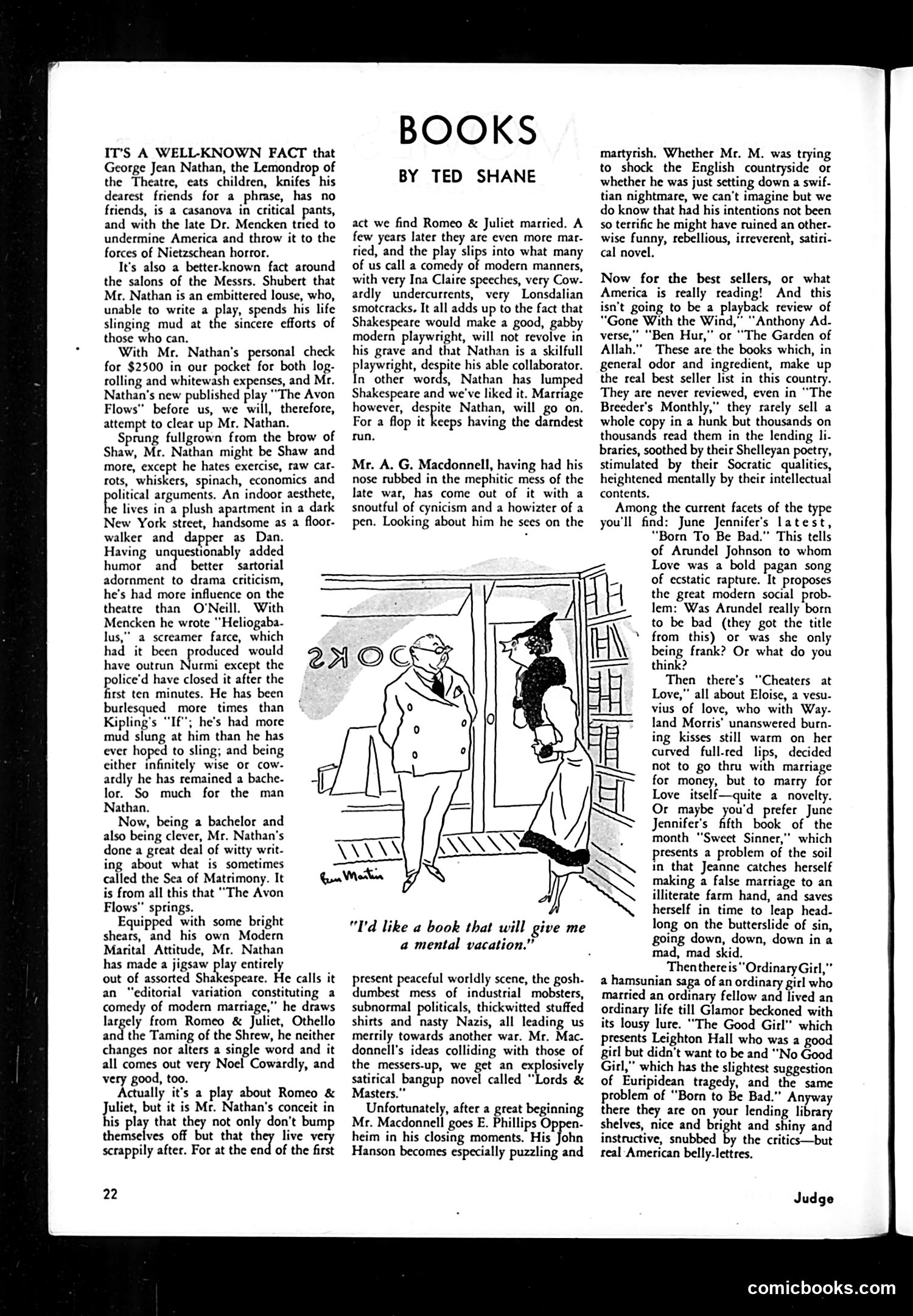
IT’S A WELL-KNOWN FACT that George Jean Nathan, the Lemondrop of the Theatre, eats children, knifes his dearest friends for a phrase, has no friends, is a casanova in critical pants, and with the late Dr. Mencken tried to undermine America and throw it to the forces of Nietzschean horror. It’s also a better-known fact around the salons of the Messrs. Shubert that Mr. Nathan is an embittered louse, who, unable to write a play, spends his life slinging mud at the sincere efforts of those who can, With Mr. Nathan’s personal check for $2500 in our pocket for both log- rolling and whitewash expenses, and Mr. Nathan's new published play “The Avon Flows” before us, we will, therefore, attempt to clear up Mr. Nathan. Sprung fullgrown from the brow of Shaw, Mr. Nathan might be Shaw and more, except he hates exercise, raw car- rots, whiskers, spinach, economics and polineal arguments. An indoor aesthete, he lives in a plush apartment in a dark New York street, handsome as a floor- walker and dapper as Dan. Having unquestionably added humor and_ better sartorial adornment to drama criticism, he's had more influence on the theatre than O'Neill. With Mencken he wrote “Heliogaba- lus,” a screamer farce, which had it been produced would have outrun Nurmi except the police’d have closed it after the first ten minutes. He has been burlesqued more times than Kipling’s “If”; he's had more mud slung at him than he has ever hoped to sling; and being either infinitely wise or cow- ardly he has remained a bache- lor. So much for the man Nathan. Now, being a bachelor and also being clever, Mr. Nathan's done a great deal of witty writ- ing about what is sometimes called the Sea of Matrimony. It is from all this that “The Avon Flows” springs. Equipped with some bright shears, and his own Modern Marital Attitude, Mr. Nathan has made a jigsaw play entirely out of assorted Shakespeare. He calls it an “editorial variation constituting a comedy of modern marriage,” he draws largely from Romeo & Juliet, Othello and the Taming of the Shrew, he neither changes nor alters a single word and it all comes out very Noel Cowardly, and very good, too. Actually it's a play about Romeo & juliet but it is Mr. Nathan's conceit in is play that they not only don't bump themselves off but that t live very scrappily after. For at the end of the first 22 BOOKS BY TED SHANE act we find Romeo & Juliet married. A few years later they are even more mar- ried, and the play slips into what many of us call a comedy of modern manners, with very Ina Claire speeches, very Cow- ardly undercurrents, very Lonsdalian smotcracks, It all adds up to the fact that Shakespeare would make a good, gabby modern playwright, will not revolve in his grave and that Nathan is a skilfull playwright, despite his able collaborator. In other words, Nathan has lumped Shakespeare and we've liked it. Marriage however, despite Nathan, will go on. For a flop it keeps having the darndest run. Mr. A. G. Macdonnell, having had his nose rubbed in the mephitic mess of the late war, has come out of it with a snoutful of cynicism and a howizter of a pen. Looking about him he sees on the Kok? “I'd like a book that will give me a mental vacation.” present peaceful worldly scene, the gosh. dumbest mess of industrial mobsters, subnormal politicals, thickwitted stuffed shirts and nasty Nazis, all leading us merrily towards another war. Mr. Mac- donnell's ideas colliding with those of the messers-up, we get an explosively satirical bangup novel called “Lords & Masters.”” Unfortunately, after a great beginning Mr. Macdonnell goes E. Phillips Oppen- heim in his closing moments. His John Hanson becomes especially puzzling and martyrish, Whether Mr. M. was trying to shock the English countryside or whether he was just setting down a swif- tian nightmare, we can't imagine but we do know that had his intentions not been so terrific he might have ruined an other- wise funny, rebellious, irreverent, satiri- cal novel. Now for the best sellers, or what America is really reading! And this isn't going to be a playback review of “Gone With the Wind,” “Anthony Ad- verse,” “Ben Hur,” or “The Garden of Allah.” These are the books which, in general odor and ingredient, make up the real best seller list in this country. They are never reviewed, even in “The Breeder's Monthly,” they rarely sell a whole copy in a hunk but thousands on thousands read them in the lending li- braries, soothed by their Shelleyan poetry, stimulated by their Socratic qualities, heightened mentally by their intellectual contents. Among the current facets of the type you'll find: June Jennifer's latest, “Born To Be Bad.” This tells of Arundel Johnson to whom Love was a bold pagan song of ecstatic rapture. It proposes the great modern social prob. lem: Was Arundel really born to be bad (they got the title from this) or was she only being frank? Or what do you think? Then there's “Cheaters at Love,” all about Eloise, a vesu- vius of love, who with Way- land Morris’ unanswered burn- ing kisses still warm on her curved full-red lips, decided not to go thru with marriage for money, but to marry for Love itself—quite a novelty. Or maybe you'd prefer June Jennifer's fifth book of the month “Sweet Sinner,” which resents a problem of the soil in that Jeanne catches herself making a false marriage to an illiterate farm hand, and saves herself in time to leap head- long on the butterslide of sin, going down, down, down in a mad, mad skid. Thenthereis “Ordinary Girl,” a hamsunian saga of an ordinary girl who married an ordinary fellow and Tired an ordinary life till Glamor beckoned with its lousy lure. “The Good Girl” which presents Leighton Hall who was a good girl but didn’t want to be and “No Good Girl,” which has the slightest suggestion of Euripidean tragedy, and the same problem of “Born to Be Bad.” Anyway there they are on your lending library shelves, nice and bright and shiny and instructive, snubbed by the critics—but real American belly-lettres. + H\ , Judge comicbooks.com