
Judge, 1937-03 · page 4 of 37
Judge — March 1937 — page 4: what you’re looking at
What you’re looking at
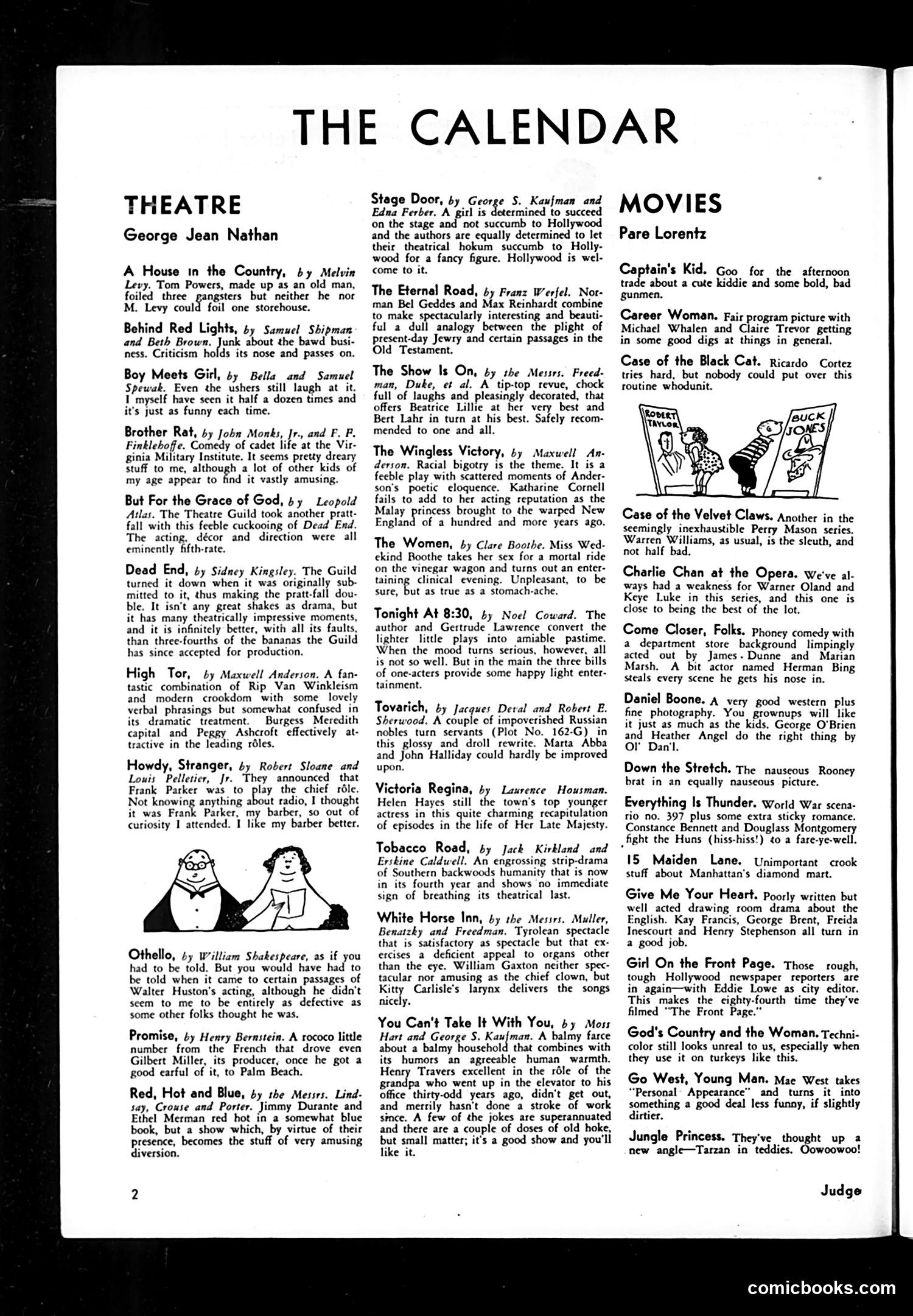
# "The Calendar" Page Analysis This page from Judge magazine presents theater and movie reviews rather than political satire. The content includes critiques of Broadway plays (like Shakespeare's *Othello* and *Promise*) and Hollywood films (ranging from *Captain's Kid* to *Jungle Princess*). Two small cartoon illustrations appear: one showing two rotund figures in what appears to be a humorous domestic scene, and another depicting a woman reading while a man gestures—likely illustrating comedic situations referenced in the reviews. The reviews themselves use satirical commentary typical of Judge's style, offering witty critiques of performances and plots. Rather than political commentary, the satire targets theatrical and cinematic quality, performers' abilities, and plot devices—standard entertainment criticism of the era.
📄 Transcribed text from this page (OCR, searchable)
Machine-transcribed from the original scan — historical spelling and the odd misread are preserved.
THE CALENDAR THEATRE George Jean Nathan A House in the Country, by Melvin Levy. Tom Powers, made up as an old man, foiled three gangsters but neither he nor M. Levy could foil one storehouse. Behind Red Lights, 4y Samuel Shipman and Beth Brown. Junk about the bawd busi- ness. Criticism holds its nose and passes on. Boy Meets Girl, sy Bella and Samuel Spewak. Even the ushers still laugh at it. I myself have seen it half a dozen times and it's Just as funny each time. Brother Rat, by John Monks, Jr., and F. P. Finkleboffe. Comedy of cadet life at the Vir- ginia Military Institute. It seems pretty dreary stuff to me, although a lot of other kids of my age appear to But For the Grace of God, by Leopold Atlas. The Theatre Guild took another pratt- fall with this feeble cuckooing of Dead End. The acting, décor and direction were all eminently fifth-rate. ind it vastly amusing. Dead End, sy Sidney Kingsley. The Guild turned it down when it was originally sub- mitted to it, thus making the pratt-fall dou- ble. It isn’t any great shakes as drama, but it has many theatrically impressive moments, and it is infinitely better, with all its faults, than three-fourths of the bananas the Guild has since accepted for production. High Tor, by Maxwell Anderson. A fan- tastic combination of Rip Van Winkleism and modern crookdom with some lovely verbal phrasings but somewhat confused in its dramatic treatment. Burgess Meredith capital and Peggy Ashcroft effectively at- tractive in the leading réles. Howdy, Stranger, by Robert Sloane and Louis Pelletier, Jr. They announced that Frank Parker was to play the chief rdle. Not knowing anything about radio, I thought it was Frank Parker, my barber, so out of curiosity I attended. I Tike my barber better. Othello, sy william Shakespeare, as if you had to be told. But you would have had to be told when it came to certain passages of Walter Huston’s acting, although he didn’t seem to me to be entirely as defective as some other folks thought he was. Promise, by Henry Bernstein. A rococo little number from the French that drove even Gilbert Miller, its producer, once he got a good earful of it, to Palm Beach. Red, Hot and Blue, by she Messrs. Lind- say, Crouse and Porter. Jimmy Durante and Ethel Merman red hot in a somewhat blue book, but a show which, by virtue of their presence, becomes the stuff of very amusing diversion. Stage Door, by George S. Kaufman and Edna Ferber. A gitl is determined to succeed on the stage and not succumb to Hollywood and the authors are equally determined to let their theatrical hokum succumb to Holly- wood for a fancy figure. Hollywood is wel- come to it. The Eternal Road, by Franz Werfel. Nor- man Bel Geddes and Max Reinhardt combine to make spectacularly interesting and beauti- ful a dull analogy between the plight of present-day Jewry and certain passages in the Old Testament. The Show Is On, by she Messrs. Freed- man, Duke, et al. A tip-top revue, chock full of laughs and pleasingly decorated, that offers Beatrice Lillie at her very best and Bert Lahr in turn at his best. Safely recom- mended to one and all. The Wingless Victory, by Maxwell An- derson. Racial bigotry is the theme. It is a feeble play with scattered moments of Ander- son's poetic eloquence, Katharine Cornell fails to add to her acting reputation as the Malay princess brought to the warped New England of a hundred and more years ago. The Women, by Clare Boothe. Miss Wed- ekind Boothe takes her sex for a mortal ride on the vinegar wagon and turns out an enter- mining clinical evening. Unpleasant, to be sure, but as true as a stomach-ache. Tonight At 8:30, by Noe! Coward. The author and Gertrude Lawrence convert the lighter little plays into amiable pastime. When the mood turns serious, however, all is not so well, But in the main the three bills of one-acters provide some happy light enter- tainment. Tovarich, by Jacques Deval and Robert BE. Sherwood. A couple of impoverished Russian nobles turn servants (Plot No. 162-G) in this glossy and droll rewrite. Marta Abba and John Halliday could hardly be improved upon. Victoria Regina, by Laurence Housman. Helen Hayes still the town's top younger actress in this quite charming recapitulation of episodes in the life of Her Late Majesty. Tobacco Road, by Jack Kirkland and Erskine Caldwell. An engrossing strip-drama of Southern backwoods humanity that is now in its fourth year and shows ‘no immediate sign of breathing its theatrical last. White Horse Inn, by the Messrs. Muller, Benatzky and Freedman. Tyrolean spectacle that is satisfactory as spectacle but that ex- ercises a deficient appeal to organs other than the eye. William Gaxton neither spec- tacular nor amusing as the chief clown, but Kitty Carlisle's larynx delivers the songs nicely. You Can't Take It With You, by Moss Hart and George S. Kaufman. A balmy farce about a balmy household that combines with its humors an agreeable human warmth. Henry Travers excellent in the rdle of the grandpa who went up in the elevator to his office thirty-odd years ago, didn’t get out, and merrily hasn't done a stroke of work since. A few of the jokes are superannuated and there are a couple of doses of old hoke, ue small matter; it's a good show and you'll like it. MOVIES Pare Lorentz Coptain's Kid. Goo for the afternoon trade about a cute kiddie and some bold, bad gunmen. Career Woman. Fair program picture with Michael Whalen and Claire Trevor getting in some good digs at things in general. Case of the Black Cat. Ricardo Cortez tries hard, but nobody could put over this routine whodunit. Case of the Velvet Claws. Another in the seemingly inexhaustible Perry Mason series. Warren Williams, as usual, is the sleuth, and not half bad, Charlie Chan at the Opera. we've al- ways had a weakness for Warner Oland and Keye Luke in this series, and this one is close to being the best of the lot. Come Closer, Folks. Phoney comedy with a department store background limpingly acted out by James. Dunne and Marian Marsh. A bit ‘actor named Herman Bing steals every scene he gets his nose in. Daniel Boone. A very good western plus fine photography. You grownups will like it just as much as the kids, George O'Brien and Heather Angel do the right thing by Ol Dan'l. Down the Stretch. The nauseous Rooney brat in an equally nauseous picture. Everything Is Thunder. world War scena- rio no. 397 plus some extra sticky romance. Constance Bennett and Douglass Montgomery fight the Huns (hiss-hiss!) ¢o0 a fare-ye-well. 15 Maiden Lane. Unimportant crook stuff about Manhattan's diamond mart. Give Me Your Heart. Poorly written but well acted drawing room drama about the English. Kay Francis, George Brent, Freida Inescourt and Henry Stephenson all turn in a good job. Girl On the Front Page. Those rough, tough Hollywood newspaper reporters are in again—with Eddie Lowe as city editor. This makes the eighty-fourth time they've filmed “The Front Page.” God's Country and the Woman. Techni- color still looks unreal to us, especially when they use it on turkeys like this. Go West, Young Man. Mae West takes “Personal: Appearance” and turns it into socething a good deal less funny, if slightly irtier. Jungle Princess. They've thought up 2 new angle—Tarzan in teddies. Oowoowoo! Judge comicbooks.com