
Judge, 1937-03 · page 12 of 37
Judge — March 1937 — page 12: what you’re looking at
What you’re looking at
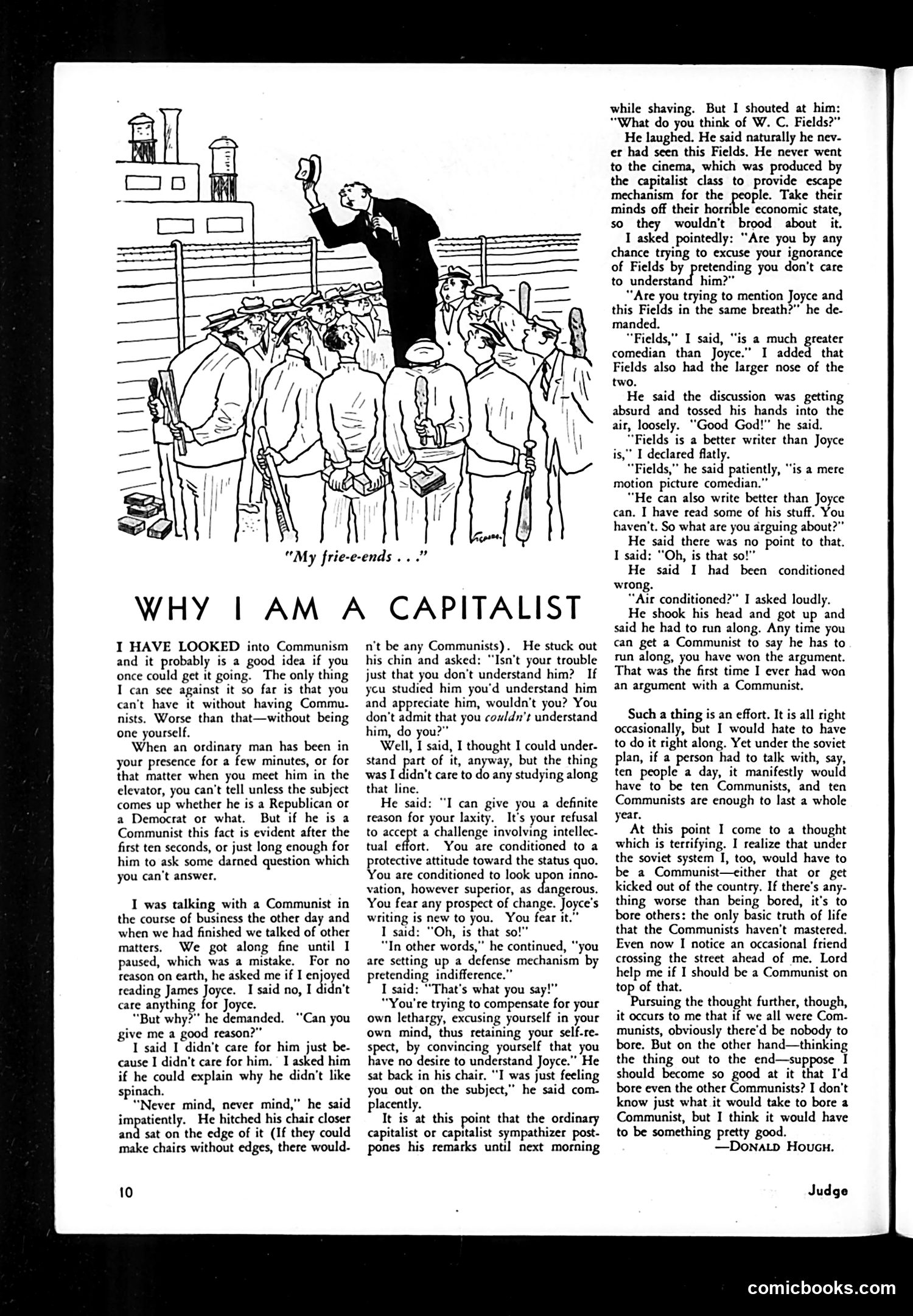
# What This Page Means This is a satirical essay by Donald Hough mocking Communist ideology and arguing for capitalism—presented as humor in Judge magazine. The cartoon shows a Communist speaker addressing a crowd with missionary zeal. The essay describes the author's encounter with an aggressive Communist acquaintance who interrogates him about not liking James Joyce, insisting his disinterest stems from capitalist conditioning and fear of intellectual challenge. The satire's point: Communists are portrayed as obnoxiously dogmatic, using pseudo-intellectual arguments to browbeat ordinary people. They demand constant ideological justification while refusing to engage honestly. The author's punchline—turning the Communist's own logic against him by questioning his ignorance of comedian W.C. Fields—exposes the hypocrisy and exhausting pedantry of Communist discourse. The essay argues capitalism, despite its flaws, is preferable to communism because it allows people to simply *exist* without constant ideological performance.
📄 Transcribed text from this page (OCR, searchable)
Machine-transcribed from the original scan — historical spelling and the odd misread are preserved.
"My frie-e-ends ... WHY I HAVE LOOKED into Communism and it probably is a good idea if you once could get it going. The only thing I can see against it so far is that you can't have it without having Commu. nists. Worse than that—without being one yourself. When an ordinary man has been in your presence for a few minutes, or for that matter when you meet him in the elevator, you can't tell unless the subject comes up whether he is a Republican or a Democrat or what. But if he is a Communist this fact is evident after the first ten seconds, or just long enough for him to ask some darned question which you can’t answer, I was talking with a Communist in the course of business the other day and when we had finished we talked of other matters. We got along fine until I paused, which was a mistake. For no reason on earth, he asked me if I enjoyed reading James Joyce. I said no, I didn’t care anything for Joyce. “But why?” he demanded. “Can you give me a good reason?” I said I didn’t care for him just be- cause I didn’t care for him. 1 asked him if he could explain why he didn’t like spinach. “Never mind, never mind,” he said impatiently. He hitched his chair closer and sat on the edge of it (If they could make chairs without edges, there would- 10 1 AM A CAPITALIST n't be any Communists). He stuck out his chin and asked: “Isn't your trouble just that you don’t understand him? If ycu studied him you'd understand him and appreciate him, wouldn't you? You don’t admit that you couldn't understand him, do you?” Well, I said, 1 thought I could under- stand part of it, anyway, but the thing was I didn’t care to do any studying along that line. He said: “I can give you a definite reason for your laxity. It’s your refusal to accept a challenge involving intellec- tual effort. You are conditioned to a protective attitude toward the status quo. You are conditioned to look upon inno- vation, however superior, as dangerous. You fear any prospect of change. Joyce's writing is new to you. You fear it.” I said: “Oh, is that so!” “In other words,” he continued, “you are setting up a defense mechanism by pretending indifference.” I said: “That's what you say!” “You're trying to compensate for your own lethargy, excusing yourself in your own mind, thus retaining your self-re- spect, by convincing yourself that you have no desire to understand Joyce.” He sat back in his chair. “I was just feeling you out on the subject,” he said com. placently. It is at this point that the ordinary capitalist or capitalist sympathizer post- pones his remarks until next morning while shaving. But I shouted at him: “What do you think of W. C. Fields?” He laughed. He said naturally he nev- er had seen this Fields. He never went to the cinema, which was produced by the capitalist class to provide escape mechanism for the people. Take their minds off their horrible economic state, so they wouldn't brood about it. I asked pointedly: “Are you by any chance trying to excuse your ignorance of Fields by pretending you don’t care to understand him?” “Are you trying to mention Joyce and this Fields in the same breath?” he de- manded. “Fields,” I said, “is a much greater comedian than Joyce.” I added that Fields also had the larger nose of the two. He said the discussion was getting absurd and tossed his hands into the air, loosely. “Good God!" he said. “Fields is a better writer than Joyce is,” I declared flatly. “Fields,” he said patiently, “is a mere motion picture comedian.” “He can also write better than Joyce can. I have read some of his stuff. You haven't. So what are you arguing about?” He said there was no point to that. I said: “Oh, is that so!” He said I had been conditioned wrong. “Air conditioned?” I asked loudly. He shook his head and got up and said he had to run along. Any time you can get a Communist to say he has to run along, you have won the argument. That was the first time I ever had won an argument with a Communist. Such a thing is an effort. It is all right occasionally, but I would hate to have to do it right along. Yet under the soviet plan, if a person had to talk with, say, ten people a day, it manifestly would have to be ten Communists, and ten Communists are enough to last a whole year. At this point I come to a thought which is terrifying. I realize that under the soviet system I, too, would have to be a Communist—either that or get kicked out of the country. If there's any- thing worse than being bored, it's to bore others: the only basic truth of life that the Communists haven't mastered. Even now I notice an occasional friend crossing the street ahead of me. Lord help me if I should be a Communist on top of that. Pursuing the thought further, though, it occurs to me that if we all were Com. munists, obviously there'd be nobody to bore. But on the other hand—thinking the thing out to the end—suppose I should become so good at it that I'd bore even the other Communists? I don’t know just what it would take to bore a Communist, but I think it would have to be something pretty good. —Donatp Houcu. Judge comicbooks.com