
Judge, 1937-03 · page 18 of 37
Judge — March 1937 — page 18: what you’re looking at
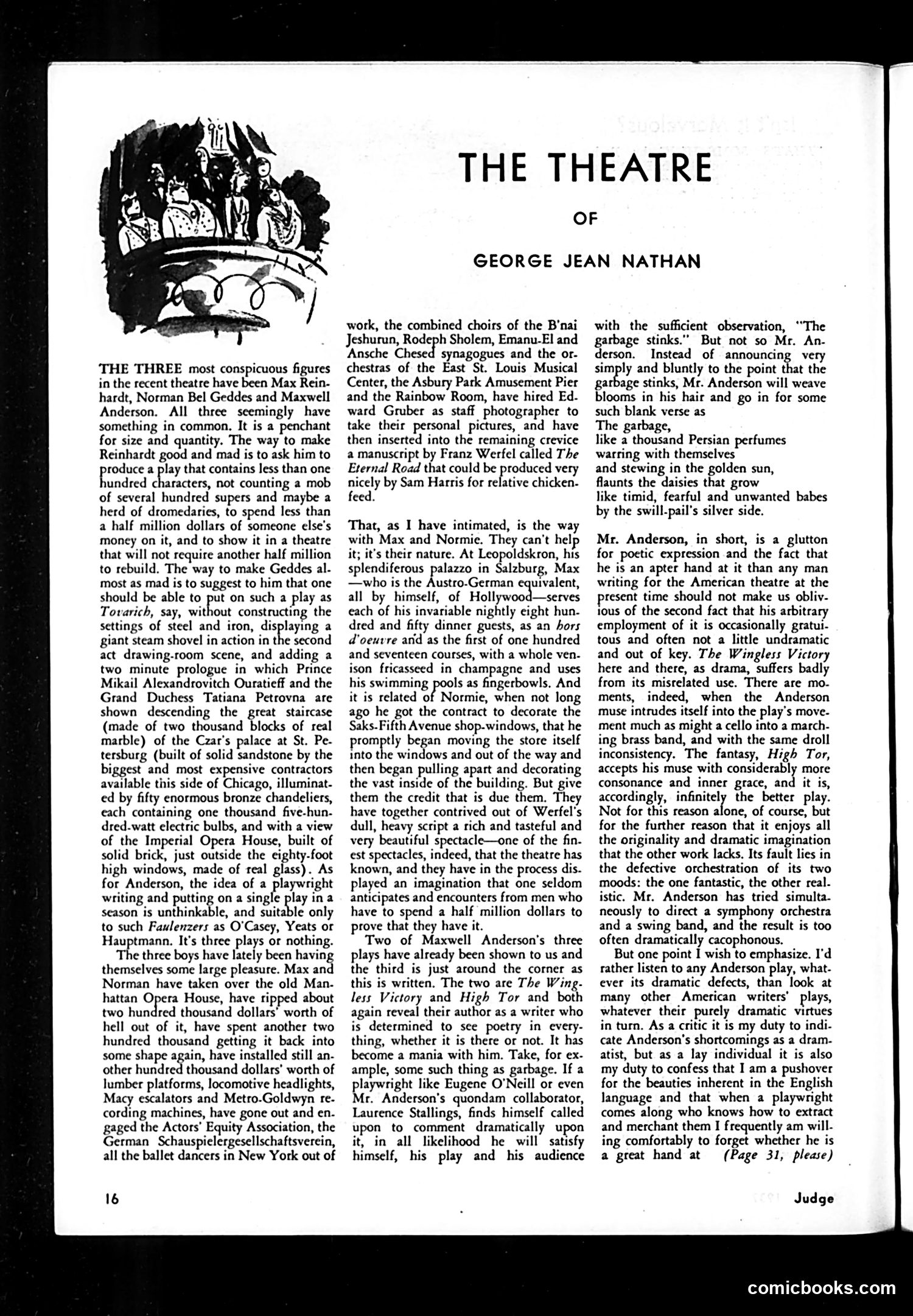
A restored page from Judge, 1937-03. Page through the whole issue in the reader above.
📄 Transcribed text from this page (OCR, searchable)
Machine-transcribed from the original scan — historical spelling and the odd misread are preserved.
THE THREE most conspicuous figures in the recent theatre have been Max Rein- hardt, Norman Bel Geddes and Maxwell Anderson. All three seemingly have something in common. It is a penchant for size and quantity. The way to make Reinhardt good and mad is to ask him to roduce a play that contains less than one undred harecers not counting a mob of several hundred supers and maybe a herd of dromedaries, to spend less than a half million dollars of someone else's money on it, and to show it in a theatre that will not require another half million to rebuild. The way to make Geddes al- most as mad is to suggest to him that one should be able to pet on such a play as Tovarich, say, without constructing the settings of steel and iron, displaying a giant steam shovel in action in the second act drawing-room scene, and adding a two minute prologue in which Prince Mikail Alexandrovitch Ouratieff and the Grand Duchess Tatiana Petrovna are shown descending the great staircase (made of two thousand blocks of real marble) of the Czar's palace at St. Pe- tersburg (built of solid sandstone by the biggest and most expensive contractors available this side of Chicago, illuminat- ed by fifty enormous bronze chandeliers, each containing one thousand five-hun- dred-watt electric bulbs, and with a view of the Imperial Opera House, built of solid brick, just outside the eighty-foot high windows, made of teal glass). As for Anderson, the idea of a playwright writing and putting on a single play in a season is unthinkable, and suitable only to such Faulenzers as O'Casey, Yeats or Hauptmann. It's three plays or nothing. The three boys have lately been having themselves some large pleasure. Max and Norman have taken over the old Man- hattan Opera House, have ripped about two hundred thousand dollars’ worth of hell out of it, have spent another two hundred thousand getting it back into some shape again, have installed still an- other hundred thousand dollars’ worth of lumber platforms, locomotive headlights, Macy escalators and Metro-Goldwyn re- cording machines, have gone out and en. gaged the Actors’ Equity Association, the German Schauspielergesellschaftsverein, all the ballet dancers in New York out of 16 THE THEATRE OF GEORGE JEAN NATHAN work, the combined choirs of the B'nai Jeshurun, Rodeph Sholem, Emanu-El and Ansche Chesed synagogues and the or- chestras of the East St. Louis Musical Center, the Asbury Park Amusement Pier and the Rainbow Room, have hired Ed- ward Gruber as staff photographer to take their personal pictures, and have then inserted into the remaining crevice a manuscript by Franz Werfel called The Eternal Road that could be produced very nicely by Sam Harris for relative chicken. feed. That, as I have intimated, is the way with Max and Normie. They can’t help it; it’s their nature. At Leopoldskron, his splendiferous palazzo in Salzburg, Max —who is the Austro-German equivalent, all by himself, of Hollywood—serves each of his invariable nightly eight hun. dred and fifty dinner guests, as an hors d'oeuvre and as the first of one hundred and seventeen courses, with a whole ven- ison fricasseed in champagne and uses his swimming pools as fingerbowls. And it is related of Normie, when not long ago he got the contract to decorate the Saks-Fifth Avenue shop-windows, that he Promptly began moving the store itself into the windows and out of the way and then began pulling apart and decorating the vast inside of the building. But give them the credit that is due them. They have together contrived out of Werfel’s dull, heavy script a rich and tasteful and very beautiful spectacle—one of the fin. est spectacles, indeed, that the theatre has known, and they have in the process dis. played an imagination that one seldom anticipates and encounters from men who have to spend a half million dollars to prove that they have it. Two of Maxwell Anderson's three plays have already been shown to us and the third is just around the corner as this is written. The two are The Wing- less Victory and High Tor and both again reveal their author as a writer who is determined to see poetry in every- thing, whether it is there or not. It has become a mania with him. Take, for ex- ample, some such thing as garbage. If a playwright like Eugene O'Neill or even Mr. Anderson's quondam collaborator, Laurence Stallings, finds himself called upon to comment dramatically upon it, in all likelihood he will satisfy himself, his play and his audience with the sufficient observation, ‘The garbage stinks.” But not so Mr. An. derson. Instead of announcing very simply and bluntly to the point that the garbage stinks, Mr. Anderson will weave blooms in his hair and go in for some such blank verse as The garbage, like a thousand Persian perfumes warring with themselves and stewing in the golden sun, flaunts the daisies that grow like timid, fearful and unwanted babes by the swill-pail’s silver side. Mr. Anderson, in short, is a glutton for poetic expression and the fact that he is an apter hand at it than any man writing for the American theatre at the present time should not make us obliv- tous of the second fact that his arbitrary employment of it is occasionally gratui- tous and often not a little undramatic and out of key. The Wingless Victory here and there, as drama, suffers badly from its misrelated use. There are mo- ments, indeed, when the Anderson muse intrudes itself into the play's move- ment much as might a cello into a march- ing brass band, and with the same droll inconsistency. The fantasy, High Tor, accepts his muse with considerably more consonance and inner grace, and it is, accordingly, infinitely the better play. Not for this reason alone, of course, but for the further reason that it enjoys all the originality and dramatic imagination that the other work lacks. Its fault lies in the defective orchestration of its two moods: the one fantastic, the other real. istic. Mr. Anderson has tried simulta- neously to direct a symphony orchestra and a swing band, and the result is too often dramatically cacophonous. But one point I wish to emphasize. I'd rather listen to any Anderson play, what- ever its dramatic defects, than look at many other American writers’ plays, whatever their purely dramatic virtues in turn. As a critic it is my duty to indi- cate Anderson's shortcomings as a dram- atist, but as a lay individual it is also my duty to confess that I am a pushover for the beauties inherent in the English language and that when a playwright comes along who knows how to extract and merchant them I frequently am will- ing comfortably to forget whether he is a great hand at (Page 31, please) Judge comicbooks.com