
Judge, 1937-03 · page 11 of 37
Judge — March 1937 — page 11: what you’re looking at
What you’re looking at
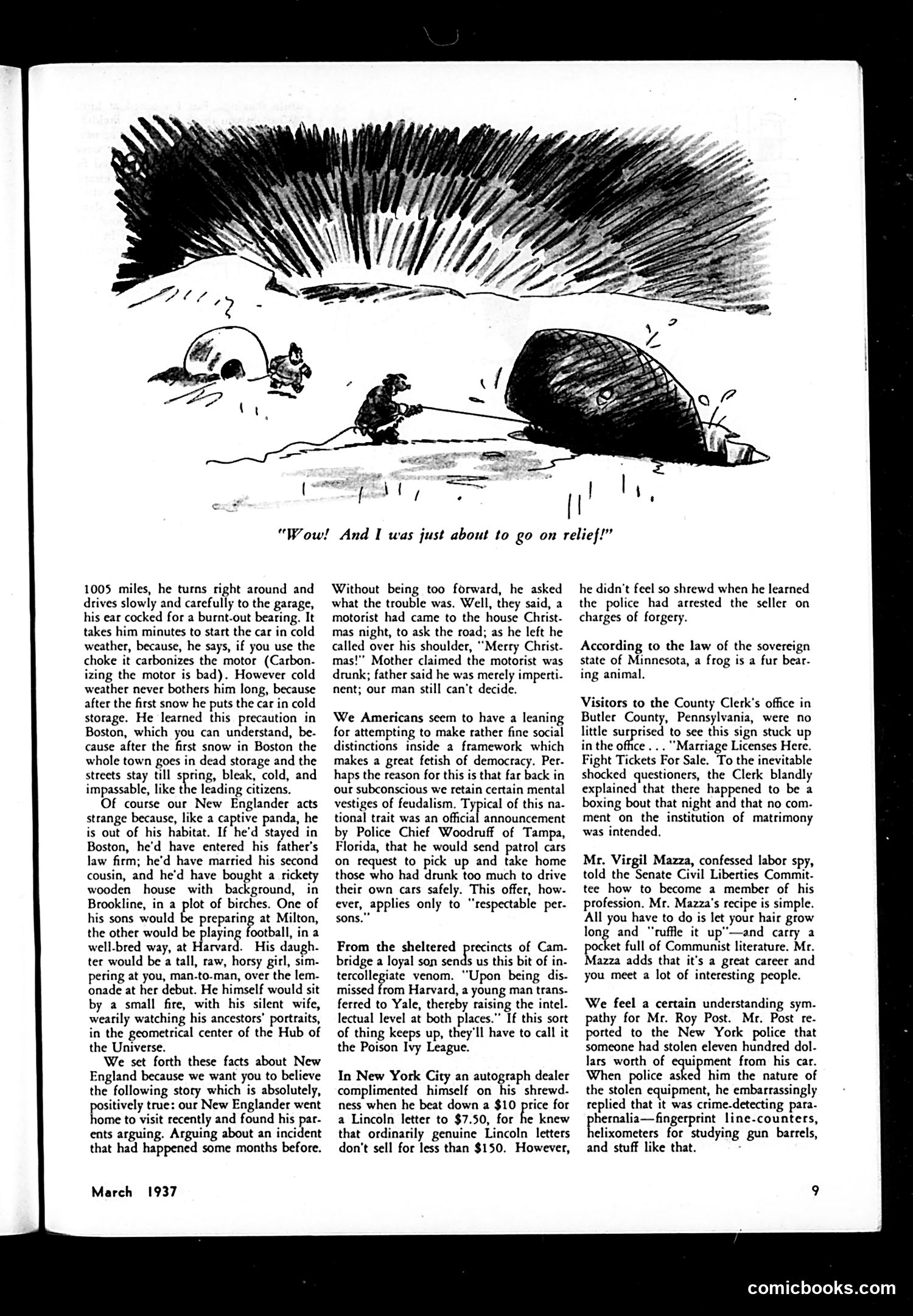
# Cartoon Analysis: Judge Magazine, March 1937 **The Main Cartoon** depicts a small figure being pulled by an enormous beetle or insect, with the caption "Wow! And I was just about to go on relief!" The joke references the Great Depression context (1937). The figure expects hardship and government relief assistance, but instead gets absurdly yanked away by this creature—suggesting life's unpredictable interruptions supersede even unemployment worries. It's dark Depression-era humor. **The Surrounding Text** consists of satirical anecdotes mocking American social pretensions: - A New England family argues for months over whether a holiday visitor was merely "impertinent" versus "drunk"—conflating class distinctions with sobriety judgments - Tampa police offer drunk-driving assistance only to "respectable persons"—highlighting hypocritical class-based "democracy" - A Yale/Harvard rivalry joke about intellectual levels - An autograph dealer conned into buying a forged Lincoln letter The overall theme critiques how Americans maintain feudal-style class consciousness while professing democratic values—a pointed 1930s social observation.
📄 Transcribed text from this page (OCR, searchable)
Machine-transcribed from the original scan — historical spelling and the odd misread are preserved.
1005 miles, he turns right around and drives slowly and carefully to the garage, his ear cocked for a burnt-out bearing. It takes him minutes to start the car in cold weather, because, he says, if you use the choke it carbonizes the motor (Carbon- izing the motor is bad). However cold weather never bothers him long, because after the first snow he puts the car in cold storage. He learned this precaution in Boston, which you can understand, be- cause after the first snow in Boston the whole town goes in dead storage and the streets stay till spring, bleak, cold, and impassable, like the leading citizens. Of course our New Englander acts strange because, like a captive panda, he is out of his habitat. If he'd stayed in Boston, he'd have entered his father’s law firm; he'd have married his second cousin, and he'd have bought a rickety wooden house with background, in Brookline, in a plot of birches. One of his sons would preparing at Milton, the other would be playing football, in a well-bred way, at Harvard. His daugh. ter would be a tall, raw, horsy girl, sim- pering at you, man-to-man, over the lem- onade at her debut. He himself would sit by a small fire, with his silent wife, wearily watching his ancestors’ portraits, in the geometrical center of the Hub of the Universe. We set forth these facts about New England because we want you to believe the following story which is absolutely, positively true: our New Englander went home to visit recently and found his par- ents arguing. Arguing about an incident that had happened some months before. March 1937 d ft ‘Wow! And 1 was just about to go on relief!” Without being too forward, he asked what the trouble was. Well, they said, a motorist had came to the house Christ- mas night, to ask the road; as he left he called over his shoulder, “Merry Christ. mas!’ Mother claimed the motorist was drunk; father said he was merely imperti- nent; our man still can’t decide. We Americans seem to have a leaning for attempting to make rather fine social distinctions inside a framework which makes a great fetish of democracy. Per- haps the reason for this is that far back in our subconscious we retain certain mental vestiges of feudalism. Typical of this na- tional trait was an official announcement by Police Chief Woodruff of Tampa, Florida, that he would send patrol cars on request to pick up and take home those who had drunk too much to drive their own cars safely. This offer, how- ever, applies only to “respectable per- sons. From the sheltered precincts of Cam. bridge a loyal son sends us this bit of in- tercollegiate venom. “Upon being dis- missed from Harvard, a young man trans- ferred to Yale, thereby raising the intel. lectual level at both places.” If this sort of thing keeps up, they'll have to call it the Poison Ivy League. In New York City an autograph dealer complimented himself on his shrewd- ness when he beat down a $10 price for a Lincoln letter to $7.50, for he knew that ordinarily genuine Lincoln letters don't sell for less than $150. However, he didn’t feel so shrewd when he learned the police had arrested the seller on charges of forgery. According to the law of the sovereign state of Minnesota, a frog is a fur bear- ing animal. Visitors to the County Clerk's office in Butler County, Pennsylvania, were no little surprised to see this sign stuck up in the office . . . “Marriage Licenses Here. Fight Tickets For Sale. To the inevitable shocked questioners, the Clerk blandly explained that there happened to be a boxing bout that night and that no com. ment on the institution of matrimony was intended. Mr. Virgil Mazza, confessed labor spy, told the Senate Civil Liberties Commit- tee how to become a member of his profession. Mr. Mazza's recipe is simple. All you have to do is let your hair grow long and “ruffle it up"—and carry a et full of Communist literature. Mr. Mazza adds that it’s a great career and you meet a lot of interesting people. We feel a certain understanding sym. pathy for Mr. Roy Post. Mr. Post re- ported to the New York police that someone had stolen eleven hundred dol- lars worth of equipment from his car. When police asked him the nature of the stolen equipment, he embarrassingly replied that it was crime-detecting para- hernalia—fingerprint line-counters, elixometers for studying gun barrels, and stuff like that. comicbooks.com