
A complete issue · 36 pages · 1928
Judge — July 21, 1928
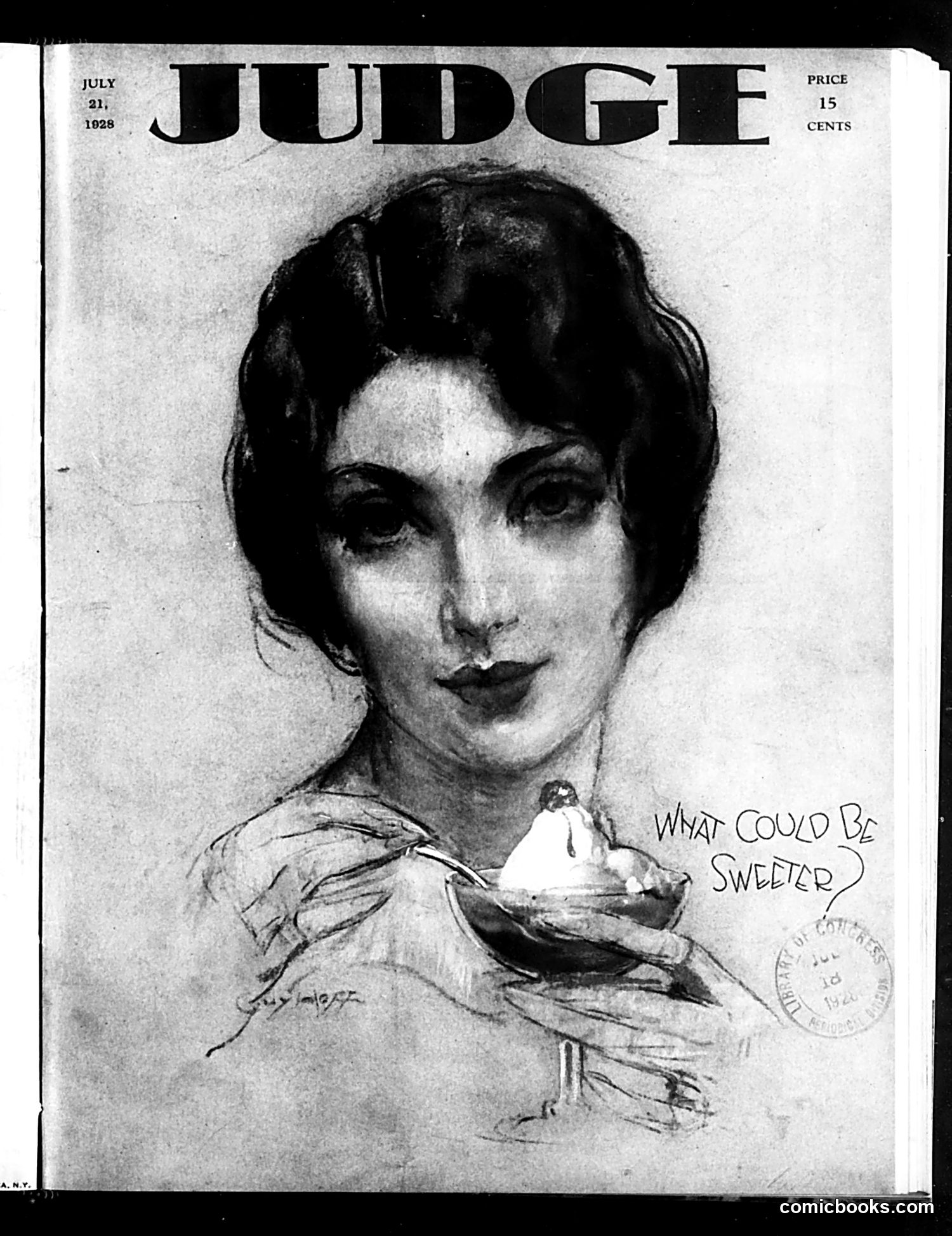
This cover features a portrait illustration of a woman holding what appears to be a dessert or confection, with the caption "WHAT COULD BE SWEETER?" The satire likely plays on period advertising and beauty standards—the woman's elegant appearance and the rhetorical question suggest commentary on consumerism, feminine ideals, or advertising conventions of the 1920s. The phrase could ironically reference commercial messaging that posed similar rhetorical questions to sell products. Without identifying the specific person depicted, this appears to be characteristic Judge magazine satire targeting contemporary advertising tropes or social attitudes. The 15-cent price point confirms this as authentic 1928 publication material. The exact satirical target remains unclear without additional context.
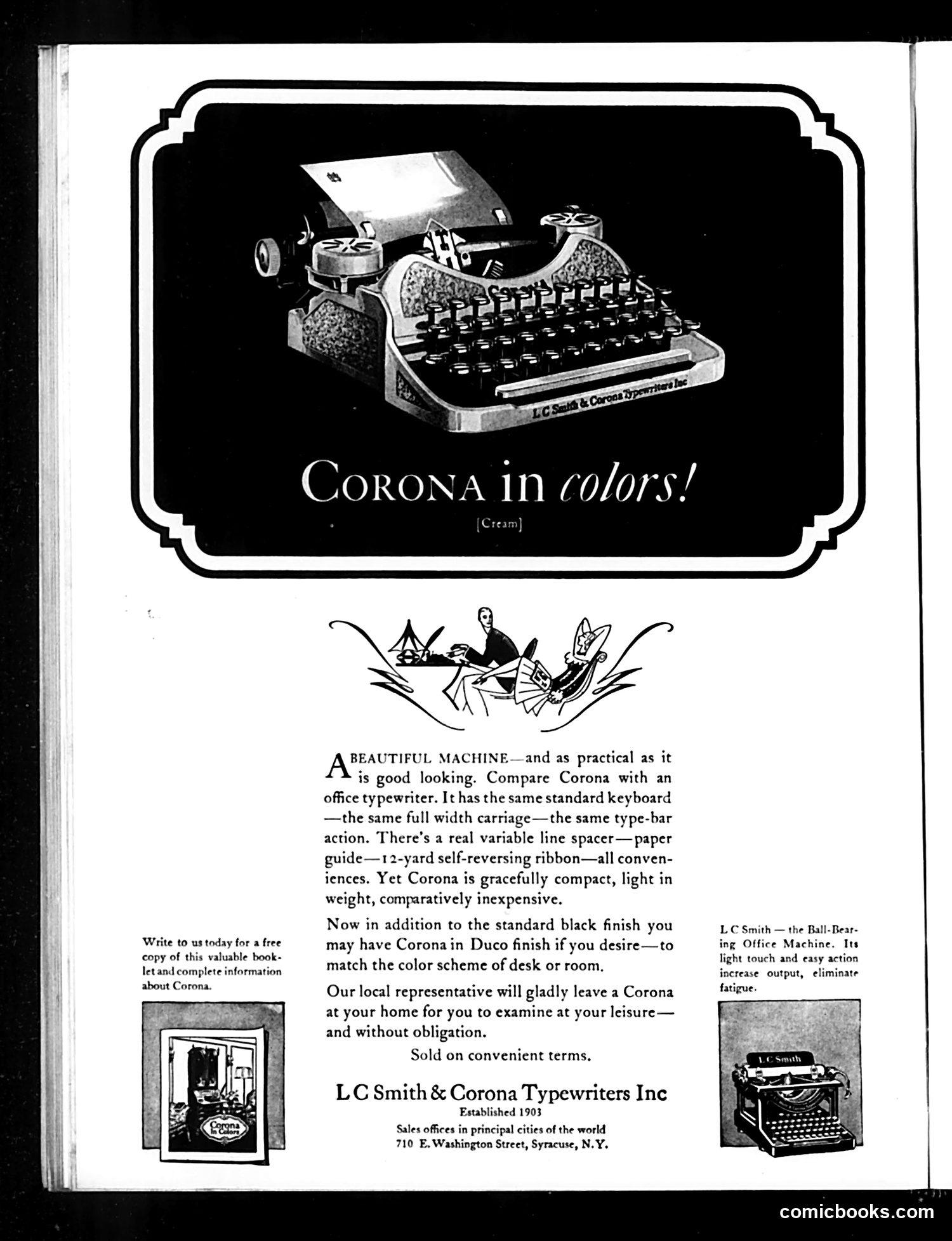
This page is **primarily an advertisement**, not satire or political commentary. It advertises Corona typewriters, manufactured by L.C. Smith & Corona Typewriters Inc. (established 1903). The ad highlights Corona's portability and aesthetic appeal—noting it comes "in colors" (cream finish shown) to match office décor, unlike standard black typewriters. The text emphasizes practical features: standard keyboard, full-width carriage, variable line spacer, and self-reversing ribbon. The small decorative illustration of a figure among leaves appears merely ornamental rather than satirical. This represents typical early-20th-century magazine advertising emphasizing both functionality and style as selling points for office equipment—common Judge magazine content alongside actual political cartoons.
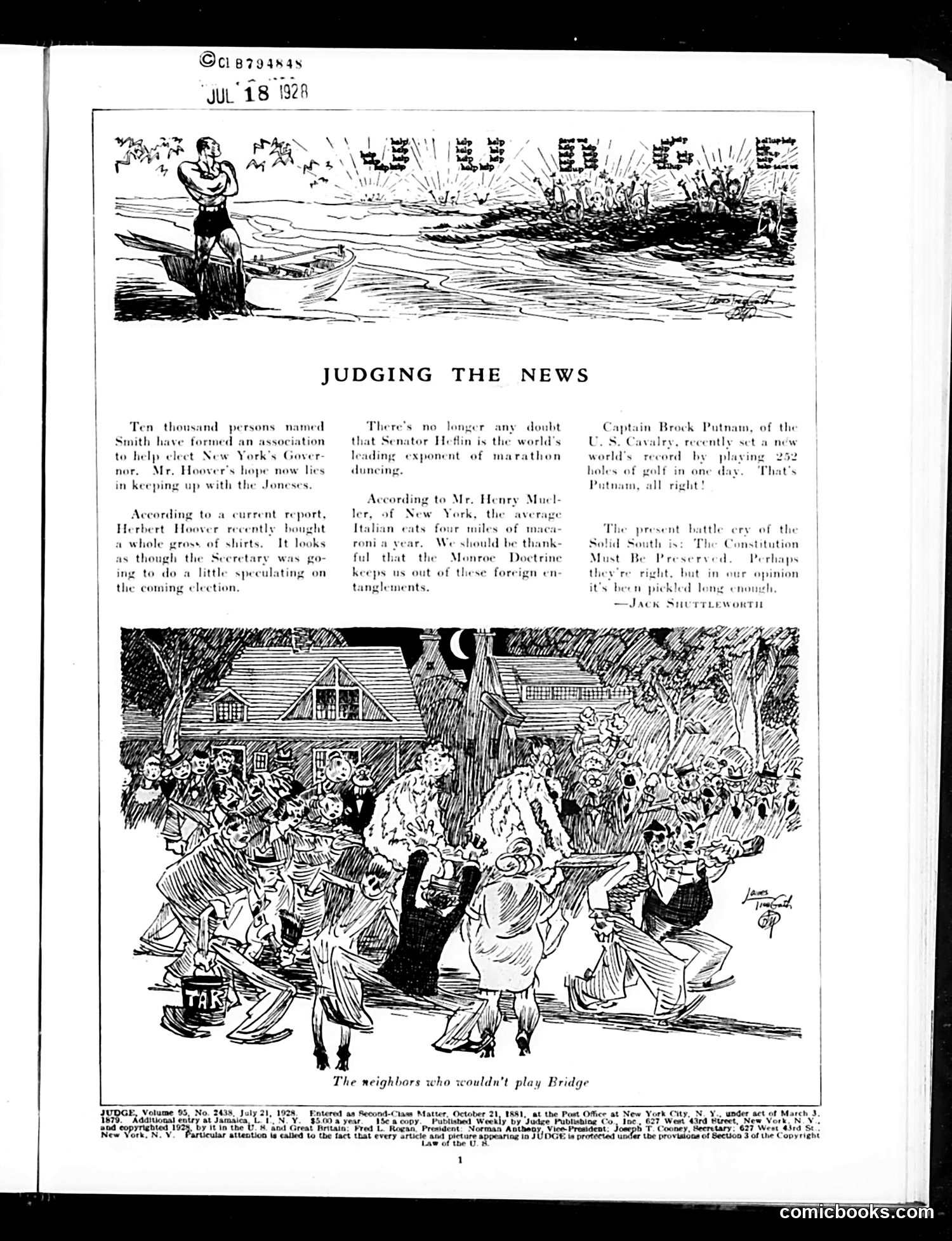
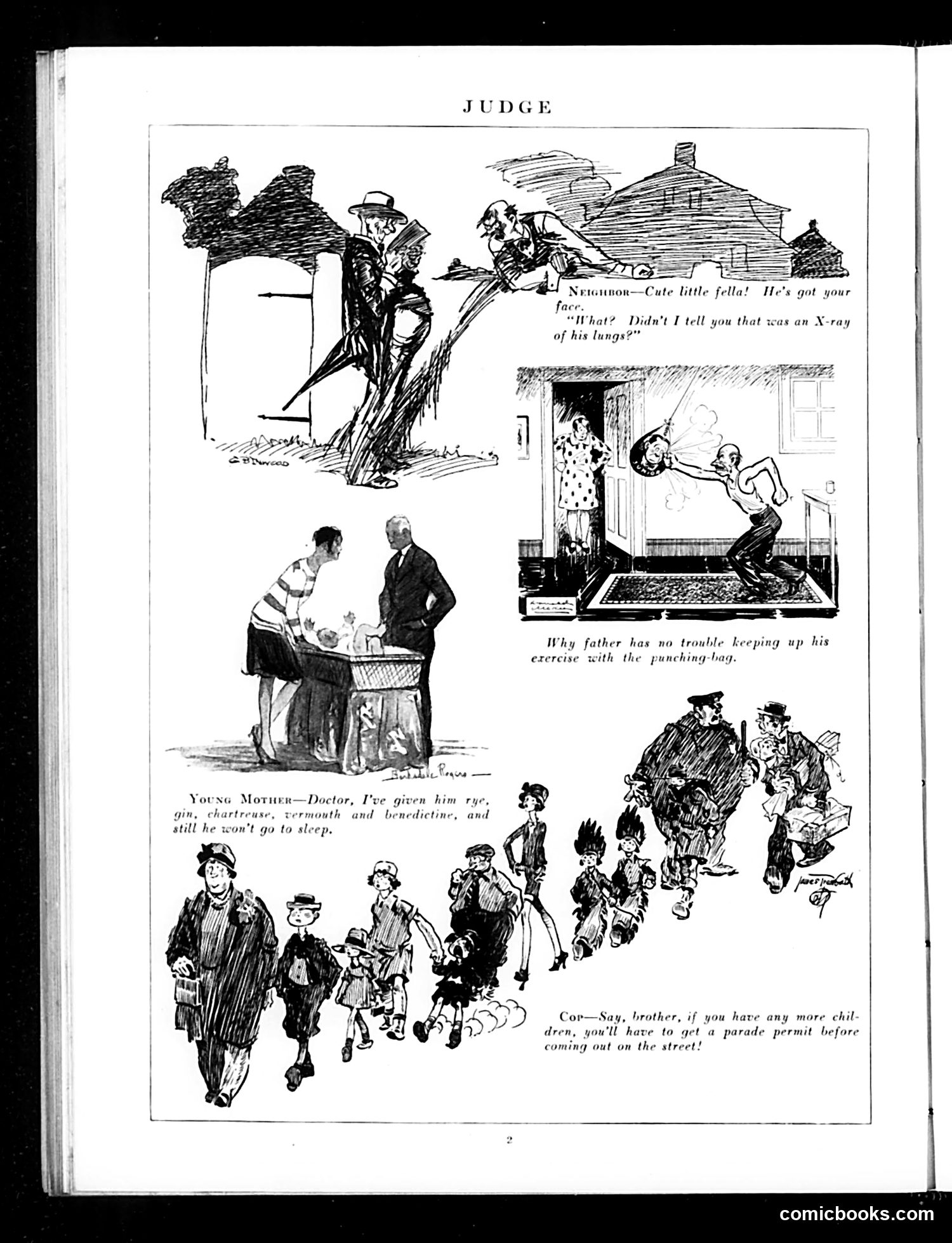
This page contains four satirical cartoons mocking urban life and parenting challenges circa early 20th century: 1. **"Neighbor"** (top): A judge confronts a neighbor about a child's bruised face, sarcastically referencing an X-ray of the child's lungs—implying the neighbor's child is violent. 2. **"Young Mother"** (left): A frazzled mother consults a doctor who's prescribed numerous remedies, yet the child still won't sleep—satirizing ineffective medical treatments for infant care. 3. **"Punching Bag"** (right): A father exercises with a punching bag while his son watches, captioned as explanation for why the father stays fit—gentle humor about exercise. 4. **"Cow"** (bottom): A policeman warns a man about needing a parade permit before bringing more children outside—satirizing overly large families as a public nuisance. The humor targets parenting struggles, medical quackery, and urban overcrowding.
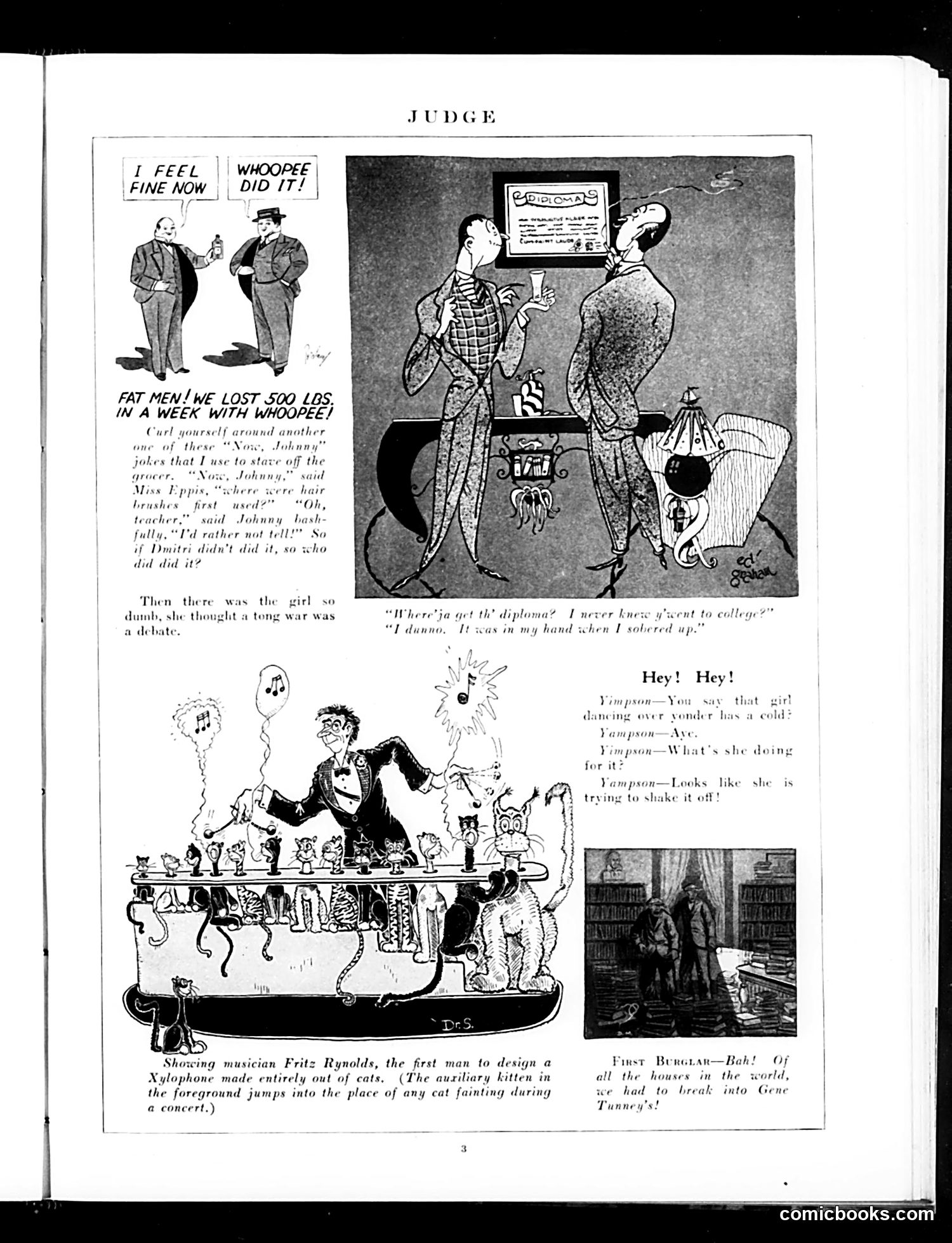
This page contains several satirical pieces from an era when Judge specialized in humor and social commentary: **Top left cartoon**: Two men discuss weight loss via "whoopee" (slang for wild partying/revelry). The joke plays on fad dieting claims popular in the early 20th century. **Center photograph**: Shows people examining what appears to be a diploma, with dialogue about college attendance—likely satirizing either educational pretensions or document fraud. **Bottom cartoon**: Depicts musician Fritz Rynolds conducting an orchestra "entirely out of cats," with cats performing in the ensemble. This appears to be absurdist humor about a novelty musical act or avant-garde performance. **Right sidebar**: A brief dialogue ("Hey! Hey!") about a girl with a cold attempting to "shake it off," using period slang. The page reflects Judge's typical blend of visual gags, social observation, and nonsense humor targeting early 20th-century American culture.
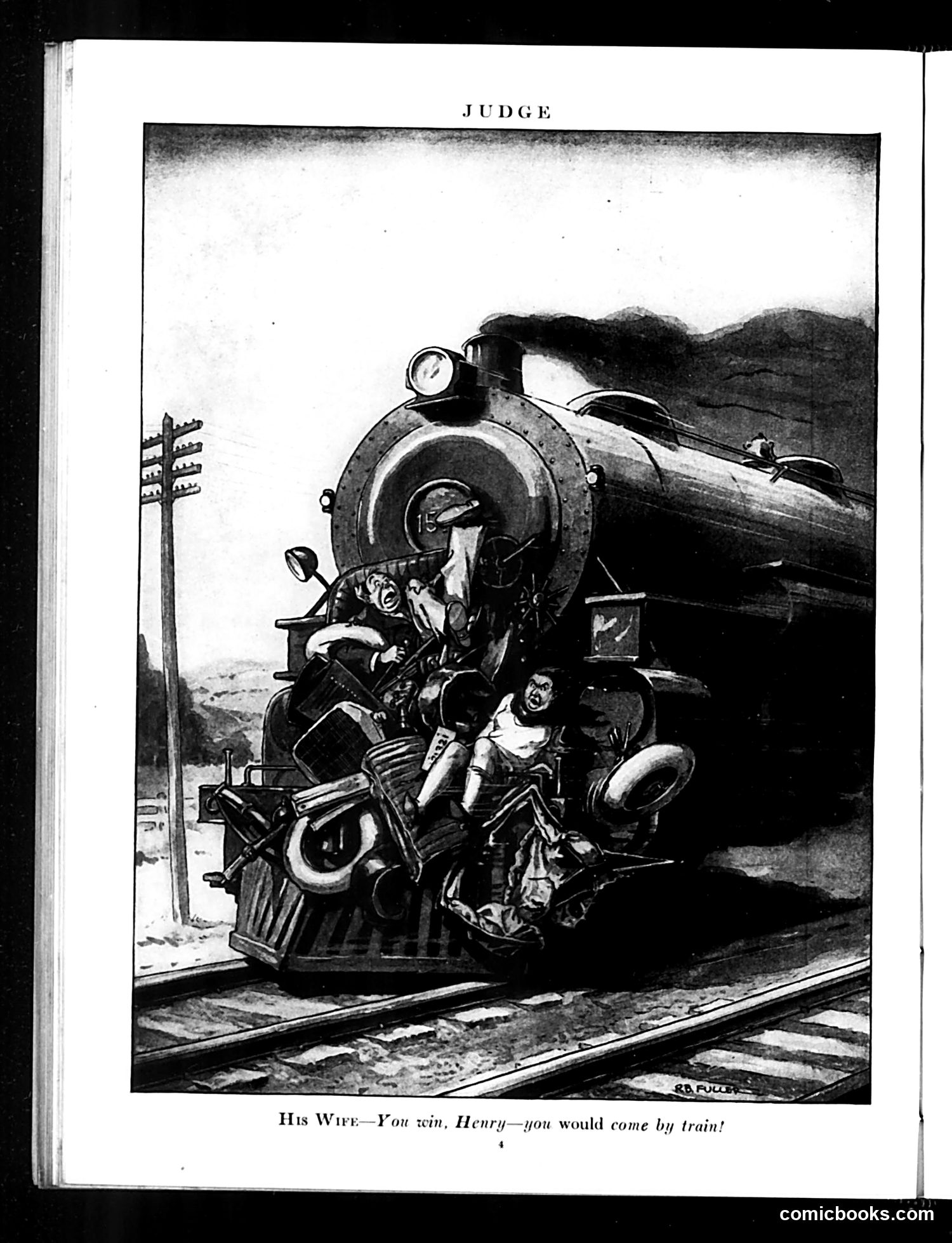
This cartoon from *Judge* magazine depicts a steam locomotive with a woman (labeled "His Wife") speaking to a man named Henry. Her caption reads: "You win, Henry—you would come by train!" The satire appears to comment on a domestic dispute about transportation methods. The man insisted on traveling by train despite his wife's (implied) preference for another mode of transport—likely an automobile, given the era when cars were becoming common but trains remained standard. The joke's point: Henry was "right" to take the train, as the image humorously shows the locomotive crowded with multiple people and chaos, suggesting the train journey was so unpleasant that his wife concedes his stubbornness was justified. It's satirizing both marital conflict and the comparative comfort of emerging automobile travel versus crowded rail transportation.
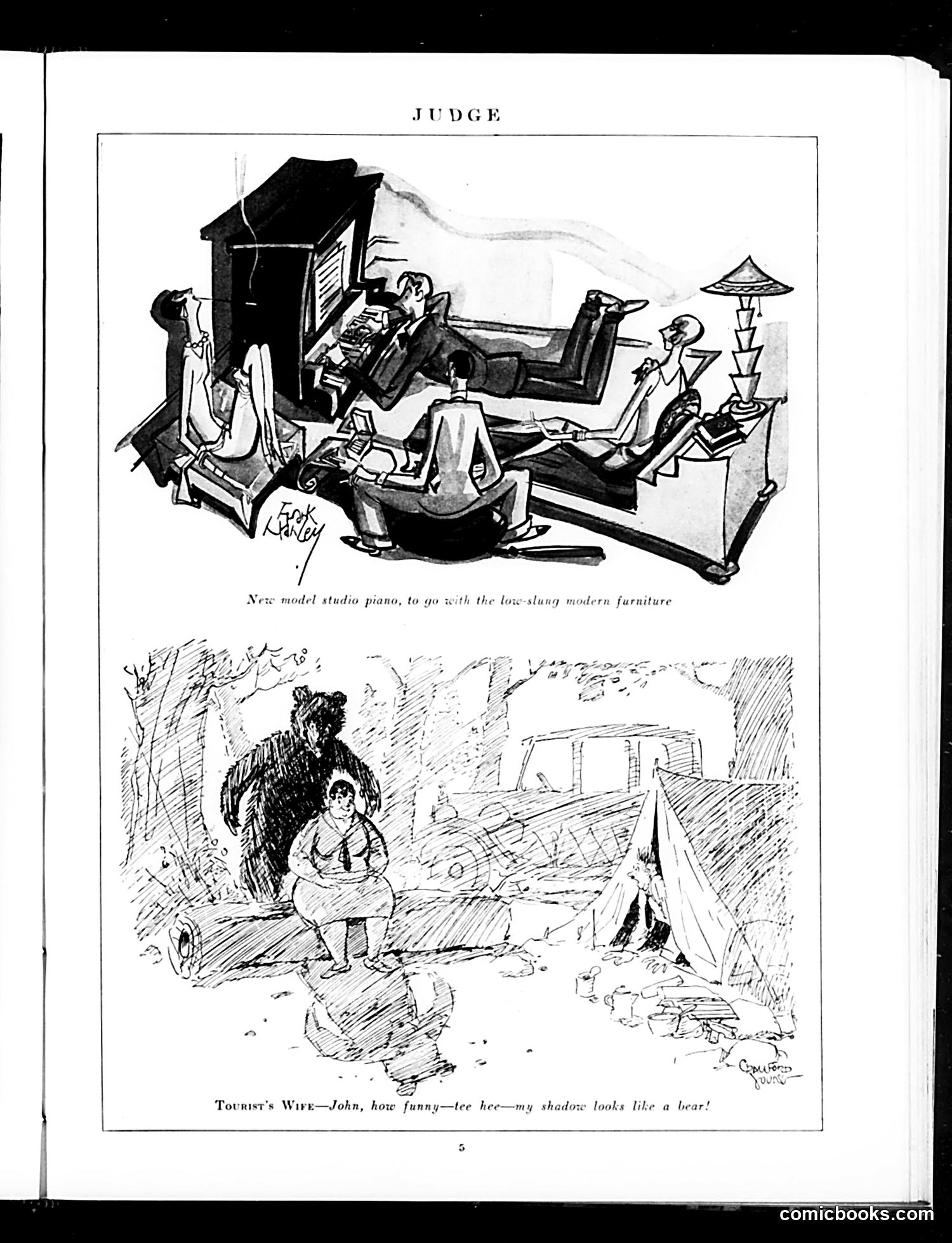
This page contains two cartoons satirizing modern life and leisure: **Top cartoon:** Mocks the "late-slang modern furniture" trend of the era, depicting a cluttered studio with people awkwardly arranged on unconventional seating. The satire targets fashionable but impractical modernist design becoming popular in studios and artistic spaces. **Bottom cartoon:** Shows a camping scene where a woman remarks that her husband's shadow resembles a bear. This jokes about the anxiety of outdoor tourism—the discomfort and uncertainty city people experience when camping or vacationing in natural settings. Both cartoons reflect early 20th-century urban anxieties about adopting new trends (modernism, recreational camping) without fully understanding or adapting to them, mocking middle-class pretension.
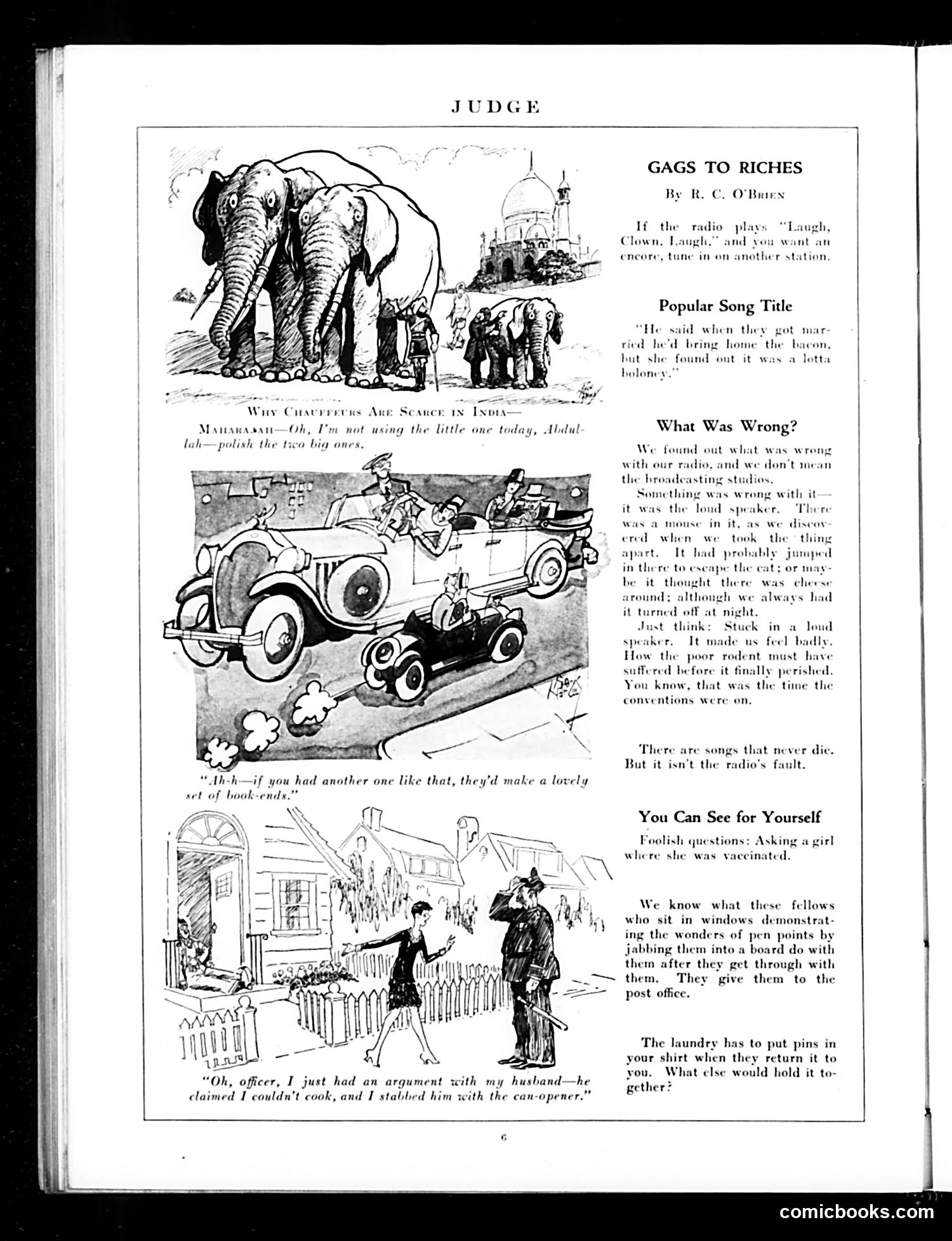
This page collects humorous one-liners and cartoon gags typical of Judge's satirical format. **Top cartoon**: Shows an elephant and mahout in India. The joke mocks colonial stereotypes—the maharajah explains he doesn't use the small elephant today but polishes "the two big ones," treating massive animals as casually as servants might handle possessions. **Middle cartoon**: A car scene jokes about radio speakers containing a mouse, then pivots to mock radio conventions (likely the 1920s-30s broadcasting industry), suggesting the "conventions" were as annoying as vermin. **Bottom cartoon**: A woman tells a police officer she stabbed her husband with a can-opener during a cooking argument—dark humor playing on domestic disputes and kitchen tool absurdity. The scattered jokes throughout mock radio quality, foolish questions (asking where someone was vaccinated), office workers stabbing pen-point demonstration boards, and laundry pins. The humor is broadly satirical, targeting everyday frustrations, emerging technology (radio), and social pretensions rather than specific political figures.
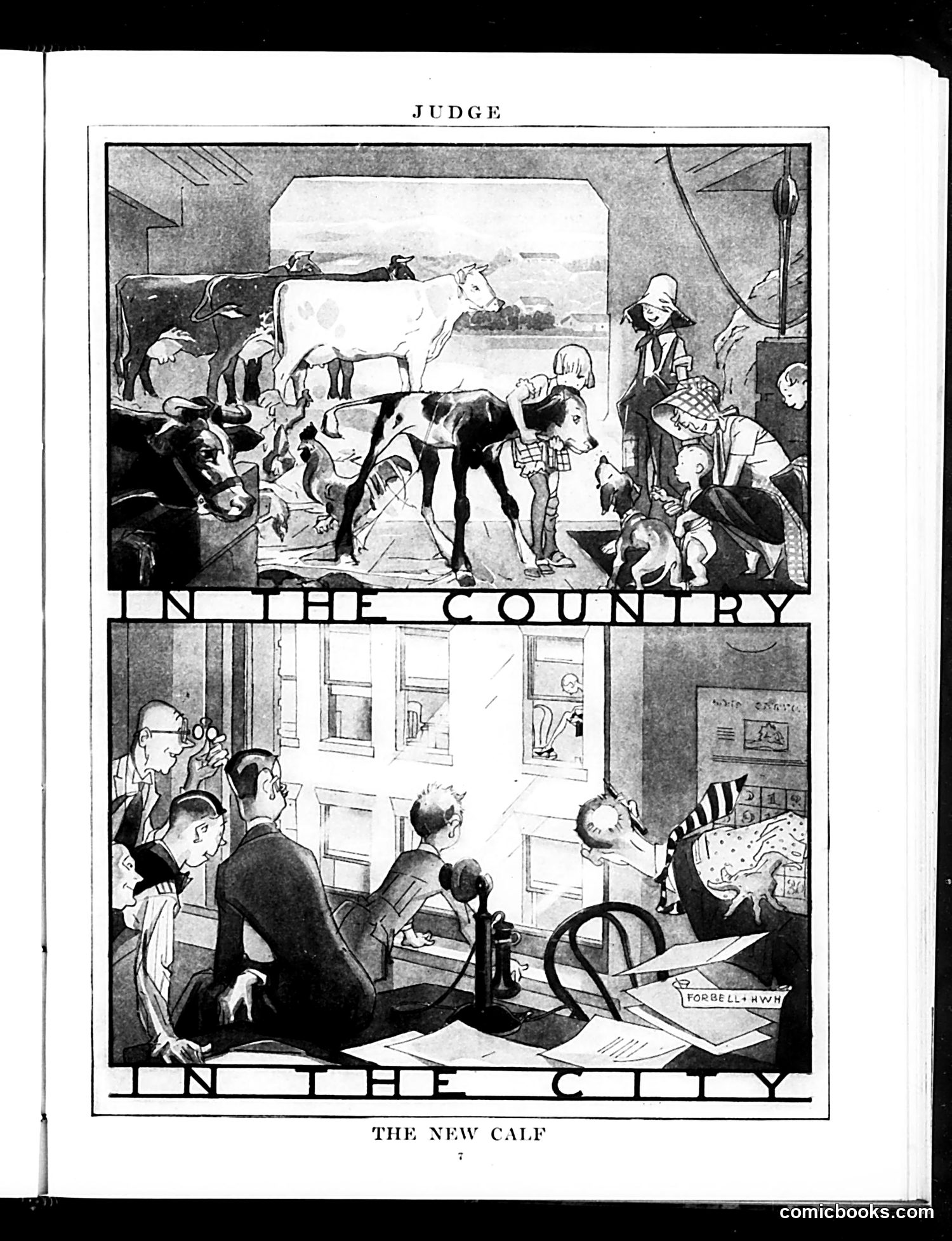
This two-panel Judge comic contrasts rural and urban life through the experience of a new calf. The top panel shows country folk—farmers and children—examining a newborn calf in a barn setting with pastoral landscape visible. The bottom panel depicts city dwellers in an office or apartment interior, apparently viewing the same calf as a novelty or curiosity. The satire likely mocks how urbanites treat rural/agricultural subjects as exotic entertainment or oddities, while the country people regard the calf as routine farm life. It reflects early 20th-century tension between cosmopolitan city dwellers and rural Americans, with Judge's typically urbane magazine poking fun at the disconnect between these two worlds. The "new calf" serves as the vehicle for this social commentary.
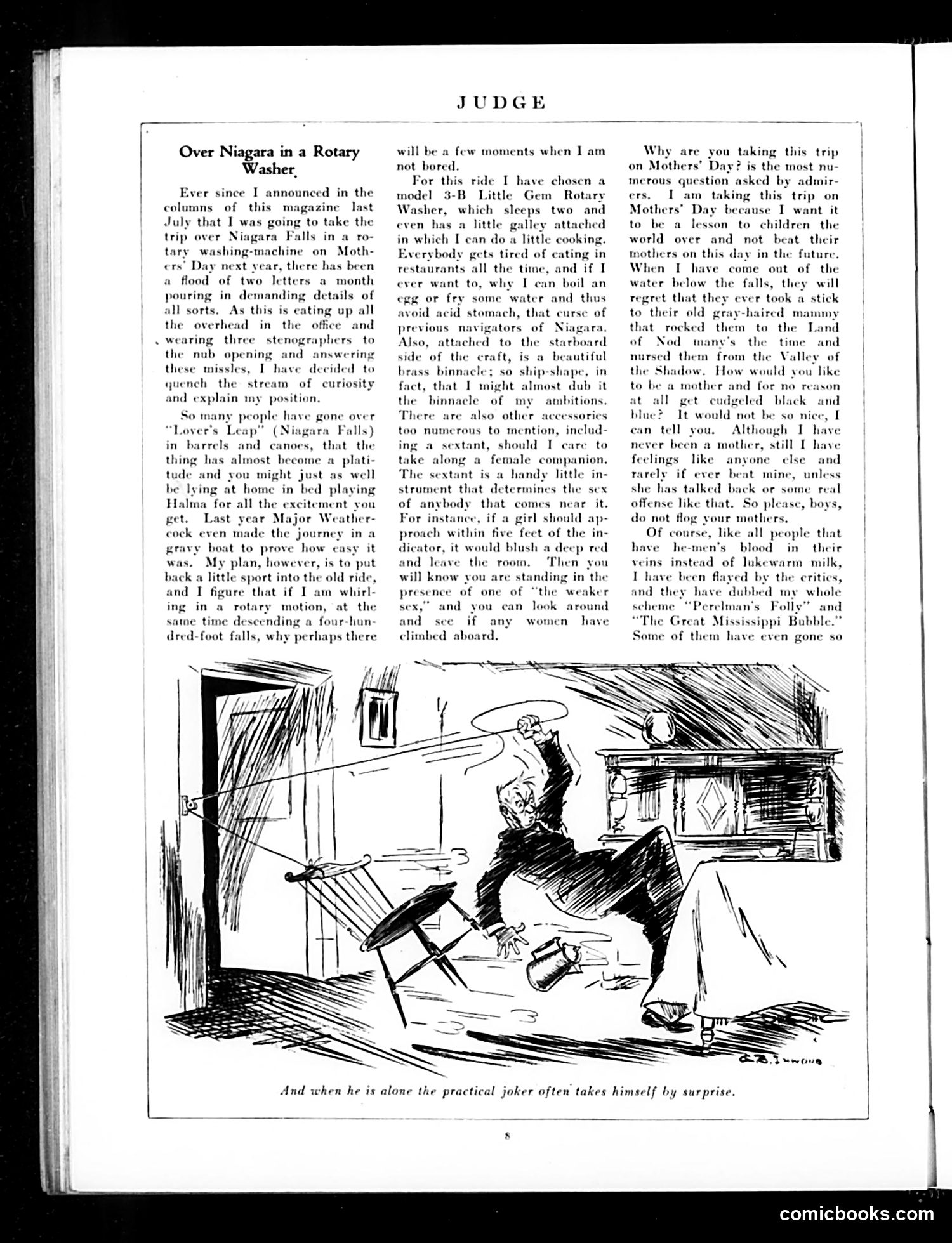
This is a humorous article about someone planning to go over Niagara Falls in a washing machine on Mother's Day. The author (likely S.J. Perelman, based on the "Perelman's Folly" reference) is satirizing both daredevil stunts and absurd publicity seeking. The joke relies on several layers: novelty seekers have made Niagara Falls jumps so common they're boring, so the author will add "sport" by spinning in a washing machine simultaneously. The nonsensical details—a galley for cooking, a brass binnacle, a "sextant" that determines people's sex—mock overwrought adventure narratives. The Mother's Day angle parodies moralizing justifications for dangerous stunts. The cartoon shows a man doing laundry indoors, reflecting the article's tongue-in-cheek treatment of the grandiose scheme. This exemplifies *Judge* magazine's satirical style: absurdist humor deflating contemporary trends and pretensions through exaggeration and deadpan delivery.
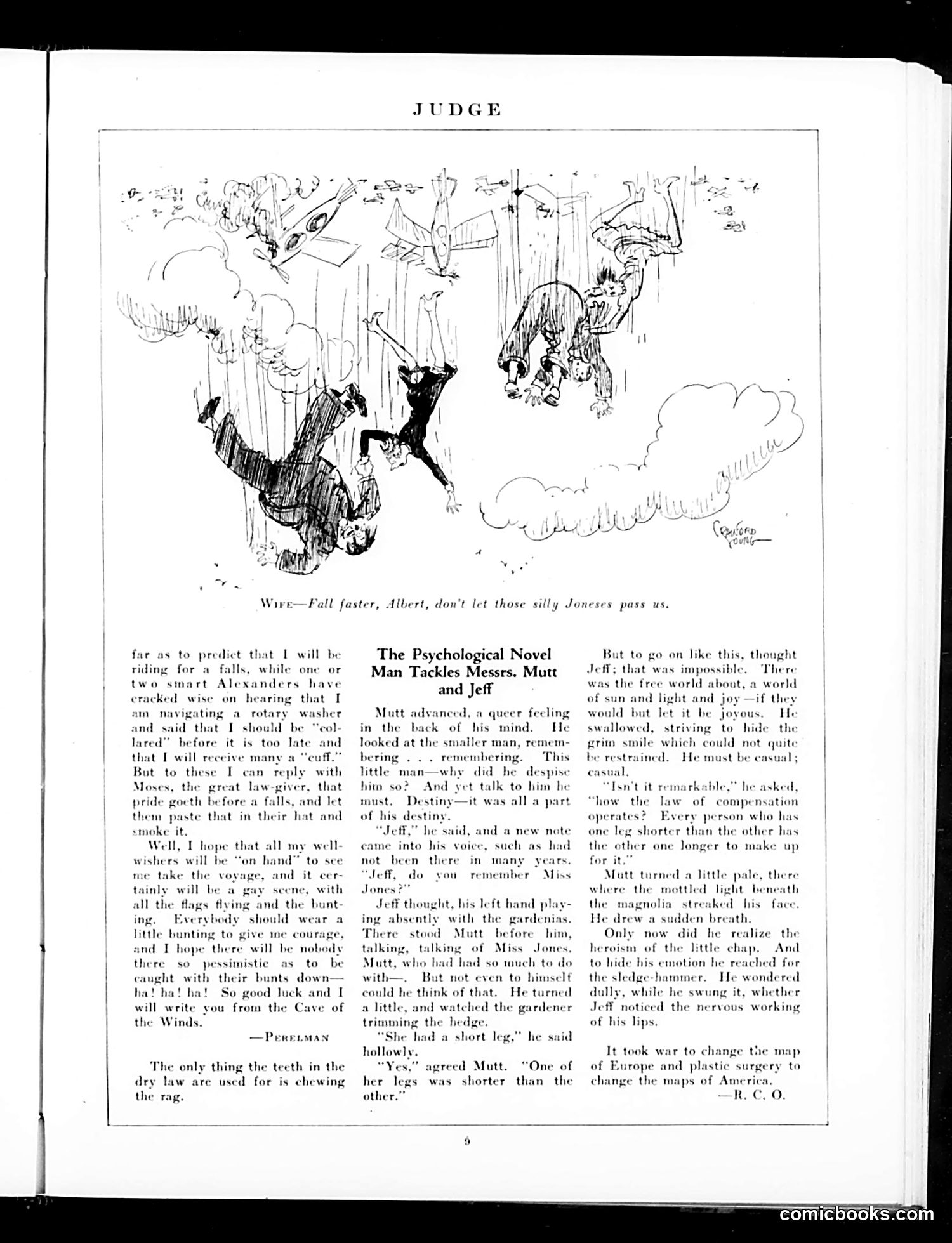
This page from *Judge* contains two distinct pieces: **The Cartoon (top):** "Wire—Fall faster, Albert, don't let those silly Joneses pass us" depicts figures falling or tumbling through clouds and debris. This appears to be satirizing competitive social climbing or financial competition during the early 20th century—the "keeping up with the Joneses" mentality. The reference to "Joneses" suggests wealthy neighbors whom people felt pressured to match in lifestyle. **The Story (bottom):** "The Psychological Novel Man Tackles Messrs. Mutt and Jeff" is a parody of modernist psychological fiction (then trendy). It mocks the overwrought introspection of literary novels by applying intense, brooding analysis to the comic strip characters Mutt and Jeff—known for simple slapstick humor. The joke: treating comedic characters' mundane observations about a woman's short leg with pseudo-intellectual depth. This satirizes the pretentiousness of psychological realism in contemporary literature. The brief joke about "dry law" references Prohibition-era constraints on alcohol.
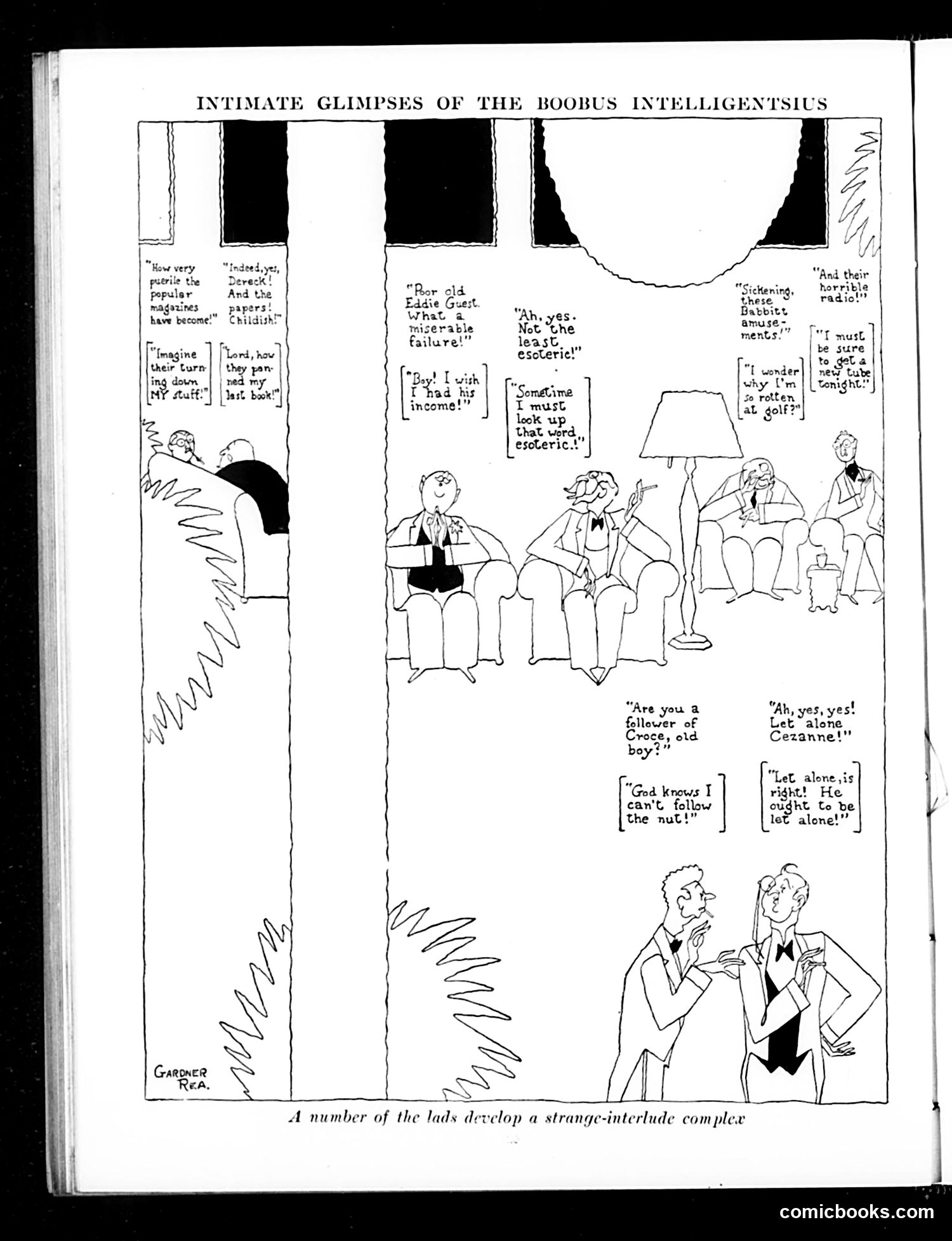
This satirical cartoon mocks pretentious American intellectuals of the Jazz Age who affect European sophistication and artistic seriousness. The title "Boobus Intelligentsius" combines H.L. Mencken's term "booboisie" with mock-Latin, establishing the target: self-important pseudo-intellectuals. The figures depicted—including what appears to be poet Eddie Guest—complain about vulgar magazines, failed artistic ambitions, and insufficient income while dropping names like philosopher Benedetto Croce, painter Cézanne, and Dante's *Divine Comedy*. They reference obscure terms like "esoteric" without understanding them. The satire attacks the affectation of Continental European cultural superiority, the pretense of esoteric knowledge, and the gap between these intellectuals' inflated self-regard and modest actual achievements. The caption references Eugene O'Neill's *Strange Interlude*, suggesting these figures are theatrically neurotic poseurs. The cartoon mocks American cultural anxiety and snobbery during the 1920s.
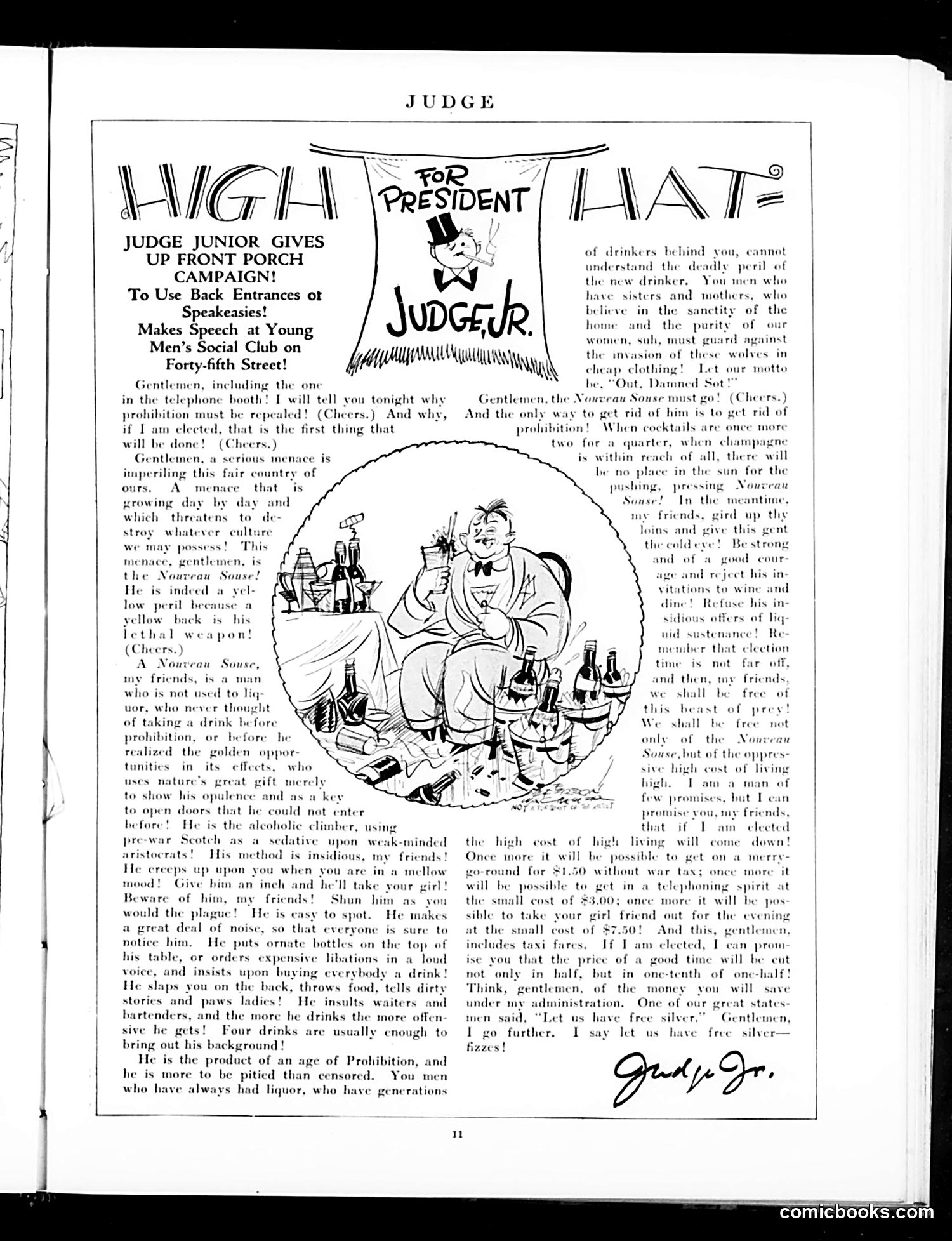
This page satirizes Prohibition-era politics and the newly wealthy "Nouveau Souse" (nouveau riche drunk). A political candidate named "Judge Junior" campaigns in speakeasies rather than front porches, promising to repeal Prohibition if elected. The satire targets two groups: the "Nouveau Souse"—newly rich people who drink ostentatiously to display wealth and status, behaving obnoxiously in public—and politicians exploiting Prohibition for votes. The candidate mocks these newly wealthy drinkers as uncultured, dangerous threats to society who previously never drank but now flaunt expensive liquor loudly. The irony is thick: the politician's solution to eliminate this problematic class is simply to repeal Prohibition and make alcohol cheap again ($1.50 cocktails), assuming availability will eliminate their pretentious showing-off. The cartoon ridicules both Prohibition's failures and the shallow materialism of wealthy Americans during the 1920s.
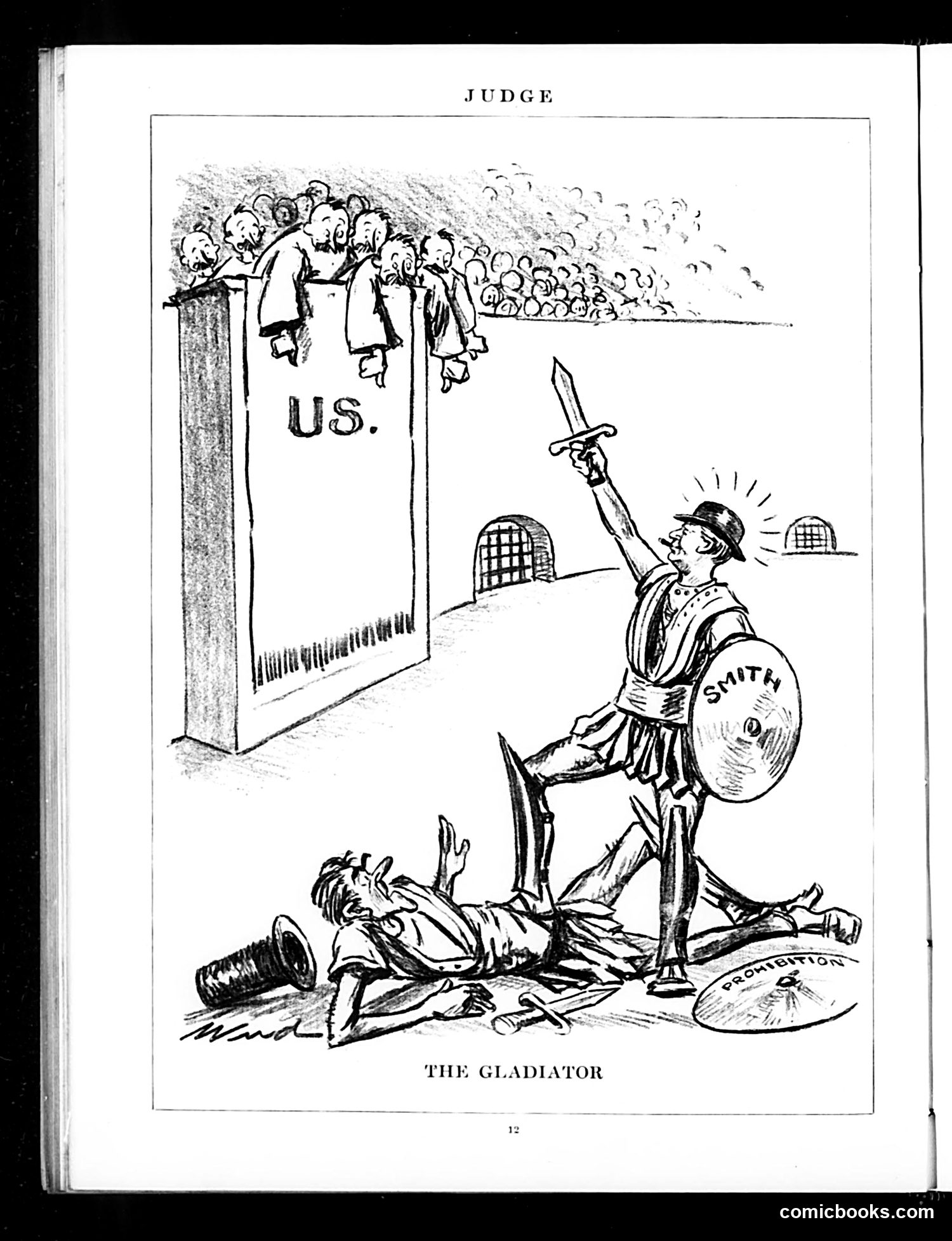
This cartoon satirizes judicial authority through gladiator imagery. A figure labeled "SMITH" (likely a judge or judicial official) stands victorious with sword and shield, positioned above a fallen opponent labeled "PROHIBITION." The tall structure labeled "U.S." contains spectators—representing the American public or judiciary—watching the contest like a Roman arena audience. The gladiator's triumph over Prohibition suggests either celebrating alcohol's legal victory or mocking judicial decisions regarding Prohibition enforcement. The cartoon's title and classical imagery transform a legal/political conflict into ancient combat, emphasizing the dramatic stakes and public spectacle surrounding Prohibition-era court battles. Without additional dating, the specific "Smith" reference remains unclear, though this appears critical of Prohibition's judicial outcome.
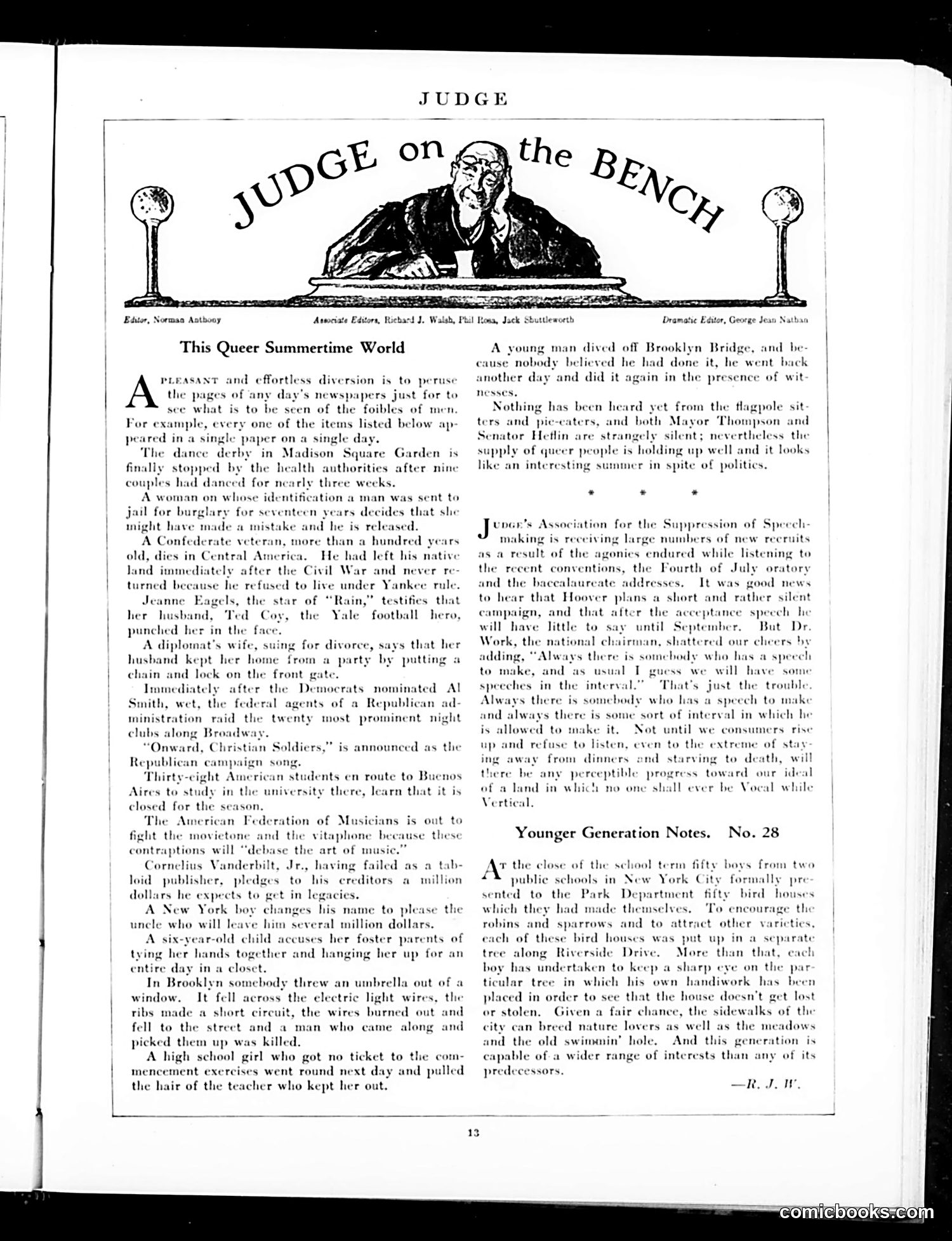
This page satirizes the absurdity of contemporary American life by cataloging bizarre news stories from a single newspaper. The "Judge on the Bench" masthead frames the commentary as judicial observation of societal folly. The main article lists genuinely strange 1928 events: a dance marathon, a Confederate veteran's death, Ted Coy's alleged spousal abuse, and a woman chained by her husband. These real incidents serve as evidence of widespread eccentricity—particularly the irrational crazes (flagpole sitting) and violent behavior dominating headlines. A secondary piece mocks the "Judge's Association for the Suppression of Speechmaking," complaining about political conventions, July 4th orations, and especially Herbert Hoover's campaign speeches. The joke targets mandatory public speaking as torture, suggesting politicians cannot resist talking despite audiences' suffering. The satire argues 1928 America has become absurd—crime, violence, and peculiar fads flourish while politicians drone endlessly. The magazine's tone is darkly comic resignation: this is simply "an interesting summer in spite of politics."
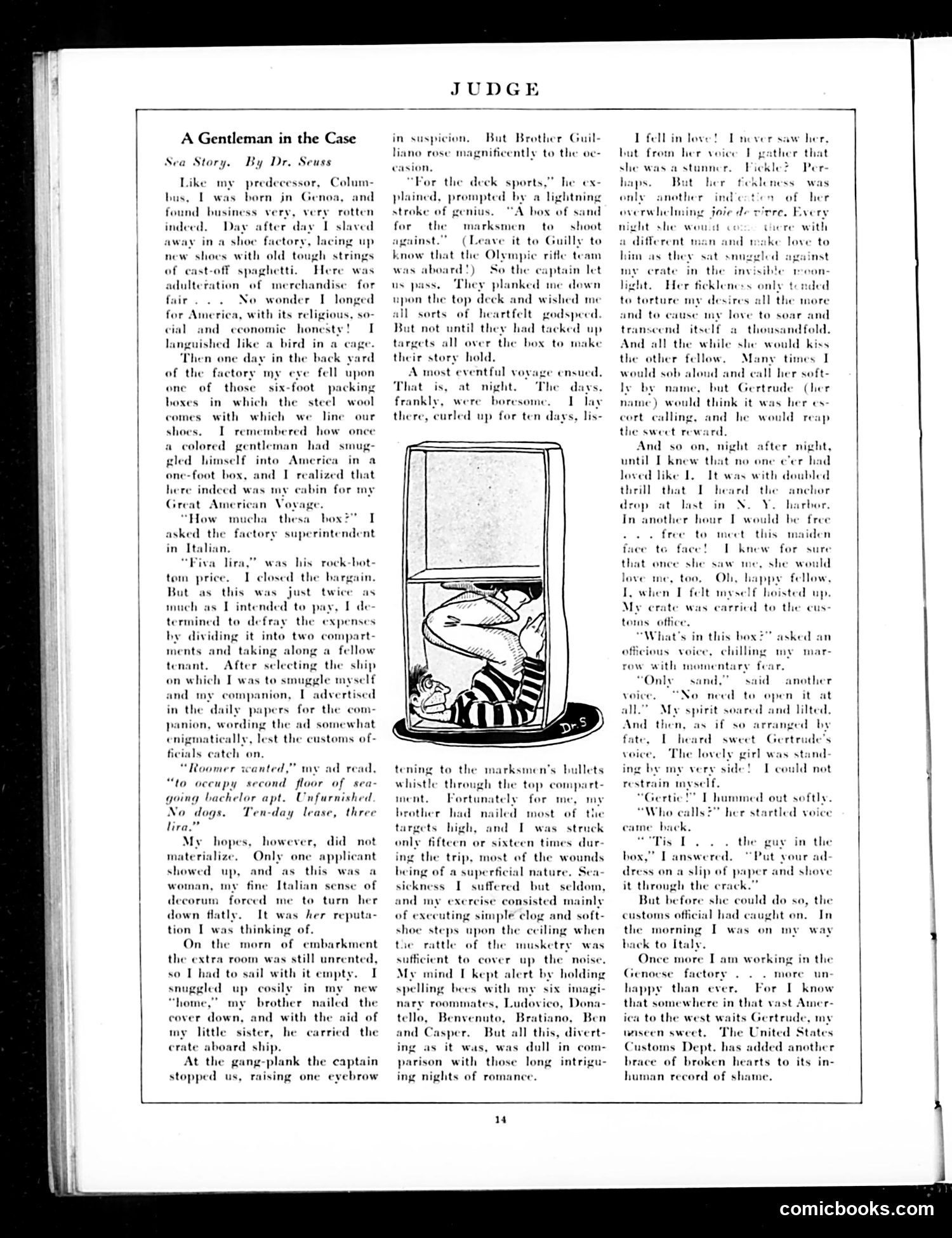
This is a humorous sea story satirizing immigration and smuggling into America. The narrator, an Italian immigrant working in a shoe factory, smuggles himself into the U.S. by hiding in a wooden crate labeled as "sand for marksmen." His brother places it on a ship's deck where an Olympic rifle team conveniently shoots at it as "target practice." The satire mocks: - **Immigration enforcement** (easily fooled customs officials) - **Italian immigrant stereotypes** (the narrator's broken English, his "fine Italian sense of decorum") - **Absurd smuggling methods** (the implausibly convenient rifle team) The romantic subplot—the narrator falling for an unseen woman in an adjacent cabin who entertains multiple men—adds comedic melodrama typical of Seuss's early work, contrasting his later children's books with his earlier satirical magazine contributions.
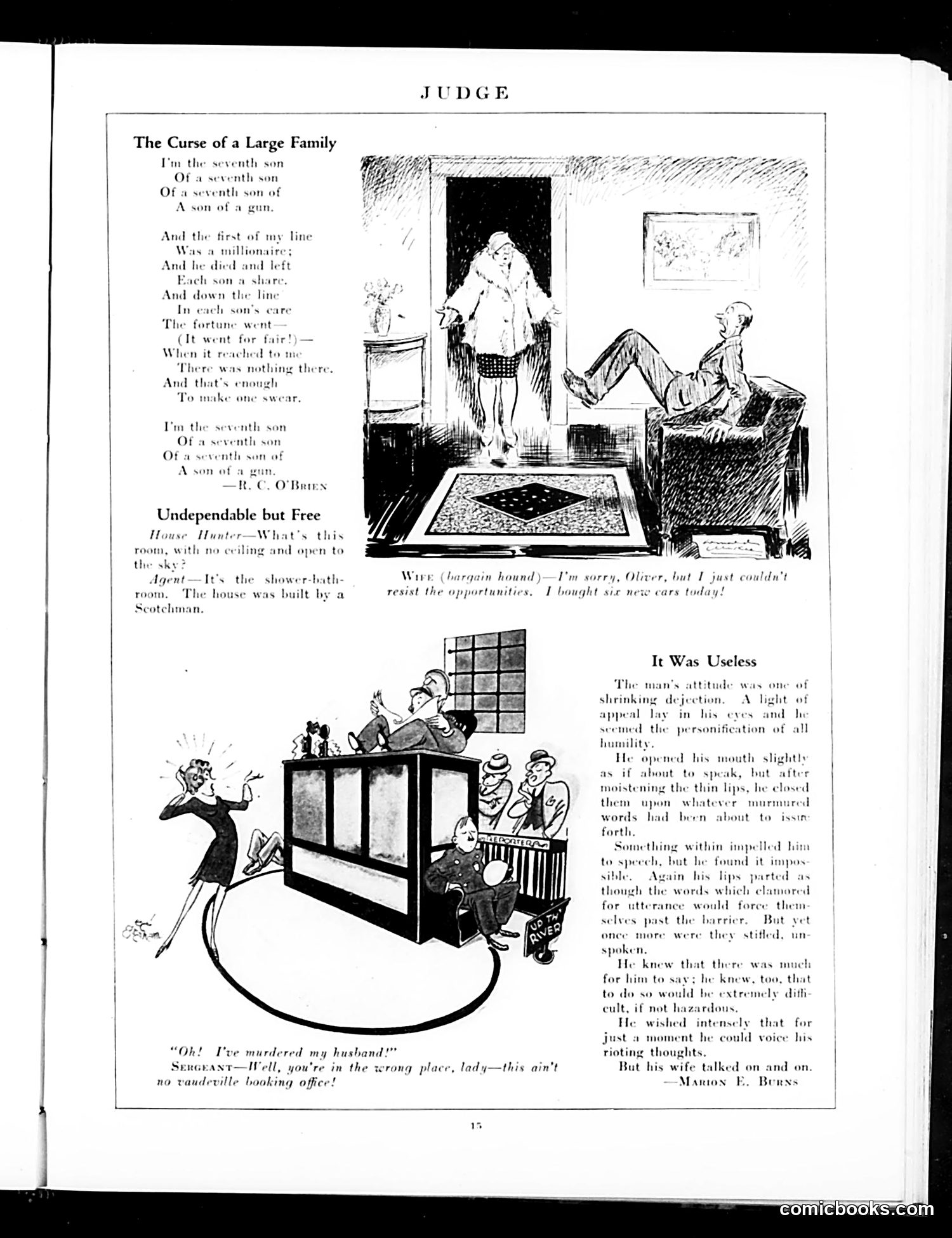
This page contains three distinct satirical pieces reflecting early 20th-century American anxieties: **"The Curse of a Large Family"** mocks inherited wealth's decline across generations. The speaker traces his ancestry through millionaires whose fortunes dwindle by the seventh generation—a commentary on wealth dissipation and poor money management among the privileged classes. **"Undependable but Free"** satirizes Scottish frugality (the house built by a Scotsman has a shower-bath instead of a proper room) and consumer excess (a wife buying six cars impulsively). The cartoon critiques both stingy construction and frivolous spending. **"It Was Useless"** depicts a husband repeatedly unable to speak while his wife talks ceaselessly. This reflects period anxieties about female chattiness and male powerlessness in marriage—common satirical targets when women's voices were gaining prominence socially and politically. The cartoons reveal class consciousness, gender tensions, and economic anxiety typical of the era.
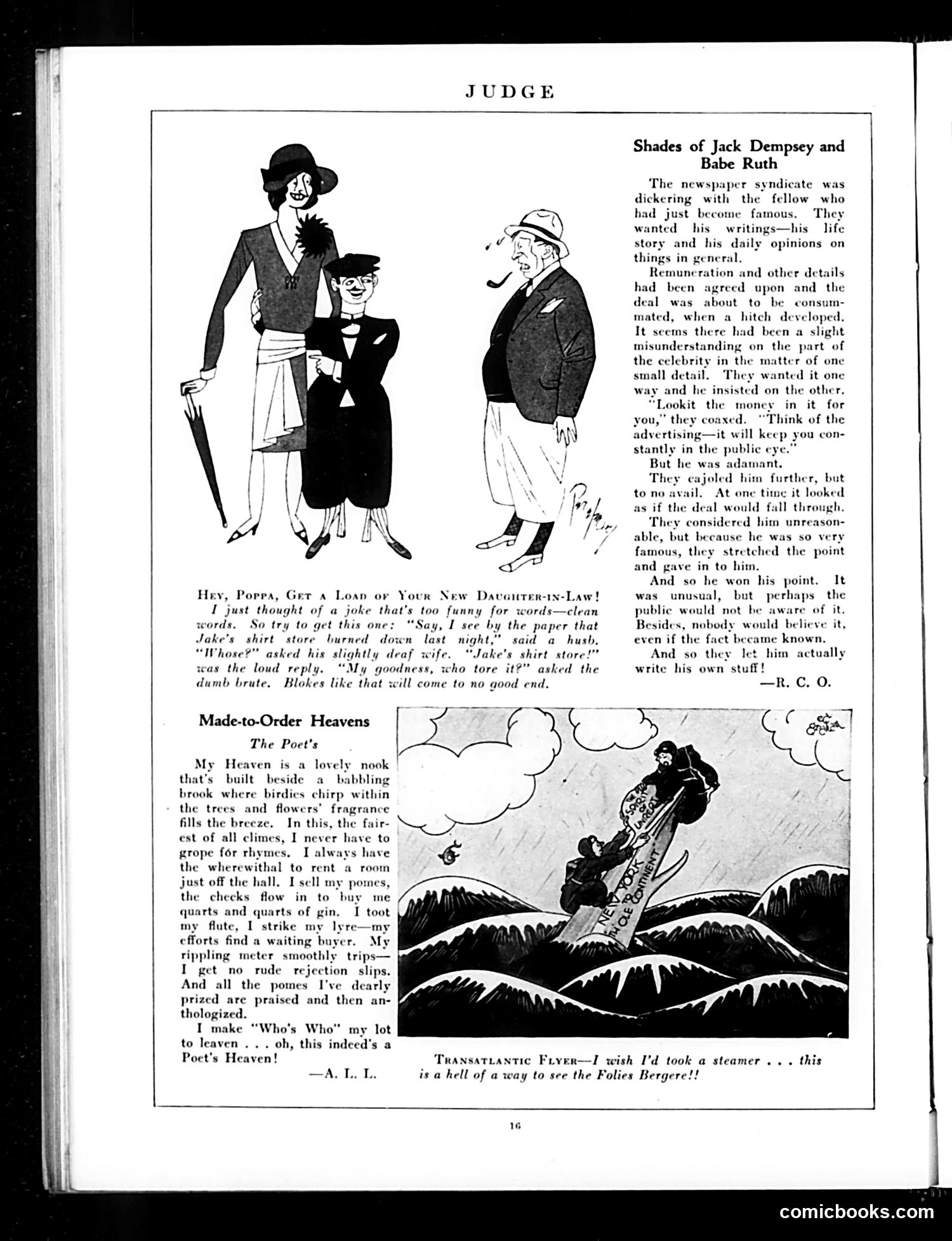
**Top Section ("Shades of Jack Dempsey and Babe Ruth"):** This satirical piece discusses a newspaper syndicate negotiating with a newly famous celebrity (likely a sports figure, given the Dempsey/Ruth reference—both major 1920s sports icons). The humor centers on the celebrity's unexpected demand: he insists on writing his own material rather than having ghostwriters. The syndicate finds this absurd—they expect famous people to be content with money and publicity, not actual creative control. The joke's twist is that they eventually capitulate because his fame is too valuable to lose. The satire mocks both celebrity entitlement and media desperation. **Middle Section ("Made-to-Order Heavens"):** A poet's humorous verse describing his ideal heaven: a picturesque setting where he never struggles to write, his poems sell immediately, and checks flow in for gin. He gets no rejection slips and his work gets anthologized. The satire targets poets' romantic self-image and their financial struggles—his "heaven" is simply modest commercial success, highlighting the actual poverty most poets face. **Bottom Cartoon:** A transatlantic passenger regrets his ocean voyage, wishing he'd taken a steamer instead to see the Folies Bergère (famous Parisian cabaret). Brief visual gag about travel priorities.
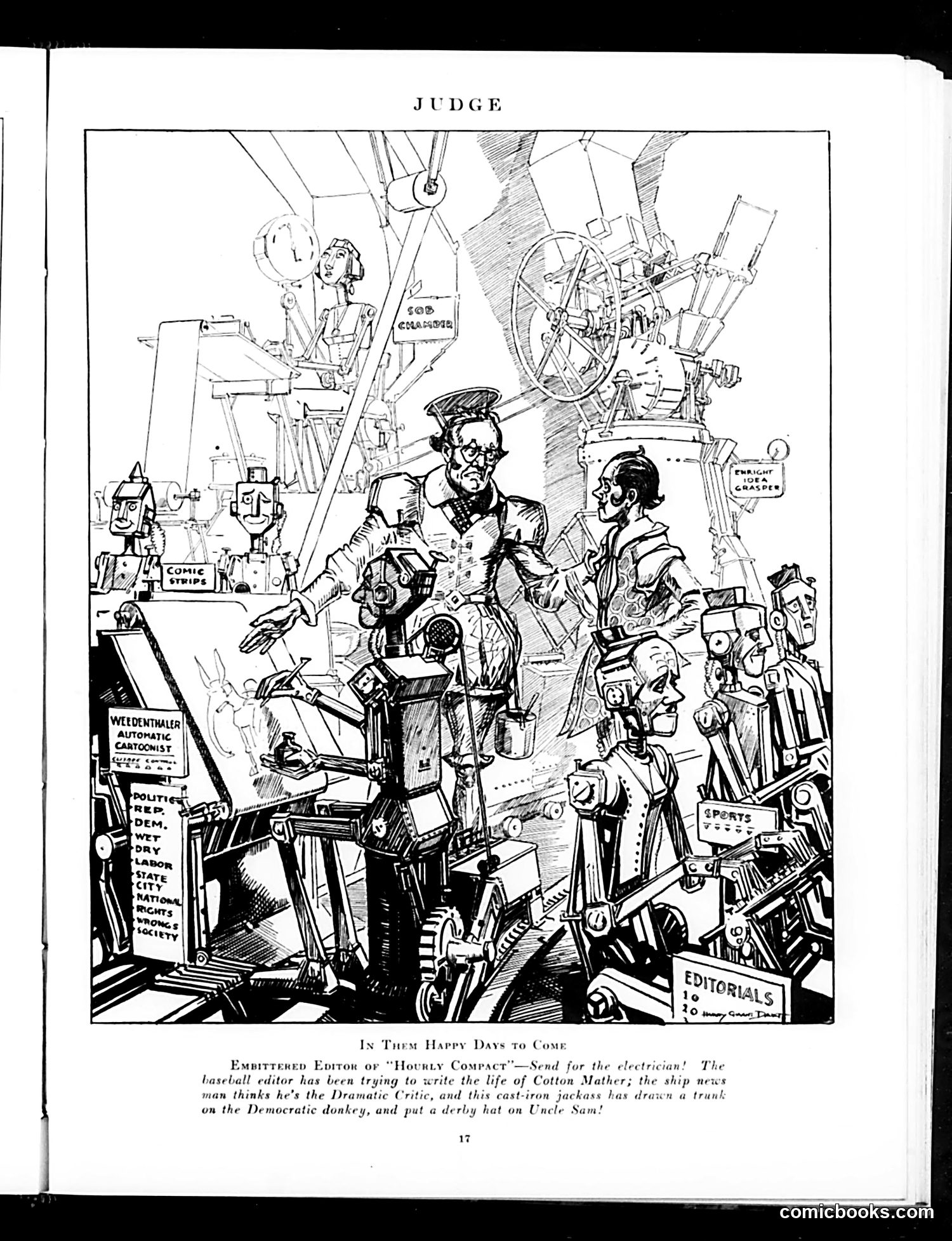
This cartoon mocks a disorganized newspaper office where roles have become absurdly mixed up. The central figure, labeled an editor of "Hourly Compact," has apparently confused his job responsibilities: a baseball editor is attempting to write about Cotton Mather (a Puritan theologian), someone thinks he's a dramatic critic, and various mechanical/industrial figures surround them in chaotic disarray. The specific references—drawing on the Democratic donkey and placing a derby hat on Uncle Sam—suggest political satire about confused messaging or incompetent editorial judgment regarding American politics and identity. The machinery and multiple labeled figures (visible on boxes including "Politics," "Sports," "Editorials") represent different newspaper departments in complete disorder, satirizing poor management and the general incompetence of the publication's leadership.
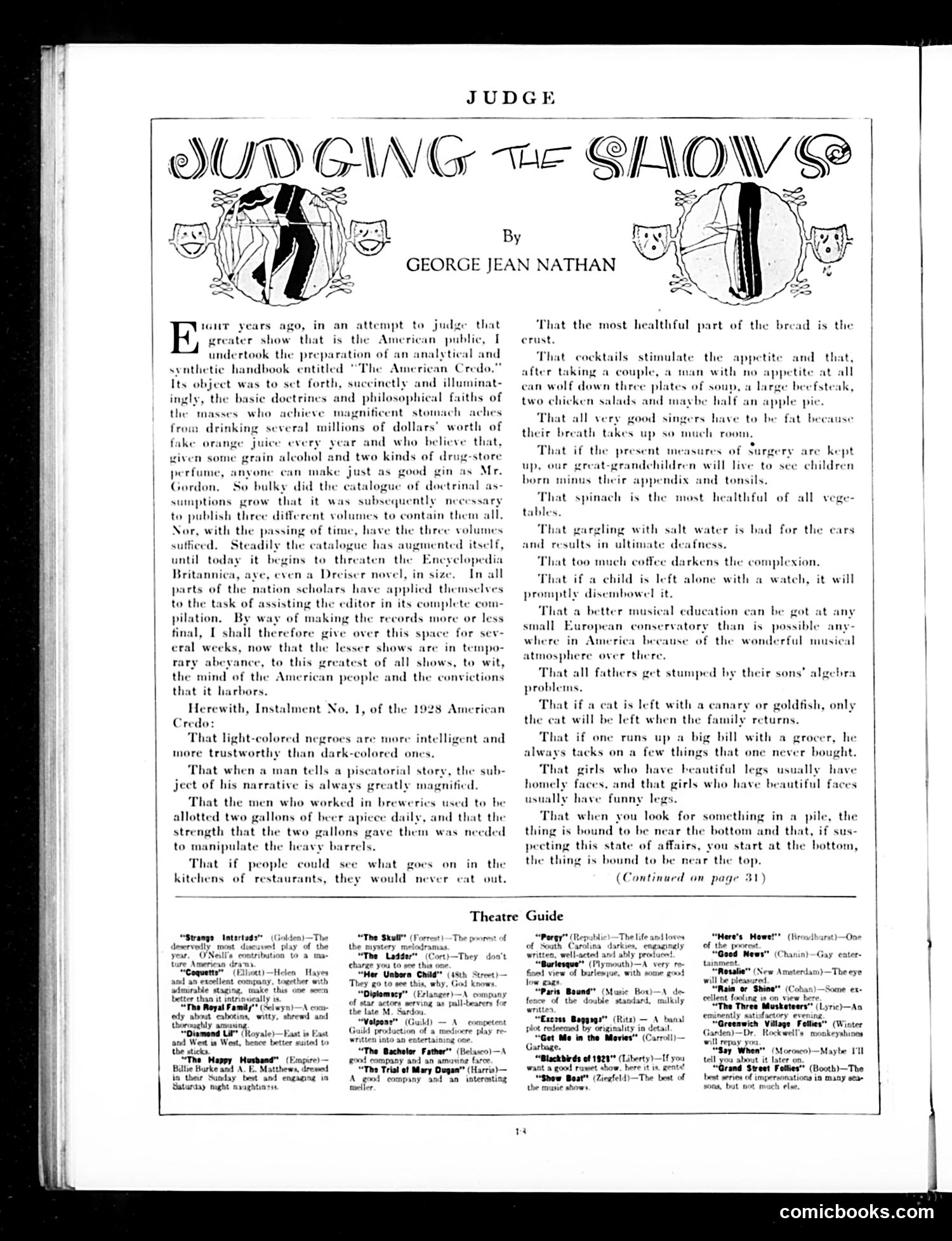
This is the opening installment of Nathan's "1928 American Credo"—a satirical catalog of popular American beliefs and superstitions. Rather than discussing theater (despite Judge being a theatrical magazine), Nathan uses his column to mock widespread folk wisdom and misconceptions held by ordinary Americans. The satire targets pseudoscientific health claims (coffee darkens skin, salt-water gargles cause deafness), dubious folk logic (fat singers have more breath capacity), and aphoristic observations presented as universal truths. Many entries appear deliberately absurd—that brewery workers could lift barrels after two daily beer rations, or that looking in a pile guarantees the item is at the bottom. Nathan's approach is anthropological: he catalogs American credulity as if documenting an exotic culture's belief system. The satire gently mocks the American public's appetite for simple, memorable "facts" that explain the world, however inaccurately. The installment continues on page 31.
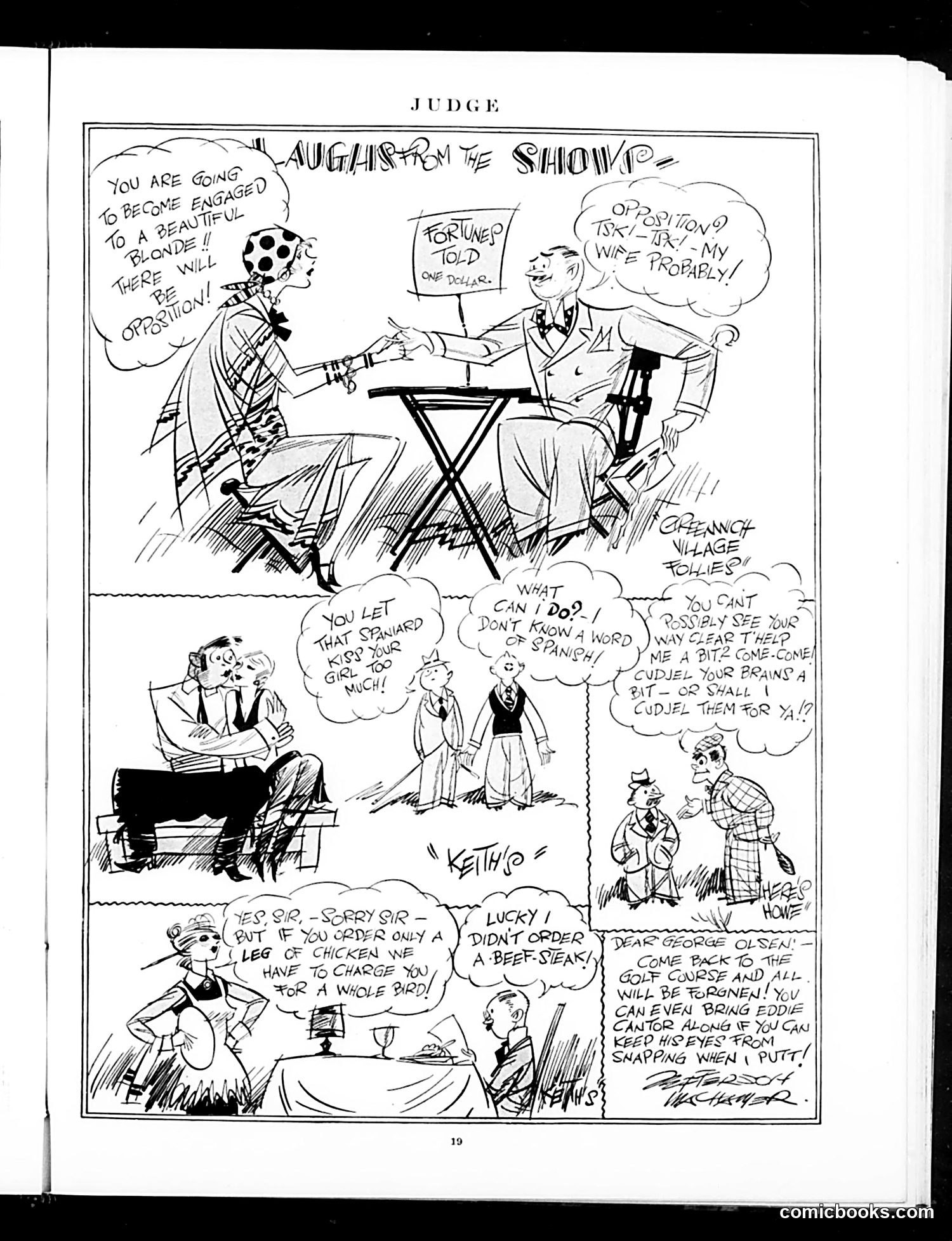
This Judge magazine page satirizes marriage and gender relations through multiple comic vignettes. The main panel depicts a fortune teller predicting a man will marry a "beautiful blonde," while the woman opposite insists marriage will lead to "opposition" and "wife problems"—presenting opposing anxieties about matrimony. Subsequent panels mock domestic life: men complaining about their wives' spending and control, wives lamenting husbands' behavior. One scene shows a waiter charging extra for chicken because it's rationed, suggesting WWI-era food scarcity. The final panel references entertainer George Olsen and Eddie Cantor, implying a husband fantasizes about escape to golf and show business. The satire targets the era's marital power struggles and the tension between romantic expectations and harsh domestic reality. The cartoon reflects 1920s anxieties about women's increasing independence and the breakdown of traditional male authority in marriage.
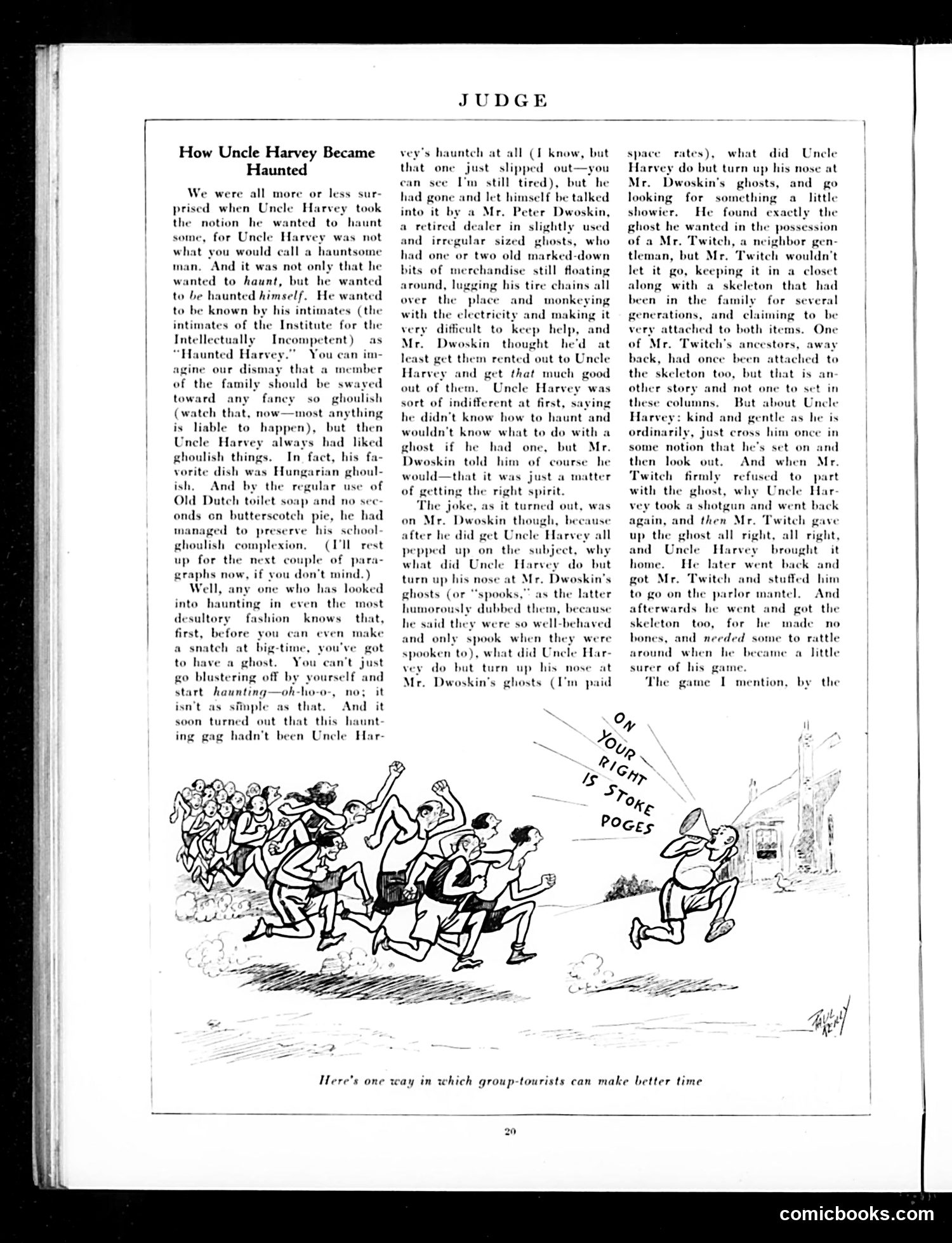
This humorous story satirizes the American tourist industry and leisure class absurdities of the early 20th century. Uncle Harvey, a member of an "Institute for the Intellectually Incompetent," decides he wants to both haunt and be haunted—a nonsensical aspiration that parodies wealthy people's frivolous pursuits. The satire targets commercialized "haunting" as a leisure activity, with Mr. Dwoskin operating as a ghost-rental salesman peddling "slightly used and irregular sized ghosts" like merchandise. The joke mocks consumer culture: Uncle Harvey rejects these budget ghosts, then forcibly acquires a superior specimen from Mr. Twitch, even shooting at him. The accompanying cartoon depicts tourists fleeing from a "stoke poges" haunting, captioned "Here's one way in which group-tourists can make better time"—suggesting organized tourist experiences were absurdly commercialized and anxiety-inducing. The piece ridicules both the wealthy's silly pastimes and the emerging tourist industry's commodification of experiences.
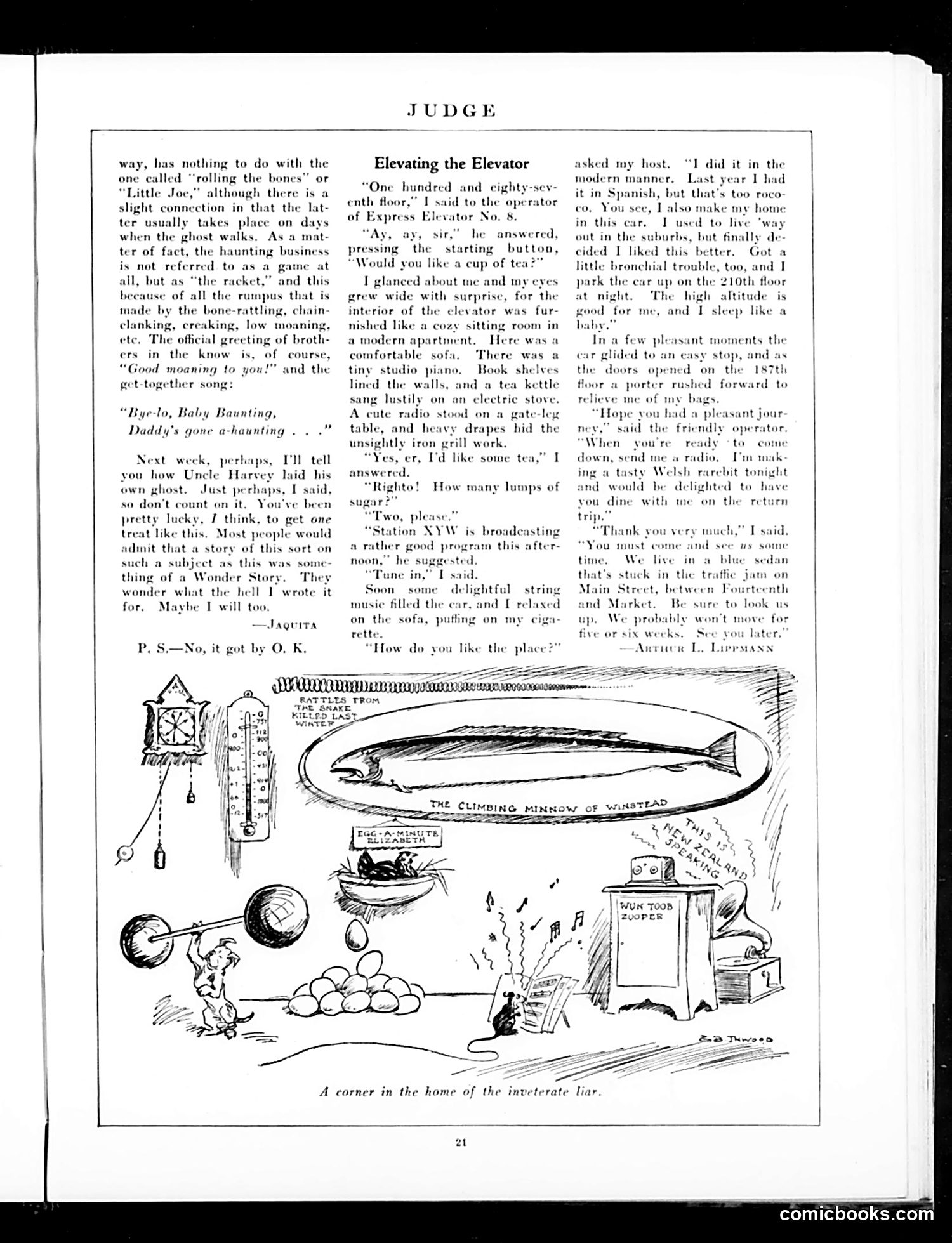
This satirical piece mocks the modern obsession with luxury and comfort, even in utilitarian spaces. The narrator describes an elevator operator who has transformed his work space into a fully appointed apartment—complete with sofa, piano, radio, tea service, and drapes—treating what should be a functional transit vehicle as a residential living room. The joke lies in the absurdity of this excess and the narrator's casual acceptance of it. The final exchange reveals the deeper satire: the operator's own living situation is a car permanently stuck in traffic on Main Street—he's invested such effort in decorating his elevator that he neglects his actual home. This critiques 1920s American materialism and the era's fetishization of modern conveniences. The illustration's bottom caption, "A corner in the home of the inveterate liar," suggests the whole scenario is fabricated tall tale—a characteristic Judge magazine device for social commentary.
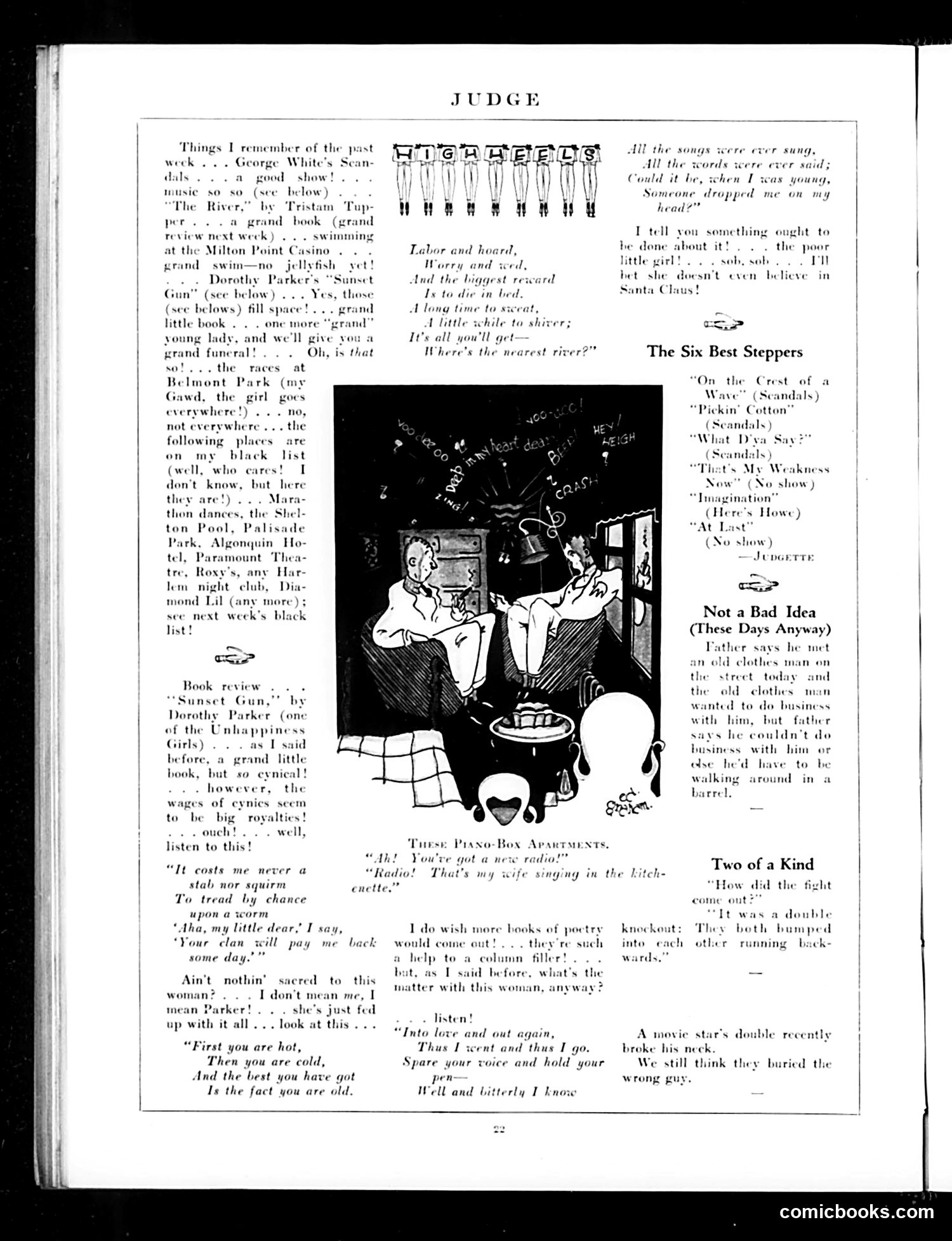
This page from *Judge* magazine features celebrity gossip, book reviews, and humorous social commentary typical of 1920s entertainment coverage. **Main Content:** The page opens with a gossip column about theatrical events and socialite activities (George White's shows, Dorothy Parker's poetry collection "Sunset Gun"). A central cartoon depicts two people in an apartment with a radio, captioned about a wife singing in the kitchen. **Dorothy Parker Satire:** The extended book review mocks Parker's cynicism through quoted verses about life's disappointments—labor, worry, death, and suffering. The commentary suggests her poetry is darkly pessimistic: "so cynical!" yet commercially successful ("big royalties"). **Social Humor:** Brief items include complaints about marathon dances and nightclub venues, a joke about an old clothes man who can't do business without wearing rags, and movie reviews of popular musicals. **The Satire:** The page satirizes modern 1920s anxieties (radio technology, cynical literature) and pokes fun at celebrity culture and literary pretension, characteristic of *Judge's* urbane, sophisticated humor aimed at educated readers.
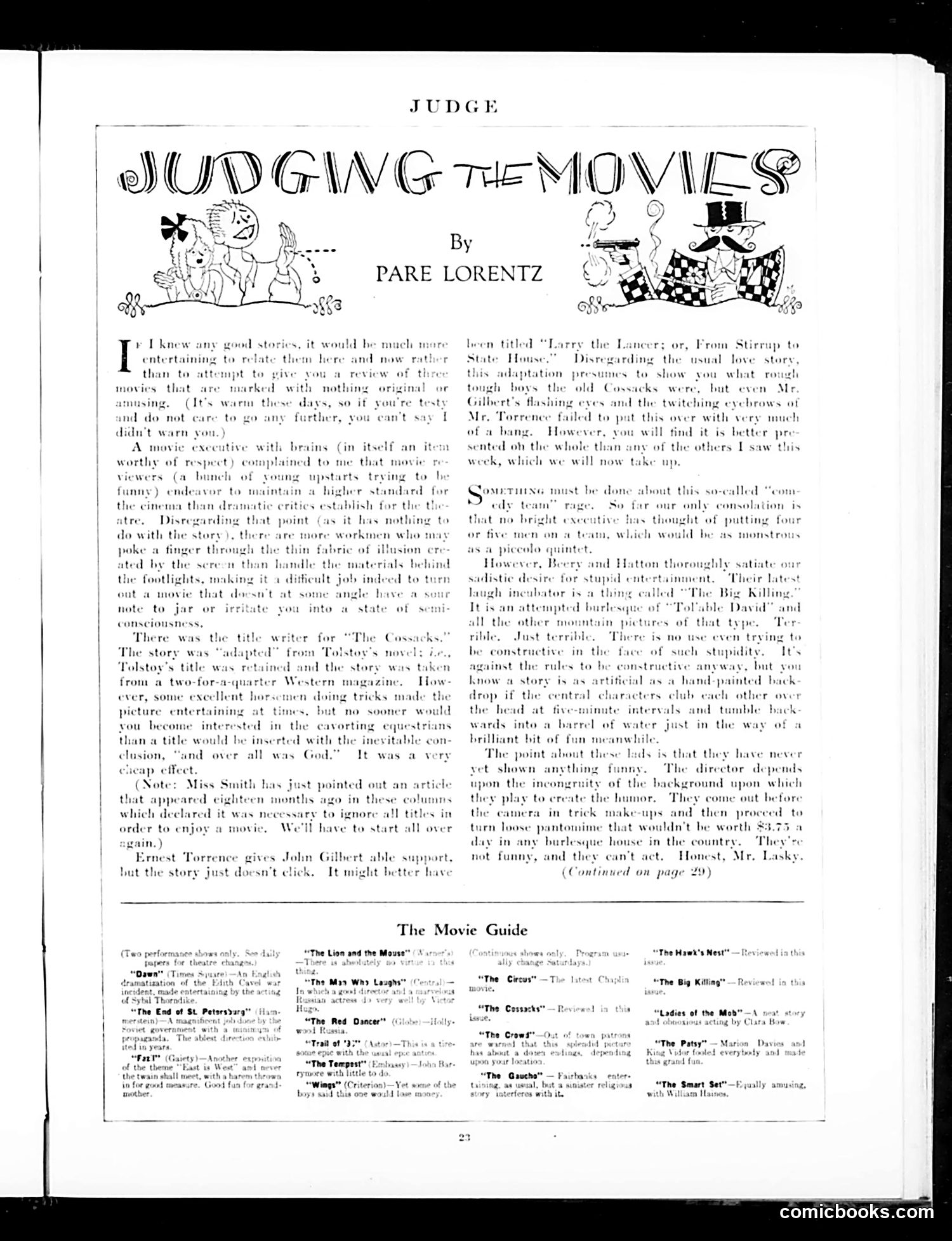
This is a film criticism column by Pare Lorentz reviewing recent Hollywood movies, primarily focusing on *The Cossacks*, a silent film starring John Gilbert and Ernest Torrence. **The Satire:** Lorentz mocks the incompetence of Hollywood "movie executives with brains" and the low standards of dramatic critics. He criticizes *The Cossacks* as a poorly adapted Tolstoy novel that fails narratively—featuring awkward title cards ("and over all was God") inserted to explain confusing action sequences. **Key Targets:** - The film's reliance on slapstick "comedy teams" and artificial pantomime over genuine humor - Incompetent female performers who resort to trick makeup rather than actual acting talent - The filmmaker's (apparently producer Louis B. Mayer, "Mr. Lasky") cynical approach of hiring cheap burlesque performers **Context:** This reflects 1920s anxieties about silent cinema's artistic legitimacy—critics debated whether movies deserved serious evaluation or were merely mechanical entertainment.
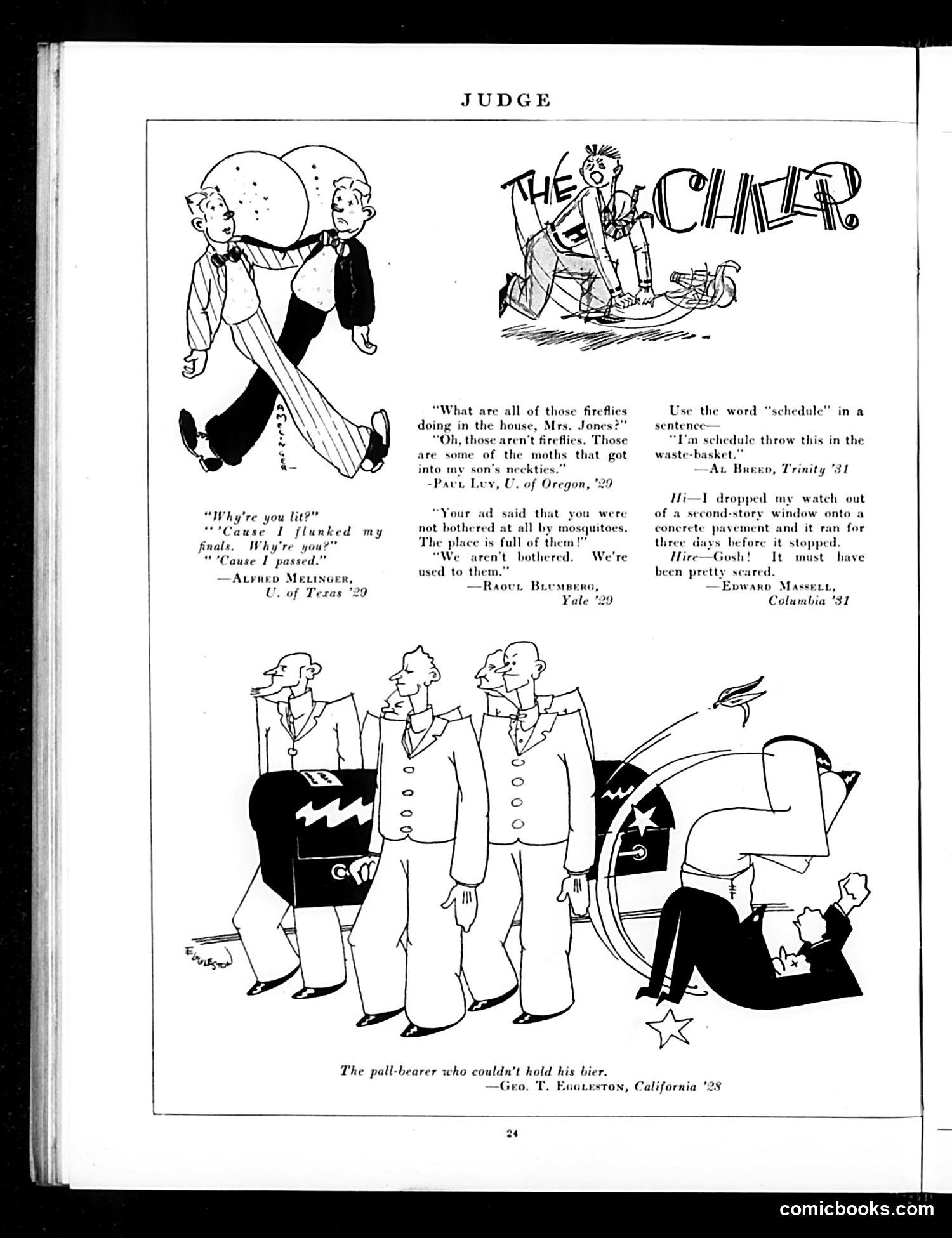
This page collects college humor submissions from various universities (circa 1928-1931). The jokes reflect typical collegiate comedy of the era: **The "Pall-bearer" cartoon** shows three men carrying a coffin labeled with lightning bolts and a star—a visual pun on "bier" (funeral stand) versus "beer" (alcohol). The joke plays on Prohibition's illegality; the pallbearer "couldn't hold his bier" because bootleg alcohol was unstable or the act itself was criminal. **Text submissions** include: a student flunking exams vs. passing (contrasting reasons for intoxication); confusion between fireflies and moths in neckties (absurdist humor); a mosquito-infested resort claiming customers are "used to them" (dry joke about poor conditions); a watch surviving a three-story fall and running for days (tall tale humor); and wordplay on "schedule" used incorrectly. The page captures college wit from the Prohibition era, emphasizing alcohol references, academic life, and period-specific absurdist humor typical of Judge's student submissions section.
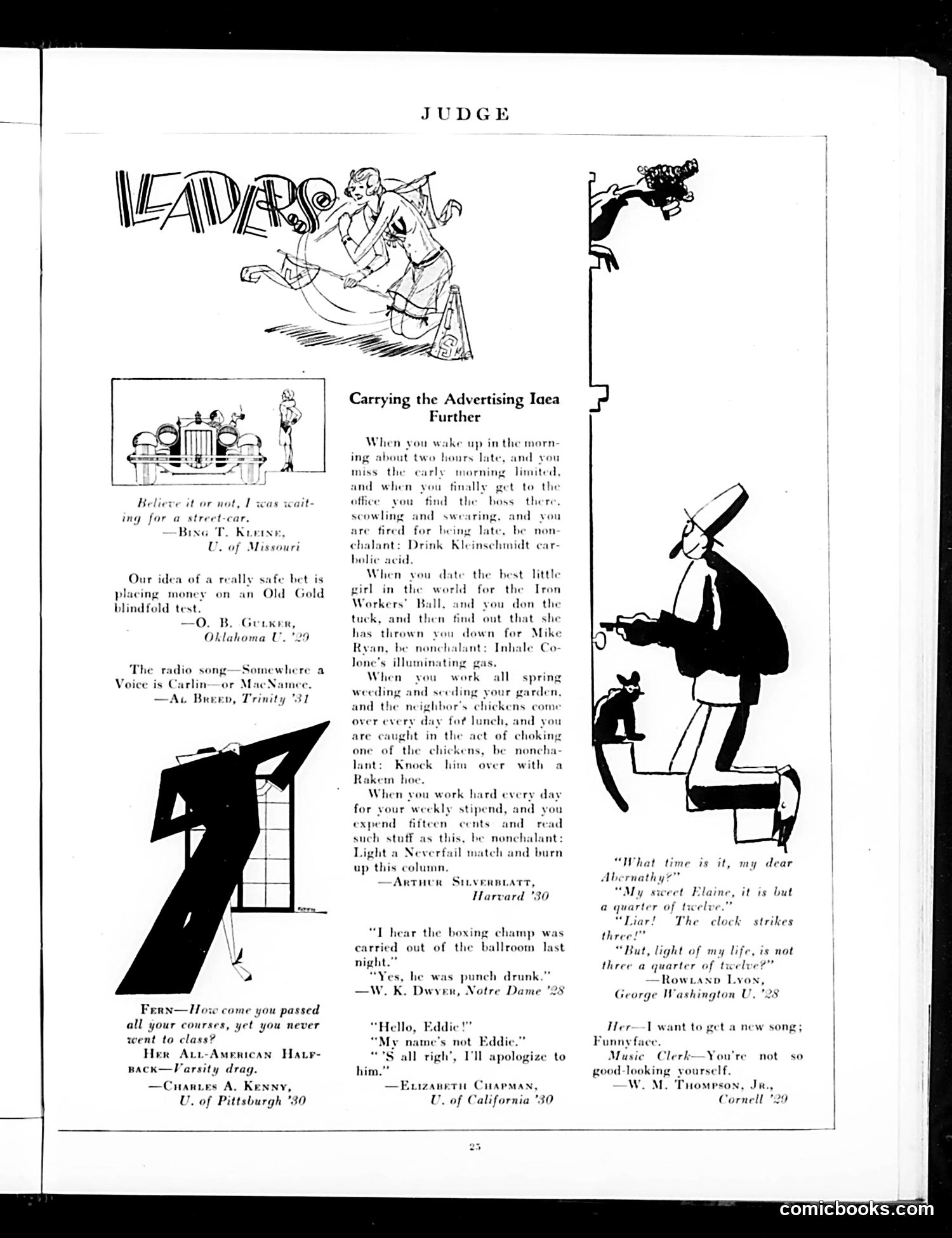
This page from Judge magazine combines humor columns with satirical commentary on 1920s college and urban life. The main feature, "Carrying the Advertising Idea Further," mocks advertising culture by suggesting absurd "nonchalant" responses to life's misfortunes—getting fired for lateness, romantic rejection, accidental animal cruelty—all "solved" by consuming advertised products like Kleinschmidt carbolic acid or Neverfail matches. The satire targets both advertising's empty promises and the era's affected coolness ("be nonchalant"). The surrounding section contains witty one-liners from college students at various universities, poking fun at campus life, dating mishaps, radio songs, and romantic deceptions. The cartoons depict exaggerated characters in comedic situations. The overall message critiques 1920s consumer culture and its reliance on products as solutions to genuine problems, while satirizing youth culture's superficial sophistication.
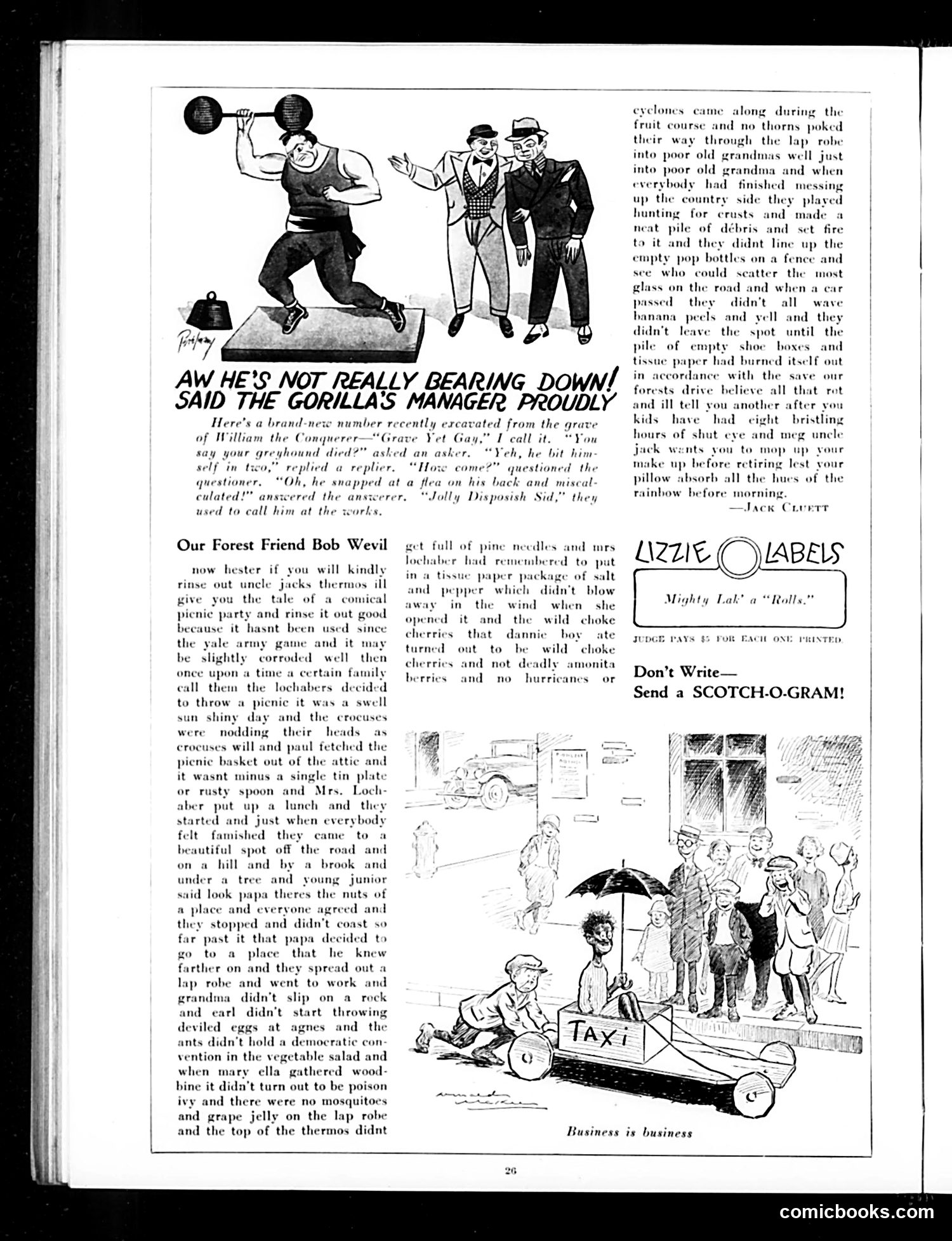
This page contains two distinct pieces of humor content: **Top cartoon:** A strongman advertises his prowess to onlookers. The manager claims he's "not really bearing down," suggesting the impressive feat requires minimal effort—a classic strongman-show boast. The small illustration depicts dumbbells, referencing circus or vaudeville strongman acts popular in early 20th-century entertainment. **"Our Forest Friend Bob Wevil" story:** A lengthy, rambling comic narrative about a family picnic that humorously emphasizes how *nothing* goes wrong—no broken dishes, no mosquitoes, no poison ivy, no spilled food. The ironic point is that real picnics are disasters, but this one is absurdly, impossibly perfect. It's satirizing the gap between idealized nature outings and messy reality. The page also includes advertisements: "Lizzie Labels" and "Scotch-O-Gram" products. The humor relies on the audience understanding early 20th-century leisure activities (picnics, circuses) and the contrast between expectation and reality.
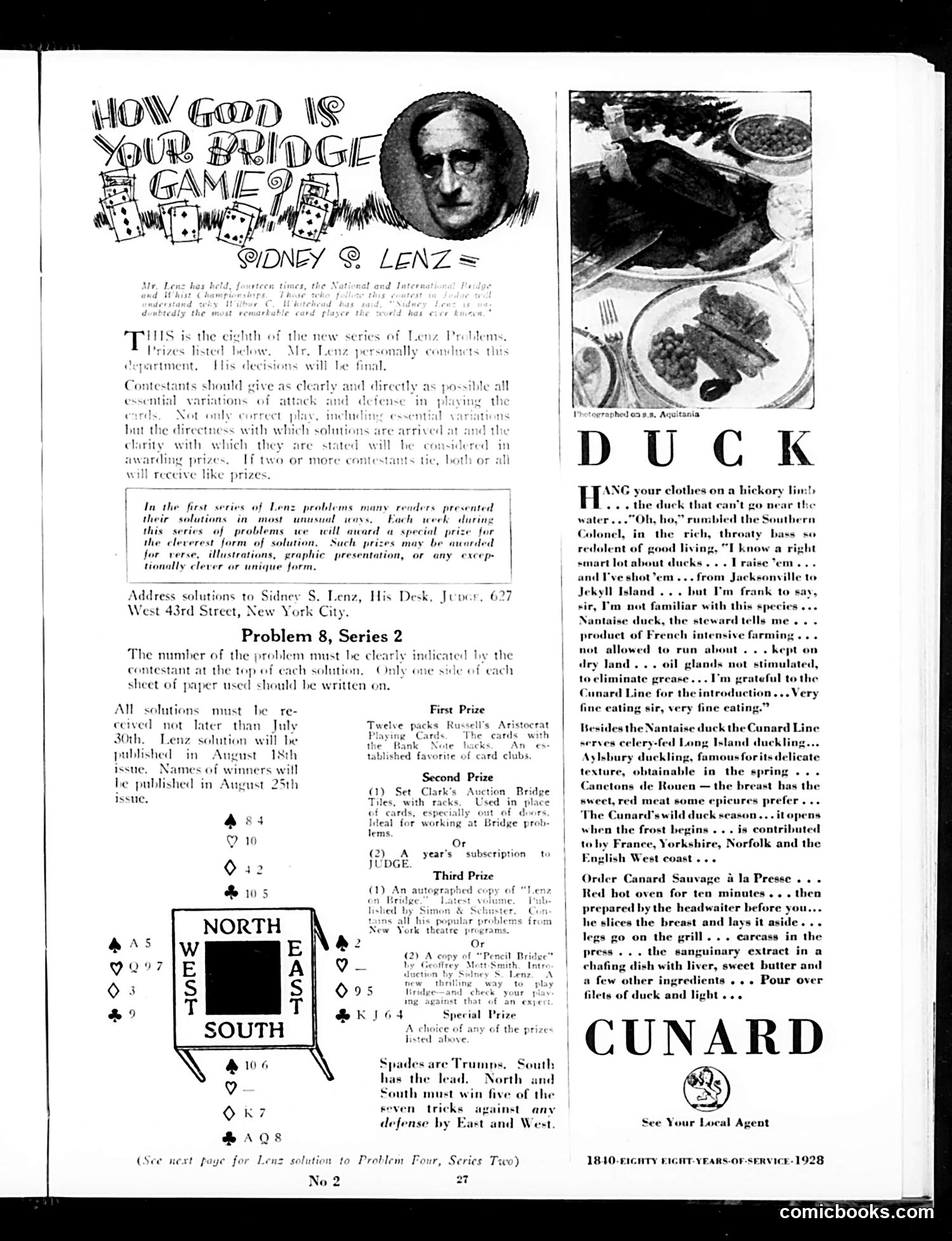
This page contains **two distinct elements**: a bridge card game problem by Sidney Lenz (a famous bridge expert), and an advertisement for Cunard Line steamship travel. The **Lenz Problem** section is a puzzle contest—readers submit solutions to a bridge hand, with prizes awarded not only for correct answers but for creative presentation (verse, illustrations, etc.). This was a popular recurring feature in Judge magazine. The **Cunard advertisement** is the noteworthy satirical content. It humorously promotes fine dining aboard Cunard ships by featuring an imaginary diner's stream-of-consciousness monologue about duck dishes. The joke juxtaposes the diner's casual, rambling remarks about various duck preparations (Nantaise duck, Aylesbury duckling, Canard de Rouen, wild duck) with increasingly sophisticated French culinary terminology. This satirizes how luxury cruise lines marketed themselves to wealthy Americans—emphasizing both continental sophistication and indulgent leisure travel, circa 1928.
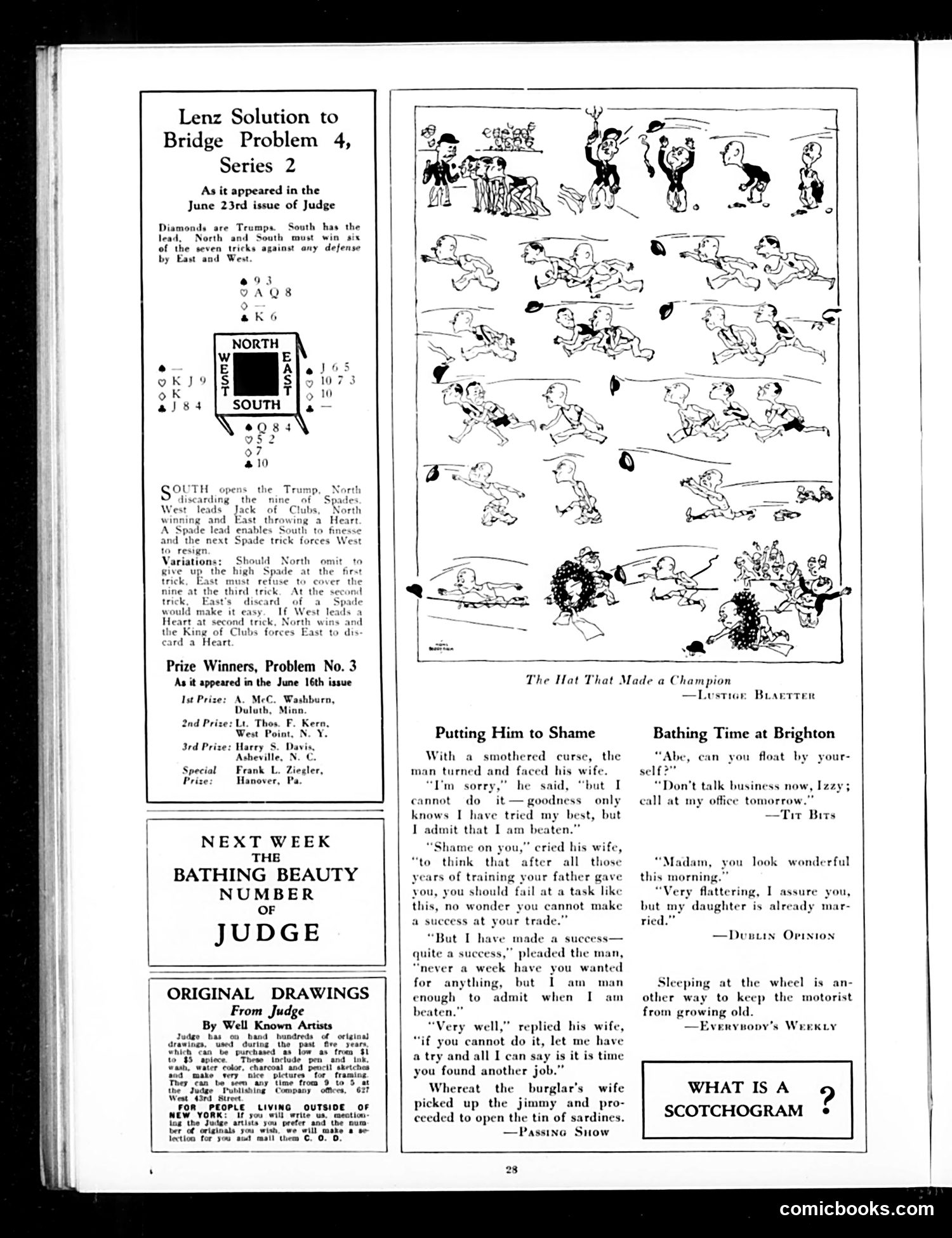
This page from Judge magazine (circa 1920s) contains several distinct elements: **Main Content:** Multiple brief humorous anecdotes and joke illustrations targeting domestic life and social situations. The largest cartoon, "Putting Him to Shame," depicts a husband admitting defeat at opening a tin of sardines while his wife criticizes his failure—the joke being that she easily succeeds, reversing expected gender roles around domestic tasks. This satirizes early 20th-century assumptions about masculine competence. **Other jokes** mock marital dynamics, bathing etiquette, and motorist behavior in lighthearted, family-friendly fashion. **Left side** features a bridge card game problem—Judge regularly published puzzle content for readers. **Bottom announcements** promote Judge's upcoming "Bathing Beauty Number" and offer original artwork for sale, reflecting the magazine's commercial side. The humor throughout reflects genteel, middle-class concerns rather than political satire, emphasizing social embarrassment and gender role reversals as comedy.
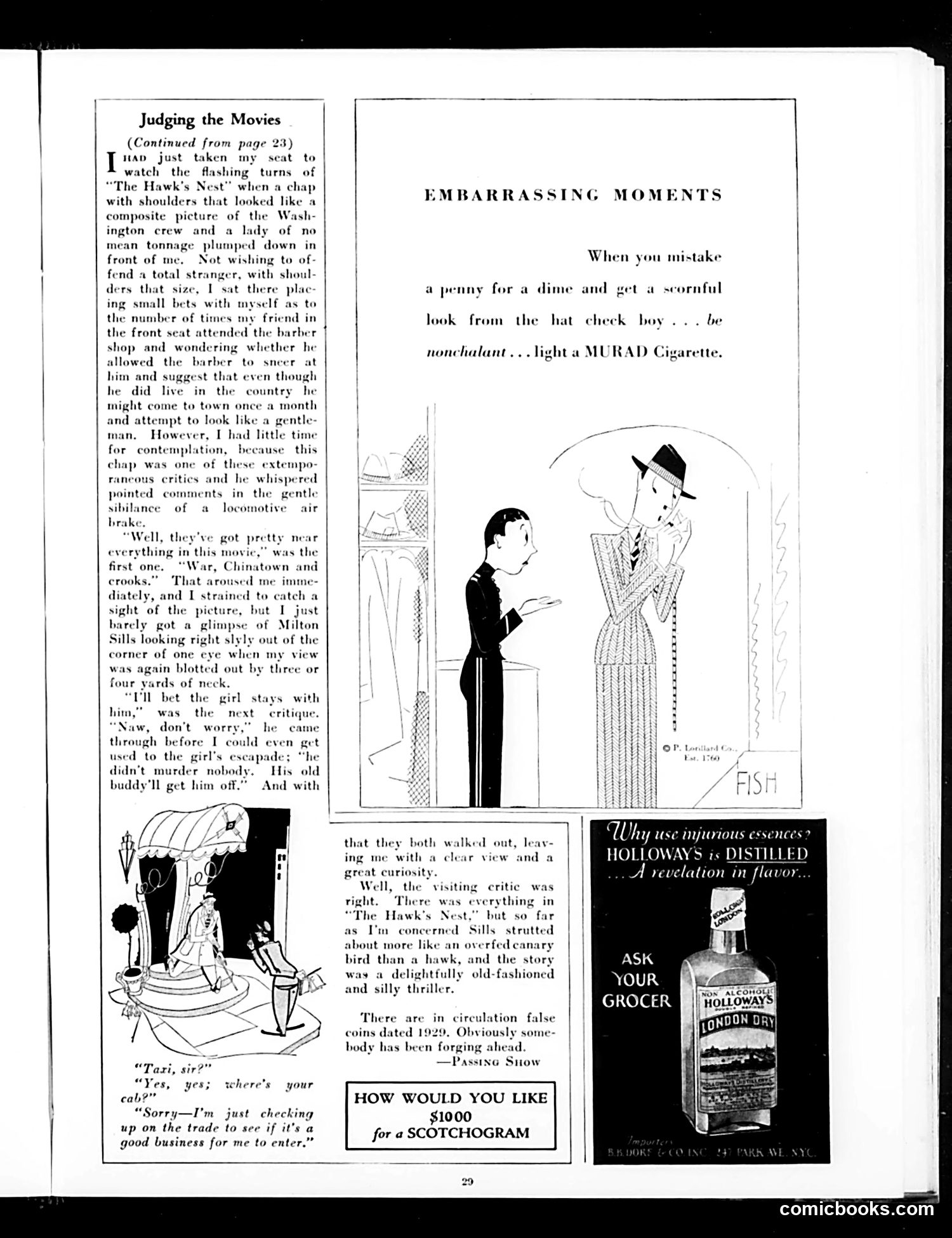
This page from Judge satirizes movie-going etiquette and social embarrassment. The main article, "Judging the Movies," mocks an overly large, aggressive moviegoer who blocks the narrator's view and provides unwanted running commentary during the film "The Hawk's Nest" (starring Milton Sills). The satire targets both the disruptive patron's rudeness and the narrator's passive-aggressive response—placing bets on his hygiene rather than confronting him directly. The "Embarrassing Moments" cartoon strip depicts social anxiety: mistaking a penny for a dime and receiving a scornful look from a hat-check boy. The solution offered is to light a Murad cigarette—nonchalance through smoking, a period advertising trope. A taxi joke about checking if cab-driving is "good business" appears below. The remaining content comprises advertisements for Holloways gin and a Scotchogram promotion—common Judge revenue sources. The satire reflects 1920s class anxieties and consumer culture concerns.
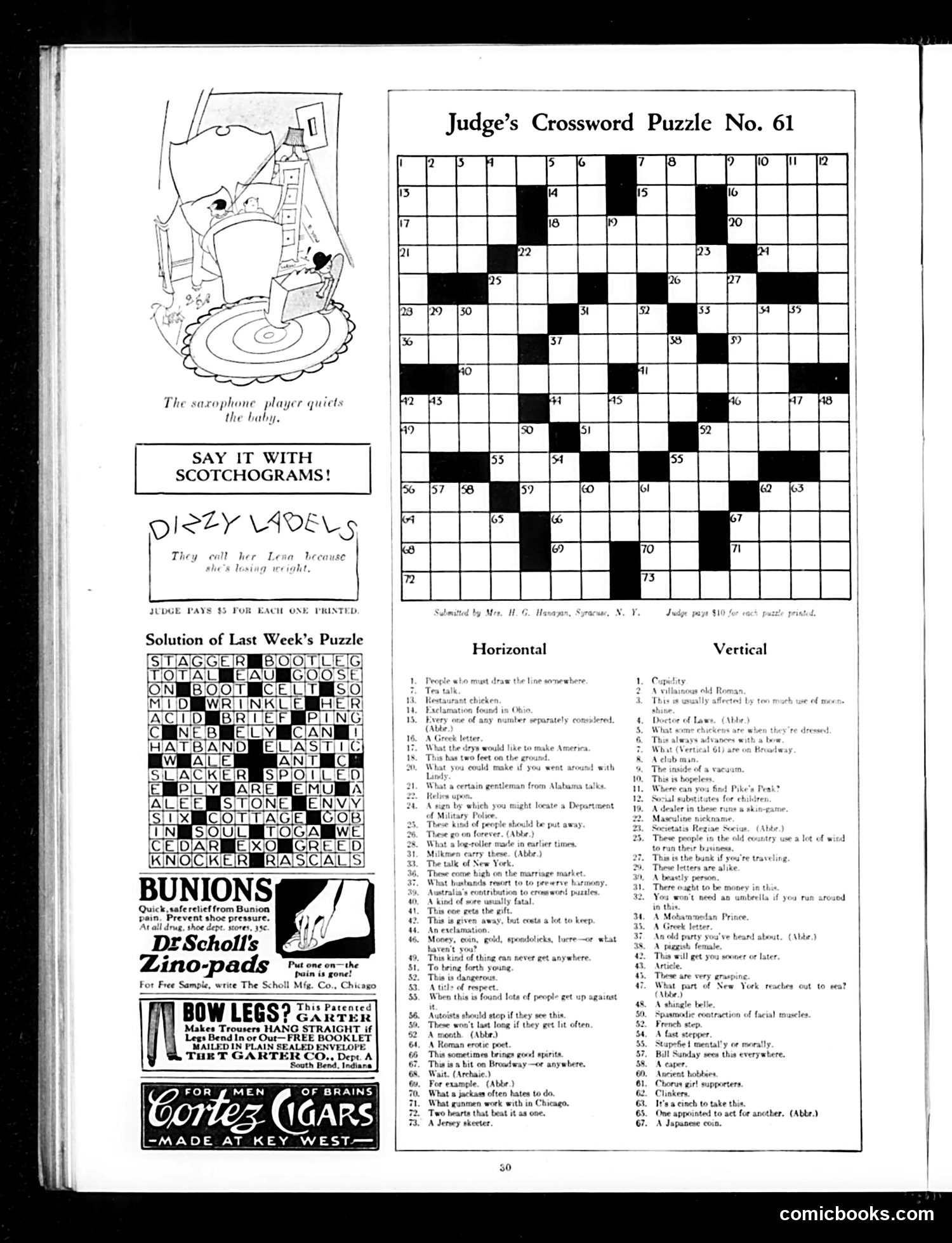
This page from *Judge* magazine is primarily a **crossword puzzle** with accompanying advertisements—not political satire. The cartoon at top shows a saxophone player soothing a baby, illustrating the phrase "The saxophone player quiets the baby." This appears to be a visual gag about jazz music's soothing effects, a contemporary reference to 1920s popular culture. Below is a section titled "Say It With Scotchograms!"—a play on the Kotex ad campaign "Say It With Flowers." This advertises humorous captioned cartoons readers could submit for $5 payment, inviting participation. The bulk of the page consists of **vintage advertisements** for consumer products: Zino-pads (bunion treatment), a garter company (for correcting bow legs), and Contos cigars. These represent typical magazine monetization of the era. The crossword puzzle itself dominates the right side, with clues referencing period-appropriate topics and slang. This is essentially a **commercial/entertainment page**, not political commentary.
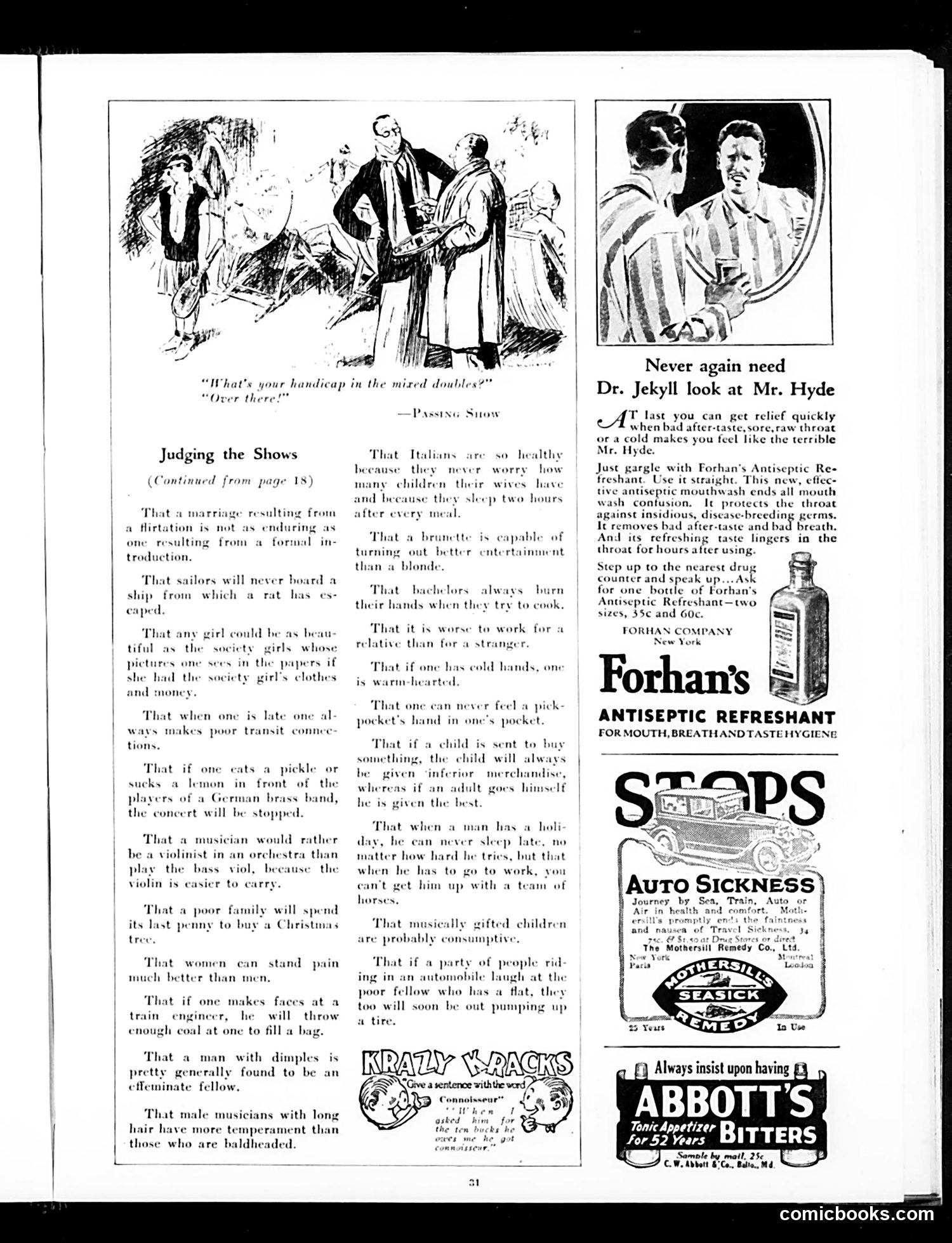
This page combines satirical commentary with period advertising. The left column, "Judging the Shows" (continued from p. 18), presents cynical social observations—truisms about human nature delivered with tongue-in-cheek humor. These joke about marriage, class differences, music, family dynamics, and everyday mishaps. The humor relies on recognizing universal human foibles: poor families buying Christmas trees despite poverty, musicians preferring easier instruments, and the karmic comeuppance of mocking strangers' flat tires. The cartoon at top depicts a formal scene where someone asks about a "handicap in the mired doubles"—likely a tennis reference—with the cryptic reply "Over there!" The satire's meaning remains unclear without additional context. The right side features three advertisements: Forhan's antiseptic mouthwash (referencing Jekyll and Hyde), Stopes' auto sickness remedy, and Abbott's bitters. These represent typical early 20th-century patent medicine marketing, promising relief from modern ailments like travel discomfort.
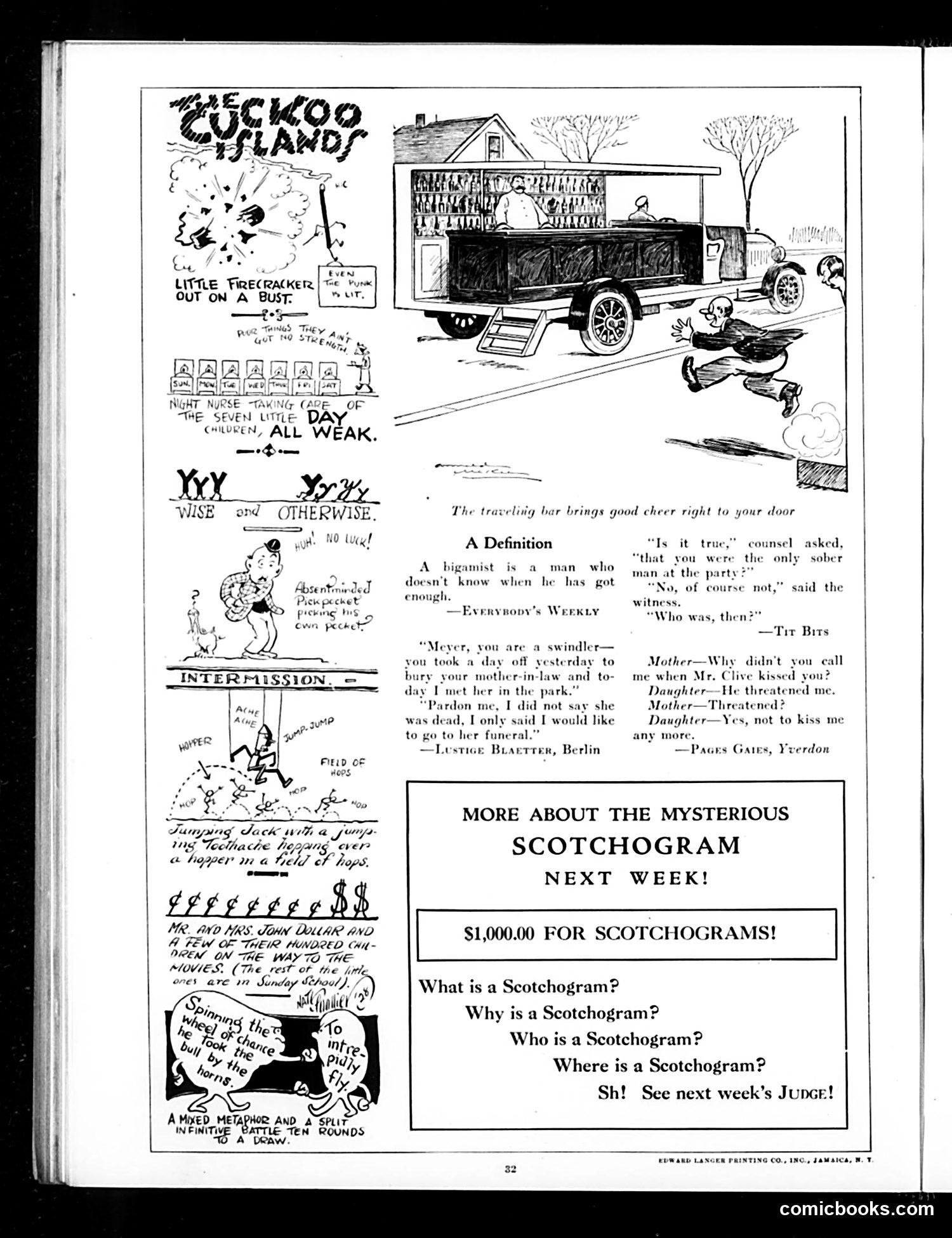
This page from the satirical magazine *Judge* contains several humor pieces typical of early 20th-century American comedy: **"Cuckoo Island" cartoons**: Absurdist sketches mocking everyday situations—a firecracker accident, night nurses exhausting themselves, and romantic mishaps. The humor relies on exaggeration and wordplay rather than political commentary. **"A Definition" and quoted jokes**: Short, punchy jokes about bigamy, swindlers, and marital situations reflecting contemporary social anxieties about infidelity and family dynamics. **The traveling bar cartoon**: An advertisement-style illustration promoting a mobile beverage service, with the caption "The traveling bar brings good cheer right to your door"—likely referencing Prohibition-era speakeasy culture or bootlegging. **Scotchogram teaser**: A mystery promotion promising "$1,000.00 for Scotchograms" with cryptic questions ("What is a Scotchogram?"), designed to entice readers to return next week—a common magazine engagement tactic. The page demonstrates *Judge's* mix of topical satire, domestic humor, and advertisement-disguised content aimed at middle-class American readers.
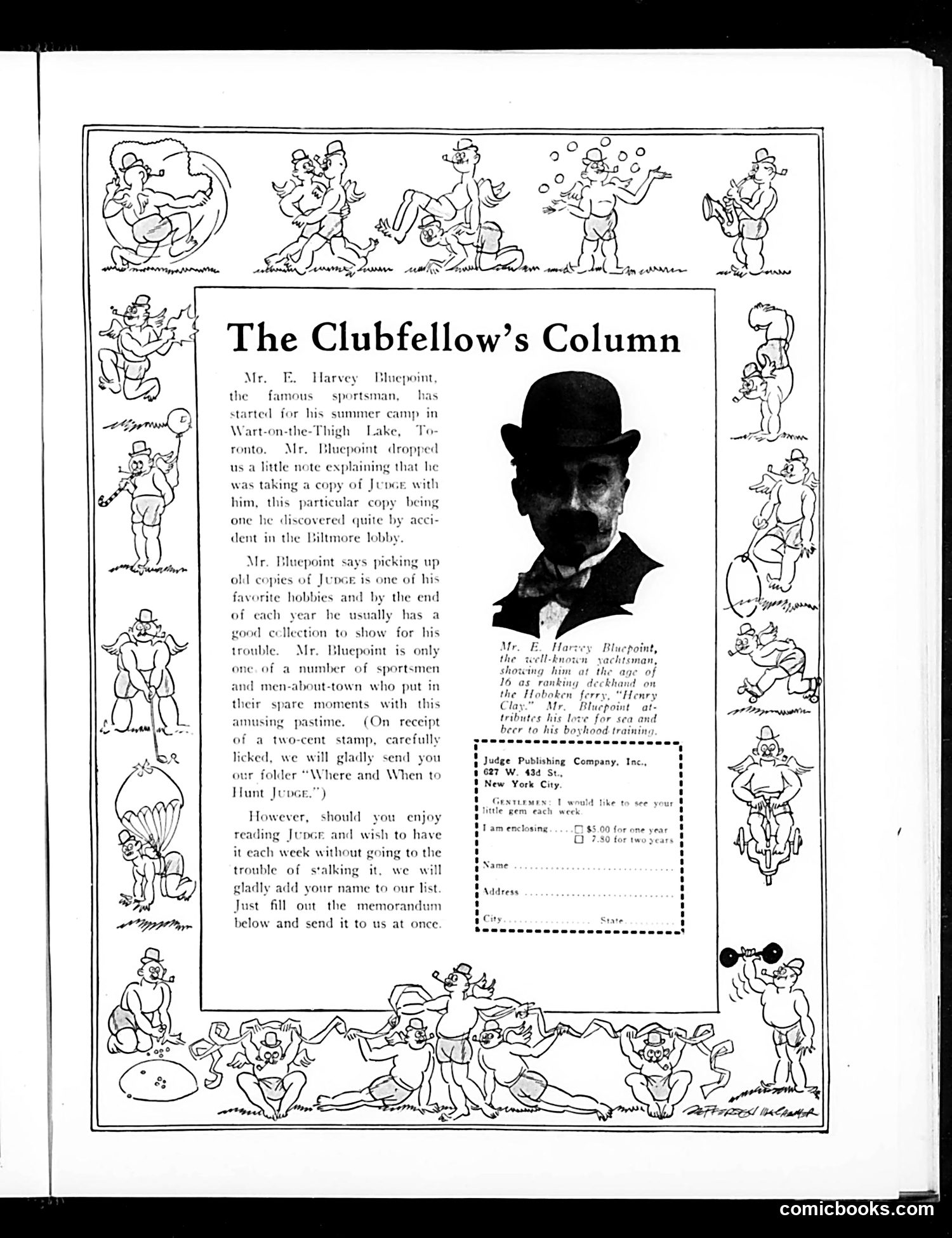
This page satirizes wealthy New York sportsmen and the leisure class. "Mr. E. Harvey Bluepoint" (a fictional character name playing on luxury goods) is mocked for collecting old copies of *Judge* magazine as a hobby—treating it like hunting game he stumbles upon in fancy hotels like the Biltmore. The satire's humor operates on multiple levels: it gently mocks both the pretentious leisure activities of the wealthy (collecting magazines as a "hobby") and *Judge* itself, using self-deprecating humor to promote subscriptions. The decorative border illustrations of playful figures reinforce the lighthearted tone. The subscription form below transforms the joke into advertising—readers are invited to simply subscribe rather than engage in the amusing "sport" of hunting old copies. It's a clever marketing device wrapped in satire targeting the magazine's affluent readership.
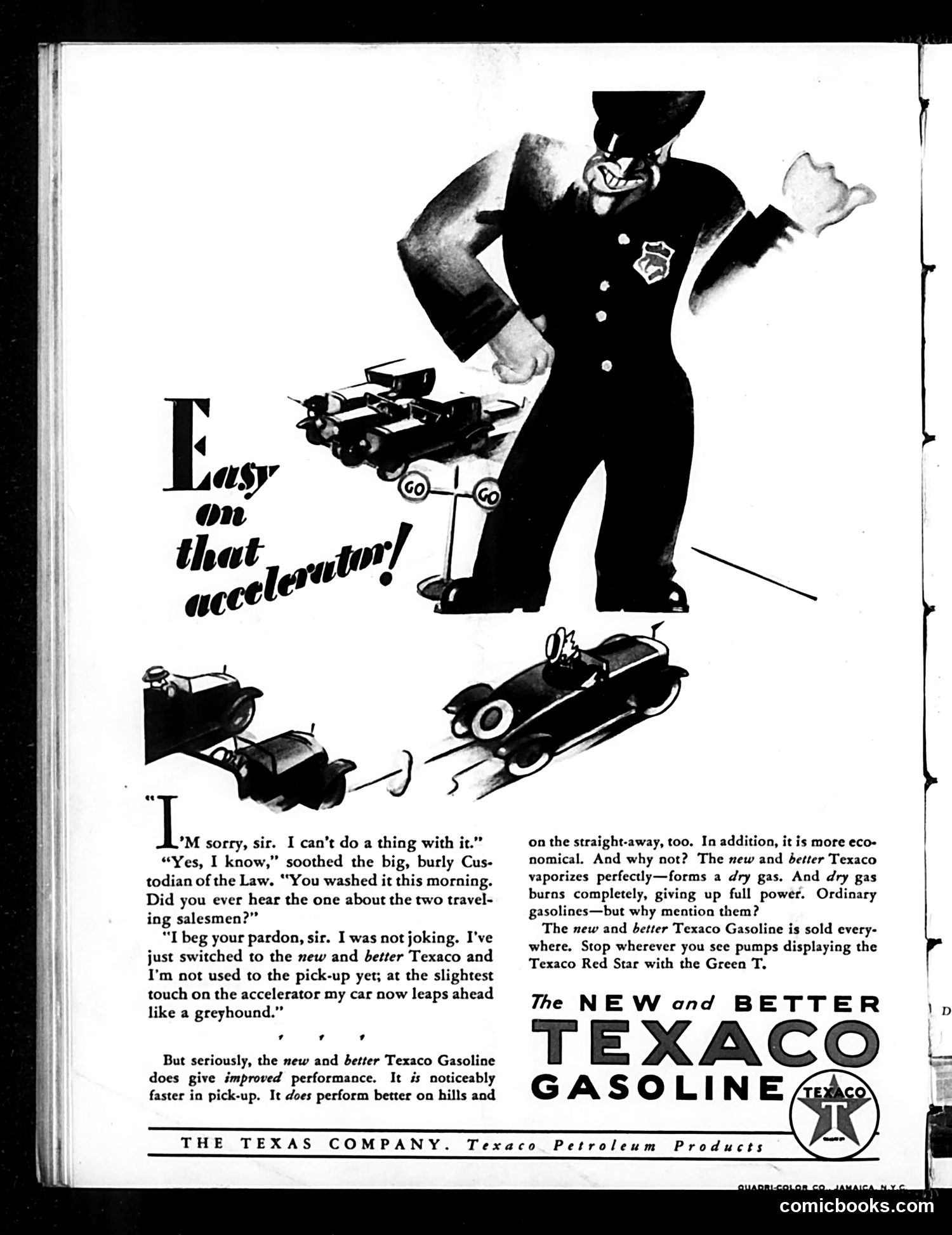
This is primarily a **Texaco gasoline advertisement**, not political satire. The cartoon depicts a traffic cop stopping a driver for speeding. The humor derives from the driver's earnest explanation: he's not actually speeding recklessly—he's simply unaccustomed to the superior acceleration of the "new and better Texaco" gasoline he just switched to. The "Custodian of the Law" (the cop) initially dismisses the excuse as a joke, but the ad then pivots to validate the claim seriously, listing genuine performance benefits: improved pick-up, better hill performance, and superior fuel economy due to better vaporization. This represents typical 1930s-40s advertising strategy: use humor and exaggeration to make a product claim memorable, then anchor it with technical explanation. The cartoon plays on the relatable frustration of uncontrolled acceleration while subtly positioning Texaco as the premium choice for performance-conscious drivers.