
A complete issue · 36 pages · 1927
Judge — August 20, 1927
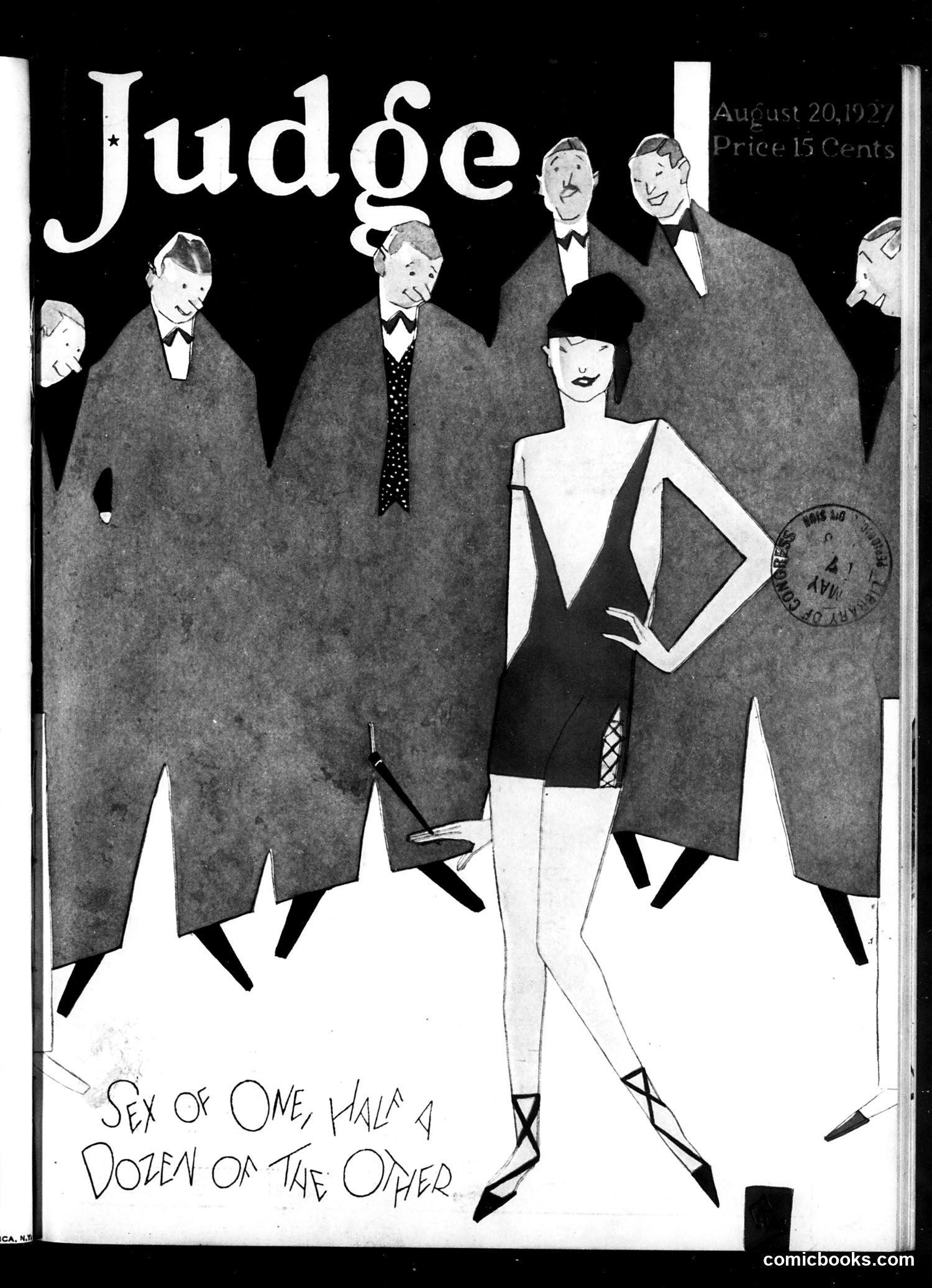
This cover satirizes gender politics of the 1920s. A elegantly dressed woman in a short black dress and heels stands confidently among five men in dark overcoats and bowler hats, all appearing dumbfounded or uncertain. The caption reads: "SEX OF ONE, HALF A DOZEN ON THE OTHER"—a play on the phrase "six of one, half a dozen of the other," meaning two options are equally valid. The joke reflects anxieties about the "New Woman" of the Jazz Age: newly enfranchised (women gained voting rights in 1920), more independent, and challenging traditional gender roles. The image mocks men's bewilderment at women's assertiveness and changing social status. The woman's confident pose contrasts sharply with the men's befuddled expressions, suggesting she holds the power in this encounter.
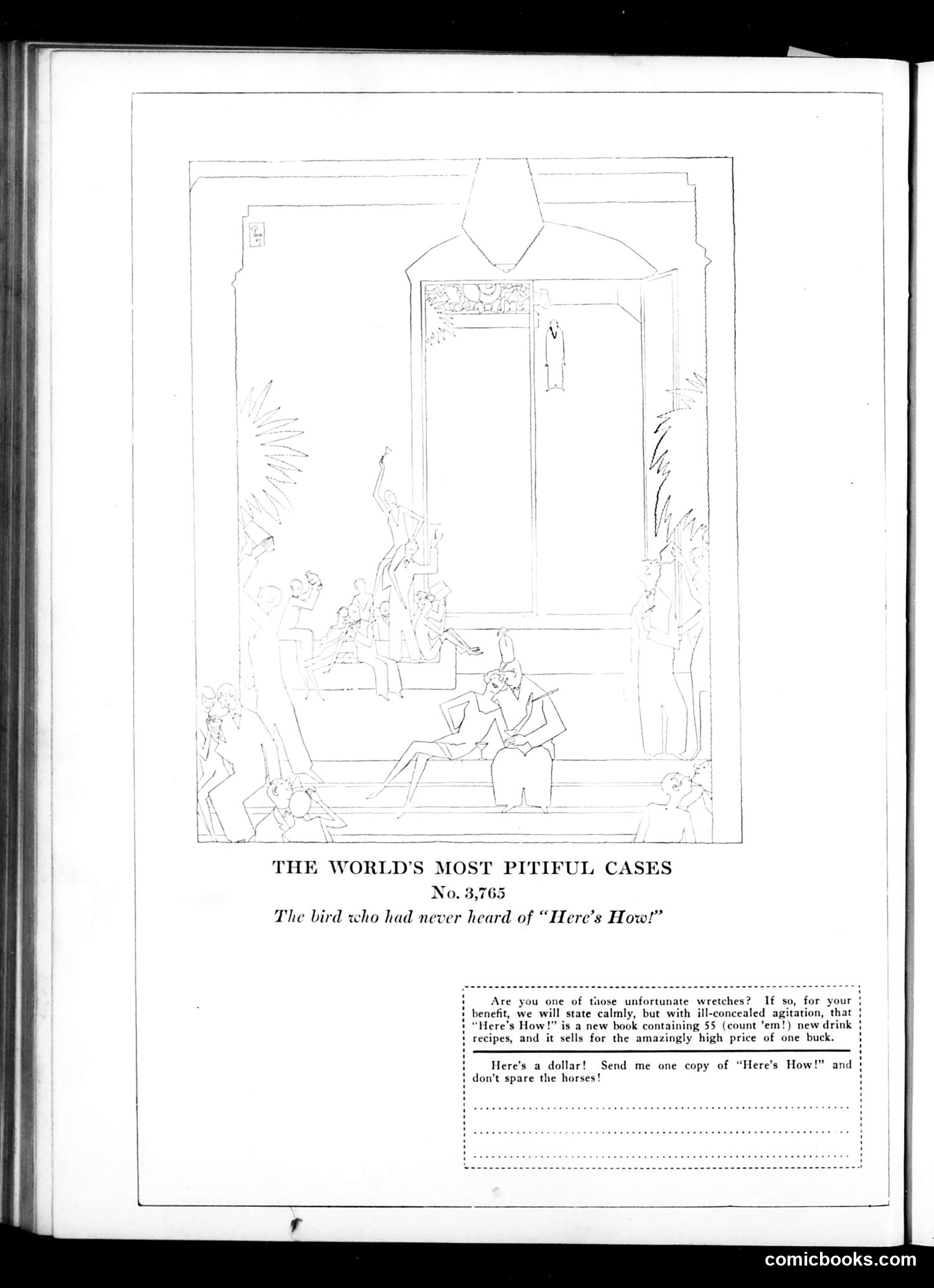
This page from *Judge* magazine presents "The World's Most Pitiful Cases No. 3,765," satirizing people who haven't heard of a popular drink called "Here's How!" The cartoon depicts what appears to be a social gathering or lounge where various figures are present. The satire targets those unfamiliar with this beverage—suggesting they are hopelessly out-of-touch or socially disadvantaged. The accompanying text mocks such "unfortunate wretches," sarcastically offering to inform them about "Here's How!" while simultaneously advertising it as a new book containing 55 drink recipes selling for one dollar. This is primarily **satirical advertising**—using humor to mock social exclusion as a marketing tactic, implying that knowing about this product signals sophistication and social awareness.
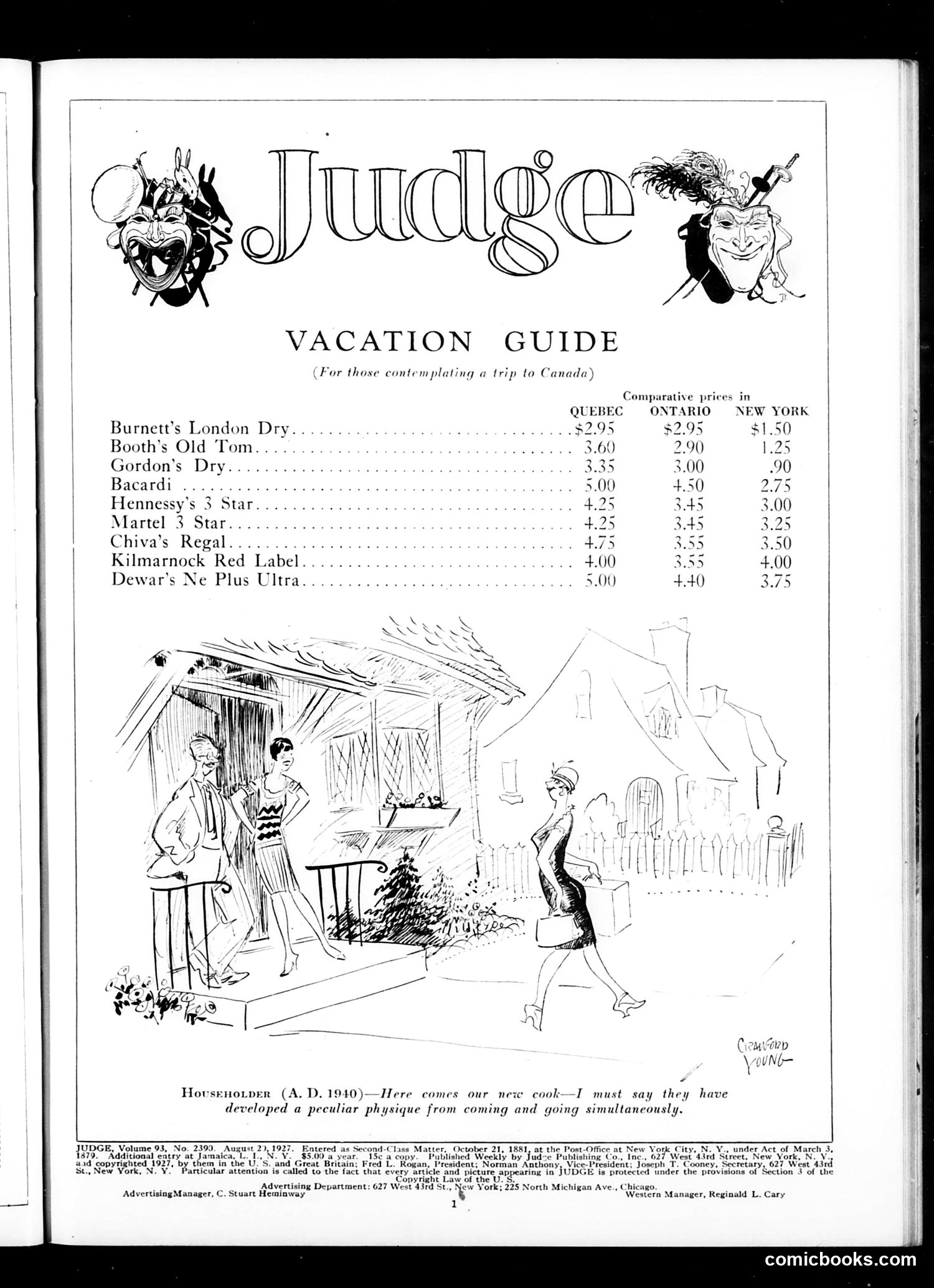
This page is primarily a **liquor price comparison guide** titled "Vacation Guide (For those contemplating a trip to Canada)," listing various alcoholic beverages with comparative prices in Quebec, Ontario, and New York. The accompanying cartoon depicts a "Householder (A.D. 1940)" observing a new cook who has "developed a peculiar physique from coming and going simultaneously." **Context**: This satirizes **Prohibition's aftermath** (which ended in 1933). The price guide mocks Americans crossing into Canada to purchase cheaper alcohol—a common practice during and after Prohibition. The householder cartoon likely jokes about servants/workers being overworked, possibly with darkly humorous undertones about exhaustion or strain. The page reflects 1930s-40s American attitudes toward alcohol consumption and cross-border commerce.
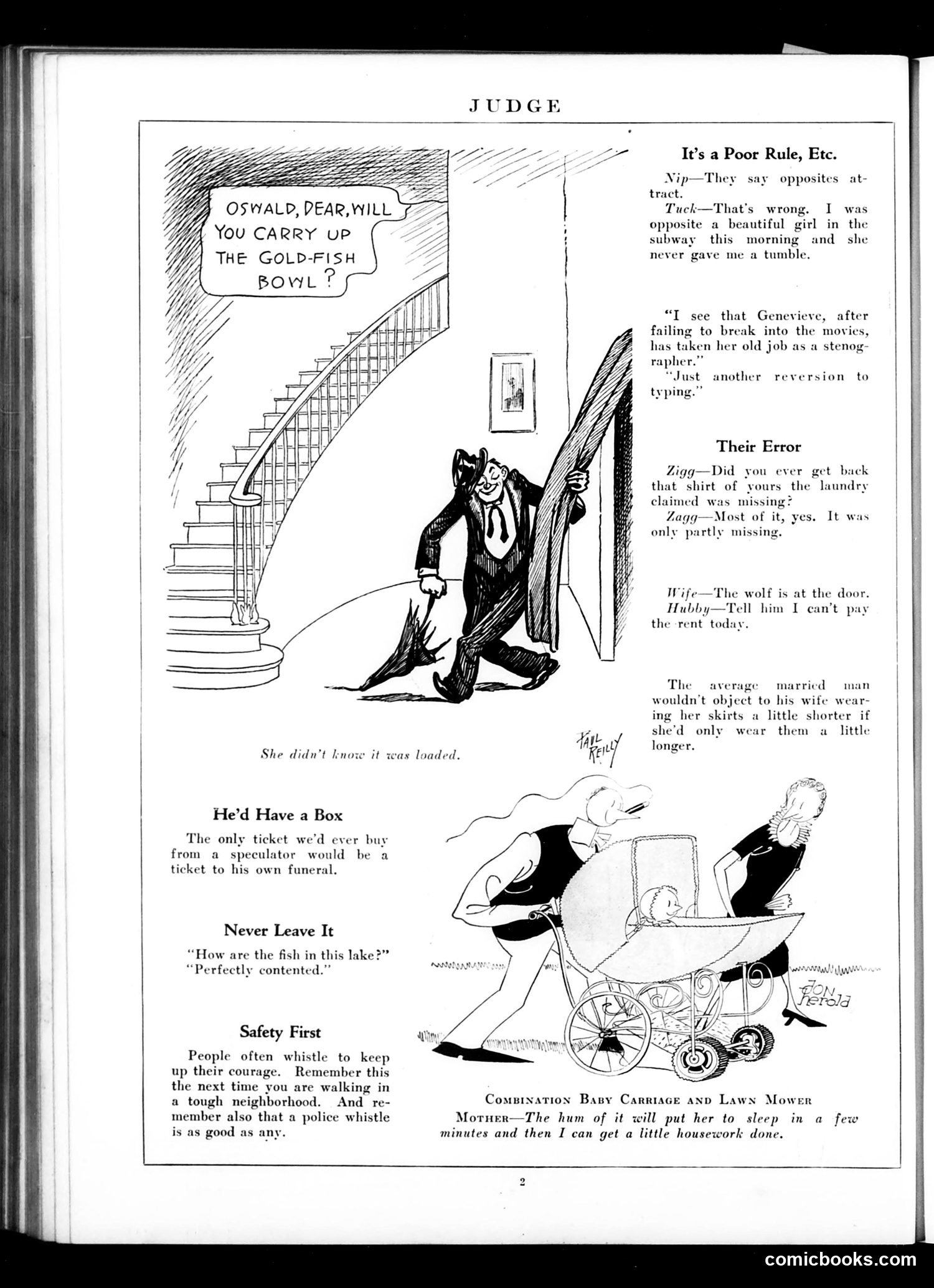
This page contains several short humorous sketches rather than political cartoons: 1. **"She didn't know it was loaded"**: A woman has apparently broken a decorative gold-fish bowl while carrying it upstairs—the joke being her innocence about its weight. 2. **"It's a Poor Rule, Etc."**: Brief quips about the saying "opposites attract," including dating mishaps and job changes. 3. **"Their Error"**, **"He'd Have a Box"**, **"Never Leave It"**, **"Safety First"**: Short domestic and social humor pieces about laundry mishaps, funeral etiquette, contented fish, and neighborhood safety whistles. 4. **"Combination Baby Carriage and Lawn Mower"**: A satirical invention combining a baby carriage with a lawn mower so mothers can accomplish housework simultaneously. These are lifestyle and domestic humor sketches typical of early 20th-century satirical magazines, without apparent political content.
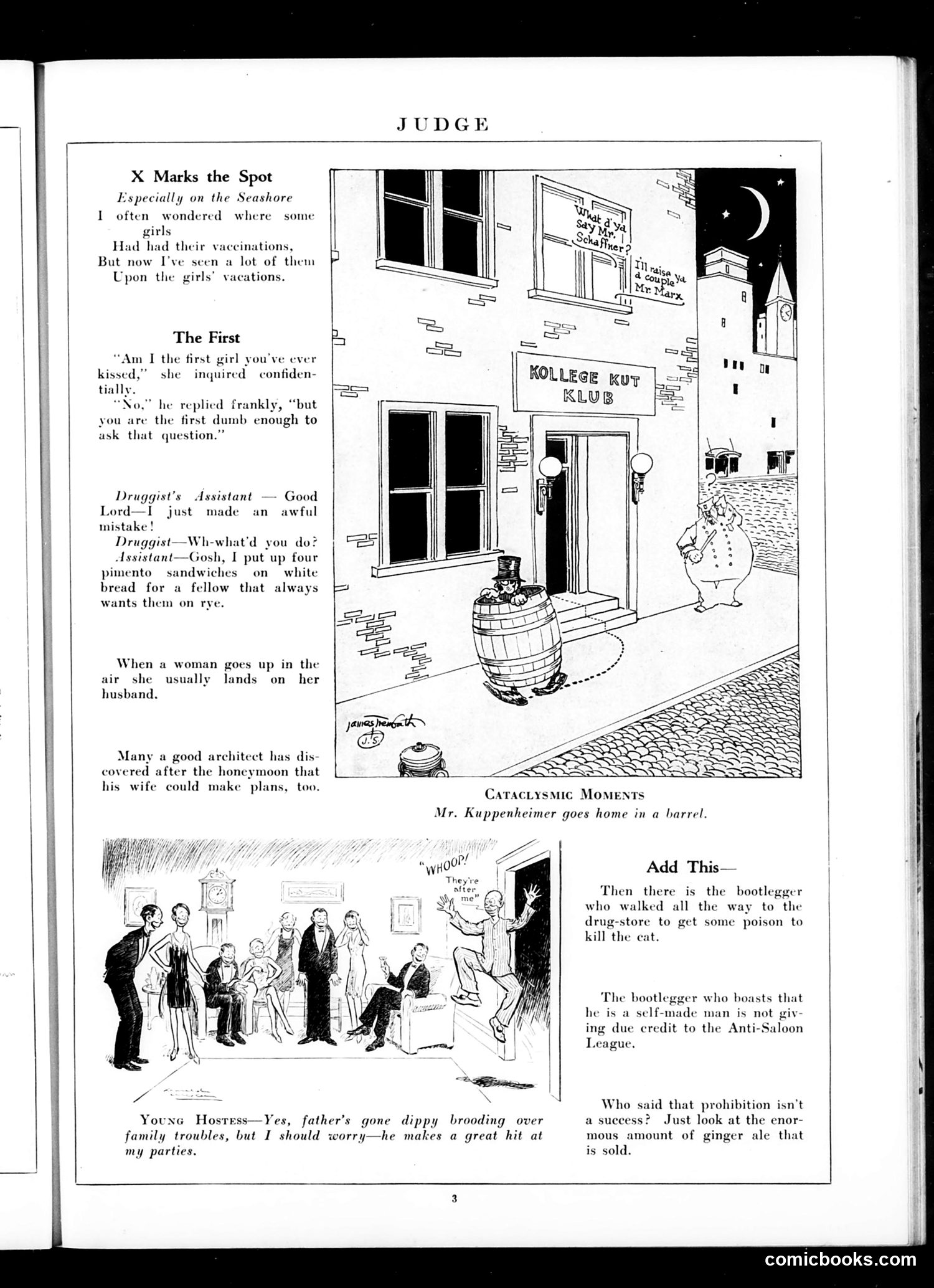
This page contains several unrelated humor pieces typical of Judge's satirical format: **"X Marks the Spot"** jokes about women's behavior on seashores and vacations—light social commentary on gender stereotypes. **"The First"** depicts a romantic exchange where a man dismisses a woman's question about being his first kiss, calling her "dumb." **"Cataclysmic Moments"** shows a barrel-shaped character (labeled "Mr. Kuppenheimer") outside a "Kollege Kut Klub"—likely a visual pun on a clothing brand. **"Add This"** consists of brief jokes about bootleggers and prohibition-era alcohol smuggling, mocking both illegal alcohol sales and the Anti-Saloon League's enforcement efforts. These reference Prohibition's (1920-1933) actual social impact and the black market it created. The lower cartoon shows a domestic scene with a caption about a worried father's parties, though details remain unclear.
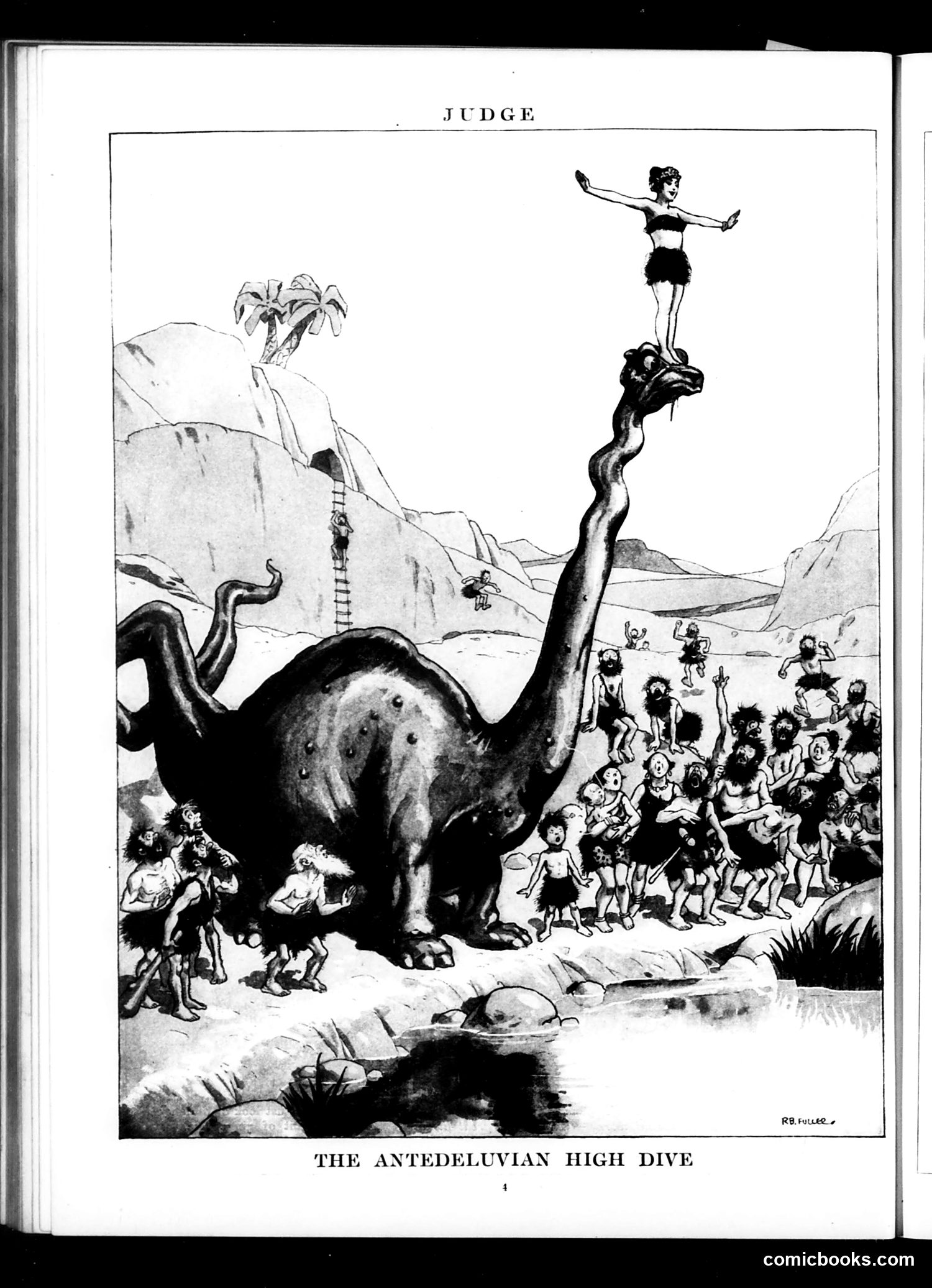
This cartoon satirizes high-diving as a dangerous entertainment spectacle. A woman performs an acrobatic dive from an elephant's trunk into a gathering of onlookers in a prehistoric landscape, complete with palm trees and rocky terrain. The title "Antediluvian" (pre-flood/ancient times) suggests the satire compares this stunt to primitive or primitive-level entertainment. The joke appears to mock the era's popular circus and vaudeville high-diving acts—dangerous performances that attracted crowds despite obvious risks. By setting it in prehistory with an elephant, *Judge* ridicules the spectacle as absurdly risky entertainment, implying society's appetite for such acts is as primitive as ancient times. The cartoon critiques both the performers' recklessness and audiences' appetite for perilous thrills.
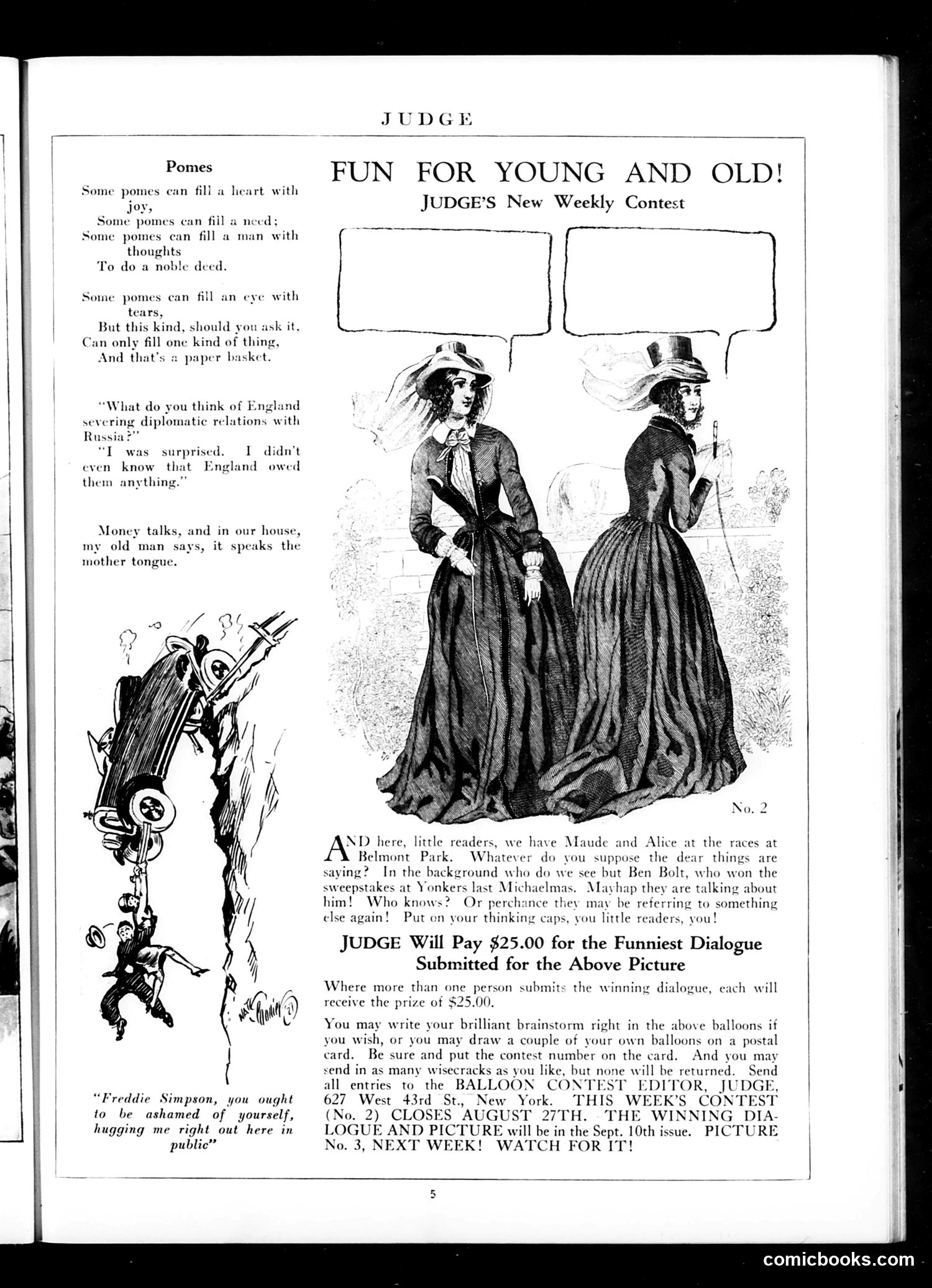
This page features a poetry section and a contest announcement rather than political satire. The main content includes: **Poetry**: Reflective verses about poems' various purposes—filling hearts with joy, minds with thoughts, and eyes with tears—concluding that only "paper baskets" reliably hold one kind of thing. **Contest Section ("No. 2")**: Shows two women (identified as Maude and Alice) at Belmont Park races. The text references Ben Bolt (a famous racehorse winner at Yonkers) and asks readers to supply witty dialogue for the empty speech balloons, offering $25 for the funniest submission. **Social Context**: The reference to horse racing and the casual mention of gambling ("stakes at Yonkers") reflects early 20th-century leisure pursuits among the wealthy that Judge's audience enjoyed. This is primarily entertainment content rather than political commentary.
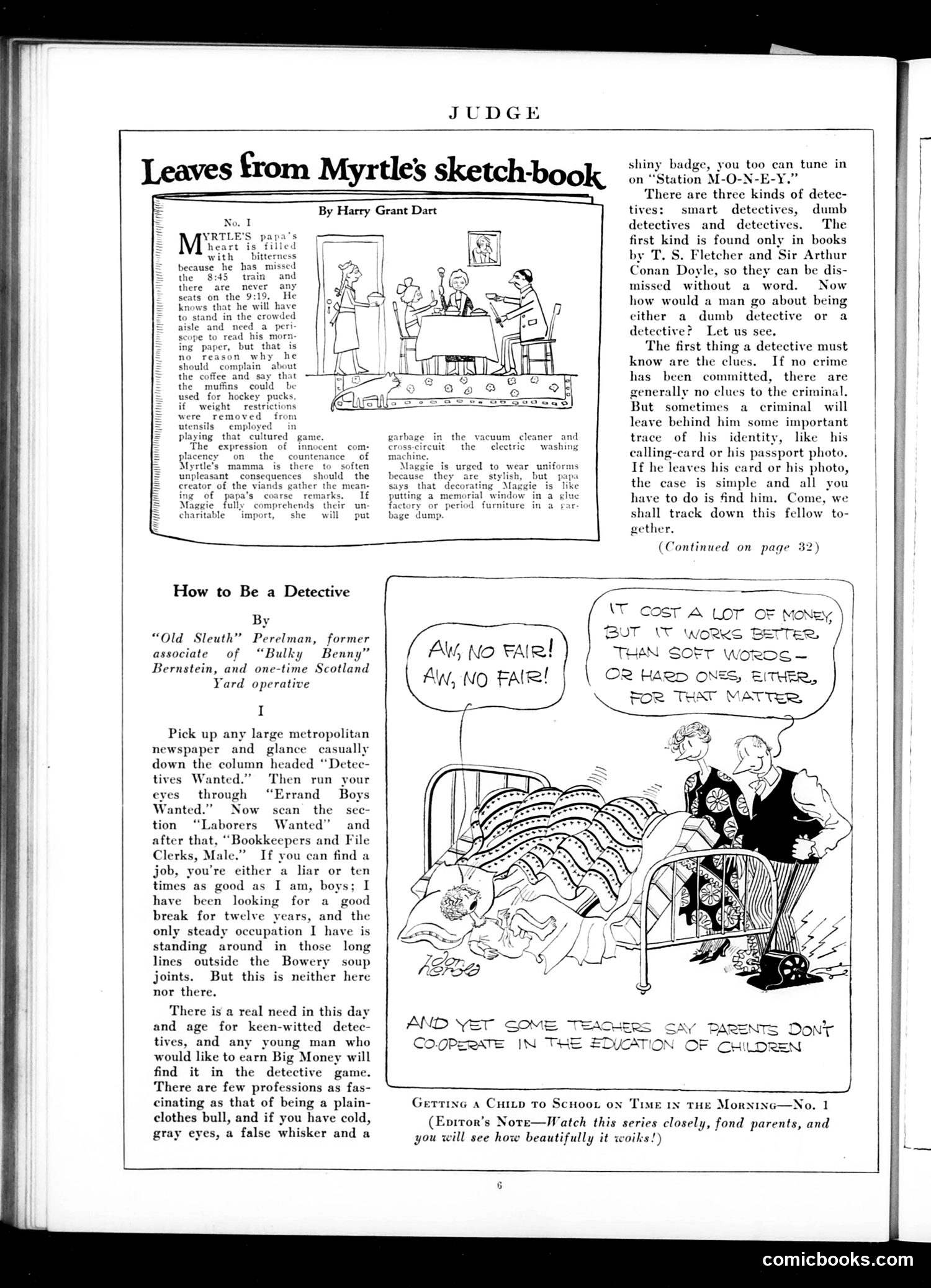
This page contains humor aimed at Depression-era readers struggling with unemployment and parenting challenges. **"Leaves from Myrtle's Sketch-Book"** satirizes domestic frustration—a commuter missing his train and stuck standing in crowded transit, forced to read newspapers rather than enjoy leisurely reading. **"How to Be a Detective"** is satirical career advice by "Old Sleuth" Perelman. The joke: a man seeking detective work discovers job listings for detectives are rarer than other positions. He's been unemployed for twelve years, only managing soup-line duty—mocking the Depression job market. The subtext suggests detective work, like other employment, is nearly impossible to find. **"Getting a Child to School on Time"** shows parents using bribery ("soft words" and "hard ones" don't work, but money does) to motivate their child to school—satirizing parental struggles and suggesting even children require financial incentives, a dark joke about economic desperation affecting family dynamics. The overall theme: economic hardship pervades modern life, from commuting to employment to basic parenting.
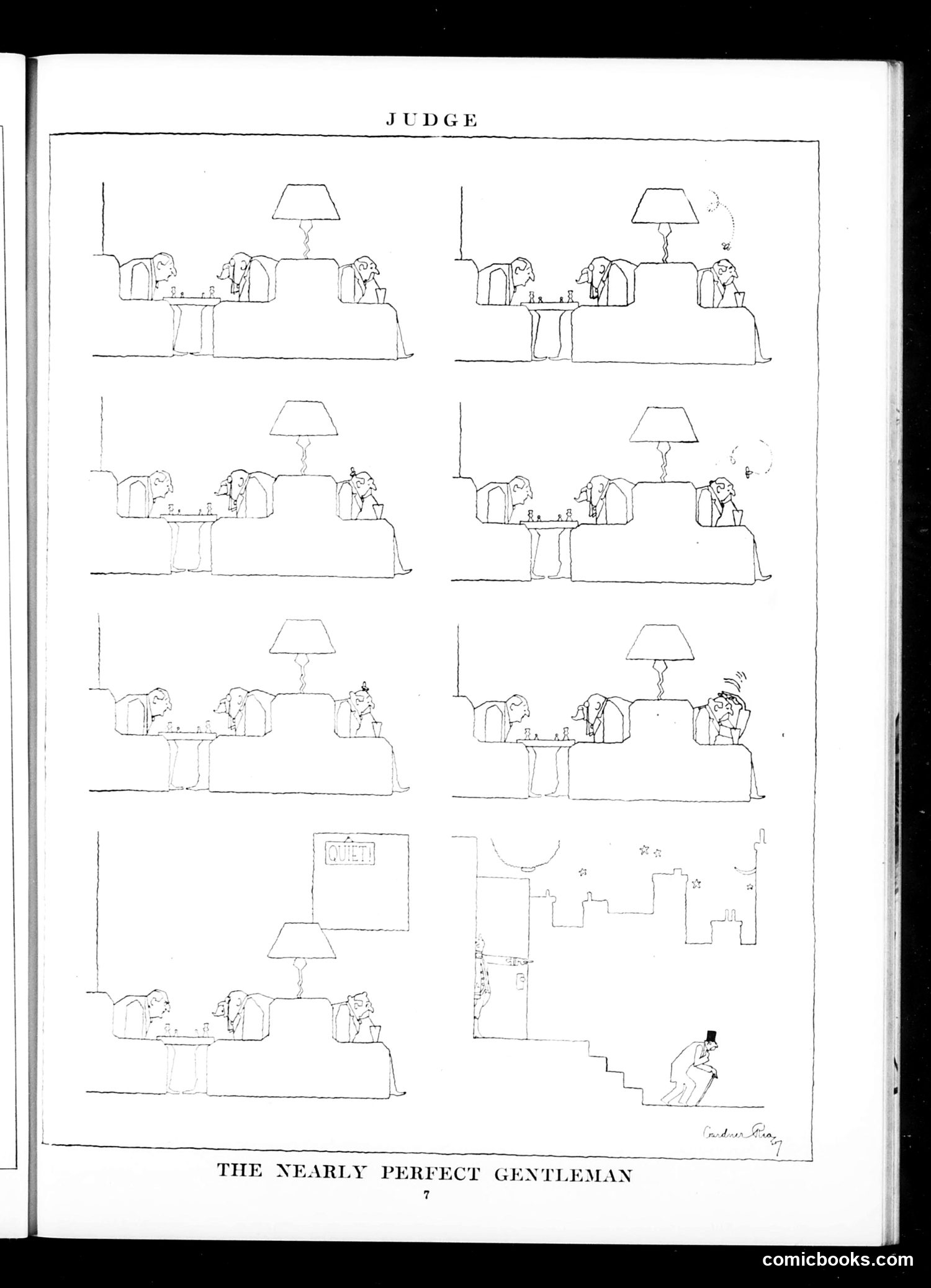
This is a sequential comic strip showing a gentleman's evening routine in what appears to be early-20th-century domestic life. The strip depicts six similar scenes of a man seated at a table with a lamp, with slight variations in his posture and expressions across panels. The final panel shows him in an armchair, appearing satisfied or content. The satire appears to mock the idealized notion of "the perfect gentleman"—suggesting that perfection consists merely of going through repetitive, mundane domestic rituals with minor variations. The joke likely critiques how society defines masculine propriety through hollow, ritualistic behavior rather than substantive character traits. The repetition emphasizes the tedious conformity expected of respectable gentlemen of the era.
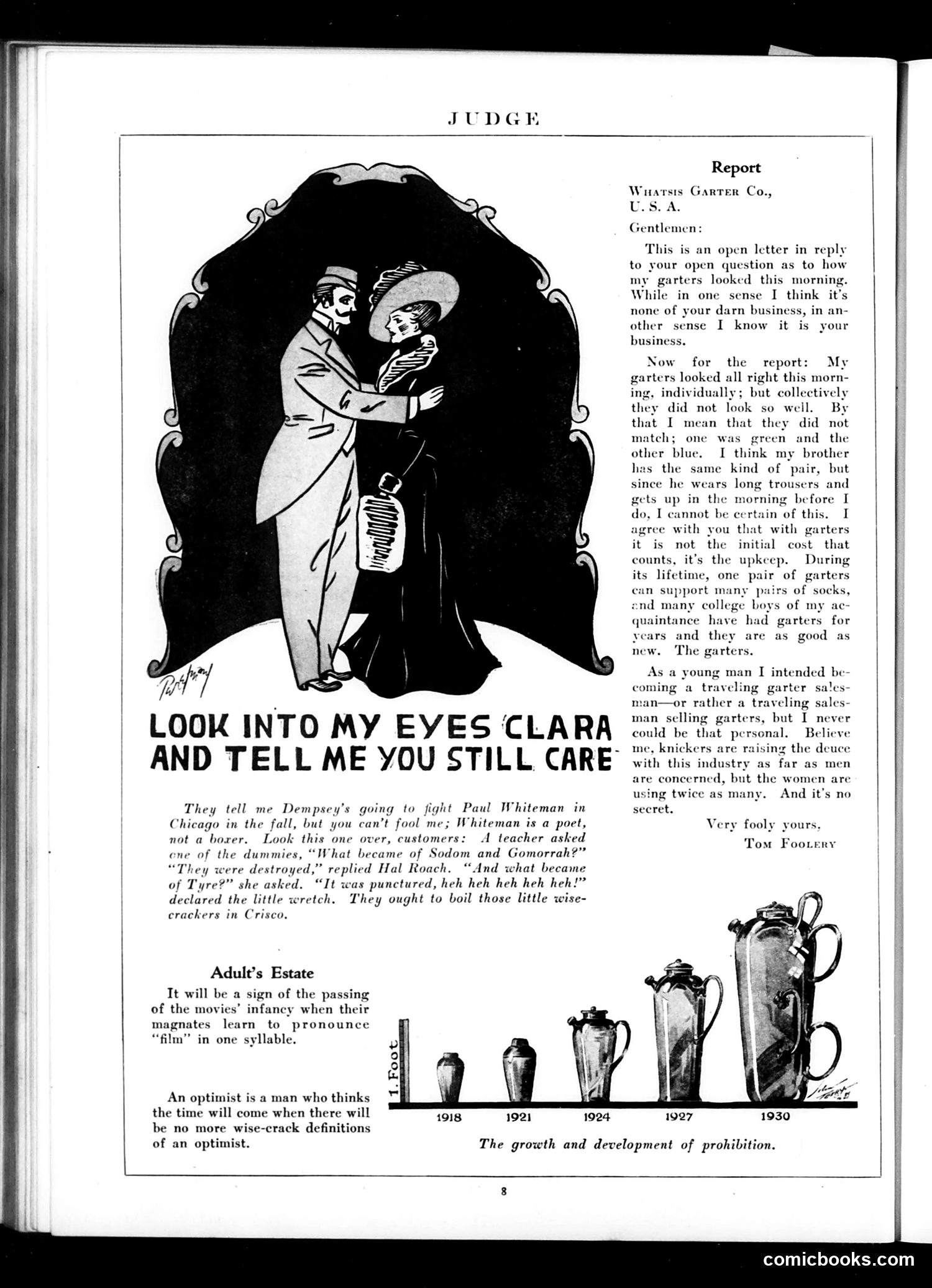
This page satirizes **garter manufacturers** through a humorous "report" letter. The main cartoon depicts a romantic couple with the caption "Look into my Eyes Clara and Tell Me You Still Care"—ironically contrasting sentimental romance with the mundane reality of garter quality and maintenance. The letter mocks both the garter industry's advertising practices and consumer culture: a company asks customers personal questions about their products, and the writer responds with tongue-in-cheek sincerity, noting that garters' true value lies in durability ("upkeep"), not initial cost. He admits he once considered becoming a traveling garter salesman. The page also includes unrelated satirical quips about boxer Jack Dempsey, a teacher's joke about biblical cities, and a chart showing "the growth and development of prohibition" (1918-1930), tracking escalating alcohol consumption despite the Prohibition era. The humor targets consumerism, advertising absurdity, and Prohibition's failure.
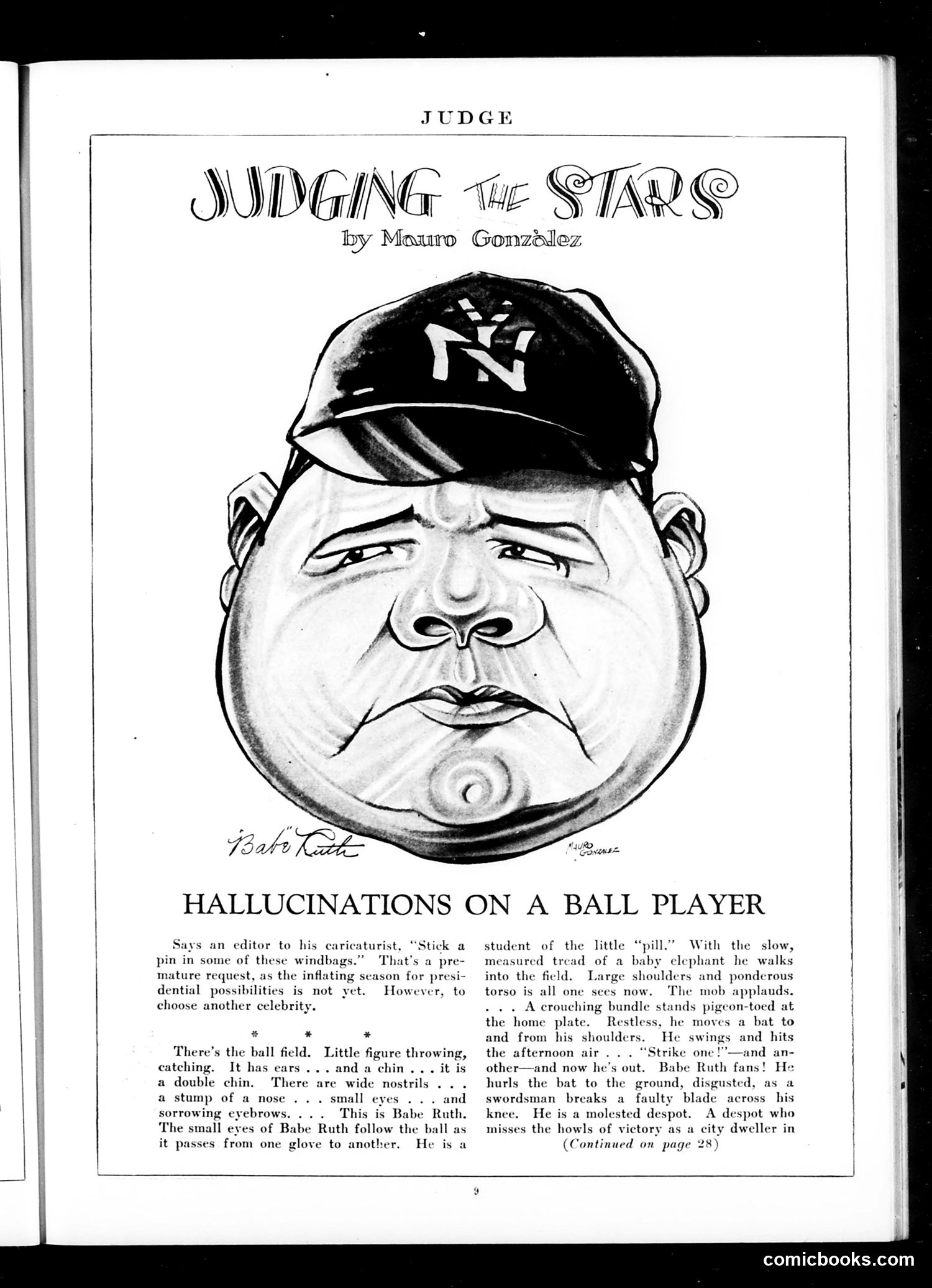
This is a caricature and satirical essay about **Babe Ruth**, the famous baseball player. The cartoon exaggerates his physical features—double chin, wide nostrils, small eyes, sloped shoulders, and massive torso—in the crude caricature style typical of early 20th-century sports humor. The satire mocks Ruth's behavior and temperament on the field. The text describes him as a "molested despot"—a star player so accustomed to adulation that he cannot handle failure. When he strikes out, he angrily throws his bat like "a swordsman breaks a faulty blade," suggesting childish petulance. The piece ridicules his oversized ego and expectation of constant victory, treating his tantrum as the behavior of someone unused to losing the crowd's approval. The humor works by contrasting Ruth's presumed self-importance with his human flaws and emotional immaturity.
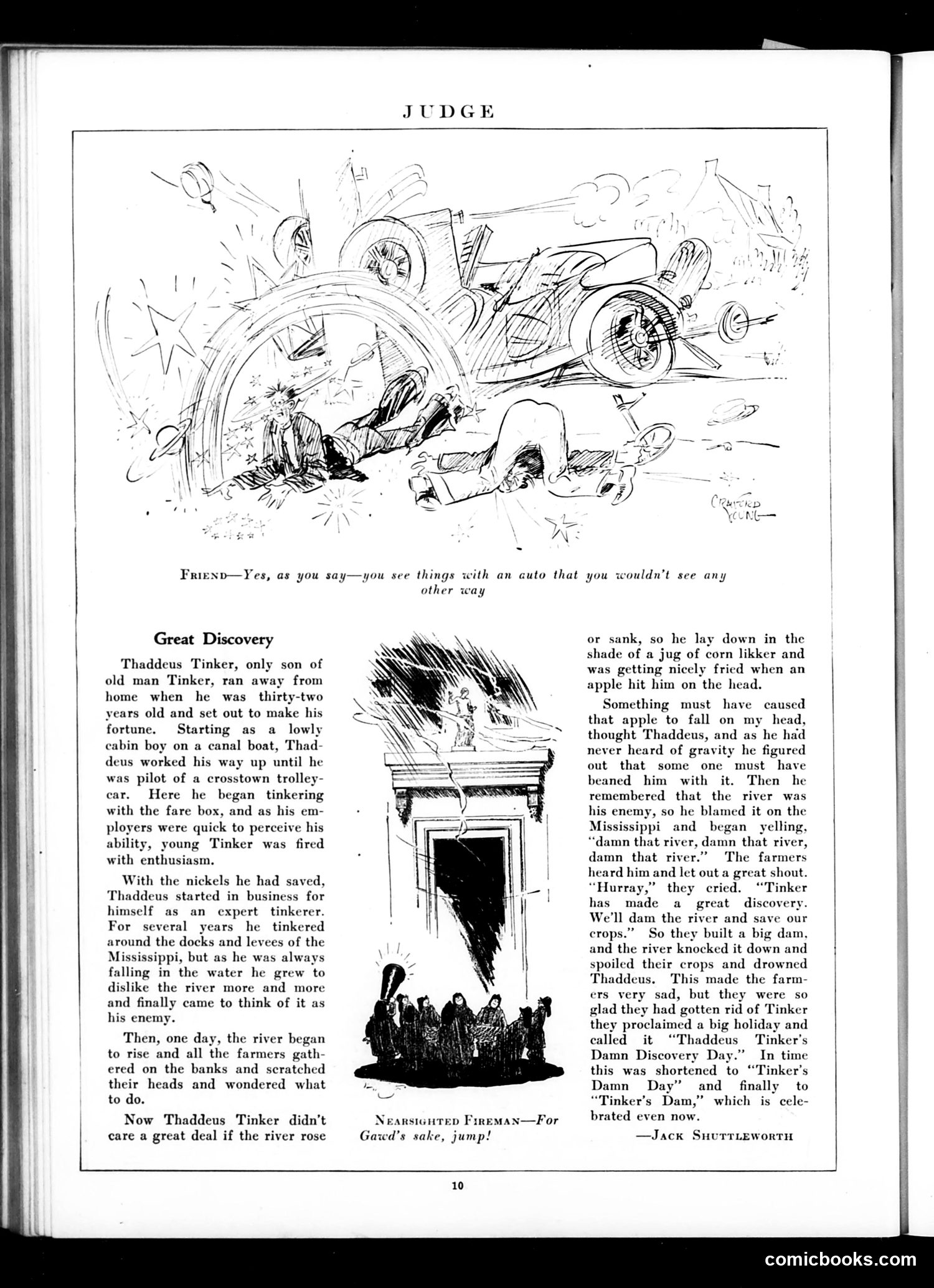
This is a humorous tall tale satirizing both the American self-made man myth and rural superstition. Thaddeus Tinker, a hapless protagonist, works his way up from cabin boy to trolley-car pilot through petty embezzlement ("tinkering with the fare box"). After being fired, he blames the Mississippi River for his misfortunes. When drunk by a riverbank, an apple hits his head. Rather than recognizing gravity, Tinker blames his enemy—the river—and irrationally yells at it. Farmers overhear and interpret his drunken ranting as genius, building a dam based on his accidental discovery. The dam fails, drowns Tinker, yet locals celebrate him as a hero, eventually naming a holiday after him. The satire mocks credulous rural communities who confuse luck with innovation, and the absurdity of historical mythology—how pointless or destructive acts get immortalized and celebrated. The phrase "Tinker's Dam" becomes proverbial through pure accident.
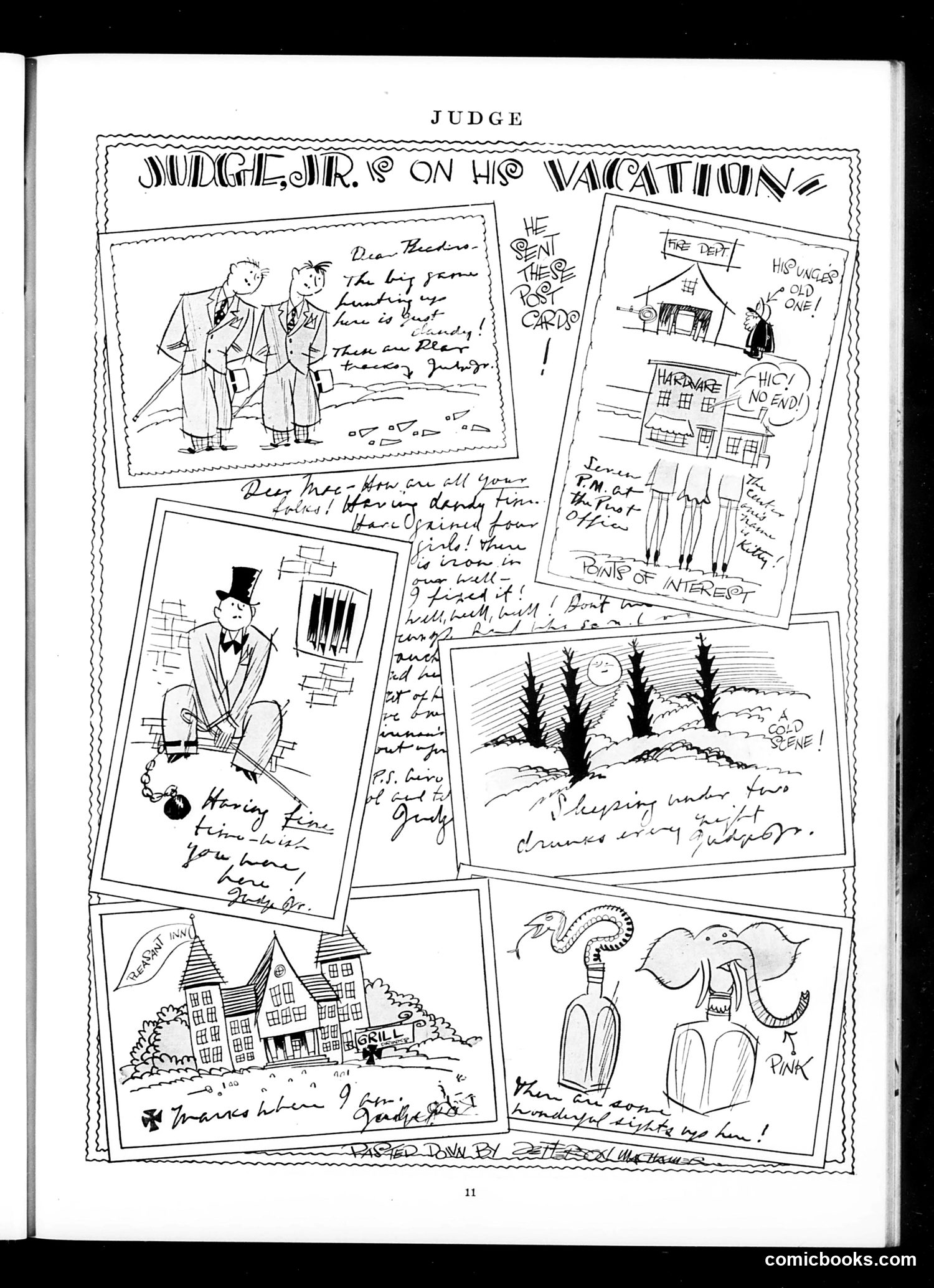
This page appears to be a humorous comic strip showing postcards and letters supposedly sent by "Judge Jr." (likely the personified younger version of Judge magazine itself) while on vacation. The gag uses the postcard format to show various vacation mishaps and absurd situations—including what appears to be a stuffy formal dinner scene, desolate landscape with dead trees, a grand estate, and surreal imagery with serpents and bottles. The handwritten captions (difficult to fully decipher) suggest comedic commentary on vacation experiences. This is satirical humor typical of Judge magazine's style: mocking the pretensions of leisure, travel, and upper-class vacation culture through ironic "vacation postcards." The specific references in the handwriting remain unclear due to legibility, but the overall joke targets familiar vacation disappointments and social absurdities.
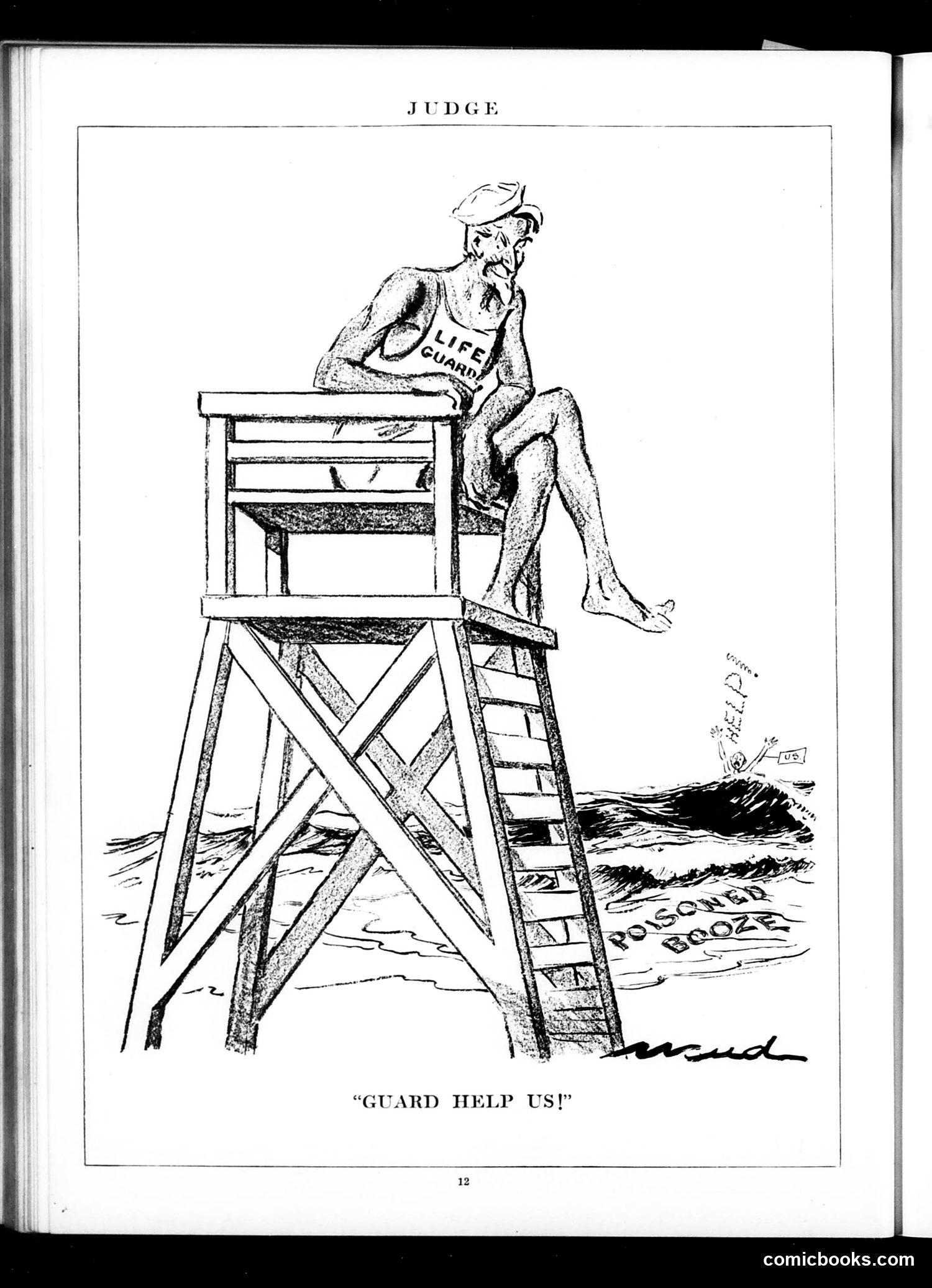
This cartoon depicts a figure wearing a "Life Guard" shirt perched on a tall lifeguard stand, appearing distressed or calling for help. Below, the beach shows turbulent waters labeled "Poison Booze" (referencing illegal alcohol during Prohibition). The satire appears to critique the inadequacy of law enforcement (represented by the lifeguard) to control bootlegging and illegal alcohol distribution during Prohibition. The ironic positioning—a lifeguard, meant to rescue people from water danger, unable to manage the "poison" flooding the beaches—suggests that authorities tasked with enforcing Prohibition were overwhelmed and ineffectual. The lifeguard's cry "Guard Help Us!" implies desperation in the face of widespread illegal alcohol smuggling and consumption. This reflects real Prohibition-era anxieties about organized crime and enforcement failures.
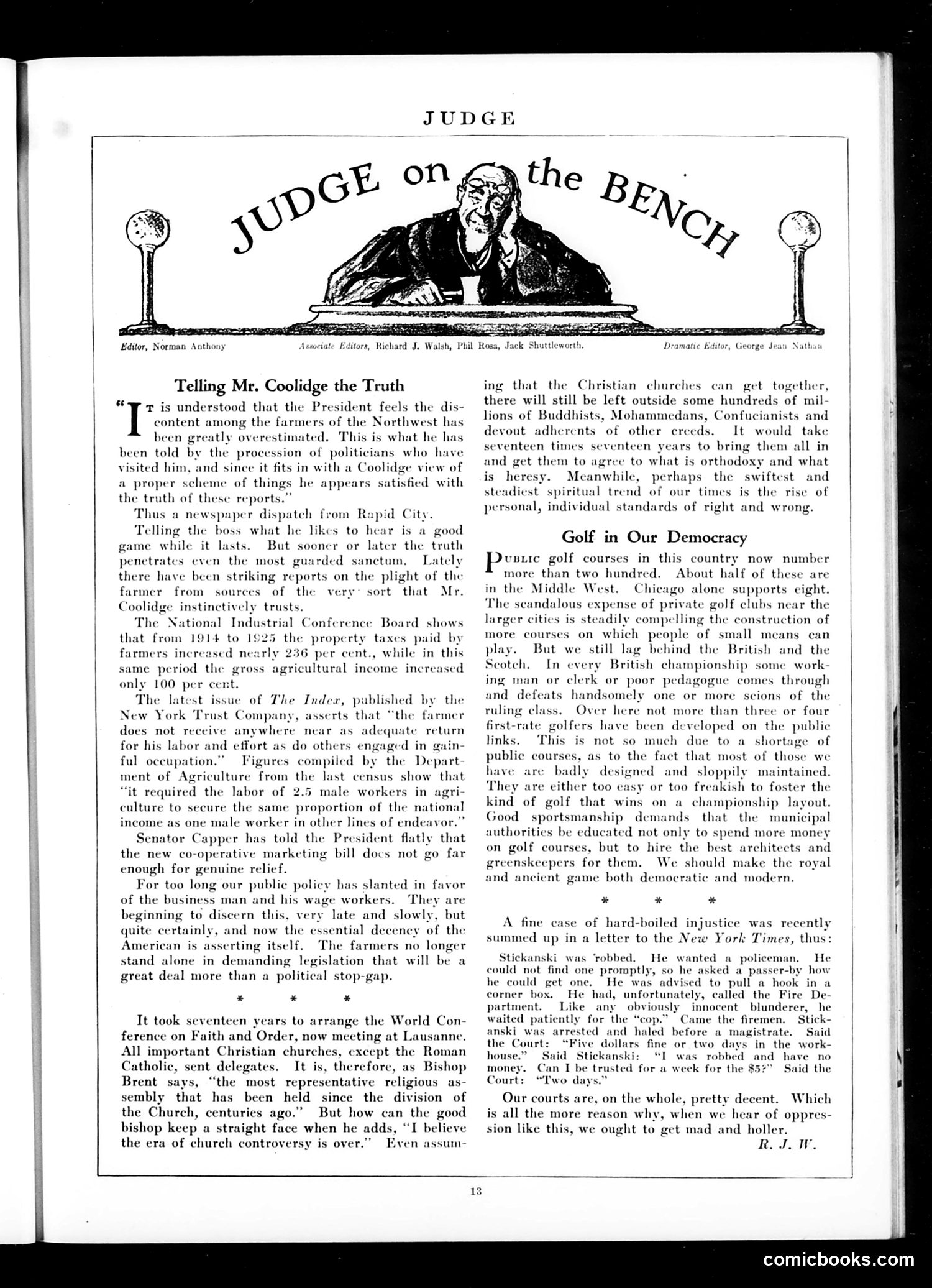
This page from *Judge* (a major American satirical magazine) contains three separate editorial commentaries: **"Telling Mr. Coolidge the Truth"** criticizes President Calvin Coolidge for accepting optimistic reports from politicians about Midwestern farm conditions while ignoring contrary evidence. The satire argues that farmers face genuine hardship—property taxes increased 236% while agricultural income rose only 100%—yet Coolidge prefers flattering accounts that align with his political philosophy. The piece advocates for meaningful farm relief legislation beyond "political stop-gaps." **On Religious Unity** mocks Bishop Brent's optimism about church reconciliation, noting that while Christian denominations may unite, hundreds of millions of Buddhists, Muslims, and Confucianists remain outside any agreement—making true religious unity impractical. **"Golf in Our Democracy"** argues that while America lags behind Britain in developing working-class golfers on public courses, wealthy private clubs remain exclusionary. The piece advocates democratic access to golf for ordinary citizens. The editorial tone reflects Progressive-era concerns: agricultural inequality, religious sectarianism, and class-based access to leisure.
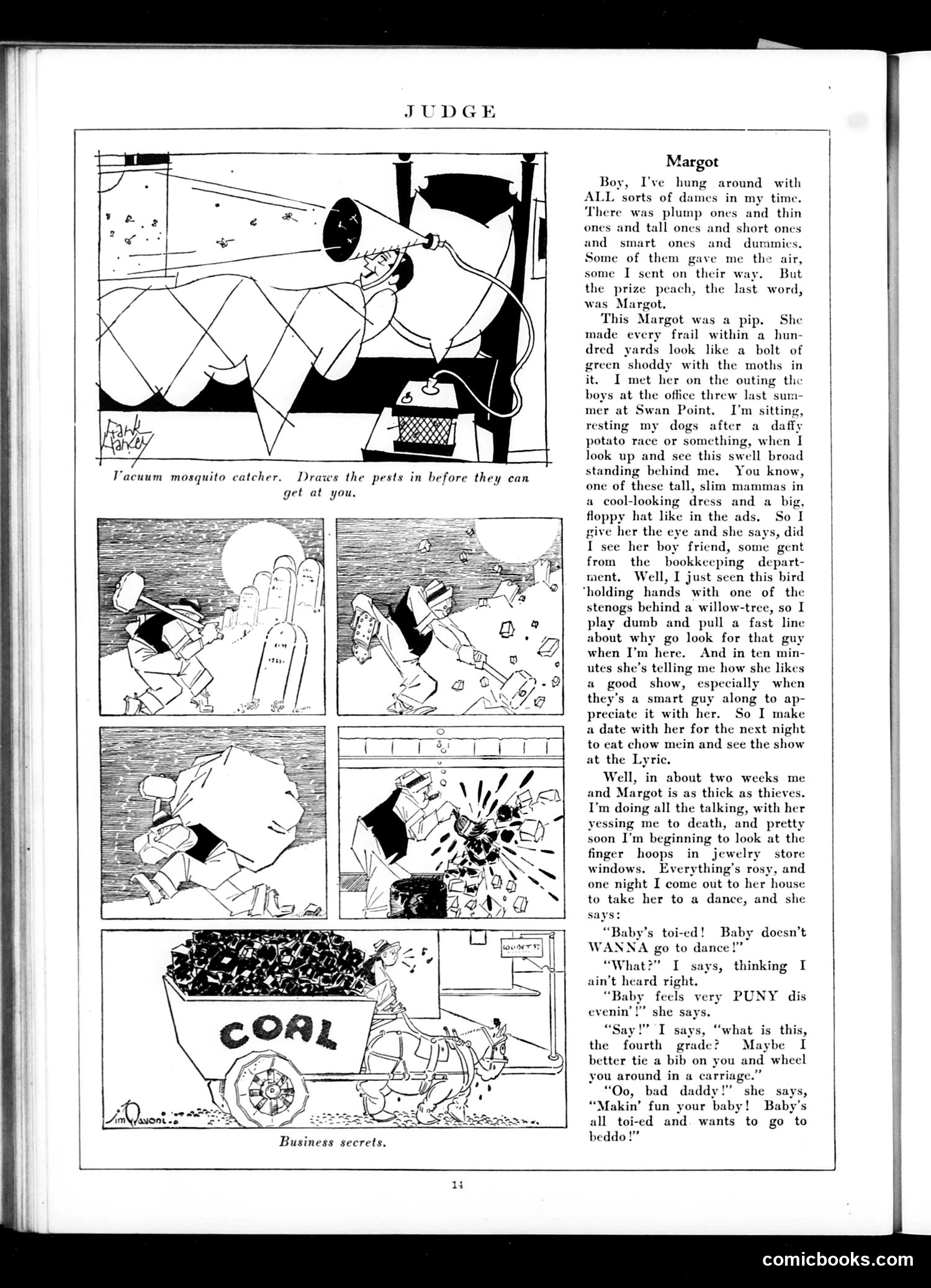
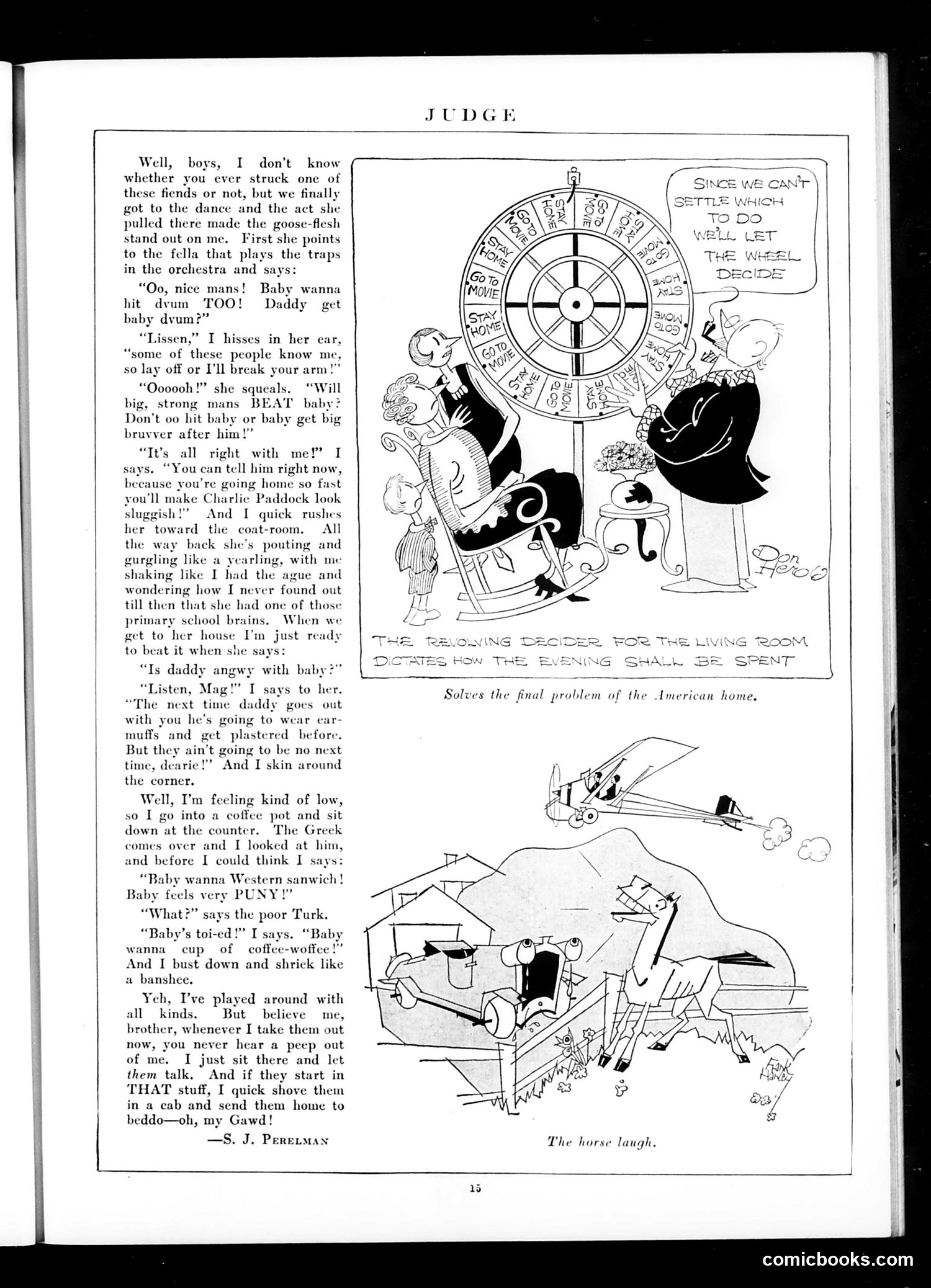
This is a humorous short story with accompanying cartoons about dating and relationships in what appears to be the 1920s-30s era. **The Setup:** A working-class man meets an attractive woman named Margot at an office outing and begins courting her. He's impressed by her beauty and apparent interest in him. **The Satire/Joke:** The punchline reveals Margot's true nature—she's manipulative and childish. When he arrives for a date, she suddenly claims to feel "puny" (unwell) and adopts baby-talk, calling herself "Baby" and demanding to go to bed instead. The narrator realizes he's been duped into a relationship with someone playing games and avoiding genuine adult interaction. **The Social Context:** The story satirizes both male vanity (the narrator's pride in winning a beautiful woman) and female manipulation through feigned helplessness or childishness—a recognized dating strategy of the era. The accompanying cartoons show practical inventions like a "vacuum mosquito catcher" and "business secrets," contrasting mundane reality with romantic delusion.
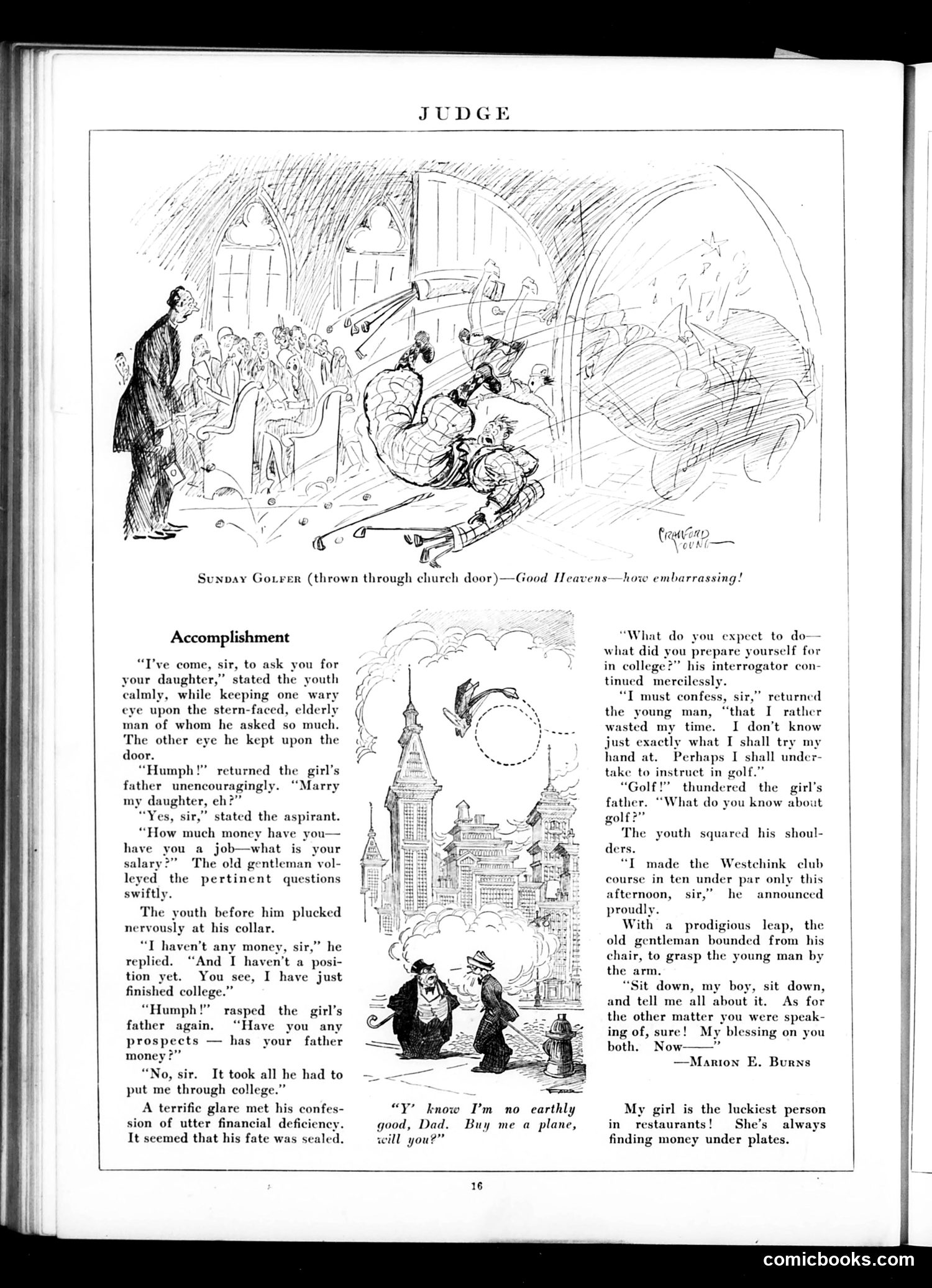
This page contains two satirical stories about young men's prospects in early 20th-century America. The top cartoon depicts a golfer crashing through a church door during service—mocking Sunday golf as scandalous behavior. The main story, "Accomplishment," satirizes class anxieties and changing values. A poor young man seeks his girlfriend's hand but has no money, job, or prospects—only a college education, which his stern father-in-law dismisses as worthless. The father's entire attitude shifts instantly when the youth mentions shooting ten under par at an exclusive golf club (Westchink). The joke: golf skill and club membership now matter more than financial stability or education for marriage approval, reflecting how wealthy Americans valued leisure accomplishments and social status over traditional merit. The secondary jokes mock both modern youth ("buy me a plane") and women's financial luck ("finding money under plates").
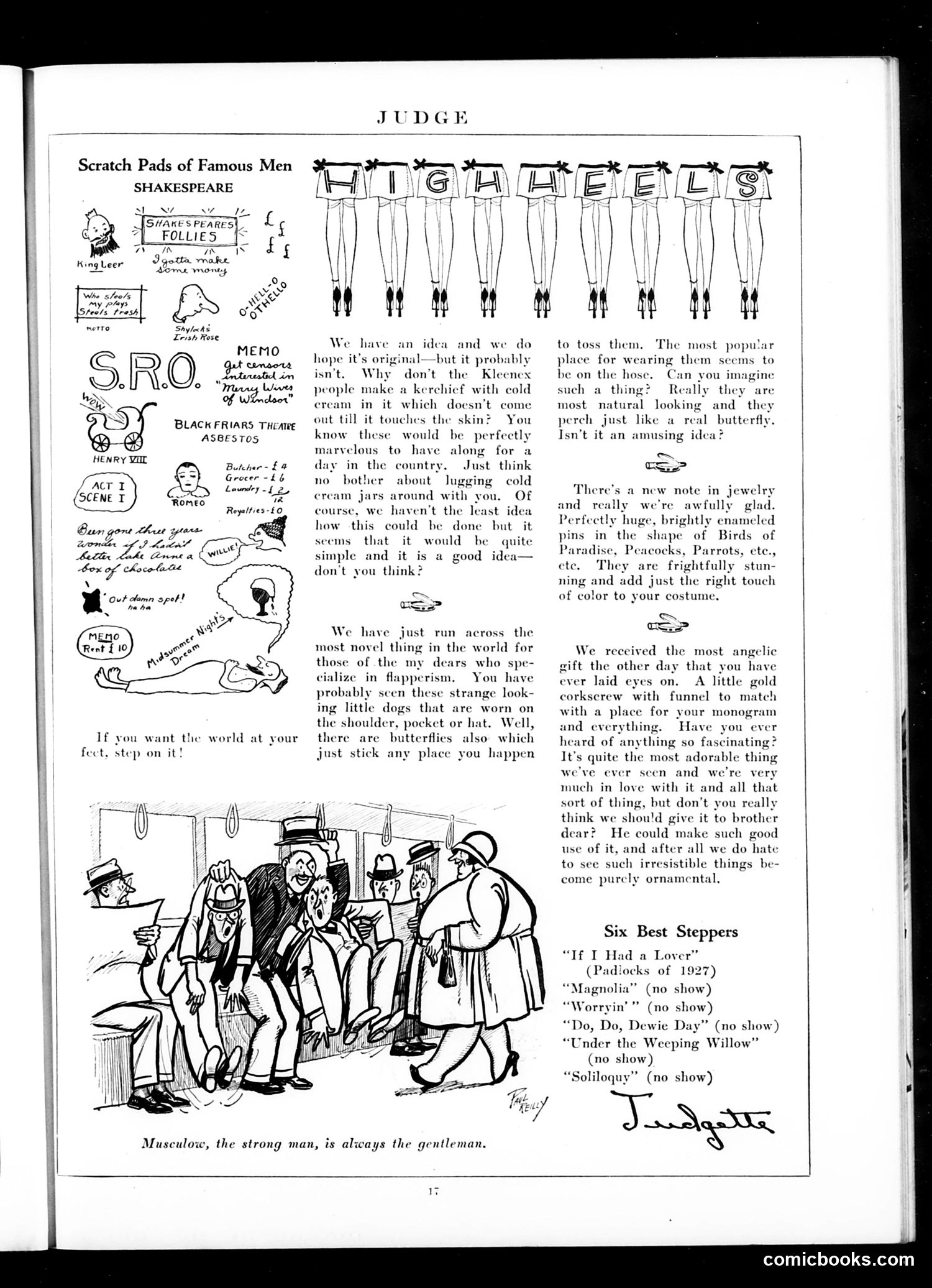
This page combines two distinct sections: **"Scratch Pads of Famous Men"** (left) and consumer advice with illustrations (right). The left side mocks Shakespeare through fake "scratch pad" notes, showing his mundane business concerns—theater expenses, royalties, cast payments—reducing the Bard to a commercial playwright worried about money, not artistic immortality. The right side offers humorous consumer product suggestions typical of 1920s "Judge" satire: Kleenex tissues pre-filled with cold cream, decorative butterflies for clothing (mimicking fashionable "flapper" accessories), enameled bird jewelry pins, and a monogrammed gold corkscrew. The tone is tongue-in-cheek, feigning earnest enthusiasm while gently mocking both the absurdity of novelty products and the materialism of contemporary consumer culture. The bottom cartoon, captioned "Musculow, the strong man, is always the gentleman," illustrates working-class dignity amid crowded urban transit—likely contrasting physical strength with moral character.
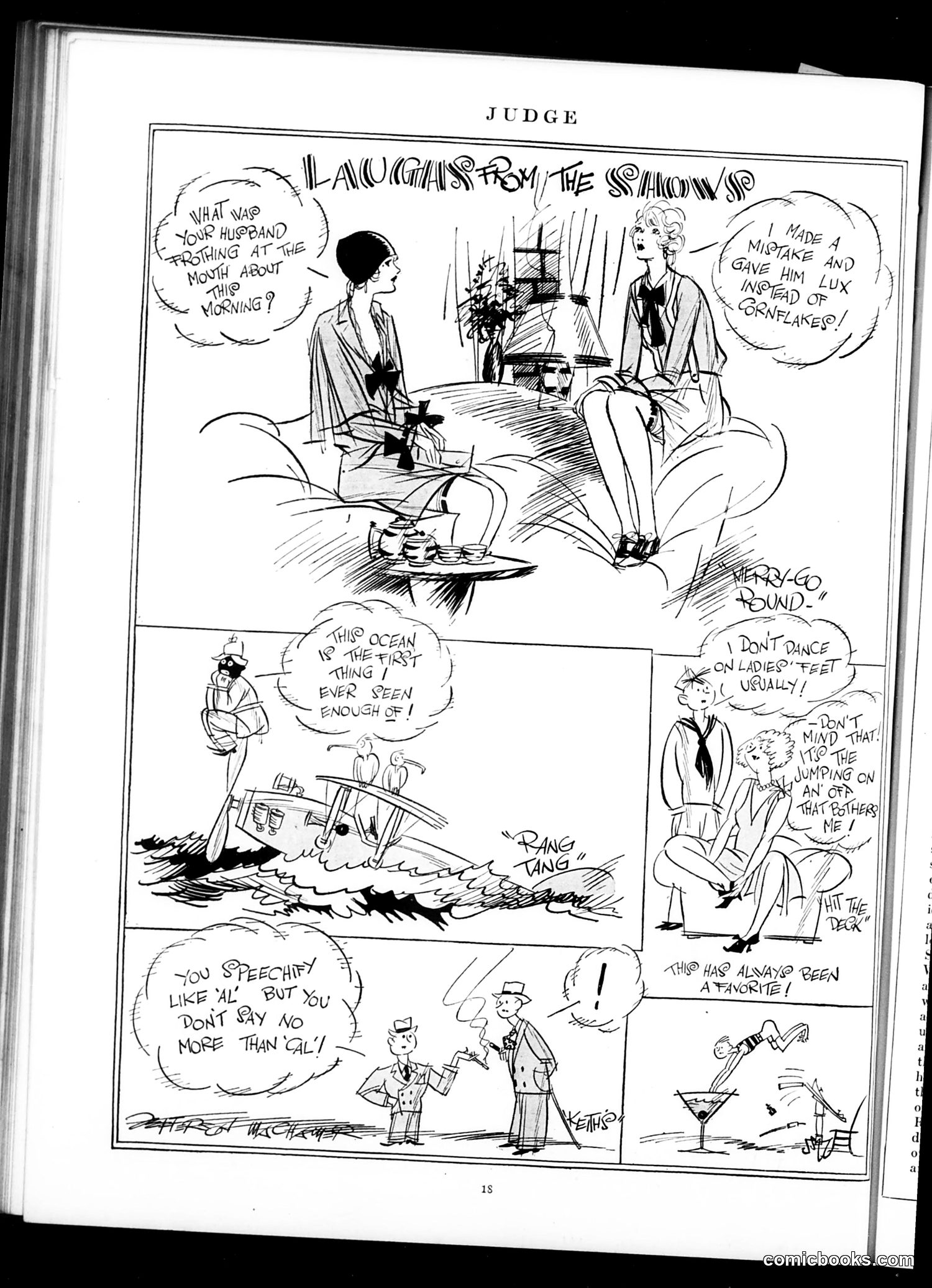
This multi-panel Judge cartoon satirizes modern social behavior, likely from the 1920s-30s based on the art style and fashion. The sequence depicts a husband's morning complaint about his wife's appearance, escalating into increasingly absurd scenarios—a sinking ship, dancing violations, and a final scene where a man makes an awkward speech at what appears to be a social gathering. The satire targets marital dynamics and social etiquette of the era. The husband's initial complaint about breakfast morphs into broader commentary on wives' behavior and social expectations. The "don't say no" speech joke references the common trope of men seeking agreement or compliance in social situations. The cartoonist critiques both domestic friction and the rigid social conventions governing public behavior—particularly around dancing, drinking (suggested by the cocktail), and gender roles in this period.
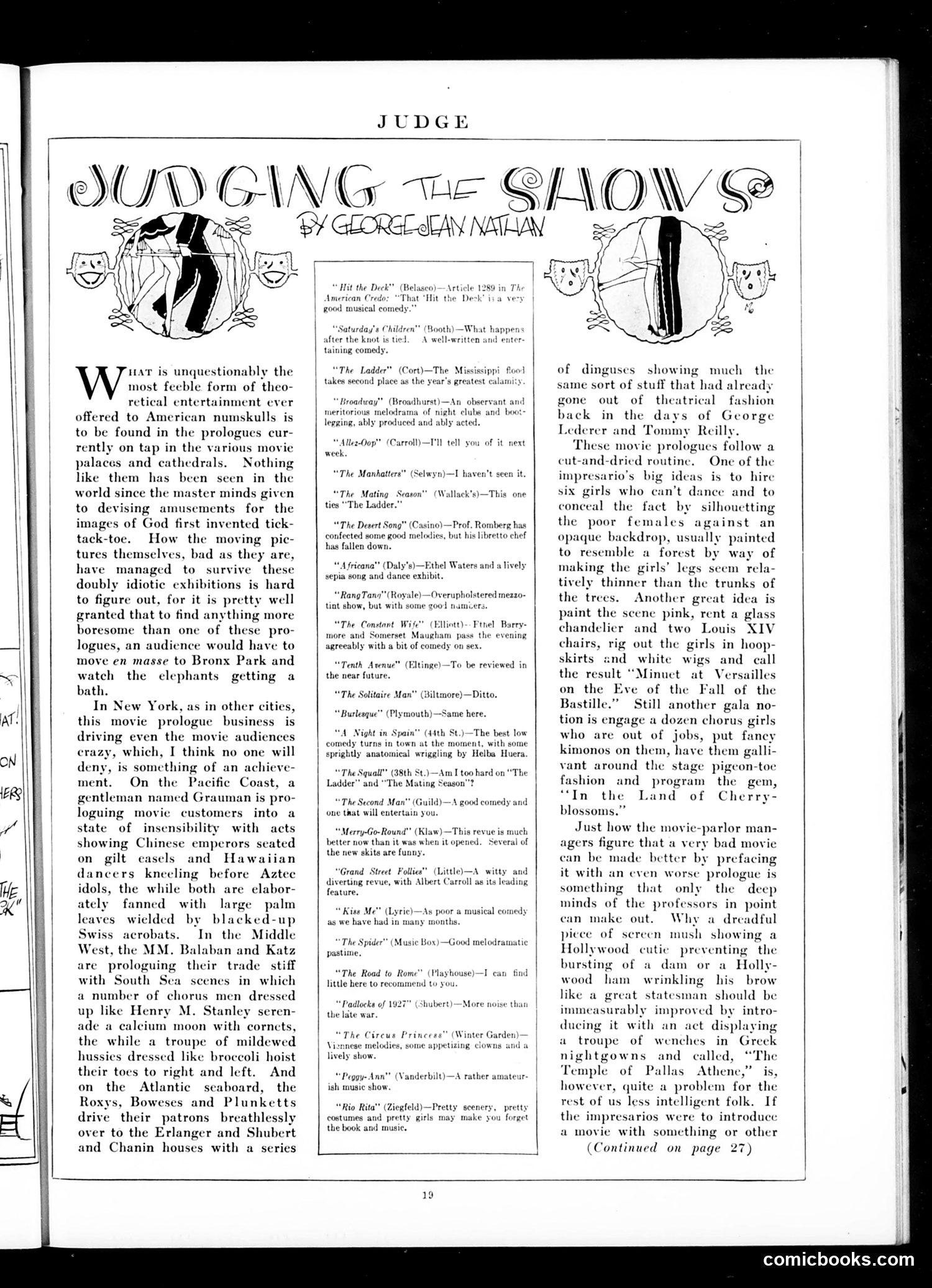
This page from *Judge* magazine satirizes the elaborate theatrical prologues that accompanied films in 1920s movie palaces. Author George Jean Nathan attacks these intermission acts as stupefyingly bad entertainment that somehow coexist with mediocre movies. The satire targets specific theater impresarios: Grauman (on the Pacific Coast) and Balaban and Katz (Midwest) are named for staging absurdly overwrought productions featuring Chinese emperors, Hawaiian dancers, and Swiss acrobats in blackface. Nathan ridicules the artistic incoherence—mixing unrelated exotic themes with slapstick choreography. The accompanying theater reviews mock current Broadway productions with similar irreverence, suggesting the entire entertainment industry has abandoned coherent storytelling for spectacle and novelty. The humor relies on readers' familiarity with these notorious theater operators and contemporary shows, positioning *Judge* as cynical arbiter of taste against mass-market entertainment's descent into absurdity.
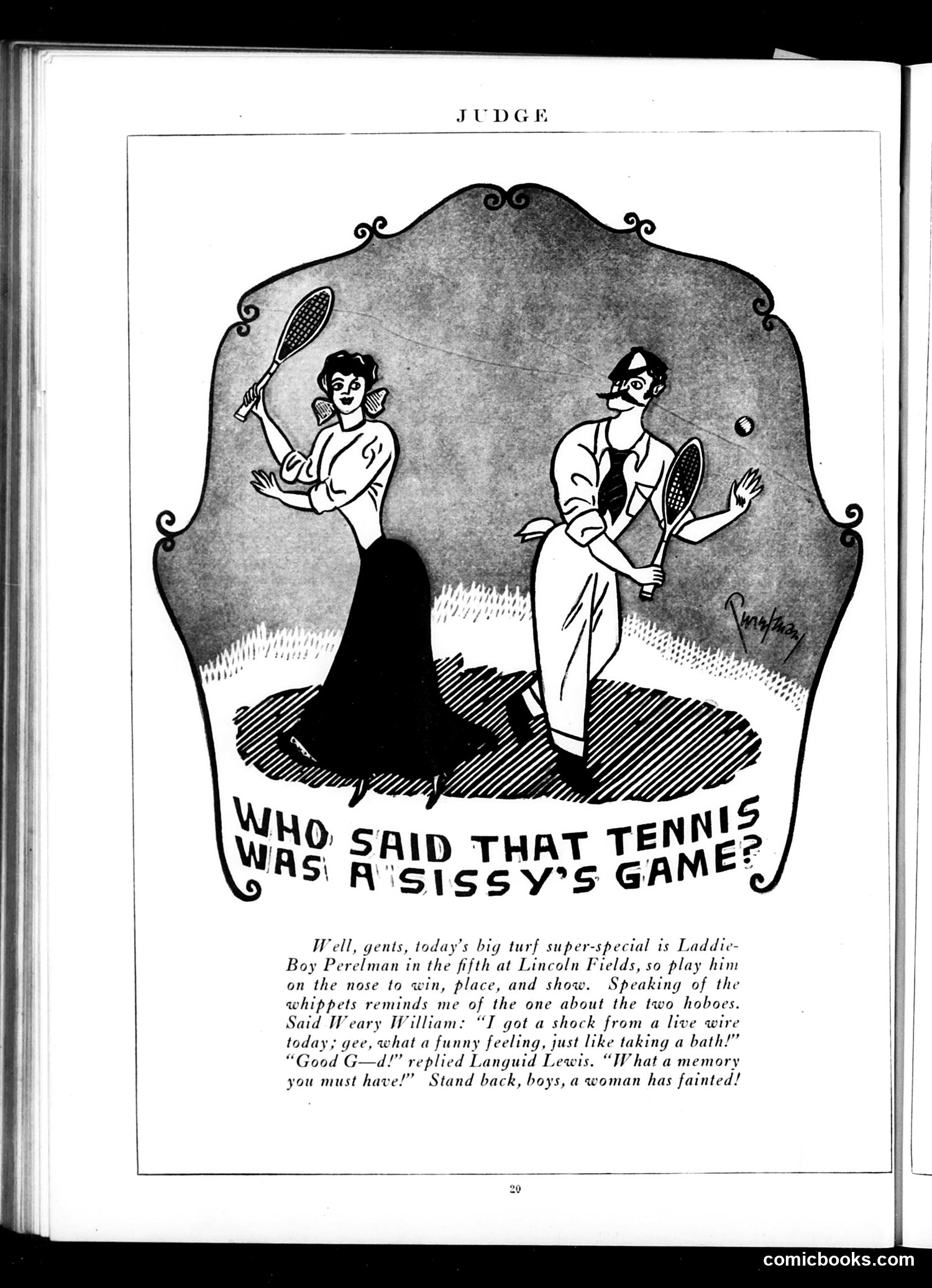
This single-panel cartoon mocks femininity in tennis through a visual joke. Two men play tennis while a woman has fainted in the foreground—the punchline being that tennis is supposedly "a sissy's game," yet a woman's delicate constitution can't handle even watching it. The accompanying text is unrelated banter about horse racing (mentioning "Laddie-Boy Perelman" at Lincoln Fields) and a hobo joke, suggesting this page mixed sports commentary with humor. The satire targets two things: the emasculation anxiety around tennis as an "unmanly" sport, and the stereotype of women as fragile and prone to swooning. By depicting women as too weak even to observe tennis, the cartoon absurdly defends the sport's masculinity while simultaneously mocking Victorian-era female delicacy tropes.
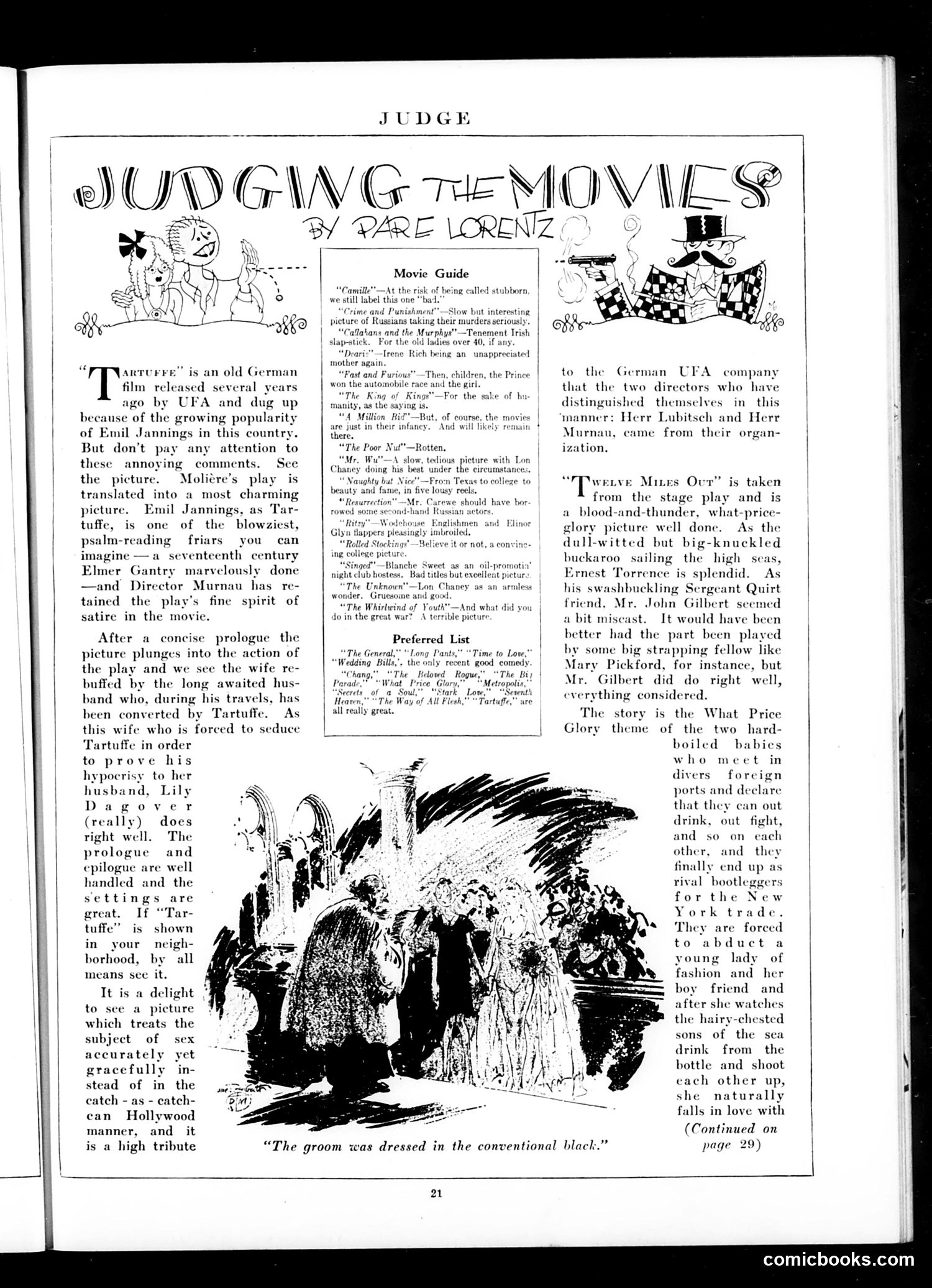
This page reviews recent films, primarily European imports and American productions from what appears to be the mid-1920s. The main review concerns **"Tartuffe,"** a German UFA film starring Emil Jannings (then popular in America), adapted from Molière's classic play about sexual hypocrisy. The reviewer praises Jannings' performance and director Murnau's handling of the satirical material, noting the film treats sex "accurately yet gracefully" rather than in Hollywood's typical "catch-as-catch-can manner." The "Movie Guide" sidebar briefly reviews other current releases, with mixed assessments. The illustration shows a formal wedding scene ("The groom was dressed in the conventional black"), likely from one of the reviewed films. The page credits Lubitsch and Murnau as distinguished German directors working for UFA—reflecting 1920s cinema's respect for German Expressionist filmmaking before the Nazi era.
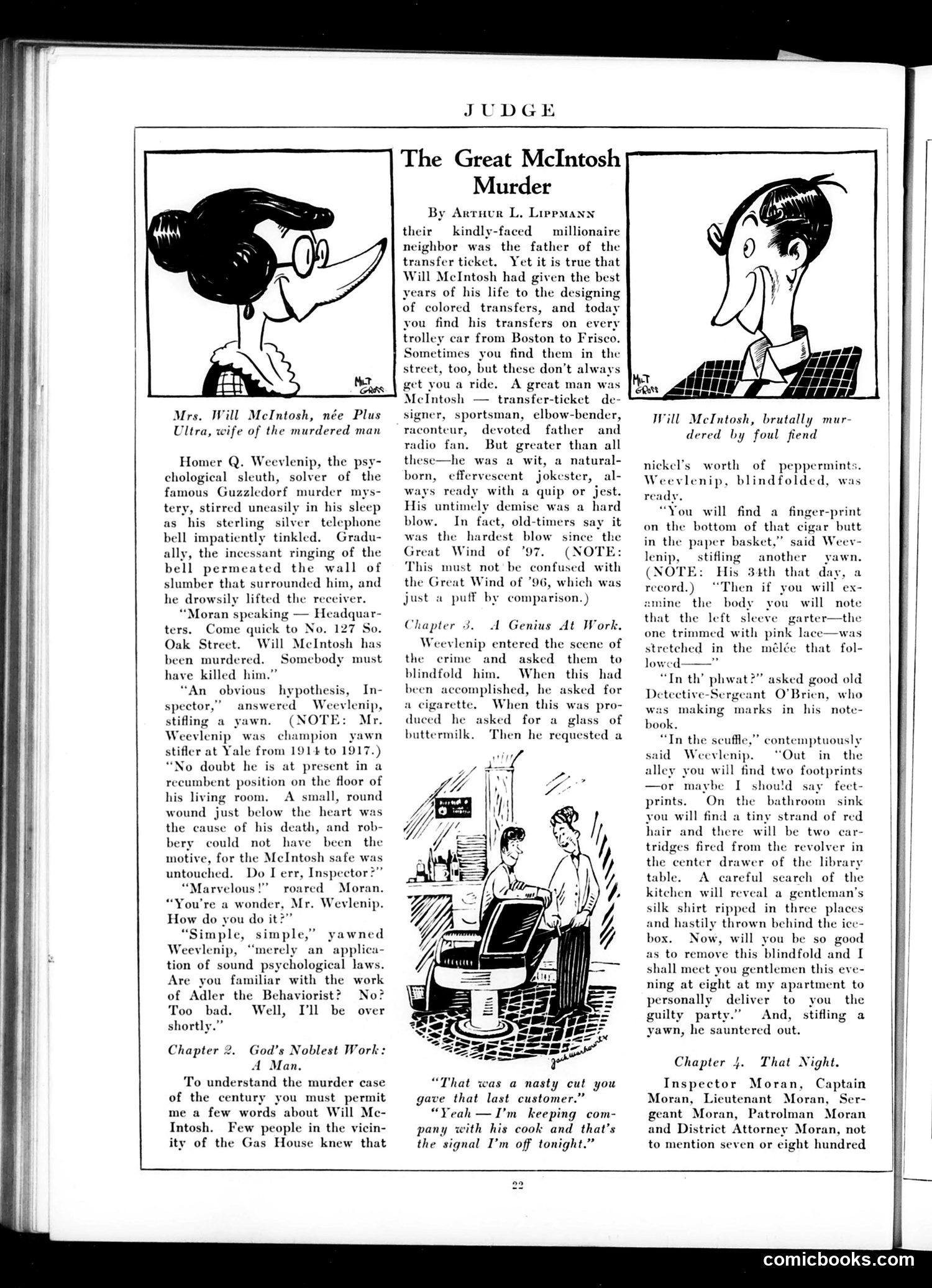
This is a parody mystery story satirizing the popular "psychological detective" genre of the early 20th century. The protagonist, Homer Q. Weevlenip, is a caricature of the brilliant deductive detective archetype (à la Sherlock Holmes). The satire works through absurdity: Weevlenip solves a murder while blindfolded, eating cigarettes, buttermilk, and peppermints—then rattles off impossibly detailed clues (fingerprints, footprints, cartridges, red hair, torn shirts) that he couldn't possibly have observed without sight. The illustrations show caricatured characters with exaggerated features typical of Judge's visual humor. The joke mocks both the detective-fiction craze and the pseudo-scientific "psychological" methods popular in the era. Weevlenip's constant yawning and affected manner further ridicule the pretentious brilliance these stories celebrated. The murdered man, Will McIntosh, is humorously credited as the inventor of colored streetcar transfers—a mundane, unglamorous achievement.
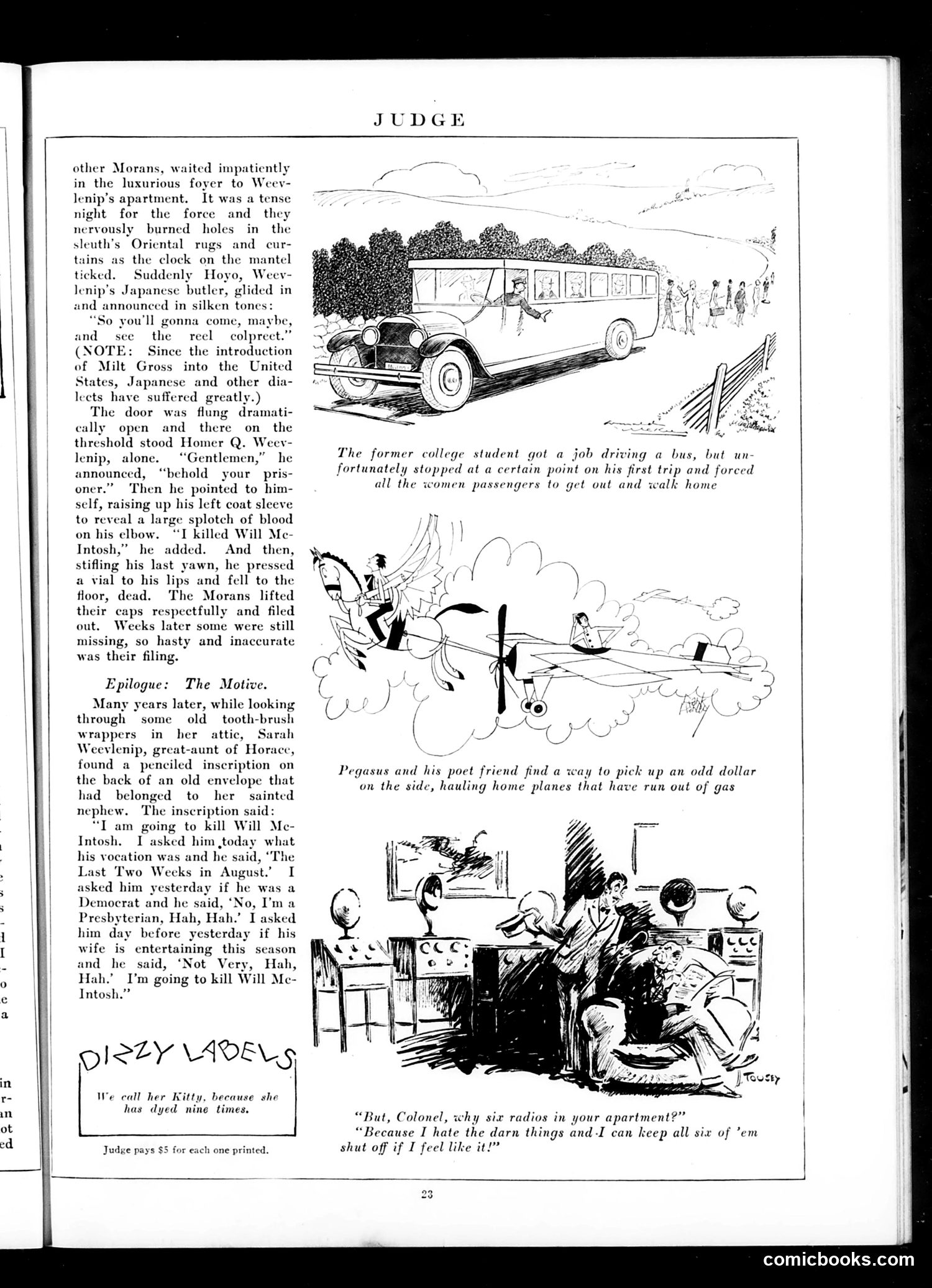
This page contains three satirical cartoons from Judge magazine, likely from the 1920s-1930s: 1. **Top cartoon**: A humorous detective story parody where a criminal confesses to murder by dramatically revealing a bloodstain, then dies. The joke mocks both overwrought crime drama and the incompetence of police ("Morans") who later go missing due to poor filing. 2. **Middle cartoon**: Satirizes a bus driver who stops mid-route and forces female passengers to walk home. The joke ridicules either misogyny or bizarre passenger treatment policies. 3. **Bottom cartoon**: A man with six radios boasts about keeping them all on simultaneously in his apartment, claiming he can "shut off" the noise "if I feel like it." This satirizes radio addiction and the new technology's intrusive nature in 1920s-30s homes. The page also includes a joke about a woman named "Kitty" who has dyed her hair nine times, and a note mocking comedian Milt Gross's exaggerated ethnic dialect humor ("Japanese butler" speaking broken English).
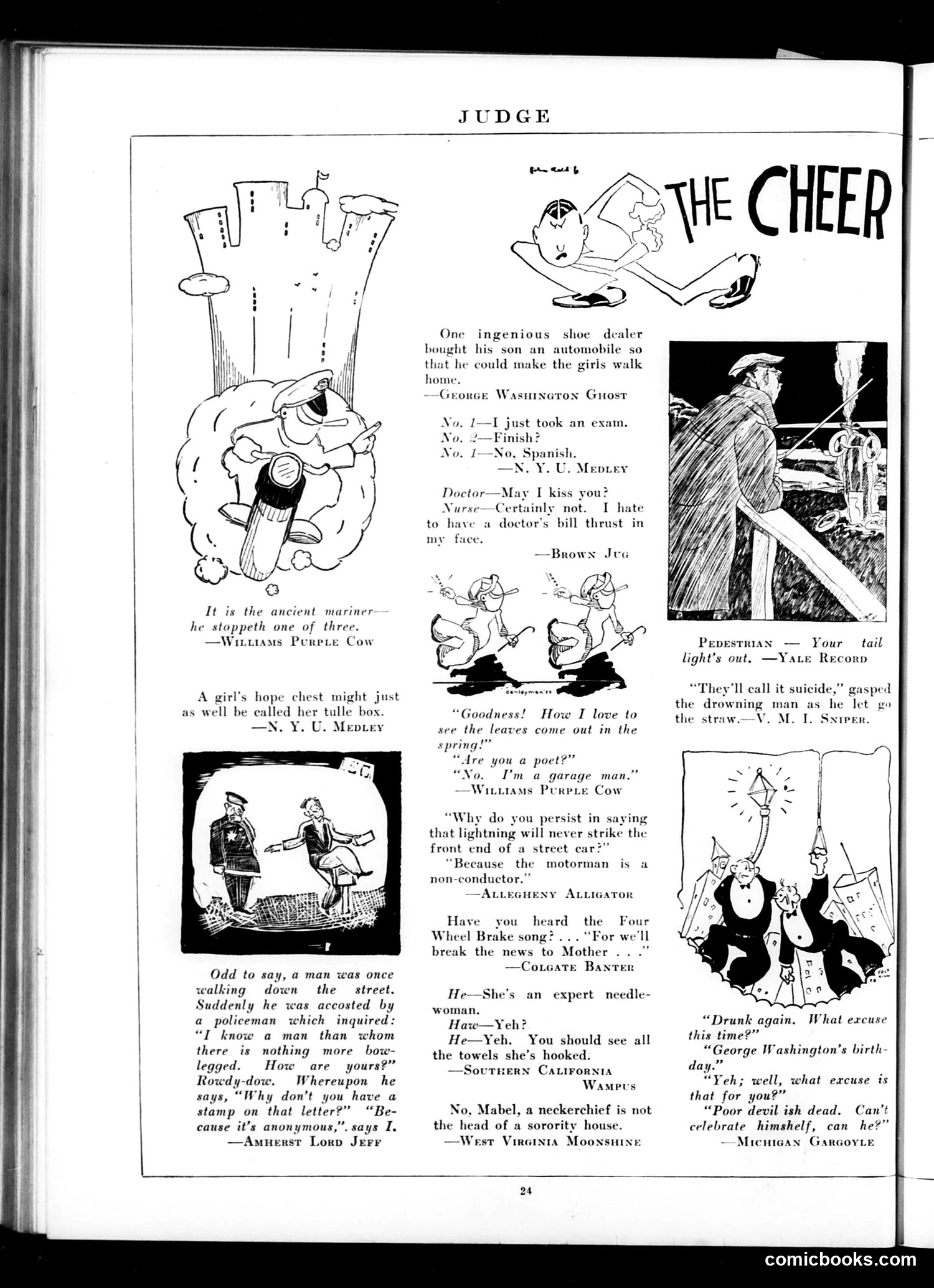
This page collects humorous one-liners and jokes from various college humor sources (N.Y.U. Medley, Brown Jug, Yale Record, etc.), typical of Judge's era content. The cartoons are simple gag illustrations accompanying quips. **Key humor themes:** - **Gender/romance jokes**: A shoe dealer buys his son a car so girls must walk home (implying dating). A nurse refuses a doctor's kiss to avoid a medical bill. References to "necking" and sorority life reflect 1920s dating culture. - **Drunk humor**: A drowning man jokes about suicide; Washington's Birthday is used as an excuse for intoxication—reflecting Prohibition-era attitudes. - **Wordplay**: Lightning won't strike a streetcar's front because "the motorman is a non-conductor" (pun on electrical/musical conductor). - **Character types**: A nurse, a garage mechanic, a "needle-woman" (likely a woman who steals/shoplifts—"hooked towels"). The page represents typical college humor magazine content: mild satire of dating conventions, drinking culture, and gender dynamics of the period.
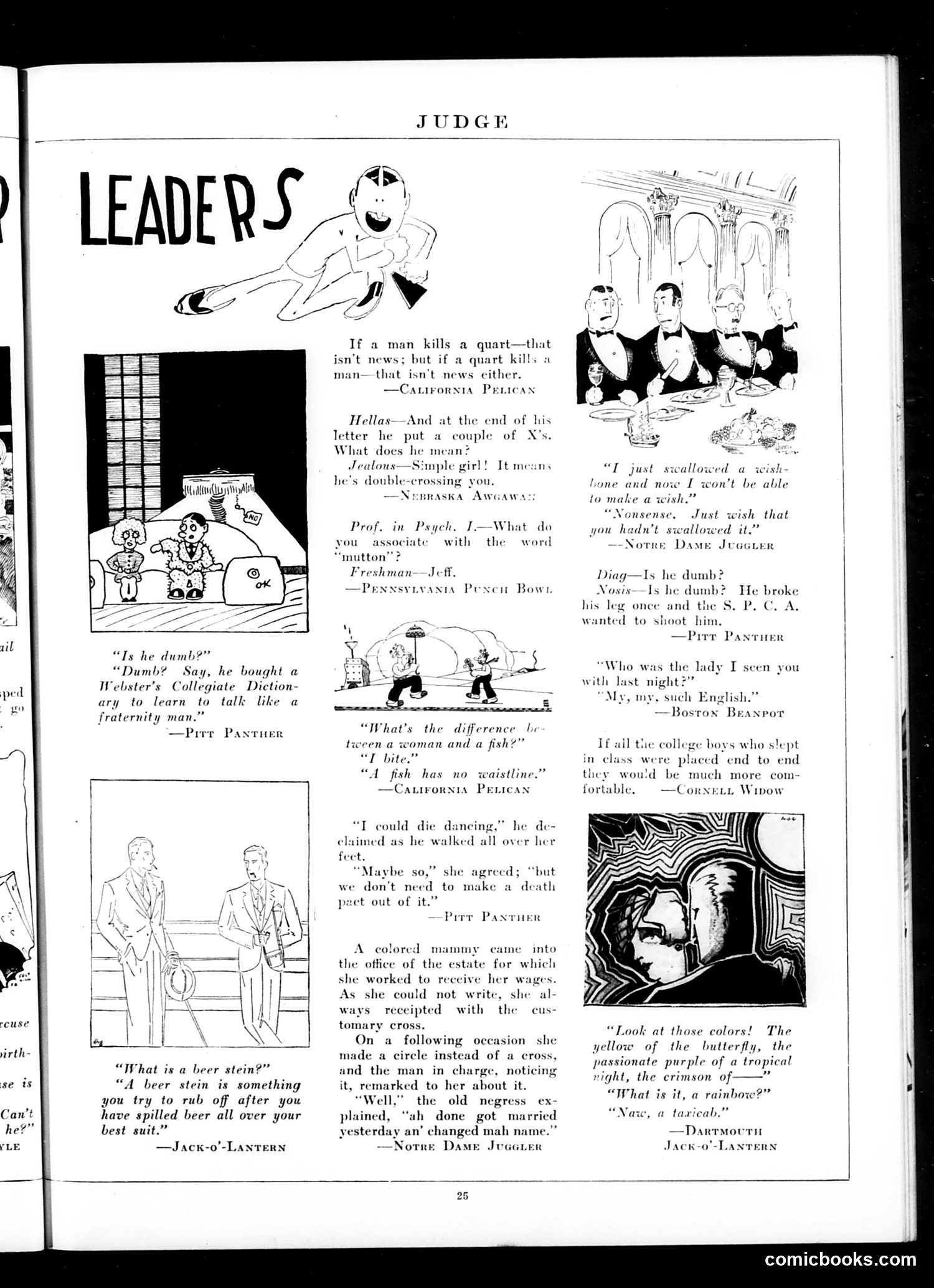
This page from *Judge* magazine contains brief jokes and one-panel cartoons targeting early 20th-century college culture and social stereotypes. **Main themes:** - **College humor**: Fraternity men pretending sophistication ("buying a dictionary to talk like a fraternity man"), drunkenness, and poor dancing - **Gender stereotypes**: Women portrayed as simple-minded or materialistic; a joke contrasting women and fish - **Racial caricature**: A story about a "colored mammy" who marks documents with an X, later substituting a circle after marriage—presented as humor about Black illiteracy and name changes - **General absurdism**: Surreal jokes about beer steins, swallowed wishbones, and college boys sleeping in class The racial content reflects the casual bigotry of the era. Most humor relies on wordplay, physical comedy, and contemporary college life references that remain recognizable today (fraternity culture, drinking, dating). The magazine attributes jokes to various college newspapers (Notre Dame, Cornell, Pennsylvania).
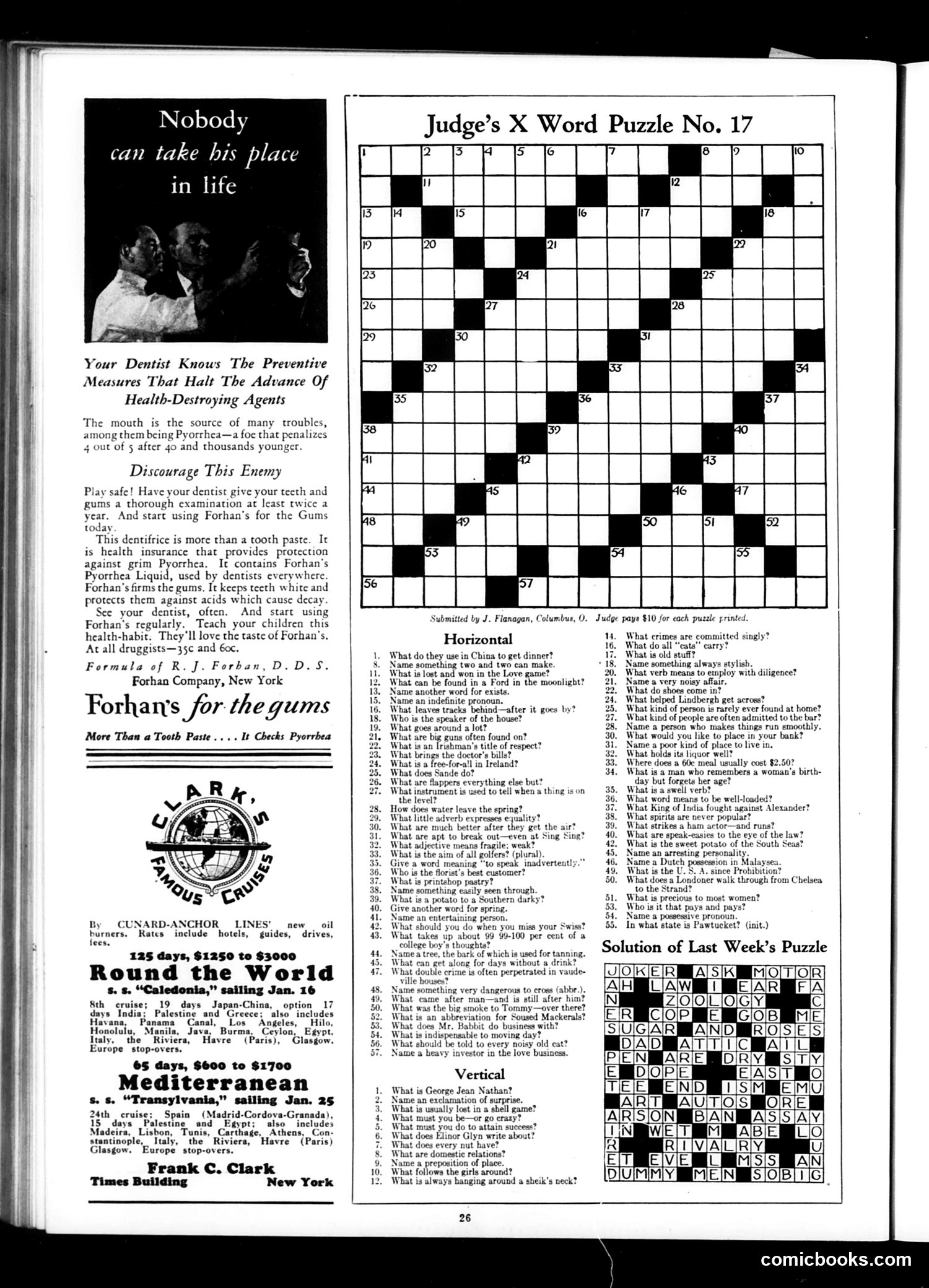
This page is primarily **advertising and a crossword puzzle**, not a political cartoon. The dominant content includes: **Main Advertisement**: Forhan's toothpaste dominates the left side with a health-focused pitch about preventing pyorrhea (gum disease), a serious concern in the early 20th century. The imagery shows concerned figures, likely emphasizing the social stigma of dental disease. **Travel Advertisements**: Cunard-Anchor Lines promote luxury cruises (world voyages, Mediterranean trips) at substantial prices ($600-$3000), targeting affluent readers. **Crossword Puzzle**: "Judge's X Word Puzzle No. 17" fills the right side—a recreational feature popular in 1920s magazines, with clues mixing wordplay, current events (Lindbergh), and contemporary references (Ford, Sande the jockey). **Context**: This reflects Judge's audience—educated, prosperous Americans interested in health consciousness, leisure travel, and modern entertainment during the prosperous 1920s.
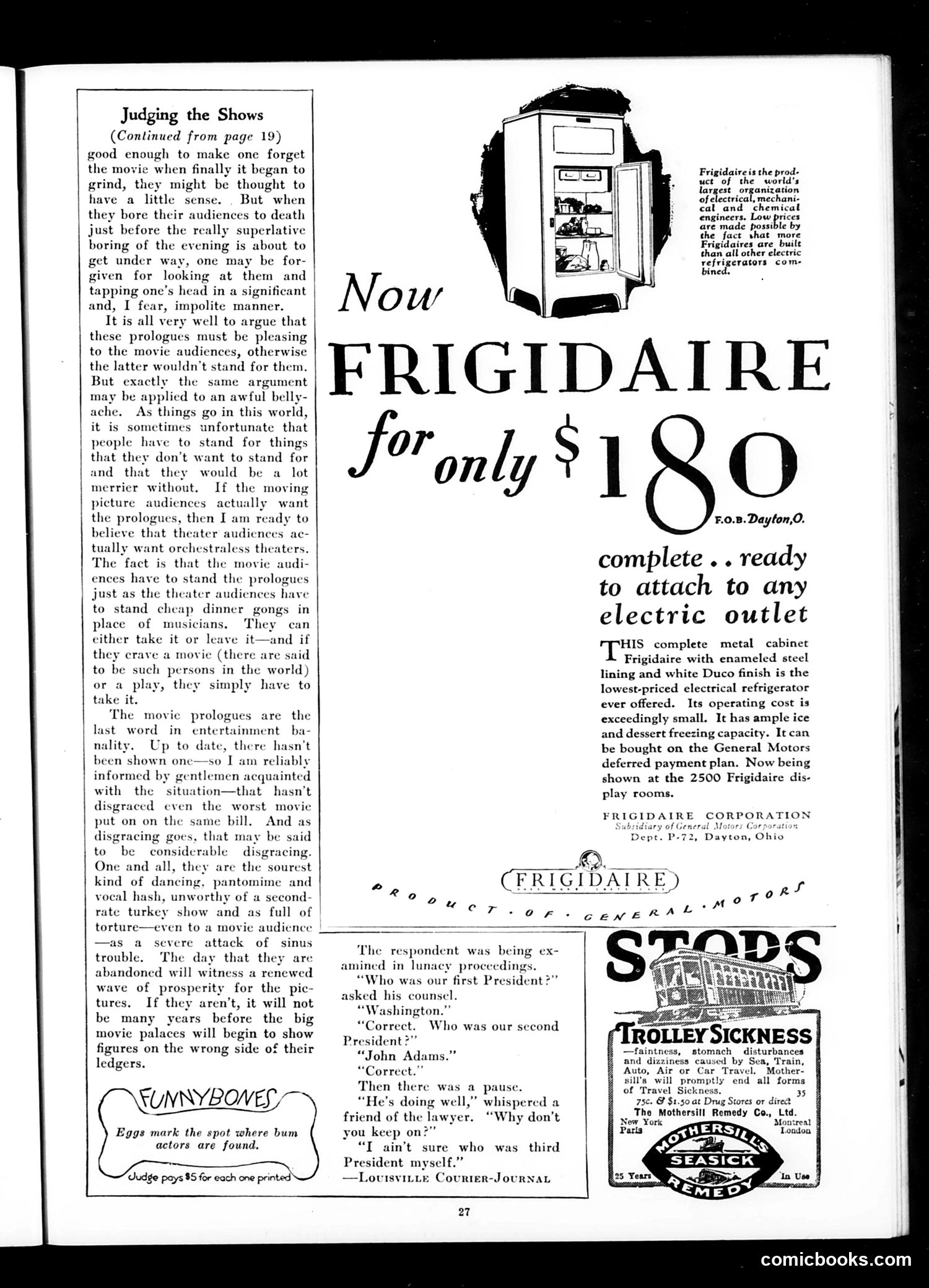
This page contains **editorial content and advertisements** rather than political cartoons. The main article critiques **movie theater prologues**—live stage performances shown before films in 1920s movie palaces. The author argues these prologues are tedious, poorly performed entertainment that audiences tolerate only because they want to see the main movie, comparing it to enduring bad orchestral music in theaters. The **"Funny Bones"** section is a light joke about bad actors. The advertisements promote **Frigidaire refrigerators** ($180, a significant price then) and remedies for travel sickness. A brief anecdote at bottom describes a competency hearing where a lawyer's client appears lucid after correctly naming early U.S. presidents—the humor comes from the low bar for "sanity." This is primarily a **commercial magazine page** blending opinion pieces with advertising, not satirical political content.
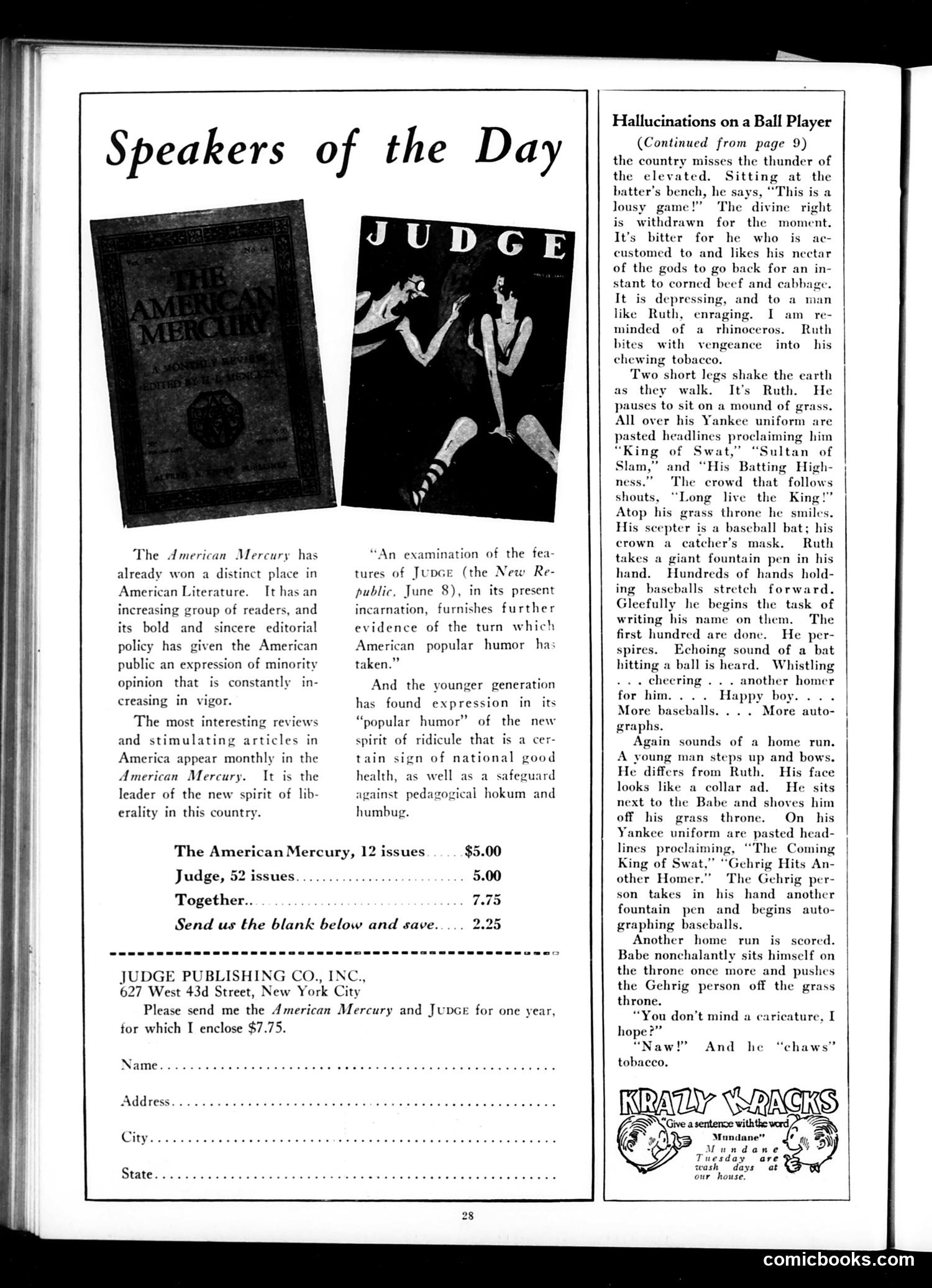
This page primarily contains **advertising and subscription offers** rather than political cartoons. The left side promotes two magazines—*The American Mercury* and *Judge* itself—positioning them as leaders of progressive, satirical American thought that challenge "pedagogical hokum and humbug." The right side continues a humorous story titled "Hallucinations on a Ball Player," clearly about **Babe Ruth**. The narrative depicts Ruth as a deity-like figure ("King of Swat," "Sultan of Slam") receiving adoration from crowds, signing autographs. The satire mocks Ruth's inflated celebrity status and ego when **Lou Gehrig** (referenced as "the Gehrig person") briefly displaces him—prompting Ruth to reclaim his throne. The ending joke about "chawing tobacco" underscores Ruth's crude, common persona beneath his heroic public image. The small "Krazy Wracks" comic at bottom is unrelated filler. The satire targets 1920s celebrity worship and sports idolatry.
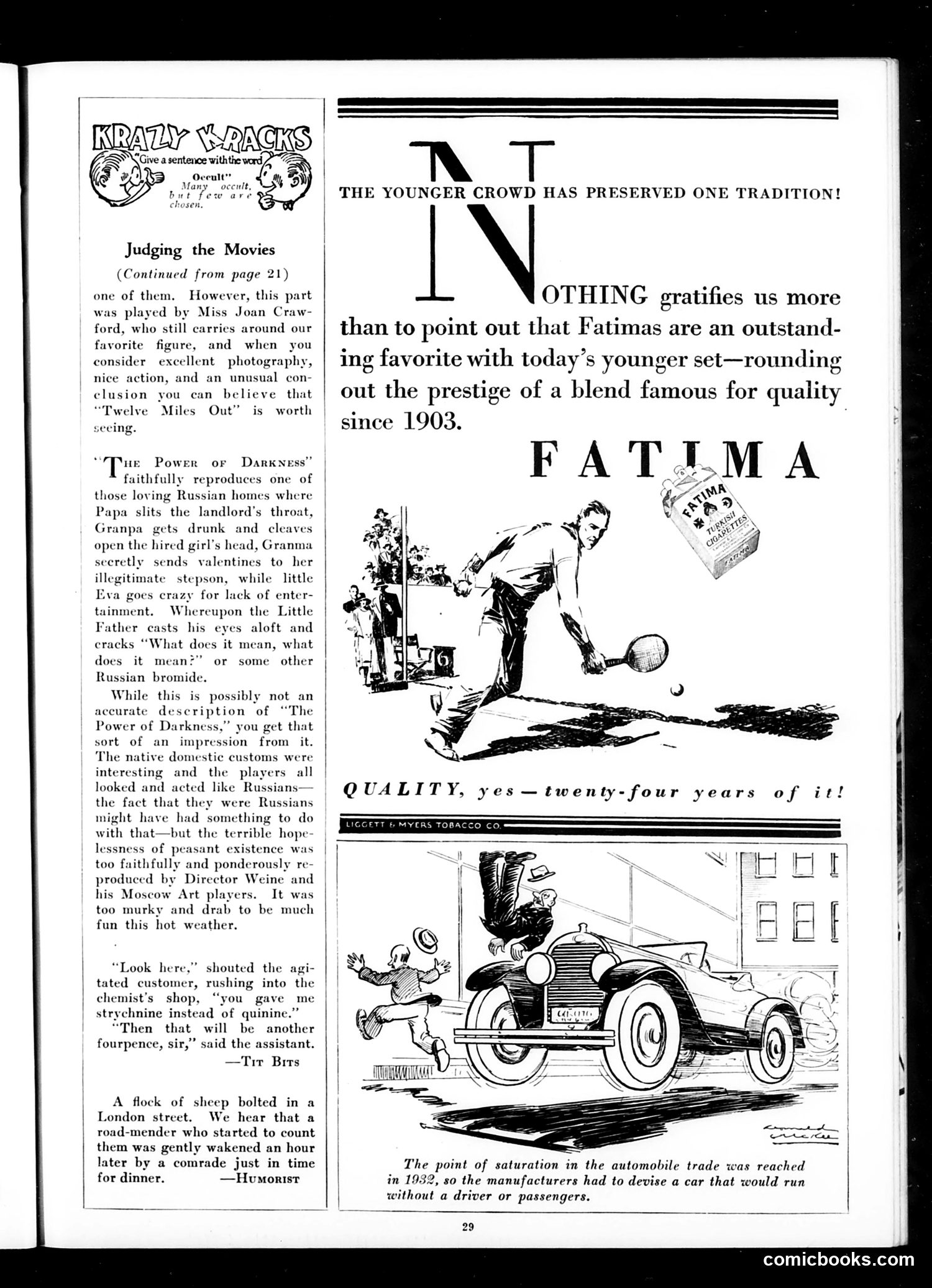
This page contains movie reviews, a humorous anecdote section ("Krazy Knacks"), and advertisements. **Movie Reviews**: The text critiques "Twelve Miles Out" (starring Joan Crawford) and "The Power of Darkness" (a Russian film). The reviewer finds the latter too bleak and depressing—faithfully depicting Russian peasant misery with excessive grimness unsuitable for summer entertainment. **Humor Section**: Brief jokes, including one about a chemist mix-up (strychnine for quinine) and sleepy sheep-counting. **Advertisements**: - **Fatima cigarettes**: Claims the younger generation continues the tradition of smoking this brand, established in 1903. - **LiGGETT & MYERS tobacco car**: A satirical cartoon showing a driverless, passengerless automobile. The caption explains that 1932 saw automobile market saturation, forcing manufacturers to invent absurd alternatives. This is social satire on American consumerism and industrial excess during the Depression era. The driverless car joke mocks both automotive industry desperation and the era's economic absurdity.
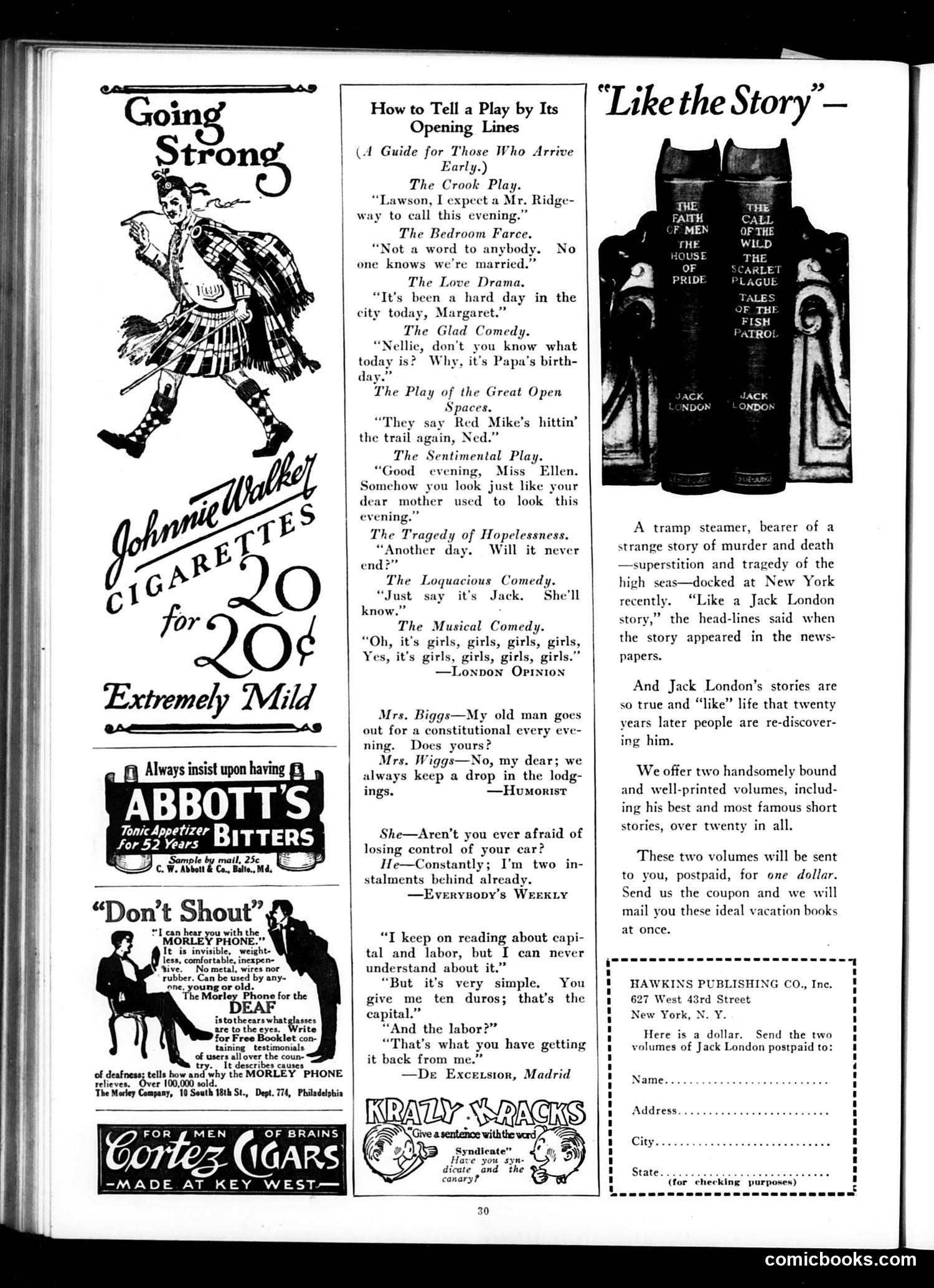
This page primarily features **satirical commentary on theatrical conventions** rather than political cartooning. The centerpiece, "How to Tell a Play by Its Opening Lines," mocks predictable theater formulas of the era by cataloging stock opening lines that instantly telegraph a play's genre—from crook plays ("Lawson, I expect a Mr. Ridgeway") to musical comedies ("Oh, it's girls, girls, girls"). The humor relies on audiences recognizing how formulaic and derivative contemporary theater had become. Each opening line is a cliché designed to signal the play's type to latecomers, suggesting theatrical writing lacked originality. The page also includes period advertisements (Abbott's Bitters, Cortez Cigars, Morley Phone) and a Jack London book promotion. A sidebar joke about installment car payments satirizes consumer debt culture—a modern concern even then. The overall tone is gentle mockery of theatrical mediocrity and emerging consumer capitalism, typical of Judge's satirical approach.
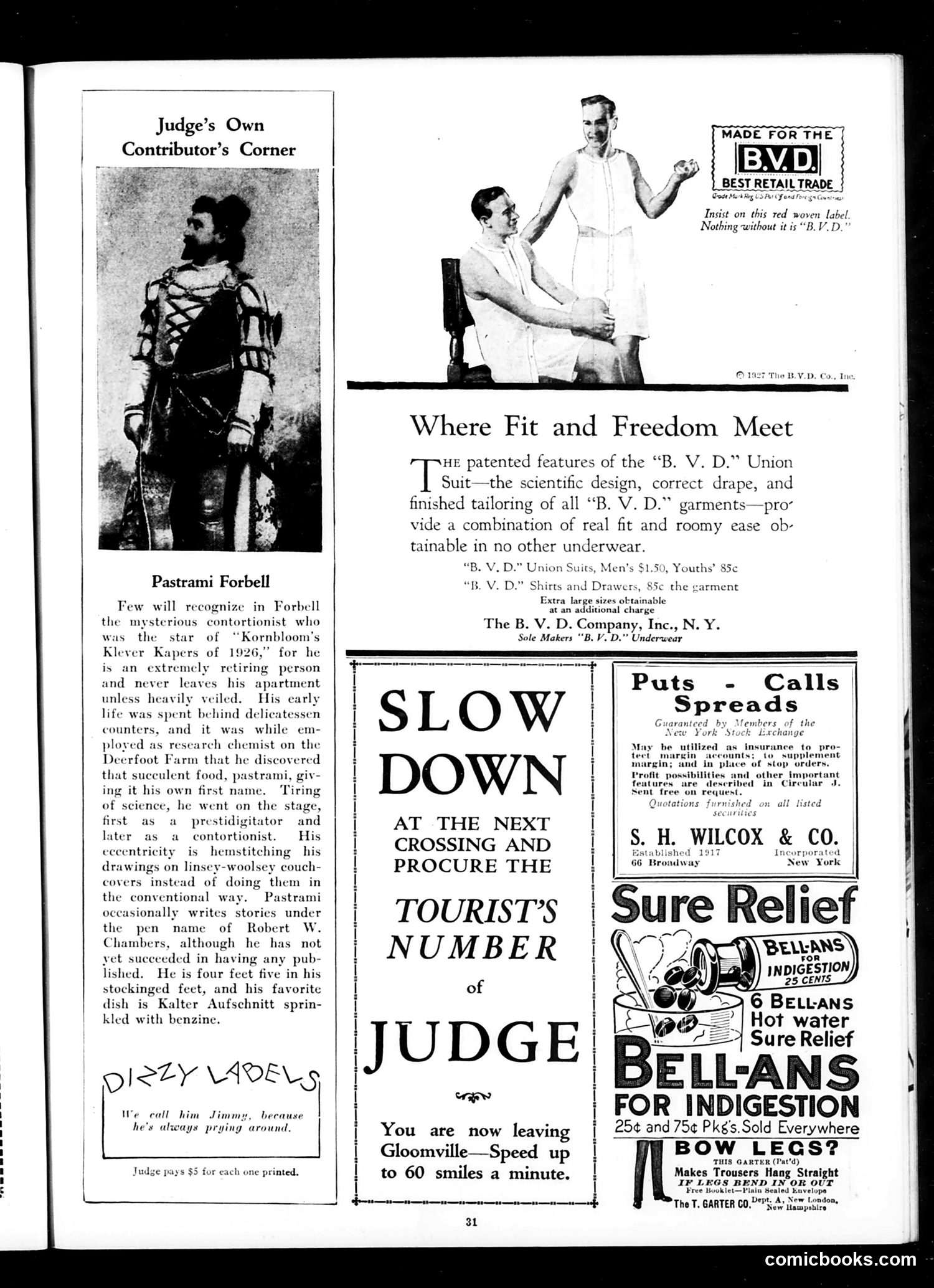
This page is primarily **advertising and filler content** rather than political satire. The main text section, "Judge's Own Contributor's Corner," offers a humorous **mock biography of "Pastrami Forbell,"** an apparently fictional character described as a reclusive contortionist and former stage performer. The joke relies on absurdist details—he's four feet tall, discovered pastrami while working as a research chemist, and enjoys it sprinkled with benzine. This appears to be satirical humor about eccentric personalities, typical of Judge's contributor showcase. The rest consists of **period advertisements**: B.V.D. underwear, Bell-Ans indigestion remedy, stock trading services, and novelty products like corrective garters for bow legs. The "Slow Down at the Next Crossing" notice is a safety/humorous road sign suggesting speeders "procure the Tourist's Number of JUDGE." No specific political figures or events are referenced. This is primarily a **commercial page mixing light satirical biography with advertisements**—representative of Judge's format blending humor with sponsored content.
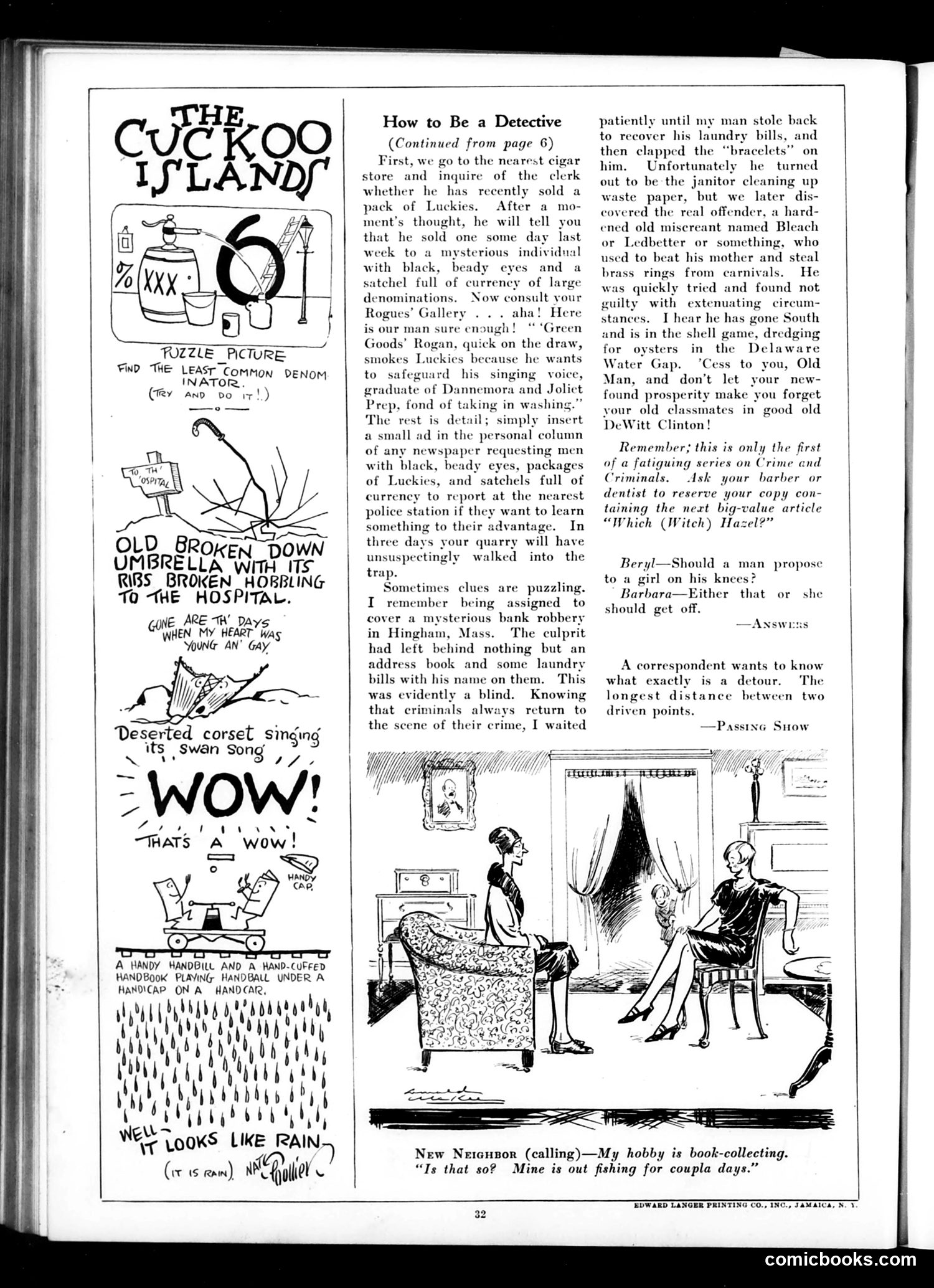
**Left Column - "The Cuckoo Island":** This section contains absurdist wordplay puzzles and illustrated gags typical of Judge's humor. The "puzzle picture" challenges readers to find alliteration or homonyms (handy/handbill/handball/handicap). The broken umbrella and deserted corset illustrations accompany nonsensical jokes—examples of the magazine's surreal, pun-based comedy style popular in early-to-mid 20th century humor publications. **Right Column - "How to Be a Detective":** A satirical advice column mocking detective fiction tropes. It parodies the era's popular mystery stories by suggesting absurdly simplistic detective methods: interrogating cigar clerks about suspicious customers, consulting "rogues' galleries," and placing newspaper ads. The humor peaks in the anecdote about catching the wrong person (the janitor) before finding the real criminal. This gently ridicules both detective stories and their illogical plots. **Bottom - Humor Q&A:** Brief joke responses about marriage proposals and the definition of "detour" represent Judge's regular advice-column satire.
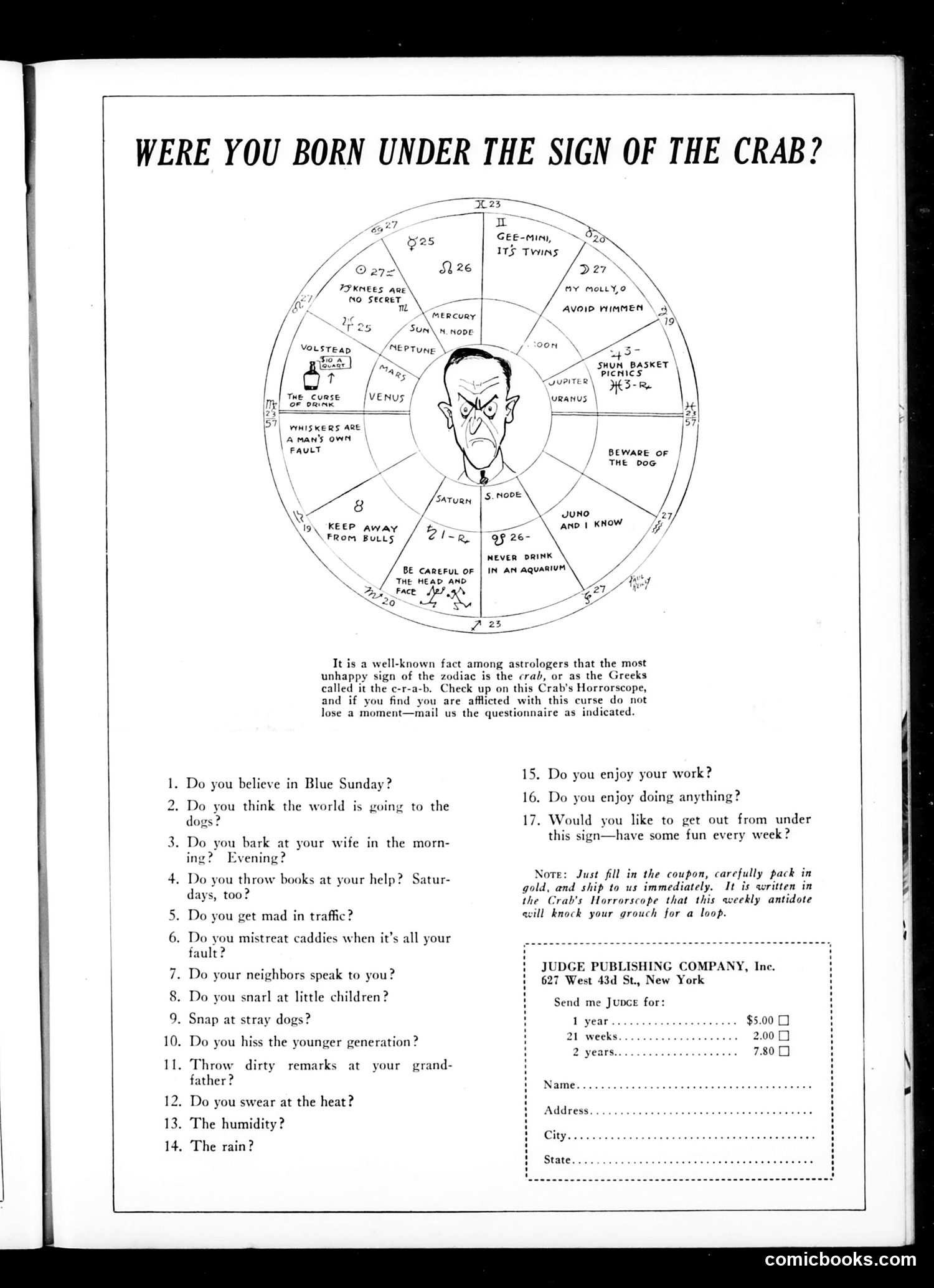
This page satirizes astrology through a fake "Crab's Horrorscope"—a zodiac parody claiming Cancer (the crab) is the zodiac's most cursed sign. The circular chart lists supposed planetary influences and personality traits associated with this "unhappy sign." The humor lies in the questionnaire below, which lists deliberately negative, antisocial behaviors: believing in superstitions, getting mad in traffic, snapping at children, hissing at youth, throwing books at servants, mistreating caddies, and swearing at weather. The satire mocks both astrology's pretensions and human grumpiness generally. By asking readers to self-diagnose whether they're afflicted with the "Crab curse," Judge ridicules astrology's pseudoscientific claims while using the caricatured angry face as a universal symbol of irritability. The magazine offers a subscription as humorous "cure" for this manufactured malady—typical period advertising satire.
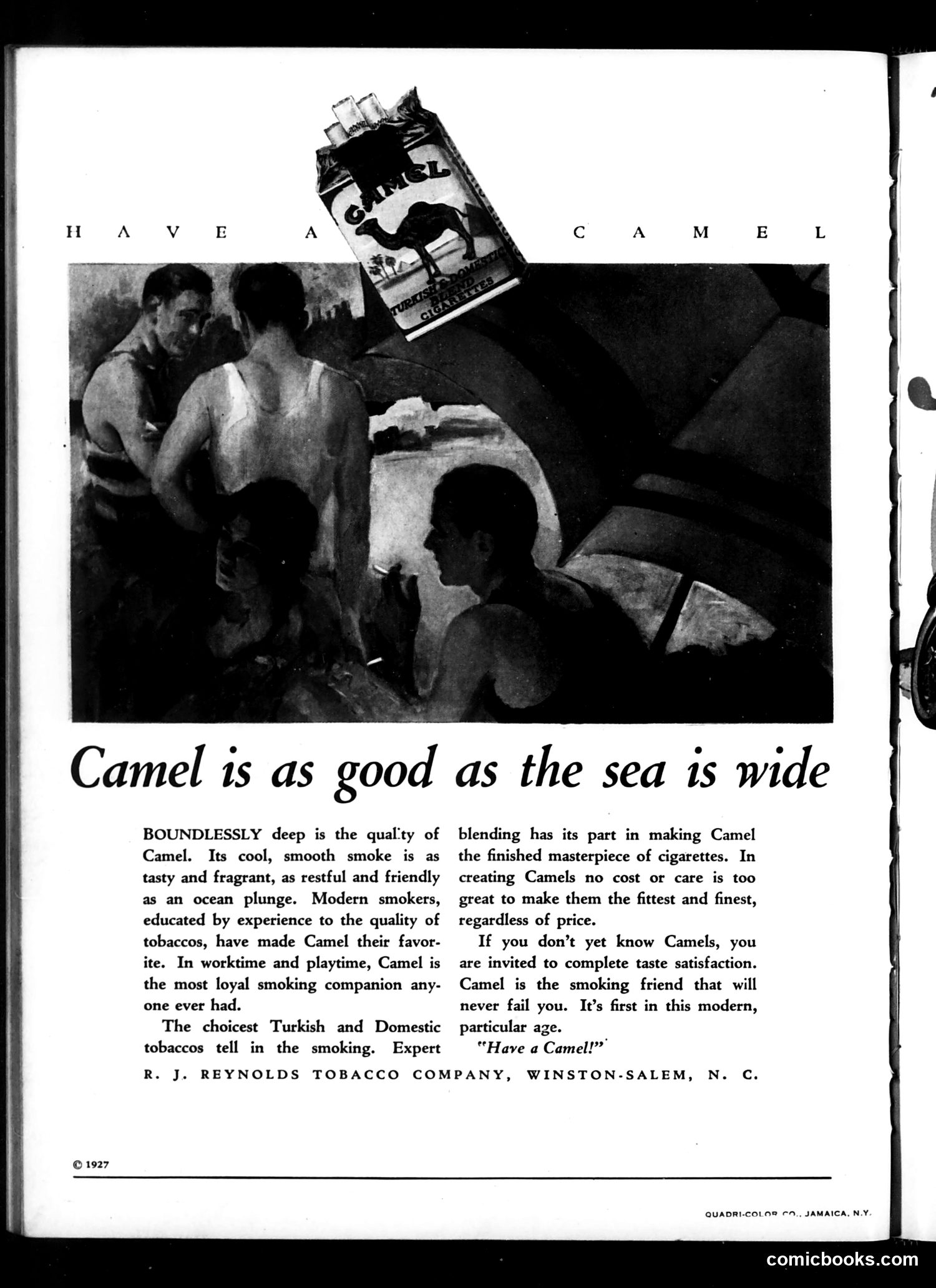
This is primarily a **cigarette advertisement**, not satire or political commentary. It's a 1927 Camel cigarettes ad from R.J. Reynolds Tobacco Company. The image shows men in what appears to be a casual social setting, likely meant to evoke relaxation and camaraderie. The ad employs marketing language comparing smoking to oceanic pleasure ("cool, smooth smoke," "ocean plunge"). For modern readers, this represents a starkly different era of advertising: tobacco was openly promoted in mainstream publications without health warnings, and ads emphasized quality and social companionship as selling points. The phrase "Have a Camel!" was the brand's slogan. The ad's presence in *Judge* magazine reflects that cigarette advertising was considered acceptable editorial content in 1920s publications. No political or social satire is evident—this is straightforward product promotion reflecting mid-century consumer culture before tobacco health risks became widely acknowledged.