
Judge, 1927-08-20 · page 21 of 36
Judge — August 20, 1927 — page 21: what you’re looking at
What you’re looking at
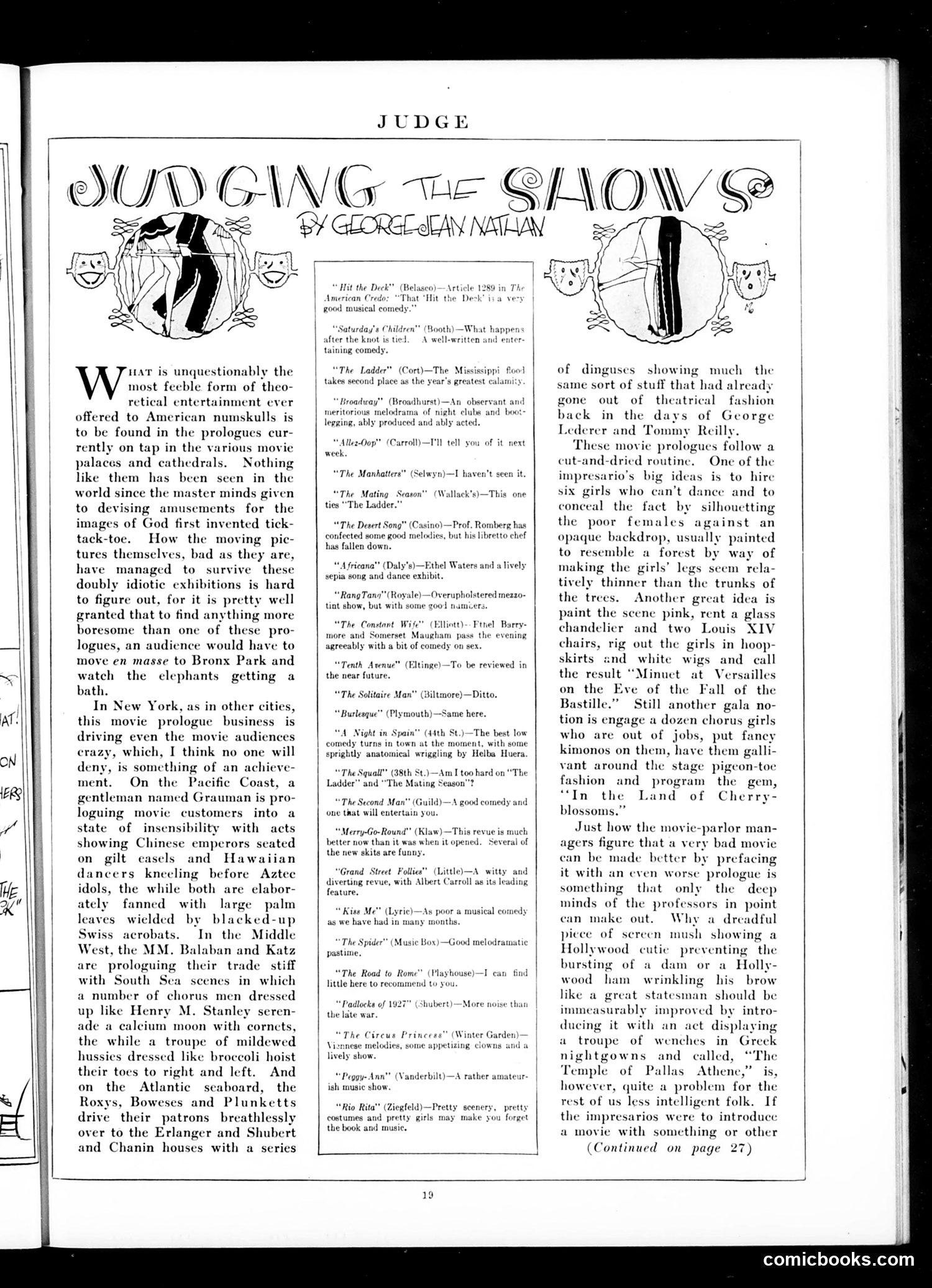
This page from *Judge* magazine satirizes the elaborate theatrical prologues that accompanied films in 1920s movie palaces. Author George Jean Nathan attacks these intermission acts as stupefyingly bad entertainment that somehow coexist with mediocre movies. The satire targets specific theater impresarios: Grauman (on the Pacific Coast) and Balaban and Katz (Midwest) are named for staging absurdly overwrought productions featuring Chinese emperors, Hawaiian dancers, and Swiss acrobats in blackface. Nathan ridicules the artistic incoherence—mixing unrelated exotic themes with slapstick choreography. The accompanying theater reviews mock current Broadway productions with similar irreverence, suggesting the entire entertainment industry has abandoned coherent storytelling for spectacle and novelty. The humor relies on readers' familiarity with these notorious theater operators and contemporary shows, positioning *Judge* as cynical arbiter of taste against mass-market entertainment's descent into absurdity.
📄 Transcribed text from this page (OCR, searchable)
Machine-transcribed from the original scan — historical spelling and the odd misread are preserved.
JUDGE nav is unquestionably the most feeble form of theo- retical entertainment ever offered to American numskulls is to be found in the prologues cur- rently on tap in the various movie palaces and cathedrals. Nothing like them has been seen in the world since the master minds given to devising amusements for the images of God first invented tic tack-toe. How the moving pic- tures themselves, bad as they are, have managed to survive these doubly idiotic exhibitions is hard to figure out, for it is pretty well granted that to find anything more boresome than one of these pro- logues, an audience would have to move en masse to Bronx Park and watch the elephants getting a bath. In New York, as in other cities, this movie prologue business is driving even the movie audiences crazy, which, I think no one will deny, is something of an achieve- ment. On the Pacific Coast, a gentleman named Grauman is pro- loguing movie customers into a state of insensibility with acts showing Chinese emperors seated on gilt and Hawaiian dancers kneeling before Aztec idols, the while both are elabor- ately fanned with large palm leaves wielded by blacked-up Swiss acrobats. In the Middle West, the MM. Balaban and are prologuing their trade stiff with South Sea scenes in which a number of chorus men dressed up like Henry M. Stanley seren- ade a calcium moon with corncts, the while a troupe of mildewed hussies dressed like broccoli hoist ease their toes to right and left. And on the Atlantic seaboard, the Rox Boweses and Plunketts drive their patrons breathlessly over to the Erlanger and Shubert and Chanin houses with a series * Hit the Deck" American Credo: Belasco)— Article That ‘Hit the Deck’ isa very good musical comedy.”” “Saturday's Children” after the knot is tied taining comedy. Booth) —What hapj A well-written and “The Ladder" (Cort)—The Mississipp akes second place as the year's greatest calamity roadway" (Broadhurst)—An observant and jous melodr: of night clubs and boot- ing, ably produced nd ably acted. “Allez-Oop” (Carroll)—T'll tell you o next “The Manhatters” (Selwyn)—I haven't seen it. “The Mating Season" (Wallack's)—This one “The Ladder.” ti “The Desert Song” (Casino) —Prof. Romberg has confected some good melodies, but his libretto chef has fallen down. “A fricana’’ (Daly's sepia song and dance —Ethel Wate hibit. nd a lively “ RangTanq"*(Royale)—Overupholstered mezz0- tint show, but with some good numiers. “The Constant Wife (Ellintt)- Ftnel Barry- more and Somerset Maugham pass the evening agreeably with a bit of comedy on sex. renth Avenue" the near future. (Eltinge) be reviewed in “The Solitaire Man" (Biltmore)—Ditto. “Burlesque” (Plymouth) —Same here. “A. Night in Spain” (44th St.) com The best dy turns in town at the moment, with ne sprightly anatomical wriggling by Helba Huera. “The Squall” Ladder” and * ‘38th St.)—Am I too hard on “The he Mating Season”? “The Second Man" (Guild) one that will entertain you. A good comedy and * Merry-Go-Round" (Klaw)—This revue is much better now than it was when it o the new skits are funny. ed. Several of “Grand Street Follies” (Little)—A witty and diverting revue, with Albert Carroll as its leading feature. “Kise J (Lytie)—As poor a mu e had in many months. “The Spider” (Music Box) —Good melodramatic pastime, “The Road to Rome’ (Playhouse)—I can little here to recommend to you. ‘adlocks of 1927" (shubert)—More noise that the kite war. e” (Winter tizing clown “The Circus Princ Viennese melodies lively show. * Peggy Ann" (Vanderbilt)—A rather amateur. ish music show “Rio Rita” (Ziegfeld)—Pretty scenery, pretty costumes and pretty girls may make you forget the boo! of dinguses showing much the same sort of stuff that had already gone out of theatrical fashion back in the days of George Lederer and Tommy Reilly. These movie prologues follow a cut-and-dried routine. One of the impresario’s big ideas is to hire six girls who can’t dance and to conc 1 the fact by silhouetting the poor females against an opaque backdrop, usually painted to resemble a forest by way of making the girls’ legs seem re tively thinner than the trunks of the trees. Another great idea is paint the scene pink, rent a glass ndelier and two Louis XIV rig out the girls in hoop- skirts and white wigs and call the result “Minuet at V ailles on the Eve of the Fall of the Bastille.” Still another gala no- tion is engage a dozen chorus girls who are out of jobs, put fancy kimonos on them, have them galli- vant around the stage pigcon-toc fashion and program the gem, “In the Land of Cherry- blossoms.” Just how the movie-parlor man- agers figure that a very bad movie can be made better by prefacing it with an cven worse prologue is something that only the deep minds of the professors in point can make out. Why a dreadful piece of sercen mush showing a Hollywood cutie preventing the bursting of a dam or a Holly- wood ham wrinkling his brow like a great statesman should be immeasurably improved by intro- ducing it with an act displaying a troupe of wenches in Greck nightgowns and called, “The Temple of Pallas Athene,” is, however, quite a problem for the rest of us less intelligent folk. If the impresarios were to introduce a movie with something or other (Continued on page 27) comicbooks.com