
Judge, 1927-08-20 · page 8 of 36
Judge — August 20, 1927 — page 8: what you’re looking at
What you’re looking at
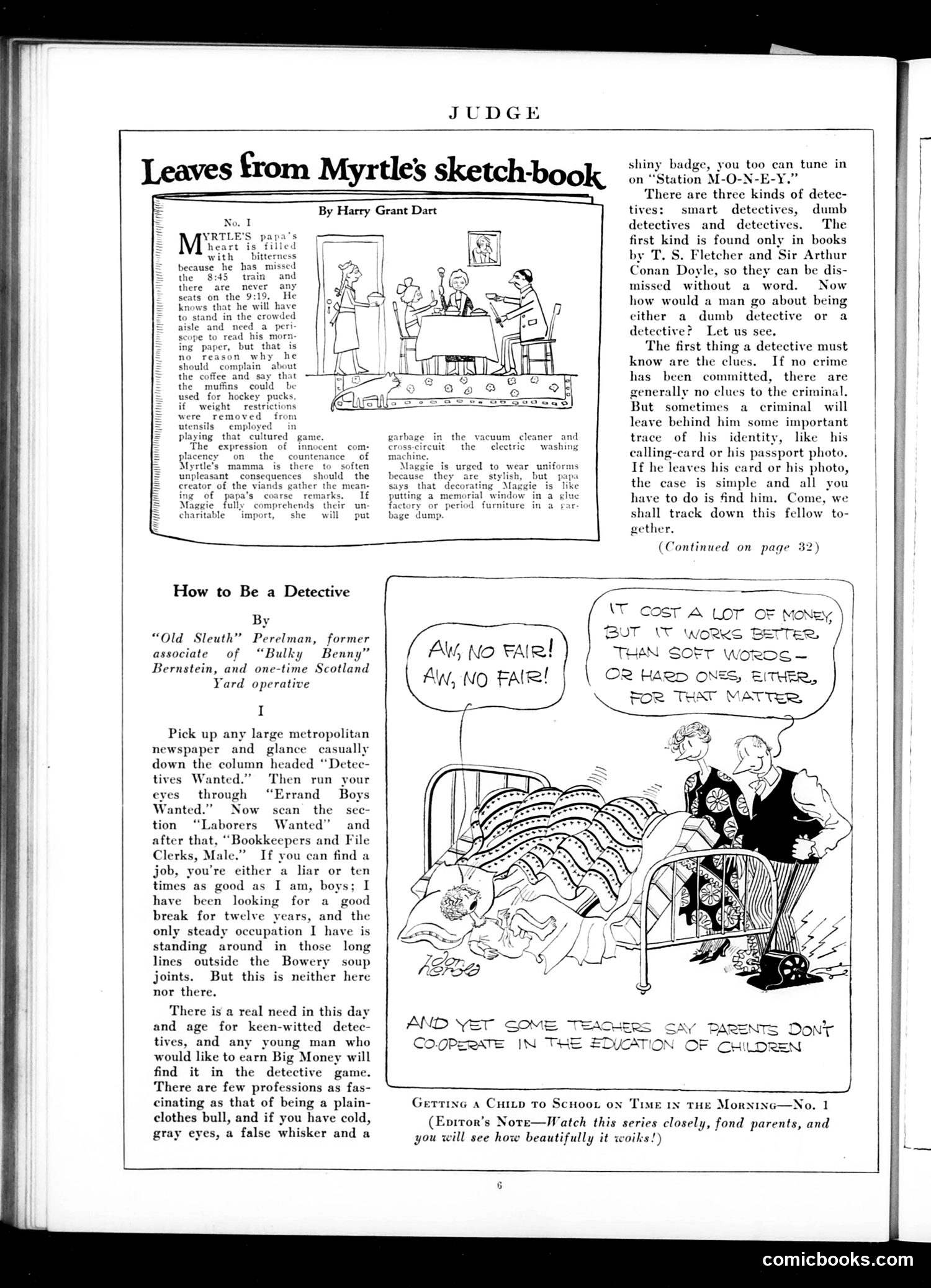
This page contains humor aimed at Depression-era readers struggling with unemployment and parenting challenges. **"Leaves from Myrtle's Sketch-Book"** satirizes domestic frustration—a commuter missing his train and stuck standing in crowded transit, forced to read newspapers rather than enjoy leisurely reading. **"How to Be a Detective"** is satirical career advice by "Old Sleuth" Perelman. The joke: a man seeking detective work discovers job listings for detectives are rarer than other positions. He's been unemployed for twelve years, only managing soup-line duty—mocking the Depression job market. The subtext suggests detective work, like other employment, is nearly impossible to find. **"Getting a Child to School on Time"** shows parents using bribery ("soft words" and "hard ones" don't work, but money does) to motivate their child to school—satirizing parental struggles and suggesting even children require financial incentives, a dark joke about economic desperation affecting family dynamics. The overall theme: economic hardship pervades modern life, from commuting to employment to basic parenting.
📄 Transcribed text from this page (OCR, searchable)
Machine-transcribed from the original scan — historical spelling and the odd misread are preserved.
JUDGE shiny badge, you too can tune in on “Station M-O-N-E-Y.” N RTL heart is filled with _ bitterness because he has missed the 8:45 train and there are never any seats on the 9:19. He knows that he will have to stand in the crowded Je and need a peri e to read his morn- ver, but that is why he There are three kinds of detec- tives: smart detect! s, dumb detectives and detecti The first kind is found only in books by T. S. Fletcher and Sir Arthur Conan Doyle, so they can be dis- missed without a word. Now how would a man go about being cither a dumb detective or a detective? Let us see. The first thing a detective must know are the clues. If no crime has been committed, there are generally no clues to the criminal. from employed in playing that cultured game. The expression of inn on the countenance of ‘3 mamma is there soften uld the he mean- arks. mprehends their un charitable ‘import, she will — put How to Be a Detective By “Old Sleuth” Perelman, former associate of “Bulky Benny” Bernstein, and one-time Scotland Yard operative I Pick up any large metropolitan newspaper and glance casually down the column headed “Detec- tives Wanted.” Then run your e through “Errand Boy ted.” Now scan the tion “Laborers Wanted” and after that, ‘Bookkeepers and File Clerks, Male.” If you can find a job, you're either a liar or ten times as good as I am, boys; I have been looking for a good break for twelve years, and the only steady occupation I have is standing around in those long lines outside the Bowery soup joints. But this is neither here nor there. There is a real need in this day and age for keen-witted detec- tives, and any young man who would like to earn Big Money will find it in the detective There are few professions as fa: cinating as that of being a plain- clothes bull, and if you have cold, gray eyes, a false whisker and a But sometimes a criminal will leave behind him some important garbage in the vacuum cleaner and trace of his identity, like his cross-circuit the electric washing . : tks calling-card or his passport photo. If he leaves his card or his photo, the case simple and all you have to do is find him. Come, we shall track down this fellow to- gether. putting an factory or p bage dump. (Continued on page 32) Cost A LOT OF MONEY, BUT WT WoRKS BETTER. THAN SOFT WoROS— \ OR HAD ONES, EITHER, FOR THAT MATTER Av Alw, NO Fate! AND YET some ate Y PARENTS Don RATE OF CHILDREN IN THE a Getting a Cuttp to Scoot on Time 1x THE Morninc—No. 1 (Eprror’s Notre—IWatch this series closely, fond parents, and you will see how beautifully it zoiks!) comicbooks.com