
A complete issue · 36 pages · 1927
Judge — July 2, 1927
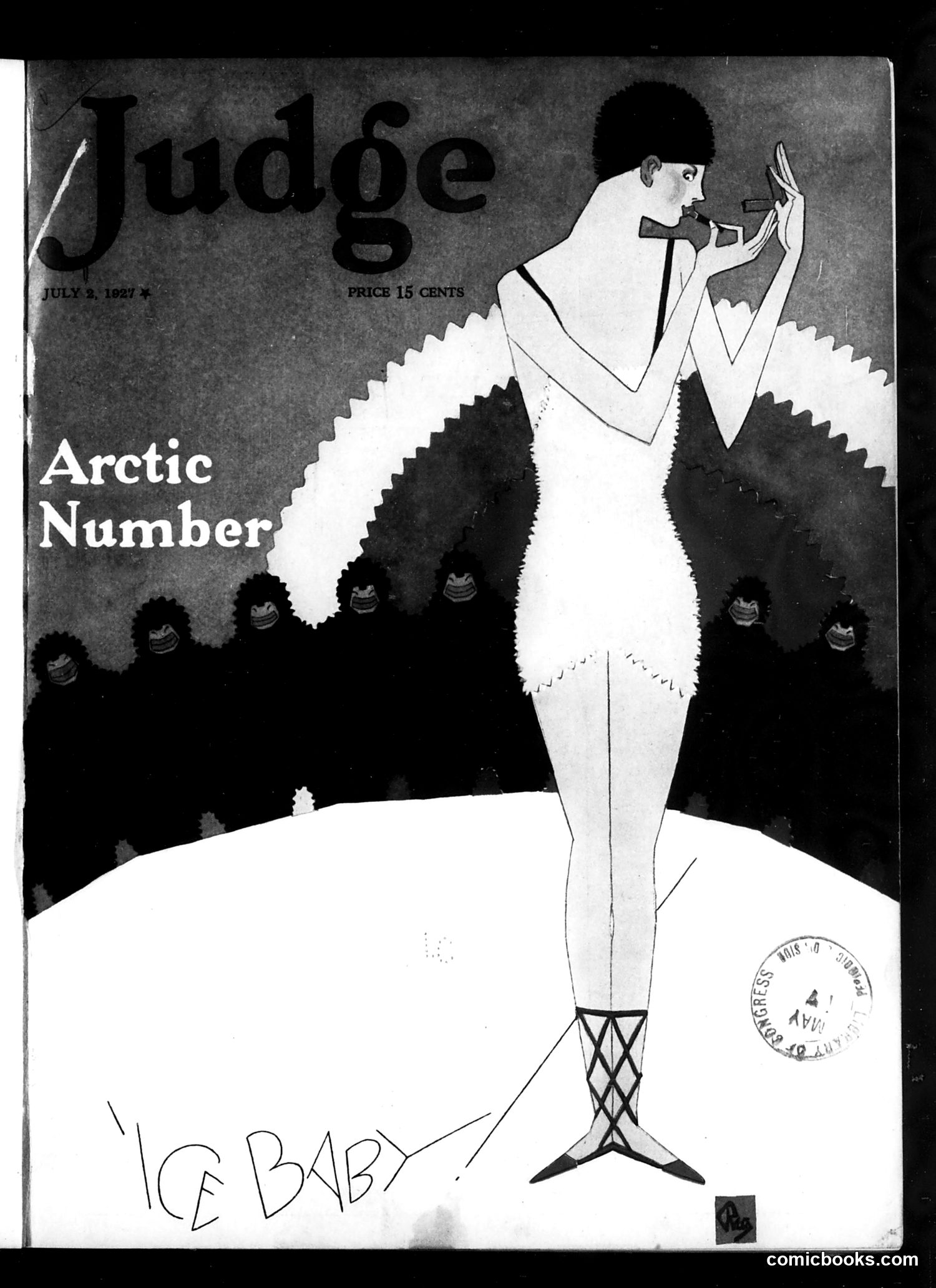
This satirical cover depicts a fashionable 1920s woman in a fur coat and cloche hat, posed against an Arctic backdrop with indigenous figures in the background. The title "Ice Baby" and "Arctic Number" suggest this is mocking either polar exploration trends or the fashion industry's use of Arctic imagery during the Jazz Age. The cover likely satirizes how American high society romanticized Arctic expeditions as exotic status symbols, while simultaneously commenting on the commercialization of Arctic imagery in fashion. The indigenous figures appear as props, reflecting problematic 1920s attitudes toward non-Western peoples. This represents Judge magazine's typical approach of using absurdist imagery to critique contemporary consumer culture and social pretensions.
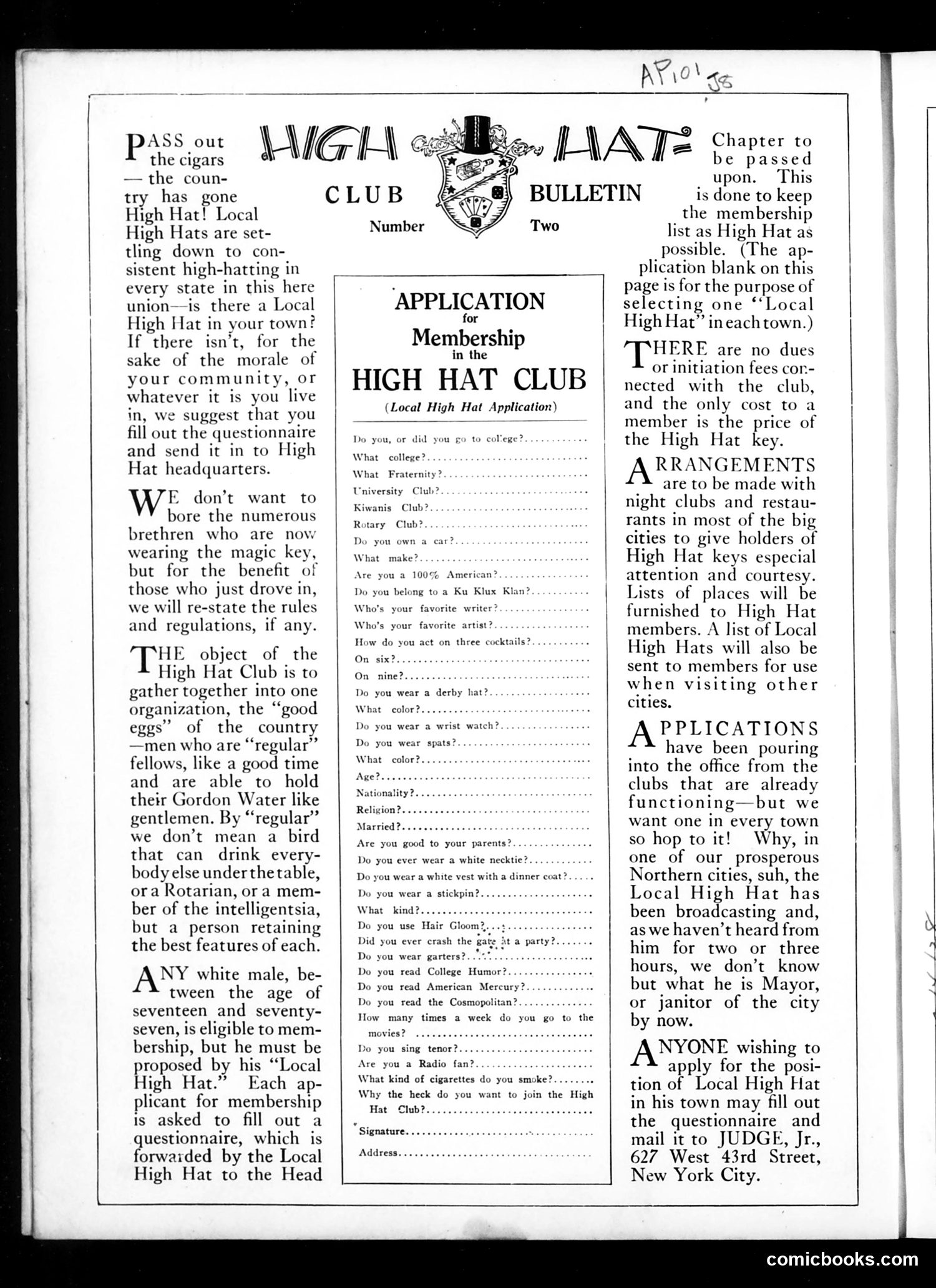
This page is primarily **membership recruitment material** rather than political satire. It promotes the "High Hat Club," a social organization claiming chapters nationwide that unite "regular fellows" who enjoy fine living—good times, cocktails, and refined company. The content is straightforward advertising: a questionnaire for prospective members asks about education, fraternity affiliations, possessions (cars, jewelry), reading habits, and social interests. There's no political cartoon here—just the club's emblem (a top hat). The implicit satire is *subtle*: the club caters to wealthy, educated white males aged 17-77, positioning itself as exclusive yet claiming to represent ordinary "good eggs." The extensive questionnaire essentially screens for class status and cultural conformity, contradicting claims of being "regular."
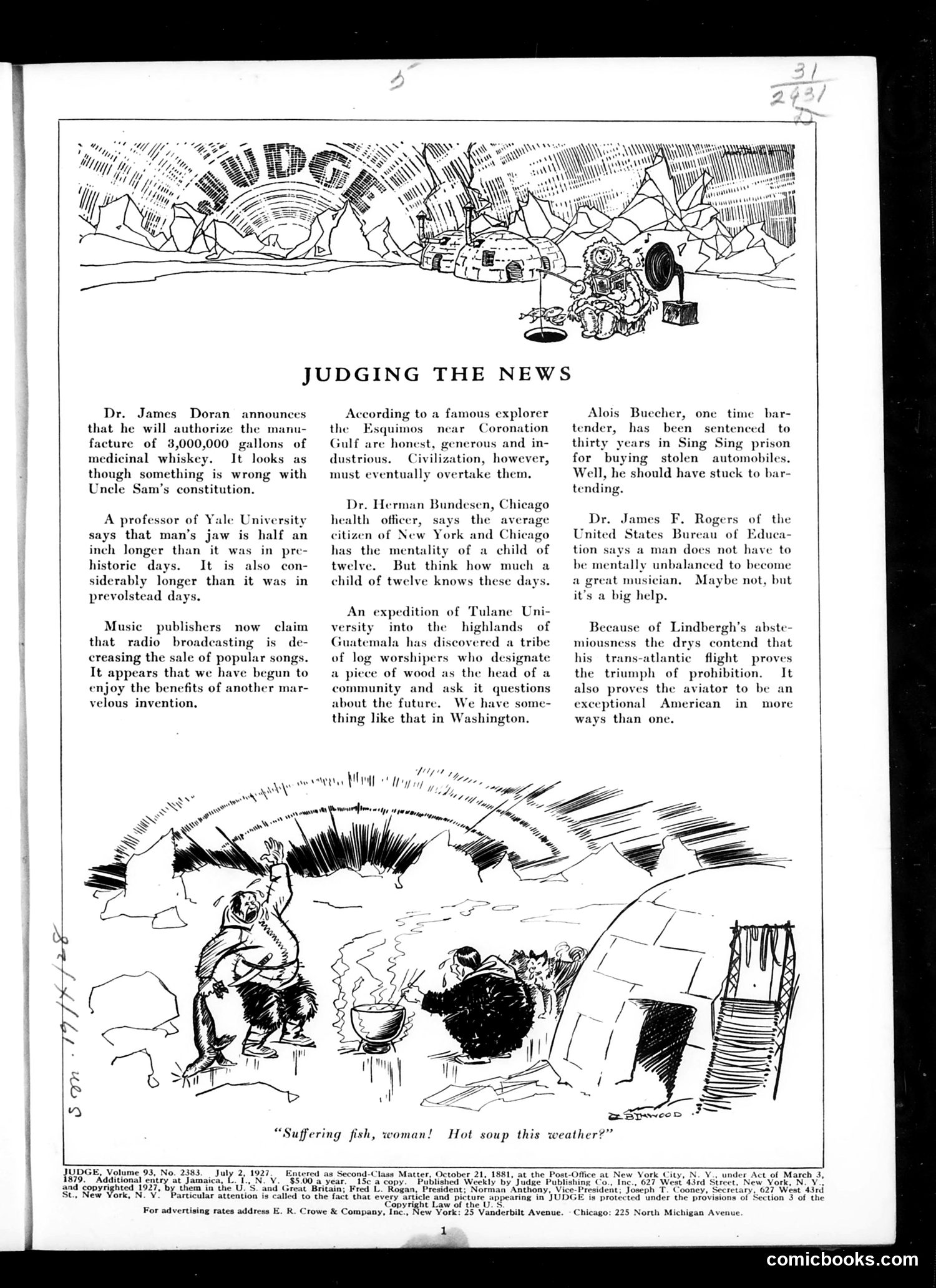
This page satirizes contemporary news items through brief commentary and cartoons. **Top cartoon**: Shows figures examining what appears to be early aviation or broadcasting equipment in a futuristic landscape labeled "JUDGE" - likely mocking sensationalized reporting about new technologies. **Bottom cartoon** ("Suffering fish, woman! Hot soup this weather!"): Depicts an igloo scene with people apparently cooking soup during an Arctic expedition. This likely satirizes either Lindbergh's recent trans-Atlantic flight (mentioned in text) or polar exploration expeditions then in public headlines. The absurd juxtaposition of making hot soup in extreme Arctic conditions appears to mock expedition reporting or survival claims. The text discusses radio broadcasting's growing popularity, scientific announcements, and references to Lindbergh's achievement as proof of American exceptionalism—all contemporary 1927 topics being treated with editorial mockery.
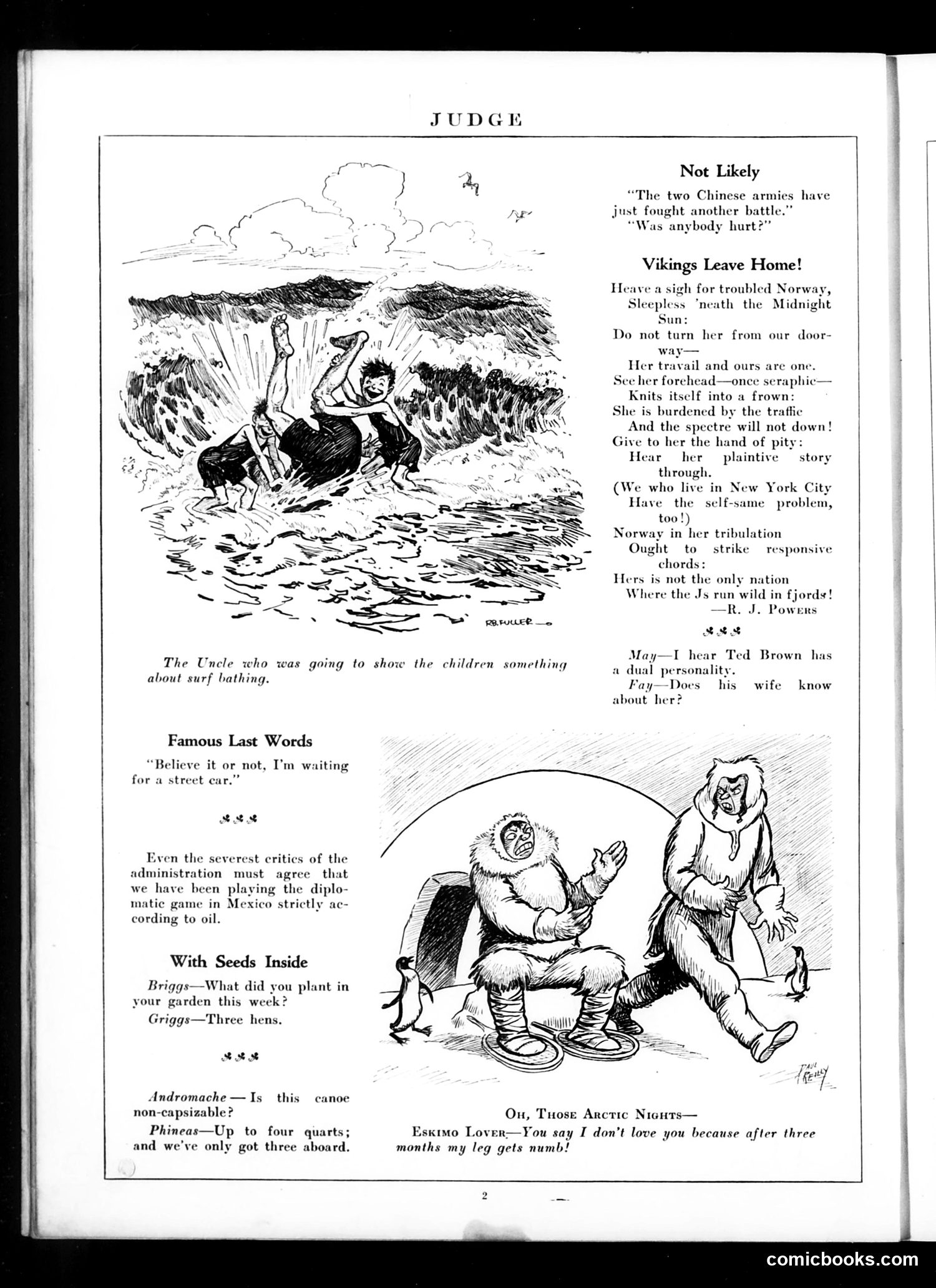
This page contains several unrelated humor pieces typical of early 20th-century satirical magazines: **Top cartoon** ("Vikings Leave Home"): A poem about Norway's difficulties, likely referencing Scandinavian immigration to America. It sympathizes with Norwegian women's hardships while drawing parallels to New York City women's struggles. **"Famous Last Words"**: A joke about waiting for a streetcar—apparently someone's final statement before tragedy. **"With Seeds Inside"**: A brief domestic humor exchange about gardening. **Bottom cartoon**: Depicts anthropomorphic animals (appears to be bears or similar creatures) in an "Arctic Nights" scenario about an Eskimo lover's complaint regarding numbness from prolonged cold exposure—a crude ethnic humor joke. The page mixes sentimental immigrant commentary with crude physical comedy typical of the era's popular humor magazines.
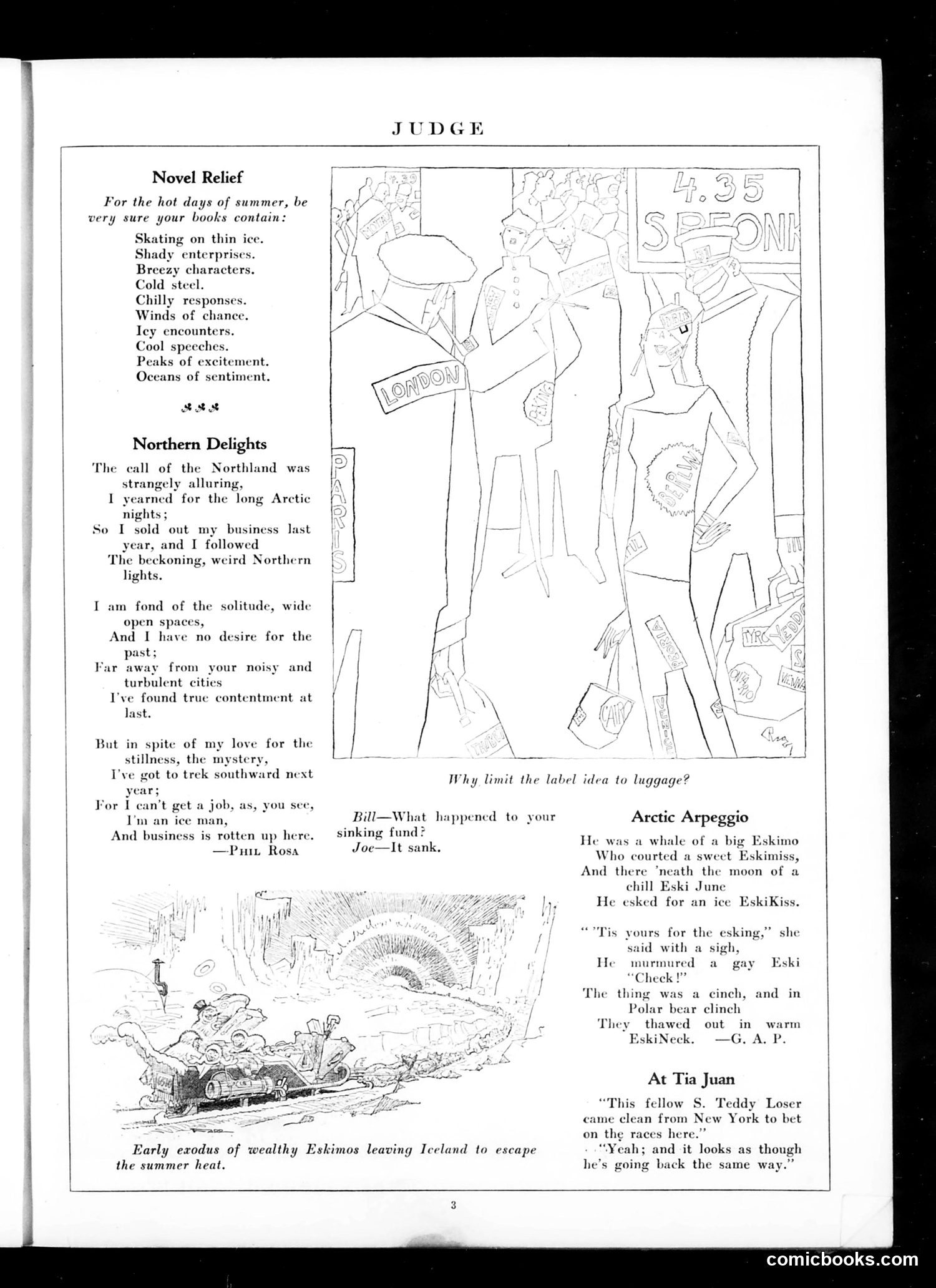
This page contains miscellaneous humor and poetry rather than political cartoons. The main content includes: **"Novel Relief"** - A summer reading list offering mental escape from heat through books with cool themes (skating, ice, arctic subjects). **"Northern Delights"** - A poem by Paul Rosa about abandoning city business to pursue Arctic exploration and solitude, though the speaker admits needing winter employment as "an ice man." **Illustrations** depict Eskimos (using period terminology) and Arctic themes, with humorous captions like "Why limit the label idea to luggage?" (showing travel stickers on a person). The bottom section contains brief jokes about sinking funds and horse racing, with no apparent political commentary. This represents Judge's lighter, whimsical content rather than satirical critique.
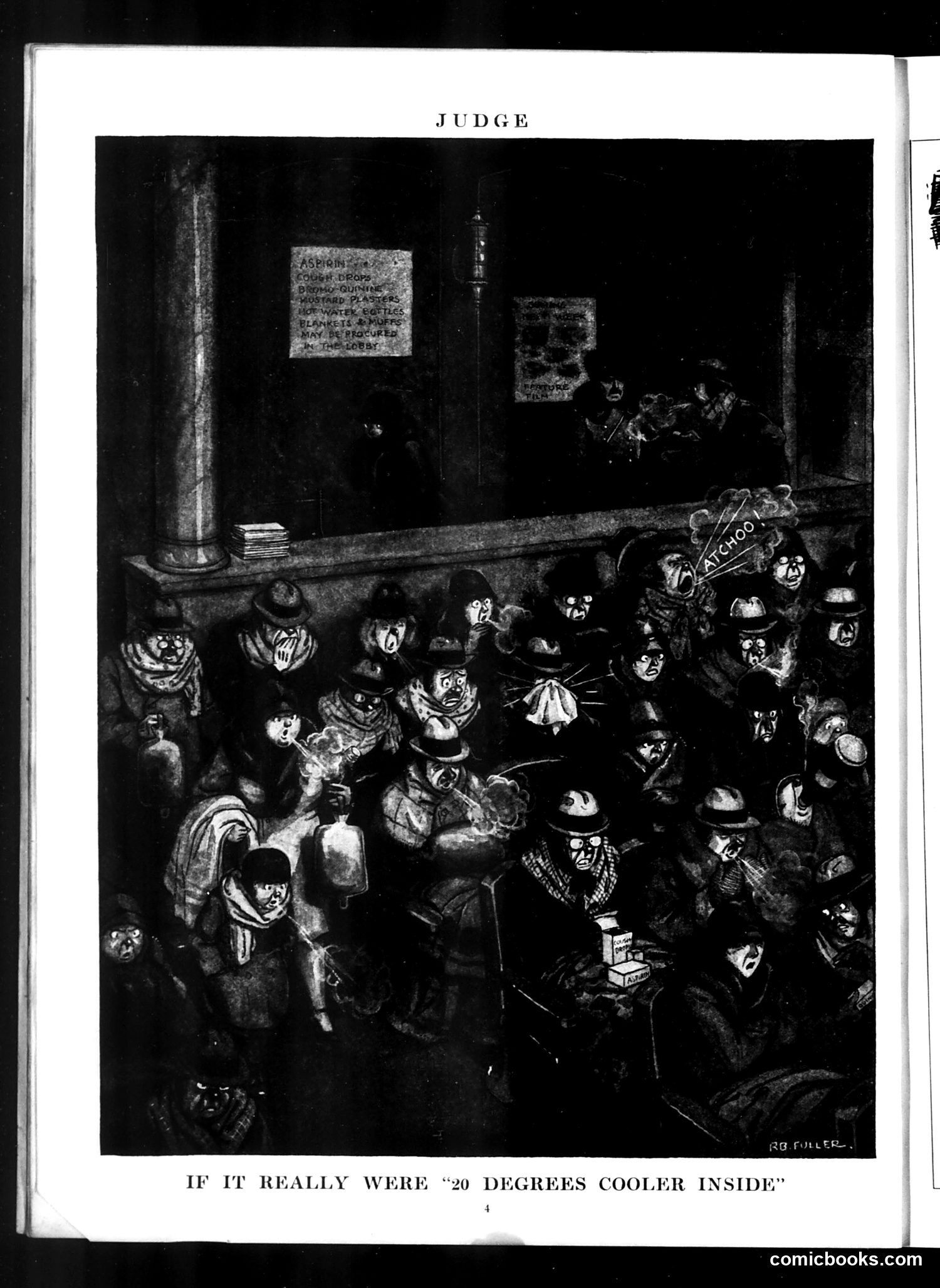
This cartoon satirizes overcrowded urban conditions, likely in a speakeasy or illegal bar during Prohibition (the "ALCOHOL" sign visible on the right). The caption "IF IT REALLY WERE '20 DEGREES COOLER INSIDE'" is ironic—the packed crowd makes the space oppressively hot and uncomfortable. The cartoon mocks the desperation of people ignoring obvious health hazards to access illegal alcohol. The cramped, sweating masses suggest both the absurdity of Prohibition's enforcement (driving drinking underground) and the poor conditions in clandestine establishments. The style and crowded composition echo German Expressionist art, emphasizing the scene's chaos and moral decay. This appears designed to critique either Prohibition's unpopularity or the dangerous venues it created—though the exact satirical target (pro- or anti-Prohibition) remains ambiguous from the image alone.
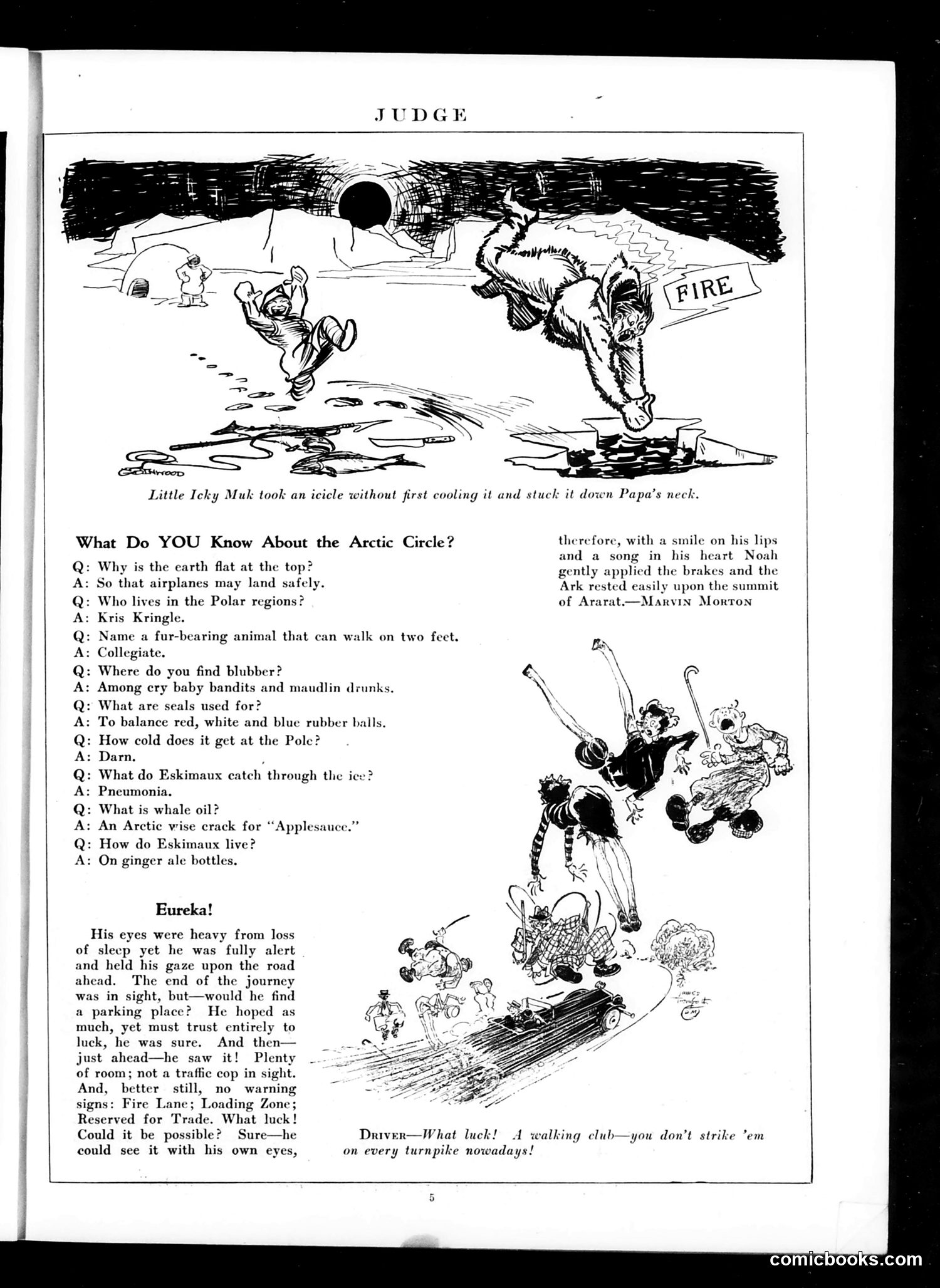
This page contains two unrelated humorous items: **Top cartoon**: "Little Icky Muk took an icicle without first cooling it and stuck it down Papa's neck" — a simple slapstick joke about a child's prank, with no political content. **Bottom section**: "What Do YOU Know About the Arctic Circle?" is a humorous quiz with absurdist answers (e.g., "Why is the earth flat at the top?" / "So that airplanes may land safely"). The humor relies on deliberately wrong or nonsensical responses rather than political satire. The larger "Eureka!" story describes someone finding an ideal parking spot — mundane urban humor with no apparent political reference. None of this content appears to reference specific political figures, events, or social commentary typical of Judge's satirical mission. This page is primarily light entertainment rather than political commentary.
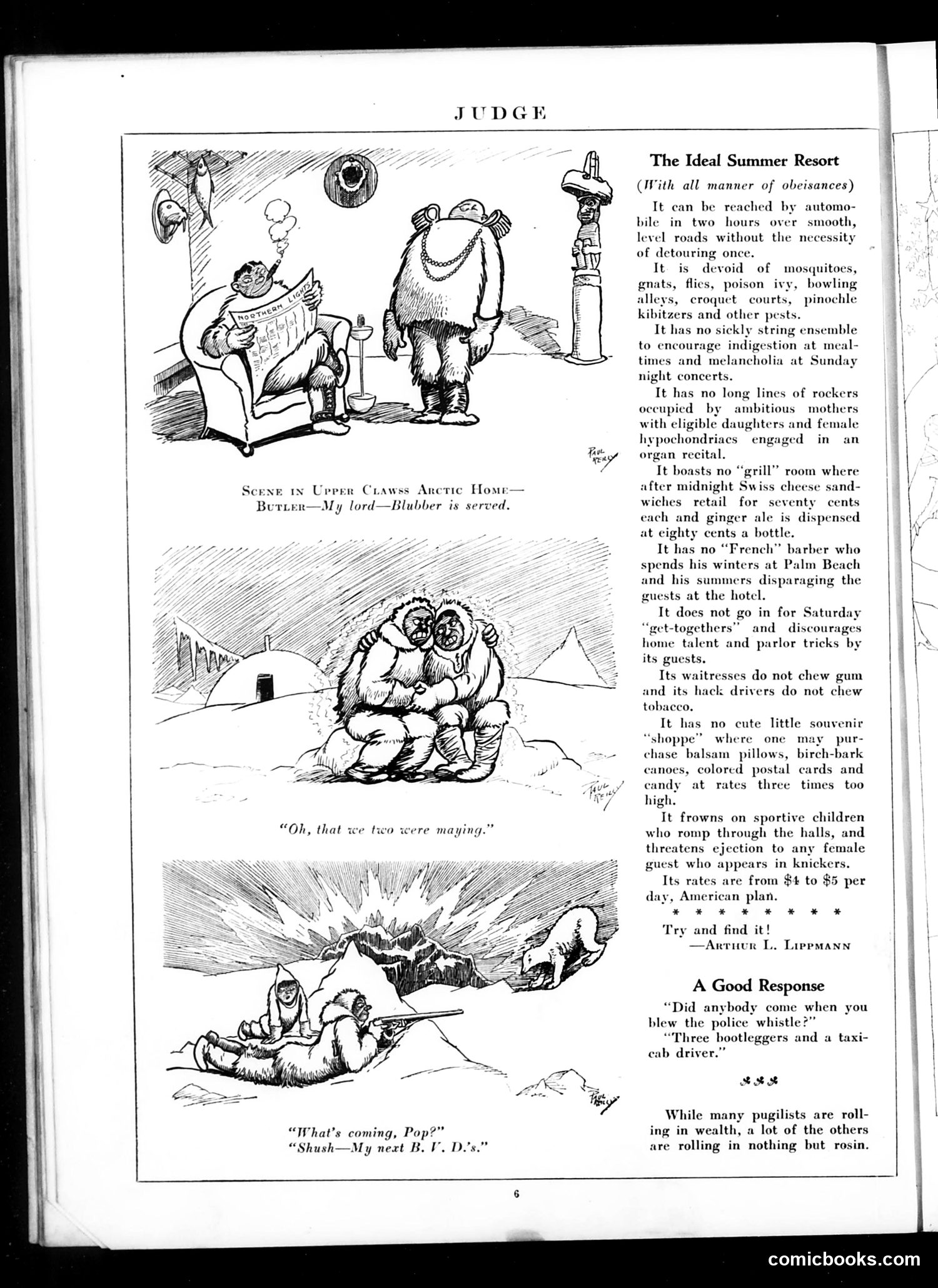
This page contains three cartoons satirizing American leisure and social life circa the 1920s-30s. **"The Ideal Summer Resort"** by Arthur L. Lippmann is the main piece—a lengthy satirical description of a fictional perfect vacation destination that exists nowhere. It mocks typical resort experiences: overpriced amenities (Swiss cheese sandwiches at 70 cents), amateur entertainers, socialite matchmaking mothers, pretentious "French" barbers, and exploitative souvenir shops. The humor lies in the impossible fantasy—an actual resort with *none* of these annoyances. The **Arctic Home cartoon** shows wealthy figures in an igloo, mocking upper-class leisure pursuits even in extreme conditions. **"A Good Response"** jokes about Prohibition-era policing: when asked who responded to a police whistle, the answer is "three bootleggers and a taxi driver"—suggesting law enforcement was so compromised during Prohibition that only criminals and cab drivers (implied accomplices in illegal transport) would appear. The cartoons collectively critique American consumer culture, resort tourism, and Prohibition's failure to eliminate crime and corruption.
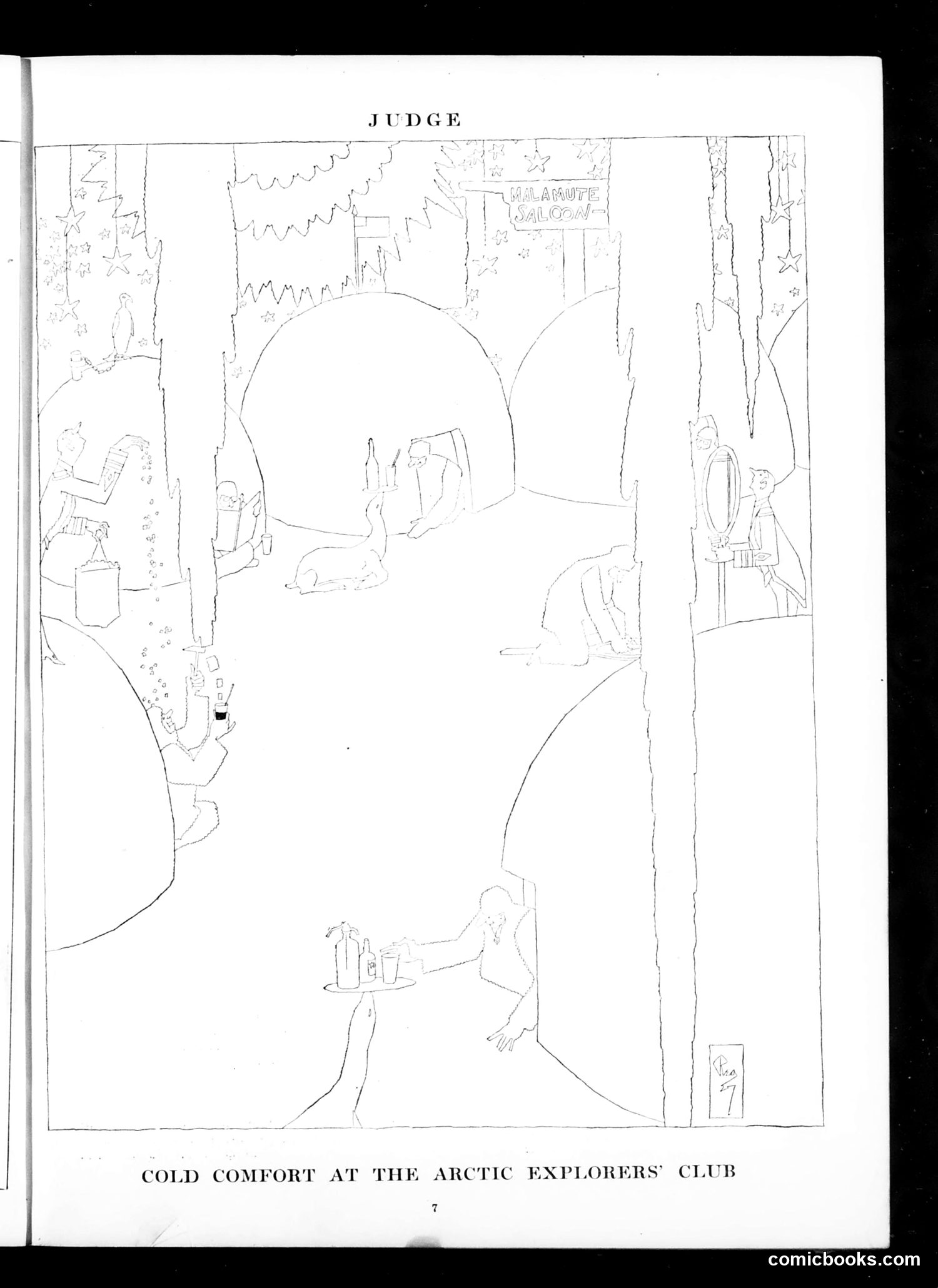
This cartoon satirizes the Arctic Explorers' Club, a real organization of men who claimed experience in polar exploration. The sketch depicts members gathered in what appears to be an igloo or ice structure at their club, huddled around minimal comforts (bottles visible on a table). The satire likely mocks the club's pretensions and the contrast between explorers' hardship narratives and their actual comfort-seeking in civilized settings. The title's irony—"cold comfort"—suggests the members receive little actual satisfaction or warmth, despite their boasts. The crude, minimal furnishings within the club setting underscore the joke that these supposedly seasoned Arctic veterans have created an unconvincing replica of their claimed adventures. Without a date visible, the specific explorers or events referenced remain unclear, but the cartoon targets the era's explorer celebrity culture and the gap between adventurers' public reputations and private behaviors.
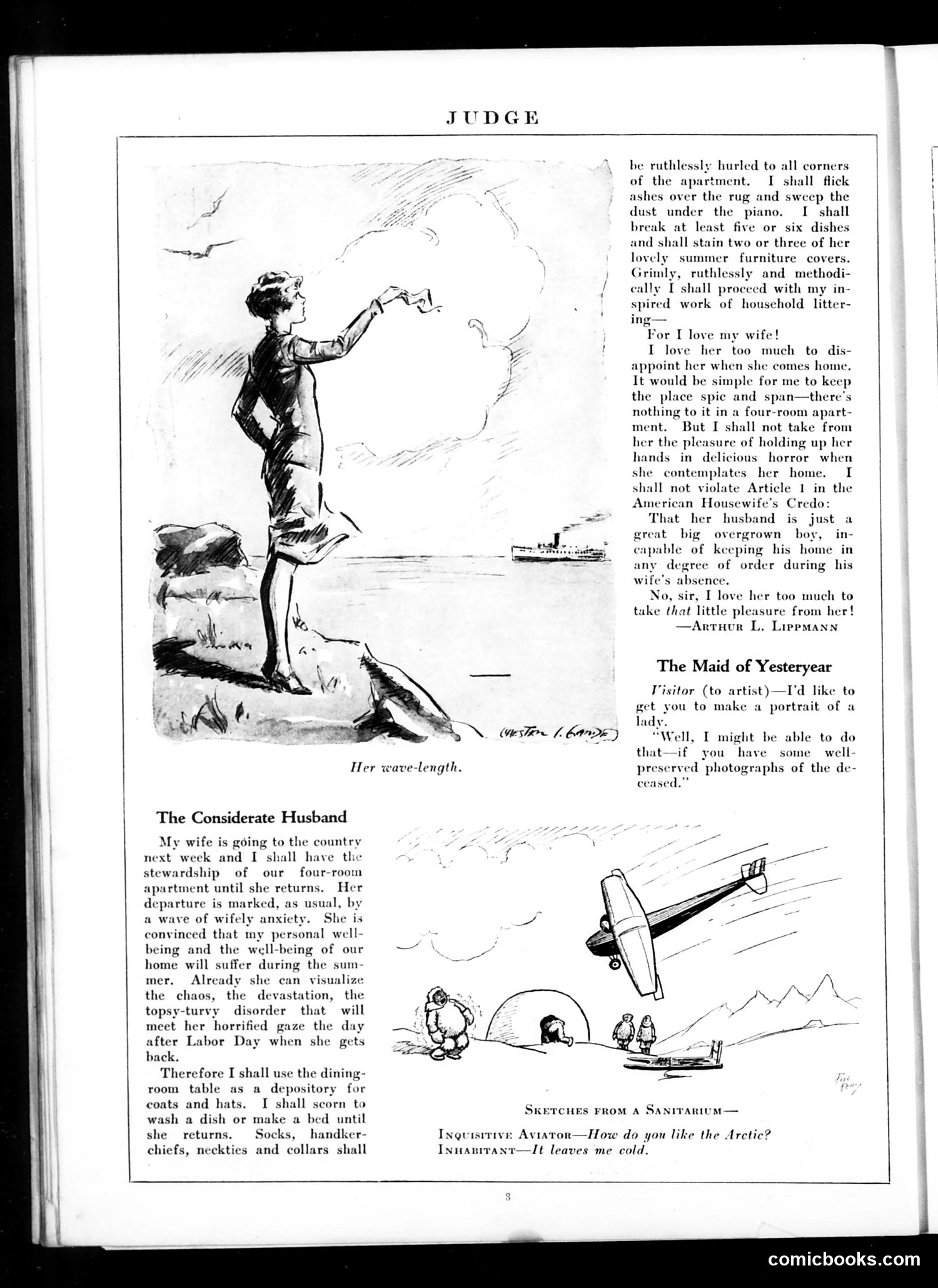
This satirical piece mocks the era's gender dynamics. A husband announces he will deliberately create chaos—leaving dishes unwashed, scattering clothes, breaking items—while his wife is away, justifying it as an act of love. His logic: she expects him to be incompetent ("just a great big overgrown boy"), so disappointing her by keeping the apartment clean would rob her of the pleasure of discovering disaster and feeling needed. The satire targets both the husband's laziness masquerading as consideration and the "American Housewife's Credo" that infantilizes men, assuming they're incapable of basic household management. It's commentary on domestic gender roles and expectations of the early 20th century, where women's household authority and men's domestic incompetence were treated as natural law rather than cultural construct.
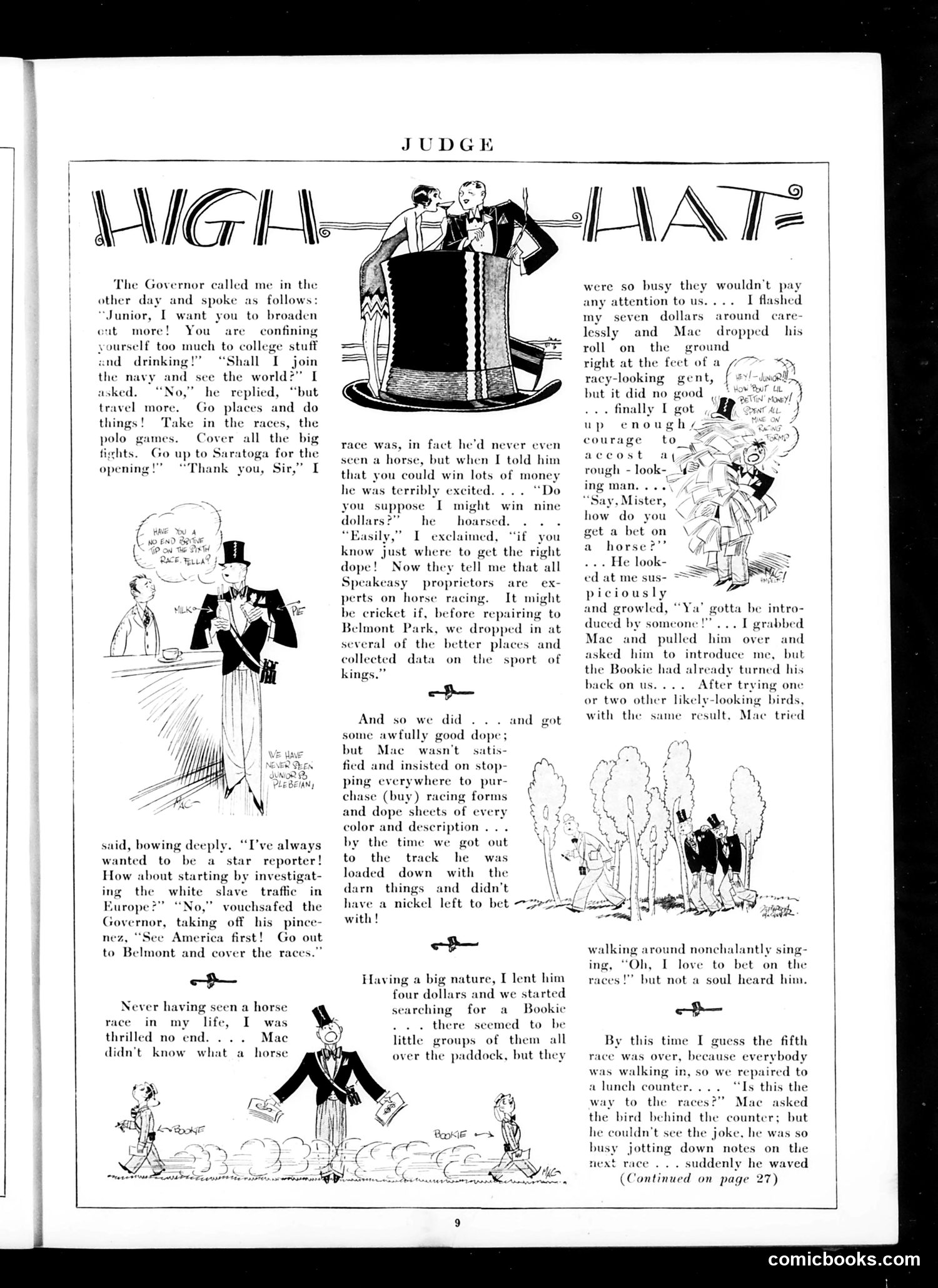
This is a humorous narrative comic about a naive young reporter assigned to cover horse racing at Belmont Park. The satire targets several 1920s social issues: **Main Figures:** The narrator (an inexperienced journalist) and "Mac" (his companion, possibly his editor), plus various stock characters—a Governor, speakeasy owners, and bookies. **The Satire Points:** 1. **Prohibition-era speakeasies** as sources of gambling "tips"—mocking the idea that illegal bars are also repositories of racing knowledge 2. **Class/sophistication gap**—the narrator's naivety contrasts with the exclusive, insider world of horse racing and bookmaking 3. **Bookies' gatekeeping**—the running joke that you need proper "introductions" to place bets, satirizing organized underworld exclusivity 4. **Media incompetence**—a reporter assigned to cover racing knows nothing about horses, gambling, or the culture The humor derives from the narrator's bumbling attempts to enter this world while losing his money to purchasing racing forms, unable to actually place bets due to social barriers within the gambling underworld.
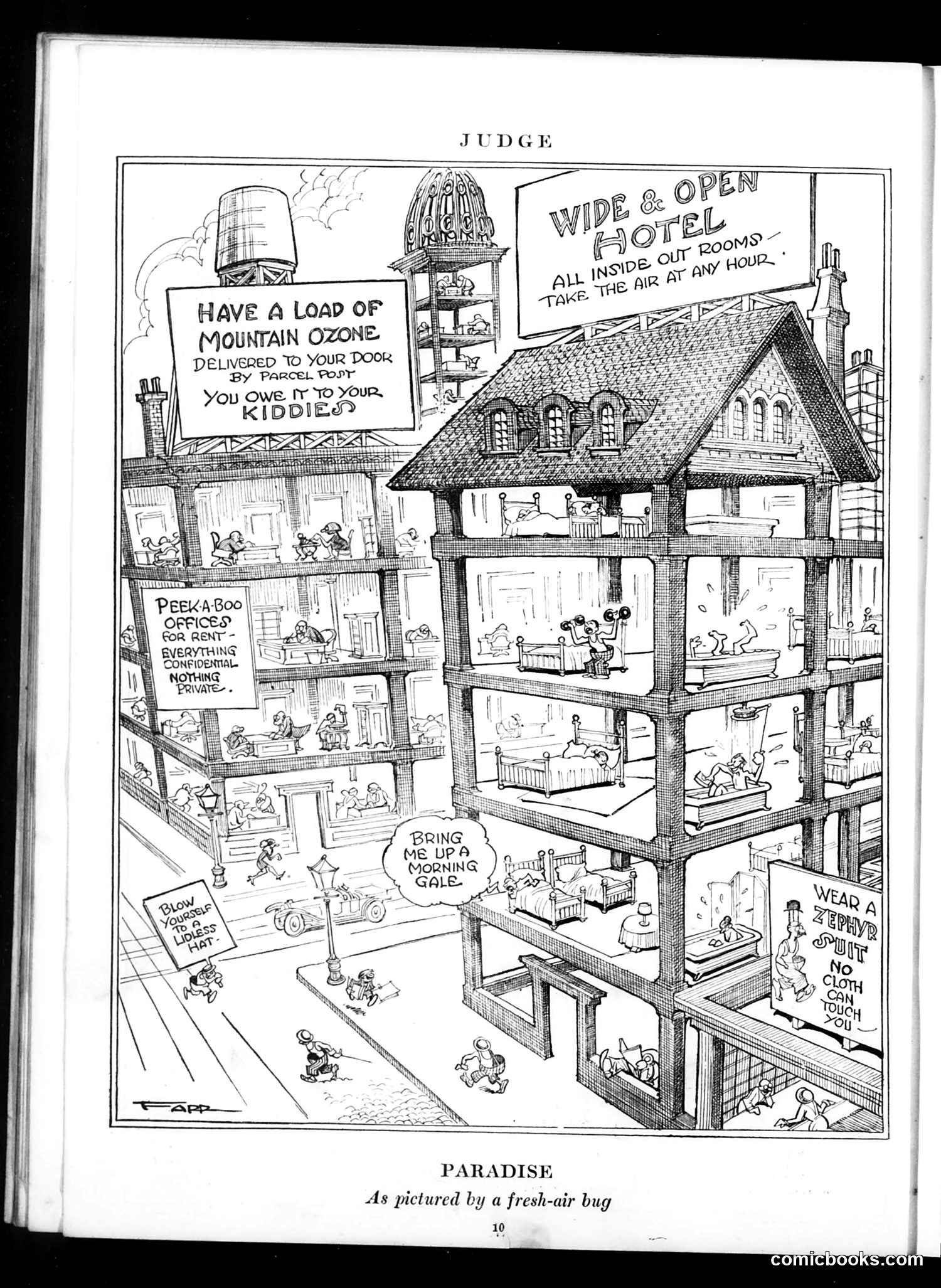
This satirical cartoon mocks the early 20th-century "fresh air" movement—a progressive health craze promoting outdoor air and ventilation as cure-alls. The cutaway building depicts an idealized "Wide & Open Hotel" where residents enjoy perpetual access to open air. The joke targets the movement's zealous advocates (the "fresh-air bug"). Various signs advertise implausible benefits: "Mountain Ozone" delivery, "Peekaboo Offices" with "Everything Confidential/Nothing Private," and instructions to "Wear a Spray/Shirt/No Cloth Should Touch You." The cartoon satirizes how fresh-air enthusiasts promoted their philosophy to absurd extremes—suggesting that constant air exposure, complete openness, and minimal clothing would solve all problems. The chaotic street scene below shows the practical reality: pandemonium and disorder rather than health and harmony.
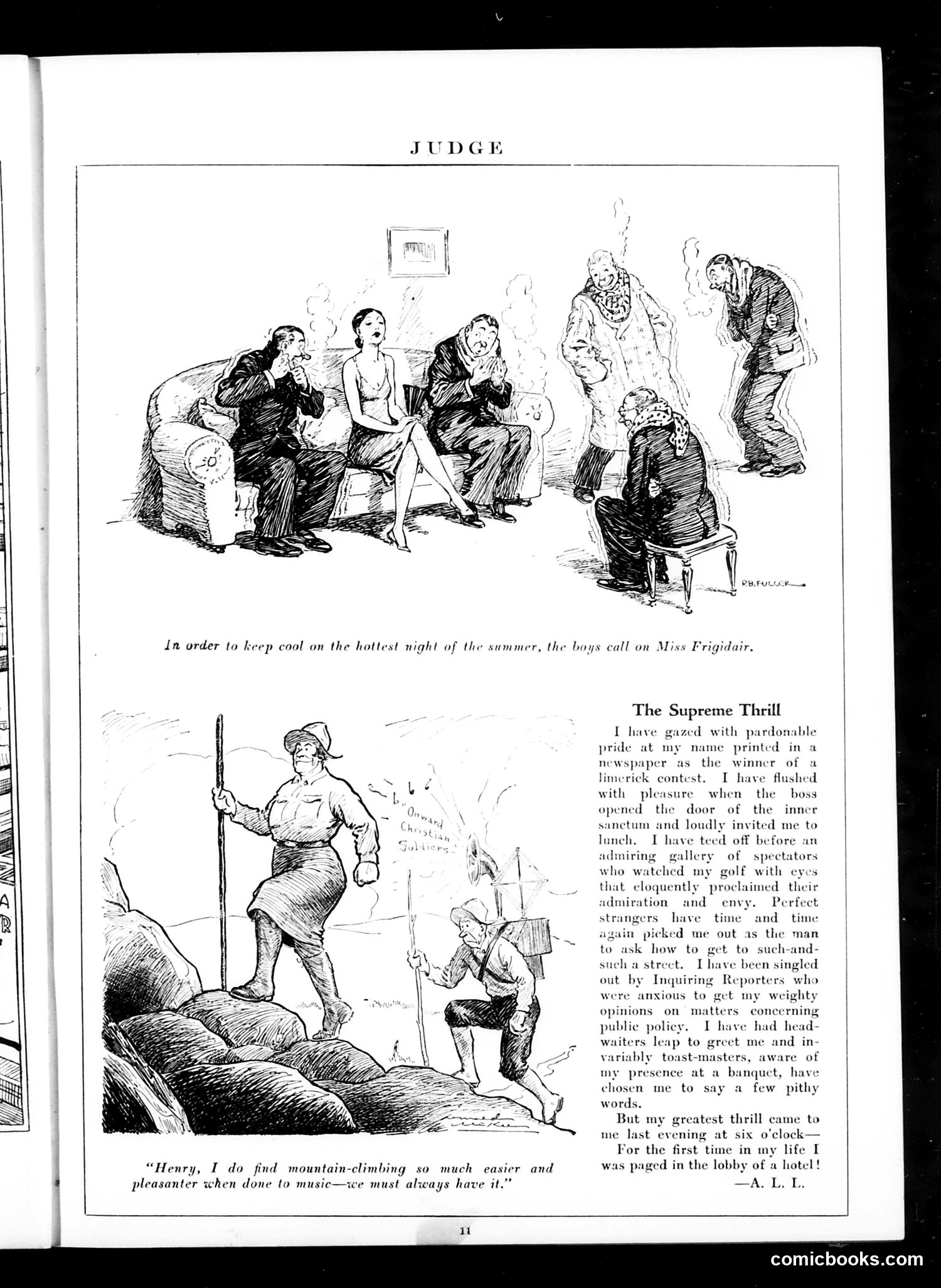
**Top cartoon**: A social scene where young men visit "Miss Frigidair" on a hot summer night. The joke plays on the surname as a pun—she literally provides coolness/air conditioning, a modern luxury. The humor is gentle social satire about courtship rituals and technological comfort. **Bottom section**: "The Supreme Thrill" is a humorous essay (not primarily a cartoon) listing various ego-gratifying experiences—winning contests, being invited to lunch by the boss, impressing golf spectators, being asked for directions, appearing in newspapers. The author builds to an anti-climactic punchline: his greatest thrill was being *paged in a hotel lobby*—the ultimate symbol of importance and social status in that era. The satire gently mocks how ordinary people measure personal significance through small social validations. The accompanying illustration of mountain-climbers suggests the effort required to achieve such modest recognition.
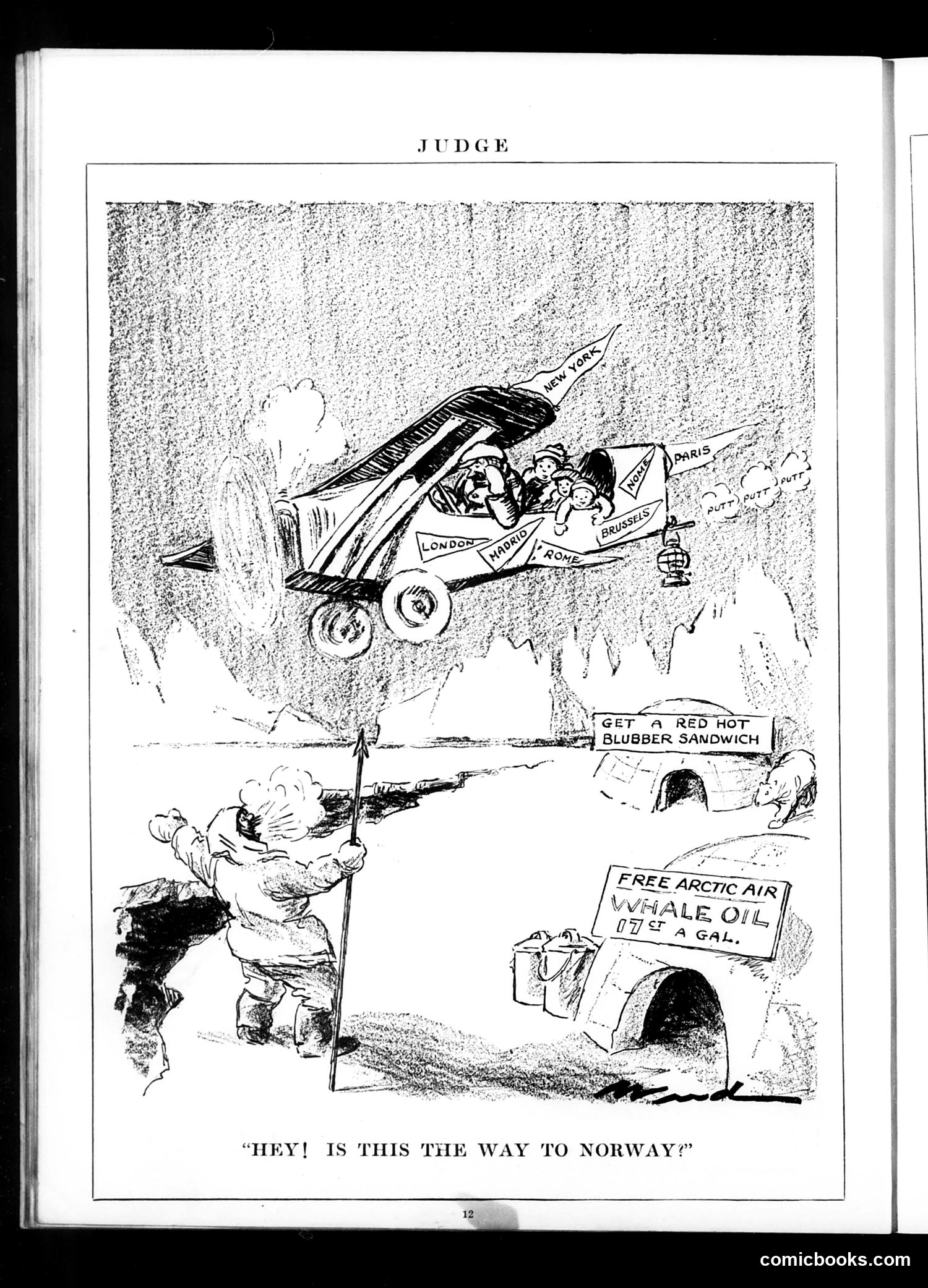
This Judge magazine cartoon satirizes Arctic exploration, likely referencing early 20th-century polar expeditions. A figure on the ground (appearing to be an Arctic explorer or prospector) holds a sign offering "Free Arctic Air / Whale Oil 11¾ a gal" and a "Red Hot Blubber Sandwich"—mocking the harsh conditions and limited provisions of polar exploration. An airplane carrying passengers labeled with European cities (London, Paris, Brussels, New York) flies overhead, asking "Is this the way to Norway?"—humorously suggesting that air travel is making traditional Arctic exploration obsolete and absurd. The contrast between the struggling ground explorer and the comfortable airplane passengers satirizes how modern transportation rendered dangerous polar expeditions outdated. The cartoon mocks both Arctic exploration nostalgia and commercialization of extreme environments.
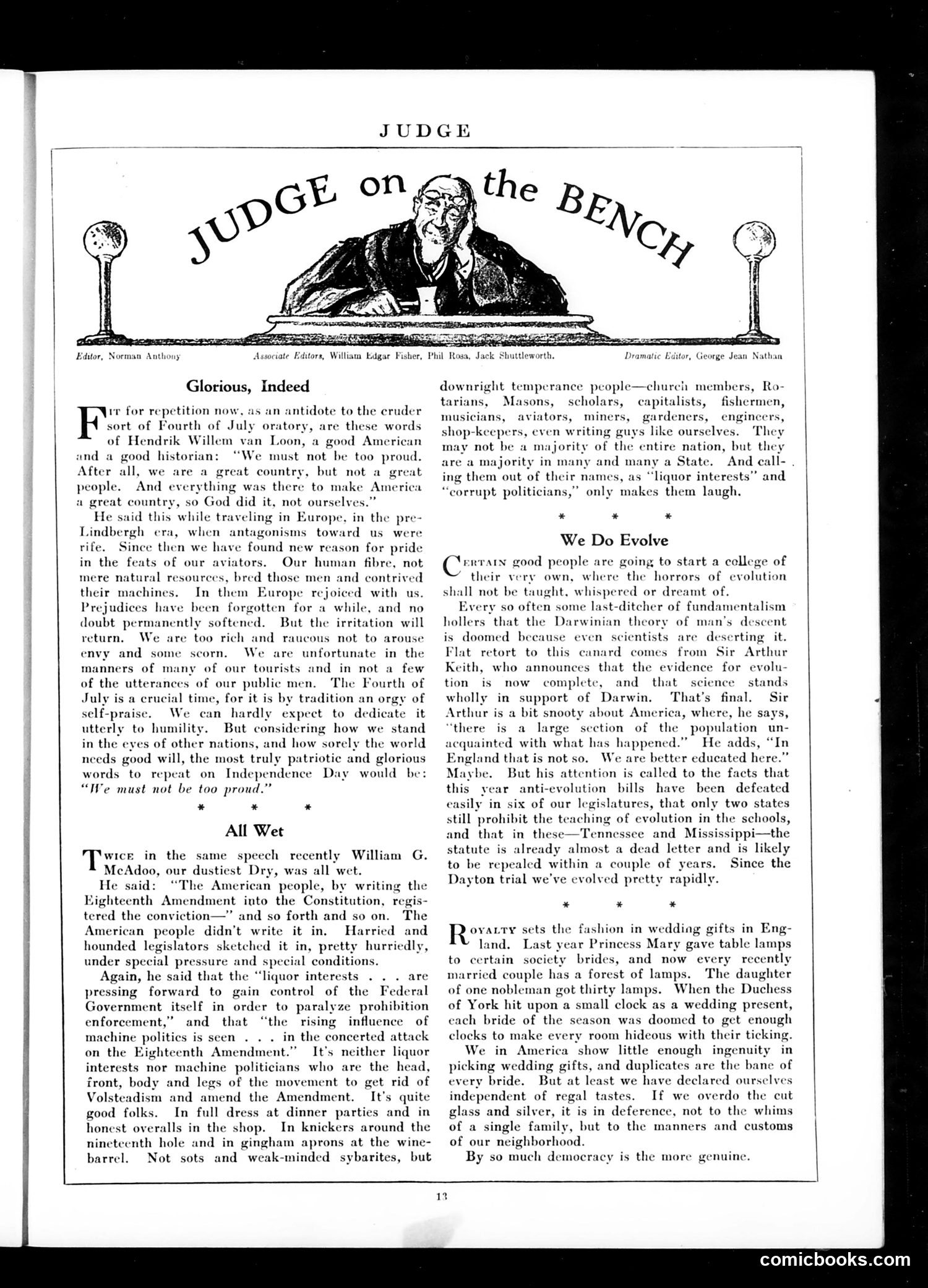
This page from Judge magazine contains three satirical editorial pieces: **"Glorious, Indeed"** critiques Fourth of July rhetoric. It quotes historian Hendrik Willem van Loon's advice that Americans should say "We must not be too proud" rather than engage in self-congratulatory Independence Day speeches. The piece argues Americans' international reputation is damaged by arrogant tourists and public figures, despite legitimate achievements in aviation and innovation. **"All Wet"** attacks William G. McAdoo (identified as a "Dry"—Prohibition supporter) for falsely claiming "the American people" wrote the Eighteenth Amendment. The satire notes that ordinary decent citizens—church members, Rotarians, shop-keepers—actually oppose Prohibition, not just "liquor interests" as McAdoo claimed. **"We Do Evolve"** mocks fundamentalists planning a college to avoid teaching evolution. It references Sir Arthur Keith's assertion that evolution is scientifically proven and complete, while sardonically noting Keith's criticism that Americans are less educated on this subject than the English. All three pieces target what Judge sees as American hypocrisy, false claims, and anti-scientific attitudes.
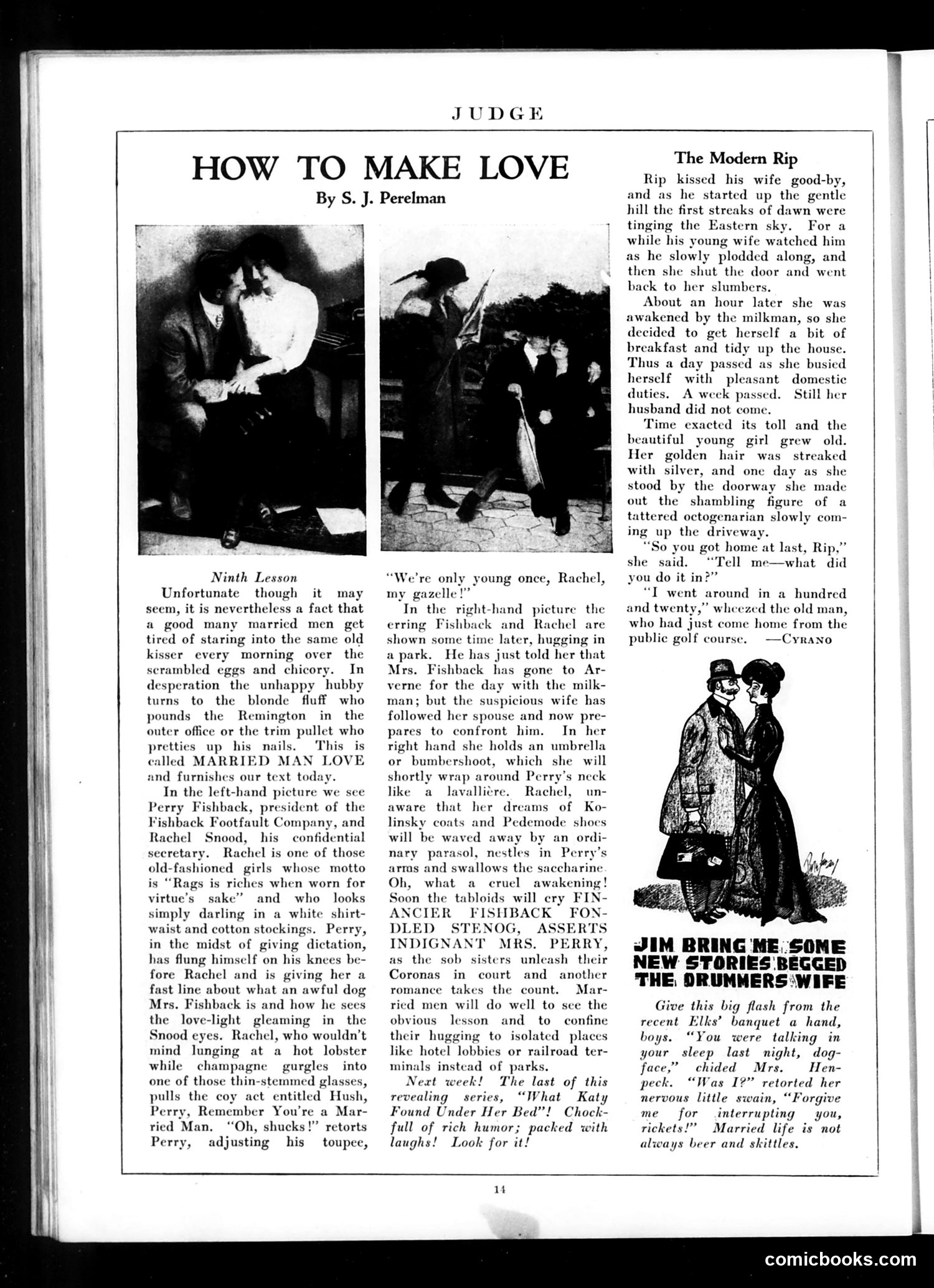
This page from Judge contains two satirical pieces by humorist S.J. Perelman: **"How to Make Love"** presents a cynical lesson on marital infidelity. The cartoon depicts a businessman (Perry Fishback) seducing his secretary Rachel—first in the office, then later caught in a park by his suspicious wife, who arrives armed with an umbrella as a weapon. The satire mocks the predictable downfall: the affair will end in tabloid scandal and divorce court. Perelman ridicules both the wandering husband's self-deception and society's dramatic response. **"The Modern Rip"** is a brief comic riff on Washington Irving's "Rip Van Winkle" tale. Here, a man leaves home early and returns decades later, aged and decrepit—but he's been at the golf course the entire time, not sleeping in the mountains. The joke satirizes the obsessive, time-consuming nature of golf among American men. Both pieces target masculine behavior: infidelity and recreational escapism as ways married men avoid domestic life.
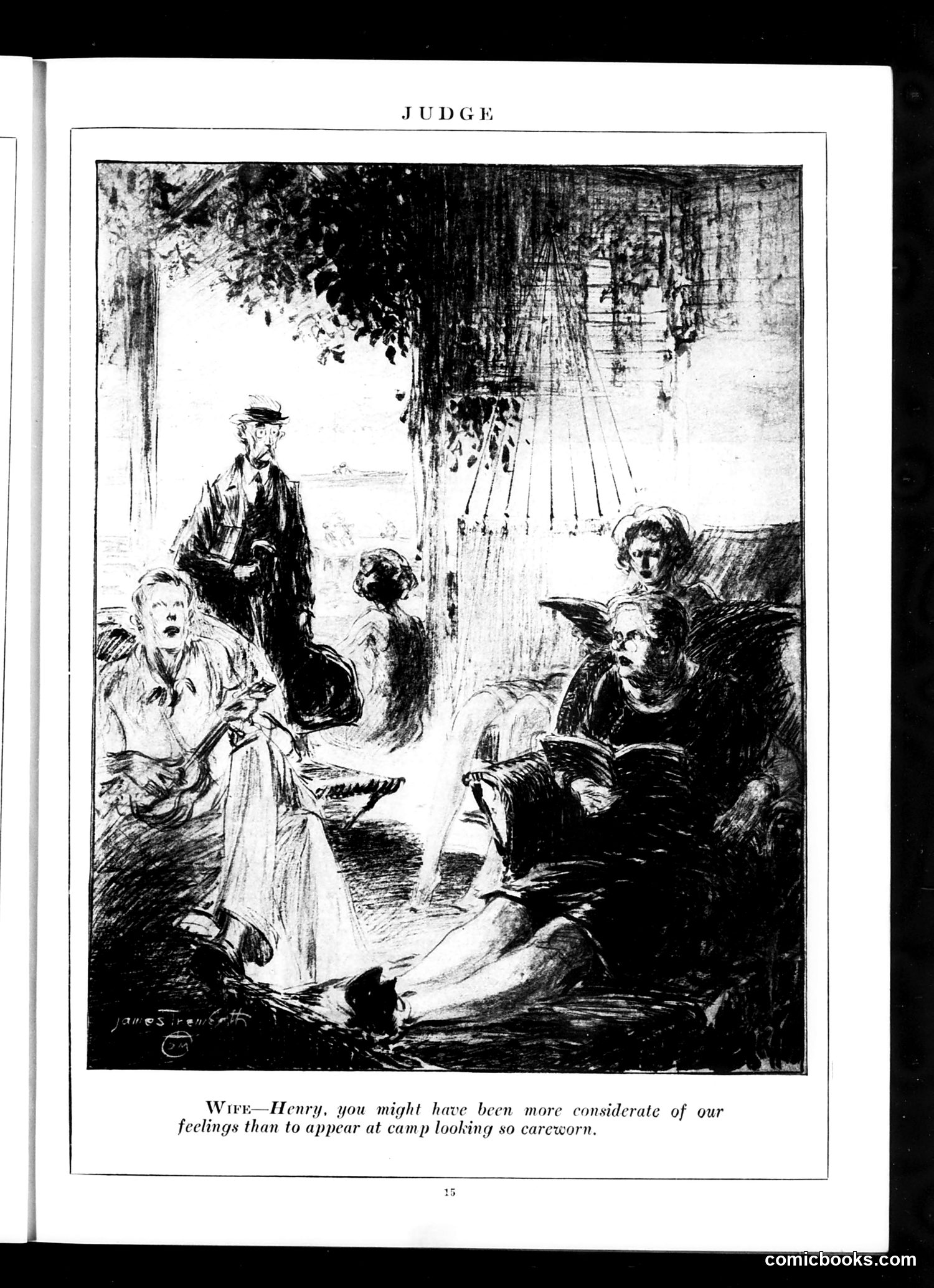
This appears to be a domestic satire cartoon titled "Wire," showing a camp scene where a wife reproaches her husband Henry for appearing visibly worried or distressed in front of others at camp. The wife's complaint—that he "might have been more considerate of our feelings than to appear at camp looking so careworn"—satirizes social pretense and performative respectability among the upper classes. Rather than addressing the actual source of Henry's anxiety, the wife prioritizes maintaining appearances before their social circle. The cartoon mocks how wealthy Americans prioritized saving face and keeping up appearances over genuine emotional honesty, a common theme in Judge's satirical commentary on Gilded Age and Progressive Era society.
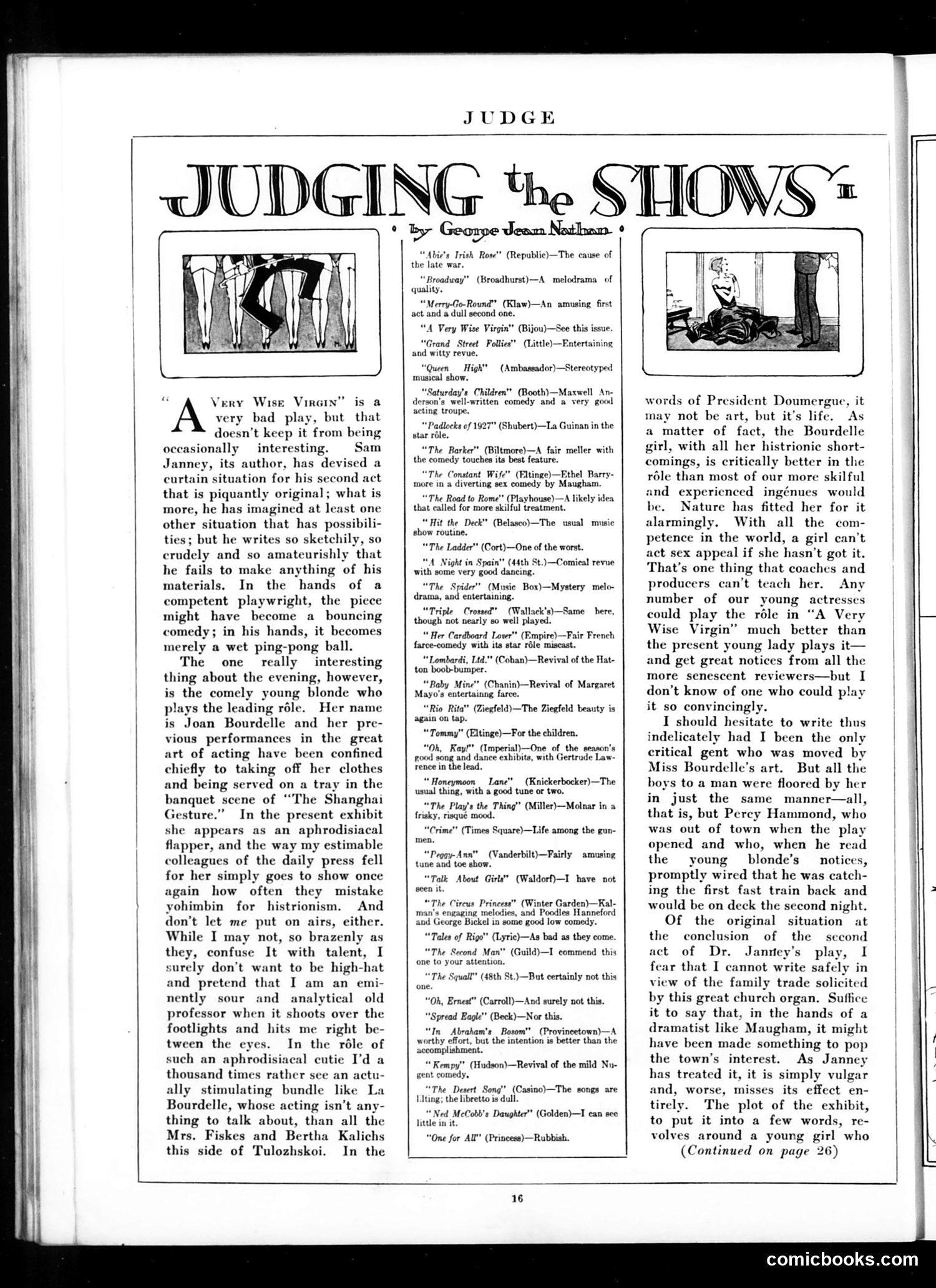
This page reviews Broadway theatrical productions from the 1920s era. The main article, "Judging the Shows" by George Jean Nathan, critiques a play called *"A Very Wise Virgin"* at the Bijou Theatre. Nathan's central point: the play itself is poorly written and crudely constructed, but its appeal lies entirely in its leading actress, Joan Bourdelle—described as an "aphrodisiacal flapper" with no real acting talent. Nathan admits he and his fellow critics are distracted by her physical attractiveness rather than her performance abilities. He acknowledges this bias humorously, confessing he'd rather watch such an appealing but talentless performer than genuinely skilled actresses like Mrs. Fiske or Bertha Kalich. The satire targets both the mediocrity of contemporary theater and critics' susceptibility to spectacle over substance—a tension relevant even today. The right column lists brief reviews of other current Broadway shows, providing context for the theatrical season being discussed.
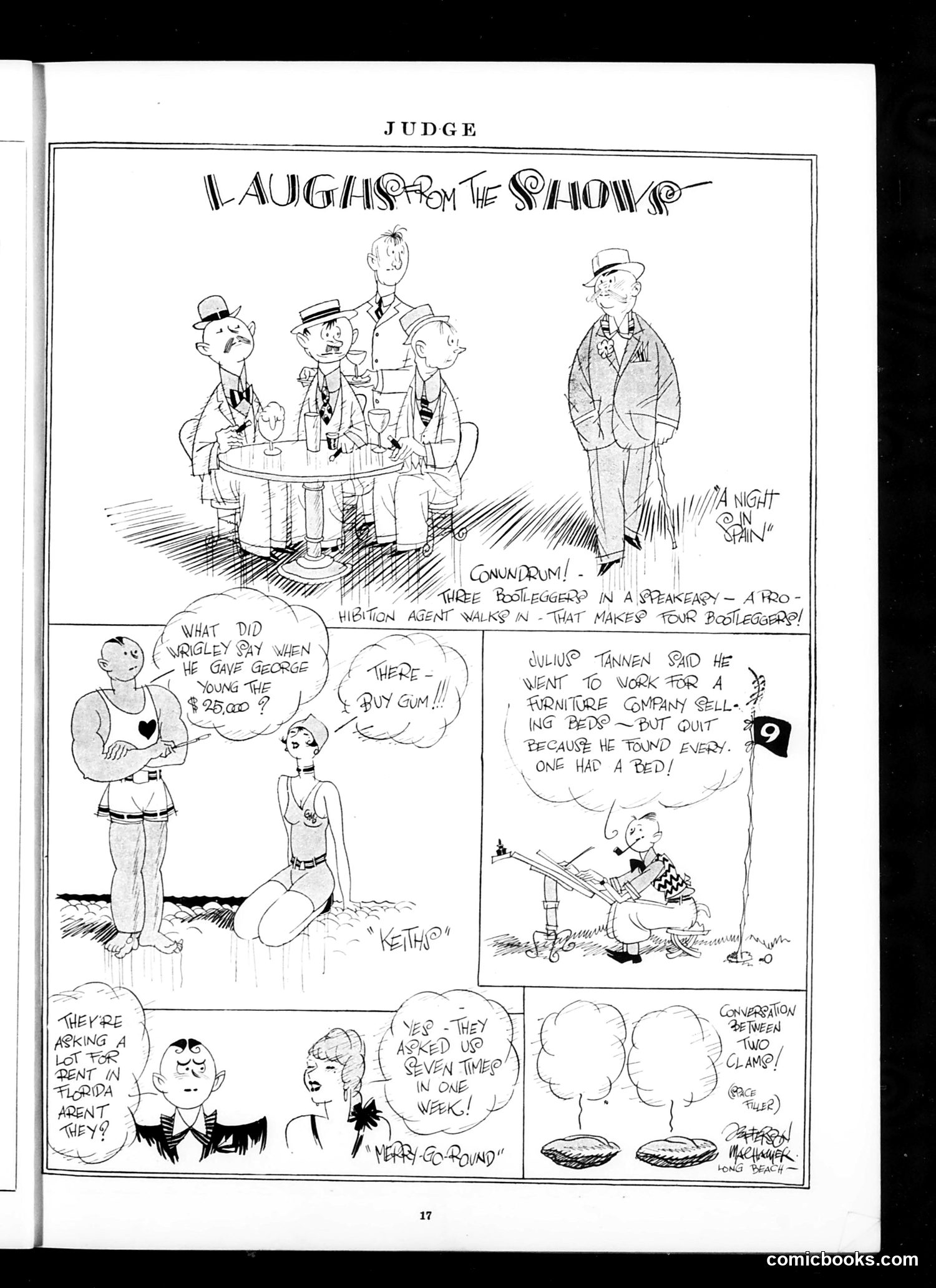
This is a multi-panel satirical comic page featuring various social humor and wordplay typical of Judge magazine's style. The top panel shows a speakeasy scene (referencing Prohibition-era illegal bars), with the central "conundrum" joke: a Prohibition agent who walks into a speakeasy—making him both enforcer and lawbreaker simultaneously. The lower panels contain separate jokes: one about George Young receiving $25,000 (context unclear without more historical information), another mocking Julius Tannen's furniture-selling failure because every bed he found was already occupied, and final panels about vacation spending in Florida and a conversation between two clams. The humor relies on wordplay, absurdist scenarios, and social commentary typical of 1920s-30s American satire. Without more historical context, specific contemporary references (like the Young reference) remain unclear, but the overall tone mocks social pretensions and human folly through exaggerated cartoon characterizations.
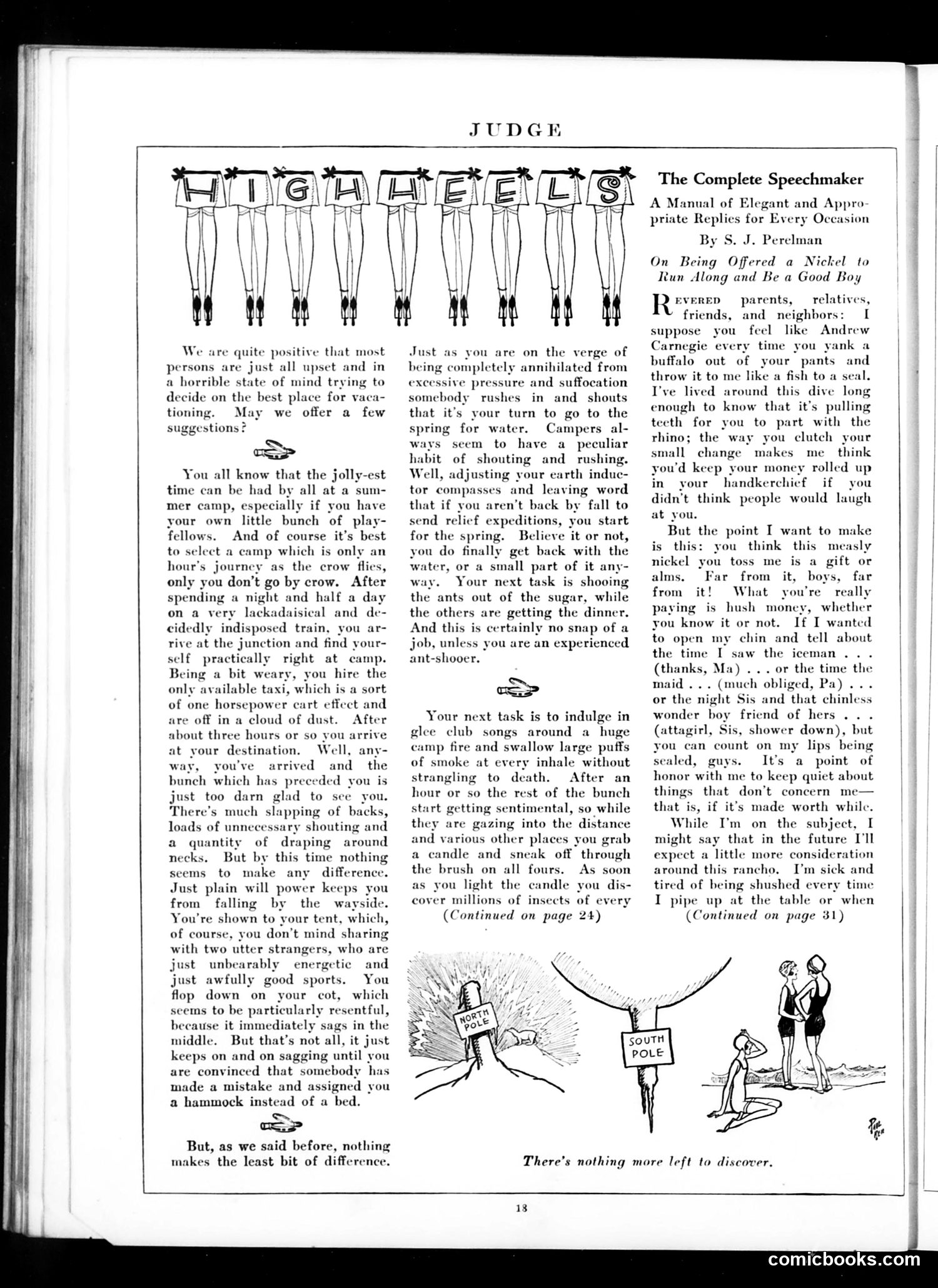
This page contains two satirical pieces about summer vacation: **Main Article**: A humorous guide mocking the summer camp experience. It satirizes the tedious journey to camp (an exhausting train ride), the overcrowded accommodations (sharing a tent with strangers, a sagging cot), and the endless chores (fetching water, removing ants from sugar, singing around campfires). The comedy derives from exaggerating every minor inconvenience of rustic camping into an ordeal, while maintaining that "nothing makes the least bit of difference"—capturing how people endure vacation mishaps stoically. **Illustration**: Shows explorers at the North and South Poles with the caption "There's nothing more left to discover," suggesting that camping has become so popularized there's nowhere left to escape to. **"Complete Speechmaker" Section**: A humorous advice column by S.J. Perelman (a well-known humorist) offering a mock-serious response to a child being offered a nickel. It sarcastically reframes the gift as "hush money" rather than generosity—social satire about adult hypocrisy and conditional kindness toward children.
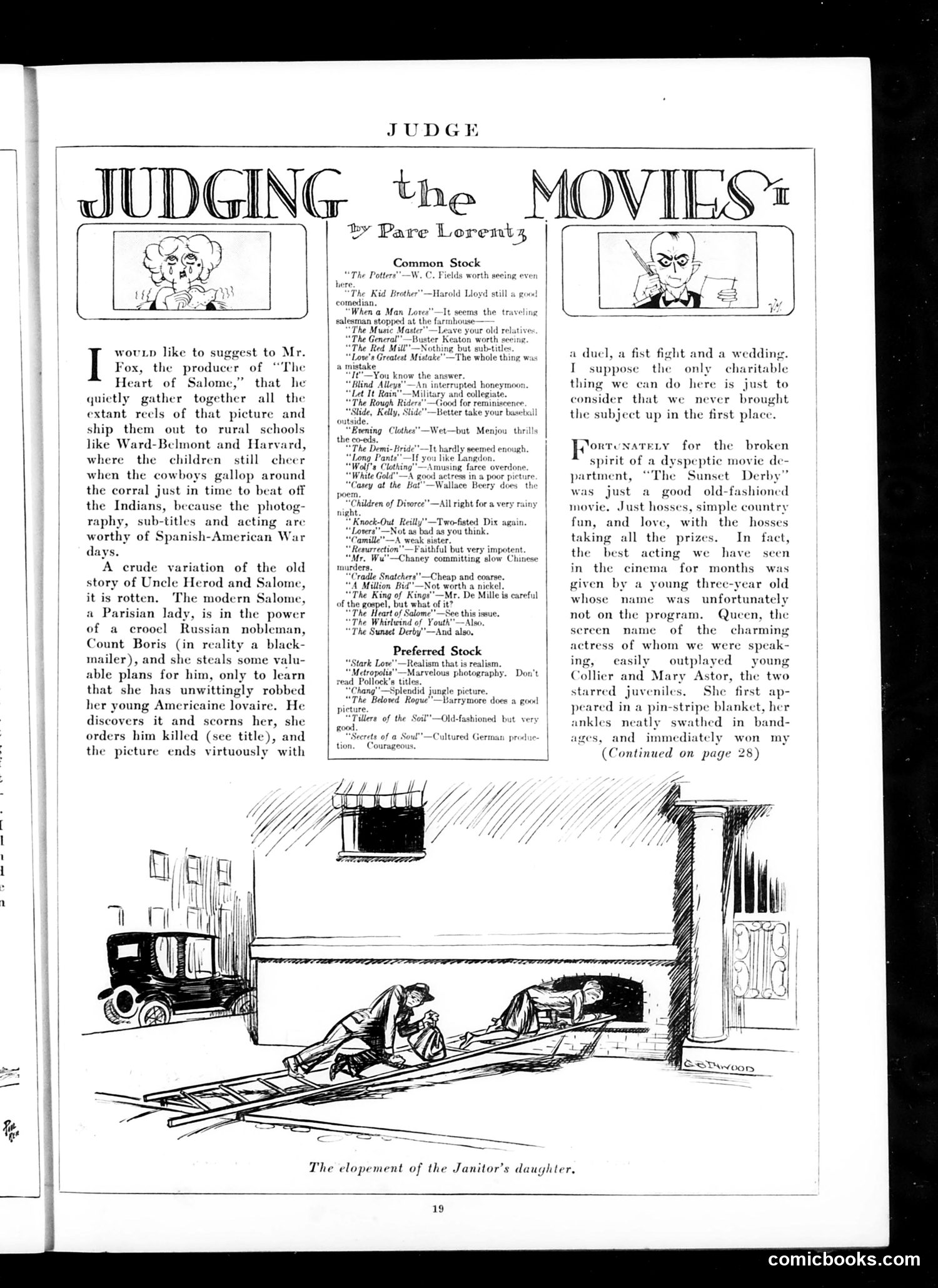
This page features Pare Lorentz's column reviewing recent films. The cartoon below illustrates a comedic scene from an unnamed film—showing figures with ladders beneath a building, captioned "The elopement of the Janitor's daughter," suggesting slapstick humor involving an escape or dramatic exit. The text critiques contemporary movies with sharp sarcasm. Lorentz mocks "The Heart of Salome" as so poorly made it belongs in rural schoolhouses alongside outdated Spanish-American War footage. He dismisses a modernized Salome story as "rotten," involving a Parisian woman, a cruel Russian nobleman blackmailer, and a romantic American—ending with her ordering the lover killed. The reviews segregate films into "Common Stock" (mediocre) and "Preferred Stock" (better quality), rating movies by Harold Lloyd, Buster Keaton, and W.C. Fields. "The Sunset Derby" receives surprising praise for simple country entertainment, particularly highlighting a three-year-old horse ("Queen") as the film's best performer—a backhanded compliment suggesting human actors were outshone.
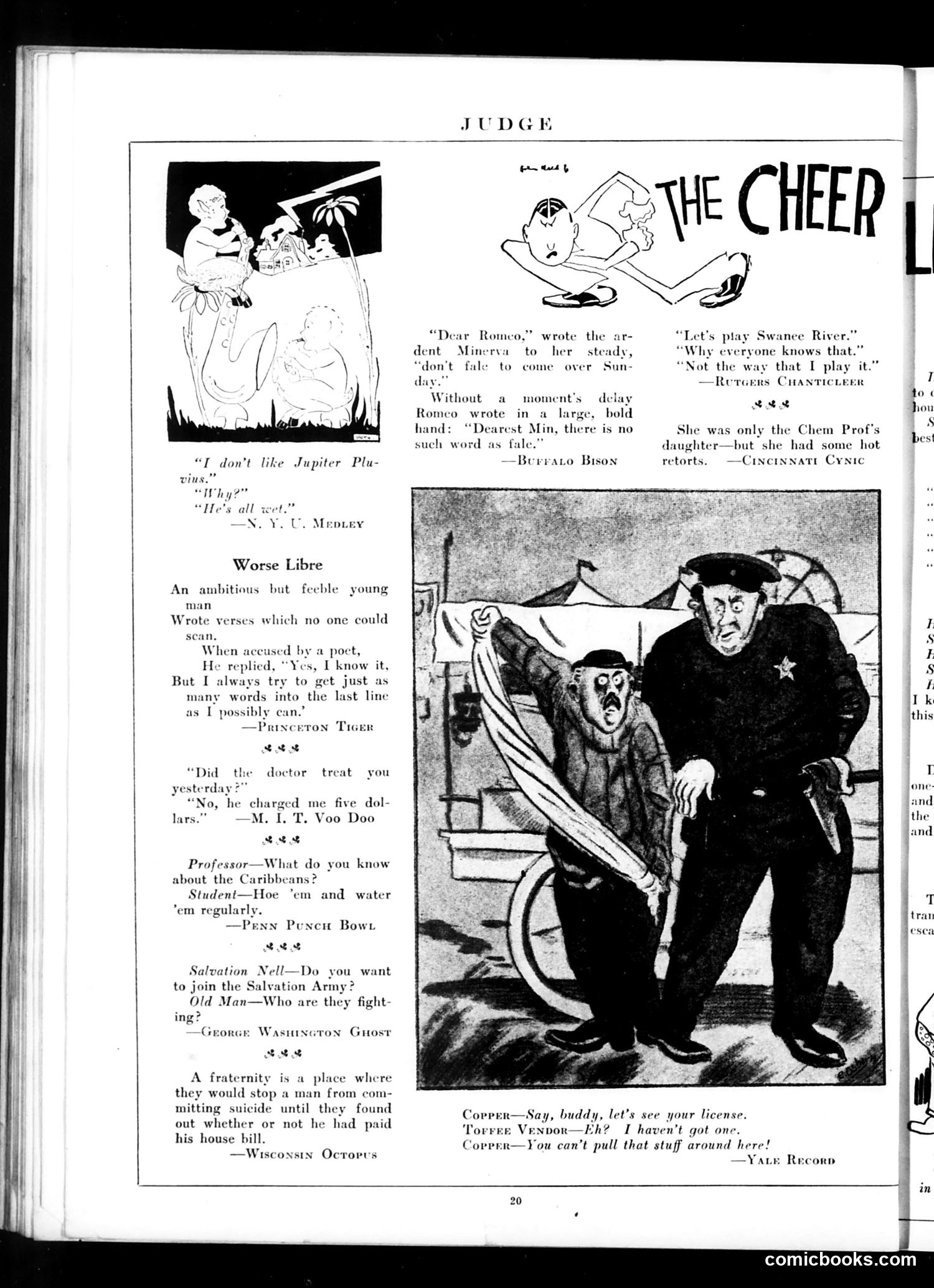
This page from *Judge* magazine contains various humorous quips and two illustrated satirical pieces. **Top cartoon**: Shows a classical or mythological scene, likely mocking pretentious artistic or literary tastes. The quote "I don't like Jupiter Pluvius" (the Roman rain god) appears to be poking fun at someone using affected classical references. **Main cartoon** (bottom): Depicts a police officer stopping a street vendor selling what appears to be hot beverages or food. The dialogue satirizes low-level corruption—the vendor lacks a proper license, and when confronted, claims he "hasn't got one," suggesting this was common urban infractions enforcement humor. The caption "You can't pull that stuff around here" implies the officer is cracking down. **Text content**: Multiple brief jokes attributed to college humor magazines (Princeton, M.I.T., Penn, Wisconsin). These mock academic pretension, romantic letter-writing, family dynamics, and fraternity materialism. The overall tone is lighthearted, targeting educated audiences familiar with college life and classical references. The page reflects early 20th-century American satirical humor emphasizing wordplay and social observation.
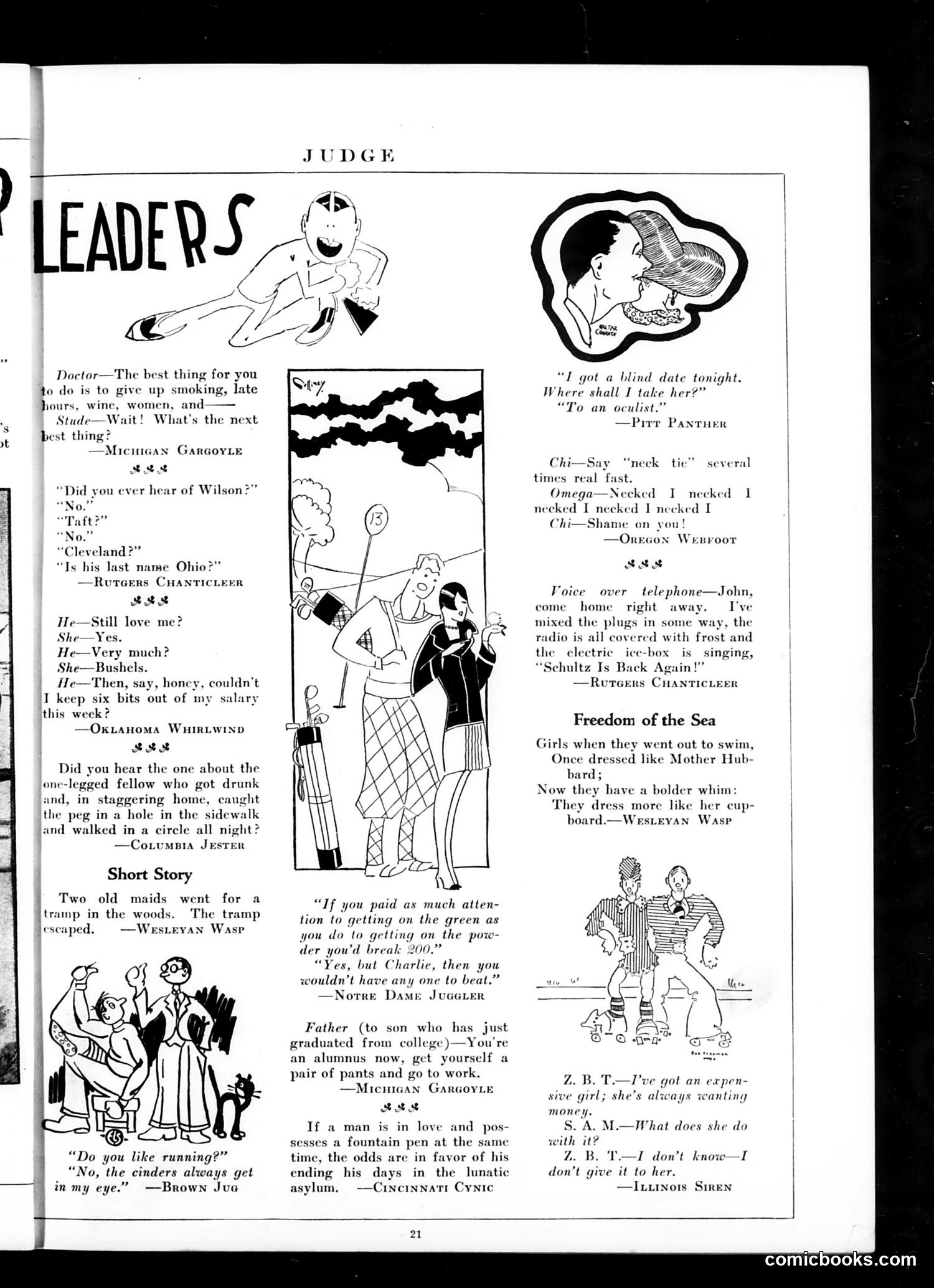
This page contains brief satirical jokes and humorous observations typical of early 20th-century American humor magazines. Key content includes: **"Leaders" section**: A collection of one-liners poking fun at contemporary attitudes. A doctor joke mocks overconsumption; a Wilson reference (likely President Woodrow Wilson) appears in wordplay; relationship humor plays on men avoiding financial responsibility. **Central cartoon**: Depicts what appears to be a social gathering, possibly illustrating dating or courtship customs. **"Freedom of the Sea"**: A satirical poem about women's changing swimwear—moving from modest Victorian styles ("Mother Hubbard" dresses) to more revealing modern fashions. This reflects 1920s debates over female liberation and changing social mores. **Miscellaneous quips**: Include jokes about college graduates needing jobs, romantic absurdities, and domestic confusion (mixed radio plugs causing chaos). The humor reflects Jazz Age anxieties: gender role shifts, modern technology, generational conflict, and courtship customs during a period of significant social change.
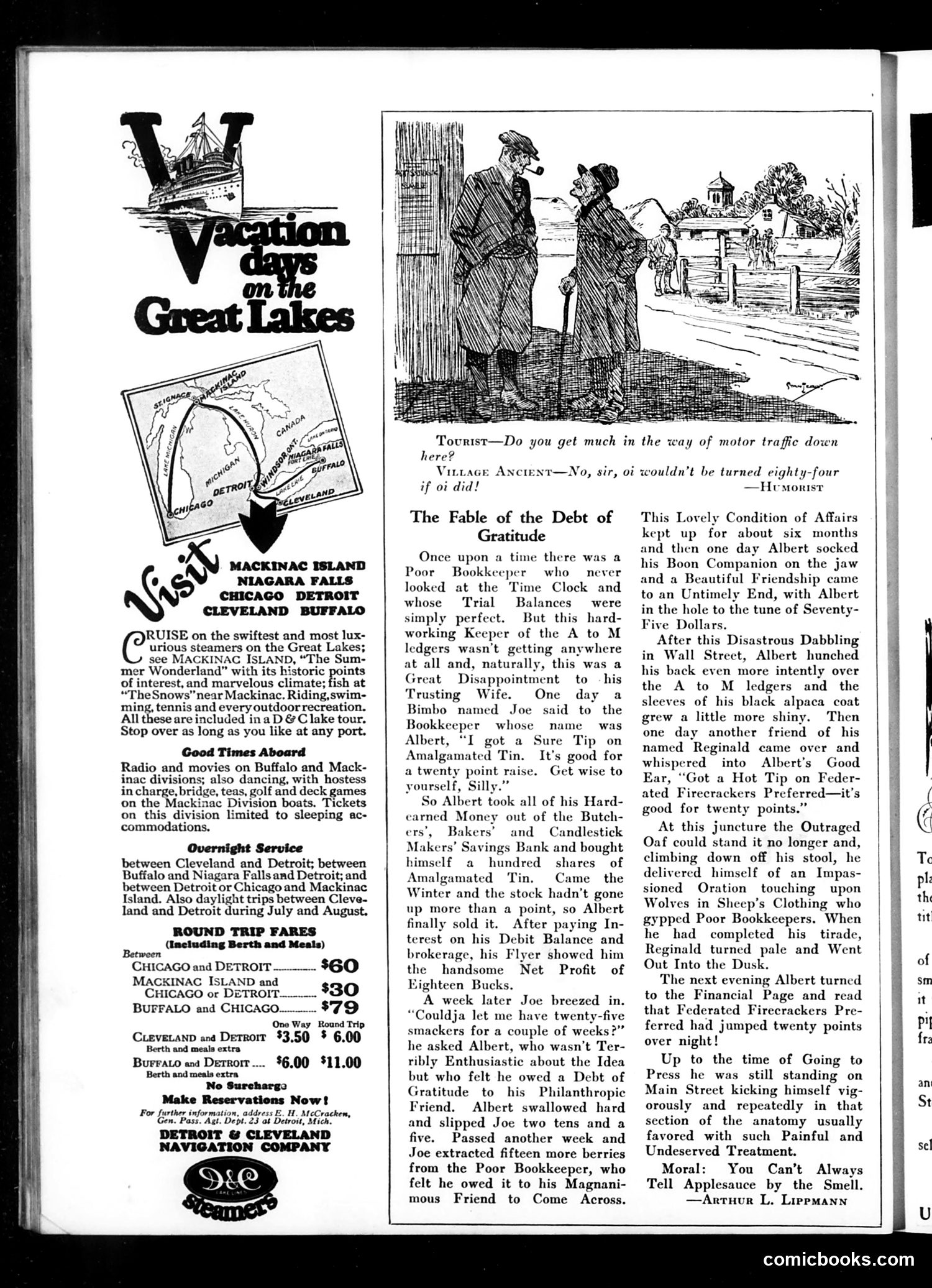
This page is primarily an advertisement for Great Lakes steamship cruises, but includes a satirical fable mocking naive financial behavior. The story ridicules a hardworking bookkeeper named Albert who foolishly invests his savings in "Amalgamated Tin" stock based on a casual tip from a friend named Joe. After losing money, Albert feels obligated to lend Joe cash repeatedly—$50 total over six months—out of misplaced "gratitude" for the original stock tip. When Albert finally confronts him, he's out $75. The moral critiques gullible working-class men who chase get-rich-quick schemes and then compound their error through guilt-driven generosity. It reflects 1920s anxiety about stock speculation and exploitation of the credulous by fast-talking con artists. Albert represents the cautionary tale: his ledger-keeping honesty cannot protect him from his own poor judgment and emotional vulnerability.
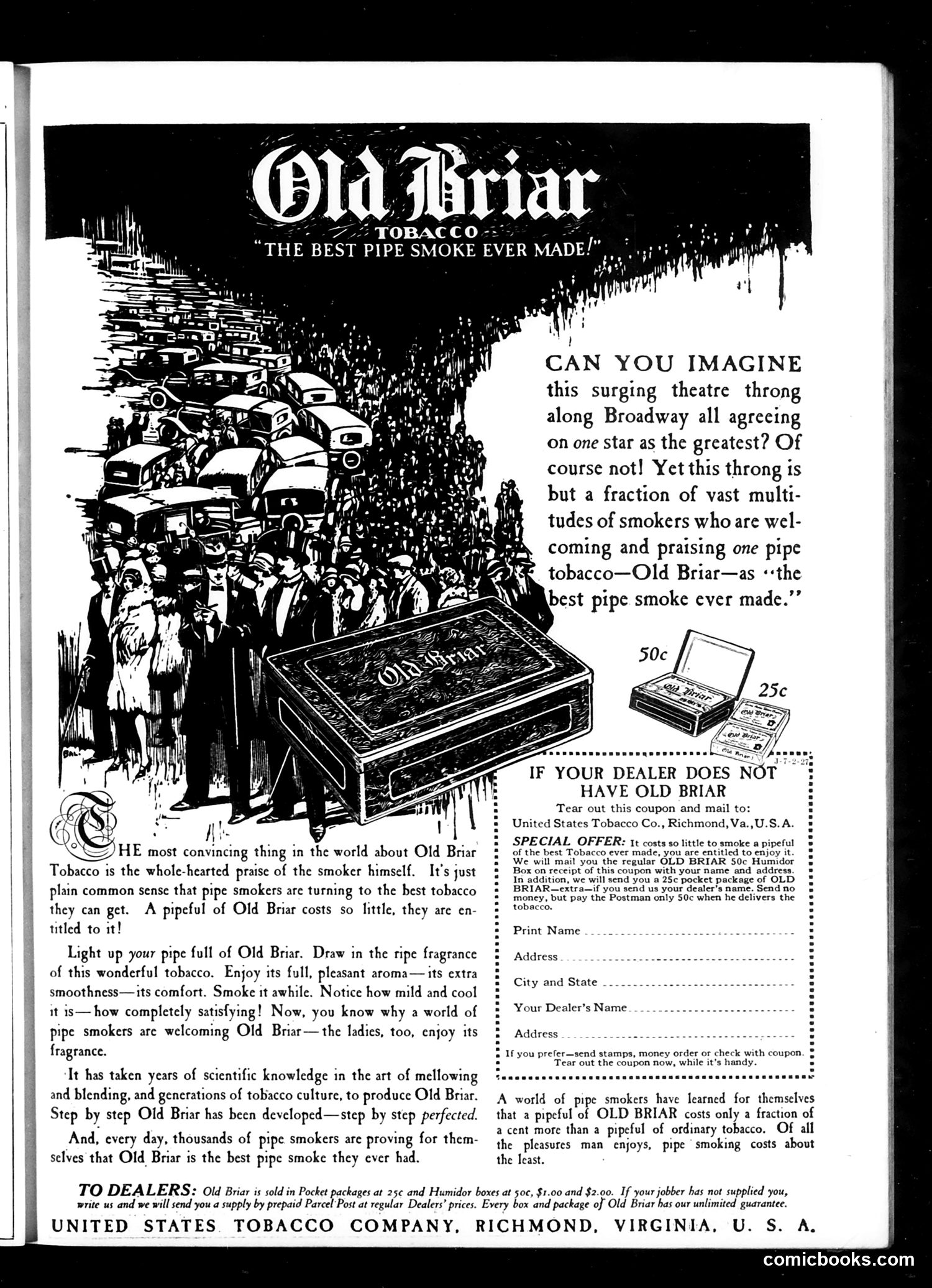
This is primarily a **tobacco advertisement**, not political satire. The page promotes Old Briar pipe tobacco to early 20th-century smokers. The visual metaphor compares widespread smoker enthusiasm for the product to a massive Broadway theater crowd—the implication being that universal agreement on "the greatest" is nearly impossible, yet countless smokers independently praise Old Briar, suggesting its genuine quality. The large illustration depicts a throng of people and vehicles, emphasizing the scale of this phenomenon. The ad targets pipe smokers specifically, emphasizing affordability, pleasant aroma, smoothness, and comfort. A tear-out coupon offers a promotional deal: customers mail in the coupon and pay the postman 50 cents upon delivery of a premium box, with an extra 25-cent package included. The copy appeals to vanity ("the ladies, too, enjoy its fragrance") and value-consciousness, claiming superior quality developed through "scientific knowledge" and "generations of tobacco culture." This reflects standard early-20th-century advertising rhetoric and marketing practices.
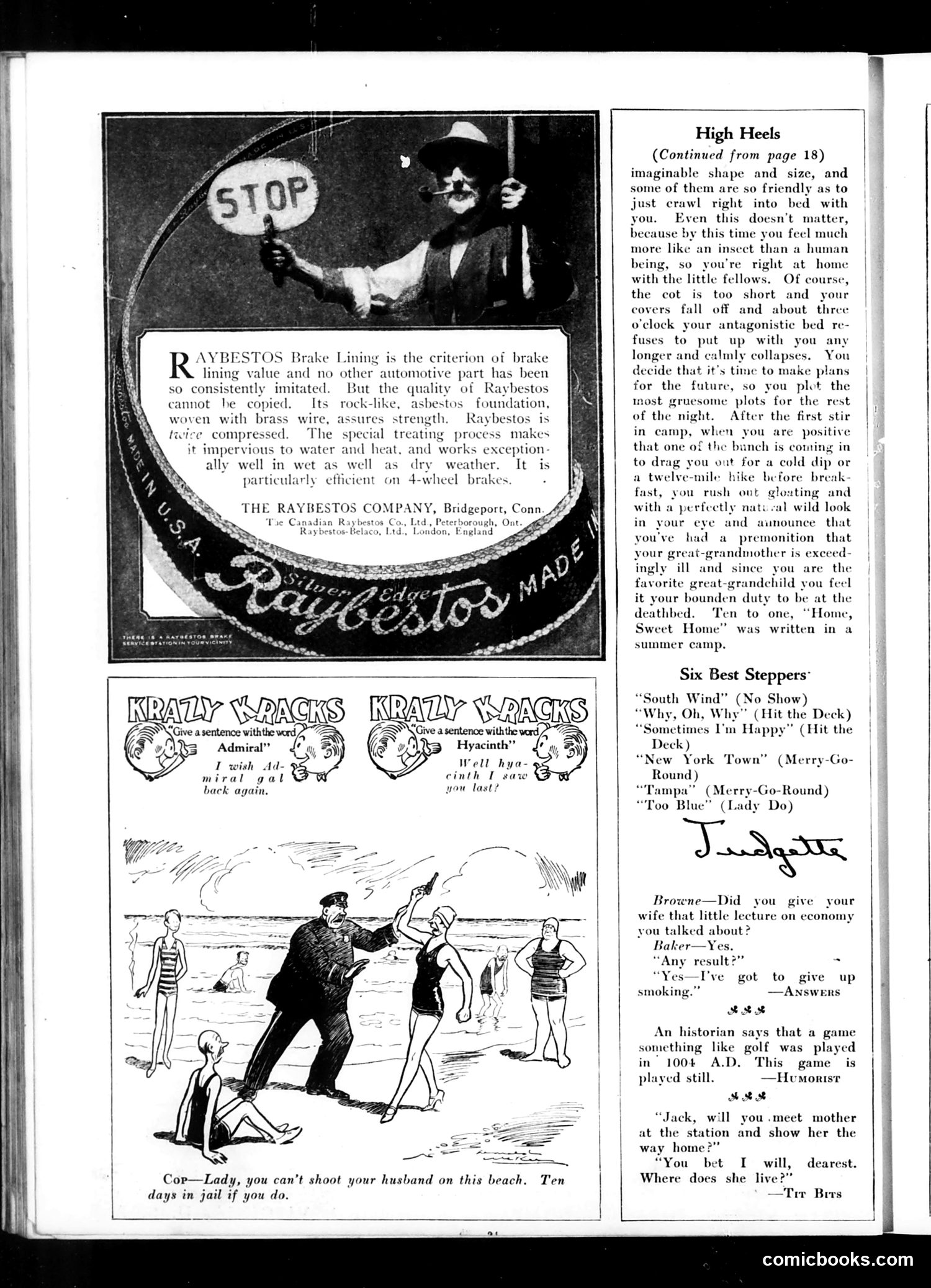
This page contains a **Raybestos brake lining advertisement** (top), two unrelated humor items below it, and a "High Heels" article continuation. The **"Krazy Kracks"** section presents two simple word-play jokes framed as cartoon panels—one featuring "Admiral" (pun unclear without full context), another with "Hyacinth" (likely a play on words about the flower or a name). The **beach cartoon** depicts social commentary: a police officer stops a woman from shooting her husband, warning of jail time. This reflects 1920s domestic humor—the implication being that spousal violence was treated as a comedic domestic dispute rather than serious crime, and the "solution" is legal punishment rather than addressing the underlying marital conflict. The joke assumes audience familiarity with marital discord as entertainment. The **"High Heels"** article discusses discomforts of summer camp life for women—insects, inadequate bedding, and the social obligation to visit sick relatives. It lists popular song "steppers" (danceable hits). The page is primarily **advertisement and light humor**, with no significant political content. The beach scene offers the only social commentary—treating spousal conflict as comedic.
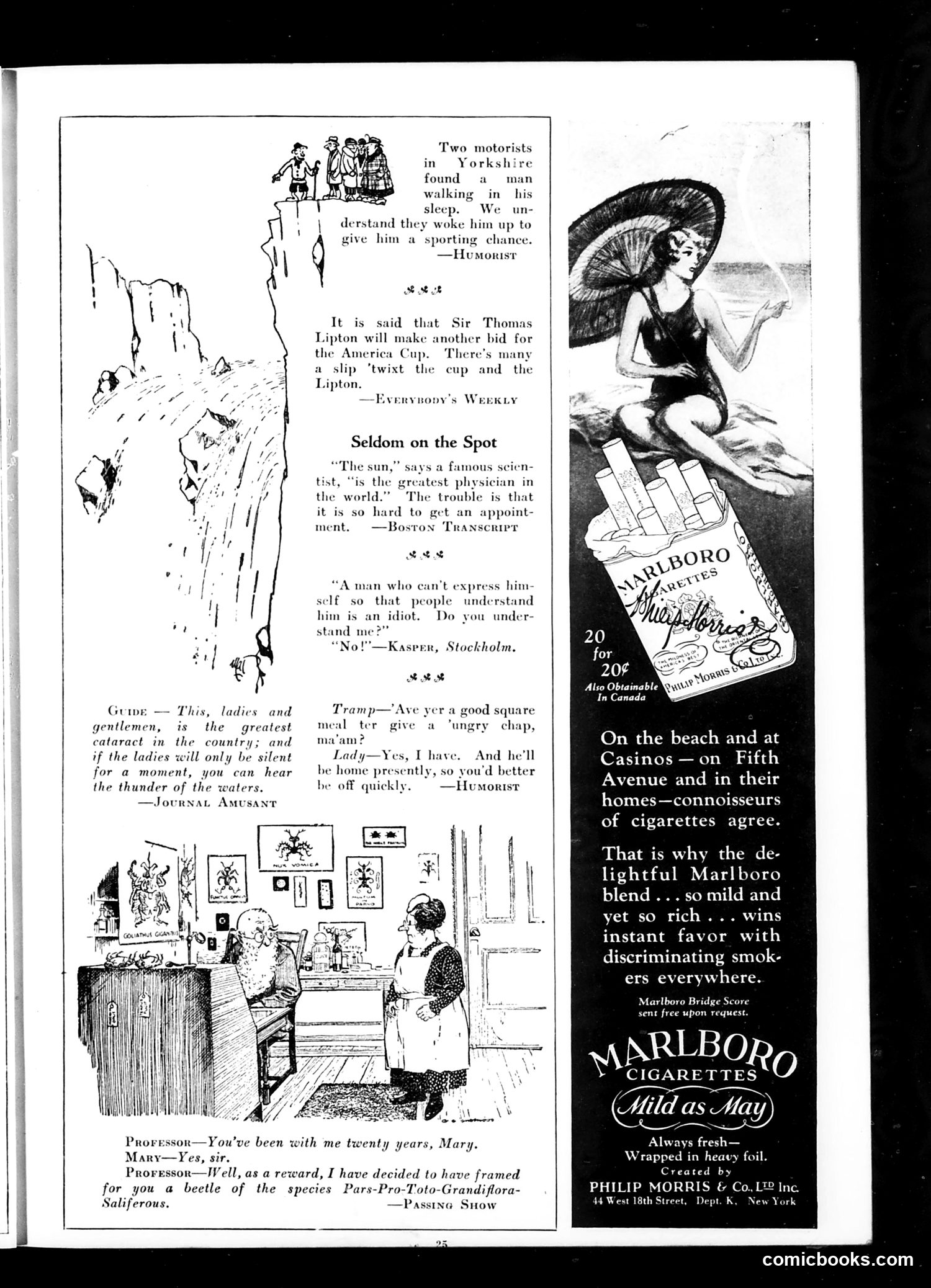
This page contains multiple satirical humor pieces typical of early 20th-century American magazines, plus a Marlboro cigarette advertisement. The cartoons mock various situations: a tour guide's dramatic speech interrupted by ladies; motorists giving a sleepwalker "sporting" awakening (dark humor about danger); Sir Thomas Lipton's repeated America's Cup challenges; difficulty securing medical appointments with the sun; a man claiming those who don't understand him are idiots (ironic given his unclear speech); a vagrant being rejected by a lady who'll feed her own husband instead; and a professor rewarding long service with a comically named beetle specimen. The humor relies on wordplay, irony, and social observation rather than political commentary. The Marlboro ad emphasizes the cigarette's mild, rich blend and appeals to "discriminating smokers"—standard early cigarette marketing before health warnings existed. The page reflects leisure-class concerns (tourism, sports, servants) and pre-modern attitudes toward homelessness and labor.
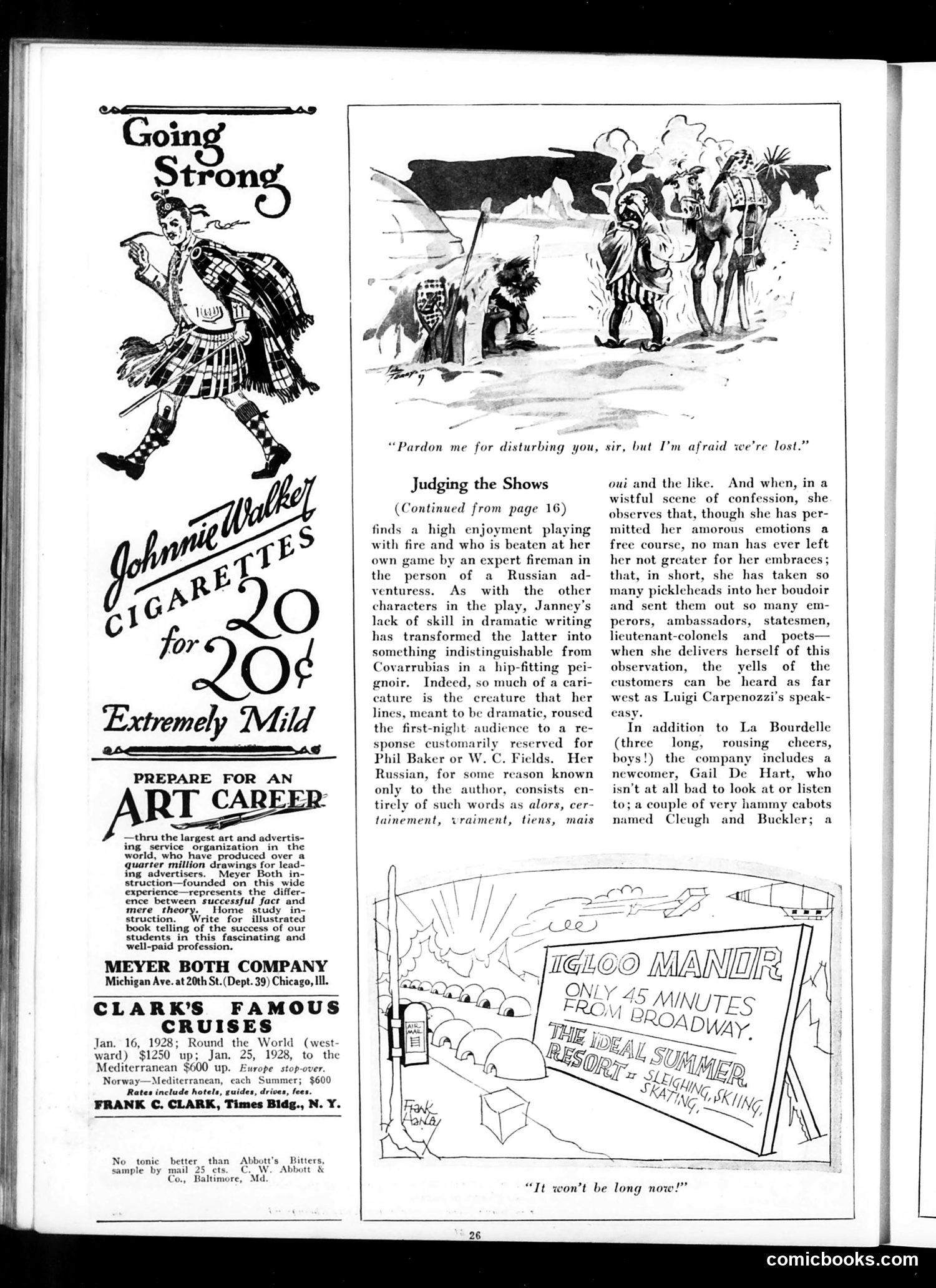
This page is primarily **advertising and entertainment coverage**, not political satire. The main content is a theater review ("Judging the Shows") discussing a Broadway play featuring an actress named Janney who plays a Russian adventuress character. The reviewer satirizes her dramatic performance—she speaks only in French phrases ("alors," "certainement," "vraiment") and makes exaggerated claims about her romantic conquests of important men. The joke is that her overwrought, comedic delivery gets bigger laughs than serious dramatic acting would. The cartoons are humorous rather than political: the top one shows a lost figure in a desert asking for directions, and the bottom depicts an "Igloo Manor" advertisement claiming only 45 minutes from Broadway—poking fun at real estate marketing. The page also carries advertisements for art instruction, cruise vacations, and cigarettes—typical 1920s magazine content with no discernible political commentary.
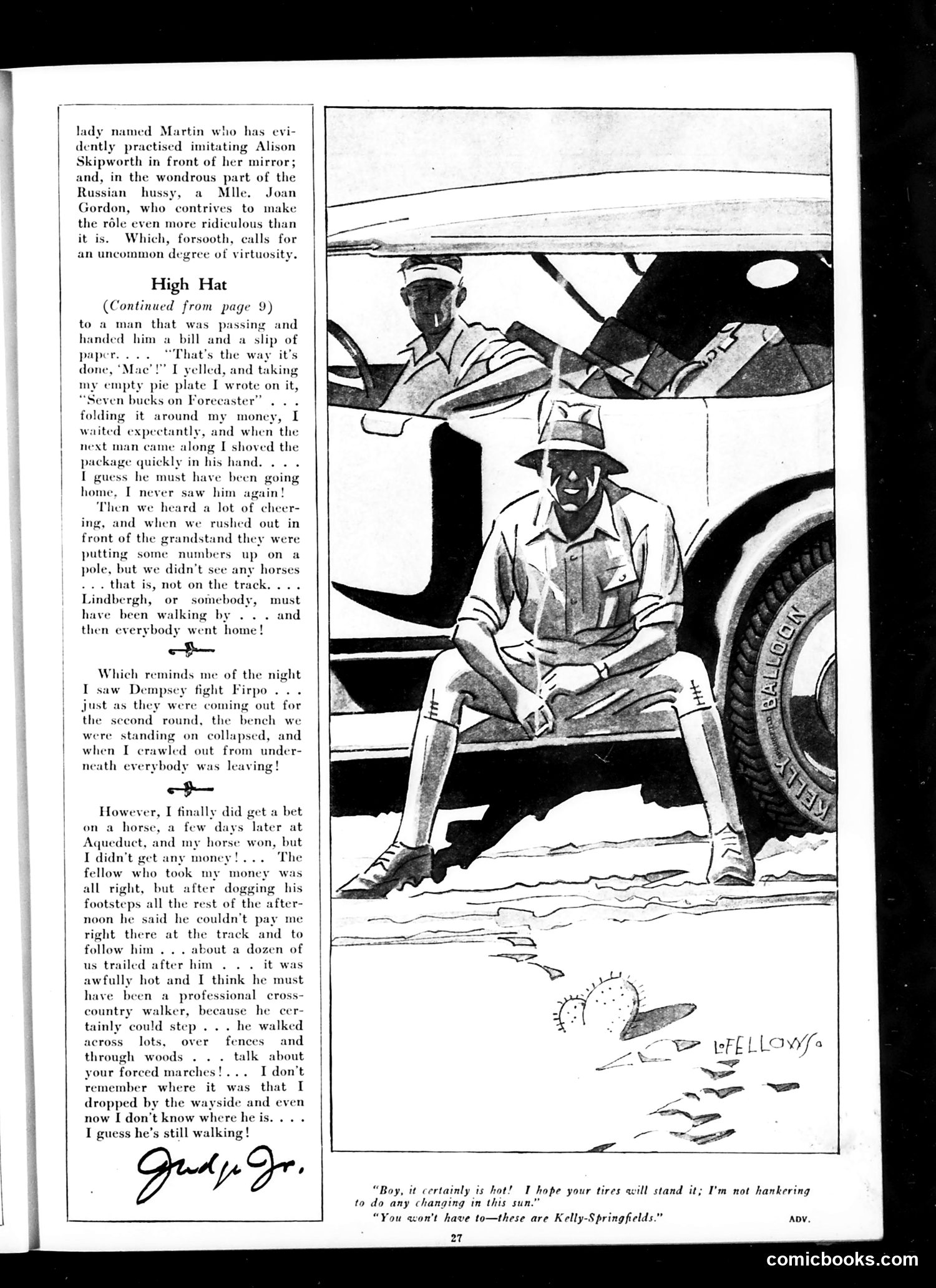
This page contains two distinct elements: **Left column:** A humorous essay titled "High Hat" (continued from page 9) recounting the author's misadventures at horse racing and boxing events. The narrator describes betting on horse races with absurd results—losing money to a bookie who disappears into the countryside, and missing famous events (Dempsey vs. Firpo fight, horse races) due to collapsing bleachers and other mishaps. The piece is a comedic tall tale about bad luck and incompetence at sporting venues. **Right side:** An illustration showing a man in work clothes and a hat sitting near a truck tire, with a small armadillo or similar creature nearby. Below is an advertisement for Kelly-Springfield tires, using the hot-weather setting as a sales pitch—the character assures his companion these tires won't need changing even in extreme heat. The page is primarily entertainment and advertising rather than political satire. The "High Hat" essay mocks the author's own foolishness; the ad uses relatable outdoor labor scenarios to promote tire durability.
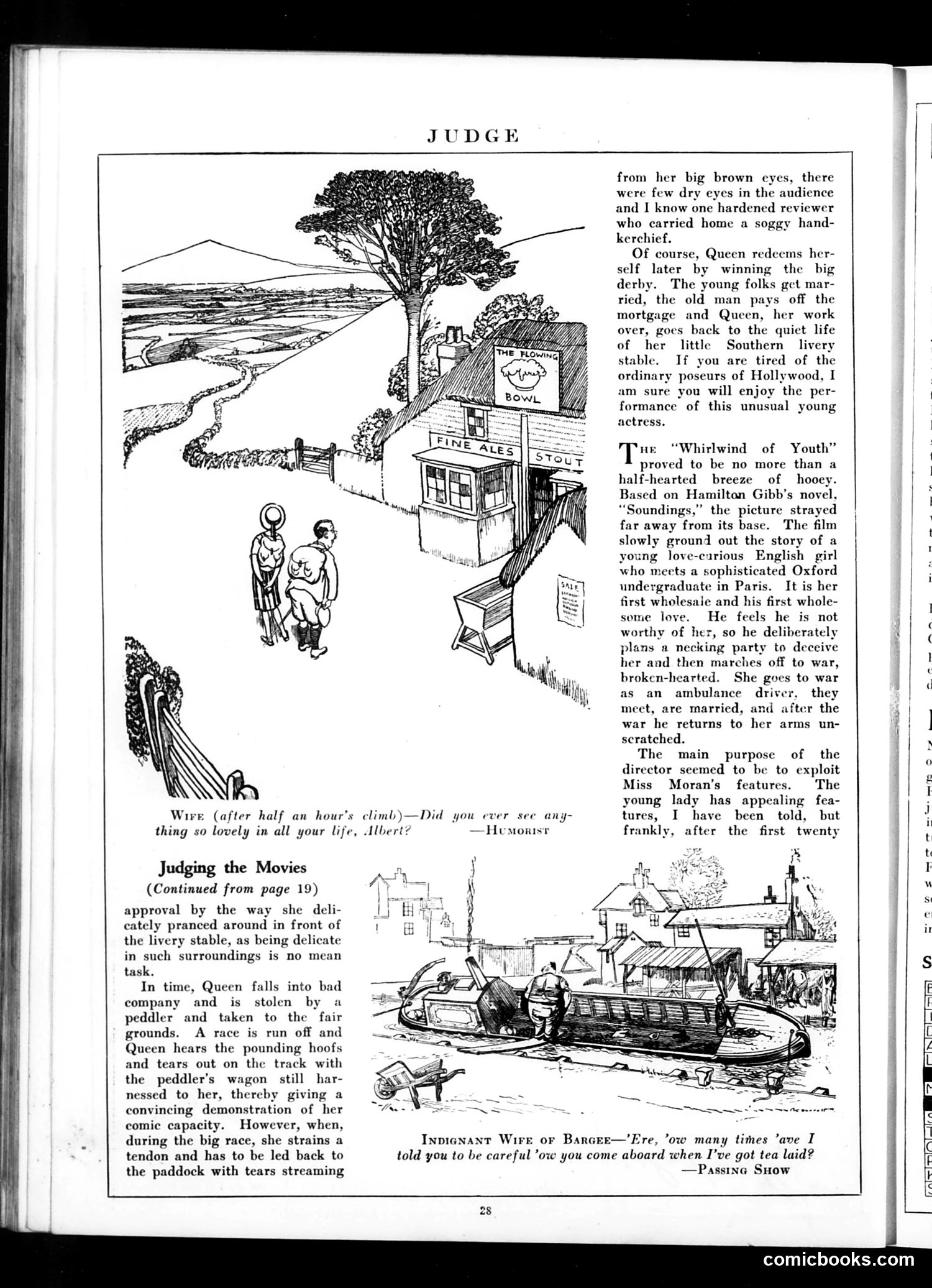
This page contains movie reviews and cartoons satirizing early Hollywood films and domestic life. **Main Content:** "Judging the Movies" reviews two films. The first concerns a horse named Queen who becomes a movie star—praised for her naturalistic performance in a Southern livery stable setting. The reviewer notes her dramatic flair when stolen and forced to race, culminating in injury. The second film, "Whirlwind of Youth," based on Hamilton Gibb's novel, is dismissed as superficial hokum. It follows a predictable romance between an English girl and Oxford student in Paris, with convenient wartime separation and reunion. The reviewer criticizes the director for prioritizing actress Moran's appearance over substance. **Cartoons:** Two humorous domestic scenes appear—one showing a couple admiring scenery with the caption about lovely views, and another depicting a working-class wife scolding her husband about carelessly boarding when tea is prepared, using period British dialect ("'ow many times"). The satire targets both shallow Hollywood filmmaking and gender dynamics in marriage.
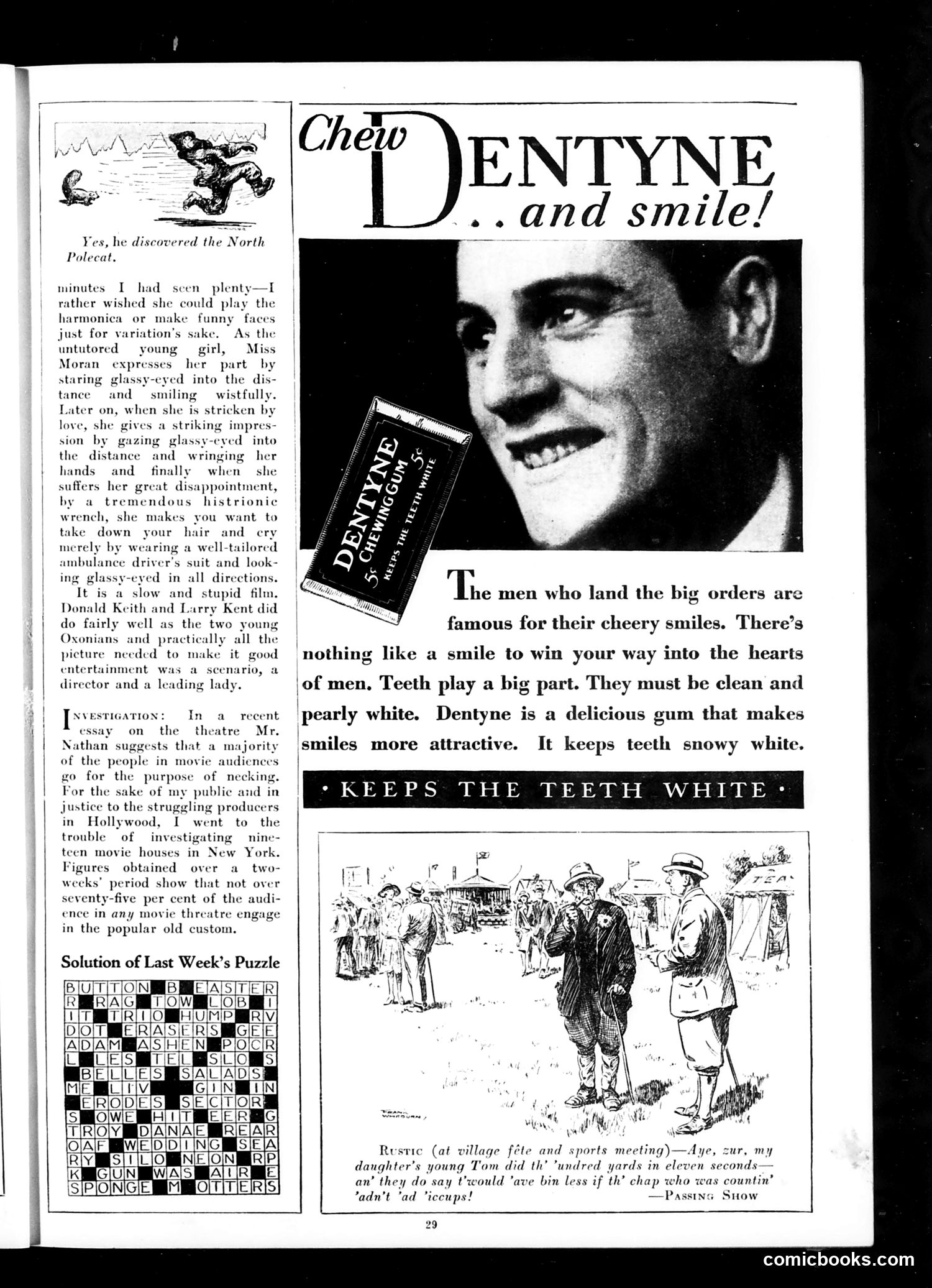
This page is primarily a **Dentyne chewing gum advertisement** disguised as editorial content in Judge magazine. The main piece is a film review criticizing a movie (apparently featuring actors Donald Keith and Larry Kent) for being slow and poorly acted. The review's actress repeatedly expresses emotion by staring "glassy-eyed into the distance"—a satirical jab at overwrought silent film acting. The advertisement then pivots this critique into a sales pitch: successful men win orders through "cheery smiles," and proper teeth maintenance (via Dentyne gum) is essential. The accompanying illustration shows businessmen at a casual social gathering, implying that an attractive smile facilitates social and professional success. The small cartoon at page top ("Yes, he discovered the North Polecat") is unrelated filler humor. This represents **early 20th-century advertising strategy**: embedding product pitches within entertainment criticism to seem less overtly commercial while reaching Judge's educated male readership.
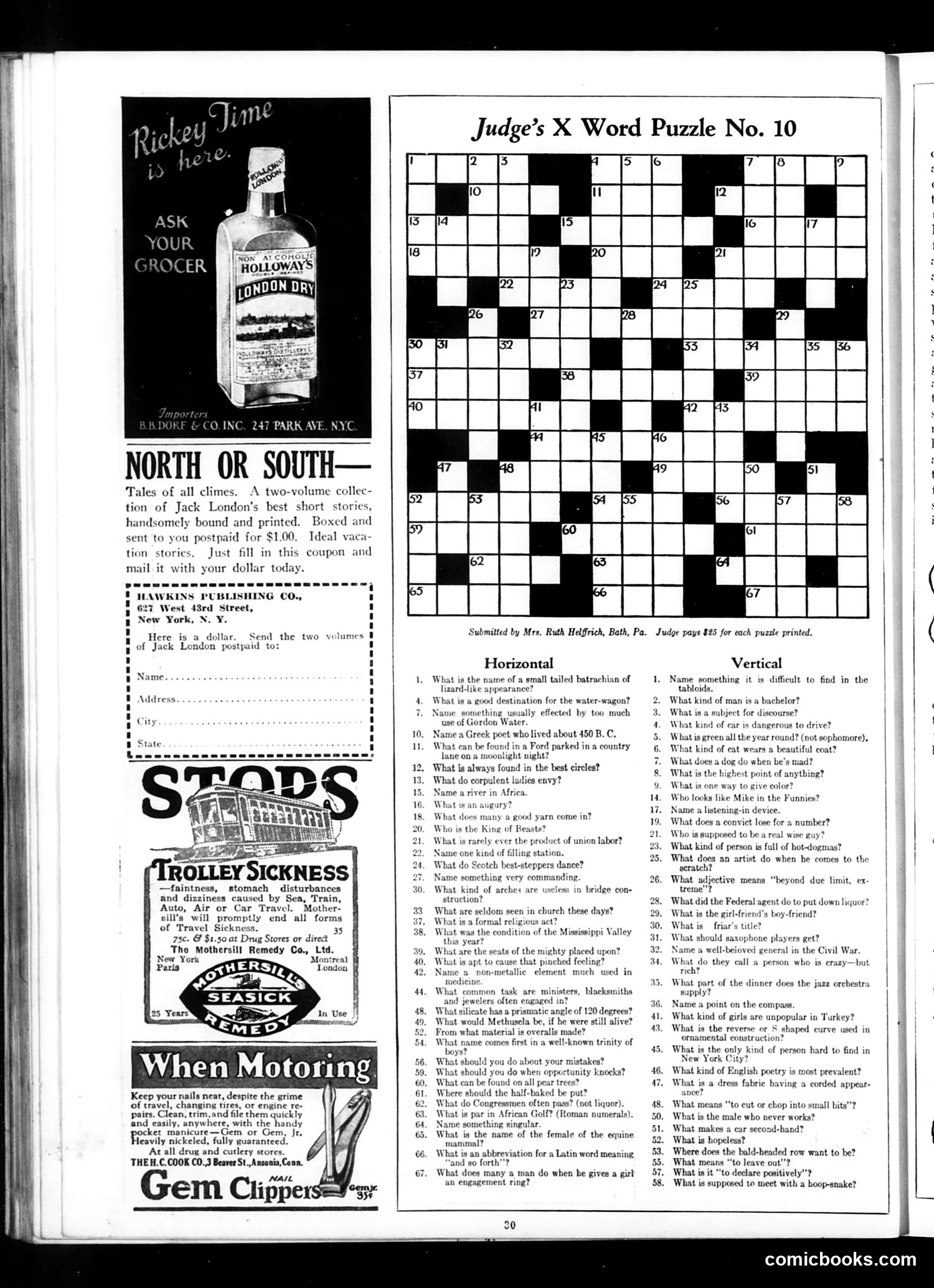
This page is primarily **advertising and puzzle content**, not satirical cartoons. It features: 1. **A gin advertisement** (top left) for "Ricksey Time" London Dry gin, urging readers to "Ask Your Grocer" 2. **A book advertisement** for Jack London's "North or South" short story collection ($1.00) 3. **Patent medicine ads** for travel sickness remedies and nail clippers—typical early 20th-century commercial pitches 4. **The main content**: Judge's crossword puzzle No. 10, with clues both horizontal and vertical. The clues are intentionally humorous, using wordplay and contemporary references (e.g., "What is rarely ever the product of union labor?" suggesting union workers were lazy; references to Prohibition-era "liquor" jokes) The puzzle itself appears designed to amuse while challenging readers—the clues contain mild social commentary typical of Judge magazine's satirical tone, but this is fundamentally an **advertising-heavy puzzle page** rather than political satire.
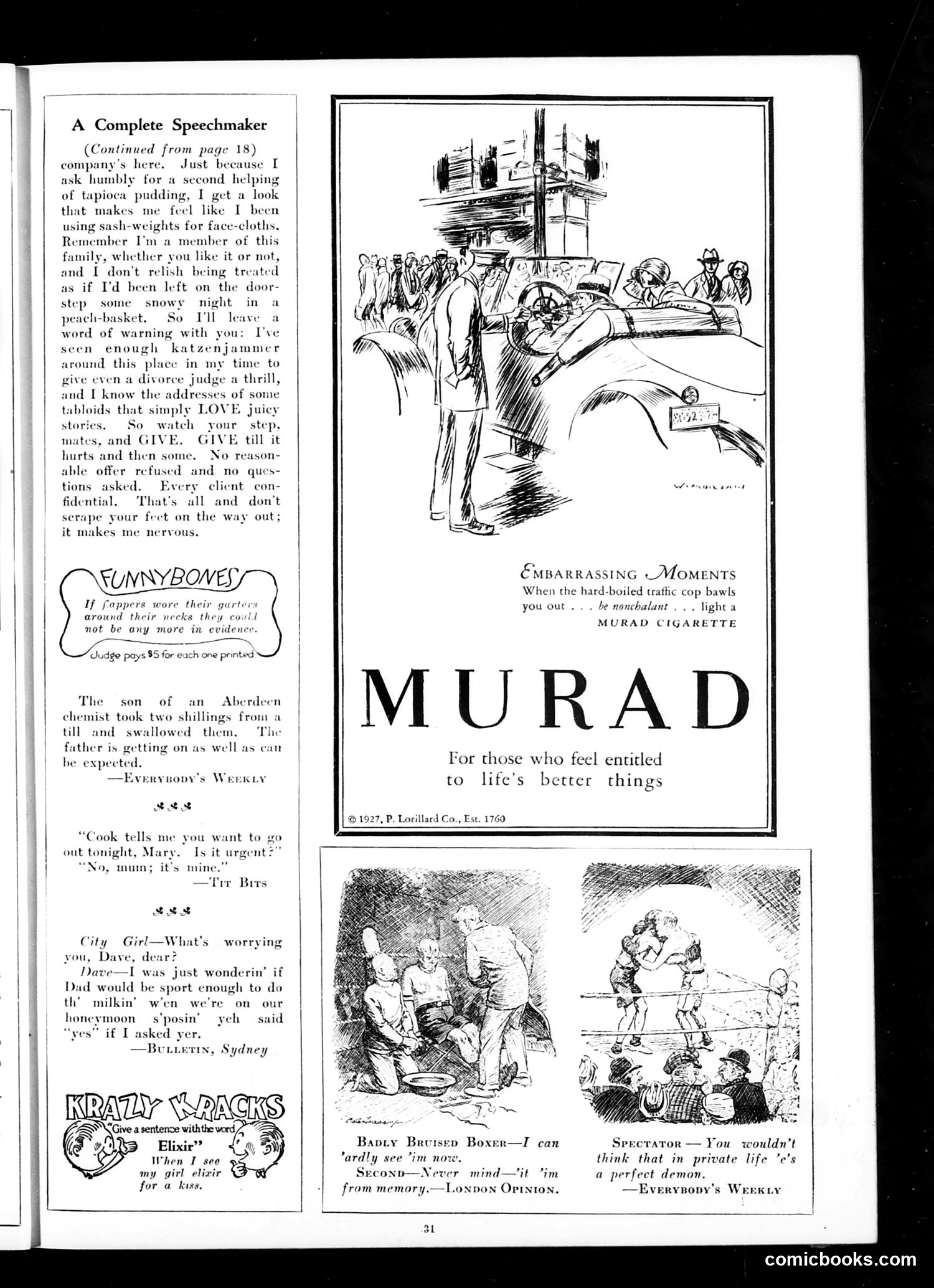
This 1927 page mixes humor columns with advertising. The main content includes: **"A Complete Speechmaker"**: A comedic monologue where a family member—likely a dependent or poor relation—delivers a mock-threatening speech demanding better treatment and money ("GIVE. GIVE till it hurts"). The humor lies in the character's audacity blackmailing the family with threats to sell stories to tabloids, inverting typical power dynamics. **"Funny Bones"**: A joke about flappers (young women of the 1920s) and their garters—suggesting they're so visible/scandalous that wearing them around necks wouldn't increase their visibility. **"Embarrassing Moments"**: An advertisement for Murad cigarettes using humor about a traffic cop to sell the product. **Bottom comics**: Brief jokes about family dynamics (cooking, courtship). The page reflects 1920s social anxieties: changing gender roles (flappers), family hierarchy, and working-class assertiveness. The humor is gentle satire of everyday domestic life rather than political commentary.
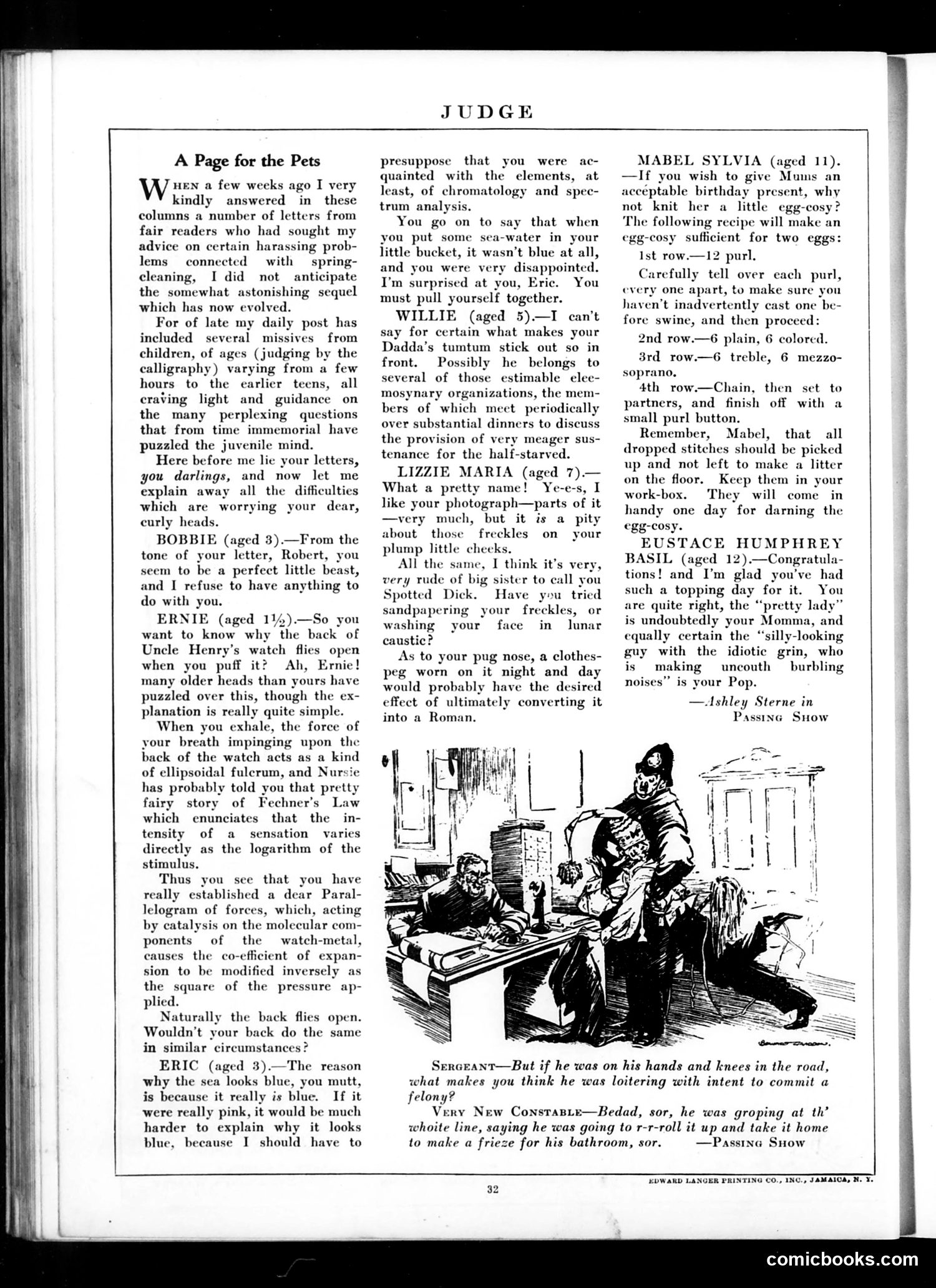
This page is a humorous advice column mocking both overly scientific explanations and earnest children's correspondence. The author receives letters from young readers asking innocent questions about everyday phenomena—why watch backs pop open, why seawater appears blue, why fathers' stomachs protrude. The satire operates through absurd, pseudo-intellectual responses using scientific jargon ("ellipsoidal fulcrum," "logarithm of the stimulus," "chromatology") to explain trivial matters, ridiculing the pretentious over-complication of simple things. When a child notes seawater in a bucket isn't blue, the columnist responds with circular logic rather than honest explanation. The accompanying illustration depicts what appears to be a police interaction, with a caption about someone "on his hands and knees in the road" committing a felony—unrelated to the column content, likely a separate joke about urban crime. The column is fundamentally satirizing pseudo-intellectual pomposity and the gap between adult self-importance and childhood's practical observations.
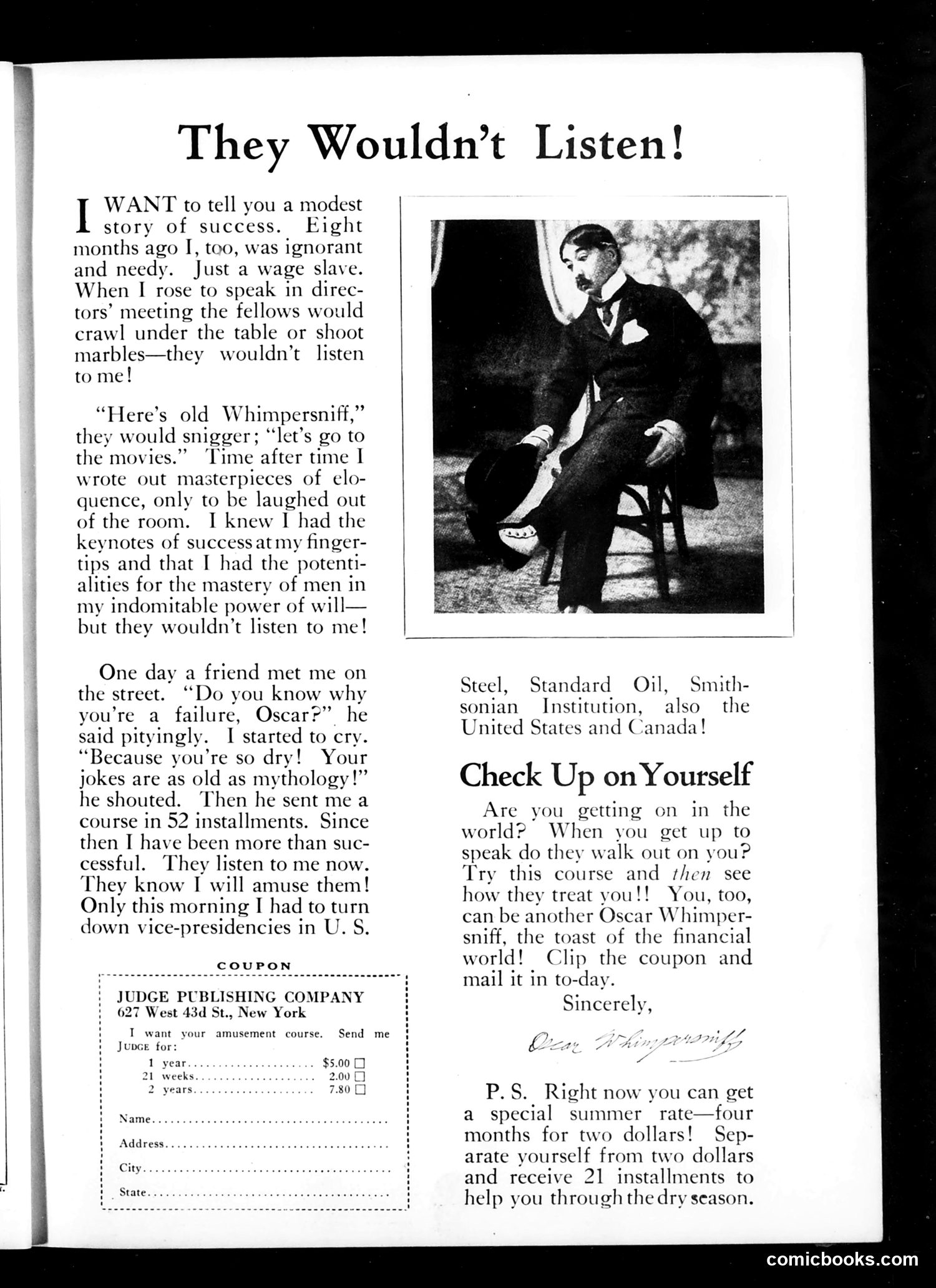
This page is primarily **advertising disguised as testimonial**, not political satire. A character named "Oscar Whimpersniff" claims that a self-help "amusement course" from Judge Publishing Company transformed him from a ridiculed failure into a successful executive. The satire is **self-directed**: Judge magazine is mocking its own self-help industry by exaggerating the promise—a man goes from being ignored in board meetings to "turning down vice-presidencies" simply by learning jokes and improving his social presence. The absurdity is intentional. The photo shows a well-dressed man in formal attire, likely representing the "successful Oscar" after taking the course. **For modern readers**: This reflects early 20th-century American confidence in self-improvement through commercial courses—the ancestor of today's online coaching and personal development industries. The joke is that Judge is selling the very thing it's satirizing: the promise that personal transformation is just one purchase away.
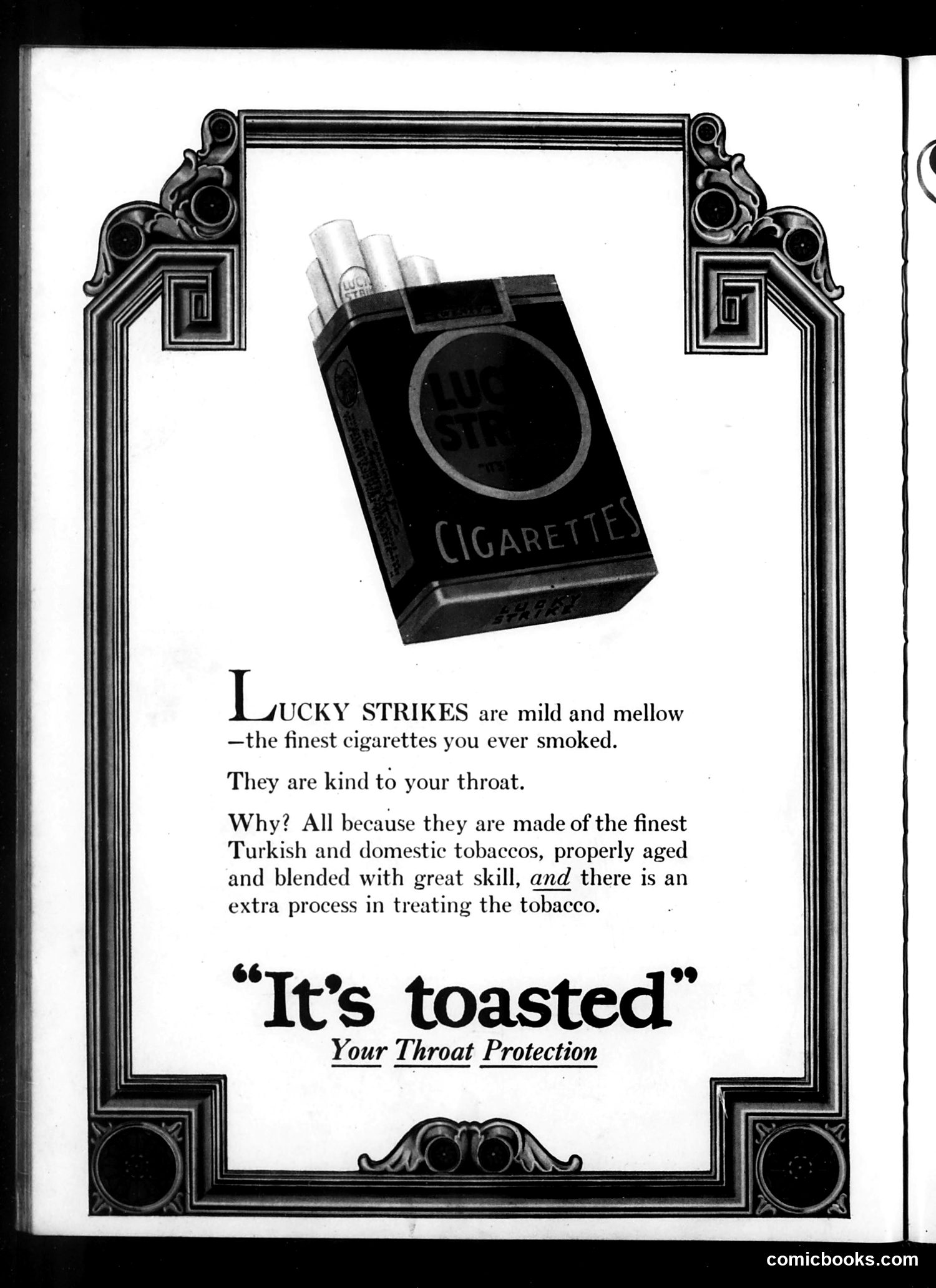
This is a **Lucky Strikes cigarette advertisement**, not political satire or editorial cartoon. The page promotes the brand's "toasted" tobacco process as a throat-protective feature—a major marketing claim of that era. The "point" is purely commercial: convincing readers that Lucky Strikes are superior because tobacco is "toasted," making them "mild and mellow" and "kind to your throat." This reflects early 20th-century advertising before cigarette health dangers were widely acknowledged. The ornate decorative border frames the product prominently. This represents how Judge magazine, while primarily satirical, contained period advertisements. The claims about throat protection now appear absurdly misleading given modern knowledge of smoking's harmful effects.