
Judge, 1927-07-02 · page 30 of 36
Judge — July 2, 1927 — page 30: what you’re looking at
What you’re looking at
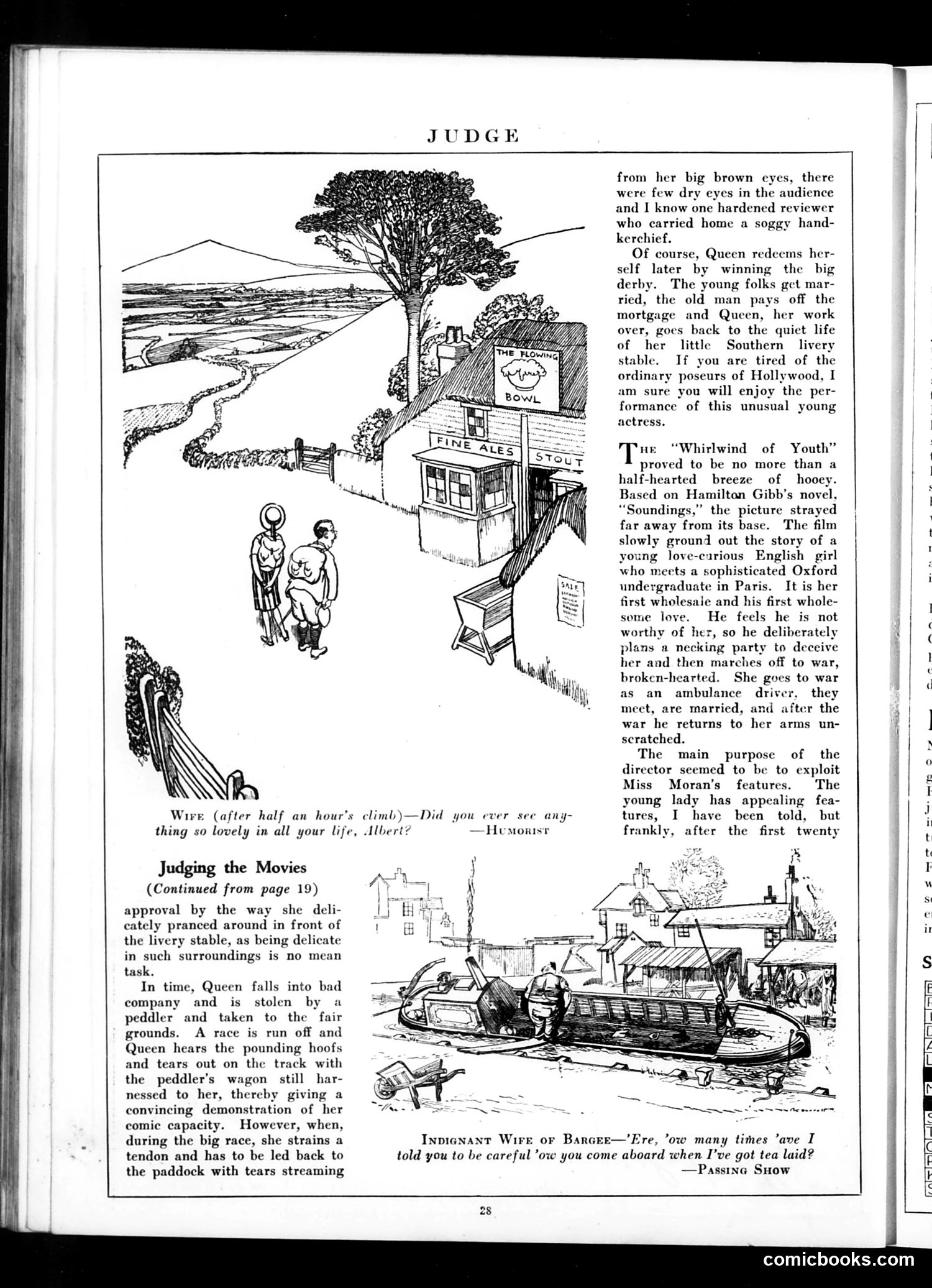
This page contains movie reviews and cartoons satirizing early Hollywood films and domestic life. **Main Content:** "Judging the Movies" reviews two films. The first concerns a horse named Queen who becomes a movie star—praised for her naturalistic performance in a Southern livery stable setting. The reviewer notes her dramatic flair when stolen and forced to race, culminating in injury. The second film, "Whirlwind of Youth," based on Hamilton Gibb's novel, is dismissed as superficial hokum. It follows a predictable romance between an English girl and Oxford student in Paris, with convenient wartime separation and reunion. The reviewer criticizes the director for prioritizing actress Moran's appearance over substance. **Cartoons:** Two humorous domestic scenes appear—one showing a couple admiring scenery with the caption about lovely views, and another depicting a working-class wife scolding her husband about carelessly boarding when tea is prepared, using period British dialect ("'ow many times"). The satire targets both shallow Hollywood filmmaking and gender dynamics in marriage.
📄 Transcribed text from this page (OCR, searchable)
Machine-transcribed from the original scan — historical spelling and the odd misread are preserved.
JUDGE from her big brown eyes, there were few dry eyes in the audience and I know one hardened reviewer | who carried home a soggy hand- | kerchief. | Of course, Queen redeems her- self later by winning the big derby. The young folks get mar- ried, the old man pays off the mortgage and Queen, her work over, goes back to the quiet life of her little Southern livery stable. If you are tired of the ordinary poseurs of Hollywood, I am sure you will enjoy the per- ! formance of this unusual young actress. Te “Whirlwind of Youth” | proved to be no more than a half-hearted breeze of hooey. | Based on Hamilton Gibb’s novel, “Soundings,” the picture strayed far away from its base. The film slowly ground out the story of a young love-curious English girl who meets a sophisticated Oxford | undergraduate in Paris. It is her | first wholesale and his first whole- some love. He feels he is not { worthy of her, so he deliberately 7 1 c plans a necking party to deceive : | her and then marches off to war, broken-hearted. She goes to war as an ambulance driver, they meet, are married, and after the f | war he returns to her arms un- ij | scratched. = The main purpose of the director seemed to be to exploit Miss Moran’s features. The ; young lady has appealing fea- : Wire (after half an hour’s climb)—Did you ever see any- tures, I have been told, but J thing so lovely in all your life, Albert? —Hemonisr frankly, after the first twenty lt te Judging the Movies I (Continued from page 19) v approval by the way she deli- : cately pranced around in front of it the livery stable, as being delicate { in such surroundings is no mean | s task. In time, Queen falls into bad i company and is stolen by a | F peddler and taken to the fair | grounds. A race is run off and | ( Queen hears the pounding hoofs i / and tears out on the track with i L the peddler’s wagon still har- nessed to her, thereby giving a 0 convincing demonstration of her _ comic capacity. However, when, 5 during the big race, she strains a Inpianant Wire or Barcee—’Ere, ’ow many times ’ave I C tendon and has to be led back to told you to be careful ’ow you come aboard when I’ve got tea laid? f the paddock with tears streaming —Passina SHow c is | comicbooks.com