
Judge, 1927-07-02 · page 18 of 36
Judge — July 2, 1927 — page 18: what you’re looking at
What you’re looking at
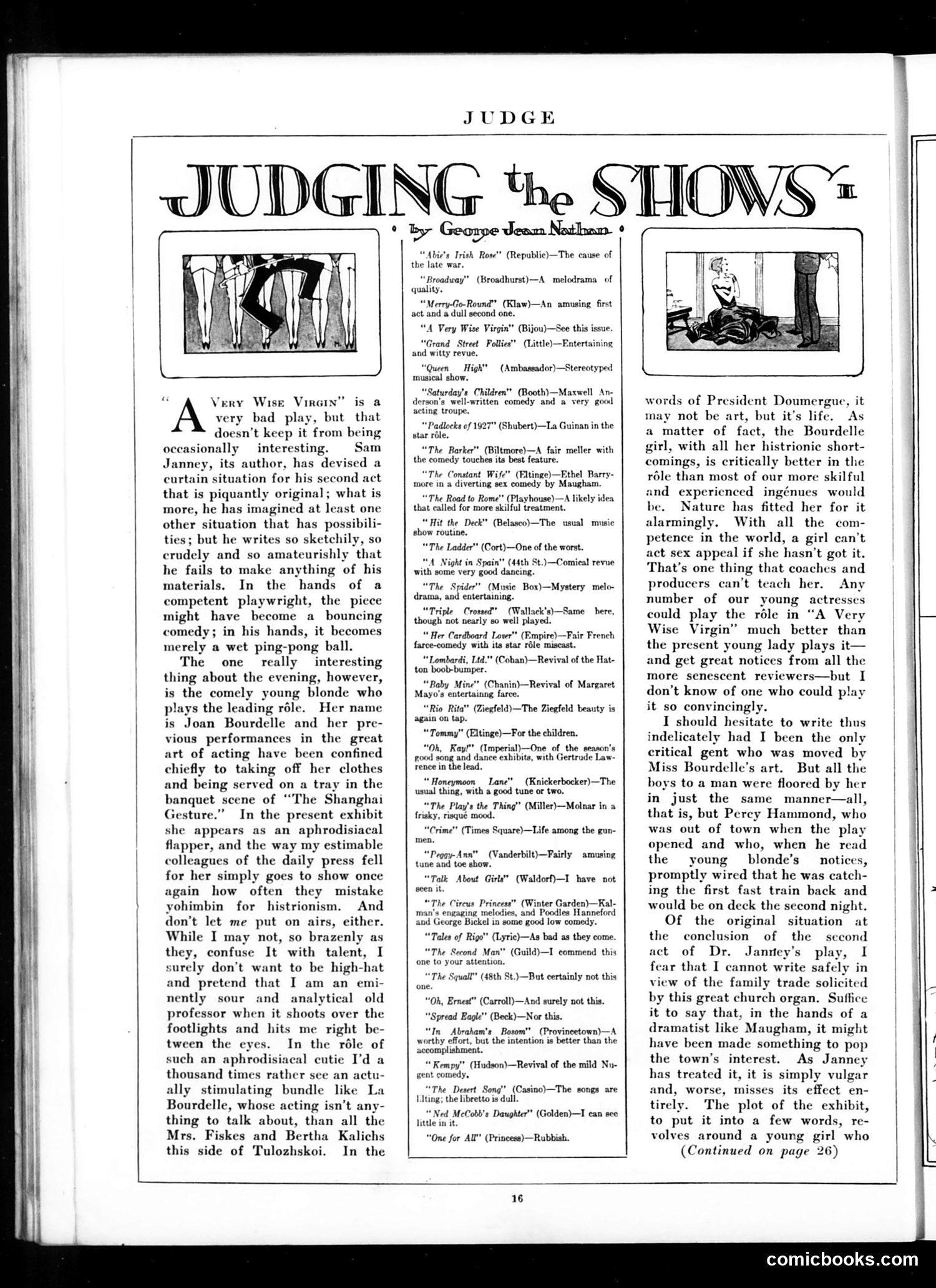
This page reviews Broadway theatrical productions from the 1920s era. The main article, "Judging the Shows" by George Jean Nathan, critiques a play called *"A Very Wise Virgin"* at the Bijou Theatre. Nathan's central point: the play itself is poorly written and crudely constructed, but its appeal lies entirely in its leading actress, Joan Bourdelle—described as an "aphrodisiacal flapper" with no real acting talent. Nathan admits he and his fellow critics are distracted by her physical attractiveness rather than her performance abilities. He acknowledges this bias humorously, confessing he'd rather watch such an appealing but talentless performer than genuinely skilled actresses like Mrs. Fiske or Bertha Kalich. The satire targets both the mediocrity of contemporary theater and critics' susceptibility to spectacle over substance—a tension relevant even today. The right column lists brief reviews of other current Broadway shows, providing context for the theatrical season being discussed.
📄 Transcribed text from this page (OCR, searchable)
Machine-transcribed from the original scan — historical spelling and the odd misread are preserved.
JUDGE JUDGING ‘he SHOWS” i ery Wise VirGin” is a A very bad play, but that doesn’t keep it from being occasionally interesting. Sam Janney, its author, has devised a curtain situation for h econd act that is piquantly original ; what i more, he has imagined at le; other situation that has pe ties; but he writes so sketel crudely and so amateurishly that he fails to make anything of his materials. In the hands of a competent playwright, the piece might have become a_ bouncing comedy; in his hands, it becomes merely a wet ping-pong ball. The one really interesting thing about the evening, however, young blonde who the leading réle. Her name Joan Bourdelle and her pre- vious performances in the great art of acting have been confined chiefly to taking off her clothes and being served on a tray in the banquet scene of “The Shang! Gesture.” In the present exhibit she appears as an aphrodisiacal flapper, and the way my estimable colleagues of the daily press fell for her simply goes to show once again how often they mistake yohimbin for histrionism. And don’t let me put on airs, either. While I may not, so brazenly as they, confuse It with talent, I surely don’t want to be high-hat and pretend that I am an emi- nently sour and analytical old professor when it shoots over the footlights and hits me right be- tween the ey In the réle of such an aphrodisiacal cutie I'd a thousand times rather see an actu- ally stimulating bundle like La Bourdelle, whose acting isn’t any- thing to talk about, than all the Mrs. Fiskes and Bertha Kalichs this side of Tulozhskoi. In the is the comely pl ““Abie's Trish Rose’ (Republic)—The cause of the late war. “Broadway” (Broadhurst)—A melodrama of quality. “Merry-Go-Round” (Klaw)—An amusing first act and a dull second one. “A Very Wise Virgin” (Bijou)—See this issue. “Grand Street Follies” (Little)—Entertaining and witty revue. “Queen High" (Ambaseador)—Stereotyped musical show. “Saturday's Children” (Booth)—Maxwell An- derson's well-written comedy and a very good acting troupe. idlocks of 1927" (Sbubert)—La Guinan in the le. star “The Barker" (Biltmore)—A fair meller with the comedy touches its best feature. “The Constant Wife” (Fltinge)—Ethel Barry- more in a diverting sex comedy by Maugham. “The Road to Rome” (Playhouse)—A likely idea that called for more skilful treatment. “Hit the Deck” (Belasco)—The usual music show routine. “The Ladder” (Cort)—One of the worst. “4. Night in Spain" (44th s with some very good dancing. “The Spider” (Music Box)—Mystery melo- drama, and entertaining. “Triple Crossed” (Wallack’s)—Same here, though not nearly so well played. “Her Cardboard Lover” (Empire)—Pair French farce-comedy with its star role miscast. “Lombardi, Ltd."" (Coban)—Revival of the Hat- ton boob-bumper. “Baby Mine” (Chanin)—Revival of Margaret Mayo’s entertainng farce. “Rio Rita” (Ziegfeld)—The Ziegfeld beauty is again on tap. “Tommy (Eltinge)—For the children. “Oh, Kay!" (Imperial)—One of the season's good song and dance exhibits, with Gertrude Law- rence in the lead. “Honeymoon Lane (Knickerbocker)—The usual thing, with a good tune or two. “The Play's the Thing” (Miller)—Molnar in a friaky, risqué mood. )}—Comical revue “Crime” (Times Square)—Life among the gun- men. “Peggy-Ann” (Vanderbilt)—Pairly amusing tune and toe show. “Talk About Girl” (Waldorf}—I have not seen it. “The Circus Princess” (Winter Garden)—Kal- man's engaging melodies, and Poodles Hanneford and George Bickel in some good low comedy. “Tales of Rigo” (Lyric)—As bad as they come. “The Second Man" (Guild)—I commend this one to your attention. “The Squall” (48th St.)—But certainly not this one. “Oh, Ernest” (Carrol!)—And surely not this. “Spread Eagle” (Beck)—Nor this. “In Abraham's Bosom" (Provineetown)—A worthy effort, but the intention is better than the accomplishment. “ Kempy” (Hudson)—Revival of the mild Nu- gent comedy, “The Desert Song’ (Casino)—The songs are ting; the libretto is dull. ‘ed McCobb's Daughter” (Golden)—I can see litde in it “One for All” (Princess)—Rubbish. words of President Doumergue, it may not be art, but it’s life. As a matter of fact, the Bourdelle girl, with all her histrionic short- comings, is critically better in the role than most of our more skilful and experienced ingénues would be. Nature has fitted her for it alarmingly. With all the com- petence in the world, a girl can’t act sex appeal if she hasn't got it. That's one thing that coaches and producers can’t teach her. Any number of our young actre could play the réle in “A Very Wise Virgin” much better than the present young lady plays it— and get great notices from all the more senescent reviewers—but I don’t know of one who could play it so convincingly. I should hesitate to write thus indelicately had I been the only critical gent who was moved by Miss Bourdelle’s art. But all the boys to a man were floored by her in just the same manner—all, that is, but Perey Hammond, who was out of town when the play opened and who, when he re: the young blonde’s __ notices, promptly wired that he was catch- ing the first fast train back and would be on deck the second night. Of the original situation at the conclusion of the second act of Dr. Janney’s pl I ur that I cannot write safely in view of the family trade solicited by this great church organ. Suffice it to say that, in the hands of a dramatist like Maugham, it might have been made something to pop the town’s interest. As Janney has treated it, it is simply vulgar and, worse, misses its effect en- tirely. The plot of the exhibit, to put it into a few words, re- volves around a young girl who (Continued on page 26) comicbooks.com