
Judge, 1927-07-02 · page 15 of 36
Judge — July 2, 1927 — page 15: what you’re looking at
What you’re looking at
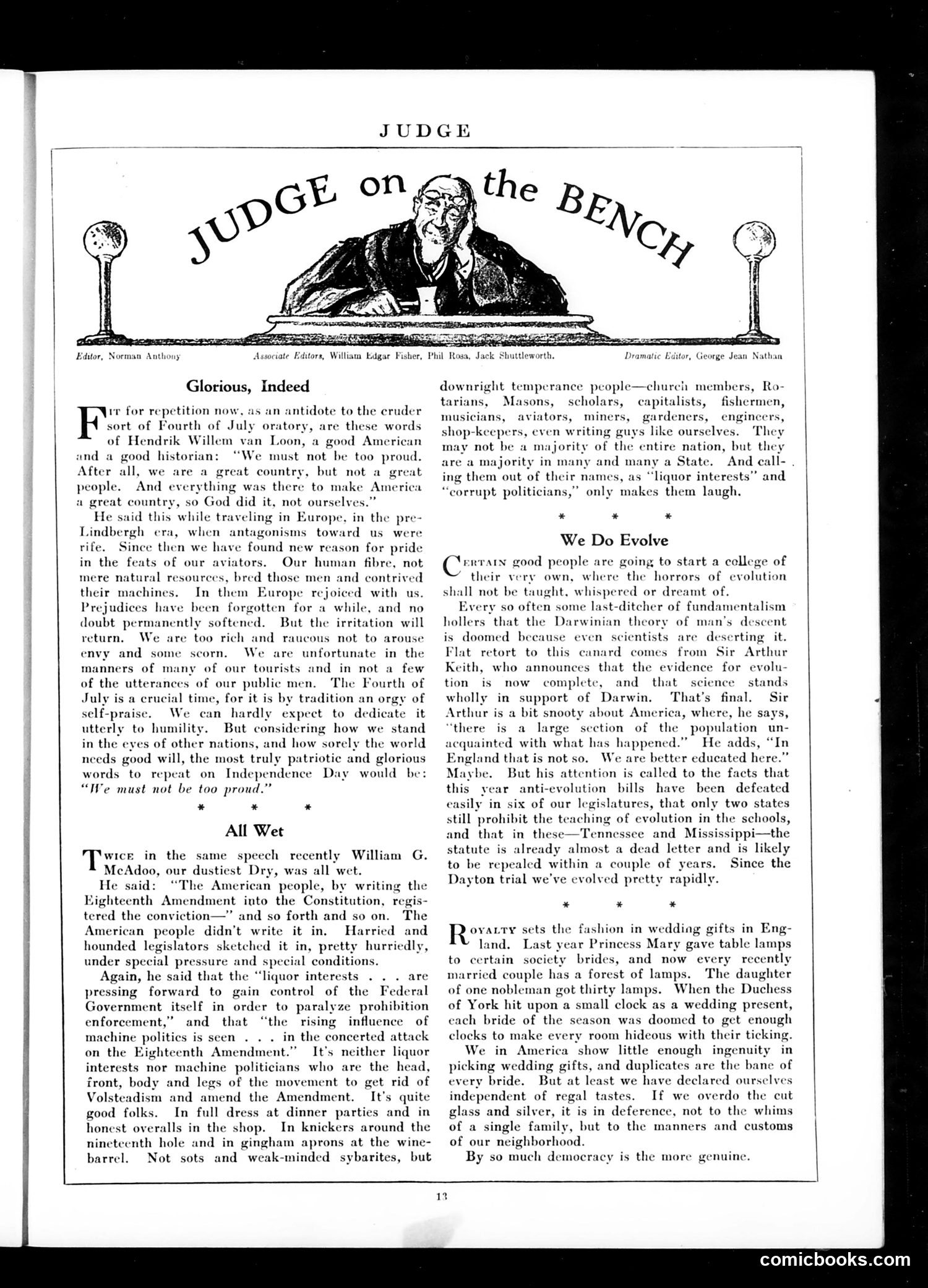
This page from Judge magazine contains three satirical editorial pieces: **"Glorious, Indeed"** critiques Fourth of July rhetoric. It quotes historian Hendrik Willem van Loon's advice that Americans should say "We must not be too proud" rather than engage in self-congratulatory Independence Day speeches. The piece argues Americans' international reputation is damaged by arrogant tourists and public figures, despite legitimate achievements in aviation and innovation. **"All Wet"** attacks William G. McAdoo (identified as a "Dry"—Prohibition supporter) for falsely claiming "the American people" wrote the Eighteenth Amendment. The satire notes that ordinary decent citizens—church members, Rotarians, shop-keepers—actually oppose Prohibition, not just "liquor interests" as McAdoo claimed. **"We Do Evolve"** mocks fundamentalists planning a college to avoid teaching evolution. It references Sir Arthur Keith's assertion that evolution is scientifically proven and complete, while sardonically noting Keith's criticism that Americans are less educated on this subject than the English. All three pieces target what Judge sees as American hypocrisy, false claims, and anti-scientific attitudes.
📄 Transcribed text from this page (OCR, searchable)
Machine-transcribed from the original scan — historical spelling and the odd misread are preserved.
JUDGE fate Editors, William Kdgar Fis Glorious, Indeed intidote to the cruder rr for repetition now, as « ) ee of Fourth of July oratory, are of Hendrik Willem van Loon, and a good historian: After all, we are at country, but not people. And everything was there to mak a great country, so God did it, not ourselves. He said this while traveling in Europe, in the p Lindbergh era, when antagonisms toward us were rife. Since then we have found new reason for pride in the feats of our aviators. Our human fibre, not mere natural resources, bred those men and contrived their machines. In them Europe rejoiced with us. Prejudices have been forgotten for a while, and no doubt permanently softened. But the irritation will return, We are too rich and raucous not to arouse envy and some scorn. We are unfortunate in the manners of many of our tourists and in not a few of the utterances of our public men. The Fourth of a crucial time, for it is by tradition an orgy of -praise. We can hardly expect to dedicate it utterly to humility. But considering how we stand in the eyes of other nations, and how sorely the world needs good will, the most truly patriotic and glorious words to repeat on Independence Day would be: “We must not be too proud.” these words a good American “We must not be too proud. a great Amer! * * * All Wet pee in the same speech r G. McAdoo, our dustiest Dry, was He said: “The American people, by writing the Eighteenth Amendment into the Constitution, regis tered the conviction—” and so forth and so on. The American people didn’t write it in. Harried and hounded legislators sketched it in, pretty hurriedly, under special pressure and special conditions. Again, he said that the “liquor interests . . . are pressing forward to gain control of the Federal Government itself in order to paralyze prohibition enforcement,” and that “the rising influence of machine polities is seen . in the concerted attack on the Eighteenth Amendment.” It's neither liquor interests nor machine politicians who are the head, front, body and legs of the movement to get rid of Volsteadism and amend the Amendment. It's quite good folks. In full dress at dinner parties and in honest overalls in the shop. In knickers around the nineteenth hole barrel. Not sots and weak-minded and in gingham aprons at the wine- sybarites, but Phil Rosa, huttlewor downright temperance people—church members, Ro- tarians, Masons, capitalists, musicians, gardeners, engincer: shop-keepers, even w s like ourselves. y may not be ation, but they ate. And call- scholars, aviators, fishermen, miners, ng guy a majority of the entire are a majority in many and many a ing them out of their names, as “liquor interests” and “corrupt poli only makes them laugh. * * * We Do Evolve Cenrats good people are going to start a college of their very own, where the horrors of evolution shall not be taught, whispered or dreamt of. Every so often some last-ditcher of fundamentalism hollers that the Darwinian theory of is doomed because man’s descent even scientists are deserting it. Flat retort to this canard comes from Sir Arthur Keith, who announces that the evidence for evolu- tion is now complete, and that science stands wholly in support of Darwin. That's final, Arthur is a bit snooty about America, where, he sa large section of the population un- acquainted with what has happened.” He adds, “In England that is not so. We are better educated here.” Maybe. But his attention is called to the facts that th year anti-evolution bills have been defeated easily in six of our legislatures, that only two states still prohibit the teaching of evolution in the schools, and that in these—Tennessee and Mississippi—the statute is already almost a dead letter and is likely to be repealed within a couple of years. Since the Dayton trial we've evolved pretty rapidly. Sir “there is a * * * Rovt* sets the fashion in wedding gifts in Eng- land. Last year Princess Mary gave table lamps to certain society brides, and now every recently married couple has a forest of lamps. The daughter of one nobleman got thirty lamps. When the Duchess of York hit upon a small clock as a wedding present, each bride of the season was doomed to get enough clocks to make every room hideous with their tic We in America show little enough ingenuity in picking wedding gifts, and duplicates are the bane of every bride. But at least we have declared ourselves inde ependent of regal tes. If we overdo the cut s and silver, it is in deference, not to the whims single family, but to the manners and customs of our neighborhood. By so much democrs more ty is the genuine. comicbooks.com