
A complete issue · 34 pages · 1927
Judge — March 5, 1927
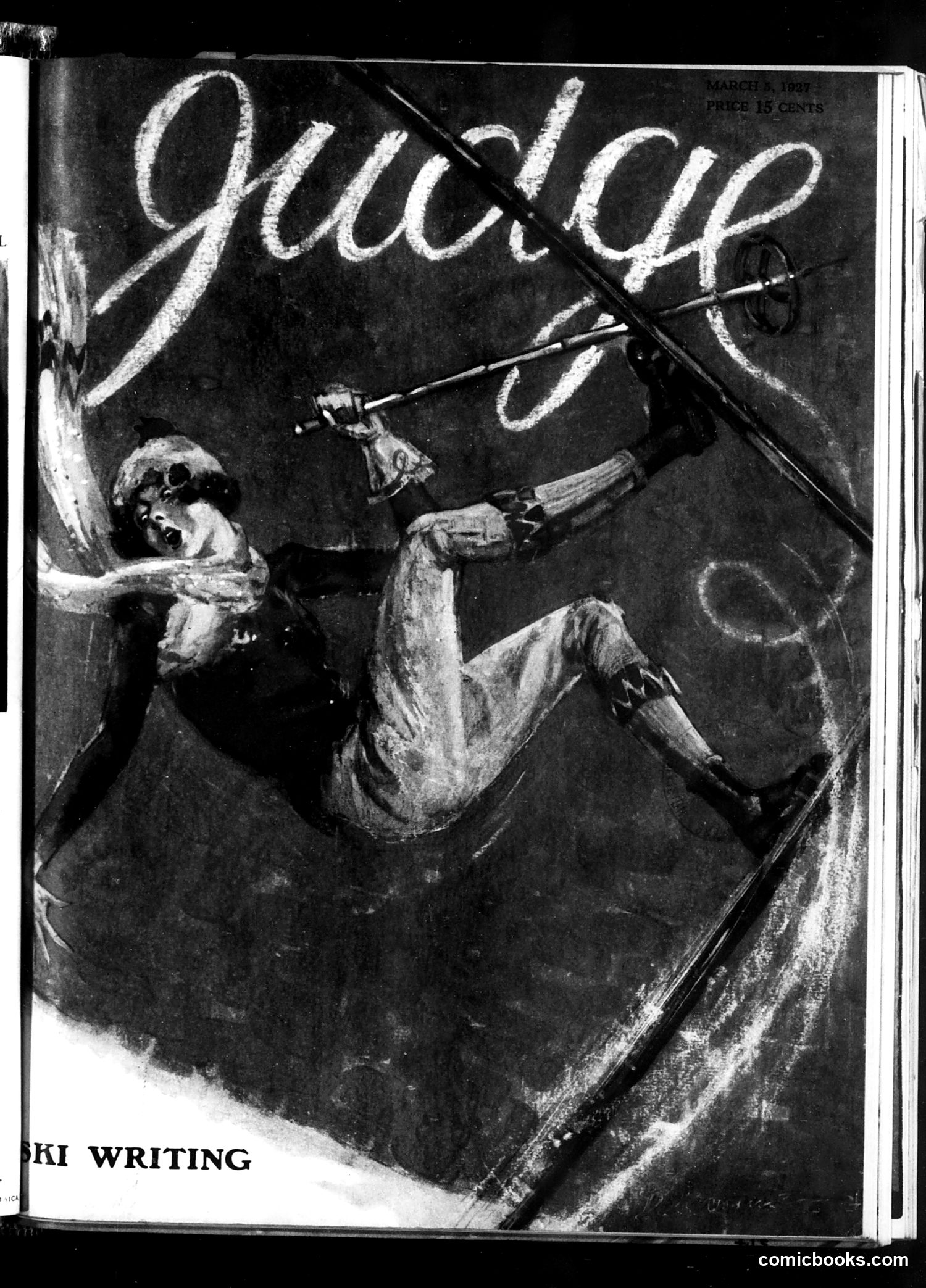
This appears to be a cover from **Judge magazine** (dated March 5, 1907, priced 15 cents). The central image shows a figure in winter clothing being pulled backward through snow by what looks like a ski pole or similar winter sports equipment, with an exaggerated expression of distress. The title "Gullop" (or similar) is prominently displayed. The phrase "SKI WRITING" appears at bottom left, suggesting this may reference winter sports or outdoor activities as metaphor for contemporary events or writing trends. Without clearer context or additional page text, the specific satirical target remains unclear—it could reference winter sports fads, a political figure's missteps, or a social trend of the 1907 era. The humor appears to rely on physical comedy and visual exaggeration typical of Judge's satirical style.
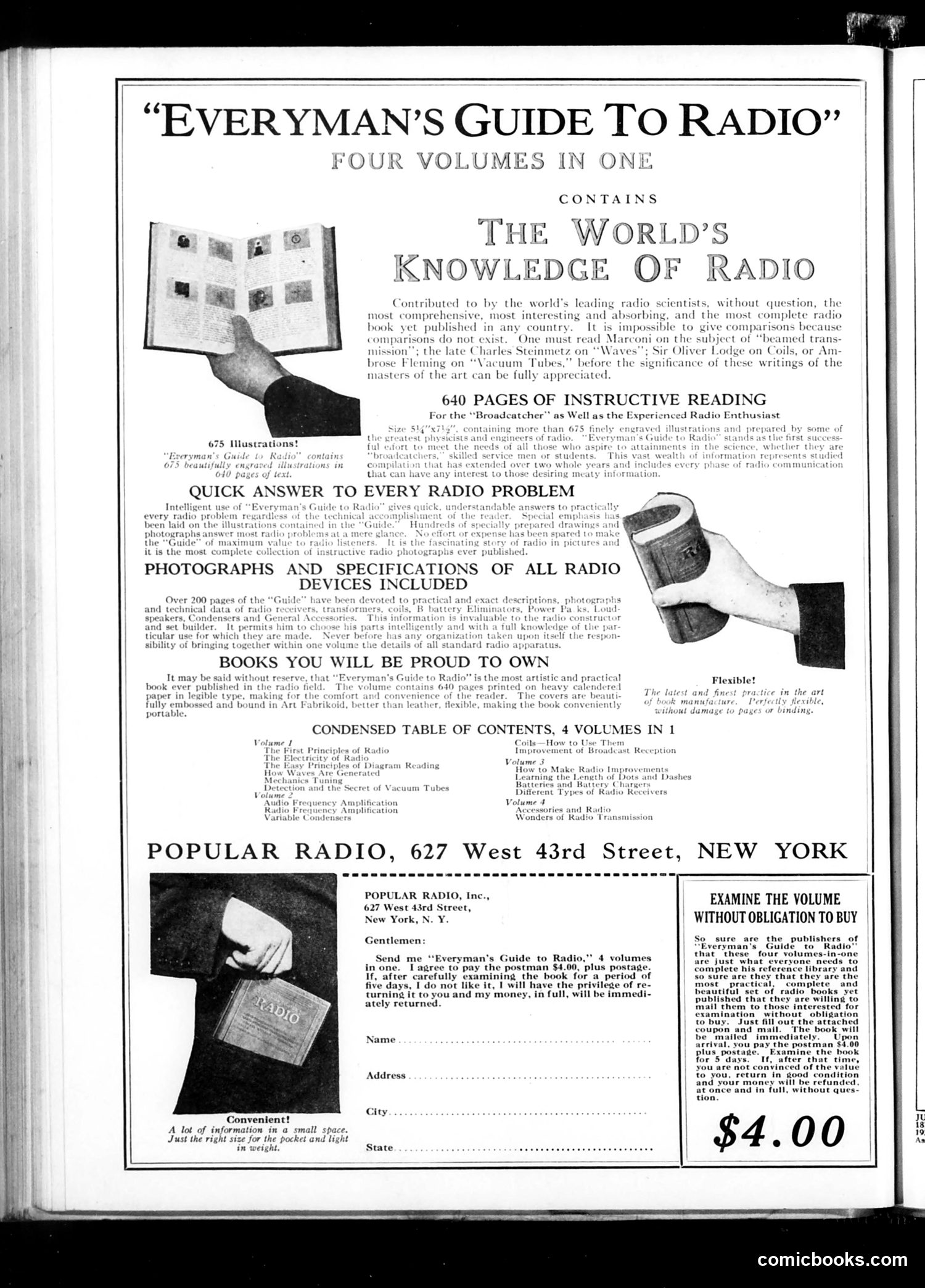
This page is primarily **advertising, not political satire**. It promotes "Everyman's Guide to Radio," a comprehensive 640-page radio instruction manual published by Popular Radio magazine (627 West 43rd Street, New York). The content emphasizes the book's practical value: it contains contributions from leading radio scientists, over 625 illustrations, photographs and specifications of radio devices, and covers topics like vacuum tubes, radio transmission, and receiver construction. The only visual elements are product photographs (an open book, radio equipment, and a portable radio) designed to showcase the guide's scope and utility. The $4.00 price and order form occupy the lower portion. This represents typical mid-20th century technical publishing marketing—no cartoon or satirical commentary is present.
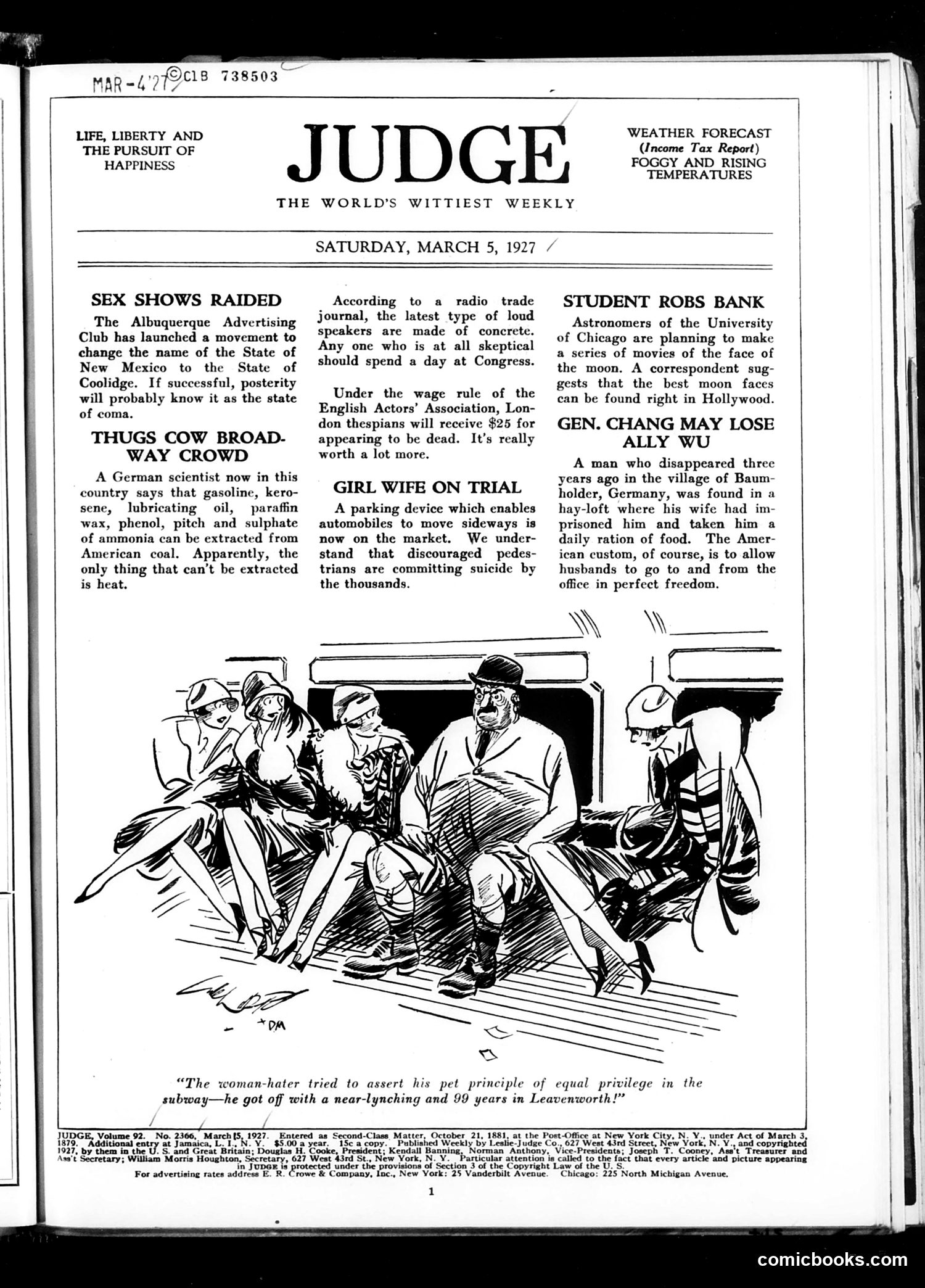
The main cartoon illustrates the caption: "The woman-hater tried to assert his pet principle of equal privilege in the subway—he got off with a near-lynching and 99 years in Leavenworth!" The scene depicts a confrontation in a crowded subway car where a man (the "woman-hater") appears to have physically assaulted women by kicking or pushing them to claim equal treatment in seating. The other passengers—both men and women—are shown violently attacking him in response, while a police officer observes. The satire mocks men's rights arguments of the era: the joke suggests that literally enforcing "equal privilege" through violence against women would result in swift, severe public retaliation. The absurdly lengthy prison sentence (99 years) exaggerates the severity of consequences for such behavior, satirizing both chivalric norms and the social consensus protecting women from male aggression.
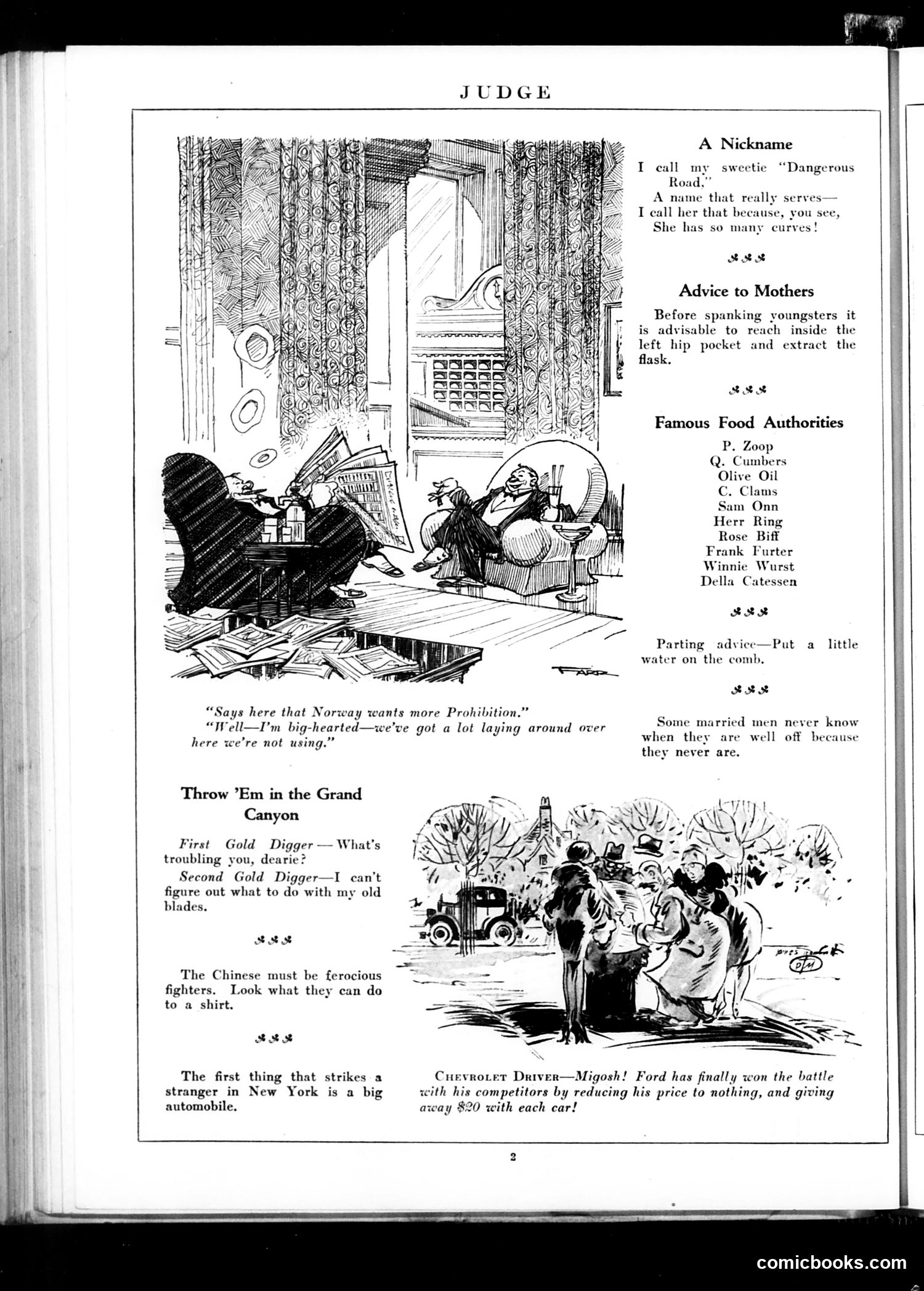
This page contains humor columns and cartoons typical of Judge's satirical style. **"A Nickname"** is a crude joke about a woman's body, calling her "Dangerous Road" because of her curves. **"Advice to Mothers"** sardonically suggests hiding alcohol before spanking children—implying mothers drink from hip flasks. **"Throw 'Em in the Grand Canyon"** features two prospectors debating what to do with worthless mining claims, with racist stereotyping about Chinese laborers and shirts. **"Chevrolet Driver" cartoon** references Ford's price war—Ford reduced prices to undercut competitors like Chevrolet, offering $20 with each car purchase. This was likely contemporary with Henry Ford's early 1920s pricing strategy. The page reflects period attitudes: casual misogyny, drinking culture during Prohibition, racism, and automotive industry competition. Most humor relies on crude stereotypes rather than sophisticated satire.
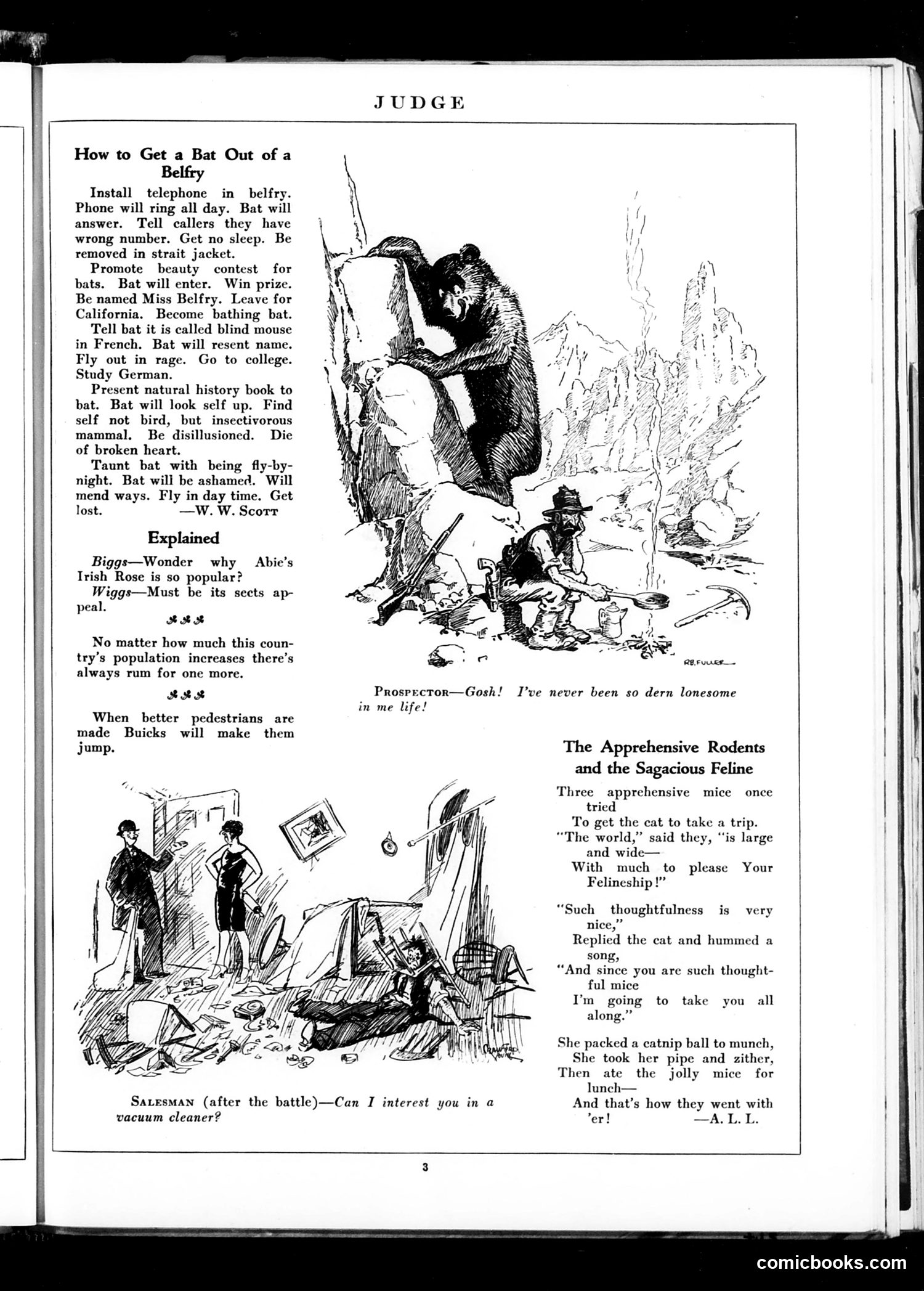
This page contains several unrelated humorous pieces typical of Judge magazine's format: **"How to Get a Bat Out of a Belfry"** is a satirical how-to list by W.W. Scott. It plays on the common phrase "bats in the belfry" (meaning someone is crazy). The absurdist suggestions—installing a telephone, promoting beauty contests, becoming a bathing beauty—mock both the phrase and impractical "advice" columns popular in the era. **"The Apprehensive Rodents and the Sagacious Feline"** is a whimsical fable where mice convince a cat to take them traveling by appealing to her thoughtfulness. It's lighthearted animal anthropomorphism, likely aimed at children. **"Salesman (after the battle)"** is a brief joke about a vacuum cleaner salesman approaching someone after what appears to be destruction or chaos—dark humor about persistent salesmanship. The cartoons appear primarily humorous rather than politically satirical.
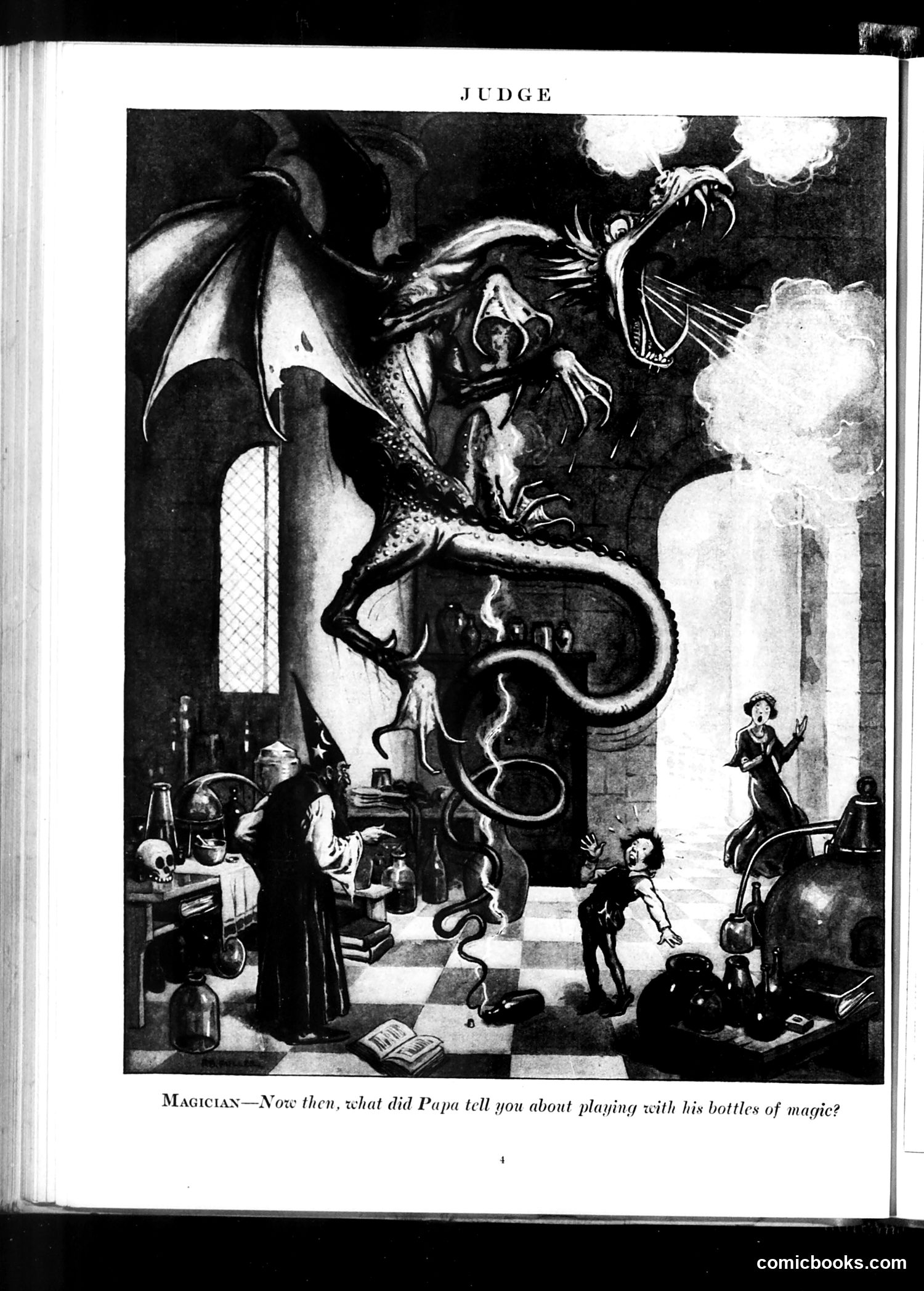
This page titled "JUDGE" depicts a theatrical scene of magical chaos in what appears to be a scholar's or alchemist's chamber. The caption reads: "MAGICIAN—Now then, what did Papa tell you about playing with his bottles of magic?" The satire shows a child character surrounded by fantastical creatures (demons, winged beings) and magical apparatus, suggesting reckless experimentation with dangerous forces. The "Papa" reference and admonishment suggest parental warnings being ignored—a common satirical trope about foolish meddling with powerful things one doesn't understand. Without additional context identifying the specific "Papa" figure or historical event referenced, the cartoon likely uses this magical mishap as metaphor for political or social folly—possibly criticizing someone's misuse of authority or dangerous experimentation with governance, though the exact target remains unclear from the image alone.
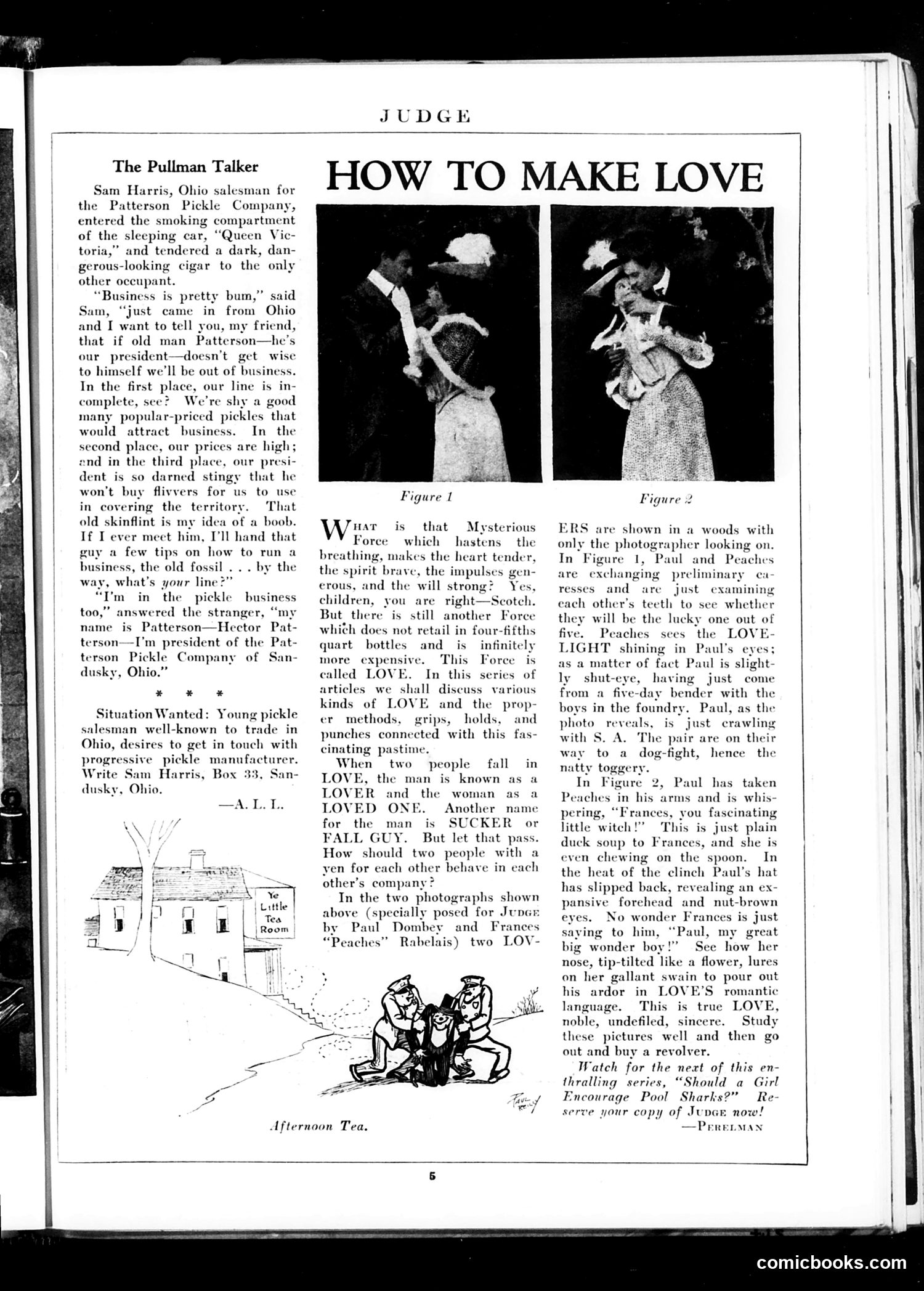
This page presents a humorous instructional article about romantic behavior, illustrated with two photographs of a couple (Paul Dombey and Frances "Peaches" Babelais) demonstrating affectionate poses. The satire mocks the earnest "how-to" advice literature popular in the era. The accompanying narrative—describing the mysterious force of love and providing staged photographic "examples" of proper courting behavior—parodies self-help guides that treated romance as a learnable technique rather than genuine emotion. The sidebar ad for a "pickle salesman" position in Ohio grounds the humor in mundane commercial life, contrasting sharply with the romantic idealism being satirized. The overall effect ridicules both overwrought romantic sentimentality and the reduction of human connection to instructional mechanics.
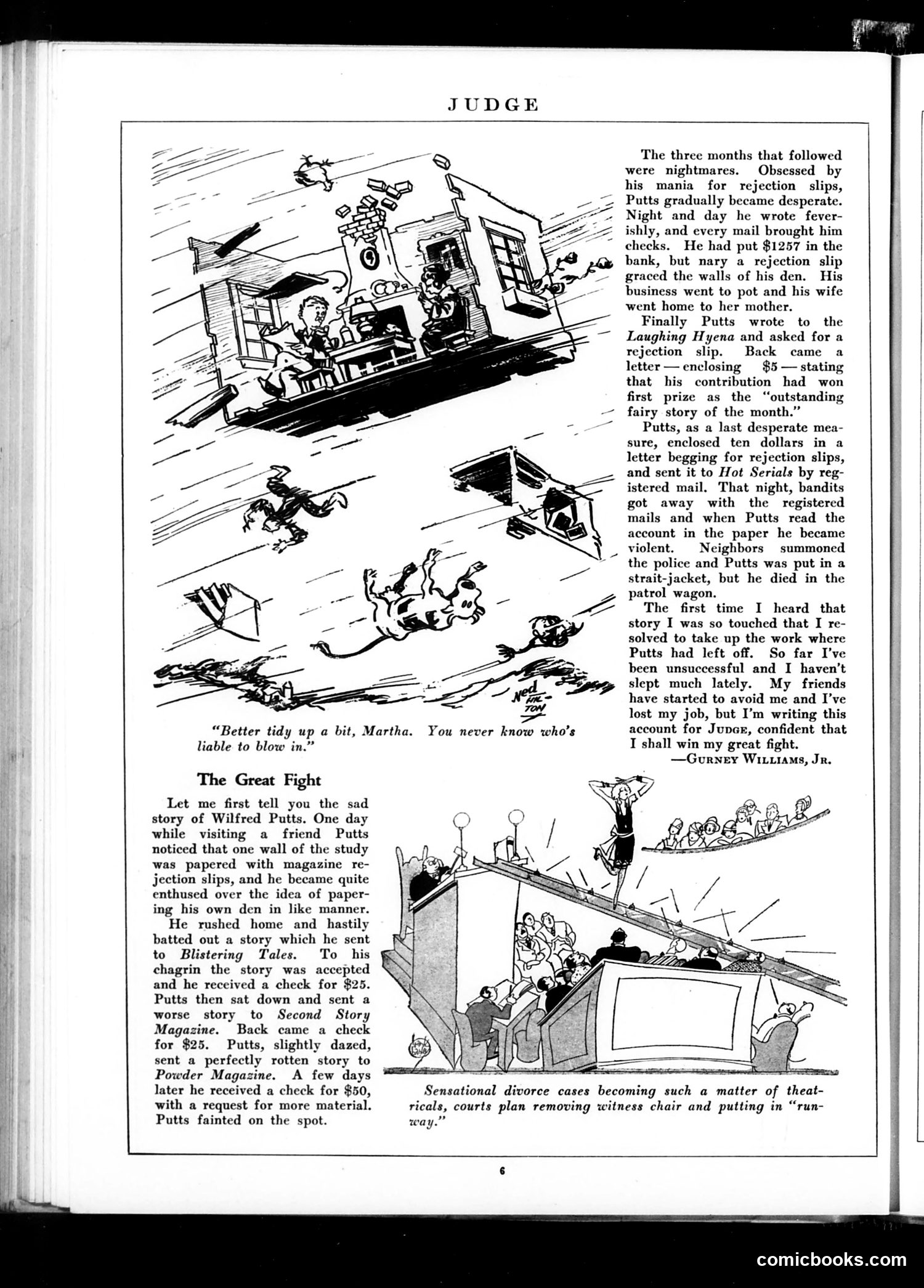
This satirical piece mocks aspiring writers' obsession with rejection slips as badges of literary authenticity. The story follows Wilfred Putts, a failed writer who becomes so fixated on collecting rejection slips (displayed as wallpaper in literary circles) that he intentionally writes terrible stories—yet keeps getting accepted and paid instead. Driven mad by his inability to be rejected, he ultimately dies. The narrator ironically claims he'll now pursue Putts's quest, expecting to fail at writing while Judge published his account anyway—a meta-joke about the magazine itself accepting mediocre submissions. The secondary cartoon mocks divorce proceedings becoming theatrical spectacles, suggesting courts might soon need a "runway" for witnesses performing for audiences rather than simply testifying. Together, these pieces satirize early 20th-century literary pretension and sensationalized media culture.
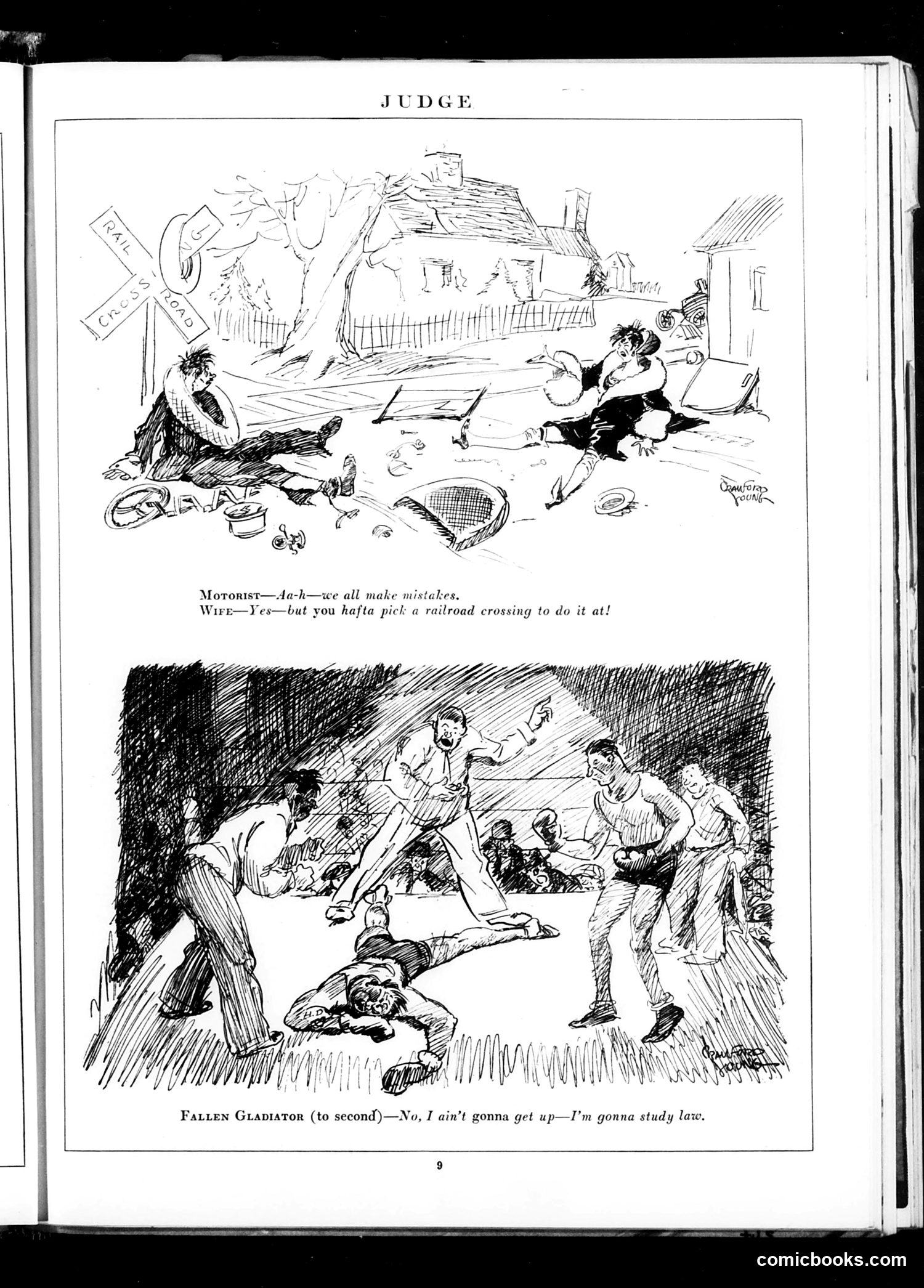
**Top cartoon**: A motorist and woman argue after a car crash near a rural house. The motorist admits "we all make mistakes," but the woman retorts that he had to pick a railroad crossing for his error—suggesting his careless driving endangered them at a particularly dangerous location. This satirizes early automobile safety and reckless drivers. **Bottom cartoon**: A baseball game depicts a "Fallen Gladiator" (injured player) lying on the ground, telling his replacement he won't get up because he's "gonna study law." This likely mocks athletes who pursued legal careers, or satirizes the rough, violent nature of baseball, suggesting it's safer to become a lawyer than continue playing. Both cartoons use humor to critique contemporary social behaviors and professions.
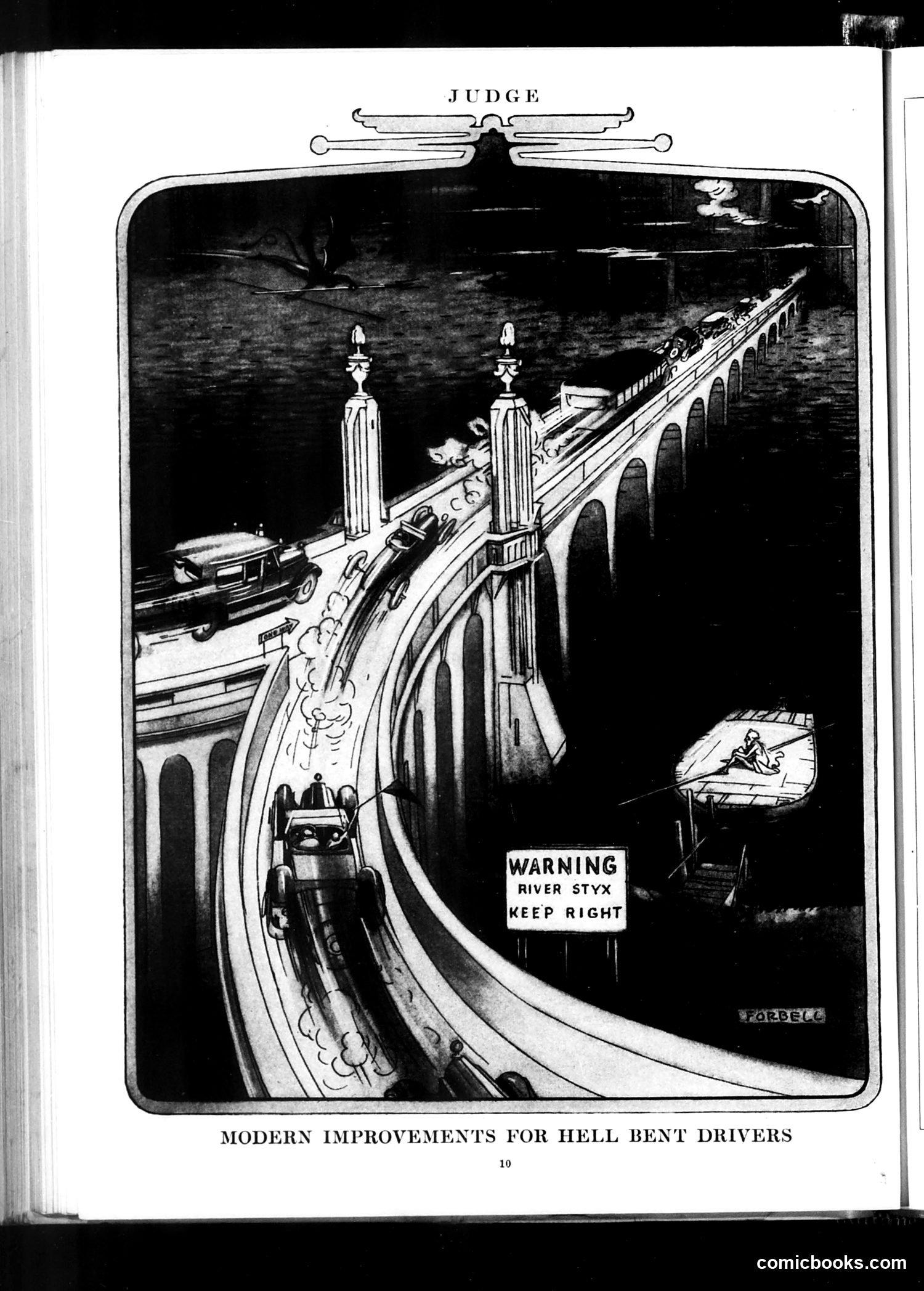
This Judge cartoon satirizes reckless drivers through a darkly humorous afterlife scenario. The illustration depicts the mythological River Styx (the boundary between the living world and the underworld in Greek mythology) reimagined as a modern highway with warning signs and infrastructure. "Hell bent drivers"—those driving dangerously fast—are literally shown driving toward Hell. The cartoon warns speeding motorists that their reckless behavior will lead to damnation, using the classical underworld as metaphor. The ornate bridge with proper signage ("Keep Right") mocks how modern traffic safety measures cannot save careless drivers from their fate. This reflects 1920s-era concerns about automobile safety and dangerous driving habits during the early automotive age, when traffic fatalities were rising sharply. The joke equates fatal recklessness with literal damnation.
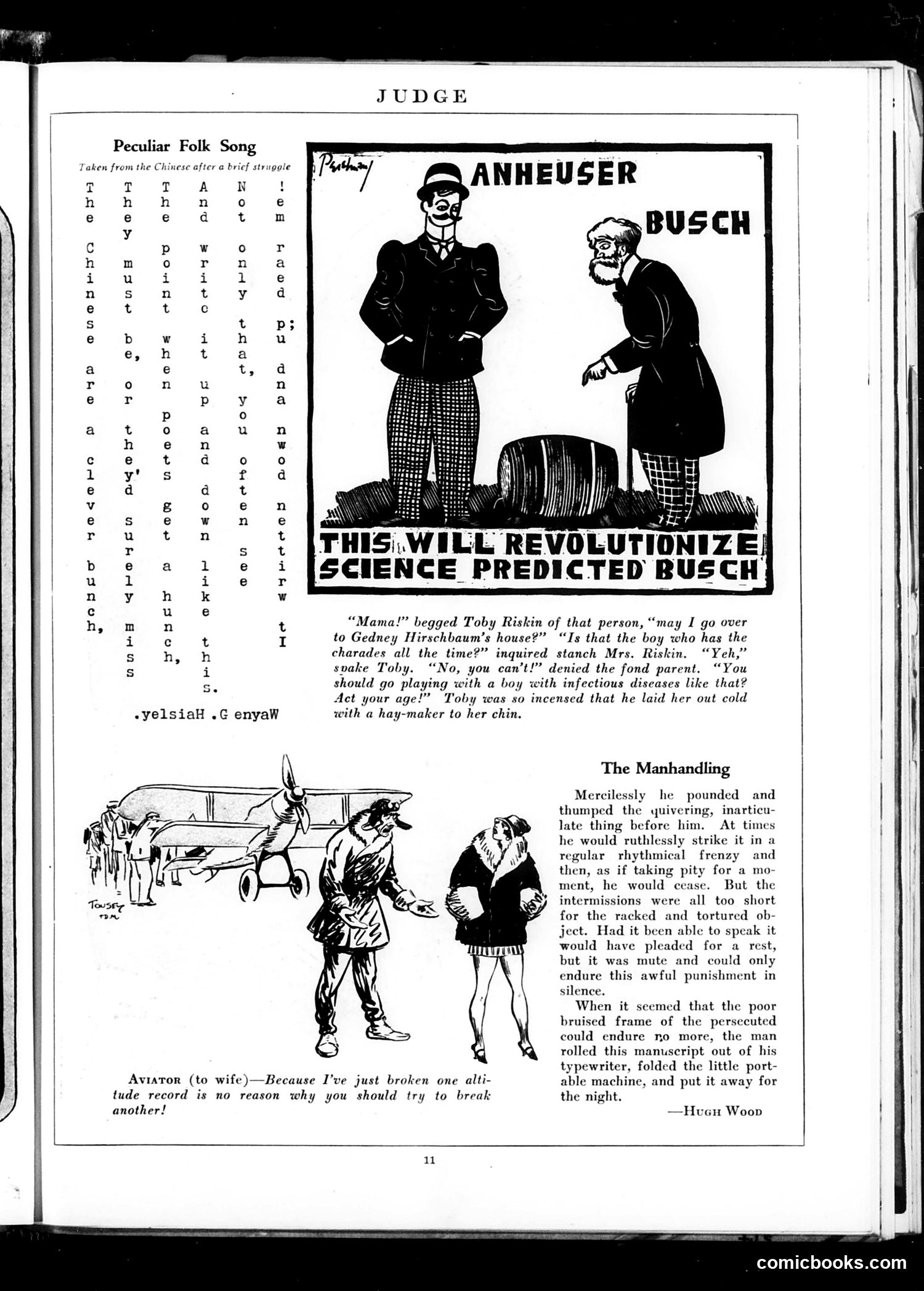
This page contains three distinct satirical pieces typical of early 20th-century Judge magazine: **"Peculiar Folk Song"**: A visual poem presented in a scrambled text format, likely mocking experimental or avant-garde poetry of the era through deliberately confusing layout. **Anheuser-Busch Advertisement**: The main cartoon shows two men with a large beer barrel, advertising "This Will Revolutionize Science Predicted Busch." This appears to satirize Anheuser-Busch's beer marketing claims, ironically suggesting beer itself is a "scientific revolution"—a common target of temperance-era satire. **"The Manhandling"** by Hugh Wood: A humorous short story about a writer brutally typing manuscript pages on a typewriter, personifying the machine as a suffering victim. The "manhandling" pun plays on both literal rough treatment and the writer's harsh creative process. **"Aviator" caption**: A joke about a pilot's wife, mocking masculine competitiveness and domestic conflict. The page reflects Judge's satirical approach to advertising, technological change, and social customs of its era.
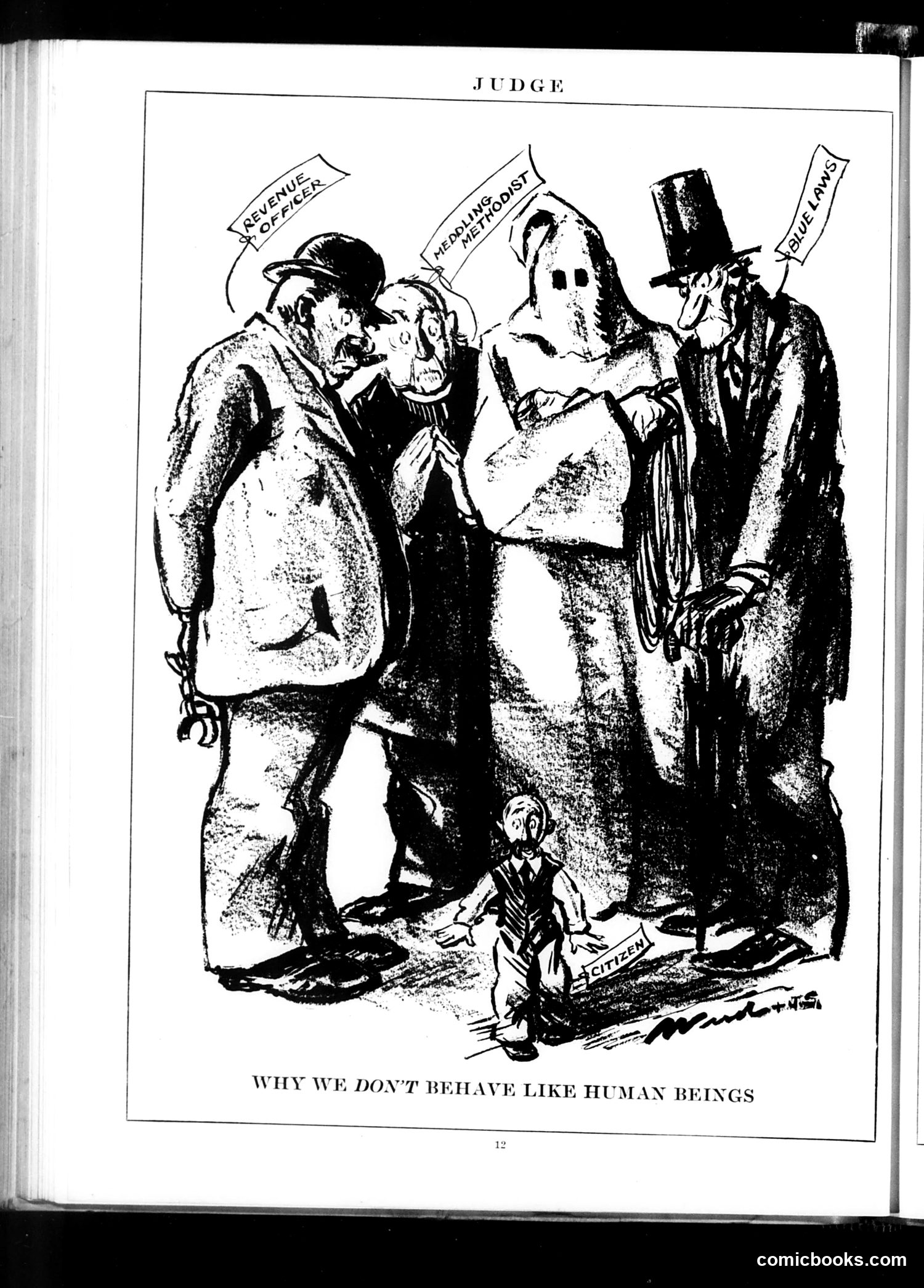
This Judge magazine cartoon satirizes corruption and poor judicial behavior. Four caricatured figures—appearing to represent judges or legal/political authorities—tower menacingly over a small, cowering "Citizen" labeled at their feet. The figures hold banners reading "Revenue of Filler," "Bribery and Graft," and "Dual Laws," exposing systematic corruption in the legal system. The cartoon's title, "Why We Don't Behave Like Human Beings," sarcastically suggests that these authority figures have abandoned basic human morality and decency. The satire criticizes how judges and officials exploit their power through bribery, selective enforcement, and financial exploitation rather than serving justice fairly. This reflects broader Progressive Era concerns about institutional corruption and judicial misconduct in early American politics.
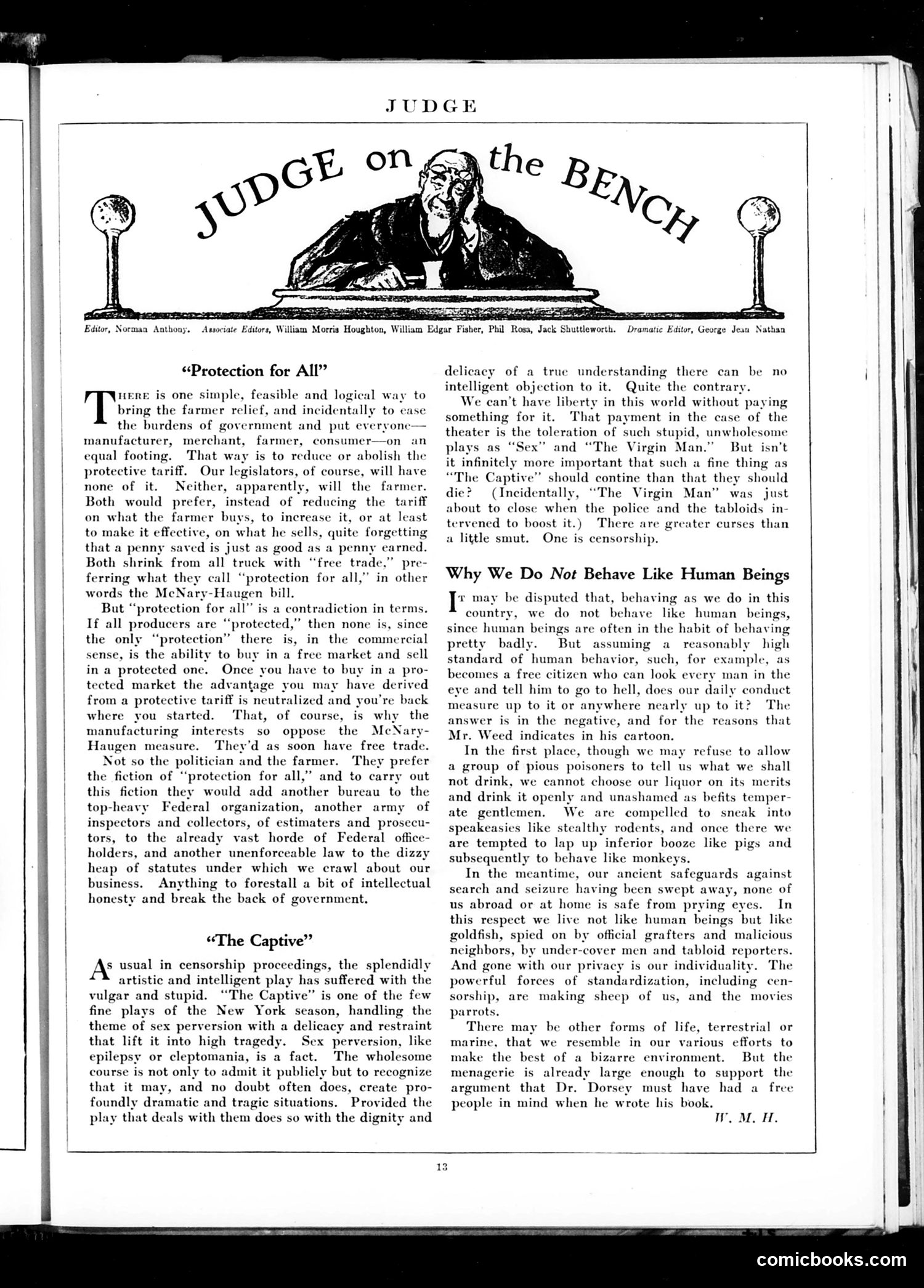
This page from *Judge* magazine contains three satirical editorials addressing 1920s American politics and culture. **"Protection for All"** attacks the McNary-Haugen farm bill, a protectionist measure supported by farmers and politicians. The writer argues that universal tariff protection is logically impossible—if everyone is protected, no one gains advantage. The satire targets both political groups for preferring comforting fictions to honest economic policy, and criticizes the expansion of federal bureaucracy needed to enforce such contradictions. **"The Captive"** defends an artistically serious Broadway play about homosexuality against censorship efforts by police and tabloid newspapers. The editor argues that mature theater handling serious subjects with dignity deserves protection, and that censorship represents a greater evil than occasional "smut." **"Why We Do Not Behave Like Human Beings"** (excerpt) appears to critique American hypocrisy and conformity pressuring citizens away from independent thought. All three pieces reflect *Judge's* satirical mission: mocking political inconsistency, defending artistic and intellectual freedom, and criticizing governmental overreach.
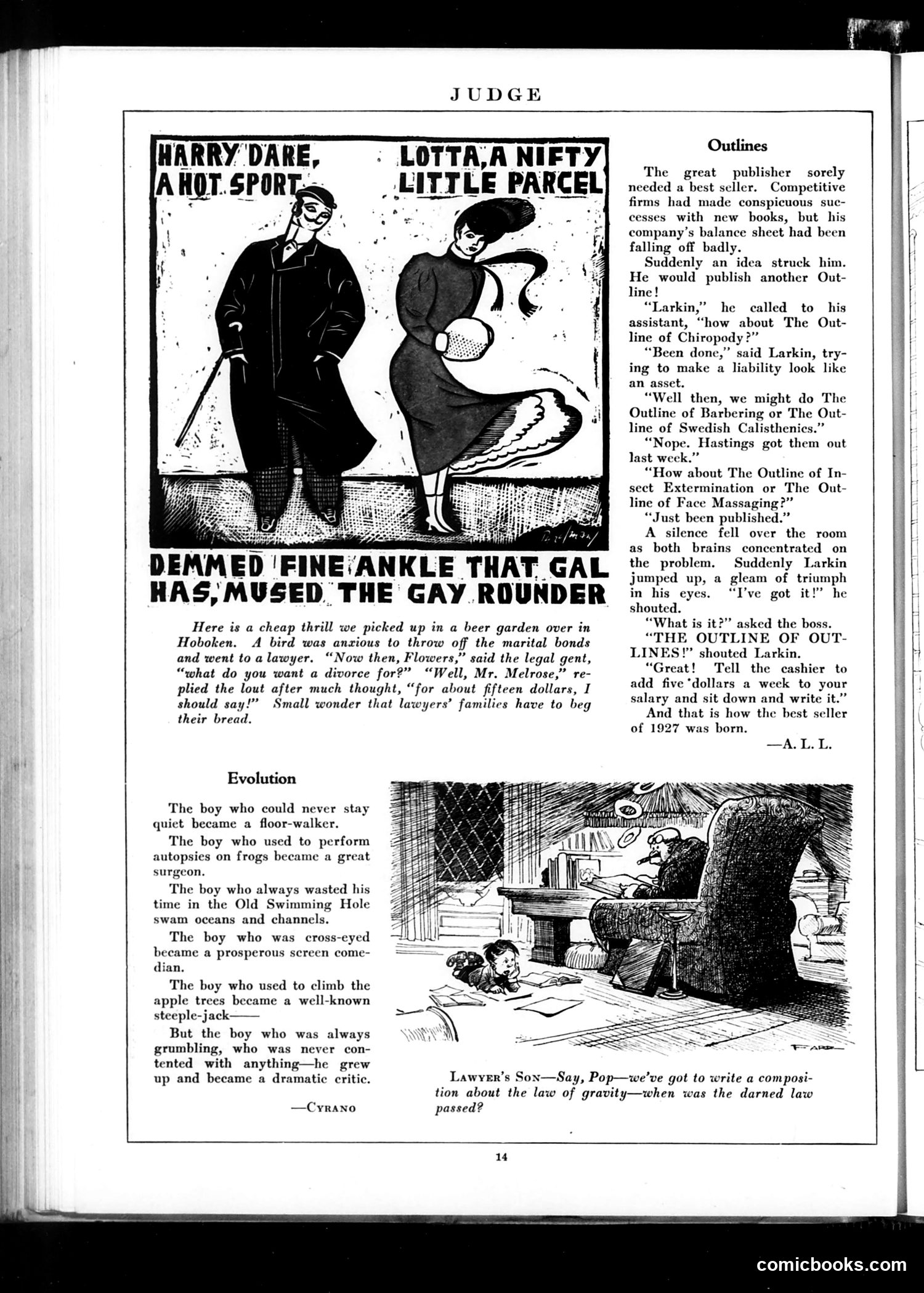
This page contains three satirical pieces targeting 1920s American culture: **Top cartoon**: A man admires a woman's ankles in a beer garden. The joke mocks both the casual divorce culture (a man seeks divorce for "$15") and the shallow male gaze—reducing romantic dissolution to physical appreciation. **"Evolution" poem**: Cyrano's witty piece suggests wayward boys grew into successful adults (surgeons, comedians, acrobats), *except* the perpetually complaining boy became a drama critic. This is professional self-deprecation, mocking critics as inherently bitter and unsuccessful. **"Outlines" story**: Satirizes 1920s publishing trends. Publishers chased bestselling "Outline" reference books (like the wildly popular "Outline of History"). The joke: a publisher's desperate solution is publishing "The Outline of Outlines"—meta-satire on trend-chasing and commercial desperation. The bottom cartoon's caption jokes about legal ignorance, with a boy asking when the "law of gravity" was passed, confusing natural law with legislation.
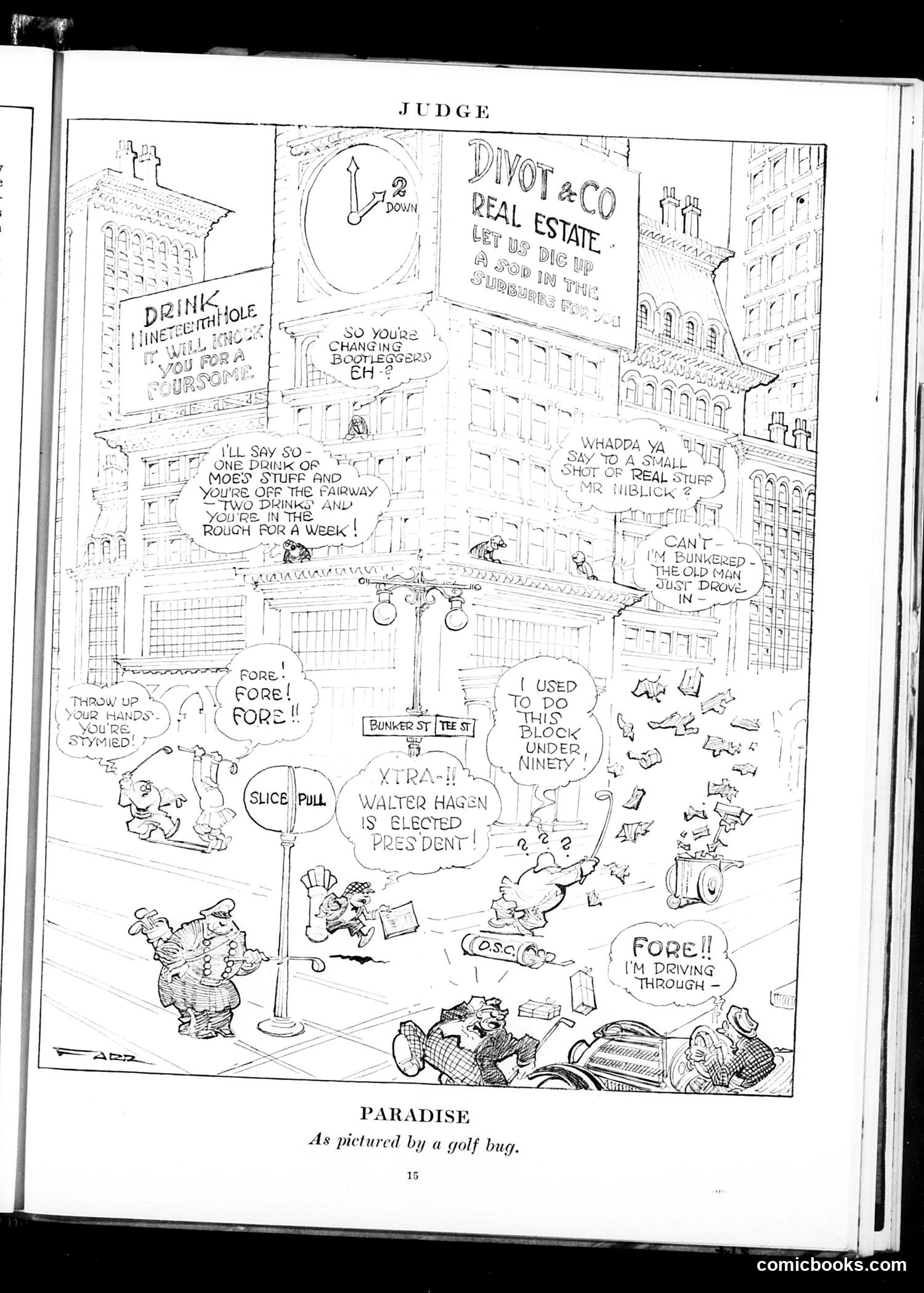
This satirical cartoon depicts a chaotic urban street scene reimagined through a golfer's obsessive perspective. The golfer views everything—buildings, pedestrians, street signs—as obstacles and opportunities in an endless golf game. Key elements include references to **Walter Hagen's election as president** (a joke about the famous golfer), real estate advertisements, and a man at street level announcing "Fore!" repeatedly as he "drives through" traffic. The satire mocks **golf obsession**: the golfer is so consumed by the sport that he literally cannot see normal city life—he sees only fairways, rough patches, and hazards. Every urban element becomes part of the game. The title emphasizes this distorted perception: paradise for a golf fanatic is essentially the entire world recontextualized as one giant golf course. This reflects early 20th-century American attitudes about the growing popularity of golf among the leisure class and satirizes how hobbies could completely dominate someone's worldview.
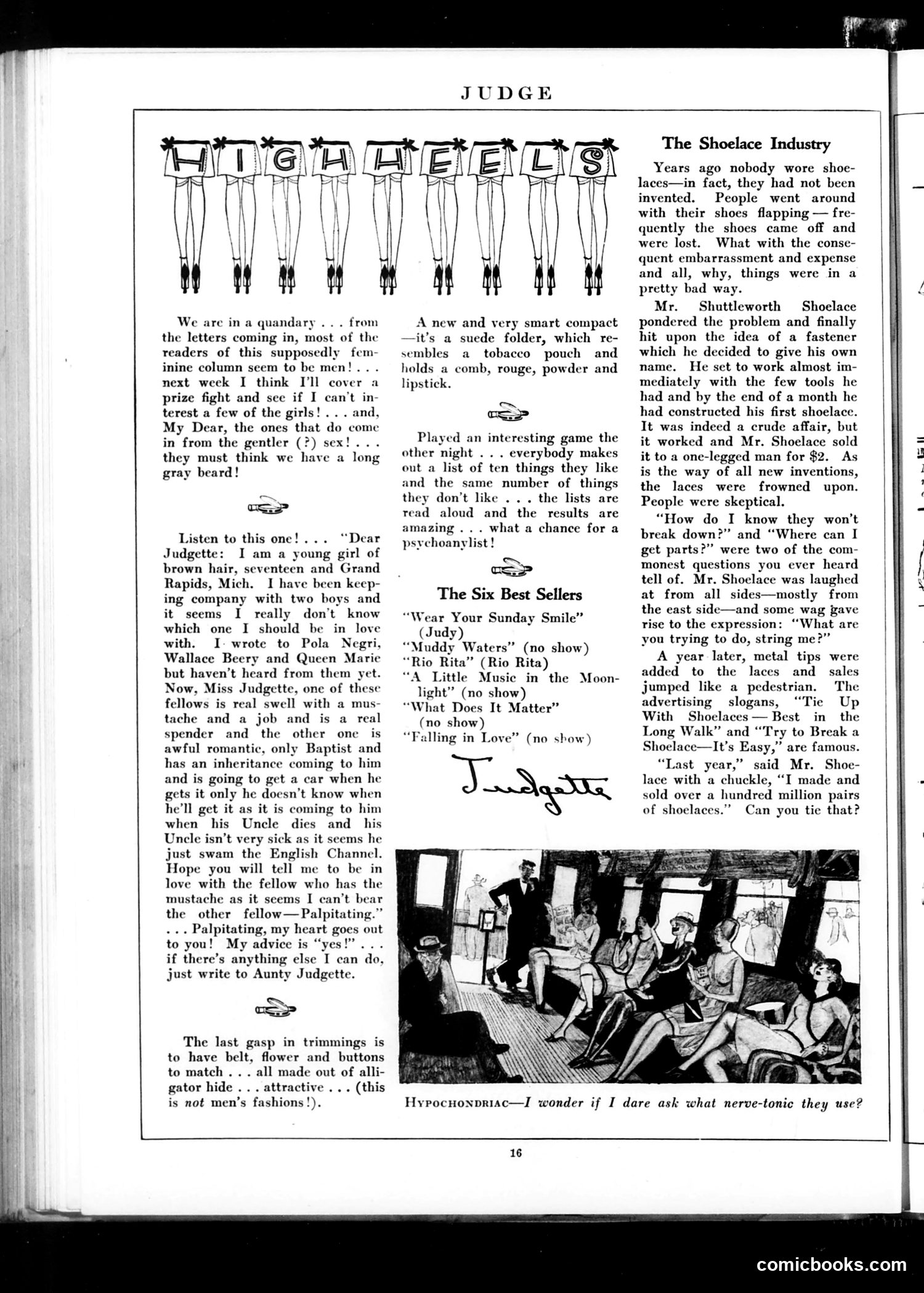
This page from *Judge* contains humor columns and a satirical story rather than political cartoons. The main content includes "Aunt Judgette's" advice column, which humorously notes that her supposedly "feminine" column attracts mostly male readers. She publishes a letter from a young woman seeking romantic advice, naming real celebrities (Pola Negri, Wallace Beery, Queen Marie) she supposedly consulted—a joke about celebrity culture and absurd advice-seeking. The page's centerpiece is "The Shoelace Industry," a mock-serious origin story crediting one "Mr. Shuttleworth Shoelace" with inventing shoelaces. It parodies industrial/business narratives by treating a mundane product with exaggerated gravity, complete with sales figures ("over a hundred million pairs") and advertising slogans. The humor lies in elevating something trivial to epic status. The bottom photograph shows a crowded social scene; its caption "Hypochondriac" suggests commentary on neurotic behavior among the fashionable set. Overall, this reflects 1920s humor emphasizing wordplay, celebrity mockery, and absurdist satire of modern consumer culture.
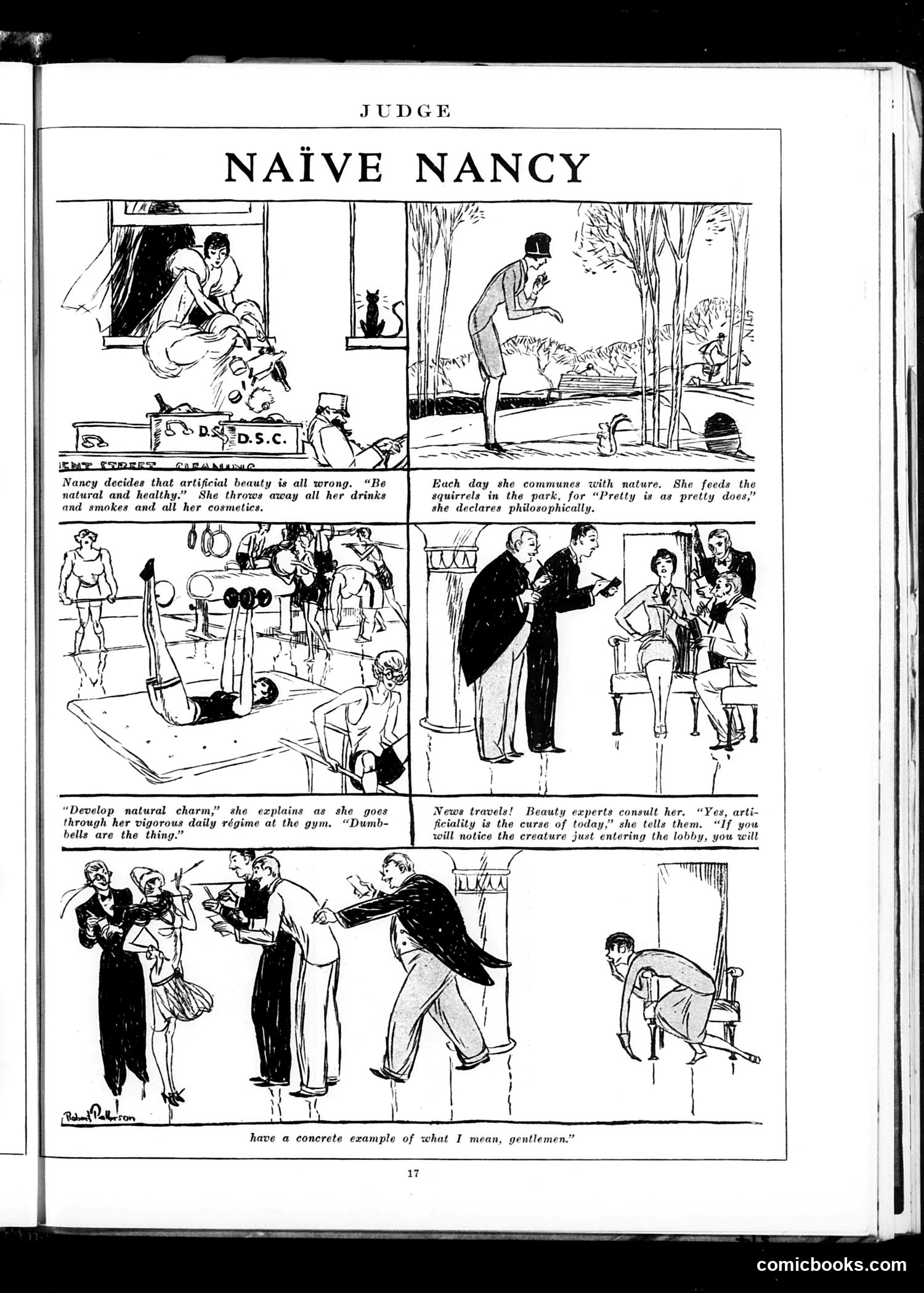
This Judge magazine comic satirizes a young woman who adopts an extreme "natural beauty" philosophy, rejecting cosmetics, cigarettes, and alcohol. Nancy embraces vigorous exercise, nature communion, and philosophical living as alternatives to artificial enhancement. The satire's target: Nancy's naive absolutism. While promoting "natural" living, she becomes obsessively disciplined—doing dumbbells compulsively, consulting with beauty experts who now follow *her* philosophy. The final panel suggests ironic comeuppance: she proudly points out "the creature just entering the lobby" as an example of artificiality's curse, implying her preaching has become as insufferable and judgmental as the vanity she rejected. The joke critiques both extremes—excessive artificiality *and* preachy naturalism—mocking Nancy's self-righteous hypocrisy: she's simply replaced one form of vanity with another.
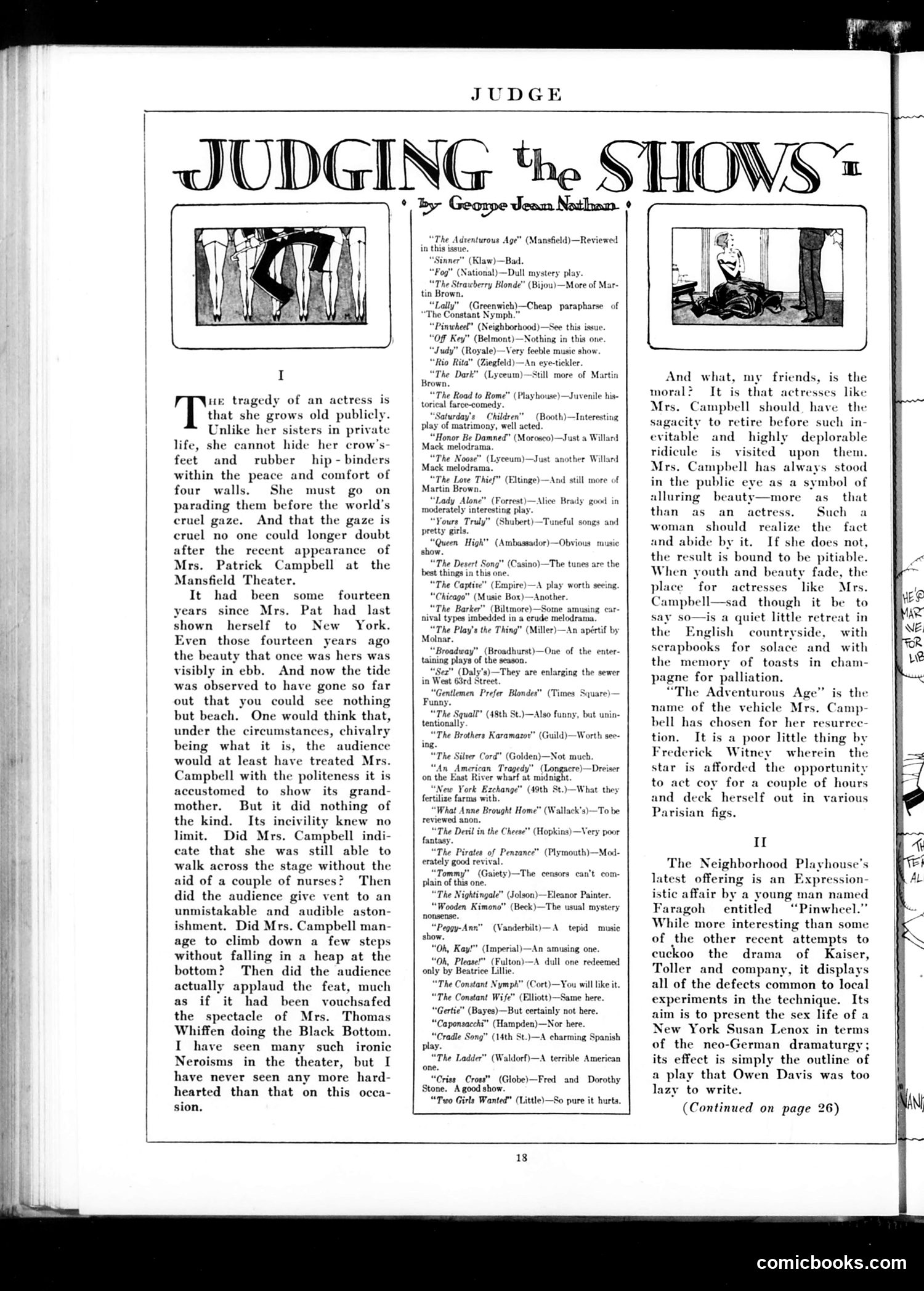
This page features theater critic George Jean Nathan's column reviewing Broadway productions. The main article (Part I) is a scathing critique of actress Mrs. Patrick Campbell's recent performance at the Mansfield Theater. **The Satire:** Nathan mocks the audience's cruel condescension toward Campbell, an aging actress. He notes that after fourteen years away, her physical decline is visible, yet the audience treats her like a museum exhibit—gasping when she walks unaided, applauding when she descends stairs without assistance. This is presented as absurdly insulting patronization masquerading as politeness. **The Point:** The piece satirizes society's harsh treatment of aging actresses who cannot hide their age behind closed doors, unlike private citizens. Nathan suggests the audience's "politeness" reveals only their unkindness and cruelty. The irony is that genuine decency would mean not drawing attention to her physical limitations. **Part II** briefly mentions the Neighborhood Playhouse's "Expressionistic" production "Pinwheel." The remainder is Nathan's capsule reviews of current Broadway shows, listing theaters and brief judgments (mostly critical).
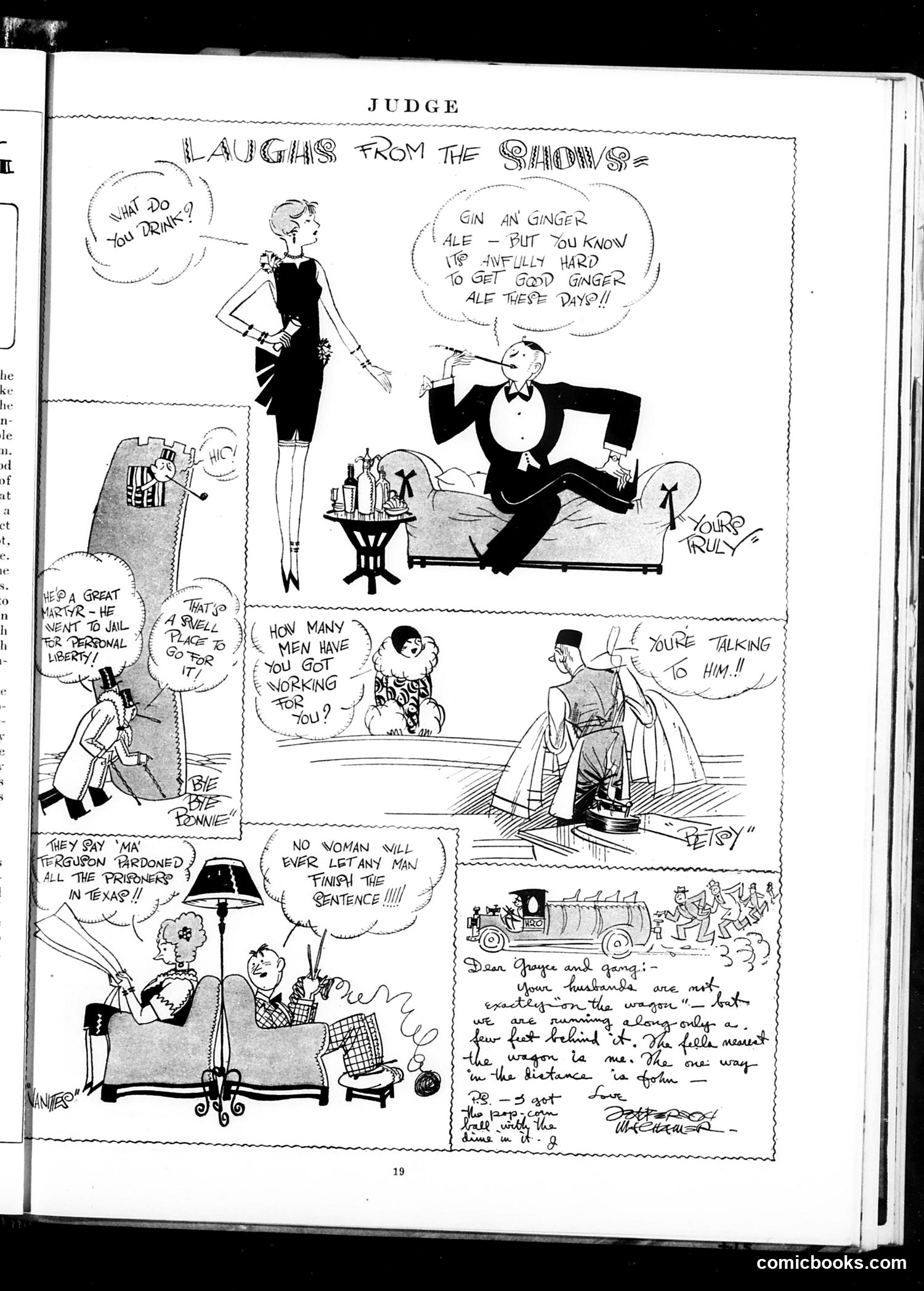
This page collects satirical vignettes mocking social attitudes of the era (likely 1920s-30s based on style). The cartoons target: **Prohibition-era drinking**: A woman asks a man what he drinks; he boasts about making homemade ginger ale, reflecting how Americans circumvented alcohol bans with substitutes. **Women's labor**: A scene questions how many men have women working for them, satirizing changing gender roles and women's employment. **Criminal justice**: A dramatic scene shows a woman declaring "No woman will ever let any man taint the sentence!"—likely mocking either lenient treatment of women criminals or suffragette rhetoric about women's moral superiority. **Prison reference**: A character mentions "Ma" Gunn and "all the prisoners in Texas," suggesting commentary on notorious criminals or jailbreaks of the period. The page uses stereotypical caricatures and exaggerated dialogue typical of Judge's satirical approach to contemporary social debates and hypocrisy.
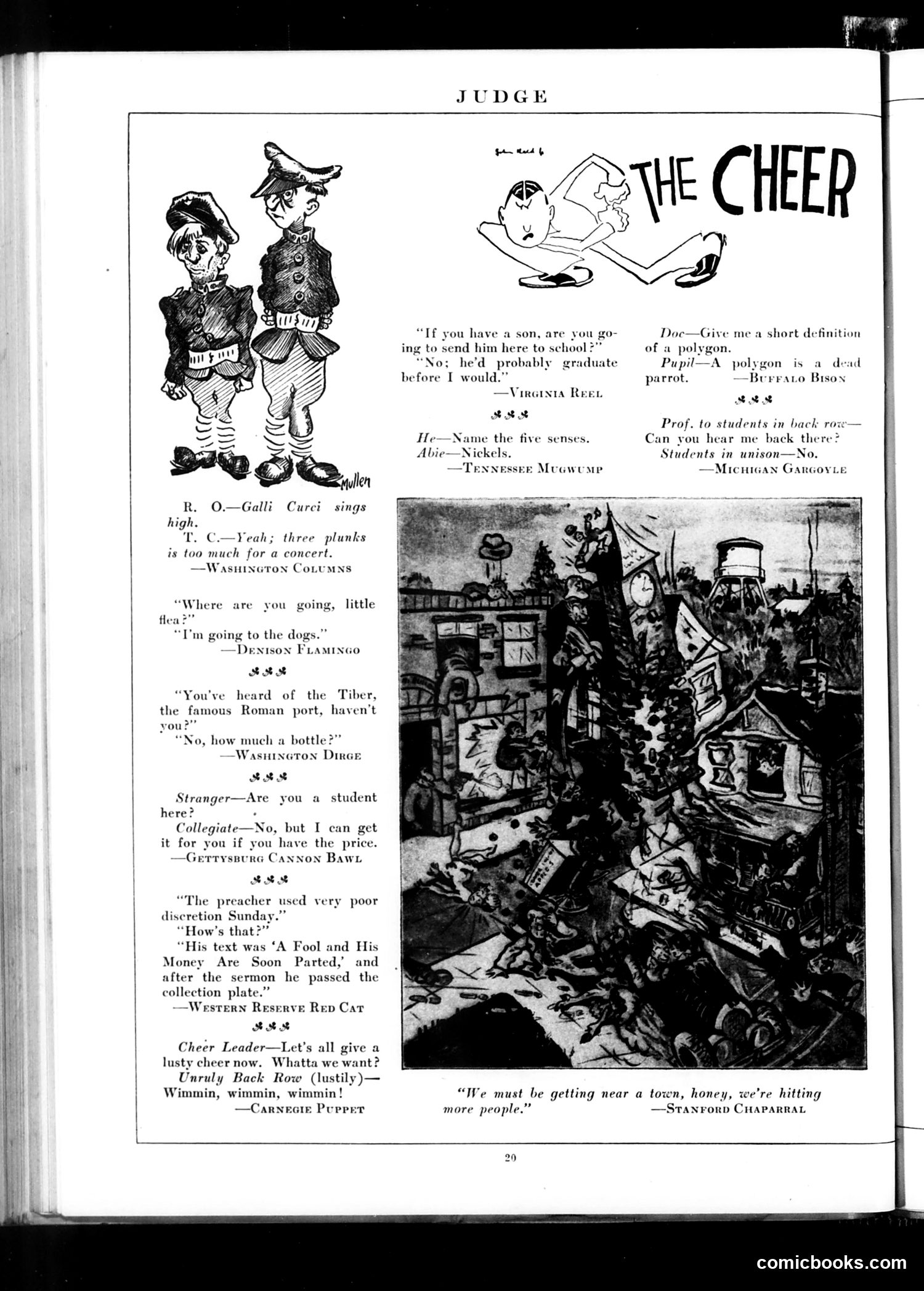
This is a humor page from *Judge* magazine featuring short jokes and quips rather than a single political cartoon. The content reflects early-to-mid 20th century American collegiate and social humor. The jokes target various subjects: opera singer Galli Curci (likely mocking her high notes), classroom incompetence (a professor students can't hear), and student behavior (back-row disruption). One exchanges classical education for practical cynicism—a student offering to procure alcohol for money, reflecting Prohibition-era speakeasy culture. Another mocks a preacher using a text about fools and money while collecting donations—satirizing clerical hypocrisy. The large illustration depicts a crowded, chaotic scene (captioned about hitting "more people" approaching a town), though its specific satirical target is unclear from the image alone. Overall, the page offers lighthearted social observation targeting academics, clergy, opera culture, and youth behavior—typical *Judge* magazine fare targeting educated, middle-class readers.
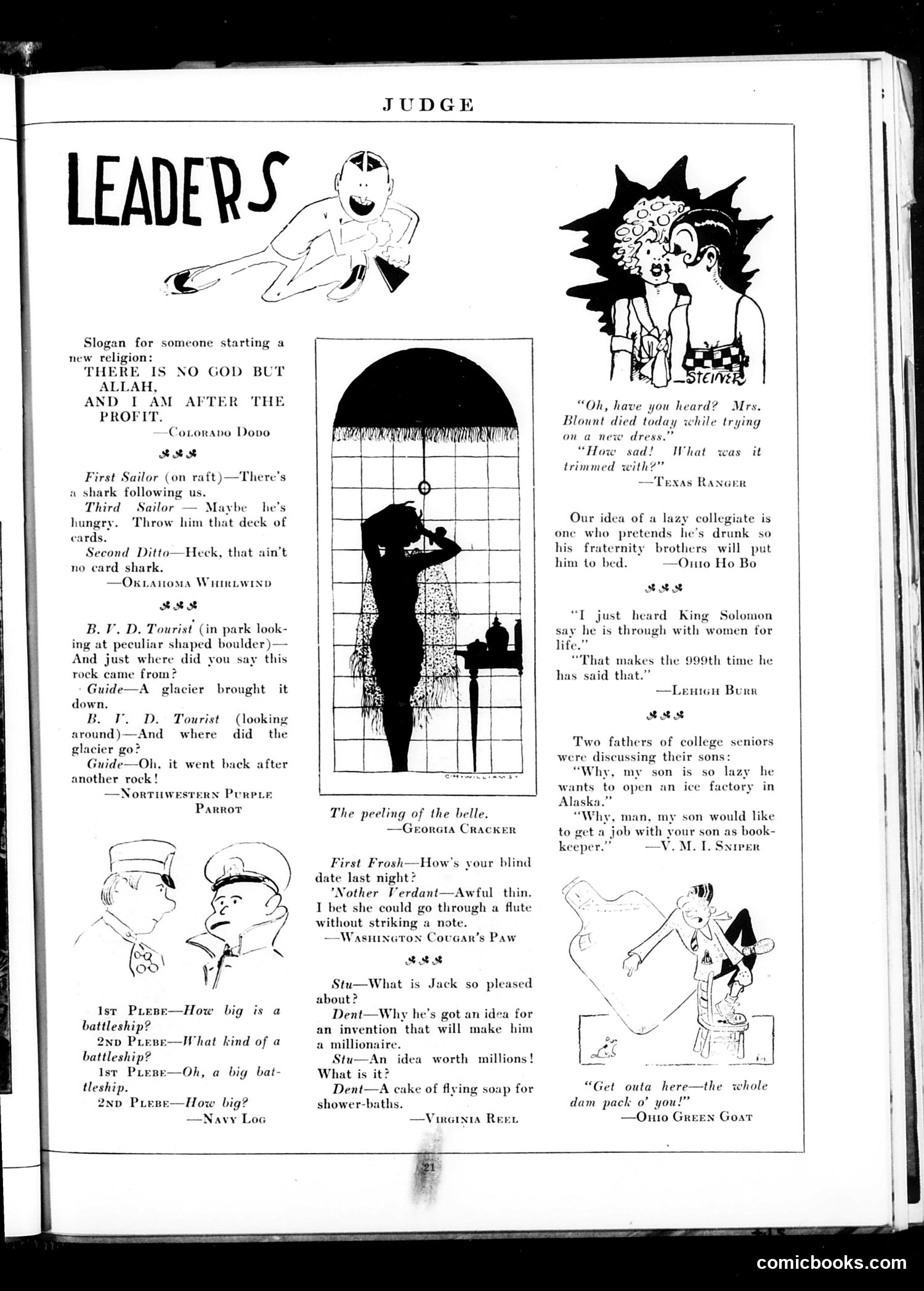
This page contains miscellaneous jokes and quips typical of early 20th-century Judge magazine. The humor targets contemporary social types and behaviors: **Key satirical targets:** - **Religious hypocrisy**: The opening quote mocks religious entrepreneurs using spirituality for profit. - **College culture**: Multiple jokes ridicule lazy collegians and fraternity excess (pretending drunkenness, avoiding work). - **Modern inventions**: A joke about "flying soap for shower-baths" satirizes absurd patent-age optimism. - **Blind dating**: "Nother Verdant" jokes about an unattractive date in crude terms. - **Fashion obsession**: A woman dies while trying on a dress, mocking women's vanity. - **Generational laziness**: Father-son humor portrays college-age men as unmotivated (one wants an ice factory in Alaska). The cartoons use exaggeration and wordplay typical of early Judge humor, targeting recognizable social stereotypes of their era without specific political figures or dated references.
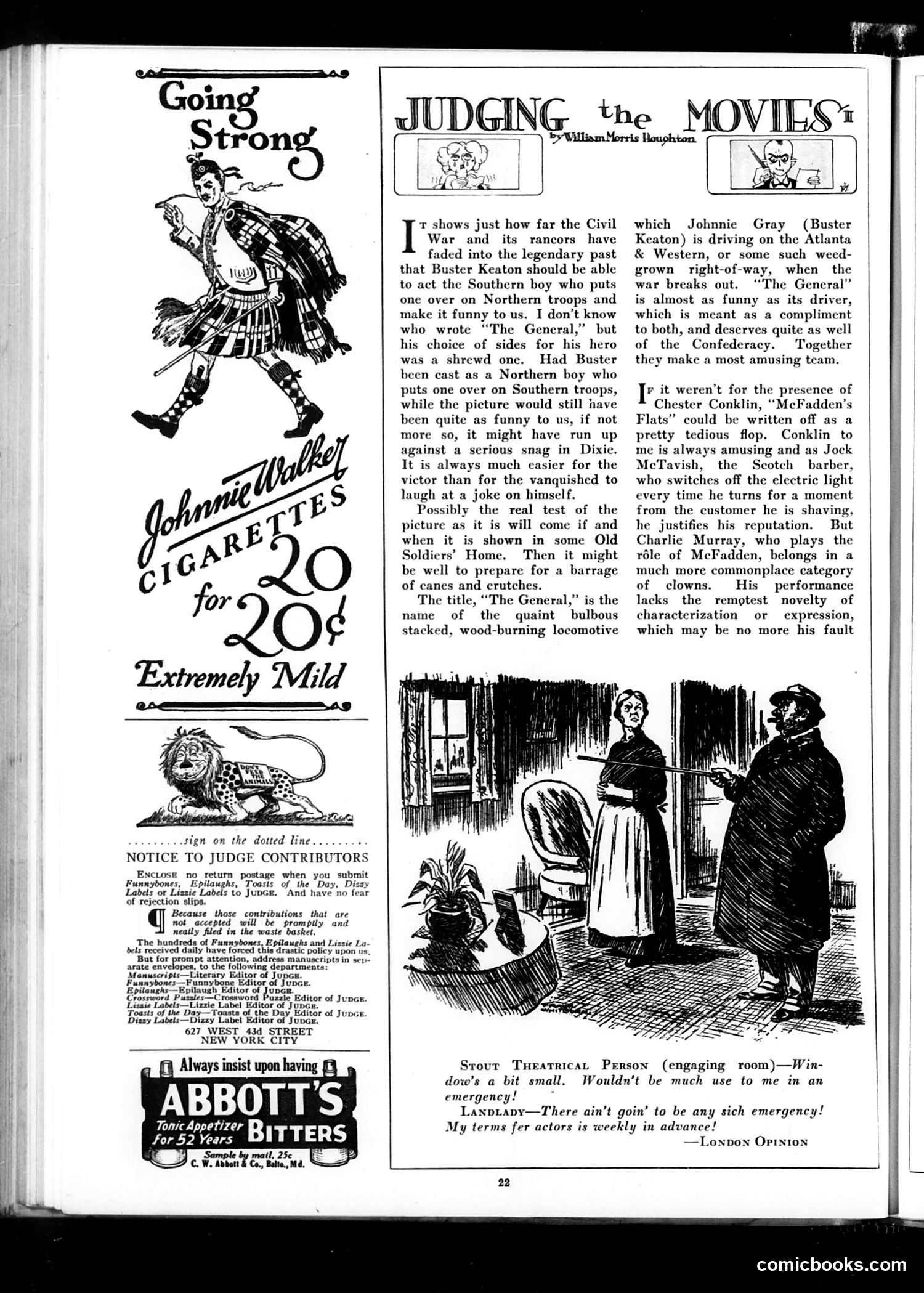
This page contains a film review column by William Morris Houghton critiquing recent movies, primarily **Buster Keaton's "The General"** (a 1926 silent film about a Confederate locomotive during the Civil War). **The satire's point:** The reviewer notes it's significant that post-Civil War America finds it funny when a *Southern* character outwits Northern troops—suggesting the North's confidence as victors allows them to laugh at themselves. He warns the film might face backlash if screened in the South, where the vanquished might not appreciate the joke. The review also discusses **"McFadden's Flats"** starring Chester Conklin (praised) and Charlie Murray (criticized as uninspired). The page also includes **"Notice to Judge Contributors"**—a humorous rejection notice informing would-be writers that unwanted submissions go directly to the waste basket. The advertisements for Johnnie Walker Cigarettes and Abbott's Bitters are period commercial content.
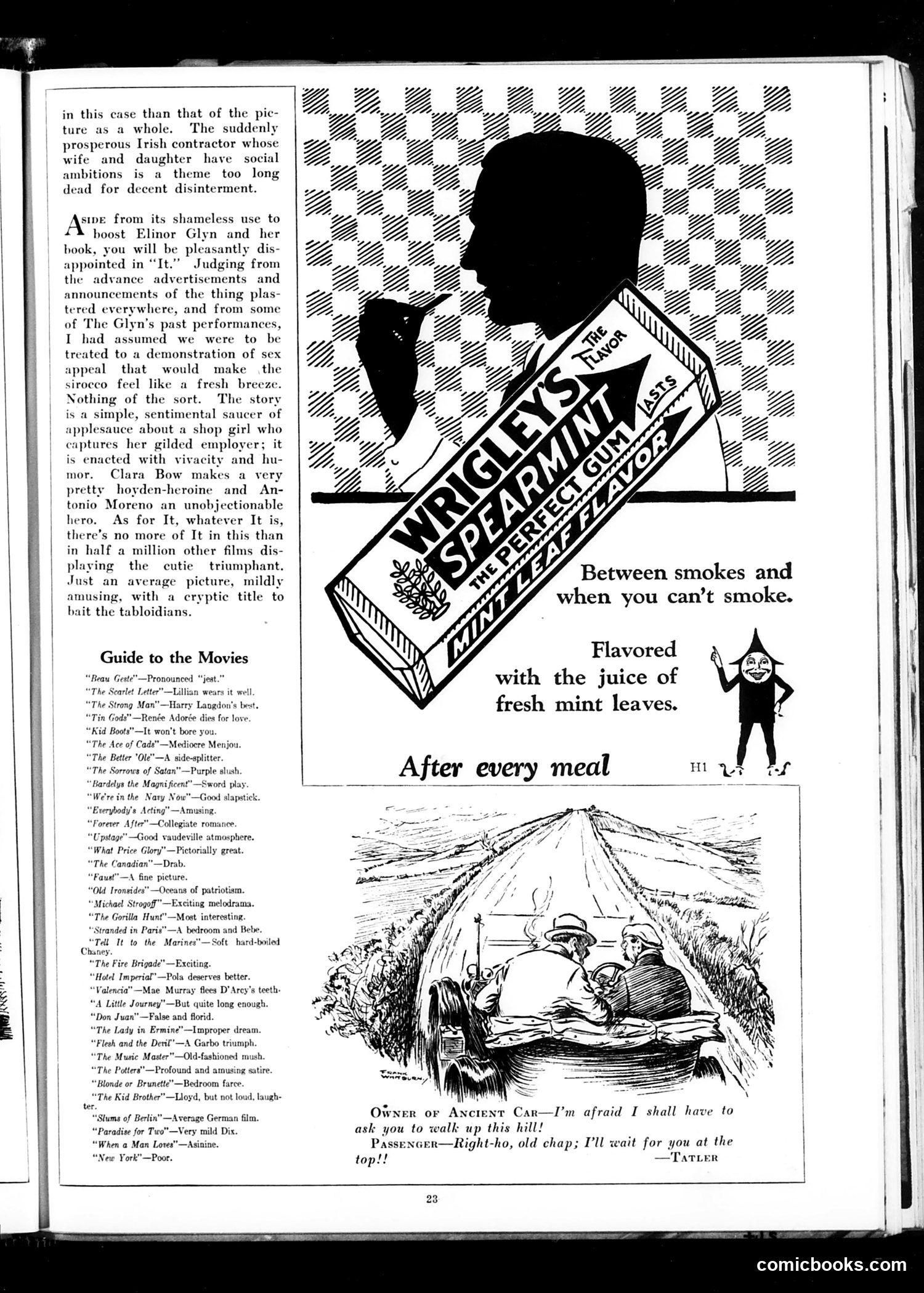
This page combines a **film review** with **advertisements and a cartoon**. The main review critiques the 1927 film "It," starring Clara Bow. The critic dismisses the movie as ordinary despite its notorious reputation—advance publicity suggested it would showcase bold sexuality (referencing author Elinor Glyn's concept of "It" as sex appeal). Instead, the reviewer finds it a sentimental story about a shop girl winning her wealthy employer, with competent but unremarkable performances. The satire lies in the gap between sensational marketing and mundane reality. The page also includes a "Guide to the Movies"—brief quips rating contemporary films, typical of Judge's entertainment coverage. The **cartoon** at bottom depicts an ancient, decrepit automobile struggling uphill. The owner asks the passenger to walk while the car climbs; the passenger agrees to wait at the top. The humor targets outdated vehicles barely functional—relatable to 1920s readers as automobiles became commonplace. The **Wrigley's Spearmint gum advertisement** occupies the upper right, using silhouette imagery to market mint-flavored gum for post-meal freshness.
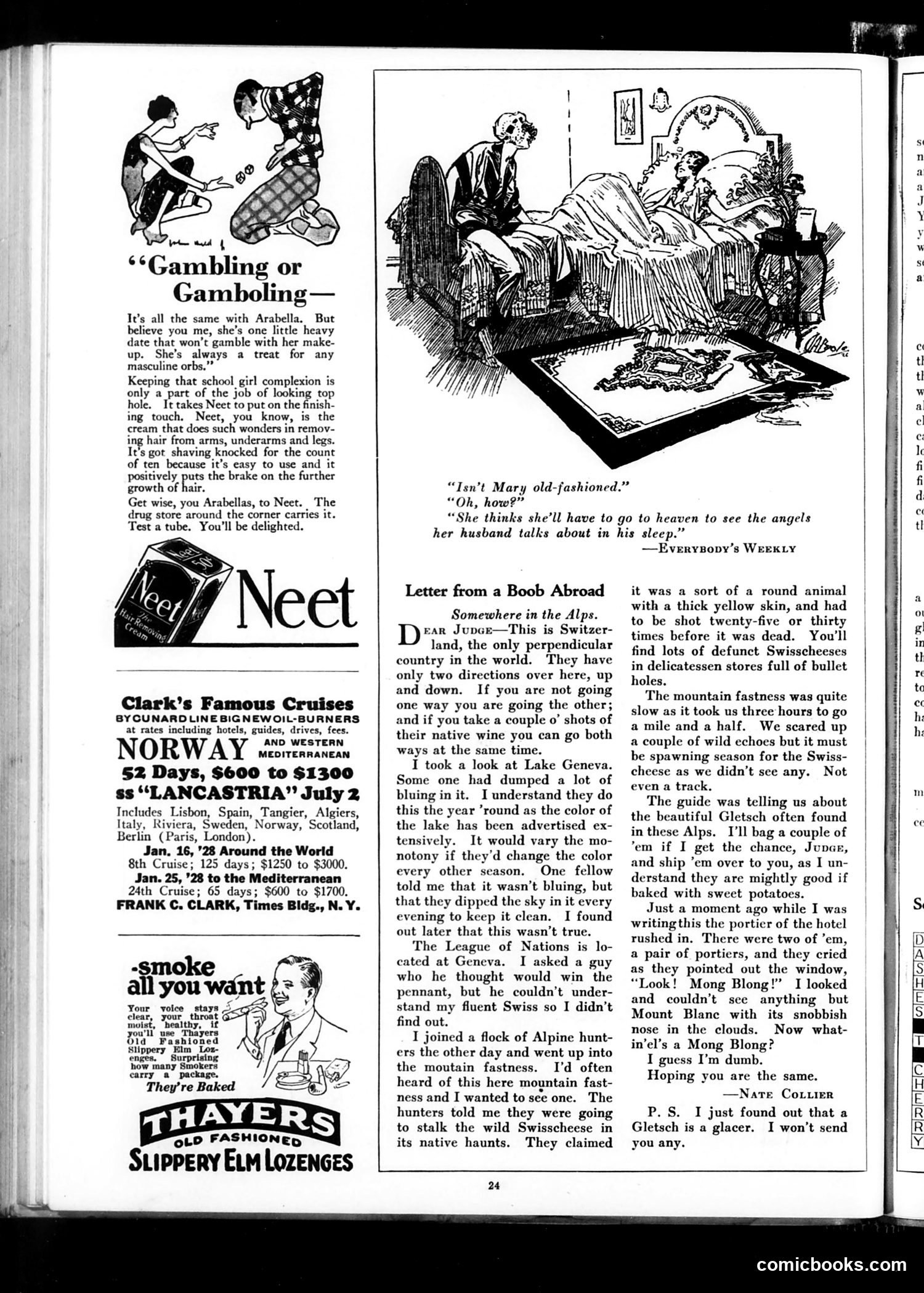
The main cartoon (top left) uses a pun on "gambling" versus "gamboling" (playful jumping) to advertise Neet hair-removal cream. The humor plays on a character named Arabella: she won't "gamble" with her appearance—meaning she won't risk looking unkempt—but she will "gambol" (dance around) confidently because Neet keeps her looking polished. The satire targets women's beauty standards and anxiety about body hair, presenting hair removal as essential to being an attractive "date." The ad suggests that maintaining flawless grooming (school-girl complexion, hairless arms/legs) is a woman's primary job in attracting male attention. The accompanying cartoon (top right) shows a domestic scene mocking old-fashioned wives, with the joke being that a woman must "go to heaven to see the angels her husband talks about in his sleep"—implying marital infidelity. The page is primarily **advertising content** mixed with light satirical humor targeting gender roles and consumer anxiety.
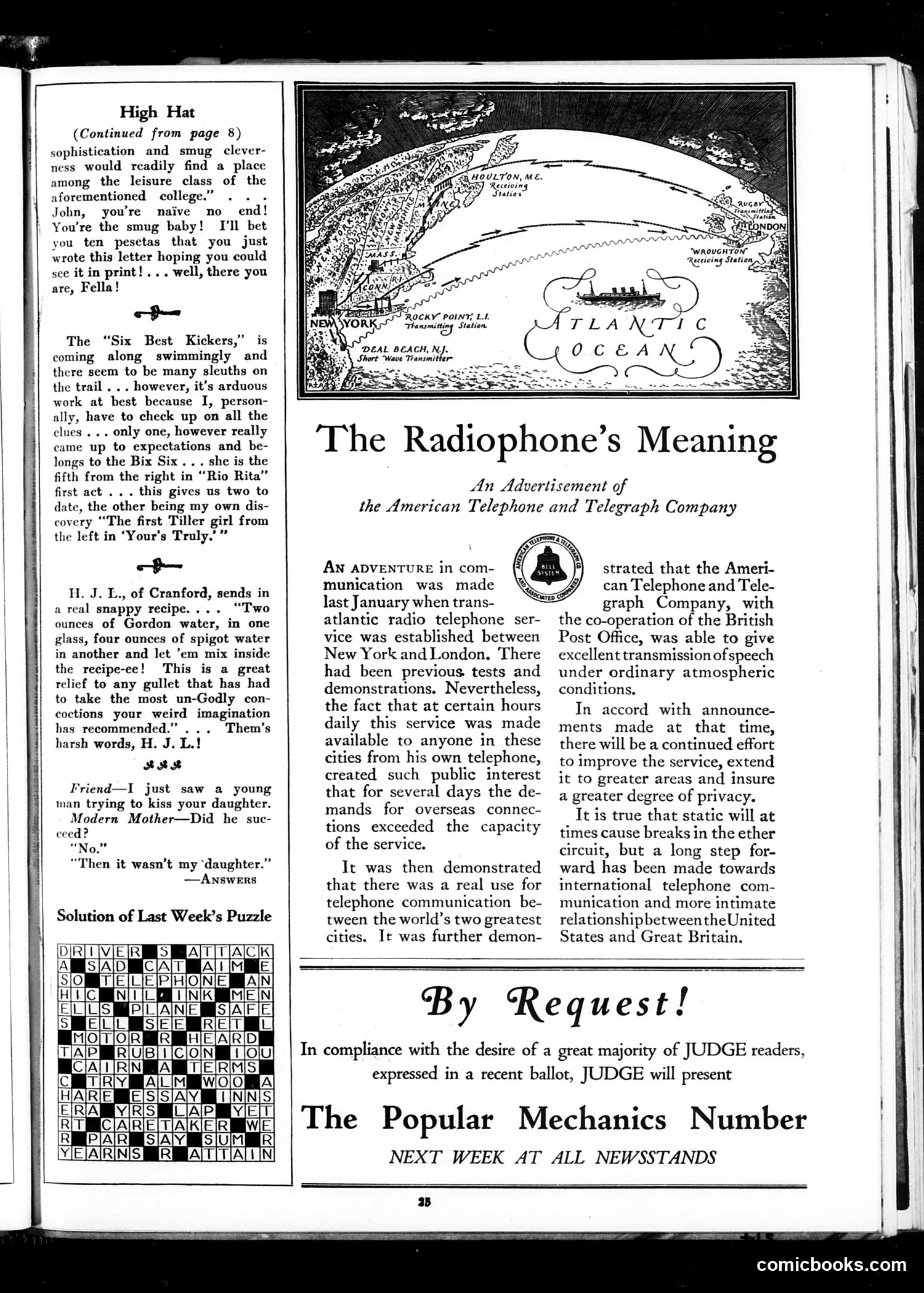
This page combines humor columns with corporate advertising. The "High Hat" section presents satirical reader letters mocking pretension—including jabs at college snobs and a humorous recipe using "Gordon water" and "spigot water" (essentially tap water). A brief joke about a young man kissing a daughter plays on the "modern mother" stereotype. The major content is an **AT&T advertisement** disguised as editorial content, promoting the newly established transatlantic radiotelephone service between New York and London (established January 1927). The ad emphasizes this technological achievement while managing expectations about limitations like atmospheric static. The page also advertises an upcoming "Popular Mechanics Number" of Judge magazine "by request," suggesting the magazine responded to reader polls for themed issues. The map shows transmission stations at Rocky Point (Long Island) and Deal Beach (New Jersey), visualizing the infrastructure behind this communications breakthrough.
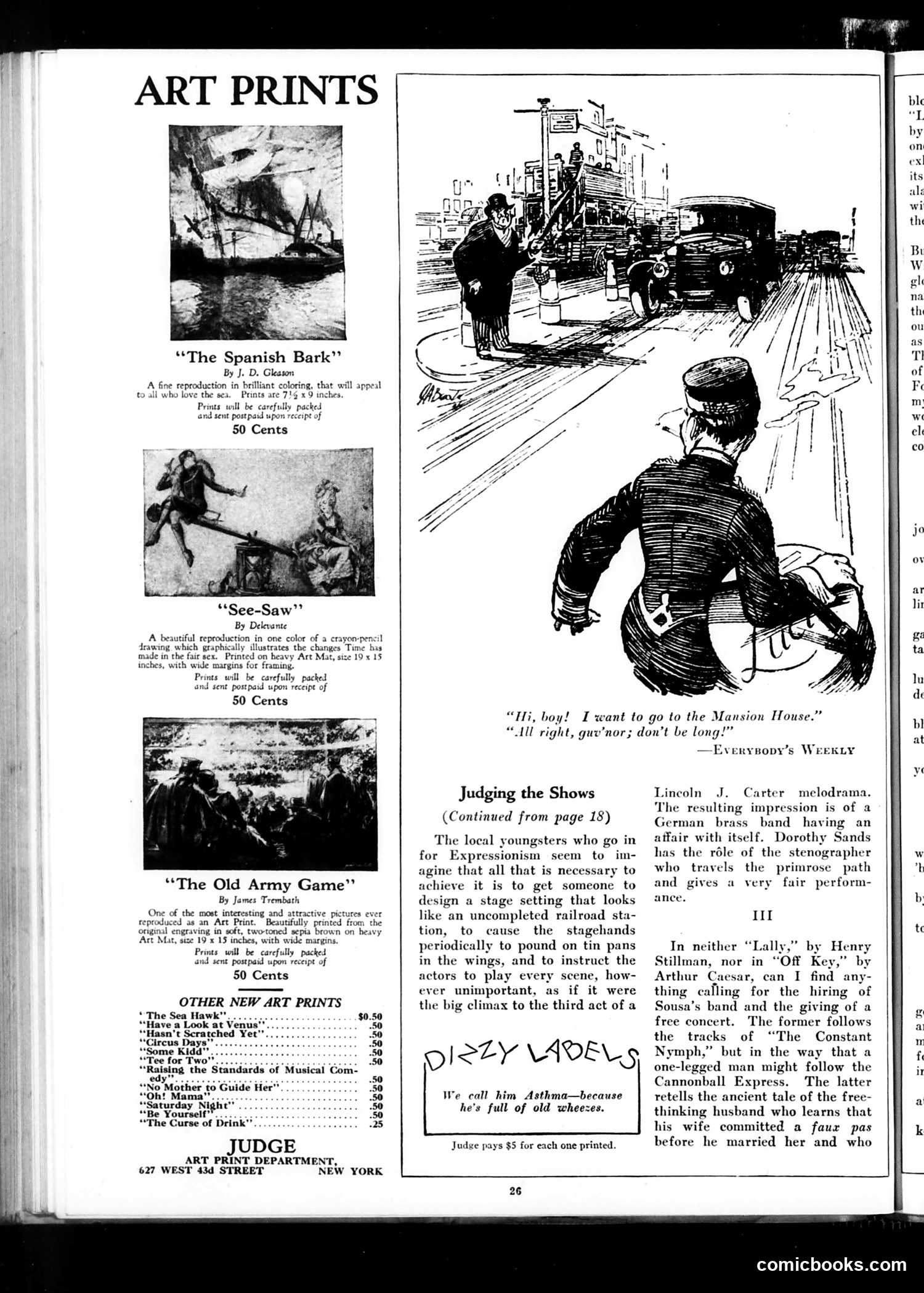
This page is primarily an **art print advertisement section** from Judge magazine, with one cartoon at the top right. The main cartoon shows a boy asking a cab driver to take him to "the Mansion House," with the driver agreeing but saying "don't be long!" The humor appears to reference the Mansion House as a well-known London location (likely the Lord Mayor's official residence), making it a joke about a brief errand or perhaps the boy's impatience—though the specific social context is unclear today. Below the cartoon, the "Judging the Shows" section critiques contemporary theater productions, particularly mocking **Expressionist stage design** as pretentious. The author sarcastically compares the overwrought theatrical style to "a German brass band having an affair with itself"—suggesting chaotic, self-indulgent excess. This reflects 1920s-era skepticism toward avant-garde European theatrical movements entering American stages. The page is otherwise dominated by **mail-order art print offerings** (50 cents each), typical advertising content for Judge magazine's revenue model.
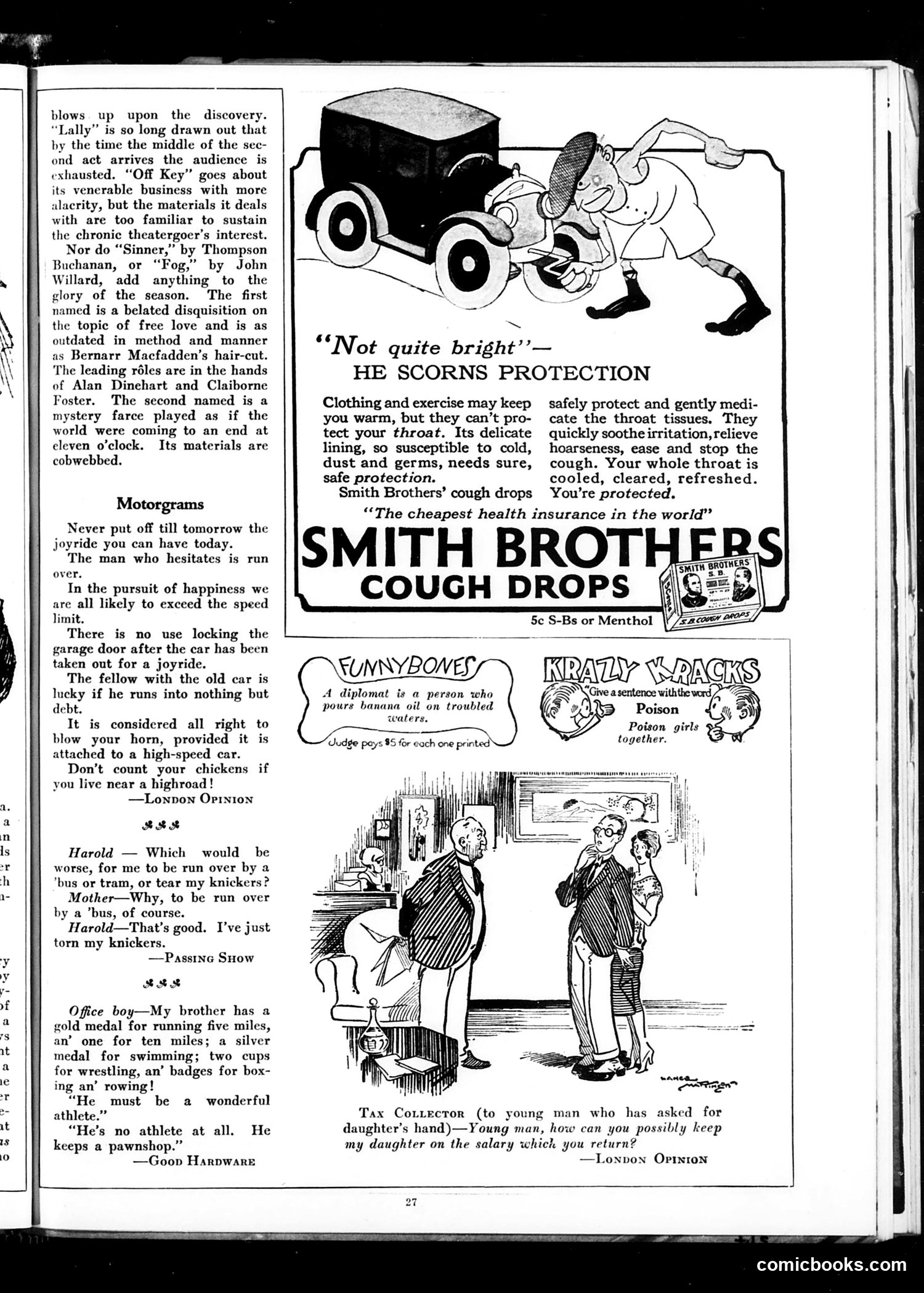
This is primarily an **advertising and humor page** from Judge magazine (likely 1920s-30s based on style). The main content is a **Smith Brothers Cough Drops advertisement** featuring a cartoon of a man being struck by a car with the caption "Not quite bright—HE SCORNS PROTECTION," arguing that throat protection is essential health insurance. The page also contains **short humor pieces and one-liners**: - **"Motorgrams"**: Satirical driving tips mocking reckless motorists and speeding culture - **Comic dialogues**: Including an exchange between Harold and his mother about being hit by a bus versus tearing his pants (dark humor about transportation dangers), and an office boy whose athletic brother actually runs a pawnshop (ironic commentary on fake credentials) - **"Funny Bones" section**: Visual gags about diplomats and poison - **Tax Collector cartoon**: A father warning a suitor he cannot support his daughter on reported salary—likely satirizing income tax evasion or under-reporting The overall tone reflects **early 20th-century urban anxieties** about modern transportation, health, employment, and social climbing.
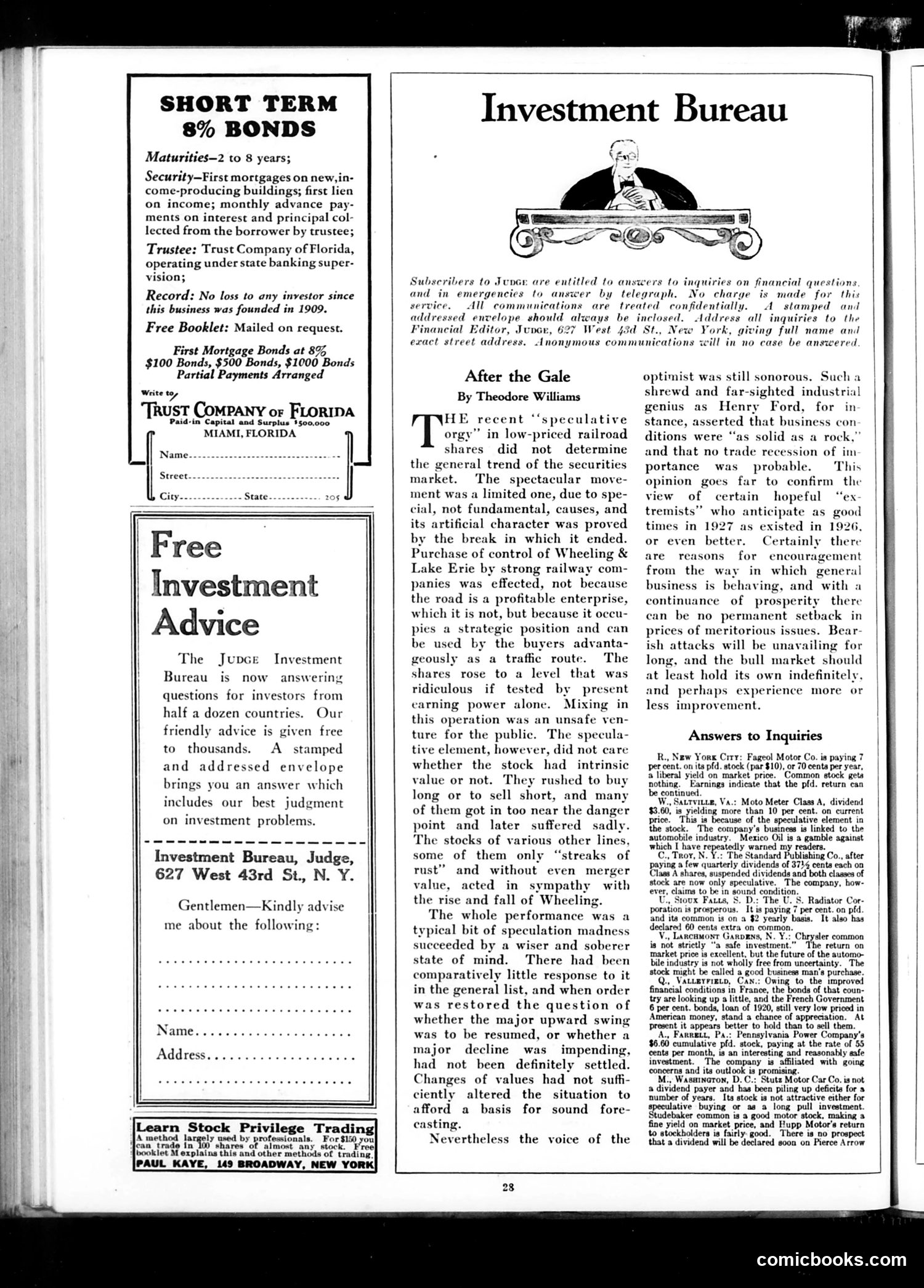
This page is primarily **financial advertising and investment advice**, not political satire. Judge magazine's Investment Bureau offered free guidance on stocks and bonds to readers. The main article, "After the Gale" by Theodore Williams, discusses a recent stock market speculation bubble in low-priced railroad shares, particularly involving the Wheeling & Lake Erie railroad. Williams criticizes the speculative frenzy—investors buying and selling these stocks recklessly based on artificial price inflation rather than genuine company value. The piece references **Henry Ford** as a voice of post-bubble optimism, asserting business conditions remained solid despite the market turbulence. Williams presents this cautiously, suggesting the broader market trend remains uncertain after the speculative episode ends. The tone is typical of 1920s financial journalism: warning against speculation while acknowledging market recovery prospects. This reflects pre-1929 crash attitudes about stock market volatility.
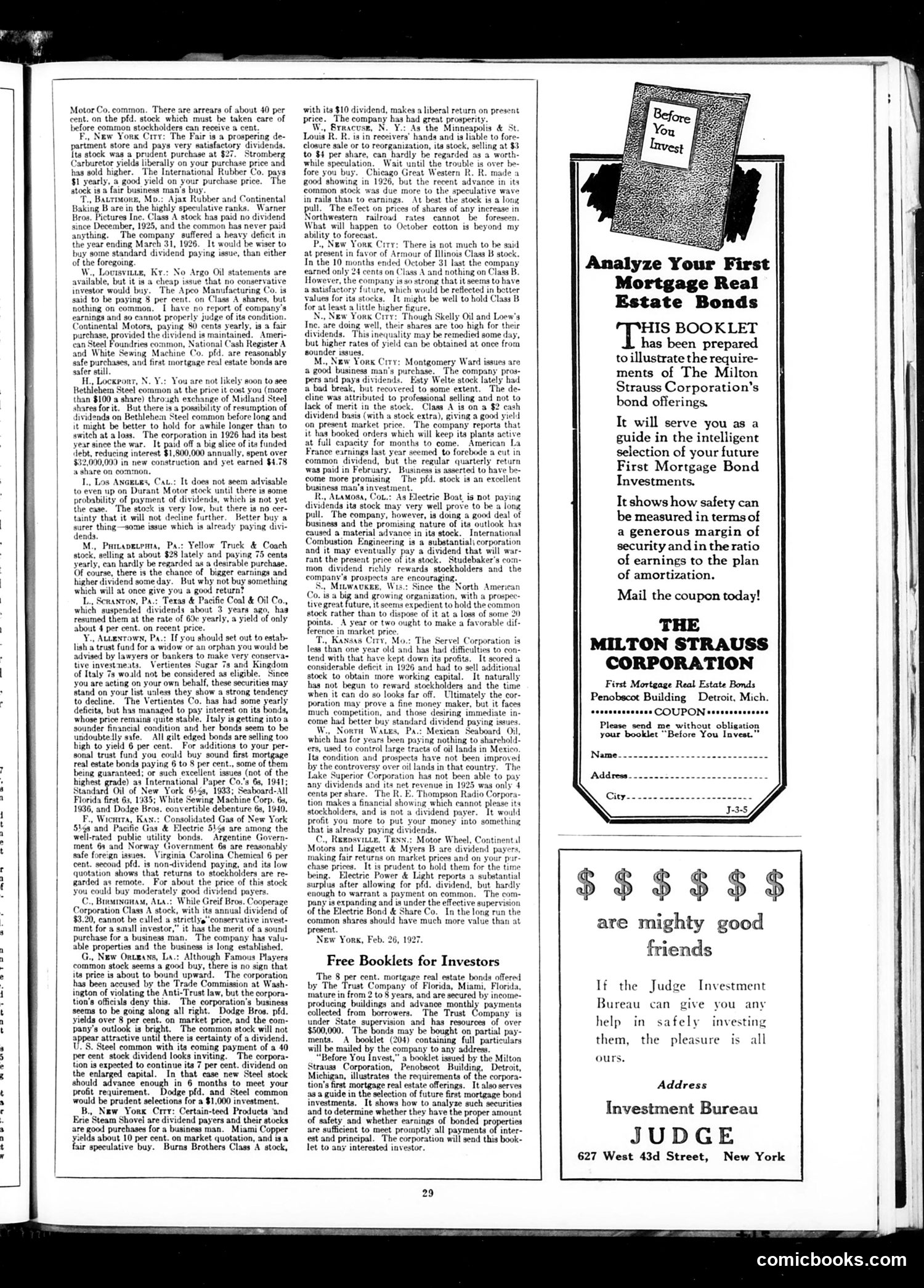
This page is primarily an **investment advice column** rather than a satirical cartoon. The "Judge Investment Bureau" responds to reader queries about stock purchases, offering conservative financial guidance typical of 1927. The visible cartoon advertisement (upper right) promotes Milton Strauss Corporation's First Mortgage Real Estate Bonds, using an abstract black ink-blot image with the tagline "are mighty good friends" to suggest financial security and stability. **Context for modern readers:** This reflects the pre-1929 stock market bubble, when investment advice columns were ubiquitous in popular magazines. The bureau cautiously recommends established dividend-paying stocks (Bethlehem Steel, International Rubber) over speculative ones (Durant Motors, Warner Bros.), warning against risky purchases—advice that would prove prescient before the October 1929 crash. The tone assumes readers are seeking reliable income through dividends rather than capital appreciation.
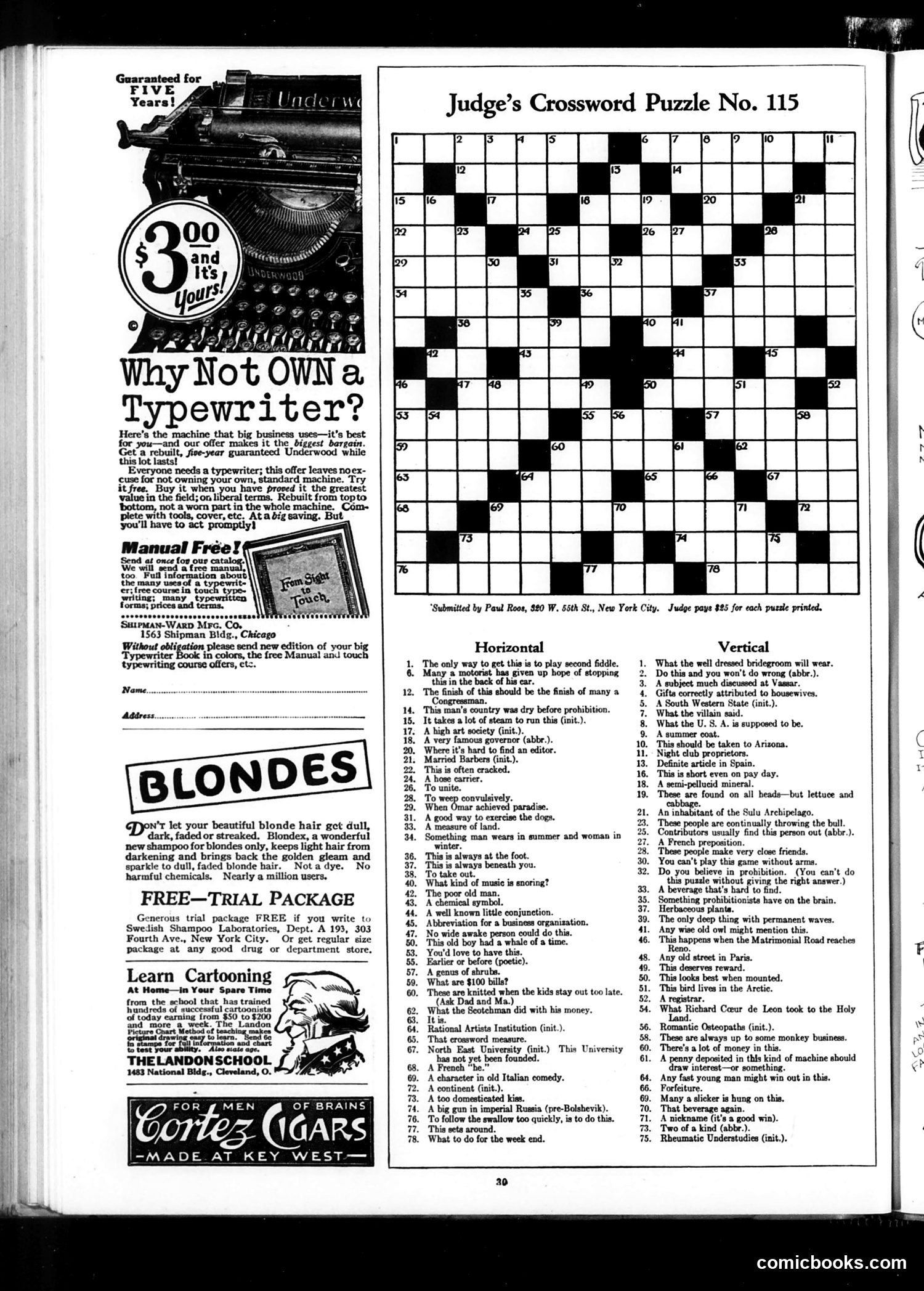
This page is primarily a **crossword puzzle** from Judge magazine (a satirical publication), submitted by Paul Ross. Judge paid $25 per puzzle printed. The puzzle itself contains no political satire—it's a standard crossword with clues mixing wordplay, current events, and general knowledge. Some clues reference 1920s-era concerns: Prohibition ("This man's country was dry before prohibition"), flappers ("These are knitted when the kids stay out too late"), and period figures like "A very famous governor." **The surrounding advertisements** reveal Judge's audience and era: - **Underwood typewriter** sales pitch (mass production, affordability) - **Blondex shampoo** (beauty product marketing) - **Cartooning correspondence school** - **Cortez cigars** (luxury goods) These ads, combined with the crossword's references to Vassar, motorists, and Congressmen, indicate Judge reached educated, middle-to-upper-class readers in the 1920s. The page demonstrates how crossword puzzles were becoming mainstream entertainment during this period.
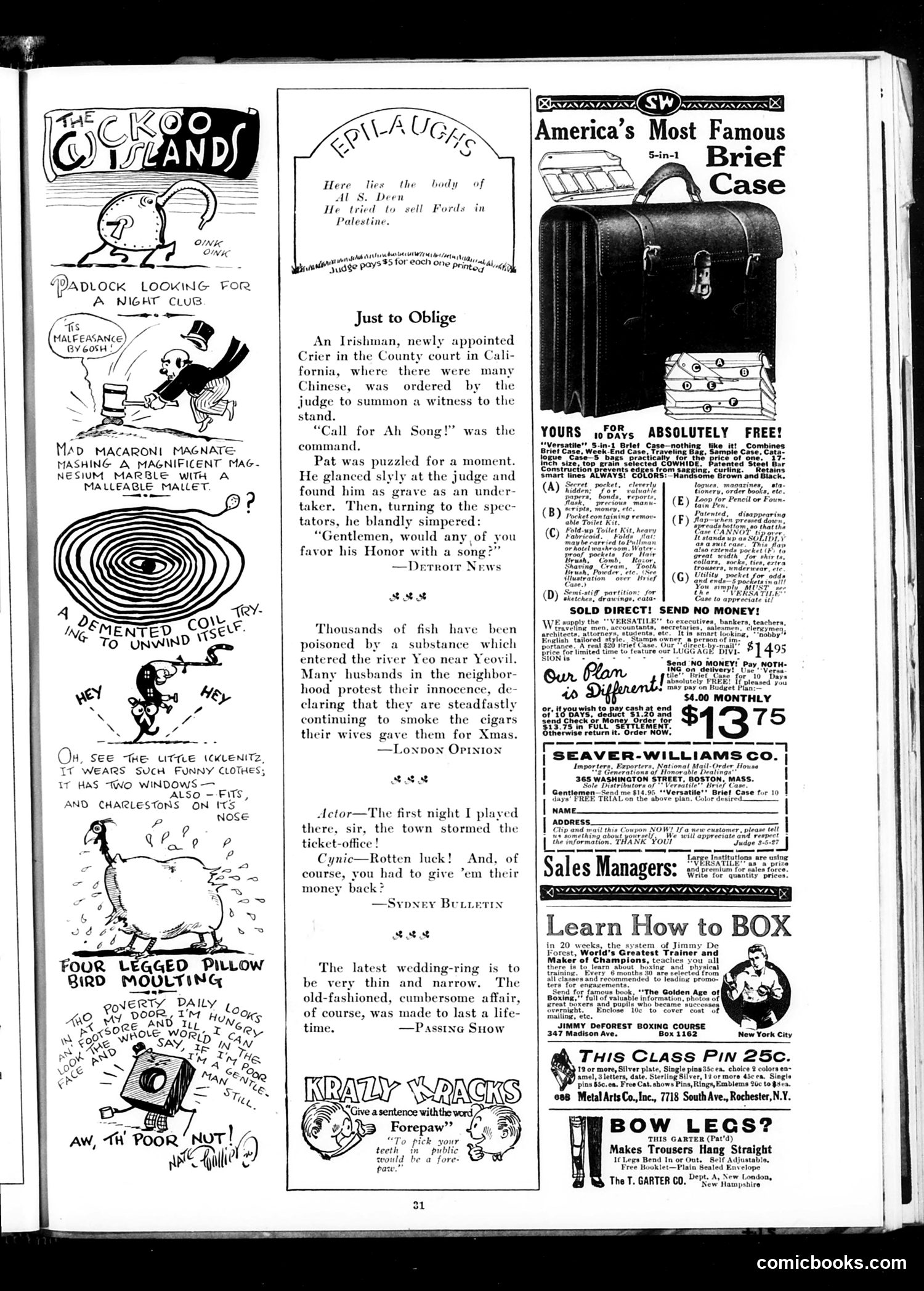
This page contains primarily **humorous comic strips and jokes** rather than political satire. "The Cuckoo Lands" strip on the left uses absurdist humor—depicting a character searching for a nightclub, then experiencing increasingly surreal situations (a spinning coil, a bird in fancy clothes). The center column offers brief jokes: an Irishman newly appointed court crier is confused when ordered to "Call for Ah Song," misinterpreting it as a request for entertainment rather than summoning a witness. This plays on ethnic humor common to the era. Another joke mocks husbands claiming their wives' terrible Christmas cigars aren't poisoning the local river. The page is **predominantly advertising**—the right side features product promotions (a "Brief Case," boxing lessons, garters for bow legs, a class pin), occupying more space than editorial content. The satire is light and domestic rather than political, reflecting Judge's focus on social observation and consumer culture humor for its middle-class readership.
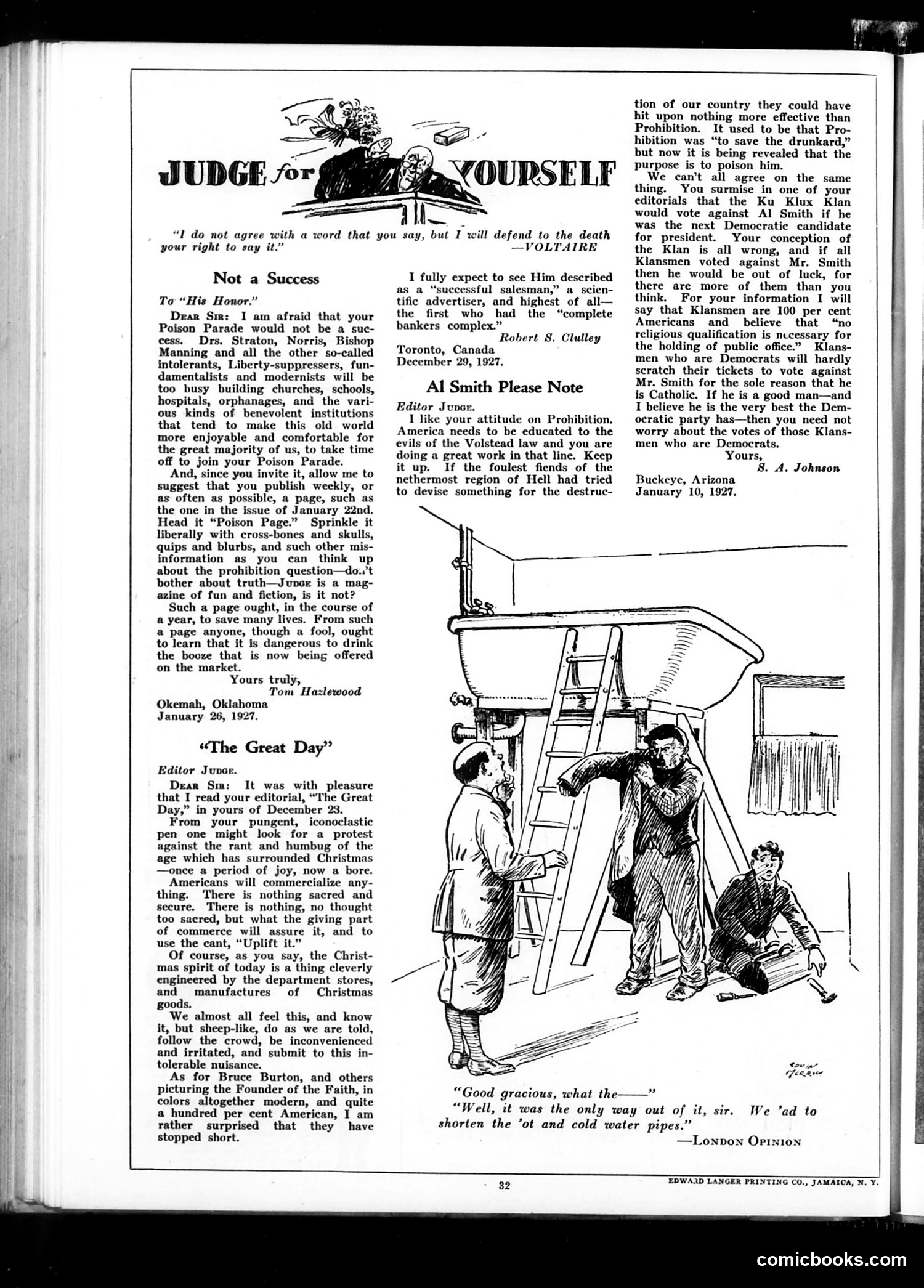
This 1927 *Judge* magazine page features a "letters to the editor" section addressing contemporary controversies. The main cartoon depicts workers installing plumbing, with the caption suggesting they shortened "old and cold water pipes"—a likely metaphor for Prohibition-era bootlegging or illicit alcohol distribution. The letters debate **Prohibition** (the Volstead Act), with writers criticizing the policy as ineffective and harmful. One correspondent defends the **Ku Klux Klan**, claiming Klansmen are "100 percent Americans," while another discusses opposition to Democratic candidate **Al Smith**, a Catholic politician the Klan opposed. The page also critiques **commercialization of Christmas** and religious intolerance among fundamentalists versus modernists—reflecting 1920s cultural tensions between traditional and progressive America. The Voltaire epigraph about defending free speech anchors these debates about American values during Prohibition's contentious decade.
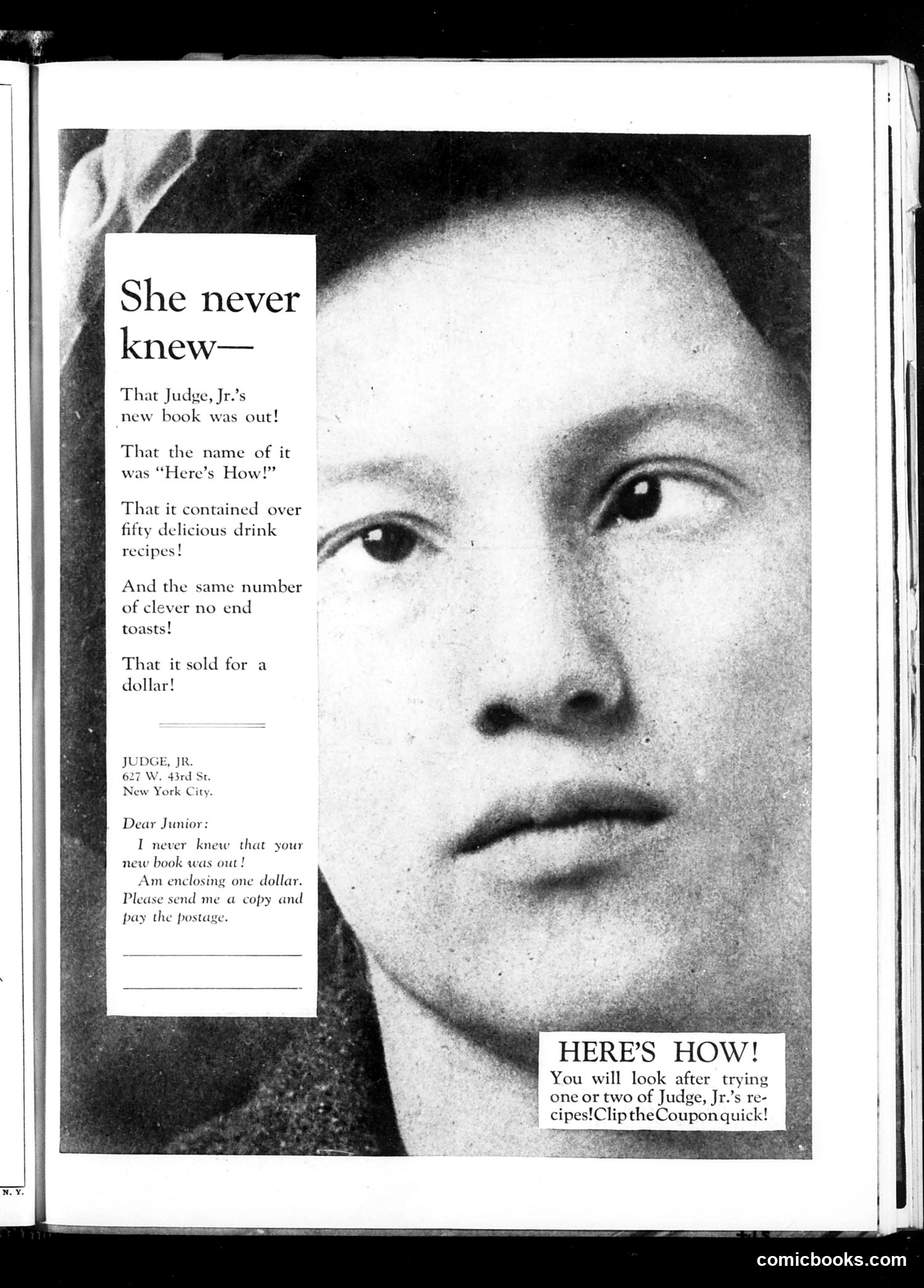
This is a **product advertisement** for a Judge magazine publication—not political satire. It advertises a cocktail recipe book called "Here's How!" published by Judge Jr., the humor magazine's subsidiary. The humor works through **ironic understatement**: a woman's surprised face accompanies the repeated refrain "She never knew" about the book's existence, despite its appealing features (50+ drink recipes, toasts, affordable dollar price). The joke is that such a desirable product somehow escaped her notice. **Historical context**: This appears from the **Prohibition era** (1920s-1930s), when alcohol was legally banned in the U.S. The irony deepens—a mainstream magazine openly advertises cocktail recipes during Prohibition, suggesting the law was widely flouted and openly mocked by publishers and readers alike. The advertisement uses the "coupon" sales technique common in vintage magazines, encouraging immediate purchase.
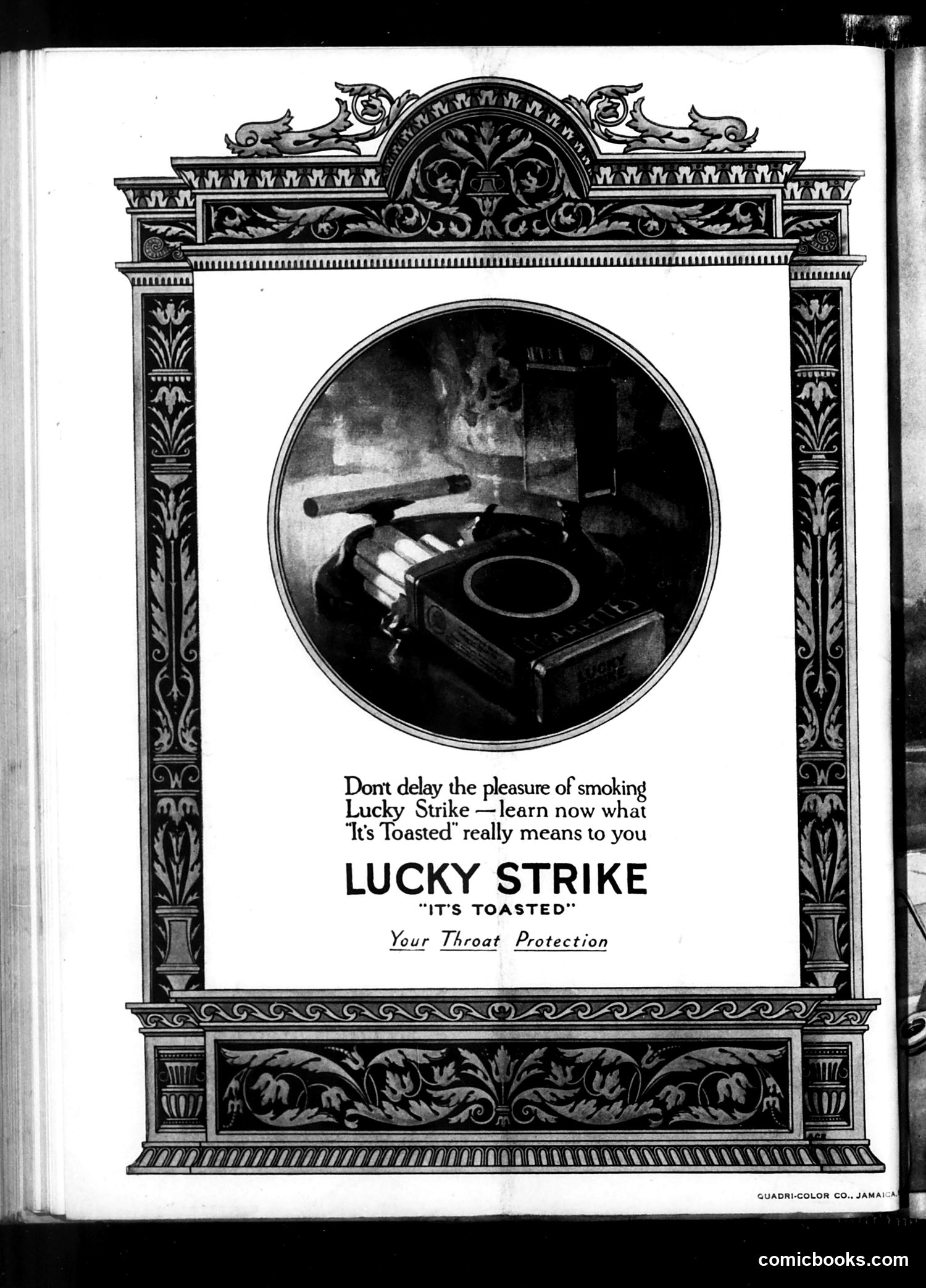
This is a cigarette advertisement rather than political satire. It promotes Lucky Strike cigarettes, emphasizing their "It's Toasted" slogan as a form of "Throat Protection." The circular image shows a telescope or scientific instrument, suggesting a quasi-scientific basis for the health claim. This reflects early-20th-century tobacco marketing that falsely claimed health benefits. The "toasting" process was marketed as a protective measure, playing on consumer anxieties about smoking's effects. Such ads were common in Judge magazine, which accepted tobacco advertising despite its satirical editorial content. The ornate decorative frame attempts to lend legitimacy and prestige to the product claim.