
Judge, 1927-03-05 · page 13 of 34
Judge — March 5, 1927 — page 13: what you’re looking at
What you’re looking at
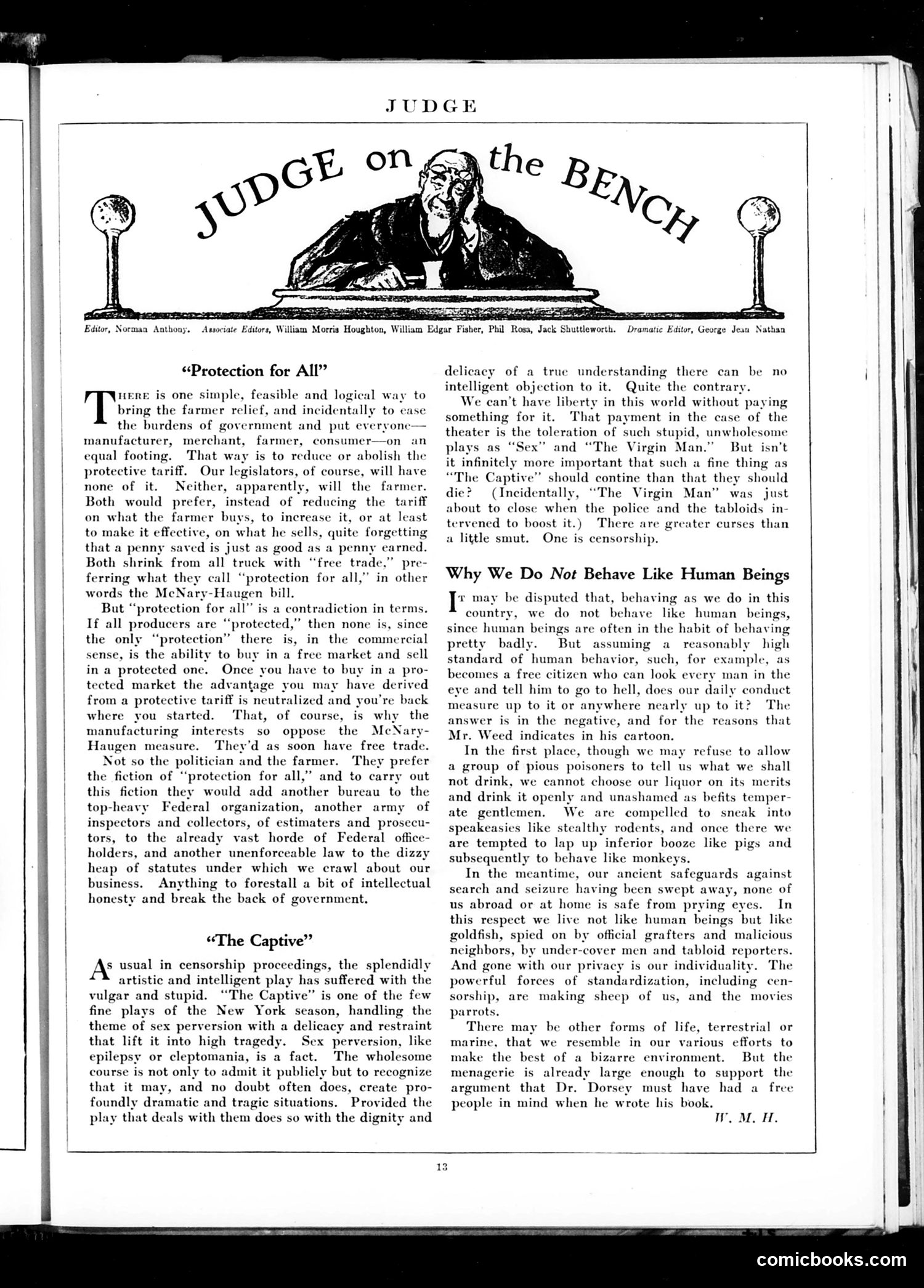
This page from *Judge* magazine contains three satirical editorials addressing 1920s American politics and culture. **"Protection for All"** attacks the McNary-Haugen farm bill, a protectionist measure supported by farmers and politicians. The writer argues that universal tariff protection is logically impossible—if everyone is protected, no one gains advantage. The satire targets both political groups for preferring comforting fictions to honest economic policy, and criticizes the expansion of federal bureaucracy needed to enforce such contradictions. **"The Captive"** defends an artistically serious Broadway play about homosexuality against censorship efforts by police and tabloid newspapers. The editor argues that mature theater handling serious subjects with dignity deserves protection, and that censorship represents a greater evil than occasional "smut." **"Why We Do Not Behave Like Human Beings"** (excerpt) appears to critique American hypocrisy and conformity pressuring citizens away from independent thought. All three pieces reflect *Judge's* satirical mission: mocking political inconsistency, defending artistic and intellectual freedom, and criticizing governmental overreach.
📄 Transcribed text from this page (OCR, searchable)
Machine-transcribed from the original scan — historical spelling and the odd misread are preserved.
JUDGE Editor, Norman Anthony, Associate Editors, William Morris Houghton, y “Protection for All” HERE is one simple, feasible and logical way to | bring the farmer relief, and incidentally to ease the burdens of government and put everyone— manufacturer, merchant, farmer, consumer—on an equal footing. That way is to reduce or abolish the protectiv iff. Our legislators, of course, will have none of Neither, apparently, will the farmer. Both would prefer, instead of reducing the tariff on what the farmer buys, to increase it, or at least to make it effective, on what he sells, quite forgetting that a penny saved is just as good as a penny earned. Both shrink from all truck with “free trade,”” pre- ferring what they call “protection for all,” in other words the McNary-Haugen bill. But “protection for all” is a contradiction in terms. If all producers are “protected,” then none is, since the only “protection” there is, in the commercial sense, is the ability to buy in a free market and sell in a protected one. Once you have to buy in a pro- tected market the advantage you may have derived from a protective tariff is neutralized and you're back where you started. That, of course, is why the manufacturing interests so oppose the MeN Haugen measure. They'd as soon have free trade. Not so the politician and the farmer. They prefer the fiction of ‘‘protection for all,” and to carry out this fiction they would add another bureau to the top-heavy Federal organization, another army of inspectors and collectors, of estimaters and prosecu- tors, to the already vast horde of Federal oftice- holders, and another unenforceable law to the dizzy heap of statutes under which we crawl about our business. Anything to forestall a bit of intellectual honesty and break the back of government. “The Captive” A usual in censorship proceedings, the splendidly artistic and intelligent play has suffered with the vulgar and stupid. “The Captive” is one of the few fine plays of the New York season, handling the theme of sex perversion with a delicacy and restraint that lift it into high tragedy. Sex perversion, like epilepsy or cleptomania, is a fact. The wholesome course is not only to admit it publicly but to recognize that it may, and no doubt often does, create pro- foundly dramatic and tragic situations. Provided the play that deals with them does so with the dignity and liam Edgar Fisher, Phil Rosa, Jack Shuttleworth. Dramatic Editor, George Jean Nathan delicacy of a true understanding there can be intelligent objection to it. Quite the contrary. We can’t have liberty in this world without paying something for it. That payment in the case of the theater is the toleration of such stupid, unwholesome plays as ‘Sex’ and “The Virgin Man.” But isn’t it infinitely more important that such a fine thing as “The Captive” should contine than that they should die? (Incidentally, “The Virgin Man” was just about to close when the police and the tabloids in- tervened to boost it.) There are greater curses than a little smut. One is censorship. no Why We Do Not Behave Like Human Beings I may be disputed that, behaving as we do in this country, we do not behave like human beings, since human beings are often in the habit of behaving pretty badly. But assuming a reasonably high standard of human behavior, such, for example, as becomes a free citizen who can look every man in the eye and tell him to go to hell, does our daily conduct measure up to it or anywhere nearly up to it? The answer is in the negative, and for the reasons that Mr. Weed indicates in his cartoon. In the first place, though we may refuse to allow a group of pious poisoners to tell us what we shall not drink, we cannot choose our liquor on its merits and drink it openly and unashamed as befits temper- ate gentlemen. We are compelled to sneak into speakeasies like stealthy rodents, and once there we are tempted to lap up inferior booze like pigs and subsequently to behave like monkeys. In the meantime, our ancient safeguards against search and seizure having been swept away, none of us abroad or at home is s from prying eyes. In this respect we live not like human beings but like goldfish, spied on by official grafters and malicious neighbors, by under-cover men and tabloid reporters. And gone with our privacy is our individuality. The powerful forces of standardization, including cen- sorship, are making sheep of us, and the movies parrots. There may be other forms of life, terrestrial or marine, that we resemble in our various efforts to mak But the support the free the best of a bizarre environment. menagerie is already large enough to argument that Dr. Dorsey must have people in mind when he wrote his book. W, ad a comicbooks.com