
Judge, 1927-03-05 · page 23 of 34
Judge — March 5, 1927 — page 23: what you’re looking at
What you’re looking at
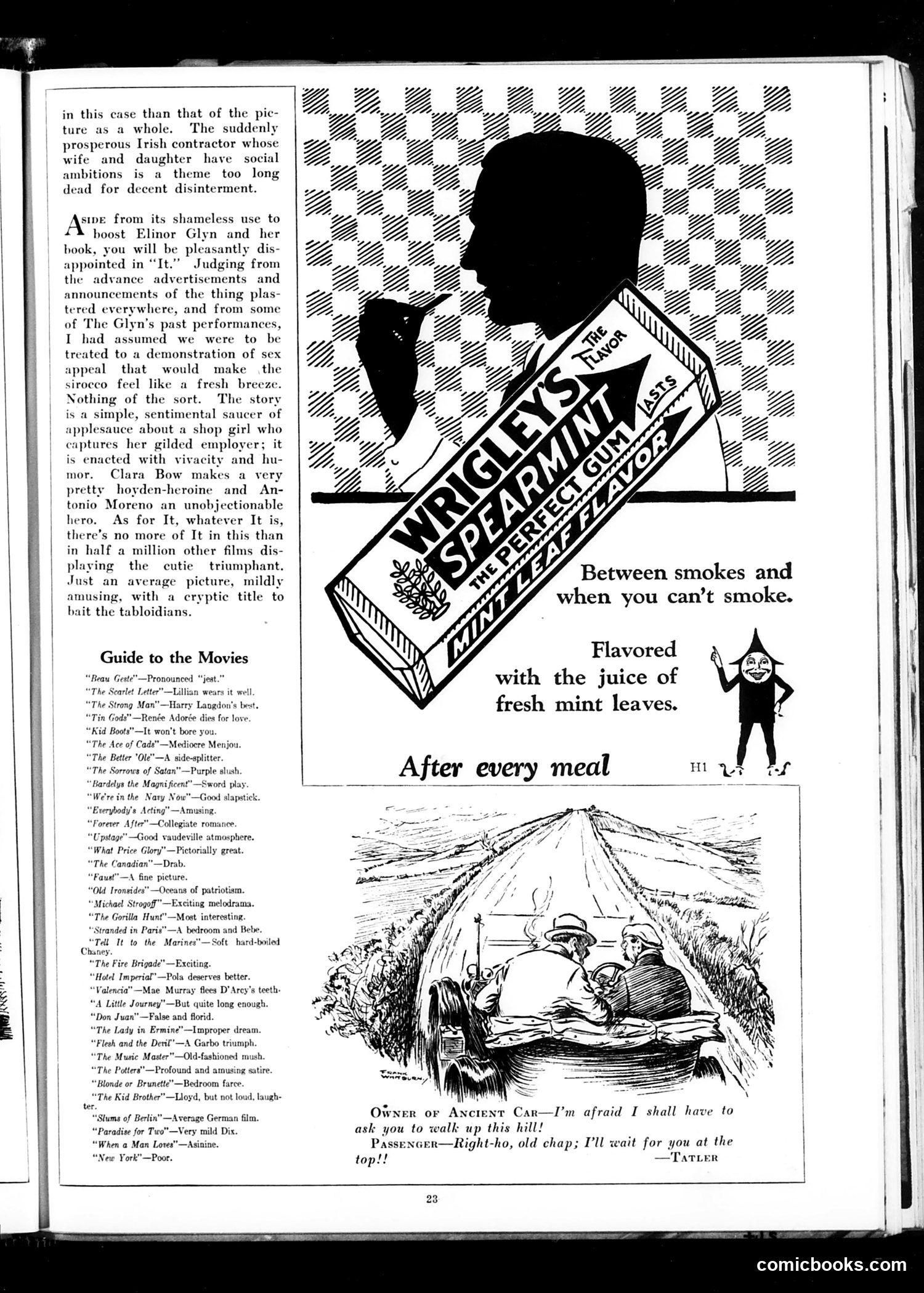
This page combines a **film review** with **advertisements and a cartoon**. The main review critiques the 1927 film "It," starring Clara Bow. The critic dismisses the movie as ordinary despite its notorious reputation—advance publicity suggested it would showcase bold sexuality (referencing author Elinor Glyn's concept of "It" as sex appeal). Instead, the reviewer finds it a sentimental story about a shop girl winning her wealthy employer, with competent but unremarkable performances. The satire lies in the gap between sensational marketing and mundane reality. The page also includes a "Guide to the Movies"—brief quips rating contemporary films, typical of Judge's entertainment coverage. The **cartoon** at bottom depicts an ancient, decrepit automobile struggling uphill. The owner asks the passenger to walk while the car climbs; the passenger agrees to wait at the top. The humor targets outdated vehicles barely functional—relatable to 1920s readers as automobiles became commonplace. The **Wrigley's Spearmint gum advertisement** occupies the upper right, using silhouette imagery to market mint-flavored gum for post-meal freshness.
📄 Transcribed text from this page (OCR, searchable)
Machine-transcribed from the original scan — historical spelling and the odd misread are preserved.
wares” in this case than that of the pic- ture as a whole. The suddenly prosperous Irish contractor whose wife and daughter have social ambitions is a_ then too long dead for decent disinterment. Aspe from its shameless use to boost Elinor Glyn and her book, you will be pleasantly dis- appointed in “It.” Judging from the advance advertisements and announcements of the thing plas- tered € and from some of The G performances, I had assumed we were to be treated to a demonstration of sex appeal that would make the sirocco feel like a fresh breeze. Nothing of the sort. The story is a simple, sentimental saucer of applesauce about a shop girl who captures her gilded employer; it is enacted with vi and hu- mor. Clara Bow makes a very pretty hoyden-heroine and An- tonio Moreno an unobjectionable hero. As for It, whatever It is, there’s no more of It in this than in half a million other films dis- playing the cutie triumphant. Just an average picture, mildly amusing, with a cryptic title to bait the tabloidians. Guide to the Movies “Beau Geste’—Pronounced “jest.” “The Scarlet ian wears it well ty Langdon’s best. “Tin Gods” —Renée Adorée dies for love “Kid Boots"—It won't bore you. “The Ace of Cads"—Mediocre Menjou. “The Better "Ol side-splitter. “The Sorrows of Satan"—Purple slush “Bardelys the Magni ficen word play. “We're in the Naty Now “Everybody's A “Forever Aft ood slapstick. —Amusing. “ollegiate romance. “Upstage"” Good vaudevill “What Price Glory"—Pictorially great. “The Canadian" —Drab. “Faust”—A fine picture. “Old Ironsides"” —Oceans of patriotism. “Michael Strogof”—Exciting melodrama. “The Gorilla Hunt"—Most interesting. “Stranded in Paris”—A bedroom and Bebe. “Tell It to the Marines"—Soft hard-boiled Chaney “The Fire Brigade" —Exciting. “Hotel Imperial” —Pola deserves better. “Valencia” —Mae Murray flees D'Arcy’s teeth- “4 Little Journey"—But quite long enough. “Don Juan" —False and florid. “The Lady in Ermine'—Improper dream. “Flesh and the Deril’—A Garbo triumph. “The Music Master"—Old-fashioned mush. “The Potters”—Profound and amusing satire. “Blonde or Brunette” —Bedroom farce. “The Kid Brother” —Lloyd, but not er. “Slums of Berlin" —Average German film. “Paradise for Two"—Very mild Dix. “When a Man Loves”—Asinine. “New York"—Poor. » \\ \\\ \ A W WN \ ZA, 2 \\ Between smokes and when you can’t smoke. Flavored with the juice of fresh mint leaves. Owner or Ancient Car—I’m afraid I shall have to ask you to walk up this hill! Passencen—Right-ho, old chap; I'll wait for you at the top!! —Tatier comicbooks.com