
Judge, 1927-03-05 · page 26 of 34
Judge — March 5, 1927 — page 26: what you’re looking at
What you’re looking at
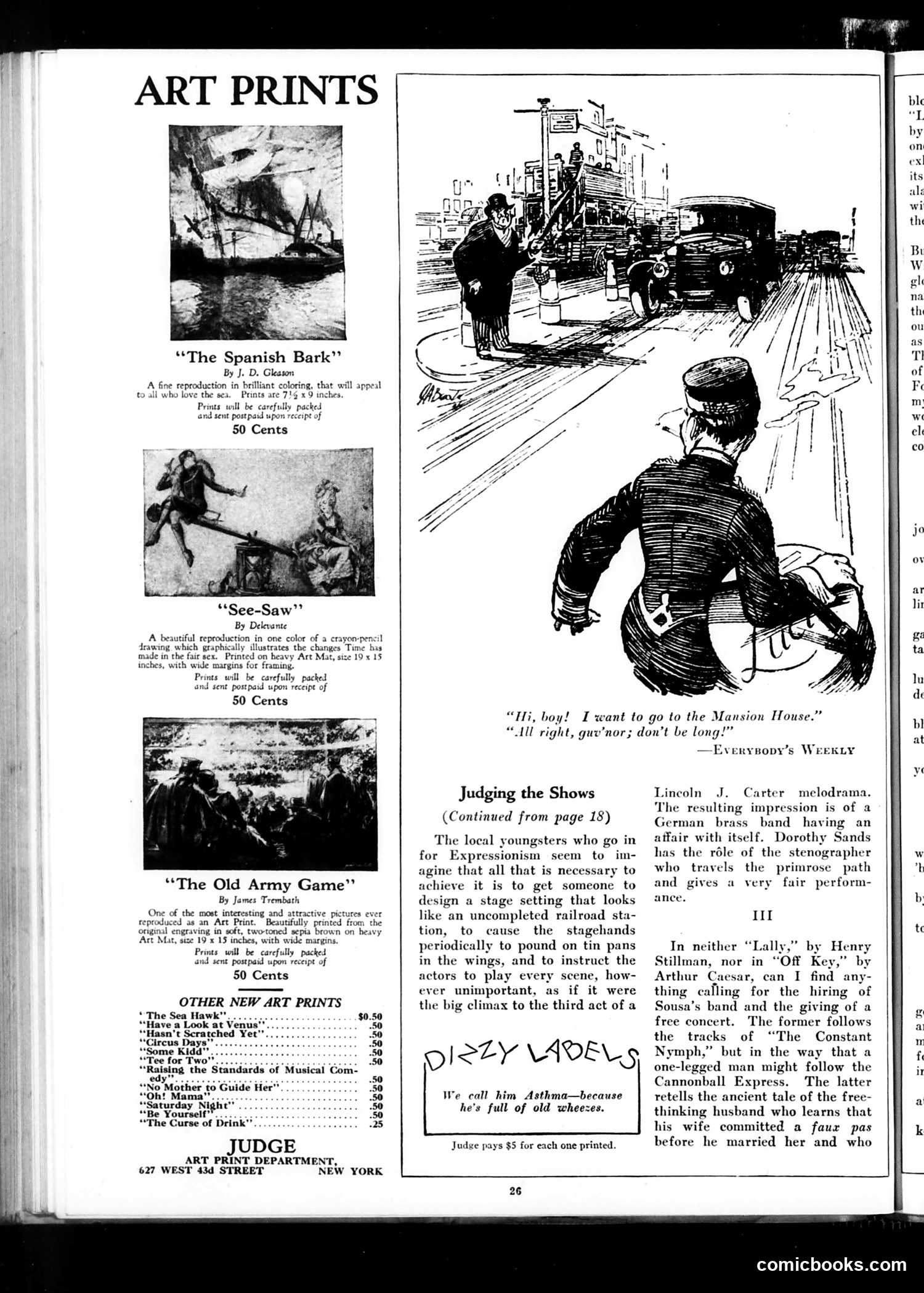
This page is primarily an **art print advertisement section** from Judge magazine, with one cartoon at the top right. The main cartoon shows a boy asking a cab driver to take him to "the Mansion House," with the driver agreeing but saying "don't be long!" The humor appears to reference the Mansion House as a well-known London location (likely the Lord Mayor's official residence), making it a joke about a brief errand or perhaps the boy's impatience—though the specific social context is unclear today. Below the cartoon, the "Judging the Shows" section critiques contemporary theater productions, particularly mocking **Expressionist stage design** as pretentious. The author sarcastically compares the overwrought theatrical style to "a German brass band having an affair with itself"—suggesting chaotic, self-indulgent excess. This reflects 1920s-era skepticism toward avant-garde European theatrical movements entering American stages. The page is otherwise dominated by **mail-order art print offerings** (50 cents each), typical advertising content for Judge magazine's revenue model.
📄 Transcribed text from this page (OCR, searchable)
Machine-transcribed from the original scan — historical spelling and the odd misread are preserved.
ART PRINTS “The Spanish Bark”’ By J. D. Gleason A fine reproduction in brilliant coloring, that will appeal to all who love the sea. Prints are 7'4 x 9 inches. Prints will be carefully packed and sent postpaid upon receipt of 50 Cents ‘“*See-Saw”’ By Delevante A beautiful reproduction in one color of a crayon drawing which graphically illustrates the changes m. the fair sex. Printed on heavy Art Mat, siz inches, with wide margins for framing. Prints will be carefully packed and sent postpaid upon receipe of 50 Cents has 19 x15 “The Old Army Game”’ By James Trembath One of the most interesting and attractive pictures ever reproduced as an Art Print. Beautifully printed from the original engraving in soft, two-toned sepia brown on heavy Art Mat, size 19 x 15 inches, with wide margins. Prints will be carefully packed and sent postpaid upon receipt of 50 Cents OTHER NEW ART PRINTS ‘ The Sea Hawk". .. $0. “Musical Com: hesess seeees JUDGE ART PRINT DEPARTMENT, 627 WEST 43d STREET NEW YORK “Ii, boy! I want to go to the Mansion House.” “All right, guv’nor; don’t be long! Judging the Shows (Continued from page 18) The local youngsters who go in for Expressionism seem to im- agine that all that is necessary to achieve it is to get someone to design a stage setting that looks like an uncompleted railroad sta- tion, to cause the stagehands periodically to pound on tin pans in the wings, and to instruct the actors to play every scene, how- ever unimportant, as if it were the big climax to the third act of a OIleZyY \LAOR..§ We call him Asthma—because he’s full of old wheezes. Judge pays $5 for each one printed. —Evenysopy’s WEE Lincoln J. Carter melodrama. The resulting impression is of a German brass band having an affair with itself. Dorothy Sands has the réle of the stenographer who travels the primrose path and gives a very fair perform- ance. Ill In neither “Lally,” by Henry Stillman, nor in “Of Key,” by Arthur Caesar, can I find any- thing calling for the hiring of Sousa’s band and the giving of a free concert. The former follows the tre of “The Constant Nymph,” but in the way that a one-legged man might follow the Cannonball Express. The latter retells the ancient tale of the free- thinking husband who learns that wife committed a faux pas before he married her and who comicbooks.com ar lin ye