
Judge, 1927-03-05 · page 18 of 34
Judge — March 5, 1927 — page 18: what you’re looking at
What you’re looking at
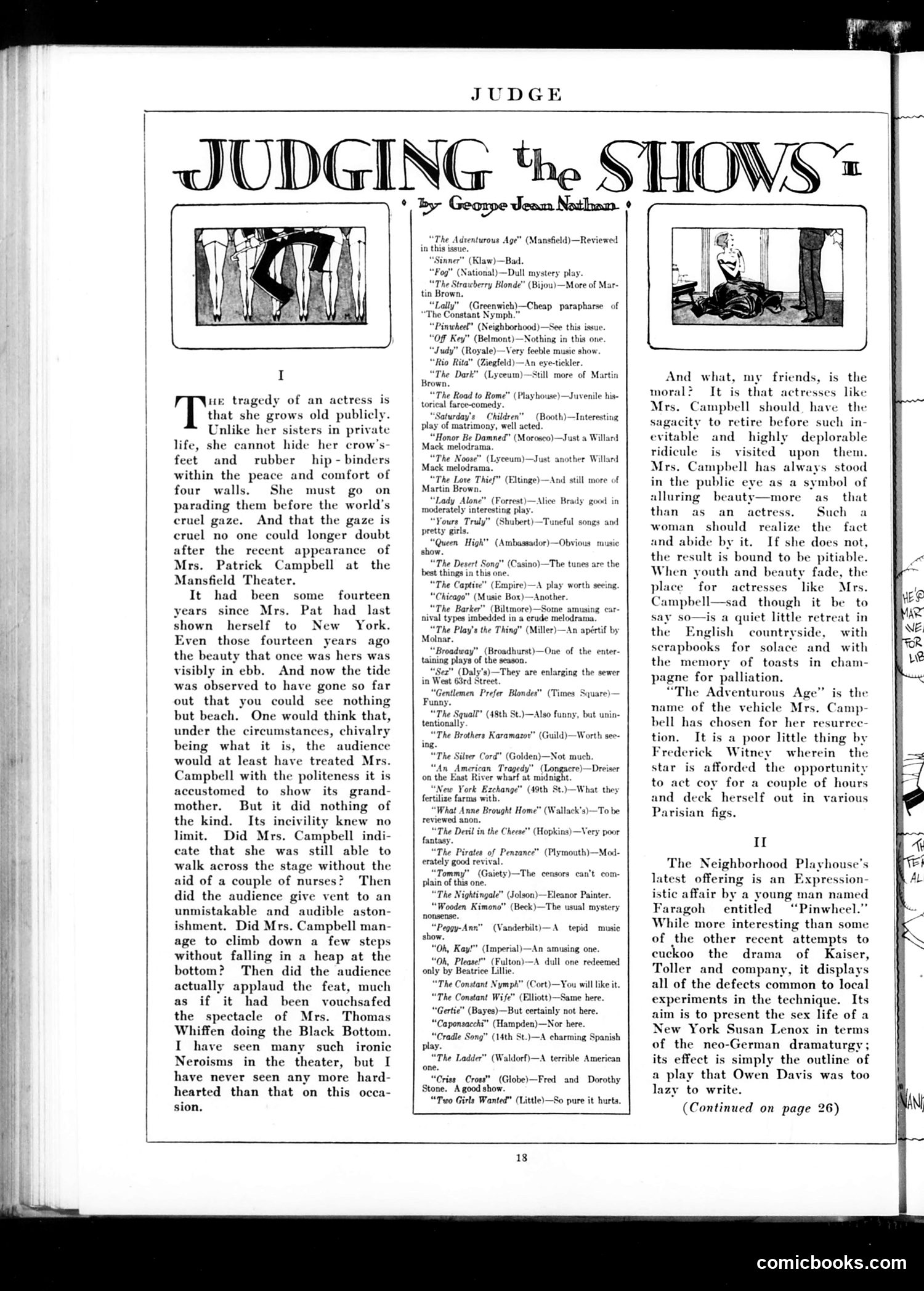
This page features theater critic George Jean Nathan's column reviewing Broadway productions. The main article (Part I) is a scathing critique of actress Mrs. Patrick Campbell's recent performance at the Mansfield Theater. **The Satire:** Nathan mocks the audience's cruel condescension toward Campbell, an aging actress. He notes that after fourteen years away, her physical decline is visible, yet the audience treats her like a museum exhibit—gasping when she walks unaided, applauding when she descends stairs without assistance. This is presented as absurdly insulting patronization masquerading as politeness. **The Point:** The piece satirizes society's harsh treatment of aging actresses who cannot hide their age behind closed doors, unlike private citizens. Nathan suggests the audience's "politeness" reveals only their unkindness and cruelty. The irony is that genuine decency would mean not drawing attention to her physical limitations. **Part II** briefly mentions the Neighborhood Playhouse's "Expressionistic" production "Pinwheel." The remainder is Nathan's capsule reviews of current Broadway shows, listing theaters and brief judgments (mostly critical).
📄 Transcribed text from this page (OCR, searchable)
Machine-transcribed from the original scan — historical spelling and the odd misread are preserved.
JUDGE JUDGING te SHOWS = I ug tragedy of an actress | that she grows old public Unlike her sisters in priv life, she cannot hide her crow’s- feet and rubber hip - binders within the peace and comfort of four walls. She must go on parading them before the world’s cruel gaze. And that the gaze is cruel no one could longer doubt after the recent appearance of Mrs. Patrick Campbell at the Mansfield Theater. It had been some fourteen years since Mrs. Pat had last shown herself to New York. Even those fourteen years ago the beauty that once was hers visibly in ebb. And now the tide was observed to have gone so far out that you could see nothing but beach. One would think that, under the circumstances, chivalry being what it is, the audience would at least have treated Mrs. Campbell with the politeness it is accustomed to show its grand- mother. But it nothing of the kind. Its ine’ y knew no limit. Did Mrs. Campbell indi- cate that she was still able to walk across the stage without the aid of a couple of nurses? Then did the audience give vent to an unmistakable and audible aston- ishment. Did Mrs. Campbell man- age to climb down a few steps without falling in a heap at the bottom? Then did the audience actually applaud the feat, much as if it had been vouchsafed the spectacle of Mrs. Thomas Whiffen doing the Black Bottom. I have seen many such ironic eroisms in the theater, but I have never seen any more hard- hearted than that on this occa- sion. by Georpe Jeam Nathan. » “The Adt in this issue. “Sinner” (Klaw)—Bad. '0g” (3 Phe Straw tin Brown, ally" (Greenwich) —Cheap parapharse of Constant Nymph.” “Pinwheel” (Neighborhood)—See this issue. “Of Key" (Belmont)—Nothing in this one. “Judy” (Royale)—Very feeble music show “Rio Rita” (Ziegfeld) —An eye-tickler. ‘he Dark" (Lyceumn)—Still more of Marti Brown. nturous Age” (Mansfield) —Reviewed !)—Dull mystery play. Blonde” (Bijou) —More of Mar- “The Road to Rome” (Playhouse)—Juvenile his- torieal farce-comedy. “Saturday's Children —(Booth)—Interesting play of matrimony, well acted. “Honor Be Damned” (Morosco)—Just a Willard jack melodrama “The Noose” (Lyceum)—Just another Willard jack melodrama. “The Lore Thief” (Eltinge)—And still e of “Lady Alone” (Forrest)—Alice Brady good in moderately interesting play. “Youre Truly” (: pretty girls. bert)—Tuneful songs and * (Ambassador)—Obvious music "" (Casino)—The tunes are the best things in “The Captive” (Empire)—A play worth seeing icago” (Music Box)—Another. “The Barker” (Biltmore)—Some amusing car- al types imbedded in a erude melodrama. “The Play's the Thing” (Miller)—An apértif by Molnar. “Broadway” (Broadhurst)—One of the enter- taining plays of the season. ez” (Daly’s)—They are enlarging the sewer in West 63rd Street. “Gentlemen Prefer Blondes (Times Square’ Funny. “The Squall” (48th St.)—Also funny, but unin- tentionally “The Brothers Karamazo” (Guild) —Worth see- ing. “The Silter Cord” (Golden)—Not much. “An American Tragedy" (Longacre) —Dreiser on the East River wharf at midnight. New York Exchange" (49th St.)—What they fertilize farms with. “What Anne Brought Home” (Wallack’s)—To be reviewed anon. “The Deril in the Cheese” (Hopkins) —Very poor fantasy “The Pirates of Penzance” (Plymouth)—Mod- erately good revival “Tommy” (C plain of this one. “The Nightingale” (Jolson)—Eleanor Painter. “Wooden Kimono” (Beck)—The usual mystery nonsense. yiPeamr-Amn” (Vanderbilt) A tepid musi show. “Oh, Kay!” (Imperial) —An amusing, one. “Oh, Please!” (Fulton)—A dull one redeemed only by Beatrice Lillie “The Constant Nymph” (Cort)—You will like it. “The Constant Wife" (Elliott)—Same here. “Gertie” (Bayes)—But certainly not here. “Caponsacchi" (Hampden)—Nor here. “Cradle Song” (14th St.)—A charming Spanish play. “The Ladder” (Waldorf)—A terrible American one. jiety)—The censors can't com- ‘riss Cross” (Globe)—Fred and Dorothy Stone. A good show. “Two Girls Wanted” (Little)—So pure it hurts. And what, my friends, is the mora It is that actresses li Mrs. Campbell should have the si sity to retire before such in- evitable and highly deplorable ridicule is visited upon them. Mrs. Campbell has always stood in the public alluring beauty—more "as th: than as an_ actress. Such woman should realize the fact and abide by it. If she does not, the result is bound to be pitiable. When youth and beauty fade, the place “for actresses like Mrs. Campbell—sad though it be to y so—is a quiet little retreat in the English countryside, with scrapbooks for solace and with the memory of toasts in cham- pagne for palliation. “The Adventurous Age” is the name of the vehicle Mrs. Camp- bell has chosen for her resurre tion. It is a poor little thing by Frederick Witney wherein the star is afforded the opportunity to act coy for a couple of hours and deck herself out in various Parisian figs. » as a symbol of t Se II The ighborhood F latest offering is an Expression- istic affair by a young man named Faragoh entitled “Pinwheel.” While more interesting than some of the other recent attempts to cuckoo the drama of Kaiser, Toller and company, it displays all of the defects common to local experiments in the technique. Its aim is to present the sex life of a New York Susan Lenox in terms of the neo-German dramaturgy; its effect mply the outline of a play that Owen Davis was too lazy to write. ayhouse’s (Continued on page 26) comicbooks.com