
A complete issue · 36 pages · 1926
Judge — September 4, 1926
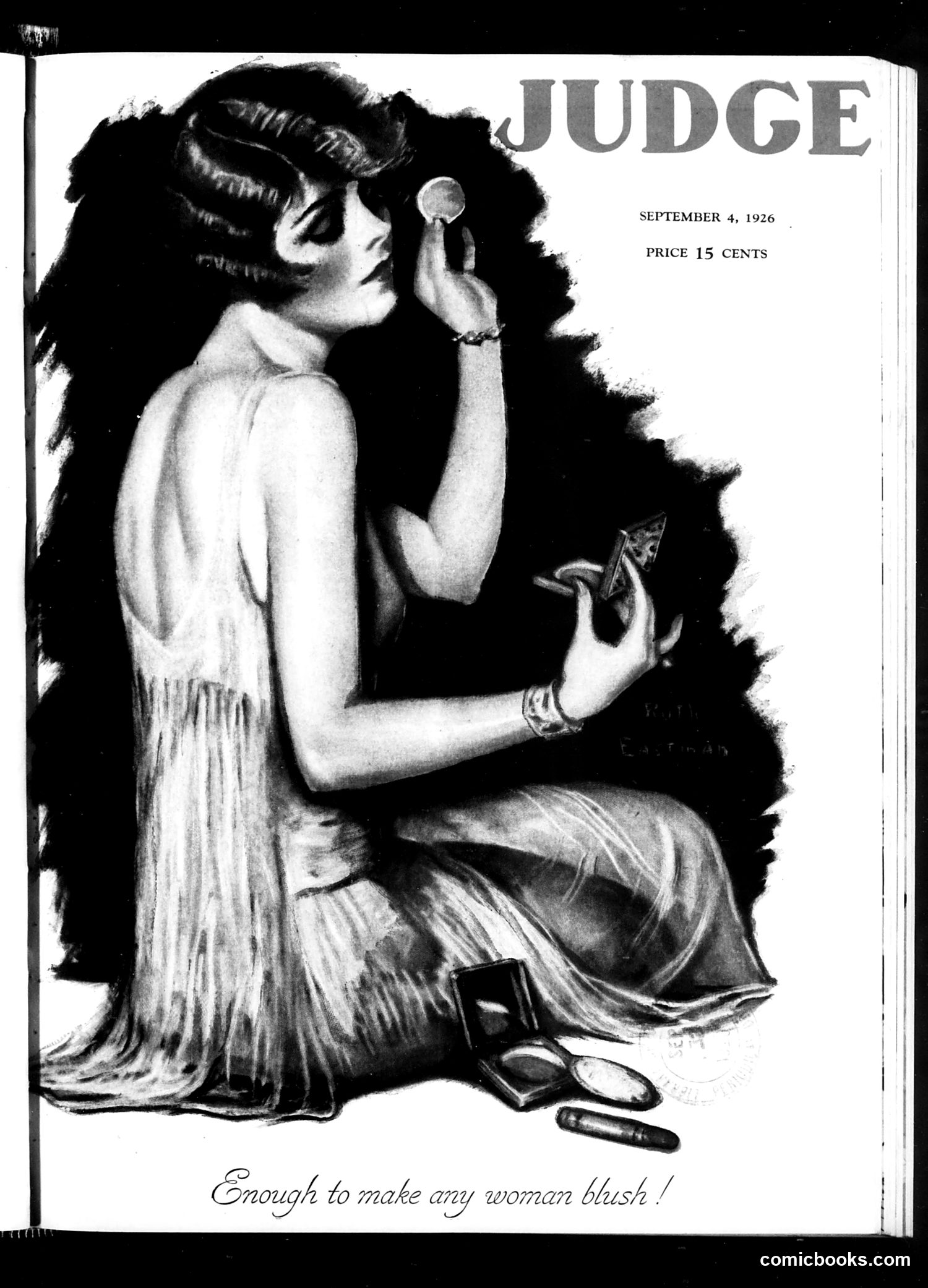
This is a cosmetics advertisement disguised as satirical content. The illustration shows a fashionable 1920s woman applying makeup, with the caption "Enough to make any woman blush!" The joke plays on the double meaning of "blush"—both the cosmetic product and the physical reaction of embarrassment. The woman's confident pose and elaborate makeup application suggest the modern "flapper" aesthetic of the Jazz Age era. The scattered cosmetic items (compact, lipstick) emphasize the commercial focus. This reflects 1926 attitudes: makeup was still somewhat controversial for respectable women, making cosmetics advertising humorous and slightly risqué. The satirical framing allowed Judge to advertise beauty products while maintaining editorial distance through humor—a common advertising strategy of the period.
This is a promotional advertisement rather than a political cartoon. Judge magazine is soliciting readers to send in "lucky" one dollar bills—specifically those featuring: - A portrait of the first U.S. President (George Washington) - The word "Washington" containing exactly ten letters - A green back In exchange for mailing in a qualifying bill with a completed coupon, readers would receive ten weeks of Judge magazine ("The World's Wittiest Weekly"). The ad promises discretion—no publication of names or photographs. This appears to be a straightforward circulation-building promotion rather than satire, using the appeal of collecting rare currency variants as an incentive for magazine subscriptions. The humor lies mainly in treating mundane dollar bill variations as "lucky" finds worthy of exchange.
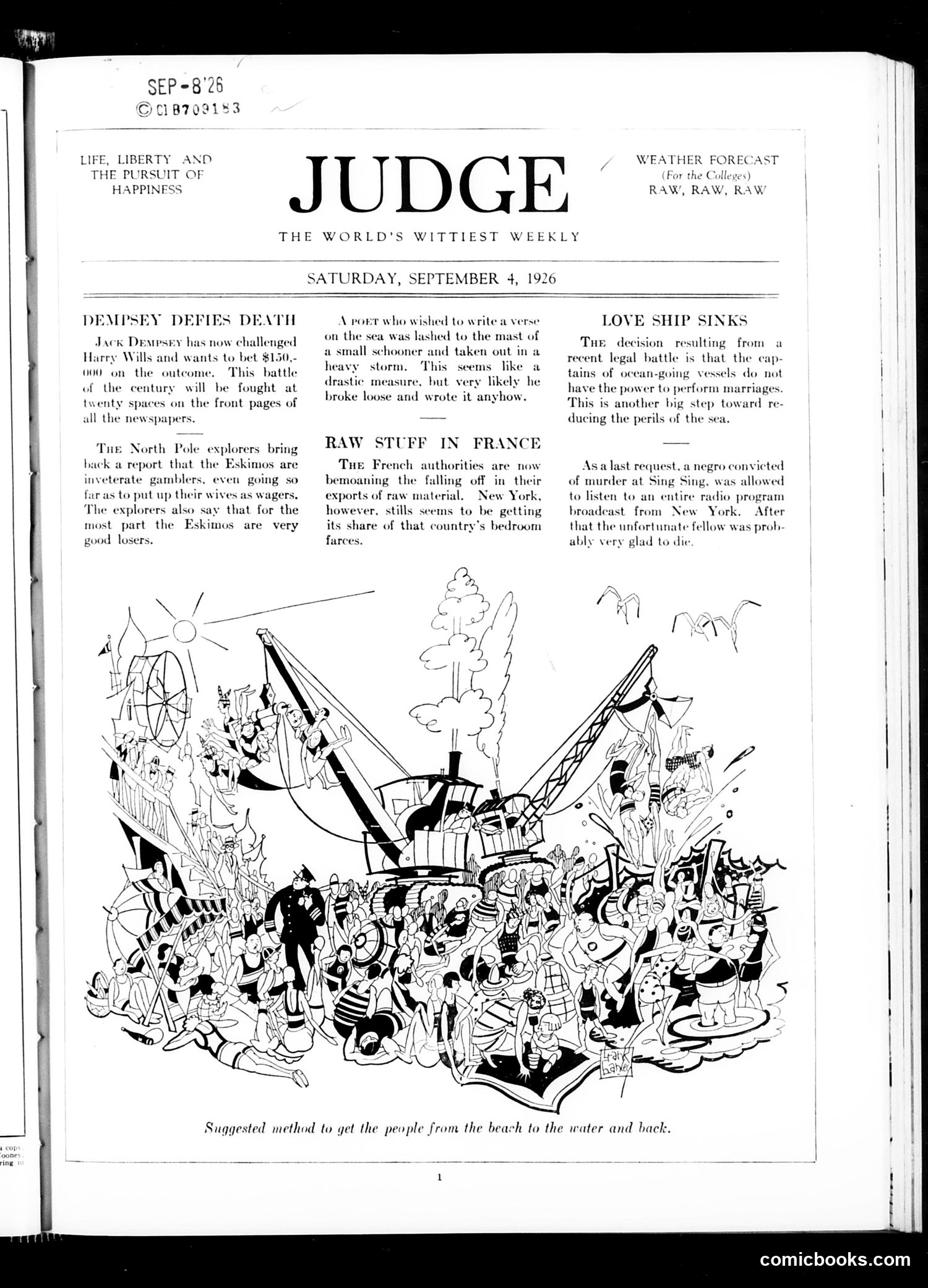
The main cartoon depicts a chaotic beach scene with the caption "Suggested method to get the people from the beach to the water and back." The central satire appears to mock overcrowded public beaches and bathing culture during the 1920s. The elaborate contraption—featuring pulleys, cranes, and mechanical devices amid a dense crowd of beachgoers—humorously exaggerates what would be needed to manage the masses efficiently. This reflects the era's growing popularity of seaside recreation and the challenges of managing crowds at public beaches. The three article headlines address contemporary news: Jack Dempsey's boxing challenge, French concerns about raw materials exports, and a legal case involving a condemned man's final broadcast request—typical of Judge's satirical coverage of current events.
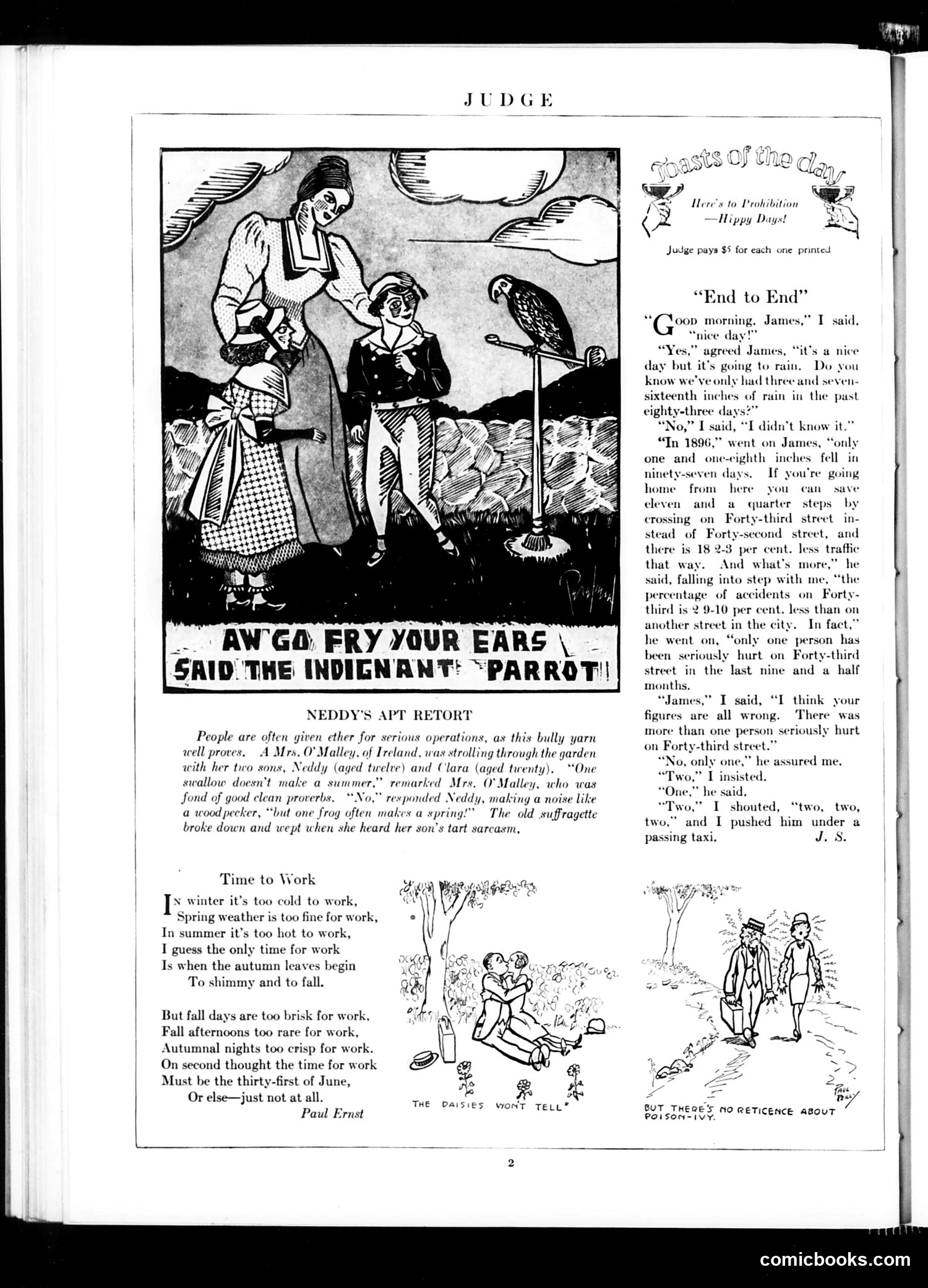
The main cartoon "Awga Fry Your Ears, Said the Indignant Parrot!" appears to be a domestic humor piece. A woman and man are shown with a parrot, apparently engaged in a quarrel about household matters. The indignant parrot's outburst serves as comic commentary—likely suggesting that even the bird finds their bickering absurd or tiresome. The accompanying "Neddy's Apt Retort" anecdote describes Mrs. O'Malley's household incident where her son made a noise, prompting her sarcastically to assume another son made a spring. It's gentle domestic satire about family life and children's mischief. The poem "Time to Work" by Paul Ernest is melancholic social commentary—suggesting no season is truly appropriate for labor. The accompanying sketches show leisure activities, implying workers shirk responsibilities year-round.
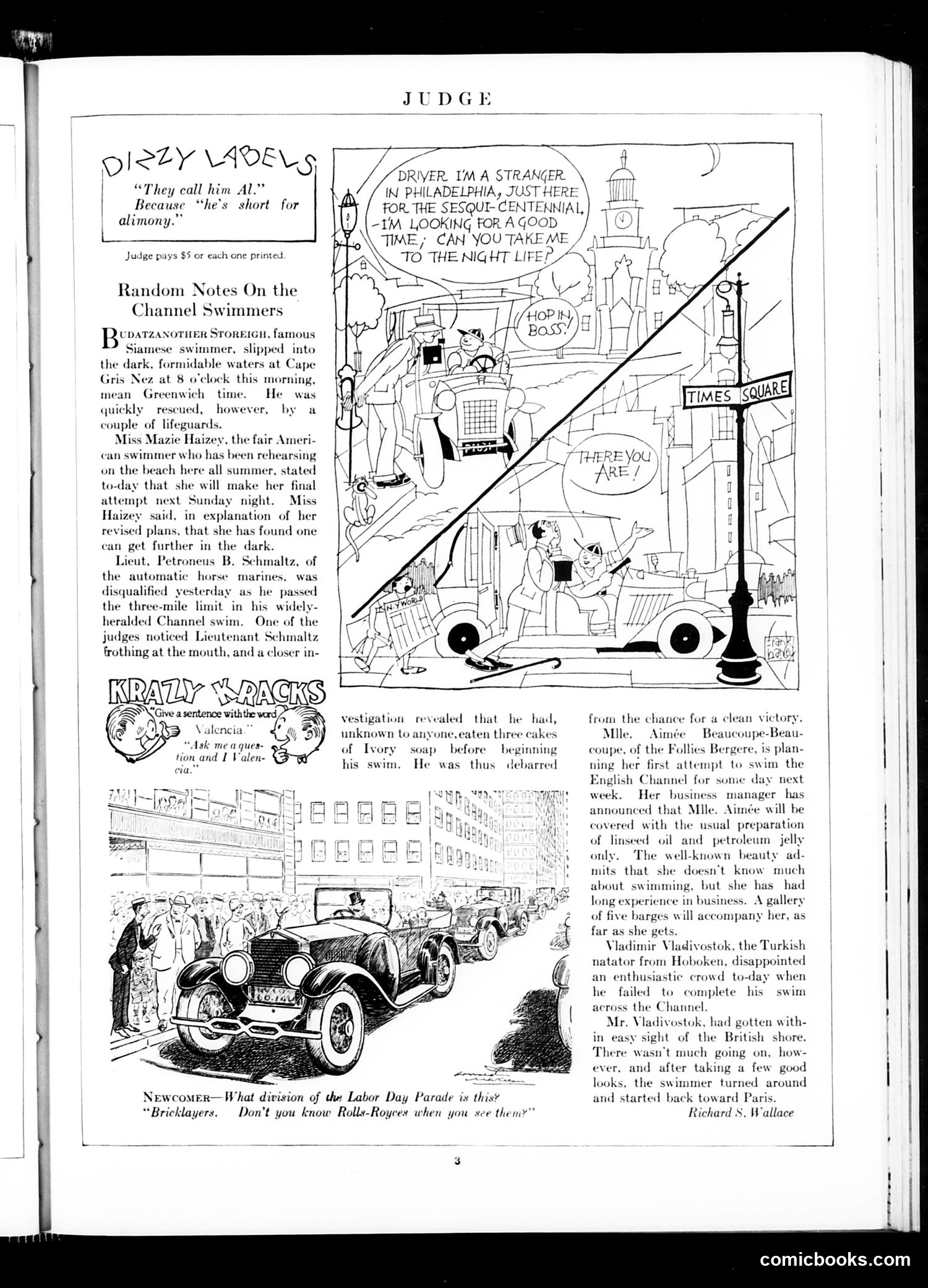
This page contains three distinct humor sections: 1. **"Dizzy Labels"** - A joke about calling someone "Al" because "he's short for alimony," satirizing divorce culture and alimony payments. 2. **"Random Notes on Channel Swimmers"** - Reports on 1920s English Channel swimming attempts, including Miss Marie Hazeltie's training and Lieutenant Petrenius B. Schmultz's disqualification for eating three cakes of Ivory soap beforehand. This mocks the era's amateur endurance athletes and their eccentric preparations. 3. **"Krazy Kracks"** - A Valencia joke and a Labor Day Parade cartoon showing fancy automobiles (likely Rolls-Royces), satirizing wealth disparities and working-class aspirations during the post-WWI period. The page reflects Jazz Age social commentary on divorce, sports fads, and class divisions.
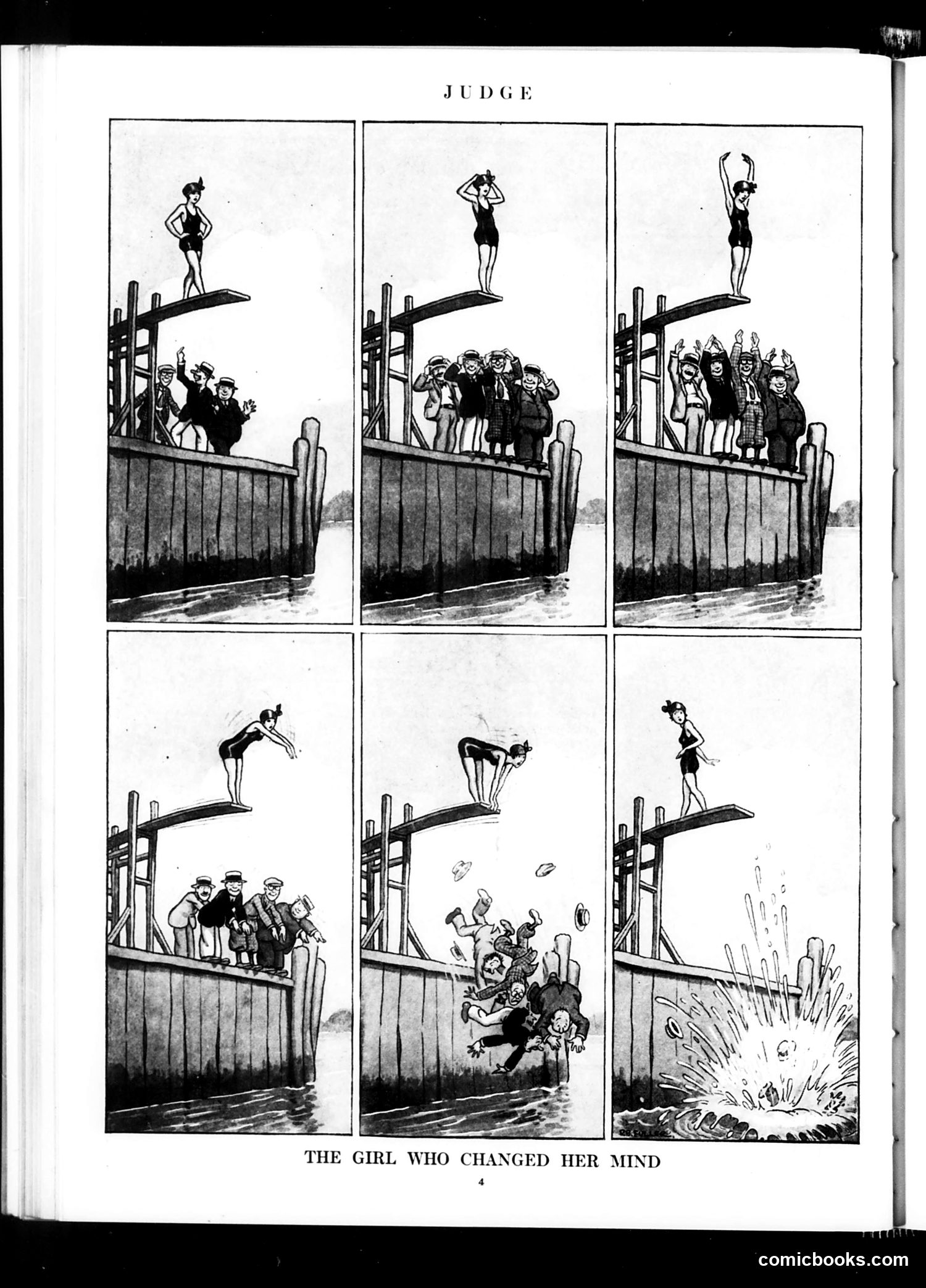
This is a satirical six-panel comic titled "The Girl Who Changed Her Mind," depicting a woman on a diving board above a crowd of onlookers. The narrative progresses from the woman posing confidently, to appearing hesitant, to diving while the crowd reacts with alarm, to her executing the dive, and finally to a splash suggesting impact or chaos below. The satire likely critiques fickleness or indecision—possibly commenting on women's suffrage debates or changing social attitudes of the era. The crowd's shocked reaction and the dramatic finale suggest the comic mocks either the woman's vacillation or public reaction to female independence. Without additional context, the specific political target remains unclear, though Judge typically targeted contemporary social controversies.
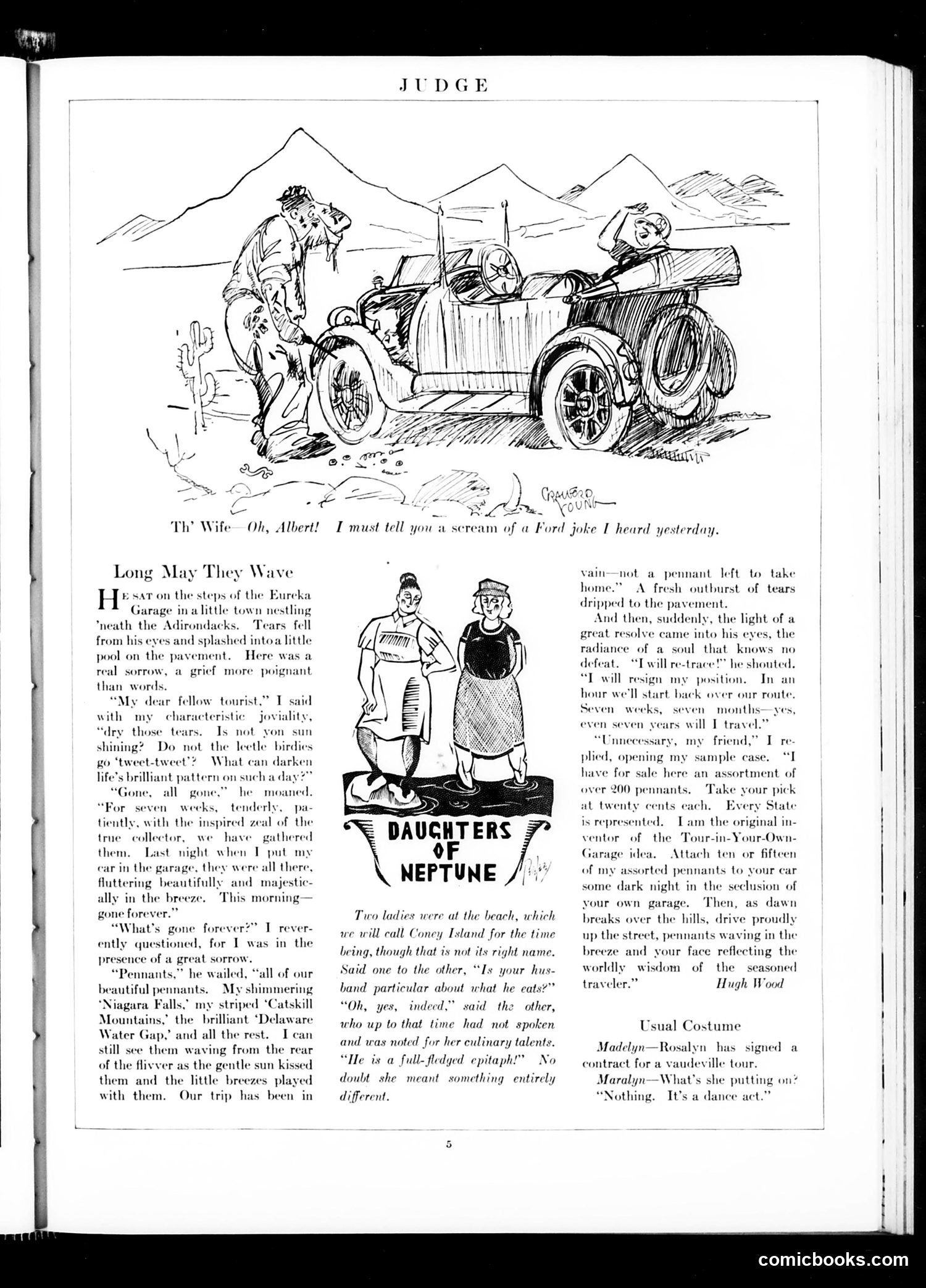
The top cartoon depicts a couple in a Model T Ford in a desert landscape. The wife tells Albert she must share "a scream of a Ford joke I heard yesterday," suggesting this is humor about early automobiles and their notorious unreliability or peculiar behavior—a common satirical target of the era. The middle section, "Daughters of Neptune," advertises a theatrical production featuring two women, likely promoting a stage show or musical performance. The bottom story, "Long May They Wave," appears to be sentimental fiction about tourists visiting Niagara Falls and the Adirondacks. It concludes with theatrical gossip about performers "Madellyn" and "Maralyn" and their vaudeville tour, suggesting this page mixes automotive humor, entertainment advertising, and light theatrical commentary rather than serious political satire.
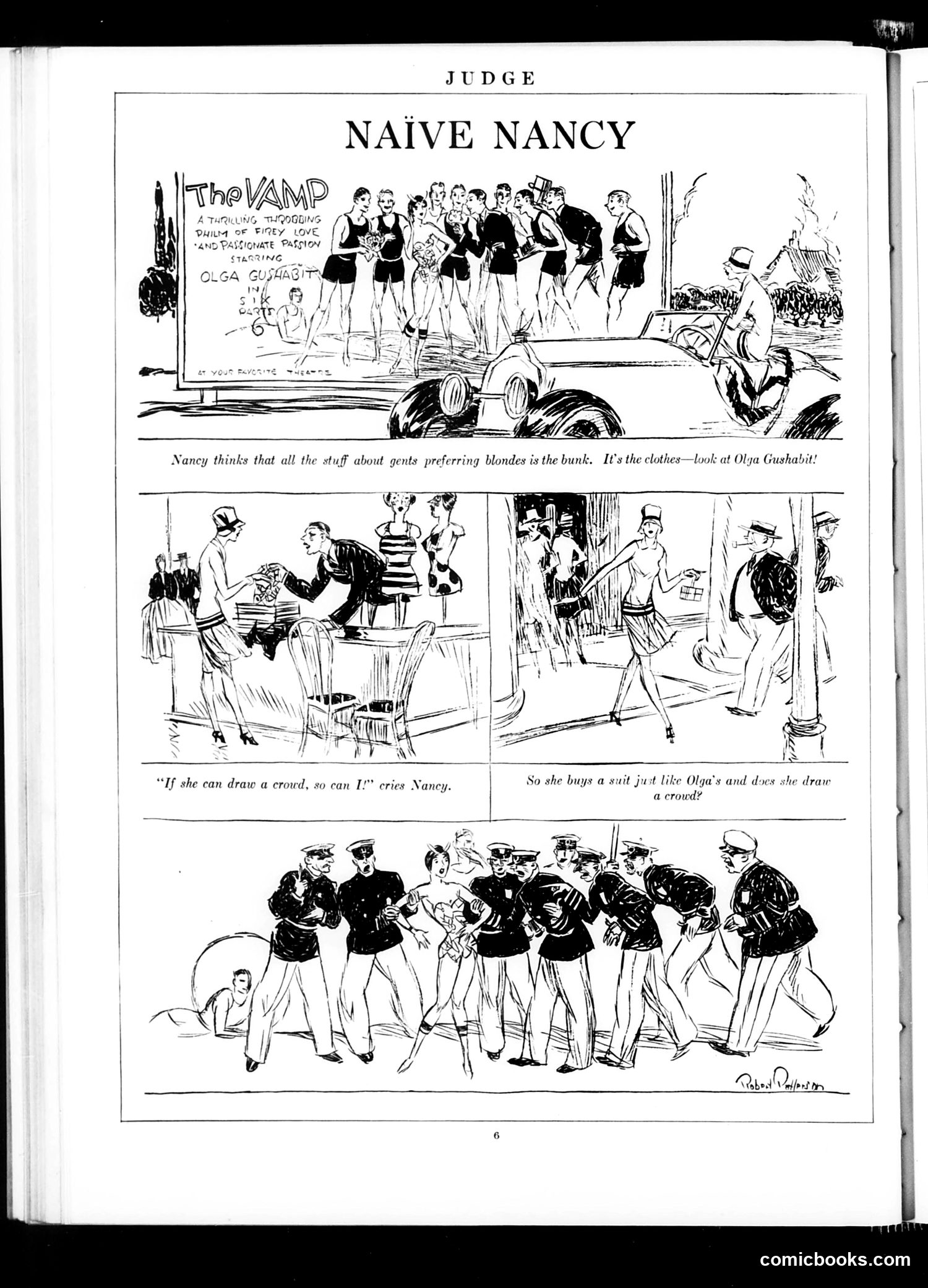
This comic mocks a character named Nancy who naively believes that fashion alone attracts attention. The satire centers on "Olga Gushabit" (likely a reference to a glamorous celebrity or public figure of the era), whose popularity Nancy attributes solely to her clothing. The joke's progression shows Nancy purchasing an identical suit, expecting to draw crowds of admirers as Olga does. The final panel reveals the satire's point: surrounding herself with uniformed men (appearing to be sailors or military personnel) doesn't create genuine attraction or social status—it only creates an awkward gathering. The comic satirizes feminine vanity and the misconception that copying a fashionable woman's wardrobe can replicate her social success, suggesting that popularity depends on factors beyond mere imitation of clothes.
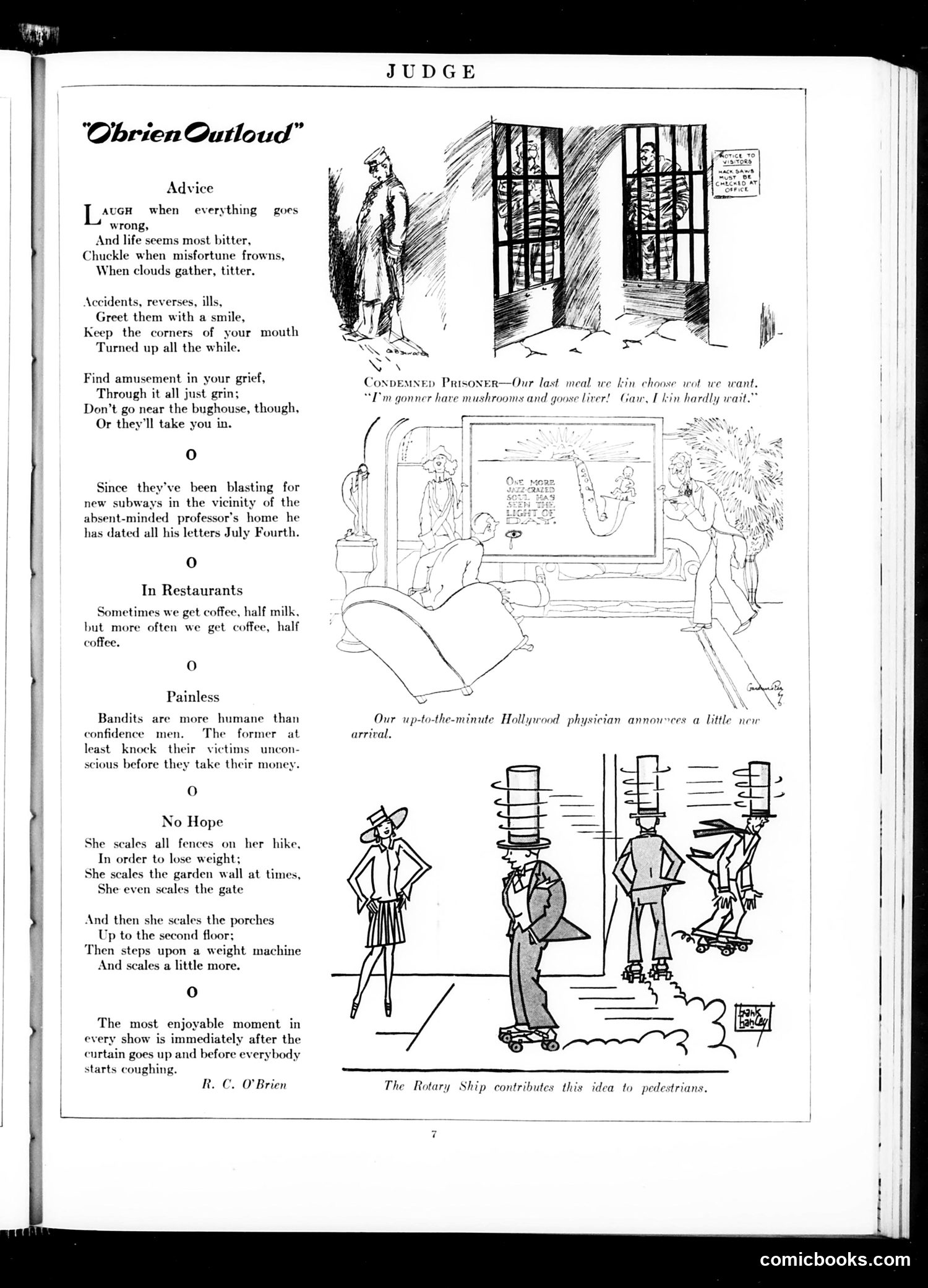
This page from Judge magazine ("Obrien Outloud" column) collects brief humorous observations on American life, likely from the 1920s-1930s based on style and references. The jokes target contemporary frustrations: absent-minded professors (stock character type), poor restaurant coffee quality, confidence men and bandits, and obsessive dieting fads among women. One cartoon shows pedestrians on "roller skates" (likely referring to newfangled skating or mobility devices), satirizing modern transportation crazes. The "Condemed Prisoner" cartoon mocks prison meal complaints. The "Hollywood physician" joke references tinseltown's then-notorious trend of dubious medical practitioners. The "No Hope" poem ridicules women's weight-loss obsession—she climbs fences and scales multiple times daily yet gains nothing, mocking both the futility of crash dieting and women's appearance anxiety. The opening "Advice" column's central joke: stay cheerful through hardship, but *not* so much that you seem insane and get institutionalized—a darkly comic commentary on mental health attitudes of the era.
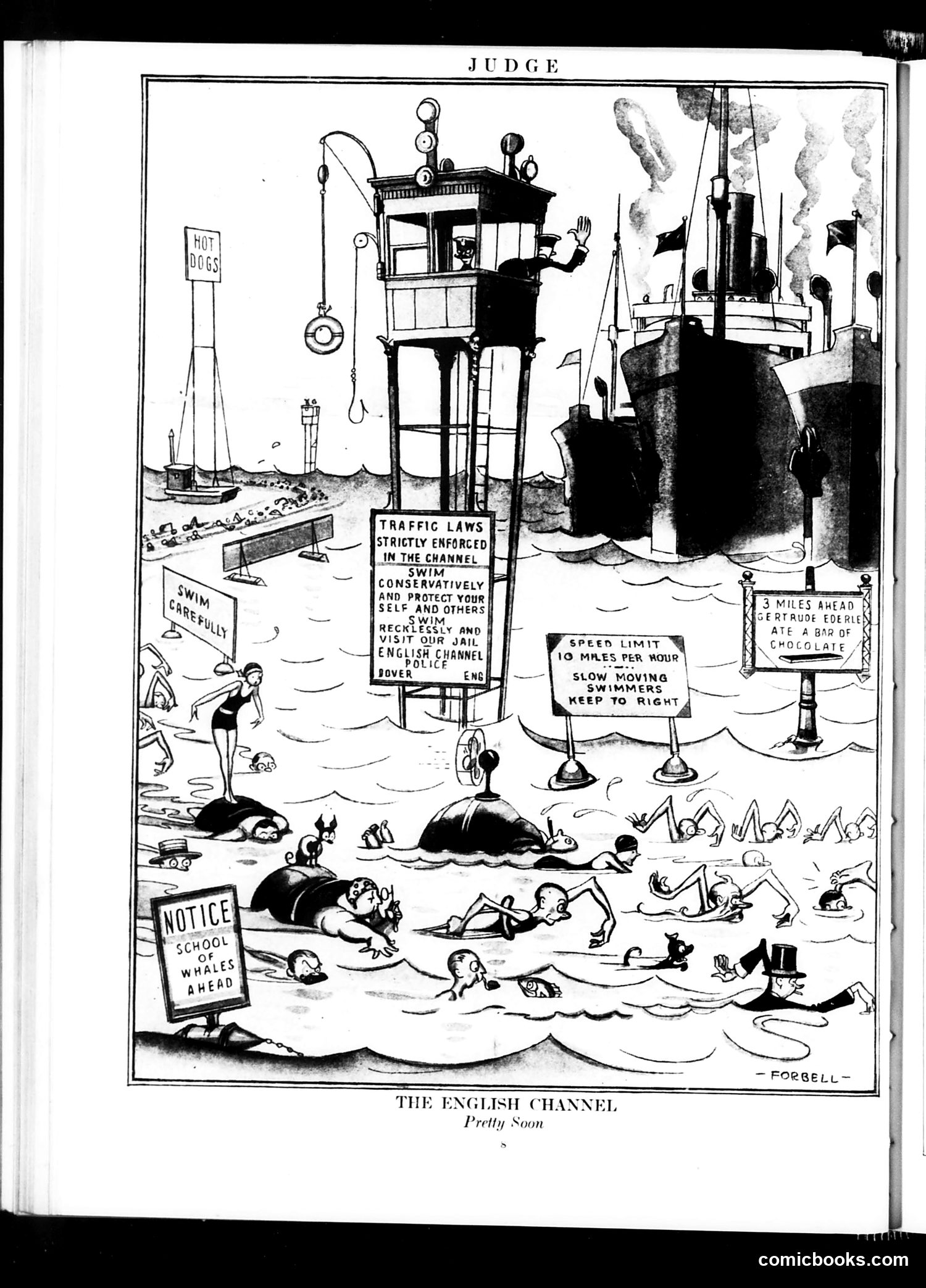
This satirical cartoon by Forbell depicts the English Channel as if it were a heavily regulated waterway with traffic laws, speed limits, and warning signs—treating swimmers like vehicular traffic. The cartoon references **Gertrude Ederle**, the famous swimmer visible on the right, who became the first woman to successfully swim the English Channel (in 1926). The satire mocks the absurdity of imposing bureaucratic regulations and traffic rules on open-water swimming, with signs for "School of Whales," speed limits (10 mph), and even a "jail" for violations. The joke targets over-regulation and the intrusion of modern, bureaucratic governance into natural activities. It's unclear whether the cartoon critiques excessive regulation generally or responds to specific contemporary proposals about Channel safety protocols.
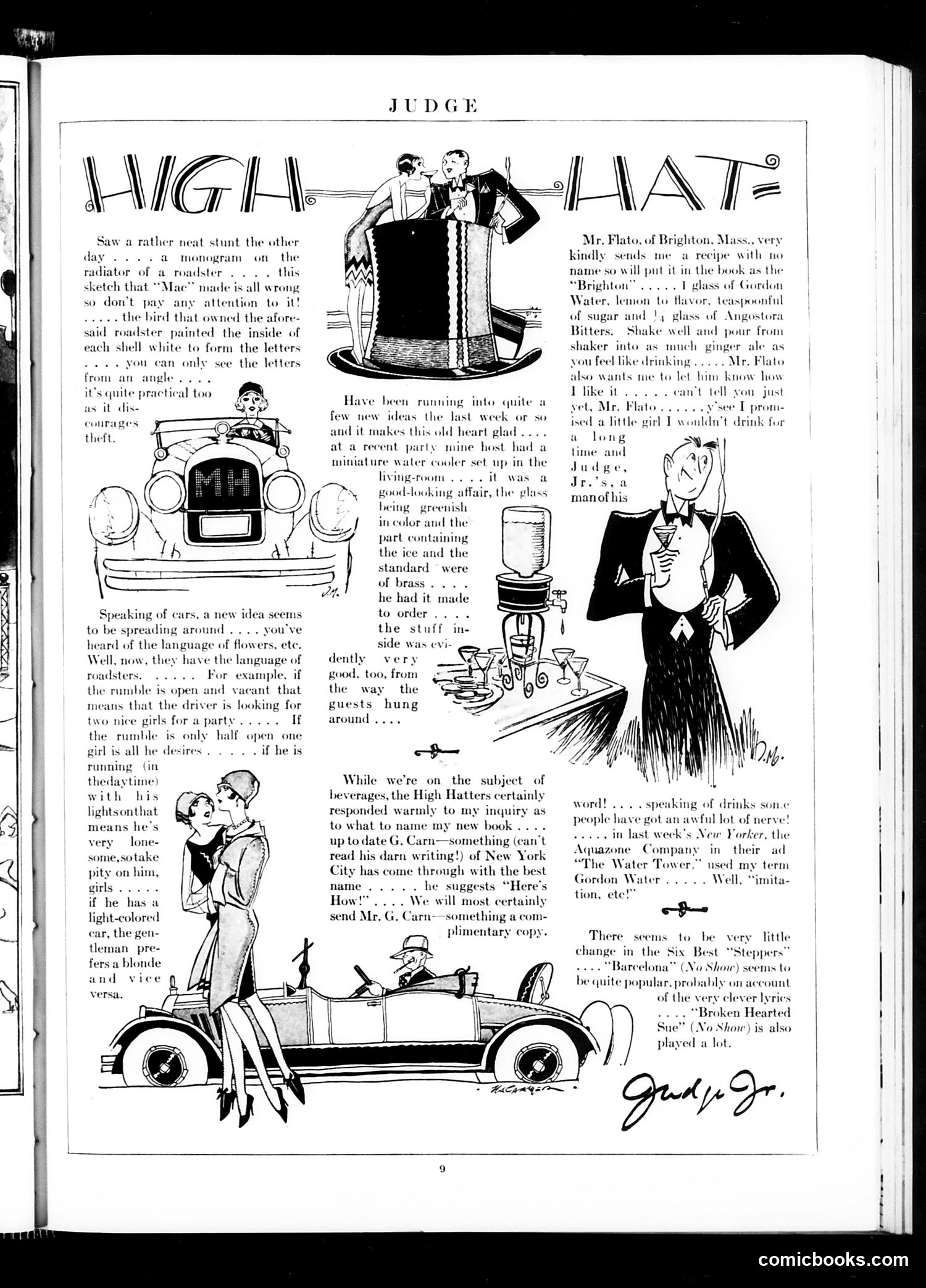
This is a humor column discussing 1920s social trends and reader contributions. The cartoons satirize contemporary fads: **Main satire points:** 1. **"Language of roadsters"** — a satirical "code" for flirting: open rumbles mean the driver seeks female passengers; daytime headlights signal loneliness; car color allegedly indicates preference for blondes or brunettes. This mocks the era's dating rituals and the absurdity of reading romantic intent into car features. 2. **Monogrammed car interiors** — poking fun at excessive personalization of automobiles as status symbols. 3. **Novelty bar equipment** — humor about Prohibition-era workarounds, including a miniature water cooler (likely disguising alcohol) displayed at parties as casual decoration. The column also includes reader recipes and song recommendations, functioning as a lifestyle advice column mixed with gentle social mockery typical of Judge's satirical approach to modern manners.
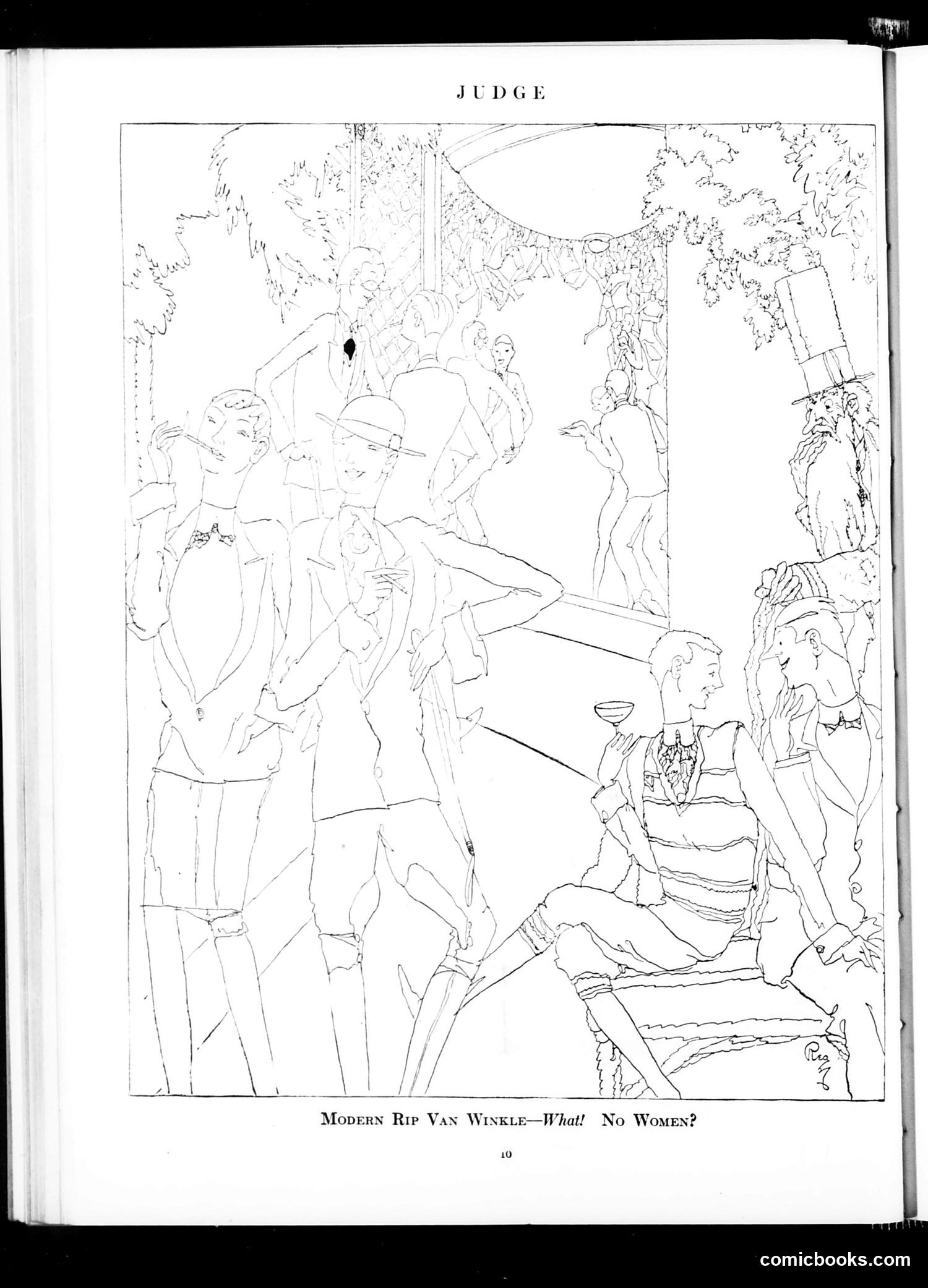
This cartoon satirizes a man (drawn as a "modern Rip Van Winkle"—referencing Washington Irving's tale of someone who slept through major changes) who has apparently awakened to find women present in previously male-only spaces. The figure appears shocked or dismayed ("What! No Women?") at this social shift. The cartoon likely comments on early 20th-century women's increasing public visibility and participation in society—whether in politics, the workplace, or social gatherings. The man's bewilderment at women's presence suggests Judge magazine is mocking resistance to women's expanding roles and freedoms. The surrounding figures suggest a mixed-gender social scene that would have been unusual or controversial in earlier eras.
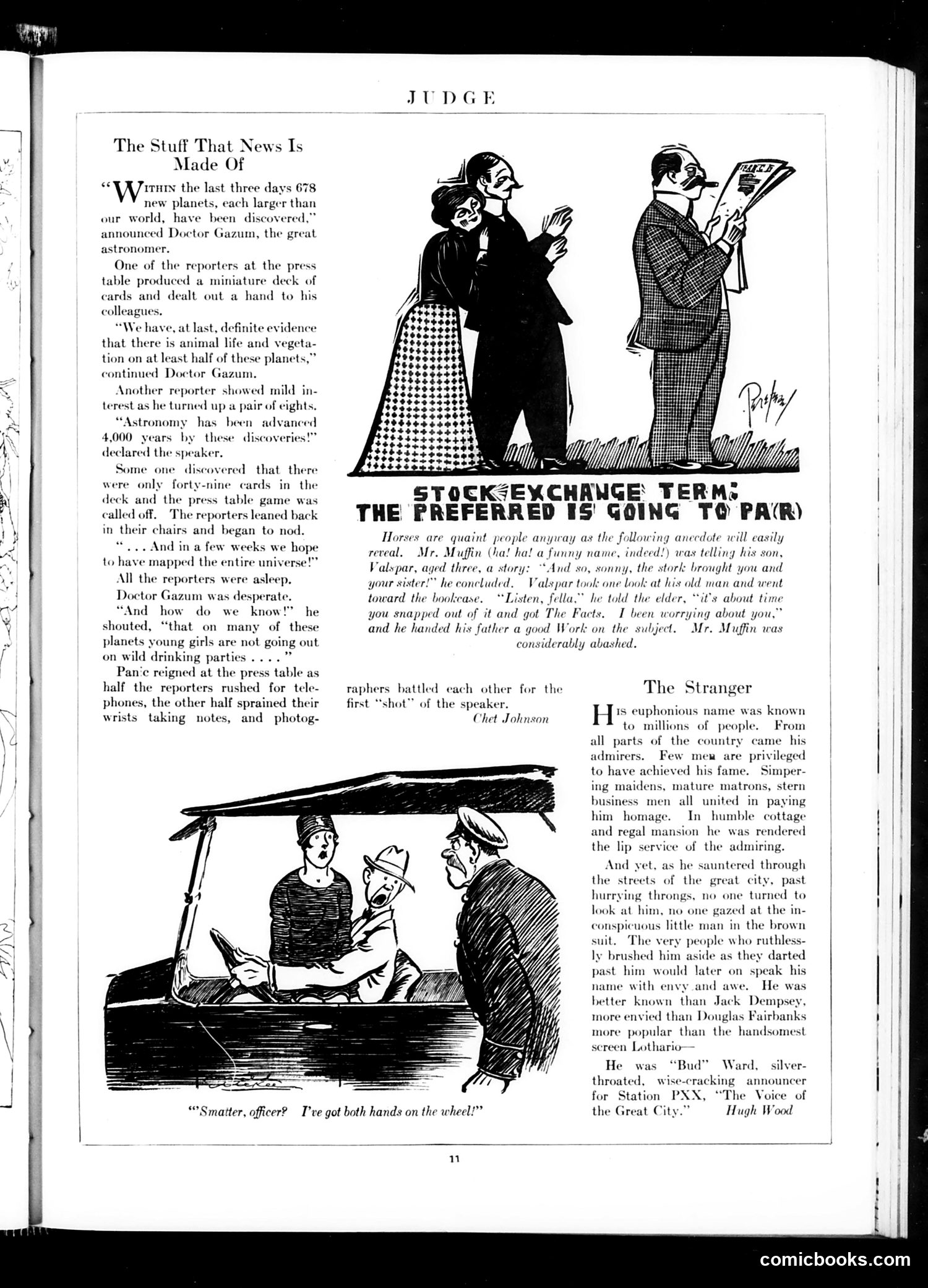
This page contains three separate satirical pieces: **"The Stuff That News Is Made Of"** mocks press reporters' indifference to serious scientific announcements. When Doctor Gazum presents discoveries of 678 new planets, journalists ignore him—playing cards, dozing off—until he mentions young women on those planets engaging in "wild drinking parties." Only then do they frantically scramble for phones and notebooks. The satire targets both journalists' sensationalism and their disinterest in actual scientific progress. **"Stock Exchange Terms"** jokes about stock market terminology. A father uses "The Preferred Is Going to Pa(r)"—a pun on stock preferences and "par"—while explaining reproduction to his young son, who cuts through the euphemism by demanding "The Facts." **"The Stranger"** (byline Hugh Wood) introduces a famous radio announcer ("Bud" Ward, voice of Station PXX) beloved nationwide, yet utterly invisible and ignored when walking city streets. The irony: millions know his name with envy, but face-to-face, he's dismissed as an "inconspicuous little man."
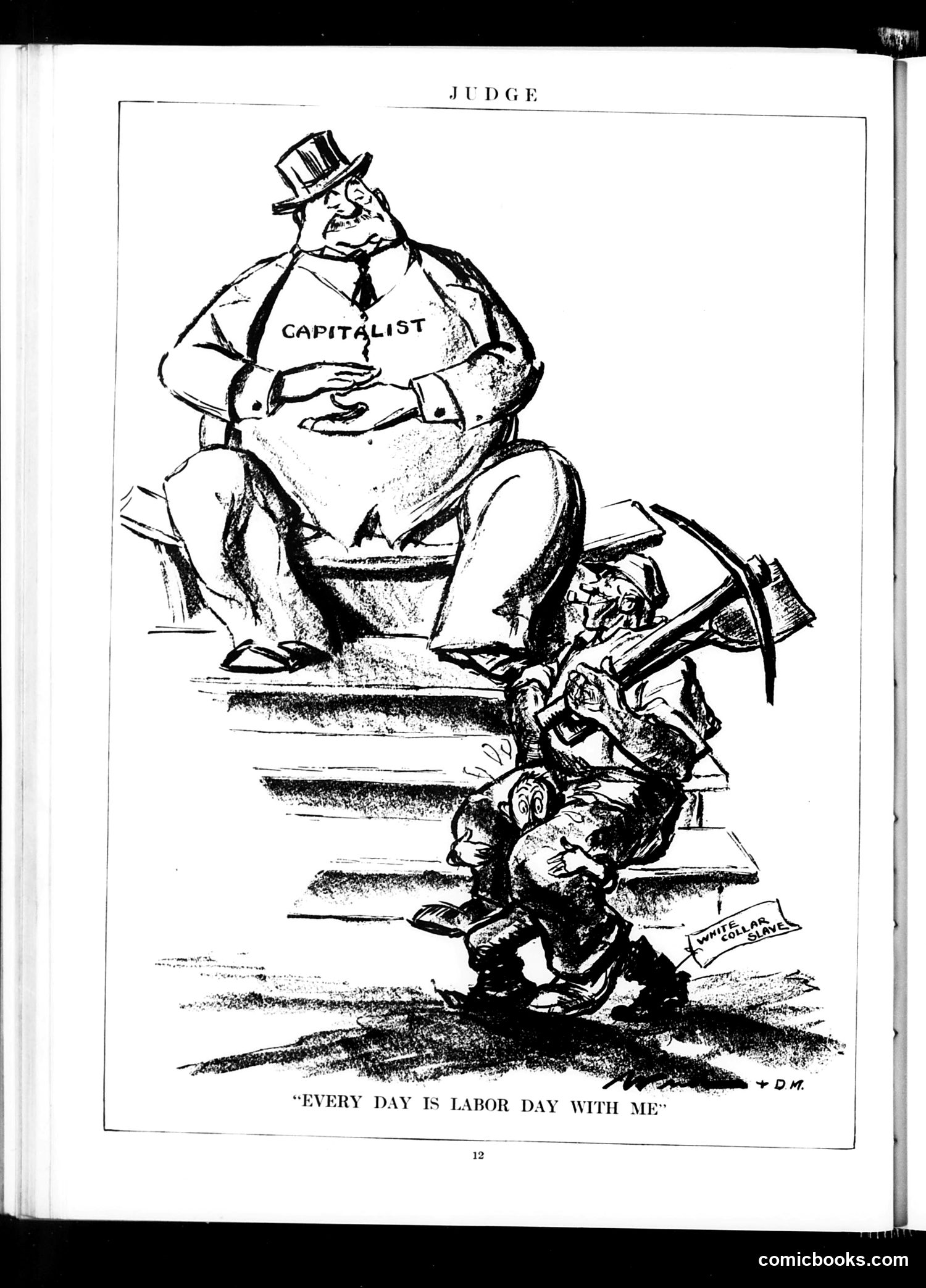
This political cartoon satirizes the relationship between capitalists and laborers. The large figure labeled "CAPITALIST" sits atop a pedestal, wearing a top hat and appearing comfortable and well-fed. Below him, a much smaller laborer (labeled what appears to be "WORKING MAN" or similar) is forced to climb endless steps while carrying heavy tools and an axe. The caption's irony is sharp: the capitalist claims "every day is labor day," but the image shows the opposite—the worker labors constantly while the capitalist rests comfortably above. This reflects early 20th-century critiques of economic inequality and exploitation, contrasting the wealthy elite's leisure with workers' unending toil.
This is an editorial essay (not a cartoon despite the illustrated header) analyzing American agricultural discontent. The piece argues that farmers—historically conservative and religiously accepting of hardship—have become chronically angry at government and Wall Street. The author, drawing on Rev. Reinhold Niebuhr's Atlantic article, traces this to a cultural paradox: **Protestantism and Puritanism unleashed capitalistic profit-seeking in America, yet America's farmers (who are predominantly Puritan) remain agrarian and thus excluded from industrial wealth**. Meanwhile, the industrial working class is largely Catholic—reversing the European pattern where Protestant regions industrialize. The essay suggests this creates friction: Puritan farmers expect religious sanction for their labor but see themselves economically subordinated to industrial profiteers operating under the same Puritan ethics they share. The underlying satire critiques how American capitalism betrayed its own moral foundations by elevating some citizens while leaving farmers perpetually aggrieved.
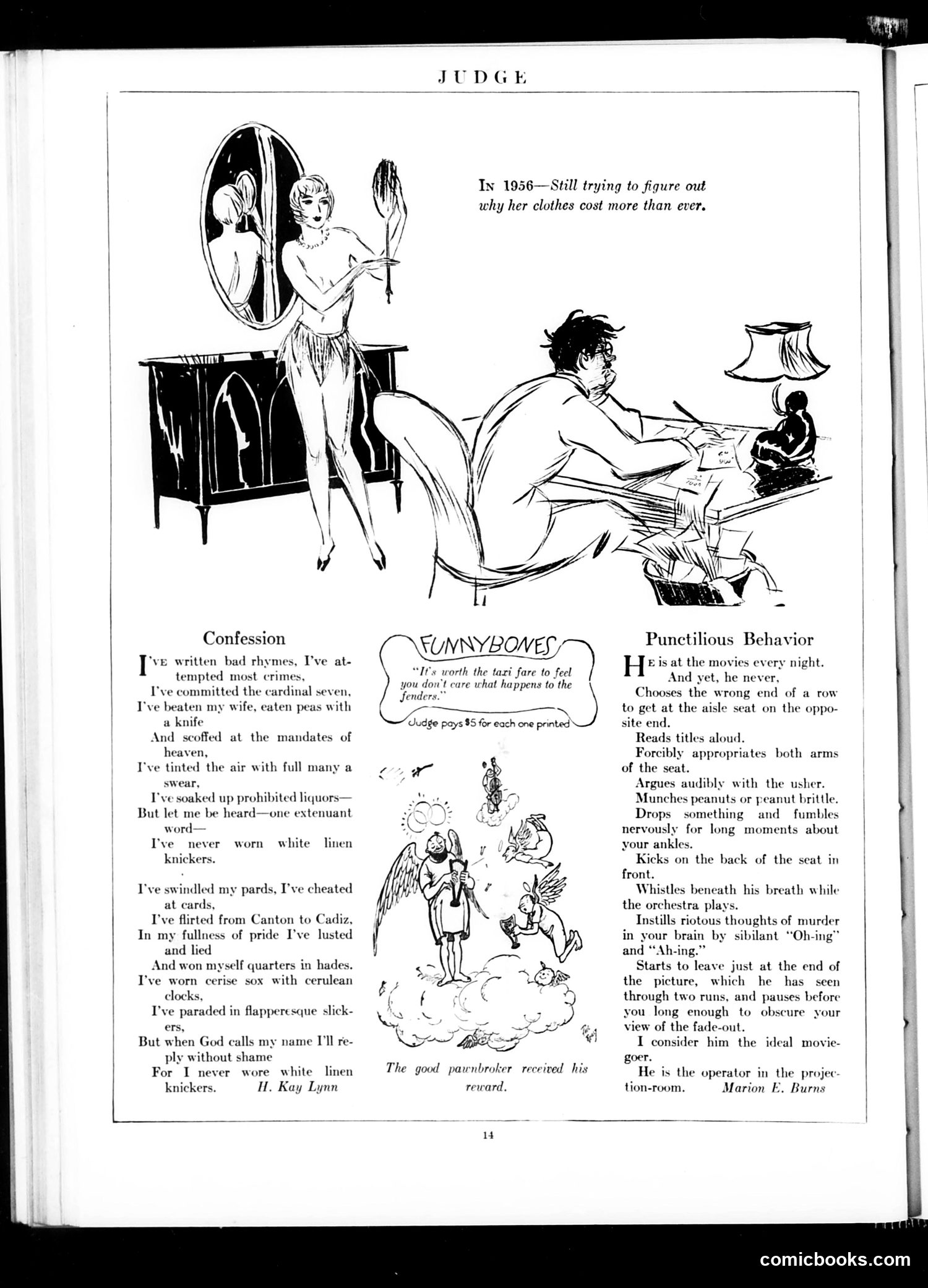
This page from *Judge* contains three satirical pieces mocking social hypocrisy and annoying behavior: **"Confession"** (left): A humorous poem by H. Kay Lynn where a man confesses to numerous moral failures—infidelity, drinking, cheating, swearing—but takes pride in never wearing "white linen knickers" (underwear). The joke satirizes selective morality: people who commit serious wrongs but obsess over trivial propriety. **"Funnybones"** (center): A brief joke about caring enough to spend taxi fare on someone you don't actually care about—mocking superficial concern. **"Punctilious Behavior"** (right): Marion E. Burns describes an ideal moviegoer as someone who exhibits *none* of the annoying theater habits listed (loud reading, seat-hogging, kicking, whistling). The twist: this "ideal" person is the projectionist in the back room—making the satire work by noting you never actually *see* the worst offenders. All three pieces humorously expose the gap between claimed values and actual behavior, a recurring *Judge* theme.
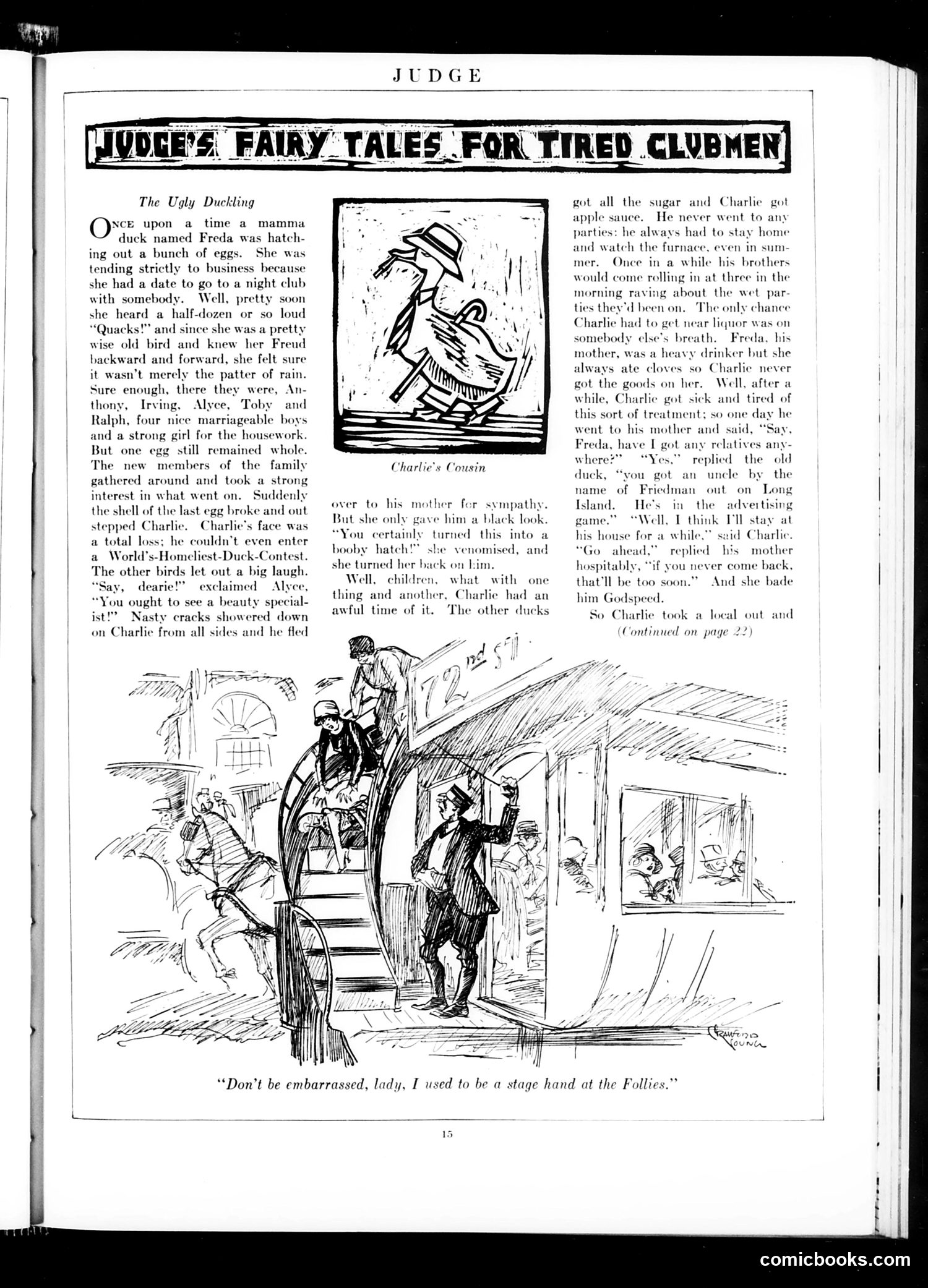
This is a modern retelling of the Hans Christian Andersen fairy tale, recasting it as social satire about class and respectability in 1920s America. Charlie, the "ugly duckling," is mistreated by his duck family—not for appearance alone, but because he's poor and uncouth while his siblings enjoy nightclubs and parties. His mother Freda is a heavy drinker (a Prohibition-era joke), and Charlie is relegated to watching the furnace while others live glamorously. The satire targets social pretension: Charlie's escape route is to visit an uncle in "advertising" on Long Island—a new, aspirational profession. The bottom cartoon shows a man boarding a ship, claiming past work as a "stage hand at the Follies" (a famous Broadway revue), suggesting reinvention and social climbing. The joke is that American society values superficial respectability and reinvention over genuine merit—much like Andersen's tale, but with 1920s consumer culture replacing fairy-tale magic as the promised transformation.
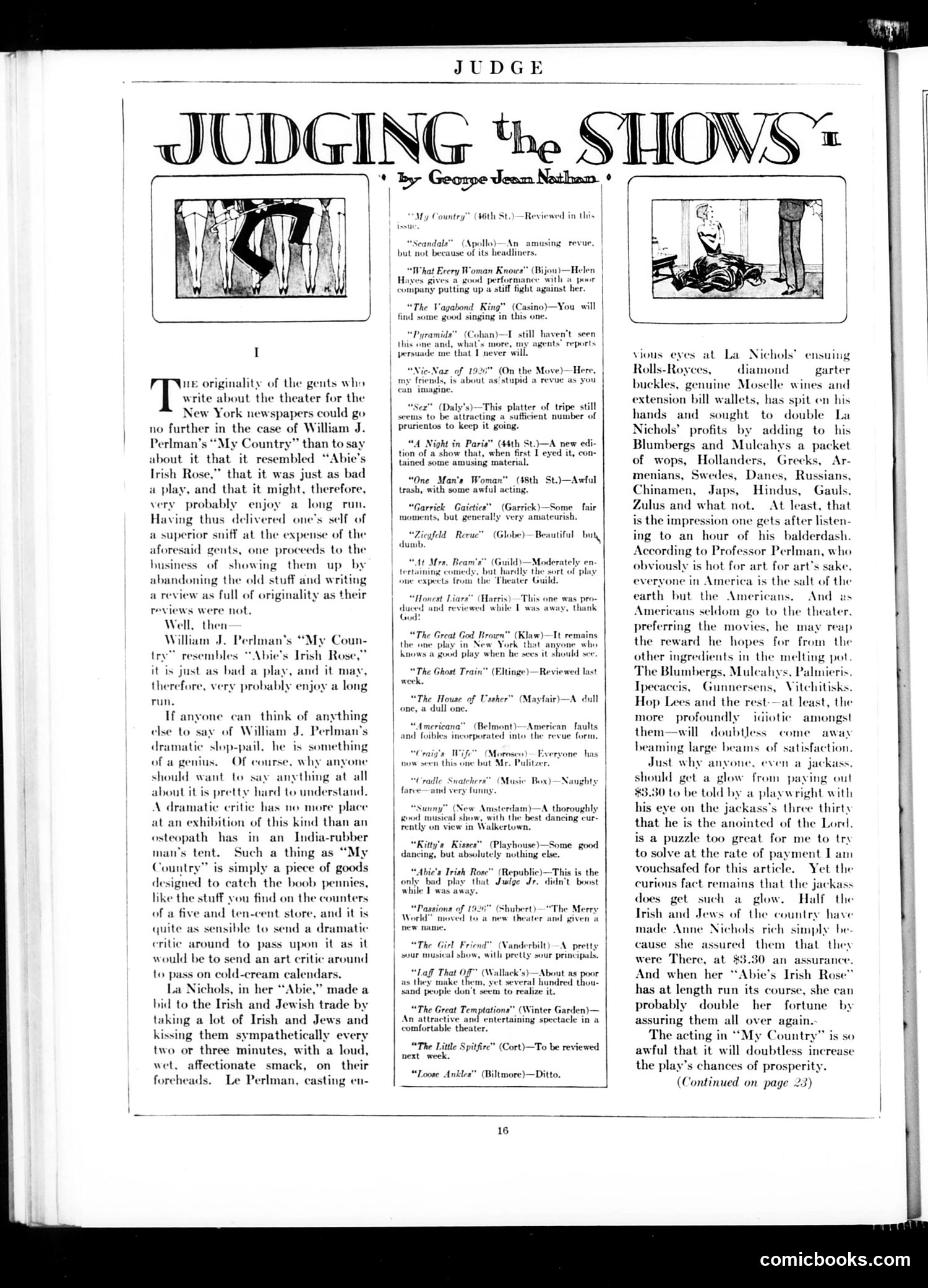
This is George Jean Nathan's theater column reviewing Broadway productions. The main satire targets lazy drama criticism itself. Nathan mocks how theater critics repeatedly compare new plays to "Abie's Irish Rose"—a successful but critically despised comedy about Irish-Jewish romance. He notes that critic William J. Perlman's "My Country" gets dismissed with the same lazy comparison, then jokes that Perlman's play will likely succeed anyway because it's designed for mass audiences ("boob pennies"), not artistic merit. The column's real barb: theatrical criticism is absurd. Nathan argues sending drama critics to review such commercial entertainment is as senseless as sending art critics to evaluate drugstore calendars. The review list below catalogs current Broadway shows with brief, often dismissive assessments—highlighting how formulaic both plays and their criticism had become in 1920s commercial theater.
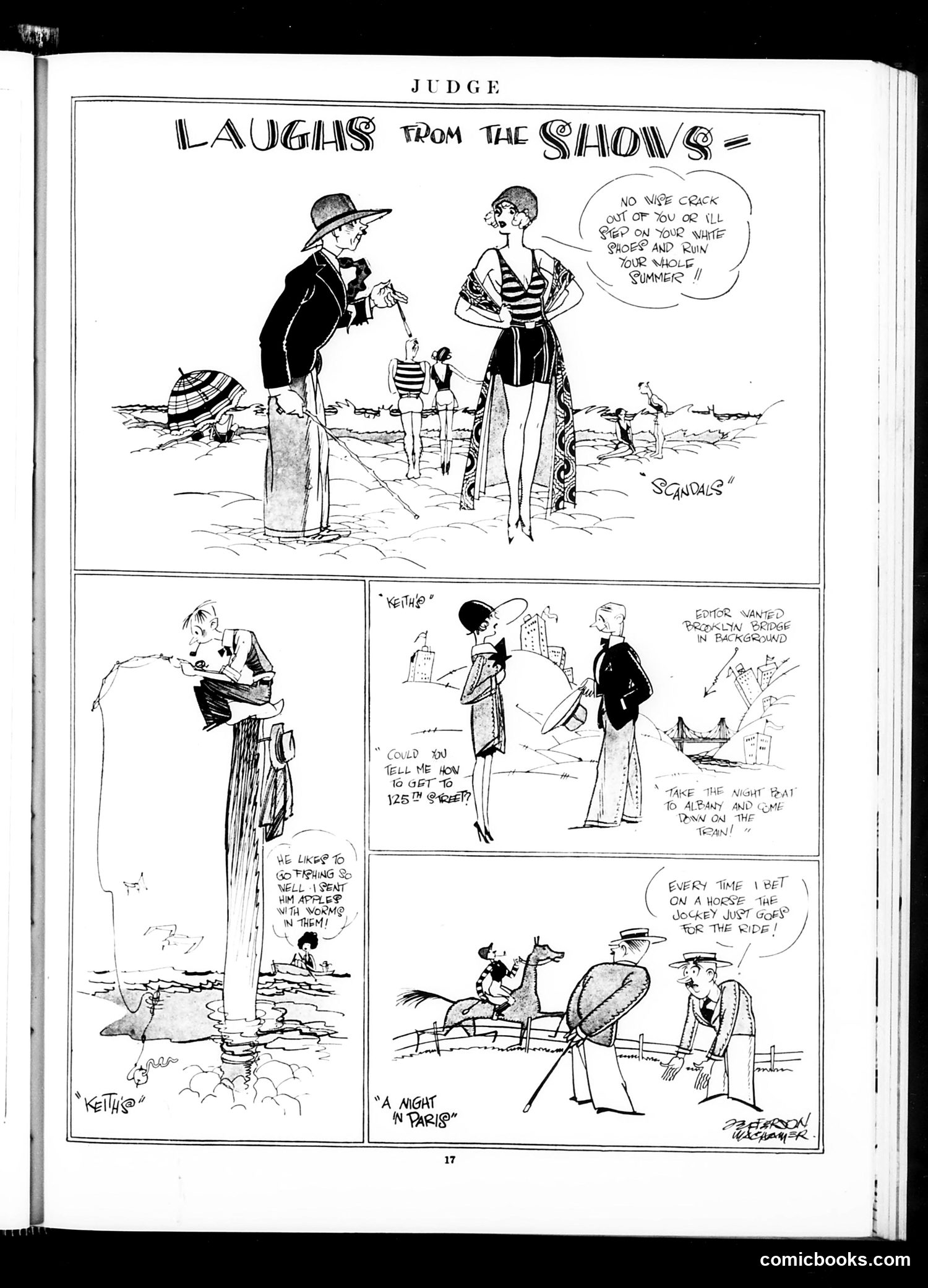
This page collects comic sketches satirizing 1920s leisure activities and social behavior. The top panel mocks overly modest beachgoers—a woman criticizes a man for exposing his legs in swimwear, calling it improper. The subsequent sketches lampoon wealthy tourists and their pretensions: a man eager to go fishing with apples for bait, urban sophisticates trying to reach "125th Street," and a fashionable couple taking a night boat to Albany. The final panel ridicules horseback riding culture, depicting a society man admitting he bets on horses solely for the jockey's appearance rather than genuine interest in racing. The satire targets upper-class affectation, prudishness about modern swimwear, and the performative nature of leisure pursuits—people engaging in activities for social status rather than authentic enjoyment. The cartoonists mock both excessive modesty and shallow materialism characteristic of Jazz Age urban society.
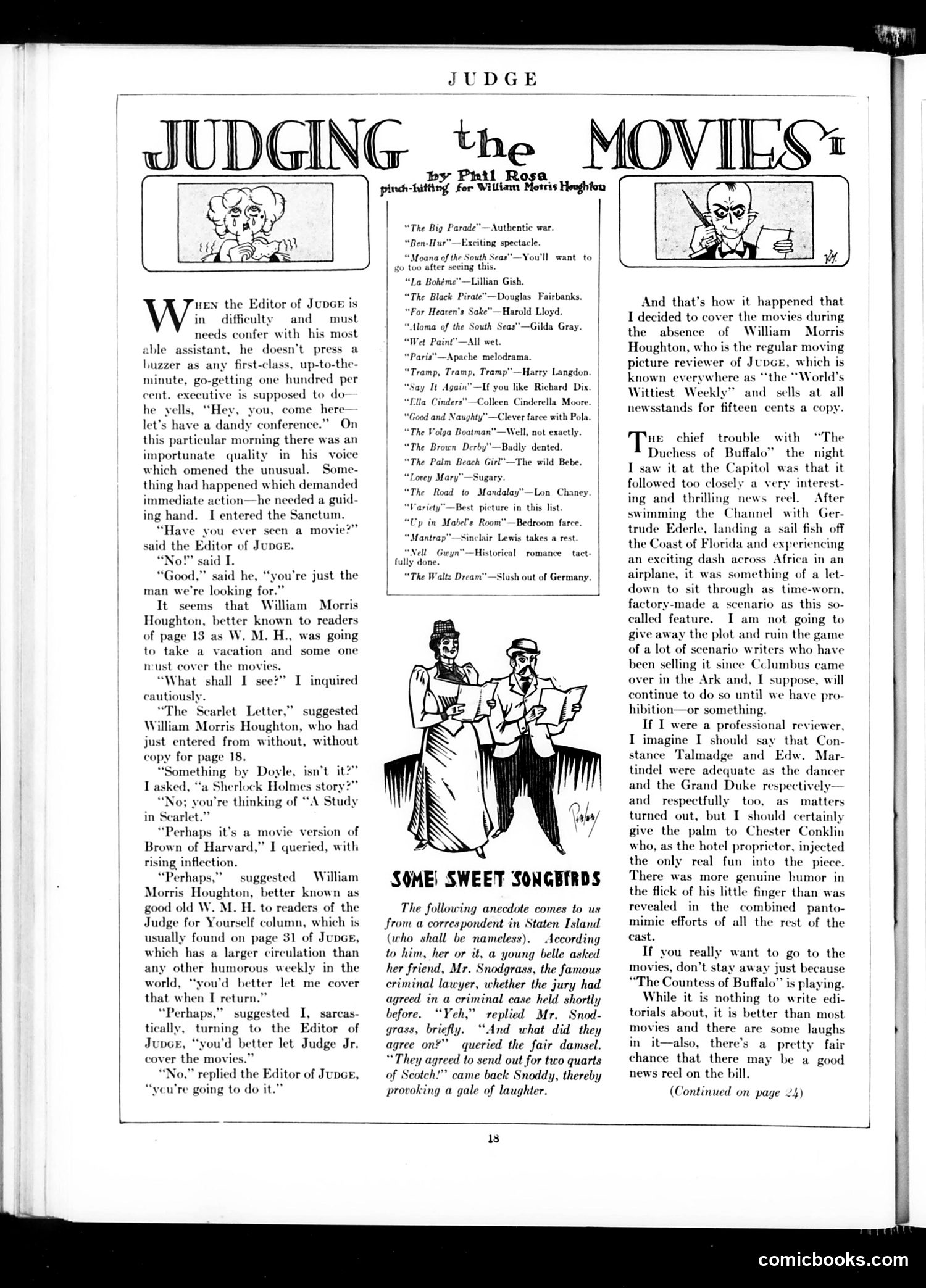
This is a humorous editorial essay by Phil Rosa about Judge magazine's movie criticism. The "plot" is that William Morris Houghton, the regular film reviewer (and author of Judge's "Judge for Yourself" column), is taking vacation. The editor reluctantly assigns an inexperienced staff member to cover movies instead. The piece pokes fun at 1920s cinema through a list of current films with sarcastic one-liners (e.g., "Wet Paint"—All wet). It's gentle satire about the quality of contemporary movies and film reviewing itself. The accompanying anecdote about a criminal lawyer ("Snodgrass") and jury members ordering scotch is a period joke playing on Prohibition-era humor—the absurdity of jurors breaking the law while serving justice. This is largely self-referential magazine humor aimed at Judge's readers, celebrating the publication's wit and circulation.
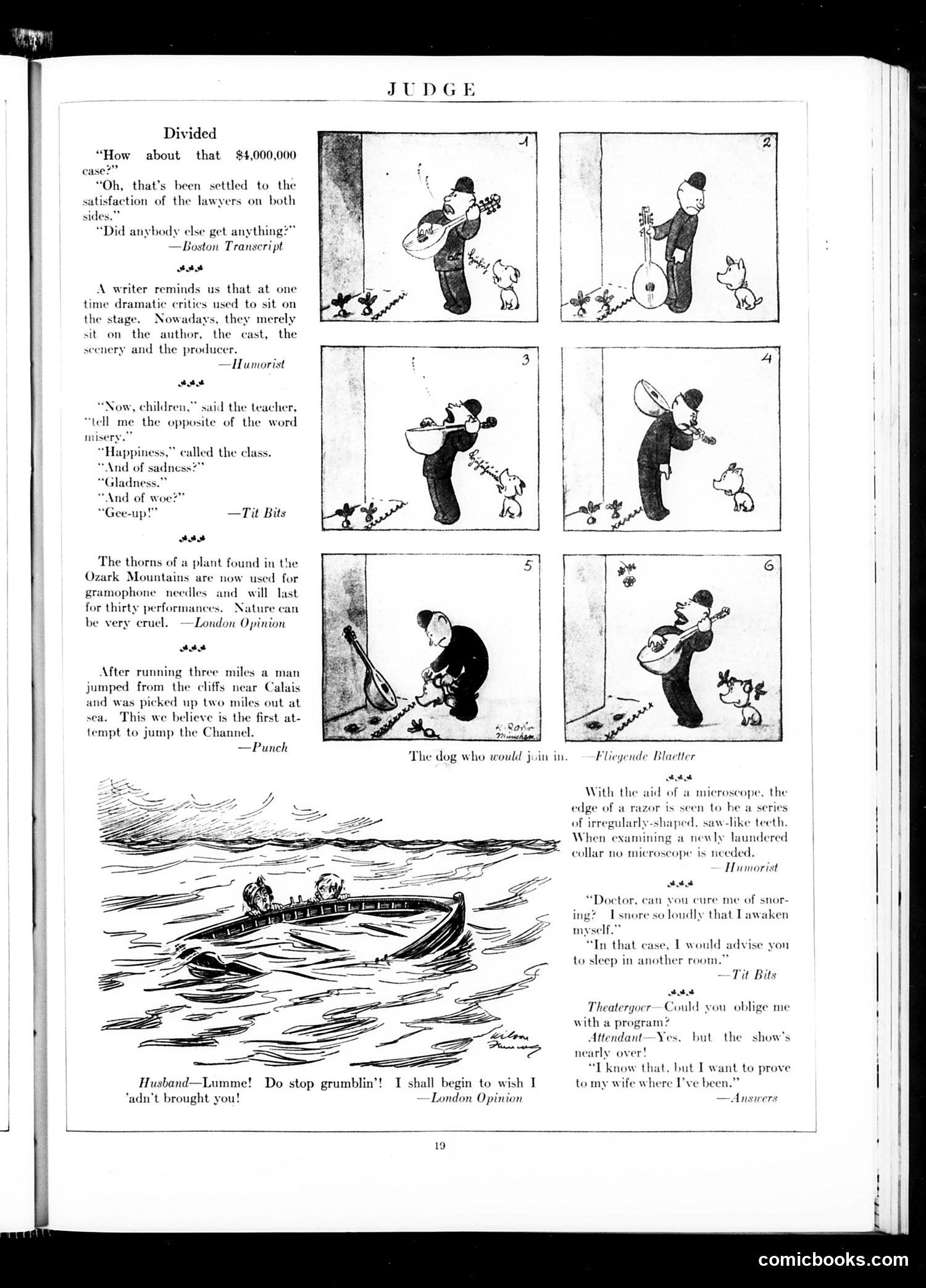
This page compiles humorous one-liners and cartoons typical of early 20th-century satirical magazines. The content mixes observational humor with light social commentary: **Notable Items:** The opening "Divided" joke satirizes legal settlements where lawyers profit handsomely while actual parties receive little—a timeless critique of the legal profession's self-interest. "The dog who would join in" cartoon series depicts a man with a stringed instrument (appears to be a banjo or guitar) repeatedly striking at a small dog attempting to approach him—visual humor based on the animal's persistent, unwanted friendliness. Other jokes mock doctors' impractical advice, husbands' excuses to wives about their whereabouts, and the absurdity of theater programs when shows are nearly finished. The tone is lighthearted domestic and professional satire rather than political commentary—typical of Judge's appeal to middle-class readers seeking gentle ridicule of everyday situations and professional pretension.
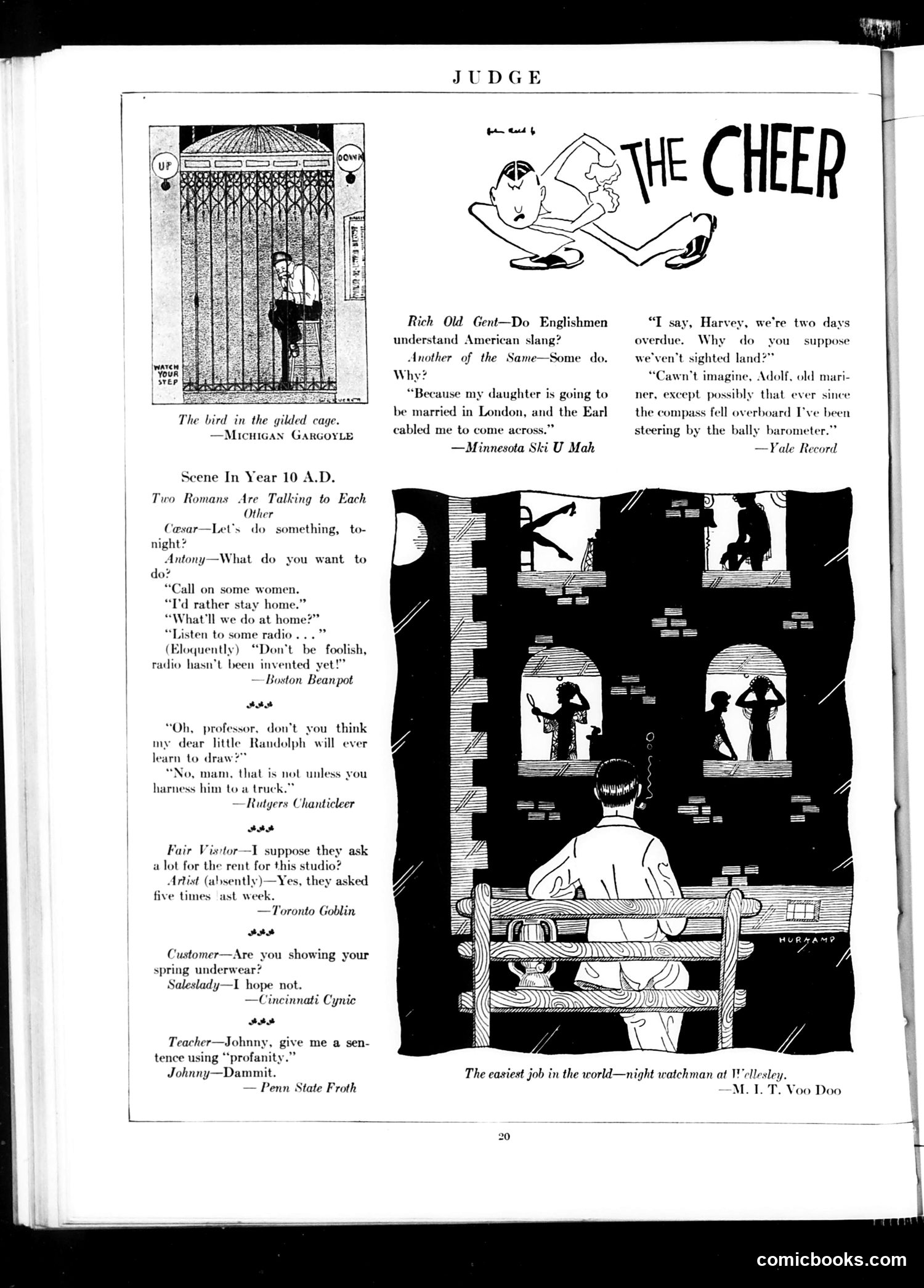
This page collects satirical humor from various sources, mostly short jokes rather than developed political cartoons. **Key Content:** The opening cartoon shows a woman in a gilded cage—likely referencing the 1900 song "A Bird in a Gilded Cage" about a woman who trades love for wealth, a social commentary on materialism. The humor pieces mock contemporary life: a joke about Romans without radio (anachronistic satire on modern dependency on technology), a professor dismissing a student's artistic talent, artists struggling with studio rent, and workplace absurdities. Two jokes reference World War I: one about steering a ship by barometer after "the compass fell overboard," and another mentioning "Adolf"—likely referencing German involvement, though unclear if specifically Hitler-era. The final cartoon depicts a night watchman at Wellesley (a women's college), with the caption "easiest job in the world"—implying the watchman has little actual work, possibly a crude joke about the institution. The satire targets materialism, technological dependence, economic hardship, and contemporary social institutions through light mockery rather than sharp political critique.
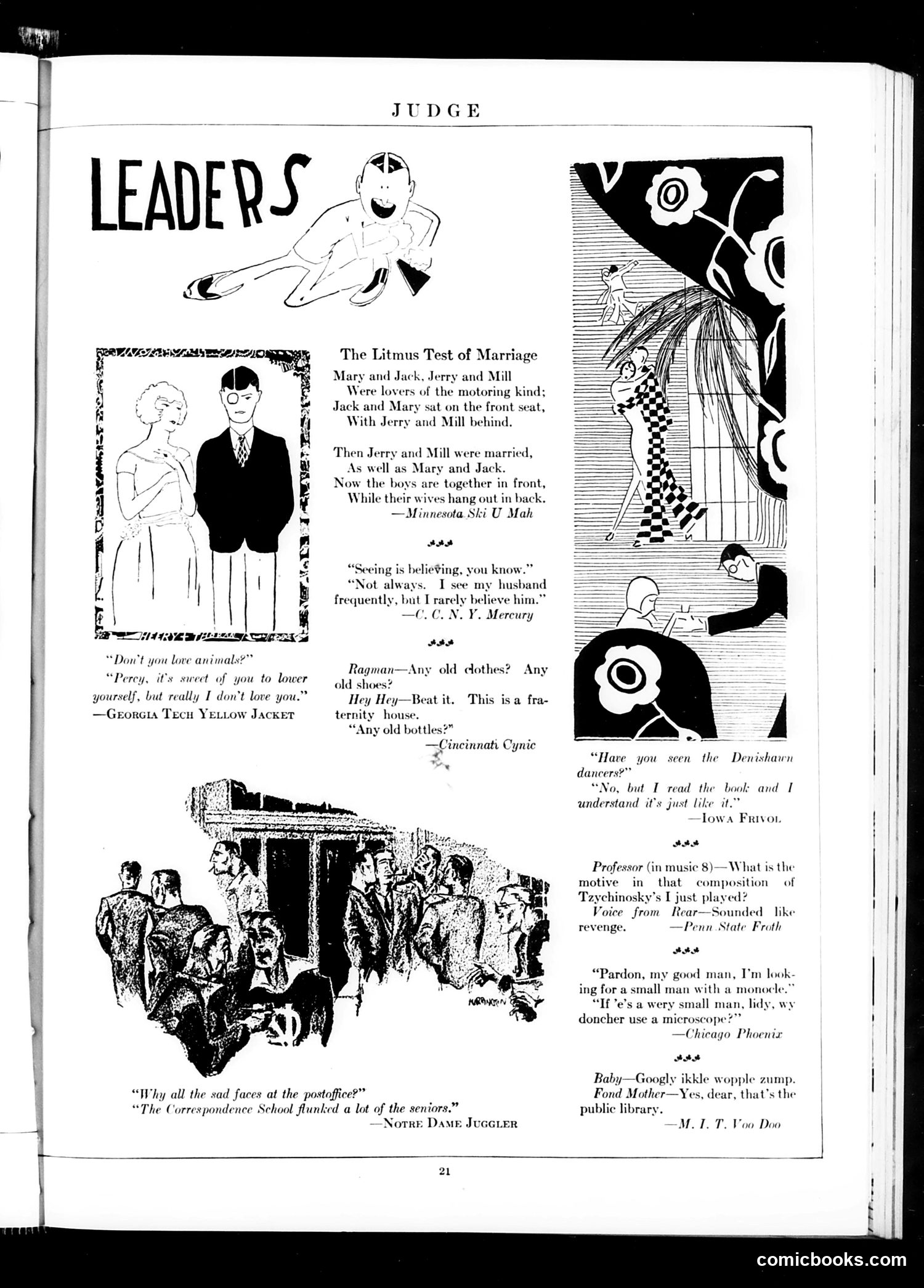
This page collects humorous quotes and cartoons about marriage, courtship, and social life, primarily targeting early-20th-century attitudes toward relationships. **Key satirical points:** The "Litmus Test of Marriage" poem mocks how marriage changes couples' dynamics—once-romantic pairs who sat together while courting now segregate by gender after marriage, with husbands in front and wives relegated to back seats. This critiques rigid gender roles and the loss of intimacy in matrimony. Other jokes target skepticism in marriage ("I rarely believe him"), the performative nature of romance, and class pretensions. The monocle joke references snobbish British affectation; references to "Denishawn dancers" likely allude to a contemporary dance troupe. The final cartoon about sad faces at the post office satirizes correspondence schools—mail-order educational programs popular at the time—by suggesting they failed seniors, perhaps mocking both the schools' effectiveness and students' disappointment. Overall, the page expresses period cynicism about marriage's erosion of romance and courtship's false promises.
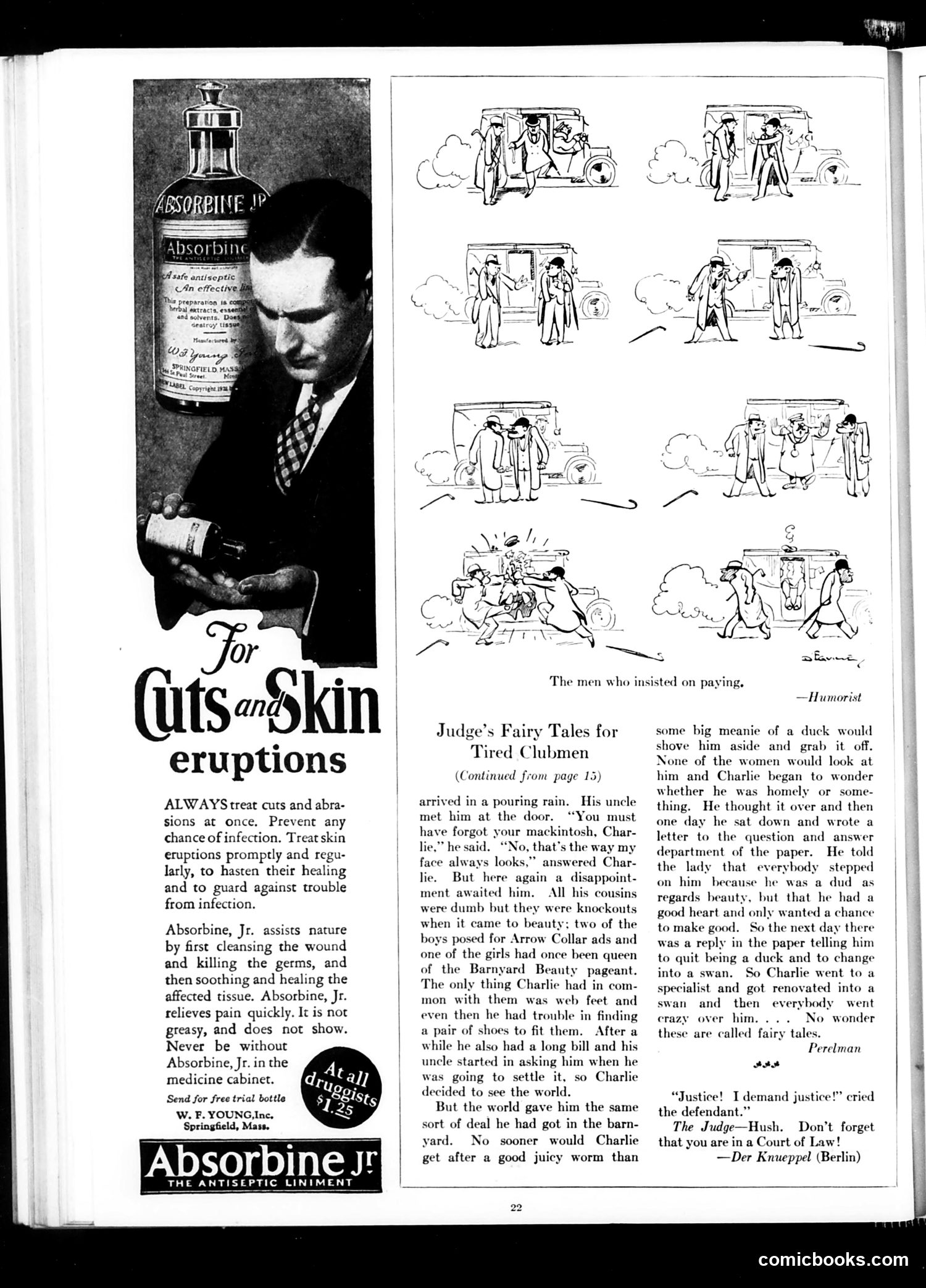
This page contains two distinct elements: an advertisement and a humorous story. **The Advertisement (Left):** Absorbine Jr., an antiseptic liniment, uses a straightforward medical pitch—showing a man treating cuts and skin eruptions. The product claims to cleanse wounds, kill germs, and heal tissue without being greasy. **"Judge's Fairy Tales for Tired Clubmen" (Right):** This is a satirical story mocking the American obsession with physical beauty and social status. Charlie, an ungainly protagonist with "web feet," is rejected by his beauty-obsessed family (whose members model for Arrow Collar ads—a reference to a famous contemporary brand). Seeking acceptance, Charlie consults an advice columnist who tells him to "change into a swan"—a literal fairy-tale solution to social inadequacy. The humor lies in the absurdity: society offers only magical, impossible fixes rather than accepting people as they are. The cartoons illustrate Charlie's misadventures being pushed aside by other ducks competing for food and attention, satirizing competitive American social hierarchies.
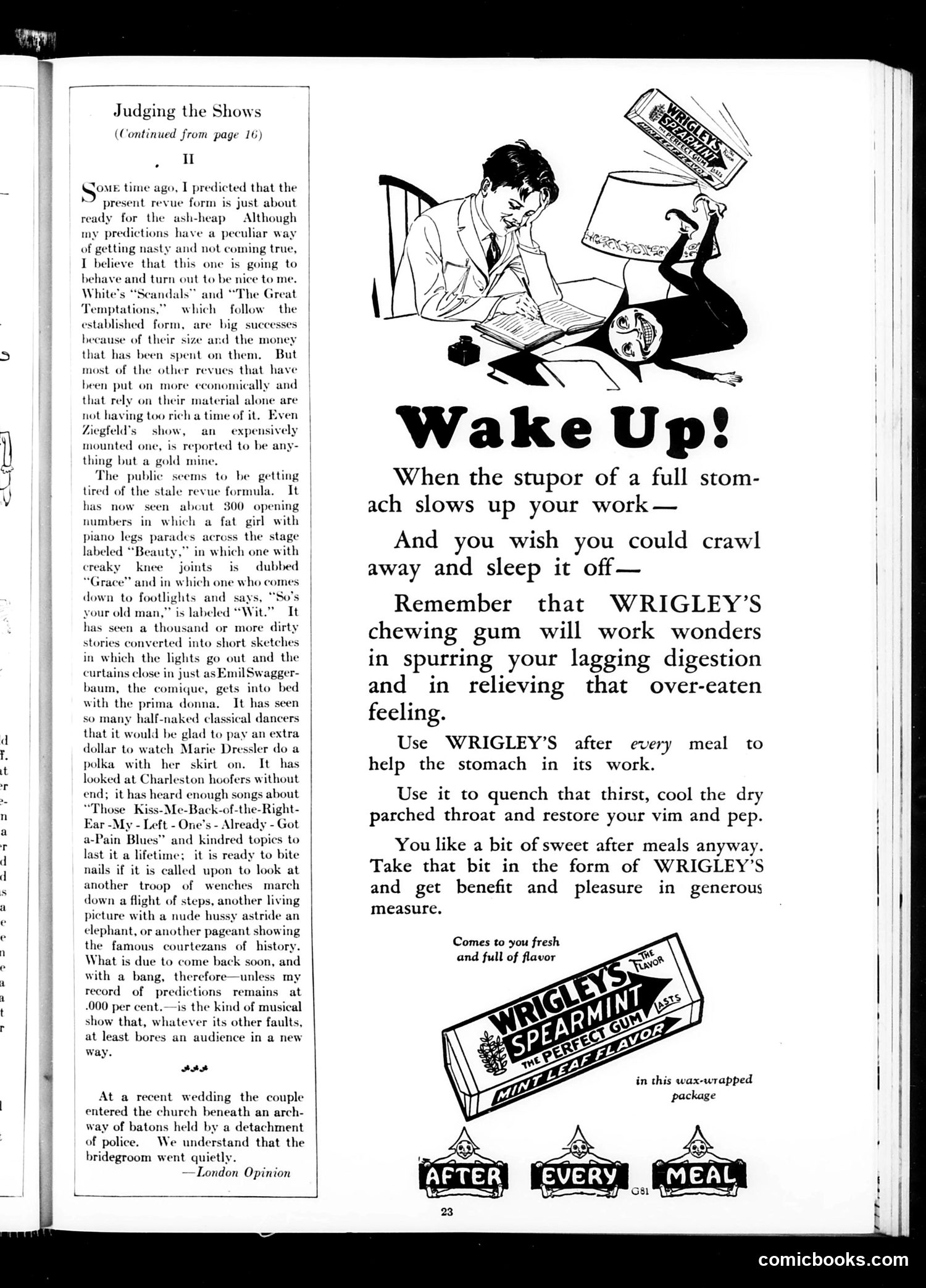
This page contains two distinct elements: **Left side ("Judging the Shows"):** A theater critic's column lamenting the exhausted revue format. The writer predicts audiences have grown tired of repetitive musical theater tropes—fat girls labeled "Beauty," Charleston dancers, classical nude performers, and formulaic comedy sketches with blackout gags. He argues revue shows (even expensive Ziegfeld productions) are failing because they rely on spectacle rather than fresh material, and predicts audiences will soon demand something different. **Right side:** A Wrigley's chewing gum advertisement using a "Wake Up!" headline. The ad satirically addresses post-lunch digestive sluggishness—the "stupor of a full stomach"—and promotes chewing gum as a digestive aid and energy restorer. **The irony:** The theater critique on the left criticizes audiences getting bored by tired, repetitive formulas, while the advertisement on the right uses equally repetitive, formulaic advertising copy to sell a product as a cure-all remedy.
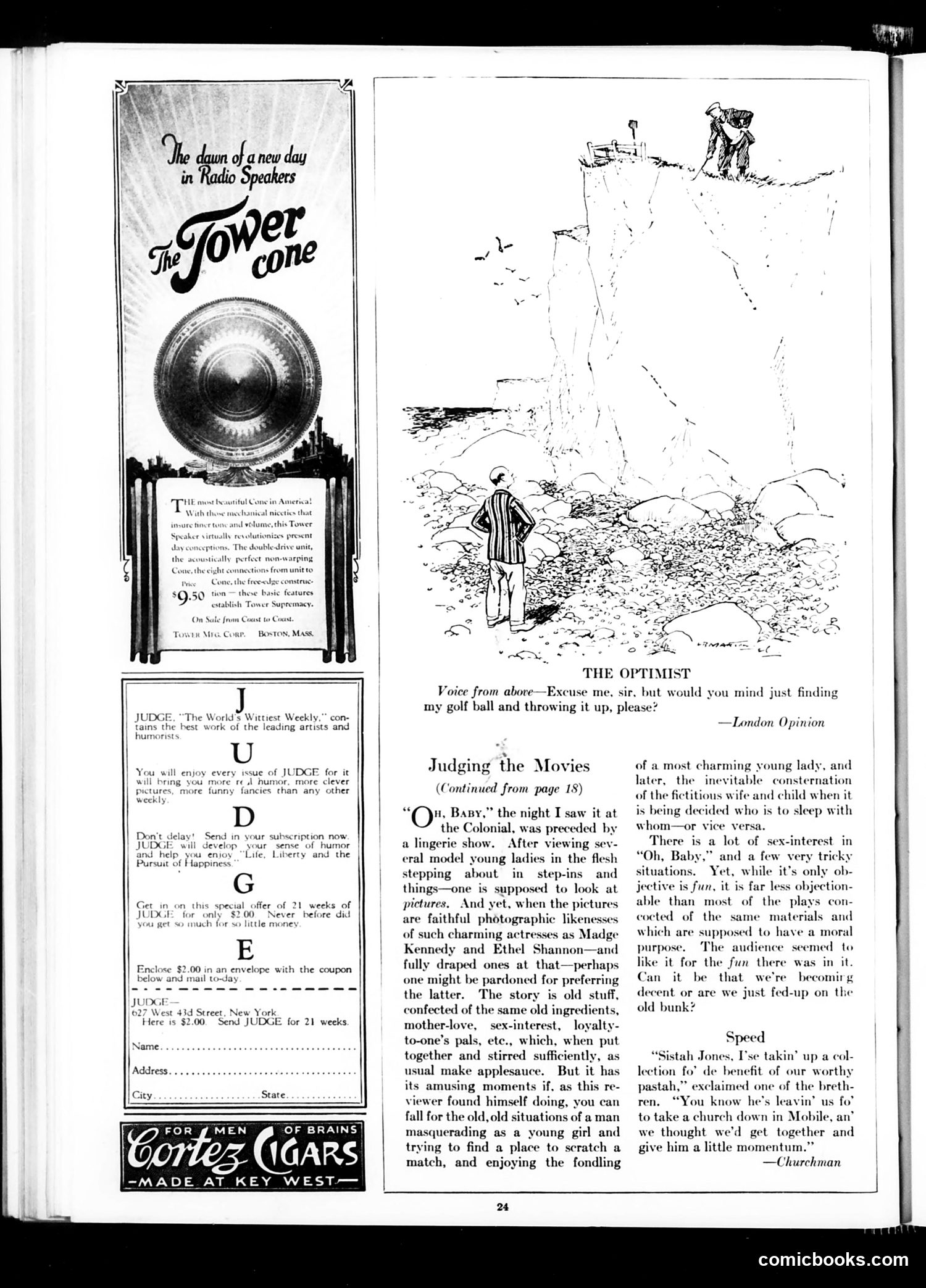
This page mixes advertising with two satirical pieces: **"The Optimist" cartoon** depicts a man at the base of a cliff calling upward to someone at the top, asking them to find and toss down his golf ball. The satire mocks upper-class optimism and entitlement—the man assumes another person will cheerfully retrieve his lost property from a dangerous height, treating inconvenience as someone else's obligation. **"Judging the Movies" review** critiques the film "Oh, Baby," noting the absurdity of preceding it with a lingerie show, then expecting audiences to focus on the actual movie. The reviewer observes that audiences seem more interested in the scantily-clad performers than the story itself. He notes the plot uses tired formulas (mother-love, romance, loyalty) and finds the situation of a man disguised as a young girl both ridiculous and entertaining—suggesting audiences simply want fun rather than moral instruction. The page primarily contains advertisements for Judge magazine subscriptions, Cortez Cigars, and Tower Cone radio speakers.
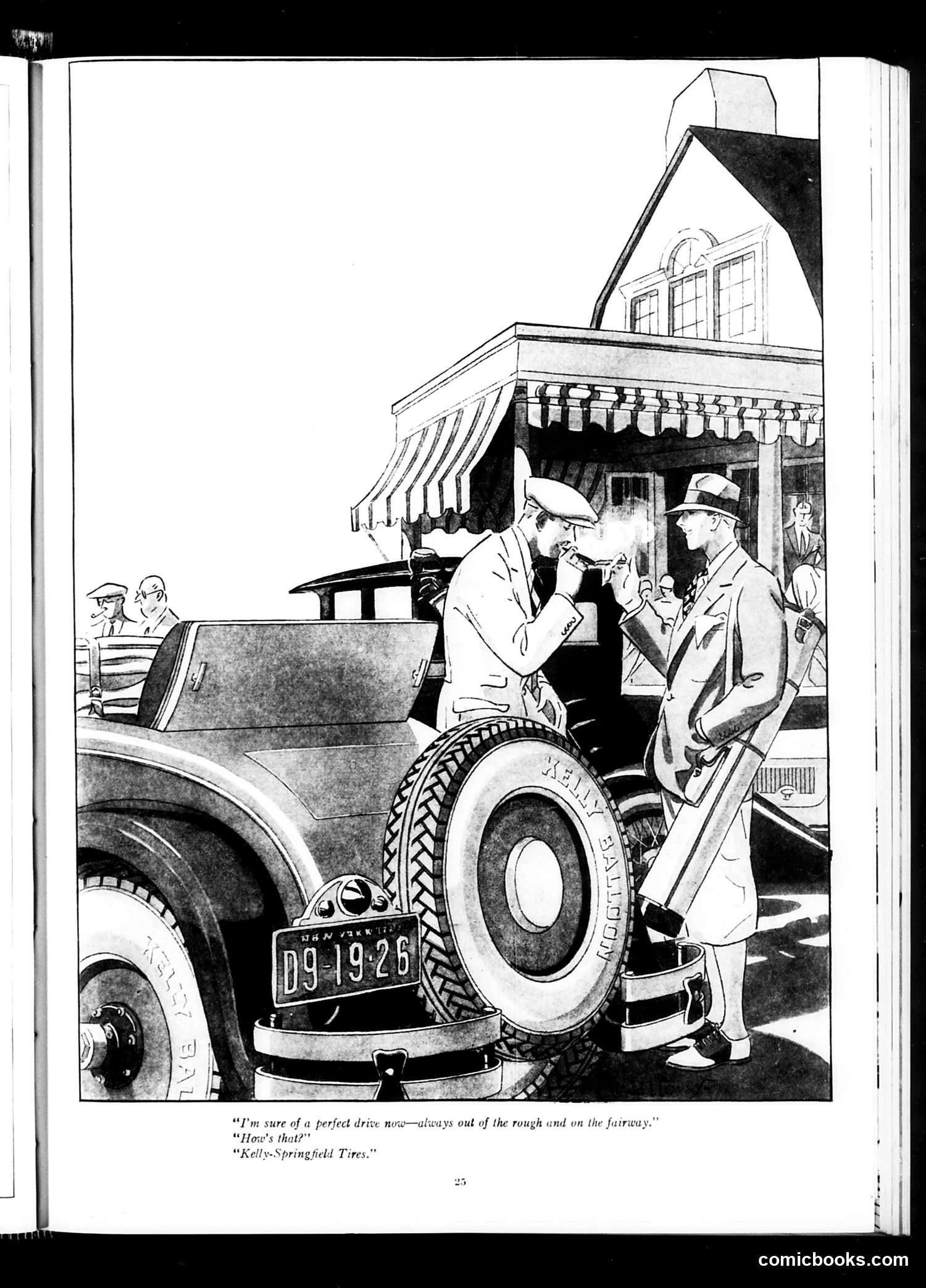
This is a **tire advertisement** disguised as a cartoon joke, not political satire. The scene depicts two men in 1920s attire examining a car (license plate: D9-1926) outside a storefront. One man boasts about achieving perfect driving—staying "out of the rough and on the fairway" (golf terminology applied to driving). When asked how, he credits "Kelly-Springfield Tires." The humor relies on a **golf metaphor**: good tires keep you on the "fairway" (the proper road) rather than in the "rough" (poor road conditions or ditches). It's a clever product endorsement using wordplay familiar to the affluent, golf-playing demographic Judge targeted. This represents typical 1920s advertising strategy: embedding product promotion within humorous editorial content.
This Judge magazine page contains financial advice and advertising from the 1920s. The main article, "Midsummer Activity" by Theodore Williams, discusses unusual stock market vigor during summer months—typically a slow season. Williams notes that wealthy investors ("men of means") have driven recent gains, with the general public following belatedly. The article references **General Motors** and **U.S. Steel** as quality stocks justifying their price increases, while warning small investors against blind faith in market leaders' optimism. Williams cites analyst **John Moody** regarding potential hidden stock distribution. The page heavily features an advertisement for the **Trust Company of Florida**, promoting 8% bonds—reflecting the era's investment marketing to middle-class savers. Overall, the content reflects 1920s pre-crash market enthusiasm tempered by some caution about speculative excess and the danger of small investors following wealthy insiders' lead without independent judgment.
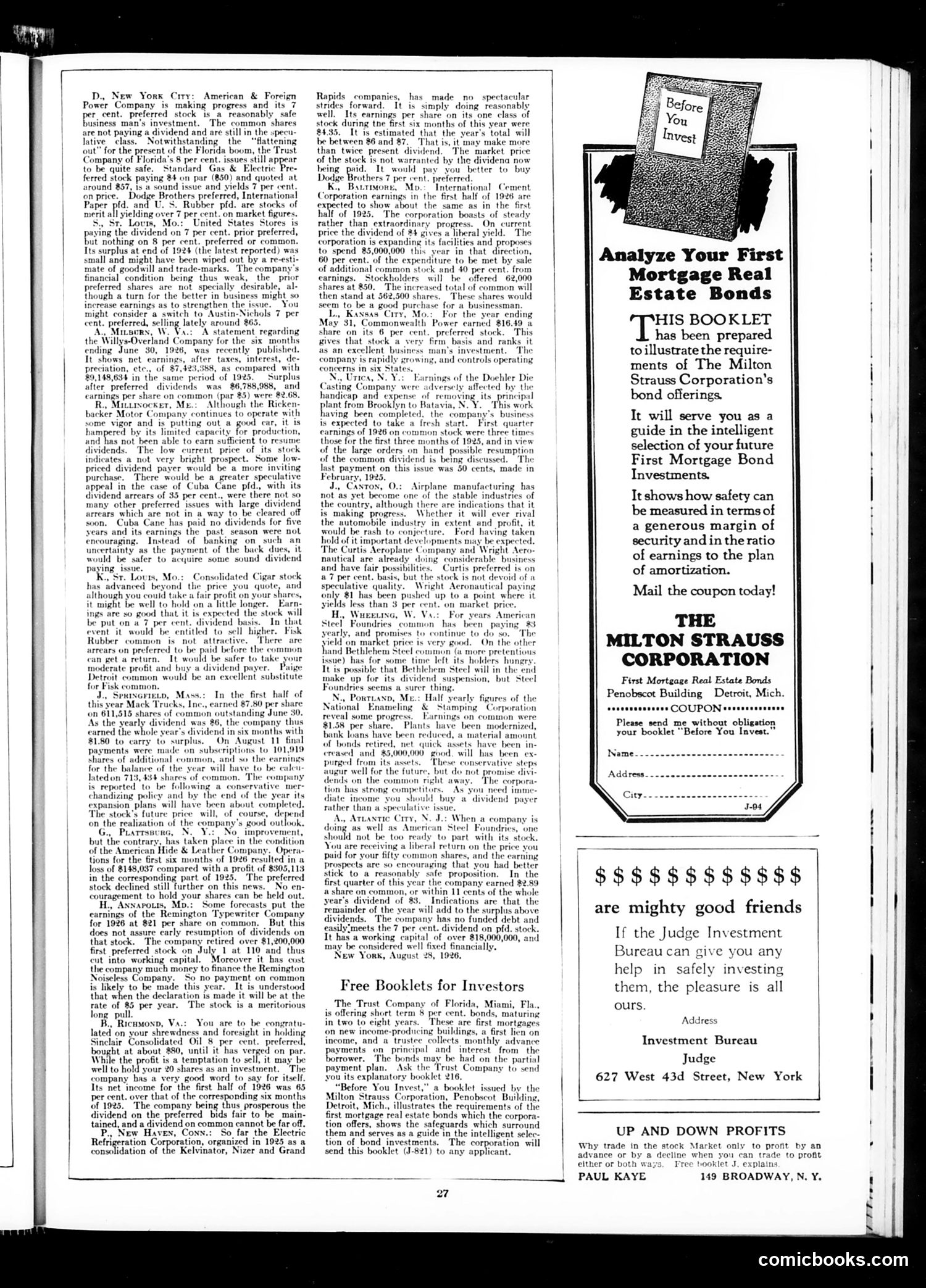
This is primarily a **financial advice column**, not a political cartoon page. It occupies most of the visible area with stock recommendations and investment analysis from a financial columnist answering readers' questions about various American companies—Willys-Overland, Mack Trucks, Cuba Cane, Remington Typewriter, and others. The right side contains **advertisements** for investment services, including one for "Milton Strauss Corporation's First Mortgage Real Estate Bonds" and another from Judge's "Investment Bureau" offering guidance on bond selection. The financial content reflects **1926 concerns**: dividend yields, preferred versus common stock safety, and post-boom market conditions (note the reference to "the present...Florida boom" cooling). There is no political satire visible—this is straightforward business journalism designed to serve Judge's affluent readership interested in safe, income-producing investments during the prosperous 1920s.
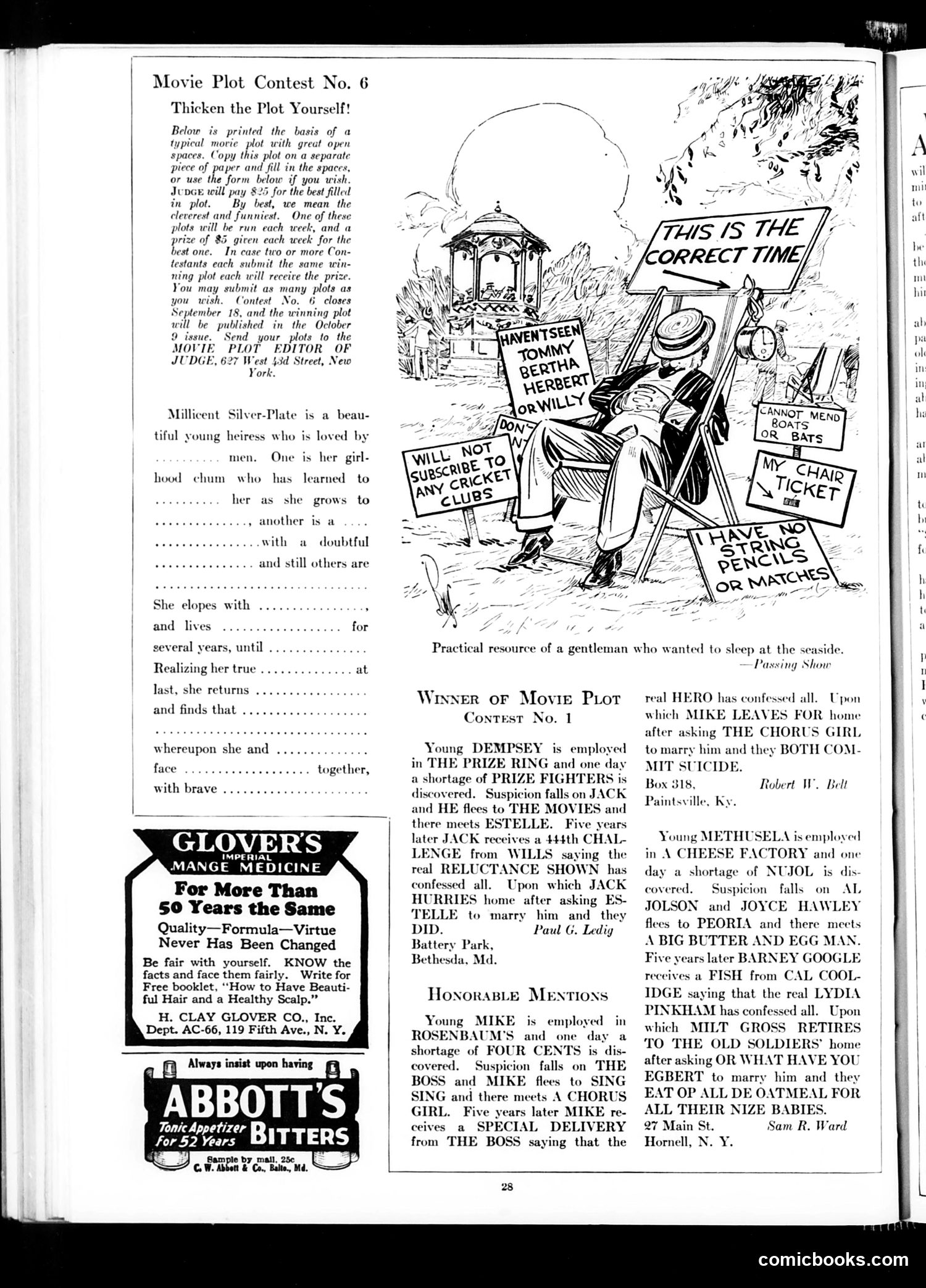
This page features a **reader-participation contest** where Judge magazine invites readers to complete a deliberately absurd movie plot template by filling in blanks. The joke is satirizing the predictable, formulaic nature of 1920s silent film plots. The cartoon illustration shows a man at the seaside surrounded by signs listing his concerns ("Will not subscribe to any cricket clubs," "Cannot borrow boats or bats," "My chair ticket," etc.)—visual satire of how easily distracted people become when trying to relax. The winning and honorable mention entries parody specific contemporary figures: references to boxer **Jack Dempsey**, boxer **Jack Wills**, comedian **Al Jolson**, cartoonist **Milt Gross**, and comic character **Barney Google**. The submissions deliberately escalate the absurdity—one entry ends with characters committing suicide, another with eating oatmeal for babies—mocking how melodramatic and ridiculous film plots could become. The satire targets both Hollywood's formula storytelling and the era's casual reference to serious subjects like boxing and suicide for comedic effect.
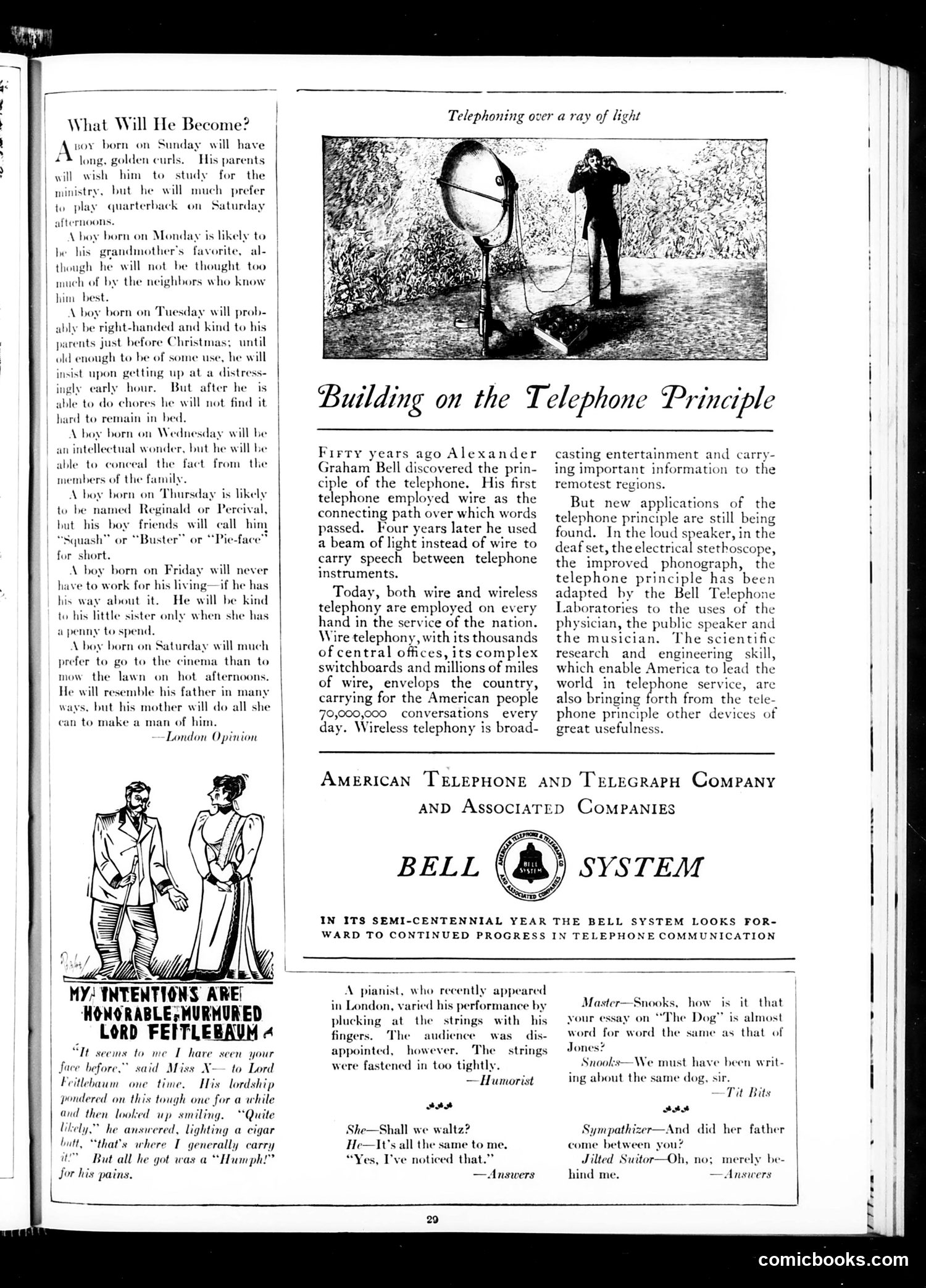
This page mixes humor with advertising. The main satirical content includes: **"What Will He Become?"** — A lighthearted piece from *London Opinion* predicting boys' futures based on birth day. The humor relies on stereotypes and ironic reversals: Sunday boys are studious but prefer football; Friday boys are lazy freeloaders; Wednesday boys are intellectually gifted but conceited. It's gentle social satire about parental expectations versus children's actual behavior. **"Lord Feitlebaum" joke** — A play on the saying "I've seen your face before." The nobleman misinterprets it as flattery about his appearance, then makes a crude joke about carrying his face around. The humor targets aristocratic pretension. **Bell System Advertisement** — Celebrates telephone technology's 50-year progress, from Bell's wire-based telephone to wireless telephony, positioning AT&T as driving American progress. The remaining items are brief humor snippets about a pianist with tied strings, a couple's waltz indifference, and a schoolboy plagiarism excuse.
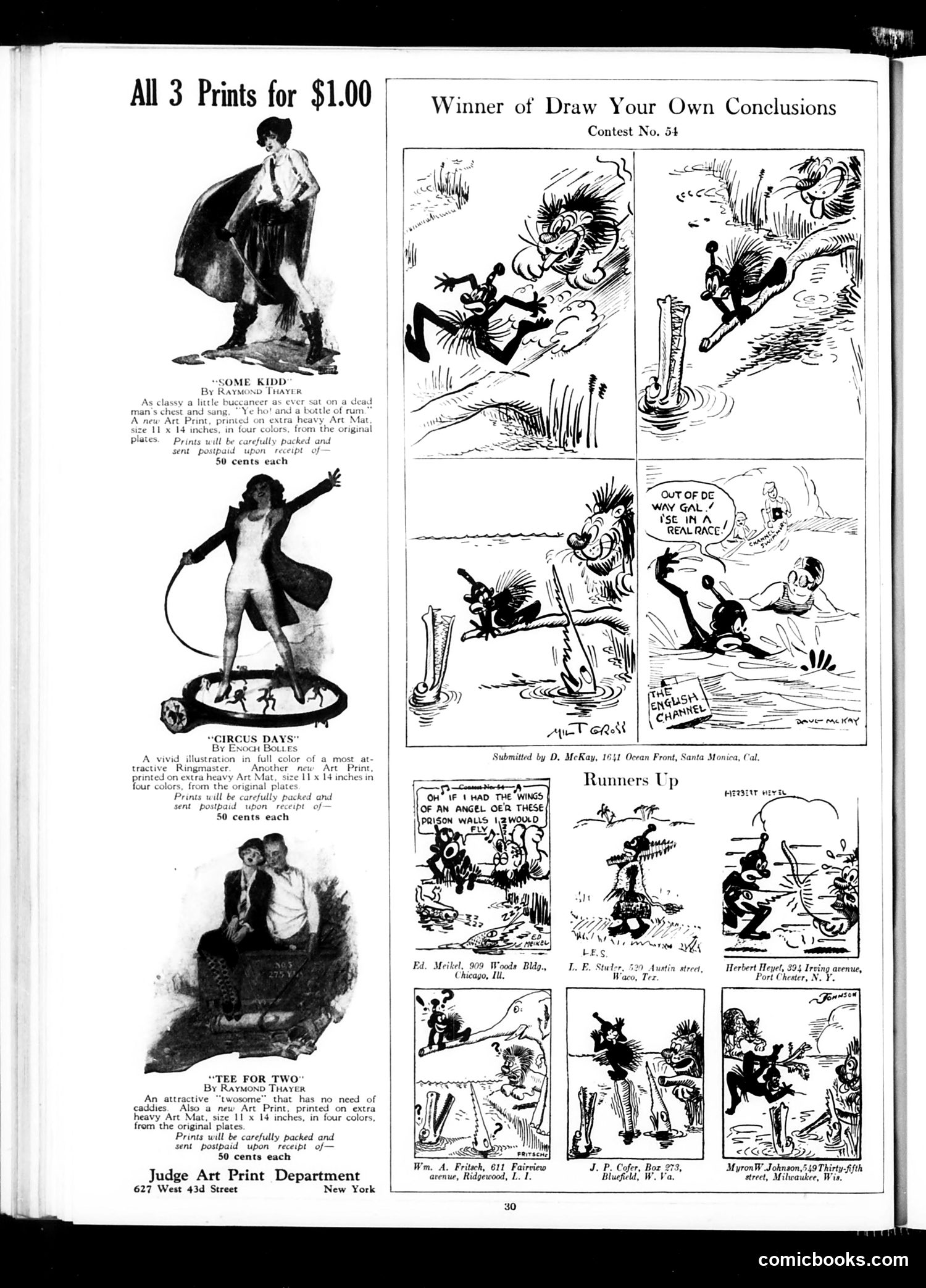
This page showcases the winner and runners-up of Judge magazine's "Draw Your Own Conclusions" Contest No. 54. The winning cartoon (top right, by D. McKay) depicts anthropomorphic animal characters in a comedic racing scene by water, with one character shouting "Out of de way gal! I'se in a real race!"—using period dialect humor typical of early 20th-century American comedy. The contest invited readers to complete or interpret cartoon scenarios. The runners-up entries shown are similarly whimsical animal-character comics addressing themes like prison escape and angel intervention. The page also advertises three art prints available from Judge's print department for $1 total: "Some Kidd," "Circus Days," and "Tee for Two"—all priced at 50 cents individually and featuring circus/performance themes popular in that era's entertainment culture.
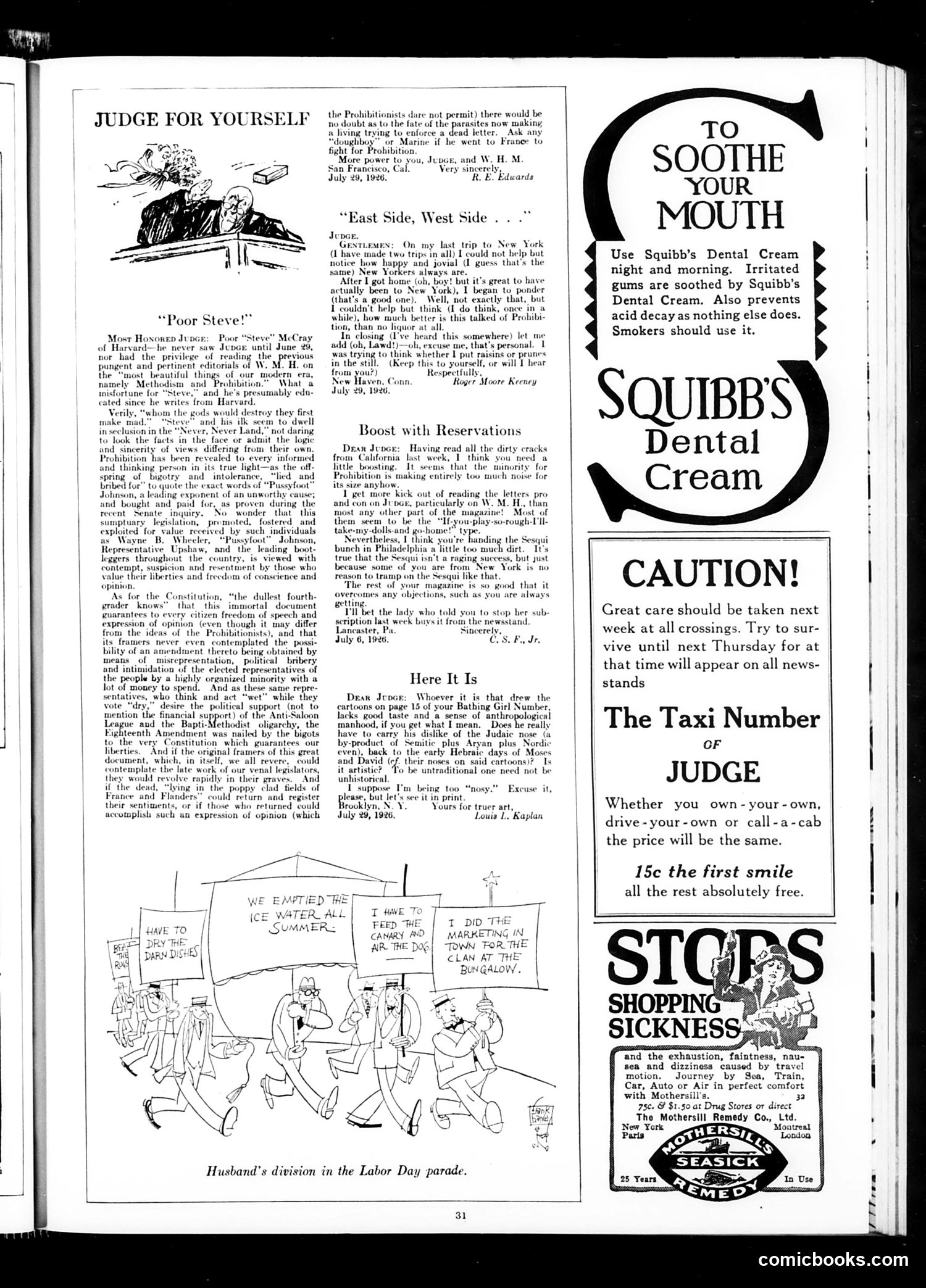
This page contains reader letters debating **Prohibition**, the constitutional ban on alcohol (1920-1933). The "Poor Steve" letter attacks Prohibition as enforced by organized groups like the Anti-Saloon League, invoking WWI veterans' freedom of conscience—a common argument that soldiers fought for liberty, not government overreach. The writer names real Prohibition activists: Wayne Wheeler and "Pussyfoot" Johnson, portraying them as corrupt manipulators. The cartoon at bottom shows husbands at a Labor Day parade with signs expressing their divisions over Prohibition ("We emptied the ice water all summer"). It satirizes how the issue split American households and communities. Other letters offer milder support for Prohibition or defend the magazine's editorial balance. The page reflects the intense social conflict Prohibition generated—pitting rural Protestant reformers against urban ethnic communities who saw it as tyranny. This was one of the era's most divisive political issues before it was repealed in 1933.
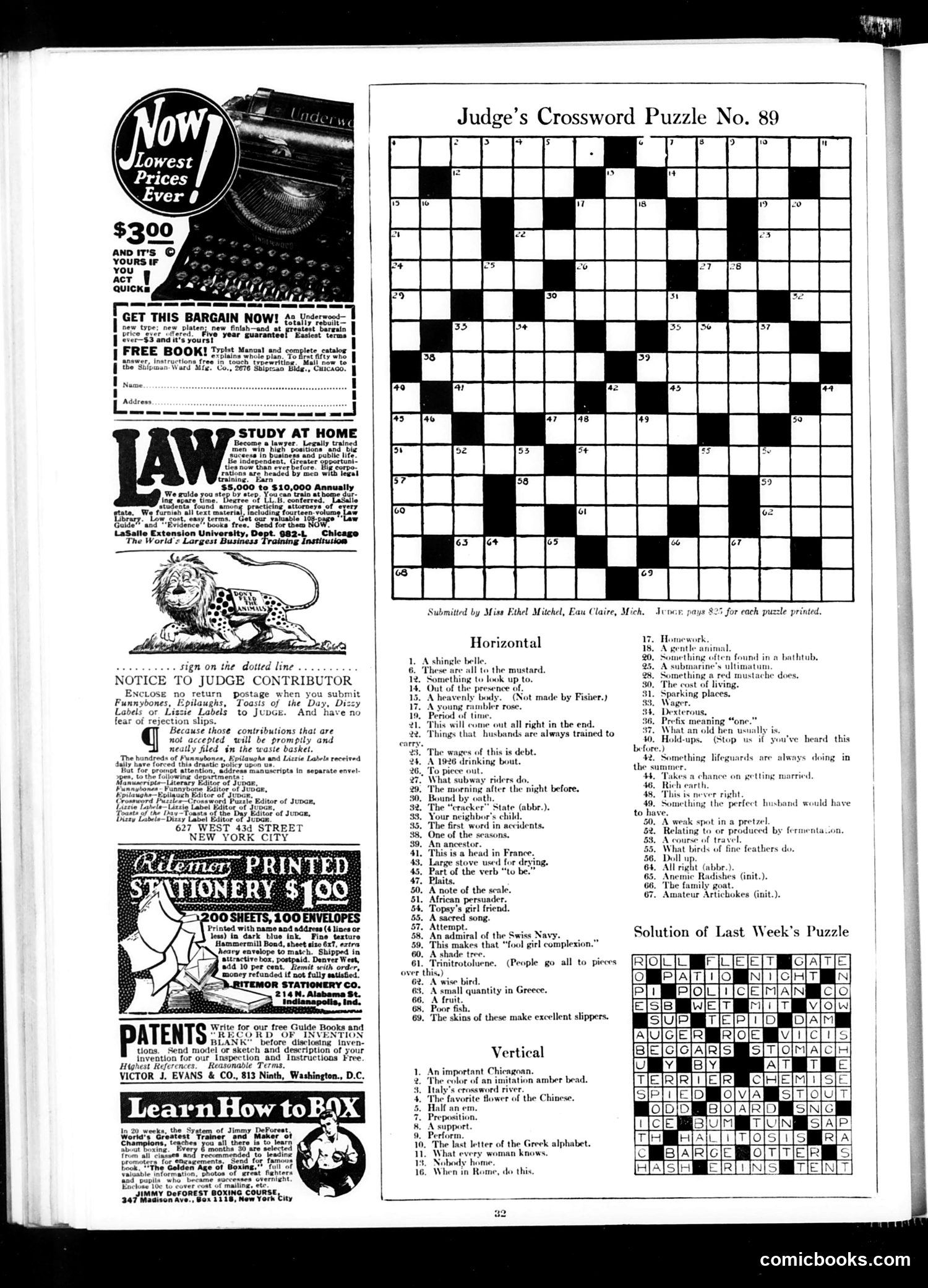
This page is primarily **advertising and puzzle content**, not satirical editorial material. The main feature is "Judge's Crossword Puzzle No. 89," submitted by a reader from Eau Claire, Michigan, with clues spanning horizontal and vertical entries. The puzzle itself contains no obvious political satire or caricature. The surrounding advertisements promote correspondence courses (law, boxing), typewriter sales, stationery printing, and patent services—typical commercial appeals from the 1920s-30s era. There is a humorous "Notice to Judge Contributors" warning submitted material will be rejected and "neatly filed in the waste basket," which is **self-deprecating editorial humor** about the magazine's submission process rather than political satire. A small notice credits an artist's work, but no specific cartoons or caricatures are visible on this page worth analyzing for political meaning. This appears to be a utilitarian page mixing puzzles and advertisements rather than carrying substantive satirical content.
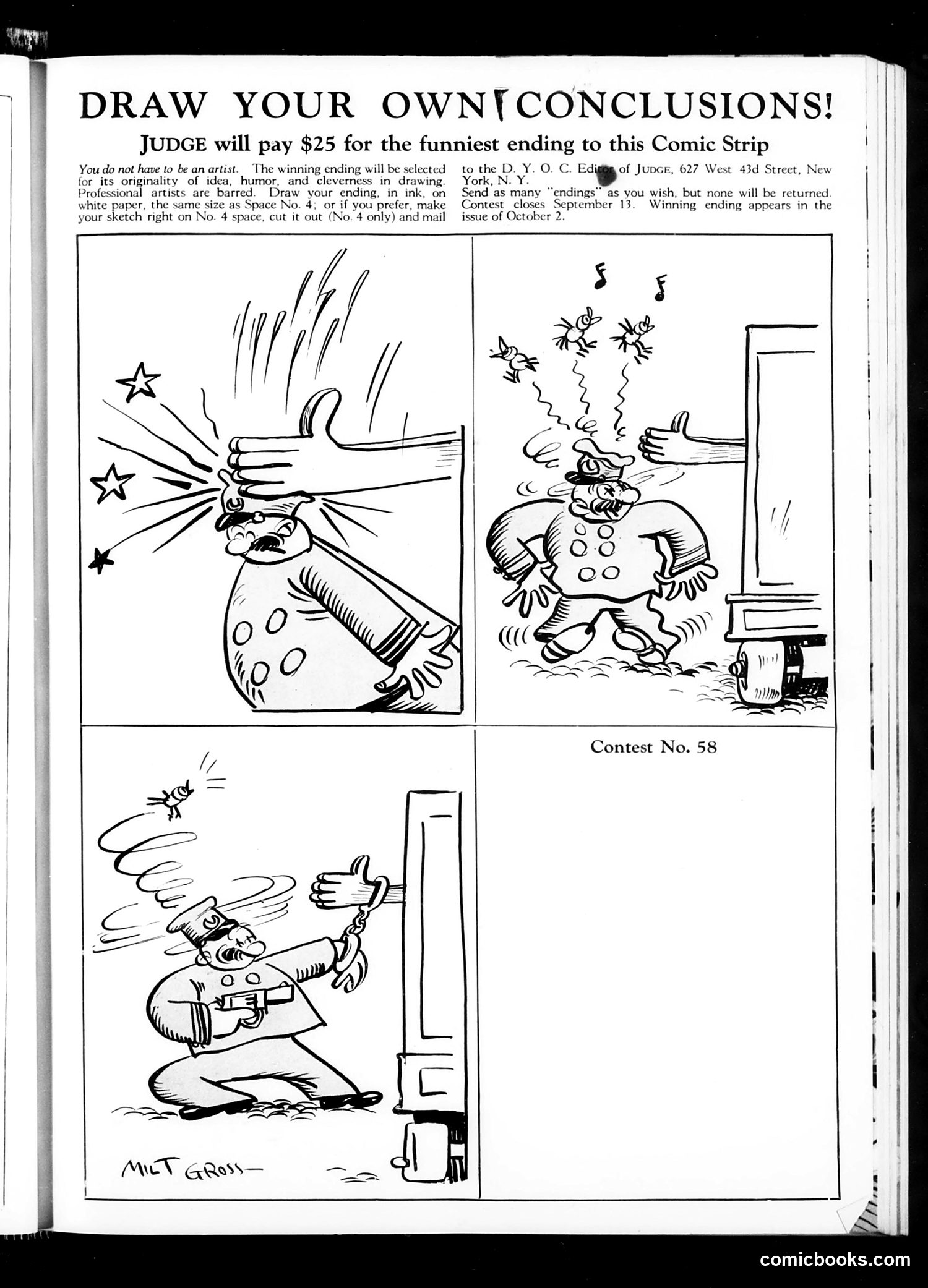
This page presents **Contest No. 58**, a reader-participation feature where Judge magazine invites submissions to complete an incomplete comic strip. The prize is $25 for the funniest ending. The three existing panels show a character (appearing to be a clown or circus performer, signed "Milt Gross") experiencing escalating chaos: first juggling while being struck by objects, then getting hit by multiple projectiles, and finally appearing disheveled near a door. The contest explicitly bars professional artists, making this a public participation feature—typical of early-to-mid 20th century magazine engagement strategies. Readers would mail completed fourth panels to Judge's offices by September 13, with winners published in the October 2 issue. This reflects how magazines entertained readers through interactive content before digital media existed.
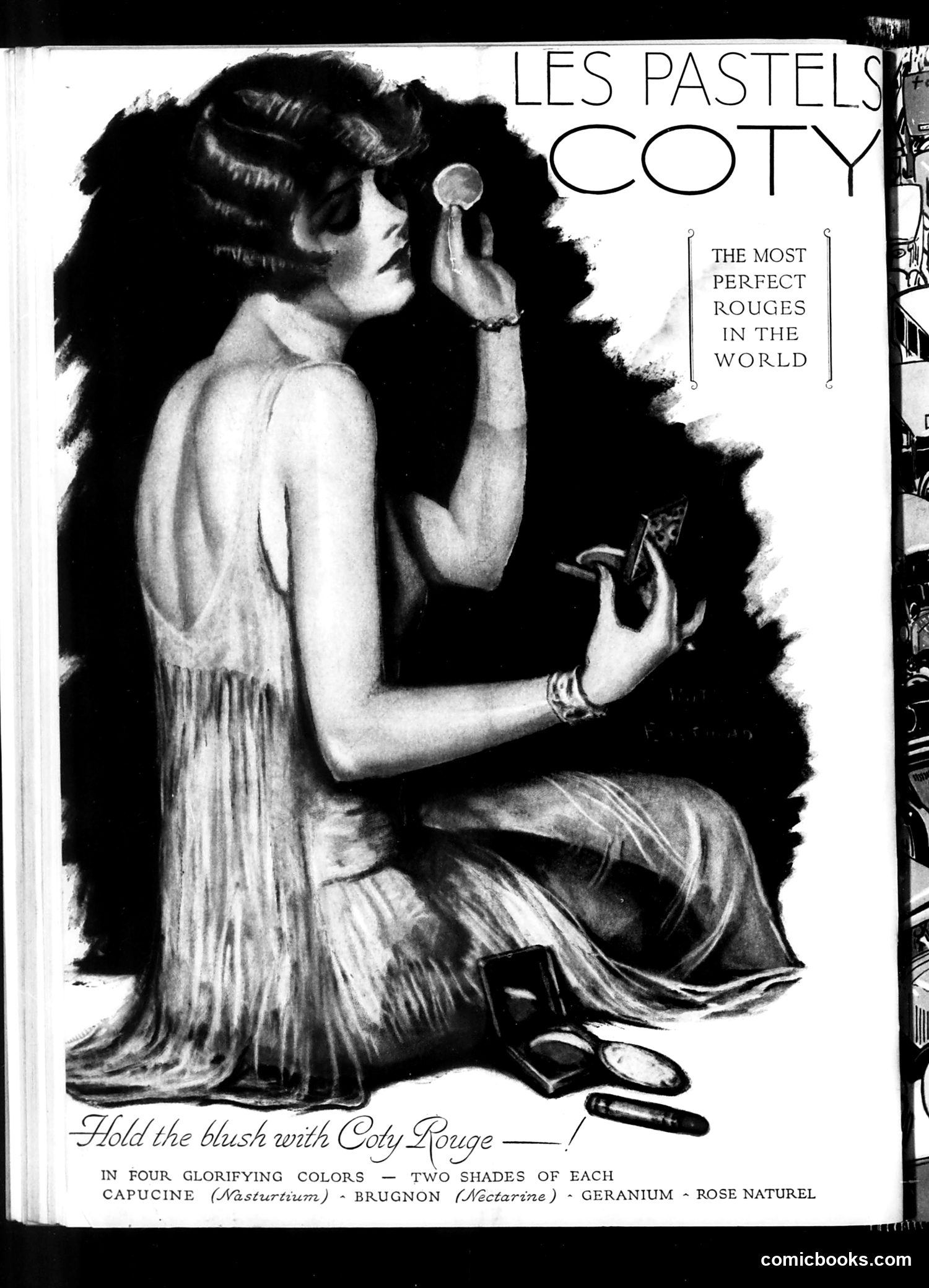
This is a cosmetics advertisement for "Les Pastels Coty" rouge (blush), not a political cartoon. The image shows a stylized Art Deco-era woman applying makeup, presented as aspirational beauty advertising. The ad promotes four rouge colors with botanical names: Capucine (Nasturtium), Brugnon (Nectarine), Geranium, and Rose Naturel. The tagline "Hold the blush with Coty Rouge" is a play on words—both literal (applying blush makeup) and suggestive of romantic excitement. The artwork exemplifies 1920s-30s luxury cosmetics marketing, targeting wealthy women through artistic presentation and sophisticated color nomenclature. There is no political satire present on this page; it's purely commercial advertising from Judge magazine's pages.