
Judge, 1926-09-04 · page 15 of 36
Judge — September 4, 1926 — page 15: what you’re looking at
What you’re looking at
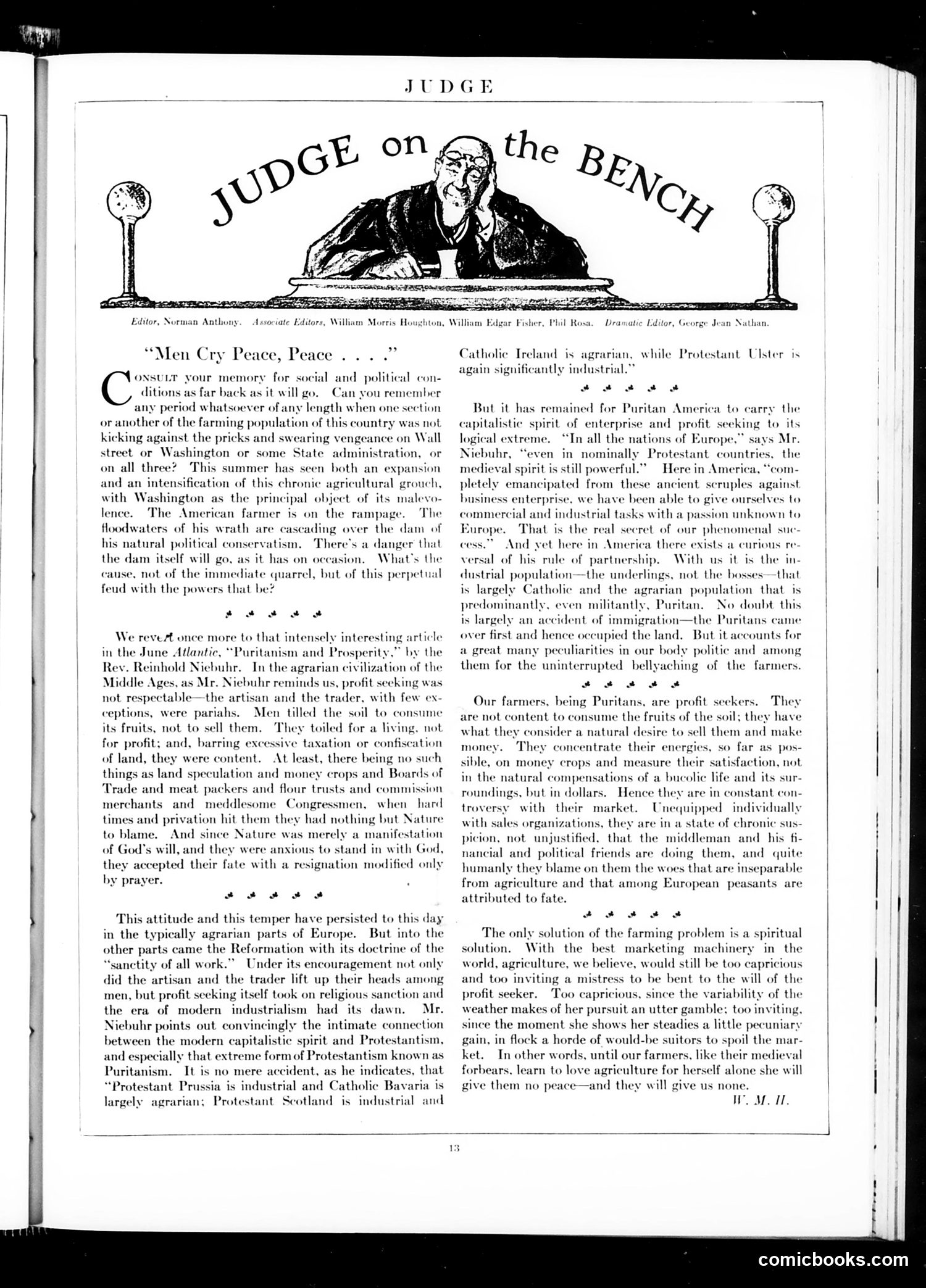
This is an editorial essay (not a cartoon despite the illustrated header) analyzing American agricultural discontent. The piece argues that farmers—historically conservative and religiously accepting of hardship—have become chronically angry at government and Wall Street. The author, drawing on Rev. Reinhold Niebuhr's Atlantic article, traces this to a cultural paradox: **Protestantism and Puritanism unleashed capitalistic profit-seeking in America, yet America's farmers (who are predominantly Puritan) remain agrarian and thus excluded from industrial wealth**. Meanwhile, the industrial working class is largely Catholic—reversing the European pattern where Protestant regions industrialize. The essay suggests this creates friction: Puritan farmers expect religious sanction for their labor but see themselves economically subordinated to industrial profiteers operating under the same Puritan ethics they share. The underlying satire critiques how American capitalism betrayed its own moral foundations by elevating some citizens while leaving farmers perpetually aggrieved.
📄 Transcribed text from this page (OCR, searchable)
Machine-transcribed from the original scan — historical spelling and the odd misread are preserved.
| JUDGE Editor, Norman Anthony “Men Cry Peace, Peace... . ONSULT Your memory for social and political con- ditions as far back as it will go. Can you remember any period whatsoever of any length when one section or another of the farming population of this country was not kicking against the pricks and swearing vengeance on Wall street or Washington or some State administration, or on all three? This summer has seen both an expansion and an intensification of this chronic agricultural grouch, with Washington as the principal object of its malevo- lence. The American farmer is on the rampage. The floodwaters of his wrath are cascading over the dam of his natural political conservatism. There's a danger that the dam itself will go, as it has on occasion. What's the cause, not of the immediate quarrel, but of this perpetual feud with the powers that be? We revezt once more to that intensely interesting article in the June Atlantic, “Puritanism and Prosperity.” by the Rev. Reinhold Niebuhr. In the agrarian civilization of the Middle Ages, as Mr. Niebuhr reminds us, profit seeking was not respectable—the artisan and the trader, with few ex- ceptions, were pariahs. Men tilled the soil to consume its fruits, not to sell them. They: toiled for a living. not for profit; and, barring excessive taxation or confiscation of land, they were content. At least, there being no such things as land speculation and money crops and Boards of Trade and meat packers and flour trusts and commission merchants and meddlesome Congressmen, when hard ion hit them they had nothing but } ature times and pri to blame. And sin of God’s will, and they were anxious to stand in with God, they accepted their fate with a resignation modified only by prayer. ature was merel 1 manifestation in the typically agrarian parts of Europe. But into the other parts came the Reformation with its doctrine of the “sanctity of all work.” Under its encouragement not only did the artisan and the trader lift up their heads among men, but profit seeking itself took on religious sanction and the era of modern industrialism had its dawn. Mr. Niebuhr points out convincingly the intimate connection between the modern capitalistic spirit and Protestantism, and especially that extreme form of Protestantism known as Puritanism. It is no mere accident he indicates, that “Protestant Prussia is industrial and Catholic Ba ia i largely agra Protestant Scotland is industrial and a is Associate Editors, William Morris Houghton, William Edgar Fisher, Phil Rosa. Dramatic Editor, George Jean Nathan: Catholic Treland is agrarian, while Protestant Ulster is again significantly industrial.” 42 et 2 But it has remained for Puritan America to carry the capitalistic spirit of enterprise and profit seeking to its logical extreme. “In all the nations of Europe,” says Mr. Niebuhr, “even in nominally Protestant countries, the medieval spirit is still powerful.” Here in America pletely emancipated from these ancient. scruples com- gainst business enterprise. we have been able to give ourselves to commercial and industrial tasks with a passion unknown to Europe. That is the real secret of our phenomenal suc- cess.” And yet here in America there exists a curious re- versal of his rule of partnership. With us itis the in- dustrial population—the underlings, not the bosses—that is largely Catholic and the agrarian population that. is predominantly, even militantly, Puritan. No doubt. this an accident of immigration—the Puritans came seccupied the land, But it accounts for a great many peculiarities in our body politic and among them for the uninterrupted bell is largel over first and hence aching of the farmers. ry tos * Our farmers, being Puritans, are profit seekers. They are not content to consume the fruits of the soil; they have what they consider a natural desire to sell them and make money. They concentrate their energies, so far as pos- sible, on money crops and measure their satisfaction, not in the natural compensations of a bucolic life and its sur- roundings, but in dollars. Hence they are in constant con- troversy with their market. Unequipped individually with sales organizations, they are in a state of chronic sus- picion, not unjustified, that the middleman and_ his nancial and political friends are doing them, and quite humanly they blame on them the woes that are inseparable from agriculture and that among European peasants are attributed to fate. ey The only solution of the farming problem is a spiritual solution. With the best marketing machinery in the world, agriculture, we believe, would still be too capricious and too inviting a mistress to be bent to the will of the profit seeker. Too capricious, since the variability of the weather makes of her pursuit an utter gamble; too inviting, since the moment she shows her steadies a little pecuniary gain, in flock a horde of would-be suitors to spoil the mar- ket. In other words, until our farmers, like their medieval forbears. learn to love agriculture for herself alone she will give them no peace—and they will give us none. WoM. I. comicbooks.com