
Judge, 1926-09-04 · page 18 of 36
Judge — September 4, 1926 — page 18: what you’re looking at
What you’re looking at
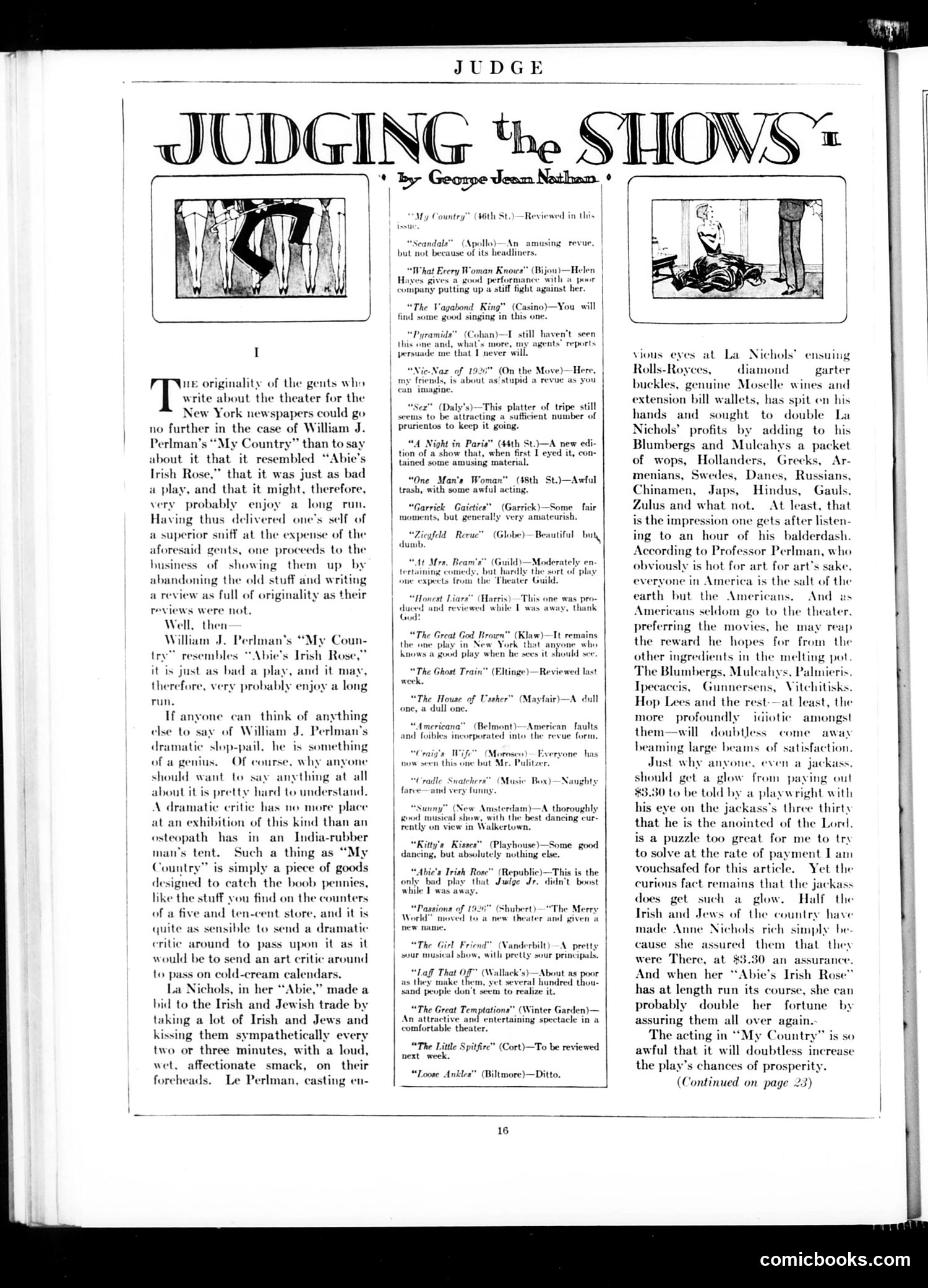
This is George Jean Nathan's theater column reviewing Broadway productions. The main satire targets lazy drama criticism itself. Nathan mocks how theater critics repeatedly compare new plays to "Abie's Irish Rose"—a successful but critically despised comedy about Irish-Jewish romance. He notes that critic William J. Perlman's "My Country" gets dismissed with the same lazy comparison, then jokes that Perlman's play will likely succeed anyway because it's designed for mass audiences ("boob pennies"), not artistic merit. The column's real barb: theatrical criticism is absurd. Nathan argues sending drama critics to review such commercial entertainment is as senseless as sending art critics to evaluate drugstore calendars. The review list below catalogs current Broadway shows with brief, often dismissive assessments—highlighting how formulaic both plays and their criticism had become in 1920s commercial theater.
📄 Transcribed text from this page (OCR, searchable)
Machine-transcribed from the original scan — historical spelling and the odd misread are preserved.
JUDGI JUDGING ‘he SHOWS * He originality of the gents who I write about the theater for the New York newspapers could go no further in the case of William J. Perlman’s “My Country” than to say about it that it resembled ‘Abie’s Irish Rose,” that it was just as bad a play, and that it might, therefore, very probably er a long run. Having thus delivered one’s self of a superior sniff at the expense of the afore business of showing them up by id gents, one proceeds to the abandoning the old stuff and writing a review as full of originality as their reviews were not. Well, then William J.P Iry" resembles rlman’s “My Coun- Abie’s Irish Rose,” it is just as bad a play, and it may, therefore, very pro| run. If an else to sa bly enjoy a long 1e can think of anything of William J. Perlman’s dramatic slop-pail, he is something of a genius, Of course, why anyone should want to say anything at all about it is pretty hard to understand. \ dramatic critic has no more place at an exhibition of this kind than an osteopath has in an India-rubber man’s tent. Such a thing as “My Country” is simply a piece of goods designed to catch the boob pennies, like the stuff you find on the counters of a five and ten-cent store, and it is quite as sensible to send a dramatic critic around to pass upon it as it would be to send an art critic around to pass on cold-cream calendars. La Nichols, in her “Abie,” made a bid to the Irish and Jewish trade by taking a lot of Irish and Jews and kissing them sympathetically every two or three minutes, with a loud, wet, affectionate smack, on their foreheads. Le Perlman, casting en- * 4 Geonpe Jeam Nathan + “My Country® (46th St.)—Reviewed in this “Scandals” (Apollo)—An amusing revue but not because of its headliners. “What Every Woman Knows" (Bijou)—Helen Hayes gives a good performance with «poor pany putting up a stiff fight against her "he Vagabond King” (Casino)\—You will find some good singing in this one. Pyramids” (Cob me and, what's 1 persuade me that I never still “Nie-Naz of 1925" (Ont my fi about as’ stupid can agin ‘ex (Da platter to be attra a sufficient number of prurientos to keep it going. “A Night in Paris” (44th St.)—A new edi- h -yed it, con- ed some amusing material, “One Man's Woman’ trash, with some awful ac (8th St.)—Awful “Garrick Gaicties"” (Garrick)—Some fair moments, but generally very amateurish, ufeld Rerue"” (Globe) —Beautiful but, Id)—Moderately en rt of play Honest Liars” (Harris) —T" duced and reviewed while Dw Go ¢ was pro: way, thank “The Great God Brown" (Klaw)—It remains play in New York mid play when he se yvone whe it should see. “The Ghost Train (Eltinge)—Reviewed last week. “The House of Ussher” (Mayfair)—A dull ‘one, a dull one. “Americana” (Belmont)—American faults “Craig's Wis now seen thi Everyone has we but Mr. Pulitzer. “Cradle Snatchers” (Music Box) —Naughty farce—and very funny “Sunny” (New Amsterdam)—A thoroughly fev musical show, with the best dancing eur- rently on view in Walkertown, Kitty's Kisses” (Pl ng, but absolute vhouse)—Some good uothing else. ‘Abie's Trish Rose” (Republic)—This is the onty bad pla that Juige Jr. didn't boost while TF was a “Passions of 1928" (Shubert) —""The Merry w theater and given at rbilt) A pretty show, with pretty: sour principals. “Laff That OF” (Wall ack’) About as poor ef panels ed thou- An attractiv comfortable theater. “The Little Spitfire” (Cort)—To be reviewed next week. “Loose Ankles” (Biltmore)—Ditto. and foibles incorporated inte the revue form. | vious eyes at La Nichols’ ensuing Rolls-I buckle ey ces, diamond garter genuine Moselle wines and ension bill wallets, has spit en his hands and sought to double La Nichols’ profits by adding to his Blumbergs and Muleahys a packet of wops, Hollanders, Greeks, Ar- menians, Swedes, Danes, Russians, Chinamen, Japs, Hindus, Gauls, Zulus and what not. At least, that is the impression one gets after listen- ing to an hour of his balderdash. According to Professor Perlman, who obviously is hot for art for art’s sake, everyone in America is the salt of the earth but the Americans. And as Americans seldom go to the theater, preferring the movies, he may red the reward he hopes for from. the other ingredients in the melting pot The Blumbergs, Muleahys, Palmieris. Ipec: is, Gunnersens, Vitehitisks. Hop Lees and the rest-—at least, the more profoundly — ic tie amongst them—will doubtless come away aming large beams of satisfaction. Just why anyone, even a jackass. should g a glow rom paying oul 0 to be told by a playwright with ye on the jackass’s three thirty that he is the anciited of the Lord. is a puzzle too great for me to try to solve at the rate of payment Iam vouchsafed for this article. Yet the curious fact remains that the jackass does get such a glow. Half the Irish and Jews of the country ha made Anne Nichols rich simply be cause she assured them that they were There, at And when her * 30 an assurance. Abie’s Irish Rose” has at length run its course, she can probably double her fortune by assuring them all over a; The acting in “My Country” is so awful that it will doubtless incre the play’s chances of prosperity. (Continued on page 23) 16 comicbooks.com