
A complete issue · 36 pages · 1925
Judge — December 5, 1925
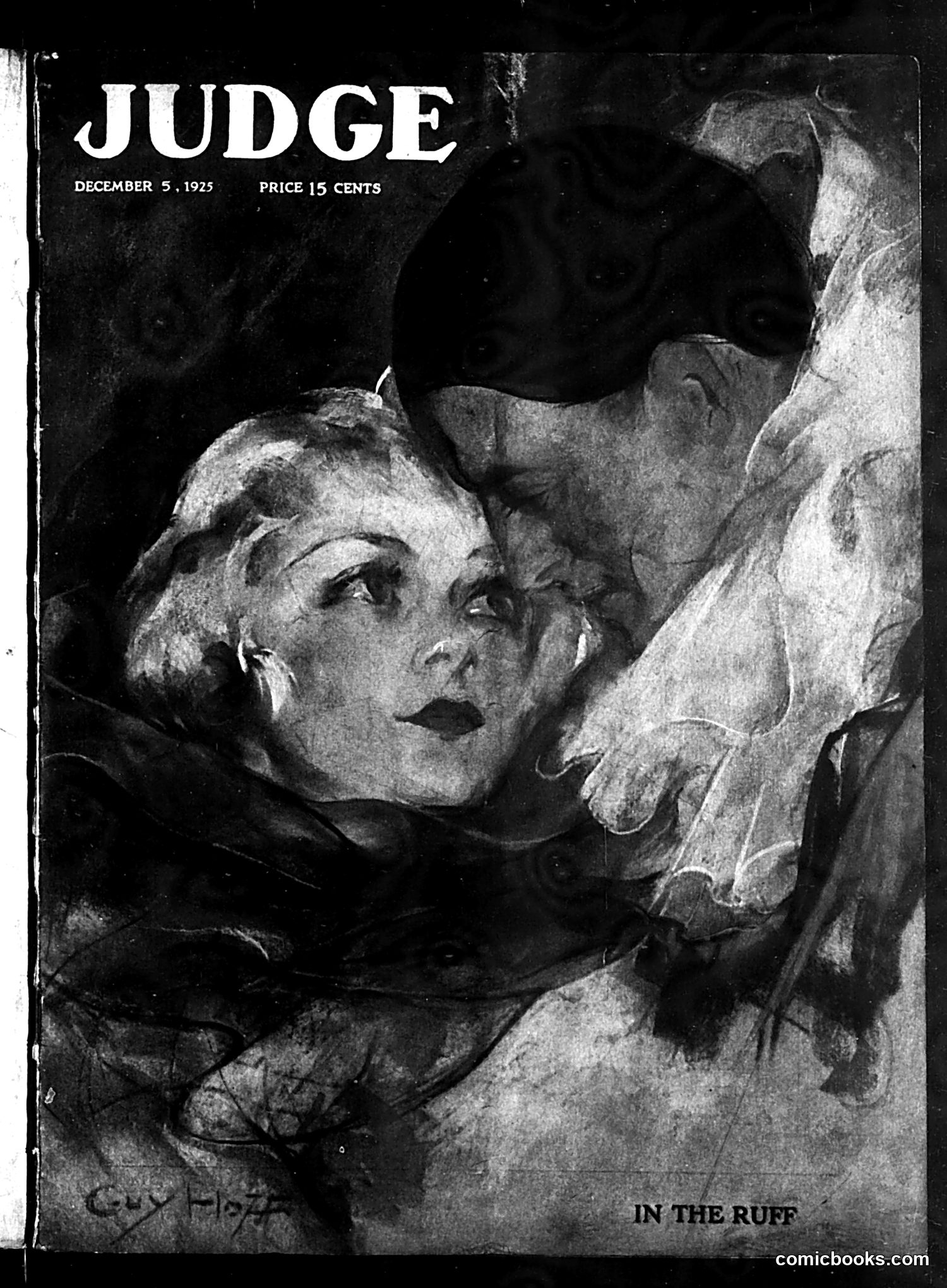
This *Judge* magazine cover from December 5, 1925 is titled "In the Ruff." The image shows a woman with short, bobbed hair (characteristic of 1920s "flapper" style) looking upward with an expression of surprise or delight, while a man's face appears behind/above her. The woman wears what appears to be a ruffled or textured garment. The satire likely comments on 1920s dating customs and the social freedoms that young women were enjoying during this era—the "flapper" generation that shocked conservative Americans with their modernized fashion, behavior, and independence. The suggestive positioning and the woman's pleased expression imply romantic or flirtatious interaction, poking fun at evolving social mores around courtship and gender relations during the Jazz Age.
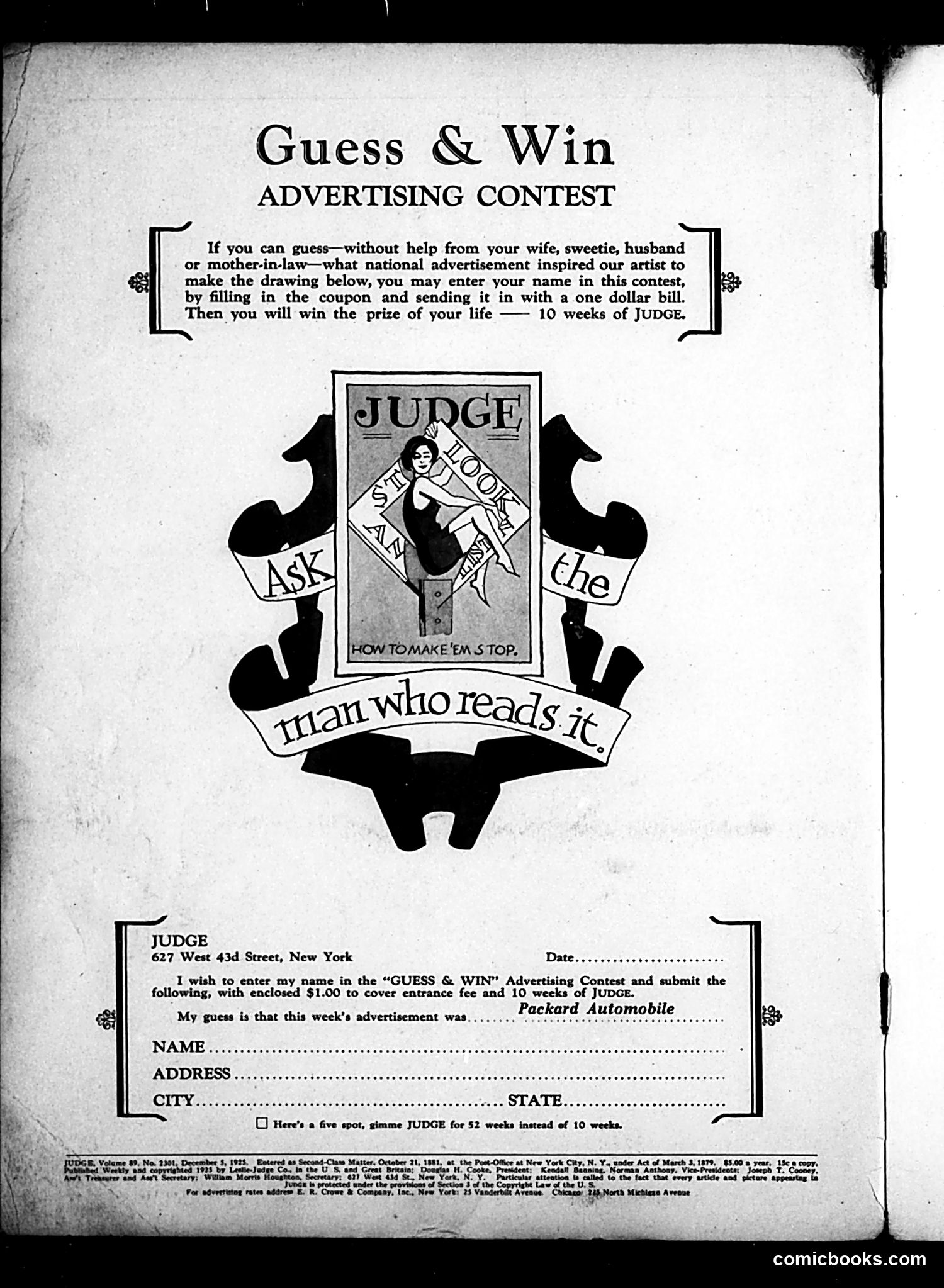
This is primarily an **advertising contest entry form** rather than editorial satire. The contest invites readers to guess which national advertisement inspired the magazine's artist to create the drawing below—the prize being 10 weeks of free Judge magazine subscriptions. The central image shows a stylized figure holding a Judge magazine cover featuring "How to Make 'Em Stop"—likely referencing an advertisement about controlling or stopping something, though the specific ad referenced is unclear from this reproduction. The form instructs contestants to submit their guess with a one-dollar entry fee. An example answer fills in "Packard Automobile" as the week's advertisement. This was a common early 20th-century magazine promotion mixing reader engagement with revenue generation.
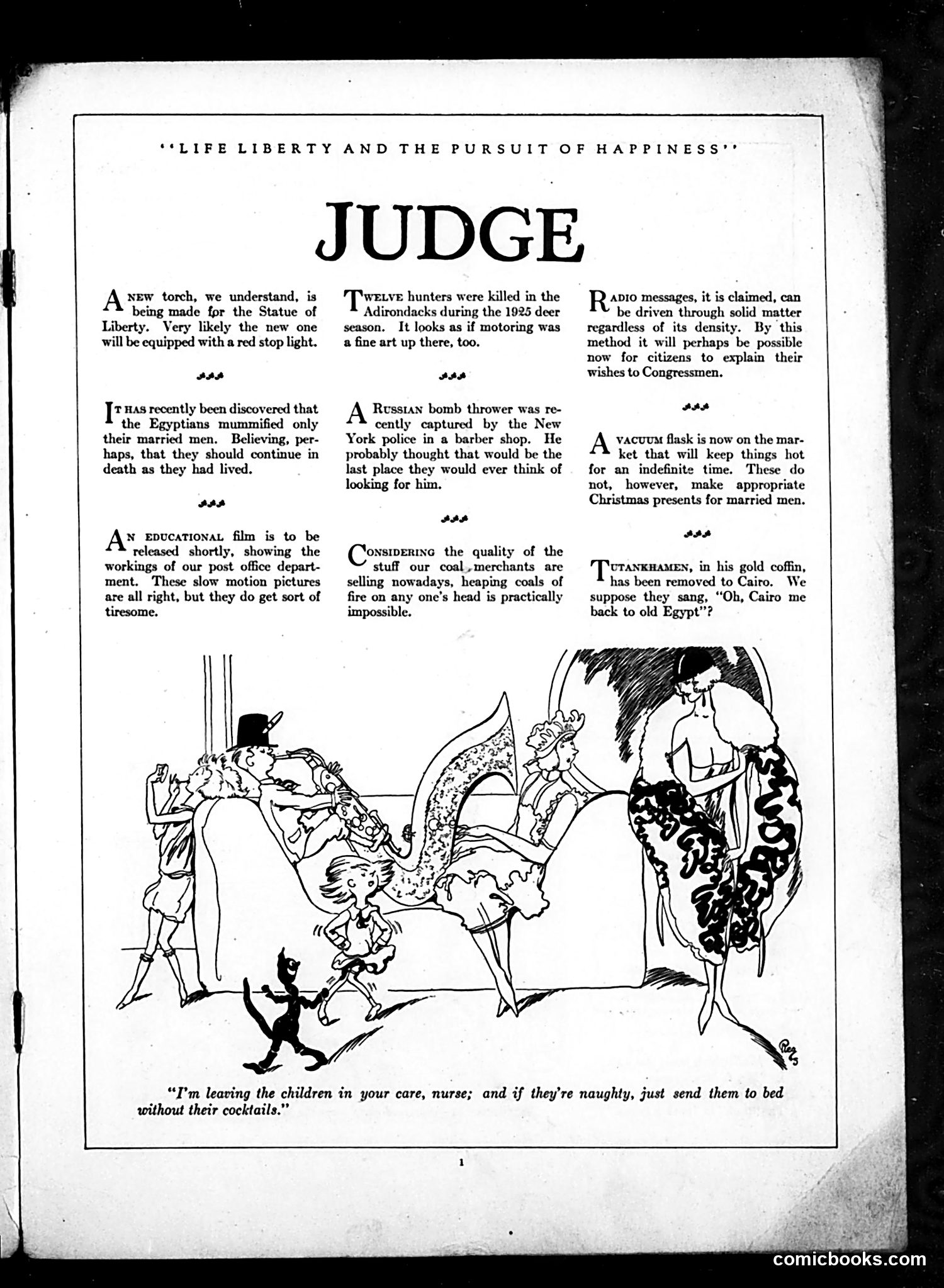
This page contains several brief satirical items and one cartoon. The main cartoon depicts a fashionable woman departing, leaving children with a nurse, with the caption: "I'm leaving the children in your care, nurse; and if they're naughty, just send them to bed without their cocktails." The satire targets 1920s-era parenting and Prohibition culture. It mocks wealthy socialites who apparently serve cocktails to children as routine, suggesting moral decay among the elite. The joke's dark humor relies on the absurdity—sending children to bed without alcohol as punishment implies they customarily consume it, which was scandalous. The surrounding brief items mock various contemporary topics: Egyptian mummification practices, an educational film, coal quality, captured Russian bomb-throwers, radio technology, Tutankhamun's discovery, and vacuum flasks—typical satirical commentary on 1920s news and consumer culture.
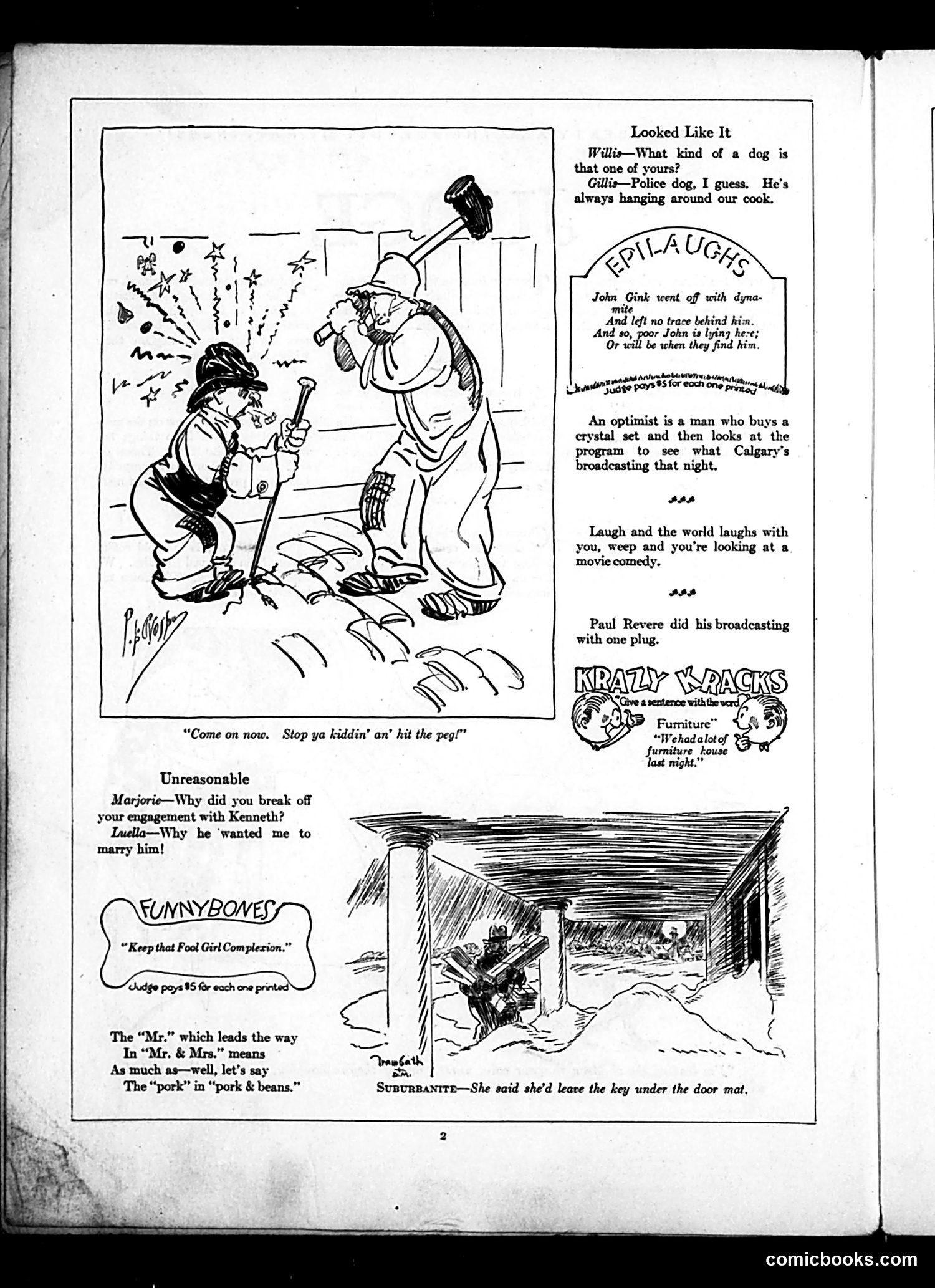
This page contains several unrelated humor items typical of Judge magazine's format: **"Come on now, Stop ya kiddin' on' hit the peg!"** - A cartoon showing two men with sledgehammers and targets, likely depicting physical comedy or carnival-style entertainment. The joke's specific reference is unclear without additional context. **"Looked Like It"** - A brief dialogue joke about a police dog hanging around the cook. **"Unreasonable"** - A joke about a broken engagement where the woman wanted marriage. **"Krazy Kracks"** and **"Funny Bones"** - Brief one-liners and advertising for beauty products. **"Suburbanite"** - A caption accompanying a sketch showing someone hiding a key under a door mat. The page exemplifies Judge's mix of visual gags, short jokes, and advertisements rather than sustained political or social commentary.
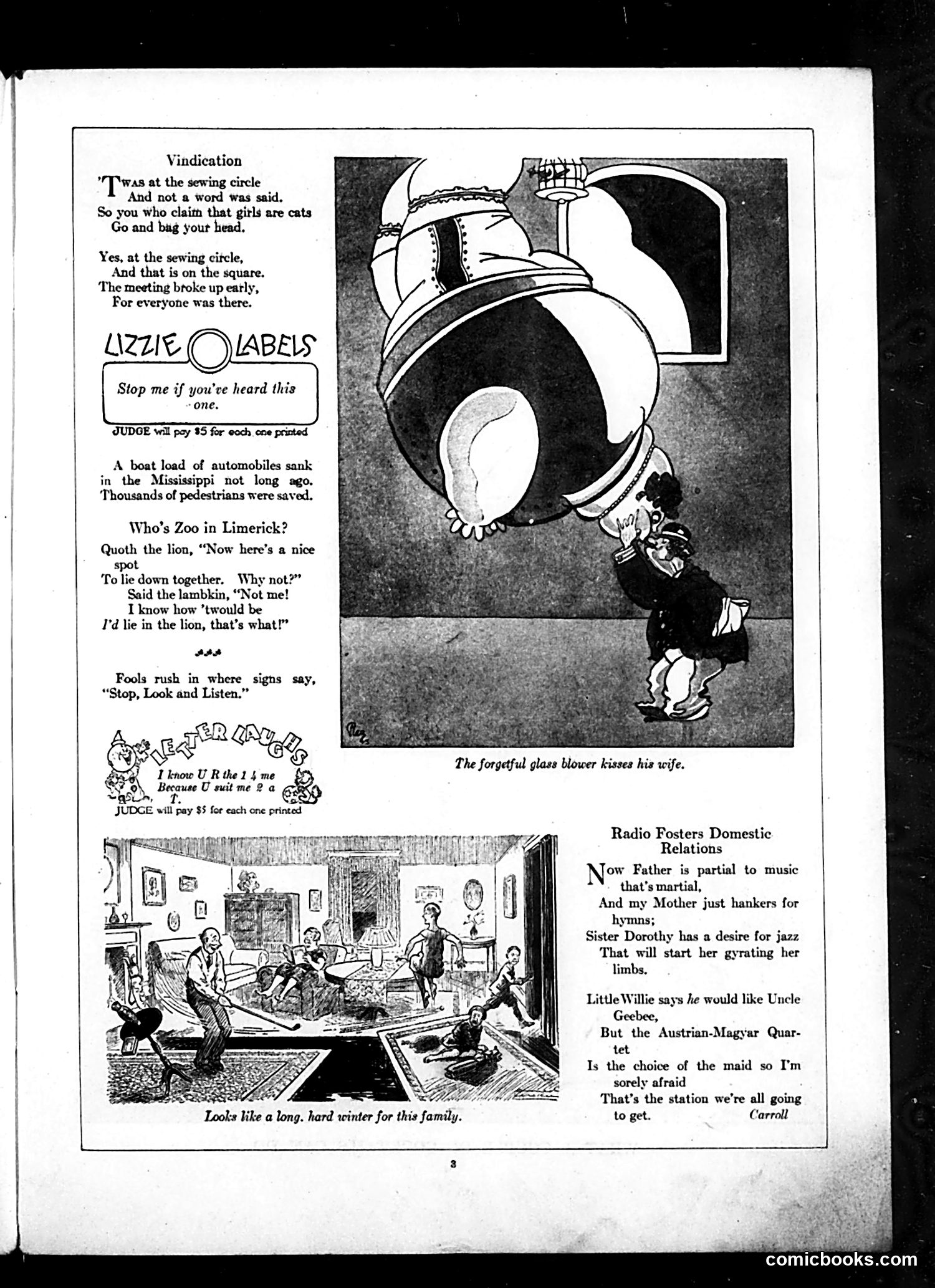
This page contains three humor pieces typical of early 20th-century satirical magazines: **"Vindication"** presents a poem mocking a sewing circle where women gather but say nothing—a jab at female social groups as pointless gatherings. **"Lizzie Labels"** and **"Alphabet Soup"** are reader-submitted jokes with monetary prizes for publication, a common Judge feature. **"The forgetful glass blower kisses his wife"** is a cartoon visual gag: a man blowing glass inadvertently creates a large bubble that obscures his face while kissing his wife—simple domestic humor. **"Radio Fosters Domestic Relations"** satirizes how radio programming creates family conflict: the father enjoys music, mother wants drama, sister likes jazz, Willie prefers Uncle Geebee, and the maid's Austrian-Magyar Quartet choice will ruin everyone's station choice. It mocks early radio's inability to satisfy diverse household tastes.
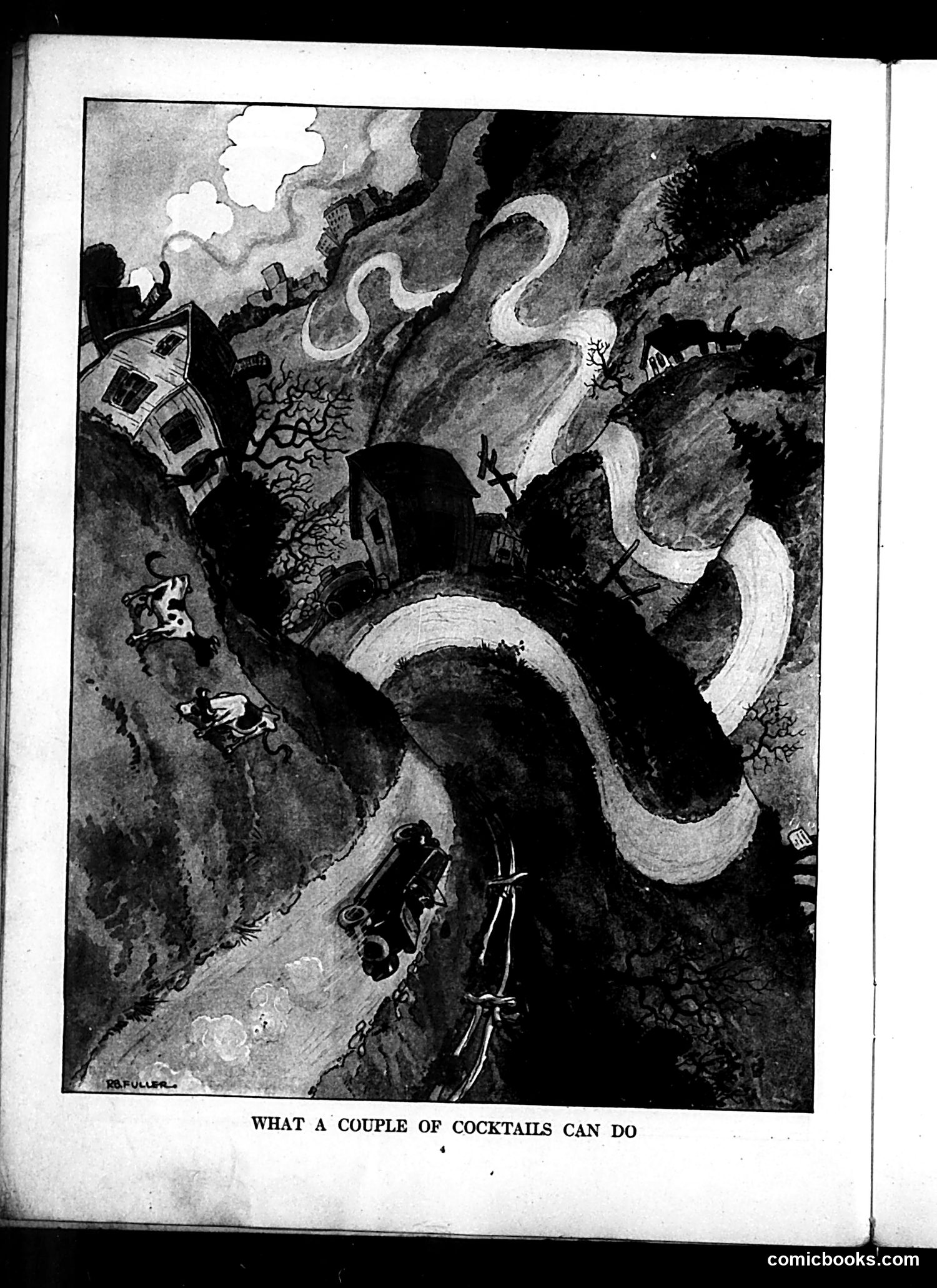
This appears to be a satirical cartoon from Judge magazine about alcohol's effects. The aerial view shows a winding road with vehicles and small figures, depicting chaos or reckless behavior caused by intoxication. The exaggerated, swirling landscape and the chaotic positioning of cars and people suggest dangerous driving or general mayhem resulting from drinking cocktails. Given the style and perspective, this likely comments on Prohibition-era concerns about illegal drinking and its social consequences—a common Judge theme. The title's sarcastic tone implies criticism of alcohol's destructive impact on behavior and safety. The artist (signed "McFullers" or similar) uses the bird's-eye view to emphasize the disorienting, chaotic effects of intoxication on judgment and coordination.
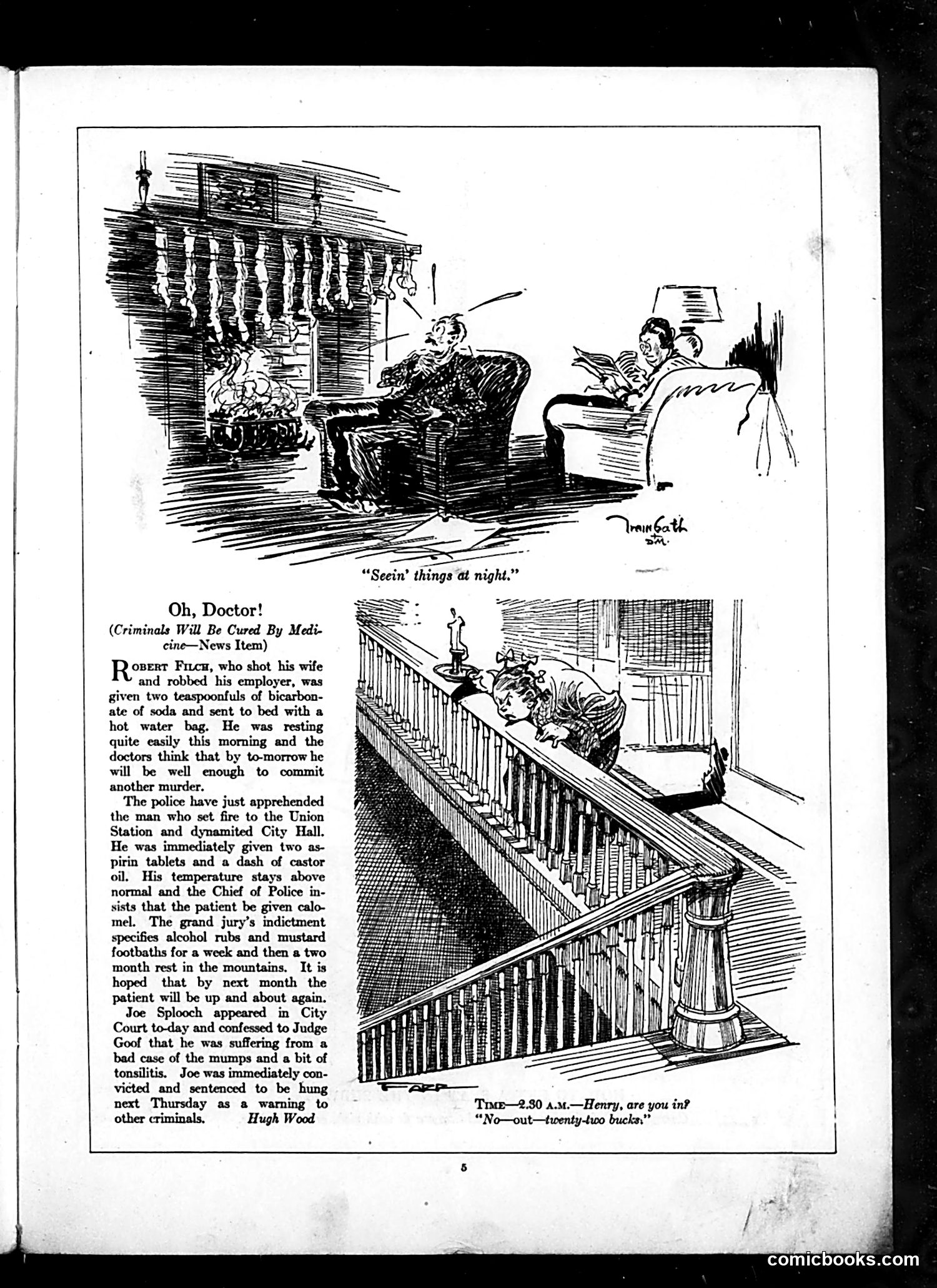
This page contains two cartoons satirizing medical treatments for criminals. **Top cartoon ("Seein' things at night"):** A man with a long nose (possibly a doctor or authority figure) treats a patient by a fireplace, suggesting dubious medical practices. **Main article and bottom cartoon:** The text describes a criminal (Robert Brown) given soda bicarbonate and sent to bed with a hot water bag after committing robbery and arson. The accompanying illustration shows a patient in bed at 2:50 a.m., being asked if he's home. The satire mocks contemporary medical pseudoscience—the notion that simple treatments like sodium bicarbonate and rest could "cure" criminals of their inclinations. The humor lies in the absurdity of treating criminal behavior as a medical condition rather than a legal matter, reflecting early 20th-century debates about criminal justice reform versus medical intervention.
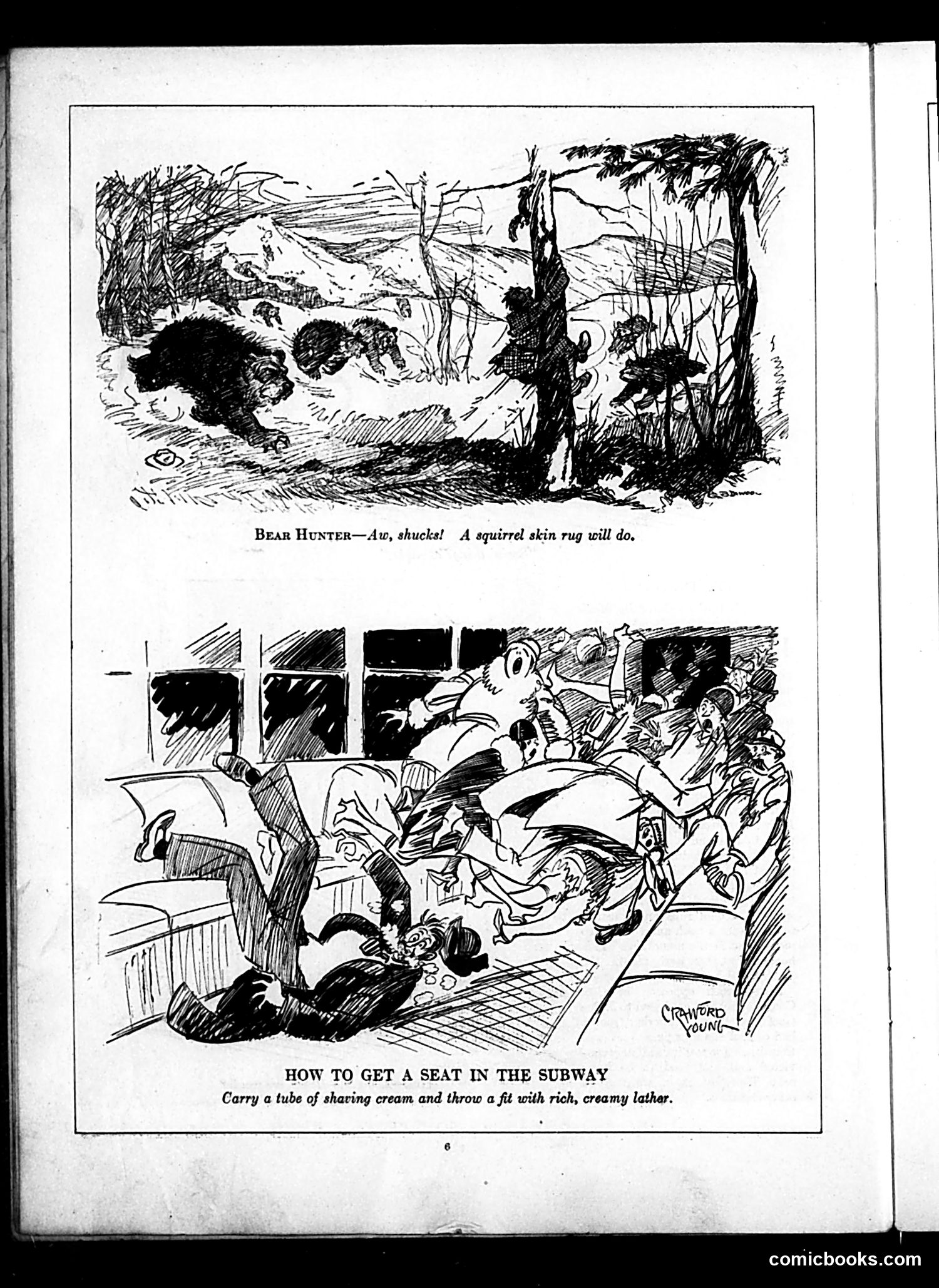
This page contains two separate satirical cartoons from *Judge* magazine. The **top cartoon** ("Bear Hunter") depicts a hunter and dogs encountering a bear, with the caption sarcastically suggesting a squirrel skin rug as an alternative—mocking impractical or absurd solutions to problems. The **bottom cartoon** ("How to Get a Seat in the Subway") is a humorous commentary on crowded public transit. It shows a chaotic subway car where someone using shaving cream causes such a commotion that passengers flee, creating an empty seat. The joke satirizes the desperation commuters face for seating in crowded subways—suggesting that creating a disturbance (mimicking lathered madness) is the only way to secure a seat. This reflects early-20th-century frustrations with overcrowded urban mass transit.
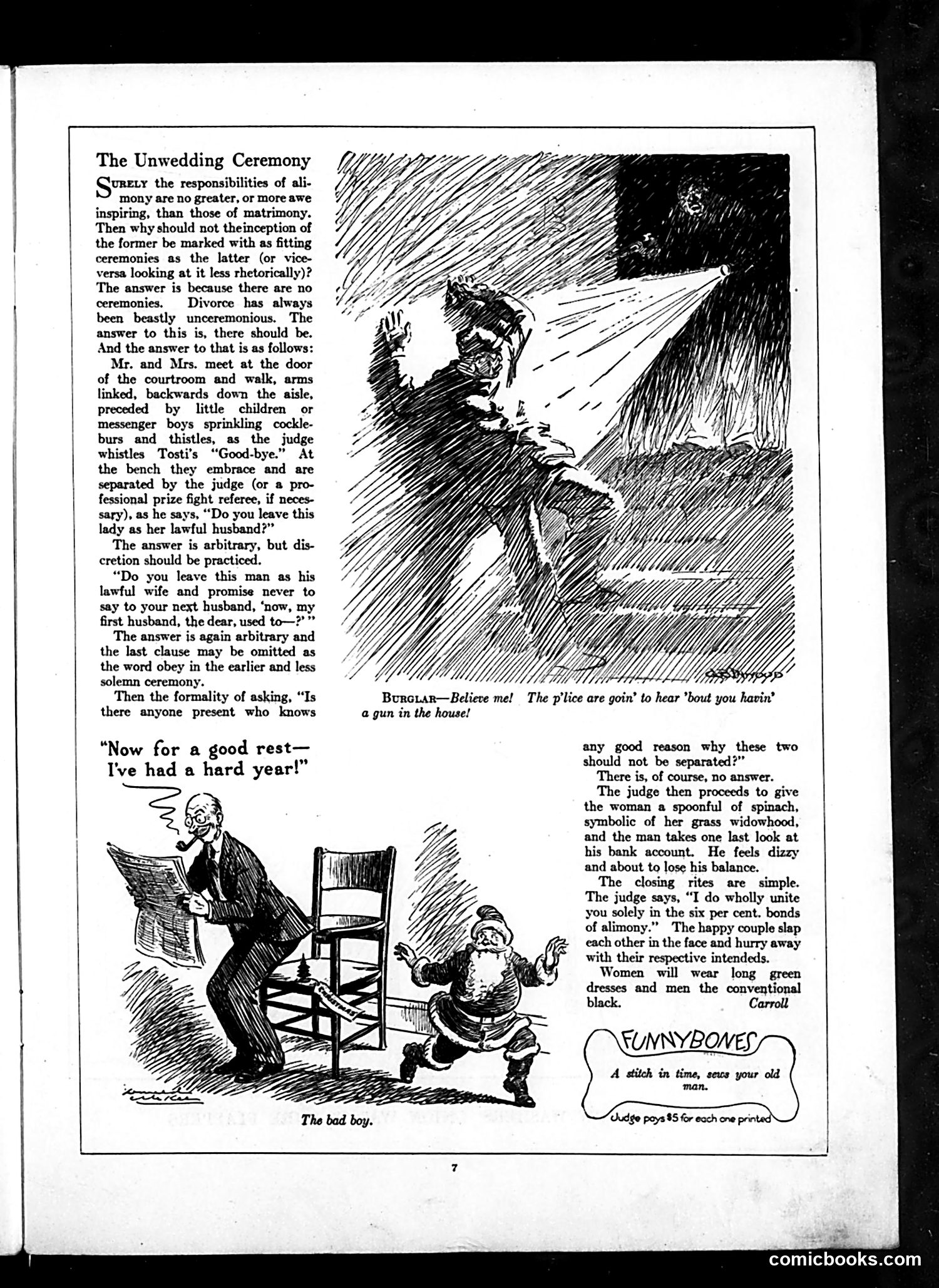
This satirical article proposes a formal, ceremonial approach to divorce—mirroring wedding ceremonies but in reverse. The author argues that since divorce carries serious financial obligations (alimony), it deserves equal ceremonial weight to marriage. The piece humorously describes an elaborate "unwedding": the couple walking backwards down the aisle, children sprinkling cockleburs instead of flowers, the judge asking if they "leave" each other as spouses, and symbolic gestures like giving the woman spinach to represent her impending widowhood. The closing joke is the judge uniting them "in the six per cent. bonds of alimony." The accompanying cartoons illustrate the gravity of divorce's financial burden and misbehaving children—suggesting both the emotional and practical chaos of broken marriages. The satire targets the arbitrary, ceremonially hollow nature of 1920s divorce proceedings while highlighting alimony's real consequences, particularly for women.
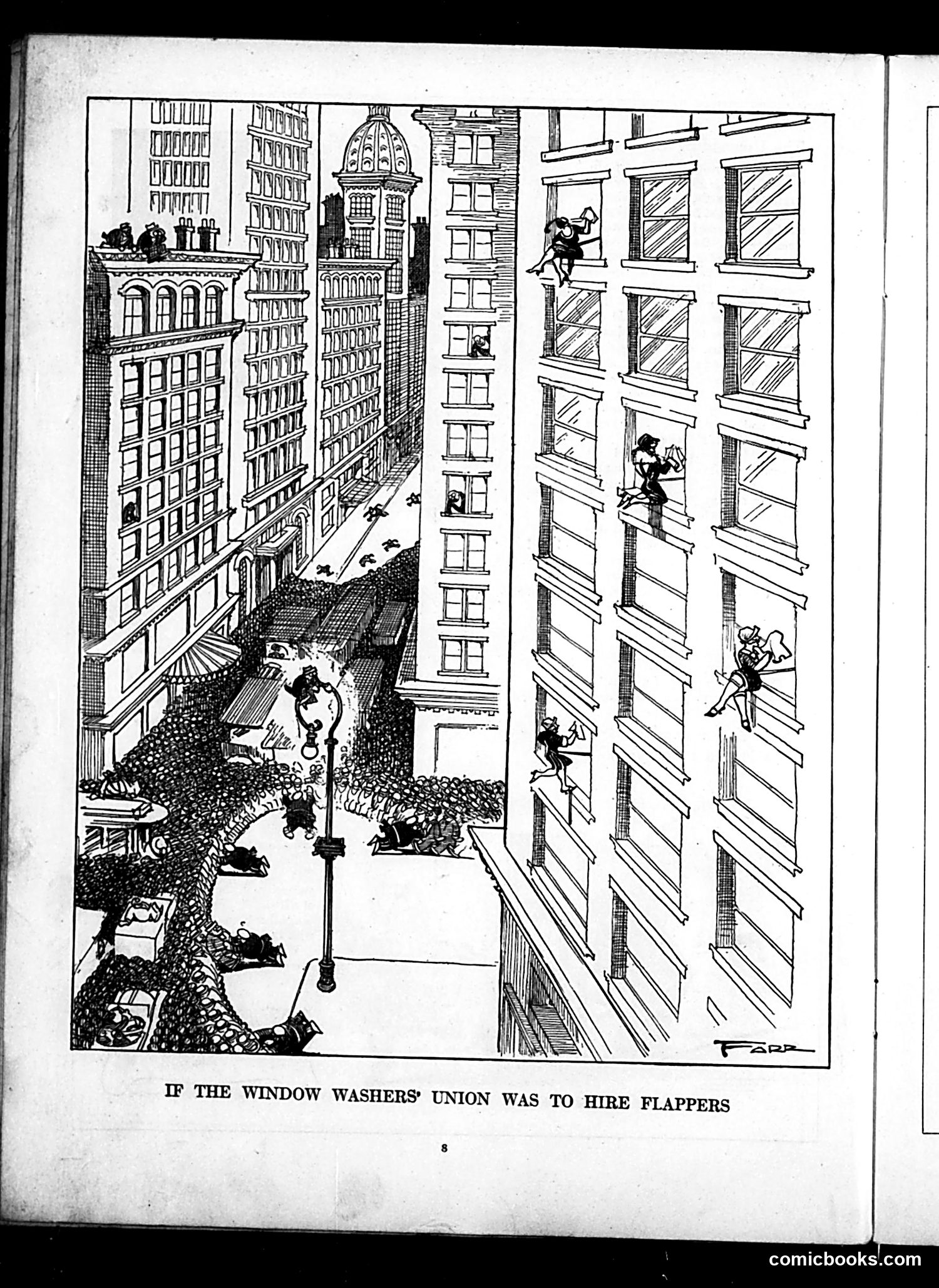
This political cartoon satirizes labor unions and "flappers"—young women of the 1920s known for their modern, unconventional behavior and fashion. The caption imagines a scenario where the window washers' union hires female flappers for the traditionally male job of high-rise window cleaning. The humor lies in the absurdity: the cartoon depicts women dangerously scaling the exterior of tall buildings with ropes, shown in precarious positions clinging to the facade. The crowded street below suggests spectators gathering to watch this chaos. The satire likely mocks both union protectionism (suggesting they'd resist female workers) and contemporary anxieties about changing gender roles. It plays on stereotypes of flappers as frivolous and unsuited for dangerous labor, while also commenting on workplace segregation and labor disputes of the era.
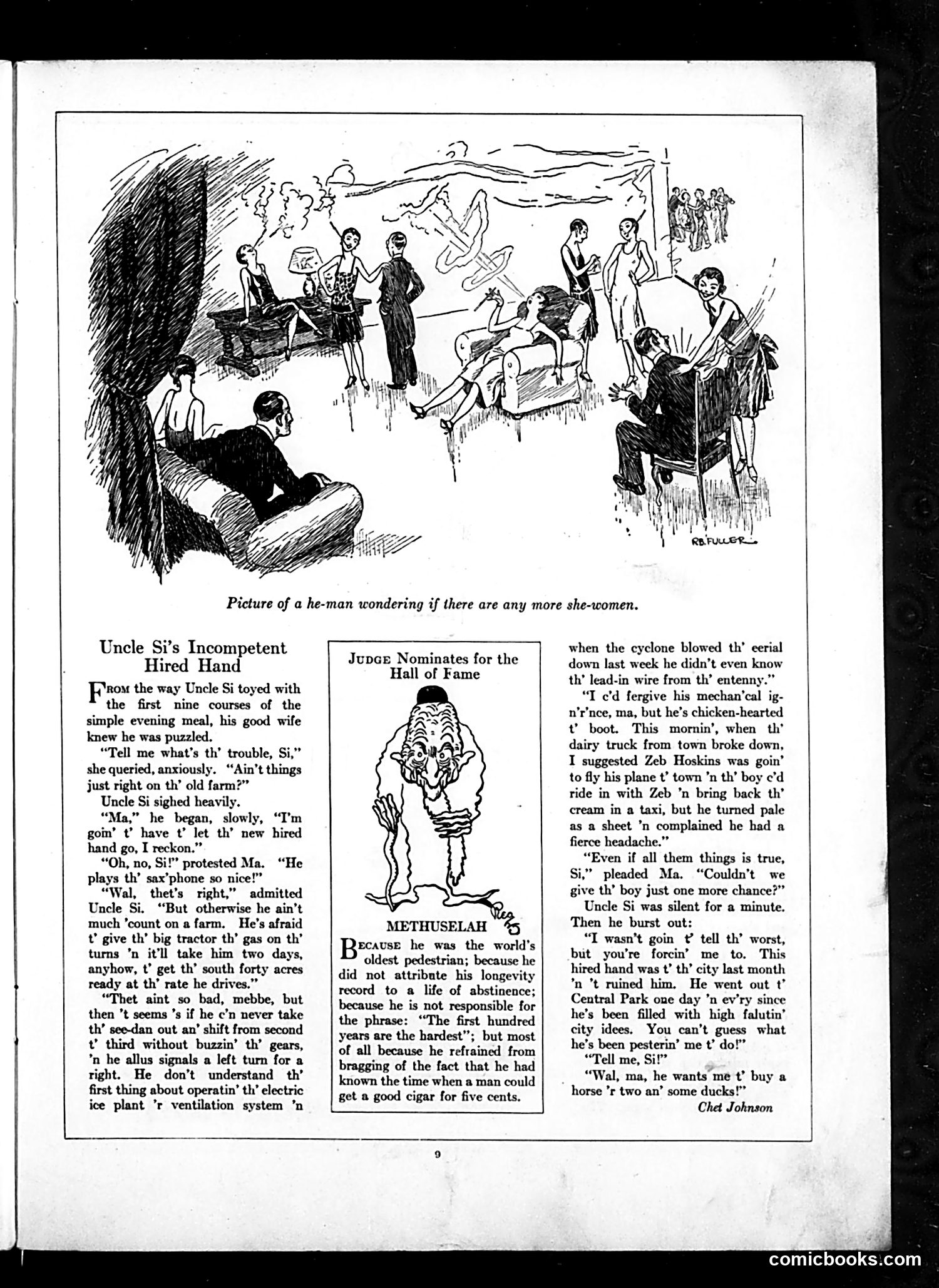
This rural humor story satirizes the clash between farm life and modern technology. Uncle Si, a farmer, must fire his hired hand despite the young man's musical talent (saxophone playing) because he's incompetent with machinery: he drives the tractor too slowly, grinds the gears carelessly, operates the electric ice plant poorly, and damaged the radio antenna. The satire's punchline reveals the real problem: the hired hand, having visited New York City, now has "high falutin' city idees" and wants Uncle Si to buy horses and ducks—essentially rejecting modern farm equipment for old-fashioned methods. The joke mocks both the hired hand's pretentious adoption of rural nostalgia and, implicitly, rural resistance to progress. It's a snapshot of 1920s-era tension between agricultural and urban American values.
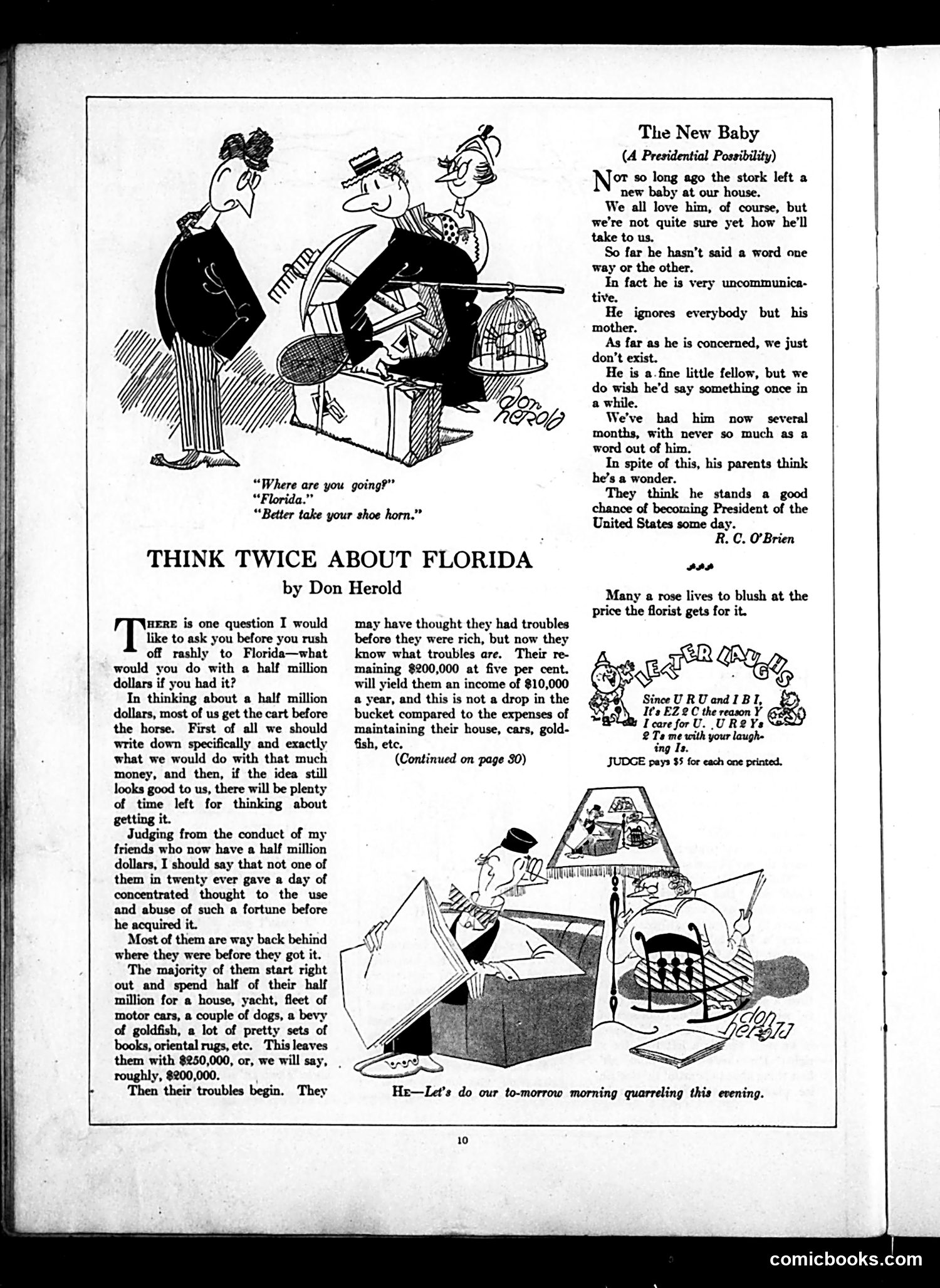
This Judge magazine page contains two satirical pieces: **"Think Twice About Florida"** (Don Herold): A commentary on the Florida real estate boom of the 1920s. Herold warns against rushing to invest a hypothetical half-million dollars in Florida property. He observes that wealthy people who relocate there typically spend lavishly on mansions, yachts, and luxury goods, then find their remaining $200,000 inadequate to maintain these expenses—creating financial trouble despite initial wealth. The satire targets get-rich-quick mentality and poor financial planning among the newly wealthy. **"The New Baby (A Presidential Possibility)"** (R.C. O'Brien): A humorous piece about an uncommunicative newborn whose parents optimistically believe he'll become President someday, despite having no evidence of his abilities. The satire likely mocks American optimism about presidential potential and parental bias. The cartoon at top depicts someone being sent to Florida with a "shoe horn"—suggesting difficulty fitting oneself into the Florida lifestyle or entering its competitive real estate market.
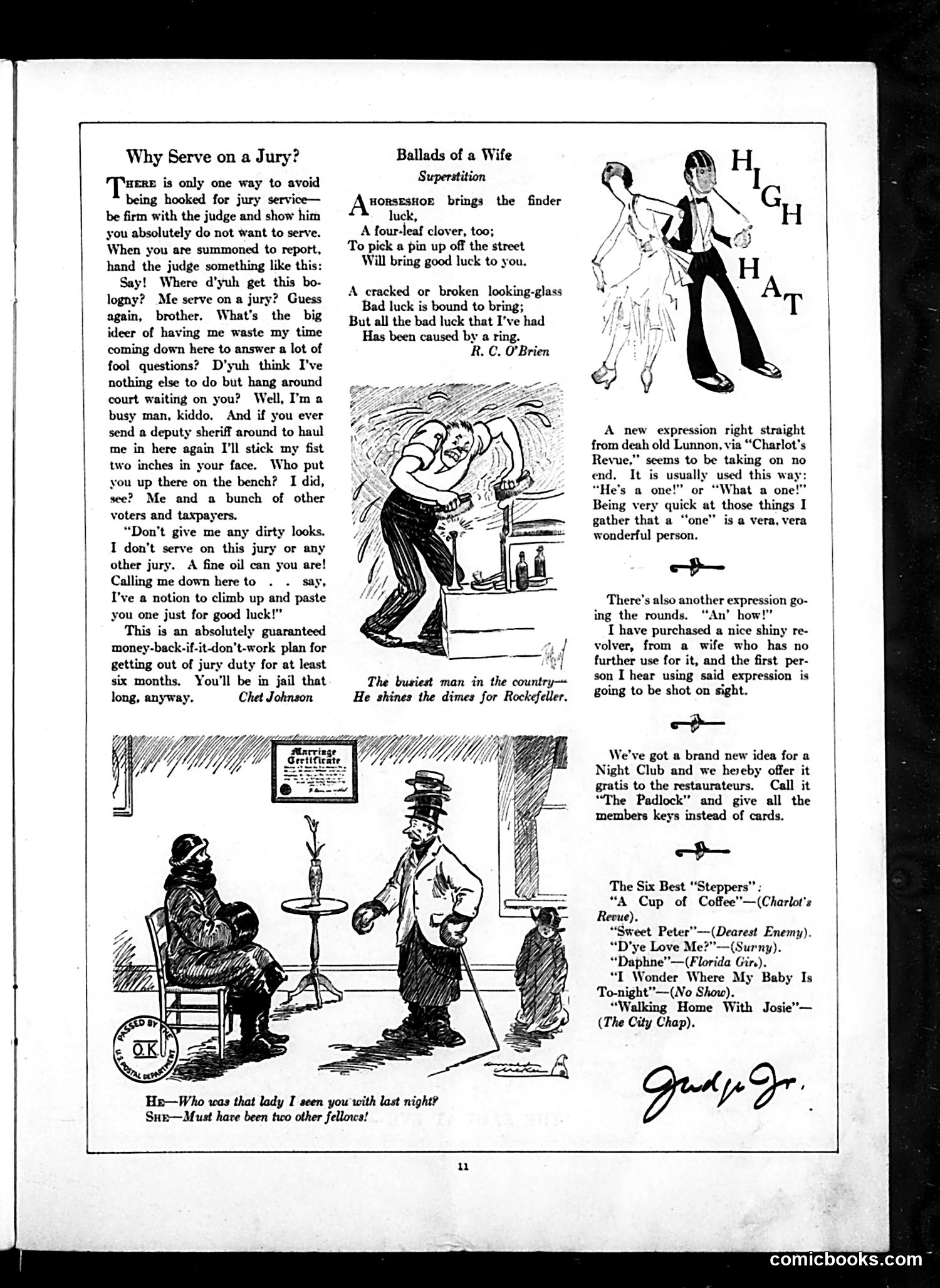
**"Why Serve on a Jury?"** is satirical advice by Chet Johnson on evading jury duty. The joke: if you're summoned, insult the judge directly and threaten violence—you'll be jailed for contempt rather than serve on the jury. The cartoon mocks both citizens' reluctance to serve civic duties and the justice system's inefficiency. **"Ballads of a Wife"** contains three unrelated pieces: a superstition poem (a woman blames a ring for her bad luck, not traditional superstitions), an illustration captioned with a marital joke (a husband suspects infidelity), and social commentary on new slang expressions like "one!" (meaning wonderful) and "an' how!" (meaning agreement). The author threatens to shoot anyone using the latter phrase. The page also advertises popular songs and a humorous "Night Club" idea: call it "The Padlock" (referencing Prohibition raids) and issue keys instead of cards to members. The overall tone reflects 1920s American social humor and cultural references now historically distant.
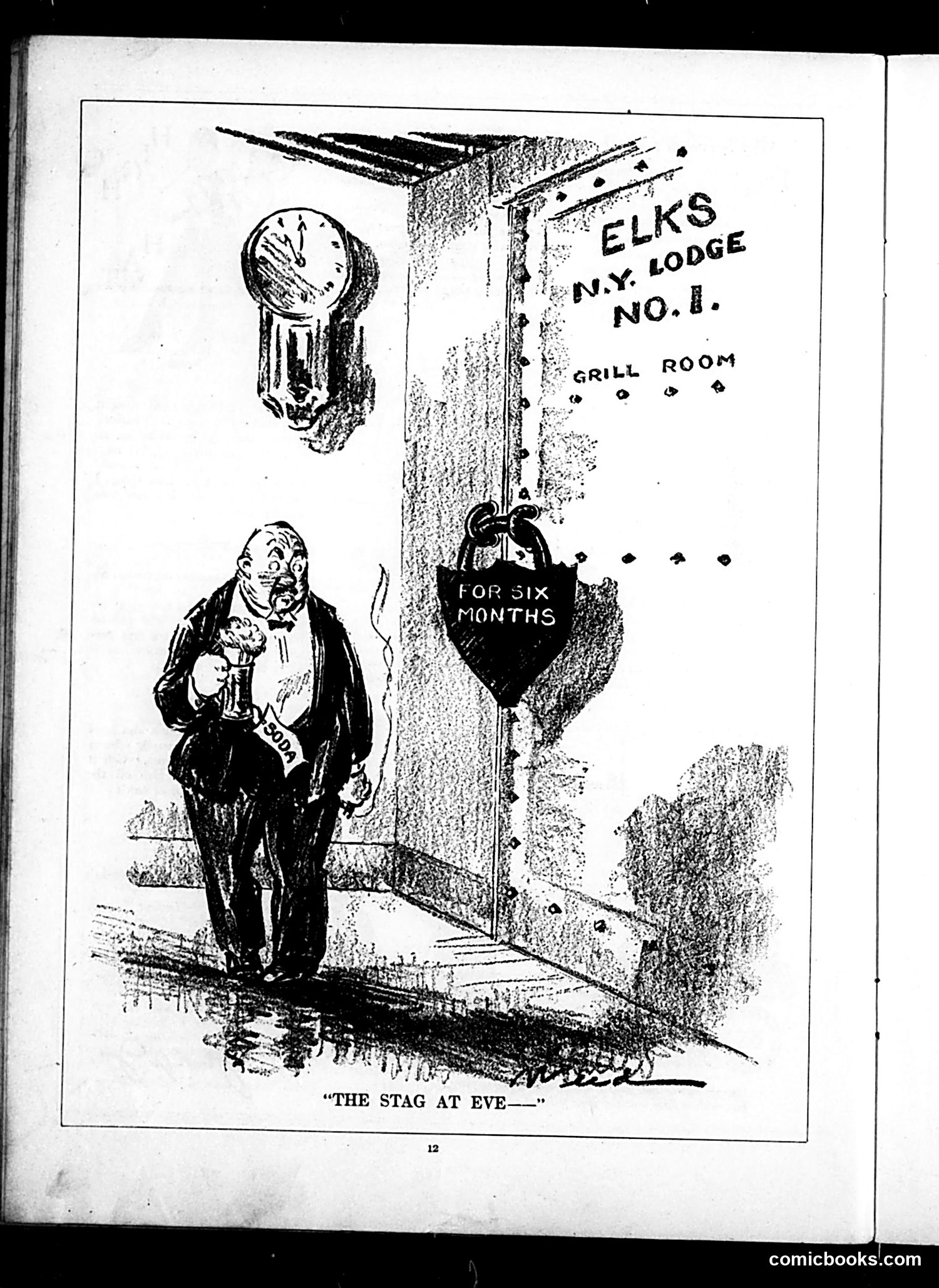
This cartoon advertises the Elks N.Y. Lodge No. 1's Grill Room. It depicts a caricatured man in formal attire, appearing distressed or anxious, standing before a door marked with a heart bearing text "FOR SIX MONTHS." A clock on the wall suggests time passing. The title "The Stag at Eve" references a famous romantic poem, but here inverts that sentiment through satire. The man's worried expression and the six-month restriction likely mock someone barred from the lodge or facing a temporary prohibition—possibly due to behavior or unpaid dues. The cartoon uses the contrast between the poetic title and the comic scenario to humorously illustrate consequences or restrictions faced by members, making a joke about lodge discipline or social exclusion.
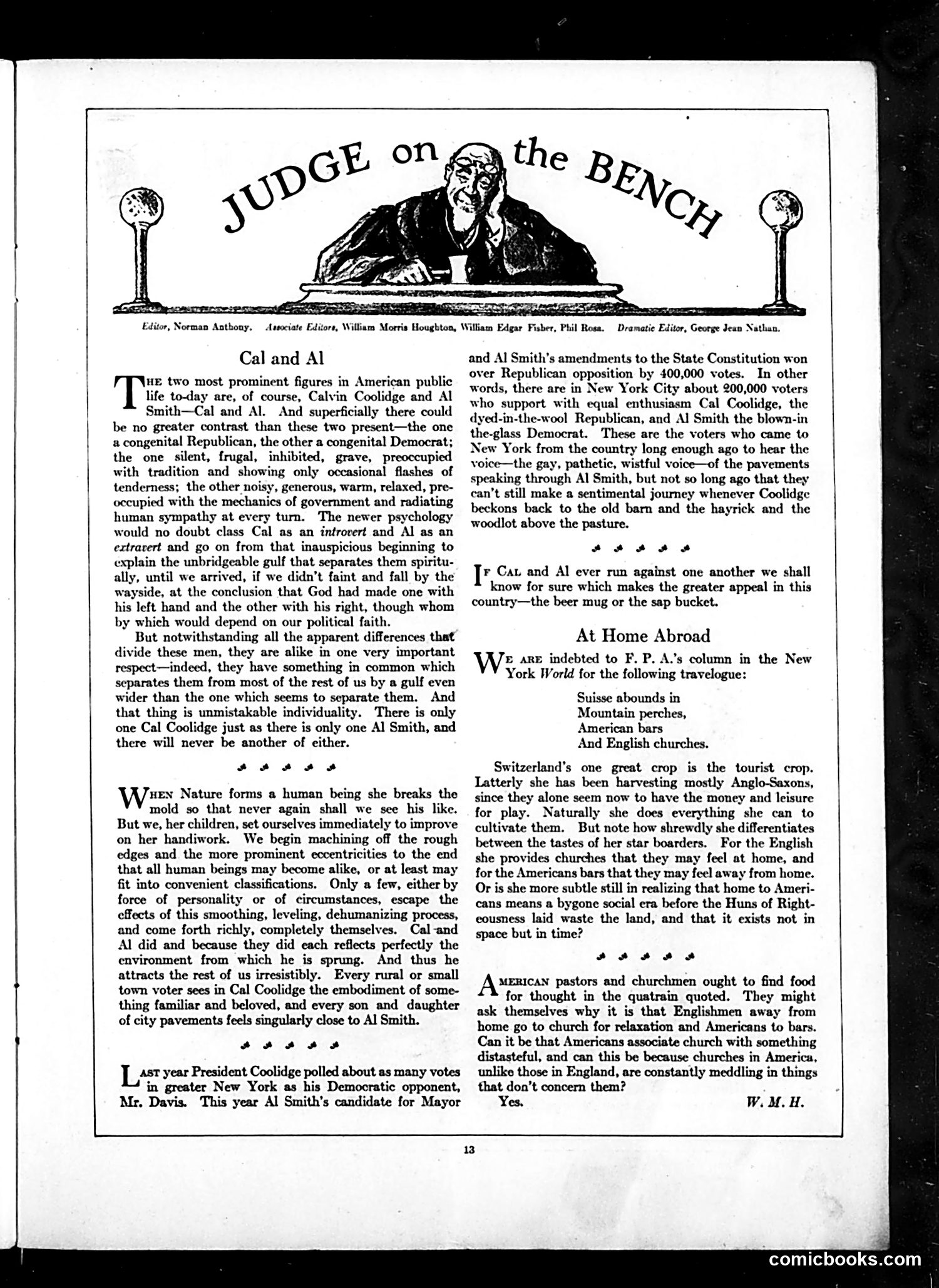
This editorial compares Calvin Coolidge (President, Republican) and Al Smith (Democratic politician, likely NYC Mayor), the two dominant figures in American politics circa 1924-1928. The piece argues that despite their superficial opposites—Coolidge "silent, frugal, inhibited"; Smith "noisy, generous, warm"—they share crucial individuality that distinguishes them from ordinary politicians and appeals to voters across party lines. The text notes that in 1924, Coolidge and Smith's Democratic opponent Davis polled equally in New York; by the following year, Smith's amendments won by 400,000 votes. The explanation: rural transplants to New York City, nostalgic for Coolidge's agrarian values ("beer mug or the sap bucket") yet attracted to Smith's urban voice and charm ("gay, pathetic, wistful voice"). The satire's point: authentic personality transcends ideology—both men succeed because they're genuinely *themselves*, not manufactured politicians. The "Judge on the Bench" masthead frames this as editorial commentary.
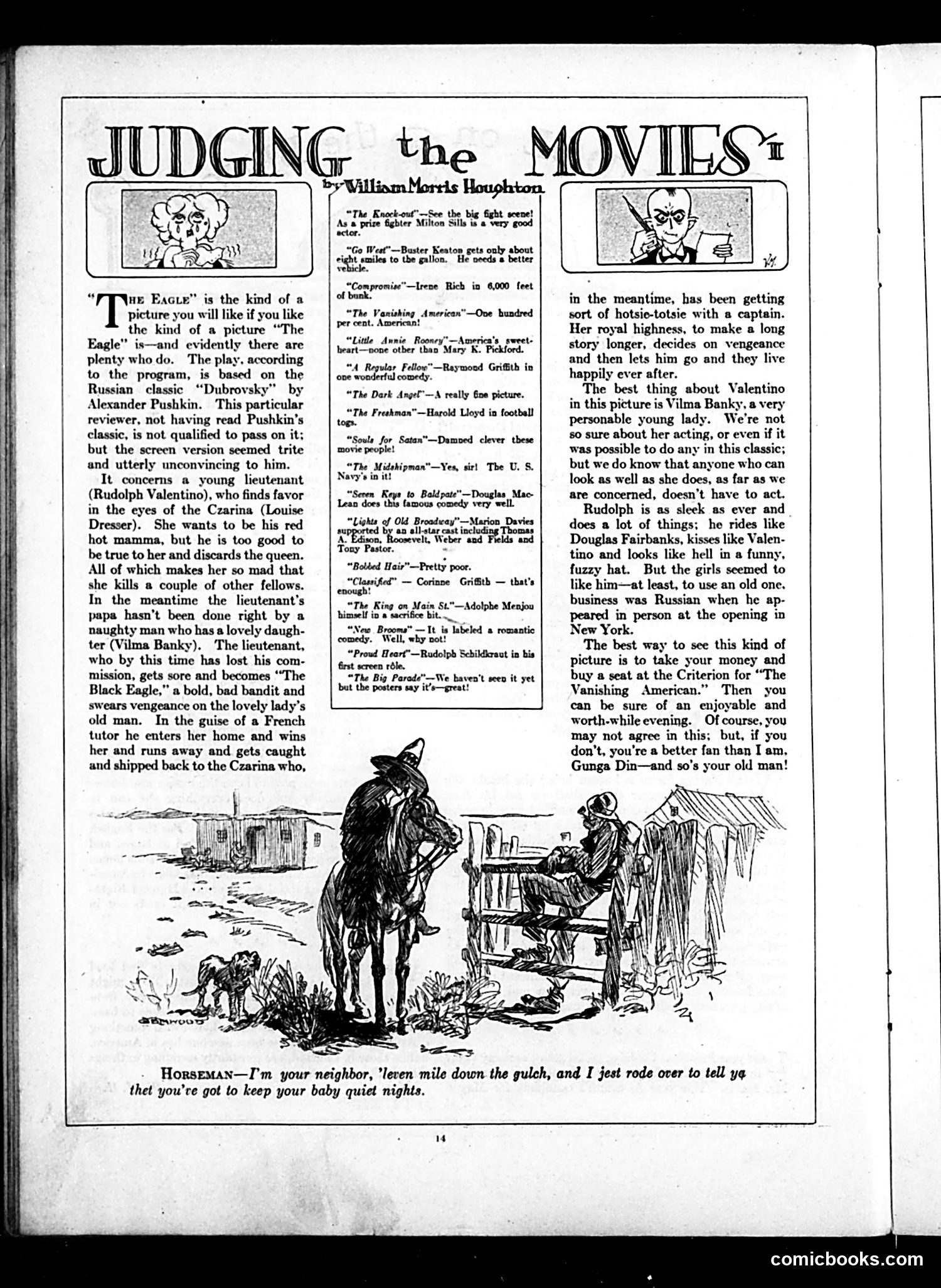
This page reviews contemporary 1920s films, including "The Eagle" starring Rudolph Valentino and Vilma Banky. The main review is sarcastically dismissive: the plot (a lieutenant-turned-bandit seeking revenge) is "trite and utterly unconvincing." The critic praises Vilma Banky's appearance but doubts her acting ability, suggesting beauty alone suffices for silent film stardom. Valentino is mocked as "sleek" but ridiculous in a "fuzzy hat"—yet notes female audiences loved him regardless. The sidebar lists other current releases with brief quips, exemplifying Judge's snobbish tone toward popular entertainment. The page concludes with an unrelated rural cartoon about a neighbor complaining about a crying baby. The satire targets both silent cinema's melodramatic plots and audiences' willingness to overlook poor quality for star appeal and romance.
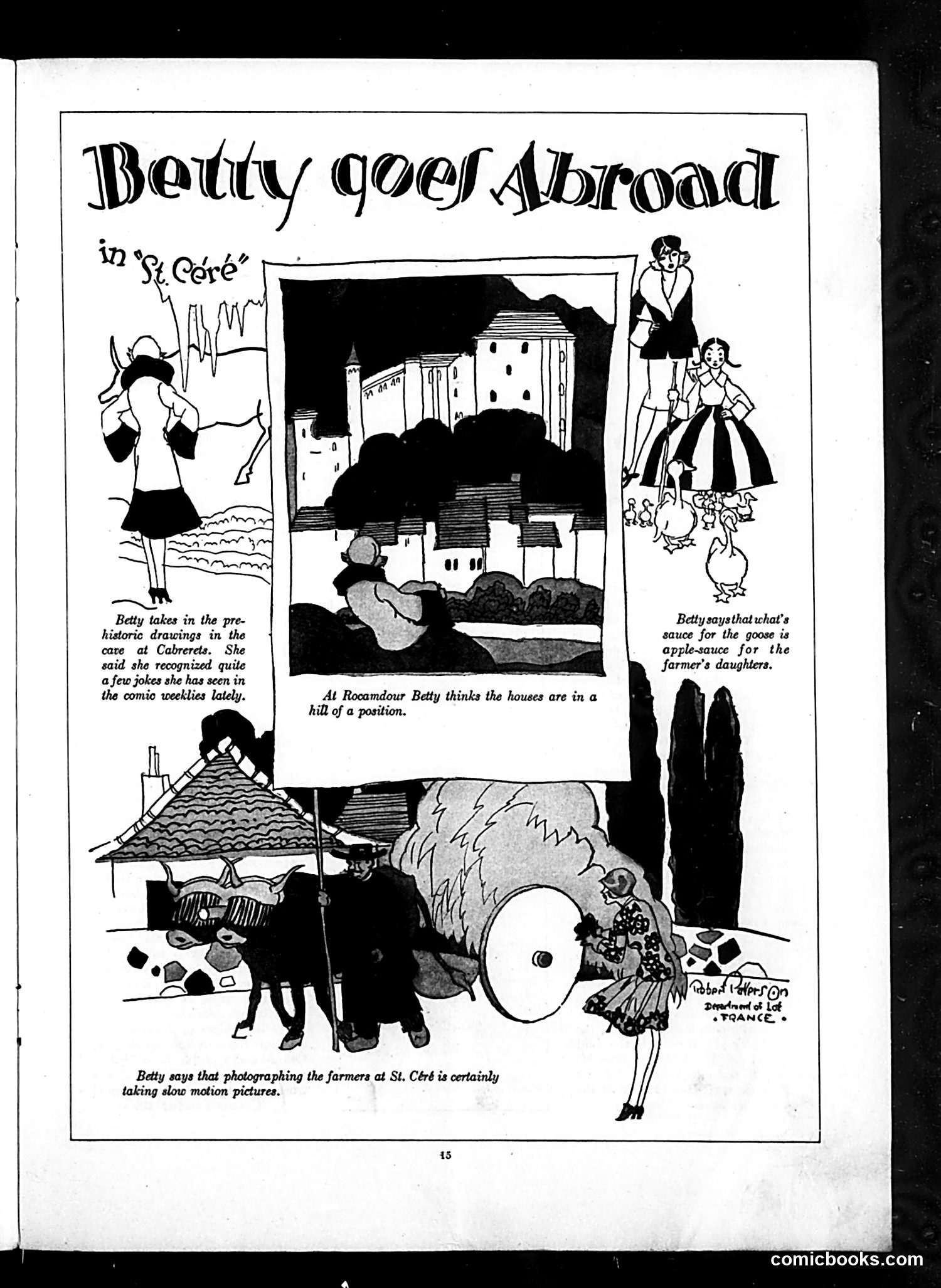
This appears to be a comic strip following "Betty" (likely a recurring character from Judge magazine) on a trip through France, visiting locations like Rocamadour and St. Céré. The humor relies on light tourist observations rather than sharp political satire: Betty comments on the picturesque but precarious positioning of French village houses, makes a pun equating the phrase "what's sauce for the goose is sauce for the gander" with farmers' daughters, and jokes that French farmers move slowly (playing on "slow motion pictures"). The strip uses typical 1920s-30s comic conventions—visual gags, puns, and gentle culture-clash humor about American tourists abroad. Rather than biting satire, it offers mild comedic observations about European architecture and rural life for Judge's American readership.
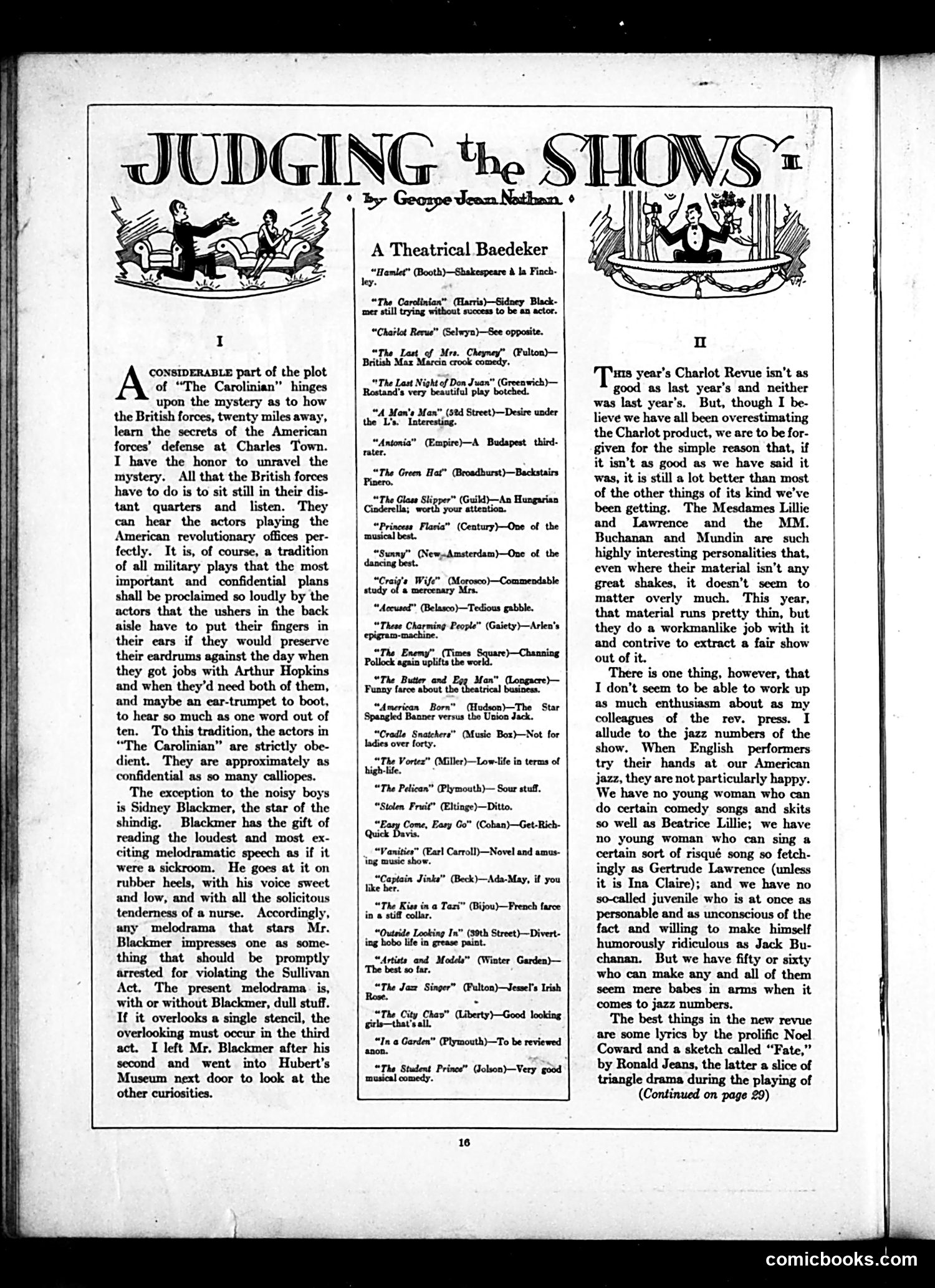
This page reviews Broadway theatrical productions, with particular focus on "The Carolinian," a Revolutionary War melodrama. Nathan satirizes the play's implausibly loud actors—who broadcast confidential military secrets so audibly that British forces can eavesdrop from miles away. He mocks this as a tiresome theatrical convention where melodramatic actors shout their lines. The exception is star Sidney Blackmer, whose mumbling, tender delivery is so quiet it renders the already-dull play nearly incomprehensible. Nathan sarcastically suggests Blackmer's understated performance in melodrama is like "violating the Sullivan Act"—treating serious material as if it were criminal negligence. The page also includes a "Theatrical Baedeker" (a travel guide-style listing) of current Broadway shows with brief, acerbic critiques. Nathan's humor relies on theater-insider knowledge and period Broadway gossip familiar to *Judge* readers.
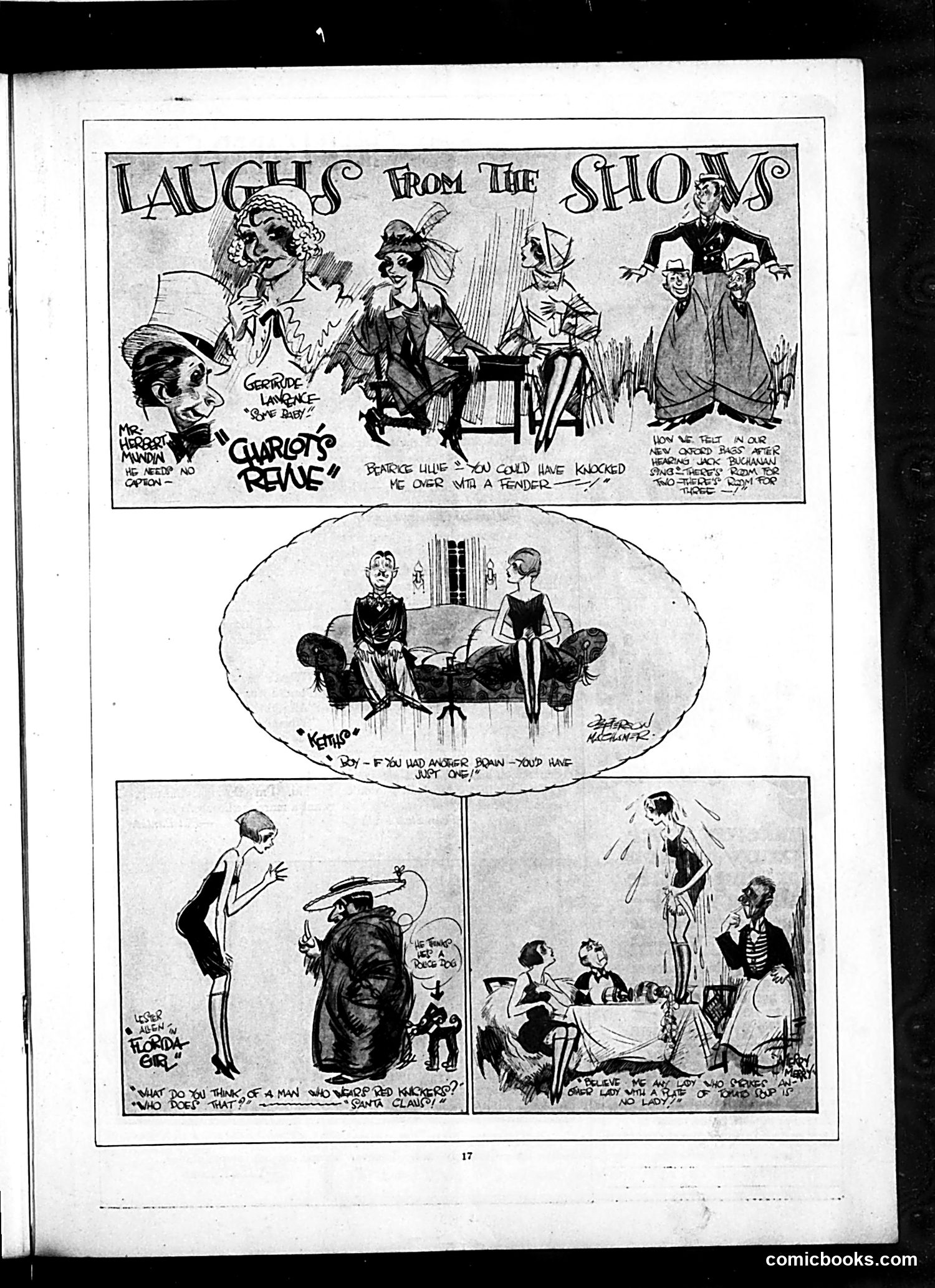
This page satirizes theatrical productions of the era. The top panel mocks specific shows and performers—references include "Chu Chin Chow's Revenge" and what appears to be commentary on stage productions and their absurdities. The middle dream-sequence panel shows two women discussing male vanity, with one saying "Boy, if you had answer down—you'd have just one!"—mocking men's self-importance. The bottom panels appear to ridicule romantic or domestic situations: one references a "Florida Girl" questioning a man's fidelity ("What do you think of a man who kept his mistress two years?"), while another satirizes sentimental or melodramatic theatrical tropes about lost love and domesticity. The overall tone mocks both theatrical pretension and period gender dynamics, using exaggerated characterizations typical of Judge magazine's satirical approach.
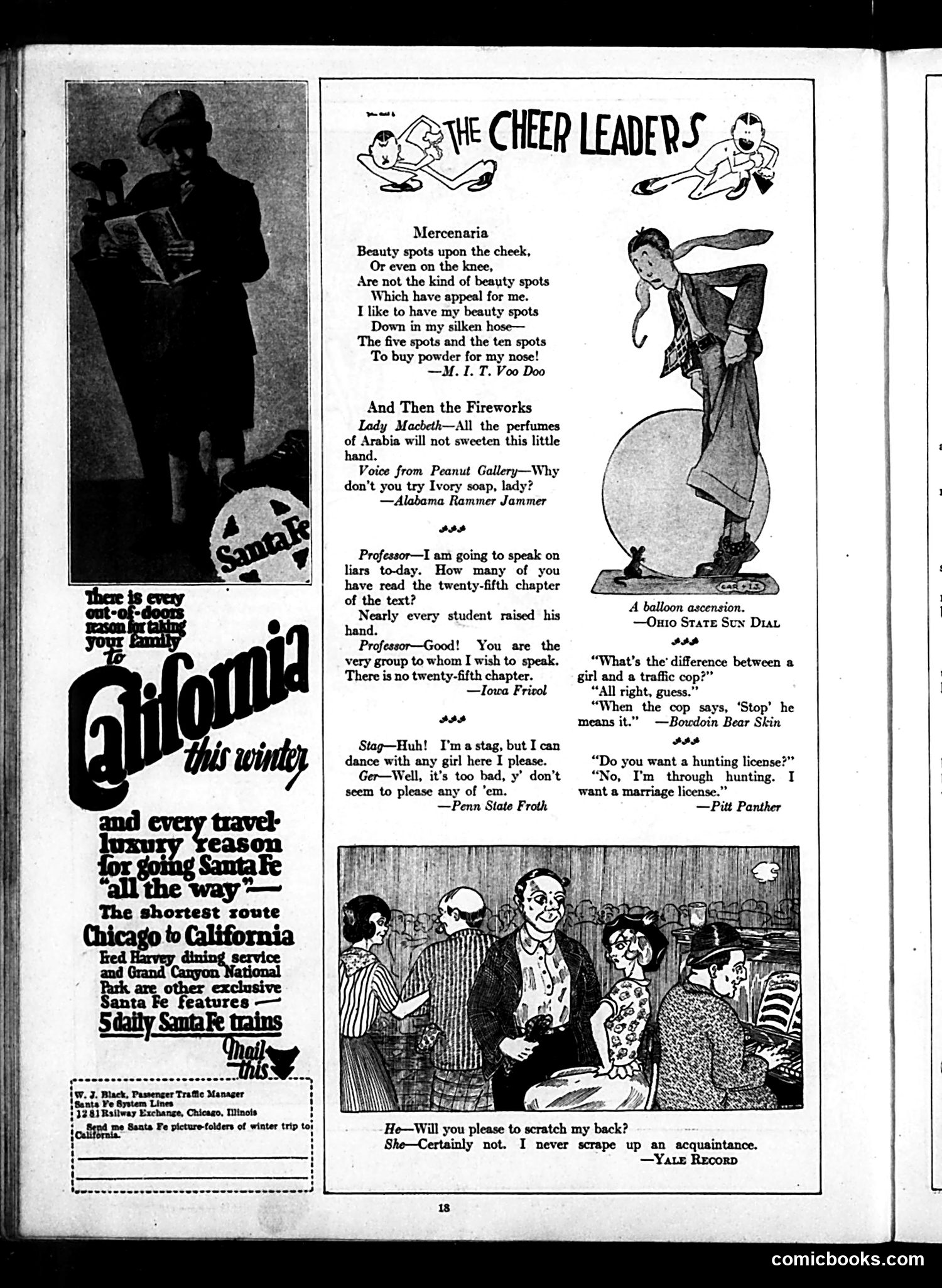
This page from **Judge** (a satirical humor magazine) collects jokes and comic bits from various college humor publications, primarily targeting young, educated readers. The content includes: **College humor exchanges** satirizing student life—a professor catching students who claimed to read a non-existent textbook chapter; jokes about dating ("stag" men unable to impress girls); marriage vs. hunting license wordplay. **Literary reference** ("Lady Macbeth") mocking Shakespeare by having a heckler suggest modern soap instead of perfume to clean guilt. **Beauty spot satire** ("Mercenaria"): The joke plays on "beauty spots" (fashionable makeup marks on skin) by redirecting the term to spots on silk stockings—a reference to purchasing powder cosmetics. This reflects 1920s-30s cosmetics culture. The **Santa Fe railroad advertisement** on the left is unrelated promotional content. Overall, the page reflects inter-collegiate humor culture, with gentle satire about student behavior, romance, and contemporary consumer goods—typical of Judge's middle-class, college-educated audience.
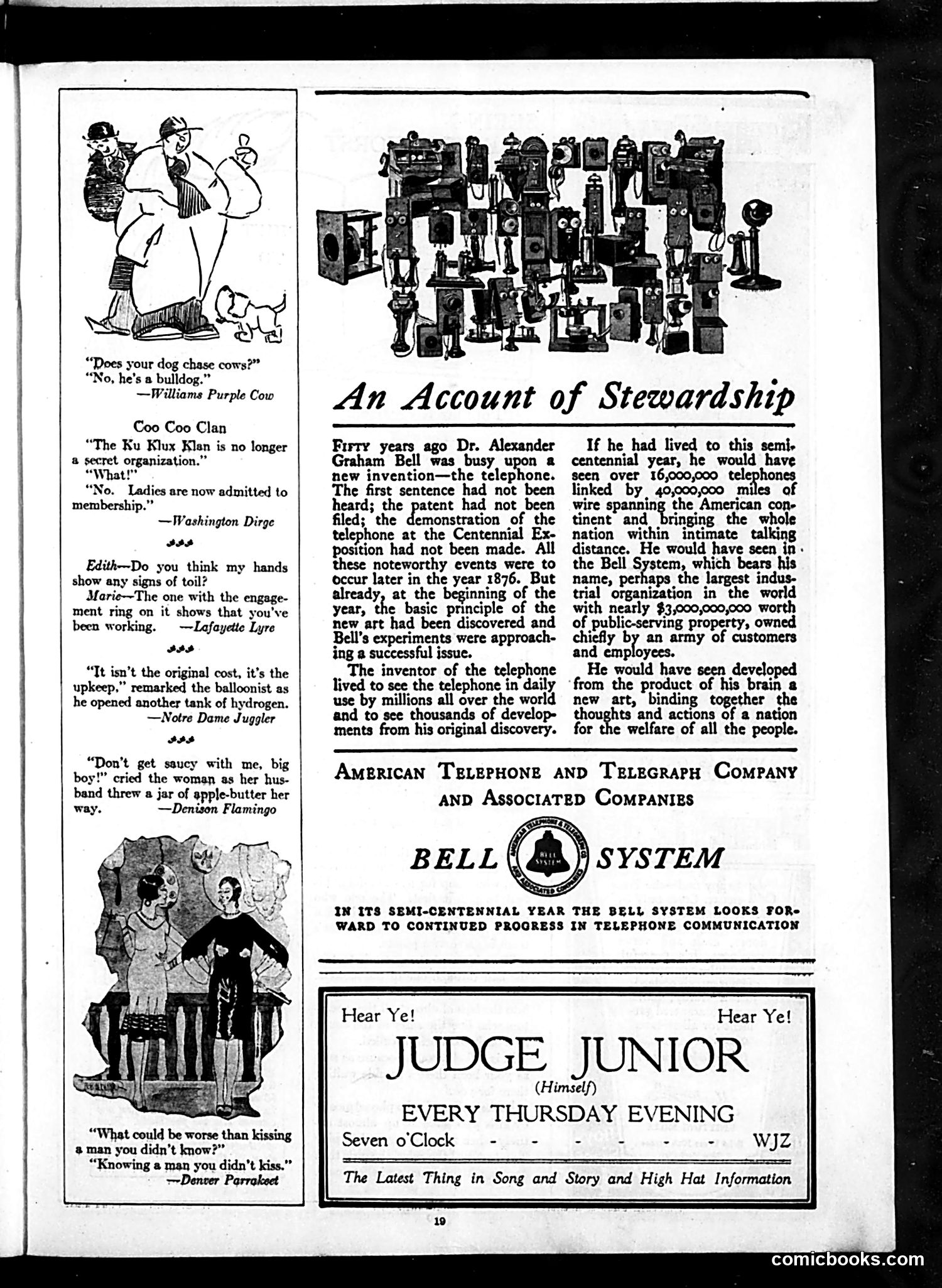
This page mixes humor with corporate advertising. The left side contains brief jokes from various contributors—wordplay about bulldogs, satire on the KKK admitting women members, quips about engagement rings and household labor. These are light social humor typical of 1920s satirical magazines. The dominant content is a Bell Telephone System advertisement disguised as editorial. "An Account of Stewardship" celebrates Alexander Graham Bell's invention fifty years prior (1876) and presents the Bell System as a benevolent industrial giant—now serving 16 million phones across 40 million miles of wire. The ad frames telephone infrastructure as democratic progress "for the welfare of all the people," emphasizing that customers and employees own the company's $3 billion in assets. This is essentially propaganda: presenting monopolistic corporate expansion as national progress and shared prosperity. The final advertisement promotes "Judge Junior" radio programming on WJZ, blending entertainment with commercial messaging—standard for Judge's advertiser-supported model.
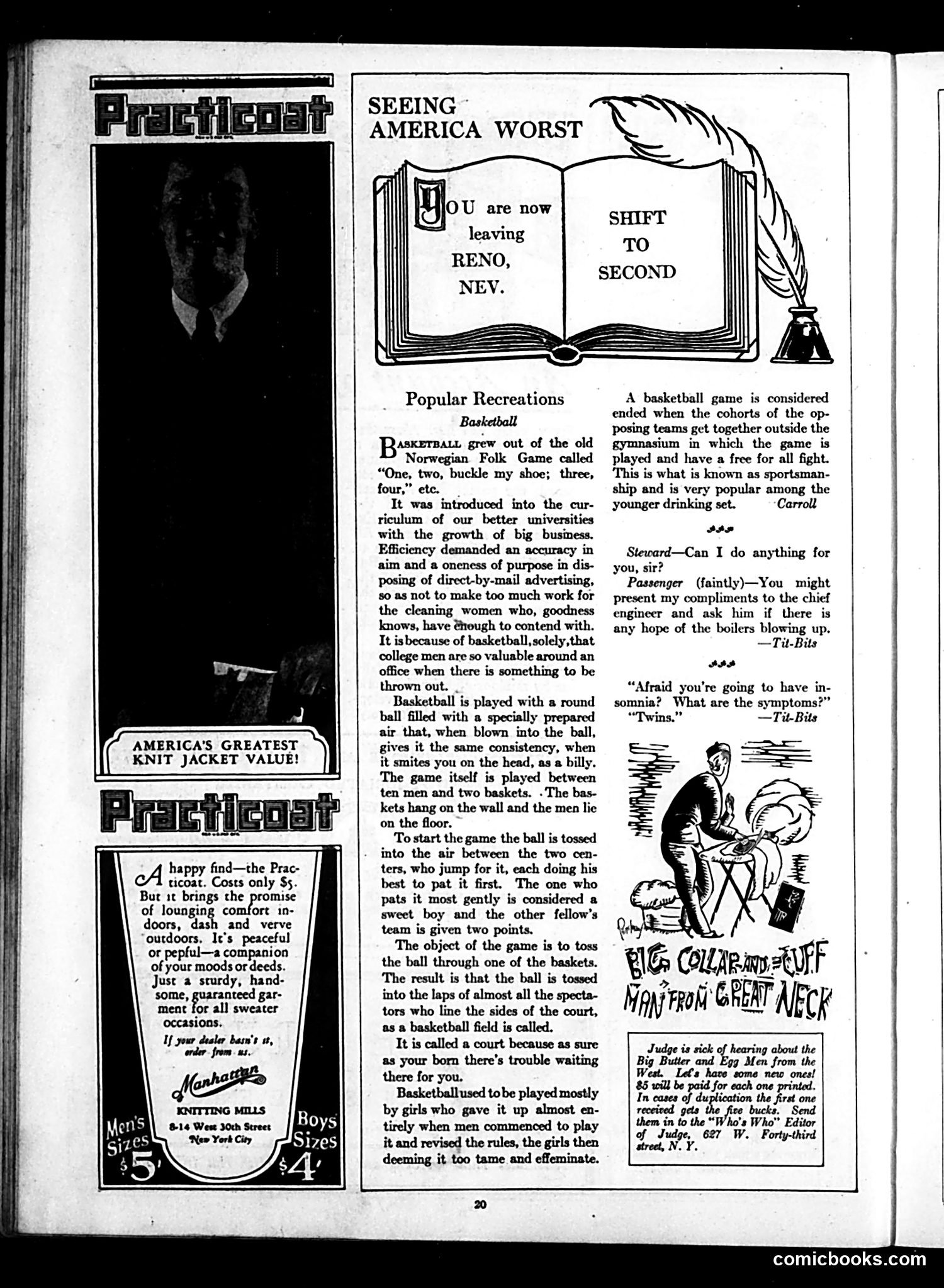
This page contains mostly **advertising and humorous filler content** rather than political satire. **Left side:** Two Practicoat sweater jacket advertisements ($5 and $4 price points) from Manhattanite Knitting Mills. **Center-right:** A mock-educational article titled "Seeing America Worst" that satirizes **basketball** through absurdist humor. The joke isn't political but rather comedic deflation—it describes basketball's origins in Norwegian folk games, then suggests it became "efficient" for office workers to throw out direct-mail advertising. The humor escalates absurdly: players "lie on the floor," spectators get hit by balls, and games end when teams fight outside the gymnasium, which is humorously called "sportsmanship" popular with "younger drinking set." **Bottom right:** Miscellaneous short jokes from "Tit-Bits" magazine about insomnia and ship travel. The basketball article appears to be parody of dry, pseudo-educational writing common in the era, poking fun at both the sport and corporate efficiency culture.
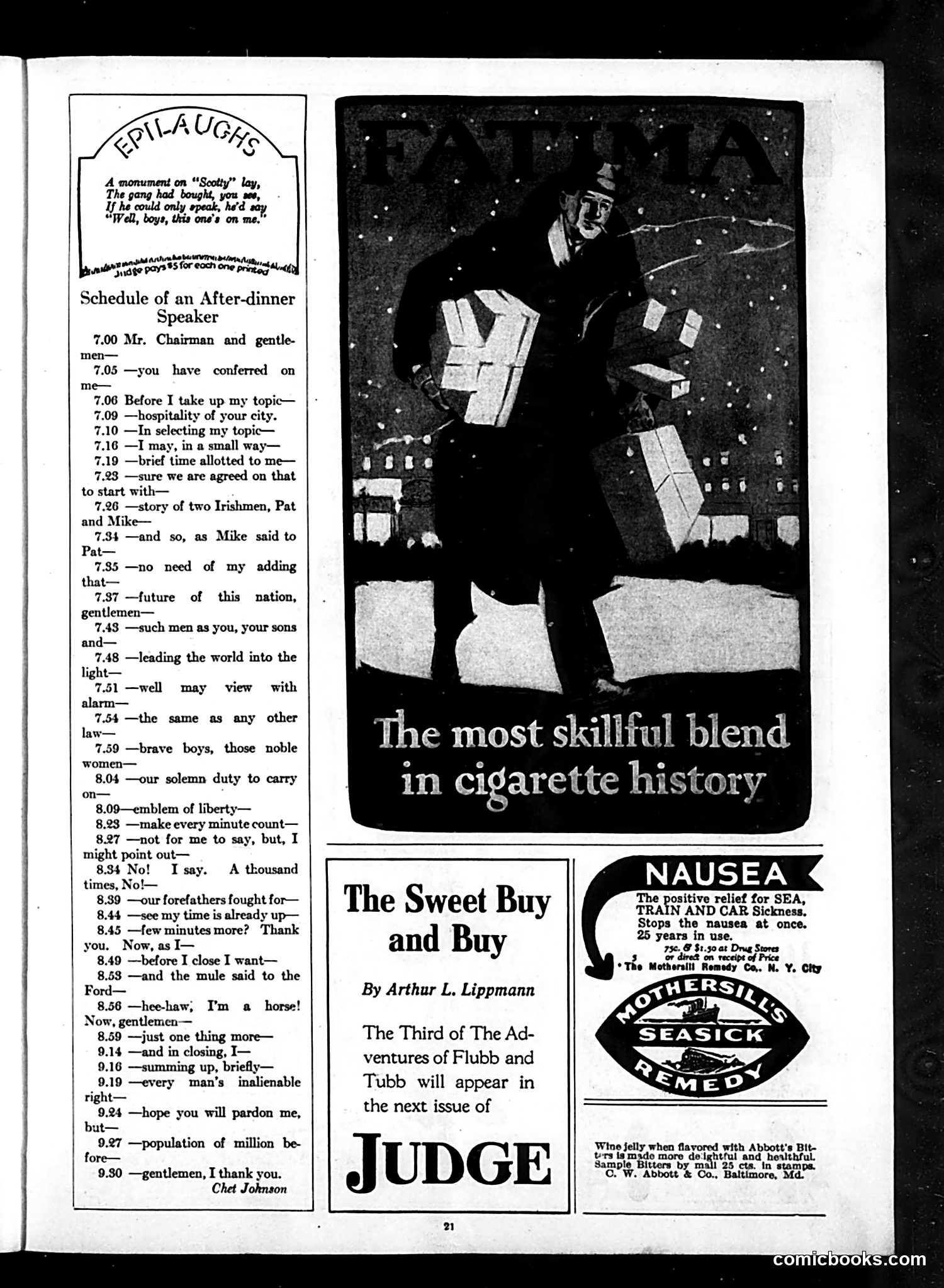
This page contains a satirical "Schedule of an After-dinner Speaker" that mocks the tedious, rambling conventions of public speaking in the early 20th century. The humor lies in the precise timing breakdown showing how after-dinner speakers waste time with excessive preliminaries, tangential Irish jokes ("Pat and Mike"), and grandiose platitudes about patriotism, liberty, and duty—all while barely addressing their actual topic. The timeline format (7:00 to 9:30) exposes the speaker's predictable formula: apologizing, flattering the host, pivoting repeatedly, inserting tired anecdotes, invoking patriotic rhetoric, then wrapping up with apologies for going overtime. This was evidently a recognizable frustration for Judge's readers—audiences expected to endure interminable, substance-free speeches at formal events. The satire critiques both speakers' self-indulgence and contemporary oratory conventions.
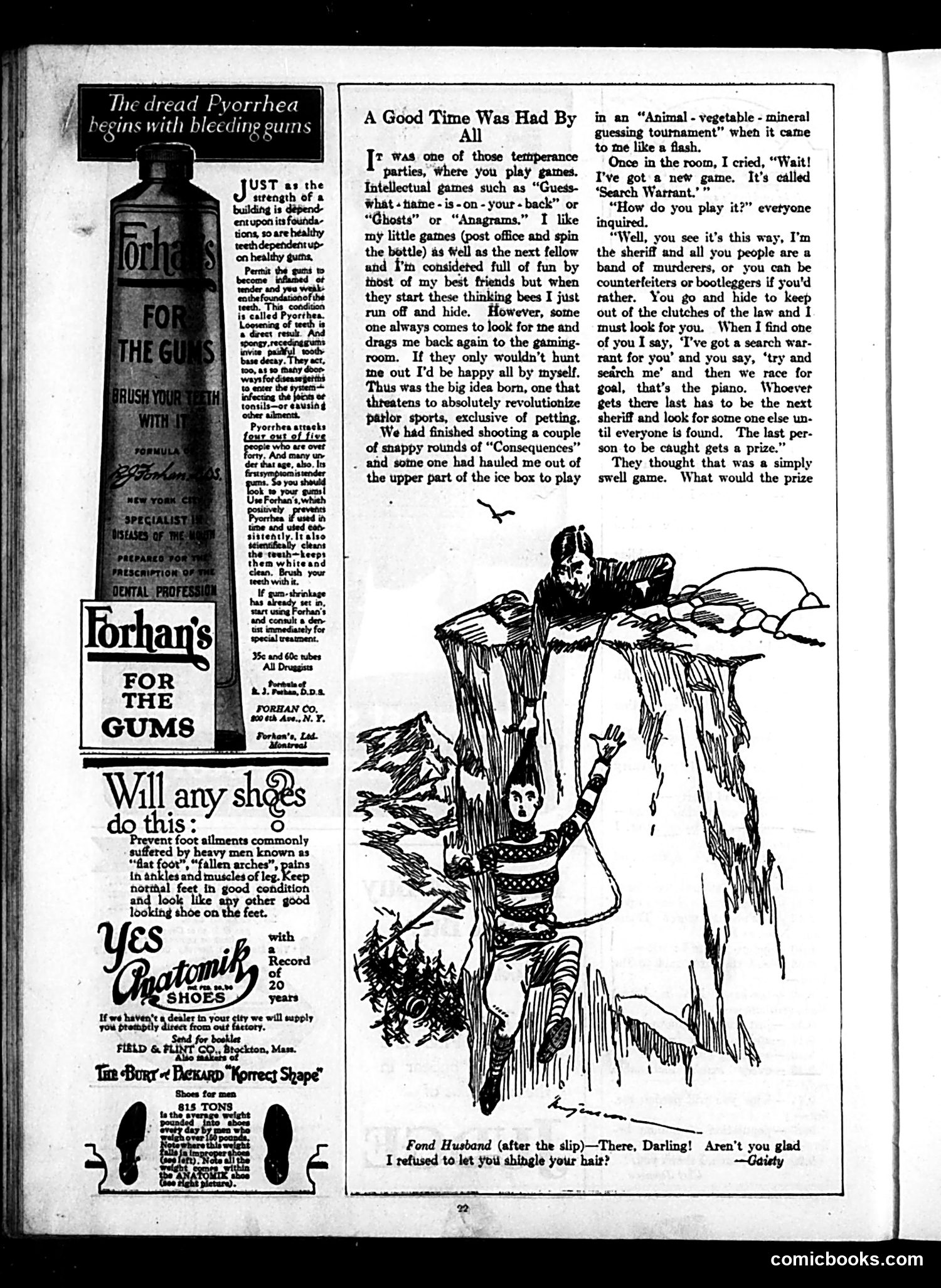
This page contains two distinct elements: advertisements and a humorous short story. **The Advertisements** occupy the left side, promoting Forhan's gum treatment (for pyorrhea/gum disease) and Pachomik shoes—typical early 20th-century patent medicine and footwear ads. **"A Good Time Was Had By"** is the main content—a lighthearted domestic humor piece. A narrator describes attending a temperance party (alcohol-free social gathering) where parlor games are played. Bored by intellectual games like "Consequences" and "Anagrams," the narrator invents "Search Warrant"—a hide-and-seek variant where players roleplay as criminals (murderers, counterfeiters, bootleggers) evading a "sheriff." The joke culminates in a small cartoon showing the narrator's spouse, amused that their spouse refused to let them get a fashionable "shingle" haircut, now grateful for that refusal after an unspecified mishap. The humor relies on domestic irony and the contrast between staid temperance-party games and the rowdy, imaginary crime scenario the narrator creates.
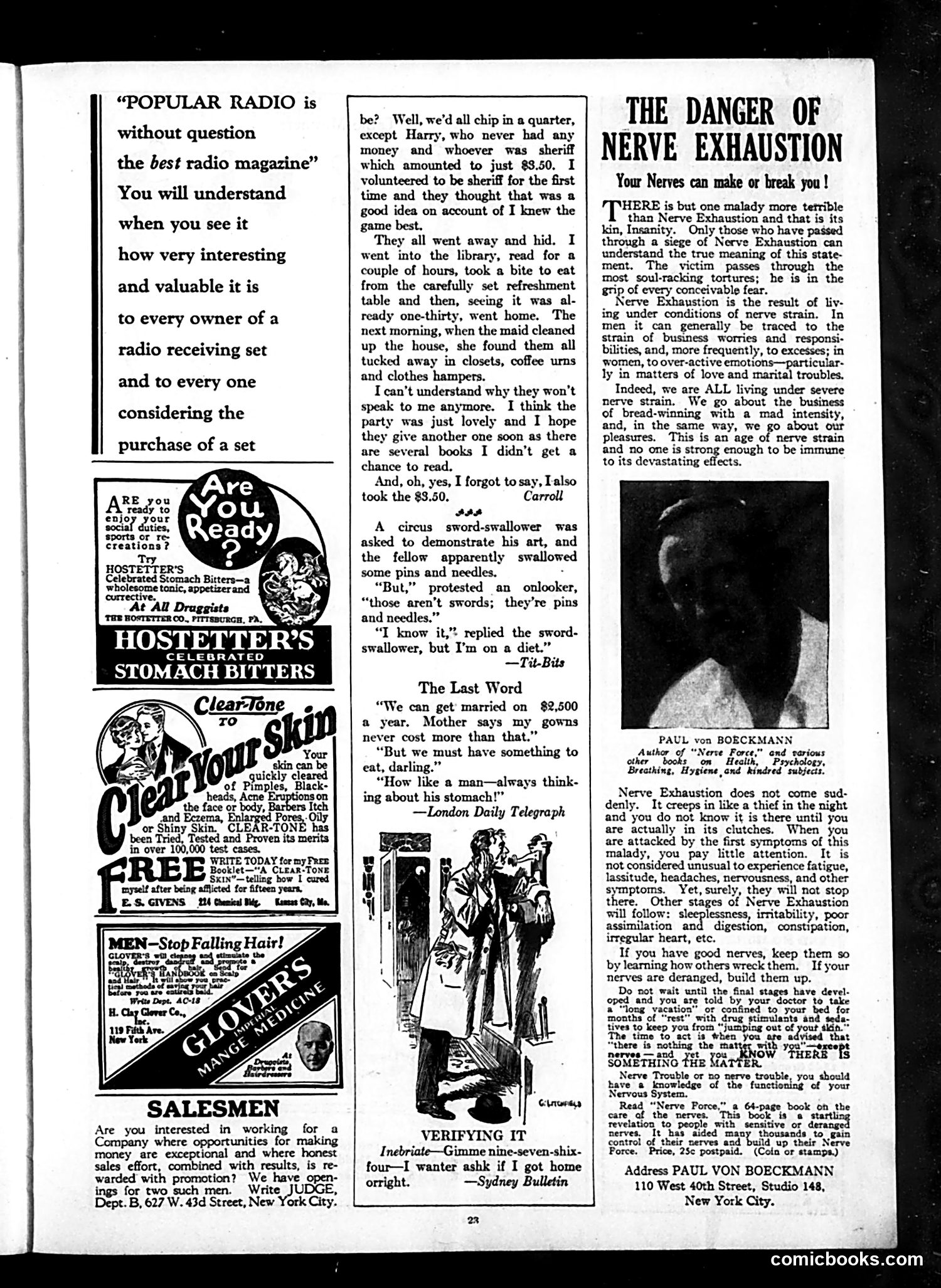
This page from *Judge* magazine mixes advertisements with humor content: **Main Cartoons/Humor:** The page contains several short jokes and anecdotes, including a story about a childish game of hide-and-seek where the narrator forgets to actually look for the hidden players, and humorous one-liners about marriage and intoxication. These demonstrate period humor about absent-mindedness and marital friction. **Notable Advertisement:** The large feature on the right promotes Paul von Boeckmann's "Nerve Force" book, treating "Nerve Exhaustion" as a medical condition—a common concern in early 20th-century America. This reflected Victorian anxieties about the stressful pace of modern life and overstimulation. **Other Ads:** The page includes typical period advertisements for Hostetter's Stomach Bitters, skin treatments, and hair restoration products—standard patent medicine pitches of the era. The page overall is primarily advertising-driven, with brief entertainment content scattered between commercial pitches typical of 1920s magazines.
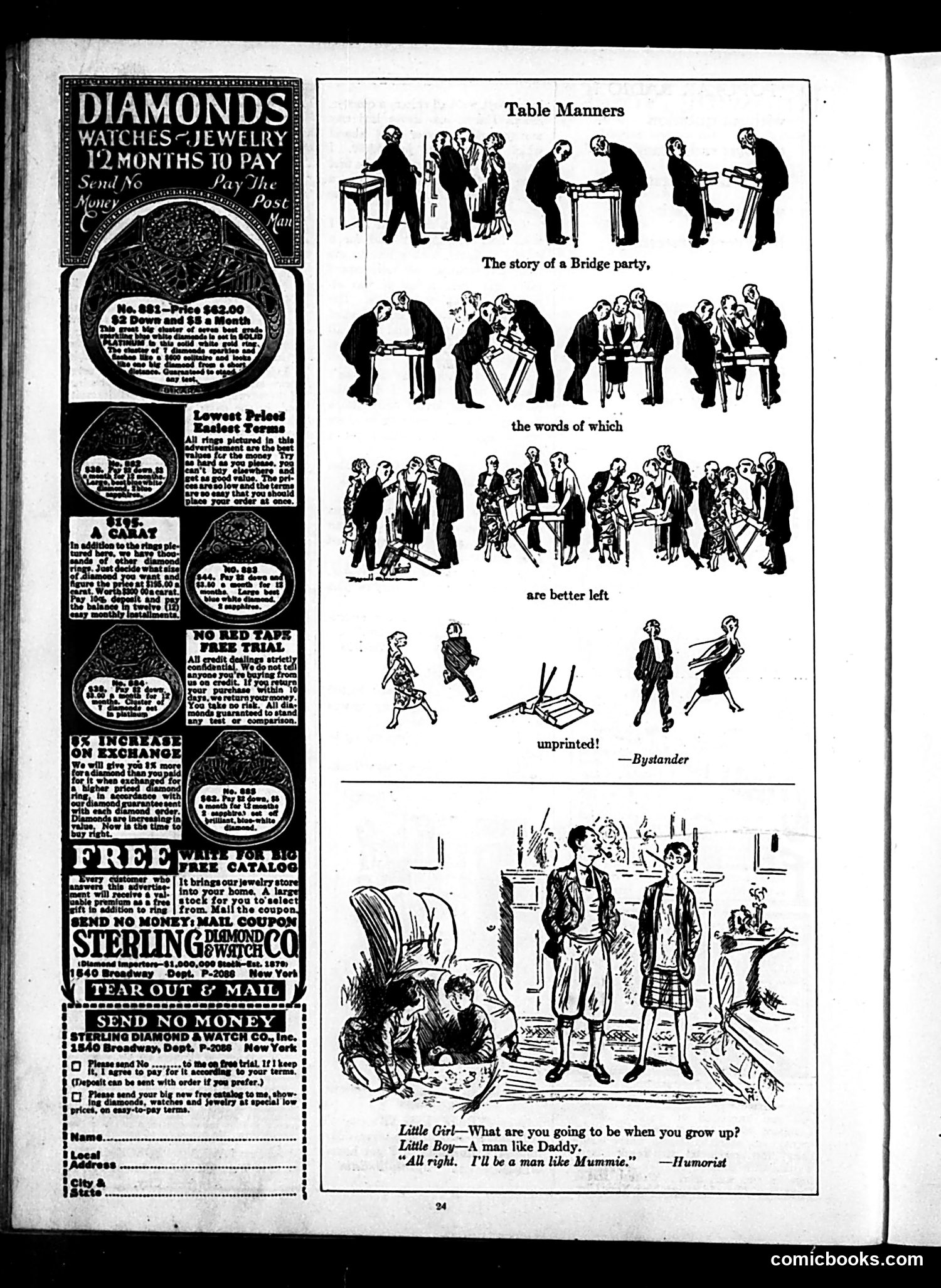
This page contains two distinct pieces of content: **Left side:** A diamond and watch mail-order advertisement for Sterling Diamond & Watch Co., offering payment plans ("Send No Money"). **Right side:** A "Table Manners" comic sequence by Bystander showing the story of a bridge party. The top panels depict proper etiquette during a card game—guests arriving, sitting properly, and behaving decorously. The middle panels show the game proceeding with dignified conversation. The bottom panels humorously contrast this with improper behavior: people fighting over the game, someone trapped under a fallen chair, and general chaos. The caption "are better left unprinted" suggests the actual words spoken during the deteriorating party were too crude or vulgar to publish. The page's final joke features children discussing their future ambitions—a boy aspires to be like his father, and a girl playfully responds she'll "be a man like Mummie," poking fun at female independence and gender role expectations of the era. The satire mocks both the pretense of proper social decorum and the reality of competitive bridge playing.
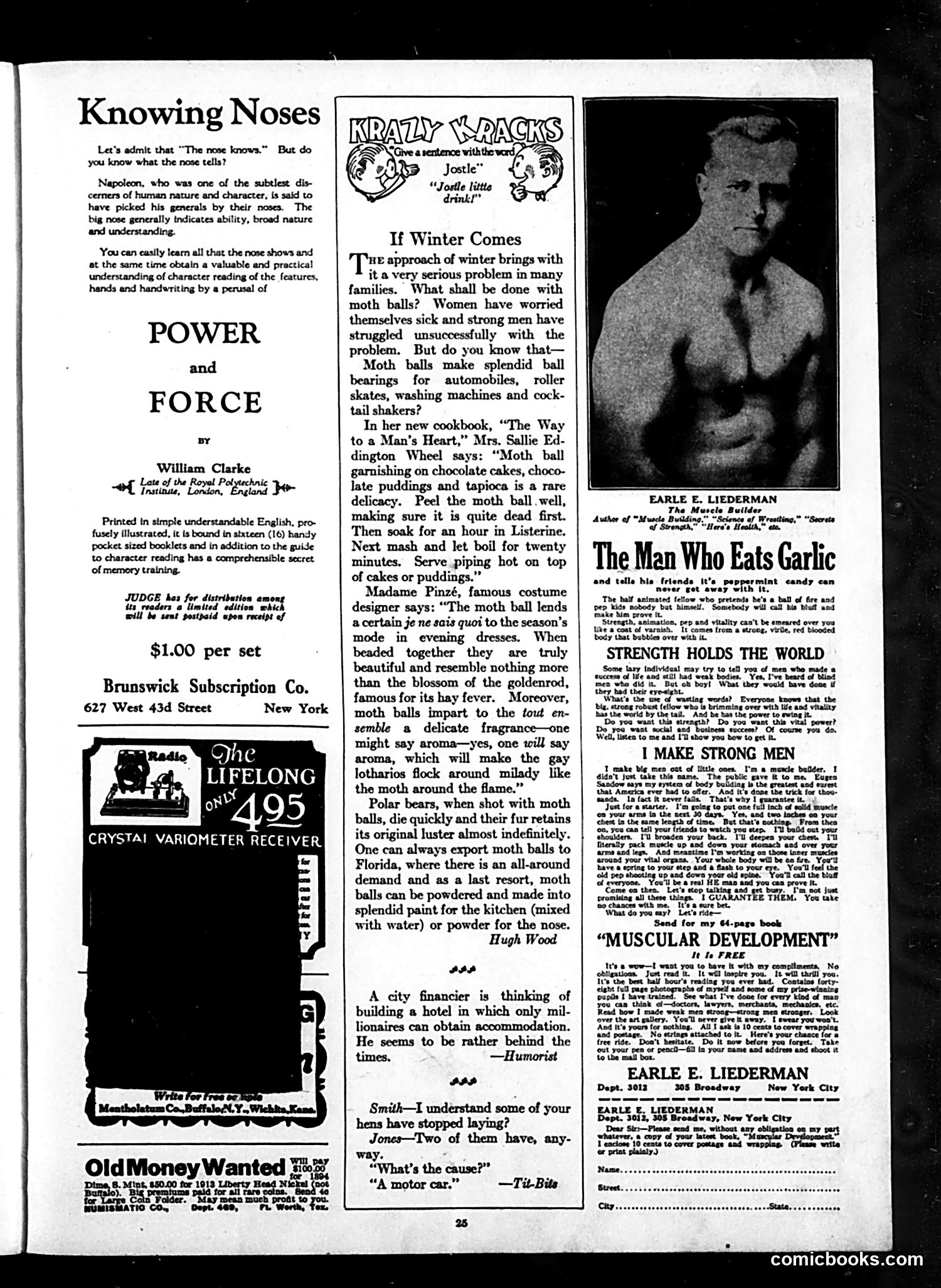
This page from *Judge* magazine contains primarily **advertisements and humorous filler content** rather than political cartoons. The main satirical piece is "If Winter Comes" by Hugh Wood—a absurdist humor column mocking domestic advice literature popular at the time. It presents increasingly ridiculous "solutions" for storing mothballs (using them as ball bearings, food garnishes, fashion accessories, polar bear ammunition). The satire targets how advice columns and cookbooks offered impractical or nonsensical guidance to housewives, treating mundane household problems as serious social concerns. The page also includes typical *Judge* humor: brief joke exchanges (about hens and motor cars) and commentary on contemporary foibles (a financier's exclusionary hotel concept). Supporting advertisements promote character-reading guides, radio receivers, and old coin purchases—standard early 20th-century magazine fare. The Earle E. Liederman fitness advertisements promoting physical strength are period-typical marketing, not satire. **Overall**: This is a humor/advertising page rather than political commentary.
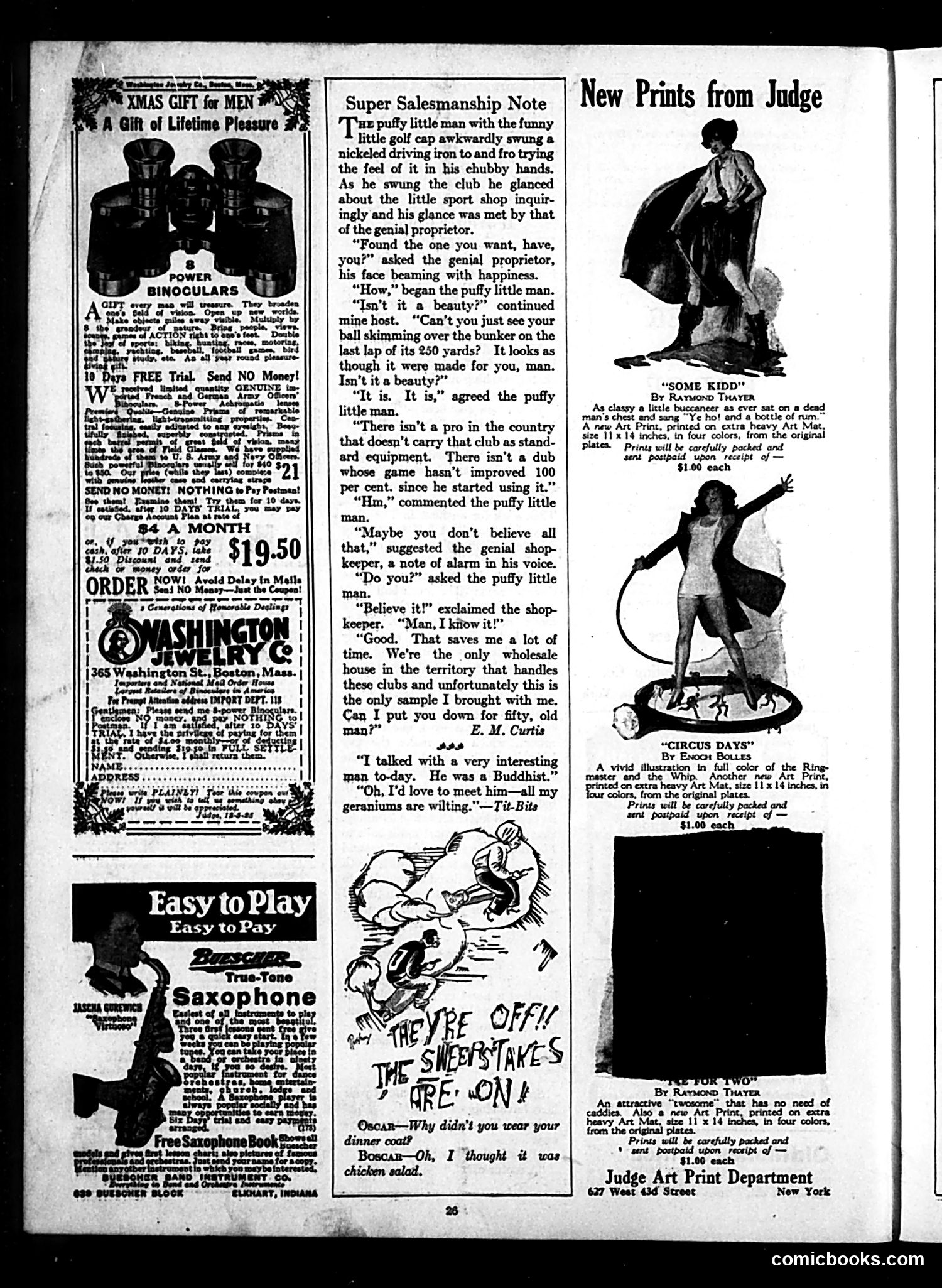
This page combines advertisements with satirical content typical of Judge magazine's format. **The Main Cartoon ("Super Salesmanship Note")** by E.M. Curtis satirizes aggressive sales tactics. A portly customer enters a golf shop interested in a driver. The shop proprietor uses manipulative techniques—flattery ("Isn't it a beauty?"), false scarcity claims ("the only sample I brought"), and appeal to authority (claiming pros use it)—to pressure the customer into bulk ordering fifty clubs. The joke mocks both the dishonest salesman's tactics and the customer's gullible acceptance of obvious manipulation. **Supporting Content:** - A brief joke about a man's conversation with a Buddhist (unrelated humor) - Two art print advertisements for "Some Kidd" (a pirate character) and "Circus Days" - Multiple product ads (binoculars, saxophone, jewelry) typical of the era The cartoon critiques early 20th-century sales culture and consumer vulnerability to high-pressure tactics—a timeless concern.
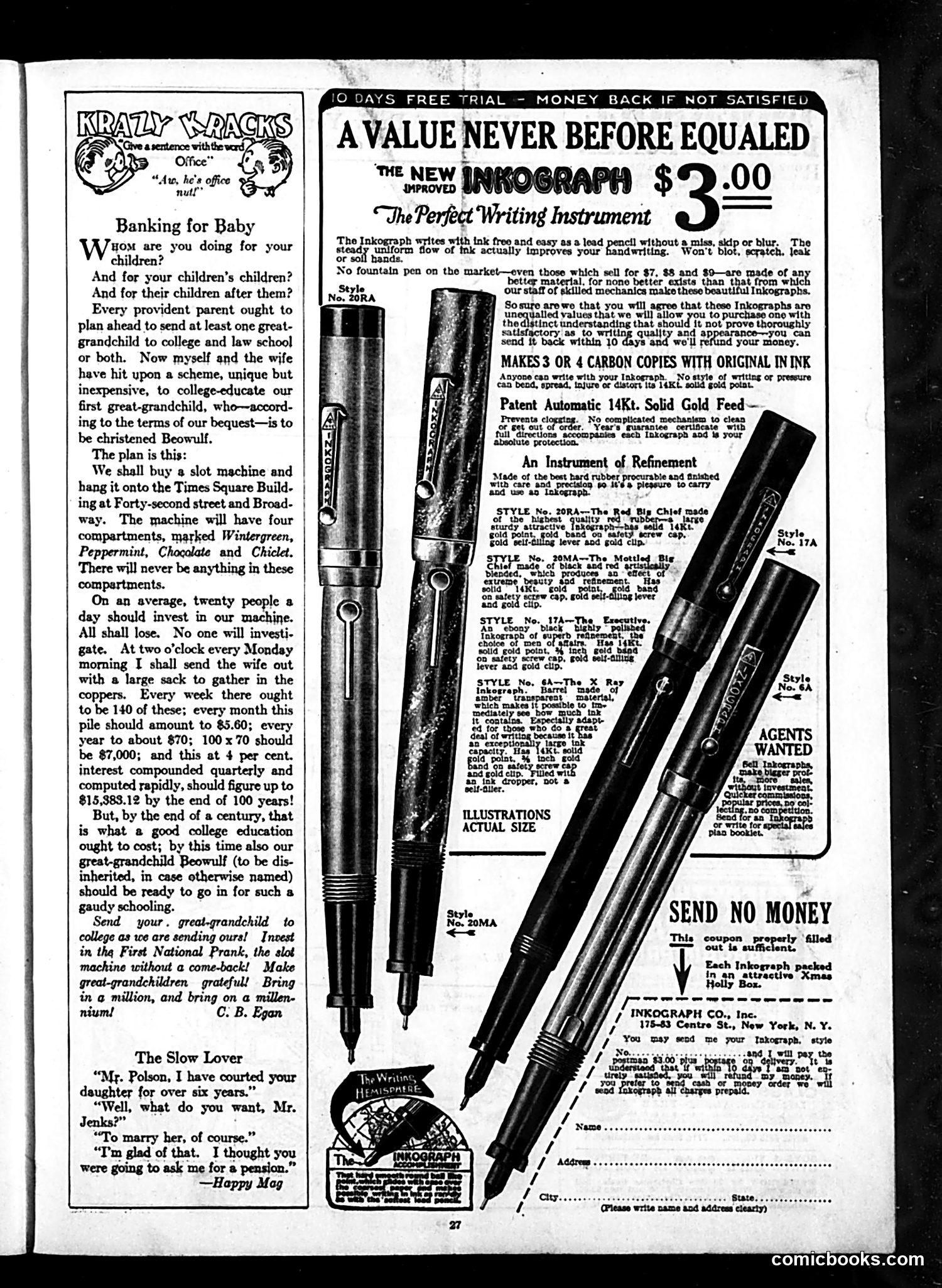
This page contains two distinct pieces of satirical content: **Left side — "Banking for Baby" by C.B. Egan:** A humorous essay satirizing both parental anxiety about children's futures and get-rich-quick schemes. The author proposes installing an empty slot machine in Times Square—explicitly a scam ("The machine will have four compartments...There will never be anything in these compartments")—to fund his great-grandchild's eventual college education. The satire mocks the obsessive financial planning of prosperous Americans and the absurdity of expecting education costs to skyrocket a century hence. The closing joke names the future heir "Beowulf" while planning to disinherit him "in case otherwise named." **Right side — Advertisement:** A full-page ad for the "Inkograph" fountain pen, priced at $3.00, featuring multiple model variations and promotional copy emphasizing quality and a 10-day money-back guarantee. **Bottom left — "The Slow Lover":** A brief joke about a suitor finally proposing after six years, with the father humorously suggesting he'd expected a pension request instead. The page is primarily advertising-driven with light satirical content.
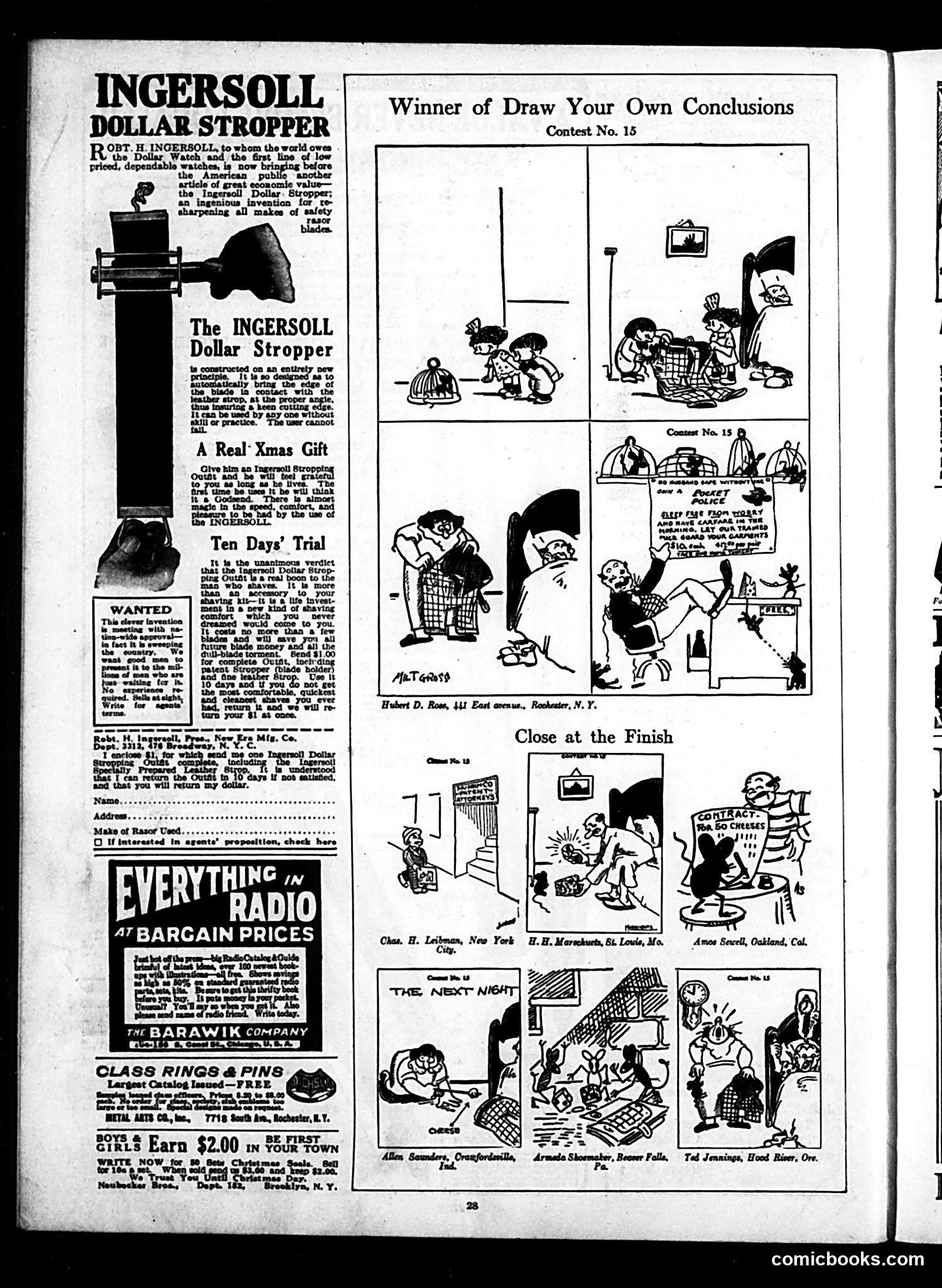
This page primarily features a **product advertisement** for the Ingersoll Dollar Stropper (a razor-sharpening device) alongside a **"Draw Your Own Conclusions" comic contest**. The left column advertises the Ingersoll stropper as an economical invention for maintaining razor blades—positioned as a practical gift. The contest occupies the right side, displaying multiple cartoon submissions from readers depicting everyday domestic and comic situations (children playing, laundry scenes, nighttime activities). Each cartoon is credited to its creator's name and location. The page includes various other period advertisements typical of 1920s-30s magazines: radio equipment, class rings, and girls' sales opportunities—representing how magazines generated revenue through classifieds and product promotions. **For modern readers:** This represents an era when magazines actively engaged readers through contests and competitions, and when small practical items like blade stropping devices were significant household conveniences worth advertising prominently. The comics are light, domestic humor rather than political satire.
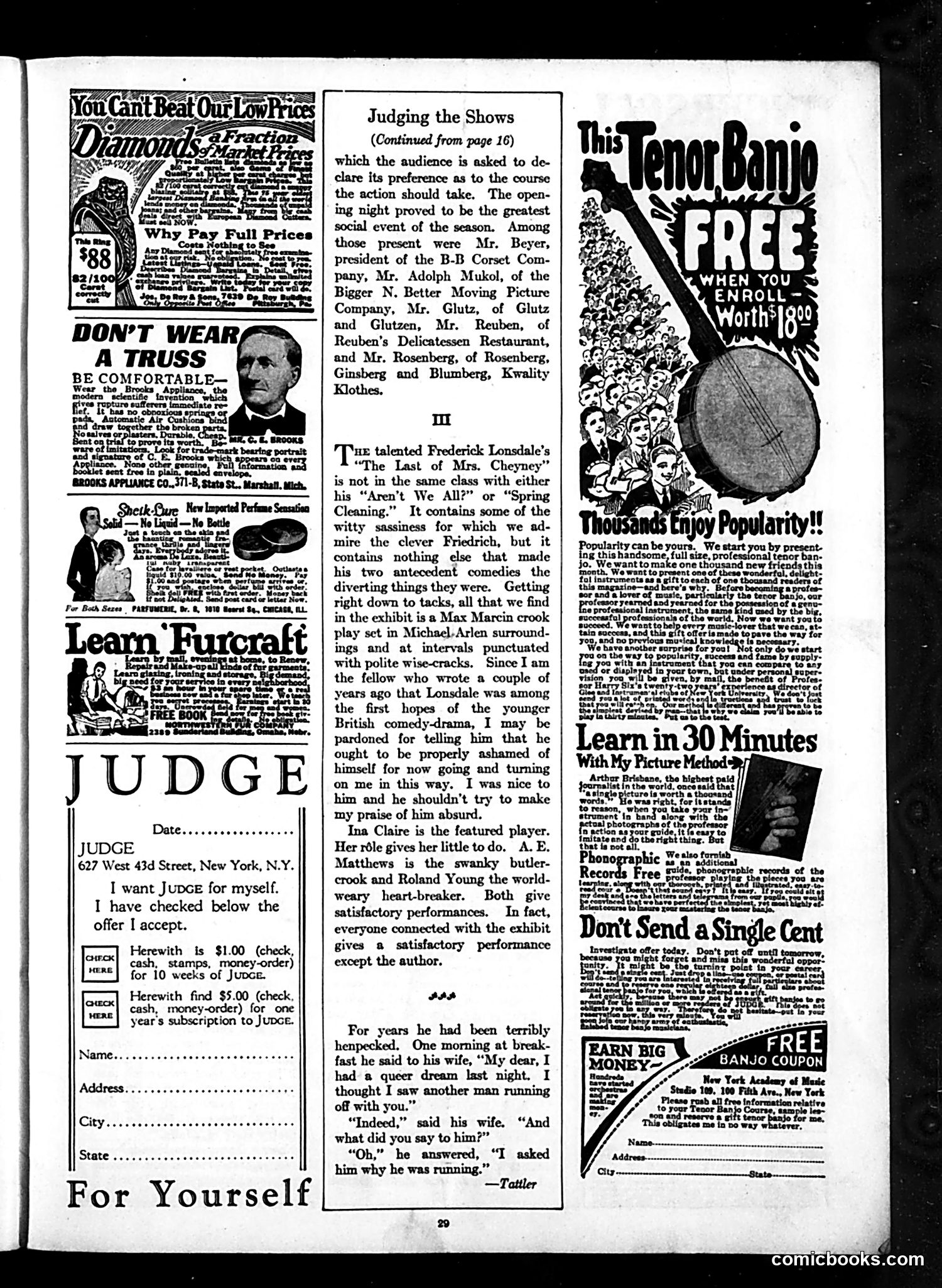
This page is primarily **theatrical criticism and advertising** from Judge magazine, with minimal political content. The main article reviews Frederick Lonsdale's play *"The Last of Mrs. Cheyney,"* comparing it unfavorably to his earlier comedies *"Aren't We All?"* and *"Spring Cleaning."* The critic (signed "A.E.") praises the clever dialogue but finds the plot—a Max Marcin crook play set in Michael Arlen surroundings—derivative. He praises featured player Ina Claire and Roland Young's performances but criticizes the author himself, with a wry self-deprecating note that his earlier praise of Lonsdale now seems embarrassing. The page includes a subscription offer for Judge magazine and an unrelated joke ("Tattler" column) about a henpecked husband. The remaining content is period advertisements for various products and services. **No identifiable political satire or caricature appears on this page.**
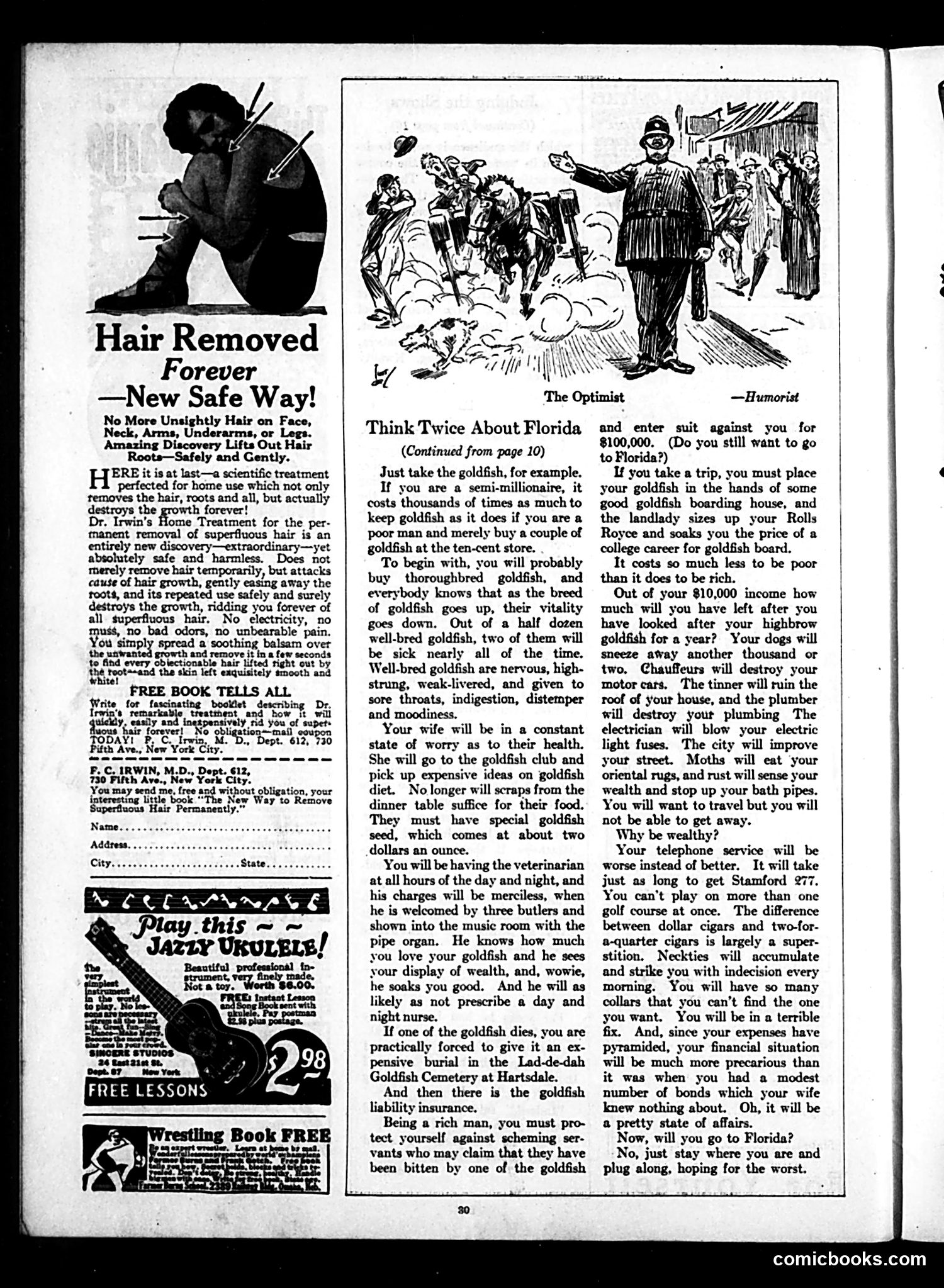
This is a satirical article mocking wealthy people considering moving to Florida, likely during the 1920s Florida real estate boom. The humor targets the absurd expenses of maintaining luxury possessions. The piece uses goldfish ownership as extended metaphor: wealthy owners must buy expensive "thoroughbred" goldfish that are paradoxically fragile and high-maintenance, requiring veterinarians, special diets costing dollars per ounce, and cemetery burials at "Lad-de-dah Goldfish Cemetery at Hartsdale." The satire escalates through servant litigation fears, boarding house fees, and eventual costs of all household staff and services (chauffeurs, plumbers, electricians). The implied argument: wealth creates endless financial drains; poverty is paradoxically cheaper. The cartoon's judge-like "Optimist" figure appears to mock blind wealthy optimism about Florida relocation—the text warns against such thinking. The advertisement for hair removal at page's edge appears incidental, typical magazine filler.
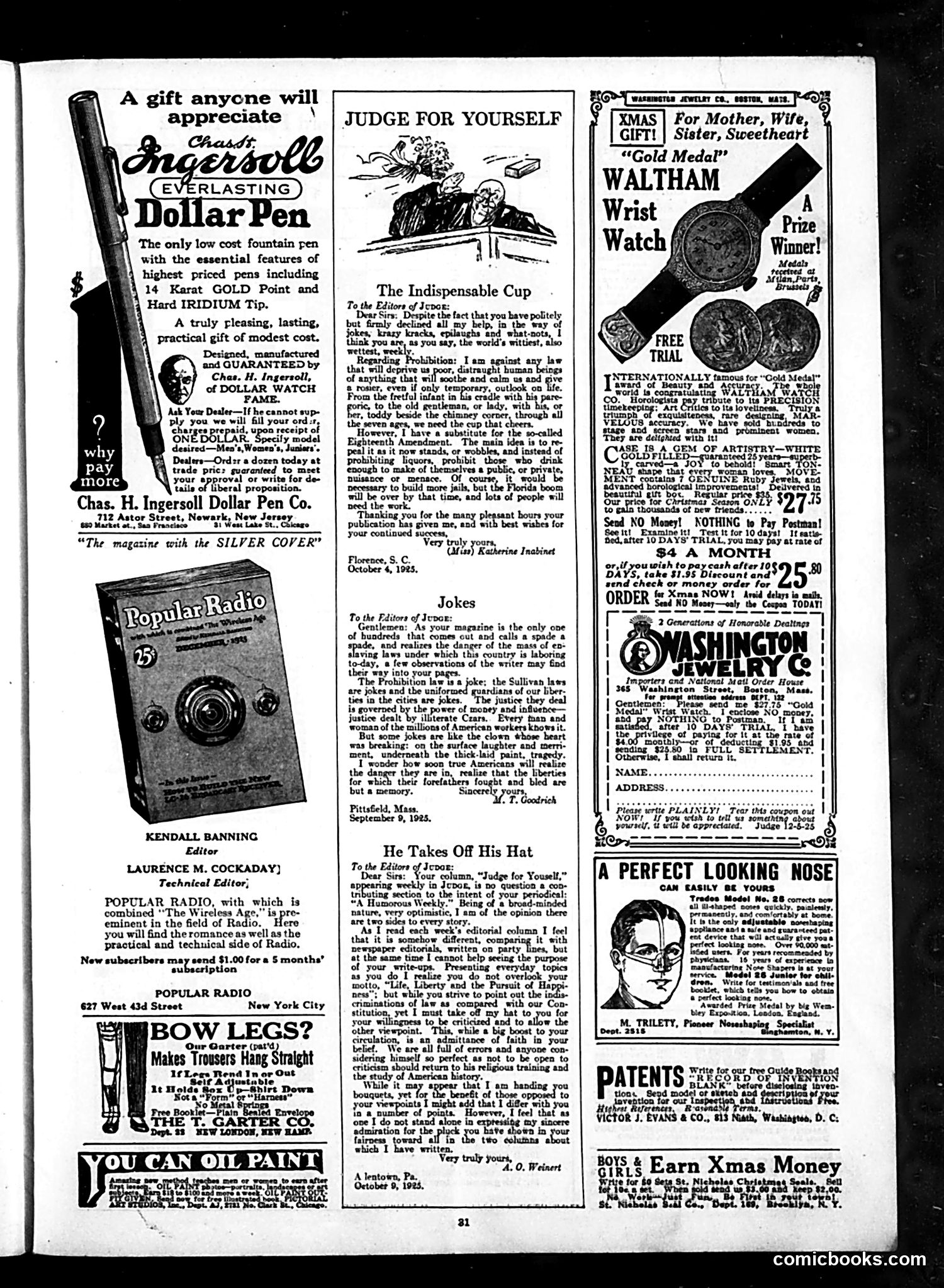
This page is primarily **advertising and reader letters**, not political satire. The notable content includes: **"Judge for Yourself" Section**: A letters column where readers debate Prohibition. One correspondent argues for replacing the 18th Amendment (alcohol ban) with laws against public intoxication instead. Another defends the column's willingness to criticize laws, praising its balanced approach to constitutional issues like Prohibition and the Sullivan laws (gun restrictions). **Historical Context**: The letters reflect 1920s debates over Prohibition's enforcement and effectiveness. References to "Sullivan laws" and critiques of "enslaving laws" suggest libertarian-leaning readers concerned about government overreach—common Judge magazine positions. **"He Takes Off His Hat"**: A reader praises the magazine's editorial independence and willingness to present multiple viewpoints on controversial topics. The page contains mostly commercial advertisements (fountain pens, watches, radio magazines) typical of 1920s publications. No significant political cartoons or caricatures appear on this particular page.
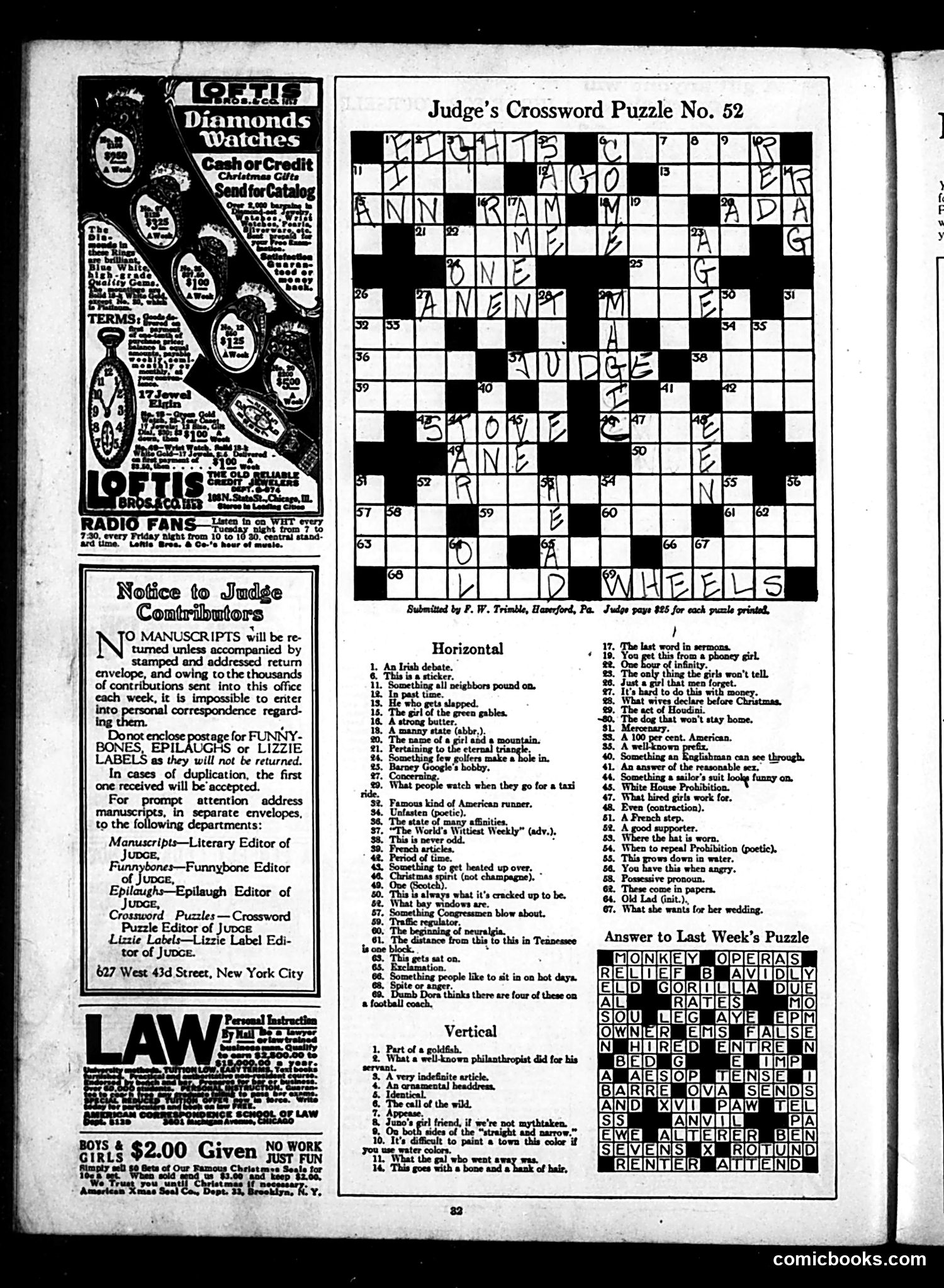
This page is primarily a **crossword puzzle** submission from contributor P. W. Trimble of Haverford, Pennsylvania, for which Judge paid $25 per published puzzle—a notable sum for the era. The page also contains **administrative notices** to Judge contributors regarding manuscript submission procedures: manuscripts must include return envelopes and addresses, and certain content types (funny bones, epilaughs, lizzie labels) won't be returned. The left side features **vintage advertisements** for luxury items—diamond watches and a LAW correspondence course—typical of Judge's upscale readership. The **answer key** to the previous week's puzzle is shown, featuring words like "MONKEY," "OPERAS," and "GORILLA." This page reflects Judge's dual nature as both satirical magazine and puzzle-entertainment publication, targeting educated, affluent readers with leisure time for crosswords and the means to purchase luxury goods.
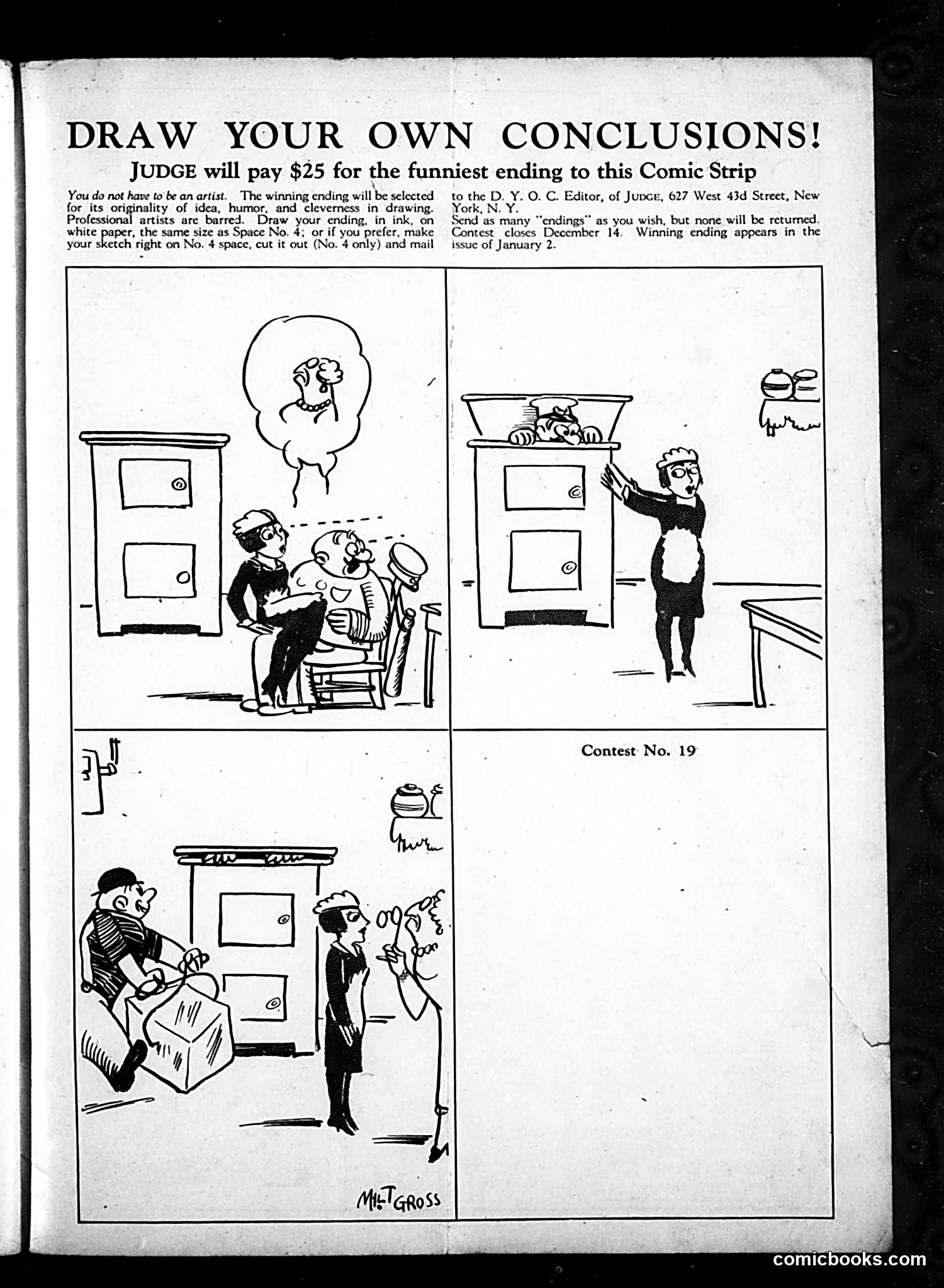
This is a reader-participation contest where Judge magazine invites non-professional artists to complete an unfinished three-panel comic strip. The prize is $25—substantial money in the early 20th century. The comic strip (labeled "Contest No. 19") shows domestic scenes involving what appear to be servants or household staff and their employers. Panel 1 depicts someone reacting with distress to news from two other figures. Panel 2 shows a person gesturing upward at a basin or tub. Panel 3 shows two figures in conversation near a door or cabinet. Without the final panel, readers must invent a punchline. The humor likely relies on class dynamics, misunderstandings, or household mishaps typical of period comedy—common satirical subjects in Judge. The contest emphasizes originality and humor over artistic skill, democratizing participation.
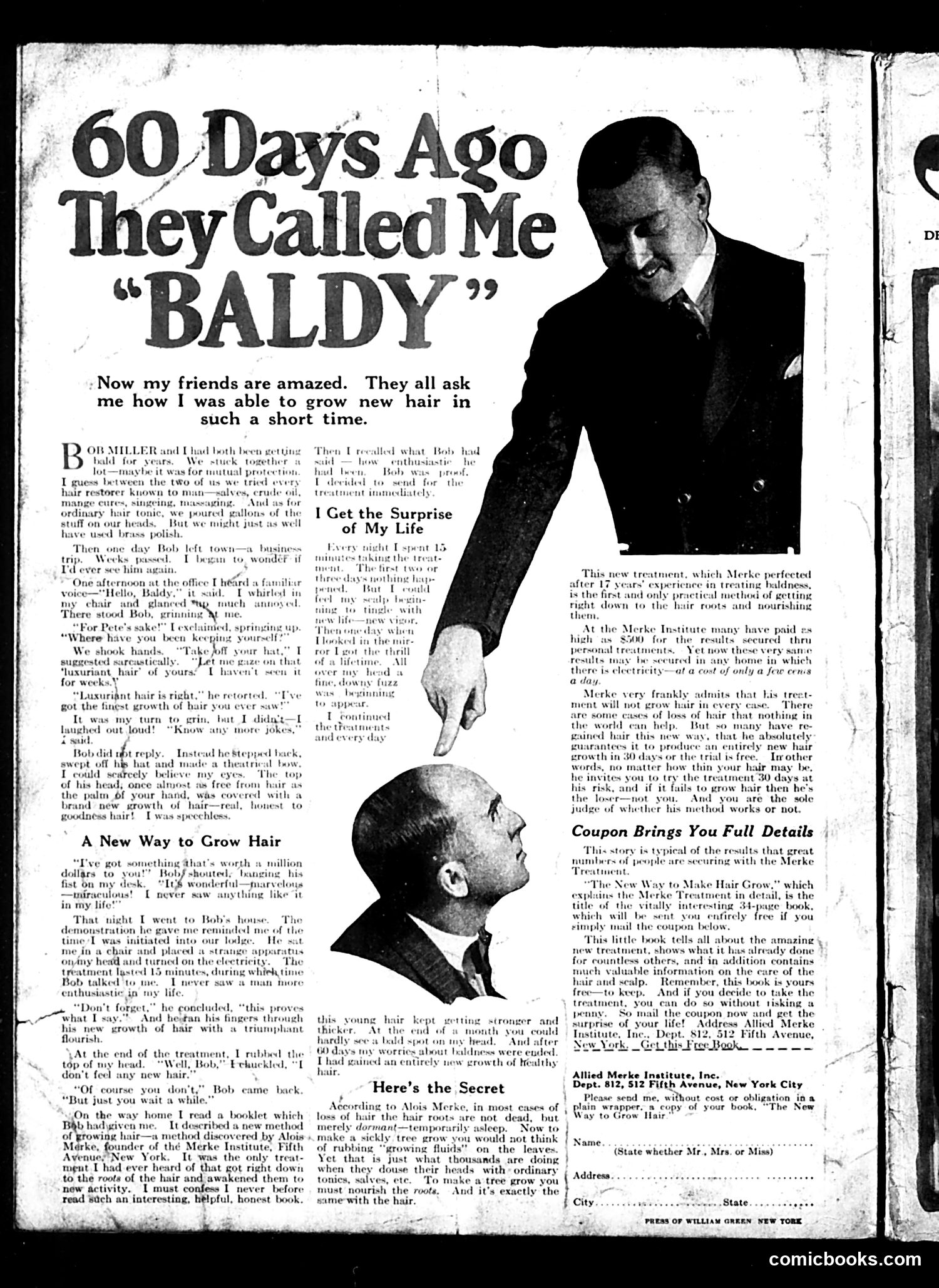
This is a **hair-restoration advertisement disguised as a testimonial story**, common in early 20th-century magazines. The "cartoon" is actually a before-and-after photographic advertisement for the Merke Institute's hair-growth treatment. A man nicknamed "Baldy" claims that within 60 days of treatment, he regrew a full head of hair—a dramatic transformation shown in the side-by-side images. **The Social Context:** Male baldness was (and remains) a source of social anxiety and mockery. The nickname "Baldy" represents the shame and ridicule the protagonist experienced. The advertisement exploits this insecurity, promising a "miraculous" solution through electrical treatments at the Merke Institute in New York City. **The Appeal:** The copy emphasizes how friends were "amazed"—appealing to vanity and the desire to regain social status. The coupon offers a free 34-page book about hair care, a common direct-marketing tactic. This represents early advertising's blending of testimonial narrative with pseudoscientific claims—electrically-stimulated hair growth was unproven but presented as factual and medically sound.