
Judge, 1925-12-05 · page 16 of 36
Judge — December 5, 1925 — page 16: what you’re looking at
What you’re looking at
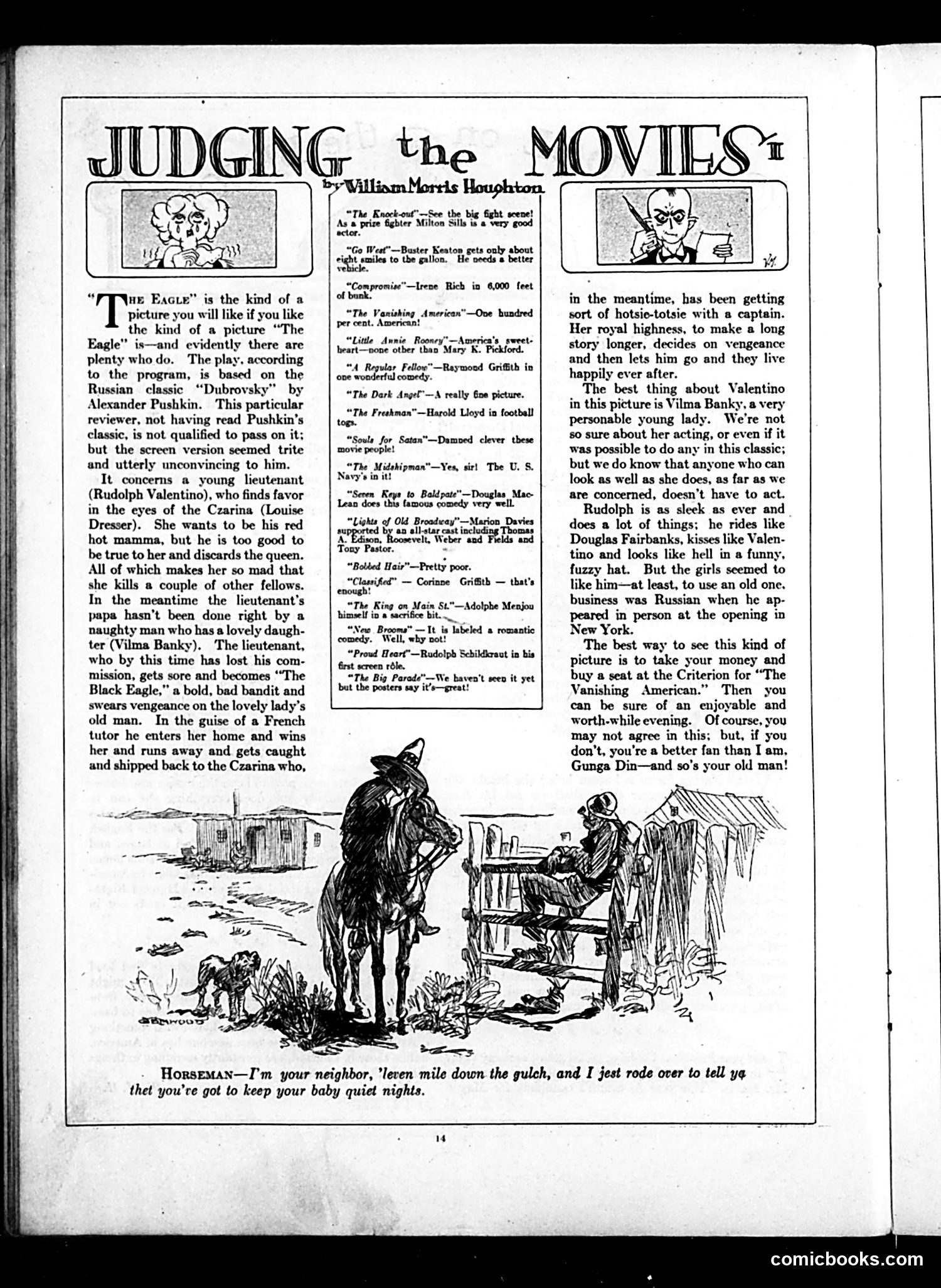
This page reviews contemporary 1920s films, including "The Eagle" starring Rudolph Valentino and Vilma Banky. The main review is sarcastically dismissive: the plot (a lieutenant-turned-bandit seeking revenge) is "trite and utterly unconvincing." The critic praises Vilma Banky's appearance but doubts her acting ability, suggesting beauty alone suffices for silent film stardom. Valentino is mocked as "sleek" but ridiculous in a "fuzzy hat"—yet notes female audiences loved him regardless. The sidebar lists other current releases with brief quips, exemplifying Judge's snobbish tone toward popular entertainment. The page concludes with an unrelated rural cartoon about a neighbor complaining about a crying baby. The satire targets both silent cinema's melodramatic plots and audiences' willingness to overlook poor quality for star appeal and romance.
📄 Transcribed text from this page (OCR, searchable)
Machine-transcribed from the original scan — historical spelling and the odd misread are preserved.
md He Eacte” is the kind of a picture you will like if you like the kind of a picture “The Eagle” is—and evidently there are plenty who do. The play, according to the program, is based on the Russian classic “Dubrovsky” by Alexander Pushkin. This particular reviewer, not having read Pushkin’s classic, is not qualified to pass on it; but the screen version seemed trite and utterly unconvincing to him. It concerns a young lieutenant (Rudolph Valentino), who finds favor in the eyes of the Czarina (Louise Dresser). She wants to be his red hot mamma, but he is too good to be true to her and discards the queen. All of which makes her so mad that she kills a couple of other fellows. In the meantime the lieutenant’s papa hasn’t been done right by a naughty man who has a lovely daugh- ter (Vilma Banky). The lieutenant, who by this time has lost his com- mission, gets sore and becomes “The Black Eagle,” a bold, bad bandit and swears vengeance on the lovely lady’s old man. In the guise of a French tutor he enters her home and wins her and runs away and gets caught and shipped back to the Czarina who, JUDGING. ‘h she MOVILS* “The Knock-out"—See scene! fox} a rie febter Milton eel good “Go West"—Buster Keaton gets only about sight ails to the gallon. “He oreds a better vel ep LaPromite” Irene Rich in 6.000 feet “The Vanishing American”—Ove bundred per cent. American! “Little Annie Rooney—America’s sweet- heart—none otber thao Mary K. Pickford. “A Regular Fellow” —Raymond Griffith in one wonderful comedy. “The Dark Angel”—A really Gne picture. tegiM Fraskman"—Harold Liayd fn foothall “Souls fer, Satan"—Damoed clever these movie people! “The Midshipman”—Yes, sir! The U. S. Navy's in itt “Senn Keys 0 Baldpats"—Douglas, Mace Lean does thes faroous comedy very apts of Old Broadway” eaten Oe Davies ted By a3 allstar cat inc rt velt, Weber and ne ‘and Tony Pastor, “Bolbed Hair"—Pretty poor. “Classified” — Corinne Griffith — that's enough! “The King on Main St."—Adolphe M hin i Sten Trea: New Brooms” —It is labeled a romantic oman: Well, why not! “Proud Hearf"—Rudolpb Schildkraut in his first screen réle. “The Big Parade"—-We haven't seen it yet but the posters say it’s—great! Horseman—I’'m your neighbor, ’leven mile down the gulch, and I jest rode over to tell y¢ thet you're got to keep your baby quiet nights. in the meantime, has been getting sort of hotsie-totsie with a captain. Her royal highness, to make a long story longer, decides on vengeance and then lets him go and they live happily ever after. The best thing about Valentino in this picture is Vilma Banky, a very personable young lady. We're not so sure about her acting, or even if it was possible to do any in this classic; but we do know that anyone who can look as well as she does, as far as we are concerned, doesn’t have to act. Rudolph is as sleek as ever and does a lot of things; he rides like Douglas Fairbanks, kisses like Valen- tino and looks like hell in a funny, fuzzy hat. But the girls seemed to like him—at least, to use an old one. business was Russian when he ap- peared in person at the opening in New York. The best way to see this kind of picture is to take your money and buy a seat at the Criterion for “The Vanishing American.” Then you can be sure of an enjoyable and worth-while evening. Of course, you may not agree in this; but, if you don’t, you're a better fan than I am, Gunga Din—and so’s your old man! comicbooks.com