
Judge, 1925-12-05 · page 15 of 36
Judge — December 5, 1925 — page 15: what you’re looking at
What you’re looking at
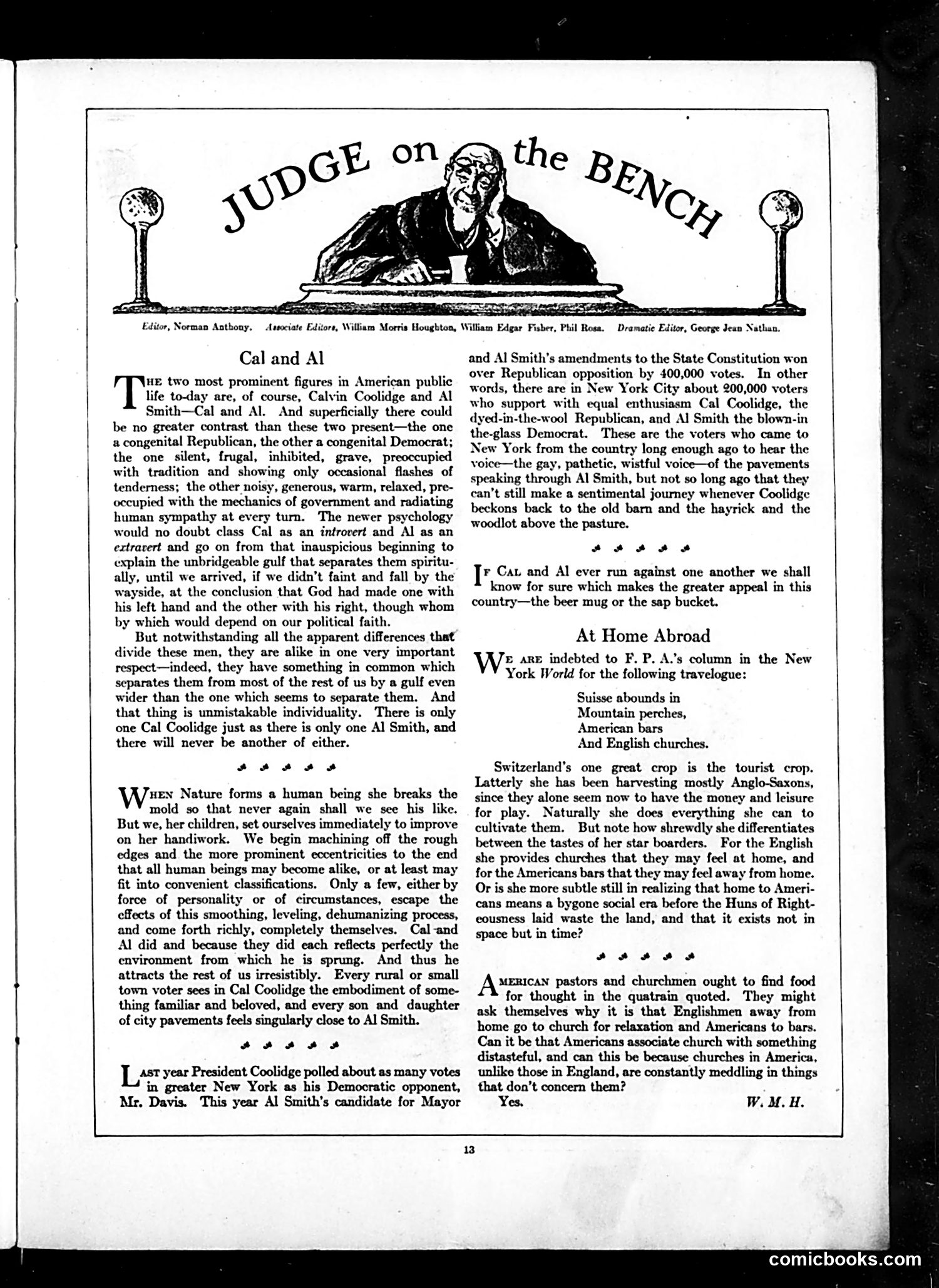
This editorial compares Calvin Coolidge (President, Republican) and Al Smith (Democratic politician, likely NYC Mayor), the two dominant figures in American politics circa 1924-1928. The piece argues that despite their superficial opposites—Coolidge "silent, frugal, inhibited"; Smith "noisy, generous, warm"—they share crucial individuality that distinguishes them from ordinary politicians and appeals to voters across party lines. The text notes that in 1924, Coolidge and Smith's Democratic opponent Davis polled equally in New York; by the following year, Smith's amendments won by 400,000 votes. The explanation: rural transplants to New York City, nostalgic for Coolidge's agrarian values ("beer mug or the sap bucket") yet attracted to Smith's urban voice and charm ("gay, pathetic, wistful voice"). The satire's point: authentic personality transcends ideology—both men succeed because they're genuinely *themselves*, not manufactured politicians. The "Judge on the Bench" masthead frames this as editorial commentary.
📄 Transcribed text from this page (OCR, searchable)
Machine-transcribed from the original scan — historical spelling and the odd misread are preserved.
Editor, Norman Anthony, Cal and Al HE two most prominent figures in American public life to-day are, of course, Calvin Coolidge and Al Smith—Cal and Al. And superficially there could be no greater contrast than these two present—the one a congenital Republican, the other a congenital Democrat; the one silent, frugal, inhibited, grave, preoccupied with tradition and showing only occasional flashes of tenderness; the other noisy, generous, warm, relaxed, pre- occupied with the mechanics of government and radiating human sympathy at every turn. The newer psychology would no doubt class Cal as an introvert and Al as an extravert and go on from that inauspicious beginning to explain the unbridgeable gulf that separates them spiritu- ally, until we arrived, if we didn’t faint and fall by the wayside, at the conclusion that God had made one with his left hand and the other with his right, though whom by which would depend on our political faith. But notwithstanding all the apparent differences that divide these men, they are alike in one very important respect—indeed, they have something in common which separates them from most of the rest of us by a gulf even wider than the one which seems to separate them. And that thing is unmistakable individuality. There is only one Cal Coolidge just as there is only one Al Smith, and there will never be another of either. et A AH SH W's Nature forms a human being she breaks the mold so that never again shall we see his like. But we, her children, set ourselves immediately to improve on her handiwork. We begin machining off the rough edges and the more prominent eccentricities to the end that all human beings may become alike, or at least may fit into convenient classifications. Only a few, either by force of personality or of circumstances, escape the effects of this smoothing, leveling, dehumanizing process, and come forth richly, completely themselves. Cal -and Al did and because they did each reflects perfectly the environment from which he is sprung. And thus he attracts the rest of us irresistibly. Every rural or small town voter sees in Cal Coolidge the embodiment of some- thing familiar and beloved, and every son and daughter of city pavements feels singularly close to Al Smith. eee ae ast year President Coolidge polled about as many votes in greater New York as his Democratic opponent, Mr. Davis. This year Al Smith's candidate for Mayor Associate Editors, William Morris Houghton, William Edgar Fisber, Phil Rosa. Dramatic Editor, George Jean Nathan. and Al Smith’s amendments to the State Constitution won over Republican opposition by 400,000 votes. In other words, there are in New York City about 200,000 voters who support with equal enthusiasm Cal Coolidge, the dyed-in-the-wool Republican, and Al Smith the blown-in the-glass Democrat. These are the voters who came to New York from the country long enough ago to hear the voice—the gay, pathetic, wistful voice—of the pavements speaking through Al Smith, but not so long ago that they can’t still make a sentimental journey whenever Coolidge beckons back to the old barn and the hayrick and the woodlot above the pasture. et A AH SH i Cau and Al ever run against one another we shall know for sure which makes the greater appeal in this country—the beer mug or the sap bucket. At Home Abroad E ARE indebted to F. P. A.’s column in the New York World for the following travelogue: Suisse abounds in Mountain perches, American bars And English churches. Switzerland’s one great crop is the tourist crop. Latterly she has been harvesting mostly Anglo-Saxons, since they alone seem now to have the money and leisure for play. Naturally she does everything she can to cultivate them. But note how shrewdly she differentiates between the tastes of her star boarders. For the English she provides churches that they may feel at home, and for the Americans bars that they may feel away from home. Or is she more subtle still in realizing that home to Ameri- cans means a bygone social era before the Huns of Right- eousness laid waste the land, and that it exists not in space but in time? eee ha SH AMERICAN pastors and churchmen ought to find food for thought in the quatrain quoted. They might ask themselves why it is that Englishmen away from home go to church for relaxation and Americans to bars. Can it be that Americans associate church with something distasteful, and can this be because churches in America, unlike those in England, are constantly meddling in things that don’t concern them? Yes, W. M.H. ee ———— comicbooks.com