
Judge, 1925-12-05 · page 18 of 36
Judge — December 5, 1925 — page 18: what you’re looking at
What you’re looking at
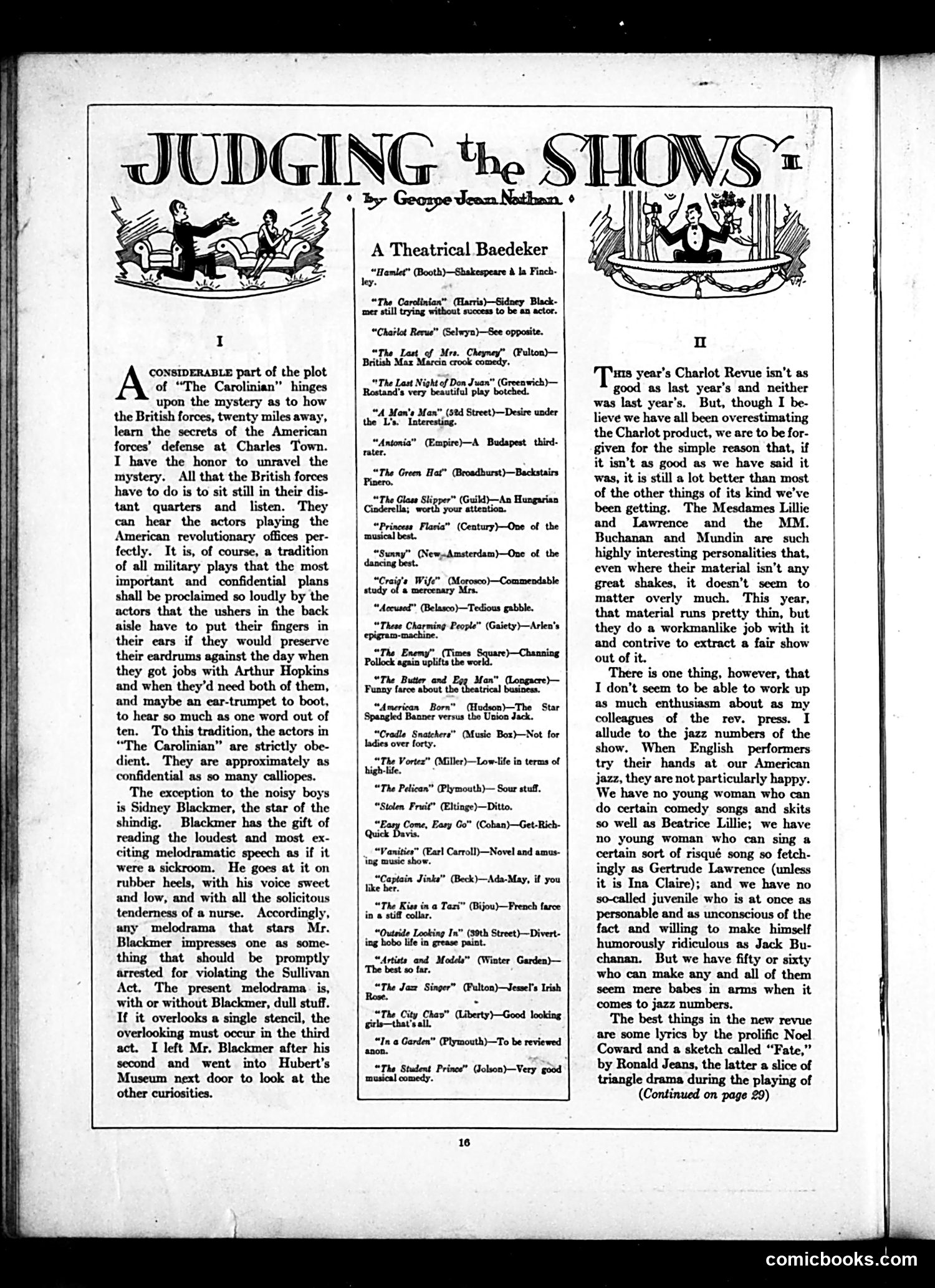
This page reviews Broadway theatrical productions, with particular focus on "The Carolinian," a Revolutionary War melodrama. Nathan satirizes the play's implausibly loud actors—who broadcast confidential military secrets so audibly that British forces can eavesdrop from miles away. He mocks this as a tiresome theatrical convention where melodramatic actors shout their lines. The exception is star Sidney Blackmer, whose mumbling, tender delivery is so quiet it renders the already-dull play nearly incomprehensible. Nathan sarcastically suggests Blackmer's understated performance in melodrama is like "violating the Sullivan Act"—treating serious material as if it were criminal negligence. The page also includes a "Theatrical Baedeker" (a travel guide-style listing) of current Broadway shows with brief, acerbic critiques. Nathan's humor relies on theater-insider knowledge and period Broadway gossip familiar to *Judge* readers.
📄 Transcribed text from this page (OCR, searchable)
Machine-transcribed from the original scan — historical spelling and the odd misread are preserved.
CONSIDERABLE part of the plot of “The Carolinian” hinges upon the mystery as to how the British forces, twenty miles away, learn the secrets of the American forces’ defense at Charles Town. I have the honor to unravel the mystery. All that the British forces have to do is to sit still in their dis- tant quarters and listen. They can hear the actors playing the American revolutionary offices per- fectly. It is, of course, a tradition of all military plays that the most important and confidential plans shall be proclaimed so loudly by the actors that the ushers in the back aisle have to put their fingers in their ears if they would preserve their eardrums against the day when they got jobs with Arthur Hopkins and when they’d need both of them, and maybe an ear-trumpet to boot, to hear so much as one word out of ten. To this tradition, the actors in “The Carolinian” are strictly obe- dient. They are approximately as confidential as so many calliopes. The exception to the noisy boys is Sidney Blackmer, the star of the shindig. Blackmer has the gift of reading the loudest and most ex- citing melodramatic speech as if it were a sickroom. He goes at it on rubber heels, with his voice sweet and low, and with all the solicitous tenderness of a nurse. Accordingly, any melodrama that stars Mr. Blackmer impresses one as some- thing that should be promptly arrested for violating the Sullivan Act. The present melodrama. is, with or without Blackmer, dull stuff. If it overlooks a single stencil, the overlooking must occur in the third act. I left Mr. Blackmer after his second and went into Hubert’s Museum next door to look at the A Theatrical Baedeker aes (Booth)—Shakespeare & la Finch- « clinian” (Harris)—Gidney Black- marin ee without success to be an actor. “Charlot Rerue” (Selwyn)—See opposite. Baiheh Mar Miecin crook comedy, "The Last Night of Don Juan” (Greenwich)— Rostuad veo beste! play botched “A Man's Man” (52d Street)—Desire under the L's. Interesting. “Antonia” (Empire)—A Budapest third- rater. “The Green Hat” (Broadhurst)—Backstairs Pinero. “The Glass Slipper” (Guild)—An Hungarian Cinderella; worth your attention. “Princess Flavia” (Century}—One of the musical best. “Sunny” NewmAmsterdam)—One of the “Craig's Wife” (Morosco)—Commendable stody of « mercenary Ma. “Accused” (Belasco)—Tedious gabble. “These Charming People” (Gaiety)—Arlen's “The Ep s it Police agus eplita the word sn “The Butter and Man” (Longacre)— Funny farce about the trical business. “American Born” (Hudson)—The Star Spangled Banner versus the Union Jack. “Cradle Snatchers” (Music Box)—Not for ladies over forty. “The Vortex” (Miller}—Low-life in terms of “The Pelican” (Plymouth)— Sour stuff. “Stolen Fruit” (Eltinge)—Ditto. “ Come, Easy Go” (Cohan)—Get-Rich- gut Bae “Vanities” (Earl Carroll)—Novel and amus- ing music show. “Captain Jinks” (Beck)—Ada-May, if “The Kise in a Taxi” (Bijou)—French farce ta’e oti collars 4 aes “Outside Looking In” (39th Street)—Divert- ing hobo fit in grease paint. “Artists and Models” (Winter Garden)— The best so far. pie Jax Singer” Paton) —Jemels Trish “The City Chav” aati Sity [heo” (Uiberty)—Good looking “In @ Garden” (Plymouth)—To be reviewed anon. “The Student Prince” (Jolson)—Ve musical comedy. whe T= year’s Charlot Revue isn’t as good as last year’s and neither was last year’s. But, though I be- lieve we have all been overestimating the Charlot product, we are to be for- given for the simple reason that, if it isn’t as good as we have said it was, it is still a lot better than most of the other things of its kind we've been getting. The Mesdames Lillie and Lawrence and the MM. Buchanan and Mundin are such highly interesting personalities that, even where their material isn’t any great shakes, it doesn’t seem to matter overly much. This year, that material runs pretty thin, but they do a workmanlike job with it and contrive to extract a fair show out of it. There is one thing, however, that I don’t seem to be able to work up as much enthusiasm about as my colleagues of the rev. press. I allude to the jazz numbers of the show. When English performers try their hands at our American jazz, they are not particularly happy. We have no young woman who can do certain comedy songs and skits so well as Beatrice Lillie; we have no young woman who can sing a certain sort of risqué song so fetch- ingly as Gertrude Lawrence (unless it is Ina Claire); and we have no so-called juvenile who is at once as personable and as unconscious of the fact and willing to make himself humorously ridiculous as Jack Bu- chanan. But we have fifty or sixty who can make any and all of them seem mere babes in arms when it comes to jazz numbers. The best things in the new revue are some lyrics by the prolific Noel Coward and a sketch called “Fate,” by Ronald Jeans, the latter a slice of triangle drama during the playing of (Continued on page 29) comicbooks.com