
Judge, 1925-12-05 · page 9 of 36
Judge — December 5, 1925 — page 9: what you’re looking at
What you’re looking at
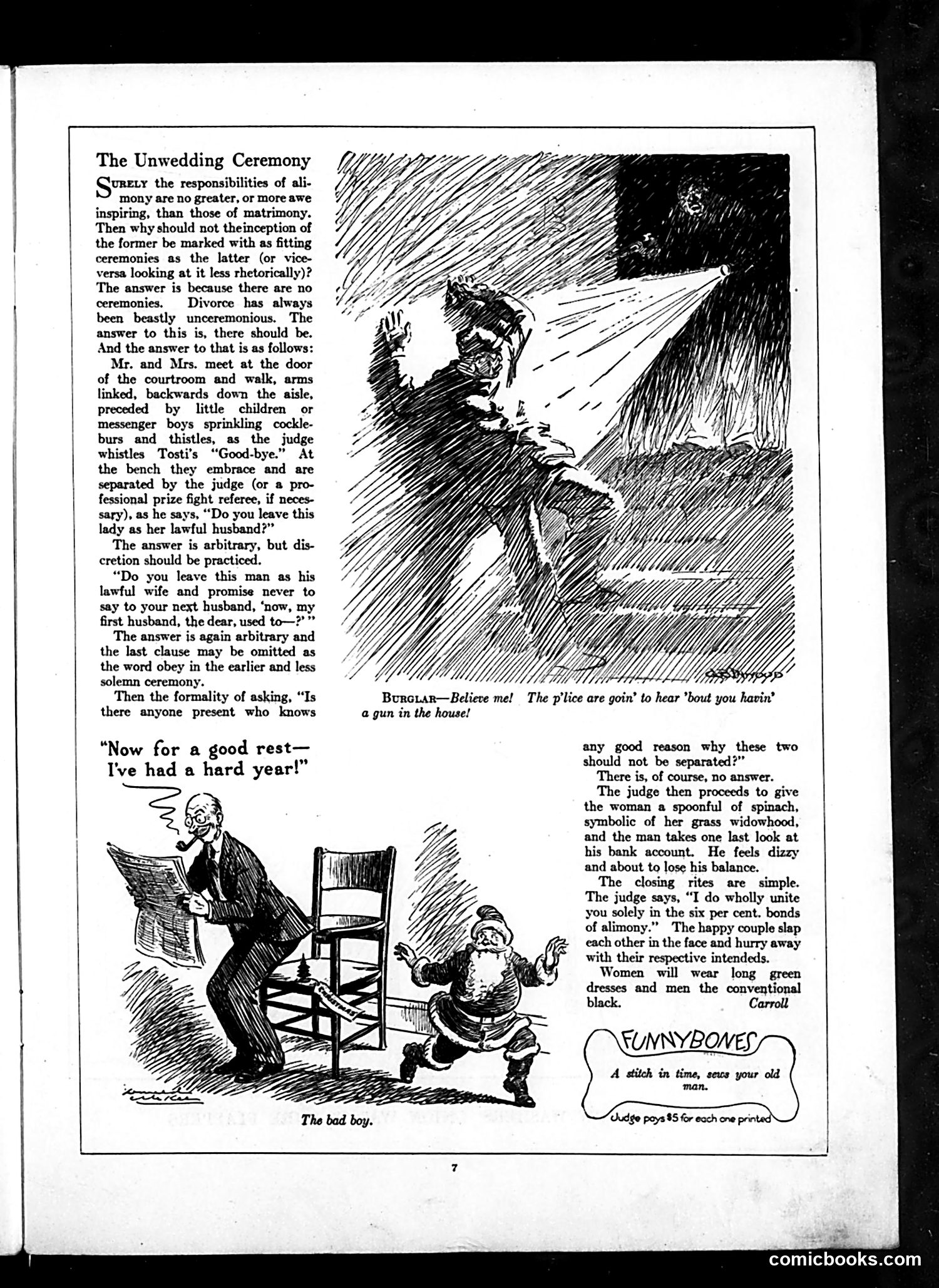
This satirical article proposes a formal, ceremonial approach to divorce—mirroring wedding ceremonies but in reverse. The author argues that since divorce carries serious financial obligations (alimony), it deserves equal ceremonial weight to marriage. The piece humorously describes an elaborate "unwedding": the couple walking backwards down the aisle, children sprinkling cockleburs instead of flowers, the judge asking if they "leave" each other as spouses, and symbolic gestures like giving the woman spinach to represent her impending widowhood. The closing joke is the judge uniting them "in the six per cent. bonds of alimony." The accompanying cartoons illustrate the gravity of divorce's financial burden and misbehaving children—suggesting both the emotional and practical chaos of broken marriages. The satire targets the arbitrary, ceremonially hollow nature of 1920s divorce proceedings while highlighting alimony's real consequences, particularly for women.
📄 Transcribed text from this page (OCR, searchable)
Machine-transcribed from the original scan — historical spelling and the odd misread are preserved.
The Unwedding Ceremony Smtr the responsibilities of ali- mony are no greater, or more awe inspiring, than those of matrimony. Then why should not theinception of the former be marked with as fitting ceremonies as the latter (or vice- versa looking at it less rhetorically)? The answer is because there are no ceremonies. Divorce has always been beastly unceremonious. The answer to this is, there should be. And the answer to that is as follows: Mr. and Mrs. meet at the door of the courtroom and walk, arms linked, backwards down the aisle, preceded by little children or messenger boys sprinkling cockle- burs and thistles, as the judge whistles Tosti’s “Good-bye.” At the bench they embrace and are separated by the judge (or a pro- fessional prize fight referee, if neces- sary), as he says, “‘Do you leave this lady as her lawful husband?” The answer is arbitrary, but dis- cretion should be practiced. “Do you leave this man as his lawful wife and promise never to say to your next husband, ‘now, my first husband, the dear, used to—?’”” The answer is again arbitrary and the last clause may be omitted as the word obey in the earlier and less solemn ceremony. Then the formality of asking, “Is there anyone present who knows “Now for a good rest— I've had a hard year!” Burciar—Believe me! The p'lice are goin’ to hear *bout you havin’ a gun in the house! any good reason why these two should not be separated?” There is, of course, no answer. The judge then proceeds to give the woman a spoonful of spinach, symbolic of her grass widowhood, and the man takes one last look at his bank account. He feels dizzy and about to lose his balance. The closing rites are simple. The judge says, “I do wholly unite you solely in the six per cent, bonds of alimony.” The happy couple slap each other in the face and hurry away with their respective intendeds. Women will wear long green dresses and men the conventional black. Carroll comicbooks.com