
A complete issue · 36 pages · 1925
Judge — August 22, 1925
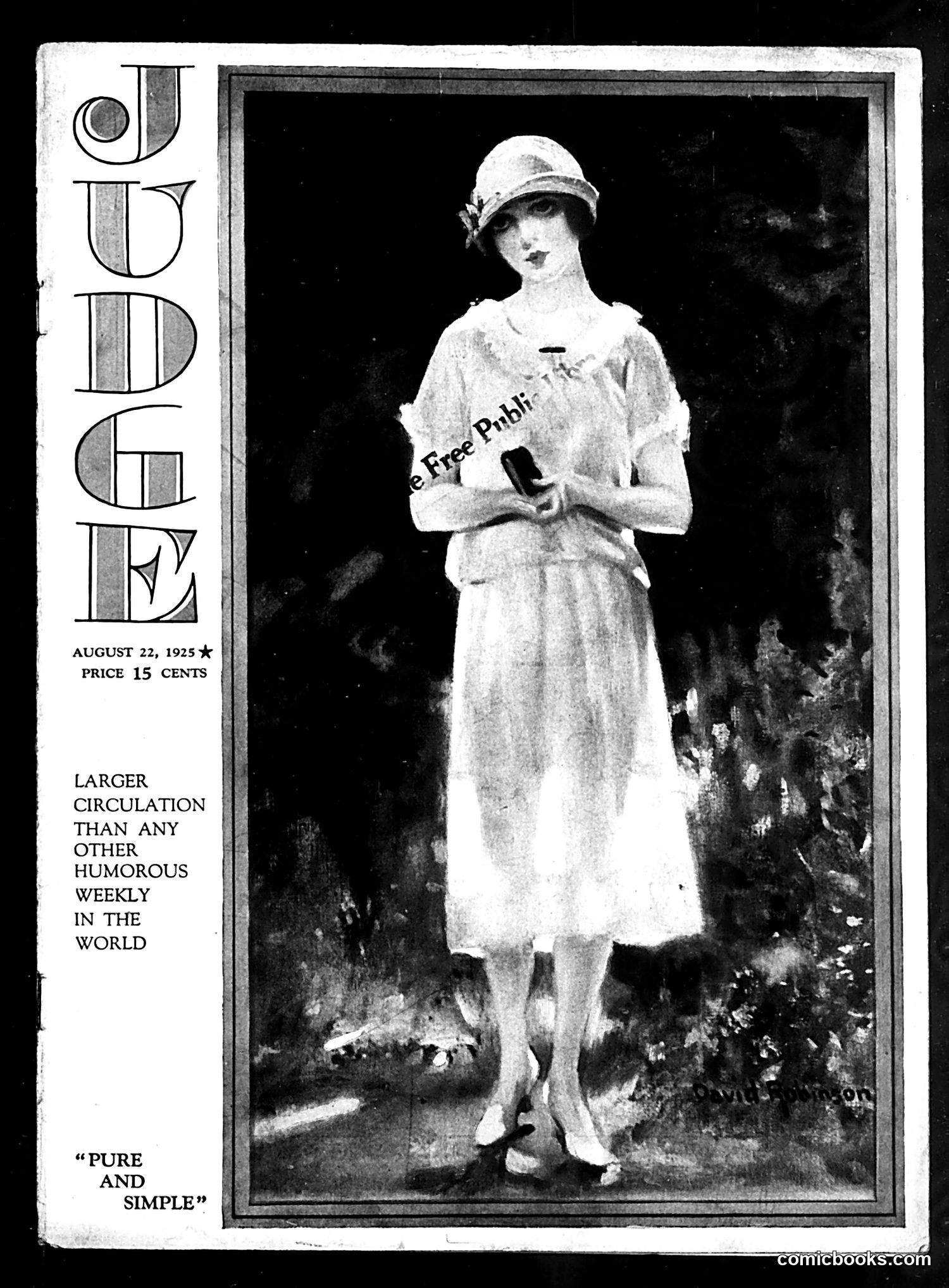
This appears to be primarily a **magazine cover with advertising** rather than political satire. The August 22, 1925 Judge cover features a fashionably dressed woman in 1920s attire—a cloche hat, light-colored dress, and shoes—holding what appears to be a book or pamphlet labeled "Free Prohibition" (text partially visible). The caption "Pure and Simple" likely references the **Prohibition era** (1920-1933), when alcohol sales were banned in America. The woman's fashionable, modern appearance represents the "flapper" style of the era. The satire seems to comment on Prohibition enforcement or public attitudes toward the unpopular law, though the exact joke remains somewhat unclear without additional context from the magazine's interior.
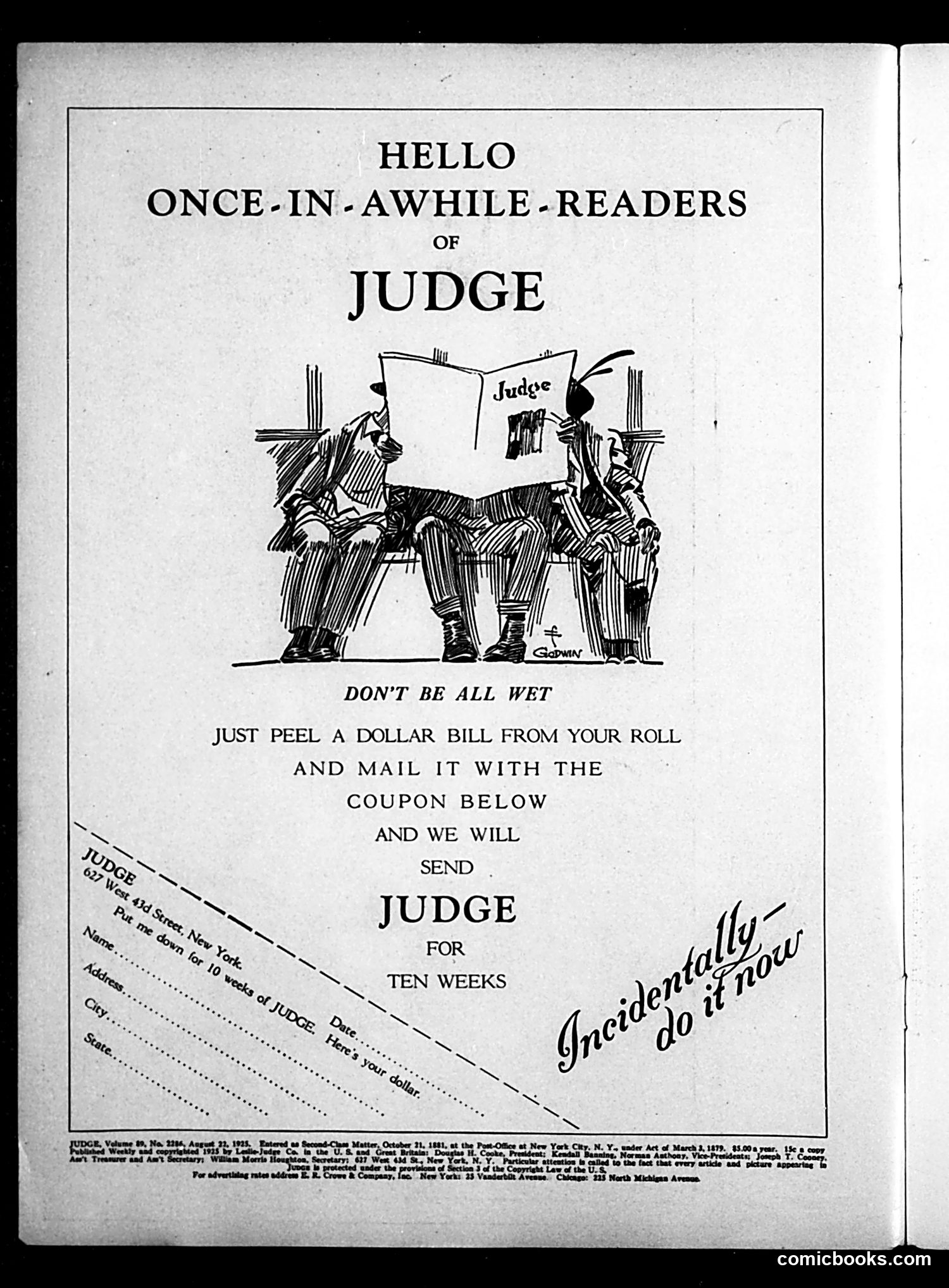
This is primarily a **subscription advertisement** for Judge magazine rather than political satire. The cartoon shows two figures reading Judge together in chairs, illustrating the magazine's appeal to casual, occasional readers ("once-in-awhile readers"). The ad humorously instructs potential subscribers not to be "all wet" (a period phrase meaning uninformed or foolish) and invites them to mail a dollar bill with the coupon below to receive Judge for ten weeks. The phrase "Incidentally do it now" creates urgency. The illustration style and casual domestic scene emphasize Judge as accessible entertainment for general audiences. This is a straightforward circulation-building advertisement typical of early 20th-century magazine promotion, with minimal satirical content—the humor lies mainly in the personified magazine and the colloquial messaging.
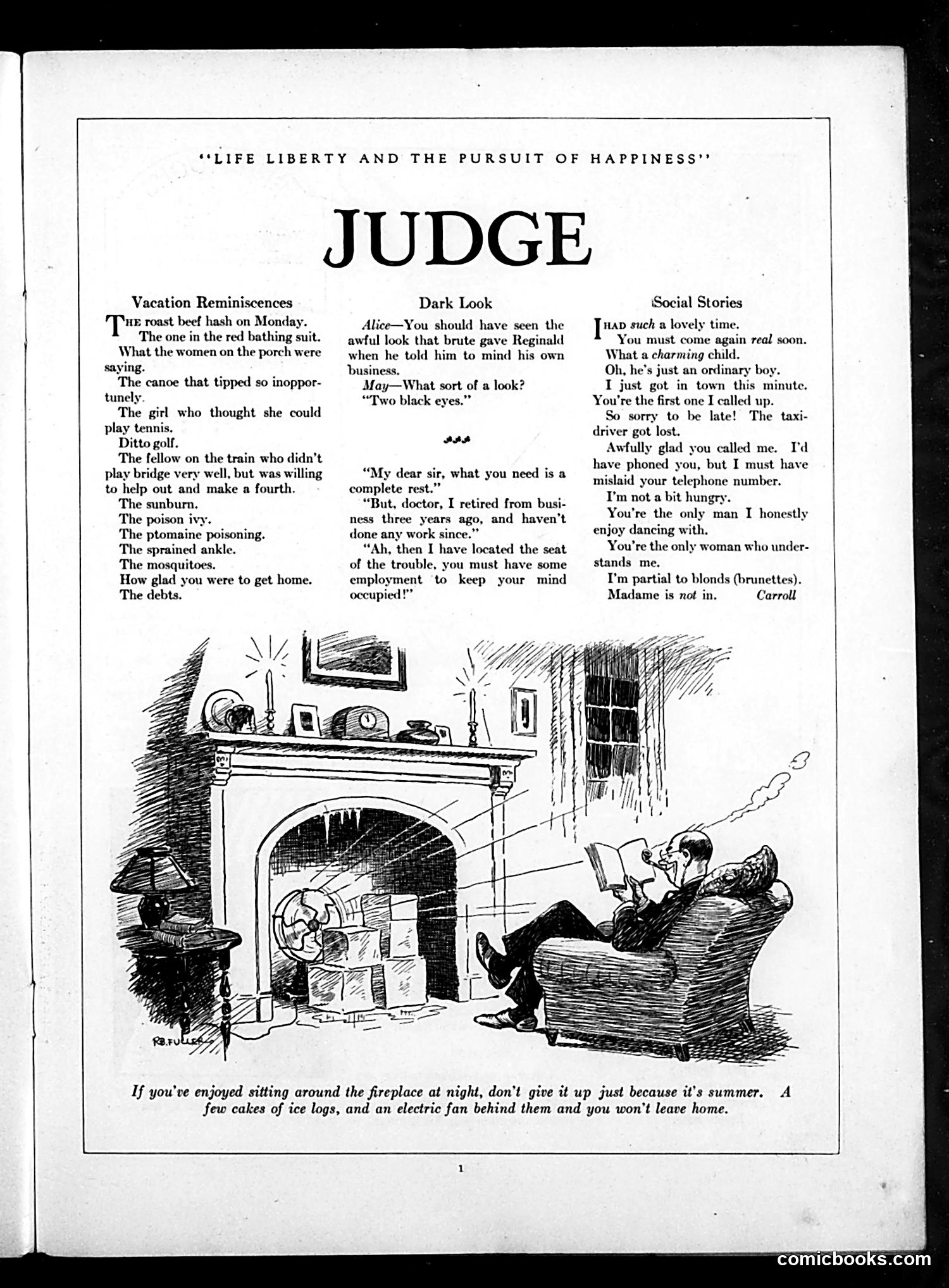
This page from *Judge* magazine contains humor columns and a cartoon rather than political satire. The "Vacation Reminiscences" and "Dark Look" sections present light social commentary—observations about everyday annoyances (mosquitoes, debts, train companions) and relationship dynamics. The main illustration depicts a man lounging by a fireplace, reading during summer. The caption humorously advises keeping the fireplace despite warm weather, suggesting comfort and coziness trump seasonal logic. This reflects early-20th-century domestic life where fireplaces were central to home life. The "Social Stories" column offers witty observations about social interactions—missed calls, romantic interest, and social etiquette. Overall, this page exemplifies *Judge's* focus on genteel, middle-class humor rather than hard-hitting political commentary. The content targets readers seeking relatable domestic and social satire.
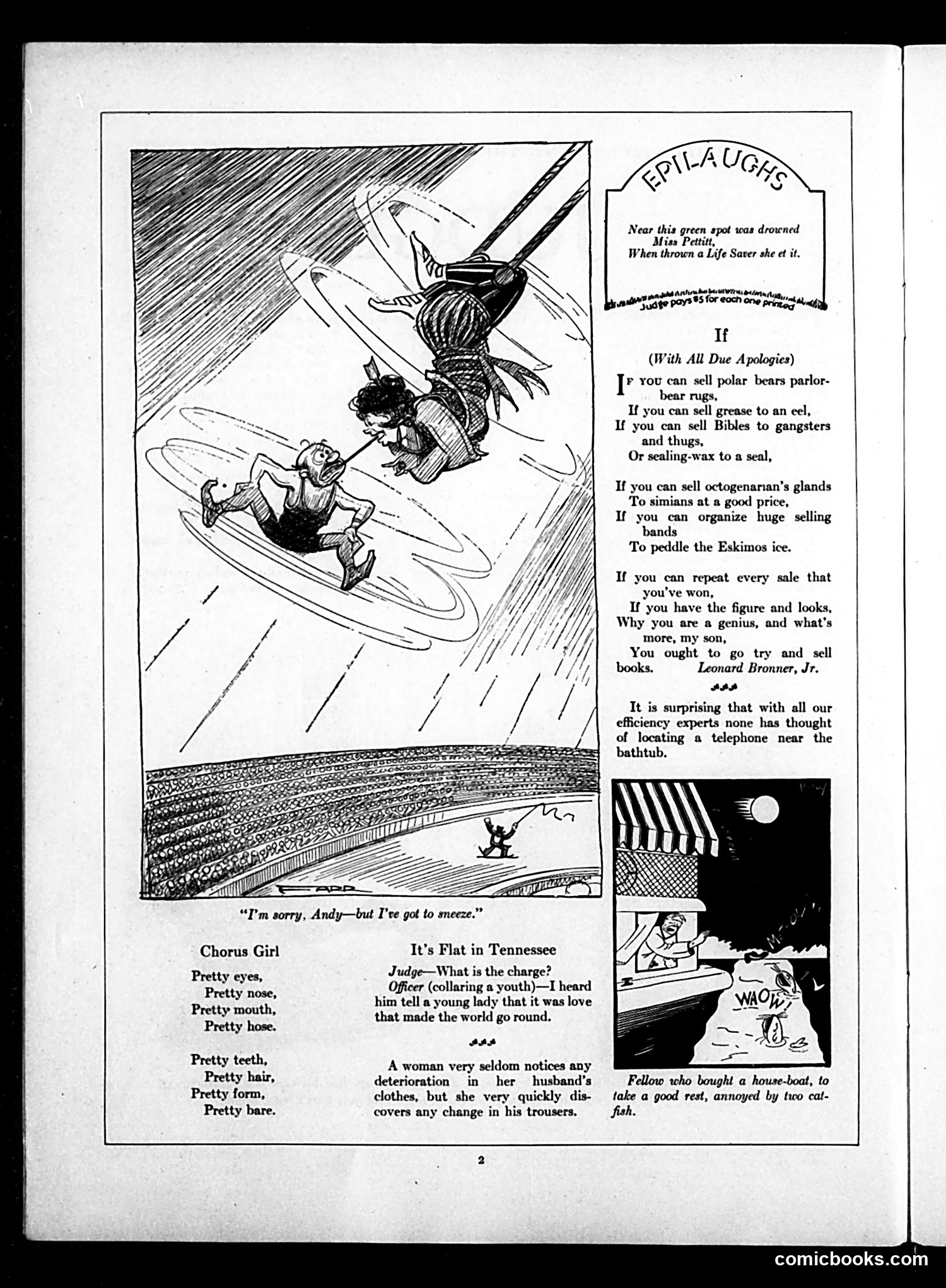
**Main Cartoon (top):** Shows two figures being thrown from an aircraft during rain, with the caption "I'm sorry, Andy—but I've got to sneeze." This appears to be a dark humor joke about the dangers of early aviation, playing on the absurdity of a life-threatening situation caused by a trivial action. **Other Content:** The page includes several brief humorous pieces: - "Chorus Girl" - a satirical poem about superficial beauty - "It's Flat in Tennessee" - a joke exchange about charges and love - A small cartoon about a houseboat owner annoyed by catfish The overall page represents typical Judge magazine fare: absurdist humor, satirical verses, and visual gags targeting various social subjects common to early 20th-century American popular culture.
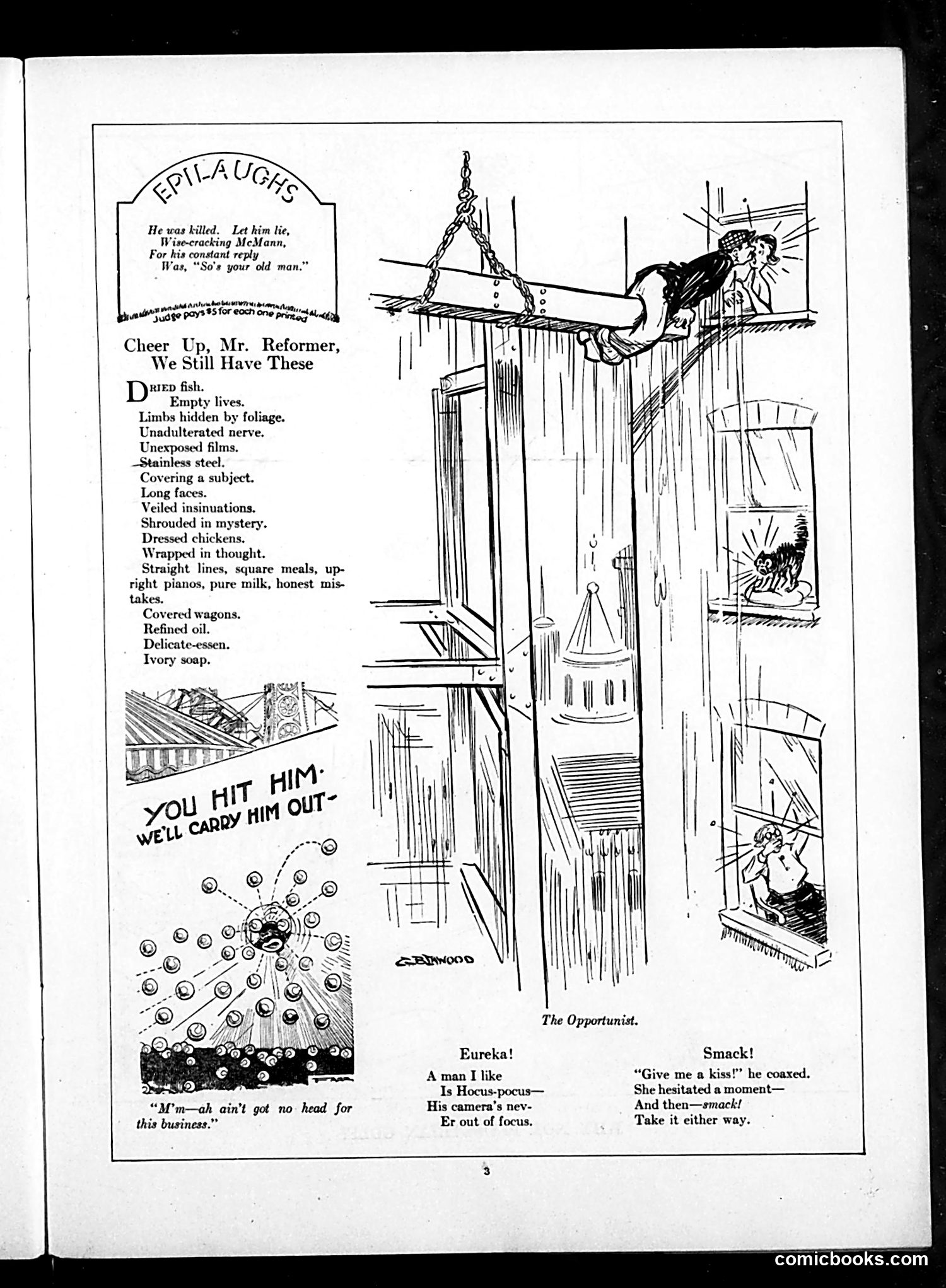
This Judge magazine page satirizes reform efforts through multiple cartoons. **"Epitaph" section**: Mocks a dead reformer with the epitaph "He was killed... For his constant reply 'It is—So is your man.'" The accompanying list ("Dummy lives," "Limbs hidden by foliage," "Stainless steel," etc.) appears to enumerate deceptive practices reformers claimed to fight, suggesting reformers' promises proved hollow. **"You Hit Him Well Carry Him Out"**: A violent scene with radiating impact lines emphasizes that reform opponents use brutality against crusaders. **"The Opportunist"**: Shows a figure climbing a building's exterior, satirizing reformers as opportunistic climbers exploiting reform movements for personal gain rather than genuine change. **Bottom jokes** play on camera/focus wordplay and romantic coercion—likely irreverent filler typical of Judge's humor. The overall message: reformers are either ineffective, violent victims, or self-serving opportunists.
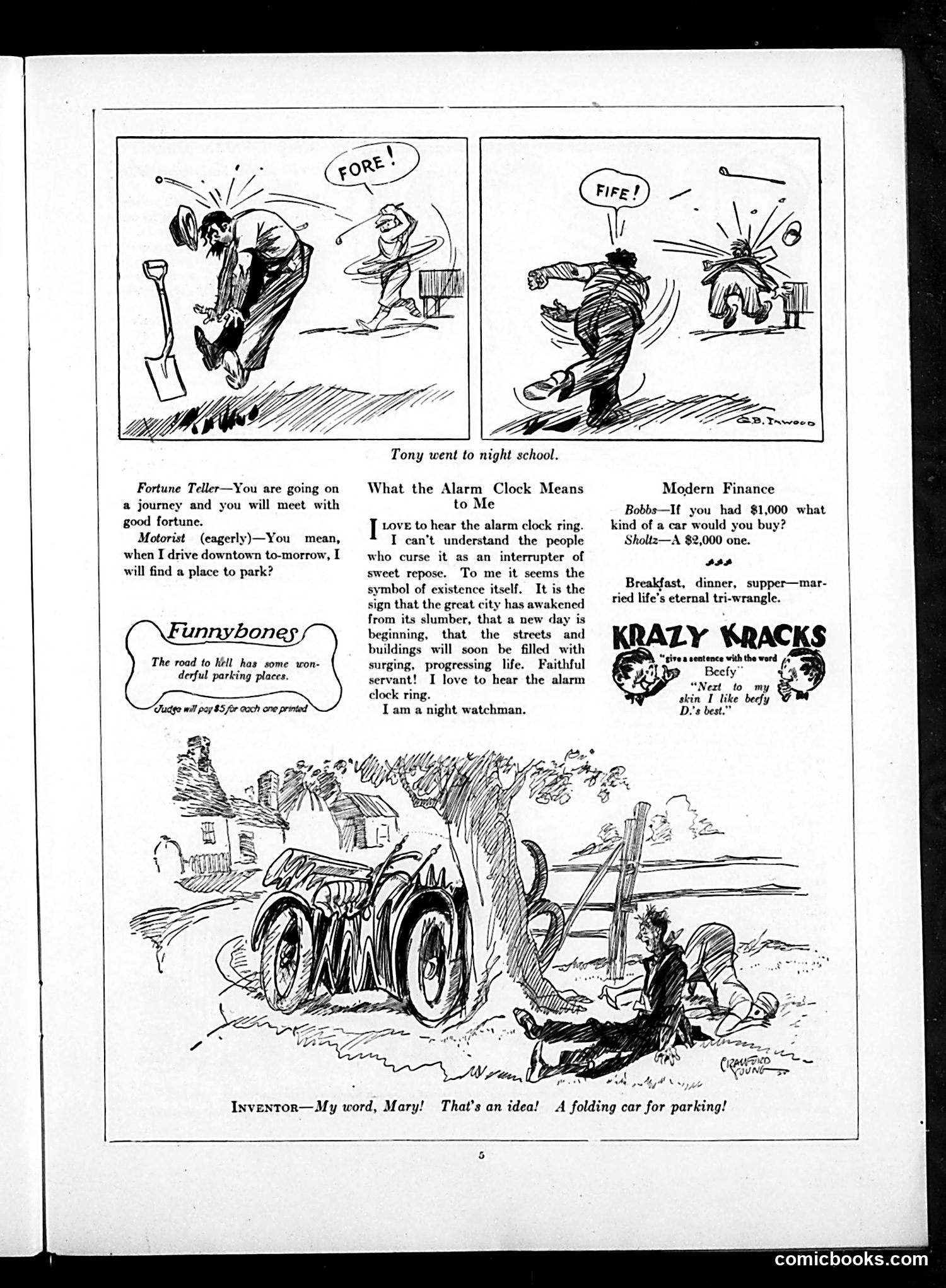
This page contains humor sketches and brief articles rather than political cartoons. The top panels show "Tony went to night school"—a comedic sequence where the character appears to mishear instructions, confusing "fore" (golf term) with "fire" (military command), creating physical comedy. The middle sections include fortune-telling humor, a brief essay praising alarm clocks as symbols of urban progress, and a "Modern Finance" joke about purchasing priorities. The bottom cartoon satirizes automobile parking problems—a common early 20th-century urban concern. It depicts an "inventor" proposing a "folding car for parking," mocking both traffic congestion and the era's enthusiasm for mechanical solutions to modern problems. The page primarily targets middle-class anxieties about city life, automobiles, and technological change.
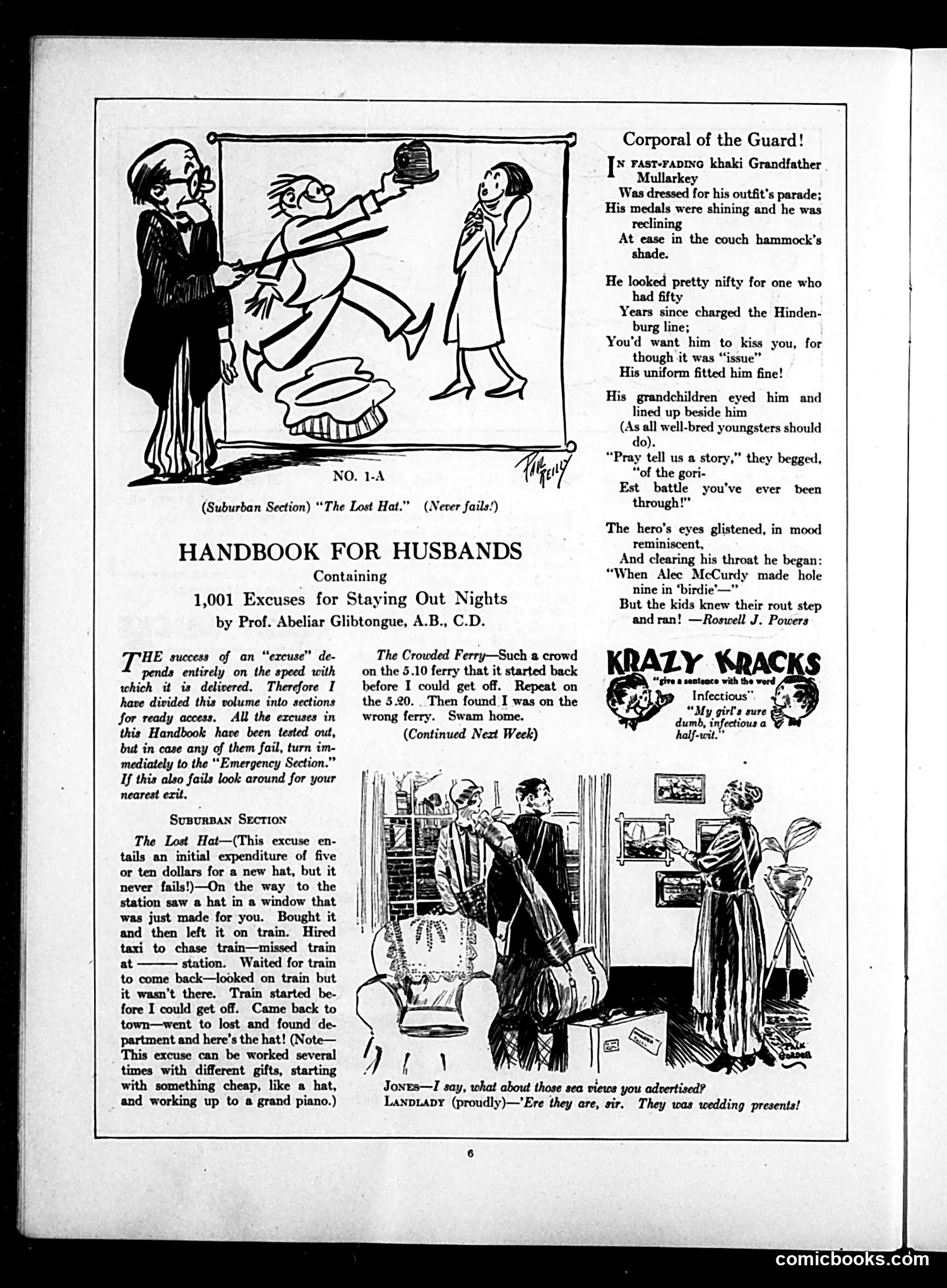
This page satirizes marital dynamics and suburban life through humor about male infidelity excuses. **"Handbook for Husbands"** is the main feature—a satirical guide offering 1,001 pretexts for staying out late. The "Lost Hat" excuse exemplifies the genre: a man fabricates an elaborate story about purchasing a hat, losing it on a train, chasing the train, waiting for ferries, and swimming home. The joke is that husbands need detailed, time-consuming excuses to hide affairs, and the handbook cynically notes this excuse "never fails." A footnote suggests the same tactic works repeatedly with increasingly expensive gifts, building to a grand piano. **"Corporal of the Guard"** is a sentimental poem about an elderly WWI veteran grandfather in uniform, peacefully napping while grandchildren beg war stories. When he finally begins—disappointing them with a golf anecdote ("hole nine in 'birdie'")—the kids leave. The joke: wartime heroism matters less than entertainment value. The **bottom cartoon** shows a couple examining sea-view property; the landlady proudly displays two women at a window—the "views" are attractive women, not scenery. It's crude double-entendre humor.
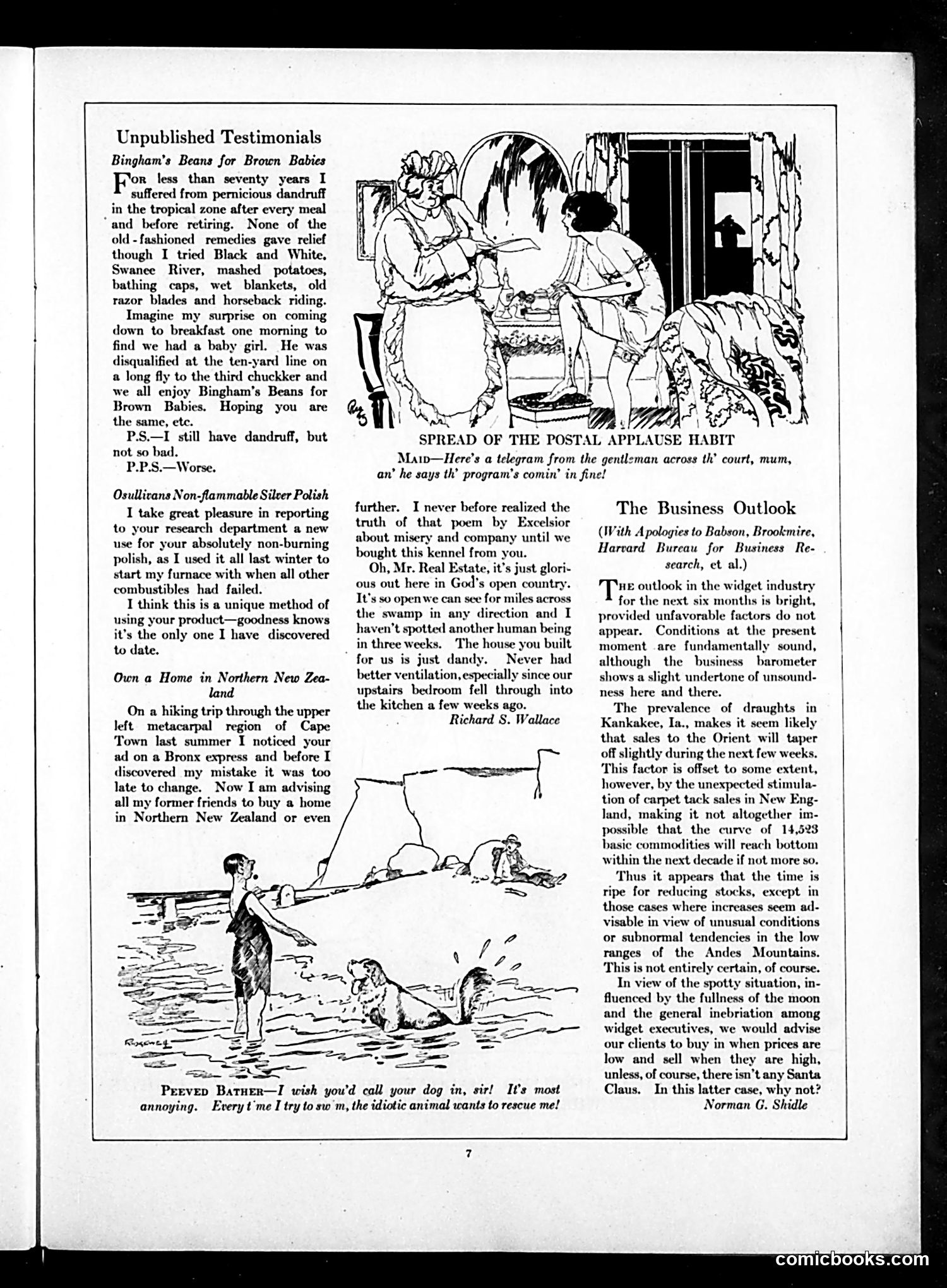
This Judge magazine page satirizes consumer testimonials and business forecasting through absurdist humor. **"Unpublished Testimonials"** mocks fake endorsements. The fictional testimonials describe products solving completely wrong problems—a dandruff cure that somehow results in having a baby; a furniture polish that works as furnace fuel; real estate in a remote, swampy location with a collapsing house. The humor lies in praising products while describing disasters, mimicking the exaggerated sincerity of actual advertising claims. **The cartoons** show everyday social awkwardness: a telegram about a radio broadcast, and a dog refusing rescue attempts during bathing. **"The Business Outlook"** parodies serious economic forecasting by using corporate jargon to say nothing meaningful—discussing mysterious factors like "Kankakee draughts" affecting Oriental sales, mentioning "14,523 basic commodities," and ending with absurd advice to "buy low, sell high, unless there's no Santa Claus." It satirizes how business analysts obfuscate uncertainty with pseudo-scientific language.
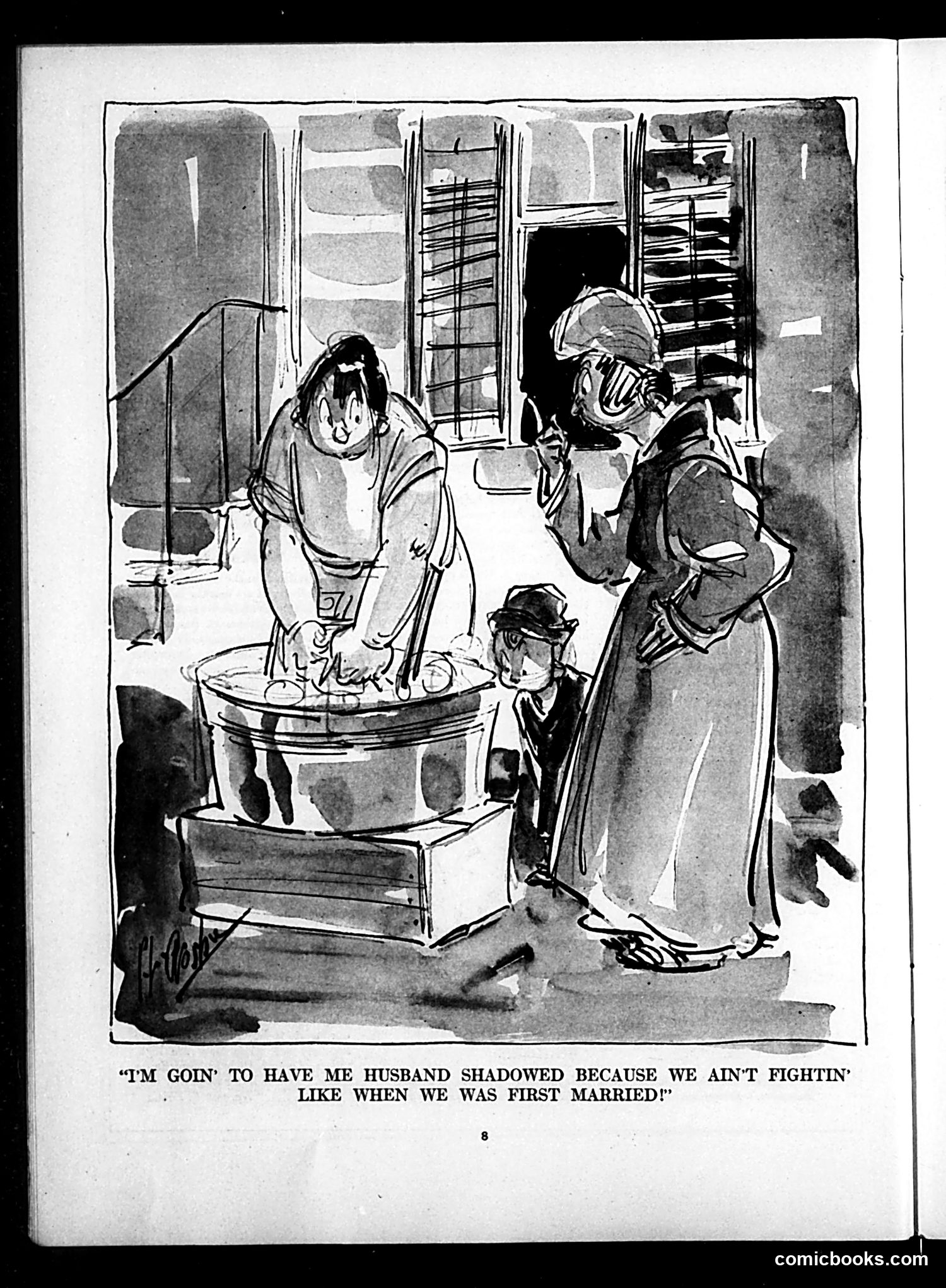
This is a domestic humor cartoon from *Judge* magazine satirizing marriage and marital conflict. The scene depicts a wife (center, at what appears to be a public bathhouse or laundry facility) speaking to two other women, expressing concern that her marriage has grown too peaceful. She jokes that she'll hire someone to follow ("shadow") her husband to provoke the kind of fights they had when newly married—implying those early conflicts were actually signs of passion and engagement. The satire targets evolving attitudes about marriage in early-to-mid 20th century America, suggesting that complacency and lack of conflict represented a loss of romantic spark. The bathhouse setting reflects the working or middle-class context of the characters. The humor relies on the absurdity of deliberately manufacturing marital discord to recreate youthful passion.
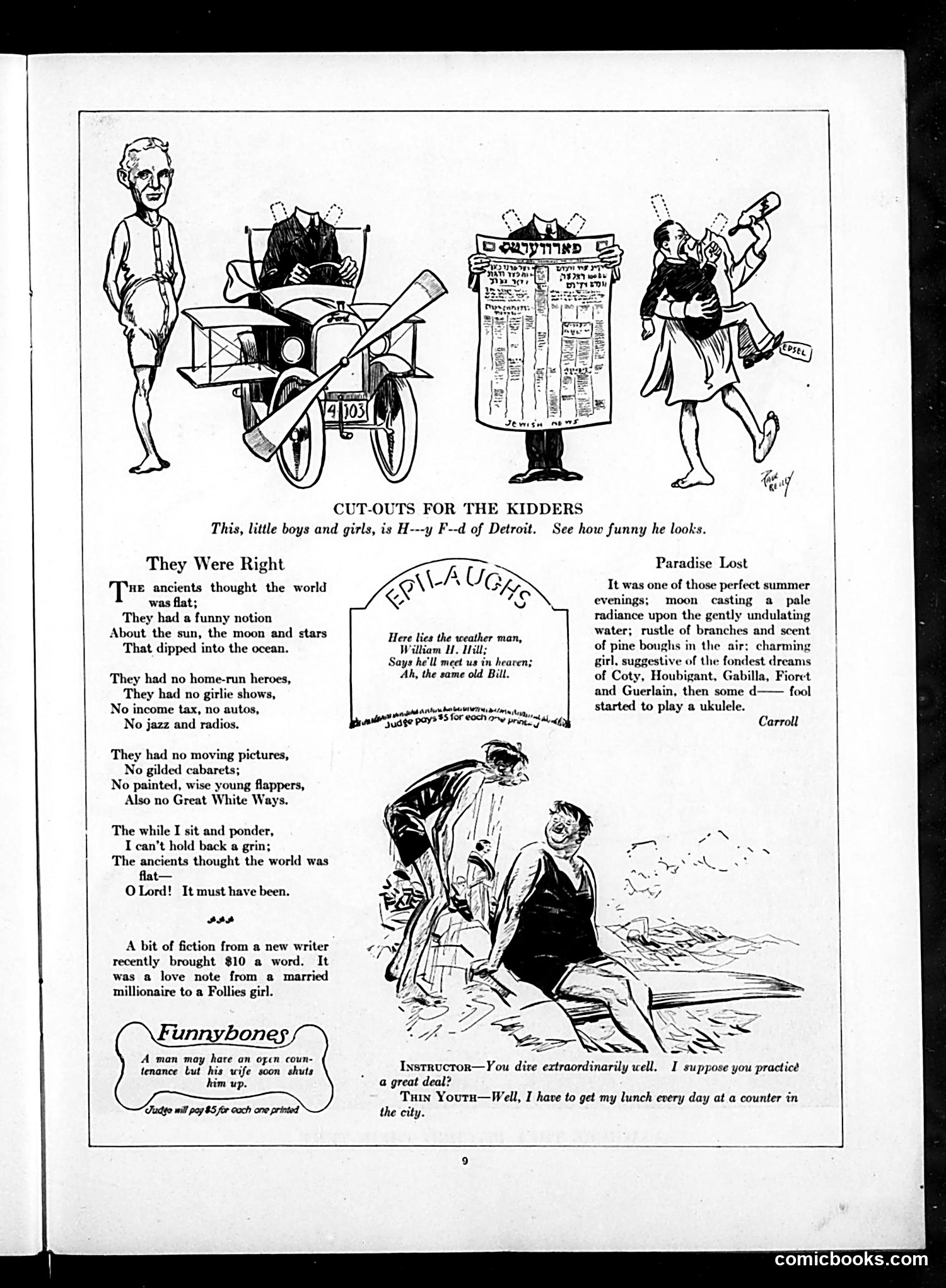
This page from *Judge* magazine contains satirical content targeting Henry Ford of Detroit (censored as "H---y F--d"). The top cutouts mock Ford by presenting caricatured figures, likely referencing his public persona and influence. The main poem "They Were Right" uses ironic nostalgia—praising the ancient world's "flat earth" simplicity while listing modern conveniences (autos, jazz, movies, flappers) that Ford himself helped popularize through mass production. The satire suggests Ford's industrial progress, while materially comfortable, has made life morally or spiritually worse. Supporting jokes mock 1920s excess: a writer earning $10/word for love notes between millionaires and Follies dancers, and a brief anecdote where a diving instructor is revealed to be practicing only because he needs affordable lunch counter meals—suggesting underlying economic desperation beneath fashionable leisure. The "weather man" epitaph appears unrelated wordplay. Overall, the page satirizes modern consumer culture and wealth inequality in the Jazz Age.
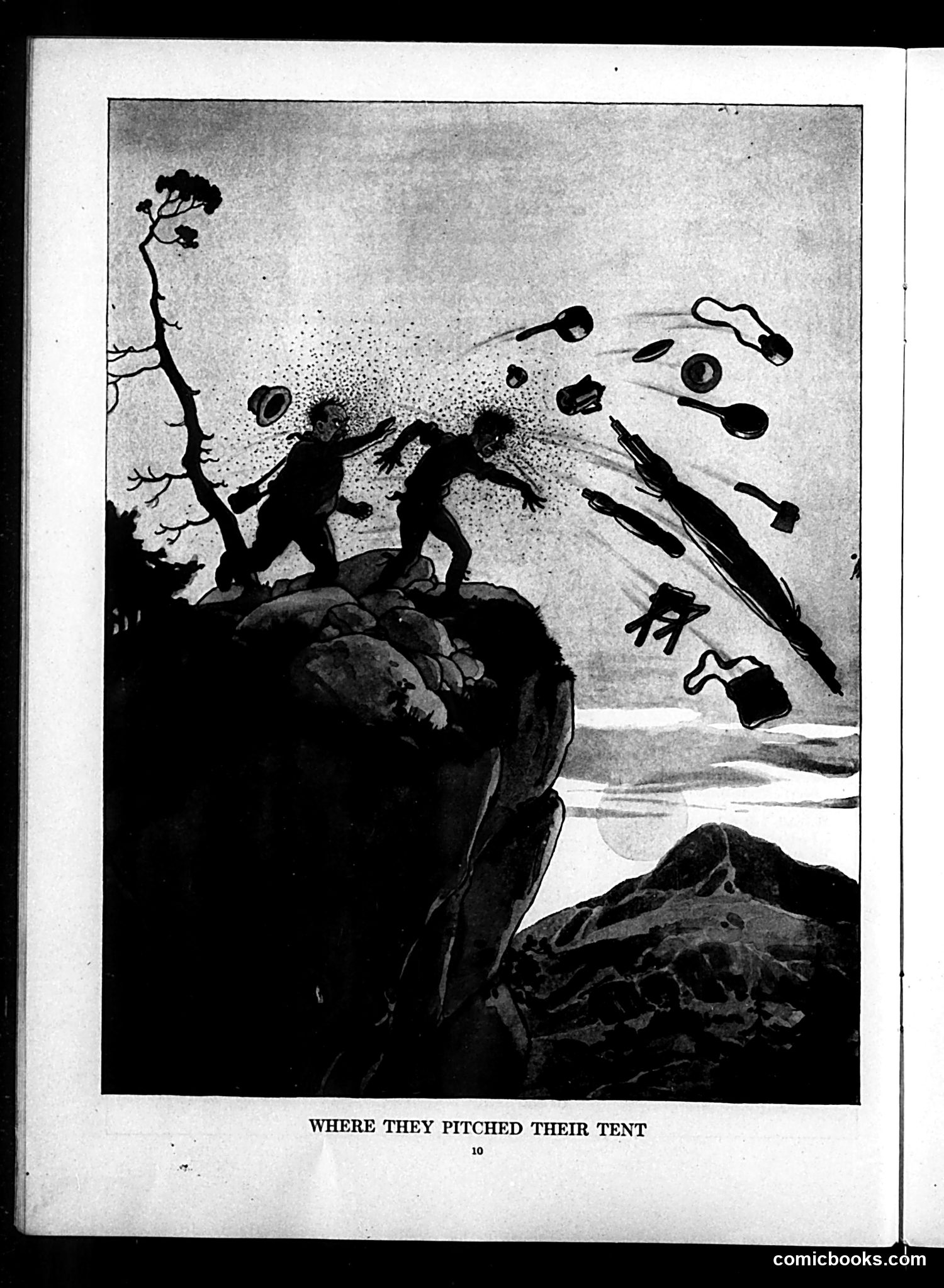
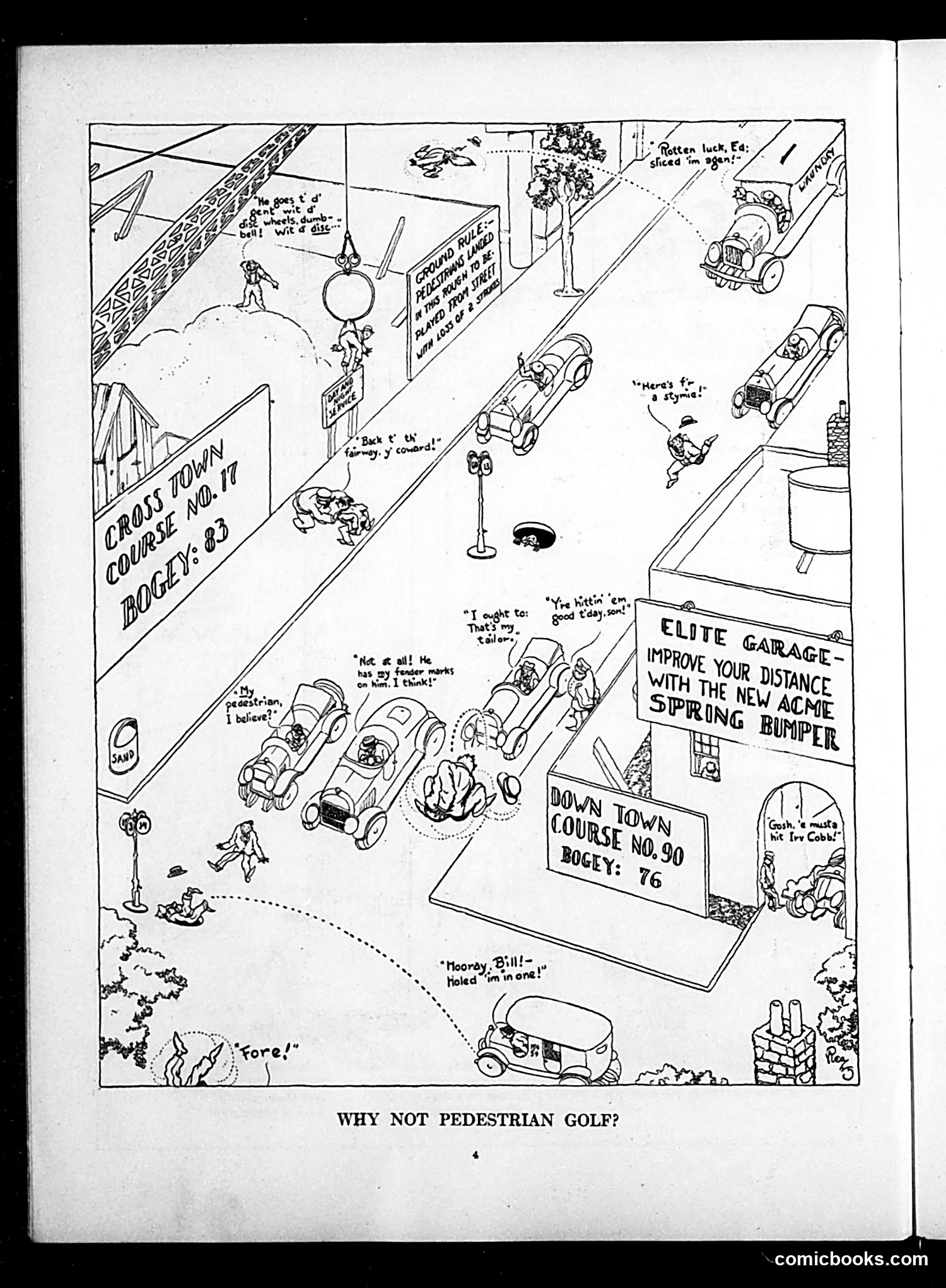
This appears to be a satirical illustration showing two figures being blown away or expelled from a cliff-like formation, with various objects and debris scattered in the air around them. The silhouetted style suggests dramatic action. The caption "WHERE THEY PITCHED THEIR TENT" suggests a commentary on displacement or failure—perhaps mocking politicians or public figures who attempted to establish themselves ("pitch their tent") in some position, only to be violently removed. Without additional context or visible identifying features, I cannot definitively name the specific figures or pinpoint the exact historical event referenced. The dramatic, expulsive imagery suggests this satirizes a failed political or social venture, but the specific political figures, date, and situation remain unclear from this page alone.
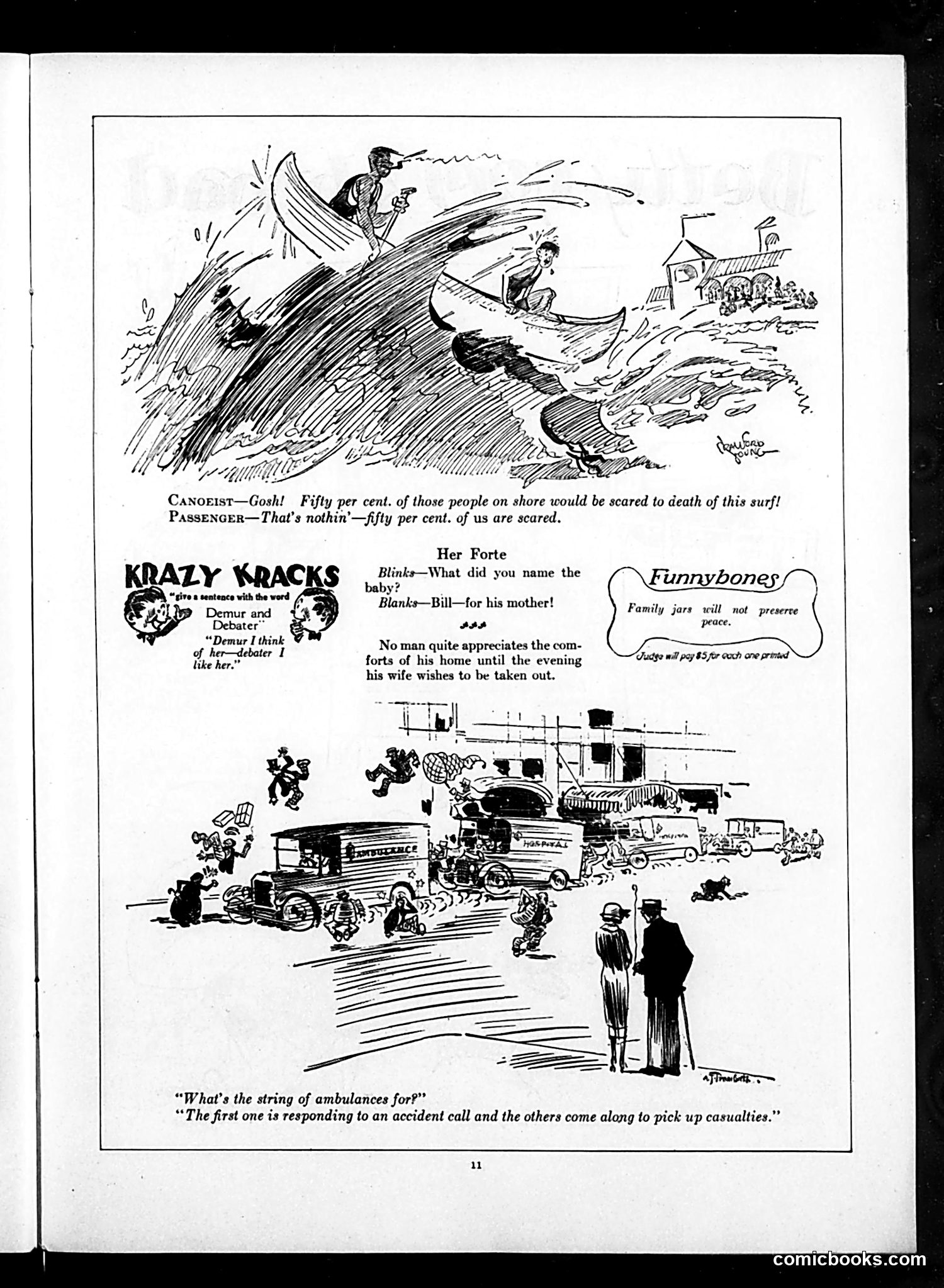
This page contains several independent humor pieces typical of early 20th-century American satirical magazines: **Top cartoon**: A surfing scene mocking timidity—both the canoeist and passenger admit to being frightened, deflating the supposed bravery of ocean recreation. **"Krazy Kracks"**: A word-game humor section where "Demur" is used in a sentence about a debate, playing on the word's similarity to "de" + "murr" (the sound of disagreement). **"Her Forte"**: A domestic joke about wives dragging reluctant husbands out socially—standard early 20th-century humor about marriage tensions. **"Funnybones"**: A one-liner about family arguments preventing peace. **Bottom cartoon**: Dark humor about traffic accidents and ambulances—the joke being that after the first ambulance responds to an accident, others arrive expecting multiple casualties, suggesting accidents were common enough to anticipate fatalities. These represent typical Judge content: lighthearted domestic situations and contemporary social observations, with no apparent political commentary.
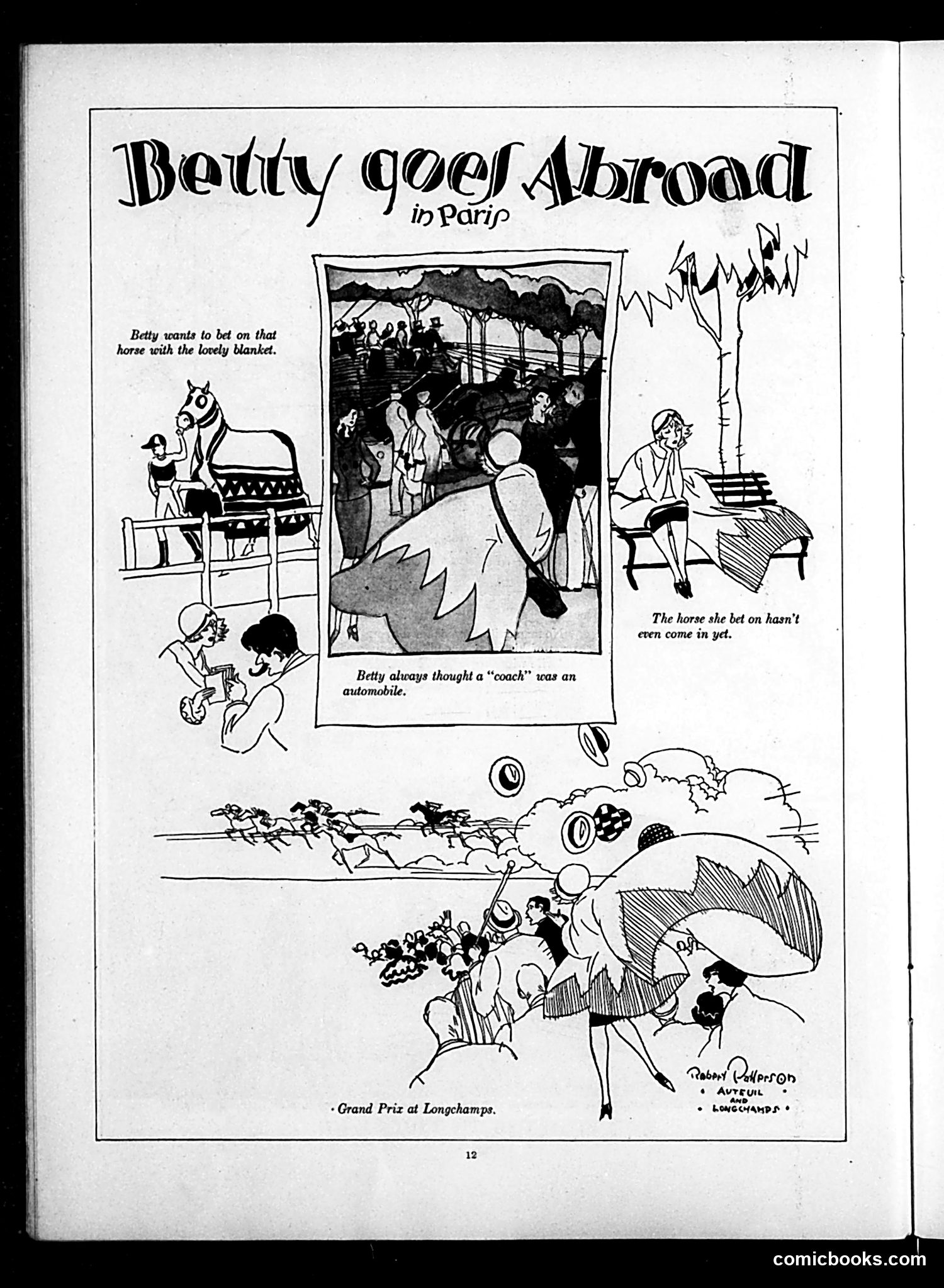
This comic strip satirizes a young woman named Betty who travels to Paris with misconceptions about European culture. The humor centers on her naïve expectations versus reality: Betty believes a "coach" is an automobile (a distinctly American misunderstanding), and she's placed a bet on a horse at what appears to be Longchamps racecourse. The central panel shows the actual horse-racing scene—a traditional European sporting event she didn't expect. The final panels depict the horse she bet on never arriving ("hasn't even come in yet"), with Betty caught in the rain with her umbrella, stranded at what's likely the Grand Prix at Longchamps. The satire targets American tourists' cultural ignorance and false assumptions about European customs, a common theme in early 20th-century Judge magazine humor.
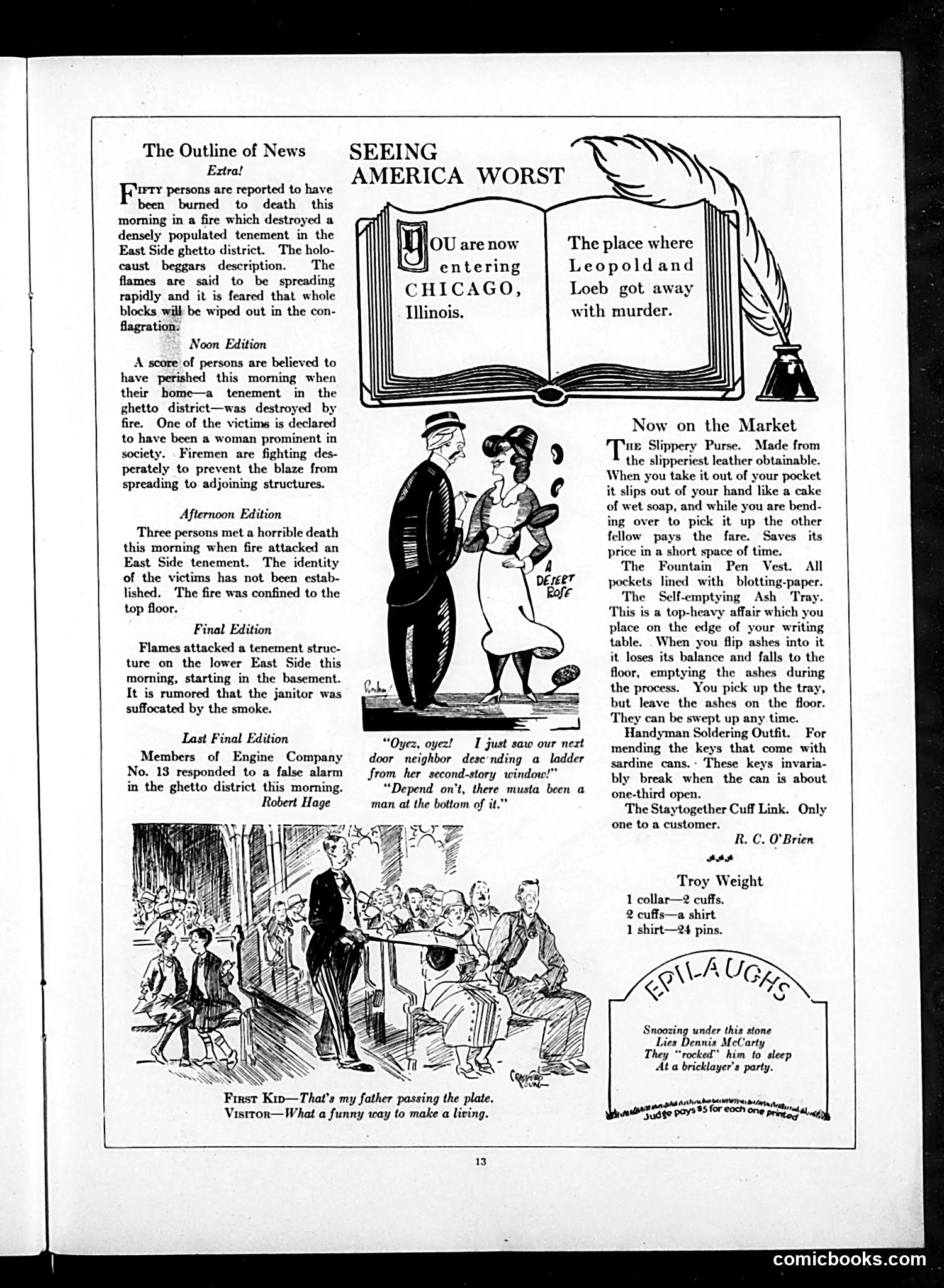
This page satirizes Chicago's reputation for crime and corruption. The "Seeing America Worst" section sarcastically labels Chicago as a destination, referencing the Leopold and Loeb murder case—a 1924 kidnapping and killing by two wealthy Chicago youths that scandalized the nation. The opening "Outline of News" mockingly shows how newspapers sensationalize the same minor fire story, exaggerating death tolls from "fifty persons" down to a false alarm, demonstrating press irresponsibility. The cartoon depicting a man and woman includes crude sexual innuendo about a neighbor descending a ladder, playing on period stereotypes about immigrant tenement dwellers. The "Now on the Market" section advertises absurdist gadgets—a slippery purse, self-emptying ash tray, broken sardine-can keys—mocking consumer culture and design failures. The "Epilaughs" section includes a dark joke about someone being "rocked" to sleep at a bricklayer's party (likely beaten). Overall, the page critiques urban crime, journalistic excess, immigrant stereotypes, and commercial gimmickry in 1920s America.
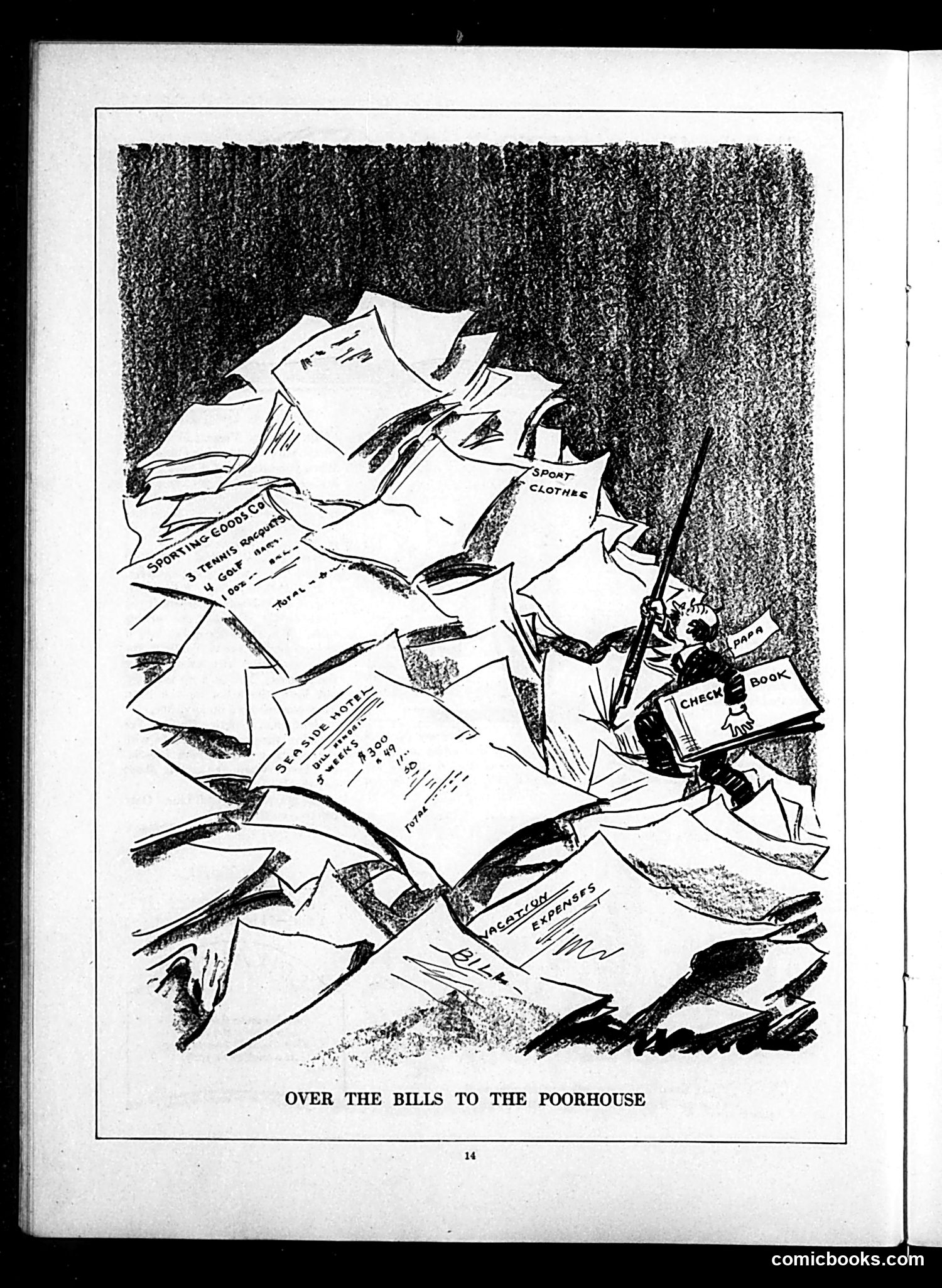
This cartoon satirizes poverty and financial ruin through a visual metaphor. A figure appears overwhelmed by bills and documents—labeled items include "Sporting Goods," "Sport Clothes," "Check Book," and various other expenses. The papers cascade chaotically, suggesting mounting debt. The caption "Over the Bills to the Poorhouse" plays on the phrase's double meaning: literally climbing over unpaid bills leads to destitution. The cartoon critiques either extravagant spending habits or the systemic conditions that trap people in poverty through debt. The style and context suggest this is early 20th-century social commentary on wealth inequality and the precarious financial situations ordinary people faced. The specific bills referenced appear to relate to consumer goods and lifestyle expenses.
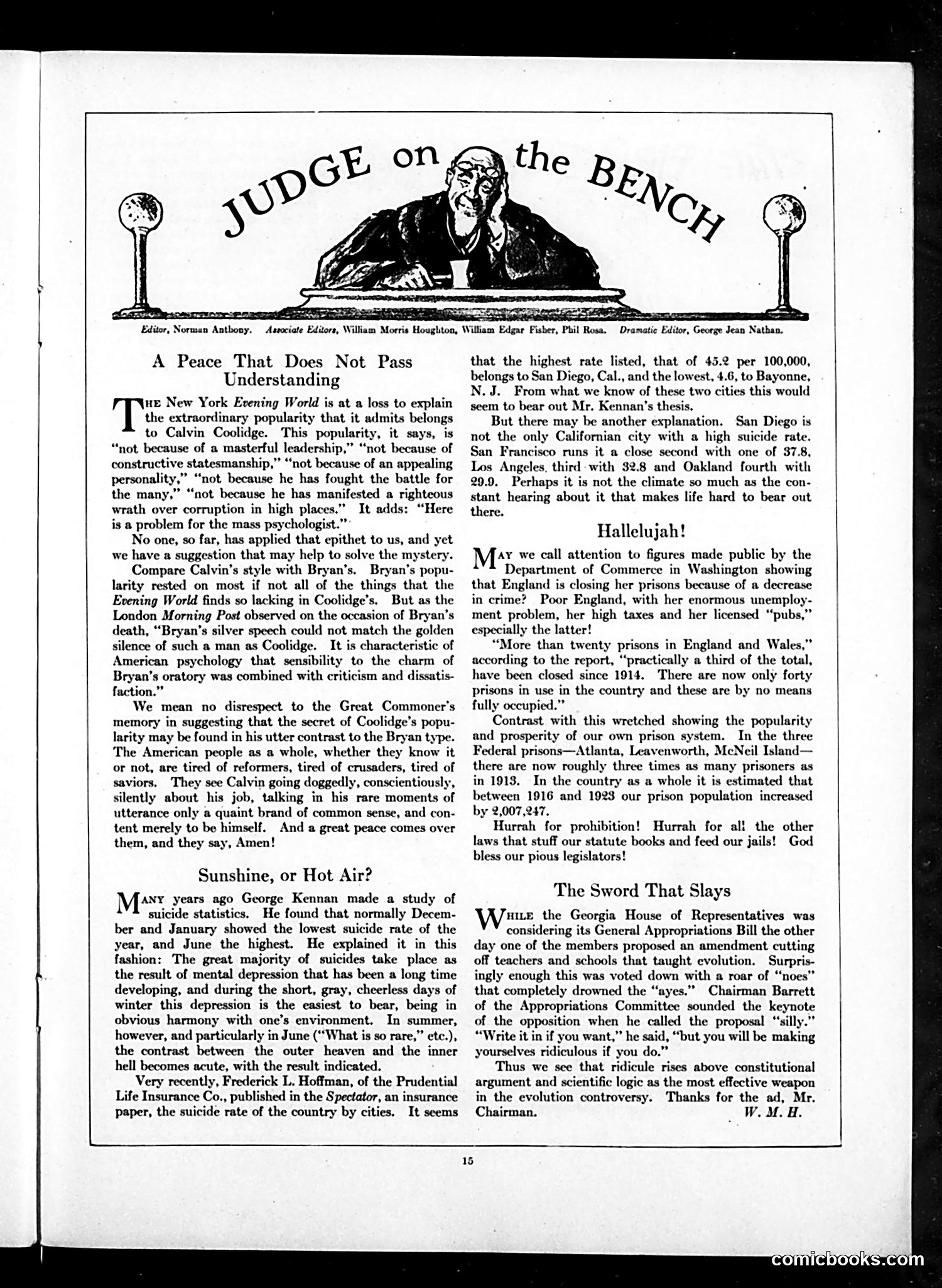
This page contains three distinct satirical pieces from Judge magazine (early 20th century): **"A Peace That Does Not Pass Understanding"** compares President Calvin Coolidge's popularity to William Jennings Bryan's. The satire suggests Americans prefer Coolidge's quiet competence and silence to Bryan's famous oratory and reformist crusading. The piece argues the public is exhausted by crusaders and saviors, finding peace in Coolidge's understated, methodical approach—a dig at both Coolidge's laconic style and American political fatigue. **"Sunshine or Hot Air?"** examines high suicide rates in California cities (San Diego highest at 45.2 per 100,000). It sarcastically suggests the problem isn't the pleasant climate but rather constant boasting about California's weather creating psychological contrast with inner depression. **"Hallelujah!"** praises England for closing prisons due to decreased crime, while mockingly noting England's unemployment, high taxes, and "licensed pubs" should produce more crime—implying the real explanation is unclear or ironic. The page's header features a judge figure overseeing these commentaries on American society and politics.
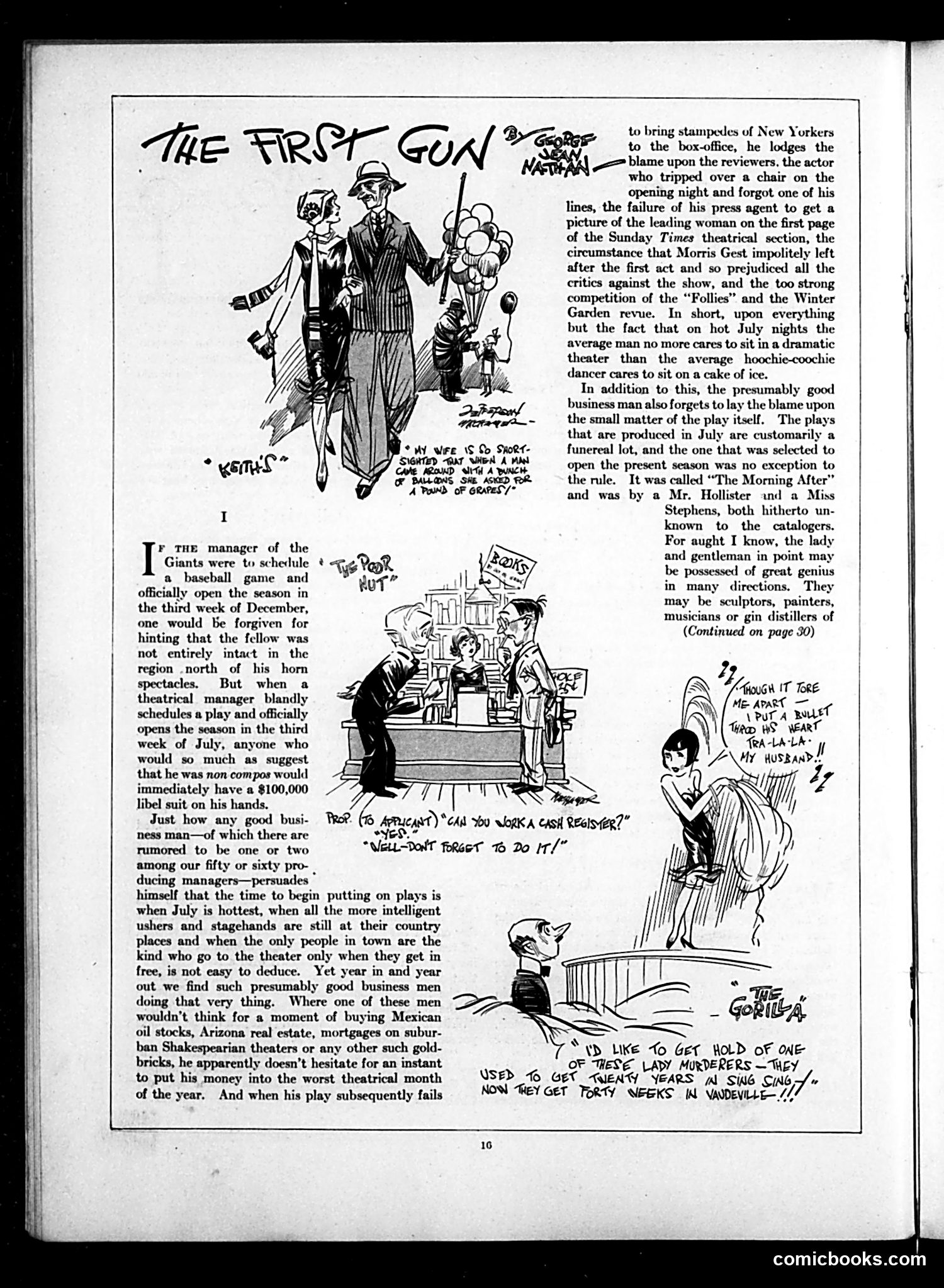
This page satirizes theatrical producers' poor business decisions, specifically their habit of opening plays in July—the worst month for theater attendance. The article mocks unnamed producers (likely referencing real Broadway figures like Morris Gest, mentioned by name) who blame external factors—bad reviews, actor mistakes, competition from revues like the Follies—for theatrical failures, while ignoring the obvious problem: **nobody goes to theaters in hot July**. The comparison is cutting: intelligent theater workers leave town; only free-ticket-takers remain. The cartoons illustrate the absurdity: one depicts a woman considering murder as preferable to sitting through a play in summer heat; another shows theatrical producers at a "cash register," suggesting their real motive is profit despite obvious doom. The satire's point: these supposedly shrewd businessmen wouldn't invest in obviously bad ventures (Mexican oil stocks, questionable mortgages) yet repeatedly gamble on summer theater productions—the theatrical equivalent of financial suicide.
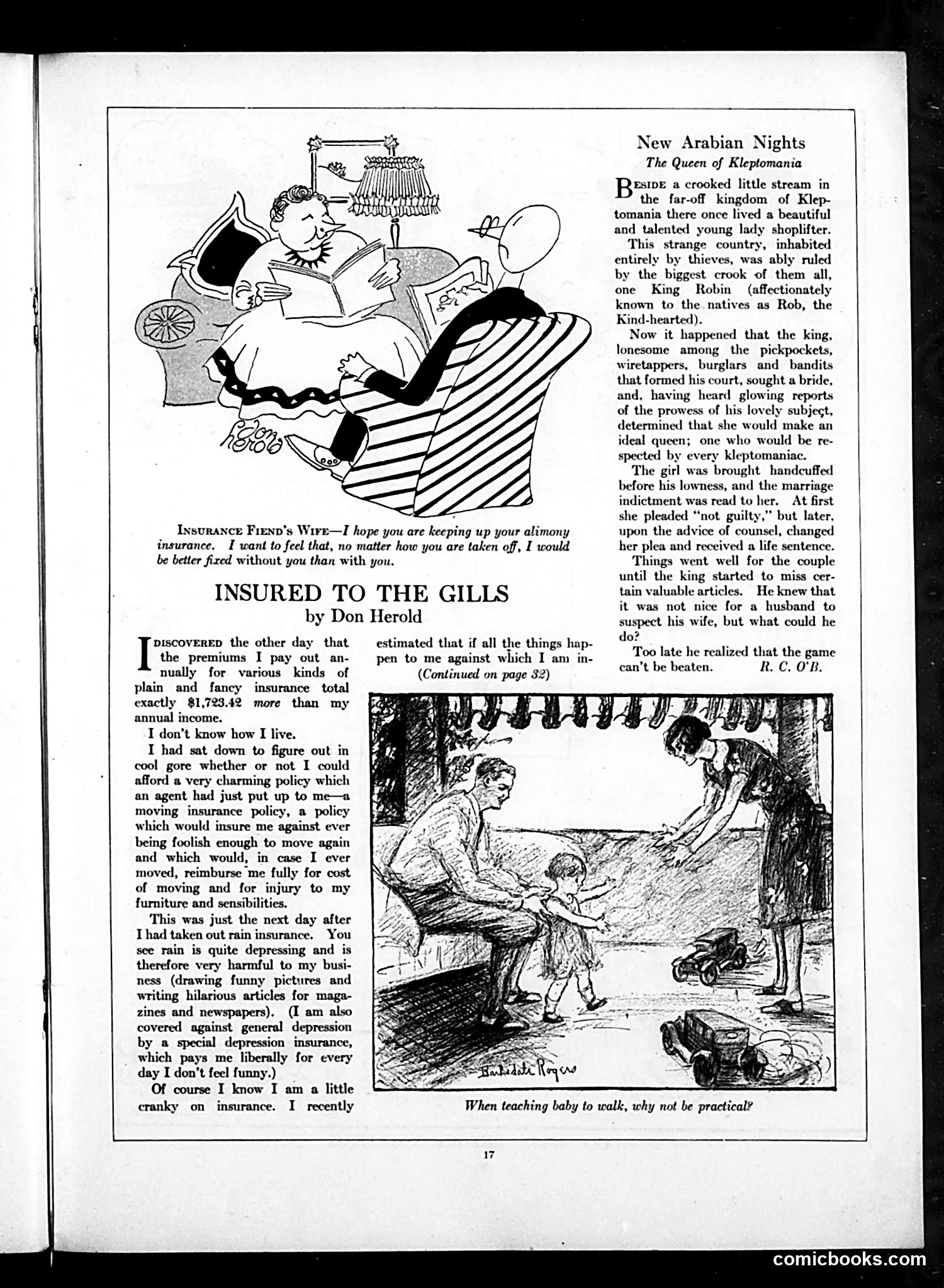
This page contains two satirical pieces: **"The Queen of Kleptomania"** is a humorous fantasy tale mocking kleptomaniacs (compulsive shoplifters). It imagines a fictional kingdom where thieves rule, including "King Robin" (a pun on "robbery"). A talented female shoplifter becomes queen, but ironically steals from her own husband—the joke being that a thief cannot be trusted even in marriage. The satire gently ridicules both criminal behavior and the notion of honor among thieves. **"Insured to the Gills"** by Don Herold is a comedic essay about insurance industry excess. The author calculates that his annual insurance premiums ($1,723.42) exceed his yearly income, covering absurdities like "rain insurance" (protecting against depression from bad weather affecting his cartoon work) and "moving insurance." The satire targets the insurance industry's aggressive marketing of unnecessary coverage to anxious consumers, showing how policies have become financially burdensome and almost comically excessive. Both pieces use humor to critique everyday American problems: crime and financial overprotection.
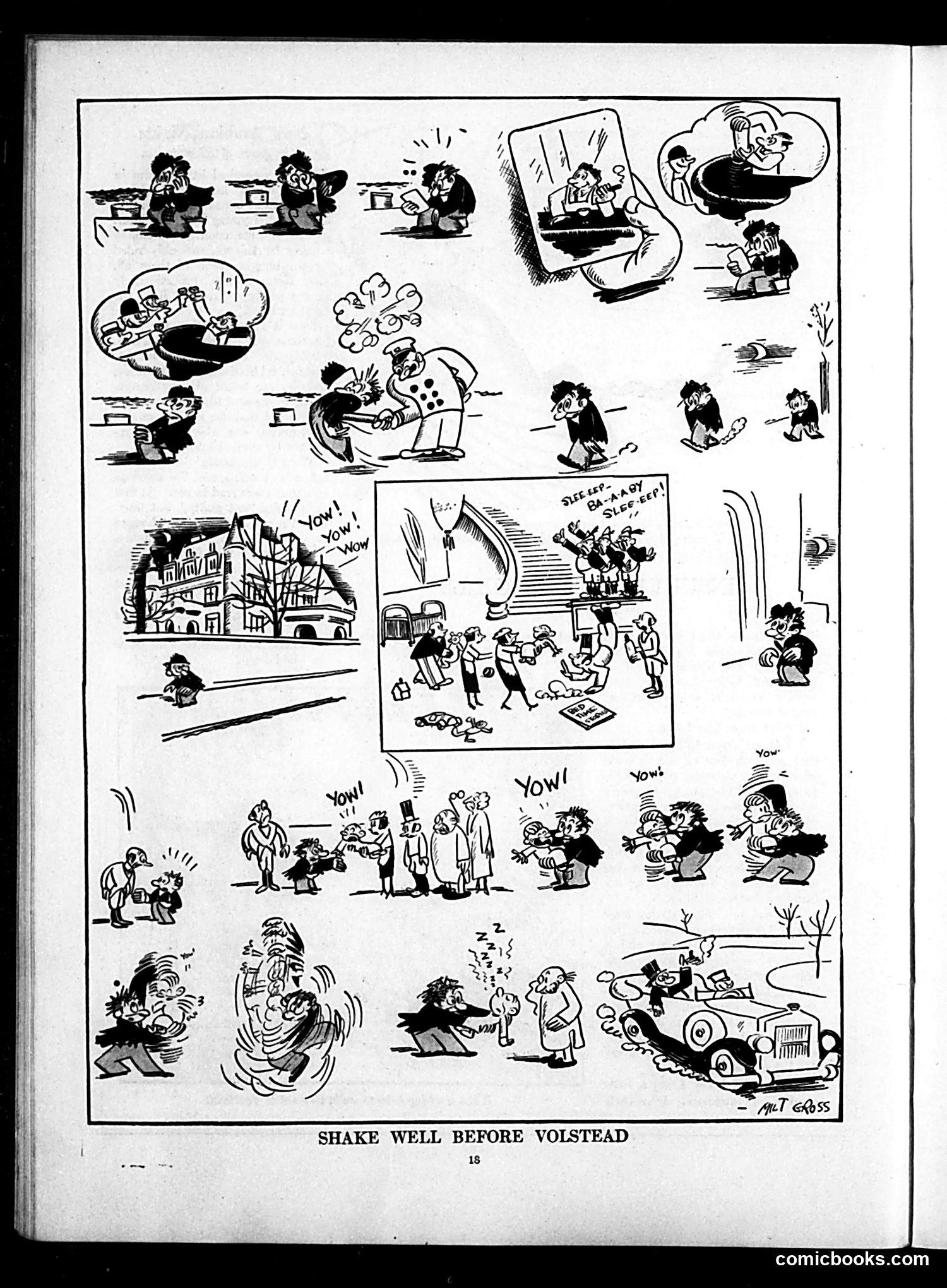
This is a satirical comic strip by Milt Gross about Prohibition (the Volstead Act, which banned alcohol). The title "Shake Well Before Volstead" is a play on medicine bottle instructions. The narrative follows characters attempting to obtain and consume alcohol illegally during Prohibition. Various panels depict scheming, hiding contraband, sneaking around authorities, and the chaos of underground drinking culture. References include speakeasies (the building scene), bootlegging operations, and people evading law enforcement. The satire mocks both Prohibition's ineffectiveness and the public's determination to circumvent it. Gross illustrates how the law created criminal enterprise and farcical behavior among ordinary citizens. The comic suggests Prohibition caused more disorder than order—hence the repeated "YOW!" exclamations conveying chaos and mayhem throughout the strip.
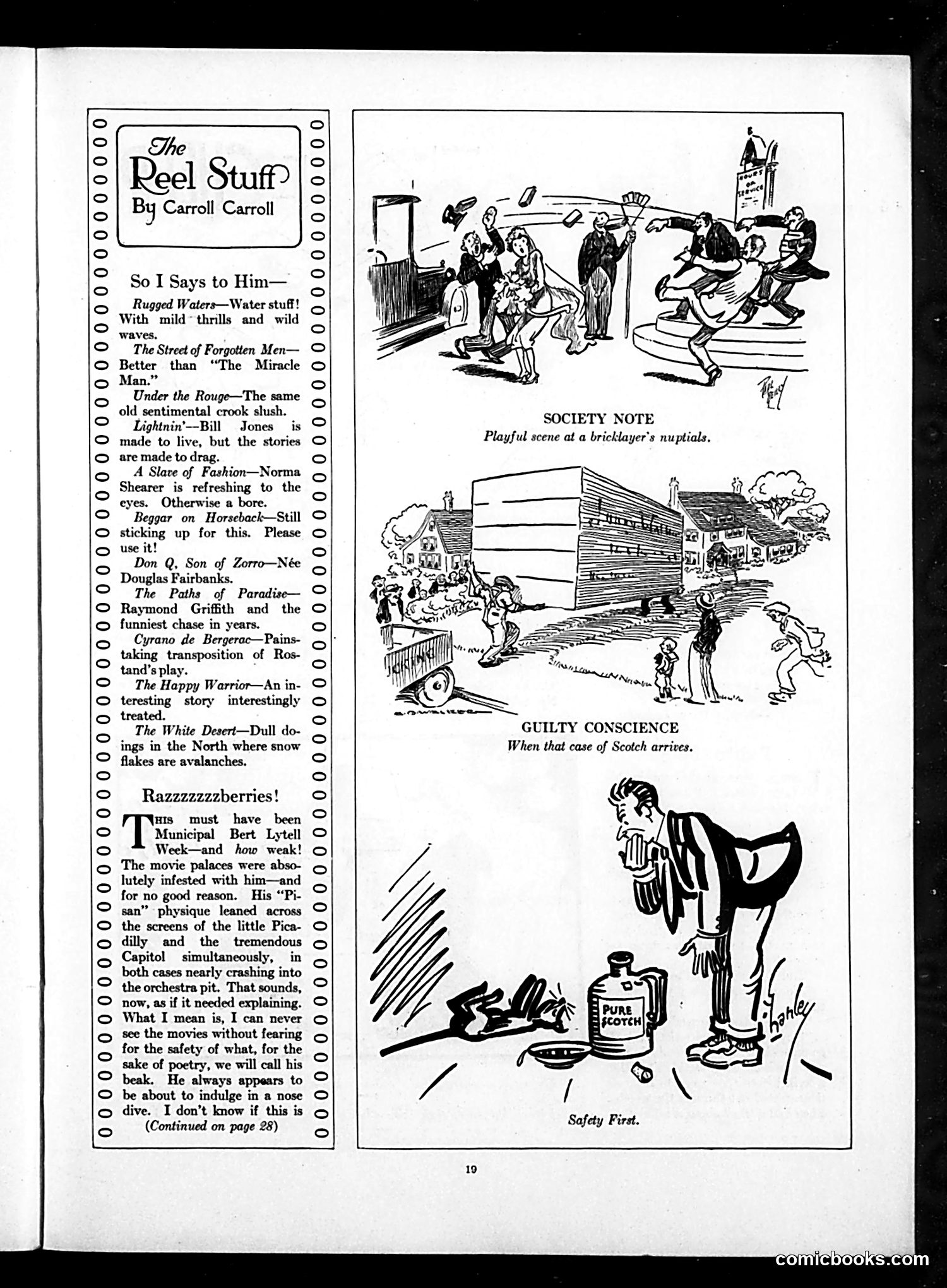
**"The Reel Stuff"** column reviews silent films, offering snappy critiques of contemporary movies. Notable mentions include Norma Shearer ("refreshing to the eyes. Otherwise a bore") and Douglas Fairbanks in "Don Q, Son of Zorro." The **"Razzzzzberries!" section** mocks "Municipal Bert Lytell Week," criticizing actor Bert Lytell's prominence in theaters despite being, apparently, an unremarkable performer whose prominent nose the critic obsesses over—joking he fears it will crash into the orchestra pit during a "nose dive." The three **cartoon panels** are unrelated gags: one depicts a chaotic brick-layer's wedding reception; another shows guilt over receiving contraband Scotch whisky during Prohibition; the third warns against unsafe behavior near what appears to be a "Pure Protein" container. These reflect 1920s concerns about Prohibition enforcement and workplace safety humor.
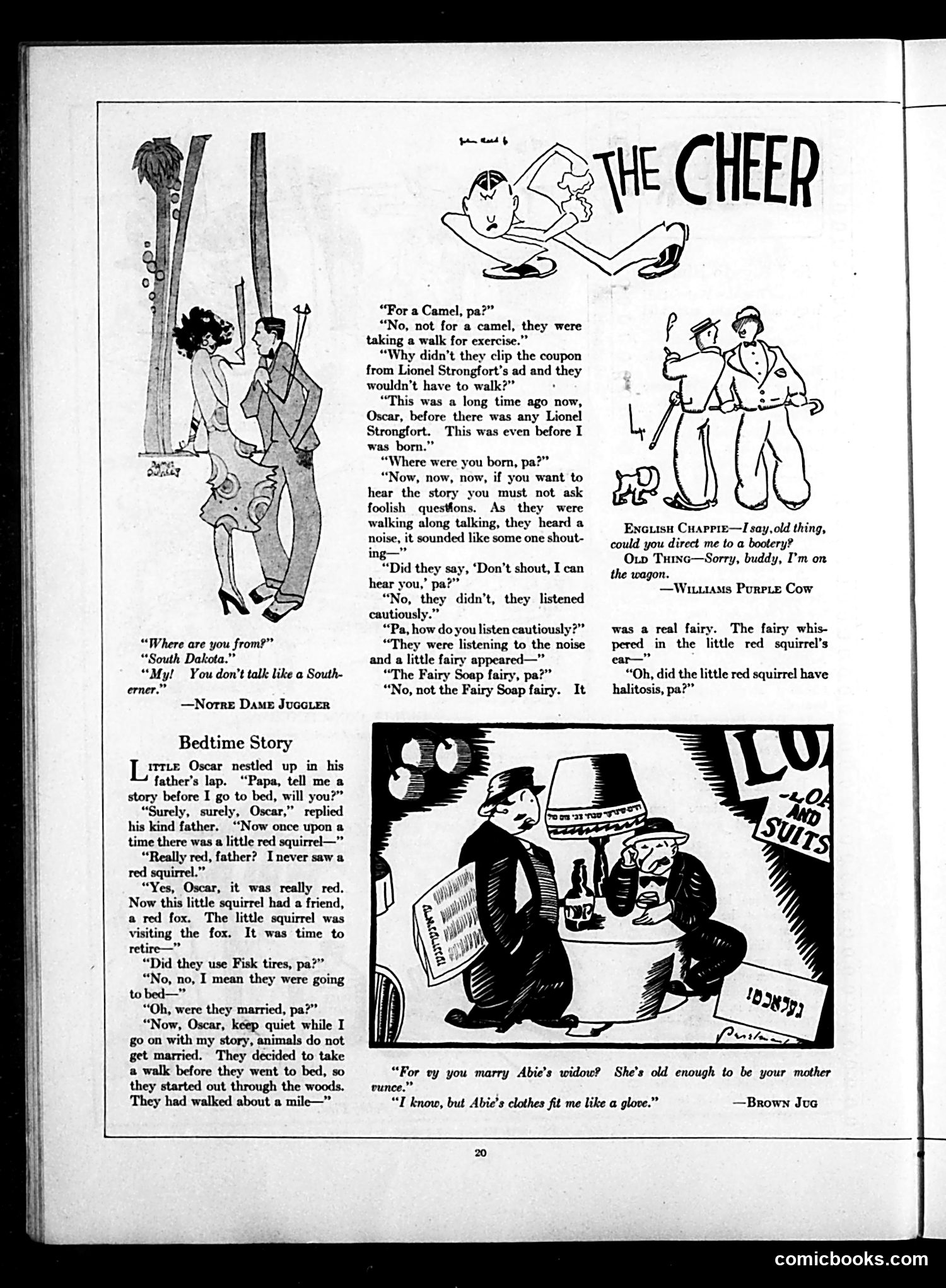
This page contains multiple satirical humor pieces typical of early 20th-century American humor magazines. **"The Cheer"** section mocks advertising saturation. A father tells his son a bedtime story, but the child constantly interrupts asking if characters used advertised products—Fisk tires, Lionel Strongfort (a mail-order fitness program), Camel cigarettes, and Fairy Soap. The satire targets how pervasively commercial advertisements had infiltrated American culture, making them inescapable even in children's storytelling. **Other brief jokes** include ethnic humor stereotypes (a South Dakota resident, a Yiddish-accented character) and sight gags about a British character asking for directions. The overall message critiques the commercialization of American life—how brand names and consumer products had become so embedded in everyday consciousness that they intrude even into innocent moments like bedtime stories.
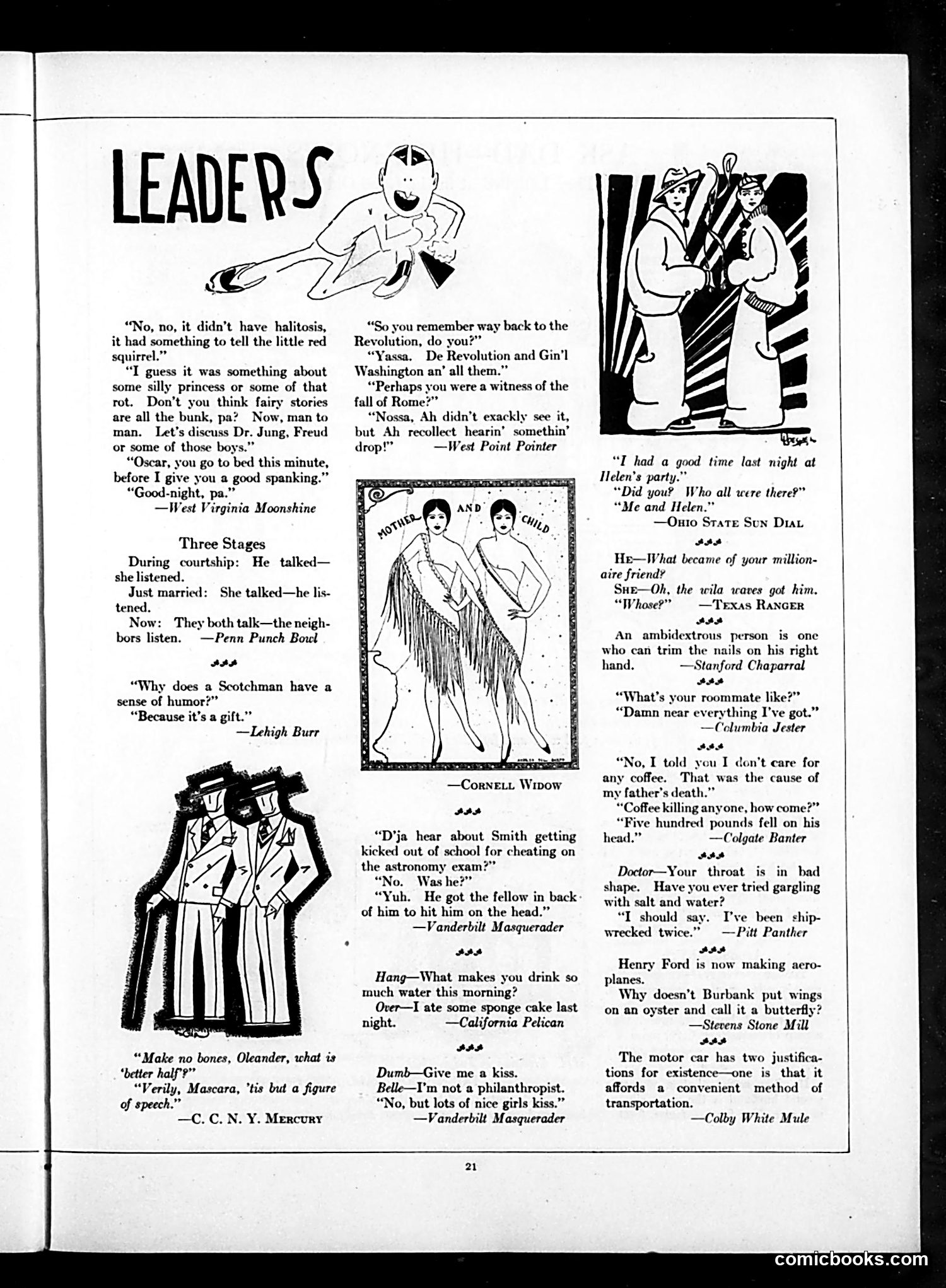
This page collects humor from college and university publications circa early 20th century. The jokes satirize contemporary social trends: **Key themes:** - **Modern parenting vs. tradition**: A child dismisses fairy tales, demanding instead to discuss Freud and Jung—mocking youth's adoption of new psychology fads - **Race and dialect humor**: Period-typical caricature of Black dialect (the "Gin'l Washington" exchange)—offensive by modern standards, reflecting the era's casual racism - **Gender roles**: "Three Stages" satirizes marriage dynamics, suggesting wives become talkative after marriage while husbands lose conversational dominance - **Henry Ford/innovation jokes**: Ribbing Ford's rapid automobile production and suggesting absurdist applications (oyster-butterflies, car-planes) - **Academic cheating**: Dark humor about exam fraud at elite universities The cartoon illustrations include flappers ("Mother and Child") reflecting 1920s cultural anxieties about changing women's roles. Overall, this reflects college humor magazines mocking modernism, changing social values, and technological disruption—with prejudices now recognized as deeply offensive.
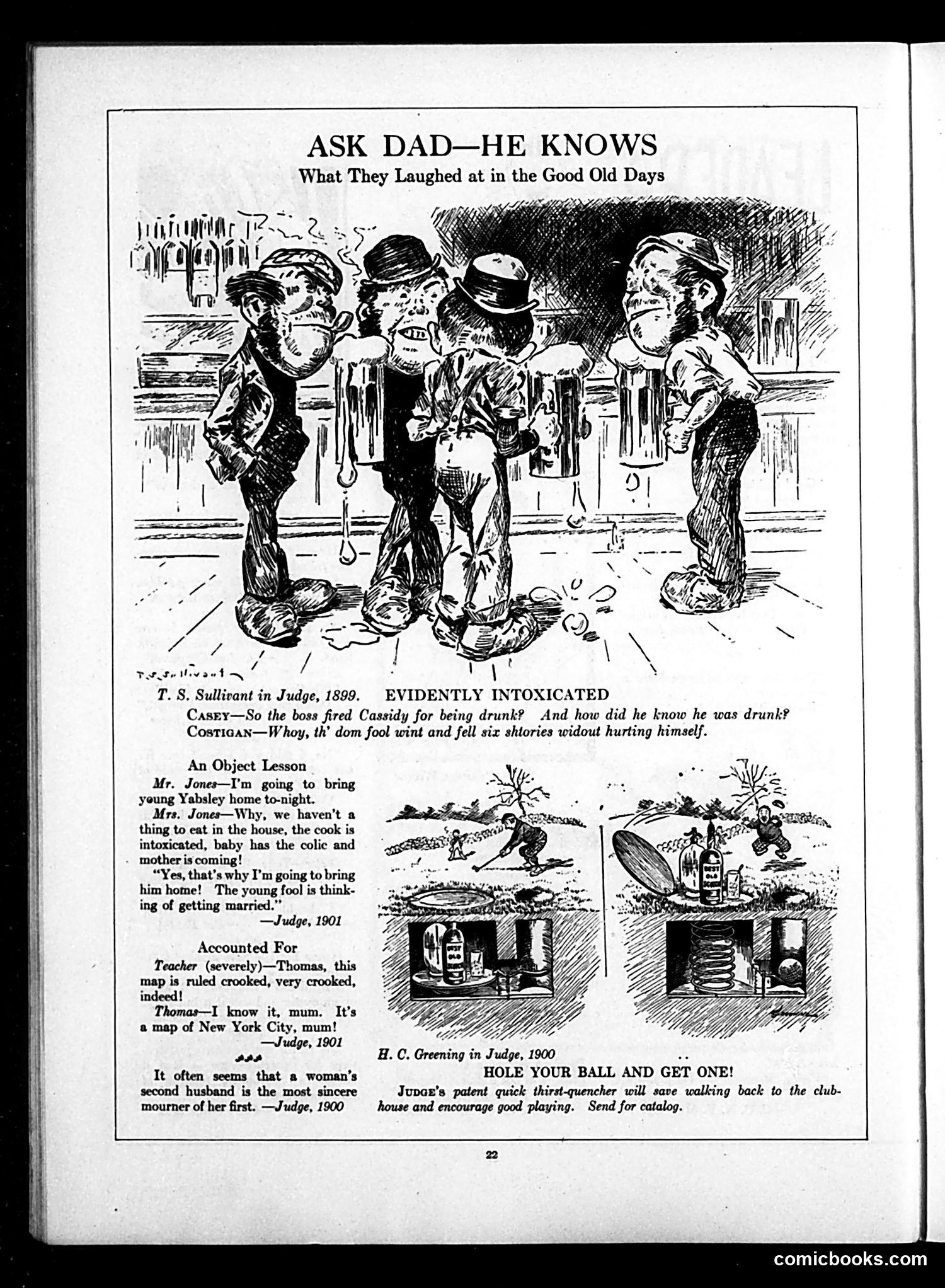
This page collects period humor from Judge magazine's "Ask Dad—He Knows" feature, showcasing early 1900s comedic sensibilities. **Main cartoon (Sullivant, 1899):** Five intoxicated men in a bar. The joke: a man fired for drunkenness fell six stories without injury—proving his extreme intoxication since he felt nothing. This relies on the era's casual attitude toward workplace drinking and physical comedy. **Subsequent jokes** satirize domestic life: a wife uses an unwanted suitor's visit as punishment (the household is chaotic); a student's crooked map of New York becomes a joke about the city's disorganization; a quip about remarriage. **Bottom advertisement:** "Hole Your Ball and Get One!" promotes Judge's patent drinking device for golfers—a "thirst-quencher" allowing golfers to drink without returning to the clubhouse. This product advertisement *itself* is satirical commentary on American leisure culture and drinking habits. Overall, the page reflects Gilded Age humor: heavy drinking normalized, domestic chaos comedic, and consumer products treated as solutions to social problems.
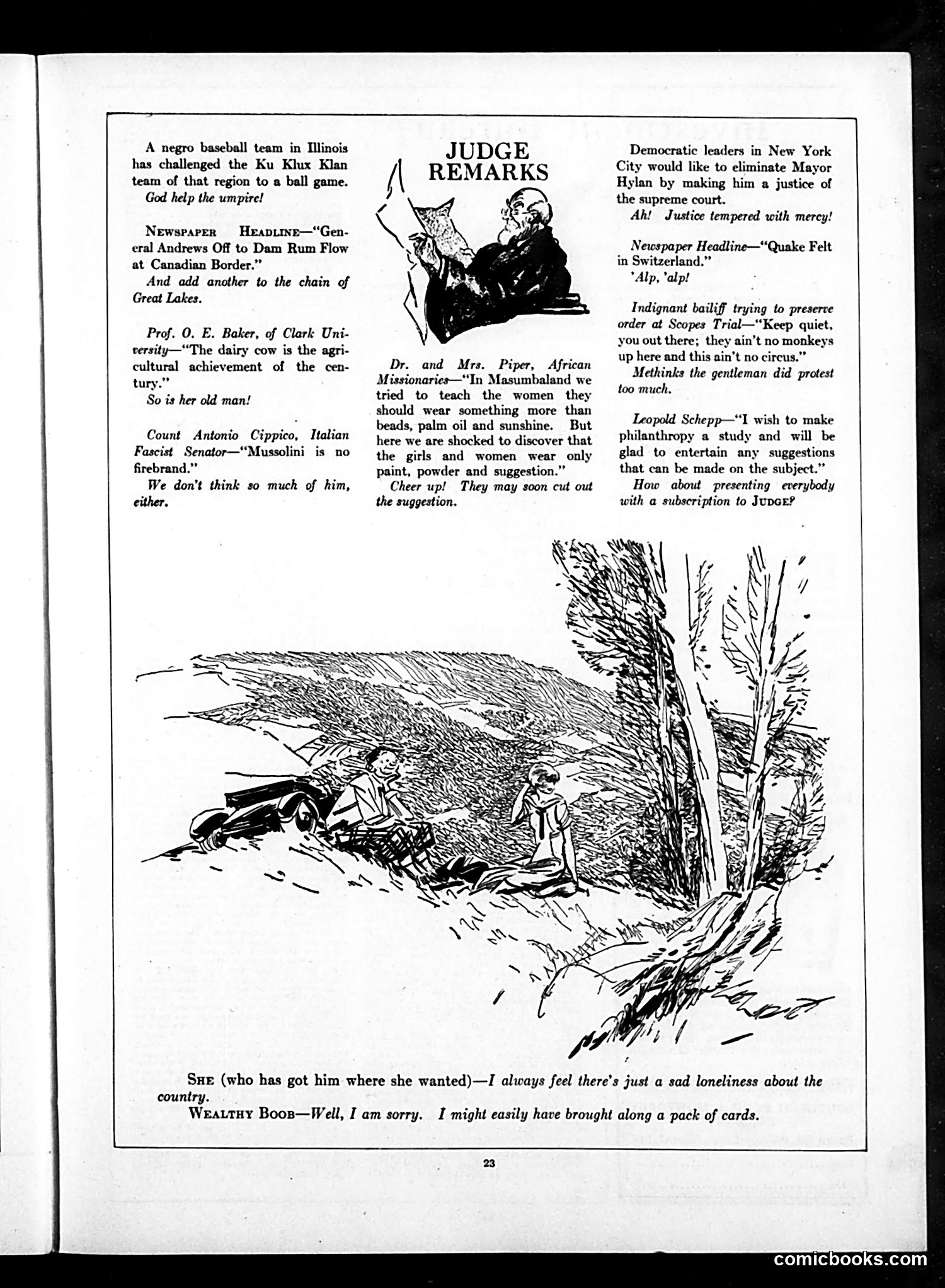
This page contains satirical commentary on early 1920s American politics and social issues: **Main items:** - **KKK baseball challenge**: Mocks racial tensions by joking about violence during a game between a Black team and a KKK team. - **Prohibition**: References "General Andrews" and rum-running at the Canadian border—commentary on alcohol smuggling during Prohibition. - **African missionaries**: Satirizes white missionaries criticizing African women's clothing while ignoring American women's revealing fashions (paint, powder). - **Mayor Hylan**: New York Democrats allegedly wanting to remove Mayor Hylan by promoting him to Supreme Court—ironic commentary on political maneuvering. - **Scopes Trial**: References the famous 1925 evolution trial, with a bailiff denying the "monkey" evolutionary connection. - **Bottom cartoon**: A "wealthy boob" and woman in a car—she's isolated in nature; he regrets not bringing cards for entertainment, suggesting shallow materialism. The page reflects Judge's style: satirizing politics, morality, and social pretension through brief, barbed observations.
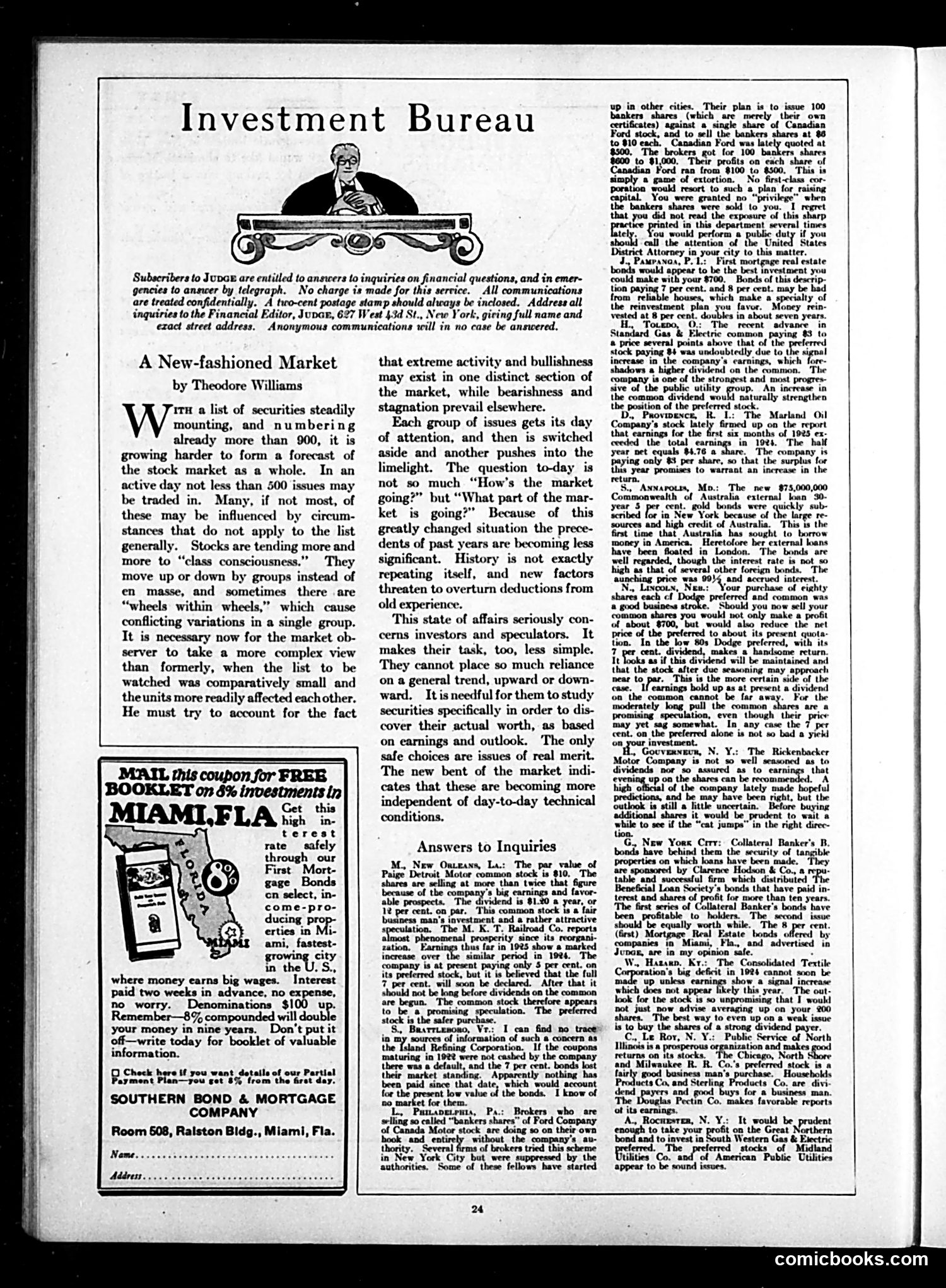
This page from Judge presents financial advice and market commentary for the magazine's subscribers. The central article, "A New-fashioned Market" by Theodore Williams, discusses how the stock market has become more complex and fragmented. Williams argues that with 900+ traded securities, investors can no longer rely on simple general trends. Instead, stocks now move in distinct "groups" based on specific circumstances rather than moving uniformly as a market. He advocates that investors study individual securities' actual earnings and merit rather than betting on broad market movements. The page also includes an "Answers to Inquiries" section addressing subscriber questions about specific stocks (Paige Detroit Motor, M.K.T. Railroad), and an advertisement for Miami real estate bonds offering 8% interest. The satirical element appears subtle here—the cartoon header shows a gentleman at a desk, likely representing the financial expert dispensing investment wisdom.
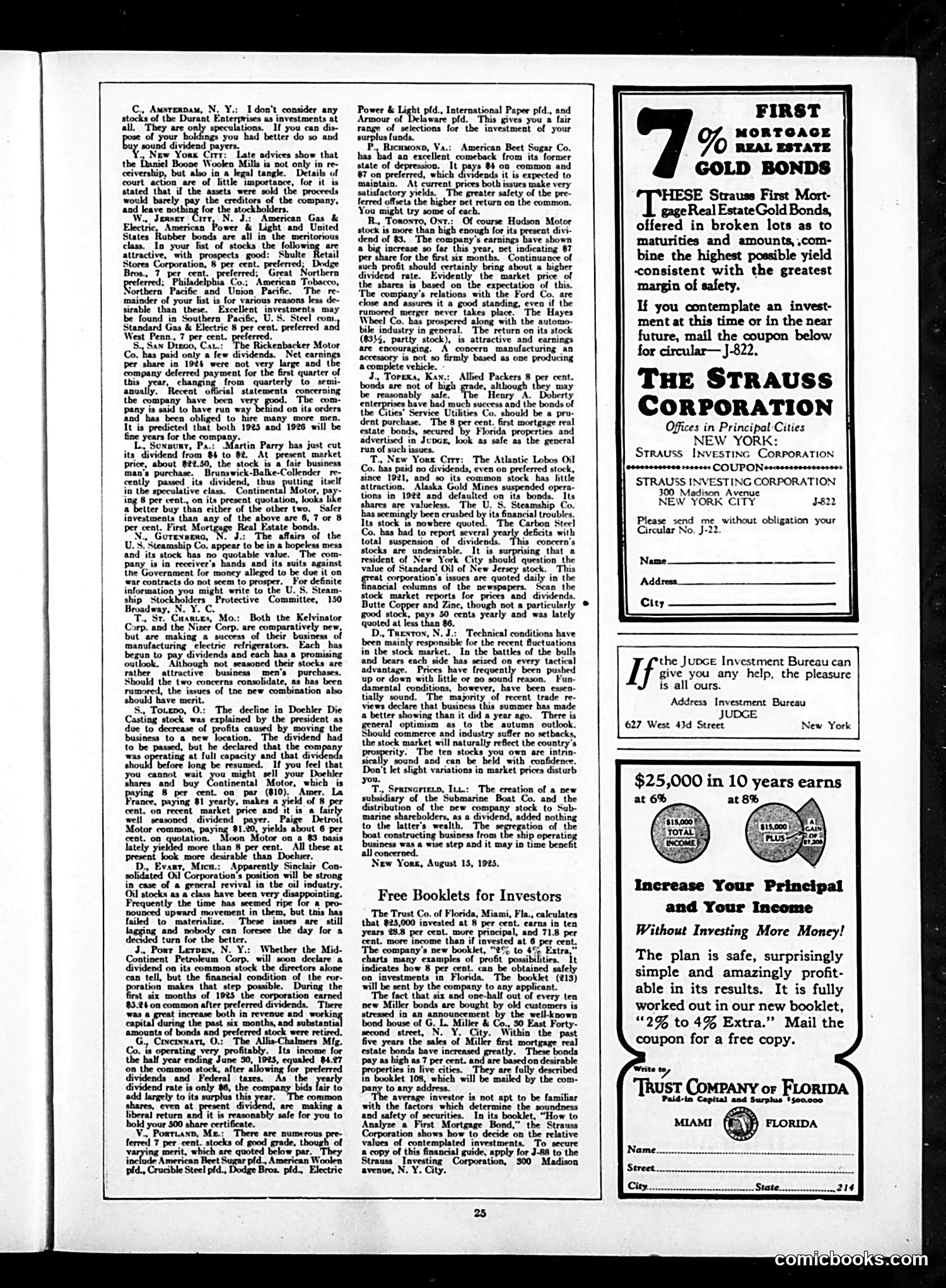
This page is primarily **financial advice columns and investment advertisements**, not political satire. It's from Judge magazine's investment section circa 1925. The content addresses readers' stock investment questions about American companies like Durant Enterprises, Rickenbacker Motor, Brunswick-Balke-Collender, and oil corporations. The adviser recommends "safer" investments like First Mortgage Bonds and blue-chip stocks (Standard Oil, U.S. Steel, Northern Pacific). The right side advertises the **Strauss Corporation's 7% Gold Bonds** and the **Trust Company of Florida's investment plan** promising "$25,000 in 10 years" at 6%. **Historical context:** This reflects the 1920s investment boom before the 1929 crash. Readers were eager for stock tips, and magazines like Judge profited from investment ads. The advice emphasizes "seasoned" dividend-payers over speculative stocks—practical counsel that would prove tragically inadequate within four years.
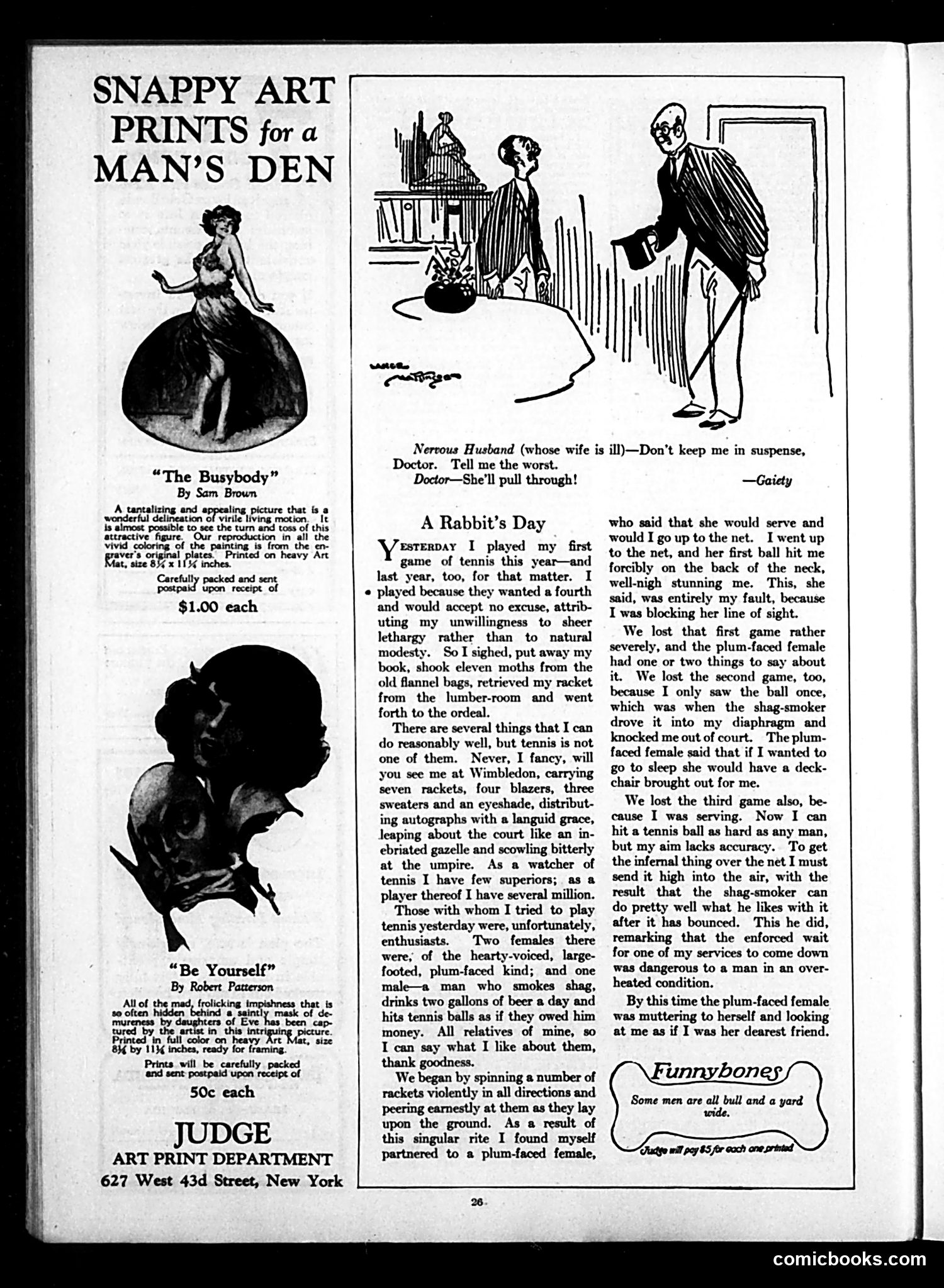
This page contains three distinct elements: **Top Left**: Advertisements for art prints marketed to men's dens—"The Busybody" (a woman in an evening gown) and "Be Yourself" (a portrait)—priced at $1.00 and 50¢ respectively. **Top Right**: A single-panel cartoon captioned "Nervous Husband" by Gaiety. A worried husband asks his doctor about his ill wife; the doctor reassures him she'll recover. The joke plays on the husband's anxious phrasing ("Tell me the worst") and the doctor's cheerful response, likely suggesting the husband dreads his wife's recovery rather than her death. **Main Text**: "A Rabbit's Day," a humorous essay about the author's terrible first tennis match of the year. He's reluctant, unathletic, and paired with an aggressive "plum-faced female" who serves poorly and blames him for losses. The piece satirizes amateur tennis players and their competitive absurdity through self-deprecating humor. The page blends advertising with light satirical commentary on contemporary middle-class leisure activities.
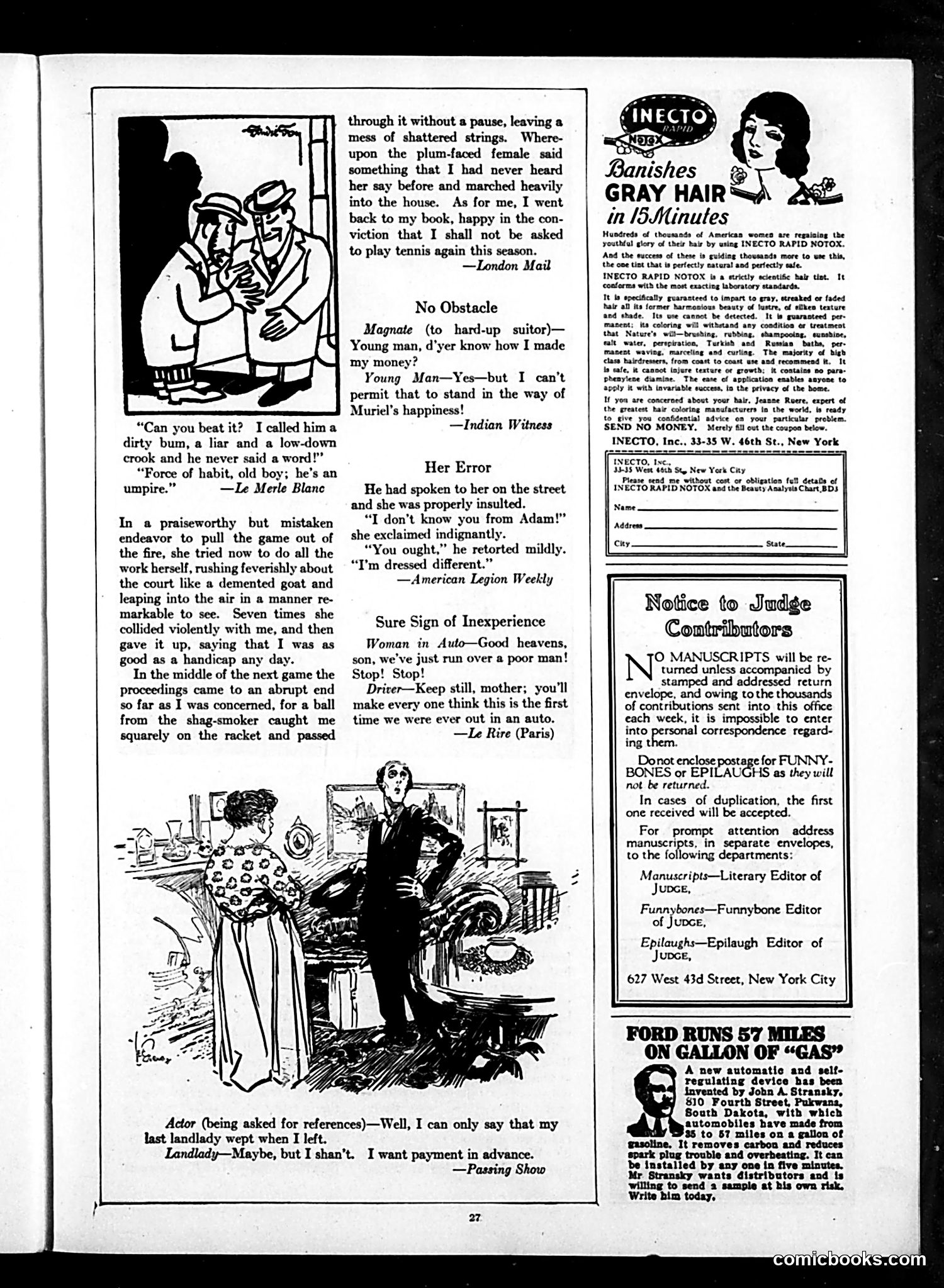
This page from **Judge** magazine (a satirical weekly) contains several humorous short pieces poking fun at social habits and gender dynamics of the era. **The main cartoons satirize:** 1. **"No Obstacle"** — A suitor seeks a father's blessing to marry his daughter. The father, a self-made "Magnate," refuses because the suitor cannot tolerate the daughter's behavior (she's rude and athletic). The joke mocks both the suitor's weakness and the father's absurd priorities—his money-making ability somehow matters more than his daughter's poor character. 2. **"Her Error"** — A woman insults a man on the street, then claims she doesn't know him. He notes she'd recognize him if he were "dressed different." The joke plays on her dismissive attitude based on appearance. 3. **"Sure Sign of Inexperience"** — A nervous female driver hits a pedestrian, but the mother passenger worries people will think it's habitual. The humor lies in their concern about appearances rather than the victim's welfare. The page also advertises **Inecto hair dye**, targeting women concerned about gray hair, and includes contributor submission guidelines.
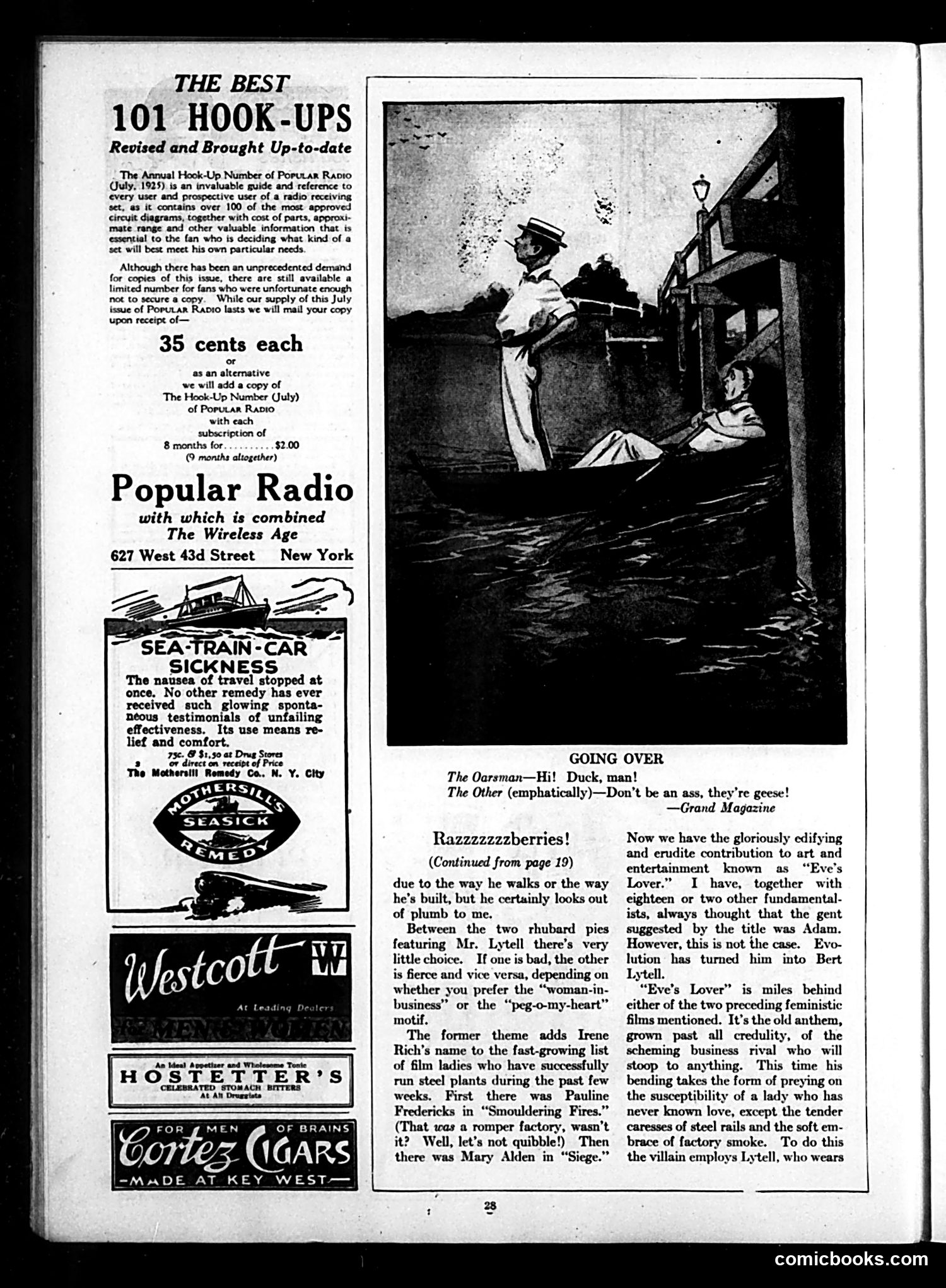
This page is primarily **advertising and product promotion** rather than political satire. The dominant content includes ads for Popular Radio magazine's "Hook-Ups" issue (radio circuit diagrams), Mothersill's Seasickness Remedy, Westcott products, and Cortez Cigars. The only satirical content is a small cartoon titled "Going Over" showing two men in a boat. One calls out "Hi! Duck, man!" The other responds indignantly: "Don't be an ass, they're geese!"—a simple visual pun playing on the homophone of "duck" (the bird vs. the action). This is credited to *Grand Magazine*. Below that is a film review column titled "Razzzzzzberries!" critiquing recent movies, including complaints about actress films depicting women running steel plants and factories—apparently a growing trend in 1920s cinema that the reviewer finds implausible and tiresome. The page reflects 1920s consumer culture and early radio enthusiasm rather than political commentary.
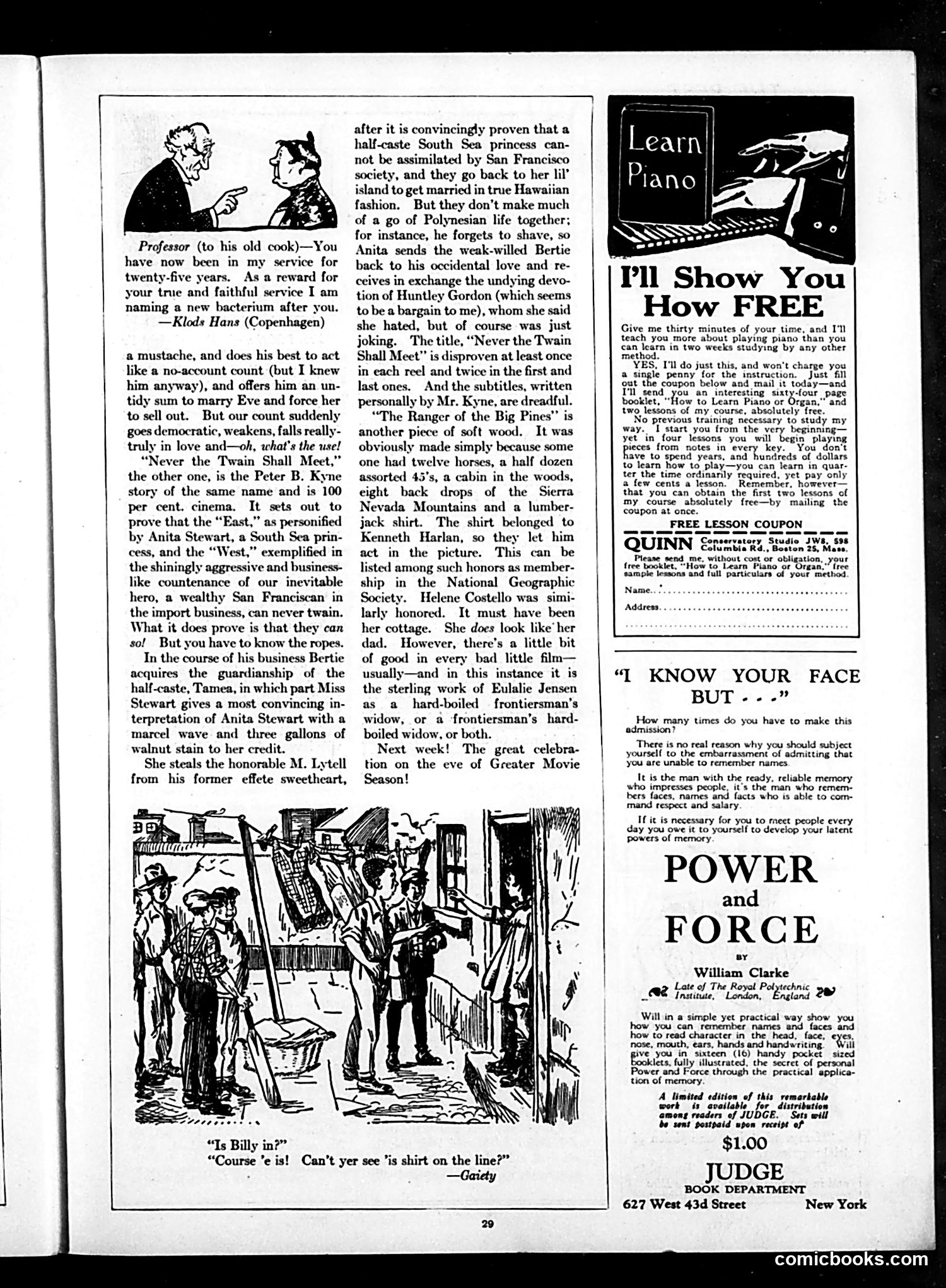
This page contains film reviews and advertisements rather than political cartoons. The main content critiques three movies from the silent film era, with particular focus on "Never the Twain Shall Meet" starring Anita Stewart—a narrative about East-West cultural incompatibility and interracial romance that ultimately "proves" the title's premise false through plot complications. The single cartoon at bottom shows a working-class laundry scene with the caption about a shirt on the line, appearing to be a simple domestic humor joke about clothing visibility. The advertisements promote piano lessons and a book on memory techniques ("Power and Force" by William Clarke). The page reflects 1920s entertainment culture and racial attitudes, particularly the era's preoccupation with whether different cultures could successfully integrate—a common film theme of the period. The reviewer's tone is dismissive toward these melodramas, treating them as formulaic and superficial.
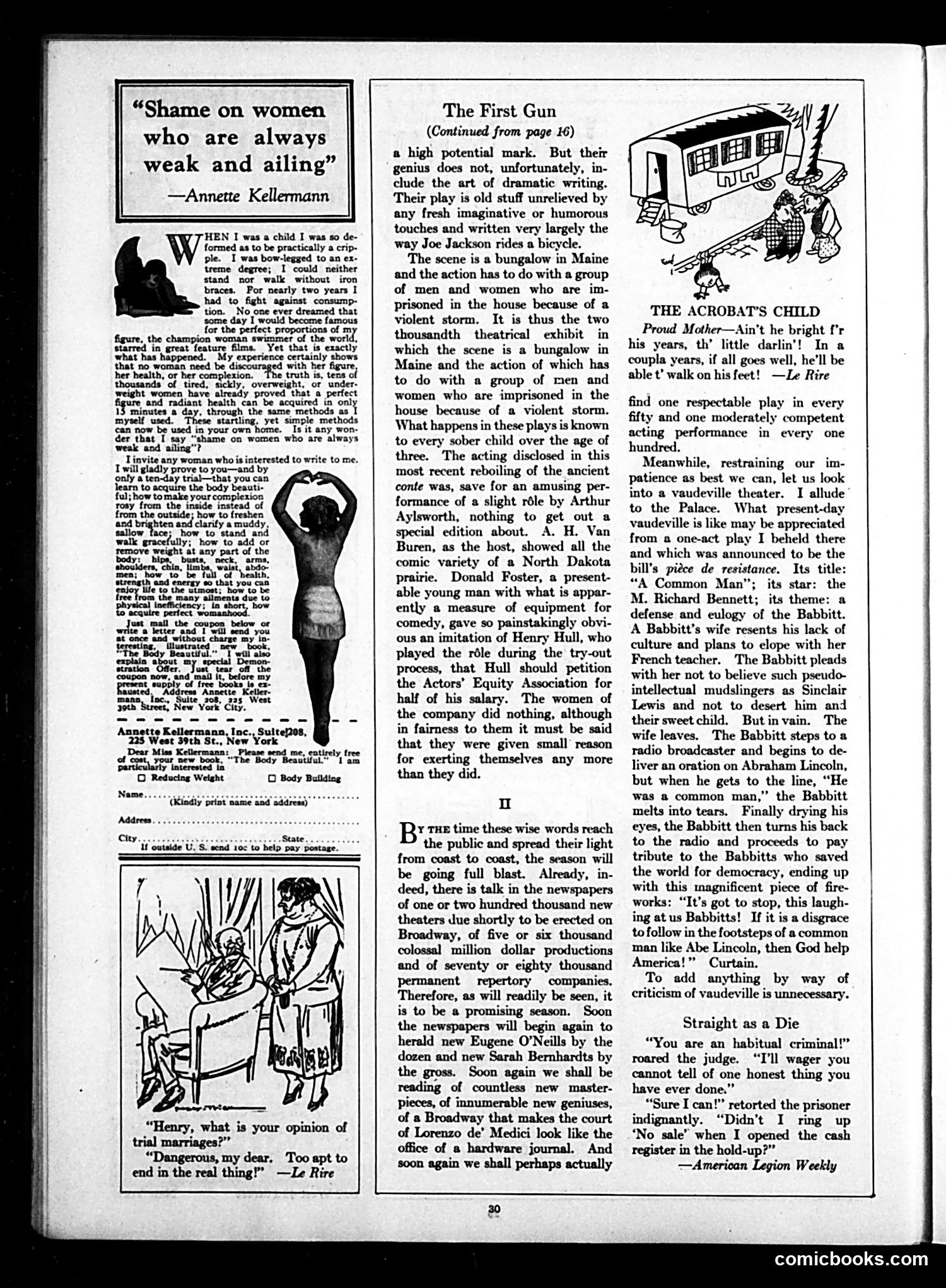
This Judge magazine page contains two main elements: **Top Left: Annette Kellermann Advertisement** Kellermann was a famous Australian swimmer and film star of the 1910s-20s. This is an advertorial testimonial where she claims her childhood physical disabilities (bow-legs, deformity) were corrected through exercise and fitness methods she's now promoting. The quote shaming "weak and ailing" women was meant to inspire female readers to pursue physical fitness—a progressive message for the era, though paternalistic by modern standards. **Center/Right: Theater Reviews** Judge's drama critic reviews two Broadway productions dismissively. "The First Gun" is criticized as derivative (a Maine bungalow storm-trapped plot recycled endlessly), with wooden acting. The reviewer mocks the predictability and mediocrity of contemporary theater while satirizing the hyperbolic press coverage that would soon herald the upcoming season as containing "new Eugene O'Neills by the dozen." **Bottom cartoon**: A humorous domestic exchange about trial marriages ending in actual marriage—social commentary on 1920s progressive attitudes toward unmarried cohabitation.
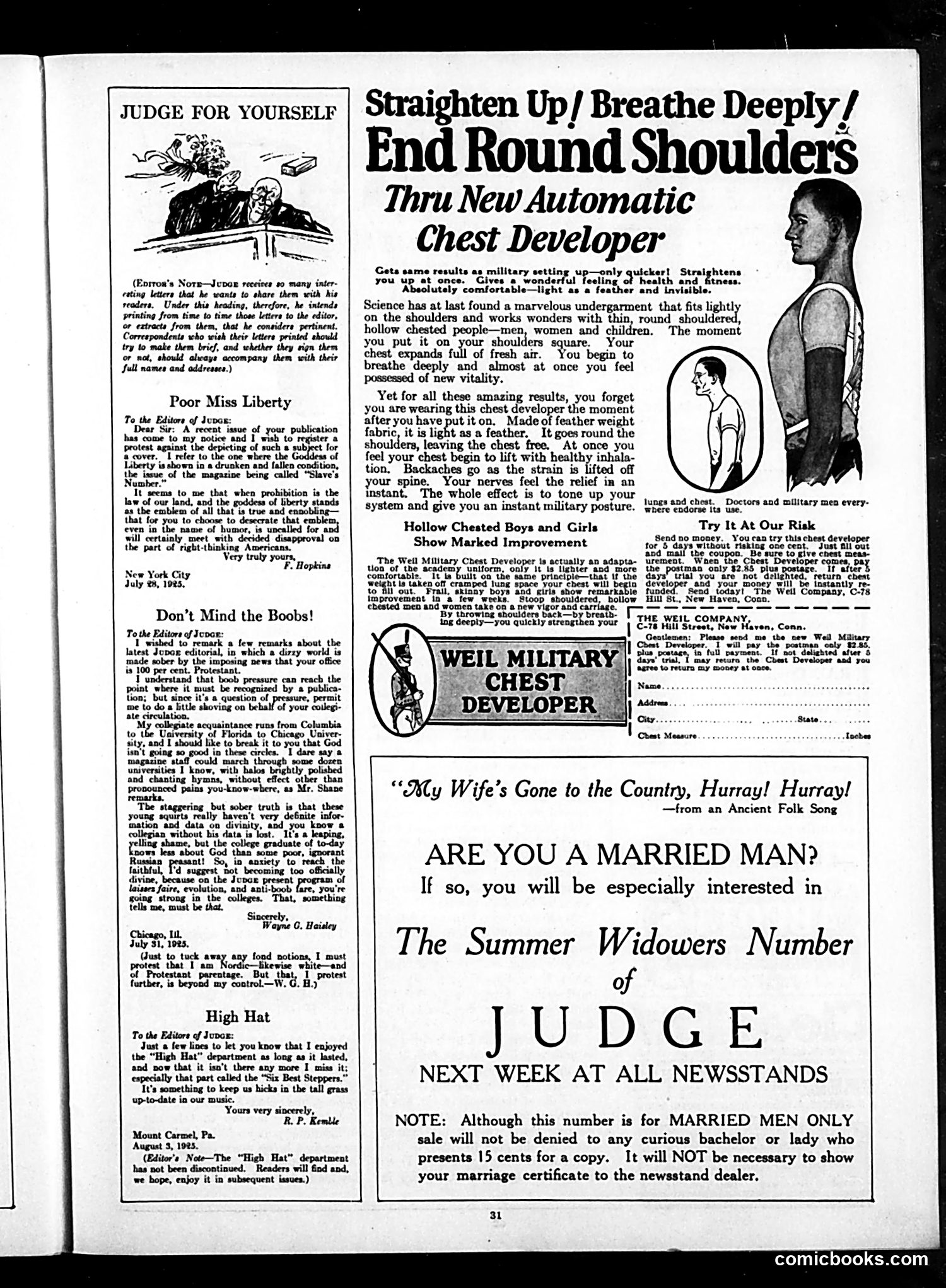
This page contains **reader letters to Judge magazine's editor** plus **advertisements**—not political cartoons per se. The letters showcase 1925 social anxieties: **"Poor Miss Liberty"** protests Judge depicting Lady Liberty as drunk, arguing this desecrates the symbol during Prohibition era when alcohol was illegal. **"Don't Mind the Boobs!"** sarcastically attacks Judge's claim to be "100 per cent Protestant," arguing college students lack religious knowledge regardless—a jab at moralistic posturing. **"High Hat"** praises a discontinued music column, humorously calling rural readers "hicks." The **Weil Military Chest Developer advertisement** promises posture improvement and masculine appearance through a corset-like device—reflecting 1920s anxieties about proper deportment and physique. The ad's military framing appeals to post-WWI masculinity ideals. The page reflects 1920s concerns: Prohibition enforcement, Protestant moralism, class divisions, and commercialized self-improvement marketed through gendered body anxieties.
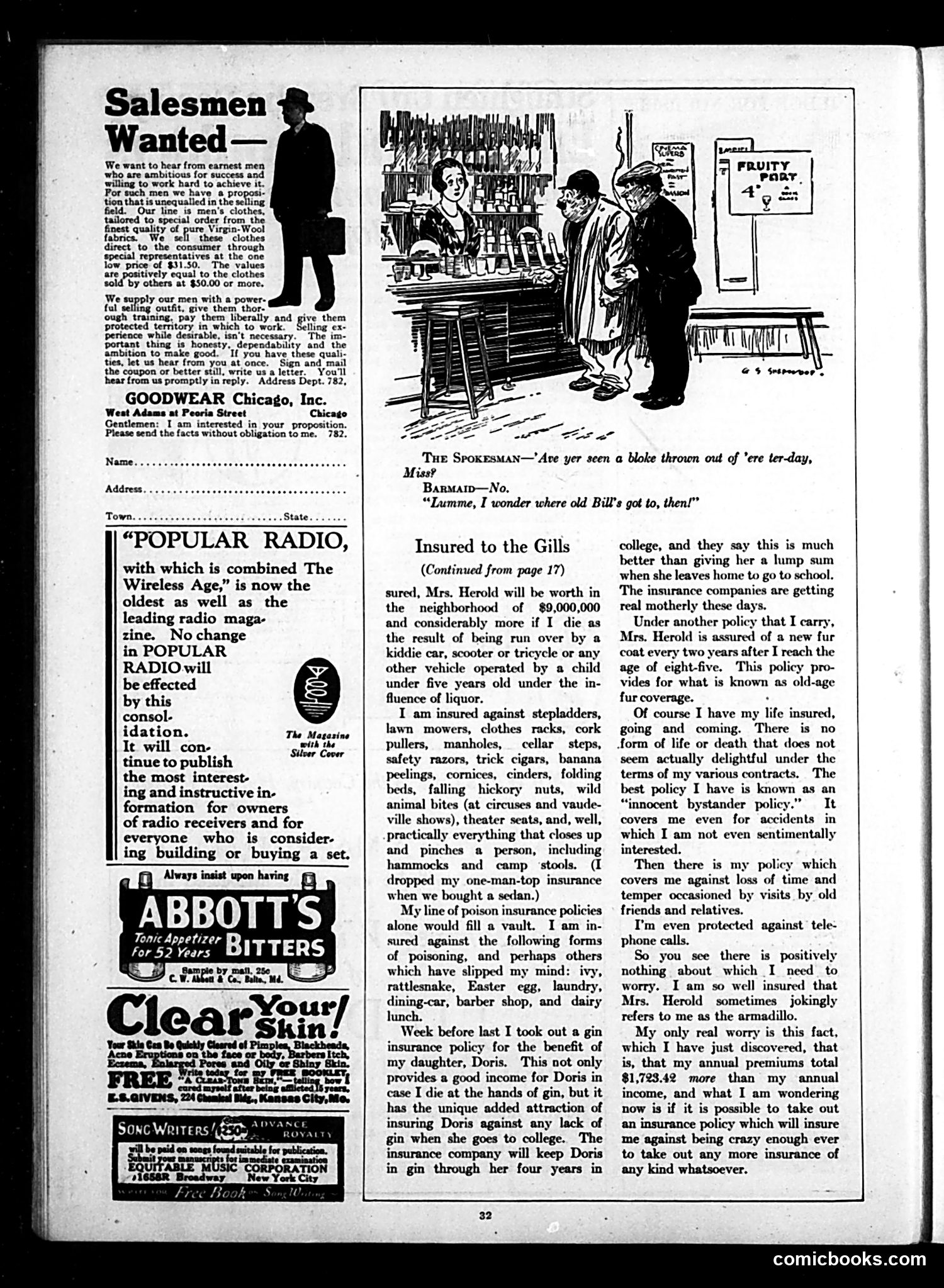
This page contains a **small cartoon** and extensive **advertisements and article text**, not primarily political satire. The cartoon shows a **British pub scene**: a barmaid and patron discussing a missing man ("old Bill"). The dialogue uses working-class London dialect ("'Lumme"). It's a gentle domestic humor piece about someone absent from his usual haunts—likely a reference to wartime absence or simply a missing regular customer. The humor is situational rather than satirical. The rest of the page features **commercial ads** (Goodwear tailored suits, Abbott's Bitters, insurance policies) and a continuation of an article titled "Insured to the Gills"—a humorous piece about an absurdly over-insured man protecting himself against increasingly ridiculous hazards (banana peels, hickory nuts, gin-related incidents). The satire here targets **insurance industry excess** and consumer anxiety, not politics.
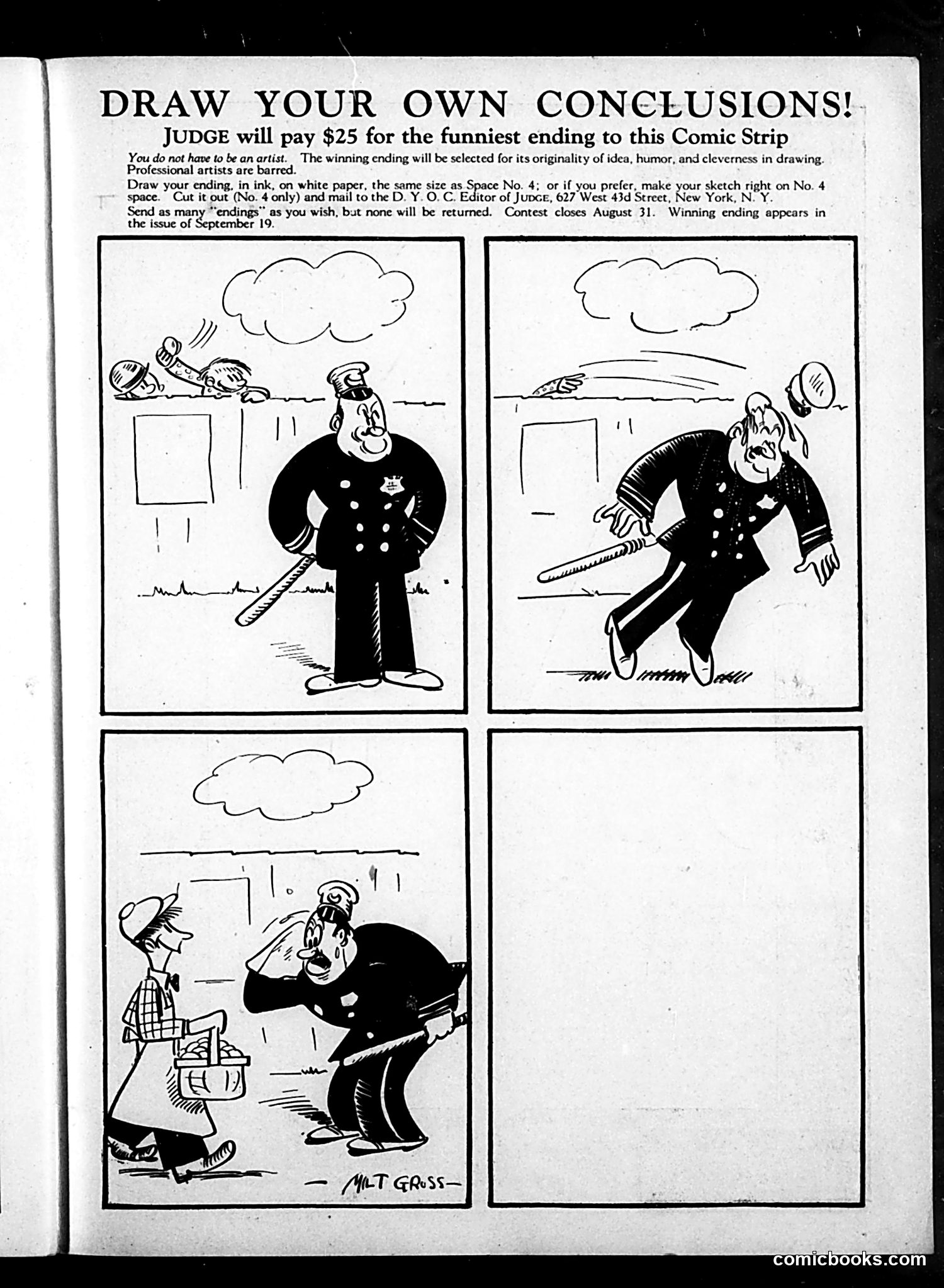
This is a reader-participation contest page from *Judge* magazine. The three completed panels (signed by Milt Gross) show a military officer discovering soldiers playing on a rooftop, then chasing them, and finally encountering what appears to be a woman with a pot—the fourth panel is blank for reader submissions. The humor targets military discipline and enlisted men's misbehavior. The officer's exaggerated facial expressions and physical comedy (chasing, running) drive the satire. The joke setup suggests soldiers shirking duties or engaged in illicit activity, caught by their superior. The contest invited non-professional readers to submit funny conclusions, paying $25 for the winner—encouraging audience participation in comic storytelling. This reflects early 20th-century magazine culture, where reader engagement was a publication strategy. Without the final panel, we cannot identify the specific military service or historical context, though the uniform and setup suggest WWI or interwar-era satire of military life.
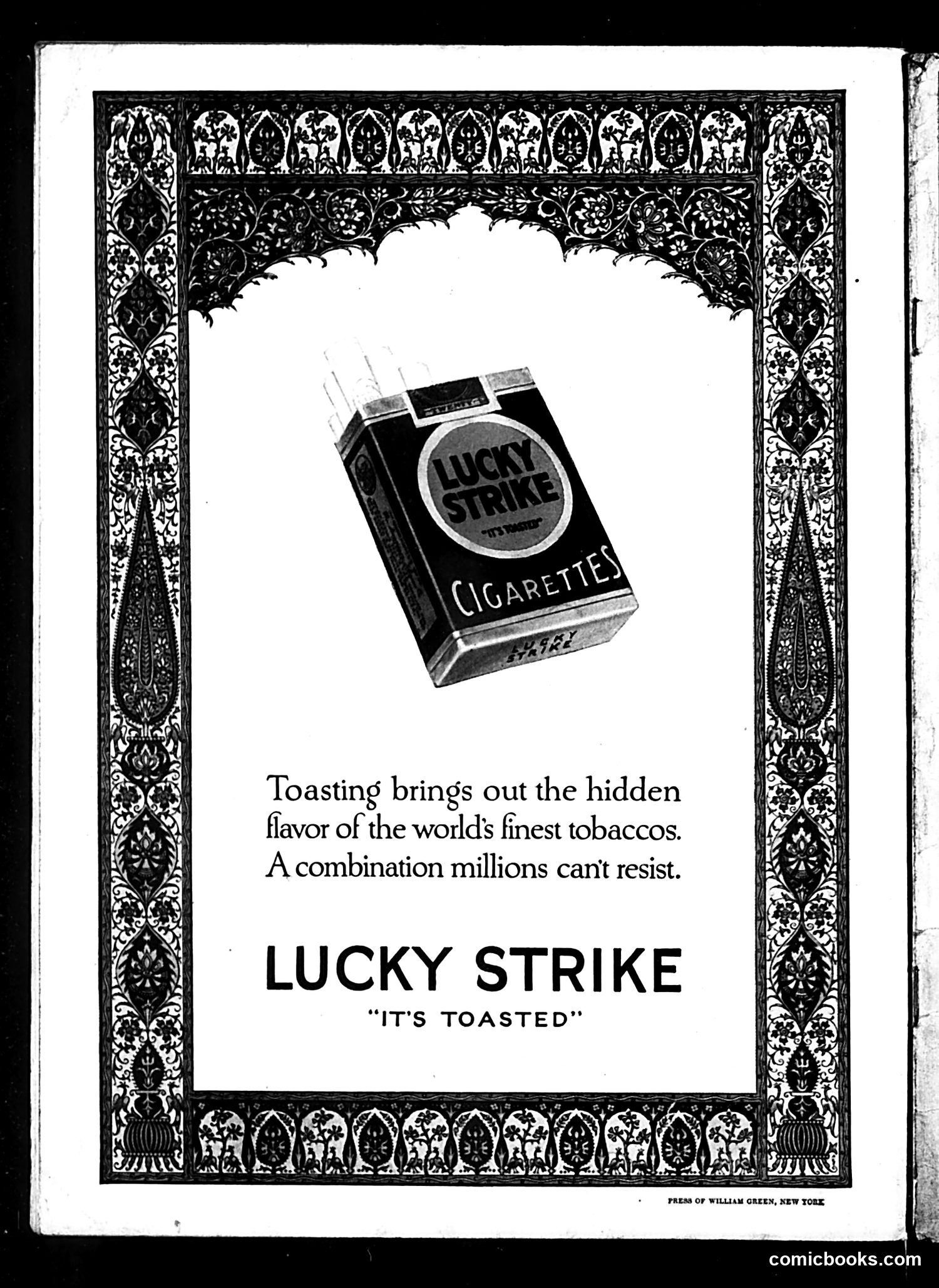
This is a **cigarette advertisement, not political satire**. It promotes Lucky Strike cigarettes, emphasizing their "toasting" process as enhancing tobacco flavor. The ad features a pack of Lucky Strikes with the slogan "It's Toasted," and copy claiming the toasting brings out "hidden flavor of the world's finest tobaccos." The ornate decorative border suggests this appeared in a high-quality magazine targeting affluent readers. The messaging—that a manufacturing process creates superior taste—was typical early-20th-century cigarette marketing. There is no cartoon, caricature, or satirical content here; this is straightforward product advertising from *Judge* magazine's commercial pages. Modern readers should note that such tobacco advertising was legal and commonplace in publications of this era.