
Judge, 1925-08-22 · page 17 of 36
Judge — August 22, 1925 — page 17: what you’re looking at
What you’re looking at
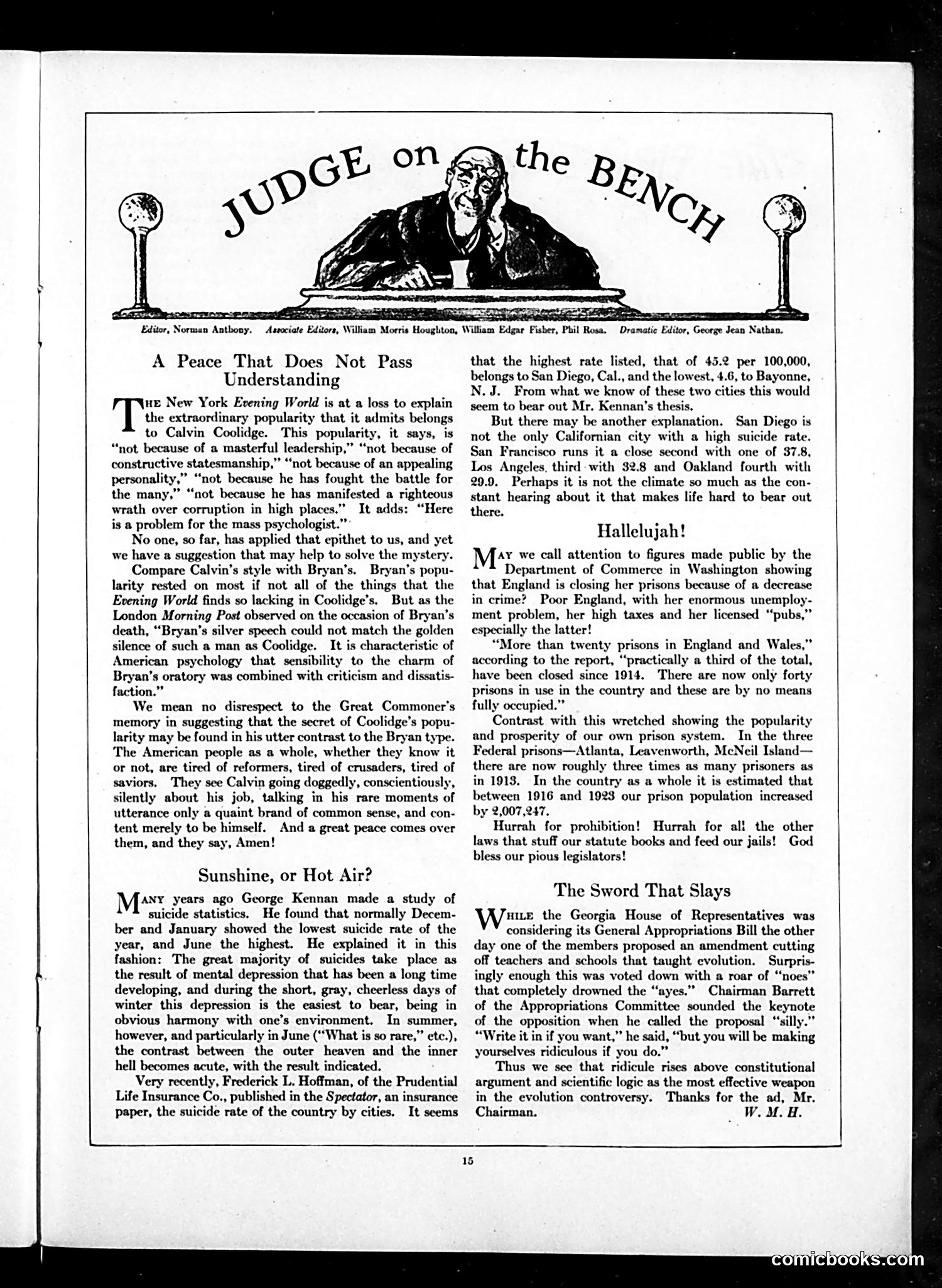
This page contains three distinct satirical pieces from Judge magazine (early 20th century): **"A Peace That Does Not Pass Understanding"** compares President Calvin Coolidge's popularity to William Jennings Bryan's. The satire suggests Americans prefer Coolidge's quiet competence and silence to Bryan's famous oratory and reformist crusading. The piece argues the public is exhausted by crusaders and saviors, finding peace in Coolidge's understated, methodical approach—a dig at both Coolidge's laconic style and American political fatigue. **"Sunshine or Hot Air?"** examines high suicide rates in California cities (San Diego highest at 45.2 per 100,000). It sarcastically suggests the problem isn't the pleasant climate but rather constant boasting about California's weather creating psychological contrast with inner depression. **"Hallelujah!"** praises England for closing prisons due to decreased crime, while mockingly noting England's unemployment, high taxes, and "licensed pubs" should produce more crime—implying the real explanation is unclear or ironic. The page's header features a judge figure overseeing these commentaries on American society and politics.
📄 Transcribed text from this page (OCR, searchable)
Machine-transcribed from the original scan — historical spelling and the odd misread are preserved.
Editor, Norman Antbony. A Peace That Does Not Pass Understanding HE New York Evening World is at a loss to explain I the extraordinary popularity that it admits belongs to Calvin Coolidge. This popularity, it says, is “not because of a masterful leadership,” “not because of constructive statesmanship,” “not because of an appealing personality,” “not because he has fought the battle for the many,” “not because he has manifested a righteous wrath over corruption in high places.” It adds: ‘Here is a problem for the mass psychologist.” No one, so far, has applied that epithet to us, and yet we have a suggestion that may help to solve the mystery. Compare Calvin's style with Bryan’s. Bryan’s popu- larity rested on most if not all of the things that the Evening World finds so lacking in Coolidge’s. But as the London Morning Post observed on the occasion of Bryan's death, “Bryan’s silver speech could not match the golden silence of such a man as Coolidge. It is characteristic of American psychology that sensibility to the charm of Bryan’s oratory was combined with criticism and dissatis- faction.” We mean no disrespect to the Great Commoner's memory in suggesting that the secret of Coolidge’s popu- larity may be found in his utter contrast to the Bryan type. The American people as a whole, whether they know it or not, are tired of reformers, tired of crusaders, tired of saviors. They see Calvin going doggedly, conscientiously, silently about his job, talking in his rare moments of utterance only a quaint brand of common sense, and con- tent merely to be himself. And a great peace comes over them, and they say, Amen! Sunshine, or Hot Air? M** years ago George Kennan made a study of suicide statistics. He found that normally Decem- ber and January showed the lowest suicide rate of the year, and June the highest. He explained it in this fashion: The great majority of suicides take place as the result of mental depression that has been a long time developing, and during the short, gray, cheerless days of winter this depression is the easiest to bear, being in obvious harmony with one’s environment. In summer, however, and particularly in June (“‘What is so rare,” etc.), the contrast between the outer heaven and the inner hell becomes acute, with the result indicated. Very recently, Frederick L. Hoffman, of the Prudential Life Insurance Co., published in the Spectator, an insurance paper, the suicide rate of the country by cities. It seems Associate Editors, William Morris Houghton, William Edgar Fisher, Phil Rosa, Dramatic Editor, George Jean Nathan. that the highest rate listed, that of 45.2 per 100,000, belongs to San Diego, Cal., and the lowest, 4.6, to Bayonne, N.J. From what we know of these two cities this would seem to bear out Mr. Kennan’s thesis. But there may be another explanation. not the only Californian city with a high suicide rate. San Diego is San Francisco runs it a close second with one of 37.8, Los Angeles, third with 32.8 and Oakland fourth with 29.9. Perhaps it is not the climate so much as the con- stant hearing about it that makes life hard to bear out there. Hallelujah! AY we call attention to figures made public by the Department of Commerce in Washington showing that England is closing her prisons because of a decrease in crime? Poor England, with her enormous unemploy- ment problem, her high taxes and her licensed “pubs,” especially the latter! “More than twenty prisons in England and Wales,” according to the report, “practically a third of the total, have been closed since 1914. There are now only forty prisons in use in the country and these are by no means fully occupied.” Contrast with this wretched showing the popularity and prosperity of our own prison system. In the three Federal prisons—Atlanta, Leavenworth, McNeil Island— there are now roughly three times as many prisoners as in 1913. In the country as a whole it is estimated that between 1916 and 1923 our prison population increased by 2,007,247. Hurrah for prohibition! Hurrah for al! the other laws that stuff our statute books and feed our jails! God bless our pious legislators! The Sword That Slays Wie the Georgia House of Representatives was considering its General Appropriations Bill the other day one of the members proposed an amendment cutting off teachers and schools that taught evolution. Surpris- ingly enough this was voted down with a roar of “noes” that completely drowned the “ayes.” Chairman Barrett of the Appropriations Committee sounded the keynote of the opposition when he called the proposal “silly.” “Write it in if you want,” he said, “but you will be making yourselves ridiculous if you do.” Thus we see that ridicule rises above constitutional argument and scientific logic as the most effective weapon in the evolution controversy. Thanks for the ad, Mr. Chairman. W. M. H.