
Judge, 1925-08-22 · page 32 of 36
Judge — August 22, 1925 — page 32: what you’re looking at
What you’re looking at
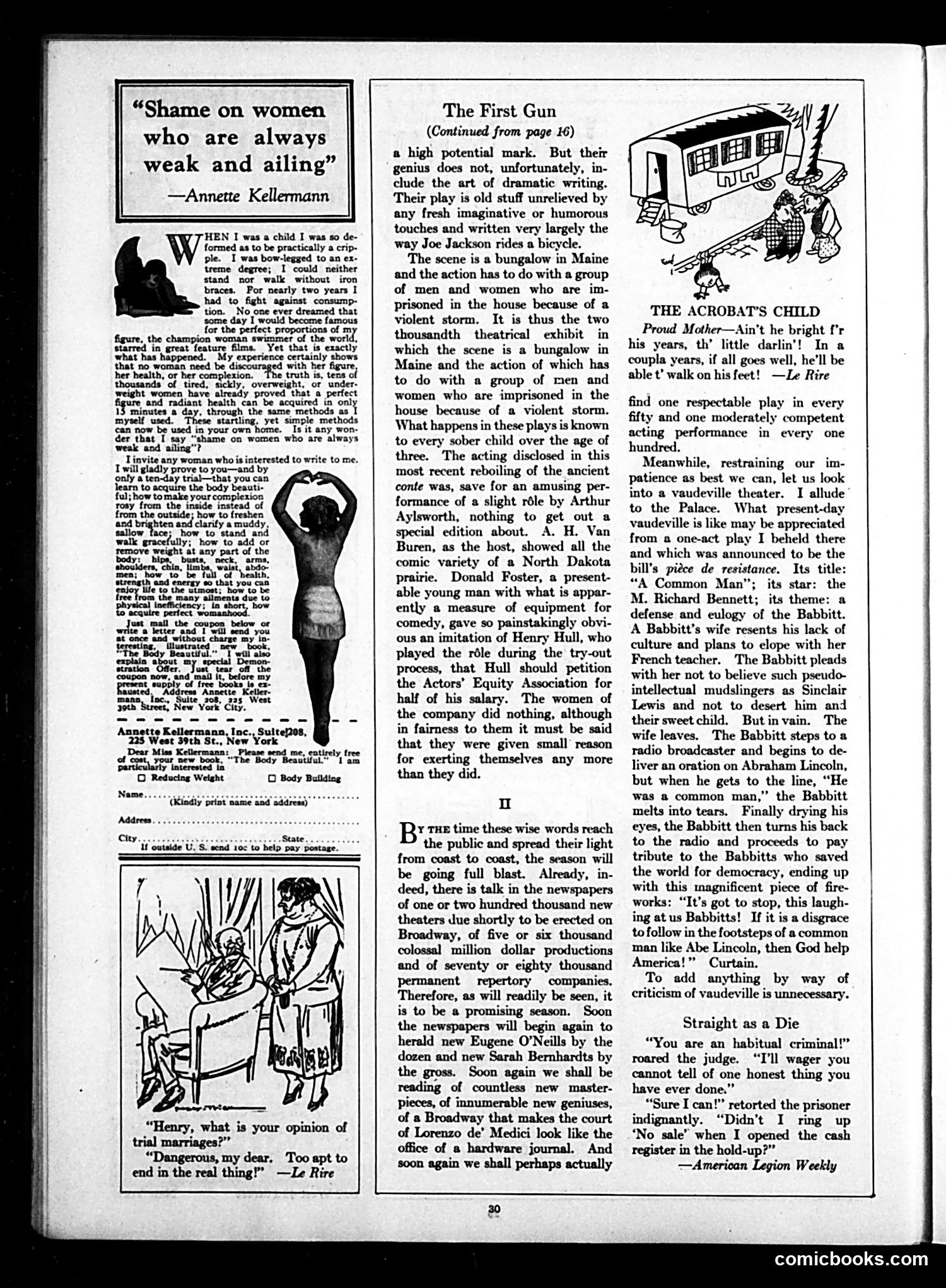
This Judge magazine page contains two main elements: **Top Left: Annette Kellermann Advertisement** Kellermann was a famous Australian swimmer and film star of the 1910s-20s. This is an advertorial testimonial where she claims her childhood physical disabilities (bow-legs, deformity) were corrected through exercise and fitness methods she's now promoting. The quote shaming "weak and ailing" women was meant to inspire female readers to pursue physical fitness—a progressive message for the era, though paternalistic by modern standards. **Center/Right: Theater Reviews** Judge's drama critic reviews two Broadway productions dismissively. "The First Gun" is criticized as derivative (a Maine bungalow storm-trapped plot recycled endlessly), with wooden acting. The reviewer mocks the predictability and mediocrity of contemporary theater while satirizing the hyperbolic press coverage that would soon herald the upcoming season as containing "new Eugene O'Neills by the dozen." **Bottom cartoon**: A humorous domestic exchange about trial marriages ending in actual marriage—social commentary on 1920s progressive attitudes toward unmarried cohabitation.
📄 Transcribed text from this page (OCR, searchable)
Machine-transcribed from the original scan — historical spelling and the odd misread are preserved.
“Shame on women who are always _ weak and ailing” —Annette Kellermann HEN I was a child I was so de- formed as to be practically a crip- ple. I was bow-legged to an ex- treme degree; I could neither stand nor walk without iron figure, the champion woman swimmer f starred in great feature films. Yet that is exactly what has happened. My experience certainly shows p ed with her figure, L startling, yet simple methods can now be used in your own home. Is it any won- der that I say “shame on women who are always weak and ailing”? Tinvite any woman who is interested to write to me. I will gladly prove to you—and by pene 2 “Henry, what is your opinion of trial marriages?” “Dangerous, my dear, Too apt to end in the real thing!” —Le Rire The First Gun (Continued from page 16) a high potential mark. But their genius does not, unfortunately, i clude the art of dramatic writing. Their play is old stuff unrelieved by any fresh imaginative or humorous touches and written very largely the way Joe Jackson rides a bicycle. The scene is a bungalow in Maine and the action has to do with a group of men and women who are im- prisoned in the house because of a violent storm. It is thus the two thousandth theatrical exhibit in which the scene is a bungalow in Maine and the action of which has to do with a group of men and women who are imprisoned in the house because of a violent storm. What happens in these plays is known to every sober child over the age of three. The acting disclosed in this most recent reboiling of the ancient conte was, save for an amusing per- formance of a slight réle by Arthur Aylsworth, nothing to get out a special edition about. A. H. Van Buren, as the host, showed all the comic variety of a North Dakota prairie. Donald Foster, a present- able young man with what is appar- ently a measure of equipment for comedy, gave so painstakingly obvi- ous an imitation of Henry Hull, who played the role during the try-out process, that Hull should petition the Actors’ Equity Association for half of his salary. The women of the company did nothing, although in fairness to them it must be said that they were given small reason for exerting themselves any more than they did. 0 Y THE time these wise words reach the public and spread their light from coast to coast, the season will be going full blast. Already, in- deed, there is talk in the newspapers of one or two hundred thousand new theaters due shortly to be erected on Broadway, of five or six thousand colossal million dollar productions and of seventy or eighty thousand permanent repertory companies. Therefore, as will readily be seen, it is to be a promising season. Soon the newspapers will begin again to herald new Eugene O’Neills by the dozen and new Sarah Bernhardts by the gross. Soon again we shall be reading of countless new master- pieces, of innumerable new geniuses, of a Broadway that makes the court of Lorenzo de’ Medici look like the office of a hardware journal. And soon again we shall perhaps actually THE ACROBAT’S CHILD Proud Mother—Ain’t he bright f’r his years, th’ little darlin’! In a coupla years, if all goes well, he'll be able t’ walk on his feet!) —Le Rire find one respectable play in every fifty and one moderately competent acting performance in every one hundred. Meanwhile, restraining our im- patience as best we can, let us look into a vaudeville theater. I allude to the Palace. What present-day vaudeville is like may be appreciated from a one-act play I beheld there and which was announced to be the bill’s piéce de resistance. Its title: “A Common Man”; its star: the M. Richard Bennett; its theme: a defense and eulogy of the Babbitt. A Babbitt’s wife resents his lack of culture and plans to elope with her French teacher. The Babbitt pleads with her not to believe such pseudo- intellectual mudslingers as Sinclair Lewis and not to desert him and their sweet child. Butinvain. The wife leaves. The Babbitt steps to a radio broadcaster and begins to de- liver an oration on Abraham Lincoln, but when he gets to the line, “He was a common man,” the Babbitt melts into tears. Finally drying his eyes, the Babbitt then turns his back to the radio and proceeds to pay tribute to the Babbitts who saved the world for democracy, ending up with this magnificent piece of fire- works: “It’s got to stop, this laugh- ing at us Babbitts! If it is a disgrace to follow in the footsteps of a common man like Abe Lincoln, then God help America!” Curtain. To add anything by way of criticism of vaudeville is unnecessary. Straight as a Die “You are an habitual criminal!” roared the judge. “I'll wager you cannot tell of one honest thing you have ever done.” “Sure I can!” retorted the prisoner indignantly. “Didn’t I ring up ‘No sale” when I opened the cash register in the hold-up?” American Legion Weekly comicbooks.com