
A complete issue · 36 pages · 1924
Judge — August 30, 1924
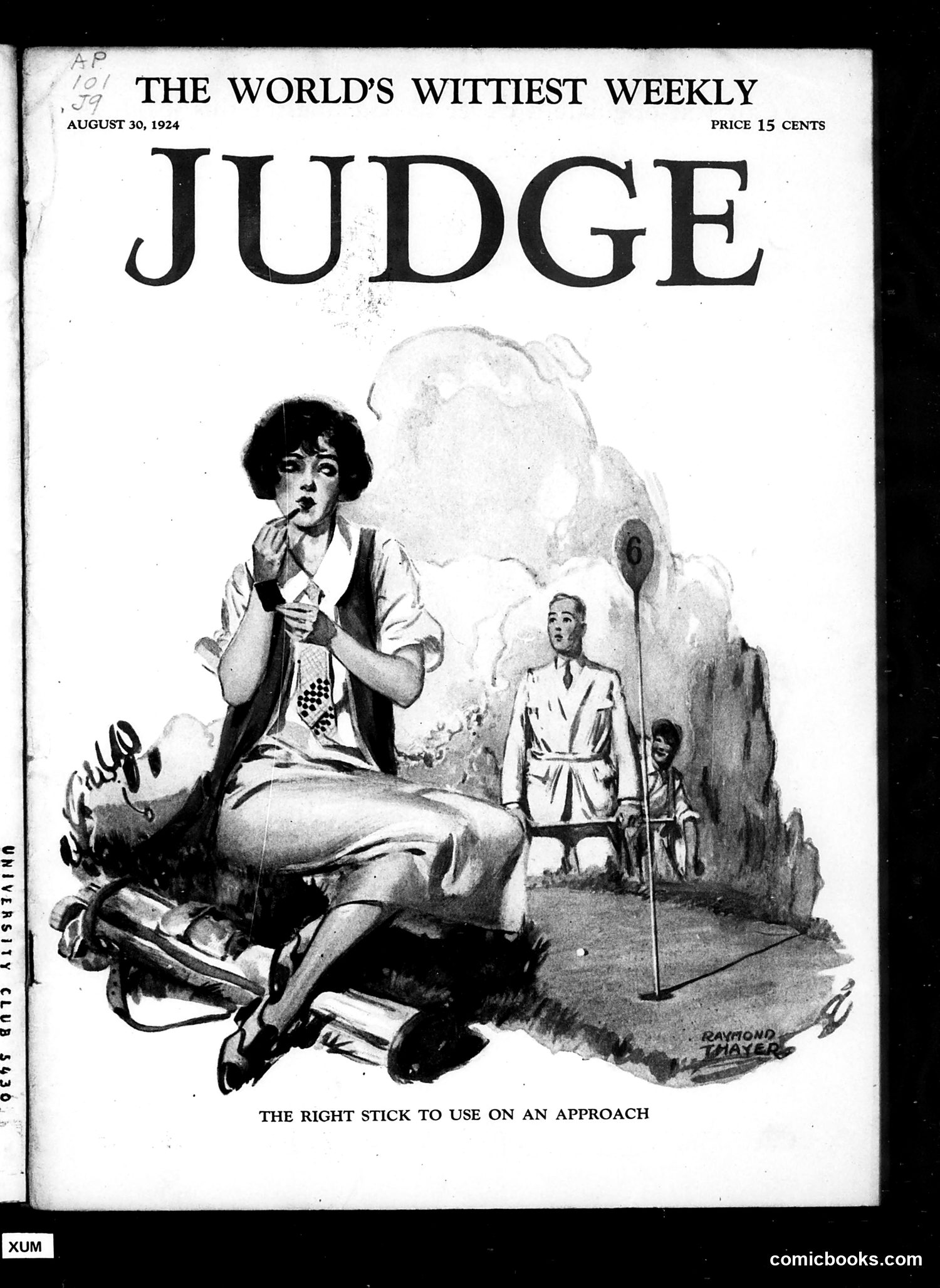
This is a golf humor cartoon. The illustration shows a woman golfer mid-swing, with two men observing in the background near what appears to be a golf flag. The caption's double meaning—"stick" referring both to a golf club and to courting strategy—suggests the cartoon jokes about using the proper approach with women, likely playing on 1920s anxieties about changing gender roles. The flapper-style woman (short dark hair, contemporary dress) represents the modern, independent woman of the Jazz Age. The humor appears to satirize either male uncertainty about how to "approach" these newly liberated women, or perhaps comments on women's increasing presence in traditionally male leisure activities like golf. The cartoon reflects 1920s social commentary on shifting gender dynamics.
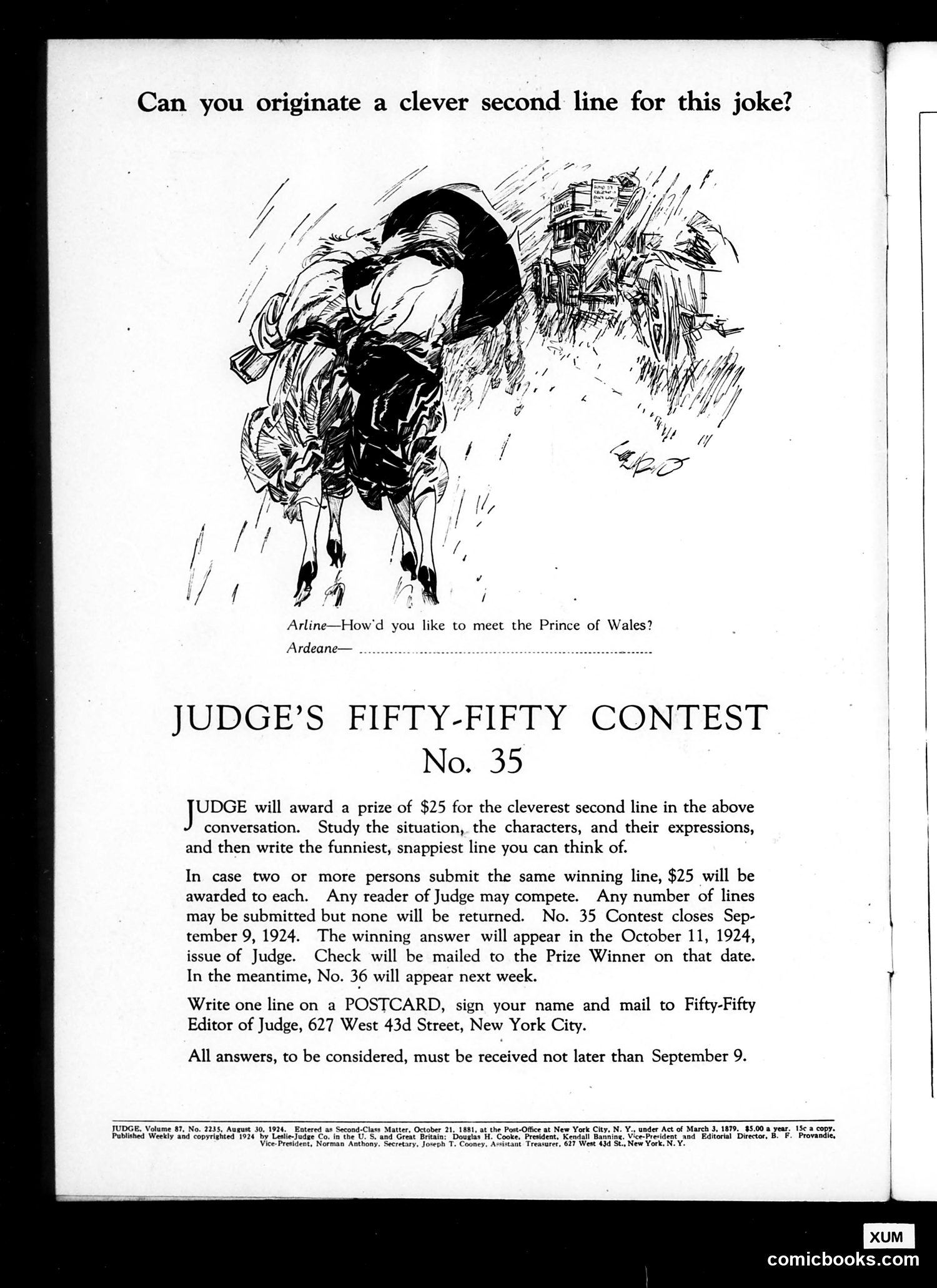
This is a "Fifty-Fifty Contest" where readers submit clever joke punchlines. The setup shows a bucking horse throwing its rider, with the first line: "Arline—How'd you like to meet the Prince of Wales?" The contestant must provide Ardeane's witty response. The humor likely plays on the Prince of Wales' reputation (circa 1924) combined with the wild horse situation. Without seeing submitted answers, the satire's exact target is unclear, but it appears to reference either the Prince's character, his romantic life, or his physical prowess—all common subjects of Judge's political and social satire during this era. The contest offers a $25 prize for the cleverest second line, deadline September 9, 1924.
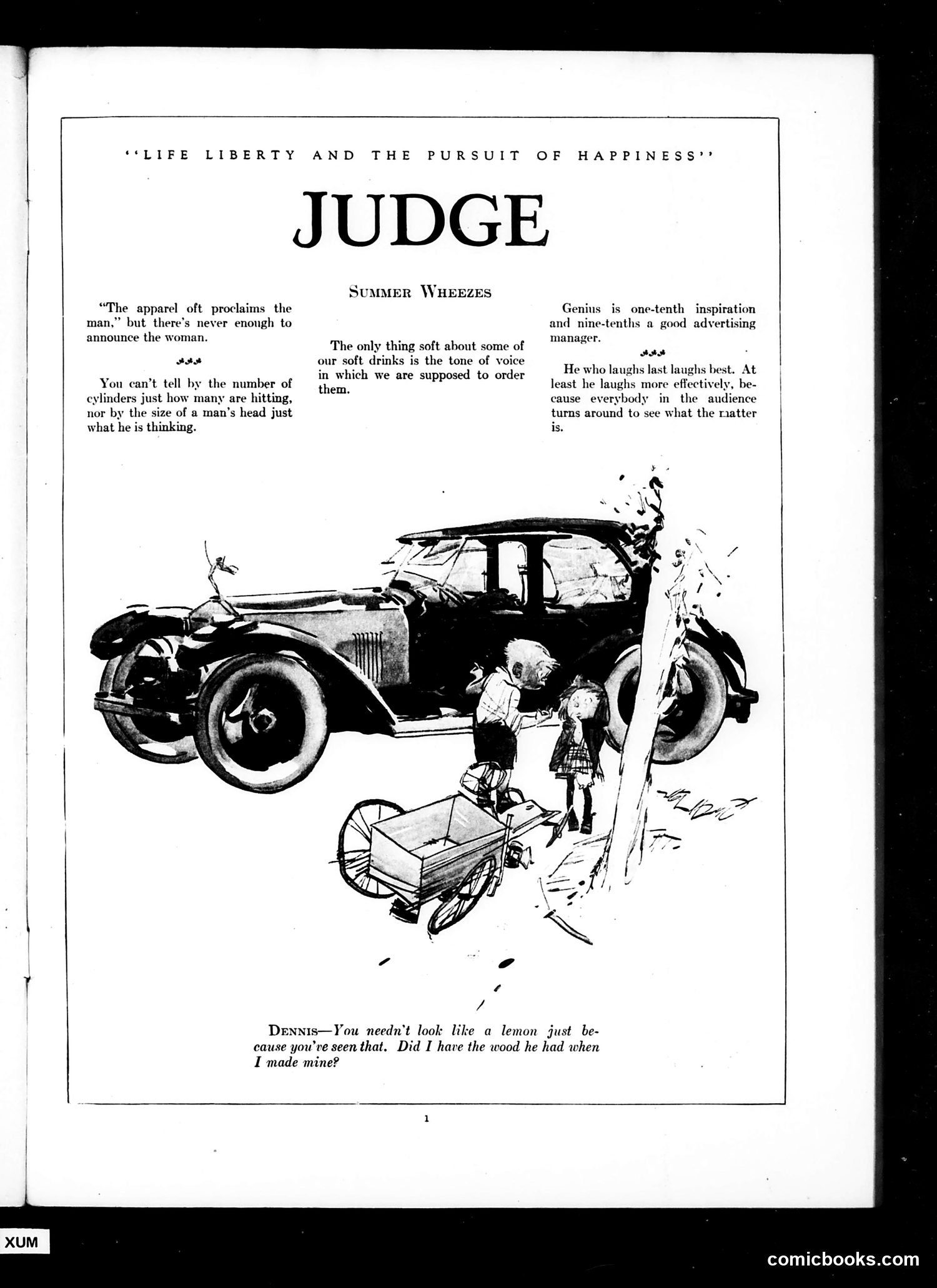
This page from *Judge* magazine features a humorous domestic scene with no clear political references. The header "Life Liberty and the Pursuit of Happiness" frames the content as social commentary. The cartoons and aphorisms mock gender dynamics and human nature: women's fashion is unpredictable ("apparel oft proclaims the man, but there's never enough to announce the woman"), intelligence can't be measured externally, and advertising requires exaggeration ("one-tenth inspiration and nine-tenths a good advertising manager"). The central illustration shows a man in a car observing children with a baby carriage and toy car—likely satirizing consumer culture or parenting anxieties. The caption "Dennis" comments on disappointment with purchased goods versus expectations. Overall, this appears to be general social satire about consumerism, vanity, and domestic life rather than addressing specific political events.
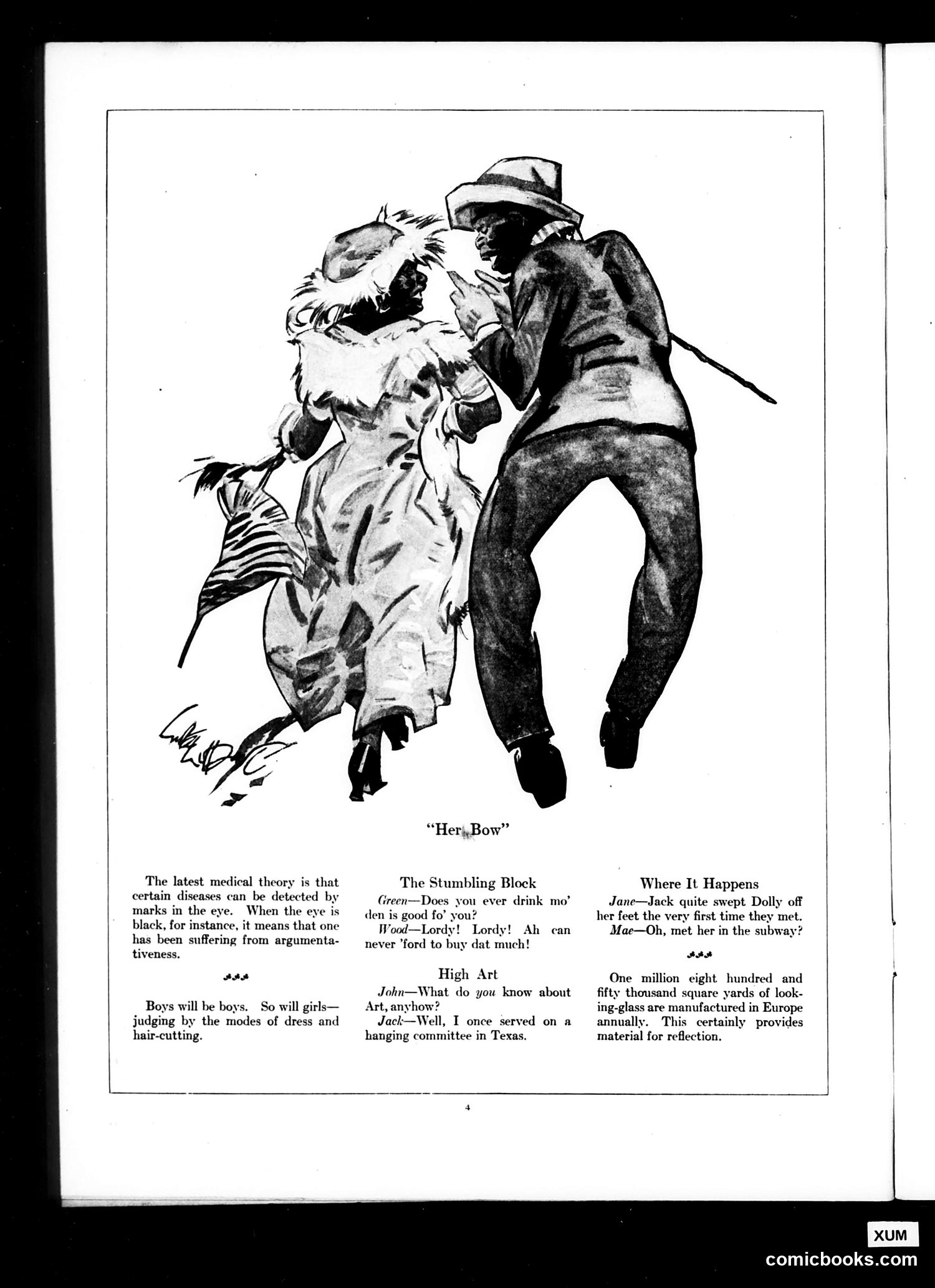
The main cartoon depicts a man carrying a woman, titled "Her Bow." The image appears to be satirizing aggressive or forceful romantic behavior, showing a man literally hauling away a resistant woman—likely commentary on contemporary dating or courtship practices. The three brief joke sections below mock various social topics: 1. **Medical diagnosis through eye marks** - satire of pseudoscientific health theories 2. **"The Stumbling Block"** - a dialogue joke about drinking and affordability 3. **"High Art"** - mocks pretentious art discourse (reference to a "hanging committee in Texas" suggests rural skepticism toward fine art) 4. **"Where It Happens"** - a subway encounter joke The page combines topical humor with social observation typical of early 20th-century Judge magazine's satirical approach to American life and manners.
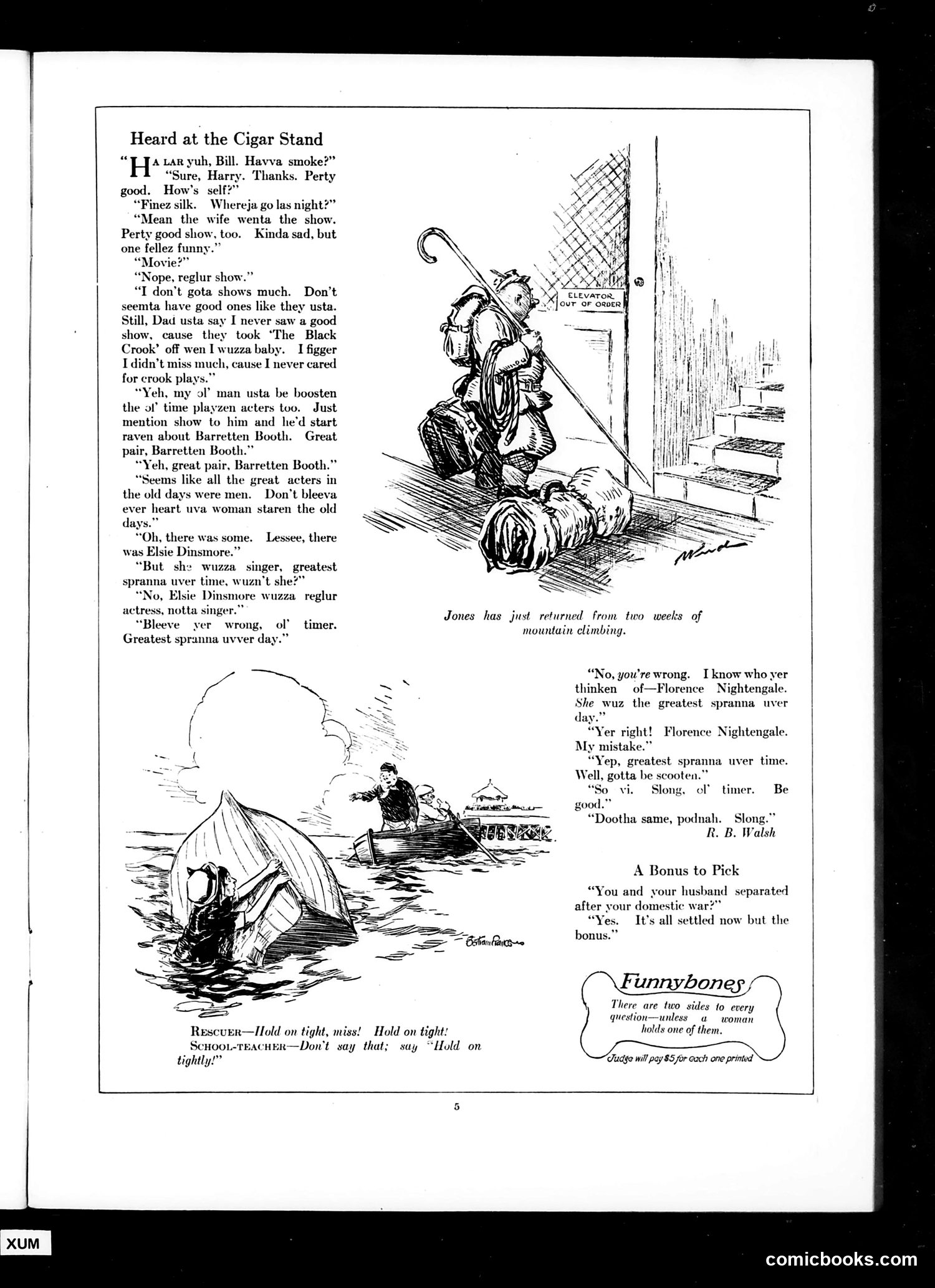
This page contains three distinct pieces of satire from Judge magazine: **"Heard at the Cigar Stand"**: A humorous dialogue between two men discussing theater, written in heavy working-class dialect. The joke hinges on their confusion about famous performers—they conflate Elsie Dinsmore (likely a stage actress) with Florence Nightingale (the famous nurse, not a singer), yet insist Nightingale was "the greatest soprano ever." The satire mocks ordinary men's casual ignorance about culture and history, presented as charming rather than foolish. **"Jones has just returned from mountain climbing"**: A simple visual gag showing a rescue scene with wordplay about grammar—a schoolteacher corrects "Hold on tight, miss!" to proper English while someone's drowning. **"A Bonus to Pick"**: A brief joke about divorce settlements, with the closing "Funnybones" quip suggesting women are the real victors in marital disputes, as they "hold one of the [two] sides." The overall tone reflects early 20th-century American humor: working-class vernacular, gender stereotypes, and casual mockery of both ignorance and education.
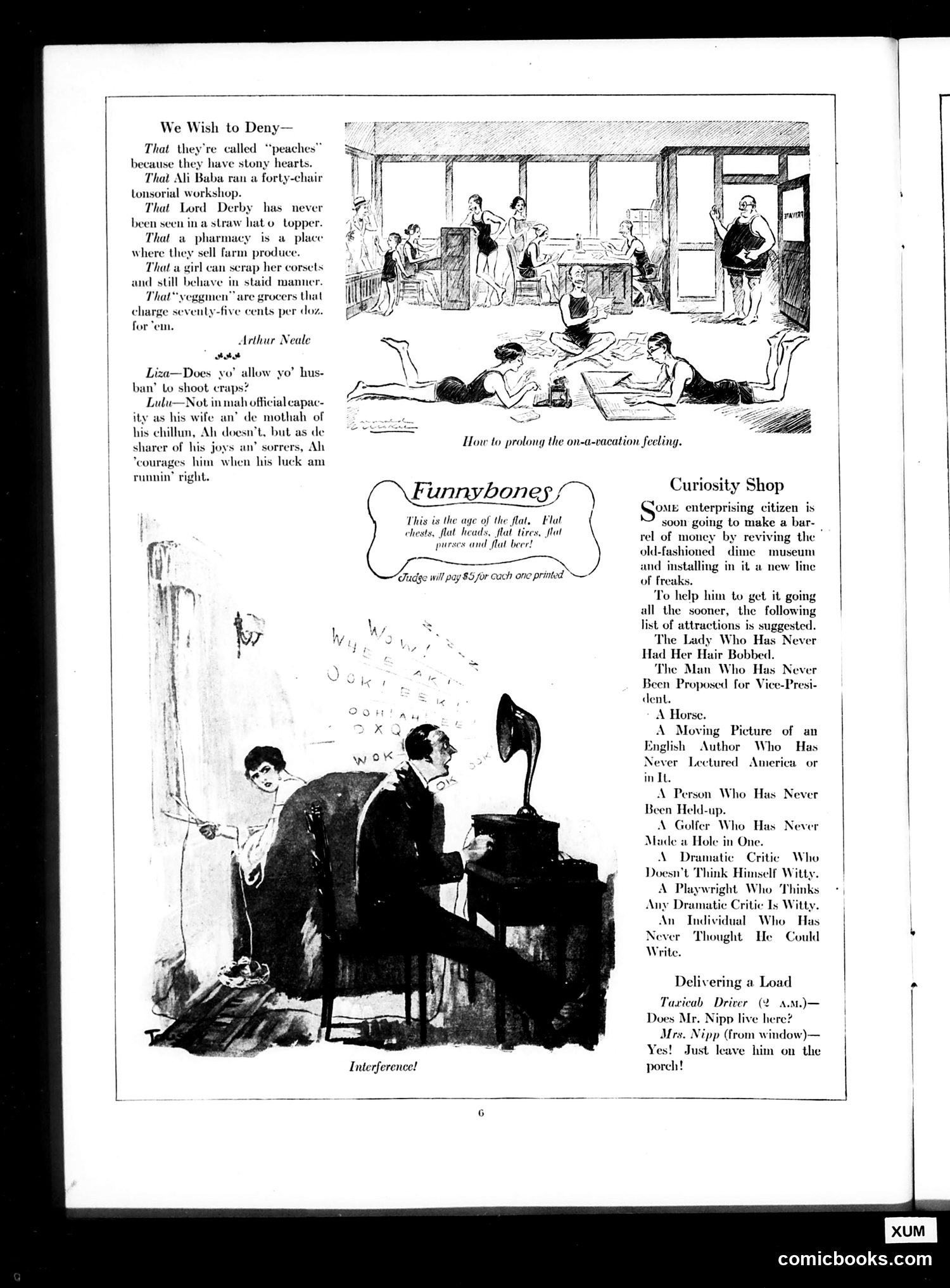
This page contains three satirical pieces typical of early 20th-century American humor: **"We Wish to Deny"** (top left): A list of mock-denials about absurd situations—Ali Baba running a barbershop, Lord Derby never wearing casual hats, pharmacies selling farm produce. The joke relies on the reader recognizing these as obviously false statements presented deadpan, mocking contemporary social pretensions. **"Funnybones"** (center): A visual gag showing two men apparently "interfering" with each other's work or activity, captioned to joke about the era's fascination with flat-chested fashion and beer. **"Curiosity Shop"** (right): Proposes attractions for a revival dime museum, satirizing modern life by listing increasingly absurd "rarities"—a woman who hasn't bobbed her hair, a golfer who's never made a hole-in-one, a dramatic critic who isn't conceited. The humor targets 1920s social trends: bobbed hair, golf's popularity, and theatrical pretension. **"Delivering a Load"** (bottom): Brief taxi-driver joke about depositing an unconscious passenger. The page exemplifies Judge's style: social observation through exaggeration and incongruity.
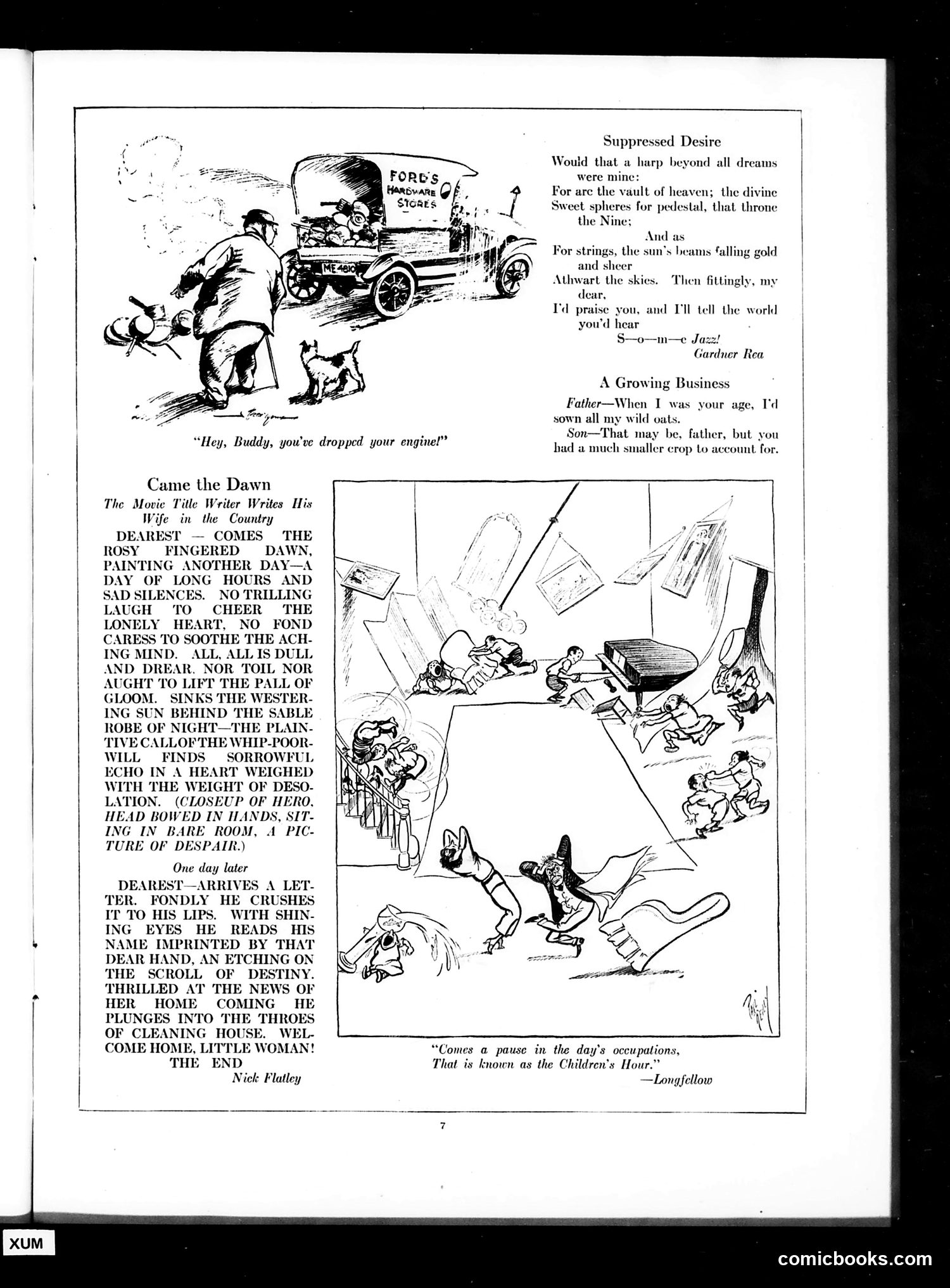
**"Hey, Buddy, you've dropped your engine!"** (top cartoon): A slapstick joke about an early automobile breaking down. A man bends over to pick up a detached engine part while his dog watches. The humor relies on the novelty and unreliability of early cars—engines were prone to literally falling apart. **"Came the Dawn"** (center): Satire of silent-film title cards and melodramatic movie writing. A husband writes his absent wife in overwrought, purple prose ("rosy fingered dawn," "weight of desolation"), describing his loneliness. The punchline: when she announces her return, he frantically cleans house instead of remaining poetic. The joke mocks both pretentious movie title-writing and husbands' priorities. **"A Growing Business"** (right): A father-son joke about wildly different moral standards. Father boasts he "sowed wild oats" in youth; son replies the father simply had fewer oats to account for—implying the son's generation is more dissolute. The page demonstrates Judge magazine's mix of automotive-era humor, film industry satire, and generational comedy.
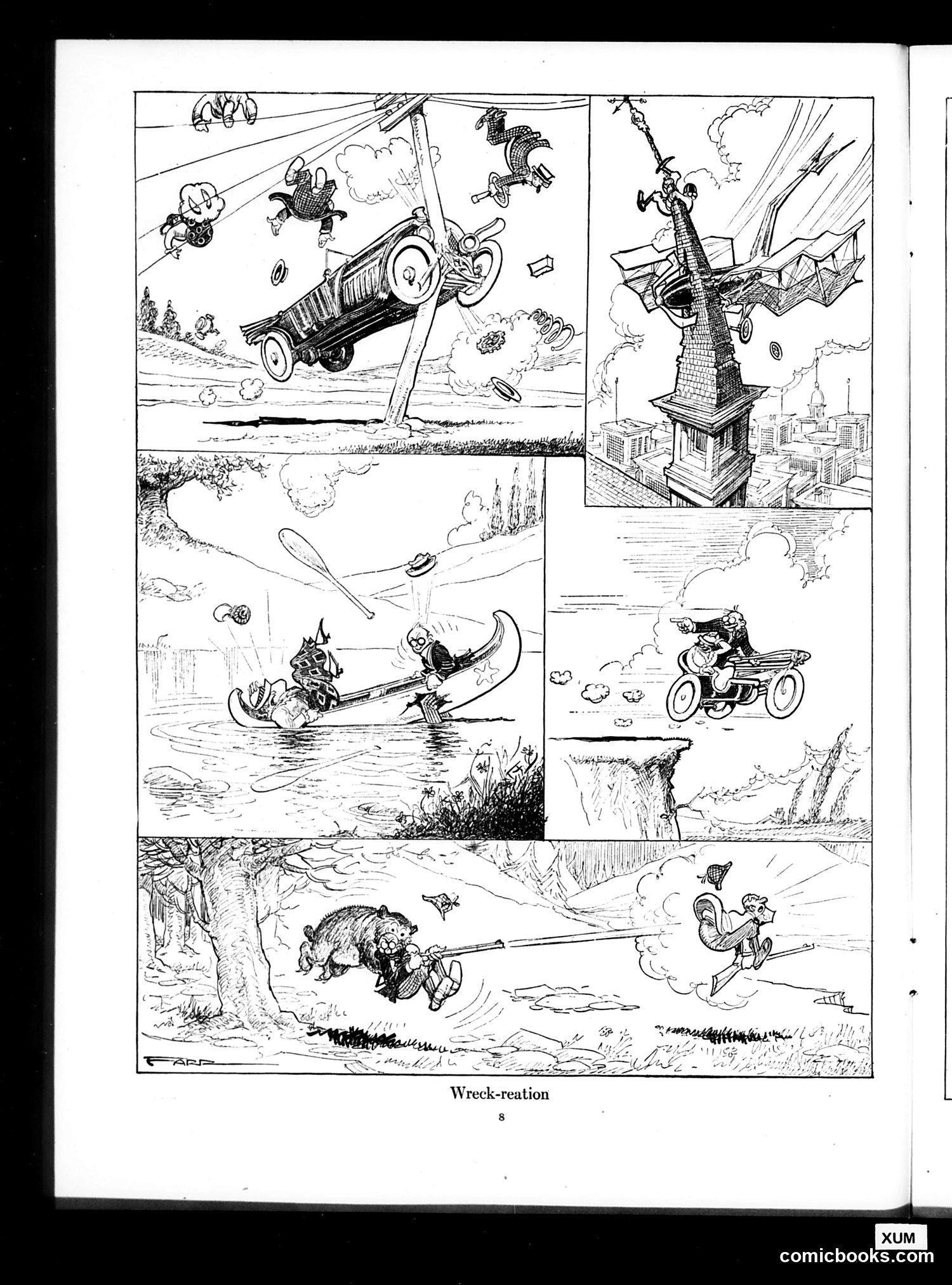
This satirical comic page depicts various characters engaging in destructive or dangerous activities presented as leisure pursuits. The title is a pun combining "wreck" and "recreation." The panels show increasingly absurd scenarios: a vehicle suspended by crane, a car/plane hybrid crashing into a landmark (appears to be the Statue of Liberty), characters on a motorcycle fleeing cliffs, people in precarious water situations, and what appears to be a bear-like figure engaged in chaotic action. The satire appears to mock reckless behavior and poor judgment presented as entertainment or fun. Without additional context from Judge magazine's publication date, the specific targets remain unclear, but the overall message critiques dangerous pastimes or foolish decision-making disguised as recreation—likely commentary on contemporary cultural trends of the era.
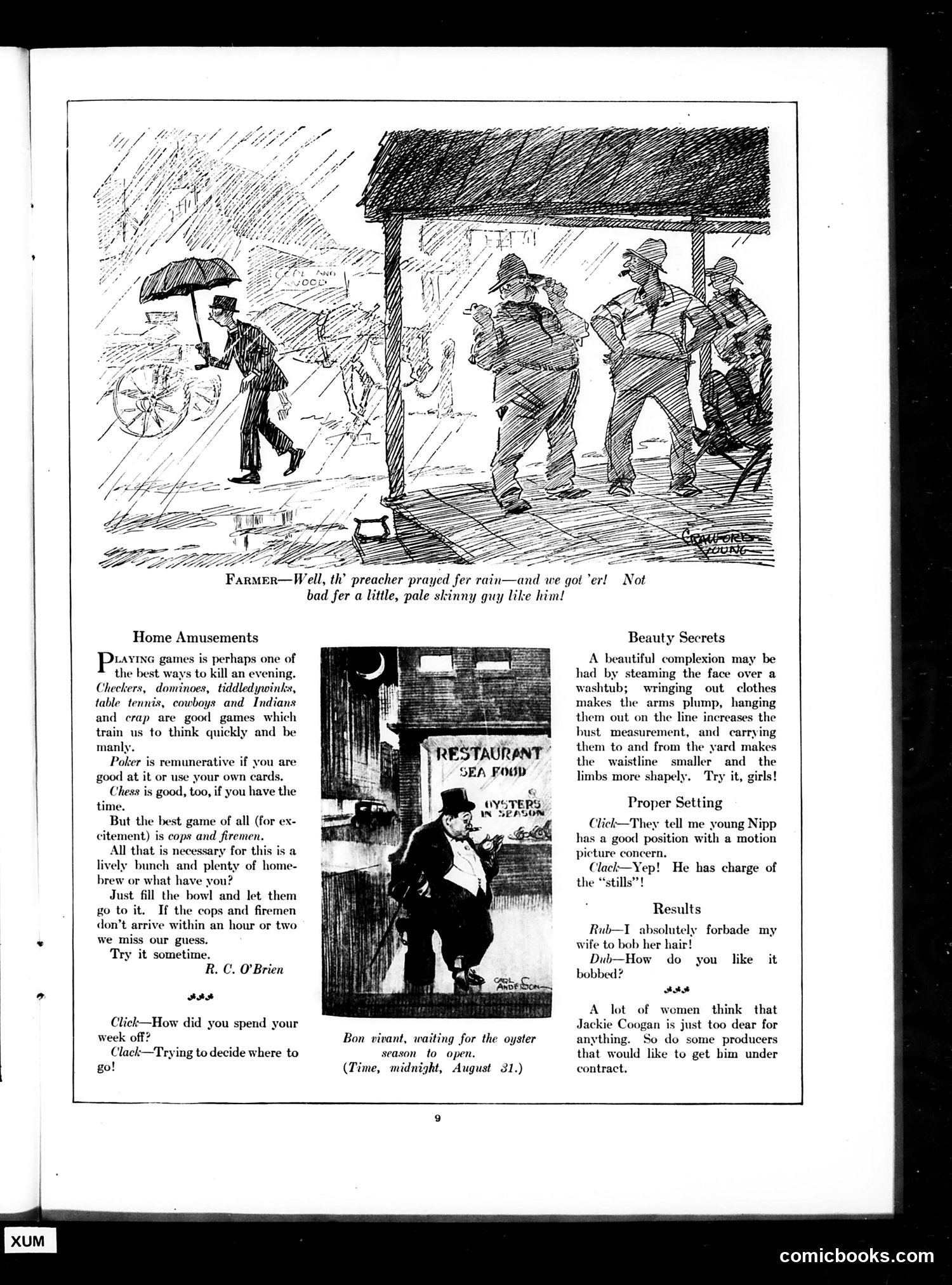
The top cartoon satirizes rural piety: a farmer stands in rain with an umbrella while others shelter under a roof. The caption jokes that the preacher's prayer for rain worked—but the farmer's slight build makes him an ironic recipient of this "blessing." The humor targets both agricultural desperation and the farmer's physical frailty. The page mixes advice columns and brief comedic dialogues typical of Judge's format. "Home Amusements" humorously recommends "cops and firemen"—playing with homemade alcohol ("home-brew")—as entertainment, satirizing Prohibition-era Americans' creative circumvention of the law. Other sections mock contemporary trends: "Beauty Secrets" ridicules women's pursuit of idealized body measurements through housework; "Proper Setting" jokes about Jackie Coogan (child actor) being expensive; and the restaurant illustration shows someone waiting for oyster season (August 31 deadline), referencing the old "R" month rule for oyster consumption. The overall tone is lighthearted social commentary on American customs and fads.
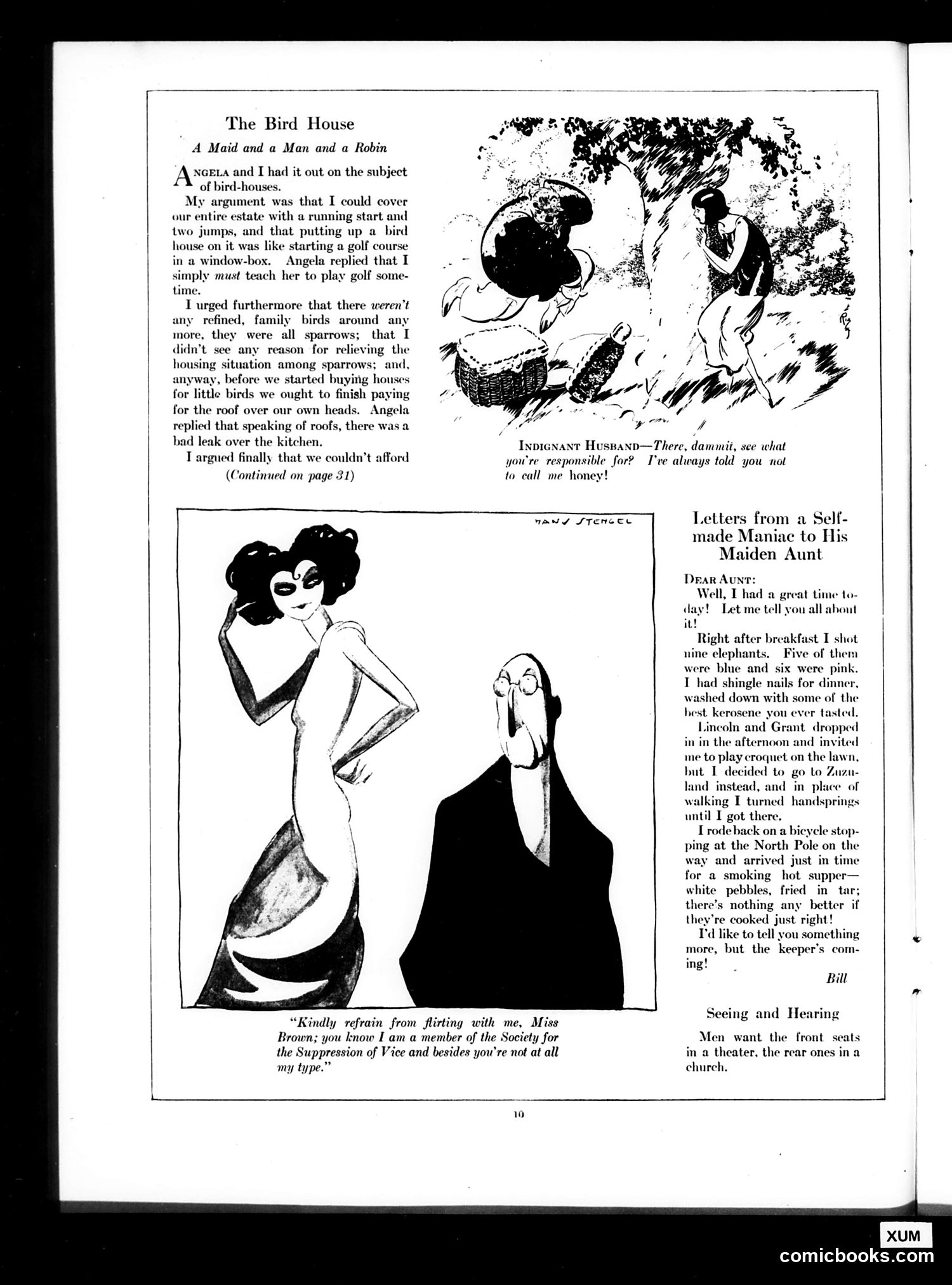
This page contains three separate humorous pieces typical of early 20th-century satirical magazines: **"The Bird House"**: A domestic comedy where a husband argues against buying birdhouses while his wife Angela insists. His practical objections (expense, uselessness for sparrows) are undermined when she points out their own roof leaks—a gentle satire on marital disputes where wives prove right about home maintenance. **Bottom cartoon**: A prudish man lecturing a flirtatious woman, claiming membership in the "Society for the Suppression of Vice." This mocks Victorian morality movements and self-righteous attitudes about propriety. **"Letters from a Self-made Maniac"**: A humorous asylum-inmate letter describing absurd fantasies (shooting colored elephants, eating nails and kerosene, handsprings to the North Pole). The punchline reveals he's institutionalized—dark humor about mental illness common to the period. **"Seeing and Hearing"**: A brief joke about theater seating preferences, possibly critiquing class distinctions or gender dynamics in public spaces. The overall tone reflects Judge's blend of domestic satire, social commentary, and absurdist humor.
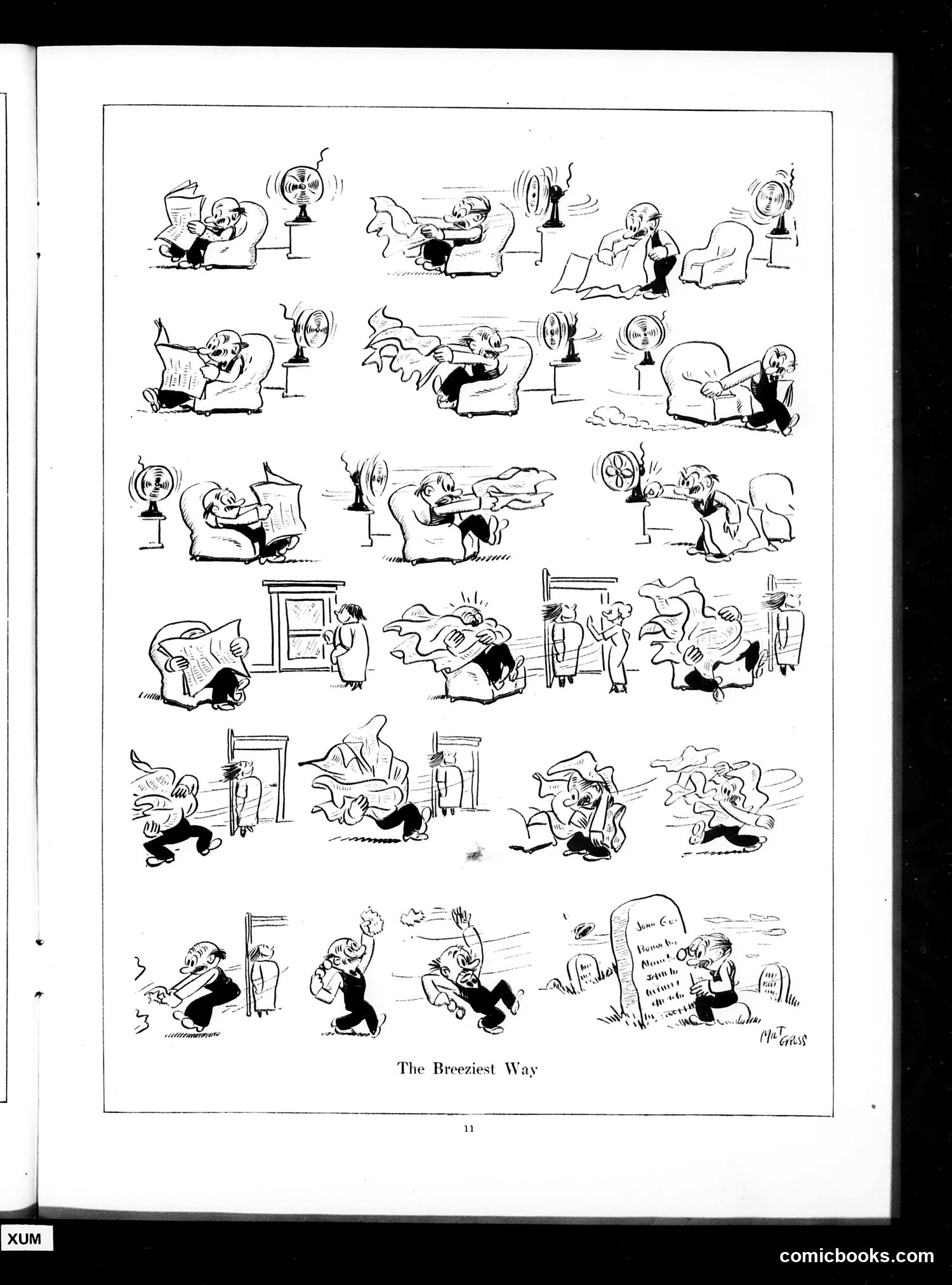
This is a comic strip depicting a man's increasingly desperate attempts to cool off in hot weather. The sequence shows him progressively adopting more extreme measures: starting with a desk fan, moving to sitting directly in front of fans, then attempting to create artificial breezes through various methods—opening windows and doors, running around, and eventually ending at what appears to be a grave. The satire mocks how people obsessively pursue relief from summer heat, escalating from reasonable solutions to absurd and self-destructive ones. The final panel's gravestone joke suggests that seeking "the breeziest way" has fatal consequences—a dark humor commentary on the desperation heat waves inspire. The cartoon reflects early-20th-century urban life before widespread air conditioning, when summer heat was a genuine public health and comfort crisis.
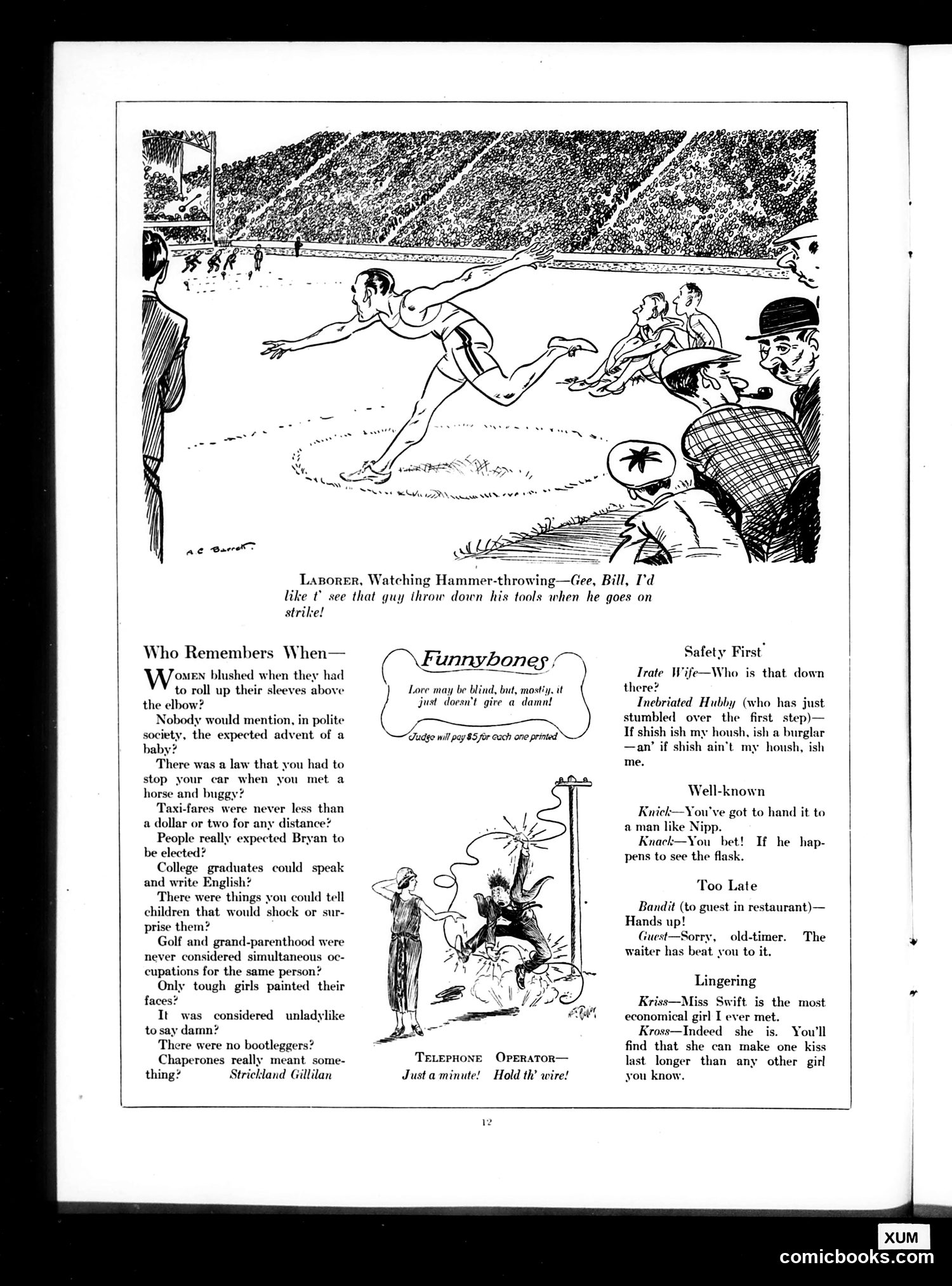
This page contains multiple satirical cartoons and humor pieces reflecting 1920s American social attitudes. **Top cartoon**: A laborer watches a hammer-throw competition, joking that he'd like to see the athlete "throw down his tools when he goes on strike"—mocking labor unrest of the era. **"Who Remembers When"**: A nostalgia piece by Strickland Gillilan lamenting lost Victorian propriety: women's exposed elbows, frank discussion of pregnancy, relaxed social rules. The reference to "Bryan" likely means William Jennings Bryan's failed presidential campaigns. The piece contrasts old morality with 1920s looseness (painted faces, casual profanity, bootleggers during Prohibition). **"Funnybones" section**: Short jokes about modern life—a telephone operator, a drunk husband mistaking his own home for a burglary, a bandit robbed by a waiter, and a girlfriend who makes kisses "last longer" (implying cheapness). These reflect contemporary concerns: technology, alcohol, economic hardship, and changing romance. The overall tone mocks both old-fashioned restrictions and modern vices.
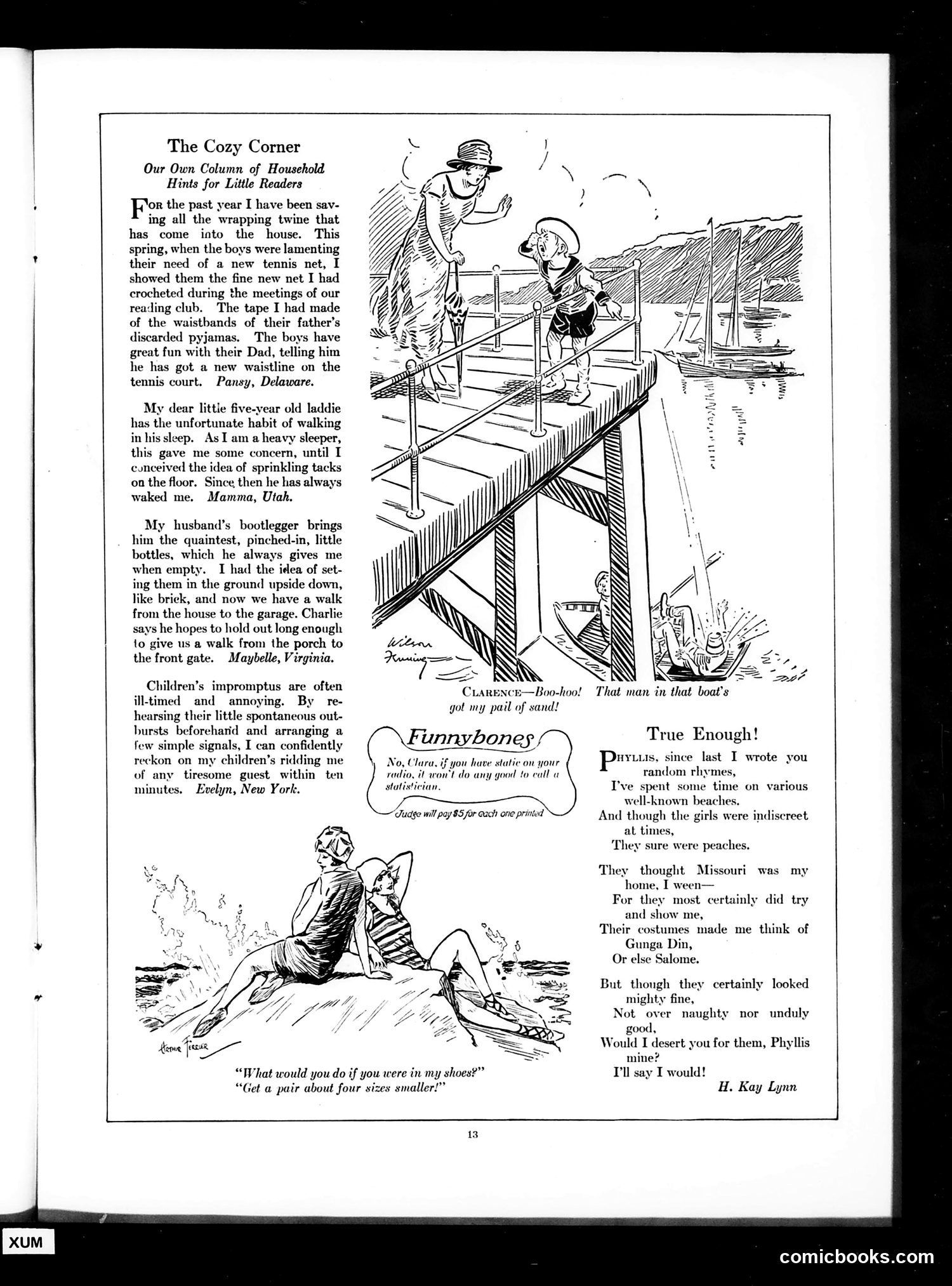
This page contains household advice and humor for a general audience. The main column offers domestic tips from readers (crocheting tennis nets from twine, using tacks to prevent sleepwalking, repurposing bootlegger bottles as garden edging). These appear tongue-in-cheek, particularly the final tip about "bootlegger bottles"—a topical reference to Prohibition-era illegal alcohol distribution. The cartoons below offer gentle domestic humor: a child's misunderstanding about sand, and a shoe-size joke. The poem "True Enough!" by H. Kay Lynn recounts beach visits and attractive women ("peaches"), with the speaker humorously insisting he wouldn't abandon his correspondent "Phyllis" despite temptations. The overall tone is lighthearted domesticity mixed with mild social commentary (bootlegging reference) and conventional flirtation humor typical of 1920s-era Judge magazine.
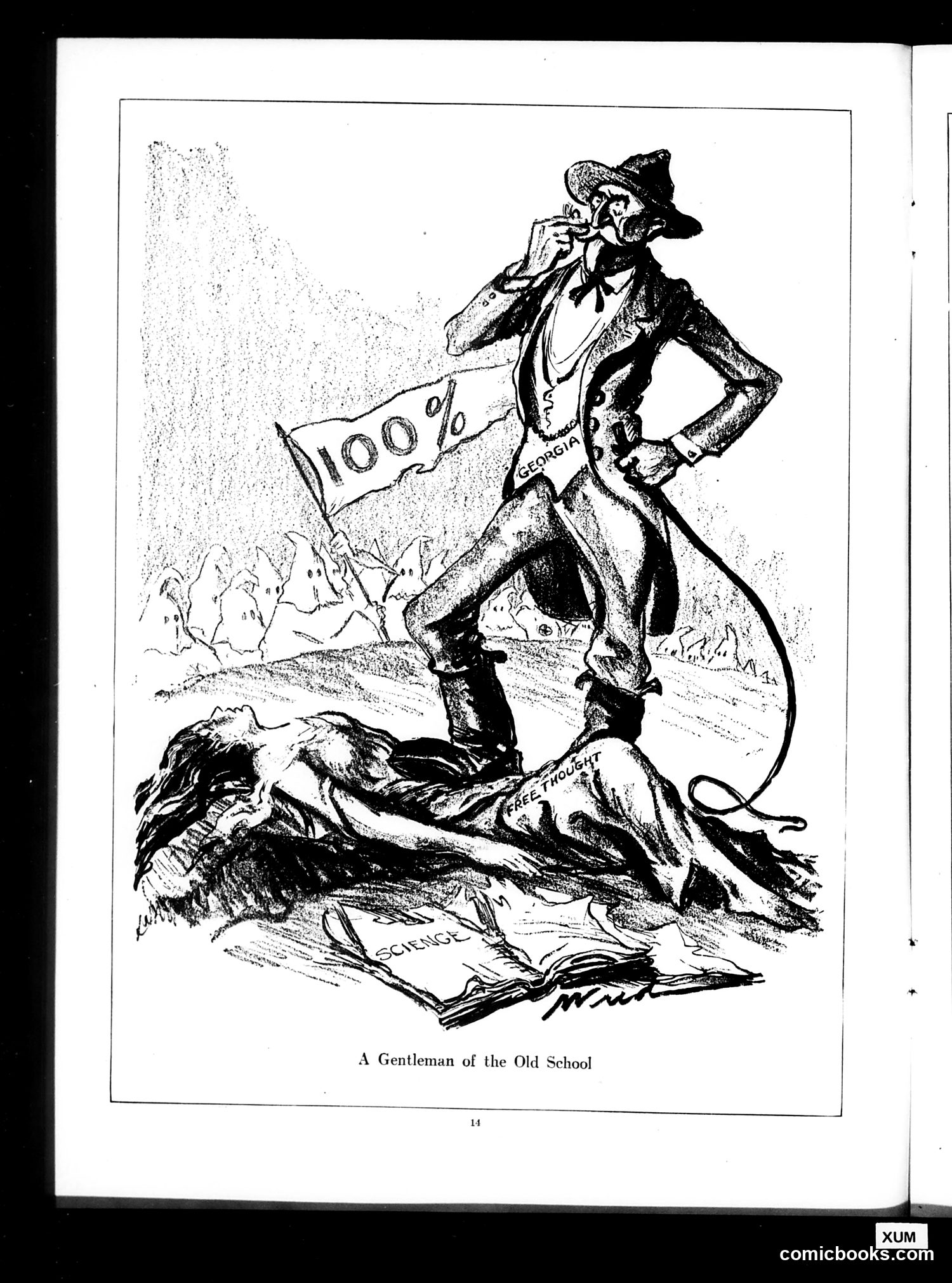
This cartoon depicts a well-dressed gentleman from an earlier era, wielding a whip labeled "100%" while standing over fallen figures labeled "Free Thought" and "Science." Books scatter beneath him. The satire criticizes dogmatic adherence to outdated beliefs and practices—the "old school" approach that suppresses modern scientific inquiry and independent thinking. The "100%" banner likely references absolute certainty or blind faith in traditional doctrine. The whip suggests authoritarian enforcement of conformity. The cartoon argues that old-fashioned gentlemen cling to antiquated ideas through coercion rather than reason, literally crushing intellectual progress. This reflects Judge magazine's progressive stance, mocking those who resisted scientific advancement and free inquiry in favor of inherited tradition.
This page contains political commentary on early 1920s America. **"A Compact"** depicts a dialogue between a Judge and Senator La Follette (progressive reformer), establishing an ironic "truce" against the Ku Klux Klan except during elections—satirizing how even opponents unite against this threat while maintaining political rivalry. **"Our Own Von Tirpitz"** critiques Rear Admiral W.L. Rodgers's prediction that America will seek war once its population reaches 200 million. The piece rebuts his logic, arguing technological progress makes territorial expansion unnecessary and that growing populations become *more* peaceful, not less. The "Von Tirpitz" reference compares Rodgers to Germany's WWI naval strategist, suggesting American militarism mirrors pre-war Prussian jingoism. **"Tinder"** argues war stems from civilian boredom and monotony in industrial society—factories, censored entertainment, standardized billboards. It cynically notes pacifists' ineffectiveness while militarists inadvertently help by breaking routine monotony. **"A Regular Hundred Percenter"** (fragment) appears to satirize self-proclaimed "100% Americans," likely KKK members using that slogan, through the contrasting example of Stewart N. McMullin.
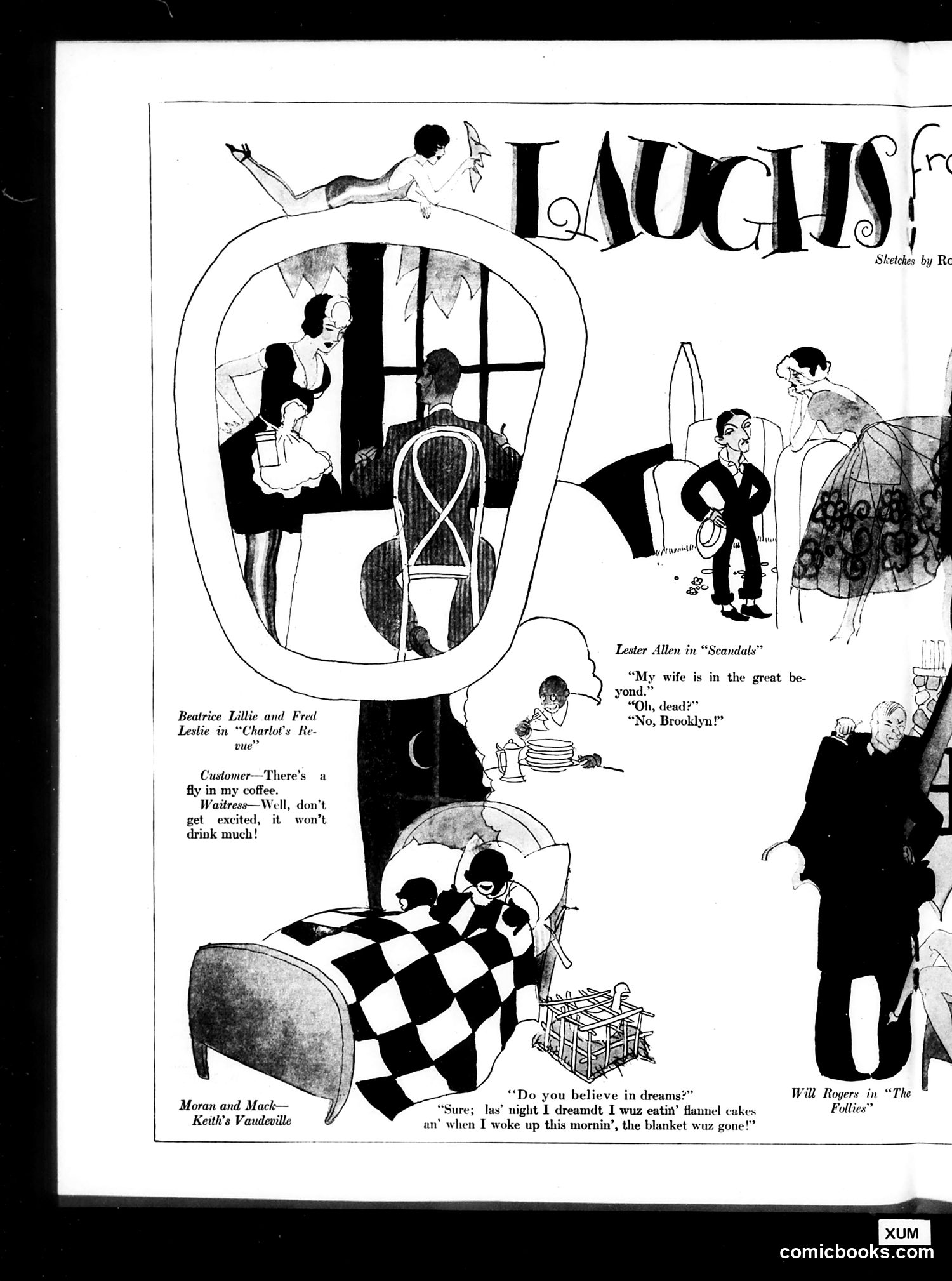
This page collects **vaudeville and Broadway theater jokes** from the 1920s, featuring sketches by popular performers of the era: Beatrice Lillie, Fred Leslie, Lester Allen, Will Rogers, and the comedy duo Moran and Mack. The humor relies on **simple, punchy one-liners** typical of stage comedy: - A wife being "in Brooklyn" (not dead) as a joke about marital discord - A waiter's deadpan response to a fly complaint - A dream joke playing on the physical absurdity of eating flannel cakes These are **theater advertisements disguised as humor content**—Judge promoted Broadway and vaudeville shows while entertaining readers with brief comedic scenes. The satire is light and domestic rather than political. The jokes depend on wordplay and unexpected punchlines rather than topical references most modern readers would recognize without theatrical context.
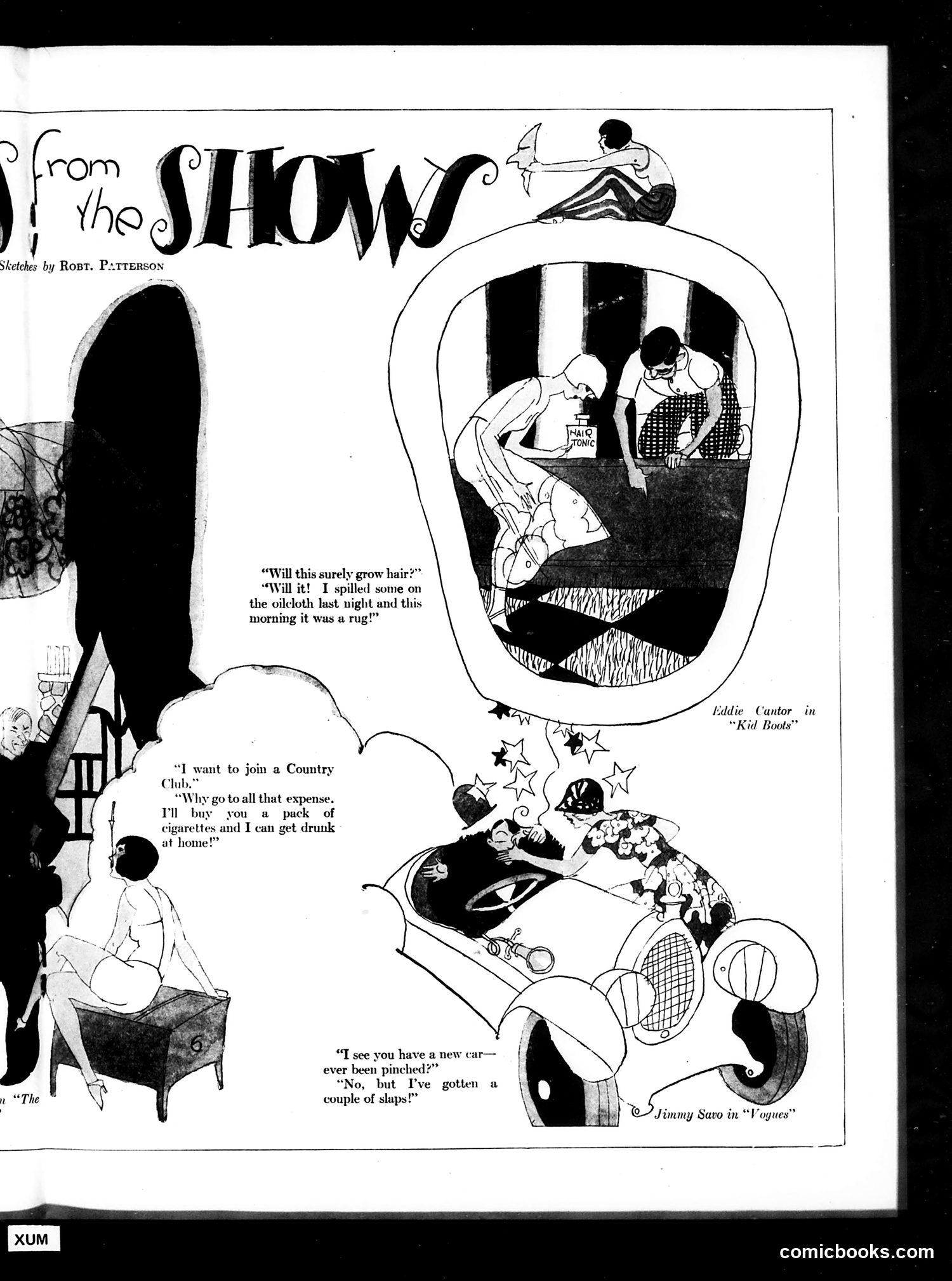
This page showcases theatrical humor sketches from Judge magazine, featuring satirical vignettes about 1920s social life. The top sketch mocks hair-growth products—a common advertising scam of the era—by joking that the substance is so potent it turned spilled liquid into a rug, exposing false marketing claims. The middle cartoon satirizes the wealthy's leisure culture. A character wanting to join an exclusive Country Club is told he doesn't need the expense; he can simply buy cigarettes and get drunk at home for the same effect—mocking both the pretension of country clubs and Prohibition-era drinking habits. The bottom sketch about a "new car" uses "pinched" (arrested) and "slaps" (traffic citations or fender-benders) to create wordplay about automotive mishaps. All three sketches feature performers from contemporary Broadway shows (Eddie Cantor, Jimmy Savo), indicating Judge's focus on theatrical culture and entertainment-world gossip for its urban, sophisticated readership.
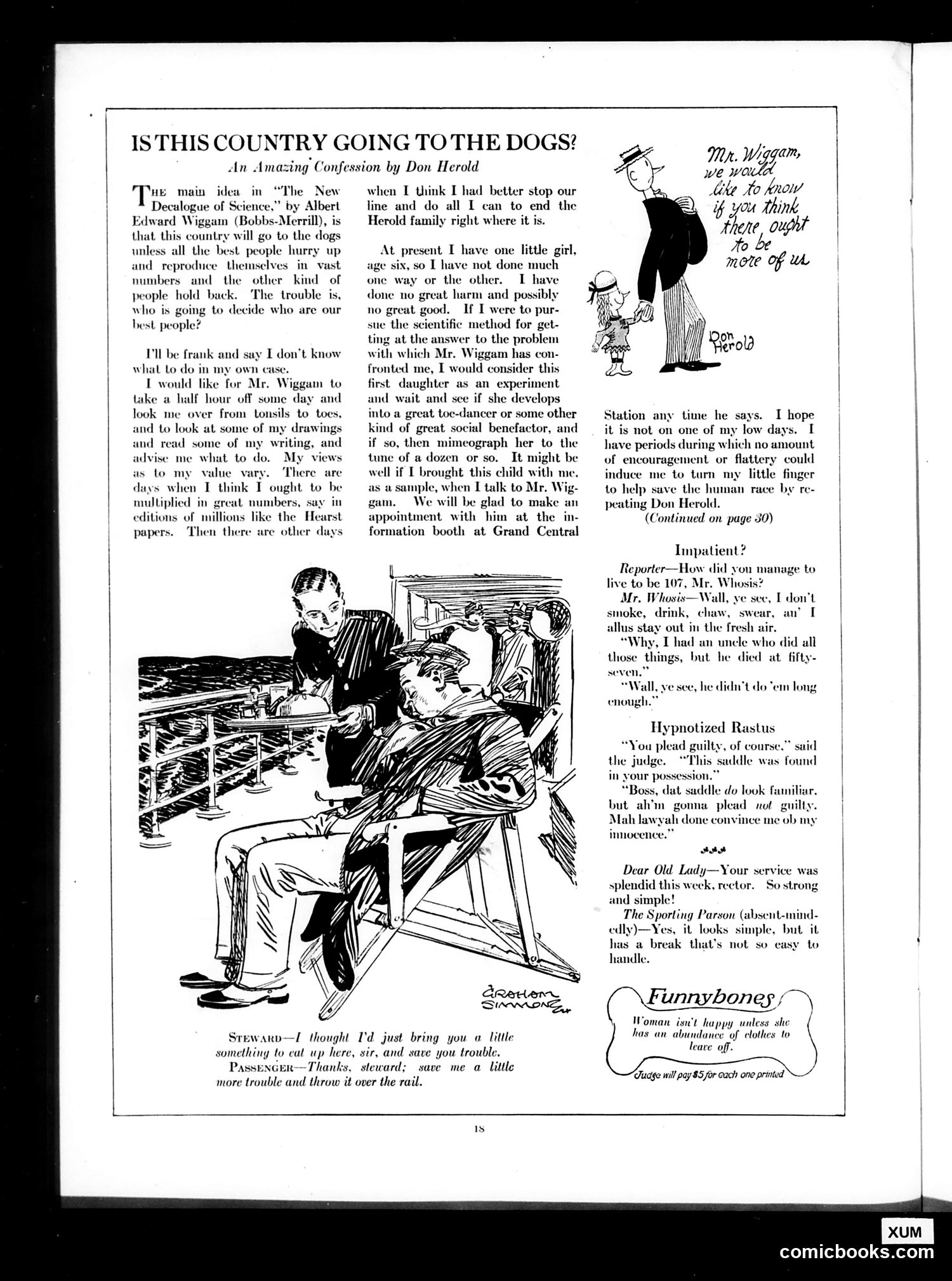
This page satirizes eugenics theory, specifically Albert Edward Wiggam's book *The New Decalogue of Science*, which advocated that "superior" people should reproduce prolifically while others should limit offspring. Don Herold's confession humorously exposes the absurdity: he can't determine whether *he* qualifies as "best people" worth multiplying, so he treats his young daughter as an "experiment" to gauge her future worth before deciding whether to have more children. The satire targets the pseudo-scientific arrogance of eugenics advocates who claim objective authority to judge human value. Herold's self-deprecating uncertainty undermines the entire premise—if an educated writer can't assess his own merit, how can anyone reliably identify society's "best" for selective breeding? The page also includes unrelated brief comics about longevity, courtroom humor, and fashion—typical Judge filler content.
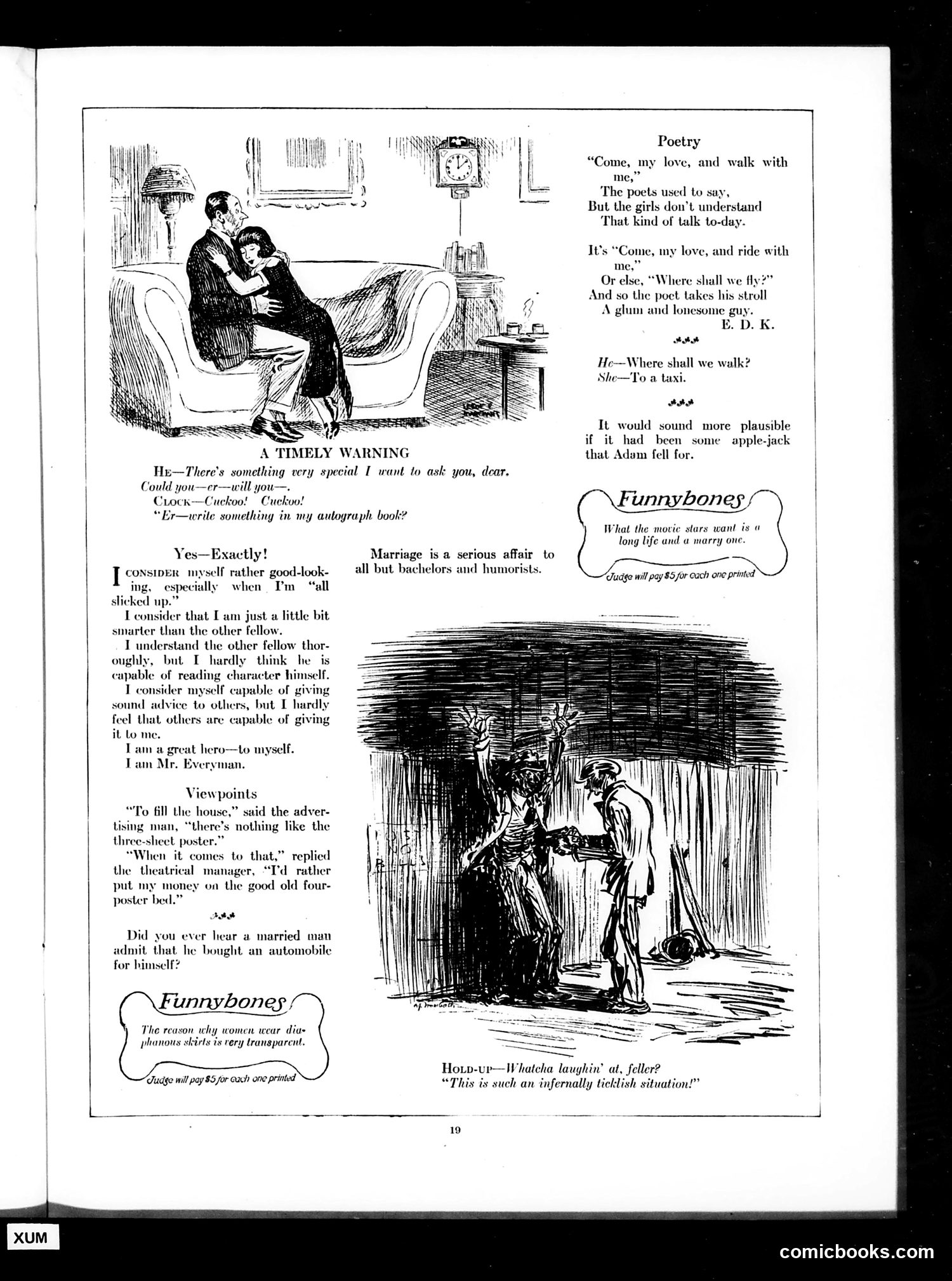
This page contains multiple humorous pieces satirizing modern courtship and marriage customs circa the 1920s-30s. The main cartoon "A Timely Warning" depicts a man nervously proposing to a woman on a sofa, interrupted by a cuckoo clock—the joke being that modern romance is disrupted by domestic banality. The poetry section mocks how modern women have abandoned romantic ideals. Where poets once invited lovers to "walk," contemporary women demand taxi rides or airplane flights—they're materialistic and unromantic. The "He—Where shall we walk? / She—To a taxi" exchange reinforces this theme: women prioritize practical transportation over poetic gestures. "Mr. Everyman" section presents satirical self-importance—a common everyman character boasting of his own superiority while dismissing others' capabilities, mocking male ego. The "Funnybones" section makes crude observations about marriage, bachelors, and women's fashion transparency—typical period humor. Overall, the page satirizes how modern dating and marriage have become transactional and unromantic, with women materialistic and men either foolish or self-deluded.
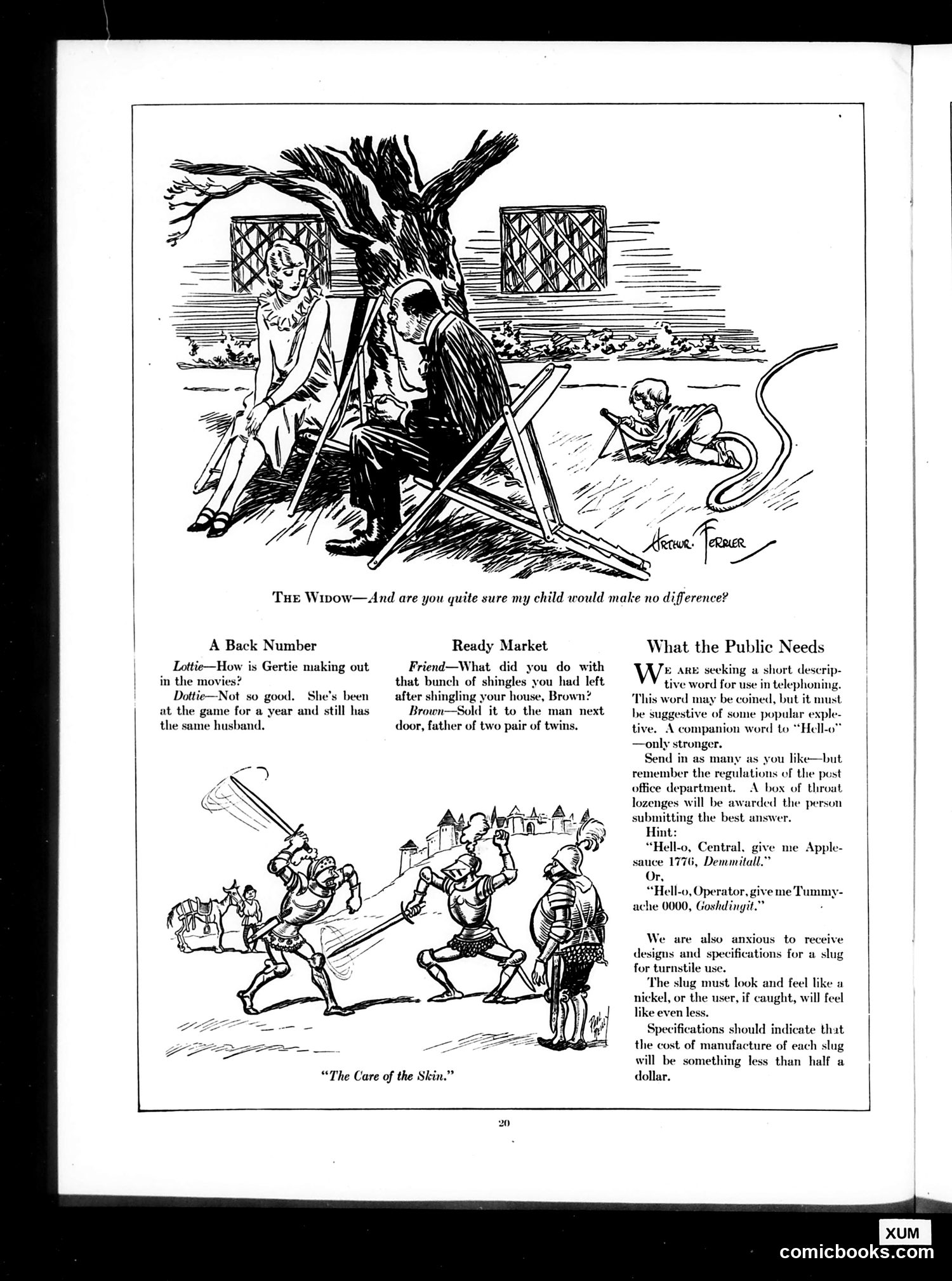
This page contains three satirical humor pieces typical of early 20th-century American humor magazines: **"A Back Number"** mocks women entering the film industry, suggesting a year in movies hasn't changed a woman's marital status—implying marriage is the real goal, not career. **"Ready Market"** jokes about selling leftover roof shingles to a neighbor described as "father of two pair of twins"—the humor relies on the implication that this man's fertility makes him desperate enough to buy scrap materials. **Top cartoon** ("The Widow") depicts a woman with a child asking a man if her child would "make no difference"—likely suggesting courtship/marriage negotiations where a woman's existing child from a previous relationship affects her marriageability. **"The Care of the Skin"** is a humorous contest asking readers to coin a telephone greeting stronger than "Hello" (suggesting mild profanities), and satirically requests designs for counterfeit coins ("slugs") for turnstiles—mocking both telephone etiquette and fare evasion. The page reflects period attitudes about women, marriage, and social propriety through crude humor.
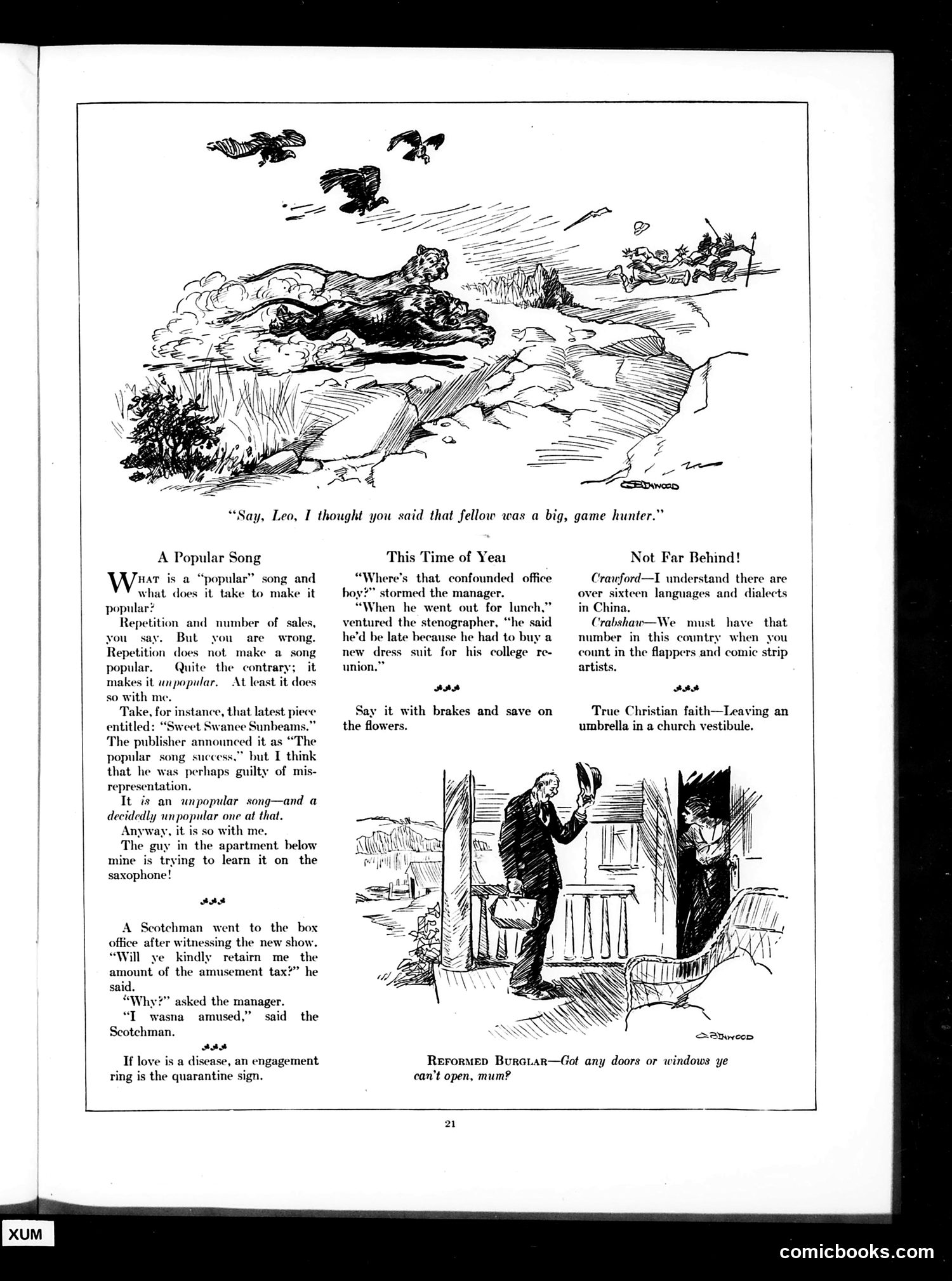
This page contains several unrelated humorous snippets typical of Judge's satirical format: **"A Popular Song"**: Mocks both a song titled "Swanee Sunbeams" and the music industry's definition of "popular." The author argues repetition makes songs *un*popular, complaining about a neighbor practicing saxophone—likely referencing how sheet music promotion relied on relentless public exposure. **"This Time of Year"**: A brief workplace joke about an office worker buying a college reunion suit instead of returning to work, poking fun at vanity and absent employees. **"Not Far Behind!"**: Social satire comparing China's 16+ languages to America's linguistic diversity, counting "flappers and comic strip artists" as distinct speech groups—mocking both flappers (1920s youth culture) and lowbrow entertainment. **"Reformed Burglar"**: A visual gag about a reformed criminal offering door/window repair services—darkly humorous given his former profession. The top cartoon depicts a failed hunter, likely satirizing exaggerated hunting stories or incompetent sportsmen. Overall, the page reflects 1920s-era social commentary on popular culture, workplace absurdity, and immigrant/cultural anxieties.
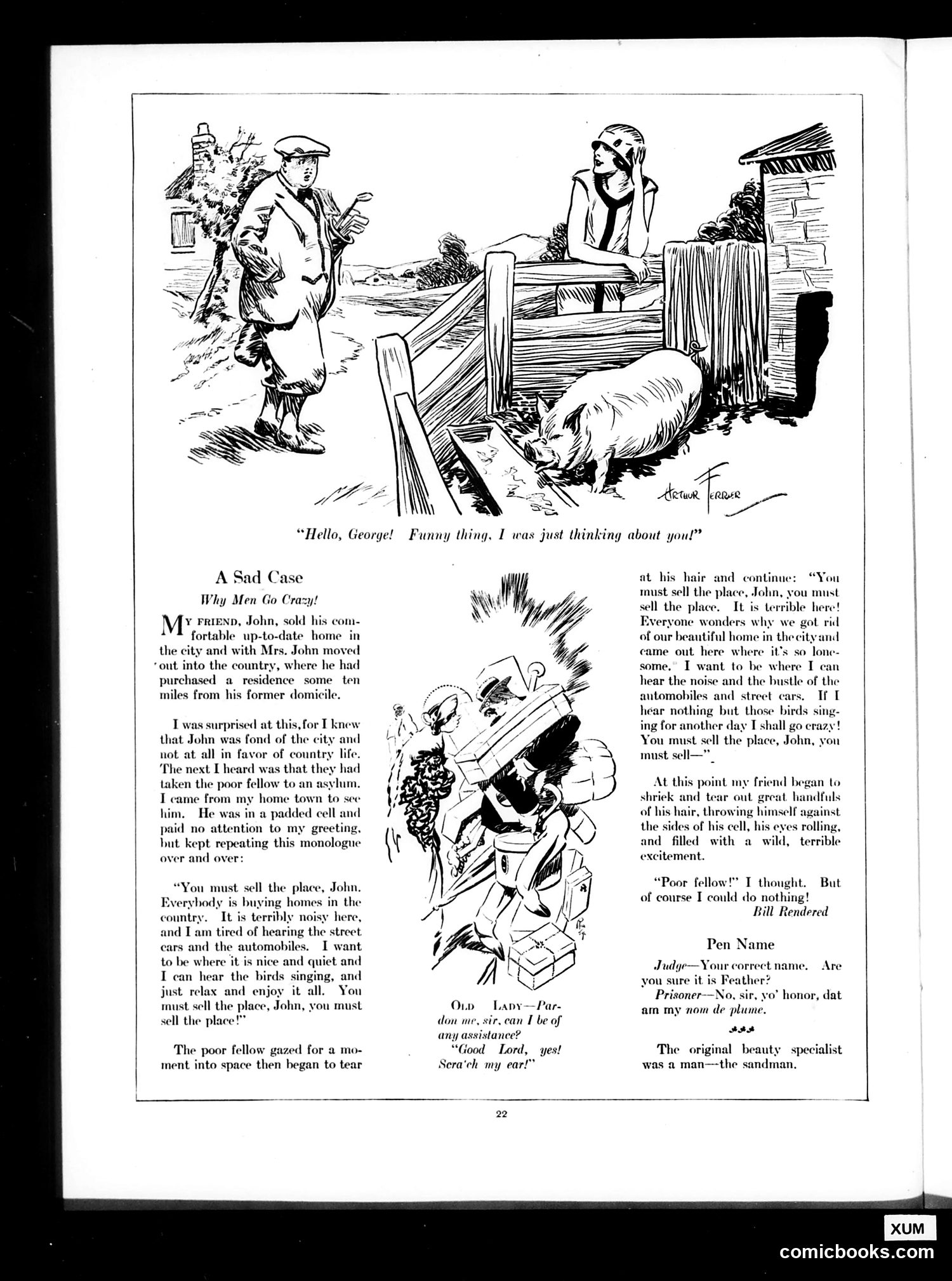
This satirical story mocks the early 20th-century trend of urbanites relocating to the countryside seeking peace and quiet. The joke is ironic: John's wife pressures him to sell their comfortable city home for rural tranquility, but her relentless nagging about the move drives him insane instead. He ends up in an asylum, obsessively repeating her demands verbatim—a darkly humorous commentary on how wives' insistence on lifestyle changes (often presented as improvements) can backfire catastrophically. The accompanying cartoon shows a man arriving home to find his wife waiting with news, captioned "Hello, George! Funny thing, I was just thinking about you!"—suggesting she has more unwelcome announcements or demands. The satire targets both the country-living craze and marital dynamics, suggesting that well-intentioned domestic decisions, when forced, create chaos rather than happiness.
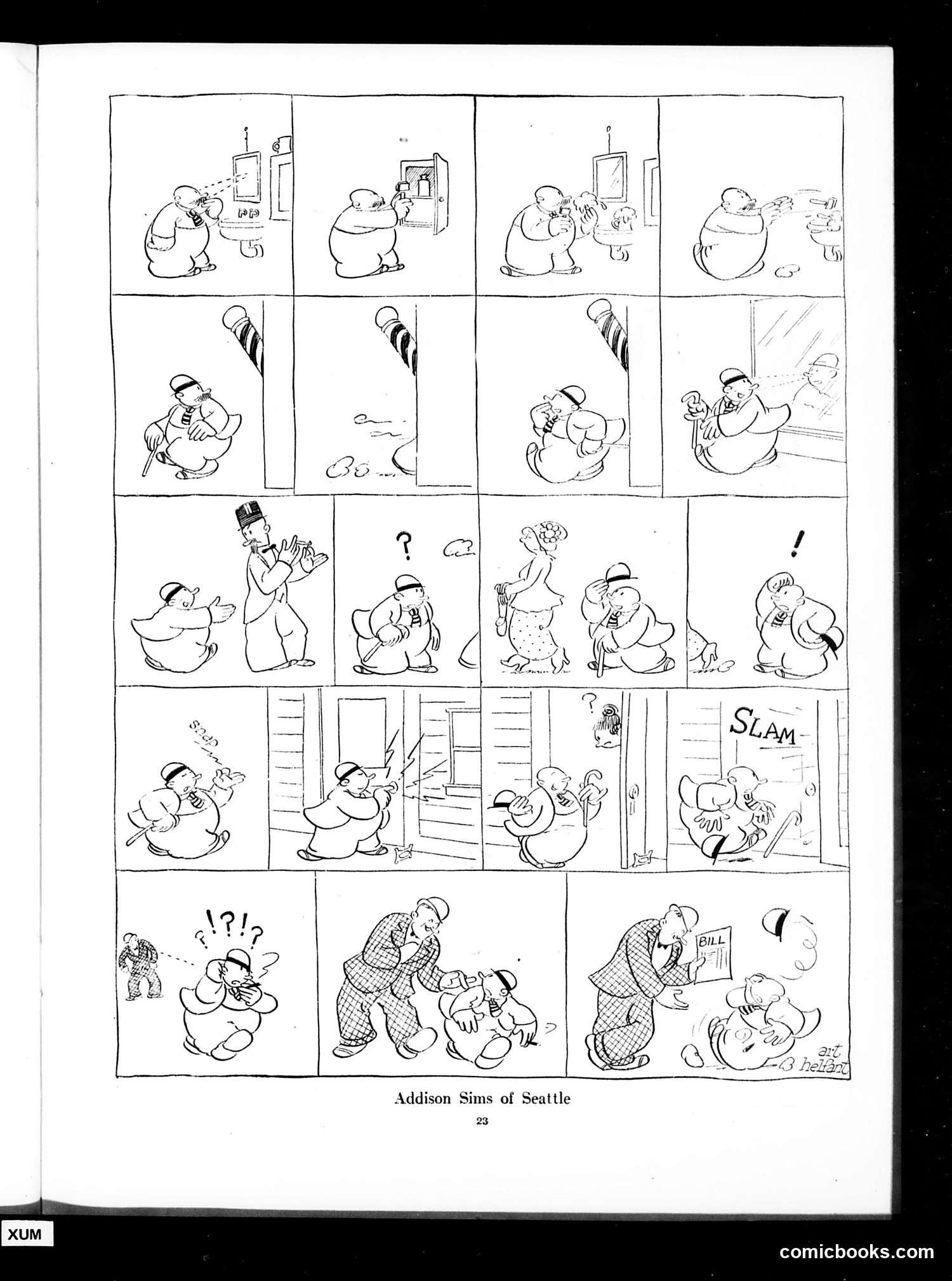
This is a sequential comic strip by Addison Sims depicting a rotund, working-class man in a bowler hat encountering various domestic and social situations. The narrative appears to follow him interacting with electrical outlets, a mailbox, a tall distinguished gentleman (possibly representing authority or wealth), and culminates in a "SLAM" and confrontation over a "BILL." The satire targets the everyday frustrations of ordinary citizens—electrical hazards, unexpected bills, and class interactions. The portly protagonist's repeated astonishment and physical comedy emphasize the indignities and surprises facing common people. The final "BILL" reference suggests commentary on financial burdens or debt, common satirical subjects in early 20th-century Judge magazine humor.
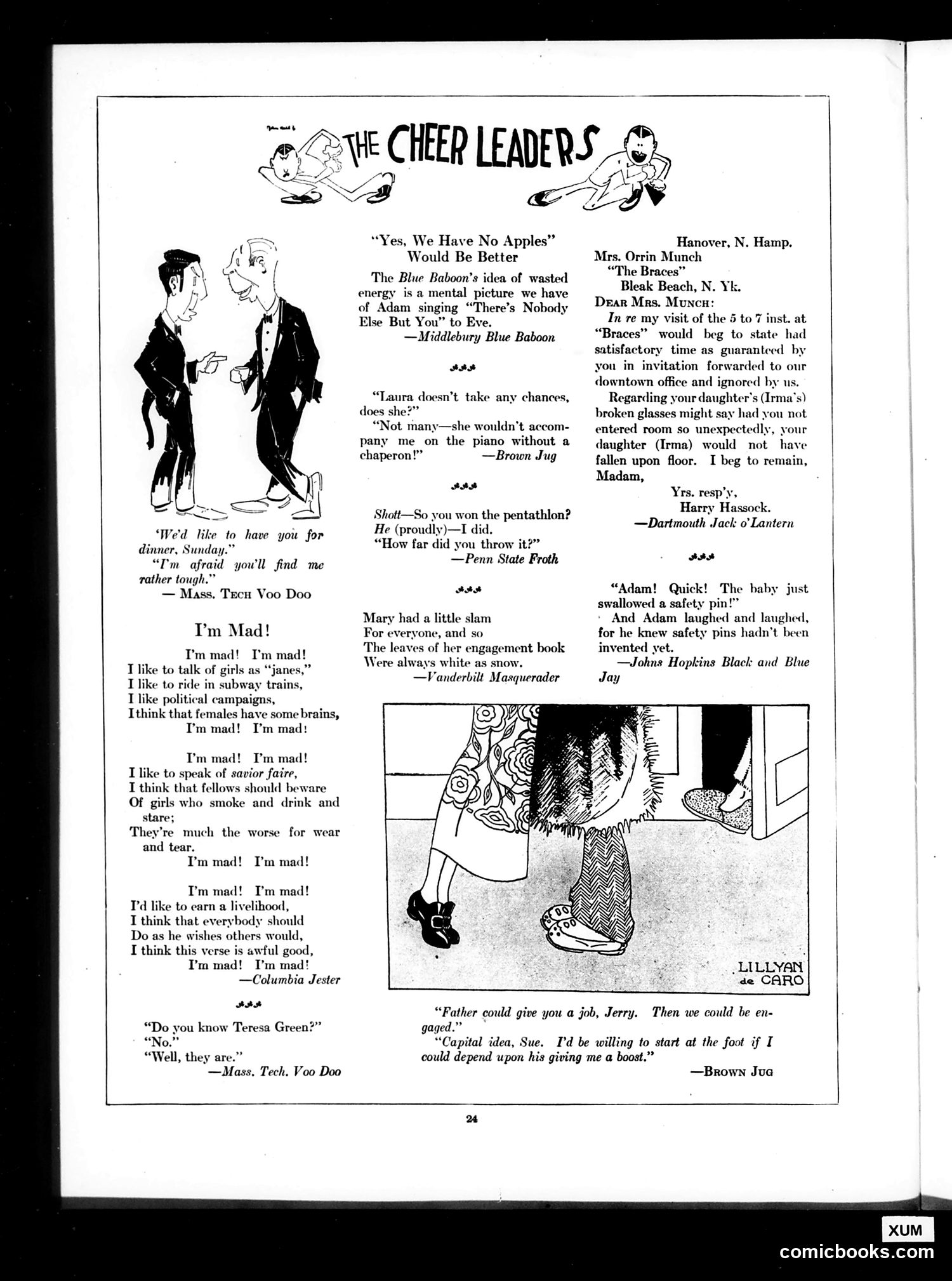
This page collects humorous verses and quips from college humor magazines (Mass. Tech Voo Doo, Columbia Jester, Penn State Froth, etc.)—typical of Judge's practice of reprinting student wit. The satire targets **modern social changes**, particularly regarding women. "I'm Mad!" mocks progressive young people who advocate for women's equality—talking of girls as "janes," supporting female education and employment, and opposing double standards. The piece ironically frames progressive views as rebellious madness. Other jokes reference **courtship conventions**: the chaperon requirement (showing outdated propriety), engagements as social currency, and women's dependence on men for economic security ("Father could give you a job...then we could be engaged"). The cartoon's caption about a "job" as prerequisite to engagement satirizes the economic reality that women had limited independence and marriage was often their economic necessity rather than choice. The anachronistic Adam joke simply plays on anachronism for mild humor. Overall, the page reflects 1920s-30s anxiety about changing gender roles—treating women's equality advocacy as humorous folly rather than legitimate reform.
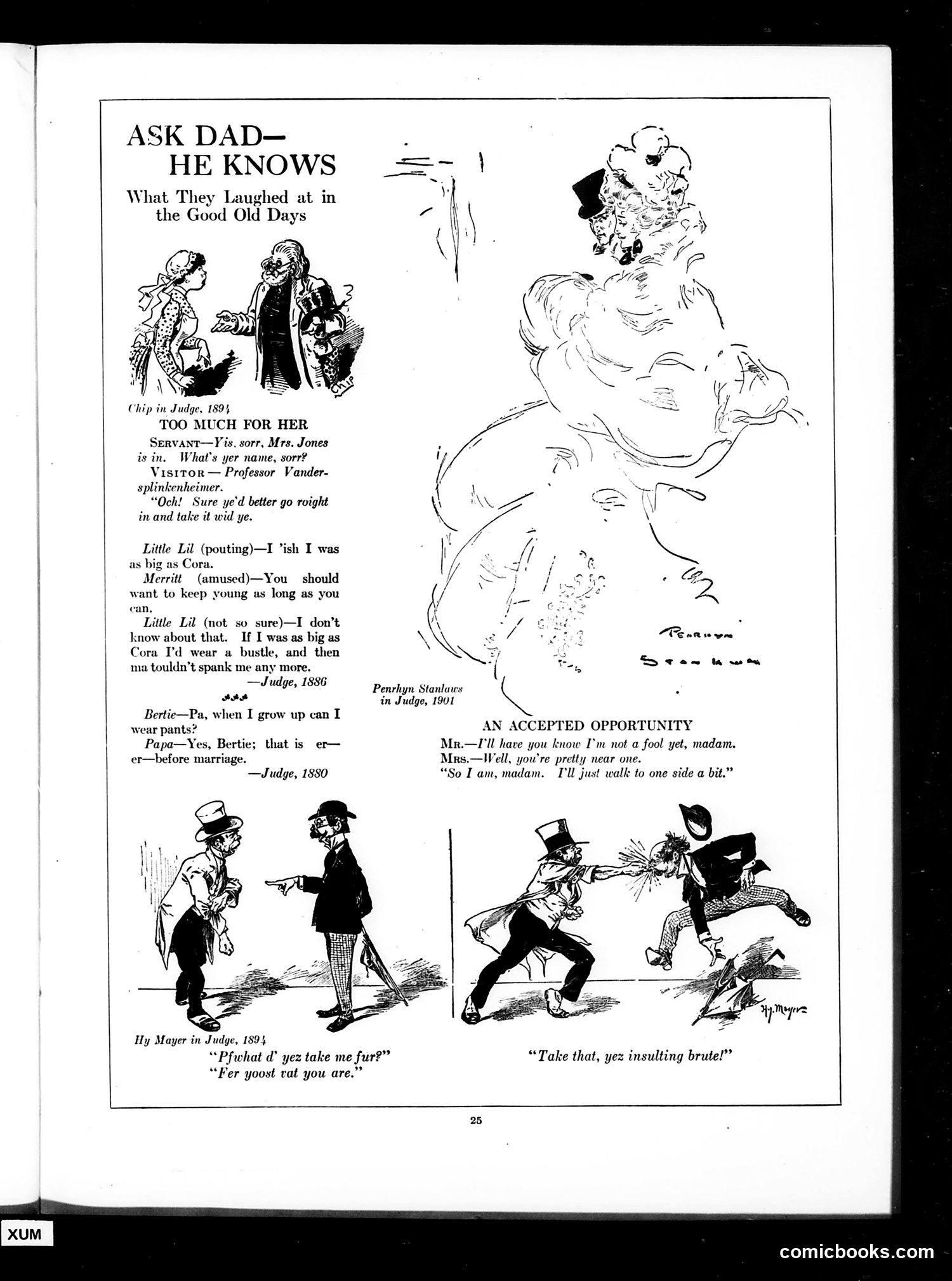
This page collects humorous anecdotes and cartoons from "the Good Old Days," presenting comedy through ethnic stereotypes and gender roles common to late-19th-century American satire. The jokes center on: **Ethnic humor**: A servant with an Irish accent finds "Professor Vandersplinkenheimer" (a German name) amusing enough to warn the visitor. The bottom cartoons feature exaggerated Irish and German accents ("Pfwhat d' yez," "yoost"). **Gender/clothing satire**: Children's observations about bustles (women's undergarments that created pronounced rear silhouettes) and whether girls should wear pants before marriage reflect anxieties about changing gender norms. **Class commentary**: A woman's pointed reminder that her suitor is "pretty near" a fool suggests satirizing courtship pretense. The page's framing as nostalgic humor from 1880-1901 suggests Judge's 1930s-era readers found these jokes quaintly outdated—though the reliance on ethnic caricature reflects the magazine's casual period bigotry.
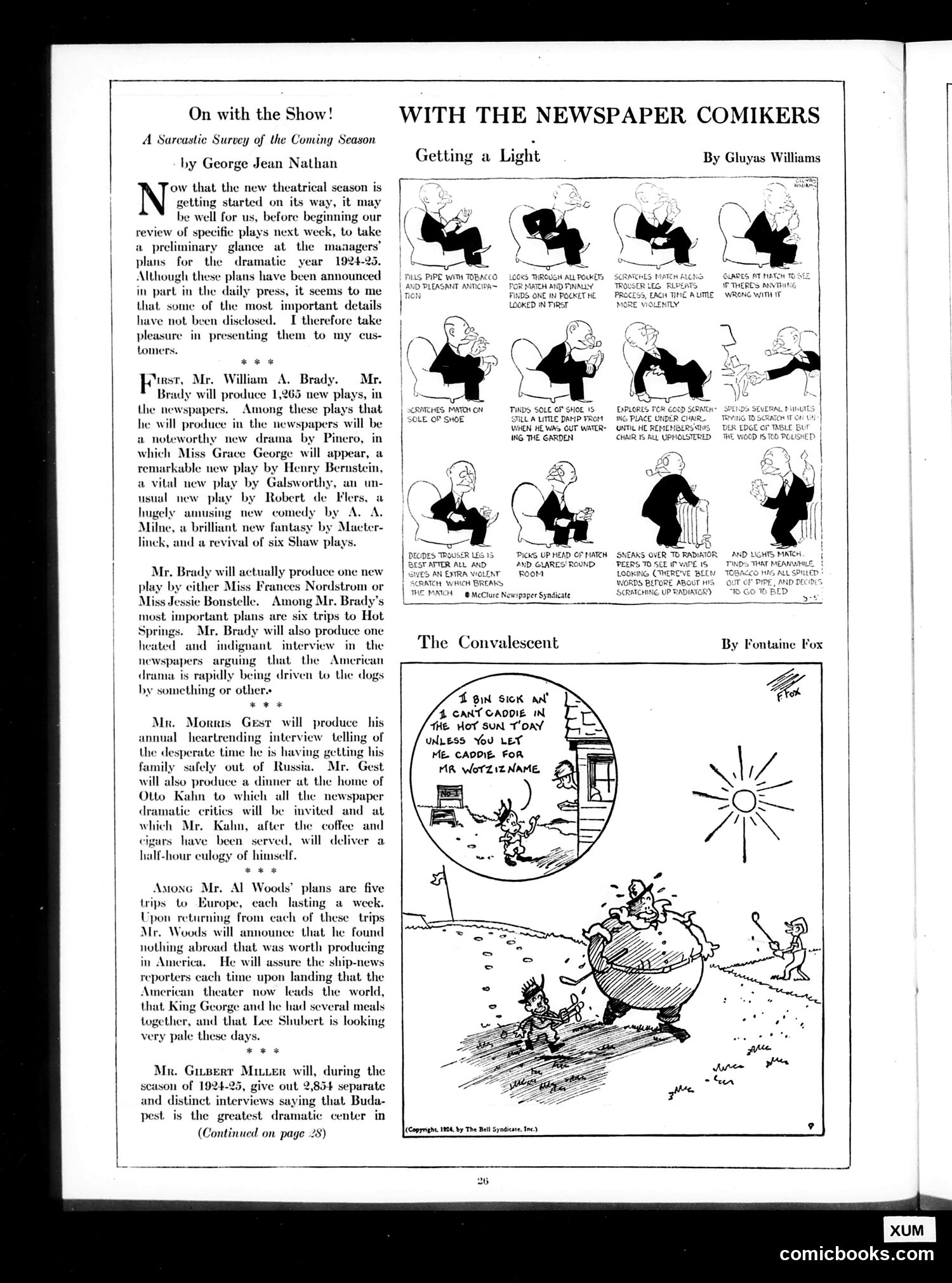
This page satirizes Broadway theater producers' self-promotional habits during the 1924-25 season. George Jean Nathan mocks their inflated claims and repetitive publicity stunts: **"Getting a Light"** (by Gluyas Williams) is a comic strip depicting a man struggling absurdly to light a cigarette—a visual metaphor for the theatrical industry's difficulties, shown through increasingly desperate attempts. **The main text** ridicules producers like William A. Brady (who claims he'll produce 1,265 plays, mostly in newspapers), Morris Gest (famous for dramatic rescue interviews about getting family out of Russia), and Al Woods (known for European trips where he proclaims American theater superior). The satire points to how these producers generate press coverage through interviews, dinners, and grandiose announcements rather than actual theatrical innovation. Nathan suggests their real "product" is publicity itself—not genuine drama. **"The Convalescent"** (by Fontaine Fox) shows unrelated comic relief about a sick golfer. The humor relies on readers recognizing these actual theatrical figures and their notorious habit of using newspapers for self-promotion.
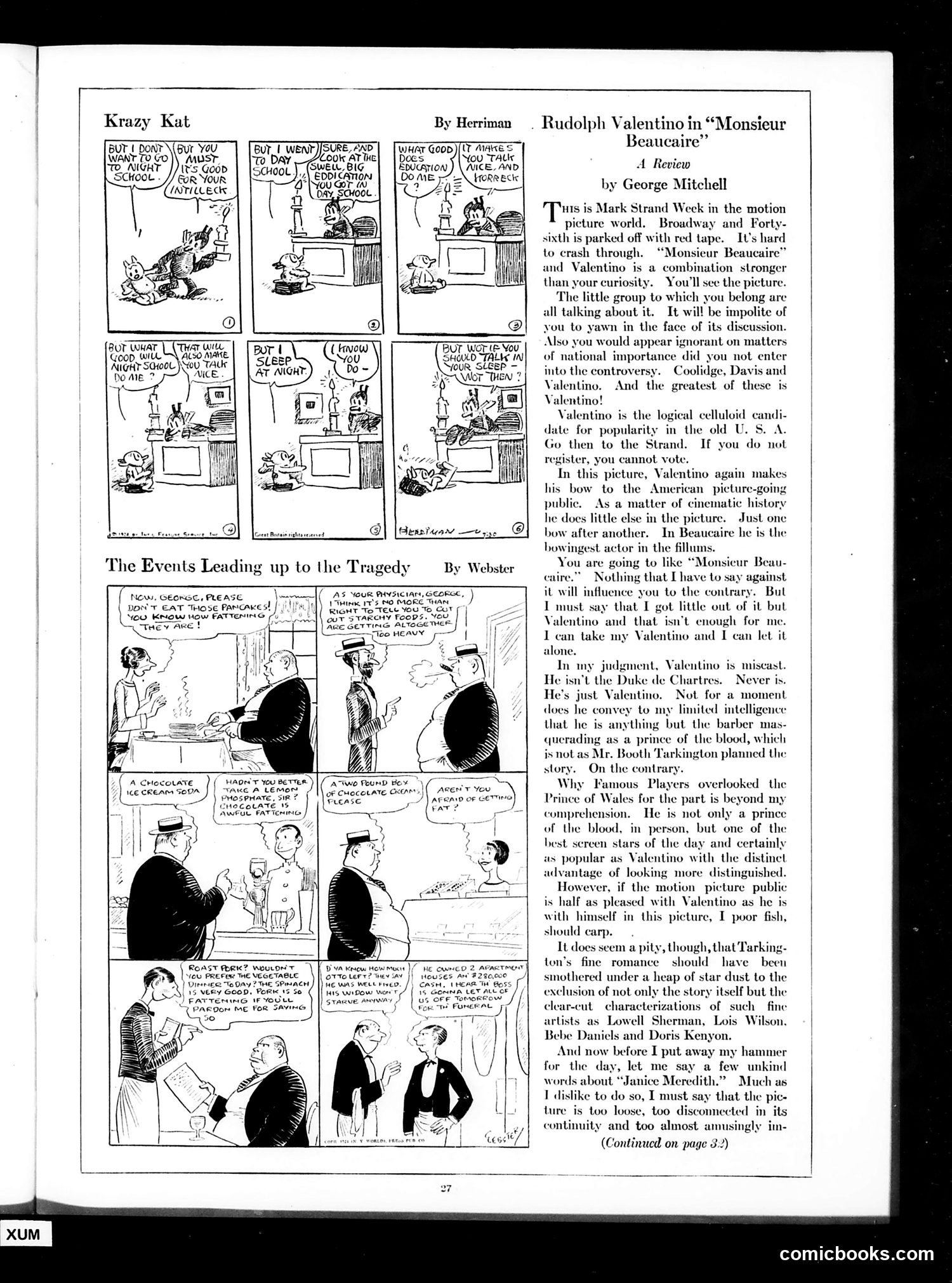
This page contains three distinct pieces about 1920s cinema and culture: **"Krazy Kat"** (top left): A comic strip by Herriman showing a cat's school truancy excuses—standard humor with no apparent political content. **"Rudolph Valentino in 'Monsieur Beaucaire'"** (right): A film review by George Mitchell discussing the silent film and Valentino's stardom. The review is somewhat critical, arguing that Valentino miscast as the Duke de Chartres merely "bows" throughout rather than truly acting. Mitchell notes Valentino's enormous popularity rivals political figures like Coolidge and Davis, yet complains the film overshadows Booth Tarkington's original story. The review mocks the hype around "Mark Strand Week"—Broadway's promotion of the film's opening. **"The Events Leading up to the Tragedy"** (bottom): A Webster comic strip depicting what appears to be a doctor warning a patient (George) against eating pancakes, with subsequent scenes of social dining and conversation—the humor derives from dietary advice and social situations of the era. The page captures 1920s enthusiasm for cinema and celebrity culture.
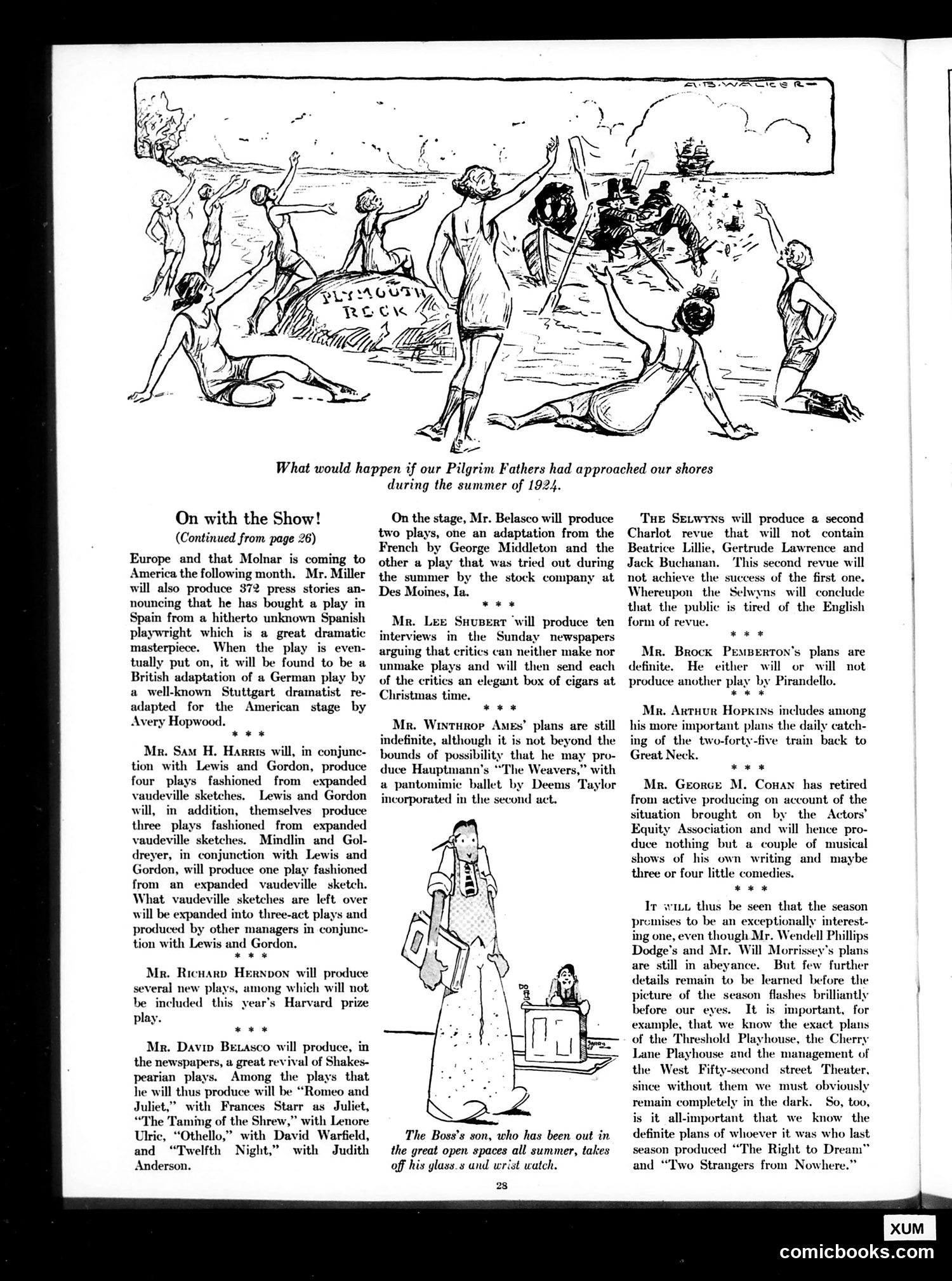
This page satirizes Broadway theater producers' grandiose plans and pretentious practices in 1924. The text mocks how producers announce ambitious projects that either fail to materialize or prove derivative—such as buying purportedly original Spanish plays that are actually "British adaptations of German plays re-adapted for the American stage." The humor targets industry absurdities: producers expanding vaudeville sketches into full plays, critics being bribed with cigars, and impresarios making inflated claims. The referenced producers (Belasco, Herndon, Hopkins, et al.) were real theatrical figures of the era whose actual competing productions and self-promotion the magazine ridicules. The cartoon header depicts colonists discovering Plymouth Rock, captioning it as "What would happen if our Pilgrim Fathers had approached our shores during the summer of 1924"—suggesting modern theater chaos would have met the Pilgrims. The final illustration shows a businessman removing his glasses, presumably clearing his vision of theatrical illusions, reinforcing the skepticism toward producers' grandiose claims.
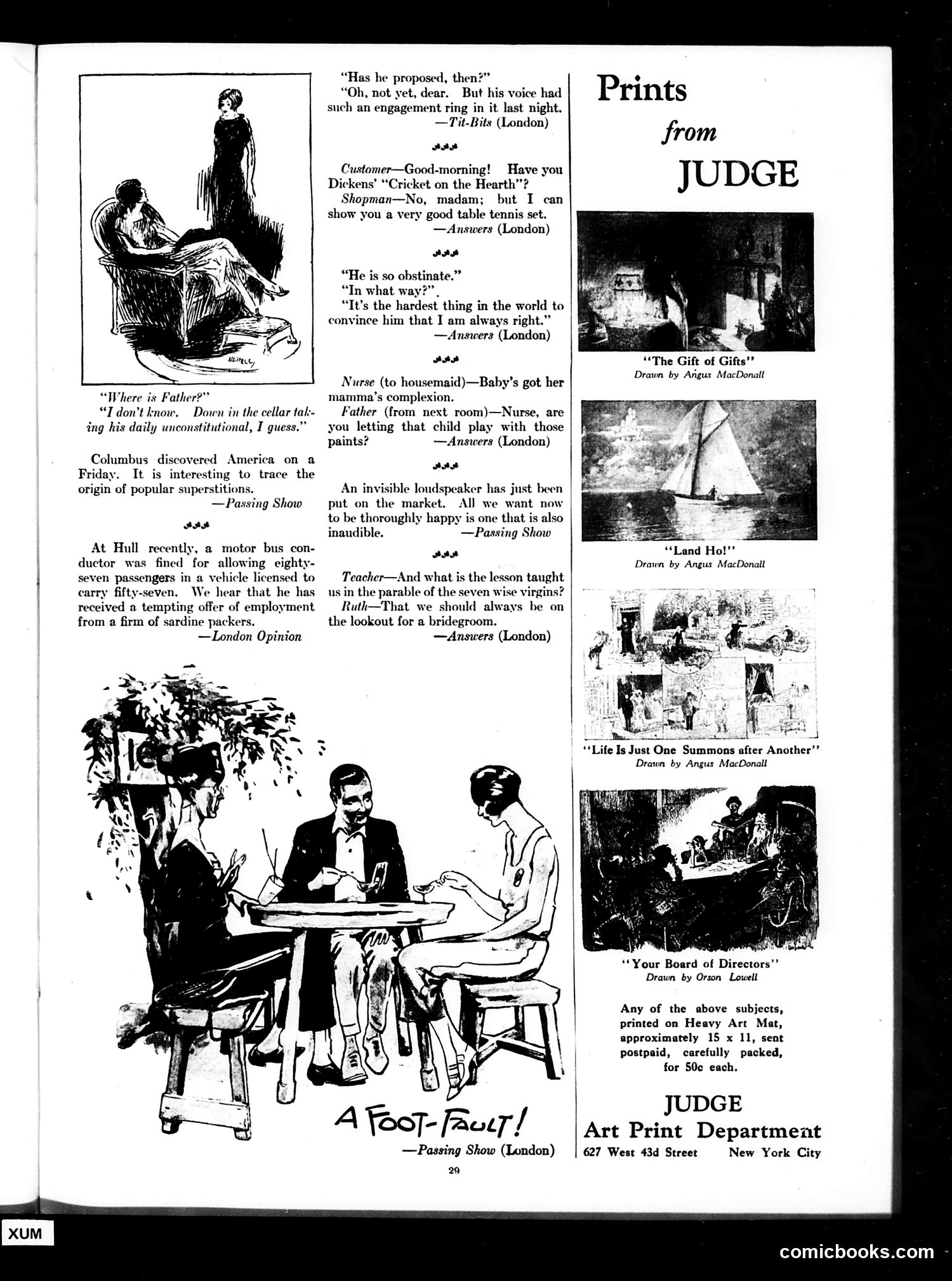
This page collects brief jokes and humorous observations from early 20th-century British and American publications. The humor relies on wordplay and social commentary: **Key jokes include:** - A father hiding in the cellar taking "unconstitutional" drinks (Prohibition-era reference) - A bus conductor severely overcrowded with passengers, now fit only for sardine packing (industrial absurdity) - A bookshop clerk confusing Dickens' title with table tennis equipment (commercial philistinism) - A baby inheriting her mother's complexion from playing with paints (visual pun) - An "invisible loudspeaker" that should also be inaudible (consumer product satire) - A schoolgirl's literal interpretation of biblical parable wisdom (youth humor) **The main cartoon** "A Foot-Fault!" depicts three people at a table—likely a divorce proceeding or legal dispute—with the ambiguous title suggesting both tennis terminology and marital conflict. The page primarily serves as an advertisement for Judge's Art Print Department, selling reproductions of these cartoons and drawings.
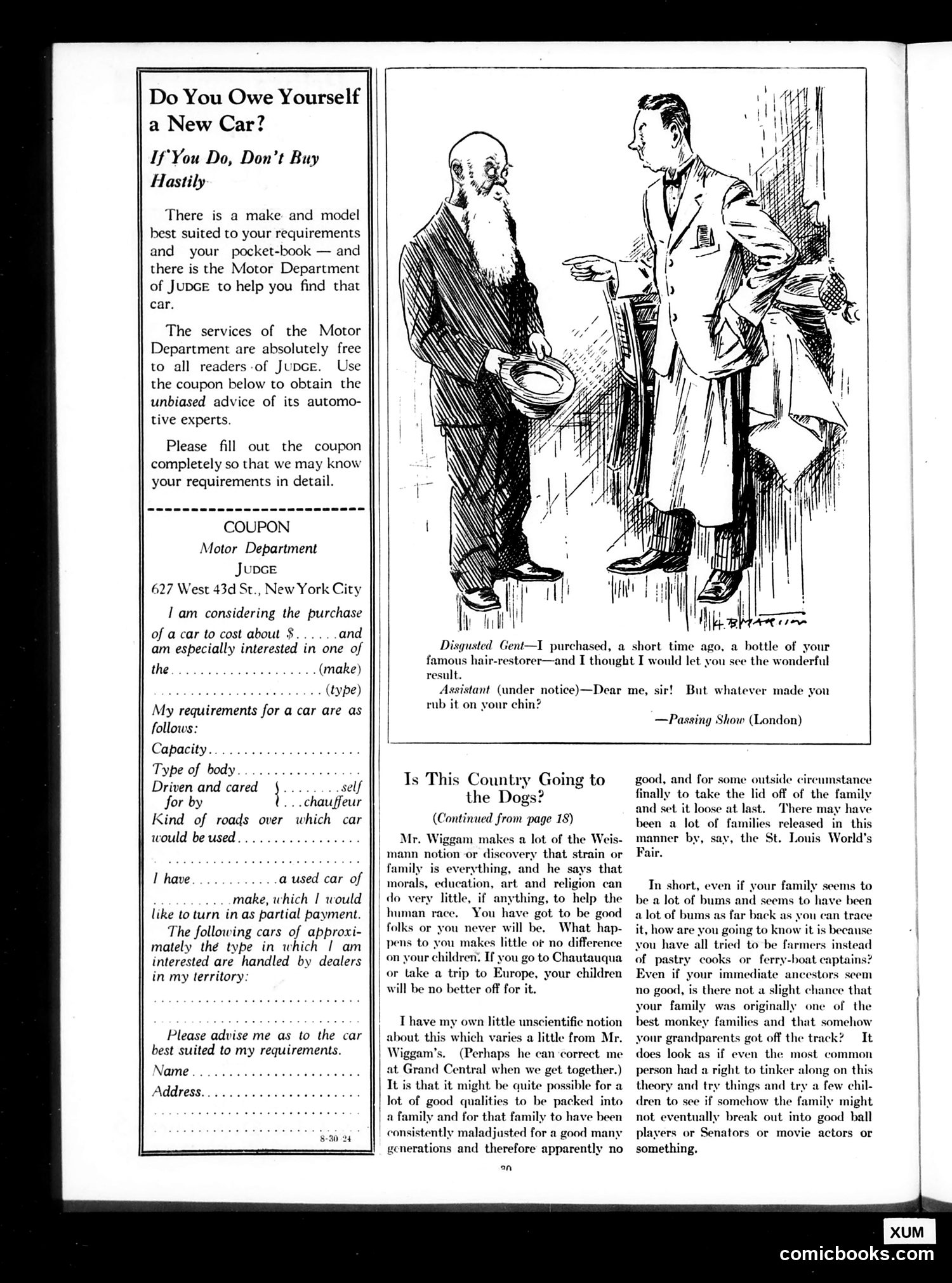
This page combines **advertising** (a coupon service for car-buying advice) with **two separate satirical pieces**. ## The Car Advertisement Judge's Motor Department offers free expert advice to readers considering automobile purchases, positioning itself as an unbiased consultant against hasty buying decisions. ## The Cartoon The sketch depicts a "Disgusted Gent" who bought a hair-restorer product, expecting miraculous results. The assistant's sarcastic response—"But whatever made you rub it on your chin?"—mocks both the product's false advertising and the customer's apparent foolishness in misapplying it. This satirizes patent medicine and consumer gullibility, a common Judge theme. ## "Is This Country Going to the Dogs?" This article discusses heredity versus environment in determining family character. The author debates Mr. Wiggam's theories about strain/genetics, arguing that even families with poor histories might unexpectedly produce successful children (athletes, politicians, actors). It's a humorous commentary on American optimism and social mobility during the early 20th century.
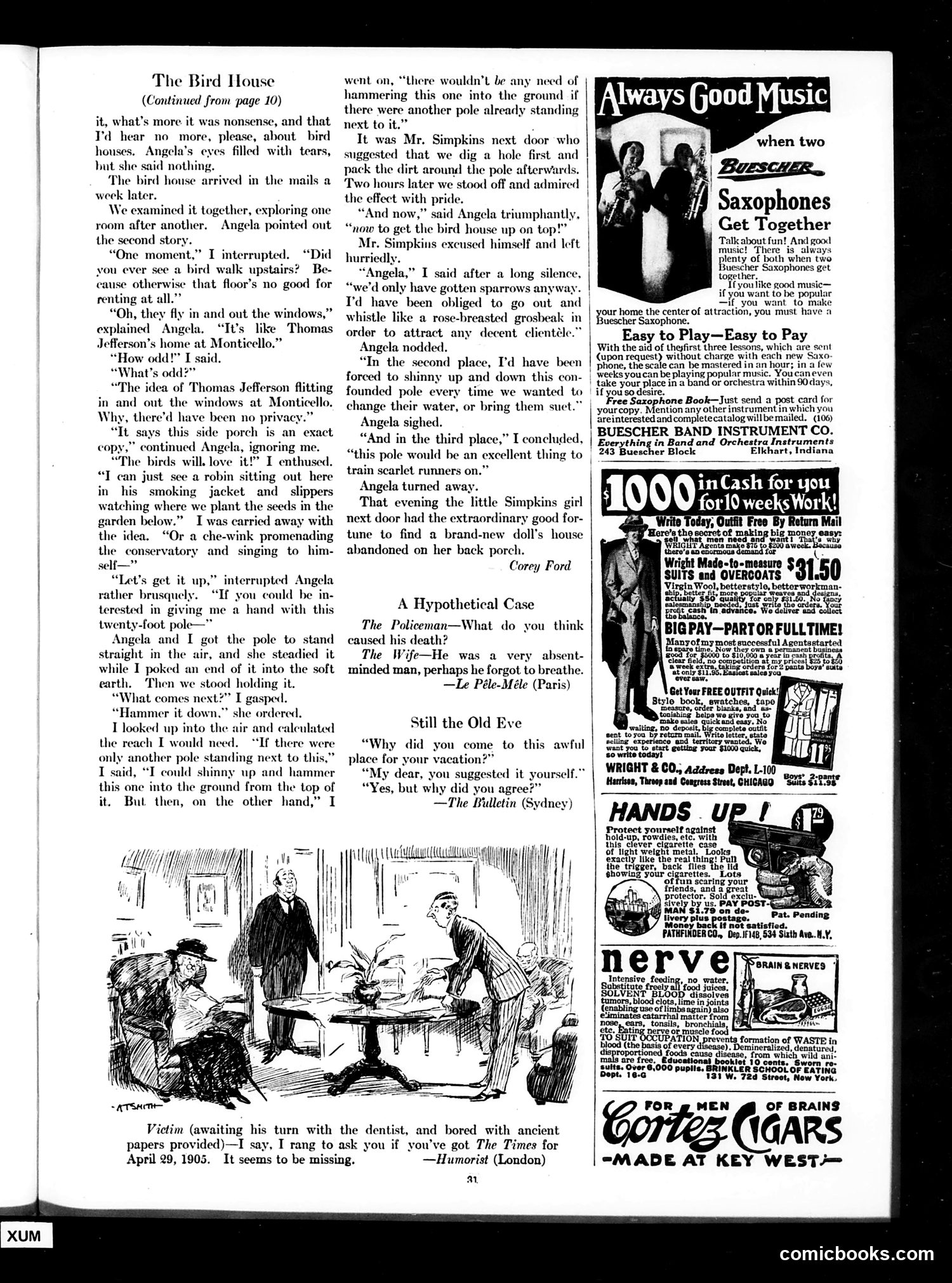
**Main Content: "The Bird House" Story** This humorous narrative describes a domestic dispute over building a decorative birdhouse. The husband ridicules his wife Angela's impractical design (featuring an upstairs the birds won't use, modeled on Monticello), and the couple struggles comically to install the tall pole structure in their yard. The joke culminates when the husband decides the pole would be better used for growing scarlet runner beans—and the birdhouse ends up abandoned on the neighbor's porch as a doll's house. **Social Commentary:** The satire mocks genteel, over-refined aesthetics and the tension between practical husbands and idealistic wives in early 1900s households. Angela's architectural pretensions (referencing Jefferson's mansion) are undercut by reality. **Bottom Cartoon:** A dentist's waiting-room joke about a bored patient requesting a specific 1905 newspaper—absurdist humor playing on tedium. **Advertisements:** Buescher saxophones and various mail-order products dominate the right side.
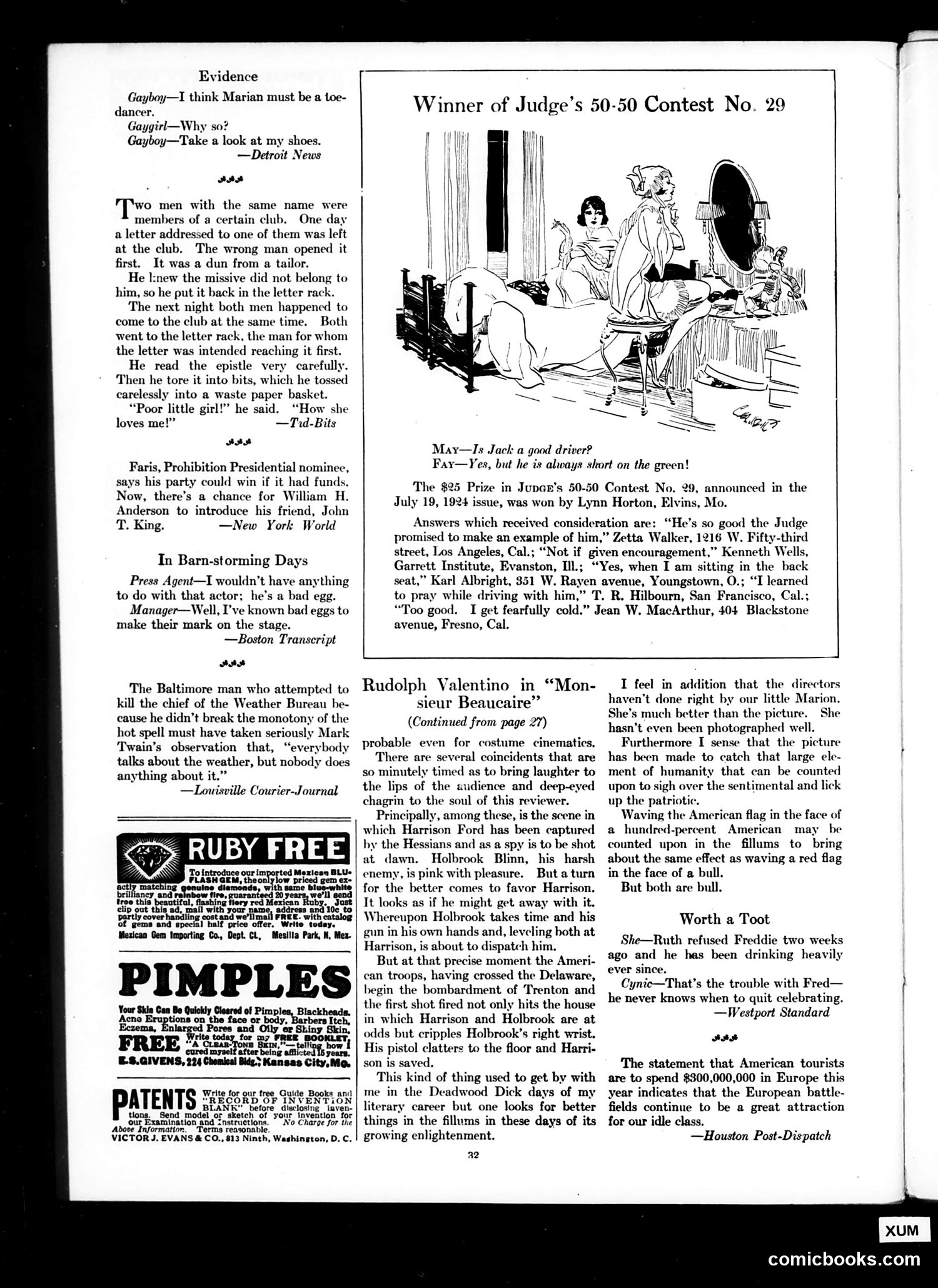
This page features **short humor pieces and advertisements** typical of Judge magazine's satirical content circa 1924. The main cartoon shows a domestic scene where a woman asks "Is Jack a good driver?" The punchline plays on "short on the green"—meaning both low on money and short on the grass/lawn, a visual double entendre about poor driving. The **text section reviews "Monsieur Beaucaire,"** a Rudolph Valentino film. The critic praises the cinematography but complains that plot coincidences strain credibility—particularly a scene where American Revolutionary War bombardment conveniently disarms a villain at the exact moment he's about to shoot the hero. The reviewer finds such contrivances acceptable in pulp literature ("Deadwood Dick days") but expects better from modern cinema. The page also includes joke submissions (winning entries from Judge's "50-50 Contest"), various advertisements (for skin treatments, gems, patents), and brief satirical notes on Prohibition politics and weather commentary.
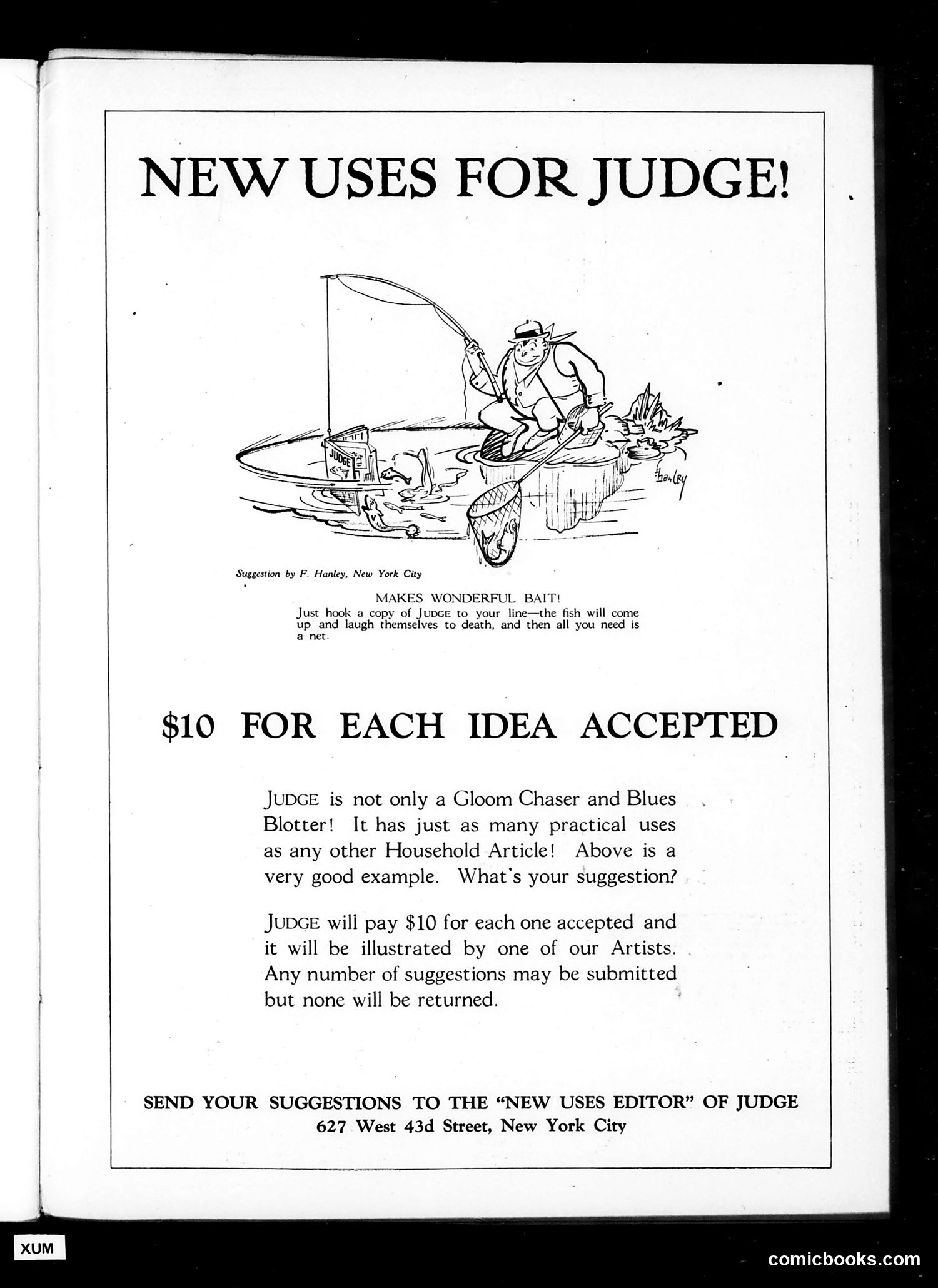
This is an **advertisement/contest page**, not political satire. Judge magazine is soliciting reader submissions for creative, humorous "new uses" for their publication itself—a clever marketing strategy. The cartoon shows the example submission: using a copy of Judge magazine as fishing bait. The joke is that fish find the magazine so funny they "laugh themselves to death," making fishing effortless. It's self-deprecating humor promoting Judge's comedic content. The magazine offered $10 per accepted idea—substantial payment for the era—with professional illustration. This encouraged reader participation and engagement while cleverly advertising Judge's own wit and utility. The campaign positions the magazine as more than just entertainment: a genuinely practical household item with multiple applications.
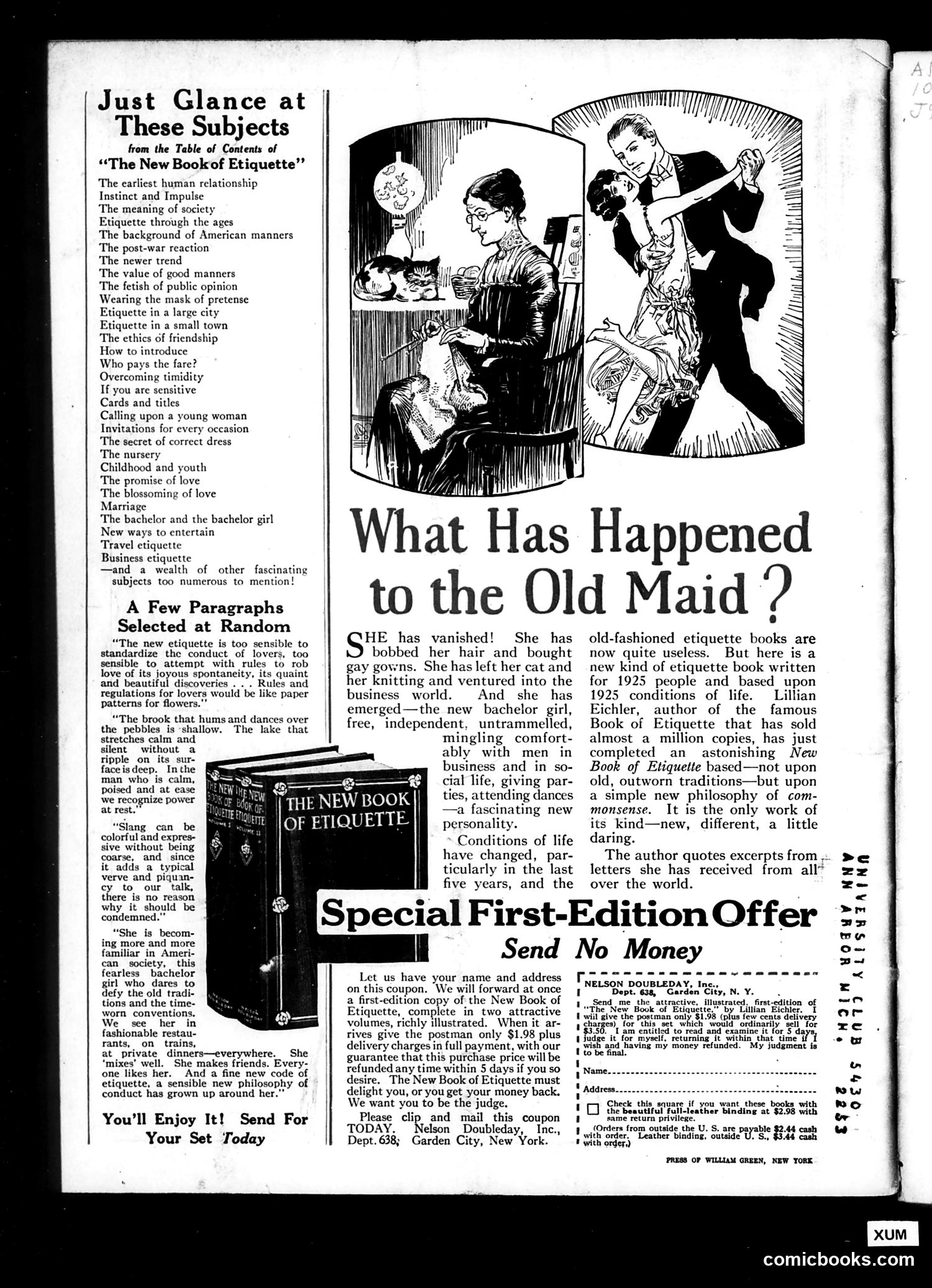
This page satirizes the rapid social changes of the 1920s, particularly regarding unmarried women. The left side lists topics from "The New Book of Etiquette" (1925), emphasizing modern subjects like "the bachelor girl" and "new ways to entertain"—reflecting post-WWI social upheaval. The main cartoon illustrates the central joke: the "old maid" has disappeared. She's been replaced by the "new bachelor girl"—a woman who bobs her hair, wears fashionable clothes, works in business, and socializes freely with men. The cartoon shows this modern woman confidently interacting in social settings that would have scandalized previous generations. The satire targets how rapidly traditional gender roles and courtship rituals have shifted. What was once unthinkable (unmarried women in public, independent careers, casual mixed-gender socializing) is now normalized. The new etiquette book itself becomes evidence of this transformation—old rules are obsolete; new ones must address entirely different social realities.