
Judge, 1924-08-30 · page 17 of 36
Judge — August 30, 1924 — page 17: what you’re looking at
What you’re looking at
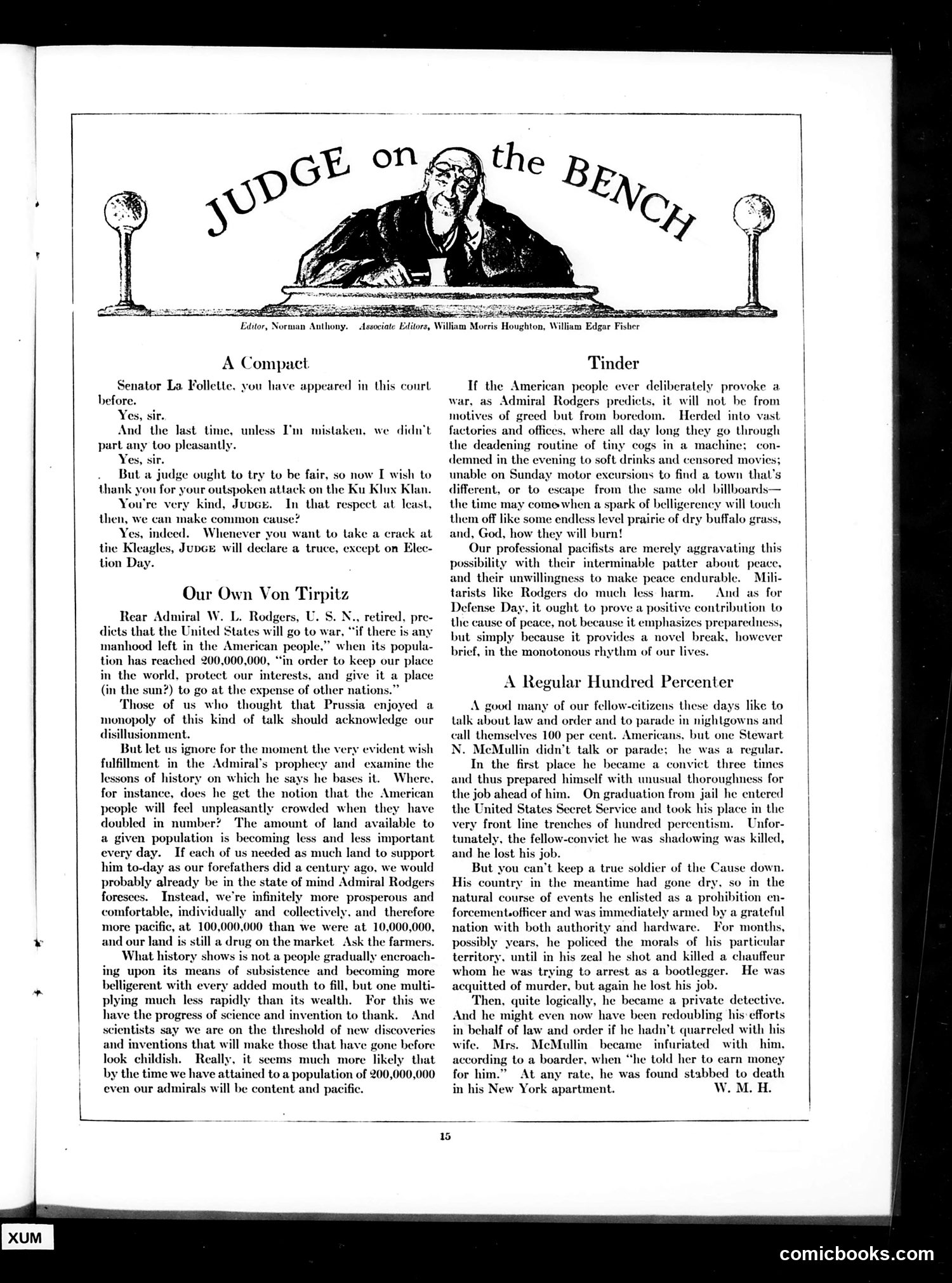
This page contains political commentary on early 1920s America. **"A Compact"** depicts a dialogue between a Judge and Senator La Follette (progressive reformer), establishing an ironic "truce" against the Ku Klux Klan except during elections—satirizing how even opponents unite against this threat while maintaining political rivalry. **"Our Own Von Tirpitz"** critiques Rear Admiral W.L. Rodgers's prediction that America will seek war once its population reaches 200 million. The piece rebuts his logic, arguing technological progress makes territorial expansion unnecessary and that growing populations become *more* peaceful, not less. The "Von Tirpitz" reference compares Rodgers to Germany's WWI naval strategist, suggesting American militarism mirrors pre-war Prussian jingoism. **"Tinder"** argues war stems from civilian boredom and monotony in industrial society—factories, censored entertainment, standardized billboards. It cynically notes pacifists' ineffectiveness while militarists inadvertently help by breaking routine monotony. **"A Regular Hundred Percenter"** (fragment) appears to satirize self-proclaimed "100% Americans," likely KKK members using that slogan, through the contrasting example of Stewart N. McMullin.
📄 Transcribed text from this page (OCR, searchable)
Machine-transcribed from the original scan — historical spelling and the odd misread are preserved.
Associate Editors, A Compact Senator La Follett before. Yes, sir. And the last time, unless I'm mistaken, we didn’t part any too pleasantly. Yes, sir. But a judge ought to try to be fair, so now I wi thank you for your outspoken attack on the Ku Kh You're very kind, JuvGe. In that respect at Icast, then, we can make common cause? Yes, indeed. Whene ou want to take a crack at tie Kleagles, Jupce will declare a truce, except on Elec- tion Day. . you have appeared in this court kK Our Own Von Airpitz Rear Admiral W. L. Rodgers, U. \., retired, pre- dicts that the United States will go to war, “if there is any manhood left in the American people,” when its popula- tion has reached 200,000,000, “in order to keep our pli in the world, protect our interests, and give it a pli (in the sun?) to go at the expense of other nations.” Those of us who thought that Prussia enjoyed a monopoly of this kind of talk should acknowledge our disillusionment. But let us ignore for the moment the very evident wish fulfillment in the Admiral’s prophecy and examine the essons of history on which he says he bases it. Where, nce, does he get the notion that the American people will feel unpleasantly crowded when they have doubled in number? The amount of land available to a given population is becoming less and less important every day. If each of us needed as much land to support him to-day as our forefathers did a centu we would probably already be in the state of mind Admiral Rodgers foresces. Instead, we're infinitely more prosperous and comfortable, individually and coll and_ therefore more pacific, at 100,000,000 than we were at 10,000,000, and our land is still a drug on the market Ask the farmers. What history shows is not a people gradually encroach- ing upon its means of subsistence and becoming more belligerent with every added mouth to fill, but one multi- plying much less rapidly than its wealth. For this we a science and invention to thank. And scientists say we are on the threshold of new discoveries and inventions that will make those that have gone before look childish. Really, it seems much more likely that by the time we have attained to a population of 200,000,000 even our admirals will be content and pacific. eee am Morris Houghton, William Edgar Fisher Tinder If the American people ever deliberately provoke a Admiral Rodgers predicts, it will not be from of greed but from boredom. Herded into vast factories and offices, where all day long they go through the deadening routine of tiny cogs in a machine; con- demned in the evening to soft drinks and censored movies; unable on Sunday motor excursions to find a town that’s different, or to escape from the same old billboards— the time may come when a spark of belligerency will touch them off like some endless level prairie of dry buffalo grass, and, God, how they will burn! Our professional pacifists are merely aggravating this possibility with their interminable patter about peace, and their unwillingness to make peace endurable. Mili- tarists like Rodgers do much less harm. — And as for Defense Day, it ought to prove a positive contribution lo the cause of peace, not because it emphasizes preparedness, but simply because it provides a novel break, however brief, in the monotonous rhythm of our lives. A Regular Hundred Percenter A good many of our fellow- talk about law and order and to parade in nightgowns and call themselves 100 per cent. Americans, but one Stewart N. MeMullin didn’t talk or parade; he was a regular. In the first place he became a convict three times and thus prepared himself with unusual thoroughness for the job ahead of him. On graduation from jail he entered the United States Secret Service and took his place in the very front line trenches of hundred percentism. Unfor- tunately, the fellow-convict he was shadowing was killed, and he lost his job. But you can’t keep a true soldier of the Caus His country in the meantime had gone dry, so the natural course of events he enlisted as a prohibition en- forcementofficer and was immediately armed by a grateful nation with both authority and hardware. For months, possibly years. he policed the morals of his particular territory, until in his zeal he shot and killed a chauffeur whom he was trying to arrest as a bootlegger. He was acquitted of murder, but again he lost his job. Then, quite logically, he became a private detective. And he might even now have been redoubling his: efforts in behalf of law and order if he hadn't quarreled with his wife. Mrs. MeMullin became infuriated with him, according to a boarder, when “he told her to earn money for him.” At any rate, he was found stabbed to death in his New York apartment. W. M. H. tizens these days like to down. comicbooks.com