
A complete issue · 36 pages · 1924
Judge — May 24, 1924
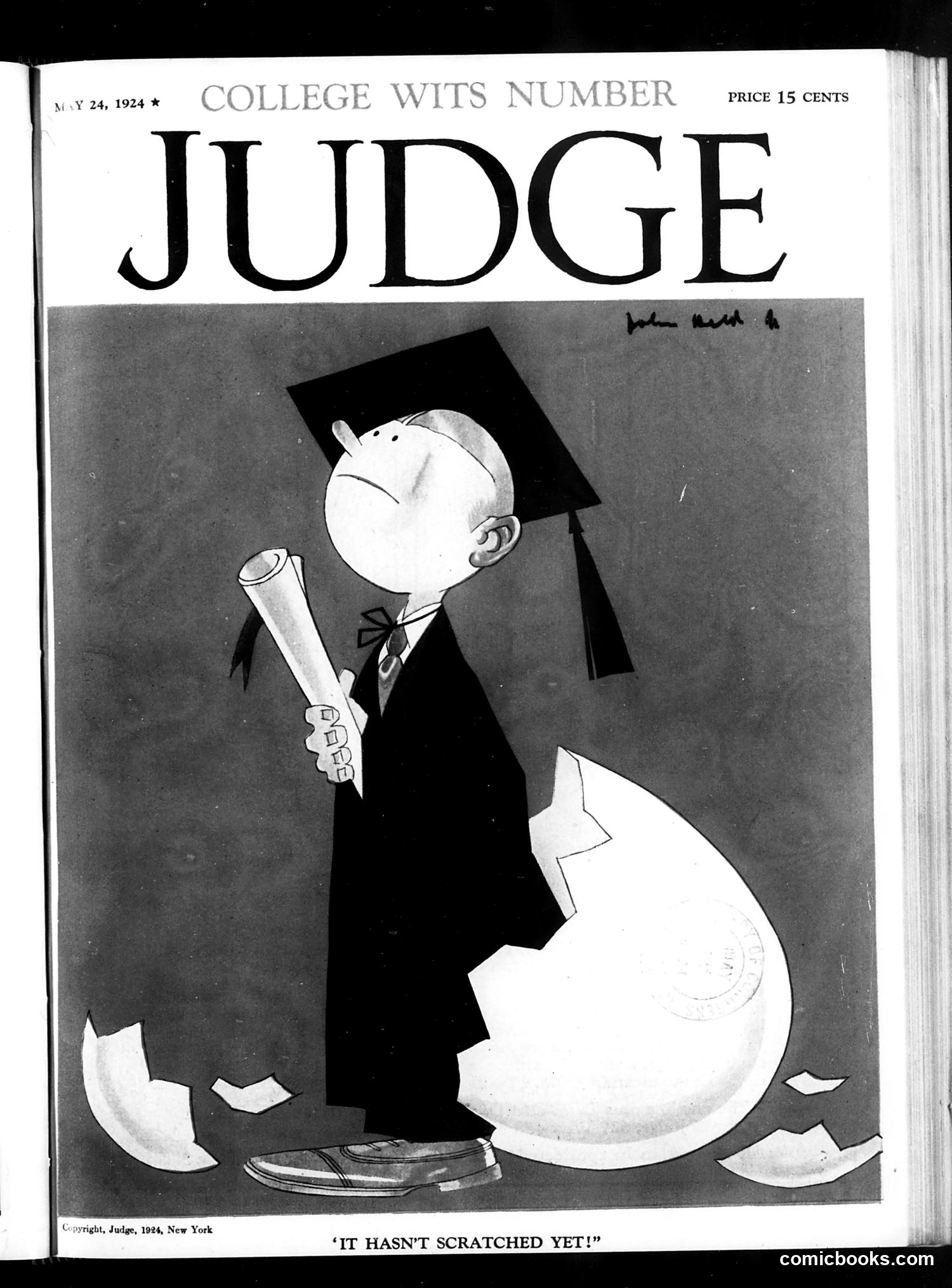
This cover satirizes academic achievement and pretension. A smug graduate in mortarboard and gown clutches his diploma while emerging from a cracked eggshell—suggesting he's been newly "hatched" or is still underdeveloped despite his credentials. The caption "It Hasn't Scratched Yet!" implies the diploma hasn't actually tested or proven his worth in the real world. The joke mocks recent college graduates who possess formal credentials but lack practical experience or maturity. The eggshell imagery emphasizes immaturity—the graduate remains fragile and unprepared despite educational trappings. This reflects 1920s anxieties about whether higher education actually produced capable adults or merely conferred ceremonial status.
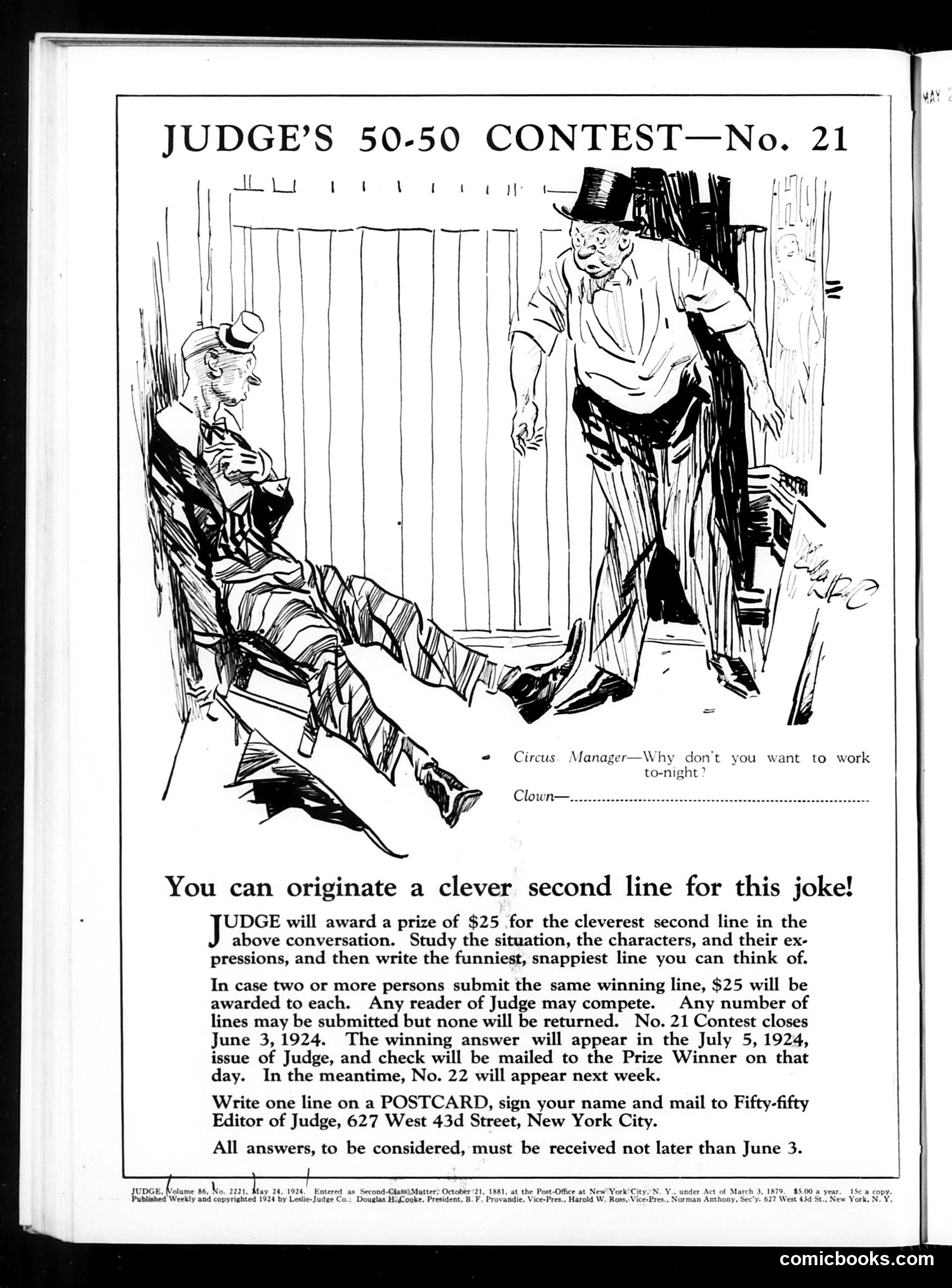
This is a "Judge's 50-50 Contest" — a humor competition inviting readers to supply a witty second line of dialogue. **The scene:** A circus clown sits exhausted against a wall while a well-dressed circus manager stands over him demanding, "Why don't you want to work to-night?" **The setup:** The visual joke plays on the clown's disheveled appearance and apparent fatigue — he looks literally worn out, suggesting physical comedy or mishaps. **The contest:** Readers were challenged to complete the clown's response. The $25 prize ($400+ today) went to the "cleverest second line." The deadline was June 3, 1924, with winners announced July 5. This reflects early 20th-century participatory entertainment, where magazine audiences actively contributed to comedic content rather than passively consuming it.
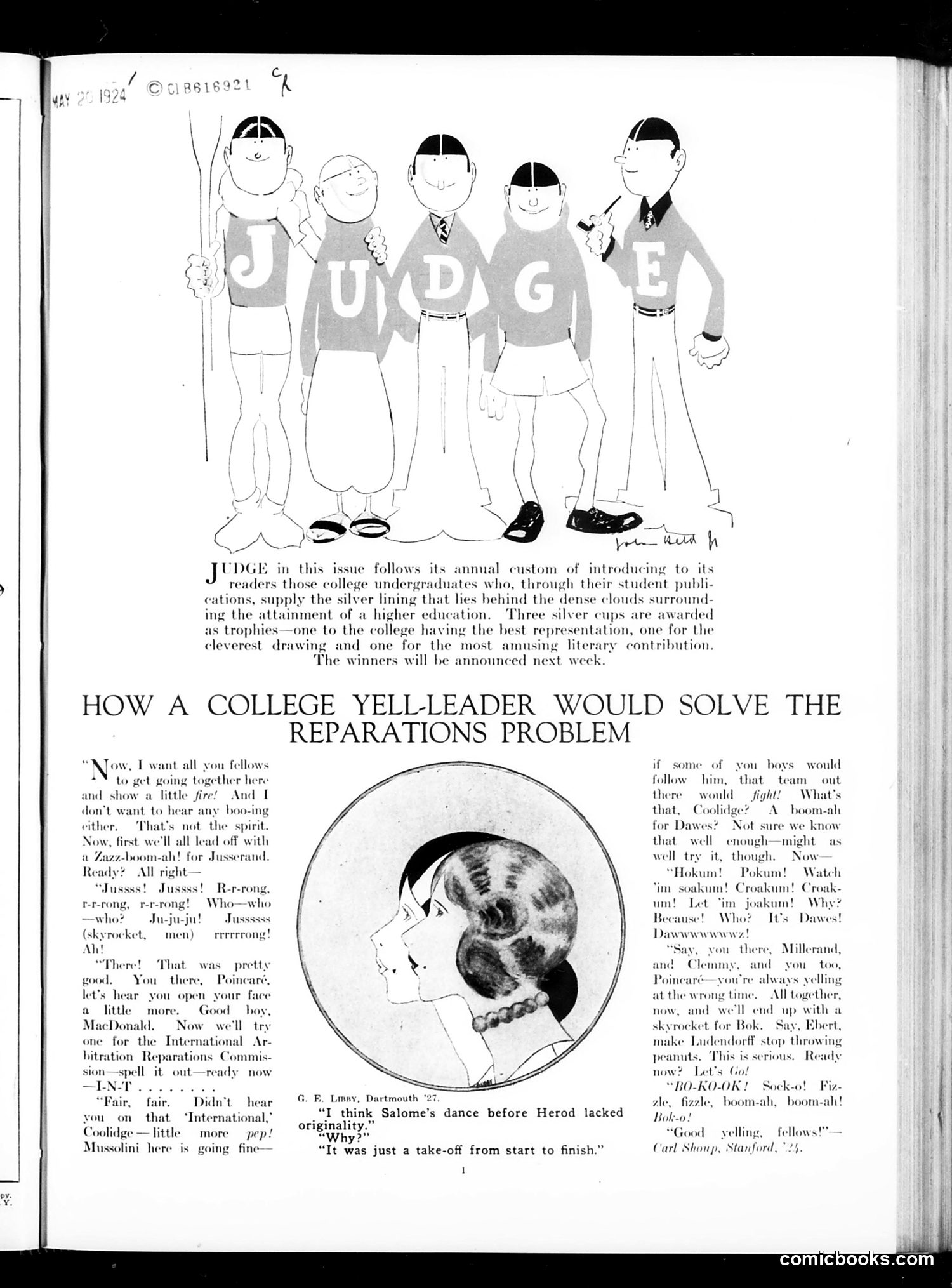
**Top Section:** Five cartoon undergraduate figures represent college publications competing for awards. The "Judge" introduces annual prizes for best representation, drawing, and literary contribution. **Main Cartoon:** Titled "How a College Yell-Leader Would Solve the Reparations Problem," this satirizes post-WWI reparations disputes (likely German war debt). A yell-leader's solution is to organize "booming" and "heckling" cheers—a humorous deflation of complex diplomatic negotiations through collegiate enthusiasm and absurdist wordplay. The satire mocks both yell-leaders' perceived superficiality and the era's unresolved reparations debates. The credited illustration by G.F. Limey (Dartmouth '22) and text by Carl Swamp (Stanford '21) reflects contemporary student humor about serious international issues.
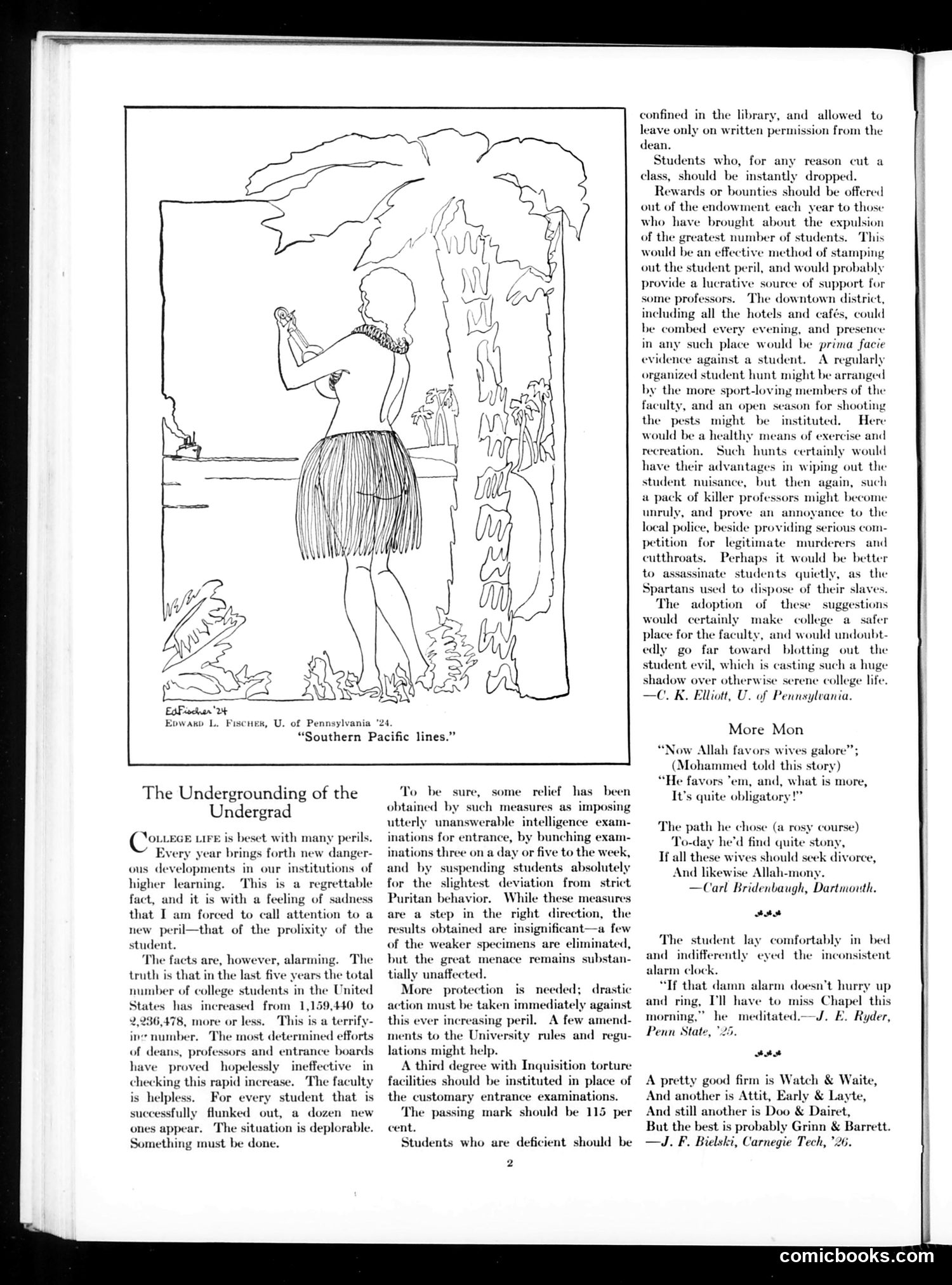
This cartoon by Edward L. Fischer satirizes college student discipline and behavior. The illustration shows a female student climbing out a window, presumably to escape dormitory restrictions—a common form of student misconduct in the early 20th century. The accompanying article, "The Undergrounding of the Undergrad," discusses the serious problem of increasing student misbehavior and academic failure in American colleges. The author argues that existing punishments (exam requirements, suspensions) are ineffective and proposes harsher measures—including potentially violent remedies like organized "student hunts"—as darkly satirical solutions to widespread student indiscipline. The cartoon's title "Southern Pacific Lines" is a pun on the railroad company, suggesting students are "traveling" via unauthorized window routes.
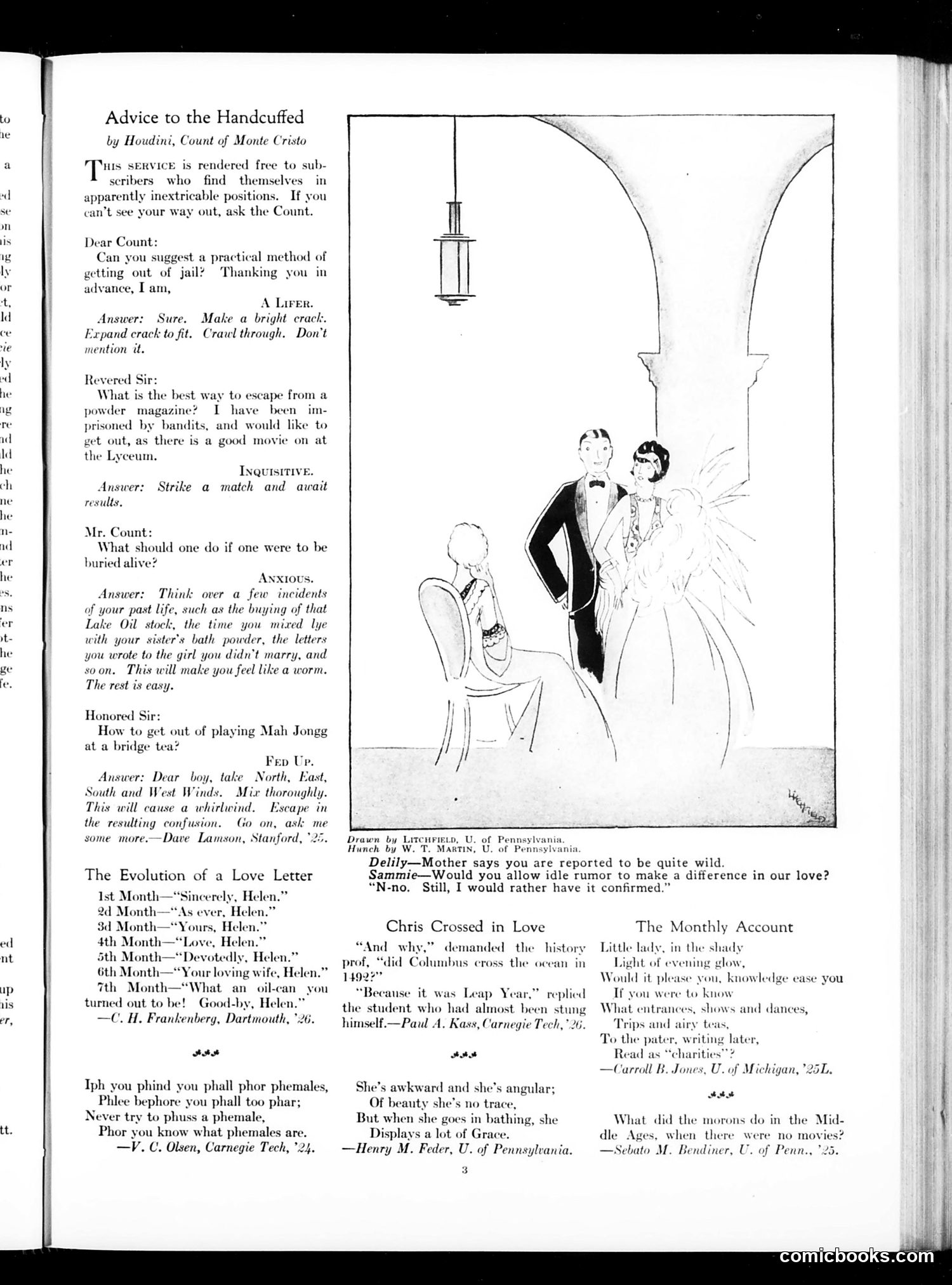
This page combines humor advice columns with a cartoon illustration. The main cartoon depicts a formal couple at what appears to be an elegant event—a man in a tuxedo and a woman in an elaborate white gown with wings, suggesting theatrical or fantastical dress. The "Advice to the Handcuffed" column presents humorous reader questions to "Houdini, Count of Monte Cristo" (referencing famous escape artists/adventurers), offering absurd solutions to predicaments like escaping jail or powder magazines. Below are brief comedic items including "The Evolution of a Love Letter" tracking how romantic language changes monthly, and various witty observations about relationships and social situations. The overall tone is light satire of courtship, social conventions, and contemporary life—typical of Judge magazine's genteel humor for educated readers.
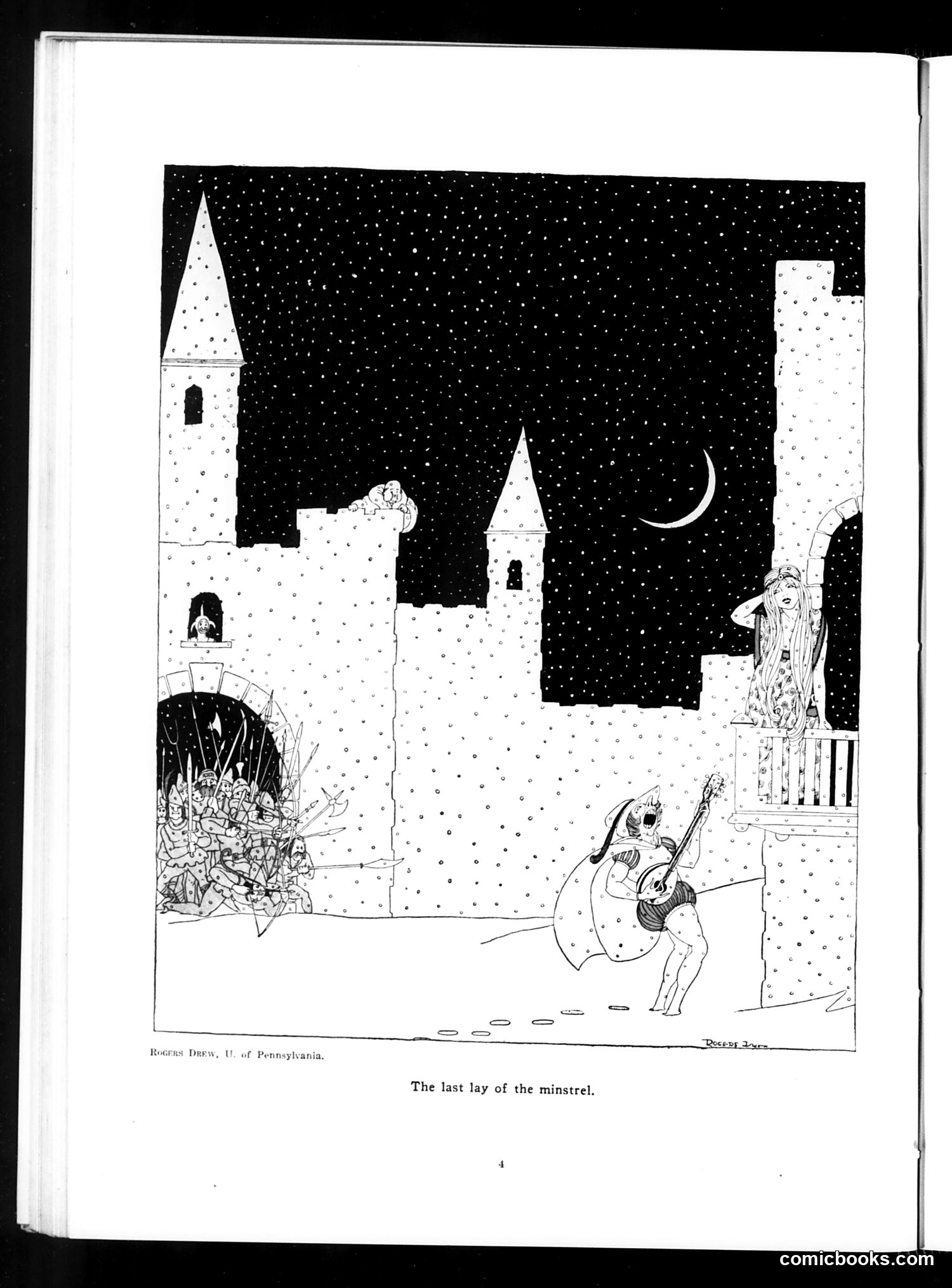
This cartoon by Rollin Drew (University of Pennsylvania) depicts a medieval castle scene at night. A minstrel performs with a lute while standing in the courtyard, seemingly serenading the castle inhabitants—a figure on the right balcony and others visible in windows and towers. The title "The last lay of the minstrel" likely references Sir Walter Scott's 1805 poem of the same name, suggesting this is a literary or cultural commentary rather than direct political satire. The cartoon appears to satirize either romantic idealism, the decline of traditional courtly arts, or possibly academic pretension through its romanticized medieval setting and musical performance. Without additional context from Judge magazine's publication date, the specific satirical target remains unclear.
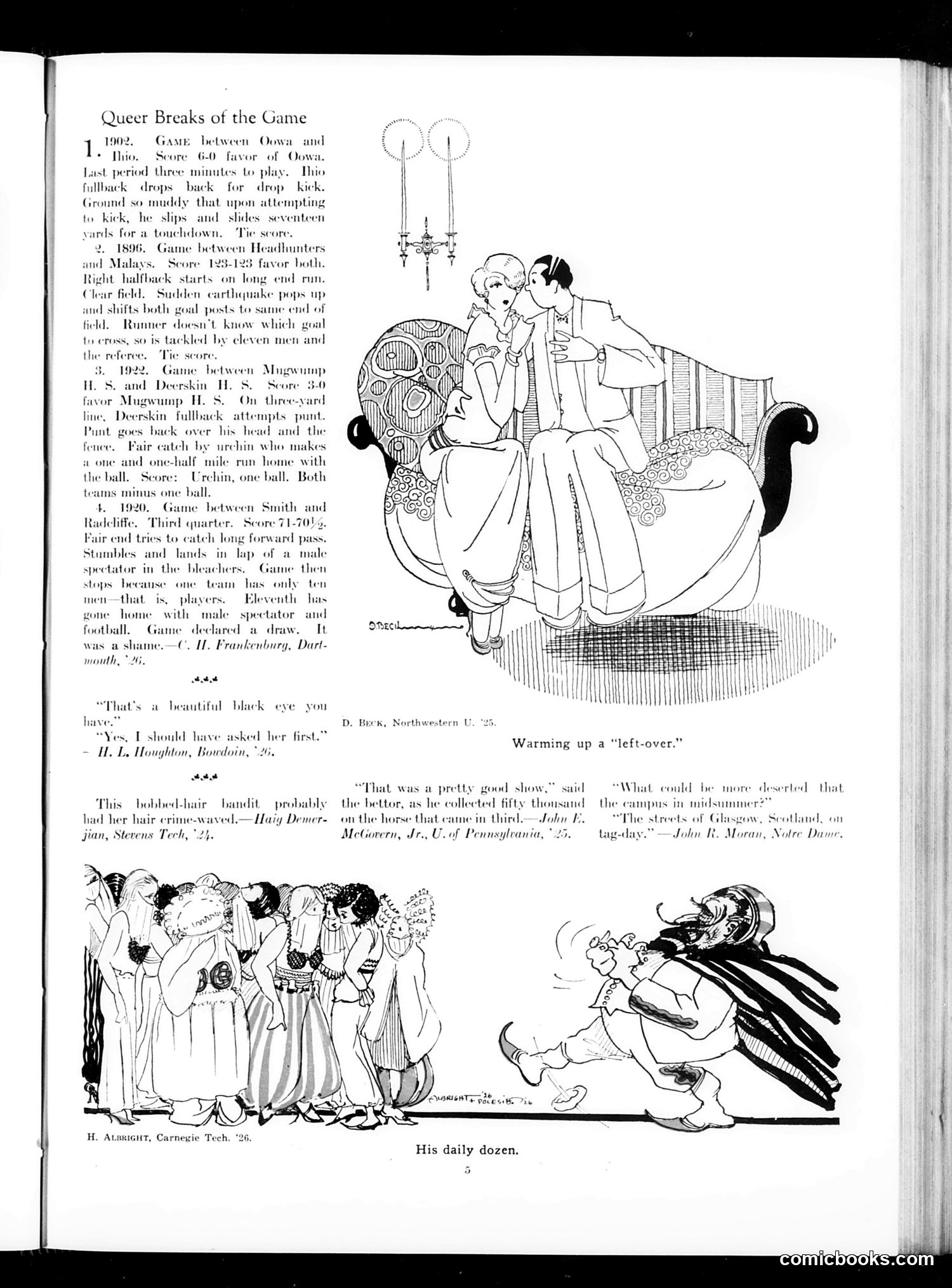
This page from *Judge* magazine collects humorous anecdotes about college football mishaps—the "queer breaks" that disrupt games. Each numbered entry describes absurd, impossible scenarios: a muddy field causing a player to slip into an unintended touchdown; an earthquake shifting goal posts mid-play; a street urchin absconding with the football; a spectator leaving with an eleventh player. The jokes rely on exaggeration and impossibility for comedic effect, typical of early 20th-century collegiate humor. The accompanying illustrations (showing a couple "warming up," a group of women, and a man with a woman's hair accessories) are unrelated vignettes—separate student humor submissions common in *Judge*. The page reflects college sports culture circa 1920s, when football dominated campus life and student publications documented humorous campus incidents and romantic entanglements.
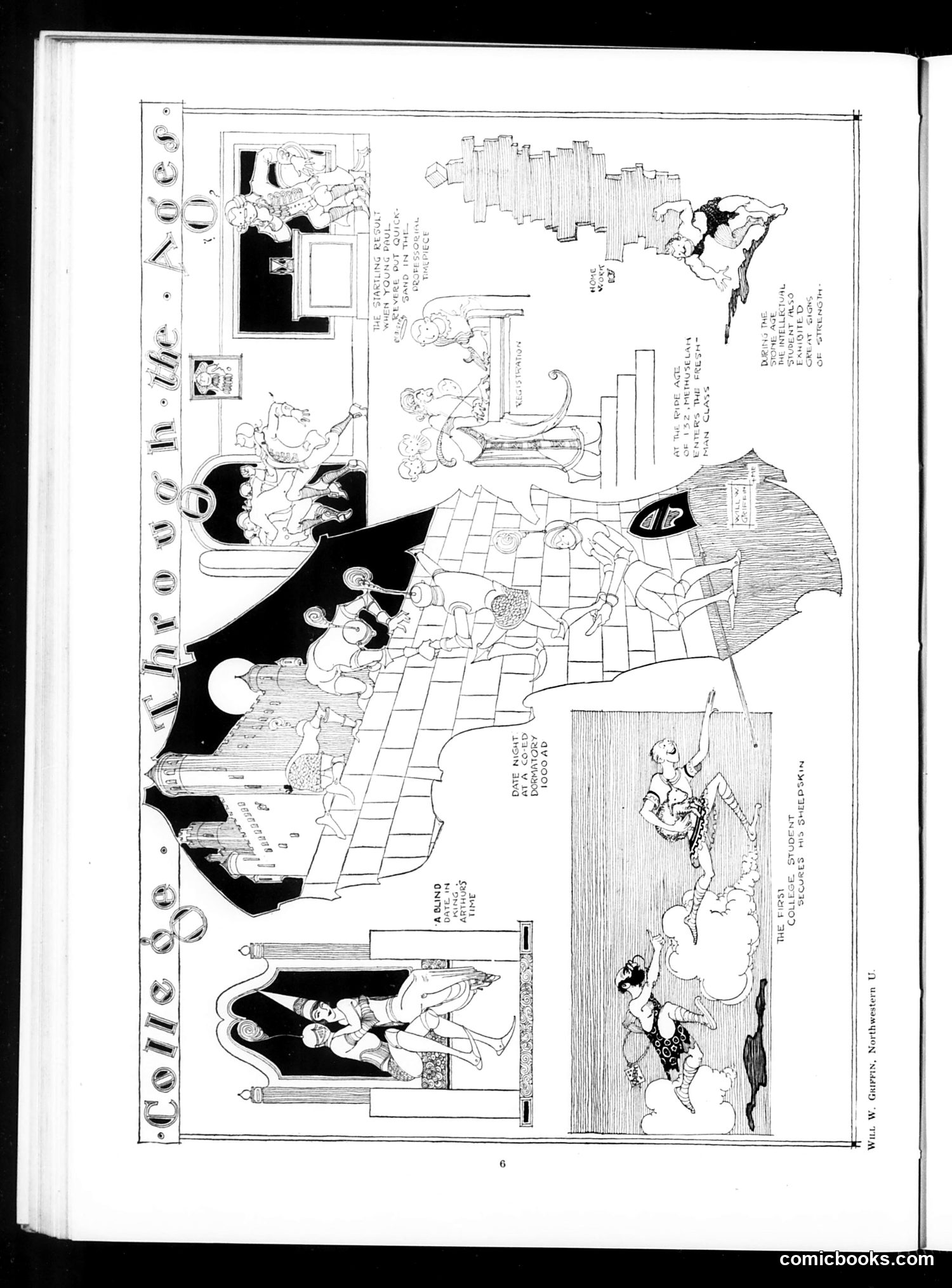
I can see this is a page from *Judge* magazine, but the OCR text is too corrupted to read clearly, and the image quality makes it difficult to identify specific figures or read captions with confidence. What's visible: The page contains multiple cartoon panels arranged around the border (titled "A VOICE IN THE WILDERNESS" on the left margin). The central illustration appears to show figures in an interior domestic scene with period clothing and furnishings. There are also separate smaller illustrated panels, including what appears to be an outdoor scene on the right. Without legible text identifying the specific political figures, events, or satirical targets, I cannot reliably explain what this cartoon means to a modern reader. The artistic style suggests late 19th or early 20th century American satire, but the specific subject requires clearer source material.
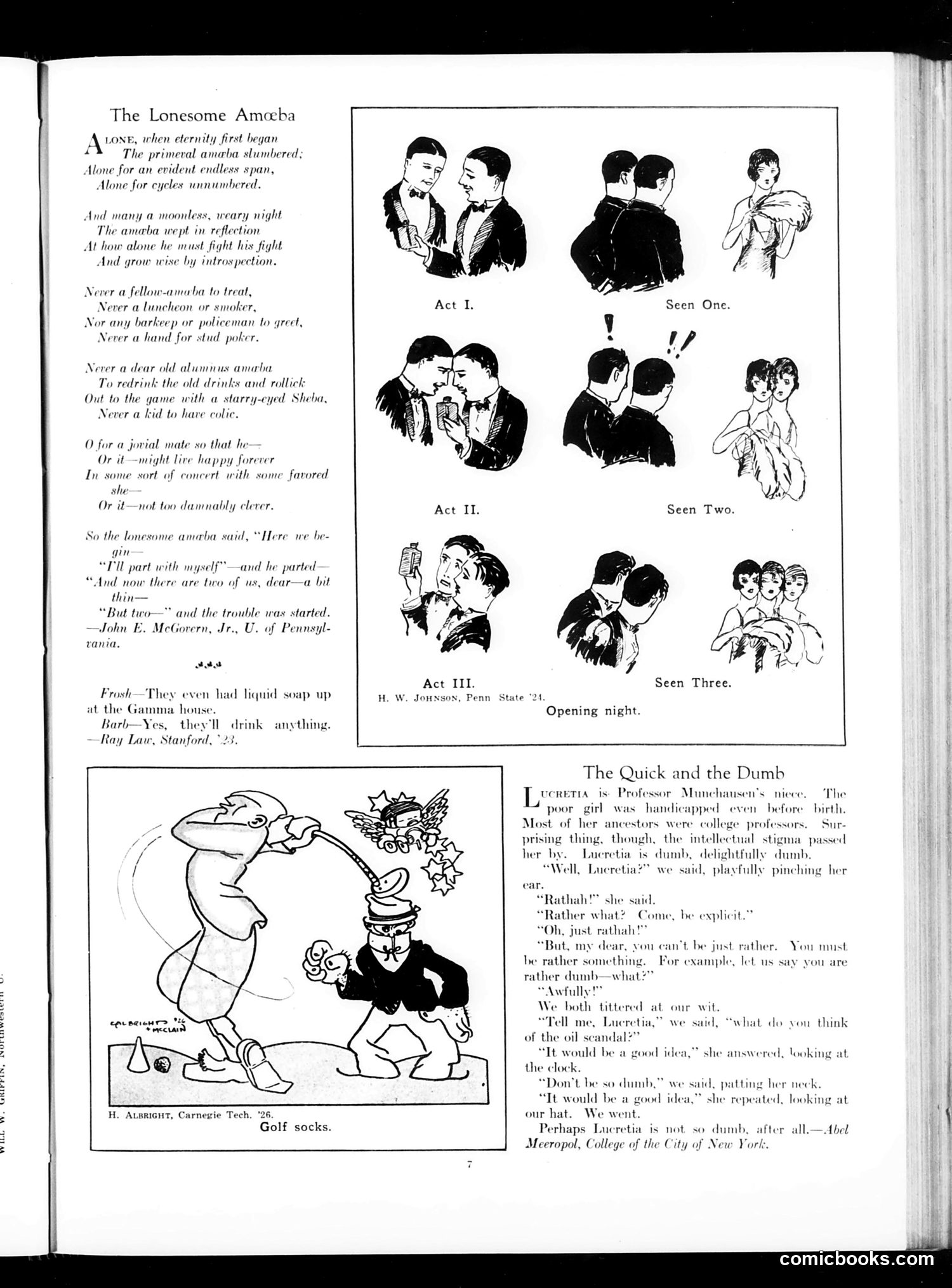
**"The Lonesome Amoeba"** is a whimsical poem mocking the isolation of single life, particularly among college men. It personifies an amoeba as a lonely bachelor yearning for companionship—luncheons, poker games, alumni outings with attractive women ("Sheba"), even parenthood. The joke culminates in the amoeba finding a mate, only to discover that partnership creates its own complications ("the trouble was started"). This satirizes the ambivalence many young men felt about bachelorhood versus marriage. **"Golf Socks"** is a cartoon by H. Albright showing exaggerated characters in a comedic conflict over athletic wear—likely poking fun at the pretentiousness of collegiate sporting culture. **"The Quick and the Dumb"** presents Lucretia, a professor's niece, as ironically stupid despite her intellectual pedigree. The satire targets the assumption that academic breeding ensures intelligence. Lucretia can only respond with vague utterances ("Rathah," "Awfully"), suggesting that hereditary advantage and actual capability are unrelated—a gentle critique of class assumptions.
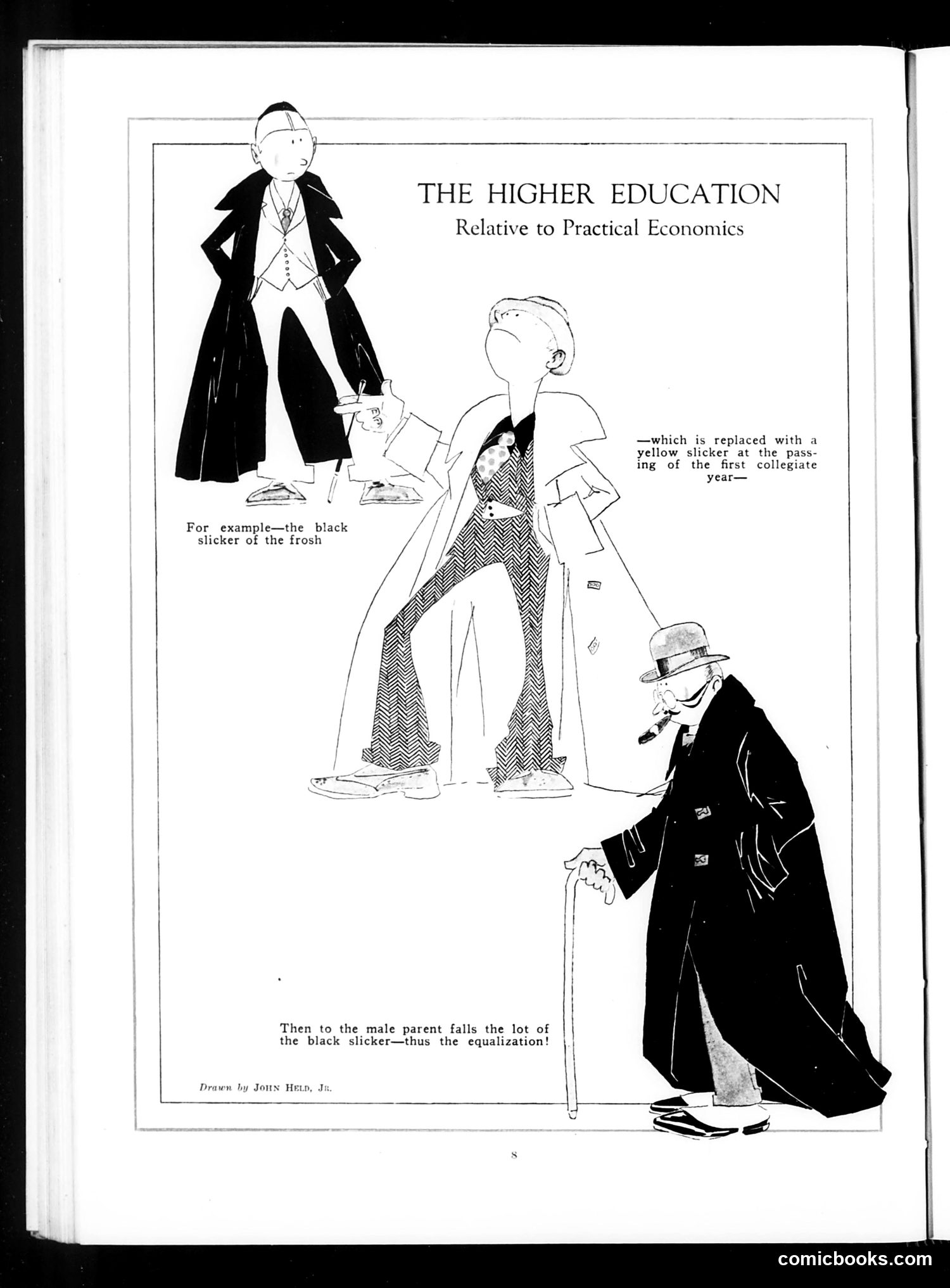
This satirical cartoon by John Held Jr. mocks the supposed leveling effect of college education on class distinctions. It depicts three figures representing different economic classes—a wealthy woman in furs, a working-class man, and an affluent gentleman—each wearing a "black slicker" (raincoat). The joke criticizes the notion that higher education creates economic equality. Despite attending college, students from privileged backgrounds allegedly shed their class markers (the black slicker becomes a yellow one after freshman year), only to have their parents eventually acquire the same working-class garment. The satire suggests that while education claims to equalize opportunity, actual class advantages and disadvantages persist—parents' economic status ultimately determines outcomes, not collegiate learning.
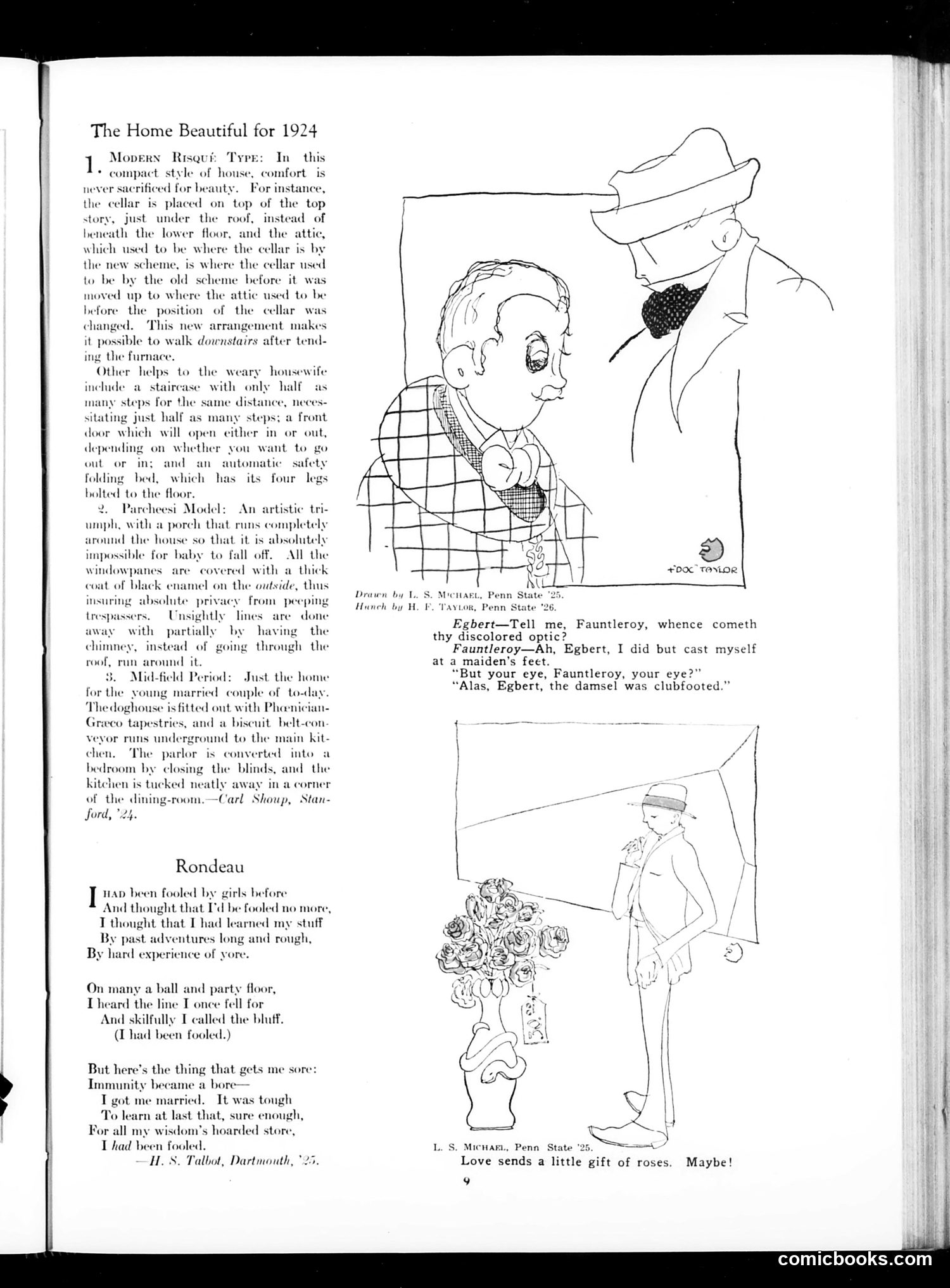
This page contains satirical commentary on 1920s domestic life through two sections: **"The Home Beautiful for 1924"** mocks absurd architectural designs supposedly aimed at modern housewives. The satire targets efficiency-obsessed home design trends by describing logically impossible features: a cellar relocated to the roof, stairs reduced by half while covering the same distance, and windows painted black for "privacy." The humor derives from treating ridiculous propositions with serious architectural language, poking fun at contemporary modernism's sometimes impractical obsession with convenience. **The illustration and "Rondeau" poem** depict romantic/domestic misadventures. One cartoon shows a young man explaining a black eye from pursuing a woman ("cast myself at a maiden's feet"), only to learn she was "clubfooted"—dark humor typical of 1920s comedy. The poem describes a man repeatedly fooled by women, culminating in marriage as the ultimate deception. Overall, the page satirizes both pretentious modern design trends and romantic mishaps in contemporary courtship culture.
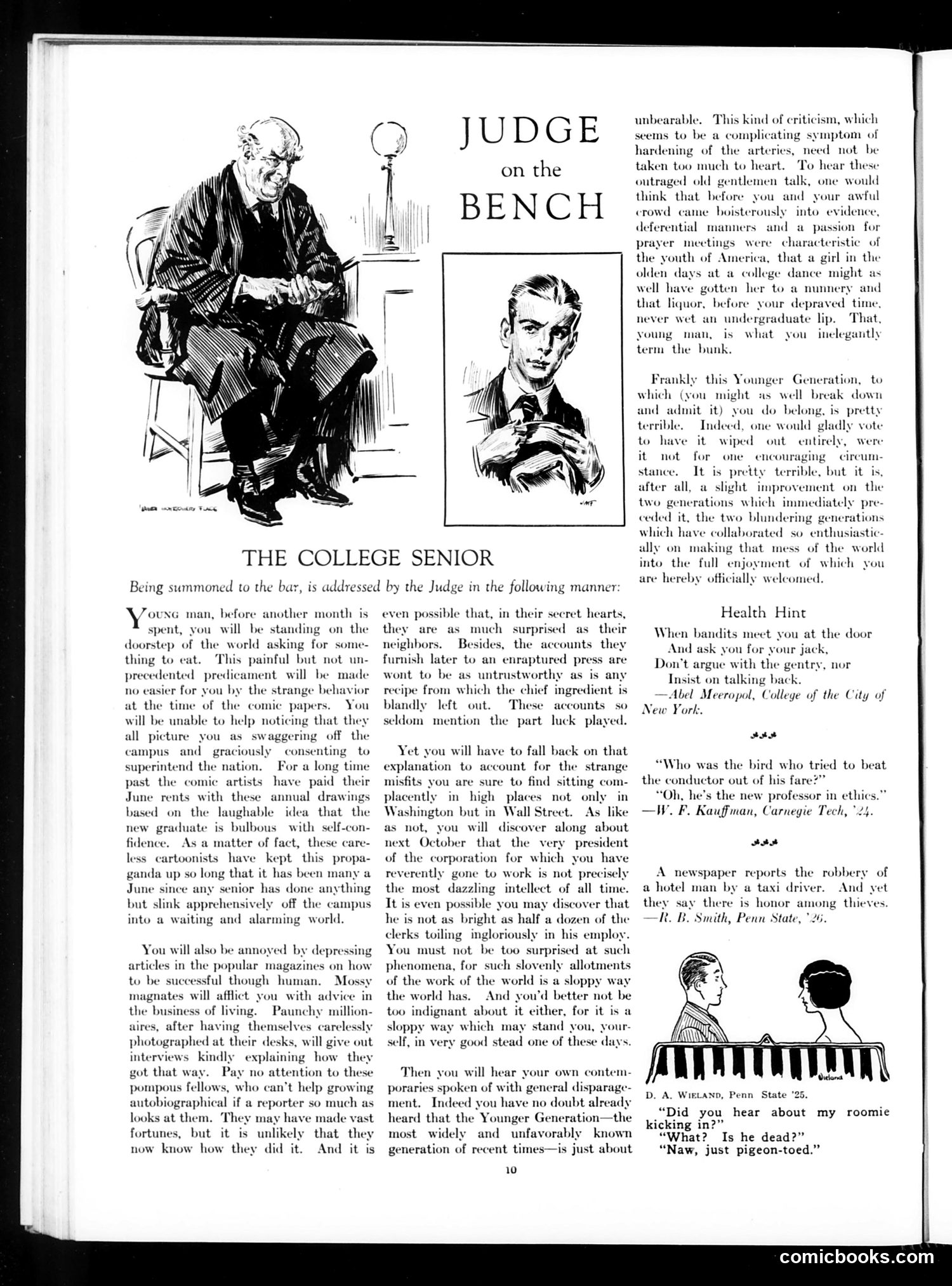
This is a satirical advice column disguised as a stern judicial lecture to graduating college seniors. The setup shows an older judge (representing establishment authority and tradition) addressing a young man about to enter the working world. The satire targets multiple groups: **The target of ridicule:** Comic papers and popular magazines that flatter graduating seniors with imagery of confident, capable young men ready to lead the nation—when reality is that graduates nervously enter an uncertain job market. **Secondary targets:** Successful businessmen and millionaires who give self-aggrandizing interviews about their success while conveniently omitting luck's role. The judge sarcastically notes their "recipes" leave out key ingredients. **The Younger Generation critique:** The piece defends young people against older critics who romanticize their own youth while condemning current youth as "unbearable"—noting these complaints are symptoms of aging ("hardening of the arteries"). The humor lies in the judge's mock-serious tone delivering worldly cynicism: corporate presidents aren't necessarily bright, the world is "sloppy," and success involves luck they won't admit.
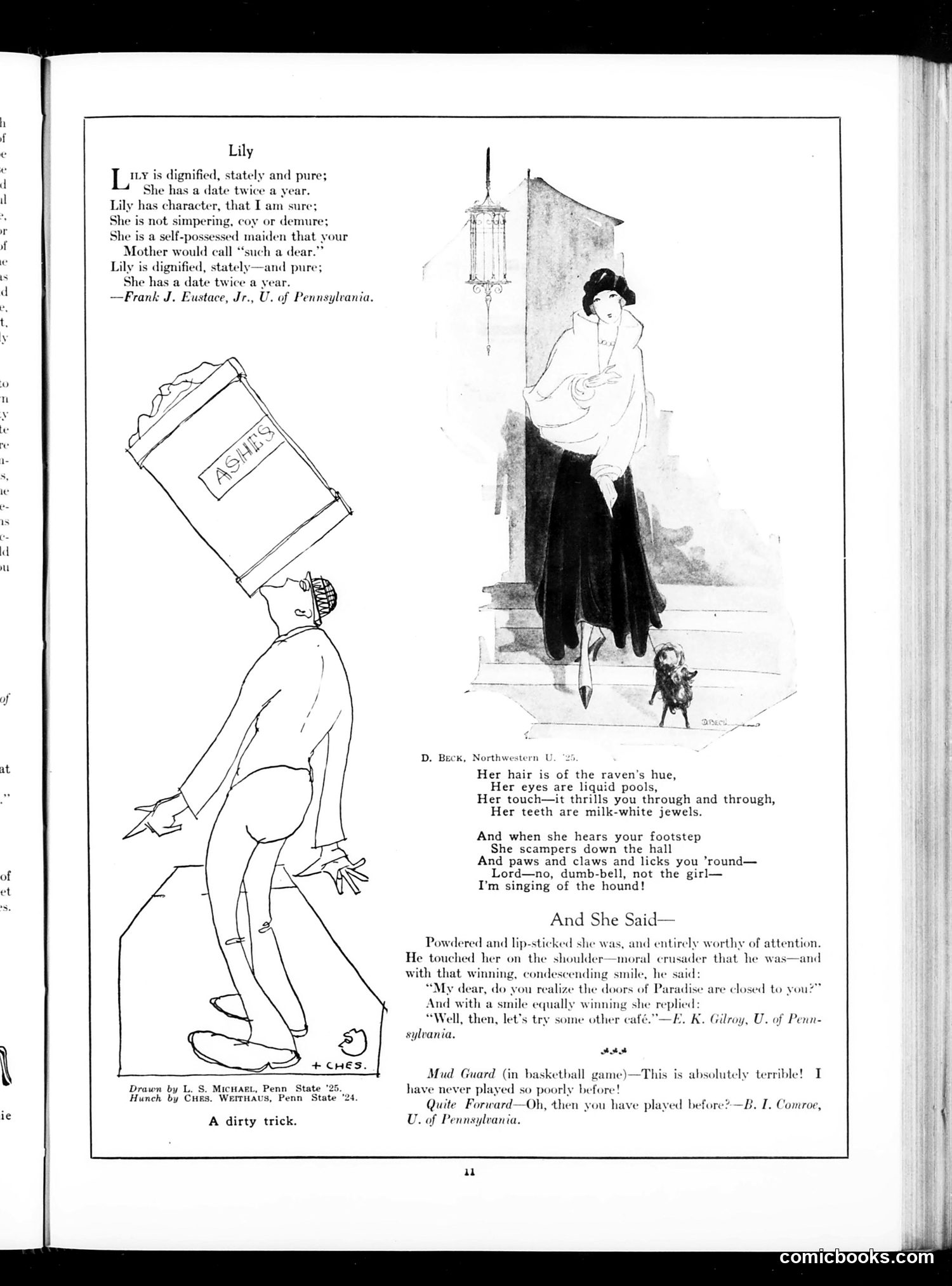
This page contains three distinct pieces of college humor from the 1920s: **"Lily" (top left):** A visual gag where a man receives an enormous box labeled "ASHES" to the head. The joke plays on the double meaning—the poem describes an idealized young woman named Lily, but the illustration subverts expectations by depicting slapstick misfortune instead. **"And She Said" (top right):** Social satire mocking moralistic men. A self-righteous "moral crusader" lectures a powdered, lip-sticked woman about virtue and Paradise, only for her to dismiss him with a witty comeback suggesting she'll simply find another café. The humor targets sanctimonious male judgment of women's behavior and appearance during the Jazz Age. **Bottom section:** Two brief, punny jokes about basketball and forward passes, typical of the magazine's college-audience humor. The overall tone reflects 1920s campus culture—irreverent toward authority and traditional morality, with humor derived from visual gags and quick wordplay. The emphasis on "painted" women and casual dismissal of moral lecturing reflects post-WWI cultural shifts.
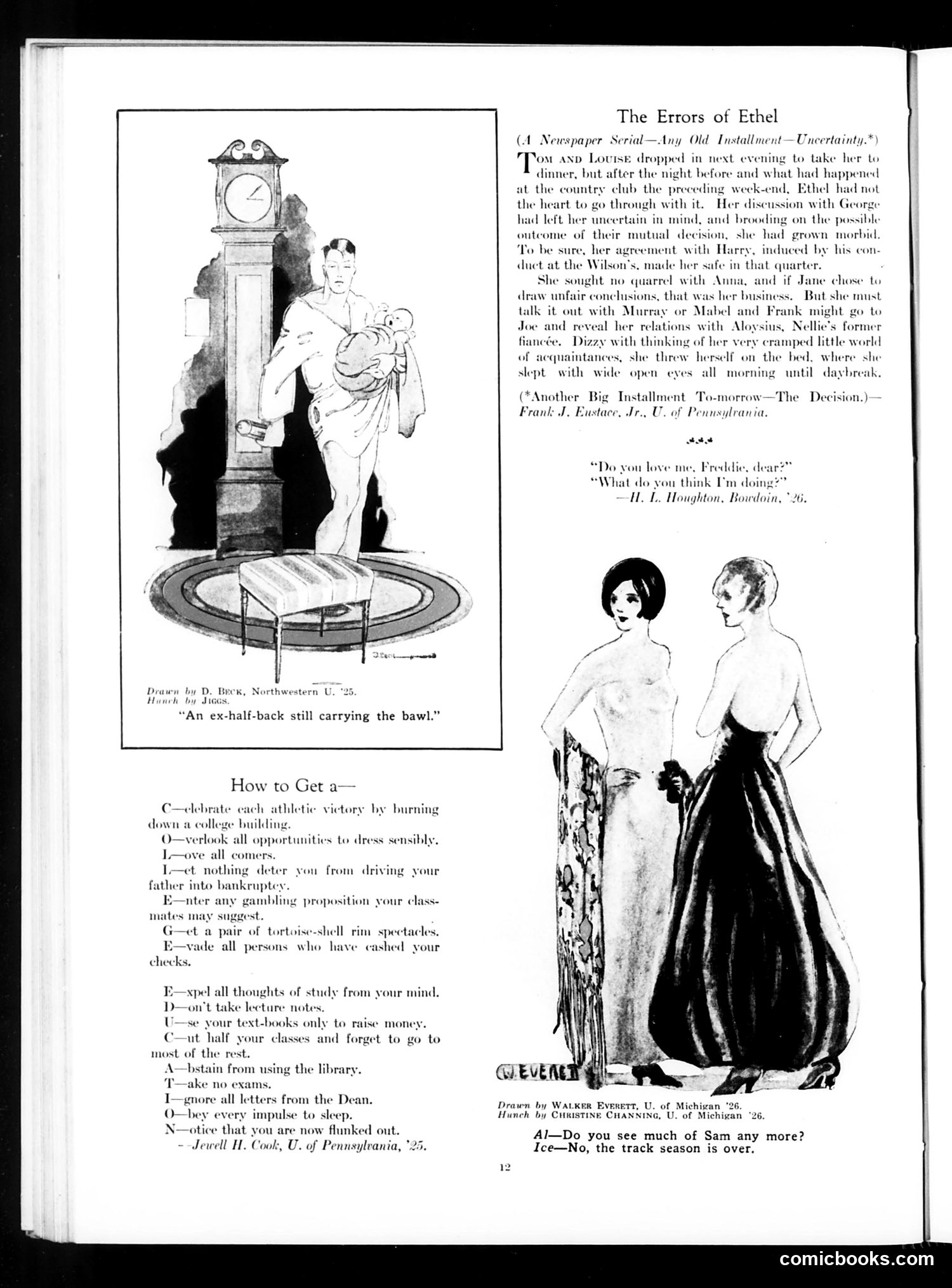
The page contains two distinct satirical pieces aimed at college students circa mid-1920s: **"How to Get a—" (acrostic poem):** A biting critique of reckless college behavior. Using the letters C-O-L-L-E-G-E-D-U-C-A-T-I-O-N, it mocks students who celebrate athletic wins by burning buildings, neglect studies, gamble, evade creditors, skip classes, avoid the library and exams, and ignore Dean's warnings—ultimately ending up expelled. The cartoon shows an athlete in formal dress still clutching a football, satirizing jocks who prioritize sports over academics. **"The Errors of Ethel":** A serialized melodrama parody mocking breathless newspaper serials. Ethel is caught in romantic entanglements with multiple men (George, Harry, possibly others), creating social anxiety in her small social circle. The overwrought prose and contrived complications satirize the overwrought, cliff-hanging narratives popular in newspapers. Both pieces target 1920s youth culture—athletic excess, academic neglect, and romantic drama—with gentle ridicule typical of Judge's satirical approach.
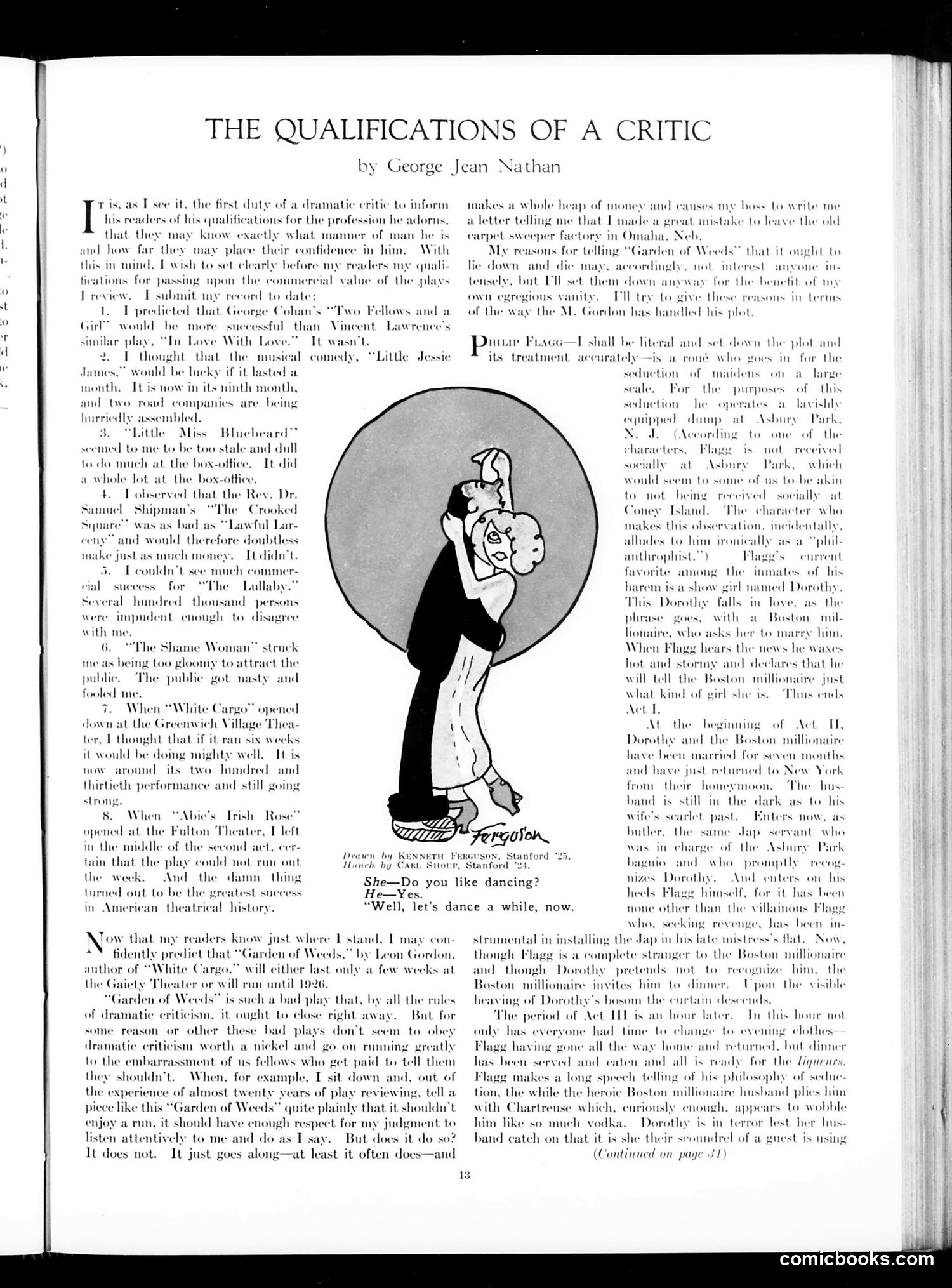
This is a theater critic's self-satirizing essay with an accompanying cartoon. Nathan lists his failed predictions about Broadway plays—declaring shows would flop that became hits ("Abie's Irish Rose," "White Cargo"), and praising ones that failed. The humor lies in Nathan admitting his professional incompetence while simultaneously claiming authority to judge the new play "Garden of Weeds." The small cartoon shows a couple dancing, illustrating a scene from the play being discussed. The satire targets theatrical critics generally: Nathan argues that despite his terrible track record, critics expect plays to obey their negative judgments. The piece is self-aware comedy—Nathan's honesty about his failures actually undermines the entire premise of dramatic criticism having predictive value. This reflects early 20th-century skepticism about whether critics actually understand what audiences want.
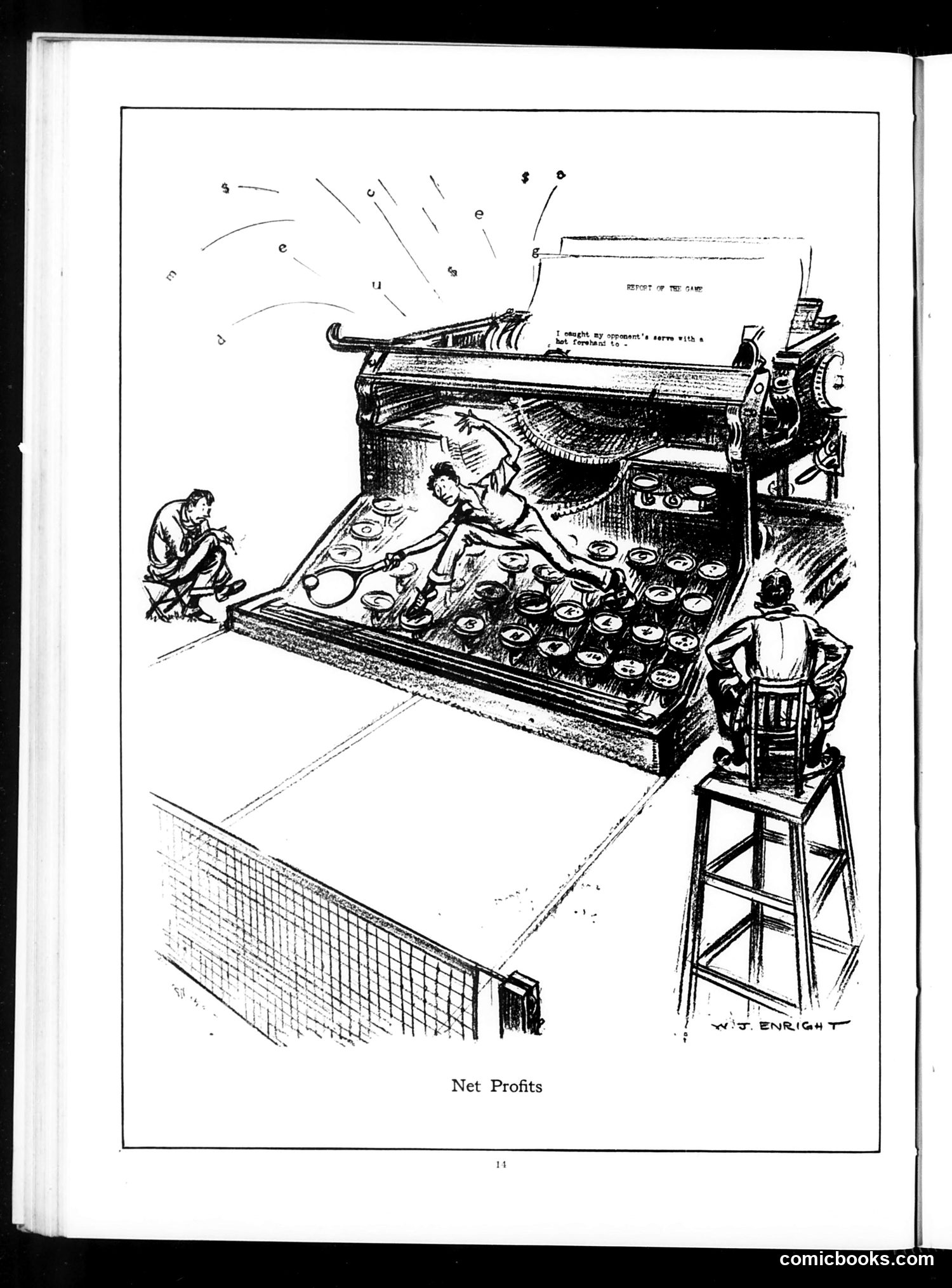
This cartoon satirizes industrial labor exploitation. A massive typewriter dominates the composition, with tiny human figures positioned around it—some operating the machine, others observing from a platform. The typewriter's keys appear to contain coins or circular objects, suggesting that profits are literally generated from the machine's operation. The title "Net Profits" is a pun: the visible net/mesh structure at the base implies that profits are extracted or filtered from labor. The workers' small scale relative to the industrial machinery emphasizes their insignificance compared to the profits produced. This appears to be social commentary on how modern industrial capitalism generates wealth while minimizing worker value—a common Progressive Era criticism in early 20th-century satirical magazines like *Judge*.
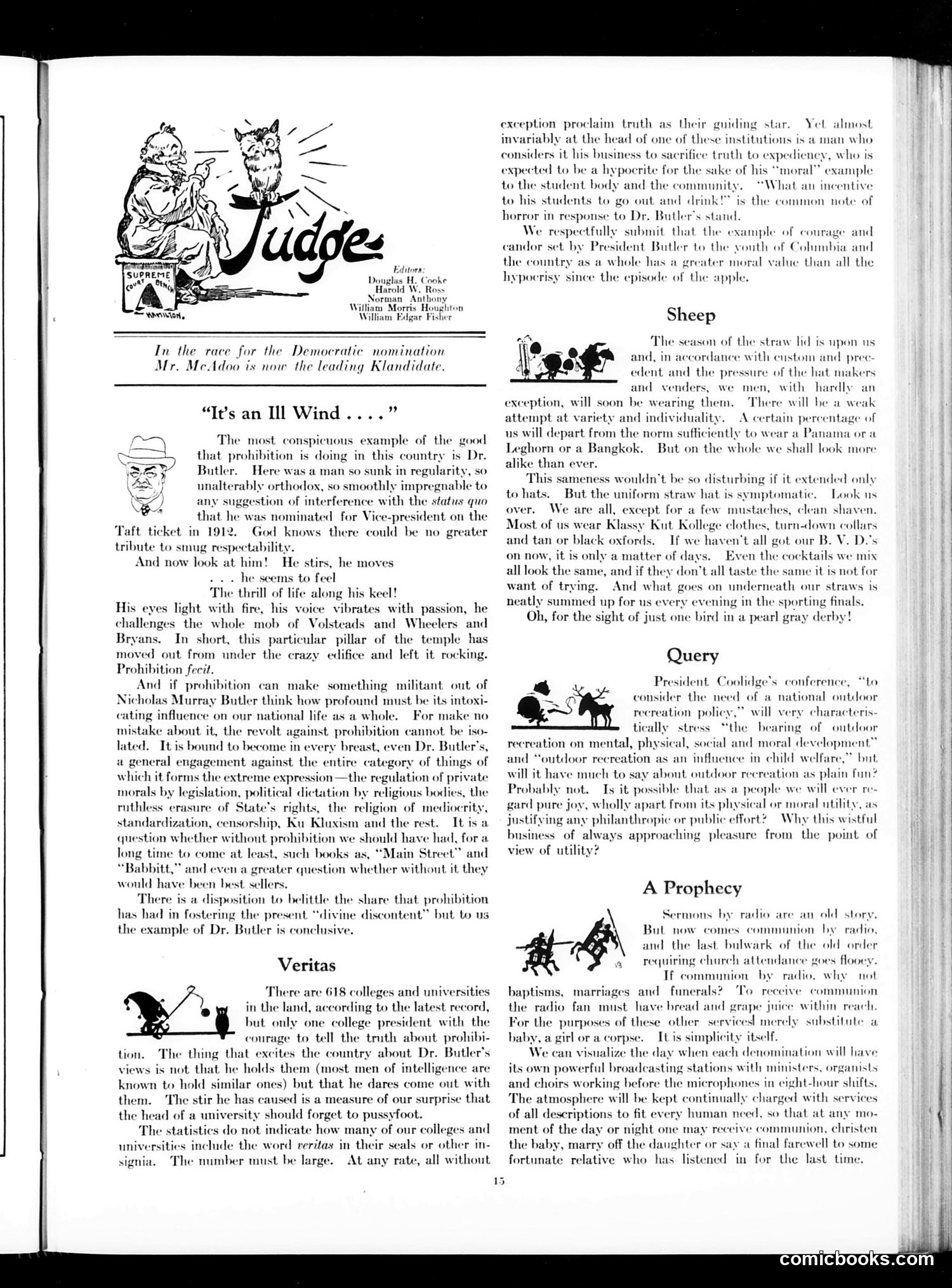
## "It's an Ill Wind" - The Main Cartoon The top cartoon mocks **Nicholas Murray Butler**, president of Columbia University, for his public criticism of Prohibition. The satire argues that Prohibition—normally presented as morally uplifting—has paradoxically awakened Butler from decades of political conformity and timidity. He was once so safely orthodox he was nominated VP on Taft's 1912 ticket; now Prohibition's overreach has made him militantly vocal against government regulation of private morals. The piece celebrates Butler's rare courage among college presidents to speak truth publicly, while criticizing academia generally for producing hypocrites who privately oppose policies they publicly support for "expediency." ## "McAdoo is now the leading Klandidate" This biting reference suggests **William McAdoo**, Democratic presidential nominee, attracted support from the **Ku Klux Klan**—a major political scandal of the 1920s. The wordplay ("Klandidate") directly links him to the KKK, reflecting Judge's condemnation of Klan influence in American politics.
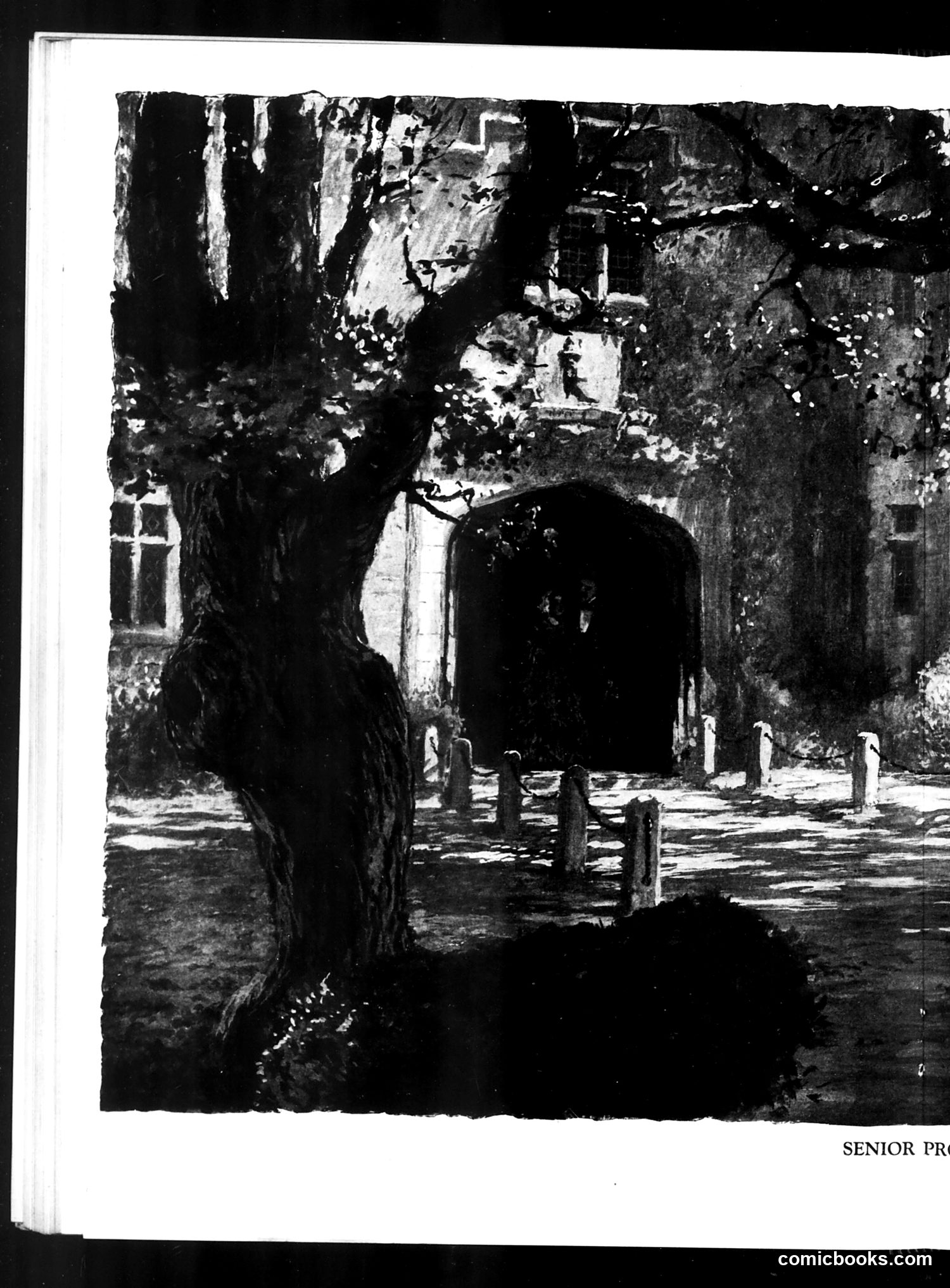
This page appears to be a fragmentary reproduction from *Judge* magazine, but the OCR text is largely corrupted and illegible ("SENIOR PR" and scattered letters/symbols). The black-and-white photograph shows what appears to be an architectural or archaeological scene—possibly ruins or an old building with an arched doorway, overgrown vegetation, and posts in the foreground. However, without clear context from the readable text, I cannot confidently identify what political or social satire this image was meant to convey. The page quality and OCR corruption prevent reliable interpretation of the cartoon's specific subject matter, figures, or satirical point. A clearer reproduction would be necessary for accurate analysis.
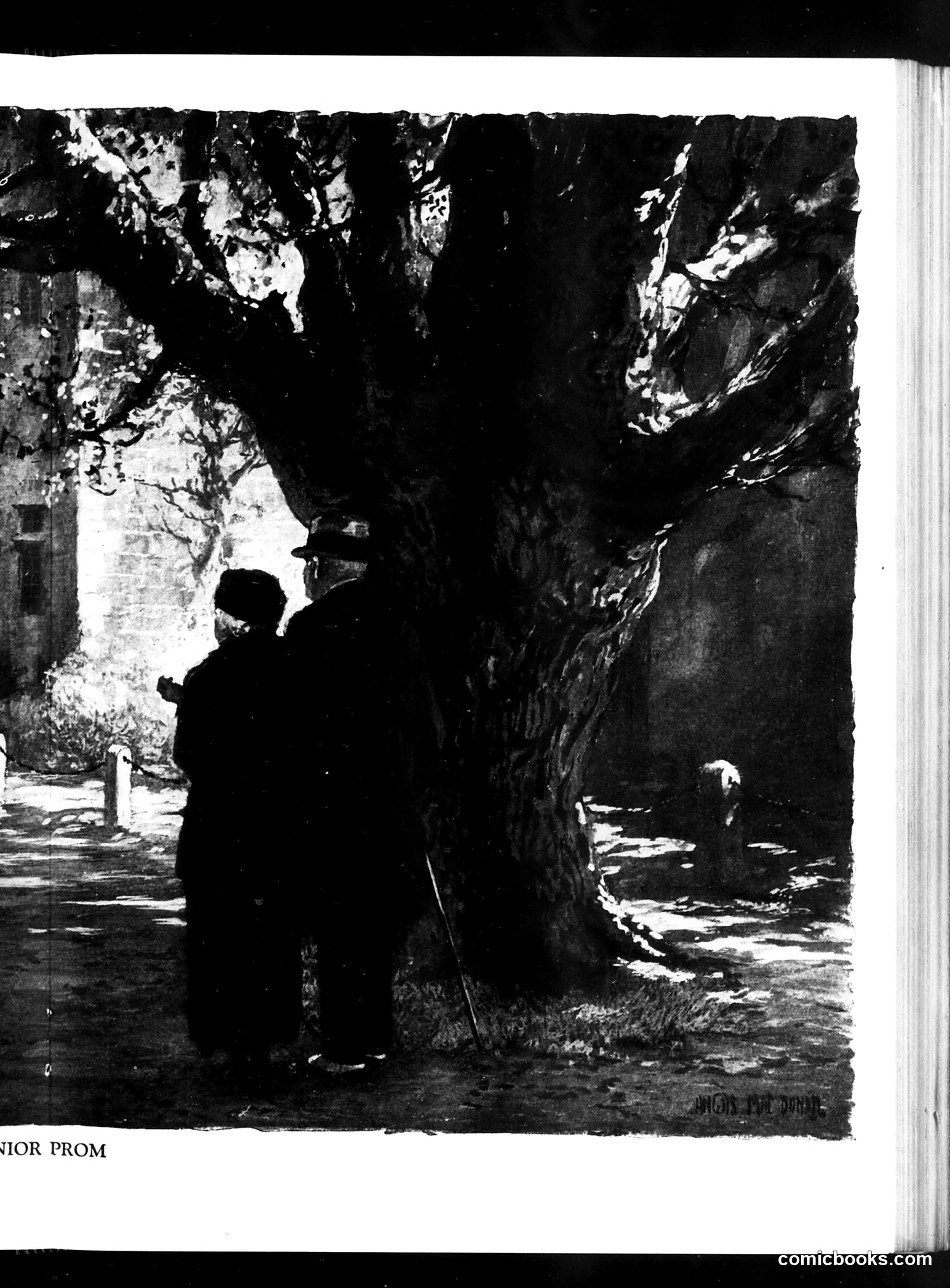
This appears to be a page from **Judge** magazine featuring what looks like a dramatic black and white photograph or illustration rather than a traditional cartoon. The image shows silhouetted figures beneath a large, gnarled tree with dramatic lighting and texturing that creates an eerie, gothic atmosphere. The partial text "IOR PROM" at the bottom suggests this may relate to a junior prom scene, though the context is unclear. The artistic style—high contrast, expressionistic rendering—suggests this may be satirizing a dramatic or melodramatic moment, possibly mocking affected behavior at formal youth events. However, without clearer text, identifying specific figures, or visible captions, I cannot definitively explain the satire's target or meaning. The imagery alone doesn't reveal Judge's intended commentary.
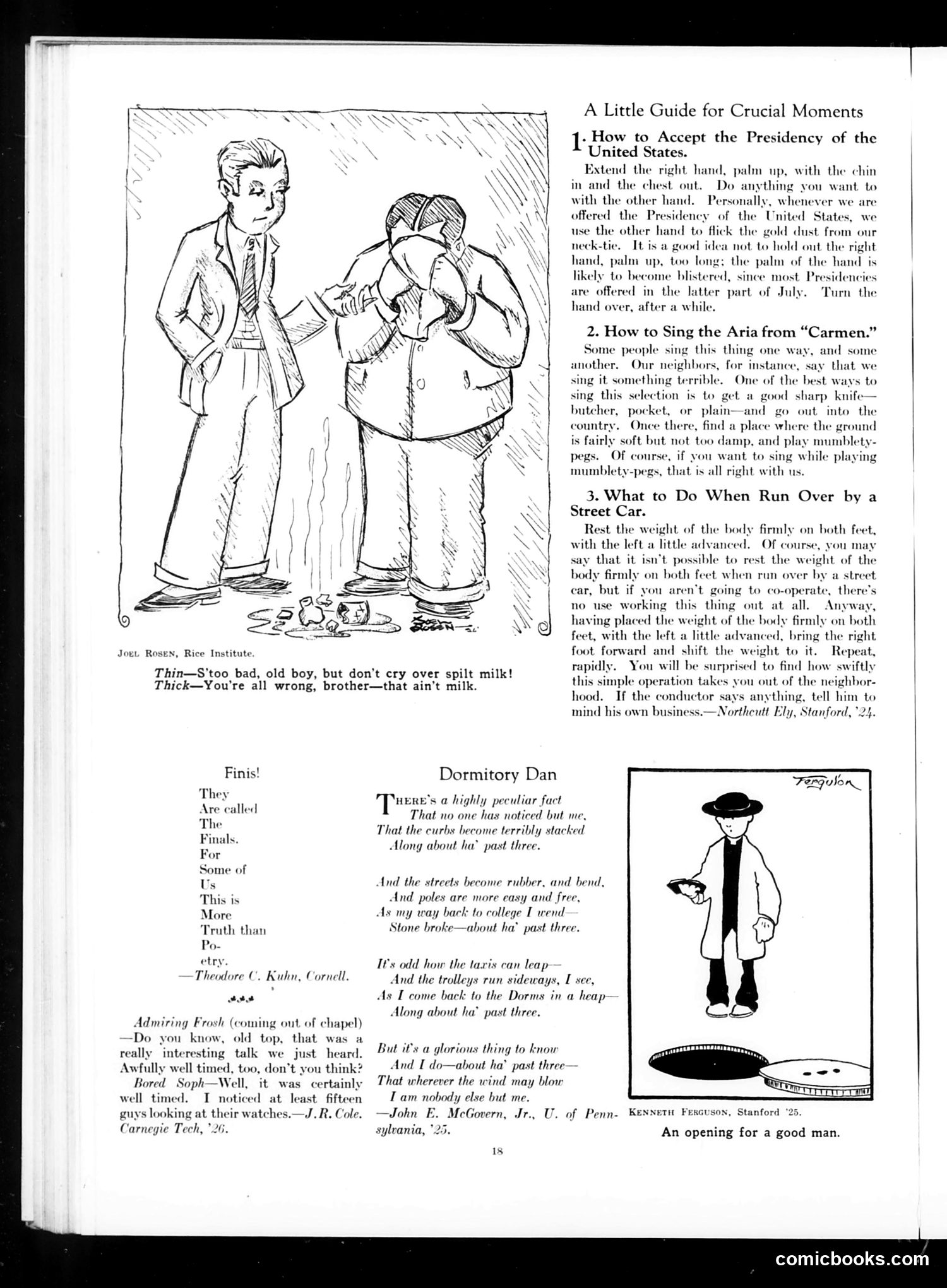
This page from *Judge* contains humorous college-oriented content from the 1920s, primarily satirizing student life and offering tongue-in-cheek "advice." The cartoon at top-left depicts two college men with the caption contrasting their reactions to spilled liquid—one sympathizes about "spilt milk," while the other crude insists "that ain't milk," suggesting students' drinking habits during Prohibition. The "Little Guide for Crucial Moments" offers absurdist mock-advice: accepting the presidency involves flicking "gold dust" from one's necktie; singing Carmen requires going to the countryside and playing mumblety-pegs; surviving a street car accident involves walking rhythmically away. These parody self-help guides while mocking pretentious behavior. "Dormitory Dan" is a poem about drunkenness ("about ha' past three"—3:30 AM), describing how streets "become rubber," taxis "leap," and trolleys "run sideways"—surreal descriptions of intoxication returning to college dormitories. The content reflects Prohibition-era college culture, where drinking was forbidden yet widespread.
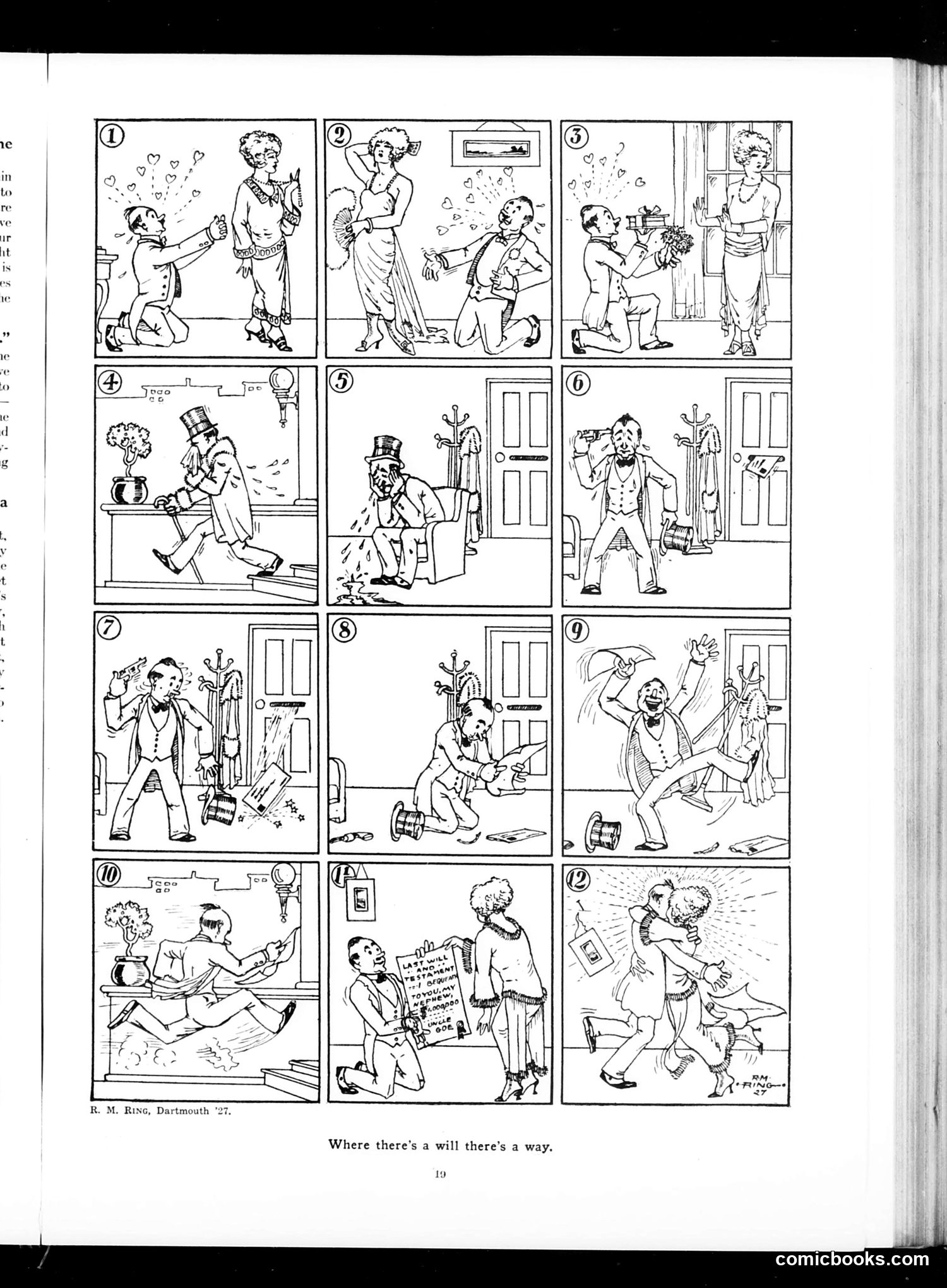
This is a 12-panel comic strip titled "Where there's a will there's a way," credited to R.M. Ring from Dartmouth '27. The narrative follows a man's persistent attempts to win over a woman's affections. The sequence shows him proposing marriage (panel 1), being rejected repeatedly, and attempting increasingly desperate romantic gestures—including elaborate gifts, public displays, and seemingly magical interventions. The strip satirizes both courtship persistence and the notion that sheer determination can overcome romantic rejection. The humor derives from the man's refusal to accept "no" and his escalating, absurd methods. It reflects early 20th-century attitudes about male persistence in romance, presented here as comedic rather than problematic.
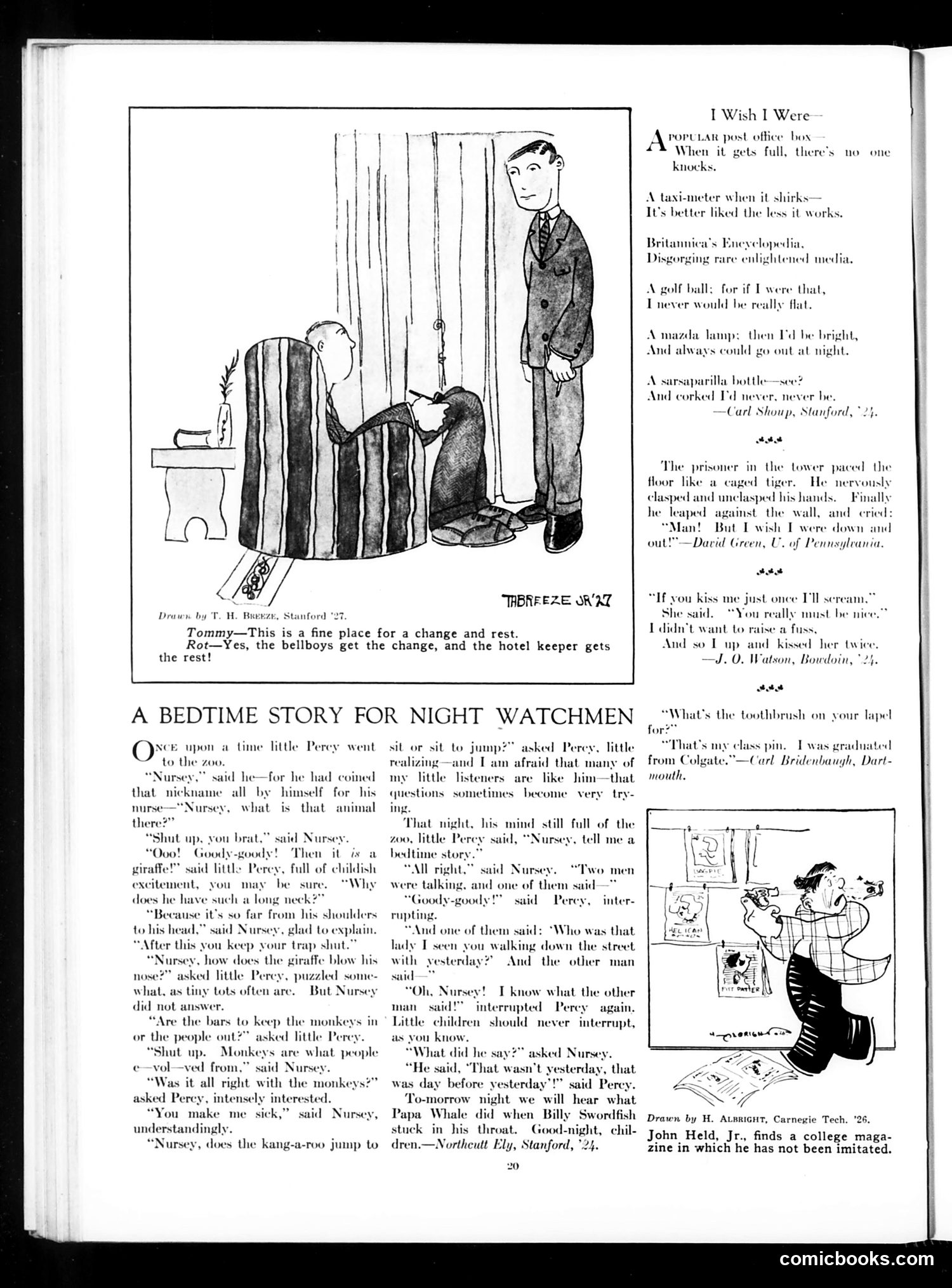
This page from *Judge* magazine contains several distinct pieces of humor: **Top Cartoon ("Breeze Gag")**: A hotel joke playing on word ambiguity—a guest complains the hotel is "a fine place for a change and rest," but the bellhop's response suggests the establishment profits from guests while providing neither comfort nor relaxation. **"I Wish I Were" Section**: A collection of humorous submitted wishes from college students, each using wordplay or ironic reversals. Examples: wishing to be a post office box (so no one would "knock"), a taxi-meter (better when it doesn't work), or a sarsaparilla bottle (so one would never be "corked"/drunk). **"Bedtime Story for Night Watchmen"**: A children's story dialogue where little Percy asks naive questions about zoo animals, particularly giraffes' long necks. The humor targets both children's literal-minded curiosity and adults' exasperation with constant questioning. **Bottom right**: A brief joke about a college student's class pin mistaken for a toothbrush. The page represents typical 1920s college humor—wordplay, gentle satire of student life, and conversational jokes.
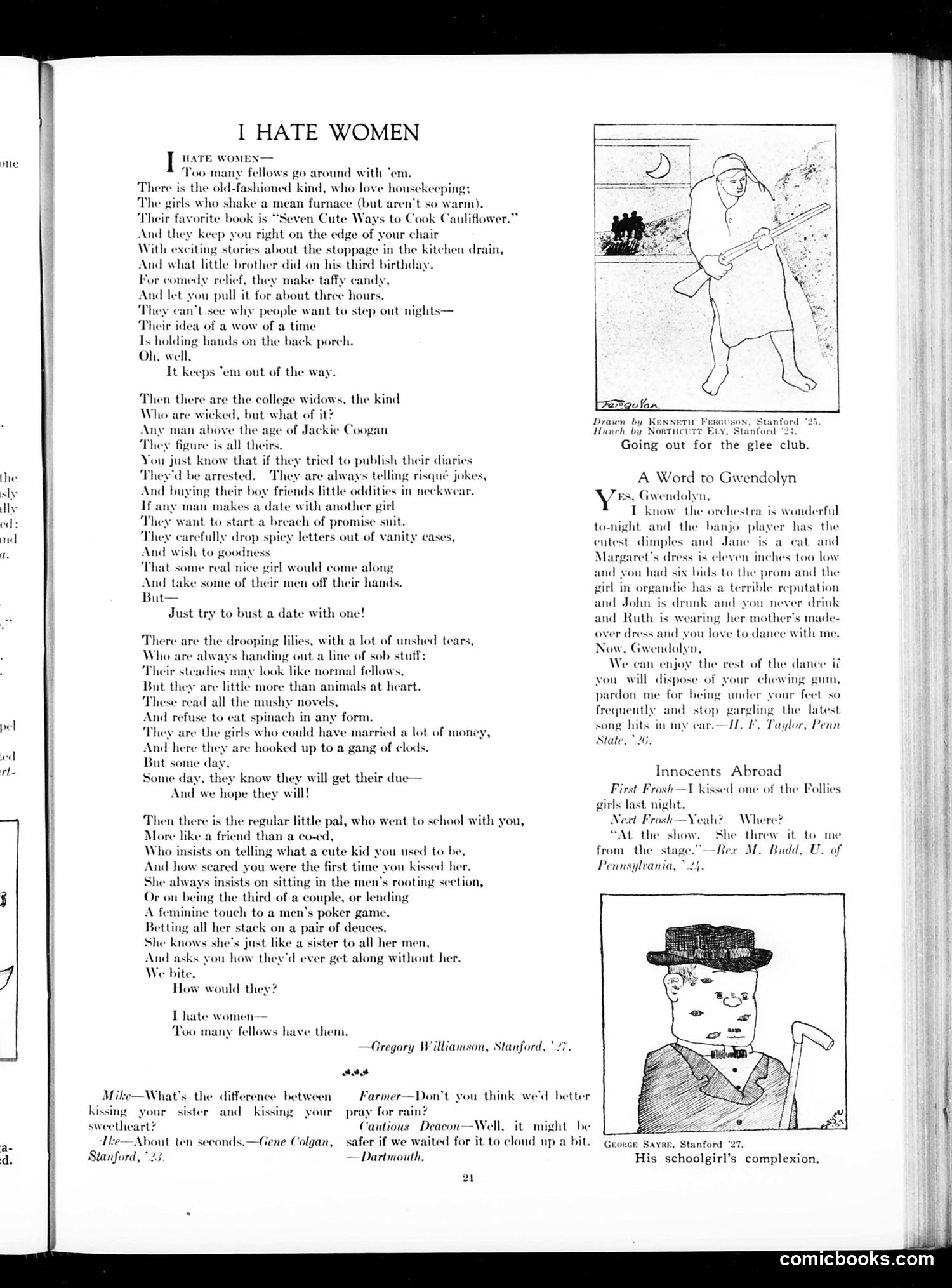
This 1920s humor piece satirizes contemporary dating and social conventions by cataloging male complaints about different "types" of women. The author (Gregory Williamson, Stanford '27) mockingly describes: - **Old-fashioned housewives**: boring, domestic-focused - **"College widows"**: sexually adventurous, litigious over broken dates - **Melodramatic types**: overly emotional, reading "mushy novels" - **"Regular pals"**: tomboyish women who participate in male spaces (poker games, rooting sections) The satire's target is male hypocrisy—each complaint reveals men's actual behavior or desires. Men simultaneously want women passive yet entertaining, loyal yet not clingy, innocent yet sophisticated. The accompanying cartoons and jokes reinforce period attitudes: women's incomprehensible preferences, their obsession with appearance and romance, their social awkwardness. The piece reflects 1920s anxiety about changing gender roles post-WWI, when women gained voting rights and greater social freedom—yet the satire ultimately reinforces traditional expectations rather than genuinely critiquing them.
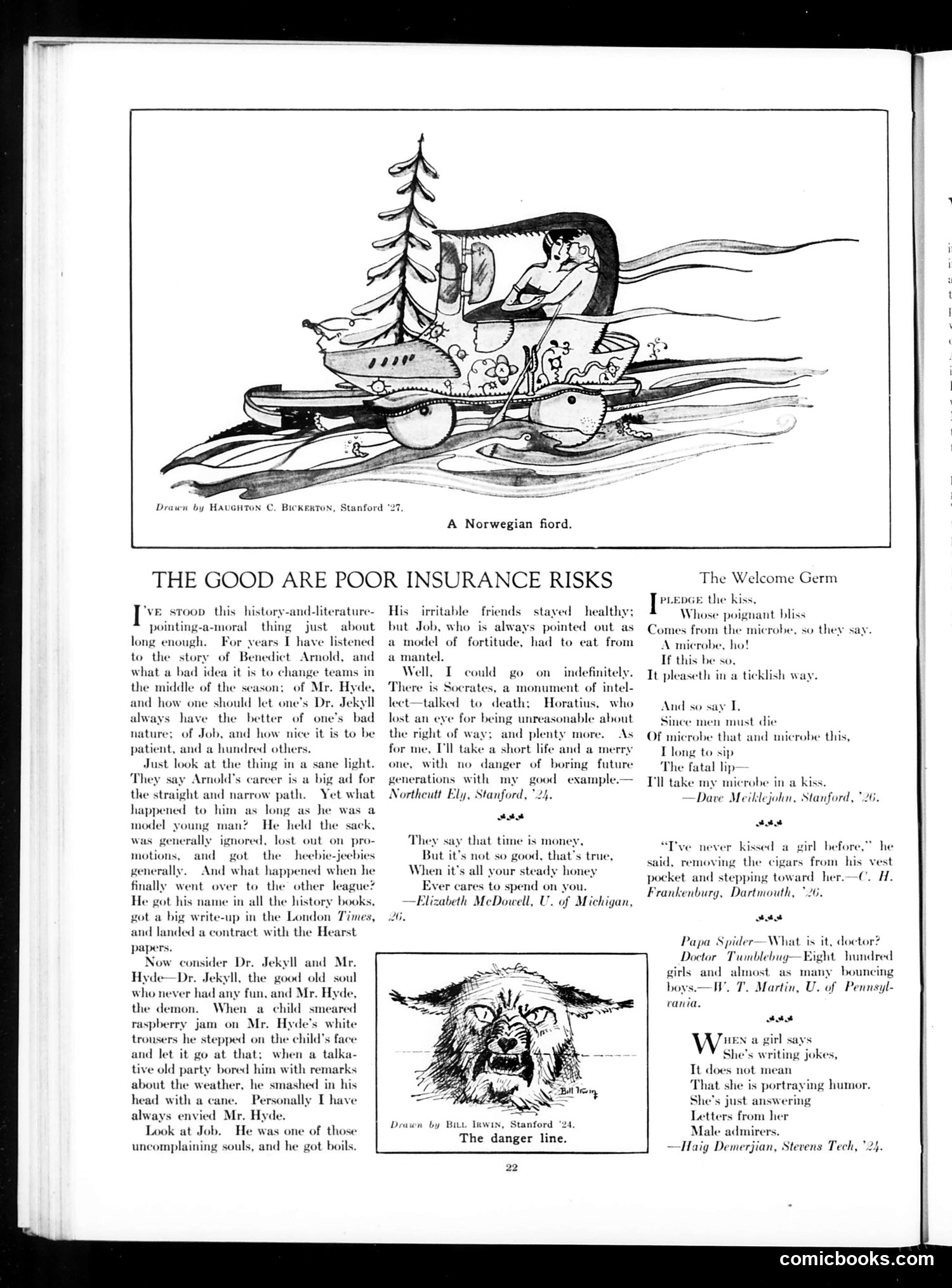
The main essay satirizes the conventional moral wisdom that goodness is rewarded. Through historical examples—Benedict Arnold, Dr. Jekyll and Mr. Hyde, Job, Socrates—the author argues the opposite: virtue brings obscurity and suffering, while vice brings fame and fortune. Arnold gained immortality only by betraying his side; Mr. Hyde enjoyed life while Dr. Jekyll suffered; Job received boils for his patience. The essay concludes that a short, merry life of vice is preferable to a long, boring virtuous one—a tongue-in-cheek rejection of Protestant work ethic and moral instruction that likely resonated with Stanford students of the 1920s. The accompanying illustrations and short poems are lighter college humor: a Norwegian fjord scene, jokes about germs in kissing, and observations on female humor writers. The tone throughout is irreverent undergraduate satire typical of campus magazines of this era.
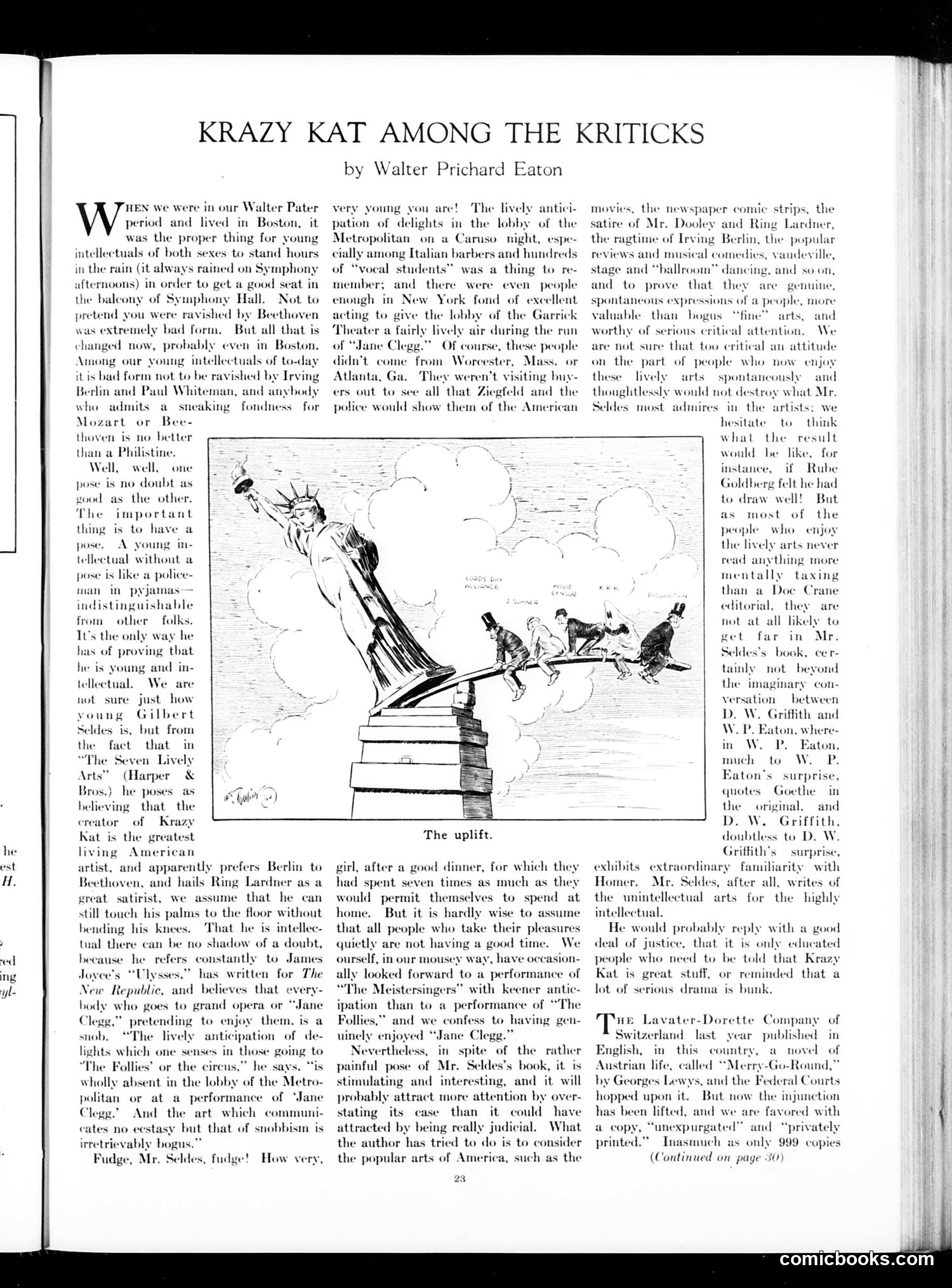
This article discusses Gilbert Seldes's book *The Seven Lively Arts*, which argues that popular entertainment—comic strips (specifically *Krazy Kat*), ragtime, vaudeville, and satirists like Ring Lardner—deserves serious critical attention equal to "high art" like opera and classical music. The accompanying cartoon "The Uplift" satirizes this very argument: figures cling to the Statue of Liberty while being lifted upward, mocking the pretentious elevation of lowbrow culture to intellectual status. The author (Eaton) gently mocks Seldes's intellectual posturing—his constant name-dropping of literary references, his dismissal of opera-goers as snobs, his need to adopt a fashionable "pose" of being a young intellectual. The piece suggests that while popular arts have merit, Seldes's earnest campaign to prove their superiority reveals more about his own need to appear intellectually clever than about genuine artistic value.
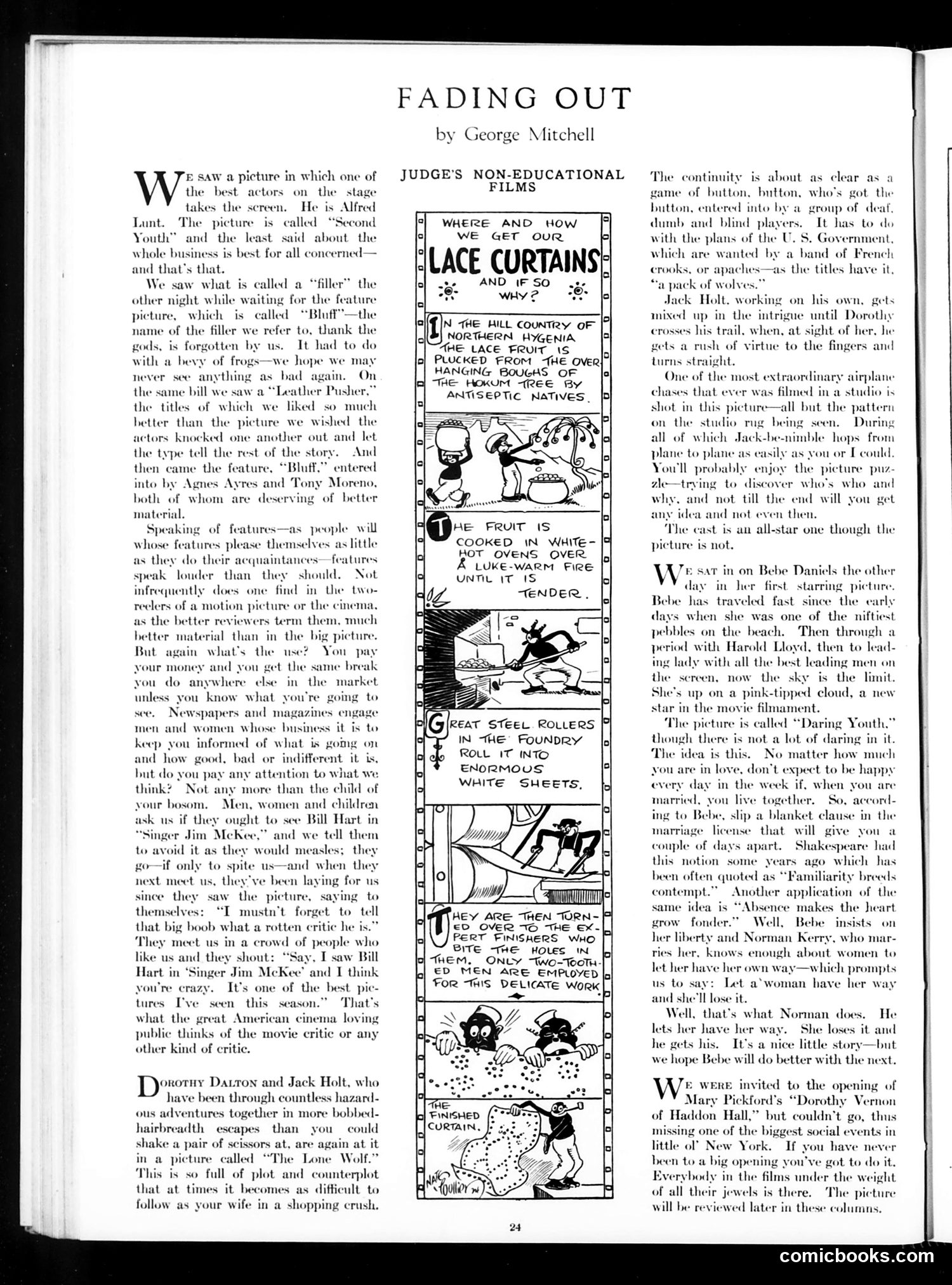
This page contains two distinct elements: **Main Article ("Fading Out"):** Film critic George Mitchell reviews recent movies, including productions with Alfred Lunt and Agnes Ayres. He critiques both feature films and short "fillers," expressing frustration that audiences ignore professional critics' negative reviews and see movies anyway—particularly Bill Hart films they've been advised against. Mitchell laments the public's indifference to critical opinion. **Sidebar Cartoon ("Judge's Non-Educational Films"):** A satirical "educational" diagram mockingly explains where lace curtains originate. It fabricates an absurd origin story: lace "fruit" grows on trees in fictional "Northern Hygenia," gets cooked in ovens, rolled through steel mills into sheets, and has holes "bitten" by specially-employed workers. The cartoon ridicules pseudo-educational films—a common cinema format of the era—by presenting completely fabricated "facts" with mock-scientific authority. It's satirizing both the gullibility of audiences who believe such films and filmmakers who peddle dubious "educational" content as factual.
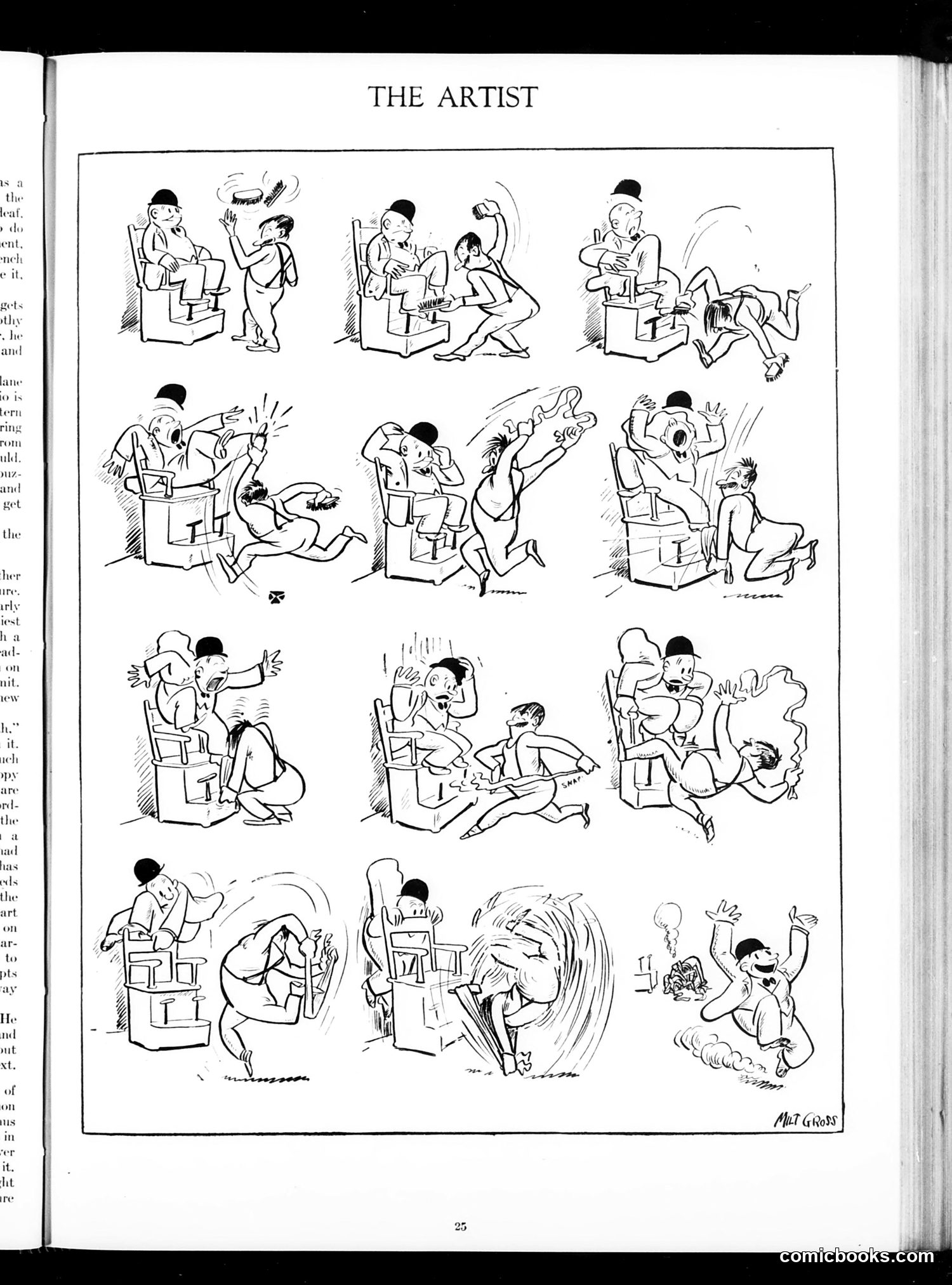
This wordless comic strip, signed by Alif Grobb, depicts an artist sitting at an easel repeatedly struggling with his work and his model's behavior. The sequence shows the model variously: posing cooperatively, becoming distracted, falling asleep, moving around restlessly, and generally failing to maintain a steady pose. In the final panels, the artist's frustration escalates—he appears to chase the model away, then celebrates alone with exaggerated joy. The satire targets the traditional artist-model relationship, mocking both the difficulty of keeping a model still and the artist's mounting exasperation. It's a relatable workplace comedy about professional challenges that modern readers would recognize as commentary on the patience required in fine art practice.
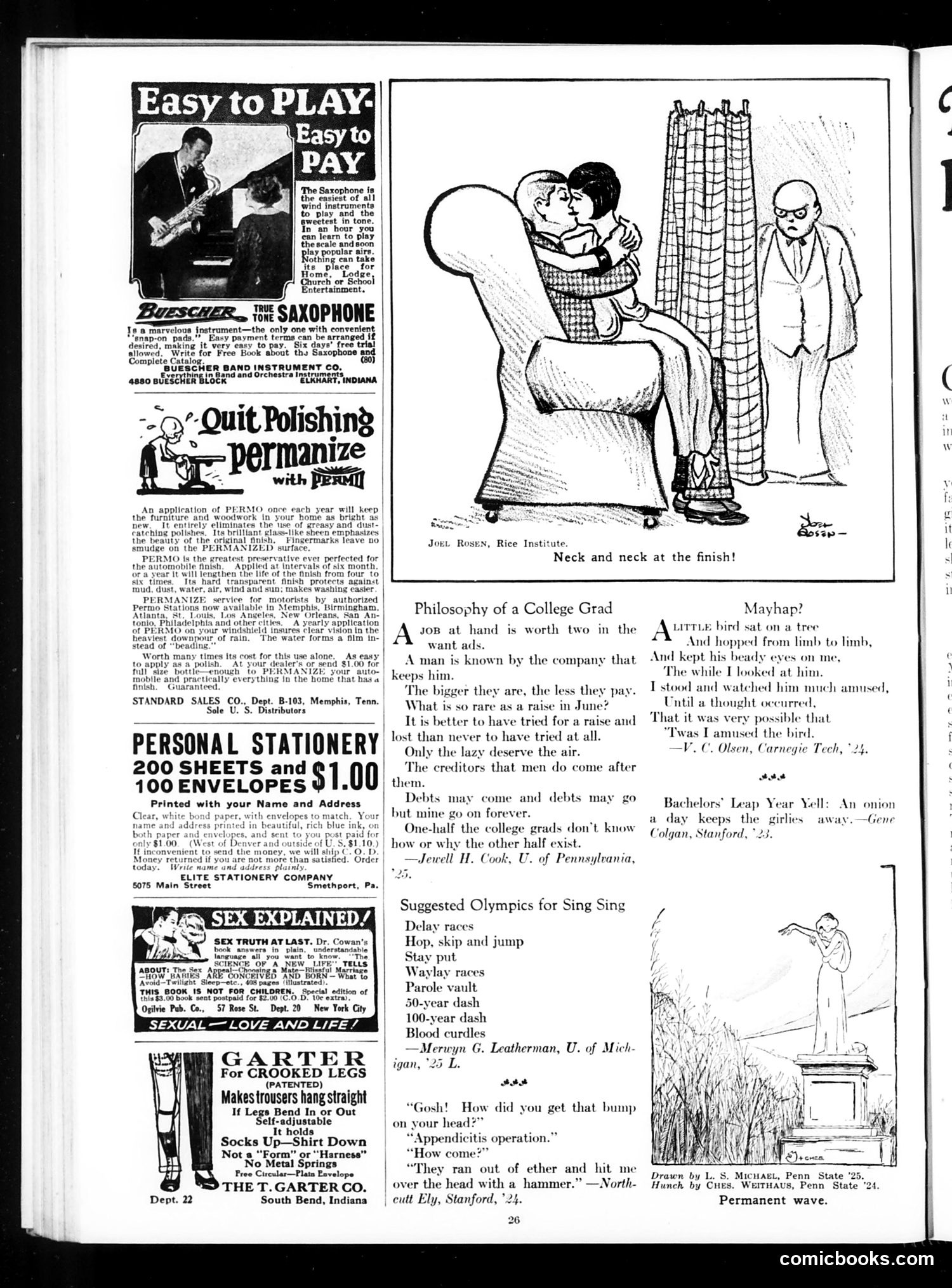
This page primarily consists of **advertisements and humorous student submissions** rather than political cartoons. The main cartoon titled "Neck and neck at the finish!" depicts a domestic scene: a woman in a chair holds a child while a man in glasses stands nearby—likely satirizing the competitive dynamics of marriage or courtship as a "race." The page's humor derives from **college student jokes and observations**: - "Philosophy of a College Grad" contains cynical aphorisms about employment and debt - "Suggested Olympics for Sing Sing" makes dark jokes about prison sentences (parole vault, 100-year dash, blood curdles) - A final joke about appendicitis puns on anesthesia ("ether") - "Bachelors' Leap Year Yell" jokes about avoiding women The advertisements—for saxophones, car polish, personal stationery, and leg braces—reflect 1920s consumer culture. The "Sex Explained" ad header suggests the magazine's adult-oriented content. This appears to be a **humor and lifestyle magazine** blending genteel satire with practical advertising, aimed at educated, urban readers.
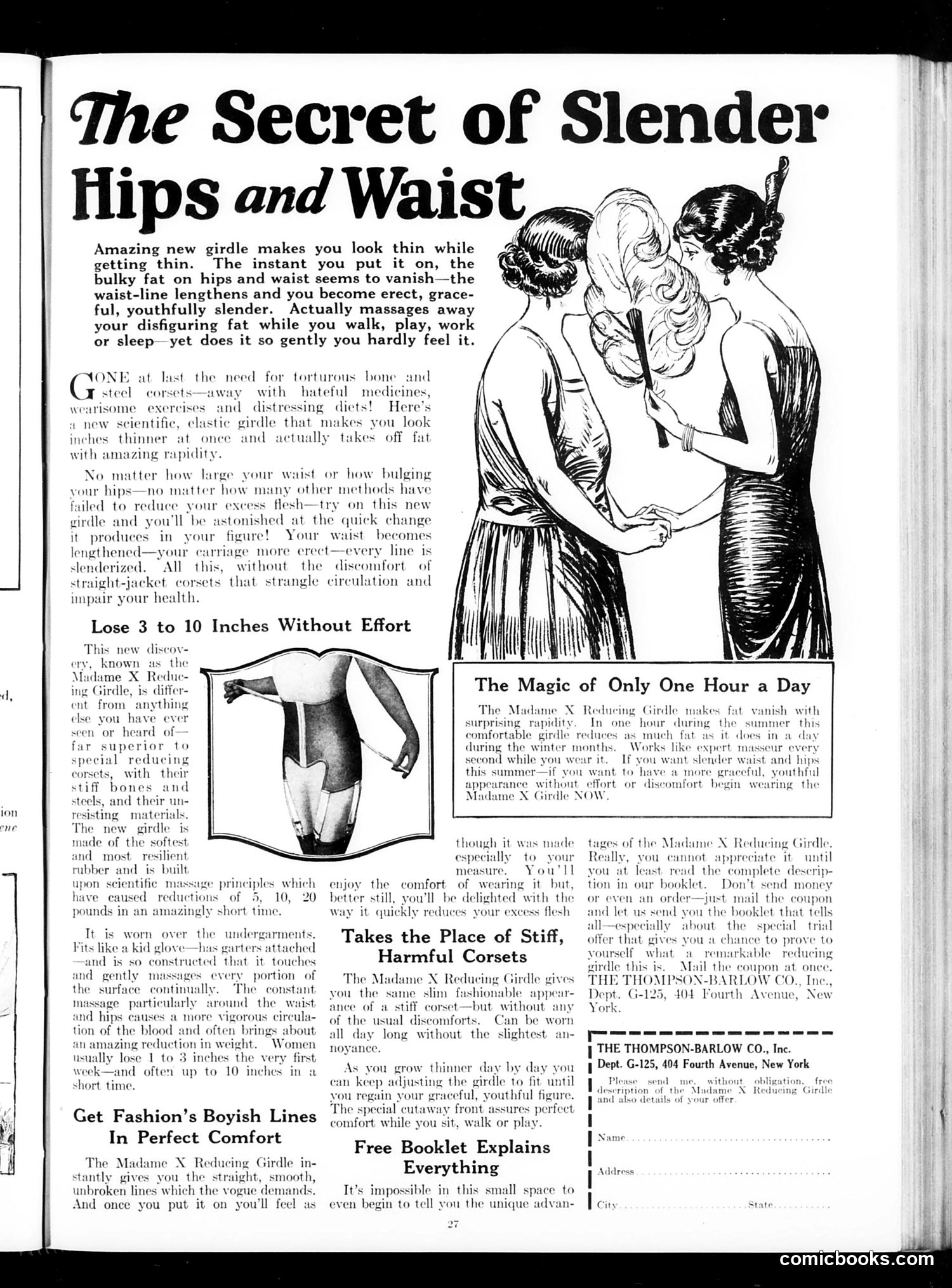
This page is primarily **advertising**, not satire or political content. It promotes the "Madame X Reducing Girdle," a women's shapewear garment. The illustration shows three women examining or wearing the girdle, demonstrating its claimed effect of creating a slimmer silhouette. The text makes exaggerated claims typical of 1920s-30s advertising: the girdle allegedly reduces weight "3 to 10 inches," "massages away" fat while worn, and requires only "one hour a day" of use to work like "expert masseur." The pitch targets women's anxieties about body shape during an era when the fashionable silhouette was slim and straight ("fashion's boyish lines"). It positions the girdle as superior to restrictive corsets—ironically, while serving the same purpose of reshaping the body. The coupon at bottom was standard advertising practice to track response and gather customer names. This is commercial persuasion, not Judge's typical satirical commentary.
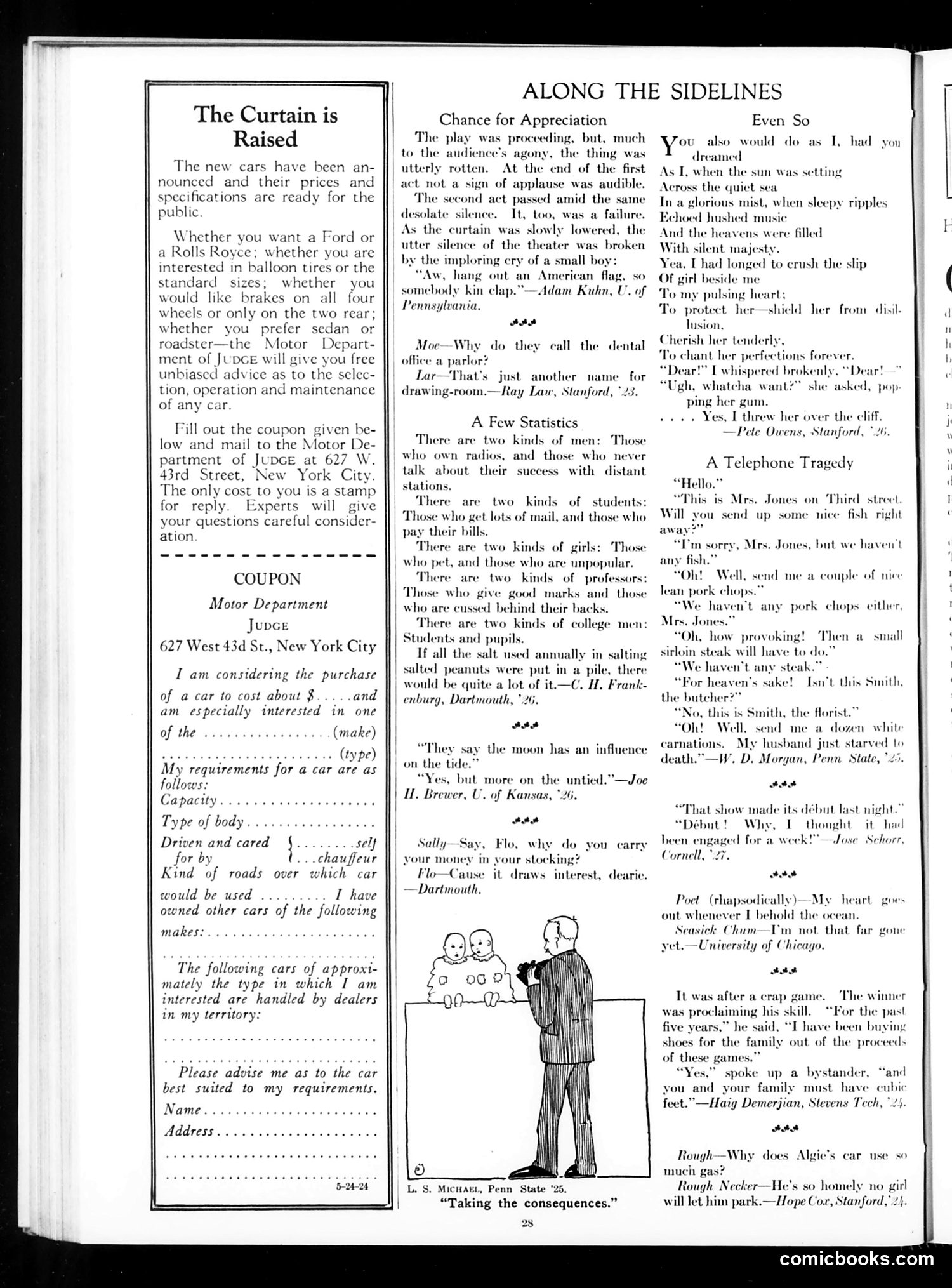
This page from **Judge** magazine (dated 5-24-24) contains mostly **humorous short items and a service coupon**, not political satire. The main content includes: - **"The Curtain is Raised"**: A service announcement offering free automotive advice via coupon—Judge's Motor Department will help readers choose cars (Ford, Rolls Royce, etc.). This reflects 1920s car-buying diversity. - **"Along the Sidelines"**: Brief humor pieces, including one about a failed theatrical performance where only a small boy breaks the silence by requesting someone "hang out an American flag, so somebody kin clap"—satirizing hollow patriotism as a response to poor entertainment. - **One cartoon** (credited to L.S. Michael, Penn State '25): Shows a man holding two babies, captioned "Taking the consequences"—likely commenting on paternity/responsibility. The remaining items are college student jokes about radios, dating, and campus life. The page reflects typical 1920s concerns: automobiles, theatrical culture, and collegiate humor rather than political commentary.
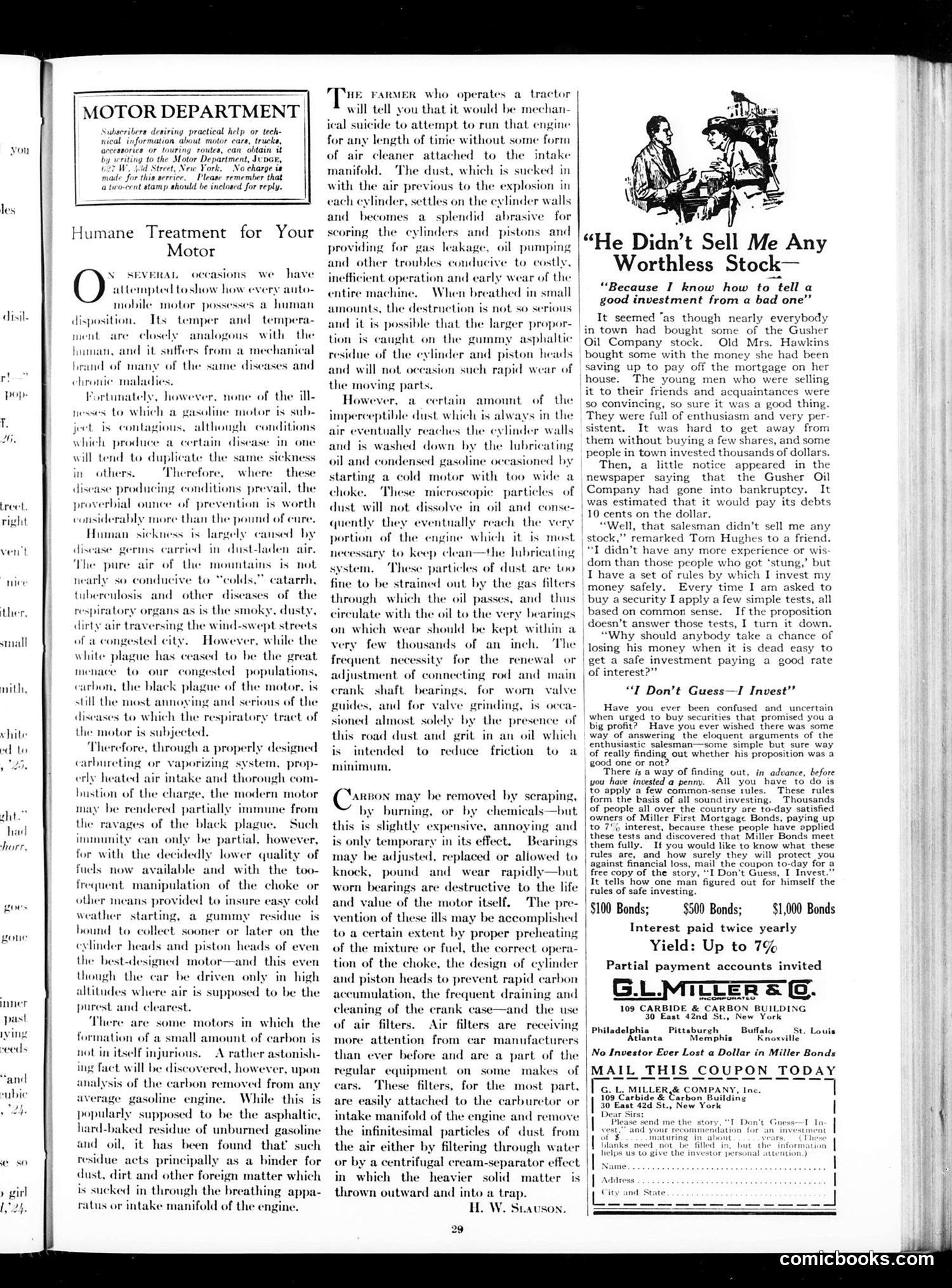
This page mixes technical motor advice with period advertising and satire. **The Main Content:** The "Motor Department" article earnestly compares automobile engines to human bodies, arguing that motors need "humane treatment"—proper air filtration, clean fuel, and maintenance to prevent "carbon sickness." The writing is sincere technical journalism. **The Satire:** The accompanying advertisement, "He Didn't Sell Me Any Worthless Stock," satirizes investment fraud. A man brags he can distinguish good investments from bad ones, then recounts how he and friends were nearly swindled by the Gusher Oil Company stock scheme—yet he recovered by recognizing the con. The satire targets overconfident investors who believe they're shrewd enough to avoid obvious scams. G.L. Miller & Co.'s bond advertisement below exploits this very psychology, implying their bonds are "safe" for those who know better. The juxtaposition—technical honesty alongside investment deception—reflects 1920s concerns about both industrial complexity and financial chicanery.
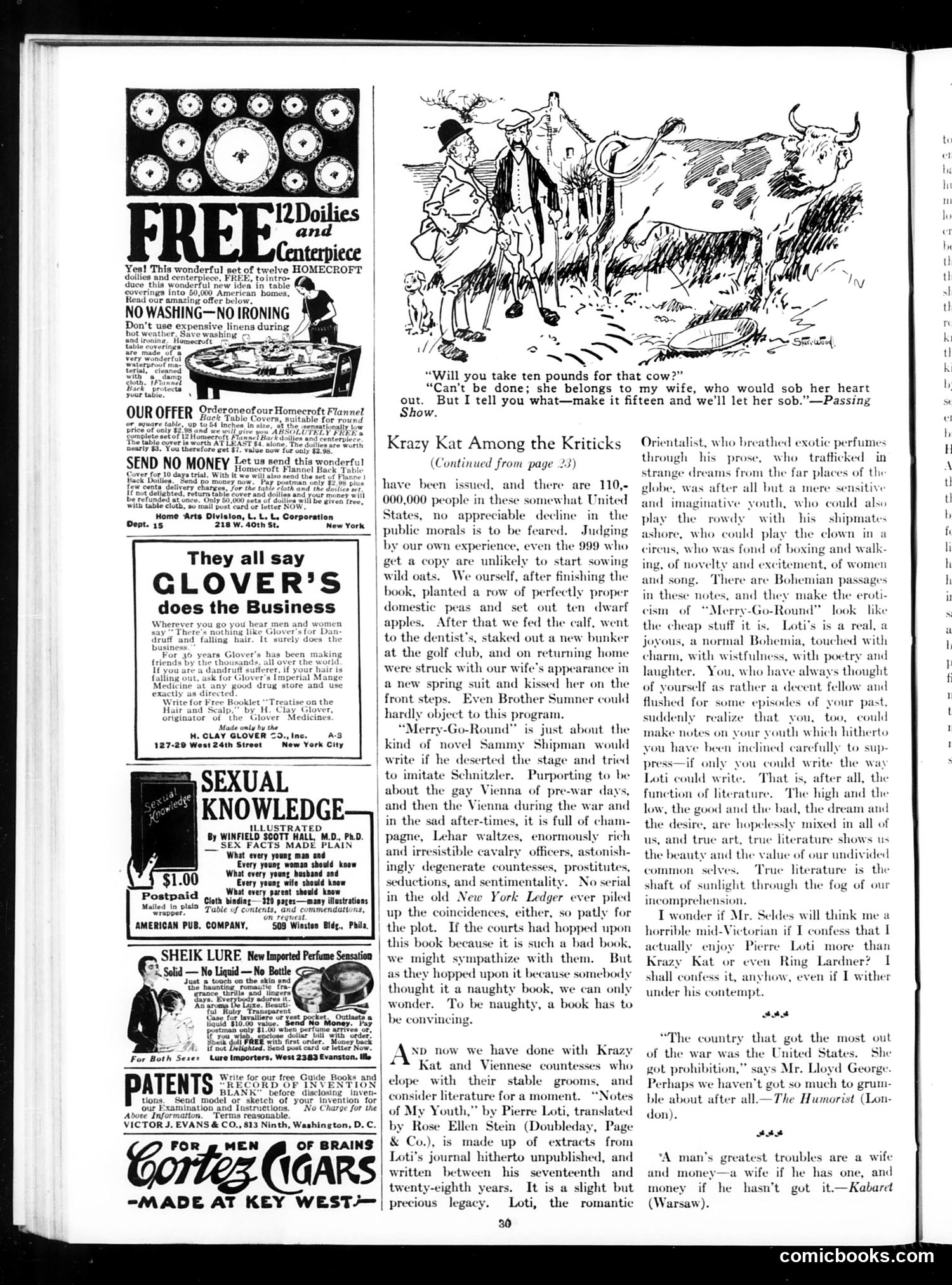
This page is primarily **advertisements and book reviews** from Judge magazine, not political satire. The main cartoon shows a rural haggling scene: a man asks to buy a farmer's cow cheaply; the farmer refuses because his wife loves it. The joke's punchline—that they'll "let her sob" (cry) if the price is right—mocks both rural sentimentality and marital dynamics. The review section critiques books including "Krazy Kat Among the Kriticks" (the famous comic strip character), "Merry-Go-Round" (a novel about pre-war Vienna), and Loti's journals. The reviewer argues that merely being "naughty" doesn't make literature immoral—books must be convincing to actually corrupt readers. The surrounding ads promote household products (table doilies), medical treatments (Glover's scalp medicine), and patent information services—typical of early 20th-century magazine content. **No major political figures or events are referenced** on this page.
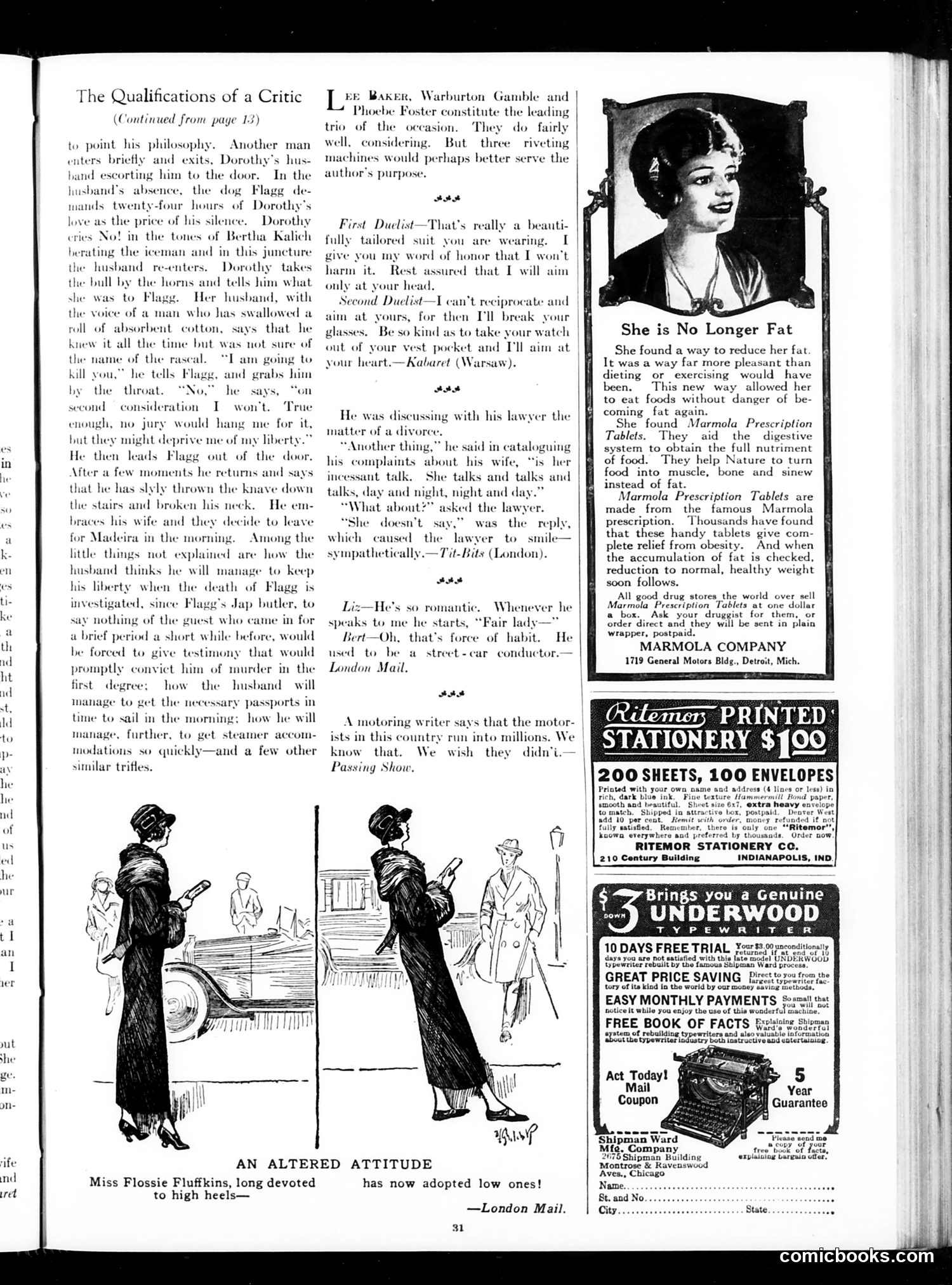
This page contains three distinct elements: **Main Cartoon ("An Altered Attitude"):** A satirical sketch showing Miss Flossie Fluffkins, a character apparently known for wearing high heels, who "has now adopted low ones!" The joke mocks fashion trends and the fickleness of women's style choices—specifically the shift from high to low heels, treated as a humorous contradiction to her established persona. **Literary Criticism Section:** The opening discusses "The Qualifications of a Critic," reviewing what appears to be a stage play involving characters named Dorothy and Flagg. It critiques how the plot handles a murder investigation with logical inconsistencies (witnesses, passports, etc.), poking fun at the implausibility of the dramatic narrative. **Advertisements:** The remaining space features period ads for Marmola weight-loss tablets, Ritemor stationery, and an Underwood typewriter—typical commercial content for 1920s magazines promoting consumer products to readers. The overall page is primarily satirical journalism mixed with period advertising rather than political commentary.
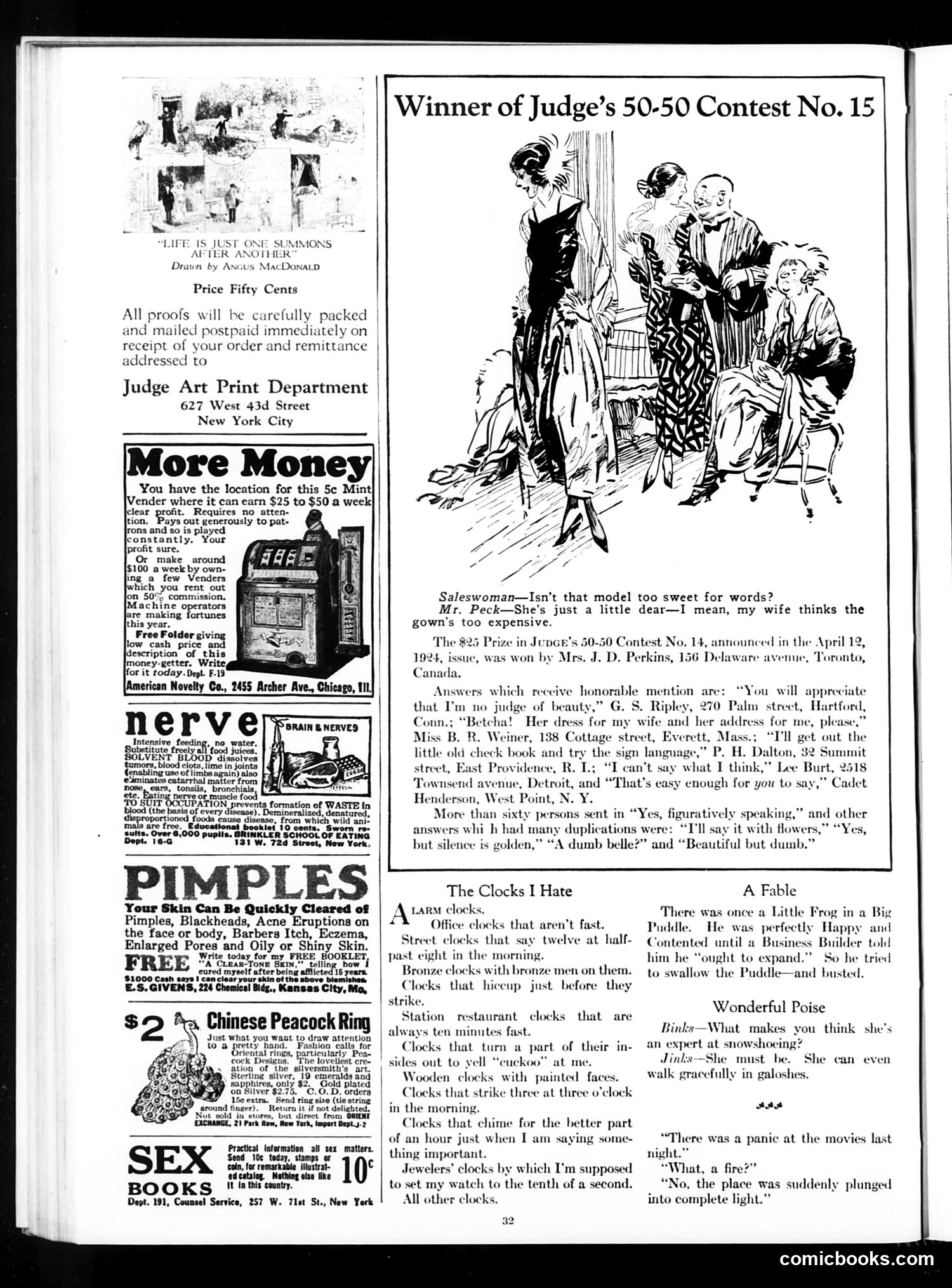
The main cartoon depicts a domestic scene where a salesman shows a model dress to a couple. The husband compliments the model as "a little dear," prompting his wife to correct him—she thinks the model is "too sweet for words" but the *gown* is too expensive. The satire targets masculine distraction and marital dynamics: the husband's wandering eye toward an attractive saleswoman, and the wife's shrewd focus on cost. The page also features Judge's "50-50 Contest No. 15"—a humor competition where readers submit witty answers to prompts. The winning entry and honorable mentions show readers completing the sentence about the overly-sweet model. This was a popular interactive feature of the era, engaging readers in satirizing social situations. The remaining content is period advertisements (pimple cures, slot machines, rings, etc.), typical of 1920s magazine filler.
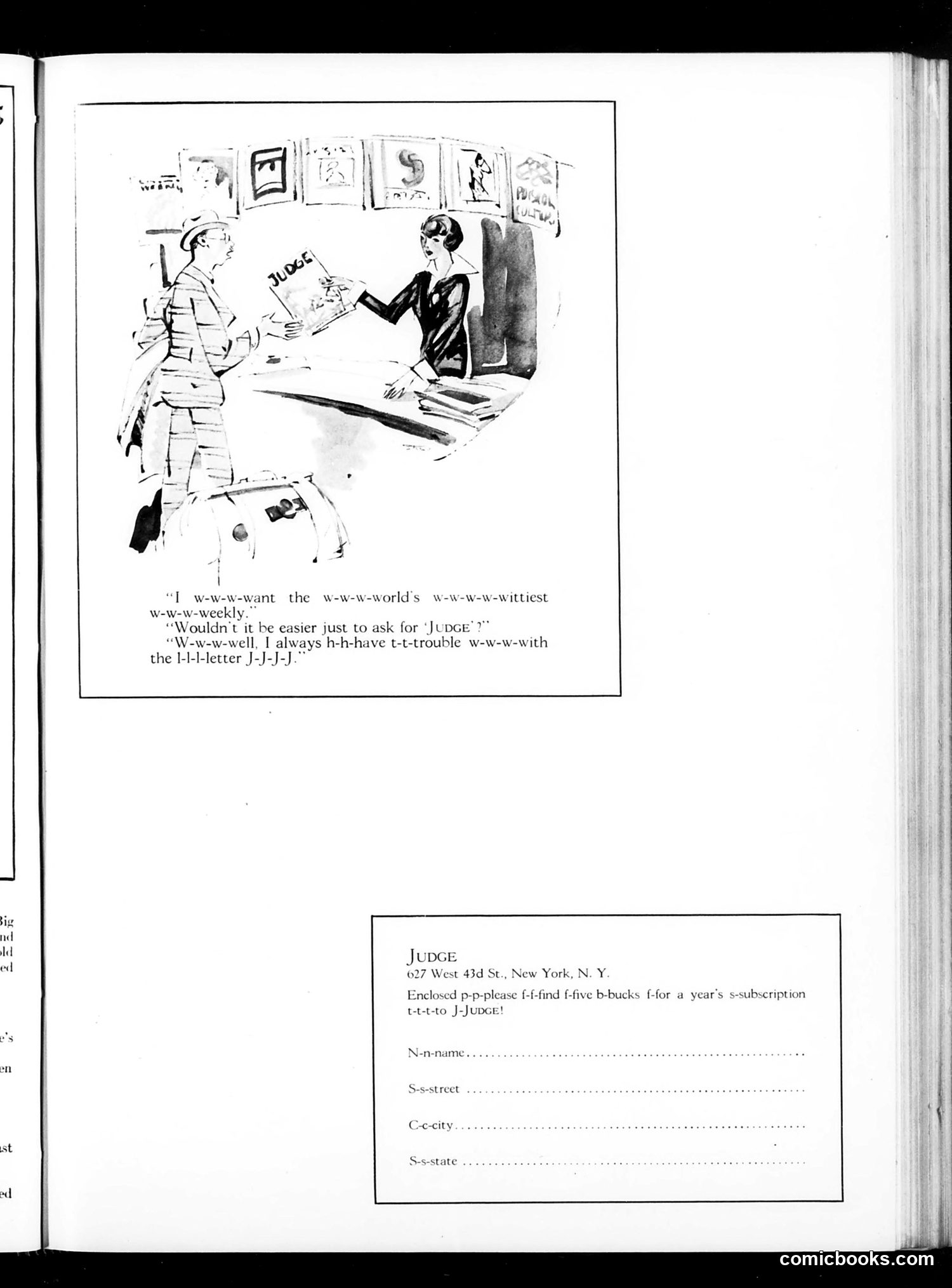
This is a humorous advertisement for *Judge* magazine disguised as a joke about stuttering. A man with a severe stutter attempts to request "the world's wittiest weekly" magazine, struggling painfully through the alliteration. A woman helpfully suggests he simply ask for "*Judge*" by name—avoiding the tongue-twisting phrase entirely. The humor works on two levels: it mocks both the man's speech impediment and the magazine's own self-promotional tagline. The accompanying subscription coupon mimics the stutterer's speech patterns (p-p-please, f-for, t-t-to), extending the joke into the call-to-action itself. This reflects early-to-mid 20th-century *Judge* advertising style: comedic, self-aware, and designed to amuse while soliciting subscriptions. The cartoon presumes readers will find the stutter amusing rather than offensive—a sensibility that wouldn't survive modern editorial standards.
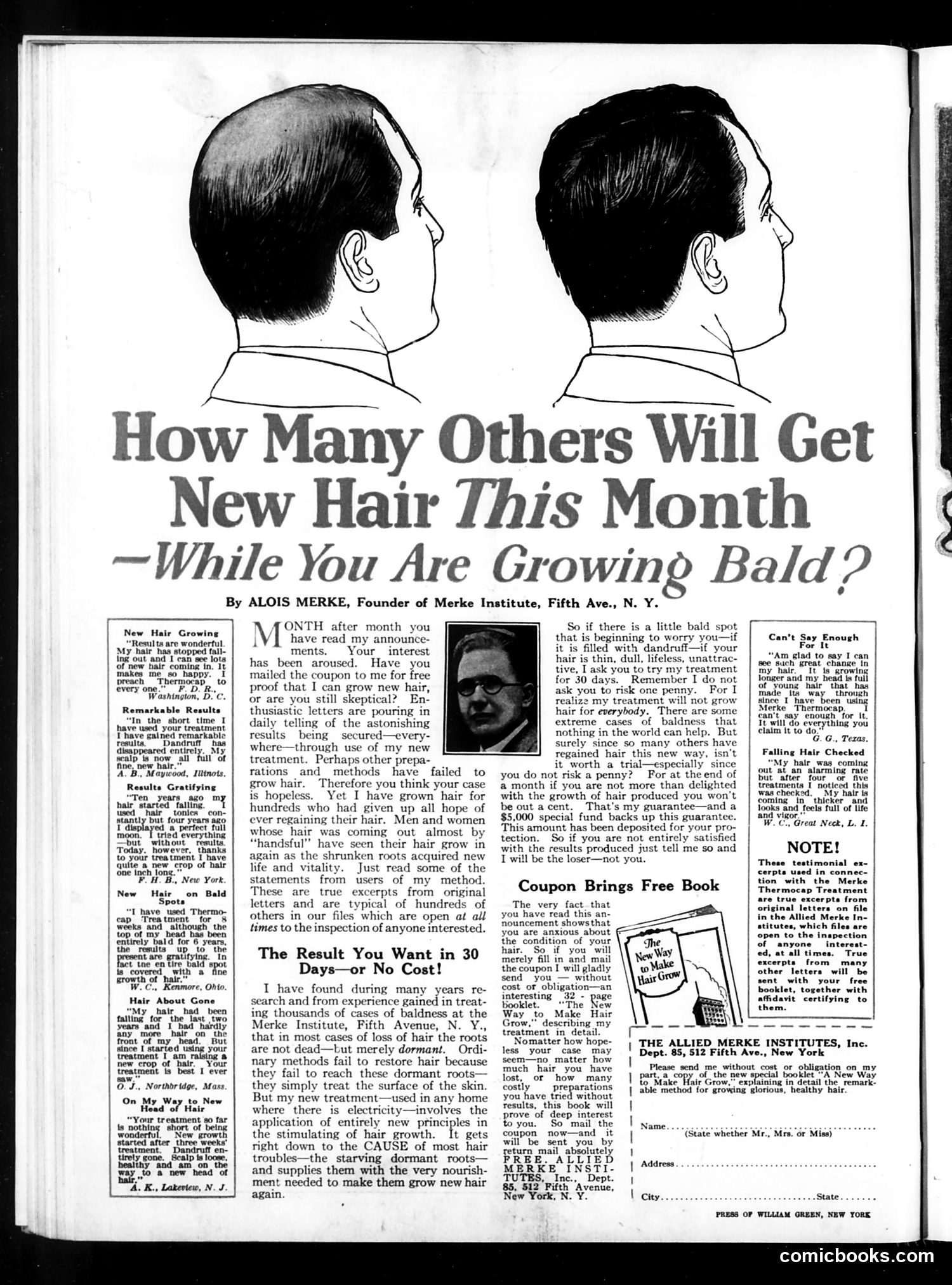
This is a full-page advertisement masquerading as editorial content in Judge magazine. Alois Merke, founder of the Merke Institute, promotes a hair-growth treatment called "Thermocap." The page uses classic early 20th-century marketing tactics: testimonials from purported satisfied customers (with initials and locations suggesting authenticity), before-and-after head illustrations, and a "free trial" coupon promising 30-day results "or no cost." The satire likely lies in Judge publishing this as legitimate content while such dubious health claims were common in the era. The repeated emphasis on dormant roots and electrical stimulation—alongside vague promises—suggests skepticism about treatments that claimed to cure baldness, a widespread concern exploited by fraudulent medical entrepreneurs. The repeated customer testimonials, while appearing genuine, were typical of patent medicine advertising's persuasion techniques targeting desperate consumers.