
Judge, 1924-05-24 · page 12 of 36
Judge — May 24, 1924 — page 12: what you’re looking at
What you’re looking at
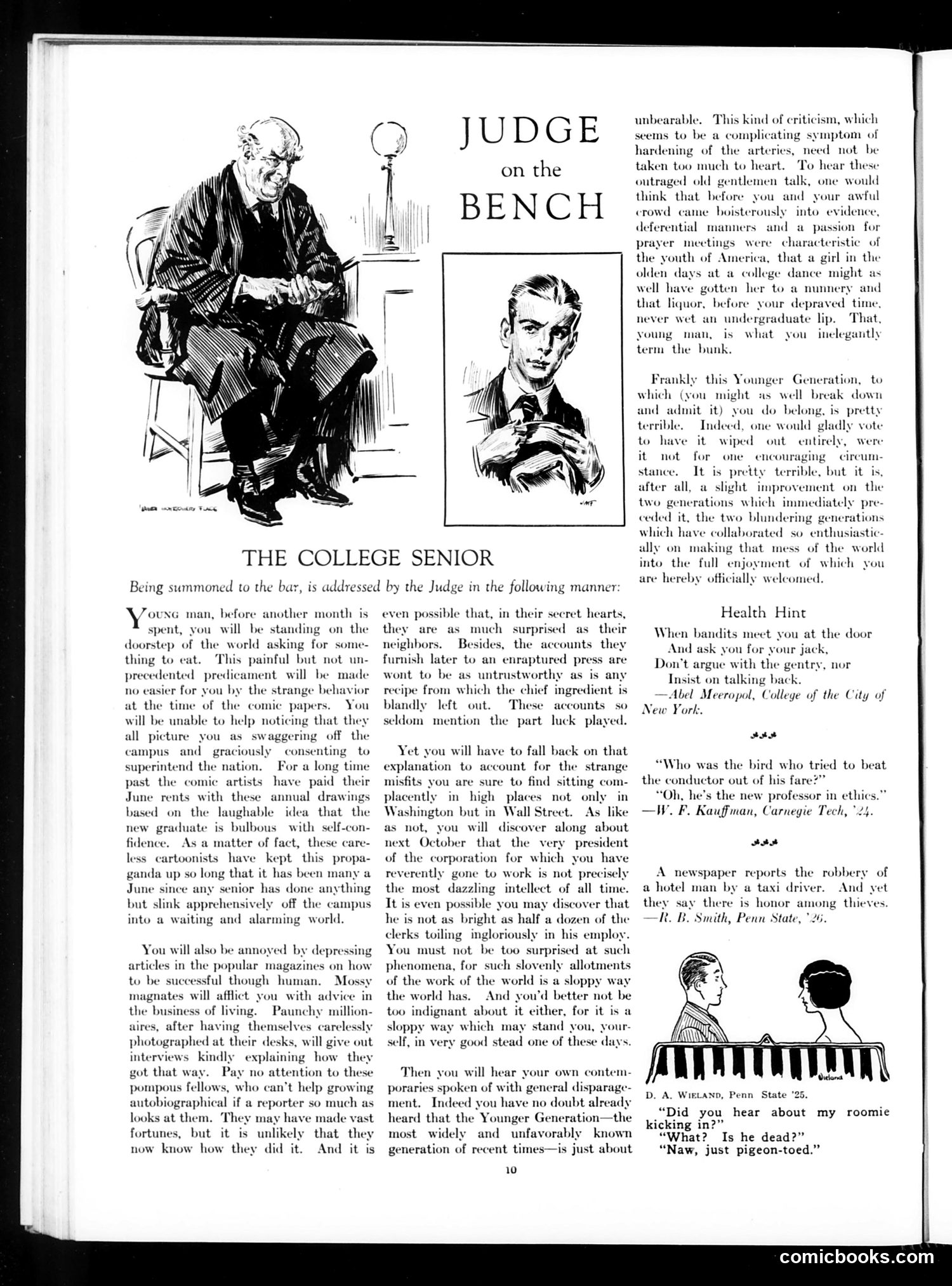
This is a satirical advice column disguised as a stern judicial lecture to graduating college seniors. The setup shows an older judge (representing establishment authority and tradition) addressing a young man about to enter the working world. The satire targets multiple groups: **The target of ridicule:** Comic papers and popular magazines that flatter graduating seniors with imagery of confident, capable young men ready to lead the nation—when reality is that graduates nervously enter an uncertain job market. **Secondary targets:** Successful businessmen and millionaires who give self-aggrandizing interviews about their success while conveniently omitting luck's role. The judge sarcastically notes their "recipes" leave out key ingredients. **The Younger Generation critique:** The piece defends young people against older critics who romanticize their own youth while condemning current youth as "unbearable"—noting these complaints are symptoms of aging ("hardening of the arteries"). The humor lies in the judge's mock-serious tone delivering worldly cynicism: corporate presidents aren't necessarily bright, the world is "sloppy," and success involves luck they won't admit.
📄 Transcribed text from this page (OCR, searchable)
Machine-transcribed from the original scan — historical spelling and the odd misread are preserved.
THE COLLEGE SENIOR Being summoned to the bar, is addressed by the Judge in the following manner Yo NG man, before another month is spent, you will be standing on the doorstep of the world asking for some- thing to eat. This painful but not un- precedented predicament will be made no easier for you by the strange behavior at the time of the comic papers. You will be unable to help noticing that they all picture you as swaggering off the campus and graciously consenting to superintend the nation. For a long time past the comic artists have paid their June rents with these annual drawings based on the laughable idea that the new graduate is bulbous with self-con- fidence. As a matter of fact, less cartoonists have kept this propa- ganda up so long that it has been many a June since any senior has done anything but slink apprehensively off the campus into a waiting and alarming world. You will also be annoyed by depressing articles in the popular magazines on how to be successful though human. Mossy magnates will afflict you with advice in the business of living. Paunchy million- aires, after having themselves carelessly photographed at their desks, will give out interviews kindly explaining how they got that wa Pay no attention to these pompous fellows, who can’t help growing autobiographical if a reporter so much as looks at them. They may have made vast fortunes, but it is unlikely that they now know how they did it. And it is even possible that, in their secret hearts, they are as much surprised as their neighbors. Besides, the accounts they furnish later to an enraptured press are wont to be as untrustworthy as is any recipe from which the chief ingredient is blandly left. out. These accounts so seldom mention the part luck played. Yet you will have to fall back on that exy tion to account for the strange misfits you are sure to find sitting com- placently in high places not only in Washington but in Wall Street. like as not, you will discover along about next October that the very president of the corporation for which you have reverently gone to work is not precisely the most dazzling intellect of all time. It is even possible you may discover that he is not as bright as half a dozen of the clerks toiling ingloriously in his employ. You must not be too surprised at such phenomena, for such slovenly allotments of the work of the world is a sloppy way the world has. And you'd better not be too indignant about it either, for it is a sloppy way which may stand you, your- self, in very good stead one of these days. Then you will hear your own contem- poraries spoken of with general dispara ment. Indeed you have no doubt already heard that the Younger Generation—the most widely and unfavorably known generation of recent times—is just about 10 unbearable. This kind of criticism, which seems to be a complicating symptom of hardening of the arteries, need not be taken too much to heart. To hear these outraged old gentlemen talk, one would think that before you and your awful crowd came boisterously into evidence, deferential, manners and a passion for prayer meetings were teristic of the youth of America, that a girl in the olden days at a college dance might as well have gotten her to a nunne' that liquor, before your depra cha y and ved time, That, you inelegantly never wet an undergraduate lip. young man, is) what term the bunk. Frankly this Younger Generation, to which (you might as well break down and admit it) you do belong, is pretty terrible. Indeed, one would gladly vote to have it wiped out enti it. not for encouraging circum- stance. It is pretty terrible, but it is, after all, a slight improvement on the two generations which immediately pre- ‘ly, were one ceded it, the two blundering generations which have collaborated so enthusiastie- ally on making that mess of the world into the full enjoyment of which you are hereby officially welcomed. Health Hint When bandits meet you at the door And ask you for your jack, Don’t argue with the gentry, nor Insist on talking back. —Abel Meeropol, College of the City of New York. Sto “Who was the bird who tried to beat the conductor out of his fare?” “Oh, he’s the new professor in ethics.” —W. PF. Kauffman, Carnegie Tech, °24. sae A newspaper reports the robbery of a hotel man by a taxi driver. And yet there is honor among thieves. Smith, Penn State,’ Hj D, A, WIELAND, Penn State “Did you hear about my roomie kicking in?” “What? Is he dead?” “Naw, just pigeon-toed.” comicbooks.com