
Judge, 1924-05-24 · page 17 of 36
Judge — May 24, 1924 — page 17: what you’re looking at
What you’re looking at
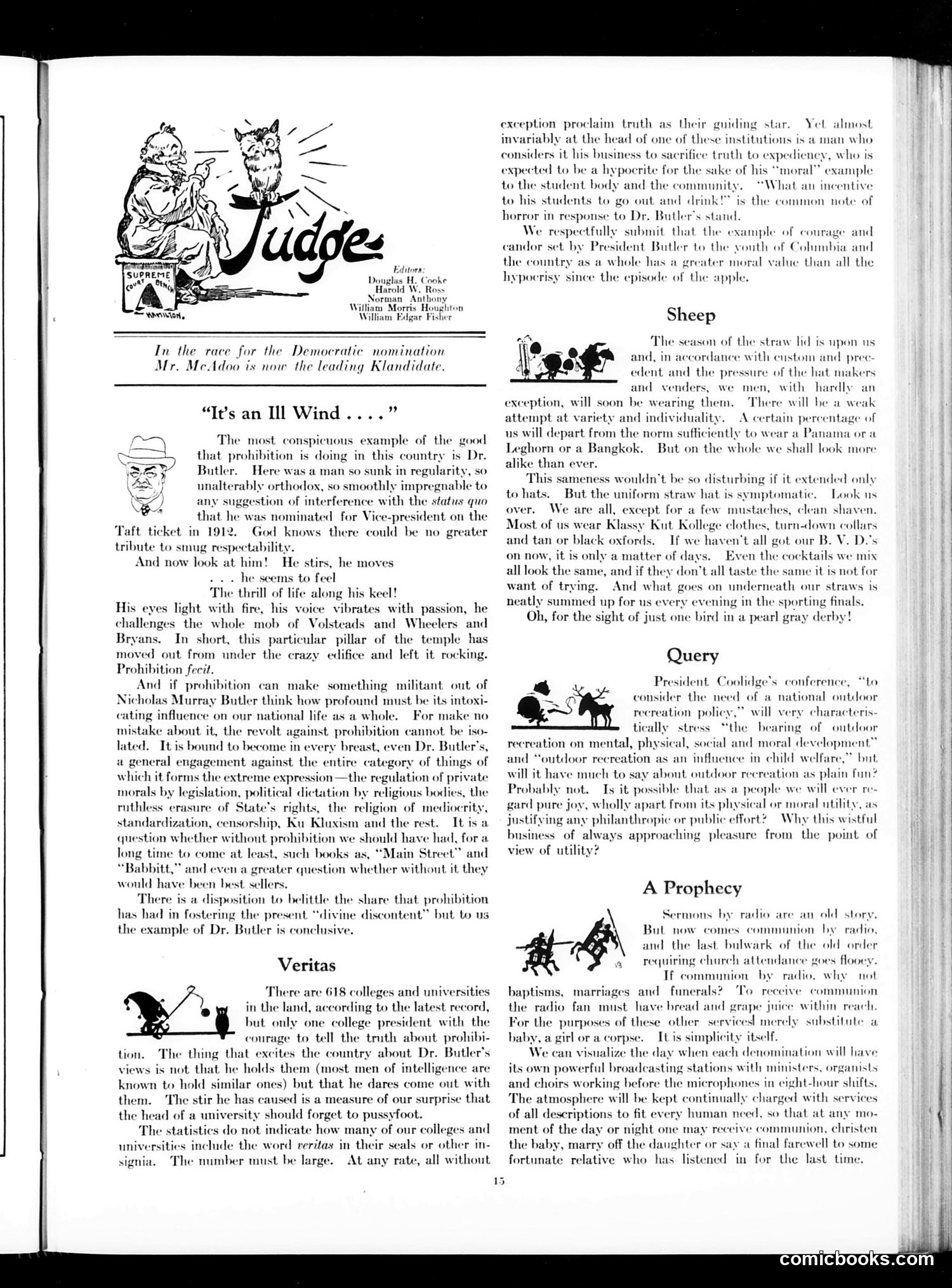
## "It's an Ill Wind" - The Main Cartoon The top cartoon mocks **Nicholas Murray Butler**, president of Columbia University, for his public criticism of Prohibition. The satire argues that Prohibition—normally presented as morally uplifting—has paradoxically awakened Butler from decades of political conformity and timidity. He was once so safely orthodox he was nominated VP on Taft's 1912 ticket; now Prohibition's overreach has made him militantly vocal against government regulation of private morals. The piece celebrates Butler's rare courage among college presidents to speak truth publicly, while criticizing academia generally for producing hypocrites who privately oppose policies they publicly support for "expediency." ## "McAdoo is now the leading Klandidate" This biting reference suggests **William McAdoo**, Democratic presidential nominee, attracted support from the **Ku Klux Klan**—a major political scandal of the 1920s. The wordplay ("Klandidate") directly links him to the KKK, reflecting Judge's condemnation of Klan influence in American politics.
📄 Transcribed text from this page (OCR, searchable)
Machine-transcribed from the original scan — historical spelling and the odd misread are preserved.
Editors Douglas H. Cooke Harold W. Ross N In the race for the Democratic nomination Mr. McAdoo is now the leading Klandidate. “It’s an Ill Wind....” The most conspicuous example of the good that prohibition is doing in this country is Dr. Butler. Here was a man so sunk in regularity, unalterably orthodox, so smoothly impregnable to suggestion of interference with the status quo that he was nominated for Vice-president on the Taft ticket in 1912. God knows there could be no greater tribute to smug respectability. And now look at him! He stirs, he moves . - . he seems to feel The thrill of life along his keel! His eyes light with fire, his voice vibrates with | challenges the whole mob of Volsteads and Wh Bryans. In short, this particular pillar of the temple hé moved out from under the crazy edifice and left it rocking. Prohibition fecit. And if prohibition can make something militant out of Nicholas Murray Butler think how profound must be its intoxi- cating influence on our national life as a whole. For make no mistake about it, the revolt against prohibition cannot be iso- lated. It is bound to become in every breast, even Dr. Butler's, a general engagement against the entire category of things of which it forms the extreme expression —the regulation of private morals by legislation, political dictation by religious bodies, the ruthless erasure of State’s rights, the religion of mediocrity, standardization, censorship, Ku Kluxism and the rest. It is a question whether without prohibition we should have had, for a long time to come at least, such books as, “Main Street” and “Babbitt,” and even a greater question whether without it they would have been best sellers. There is a disposition to belittle the share that prohibition has had in fostering the present “divine discontent” but to us the example of Dr. Butler is conclusive. ssion, he nd Ts Veritas There are 618 colleges and universities e in the land, according to the latest record, but only one college president with the courage to tell the truth about prohibi- tion. The thing that excites the country about Dr. Butler's views is not that he holds them (most men of intelligence are known to hold similar ones) but that he dares come out with them. ‘The stir he has caused is a measure of our surprise that the head of a university should forget to pussyfoot. The statistics do not indicate how many of our colleges and universities include the word veritas in their seals or other in- signia. The number must be large. At any rate, all without exception proclaim truth as their guiding star. Yet almost invariably at the head of one of these institutions is a man who considers it his business to sacrifice truth to expediency, who is expected to be a hypocrite for the sake of his “moral to the student body and the communit example “What an incentive is the common note of horror in response to Dr. Butler's stand. We respectfully submit that the example of and candor set by President Butler to the youth of Columbia and the country as a whe hypocrisy since the e to his students to go out and drink “has a greater moral value than all the isode of the apple. Sheep The season of the straw lid is upon us: \\ aiid) avaccofddnce with custom and pre edent and the pressure of the hat makers and venders, we men, with hardly an exception, will soon be wearing them. There will be a we: attempt at variety and individuality. A certain percentz us will depart from the norm sufficiently to wear a Panama or a Leghorn or a Bangkok. But on the whole we shall look more alike than ever. This sameness wouldn't be so disturbing if it extended only tohats. But the uniform straw hat is symptomatic. Look us over. We are all, except for a few mustaches, clean shaven. Most of us wear Klassy Kut Kollege clothes, turn-down collars and tan or black oxfords. If we haven't all got our B. V. D.’s on now, it is only a matter of days. Even the cocktails we mix all look the same, and if they don’t all taste the same it is not for want of trying. And what goes on underneath our straws is neatly summed up for us every evening in the sporting finals. Oh, for the sight of just one bird in a pearl gray derby! Query President. Coolidge’s conference, “to & consider the need of a national outdoor recreation policy,” will very characteris tically stress “the bearing of outdoor recreation on mental, physical, social and moral development” Ife about outdoor recreation as pl and “outdoor recreation as an influence in child welfare,” but will it have much to sa ain fun? Probably not. Is it possible that as a people we will ever re- gard pure joy, wholly apart from its physical or moral utility, as justifying any philanthropic or public effort? Why this wistful business of always approaching pleasure from the point of view of utility? A Prophecy Sermons by radio are an old stor But now comes communion by radio, and the last bulwark of the old order » requiring church attendance goes flooey. If communion by radio, why not baptisms, marriages and funerals? ‘To receive communion the radio fan must have bread and gr: juice within reach For the purposes of these other services| meri baby, a girl or a corpse, It is simplicity itself. We can visualize the day when each denomination will have its own powerful broadcasting stations with ministers, organists and choirs working before the microphones in eight-hour shifts. The atmosphere will be kept continually charged with services of all descriptions to fit every human need, so that at any mo- ment of the day or night one may receive communion, christen the baby, marry off the daughter or say a final farewell to some fortunate relative who has listened in for the last time. ly substitute a