
Judge, 1924-05-24 · page 25 of 36
Judge — May 24, 1924 — page 25: what you’re looking at
What you’re looking at
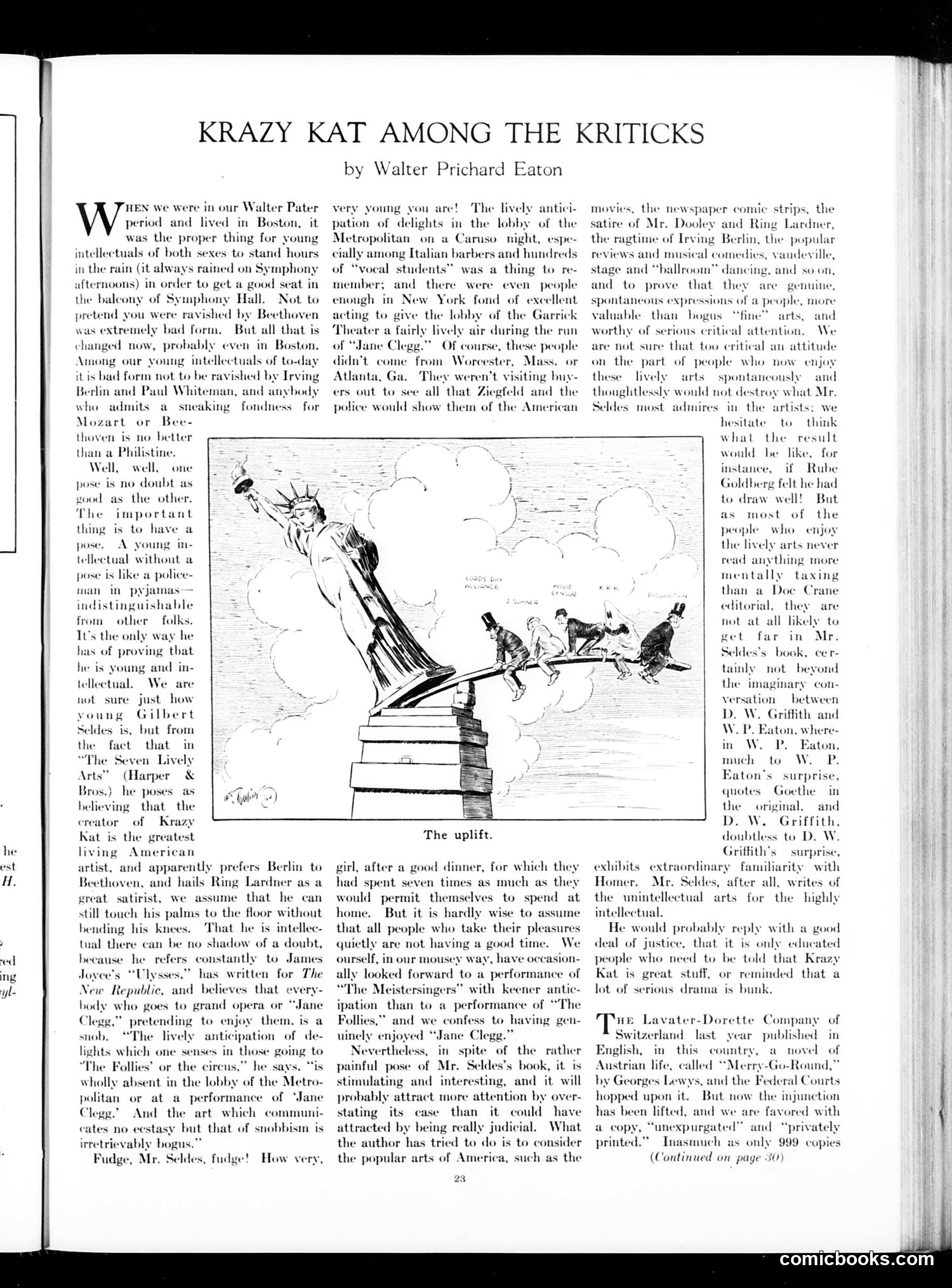
This article discusses Gilbert Seldes's book *The Seven Lively Arts*, which argues that popular entertainment—comic strips (specifically *Krazy Kat*), ragtime, vaudeville, and satirists like Ring Lardner—deserves serious critical attention equal to "high art" like opera and classical music. The accompanying cartoon "The Uplift" satirizes this very argument: figures cling to the Statue of Liberty while being lifted upward, mocking the pretentious elevation of lowbrow culture to intellectual status. The author (Eaton) gently mocks Seldes's intellectual posturing—his constant name-dropping of literary references, his dismissal of opera-goers as snobs, his need to adopt a fashionable "pose" of being a young intellectual. The piece suggests that while popular arts have merit, Seldes's earnest campaign to prove their superiority reveals more about his own need to appear intellectually clever than about genuine artistic value.
📄 Transcribed text from this page (OCR, searchable)
Machine-transcribed from the original scan — historical spelling and the odd misread are preserved.
ed ing yl- \ K THEN we were in our Walter Pater period and lived in Boston, it was the proper thing for young intellectuals of both sexes to stand hours ymphony afternoons) in order to get a good seat in the balcony of Symphony Hall. Not to pretend you were ravished by Beethoven was extremely bad form. But all that is in Boston, Among our young intellectuals of to-« it is bad form not to be ravished by Irving Berlin and Paul Whiteman, and anybody who admits a sneaking fondness for Mozart or Bee- thoven is no better in the rain (it always rained on $ changed now, probably « KRAZY KAT AMONG THE KRITICKS by Walter Prichard Eaton very young you are! The lively antici- pation of delights in the lobby of the Metropolitan on a Caruso night, espe- cially among Italian barbers and hundreds of “vocal students” was a thing to re- member; and there were even people enough in New York fond of excellent acting to give the lobby of the Garrick ‘Theater a fairly lively air during the run Of course, these people of “Jane Clegg.” didn’t come from Worcester, Mass. or Atlanta, They weren't visiting buy- ers out to see all that Ziegfeld and the police would show them of the American movies, the newspaper comic strips, the satire of Mr. Dooley and Ring Lardner, the ragtime of Irving Berlin, the popular reviews and musical comedies, vaudeville, stage and “ballroom” dancing and to prove that they a 1d soon, genuine, spontaneous expressions of a people, more valuable than bogus “fine arts, and worthy of serious critical attention. We are not sure that too critical an attitude on the part of people who now enjoy lively arts thoughtlessly would not destroy what Mr. Seldes most admires in the artists; we think these spontancously and hesitate to than a Philistine. Well, well, one pose is no doubt as good as the other. The important thing is to have a pose. A young in- tellectual without a pose is like a police- man in pyjamas— indistinguishable from other folks. It’s the only way he has of proving that he is young and in- ctual. We are not sure just how young Gilbert Seldes is, but from the fact that in “The Seven Lively Arts” (Harper & Bros.) he poses as believing that the what the result would be like, for instance, if Rube Goldberg felt he had to draw well! But as most of the people who enjoy the lively arts never anything more mentally taxing than a Doe Crane editorial, they are not at all likely to get far in Mr. Seldes’s book, ce r- tainly not beyond the imaginary con- between iriffith and WP. on, where- in W. P. Eaton, much to W. P. Eaton's surpri versation dD. W Goethe in creator of — Krazy Kat is the greatest living Am artist, and apparently prefers Berlin to Beethoven, and hails Ring Lardner as a great satirist, we assume that he can still touch his palms to the floor without bending his knees. That he is intellec- tual there can be no shadow of a doubt, ise he refers constantly to James has written for The V he «” Republic, and believes that © hody who goes to grand opera or “Jane Clegg,” pretending to enjoy them, is a snob. “The livel. lights whic in those going to ‘The Follies’ or the circus,” he says, “is wholly absent in the lobby of the Metro- poli anticipation of de- one sens an or at a performance of ‘Jane Clegg.” And the art’ which communi- cates no eestasy but that of snobbism is irretrievably bogus.” Fudge, Mr. Seldes, fudge! How very, The uplift. girl, after a good dinner, for which they had spent seven times as much as they would permit themselves to spend at home. But it is hardly wise to assume that all people who take their pleasures quietly are not having a good time. We ourself, in our mousey way, have occasion- ally looked forward to a performance of “The Meistersingers” with keener antic- ipation than to a performance of “The Follies,” and we confess to having gen- uincly enjoyed “Jane Clegg.” orth . in spite of the rather painful pose of Mr. Seldes’s book, it: is stimulating and interesting, and it will probably attract more attention by over- stating its than it could have attracted by being really judicial. What the author has tried to do is to consider the popular arts of America, such as the 23 quotes the orig and Db. W. fith, doubtless to D. W Griffith's surprise, exhibits extraordinary familiarity with Homer. Mr. Seldes, after all, writes of the unintellectual arts for the highly intellectual. He would probably reply with a good deal of justice, that it is only educated people who need to be told that Krazy Kat is great stuff, or reminded that a lot of serious drama is bunk, Tre Lavater-Dorette Company of Switzerland last year published in English, in this country, novel of Austrian life, called “Me -Round,” by Georges Lewys, and the Federal Courts hopped upon it. But now the injunction has been lifted, and we are favored with “, “unexpurgated” and “privately Inasmuch as only 999 copies (Continued on page 30) comicbooks.com