
Judge, 1924-05-24 · page 15 of 36
Judge — May 24, 1924 — page 15: what you’re looking at
What you’re looking at
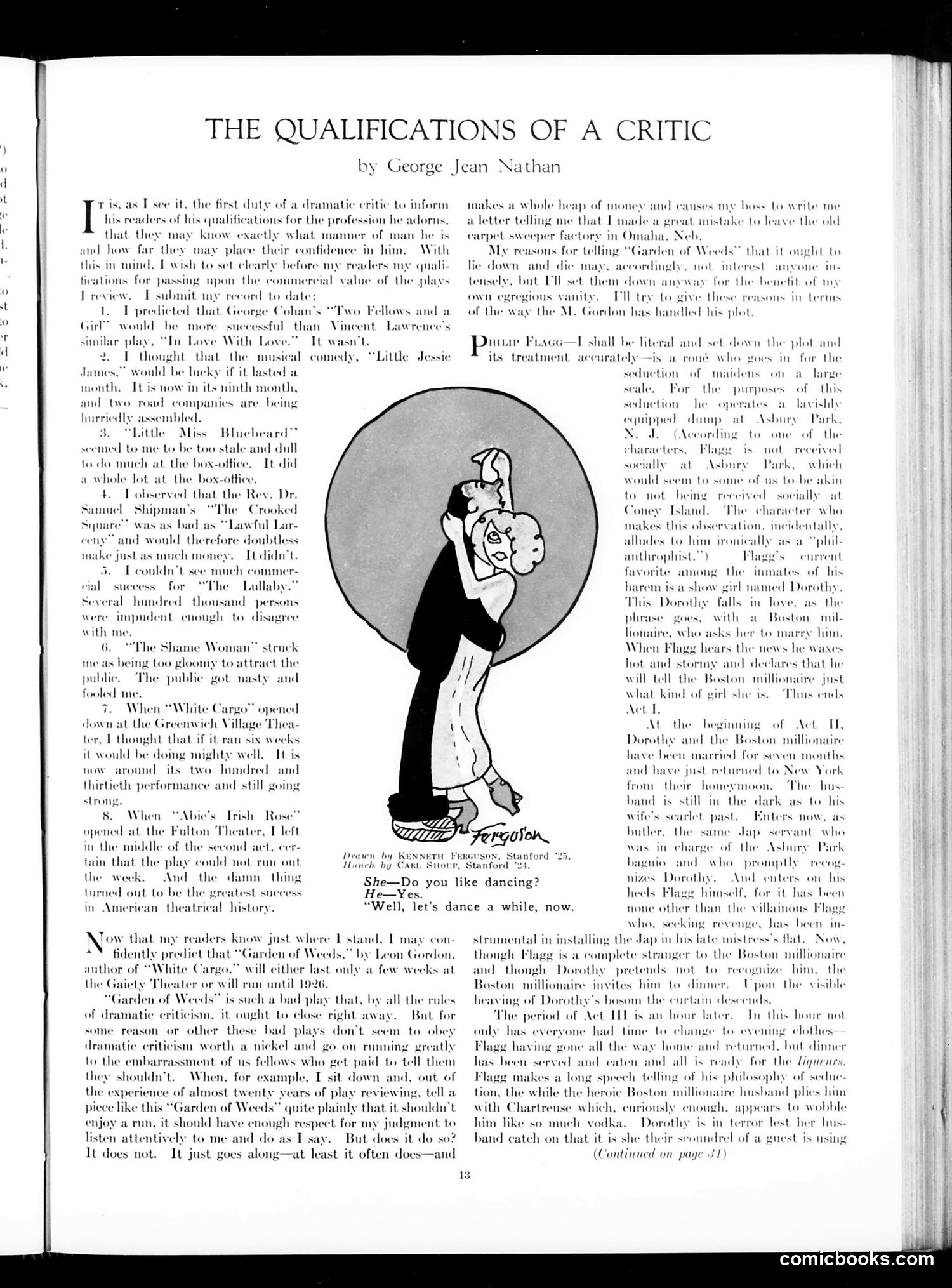
This is a theater critic's self-satirizing essay with an accompanying cartoon. Nathan lists his failed predictions about Broadway plays—declaring shows would flop that became hits ("Abie's Irish Rose," "White Cargo"), and praising ones that failed. The humor lies in Nathan admitting his professional incompetence while simultaneously claiming authority to judge the new play "Garden of Weeds." The small cartoon shows a couple dancing, illustrating a scene from the play being discussed. The satire targets theatrical critics generally: Nathan argues that despite his terrible track record, critics expect plays to obey their negative judgments. The piece is self-aware comedy—Nathan's honesty about his failures actually undermines the entire premise of dramatic criticism having predictive value. This reflects early 20th-century skepticism about whether critics actually understand what audiences want.
📄 Transcribed text from this page (OCR, searchable)
Machine-transcribed from the original scan — historical spelling and the odd misread are preserved.
THE QUALIFICATIONS OF A CRITIC by George Jean Nathan ris, as T see it, the first duty of a dramatic critic to inform I his readers of his qualifications for the profession he adorns, that they may know exactly what manner of man he is md how far they may place their confidence in him. With this in mind, [wish to set clearly before my re rs my quali- fications for passing: upon the commercial value of the plays J review. TL submit my: record to date: 1. [predicted that George Cohan’s “Two Fellows and a Girl wonld be more successful) than Vincent) Lawrence's jar play. “In Love With Love.” Tt wasn't. 2. TP thought that) the musical comedy, “Little Jessie James.” would be lucky if it lasted a sin month. [tis now in its ninth month, and two road companies are being hurriedly assembled, 3. “Little Miss Bluebeard’? and dull It did seemed tome to be too sta to do much at the box-offi a whole Jot at: the box-office. t Samuel Square’ was as bad d » doubtless and would the: ustas much money. [tdidn't. 5. Tcouldn’t see much commer- cial success) for “The Lullaby.” Several hundred thousand persons: were impudent enough to d with me. 6. The Shame Woman” struck me as being too gloomy to attract the public. ‘The publie got nasty and fooled me. When “White Cargo” opened down at the Greenwich Village Thea- ter, L thought that if it ran six weeks it would be doing mighty well. Tt is now around its two hundred and thirtieth performance and still going strong. When “Abie’s Trish Rose” opened at the Fulton Theater, T left in the middle of the second act, cer- tain that the play could not run out the week. And the damn thing turned out to be the greatest success He—Yes. in American theatrical history. “Well, let's dance a while, now. N yw that my readers know just where 1} stand. LE may con- 4N fidently predict that “Garden of Weeds.” by Leon Gordon, author of “White Cargo.” will either last only a few weeks al the sty Theater or will run until L926. rden of Weeds” is such a bad play that, by all the rules tic criticism, it ought lo close right away. But for some reason or other these bad plays don’t: seem to obey of dran dramatic criticism worth a nickel and go on running Iy ssment of us fellows who get paid to tell them they shouldn't. When, for example, I sit down the experienc piece like this to the embar di. out of of almost twenty years of play reviewing, tell a Garden of Weeds” quite plainly that it shouldn't enjoy a run, it should have enough respect for my judgment to listen attentively to me and do as T say. But does it do so? It does not. It just goes along—at least it often does—and Drawn by KeNNeti FeRouso’ Hunch by Cant Suovr, $ She—Do you like dancing? nee makes a whole heap of money and causes my boss to write me a letter telling me that [made timistake to leave the old carpet sweeper factory in Omaha. Neb My reasons for telling “Garden of Weeds” that it ought to lie down and die may. accordingly. not interest. anyone in- tensely, but PI set them down anyway for the benefit, of my own egregious vanity. Pll try to give these reasons in berms of the way the M. Gordon has handled his plot. Dutiav PLaGG—E shall be literal and set down the plot and its treatment accurately —is a roué who goes in for the seduction of maidens on a large scale. Por the purposes of this seduction he operates a lavishly equipped dump at Asbury Park. J (According to one of the characters, Flagg is not) received socially at) Asbury Park, which would seem to some of us to be akin to not being received socially at Coney Island. ‘The character who makes this observation. incidentally, alludes to him ironically anthrophist.”) FI. asa “phil Ss current favorite ame the inmates of his ie emis a show girl named Dorothy his Dorothy falls in love, as the phrase goes, with a Boston mil- lionaire, who asks her to marry him When | hot and stormy and declares that he will tell the Boston millionaire just what kind of ¢ Act I. At othe beginning of Net TL, Dorothy and the Boston millionaire have been mar age hears the news he waxes irk she is. Thus ends ed for seven months aw York from their honeymoon. ‘The hus band is still in the dark as to his and have just returned to} Wife's scarlet past. Enters now, as butler, the same Jap servant) who f the Asbury Py who promptly re wrothy. And enters on his ranford and heels none othe go himself. for it has been than the villainous Plage who, seeking revenge, has been in- strumental in installing the Jap in his late mistress’s Hat. Now, though Flagg is a complete stranger to the Boston millionaire and though Dorothy pretends not to recognize him, the Boston millionaire invites him to dinner. Upon the visible heaving of Dorothy's bosom the curtain descends The period of Act PEE is an hour later. In this hour not only has everyone had time to change to evening clothes: Flagg having gone all the way home and returned, but dimer has been served and Fl tion, the while the heroic Boston millionaire husband plies him uten and all is ready for the liqueurs. we makes a long speech telling of his philosophy of seduc with Chartreuse which, curiously enough, appears to wobble him like so much vodka. Dorothy is in terror lest her hus- band catch on that it is she their scoundrel of a guest is using (Continued on paye 31) comicbooks.com