
A complete issue · 37 pages · 1924
Judge — January 26, 1924
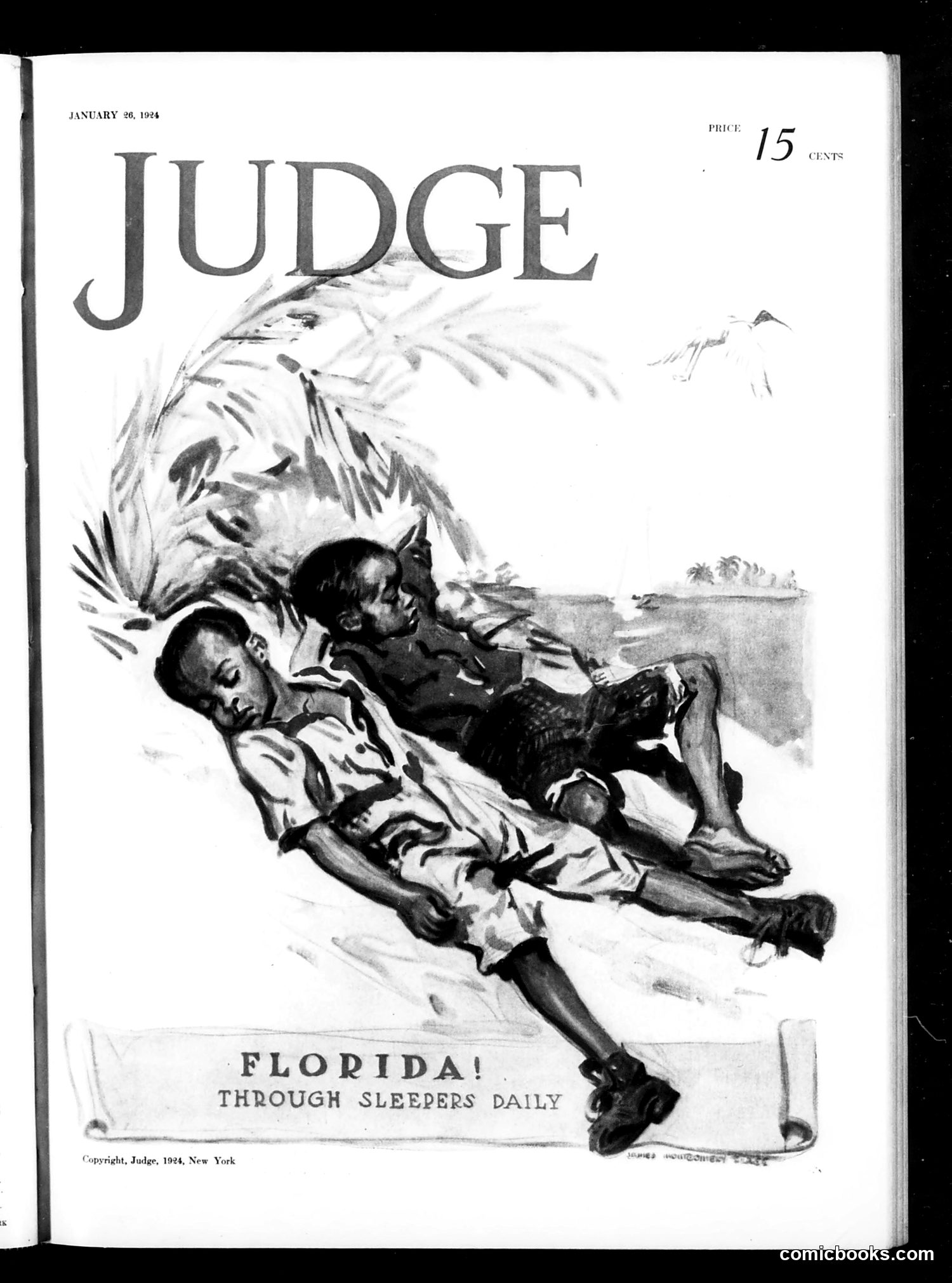
This satirical cover depicts two figures sleeping beneath a palm tree, with the caption "FLORIDA! THROUGH SLEEPERS DAILY." The cartoon mocks the Florida real estate boom of the 1920s. The sleeping figures—appearing to be tourists or investors—suggest people arriving in Florida via overnight train "sleepers" (sleeping cars), likely arriving exhausted or unprepared. The exaggerated, caricatured style implies the absurdity of the Florida migration craze. The satire critiques the frenzy around Florida land speculation during this period, when Americans rushed to invest in Florida property. The "sleepers daily" reference underscores how routine this migration had become—people were constantly arriving, often without careful consideration. The joke suggests these travelers would sleep through (or be oblivious to) the realities of their investments, capturing contemporary skepticism about the Florida boom's sustainability.
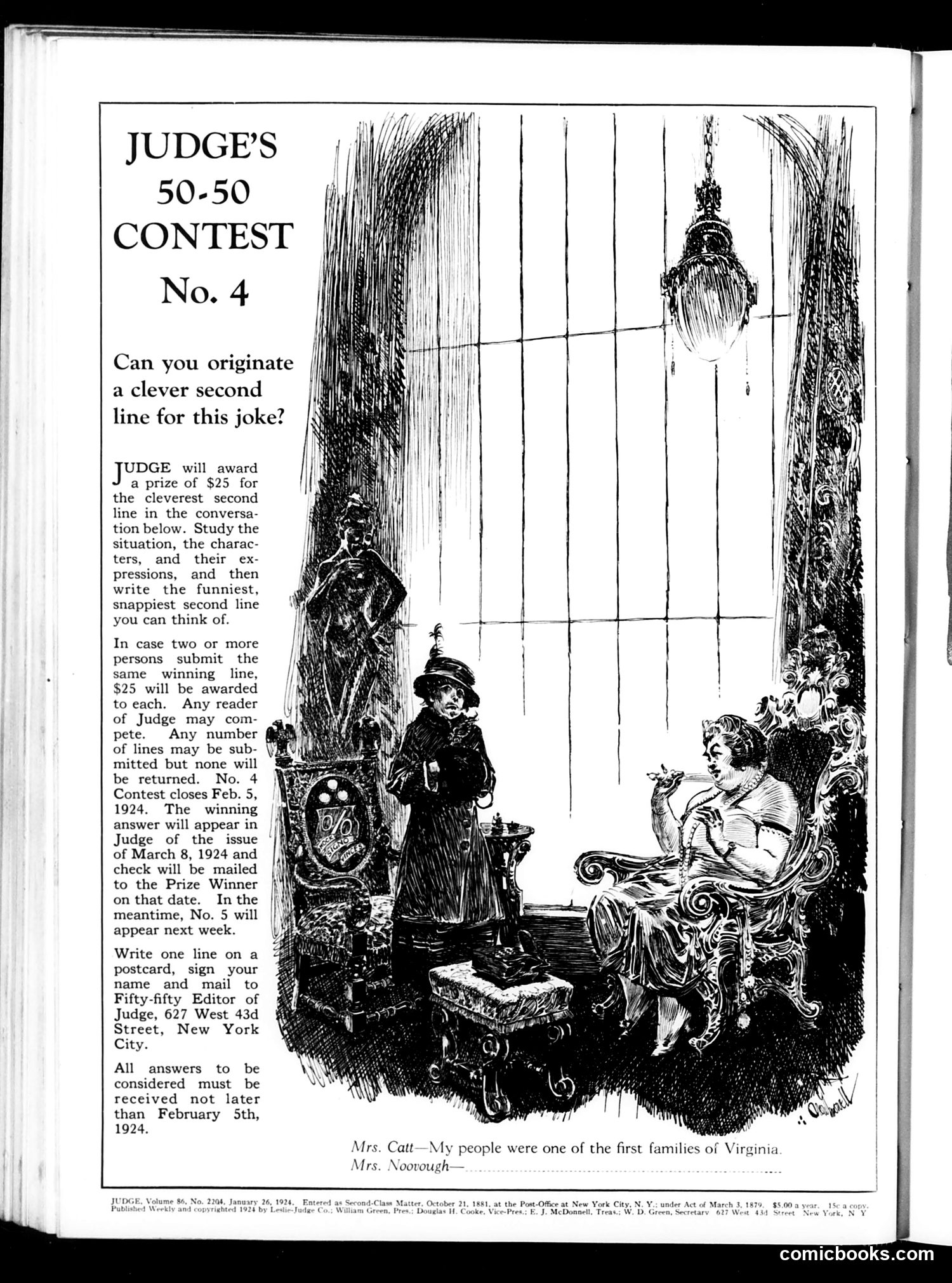
This page features a humor contest, not political satire. The magazine offered a $25 prize for readers to submit a clever "second line" to complete a joke. The illustration shows two women in an ornate interior setting. According to the caption, Mrs. Catt (likely women's suffrage leader Carrie Chapman Catt) says to Mrs. Noorough: "My people were one of the first families of Virginia." The contest invites readers to supply a witty comeback or response. The joke appears to play on class pretension and social hierarchy—Mrs. Catt's boast about prestigious ancestry invites ridicule. Entries closed February 5, 1924, with winners announced in the March 8 issue. This represents Judge magazine's typical early-20th-century format mixing editorial cartoons with reader-participation humor contests.
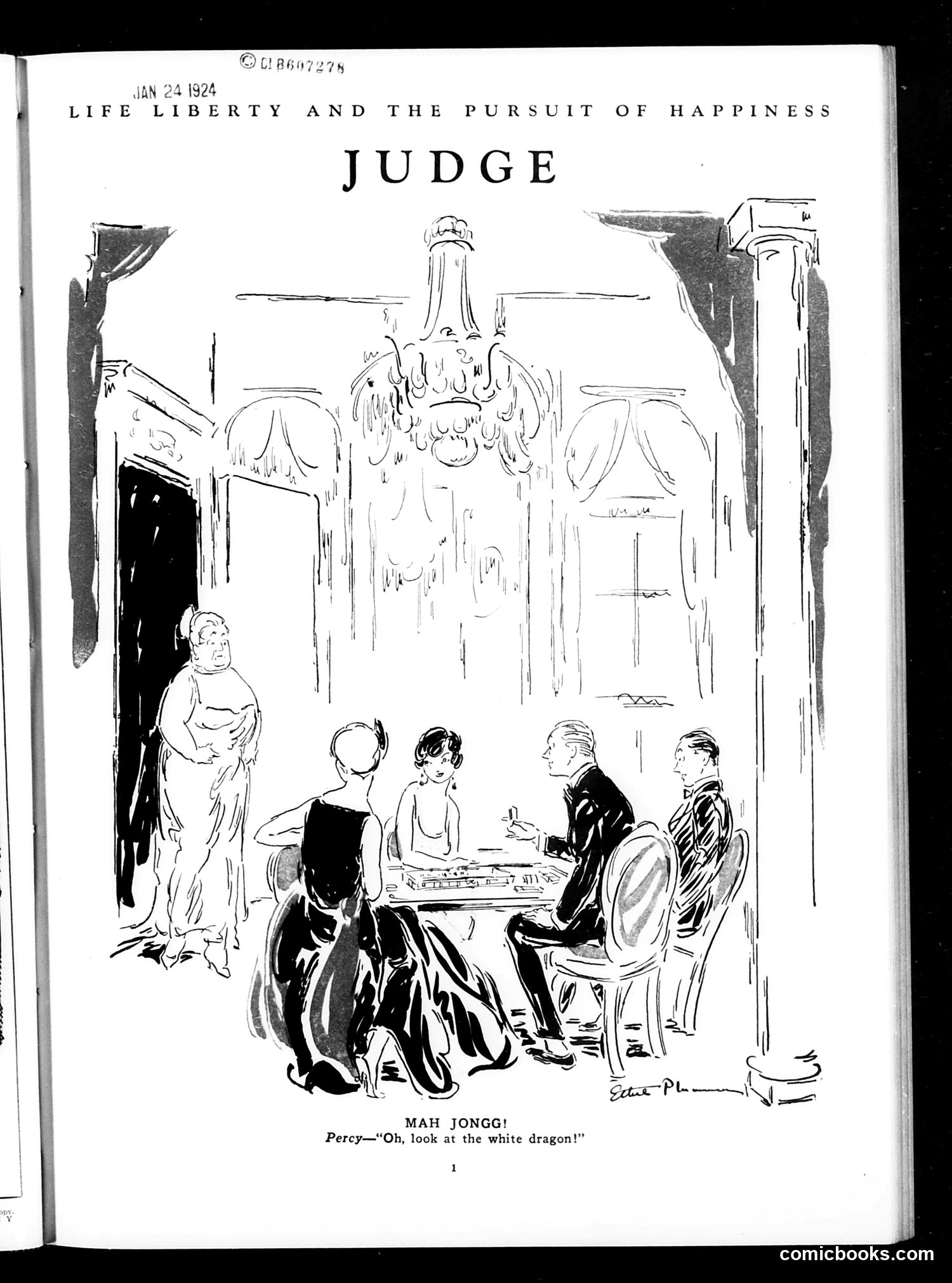
This cartoon depicts a scene titled "MAH JONGG!" with the caption "Percy—'Oh, look at the white dragon!'" The satire targets the 1920s American craze for Mahjong, a Chinese tile game that became wildly popular among American society during this period. The illustration shows well-dressed people gathered around a Mahjong table, with a statue of Lady Liberty presiding above them in the background—a striking juxtaposition suggesting that Americans were distracted by frivolous foreign pastimes rather than attending to civic duties or "American" values. The humor lies in the obsessive fascination with Mahjong among the leisure class, depicted as utterly absorbed in the game while patriotic symbolism literally looms overhead, unheeded.
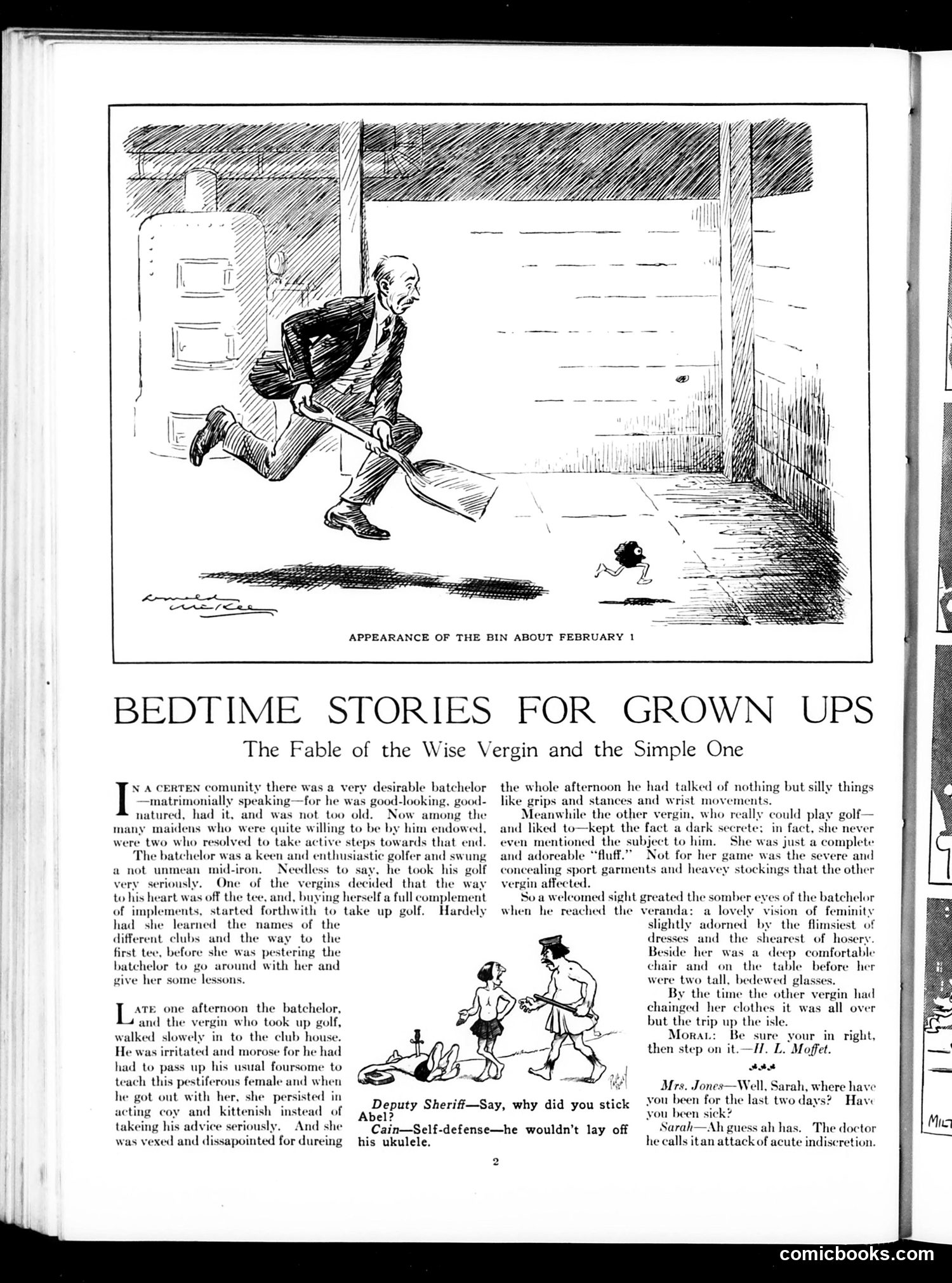
The top cartoon, titled "APPEARANCE OF THE BIN ABOUT FEBRUARY 1," shows a man frantically sweeping with a shovel while a small figure (possibly representing refuse or a problem) appears in the corner. This likely references a seasonal issue—perhaps municipal waste management or a social problem that recurs yearly around February. The main content is "Bedtime Stories for Grown Ups: The Fable of the Wise Virgin and the Simple One," a moral tale contrasting two women's approaches to domestic life and self-improvement. One bachelor pursues golf; the other encourages him toward responsibility and self-care instead. The satirical dialogue at bottom between "Deputy Sheriff" and "Cain" regarding "self-defense" and an "ukulele" is unclear without additional context. This appears to be family-oriented humor blending domestic satire with social commentary.
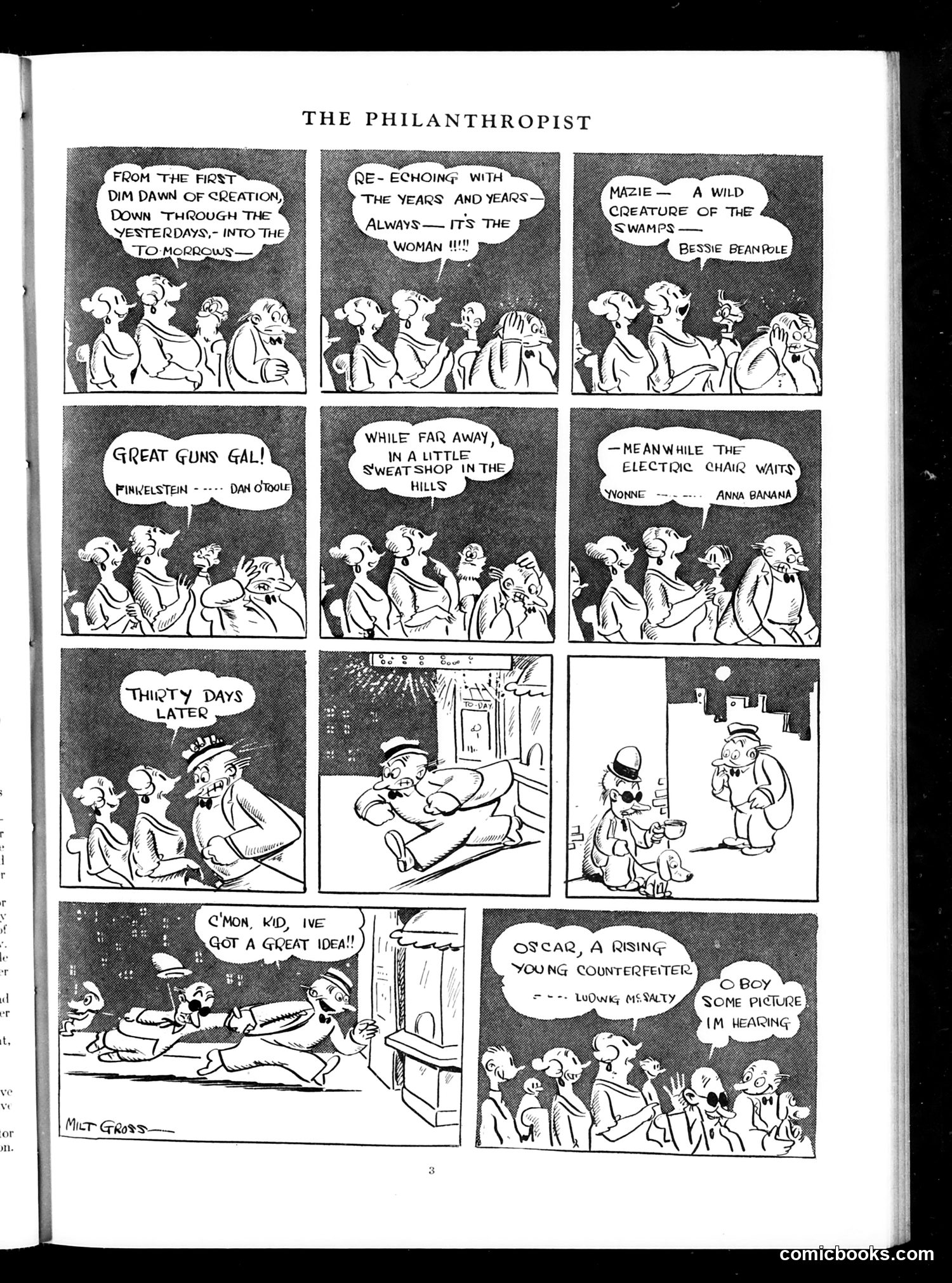
This satirical comic mocks wealthy donors who make grand charitable gestures while remaining ignorant of—or indifferent to—actual social problems. The wealthy character recites famous philanthropists and their causes ("Great Guns, Gal! Pinklestein—Dan O'Doyle"; "Mazie, a wild creature of the swamps—Bessie Beamgle"), suggesting he's simply name-dropping fashionable charitable interests without genuine understanding. The punchline arrives when he proposes "Oscar, a rising young counterfeiter" as his philanthropic project, revealing he's so detached from reality that he can't distinguish between legitimate charity and absurdity. The satire suggests wealthy donors often support causes based on social fashion rather than genuine need or comprehension. The comic critiques performative philanthropy and the disconnect between the wealthy and actual social conditions.
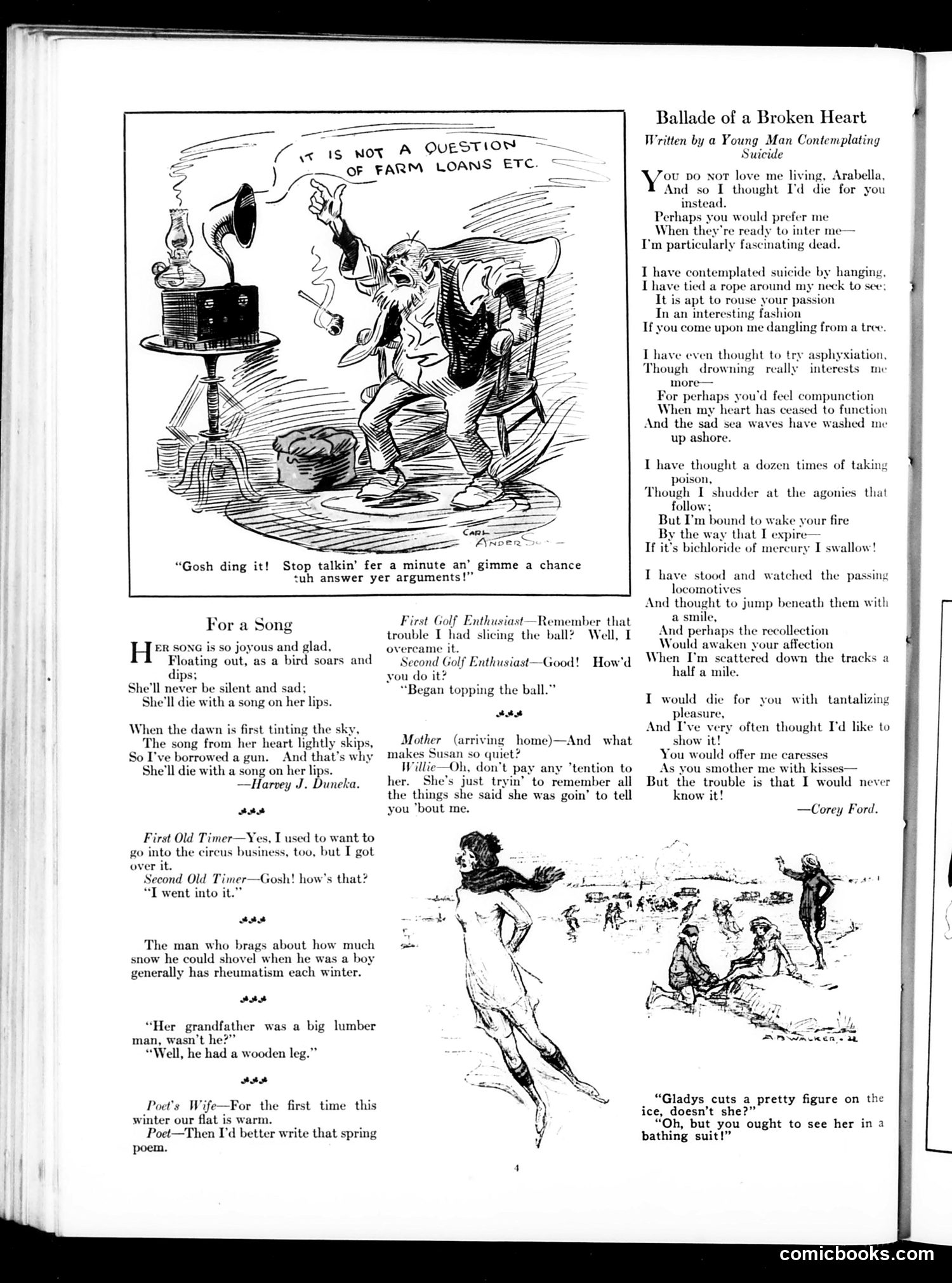
The main cartoon depicts a domestic dispute about finances. One figure sits at a table with a lamp and ledger, stating "It is not a question of farm loans etc." while another figure gestures frantically. The caption reads: "Gosh ding it! Stop talkin' fer a minute an' gimme a chance 'uh answer yer arguments!" This satirizes rural/agricultural financial disputes, likely referencing contemporary debates about farm loans—a persistent political issue in early 20th-century America. The cartoon mocks how such arguments become circular and unproductive, with neither party able to get a word in. The remaining page content consists of humorous short poems and a separate cartoon about ice skating. These appear to be typical Judge filler material rather than focused political satire.
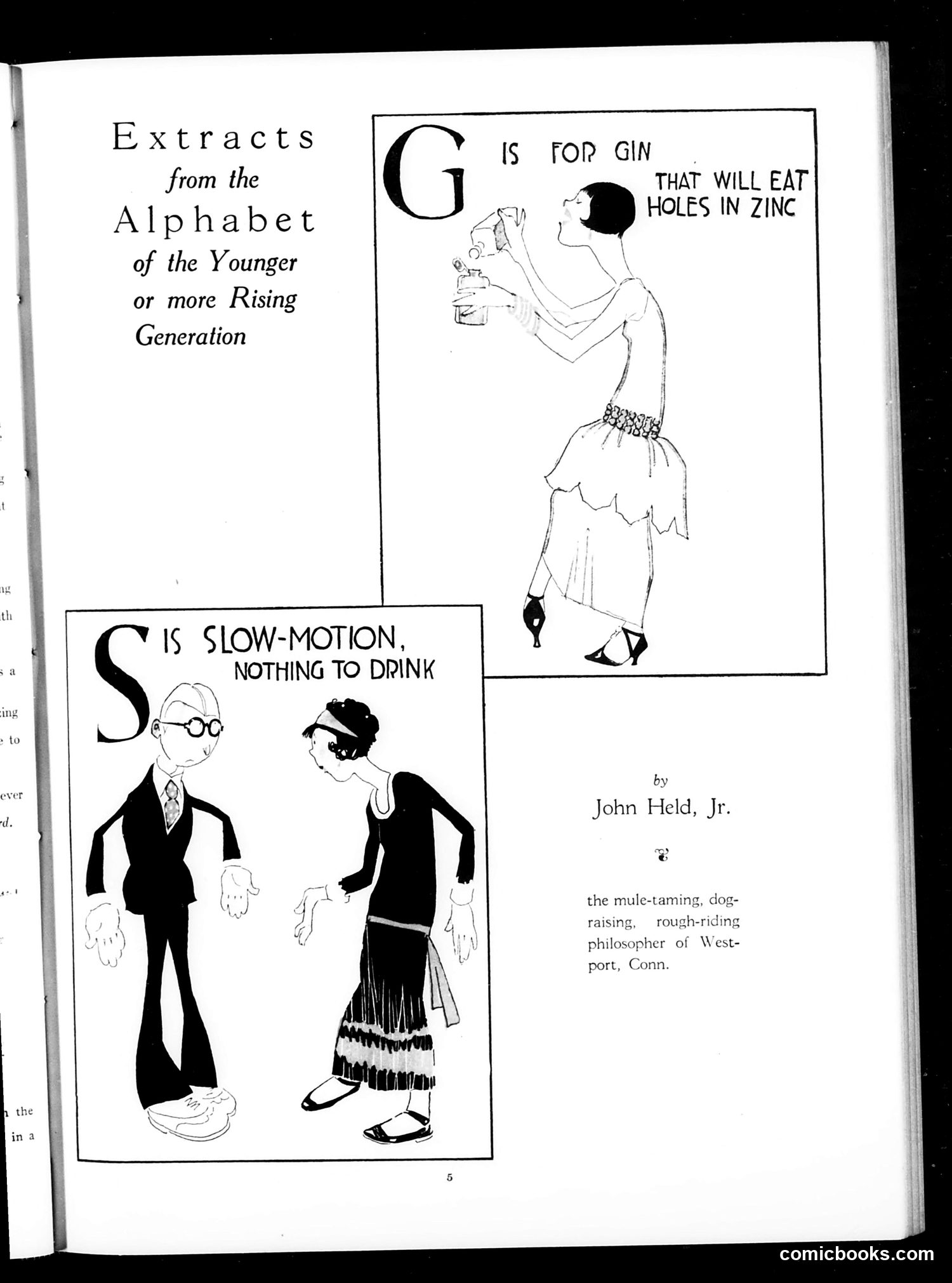
This page from Judge magazine features two satirical alphabet entries by John Held Jr., a prominent 1920s cartoonist known for depicting Jazz Age culture. **"G is for Gin"** mocks Prohibition-era drinking culture, showing a flapper woman consuming gin despite the federal alcohol ban (1920-1933). The "holes in zinc" reference suggests she's drinking industrial-grade or dangerously adulterated gin—a real hazard of illegal speakeasies and bootleg operations. **"S is Slow-Motion, Nothing to Drink"** appears to mock older generation restraint or sobriety, contrasting conservative older figures with the younger generation's casual law-breaking regarding alcohol. The satire targets generational conflict during Prohibition: the "rising generation" openly flouted alcohol laws while their elders maintained propriety. Held Jr. uses humor to critique both youth rebellion and the ineffectiveness of Prohibition itself.
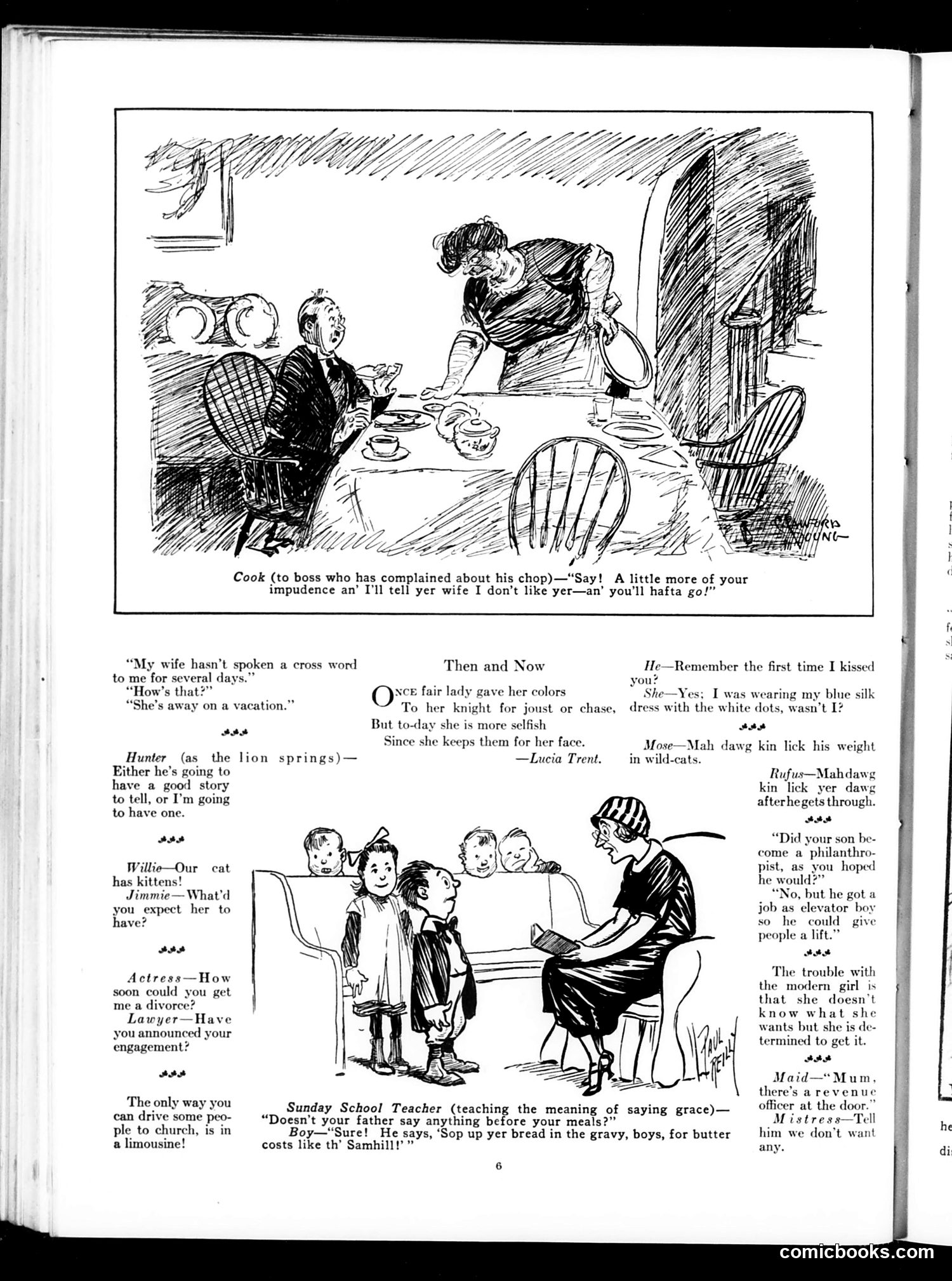
This is a humor page from Judge magazine featuring multiple unrelated short jokes and comic sketches typical of early 20th-century American satirical publications. The top cartoon depicts a cook threatening his employer with marital discord—a servant using knowledge of the boss's domestic troubles as leverage, inverting the usual power dynamic. The text snippets below present brief jokes on various social topics: marital discord, divorce proceedings, class distinctions (church attendance requiring luxury cars), and economic hardship (a father rationing butter during apparent financial strain). One sketch mocks a working-class father's rough speech at dinner prayers. The "Then and Now" verse contrasts medieval courtship—where ladies wore colors for their knights—with modern materialism, where women now use cosmetics on their faces instead. A "revenue officer" joke references Prohibition-era bootlegging, with the household rejecting contact with tax agents. These jokes reflect early 20th-century concerns: economic anxiety, changing gender roles, class consciousness, and Prohibition's social impact. The humor is gentle domestic satire rather than pointed political commentary.
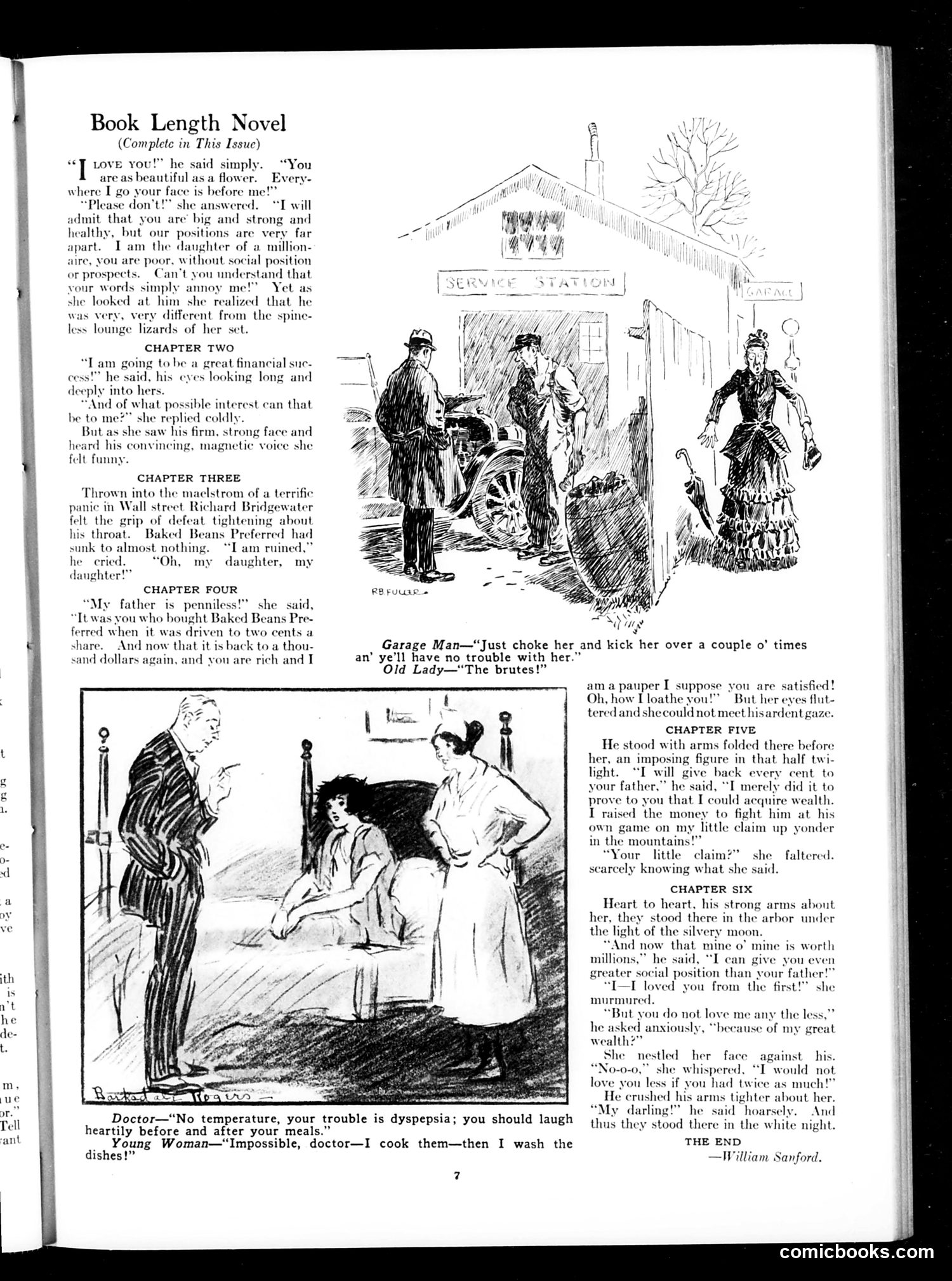
This page contains a serialized romantic novel ("Book Length Novel") lampooning the melodramatic fiction popular in early 20th-century magazines. The story follows a familiar formula: a poor man (Richard Bridgewater) loves a wealthy woman, loses his fortune, then strikes it rich in mining, ultimately winning her heart. The satire lies in exaggerating every cliché—the flowery dialogue ("beautiful as a flower"), class conflict, dramatic reversals, and overwrought emotional declarations. The inserted comic vignettes mock the story's sentimentality: a "Garage Man" joke about abusing women, and a doctor-patient exchange about dyspepsia (indigestion) underscore the page's cynicism toward both romance and contemporary advice literature. The crude illustration style and breathless chapter breaks parody cheap serialized fiction, suggesting Judge's audience found such earnest romantic narratives absurd and worthy of ridicule.
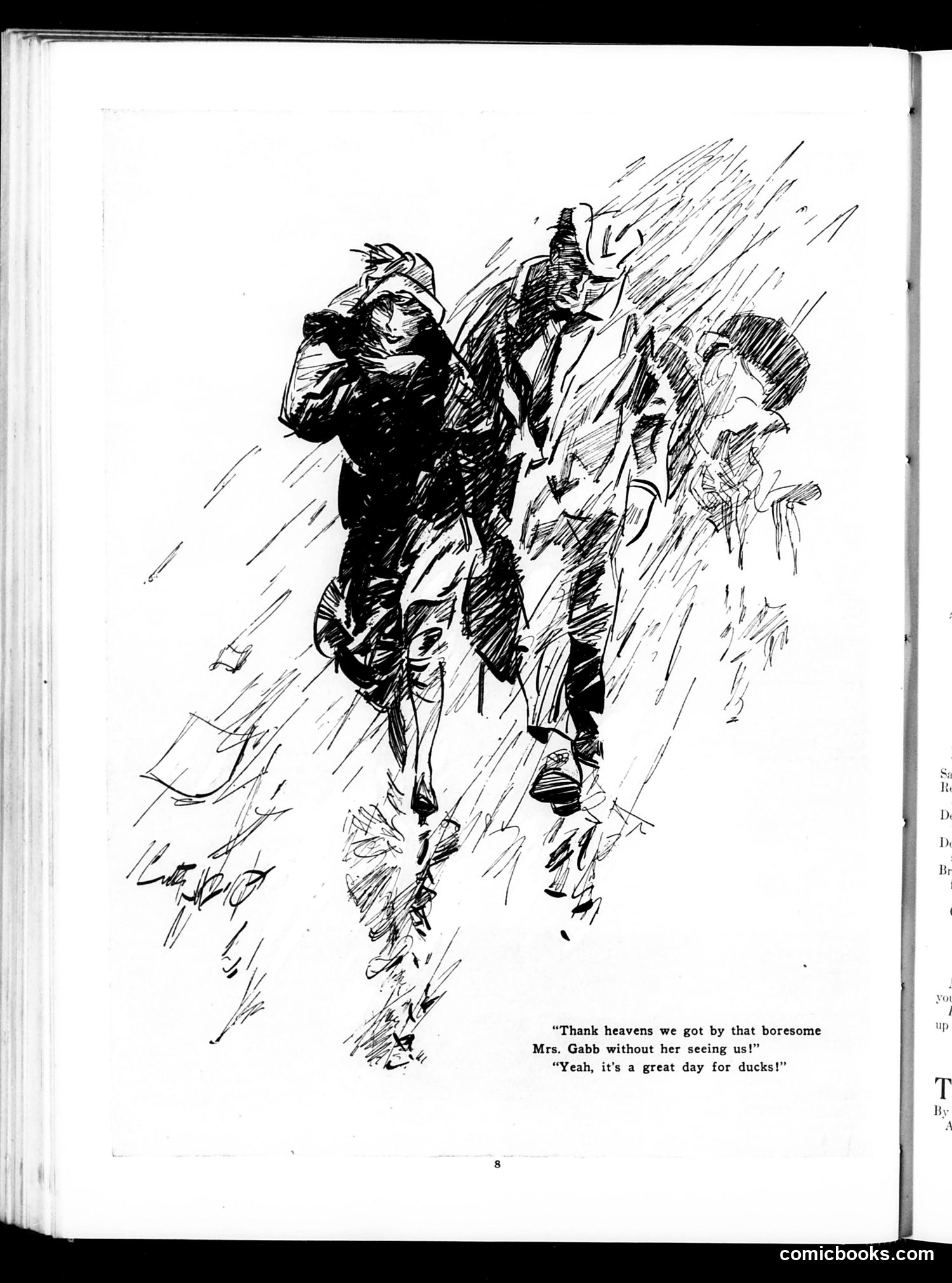
This sketch depicts two figures fleeing through rain or harsh weather. The caption references "Mrs. Gabb" (likely a character from the period) being avoided, with one character relieved they escaped her notice. The second character responds that "it's a great day for ducks"—a colloquial expression meaning bad weather is perfect for ducks but unpleasant for humans. The satire appears to be **domestic humor**: the joke conflates escaping an annoying or nagging woman (Mrs. Gabb) with enduring miserable weather conditions. The "ducks" quip suggests resignation to uncomfortable circumstances. This reflects early-20th-century magazine humor that often portrayed marriage or domestic life as something to escape from, presenting wives as tedious obstacles. The actual historical context of "Mrs. Gabb" remains unclear without additional sourcing.
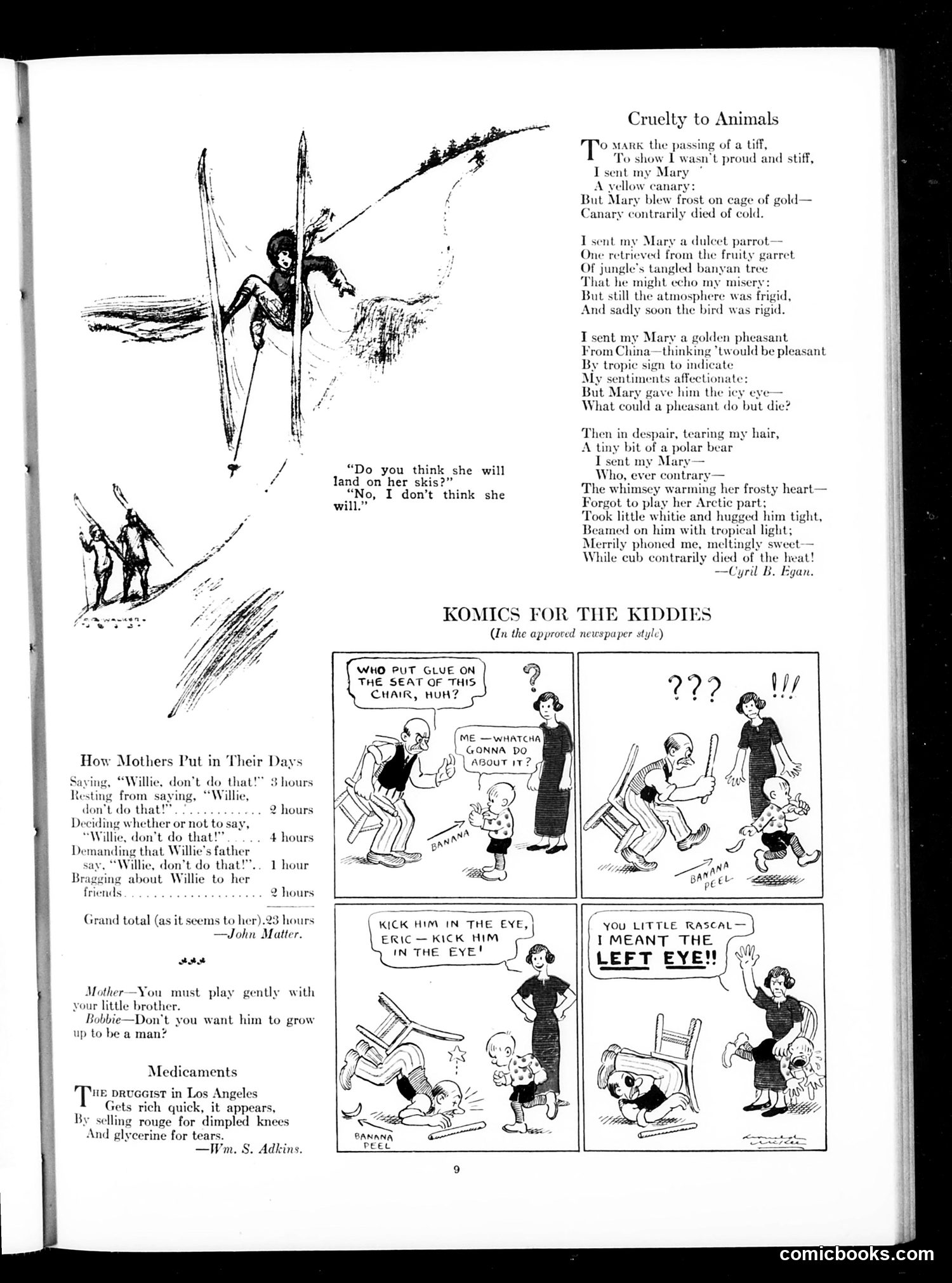
This Judge magazine page contains three distinct pieces of early 20th-century American humor: **"How Mothers Put in Their Days"** satirizes maternal exhaustion through exaggerated time accounting—mothers spend 23 hours saying "Willie, don't do that!" to misbehaving sons. The joke mocks both child-rearing tedium and the emerging "scientific" breakdown of daily activities. **"Cruelty to Animals"** is a romantic poem where a suitor repeatedly sends exotic birds (canary, parrot, pheasant, polar bear cub) to win over a cold woman named Mary. Each animal dies from her indifference—until a polar bear cub melts her heart, only to die from the sudden warmth. It's absurdist satire on romantic gestures and emotional inconsistency. **"Komics for the Kiddies"** shows children misbehaving (gluing chairs, kicking each other) with adults helplessly responding. The final panel's "LEFT EYE!!" punchline relies on slapstick violence as humor—reflecting period attitudes toward child discipline that modern readers would find disturbing. The sketchy illustrations and newspaper-style comedy reflect Judge's mid-century American satire aesthetic.
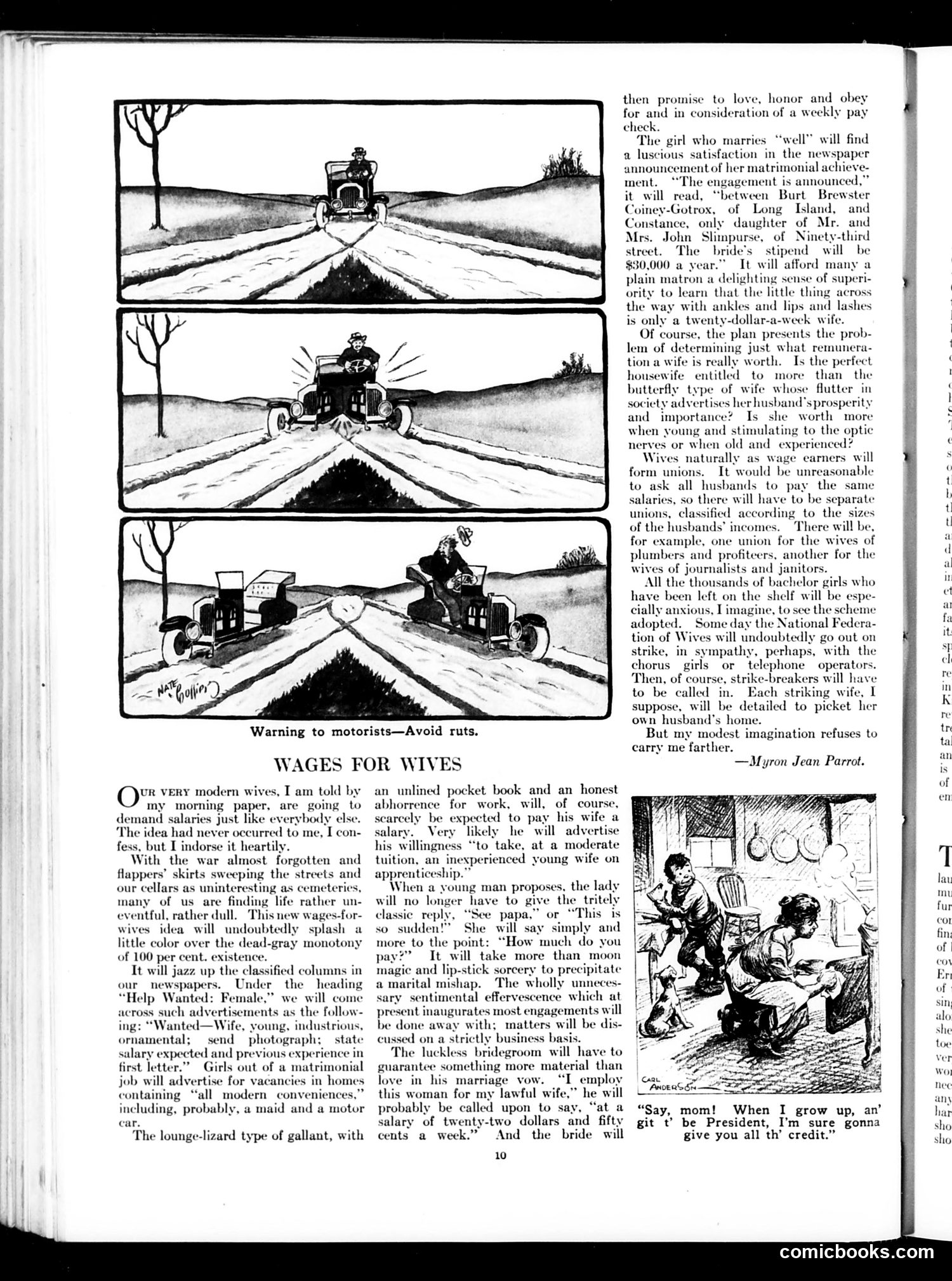
This is satirical commentary on the emerging 1920s feminist demand for women's economic independence and paid labor within marriage. The article mocks the idea of wives receiving salaries from husbands as a business transaction rather than a romantic partnership. The three cartoon panels above depict the escalating chaos of motorists on a road, illustrating how modern life has become hectic and "eventful" — the author uses this visual metaphor to suggest that wives' wage demands would add similar disorder to domestic life. The satire targets several anxieties: wives becoming unionized workers, marriages reduced to contracts, standardized pay scales based on husband's income, and the erosion of sentimental romance. The author also mocks "bachelor girls" (unmarried women) eagerly adopting this scheme. The accompanying cartoon shows a child telling her mother she'll become President — suggesting the article's broader anxiety about women's expanding ambitions and independence following World War I.
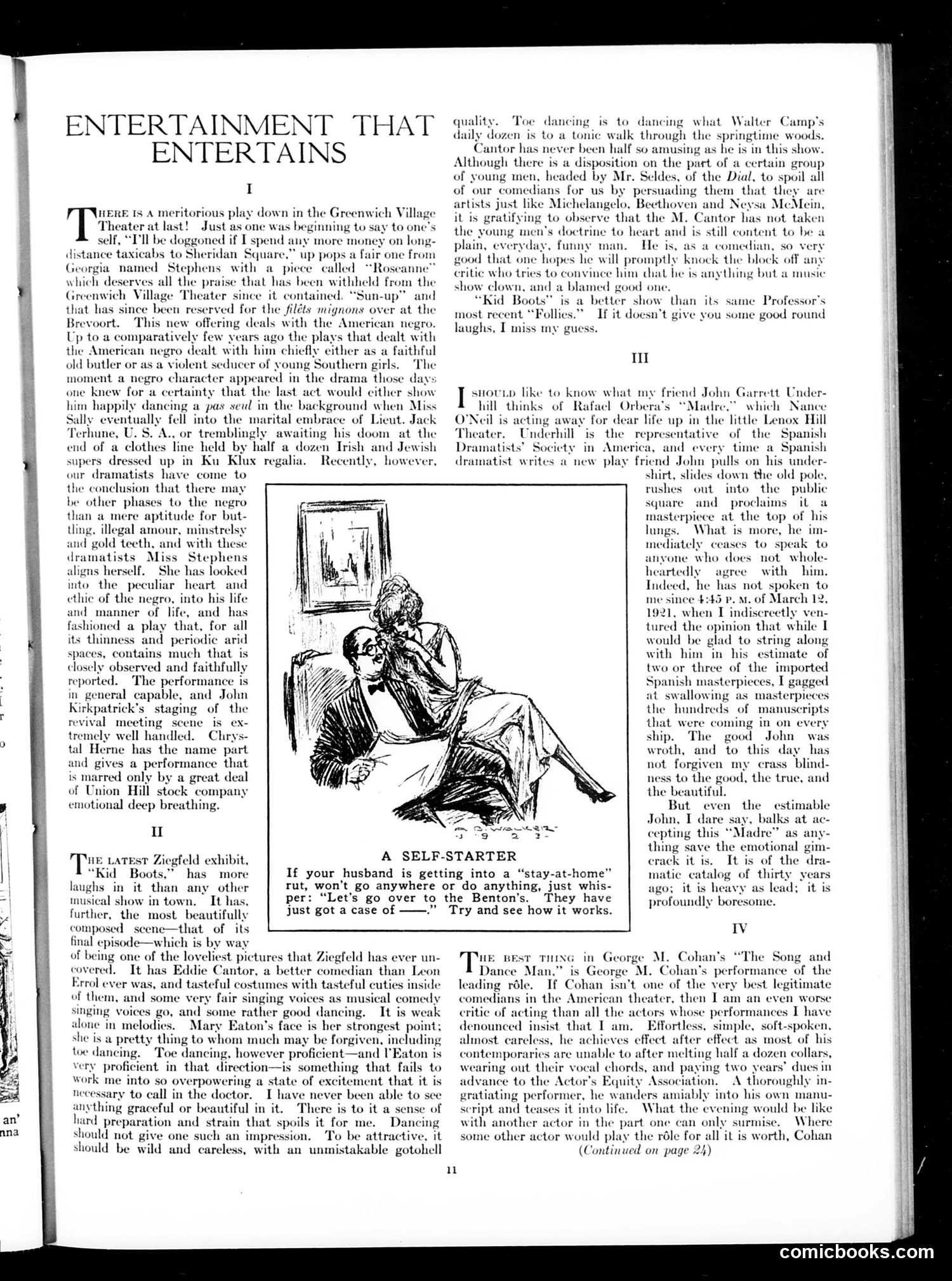
This is a theatrical review column praising recent Broadway productions. The main points: **"Roseanne"** (Greenwich Village Theater): A play by Georgia-born author Stephens is celebrated for moving beyond stereotypical depictions of African Americans in drama—previously shown only as faithful servants or violent criminals (the review references how Black characters would either dance happily in background scenes or face lynch mob violence). This play is praised for exploring authentic Black life and character with depth. **"Kid Boots"** (Ziegfeld production): Praised for comedy and beautiful staging, featuring Eddie Cantor. The reviewer admires Mary Eaton's dancing despite criticizing toe-dancing generally as mechanically strained rather than naturally graceful—comparing it unfavorably to Walter Camp's exercise routines. The accompanying illustration shows a couple in an intimate domestic scene, accompanying an advertisement about rekindling a "stay-at-home" husband's interest in going out. The tone is sophisticated theater criticism typical of Judge's urbane, educated readership.
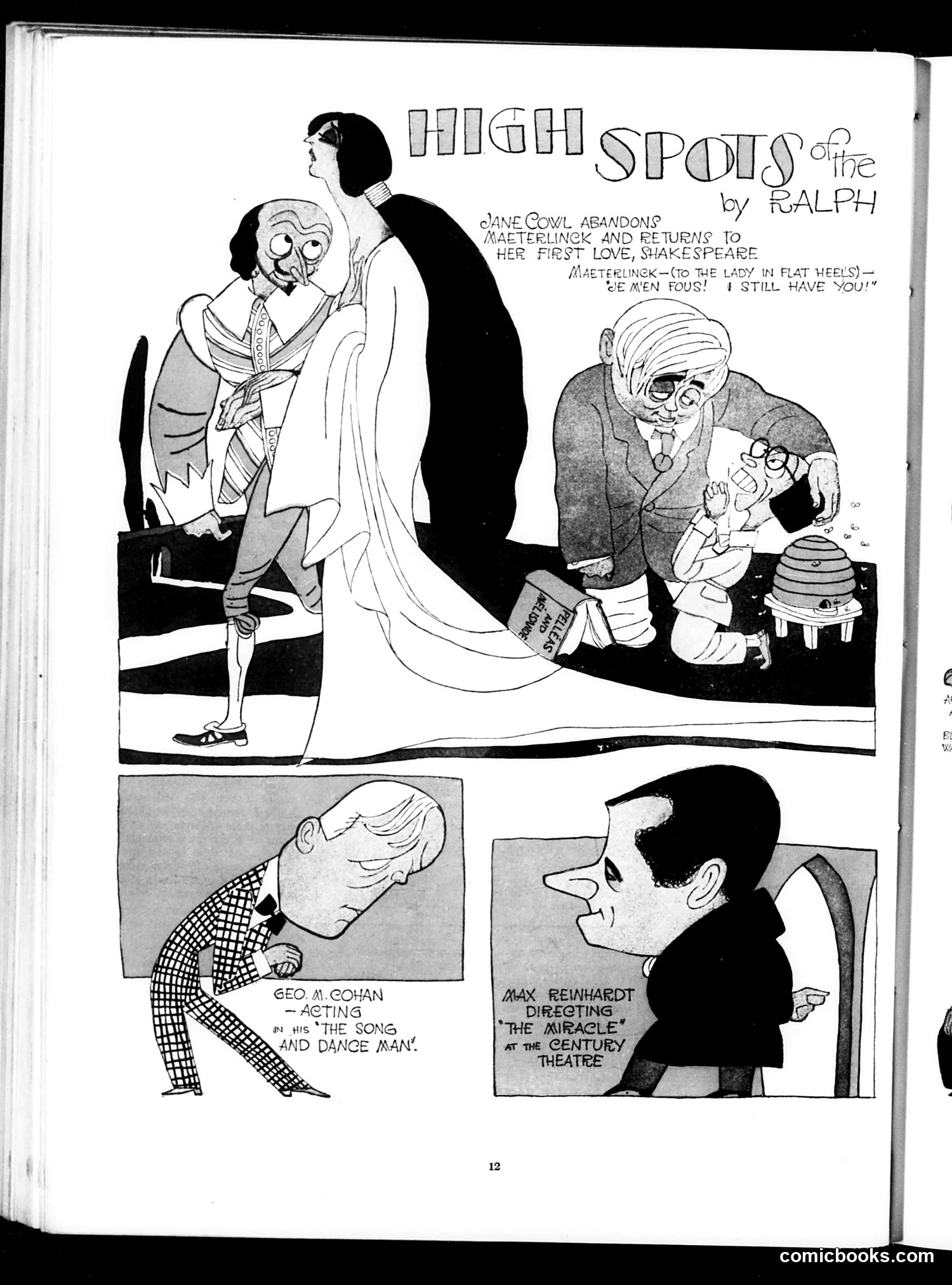
This theatrical satire by Ralph mocks actress Jane Cowl's career choices. The main panel shows Cowl returning to Shakespeare after abandoning Maurice Maeterlinck (a Belgian Symbolist playwright), with an older male figure—likely Maeterlinck himself—declaring his continued devotion despite her infidelity to his work. The lower panels feature caricatures of contemporary theater figures: George M. Cohan (actor/performer in "The Song and Dance Man") and Max Reinhardt (director of "The Miracle" at the Century Theatre). The satire targets theatrical pretension and the fickleness of actresses who shift between avant-garde European playwrights and commercial entertainment. The joke relies on readers' familiarity with these stage personalities and the theatrical landscape of the era (likely 1910s-1920s).
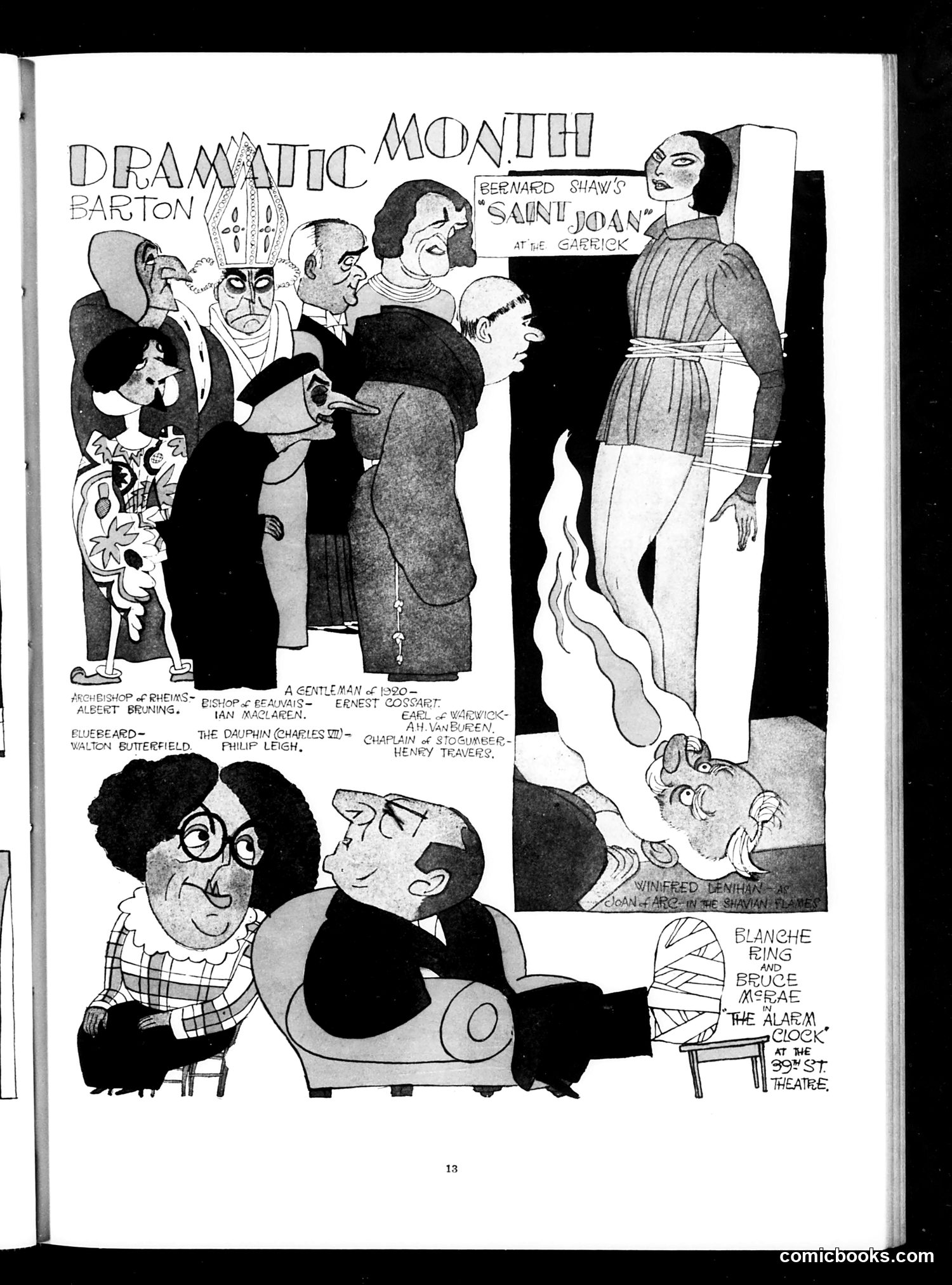
This page satirizes theatrical productions of the moment, labeled "Dramatic Month" by Barton. The top panel mocks "Saint Joan" at the Garrick Theatre, featuring caricatured figures representing various theatrical personalities and productions. Named individuals include Bernard Shaw (the play's author) and various actors and clergy characters from the production. The bottom panel shows two comedic figures, apparently critics or theater-goers, discussing current shows. References to "A Gentleman of 1920" and other productions suggest this reviews the Broadway/theater scene of that era. The satire targets both the pretentiousness of contemporary theater and its key figures through exaggerated caricature—a typical Judge magazine approach to cultural commentary.
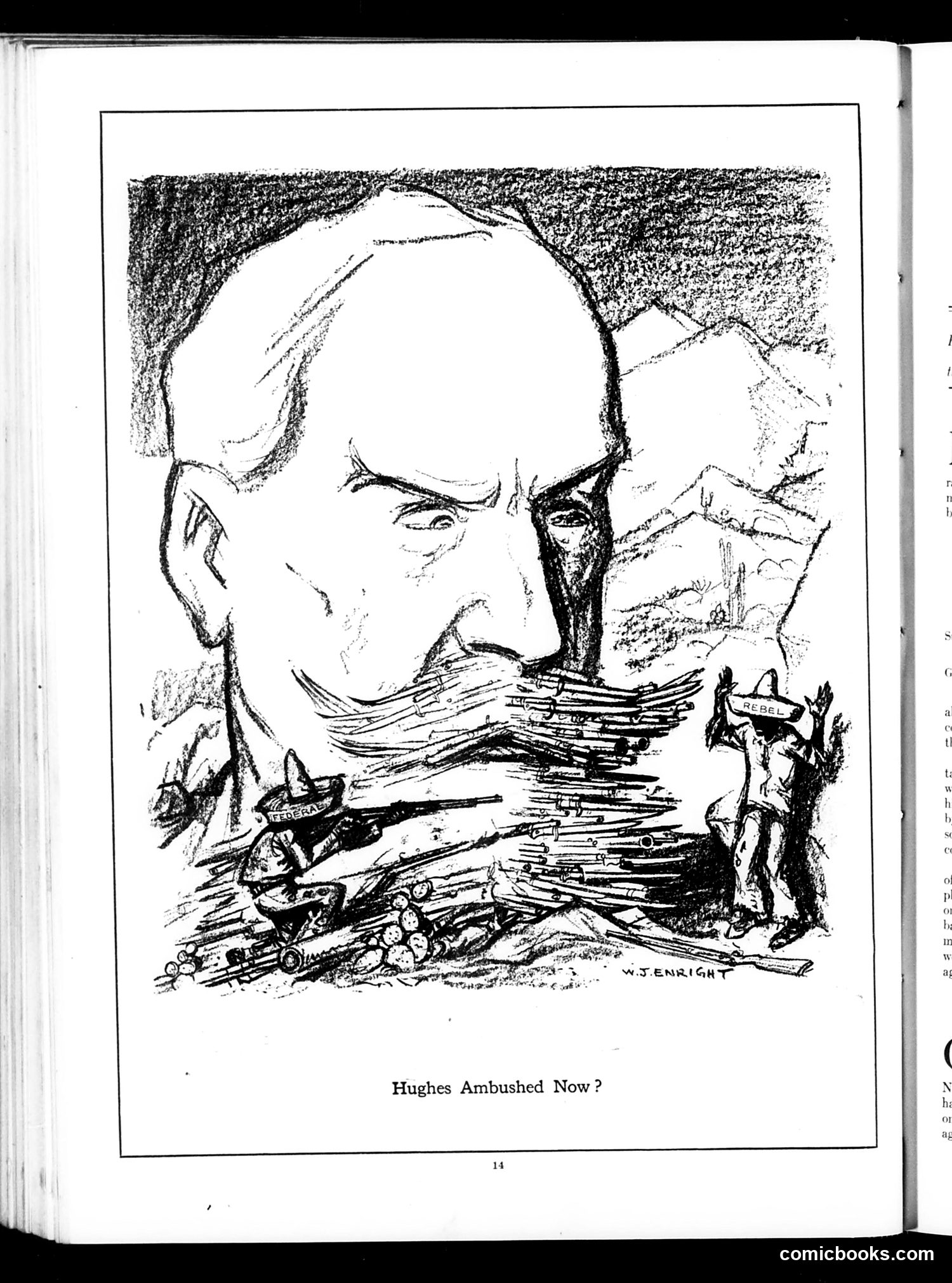
This is a satirical cartoon signed by W.T. Enright depicting a large, stern male face with a beard that's been obscured or "ambushed" by what appears to be sticks, logs, and weapons at the chin/mouth area. The cartoon references someone named Hughes being "ambushed." Without additional context about the specific date and issue of Judge magazine, I cannot definitively identify which Hughes is referenced or what political/military situation is being satirized. However, the violent imagery suggests commentary on a public figure facing political opposition or military conflict. The question mark in the title indicates the cartoonist is speculating about whether Hughes has been caught off-guard or defeated. To properly explain this satire would require knowing the publication date and contemporary events involving a prominent Hughes figure.
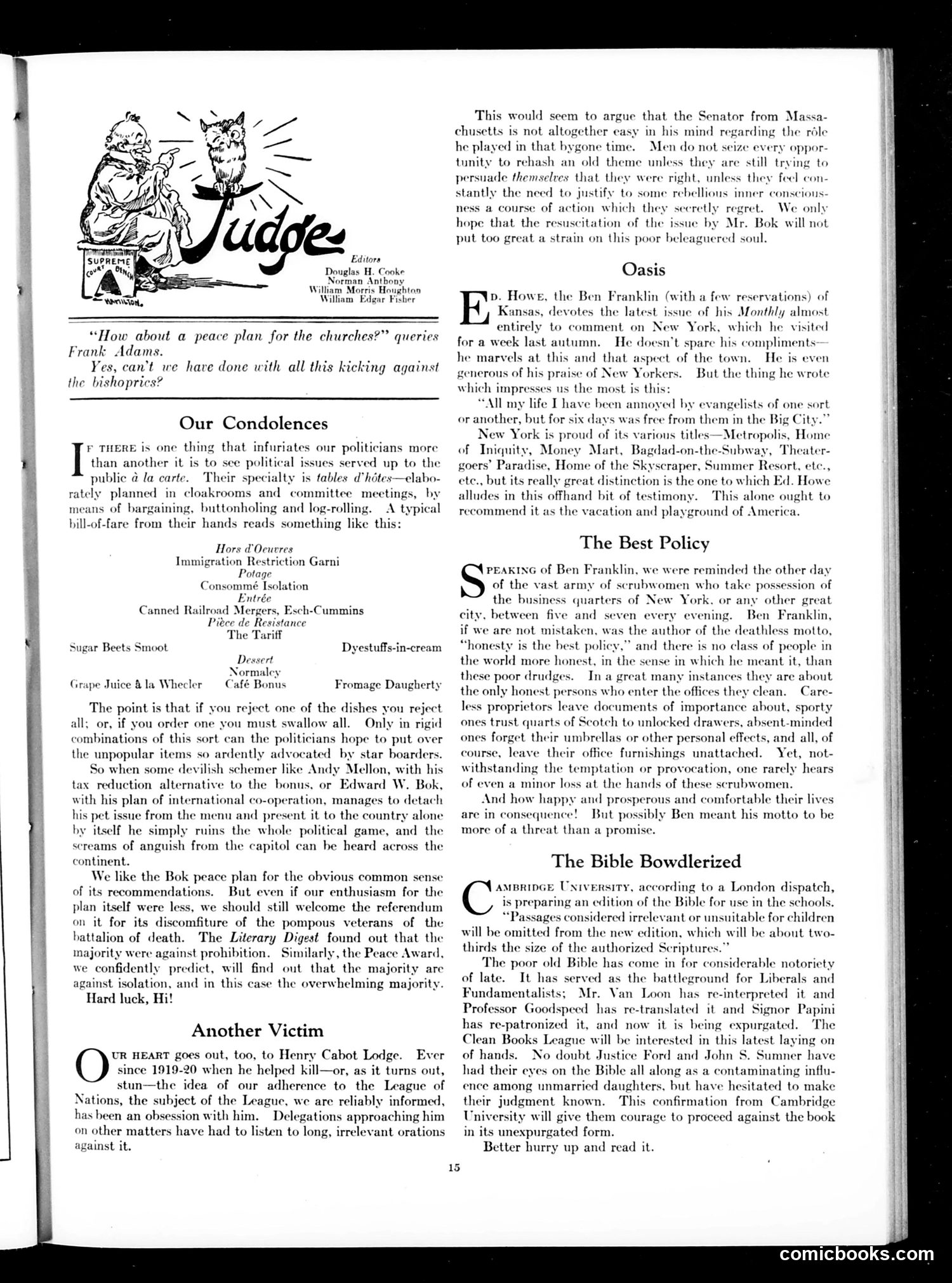
The main cartoon depicts a figure (likely representing a politician or public figure) being confronted by an owl labeled "Judge"—the magazine's mascot—suggesting editorial criticism or judgment about some political matter. The accompanying articles criticize American political practices of the early 1920s. One piece mocks politicians' tendency to bundle unpopular legislative items together (using a restaurant menu as metaphor) so voters must accept them as a package. It praises Edward W. Bok's peace plan and a Literary Digest referendum for disrupting this system. Another section attacks Senator Henry Cabot Lodge, who led opposition to the League of Nations around 1919-20. The writer suggests Lodge's continued obsession with the topic reveals guilty conscience—that he secretly doubts his own position. The "Oasis" section humorously praises New York City's virtue: it apparently lacks evangelical street preachers, unlike other American cities. The satire targets post-WWI political maneuvering, isolationism, and backroom legislative tactics typical of the Harding administration era.
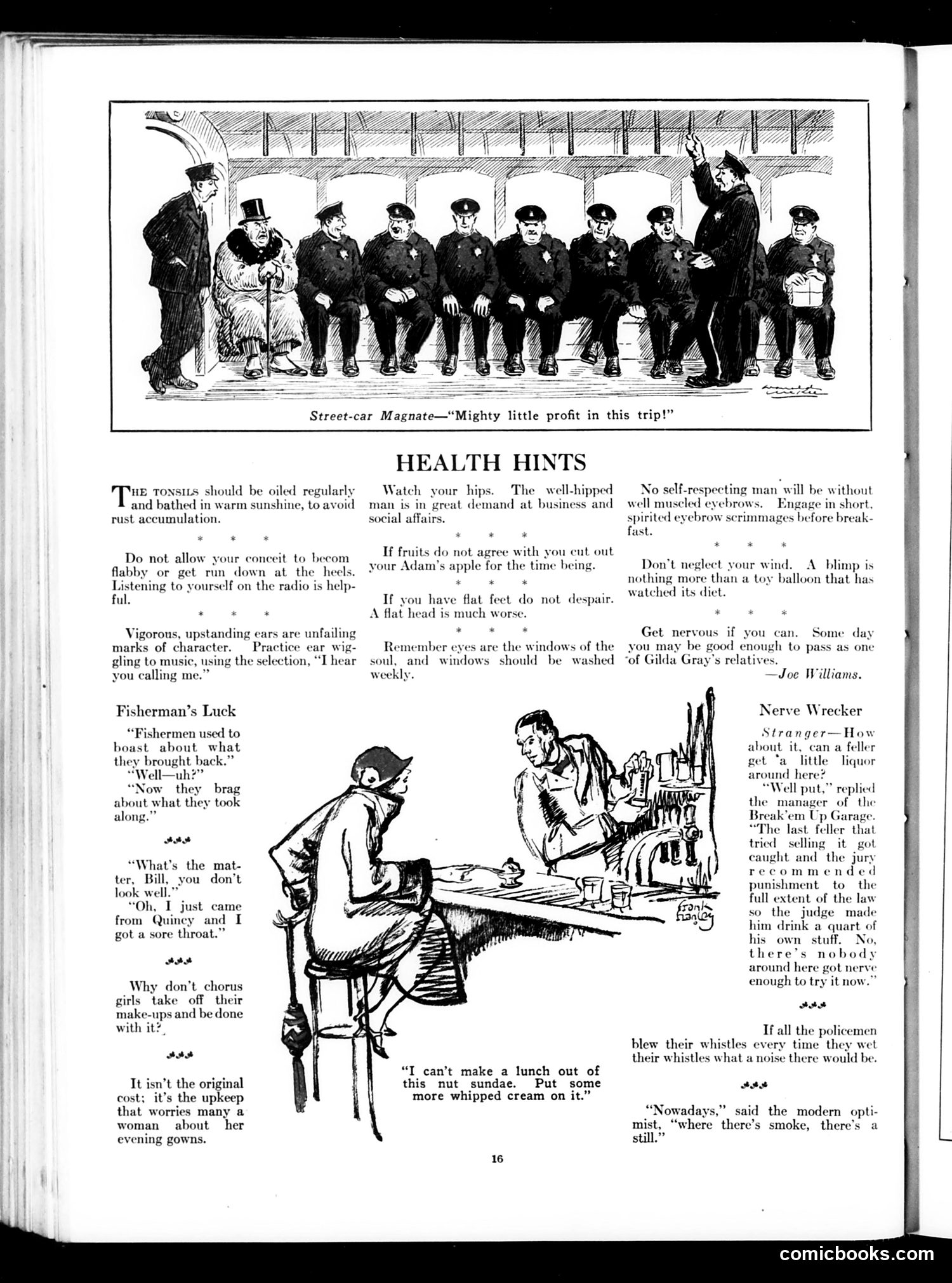
The top cartoon depicts a streetcar conductor surrounded by seated passengers, captioned "Mighty little profit in this trip!" This satirizes the economics of public transit during Prohibition—the conductor expects minimal fares, suggesting ridership was poor (likely due to economic conditions or competition). The "Health Hints" section is absurdist satire mocking fad health advice popular in the 1920s. Jokes like "oil your tonsils" and "cut out your Adam's apple" if fruits disagree mock pseudoscientific wellness trends of the era. The anecdotes scattered throughout contain period-specific humor: one jokes about Prohibition's failure ("Break'em Up Garage" manager who punished a liquor seller by forcing him to drink his own product), another references the flapper "Gilda Gray," and the final line jokes that despite Prohibition, illegal stills still operate ("where there's smoke, there's a still"). Overall, the page satirizes 1920s American life: transit woes, health fads, entertainment culture, and the widespread flouting of Prohibition laws.
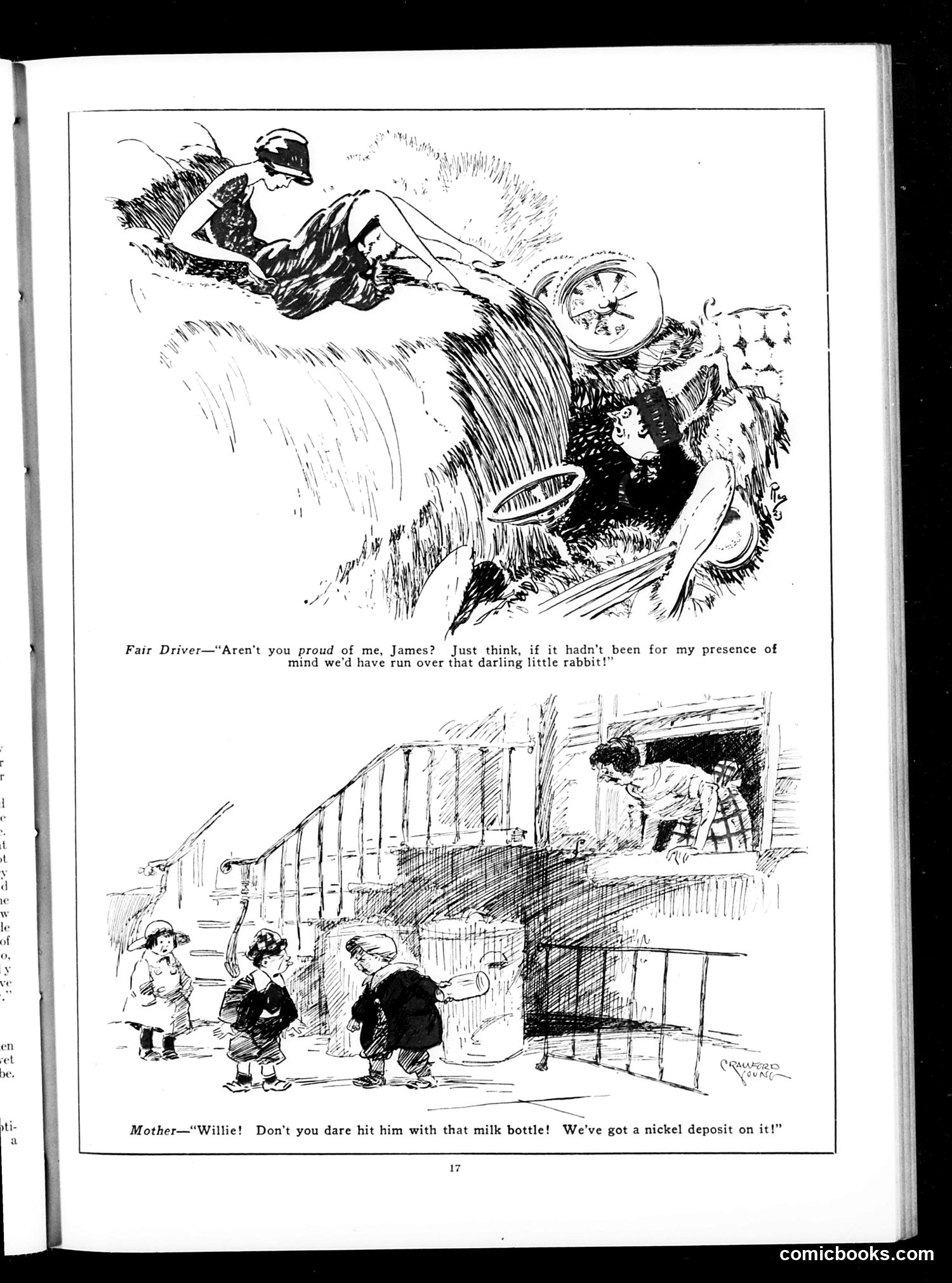
**Top cartoon ("Fair Driver"):** A woman driver boasts to her male companion (James) about narrowly avoiding a rabbit. The satire mocks early female drivers—suggesting they're oblivious or poor drivers who would congratulate themselves for basic safety, while implying their "presence of mind" is questionable or limited. **Bottom cartoon ("Mother"):** A mother scolds her son Willie for threatening another child with a milk bottle, warning him not to damage it because they have a nickel deposit. This satirizes Depression-era penny-pinching and parental priorities—the mother is more concerned about recovering the deposit than her son's violent impulses, reflecting economic hardship when even small deposits mattered. Both cartoons use humor to critique social behaviors: gender stereotypes about driving and working-class financial desperation.
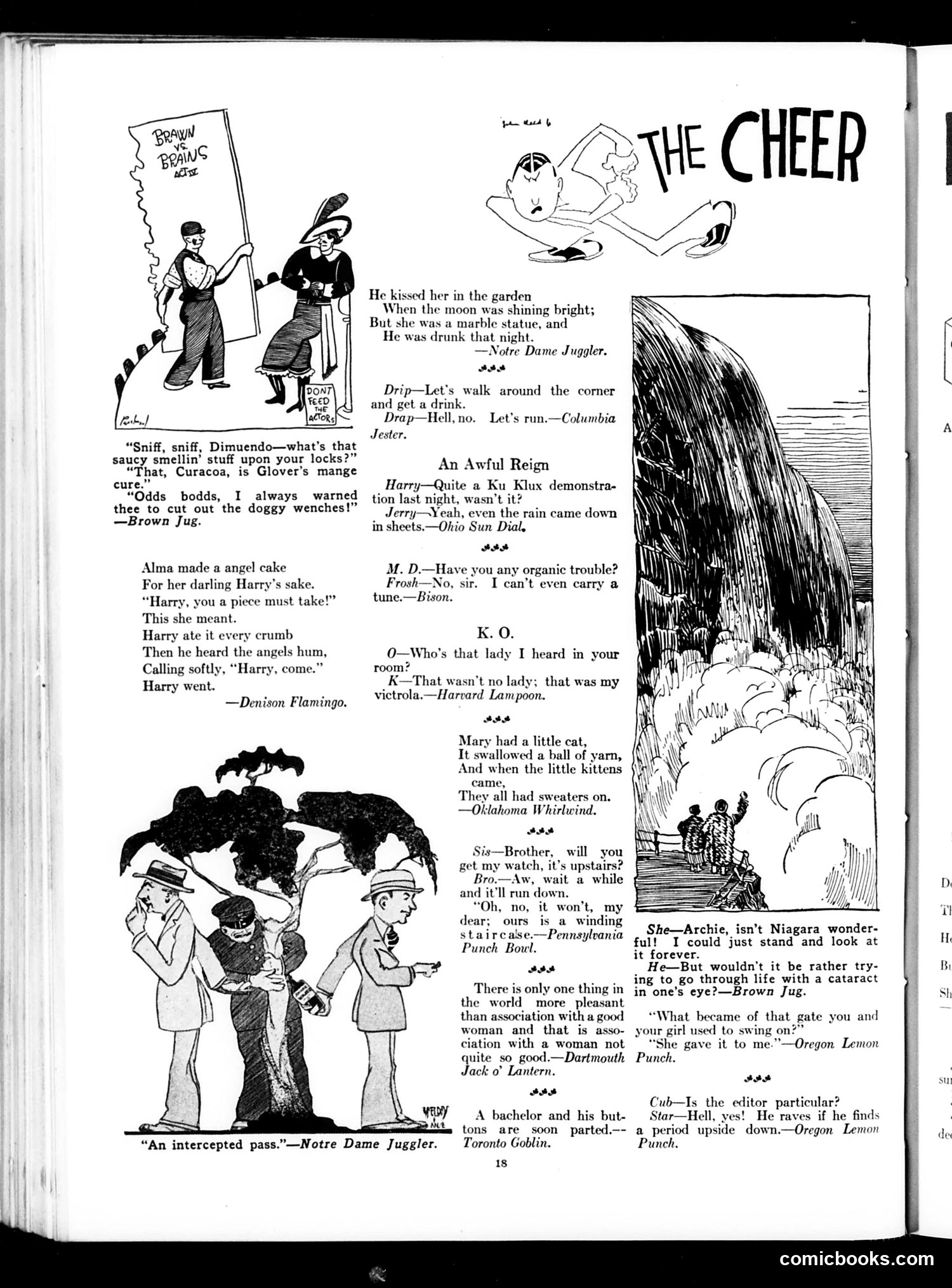
This is a humor compilation page featuring brief jokes and cartoons from various college and satirical publications. The content reflects early-20th-century collegiate and social humor: **Visual cartoons** include domestic/relationship scenarios and what appears to be a "Ku Klux" reference ("An Awful Reign") mocking a KKK demonstration where "even the rain came down in sheets"—a crude pun equating rain with the group's white robes. **Recurring joke themes**: - Romantic misunderstandings (drunk man kissing a statue) - College pranks and mishaps (a frosh's lack of musical talent) - Marriage/courtship humor (bachelors losing buttons; women's fickleness) - Wordplay ("organic trouble," victrola confusion, cataract jokes) **The tone** is lighthearted mockery of romance, domesticity, and student life. Most jokes rely on puns, misheard phrases, or naive situations. The content reflects era-typical attitudes about gender relations and casual racism (the KKK joke treats violence as punchline-worthy).
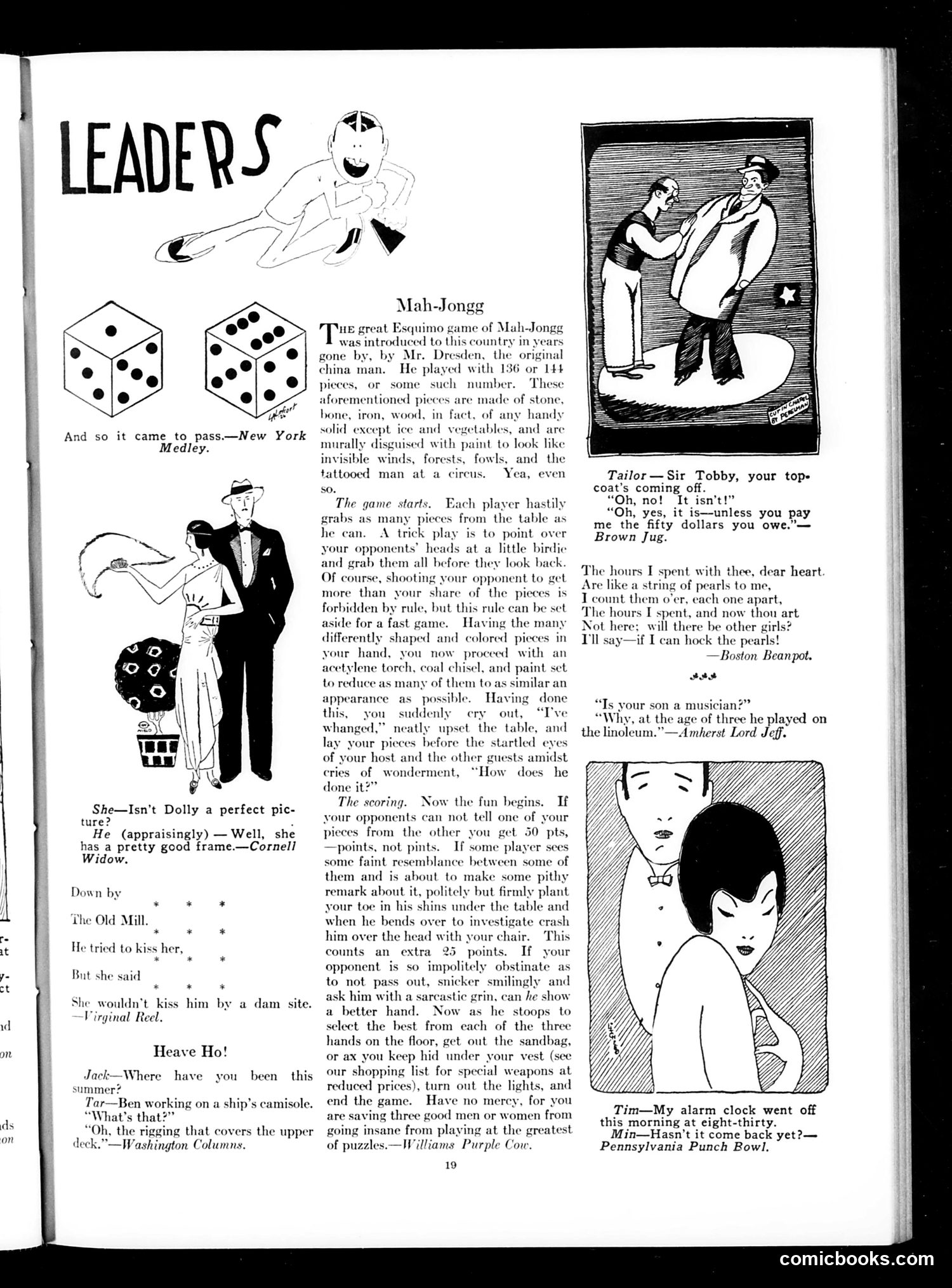
This page from the satirical magazine *Judge* contains humor pieces mocking the 1920s fad of Mah-Jongg, the Chinese tile game that became wildly popular in America during this era. **Main Content: "Mah-Jongg"** The lengthy central article satirizes both the game itself and American enthusiasm for exotic imports. It humorously describes increasingly absurd and violent strategies for winning—from sleight-of-hand to shooting opponents and using sandbags and axes. The satire targets Americans' simultaneous fascination with "Oriental" culture and their tendency toward crude, aggressive behavior. **Surrounding Elements:** The page includes typical *Judge* filler material: short joke quips about romance and relationships from college humor magazines (Cornell Widow, Washington Columns, etc.), plus illustrations of a fashionable woman and Mah-Jongg players. **Context:** The satire assumes readers understand Mah-Jongg's 1920s popularity—a status symbol among the fashionable set. The exaggerated violence parodies both gaming obsession and American "roughness" masquerading as sophistication.
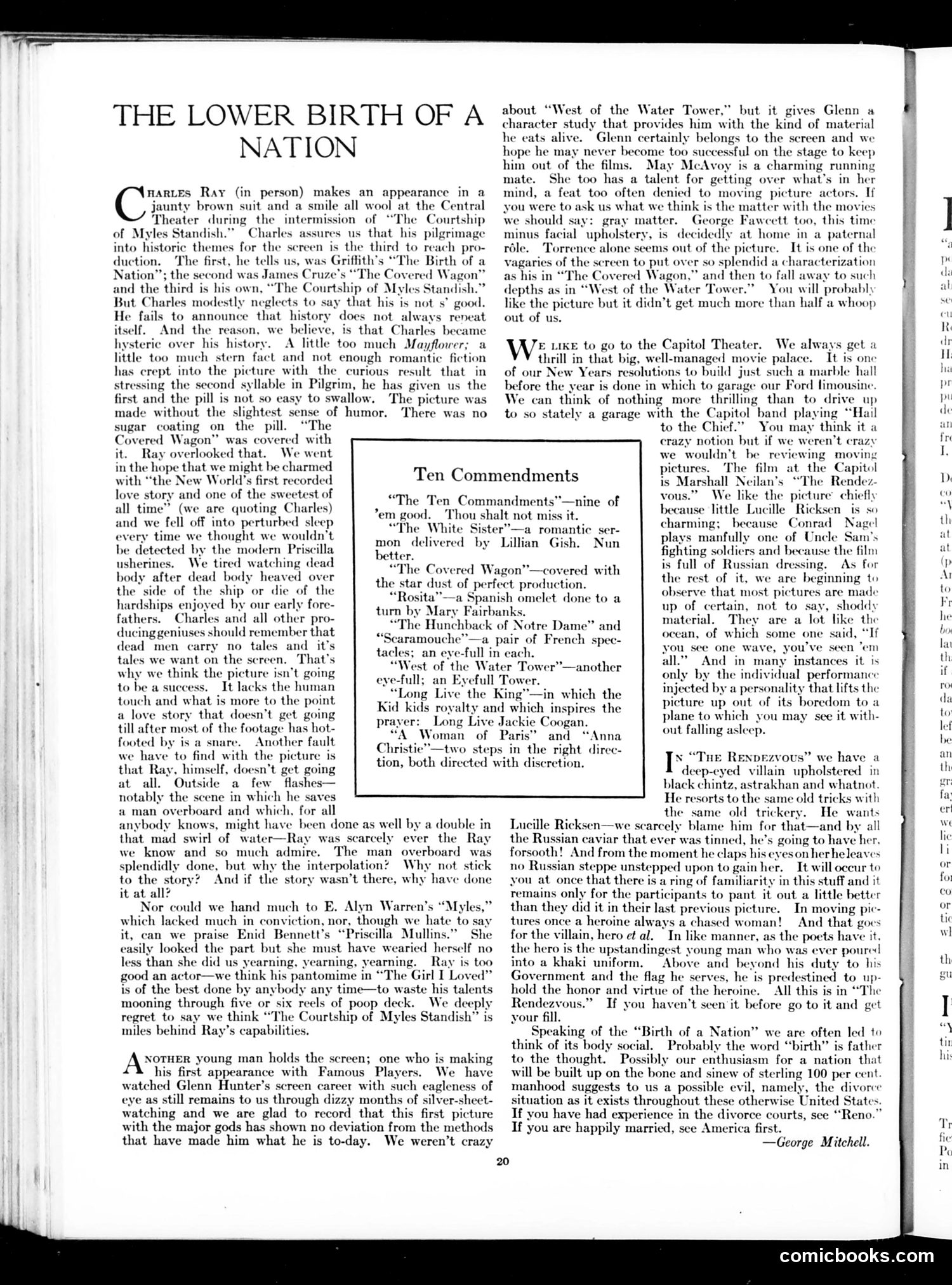
This is a film review satirizing Charles Ray's historical drama *The Courtship of Myles Standish*. The title mocks D.W. Griffith's infamous 1915 film *The Birth of a Nation*, suggesting Ray's film is an inferior imitation. The reviewer criticizes Ray for making a tedious, humorless historical picture—one bogged down by factual accuracy rather than romantic storytelling. The key complaint: the film lacks "sugar coating" and human interest. Where *The Covered Wagon* (James Cruze's successful rival Western) succeeded with entertainment, Ray's Pilgrim tale fails by taking itself too seriously, showing corpses and hardship rather than compelling drama. The reviewer also faults Ray's own performance, claiming he appears uninvested despite being an otherwise talented actor. The satire targets both Ray's creative misjudgment and the early 1920s trend of prestige historical pictures that prioritize accuracy over audience engagement—the opposite of what made earlier epics work.
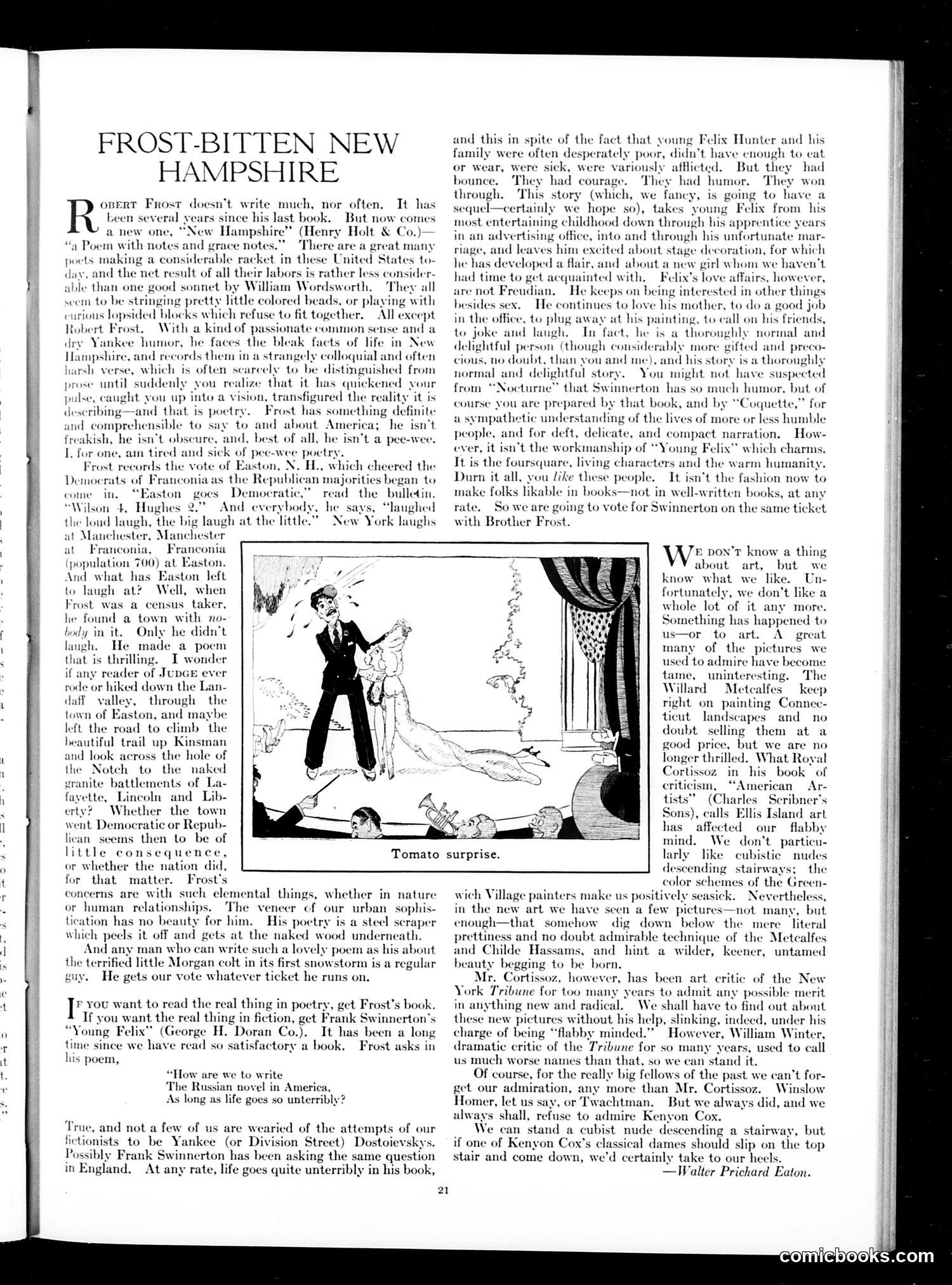
This is a literary review praising poet Robert Frost's new book "New Hampshire" and novelist Frank Swinnerton's "Young Felix." The small cartoon labeled "Tomato surprise" depicts a man in formal dress appearing startled or knocked back by what appears to be a tomato or projectile—likely illustrating Frost's anecdote about discovering the town of Easton, New Hampshire had virtually no residents when he worked as a census taker. The image humorously visualizes the "surprise" of finding an empty town. The review celebrates Frost for writing with "passionate common sense" and "dry Yankee humor" about New Hampshire life, contrasting him favorably against contemporary poets the critic dismisses as frivolous. The author also praises Swinnerton for creating likable, normal characters rather than following fashionable literary trends toward obscurity and psychological complexity. Both reviews advocate for accessible, humanistic literature grounded in authentic American experience.
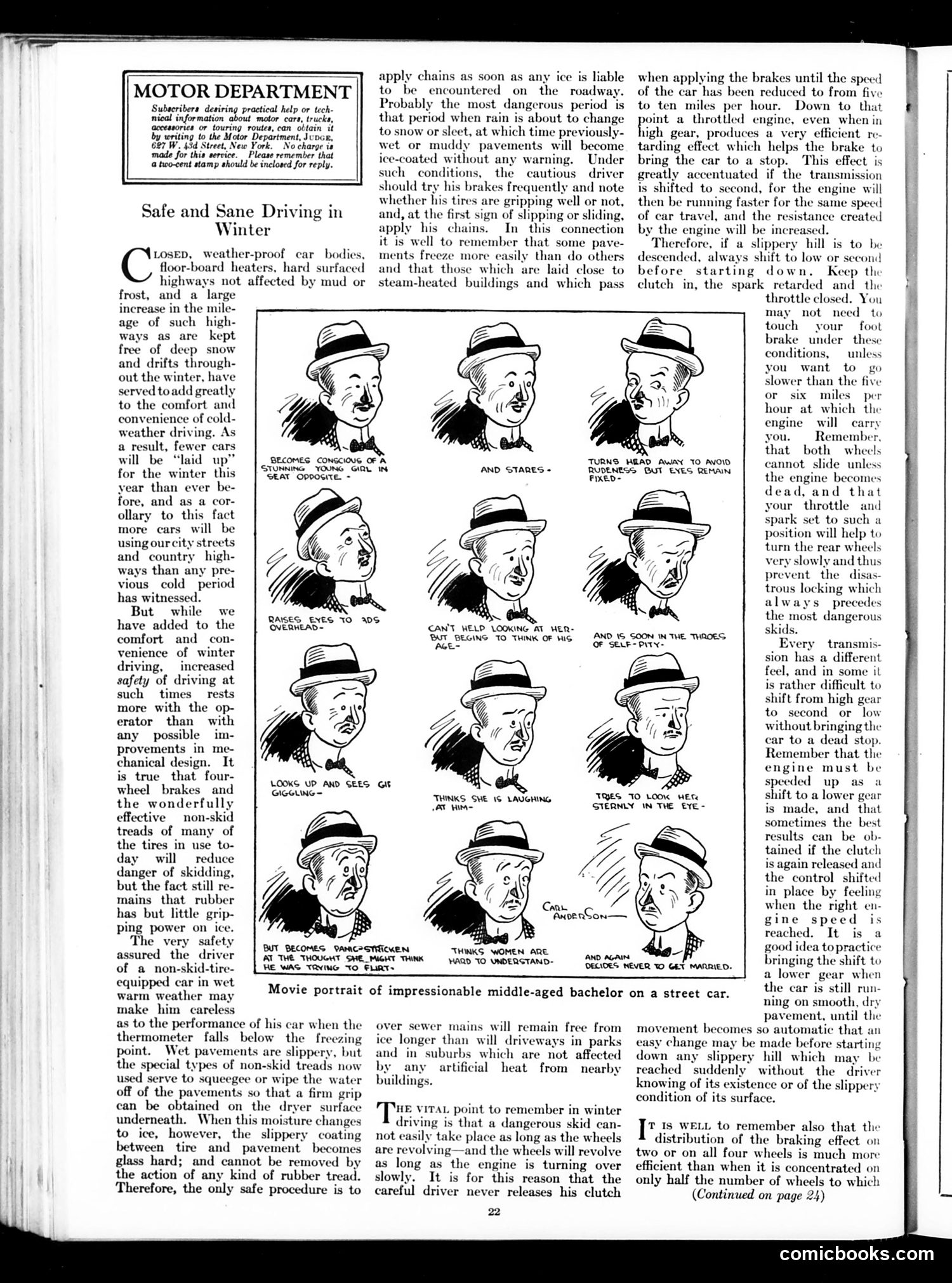
This page contains two distinct pieces: **Left side:** A practical article on winter driving safety, with an instructional cartoon strip showing a middle-aged bachelor on a streetcar repeatedly distracted by an attractive woman. The nine-panel sequence humorously depicts his internal conflict: becoming conscious of her, trying not to stare, worrying she'll think he's flirting, convincing himself women are incomprehensible—all while his eyes betray him. The satire gently mocks male awkwardness and the absurdity of trying to appear respectable while being obviously smitten. **Right side:** Technical advice on winter driving, addressing early 1900s car owners about chains, brakes, tire grip on ice, and transmission control. The juxtaposition of serious automotive safety alongside comic male social anxiety creates the satirical contrast typical of Judge magazine—pairing practical information with humor about human nature and contemporary urban life.
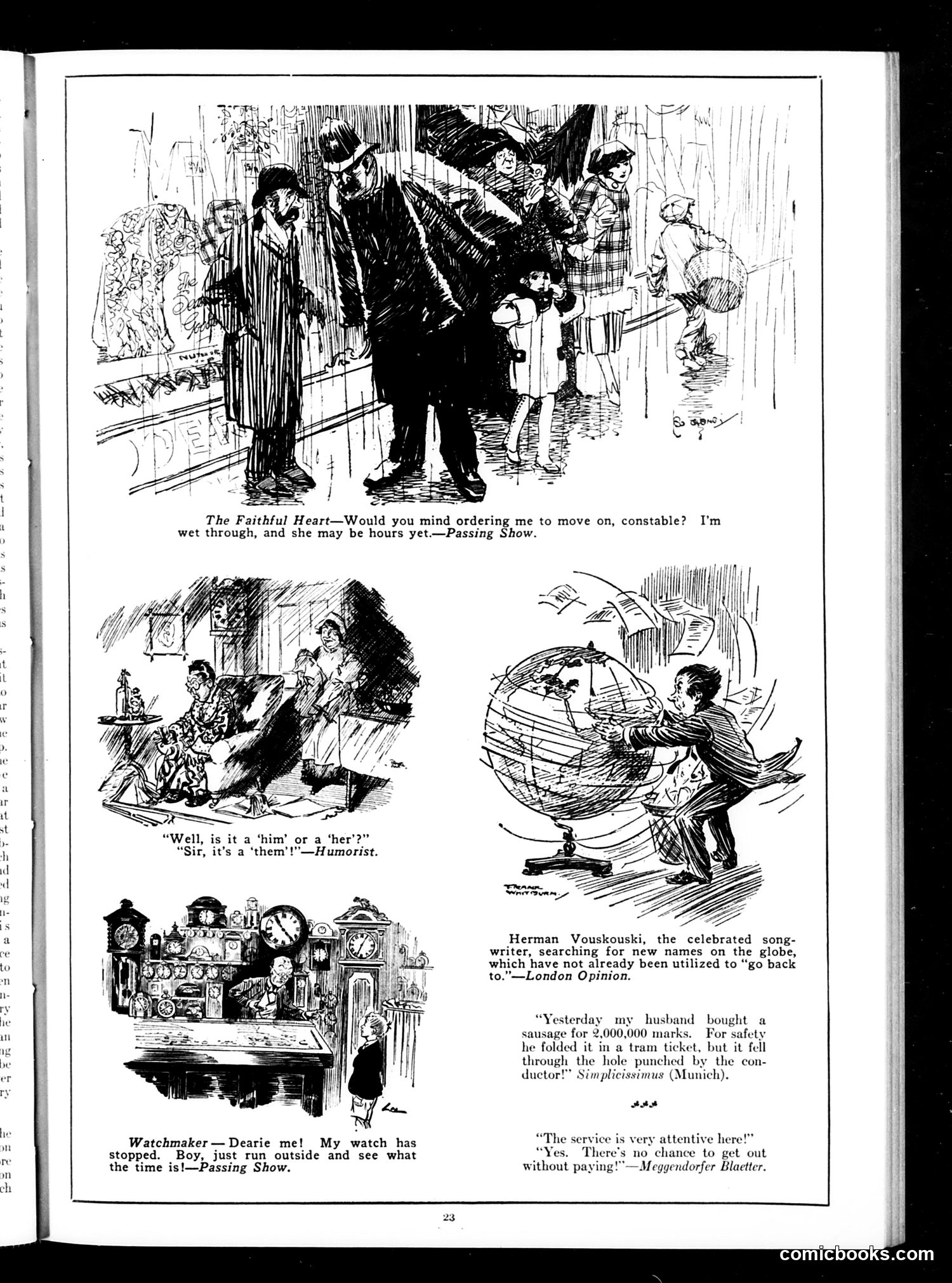
This page collects brief humorous vignettes from various sources, mostly depicting early 20th-century social situations: **Top cartoon**: A constable encounters a woman waiting in the rain for a "passing show" (traveling performance). The joke centers on her dedication—she's soaked but won't leave her spot, asking the officer not to move her along. **Gender joke**: A parent can't determine a child's sex, responding "it's a 'them'"—likely satirizing either unclear clothing conventions or ambiguous appearance. **Vouskouski reference**: Appears to be a real or fictional songwriter who exhausts place-names for song titles ("going back to" was a popular nostalgic songwriting trope of the era). **Sausage joke**: Appears to mock wartime inflation or currency collapse (2,000,000 marks suggests German hyperinflation); a husband's absurdly valuable sausage falls through a tram ticket hole. **Bottom cartoons**: A watchmaker's joke about checking external time, and a restaurant humor about inescapable payment obligations. The page demonstrates Judge's style of reprinting international humor across publications.
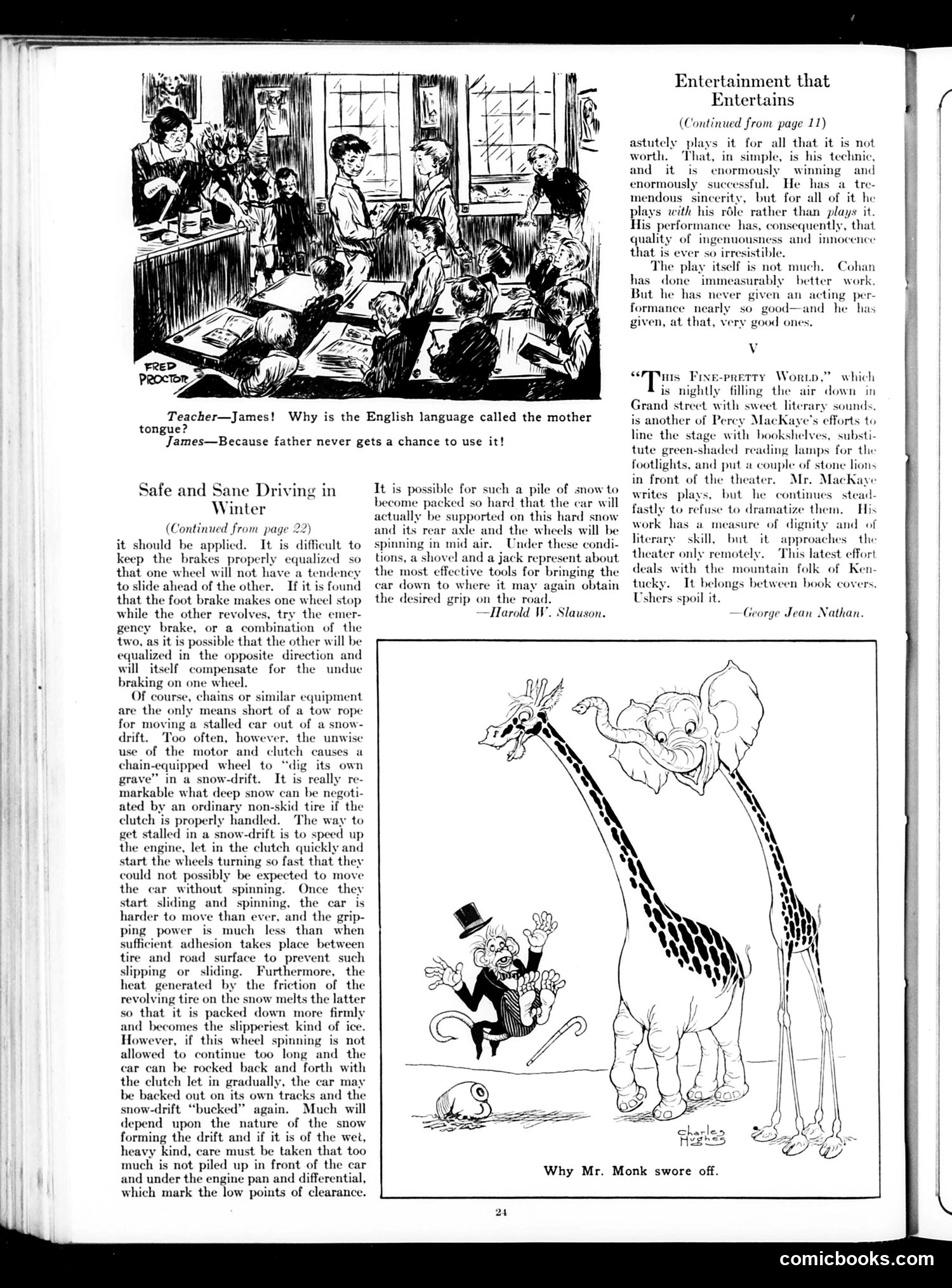
**The Classroom Joke:** A simple gag about gender dynamics: when asked why English is called the "mother tongue," James quips that fathers never get to speak because mothers dominate conversation. This reflects early 20th-century domestic humor playing on the stereotype of talkative wives. **"Why Mr. Monk swore off":** The cartoon shows a man being chased by an angry elephant and giraffe, apparently after some transgression. The humor lies in the absurd consequence—encountering wild animals—justifying his oath to reform. The cartoon is credited to Charles Briggs and appears to be generic comic relief rather than political satire. **Other Content:** The page includes practical advice on winter driving (chain use, brake technique) and theater reviews discussing actor George M. Cohan's performance style and playwright Percy MacKaye's literary approach to drama. The page reflects Judge's mix of light domestic humor, practical guidance, and entertainment criticism typical of the era's general-interest magazines.
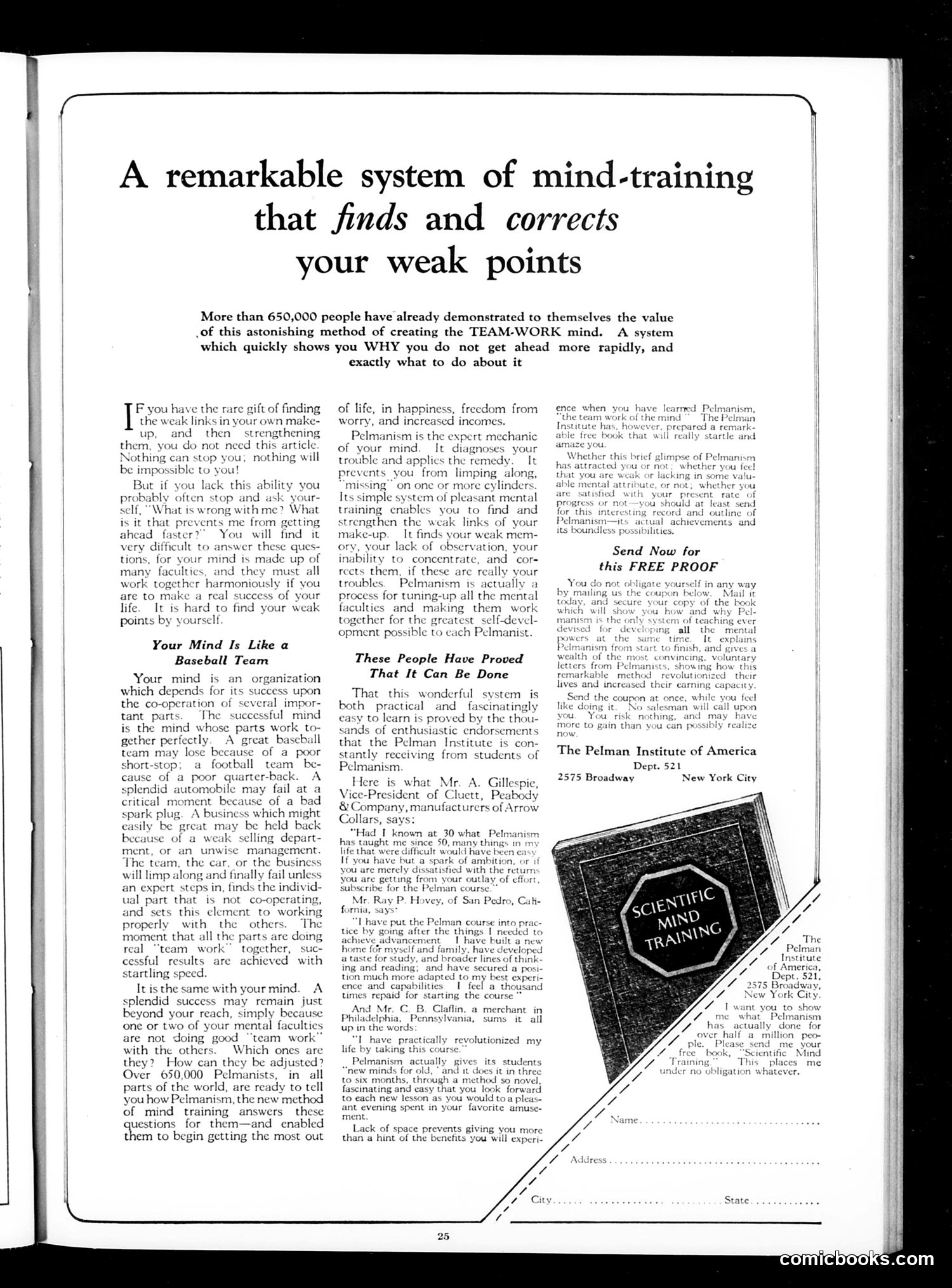
This page is primarily **advertising for Pelmanism**, a self-help mind-training system claiming over 650,000 practitioners worldwide. The text uses a sports/mechanical metaphor—comparing the mind to a baseball team or automobile engine with faulty parts—to pitch the idea that mental faculties need "teamwork" to function properly. The advertisement features testimonials from apparent business figures (a vice-president of Arrow Collar Company), claiming Pelmanism helps identify and correct mental "weak points" relating to memory, concentration, and observation. **The satire/context**: This represents early 20th-century pseudoscientific self-improvement marketing that exploited anxieties about success and competitiveness. The page's prominent placement in *Judge* suggests the magazine may have been satirizing or simply profiting from such dubious "scientific mind training" claims—common in this era before modern consumer protection laws. The coupon format at page bottom indicates this was a direct-response advertisement rather than editorial content.
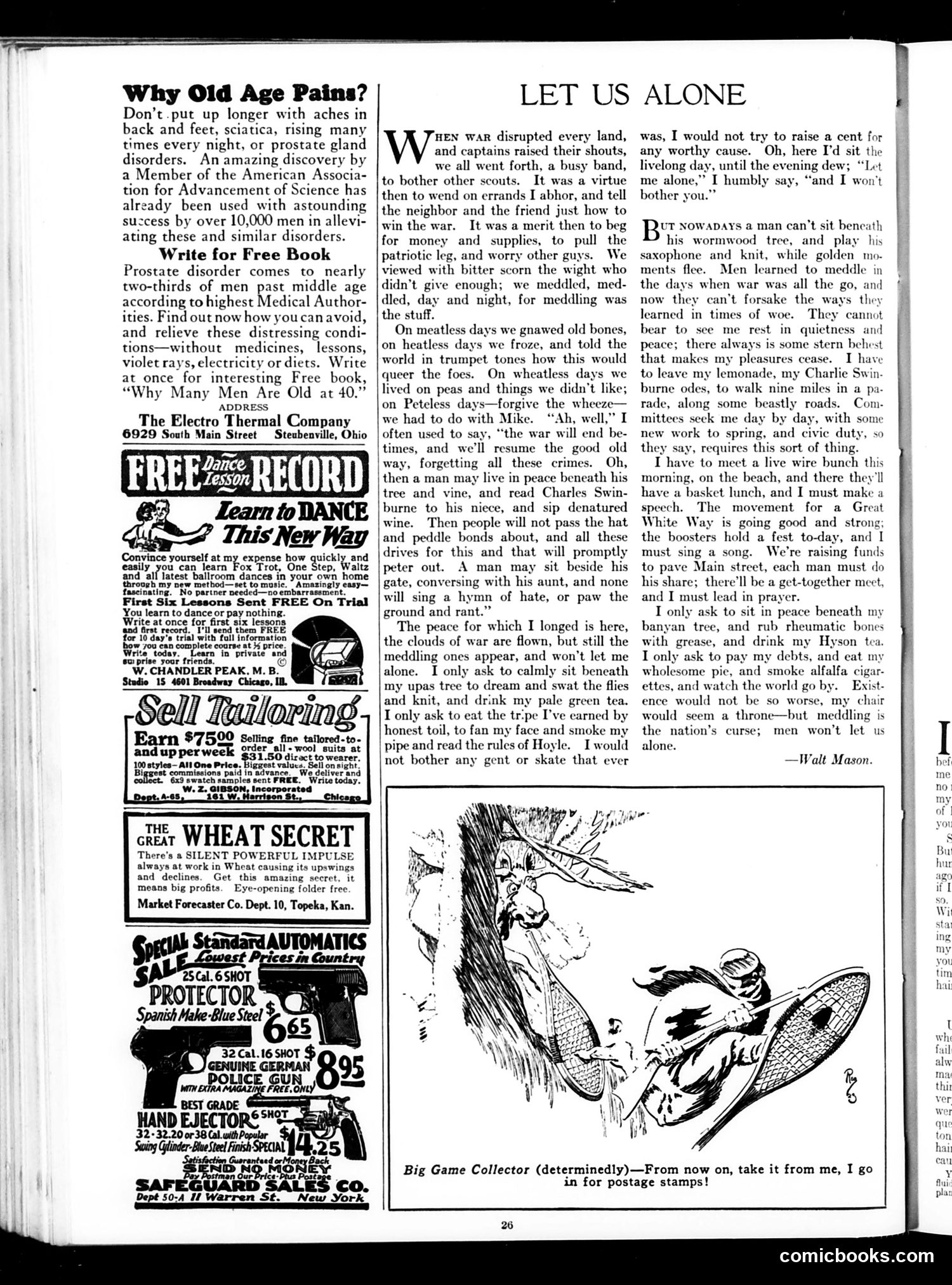
This page contains primarily **advertising** for various mail-order products (dance lessons, tailoring, weapons, medical treatments). The main editorial content is Walt Mason's poem "Let Us Alone." **The Poem's Message:** Mason's verse satirizes American meddlesomeness during and after World War I. The speaker describes how during wartime, citizens eagerly participated in rationing (meatless/wheatless days), bond drives, and civic pressure—viewing this interference in others' lives as patriotic duty. Now that peace has arrived, the speaker ironically notes that **meddling continues unchanged**. Americans won't leave him alone despite the war's end. He simply wants to rest under his tree, read, smoke, and live quietly—but the "meddling ones" persist in their intrusive ways. **The Satire:** Mason critiques how wartime restrictions and social pressure became habitual American behavior that didn't disappear with peace. The joke is that citizens who justified constant interference as patriotic wartime necessity revealed their true nature: they simply *enjoyed* meddling and controlling others. The accompanying cartoon (bottom) shows a man being interrupted while fishing—a visual metaphor reinforcing the poem's theme.
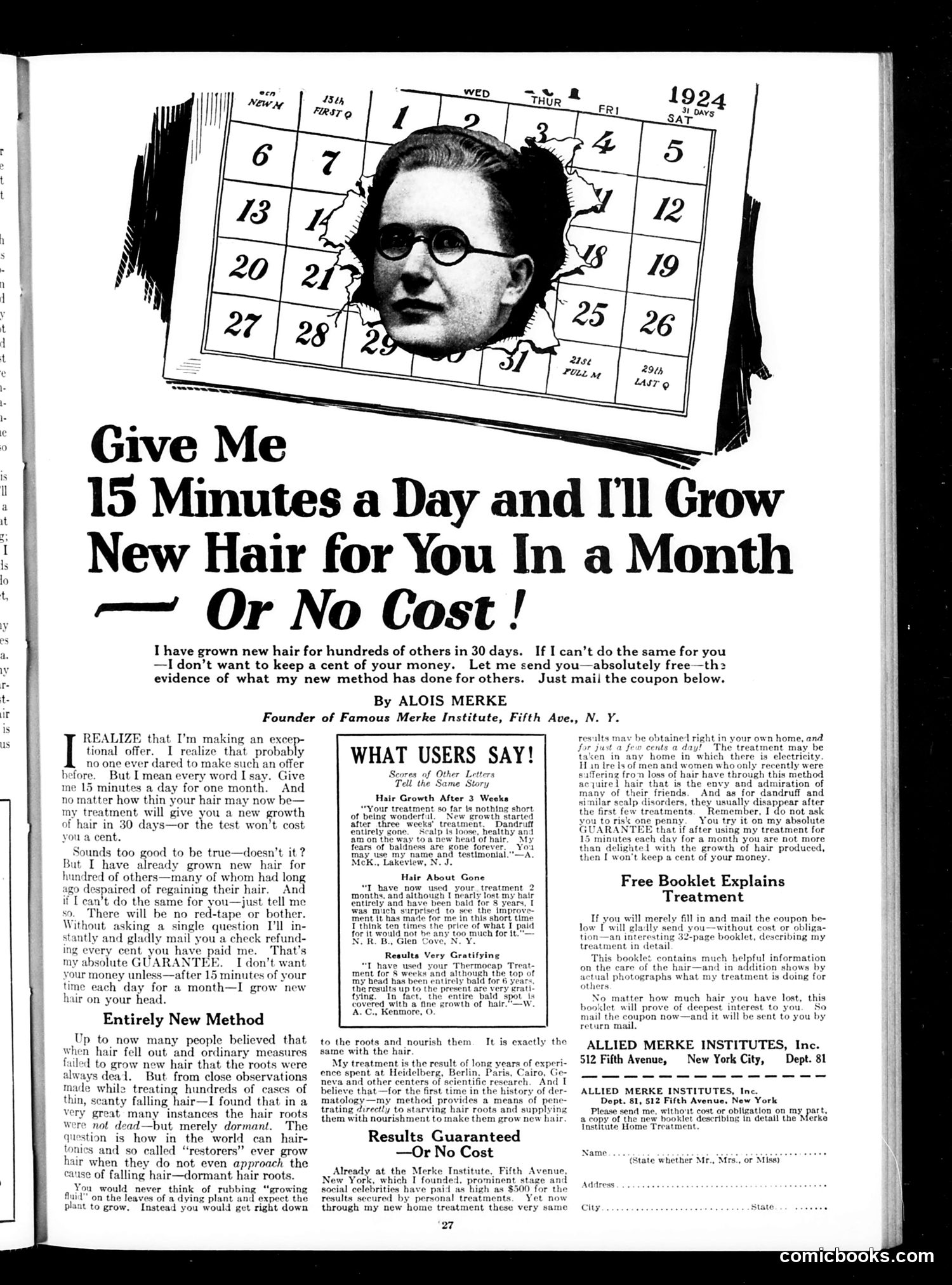
This is primarily a **full-page advertisement**, not political satire. It promotes Alois Merke's hair-growth treatment system (1924). ## The Content: The ad features a man's face superimposed on a 1924 calendar, wearing round glasses and a mustache. The headline promises new hair in 30 days with just 15 minutes daily—"or no cost." ## Why It Matters Historically: This exemplifies **early 20th-century patent medicine advertising** common in magazines like *Judge*. Key tactics visible: - **Dramatic guarantee language** ("absolutely free," money-back promise) - **Fake testimonials** ("WHAT USERS SAY!")—unverifiable success stories - **Scientific-sounding jargon** (references to "dermatology," research in European cities) - **Prestige appeals** (mentions celebrities paying $500 at his institute) - **Mail-order coupon** for home treatment This represents the era before FDA regulation of medical claims. Such ads were standard in magazines and often contained unfounded promises. The visual gimmick of the calendar face suggests desperation about aging and appearance—concerns exploited by unregulated advertisers.
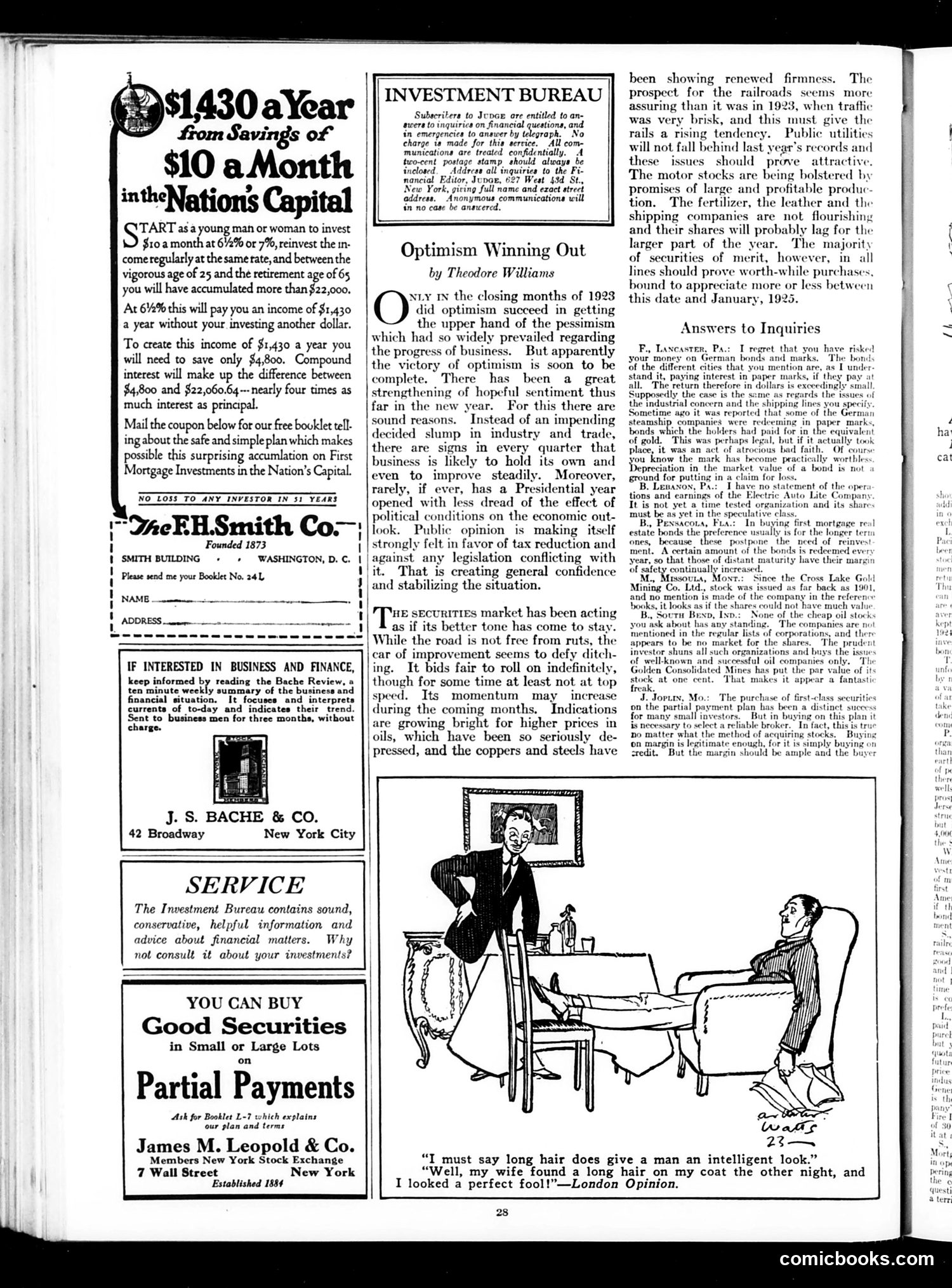
This page is primarily **financial advertising** mixed with investment advice columns, typical of Judge's 1920s content. The main cartoon (bottom right) is a simple domestic joke: A man admits to his wife that he found a long hair on his coat, and she sarcastically responds that long hair makes men look intelligent—implying he's foolish for his excuse. The cartoonist is labeled "Cesare" and credited to "London Opinion," suggesting it was reprinted. The substantive content includes: - **"Optimism Winning Out"** column by Theodore Williams discussing 1924 economic recovery after 1923's pessimism, praising the stock market's strength and noting reduced political anxiety during a Presidential election year. - Multiple **investment service advertisements** (E.H. Smith Co., J.S. Bache & Co., James M. Leopold & Co.) offering conservative financial products and advice to readers. - An **"Investment Bureau"** section offering Judge readers free financial consultation. The page reflects 1920s prosperity-era optimism and Judge's role marketing financial services to educated middle-class readers.
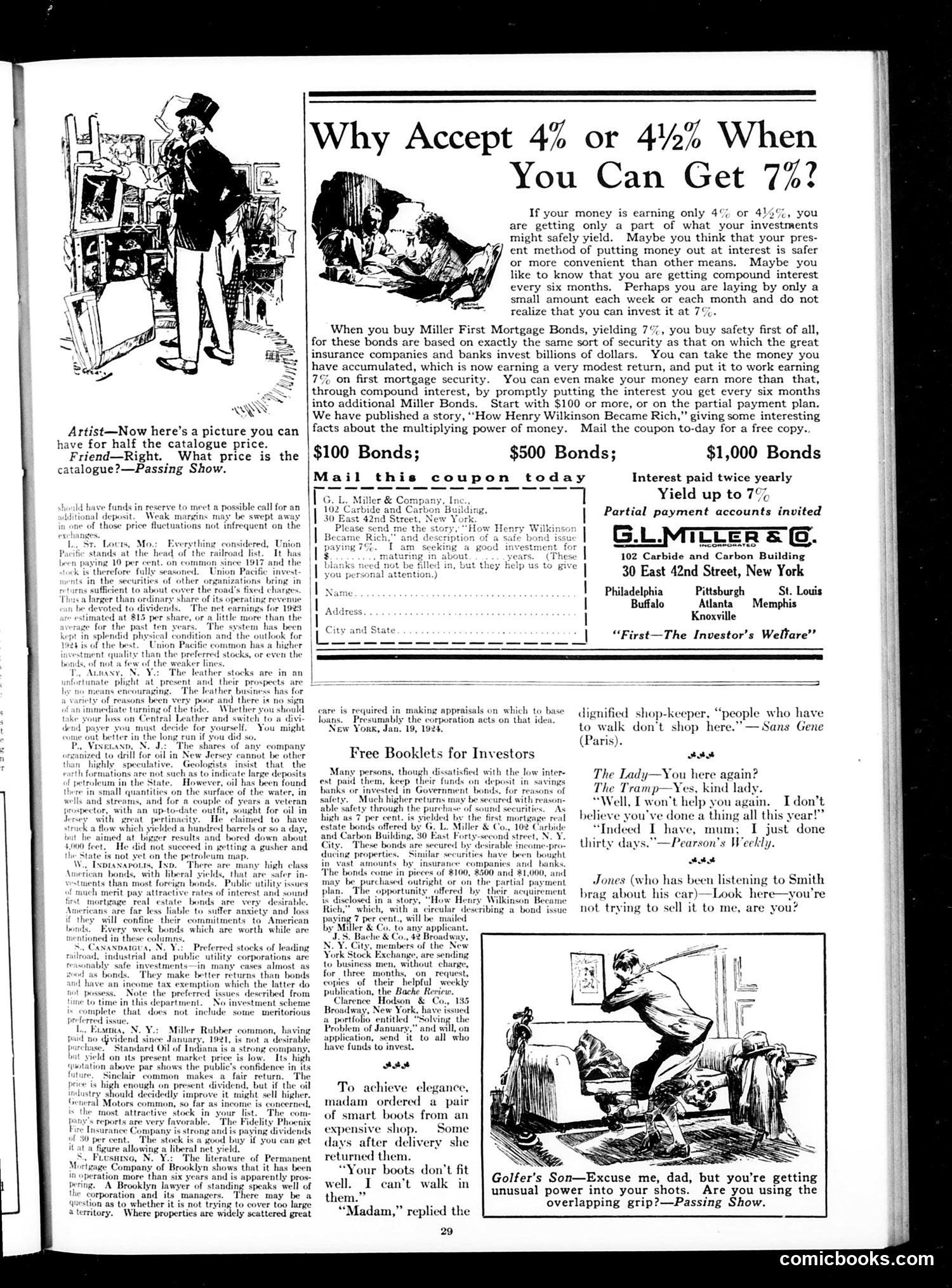
This page is primarily **advertising**, not editorial satire. The main content is a G.L. Miller & Co. investment advertisement promoting mortgage bonds yielding 7% interest. The small cartoon at top-left shows a wealthy man in a top hat examining artwork, with the caption joking about "catalogue price"—likely a visual pun about financial value. Below are brief humor items: "The Lady" and "The Tramp" discuss financial hardship; "Jones" boasts about a car; and "Golfer's Son" makes a pun about golf grip pressure. **The core message**: During the 1920s economic boom, Miller & Co. urged investors to move money from low-yield bonds (4-4.5%) into their first-mortgage bonds paying 7%. The advertisement emphasizes safety—comparing bonds to insurance company investments—while promoting compound interest and partial-payment plans to attract middle-class investors. This reflects pre-Depression optimism about financial markets and aggressive securities marketing.
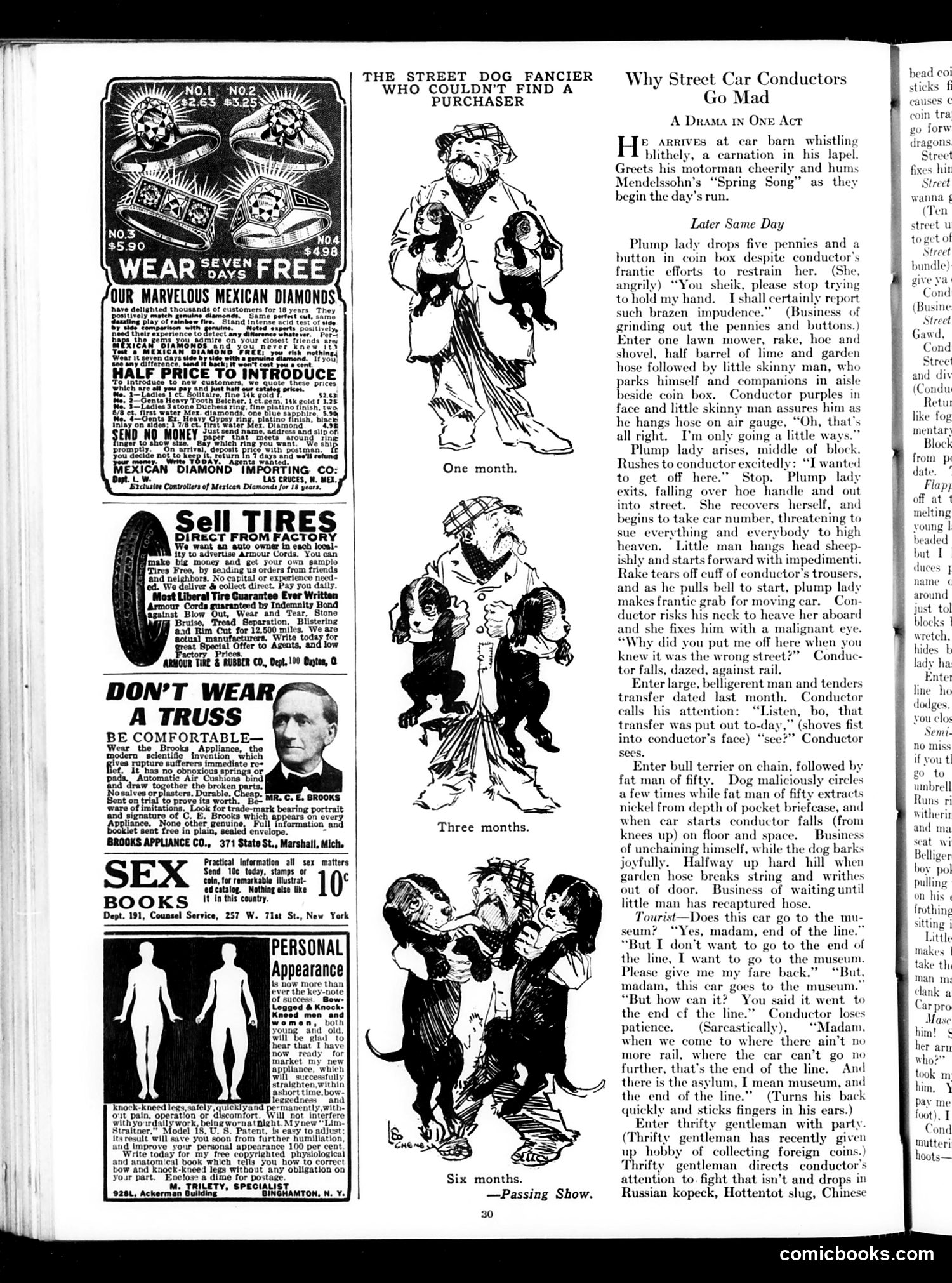
This page contains **two distinct elements**: advertisements and a satirical comic sketch. The main cartoon, "Why Street Car Conductors Go Mad," is a **comedic drama** depicting the daily frustrations of a streetcar conductor. It follows him from his cheerful morning shift through increasingly absurd passenger interactions: - A woman drops coins and a button, then accuses him of impropriety - A man boards with lawn equipment, blocking the aisle - The same woman demands to exit mid-block, then falls out onto the street - She threatens to report him while re-boarding - A passenger presents an expired transfer **The satire's point**: The sketch humorously illustrates how ordinary, frustrating passenger behavior—rudeness, confusion, obstruction, dishonesty—would drive conductors to madness. It's sympathetic comedy targeting the conductor's impossible job managing the public. The surrounding **advertisements** (tires, medical devices, "sex books") are typical of Judge magazine's commercial content and don't relate to the cartoon.
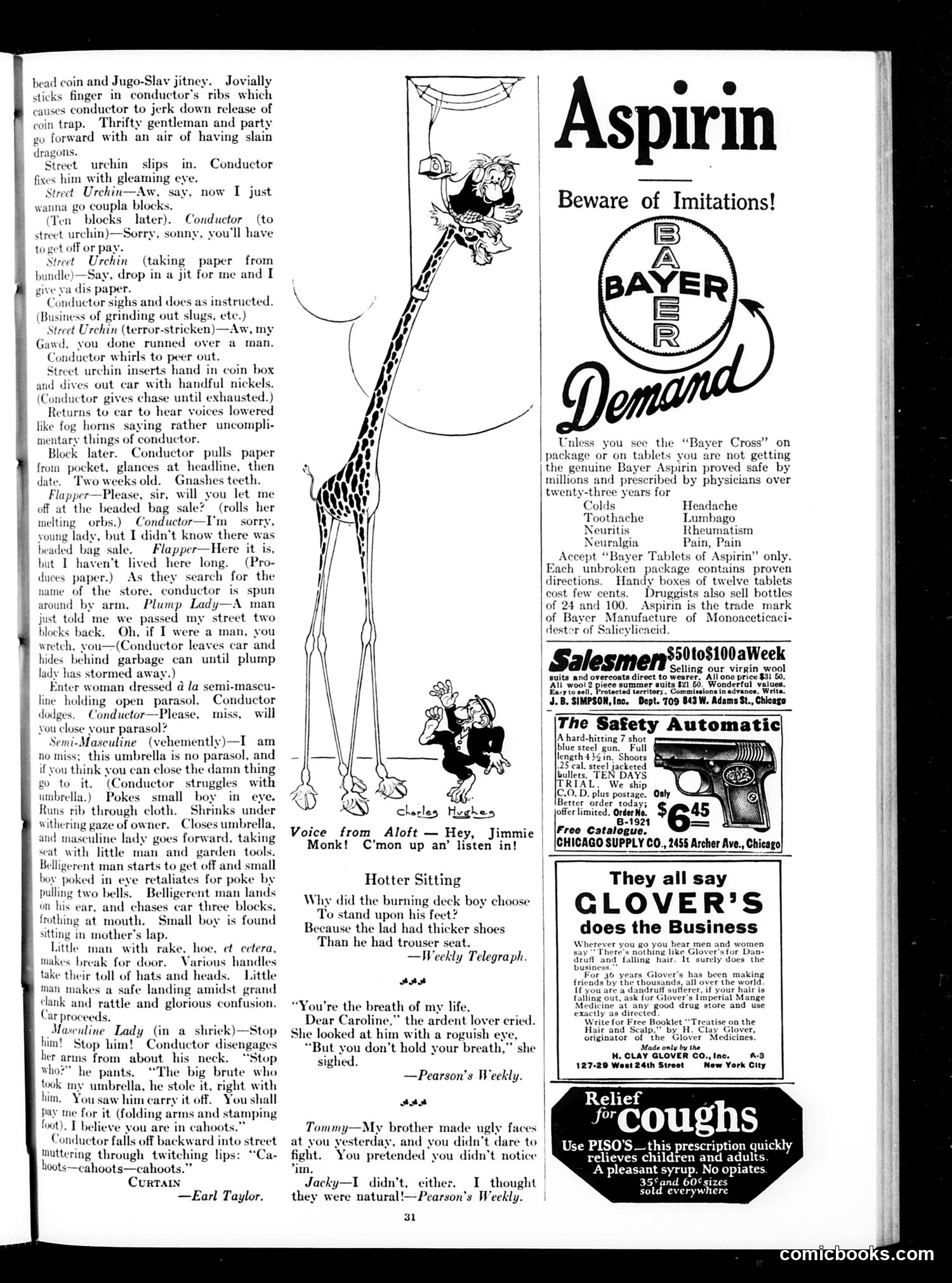
This page is primarily **advertising with humorous filler content**. The main feature is a large **Bayer Aspirin advertisement** warning consumers to beware imitations and look for the "Bayer Cross" trademark—reflecting early 20th-century concerns about counterfeit medicines. The illustrated narrative at left depicts a **streetcar conductor's increasingly absurd day**, dealing with various difficult passengers: fare cheaters, rude flapper women, aggressive customers, and a person with an "umbrella/parasol" dispute. The conductor is repeatedly frustrated and humiliated, culminating in his complete mental breakdown. This is **slapstick social satire** about urban transit frustrations and class conflicts—the conductor represents the working man constantly disrespected by various passenger types (modern youth, aggressive women, working-class men). The page also includes brief humorous anecdotes from newspapers (Pearson's Weekly, Telegraph) and unrelated advertisements for guns and cough syrup. No specific political figures or events are referenced.
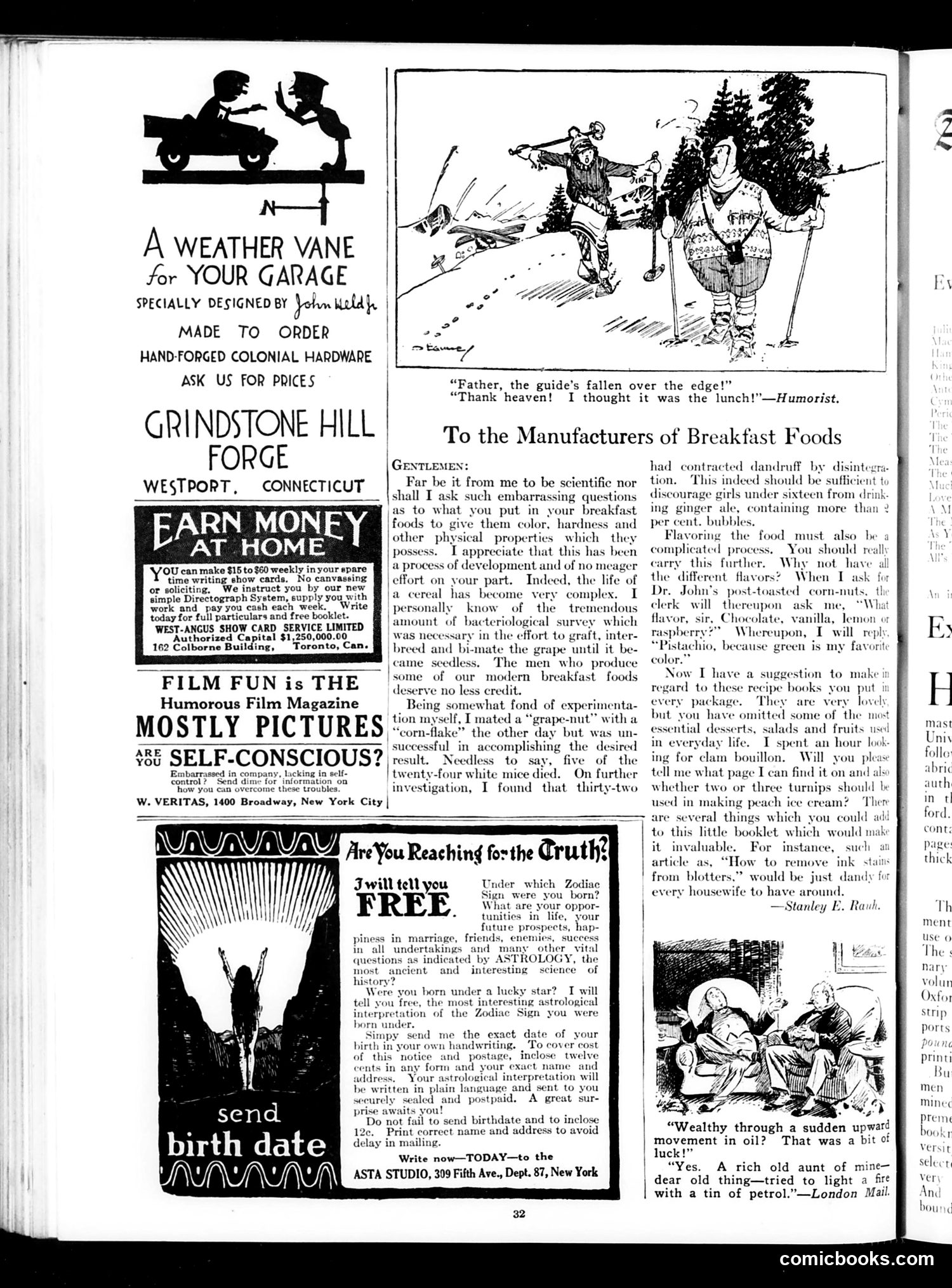
This page is primarily **advertising and fillers** rather than editorial content. The main cartoon at top shows a skiing mishap—a guide has fallen off a cliff, and the father quips he thought it was lunch, playing on the stereotype of guides as incompetent or the lunch being unappetizing. The dominant content comprises period advertisements: a weather vane business, work-from-home show card schemes, astrology readings, and a film magazine. The lengthy letter "To the Manufacturers of Breakfast Foods" satirizes the era's breakfast cereal industry—mocking their complex production processes, ingredient claims, and the recipe booklets they included. The writer humorously suggests flavoring variations (pistachio) and notes the booklets omit practical recipes like removing ink stains. The ads reflect early 20th-century concerns: self-consciousness remedies, mail-order work schemes, and astrological fortune-telling—all common targets of satire in humor magazines.
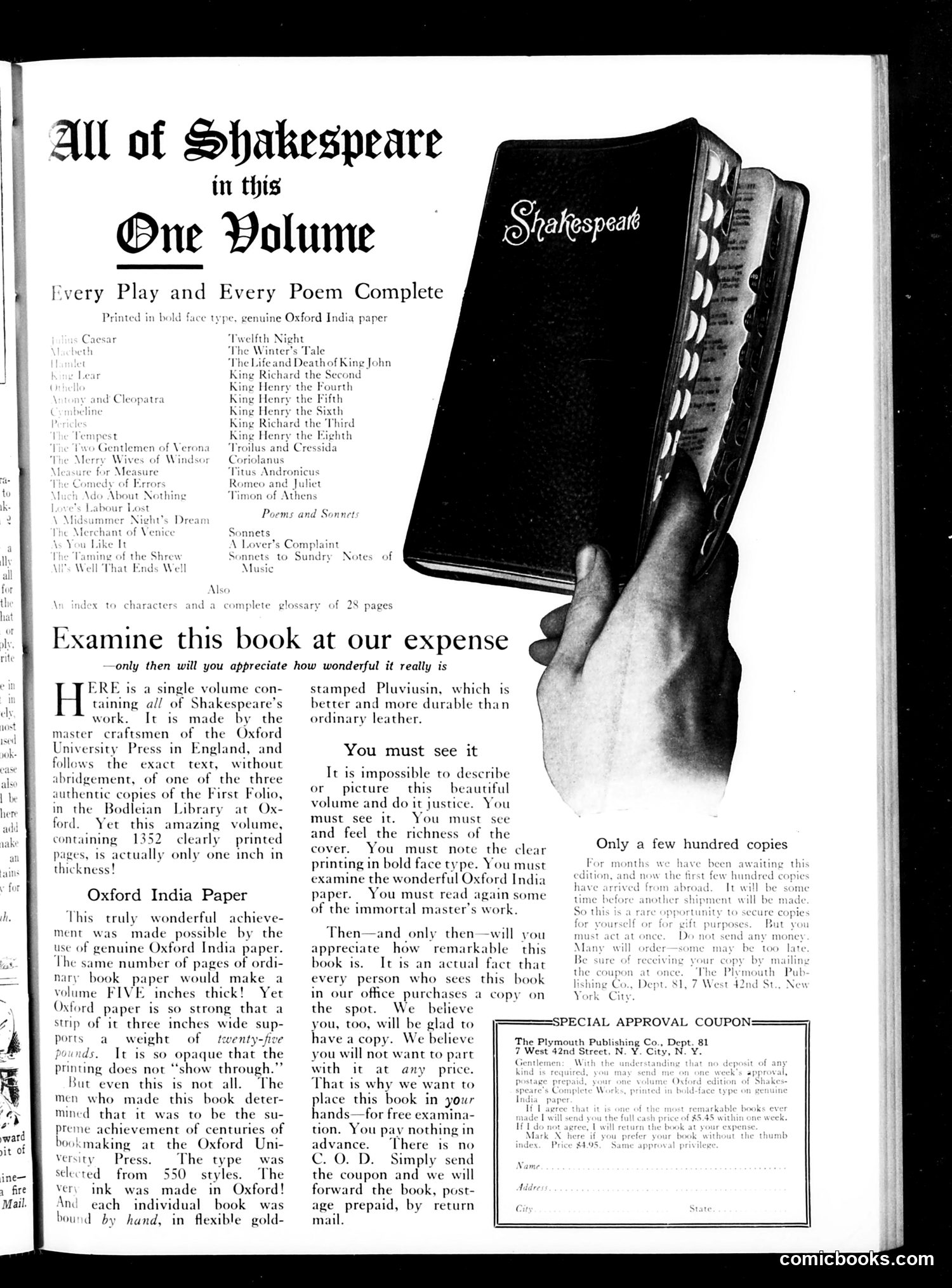
This is **not a cartoon or satire page**, but rather a **full-page advertisement** for a complete Shakespeare edition published by Plymouth Publishing Co. The page promotes a single-volume collected works of Shakespeare printed by Oxford University Press. The key selling point is the use of "Oxford India Paper"—a genuine, thin but durable paper that allows 1,352 pages to fit in a volume only one inch thick (versus five inches with ordinary paper). The advertisement emphasizes the book's quality: the text follows authentic First Folio copies, features bold-face printing, and is hand-bound in flexible gold-stamped leather. The marketing strategy relies on exclusivity ("only a few hundred copies") and urgency, offering free examination via mail with a "Special Approval Coupon"—the reader pays nothing upfront, only upon deciding to keep it. This represents early 20th-century direct-mail advertising in a literary magazine, targeting educated readers willing to pay premium prices for a luxurious, comprehensive literary edition.
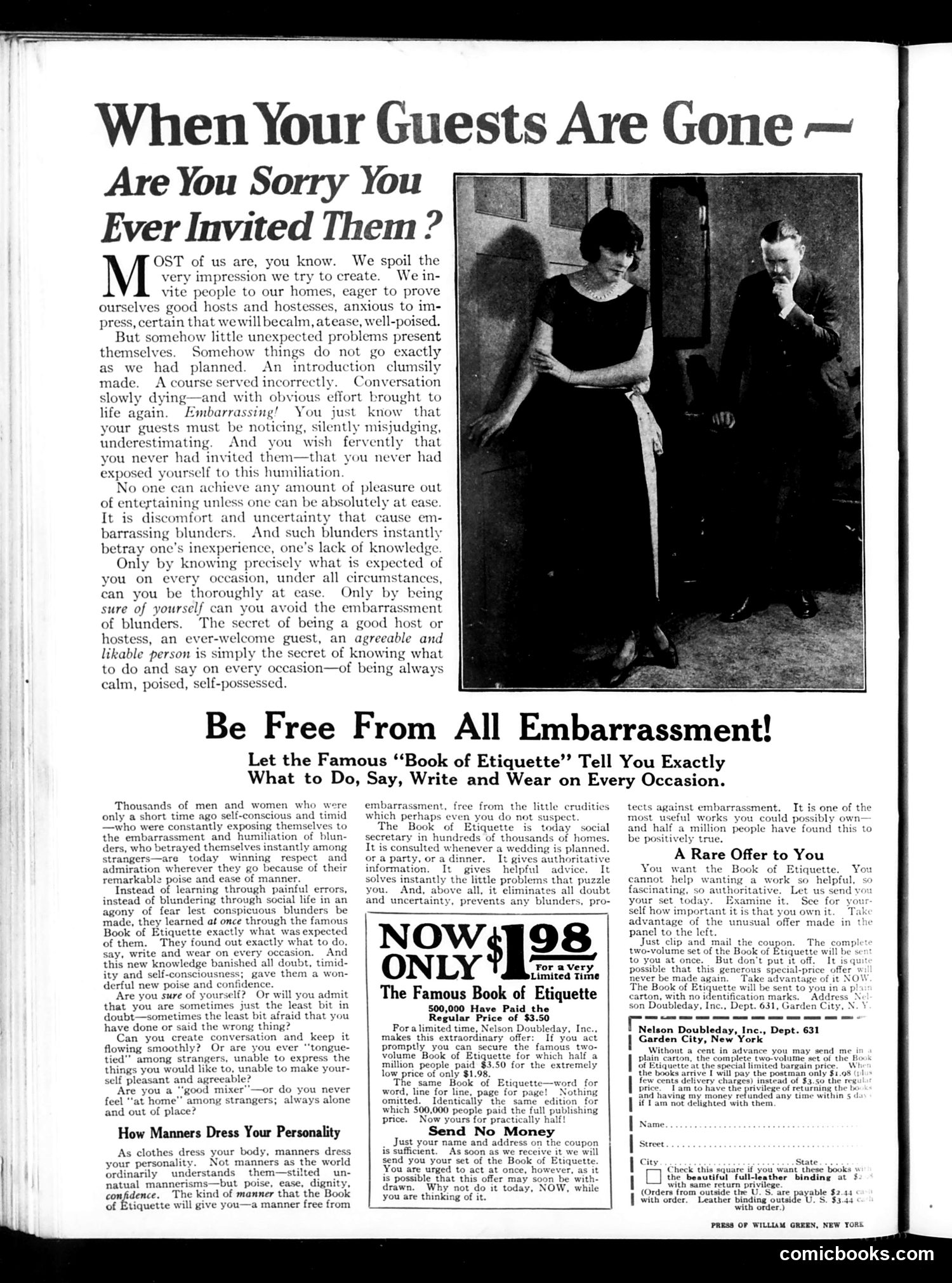
This page is primarily **advertising disguised as advice content**—a common early 20th-century marketing tactic. The article warns readers about social embarrassment when hosting guests, claiming that etiquette knowledge prevents blunders. The photograph shows what appears to be an awkward social gathering, illustrating the anxiety being sold. The main pitch: a "Book of Etiquette" priced at $1.98 (marked down from $3.50), marketed as essential for avoiding social humiliation. The advertisement claims 500,000 copies sold and emphasizes that proper etiquette creates "poise" and "confidence." **The satire/appeal:** The piece exploits class anxiety and social insecurity—common Depression-era concerns about maintaining respectability. By framing etiquette as learnable knowledge rather than innate breeding, it democratizes status anxiety while selling a solution. The coupon-based call-to-action at page bottom was typical direct-response advertising of the era.

I can see this is a blank or nearly blank page from Judge magazine. The image shows what appears to be a mostly white page with minimal visible content - just the binding on the left side and the comicbooks.com watermark at the bottom. There is no discernible cartoon, illustration, text, or satirical content visible on this particular page that I can analyze. This may be a blank page between articles, an advertisement page that didn't reproduce clearly in the scan, or a page that has faded significantly over time. Without visible content to examine, I cannot identify figures, political references, or explain any satirical intent.