
Judge, 1924-01-26 · page 23 of 37
Judge — January 26, 1924 — page 23: what you’re looking at
What you’re looking at
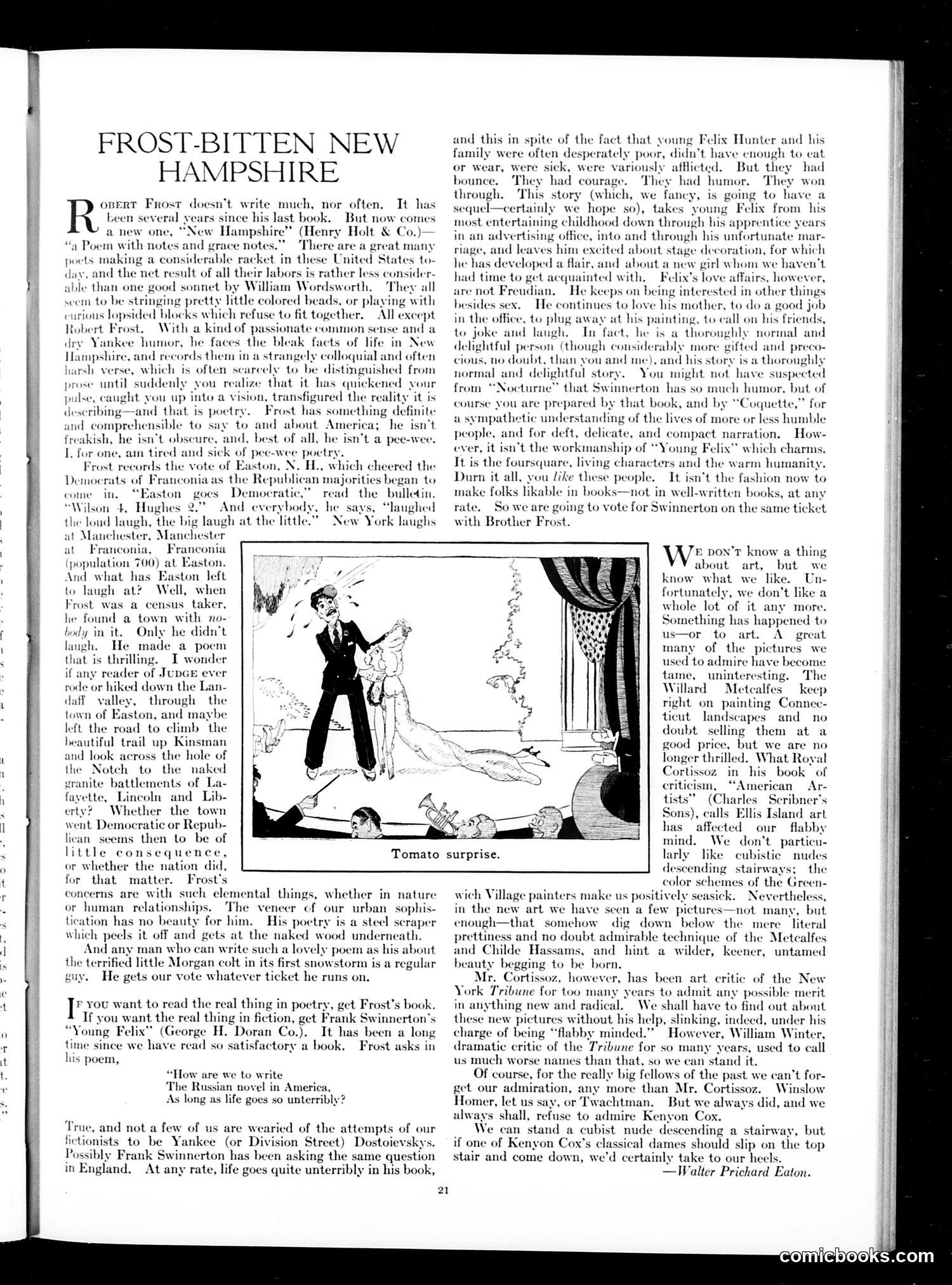
This is a literary review praising poet Robert Frost's new book "New Hampshire" and novelist Frank Swinnerton's "Young Felix." The small cartoon labeled "Tomato surprise" depicts a man in formal dress appearing startled or knocked back by what appears to be a tomato or projectile—likely illustrating Frost's anecdote about discovering the town of Easton, New Hampshire had virtually no residents when he worked as a census taker. The image humorously visualizes the "surprise" of finding an empty town. The review celebrates Frost for writing with "passionate common sense" and "dry Yankee humor" about New Hampshire life, contrasting him favorably against contemporary poets the critic dismisses as frivolous. The author also praises Swinnerton for creating likable, normal characters rather than following fashionable literary trends toward obscurity and psychological complexity. Both reviews advocate for accessible, humanistic literature grounded in authentic American experience.
📄 Transcribed text from this page (OCR, searchable)
Machine-transcribed from the original scan — historical spelling and the odd misread are preserved.
FROST-BITTEN NEW HAMPSHIRE obert Frost doesn’t write much, nor often. It has R been several years since his last book. But now comes a new one, “New Hampshire” (Henry Holt & Co.) “a Poem with notes and grace notes.” ‘There are a great many poets making a considerable racket in these United States to- day, and the net result of all their labors is rather less consider- able than one good sonnet by William Wordsworth. They all seem to be stringing pretty little colored beads, or playing with curious lopsided blocks which refuse to fit together. All except Robert Frost. With a kind of passionate common sense and a dry Yankee humor, he faces the bleak facts of life in New Hampshire, and records them in a strangely colloquial and often harsh verse, which is often scarcely to be distinguished from - until suddenly you realize that it has quickened your ‘aught you up into a vision, transfigured the reality it is describing—and that is poetry. Frost has something definite and comprehensible to say to and about America; he isn’t akish, he isn’t obscure, and, best all, he isn’t a pee-wee. I, for one, am tired and sick of pee-wee poetry. Frost records the vote of Easton, N. H., which cheered the Democrats of Franconia as the Republican majorities began to come in, “Easton s Democratic,” read the bulletin. “Wilson 4+, Hughes And everybody, he the loud laugh, the big laugh at the little.” at Manches' Man hester and this in spite of the fact that young Felix Hunter and his family were often desperately poor, didn’t have enough to eat or wear, were sick, were variously afflicted. But they had bounce. They had courage. They had humor. They won through. This story (which, we fancy, is going to have a sequel—certainly we hope so), takes young Felix from his most entertaining childhood down through his apprentice years in an advertising office, into and through his unfortunate mar- riage, and es him excited about stage decoration, for which he has developed a flair, and about a new girl whom we haven't had time to get acquainted with, Felix’s love affairs, however, are not Freudian. He keeps on being interested in other things hesides se He continues to love his mother, to do a good job in the office, to plug away at his painting, to call on his friends, to joke and laugh. In fact. he is a thoroughly normal and delightful person (though considerably more gifted and preco- cious, no doubt, than you and me), and his story is a thoroughly normal and delightful story. You might not have suspected from “Nocturne” that Swinnerton has so much humor, but of » prepared by that book, and by “Coquette,” for a sympathetic understanding of the lives of more or less humble people, and for deft, delicate, and compact ition. How- ever, it isn’t the workmanship of “Young Felix’? which charms. It is the foursquare, living characters and the warm humanity. Durn it all, you like these people. It isn't the fashion now to make folks likable in books—not in well-written books, at any rate. So we are going to vote for Swinnerton on the same ticket with Brother Frost. course you a population 700) at And what has Easton left to laugh Well, when Frost. was a census taker, he found a town with no- body in it. Only he didn't laugh. He made a poem that is thrilling. I wonder if any reader of JuDGE ever rode or hiked down the Lan- daff valley, through the town of Easton, and maybe left the road to climb the beautiful trail up Kinsman and look across the hole of the Notch to the naked granite battlements of La- fayette, Lincoln and Lib- Whether the town went Democratic or Repub- lican seems then to be of little consequence, or whether the nation did, for that matter. Frost's concerns are with such elemental things, whether in nature or human relationships. The veneer cf our urban sophis- tication has no beauty for him. His poetry is a steel scraper which peels it off and gets at the naked wood underneath. And any man who can write such a lovely poem as his about the terrified little Morgan colt in its first snowstorm is a regular guy. He gets our vote whatever ticket he runs on. F you want to read the real thing in poetry, get Frost’s book. If you want the real thing in fiction, get Frank Swinnerton’s “Young Felix’’ (George H. Doran Co.). It has been a long time since we have read so satisfactory a book. Frost asks in his poem, “How are we to write The Russian novel in America, As long as life goes so unterribly? True, and not a few of us are wearied of the attempts of our fictionists to be Yankee (or Division Street) Dostoievskys. Possibly Frank Swinnerton has been asking the same question in England. At any rate, life goes quite unterribly in his book, 21 Tomato surprise. W® pon’? know a thing about art, but we know what we like. Un- fortunately, we don’t like a whole lot’ of it any more. Something has happened to us—or to art. A great many of the pictures we used to admire have become tame, uninteresting. The Willard = Metcalfes keep right on painting Connec- ticut landscapes and no doubt. selling them at a good price, but we are no longer thrilled. What Royal Cortissoz in his book of criticism, ‘American Ar- tists” (Charles Scribner's Sons), calls Ellis Island art has affected our flabby mind. We don’t particu- larly like cubistie nudes descending stairways; the color schemes of the Green- wich Village painters make us positivel Nevertheless, in the new art we have seen a few pictures—not many, but enough—that somehow dig down below the mere literal prettiness and no doubt admirable technique of the Metcalfes and Childe Hassams, and hint a wilder, keener, untamed beauty begging to be born, Mr. Cortissoz, however, has been art critic York Tribune for too many years to admit any possible merit in anything new and radi We shall have to find out about these new pictures without his help, slinking, indeed, under his charge of being “flabby minded.” However, William Winter, dramatic critic of the Tribune for so many years, used to call us much worse names than that, so we can stand it. Of course, for the really big fellows of the past we can’t for- get our admiration, any more than Mr. Cortissoz. Winslow Homer, let us say, or Twachtman. But we always did, and we shall, refuse to admire Kenyon Co: ‘an stand a cubist nude descending a stairway, but if one of Kenyon Cox’s classical dames should slip on the top stair and come down, we'd certainly take to our heels. —Walter Prichard Eaton. the New of