
Judge, 1924-01-26 · page 24 of 37
Judge — January 26, 1924 — page 24: what you’re looking at
What you’re looking at
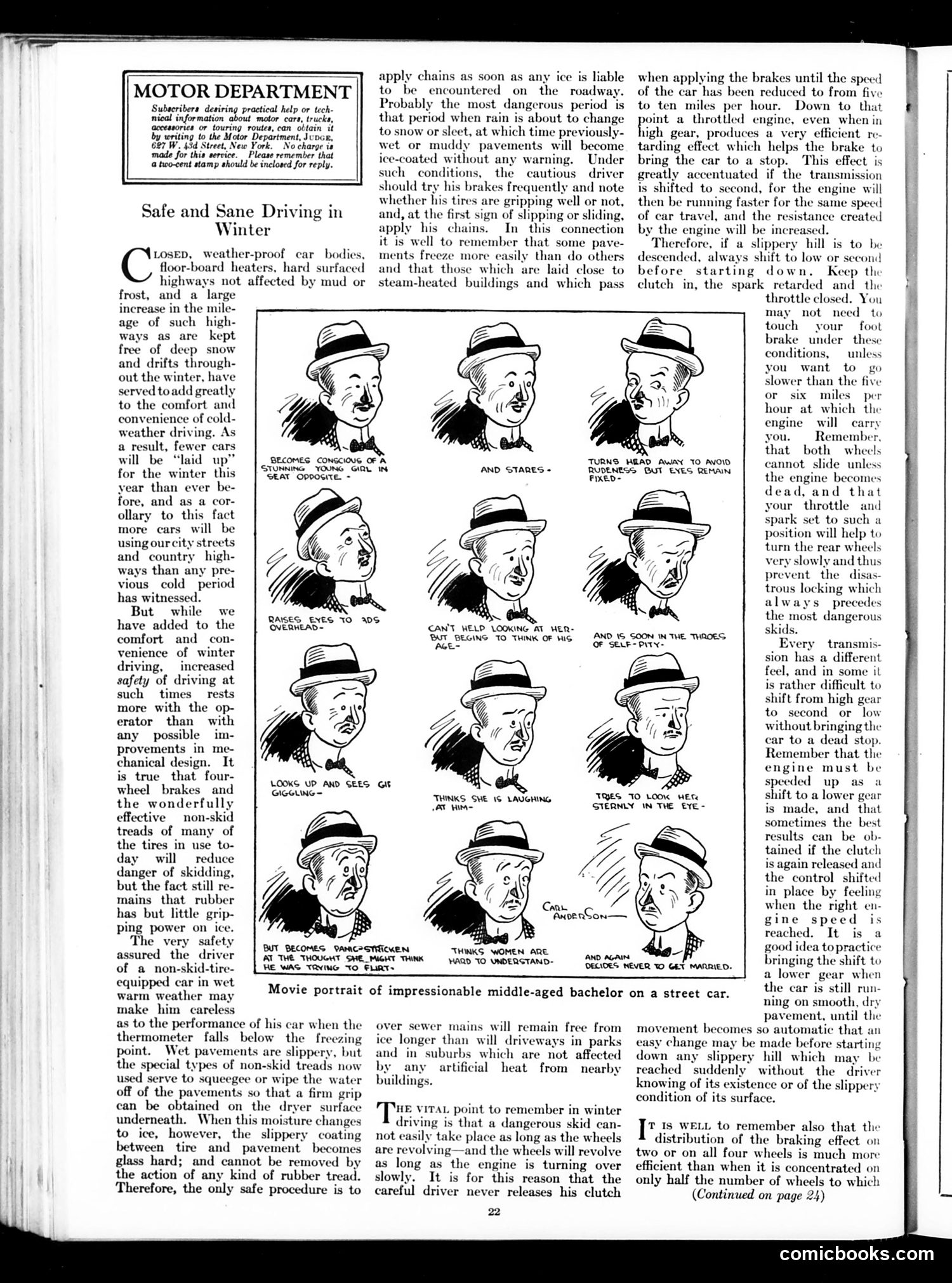
This page contains two distinct pieces: **Left side:** A practical article on winter driving safety, with an instructional cartoon strip showing a middle-aged bachelor on a streetcar repeatedly distracted by an attractive woman. The nine-panel sequence humorously depicts his internal conflict: becoming conscious of her, trying not to stare, worrying she'll think he's flirting, convincing himself women are incomprehensible—all while his eyes betray him. The satire gently mocks male awkwardness and the absurdity of trying to appear respectable while being obviously smitten. **Right side:** Technical advice on winter driving, addressing early 1900s car owners about chains, brakes, tire grip on ice, and transmission control. The juxtaposition of serious automotive safety alongside comic male social anxiety creates the satirical contrast typical of Judge magazine—pairing practical information with humor about human nature and contemporary urban life.
📄 Transcribed text from this page (OCR, searchable)
Machine-transcribed from the original scan — historical spelling and the odd misread are preserved.
MOTOR DEPARTMENT Subscribers desiring practical help or tech. nical information about motor cars, trucks, accessories or touring routes, can obtain it by writing to the Motor Department, Jubce, 687 W. 43d Street, New York. No charge is made for this service. Please remember that @ teo-zent stamp should be inclosed for reply. Safe and Sane Driving in Winter OSED, weather-proof car bodies. floor-board heaters, hard surfaced highways not affected by mud or frost, and a large increase in the mile- age of such high- ways as are kept free of deep snow and drifts through- out the winter, have served to add greatly to the comfort and convenience of cold- weather driving. As a result, fewer cars I will be “laid up” for the winter this year than ever be- fore, and as a cor- ollary to this fact more cars will be using ourcity str and country high- ways than any pre- vious cold period has witnessed. But while we have added to the comfort and con- venience of winter driving, increased safety of driving at such times rests more with the op- erator than with any possible im- provements in me- chanical design. It SEAT Opposite. - BECOMES CONSCIOUS OF A STUNNING YOUNG GIRL IN, RAISES EYES TO 205 apply chains as soon as any ice is liable to be encountered on the roadway. Probably the most dangerous period is that period when rain is about to change to snow or sleet, at which time previously- wet or muddy pavements will become ice-coated without any warning. Under such conditions, the cautious driver should try his brakes frequently and note whether his tires are gripping well or not, and, at the first sign of slipping or sliding, apply his chains. In this connection it is well to remember that some pav ments freeze more easily than do others and that those which are laid close to steam-heated buildings and which pass FIKED- CAN'T HELP LOOKING AT HER- BUT BEGINS TO THINK OF HIS Ao THINKS SHE IS LAUGHING HiM= is true that four- LONG. UP Ai CS Cit wheel brakes and LOOMS uP the wonderfully effective non-skid treads of many of the tires in use to- day will reduce danger of skidding, but the fact still re mains that rubber has but little grip- ping power on ic The very safe assured the driver of a non-skid-tire- equipped car in wet warm weather may make him carele: as to the performance of his car when the thermometer falls below the freezing point. Wet pavements are slippery, but the special types of non-skid treads now used serve to squeegee or wipe the water off of the pavements so that a firm grip can be obtained on the dryer surface underneath. When this moisture changes to ice, however, the slippery coating between tire and pavement becomes glass hard; and cannot be removed by the action of any kind of rubber tread. Therefore, the only safe procedure is to BUT BECOMES DAMICPGTIICKEN, AT THE THOUGHT SHE_LMIGHT THINK HE WAS TRYING YO FLIRT~ THINKS WOMEN ARE. HARD TO UNDERSTAND- Movie portrait of impressionable middle-aged bachelor on a street car. over sewer mains will remain free from ice longer than will drivev in parks and in suburbs which are not affected by any artificial heat from nearby buildings. T= VITAL point to remember in winter driving is that a dangerous skid can- not easily take place as long as the wheels are revolving—and the wheels will revolve as long as the engine is turning over slowly. It is for this reason that the careful driver never releases his clutch 22 TURNS HEAD AWAY TO AVOID RUDENESS GUT EYES REMAIN AND \S_SOON IN THE THROES OF SELF=PITY- THES TO LOOK HER STERNLY IN THE EYE - DECIDES NEVER TO GET MARRIED. when applying the brakes until the speed of the car has been reduced to from five to ten miles per hour. Down to that pan a throttled engine, even when in high gear, produces a very efficient re- tarding effect which helps the brake to bring the car to a stop. This effect is greatly accentuated if the transmission is shifted to second, for the engine will then be running faster for the same speed of car travel, and the resistance created by the engine will be increased. Therefore, if a slippery hill is to be descended, always shift to low or second before starting down, Keep thi clutch in, the spark retarded and thi throttle closed. You may not need to touch your foot brake under these conditions, — unless you want to go slower than the five or six miles per hour at which the engine will carry you. — Remember, that both wheels cannot slide unless the engine becomes dead, and that your throttle and spark set to such a position will help to turn the rear wheels very slowly and thus prevent the disas- trous locking which always precedes the most dangerous skids Every transmis- sion has a different feel, and in some it is rather difficult to shift from high gear to second or low without bringing the car to a dead stop. Remember that the engine must be speeded up a shift to a lower gear , and that the best results can be ob- tained if the clutch is again released and the control shifted in place by feeling when the right en- gine speed is reached. It is a good idea topractice bringing the shift to a lower gear when the car is still run- ning on smooth, dry pavement, until the movement becomes so automatic that an easy change may be made before starting down any’ slippery hill which may be reached suddenly without the driver knowing of its ence or of the slippery condition of its surface. I" Is WELL to remember also that the distribution of the braking effect on two or on all four wheels is much more efficient than when it is concentrated on only half the number of wheels to which (Continued on page 24) comicbooks.com