
Judge, 1924-01-26 · page 22 of 37
Judge — January 26, 1924 — page 22: what you’re looking at
What you’re looking at
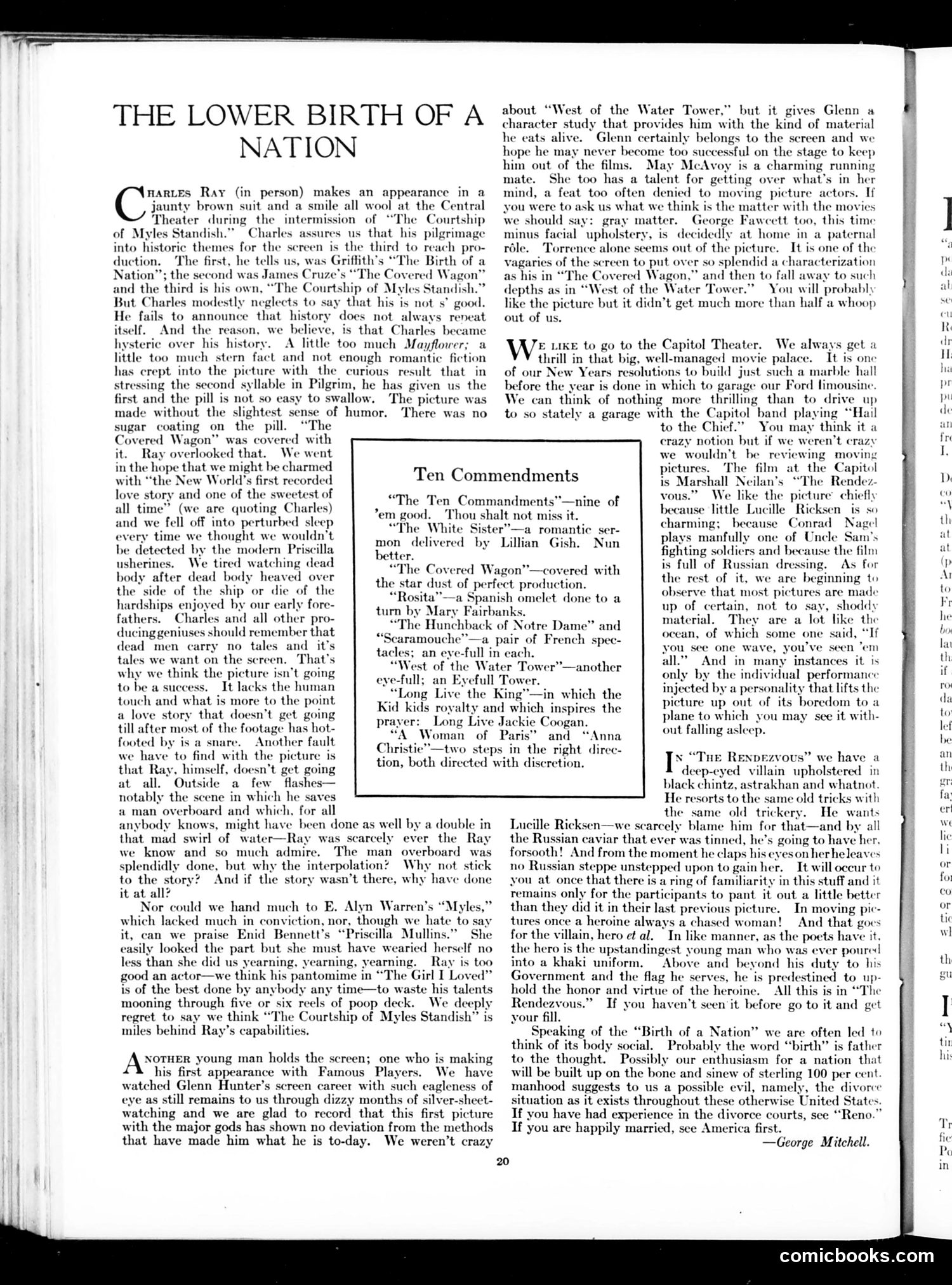
This is a film review satirizing Charles Ray's historical drama *The Courtship of Myles Standish*. The title mocks D.W. Griffith's infamous 1915 film *The Birth of a Nation*, suggesting Ray's film is an inferior imitation. The reviewer criticizes Ray for making a tedious, humorless historical picture—one bogged down by factual accuracy rather than romantic storytelling. The key complaint: the film lacks "sugar coating" and human interest. Where *The Covered Wagon* (James Cruze's successful rival Western) succeeded with entertainment, Ray's Pilgrim tale fails by taking itself too seriously, showing corpses and hardship rather than compelling drama. The reviewer also faults Ray's own performance, claiming he appears uninvested despite being an otherwise talented actor. The satire targets both Ray's creative misjudgment and the early 1920s trend of prestige historical pictures that prioritize accuracy over audience engagement—the opposite of what made earlier epics work.
📄 Transcribed text from this page (OCR, searchable)
Machine-transcribed from the original scan — historical spelling and the odd misread are preserved.
THE LOWER BIRTH OF A NATION ( a Ray (in person) makes an appearance in a jaunty brown suit and a smile all wool at the Central Theater during the intermission of “The Courtship of Myles Standish.” Charles assures us that his pilgrimage into historic themes for the screen is the third to reach pro- duction. The first, he tells us, was Griffith’s “The Birth of a Nation”; the second was James Cruze’s “The Covered Wagon” and the third is his own, “The Courtship of Myles Standish.” But Charles modestly neglects to say that his is not s’ good. He fails to announce that history does not always reneat itself. And the reason, we believe, is that Charles became hysteric over his history. A little too much Mayflower; a little too much stern fact and not enough romantic fiction has crept into the picture with the curious result that in stressing the second syllable in Pilgrim, he has given us the first and the pill is not so easy to swallow. The picture was made without the slightest sense of humor. There was no sugar coating on the pill. “The Covered Wagon” was covered with it. Ray overlooked that. We went in the hope that we might be charmed with “the New World’s first recorded love story and one of the sweetest of all time? (we are quoting Charles) and we fell off into perturbed sleep every time we thought we wouldn't be detected by the modern Priscilla usherines. We tired watching dead body after dead body heaved over the side of the ship or die of the hardships enjoyed by our early fore- fathers. Charles and all other pro- ducing geniuses should remember that dead men carry no tales and it’s tales we want on the screen. That's why we think the picture isn’t going to be a sue It lacks the human touch and what is more to the point a love story that doesn’t get going till after most of the footage has hot- footed by is a snare. Another fault we have to find with the picture is that Ray, himself, doesn’t get going at all. Outside a few flashes— notably the scene in which he saves a man overboard and which, for all anybody knows, might been done as well by a double in that mad swirl of water—Ray was scarcely ever the Ray we know and so much admire. The man overboard was splendidly done, but why the interpolation? Why not stick to the story? And if the story wasn’t there, why have done it at all? Nor could we hand much to E, Alyn Warren's “Myles,” which lacked much in conviction, nor, though we hate to say n we praise Enid Bennett’s “Priscilla Mullins.” She easily looked the part but she must have wearied herself no less than she did us yearning, yearning, yearning. Ray is too good an actor—we think his pantomime in “The Girl I Love is of the best done by anybody any time—to waste his talents mooning through five or six reels of poop deck. We deeply regret to say we think “The Courtship of Myles Standish” is miles behind Ray’s capabilities. ’em good. “The mon delivered by better. turn by Mary F “The Hunck est of the W eye-full; an I Long Kid kids ro prayer: Long Li Woman ANoTHE young man holds the screen; one who is making his first appearance with Famous Players. We have watched Glenn Hunter's screen careet with such eagleness of eye as still remains to us through dizzy months of silver-sheet- watching and we are glad to record that this first picture with the major gods has shown no deviation from the methods that have made him what he is to-day. We weren’t crazy Ten Commendments White Sister”—a romantic ser- Lillian Gish. “The Covered Wagon”—covered with the star dust of perfect production. “Rosita” —a Spanish omelet irbanks. ck of Notre Dame” and a pair of French spec- an eye-full in each. ive the King’ of Paris” and Christie"—two steps in the right diree- tion, both directed with discretion. I about “West of the Water Tower, character study that provides him with the kind of material he eats alive. Glenn certainly belongs to the screen and we hope he may never become too successful on the stage to keep him out of the films. May McAvoy is a charming running mate. She too has a talent for getting over what's in her mind, a feat too often denied to moving picture actors. If you were to ask us what we think is the matter with the movies we should say: gray matter. George Fawcett too, this time minus facial upholstery, is decidedly at home in a paternal réle. Torrence alone seems out of the picture. It is one of the vagaries of the screen to put over so splendid a characterization as his in “The Covered Wagon,” and then to fall away to such depths as in “West of the Water Tower.” You will probabl. like the picture but it didn’t get much more than half a whoop out of us. * but it gives Glenn a E LIKE to go to the Capitol Theater. We always get a thrill in that big, well-managed movie palace. It is onc of our New Y resolutions to build just such a marble hall before the year is done in which to garage our Ford limousine. We can think of nothing more thrilling than to drive up to so stately a garage with the Capitol band playing ‘Hail to the Chief.” You may think it a crazy notion but if we weren't c1 we wouldn't be reviewing moving pictures. ‘The film at the Capitol is Marshall Neilan’s “The Rendez- vous.” We like the picture’ « be e little Lucille Ricksen ch rming: because Conrad Nor | plays manfully one of Unele Sam's . Bghting soldiers and because the film is full of Russian dressing. As for the rest of it, we are beginning to observe that most pictures are made up of certain, not to say, shoddy material. They are a lot like the ocean, of which some one said, “If you see one wave, you’y all.” And in many instances it is only by the individual performance injected by a personality that lifts the picture up out of its boredom to a plane to which you may see it with- out falling asleep. done to a seen ‘em ver” —another n which the h inspires the e Coogan. “Anna “Tue Renpezvous” we have a deep-cyed villain upholstered. in black chintz, astrakhan and whatnot He resorts to the same old tricks with the same old_ trick He wants Lucille Ricksen—we scarcely blame him for that—and by all the Russian caviar that ever was tinned, he’s going to have her. forsooth! And from the moment he claps his eyeson herheleaves no Russian steppe unstepped upon to gain her. It will occur to you at once that there is a ring of familiarity in this stuff and it remains only for the participants to pant it out a little better than they did it in their last previous picture. In moving pic- tures once a heroine always a chased woman! And t for the villain, hero et al. In like manner, as the poe! the hero is the upstandingest young man who was ever poured into a khaki uniform. Above and ie yond his duty to his Government and the flag he s stined to up- hold the honor and virtue of the he eroine. All this is in “The Rendezvous.” If you haven't seen it before go to it and get your fill. peaking of the “Birth of a Nation” we are often led to think of its body social. Probably the word “birth” is father to the thought. Possibly our enthusiasm for a nation that will be built up on the bone and sinew of sterling 100 per cent. manhood suggests to us a possible evil, namely, the divorc« situation as it exists throughout these otherwise United States. If you have had experience in the divorce courts, see “Reno If you are happily married, see America fi —George Mitchell. comicbooks.com