
Judge, 1924-01-26 · page 13 of 37
Judge — January 26, 1924 — page 13: what you’re looking at
What you’re looking at
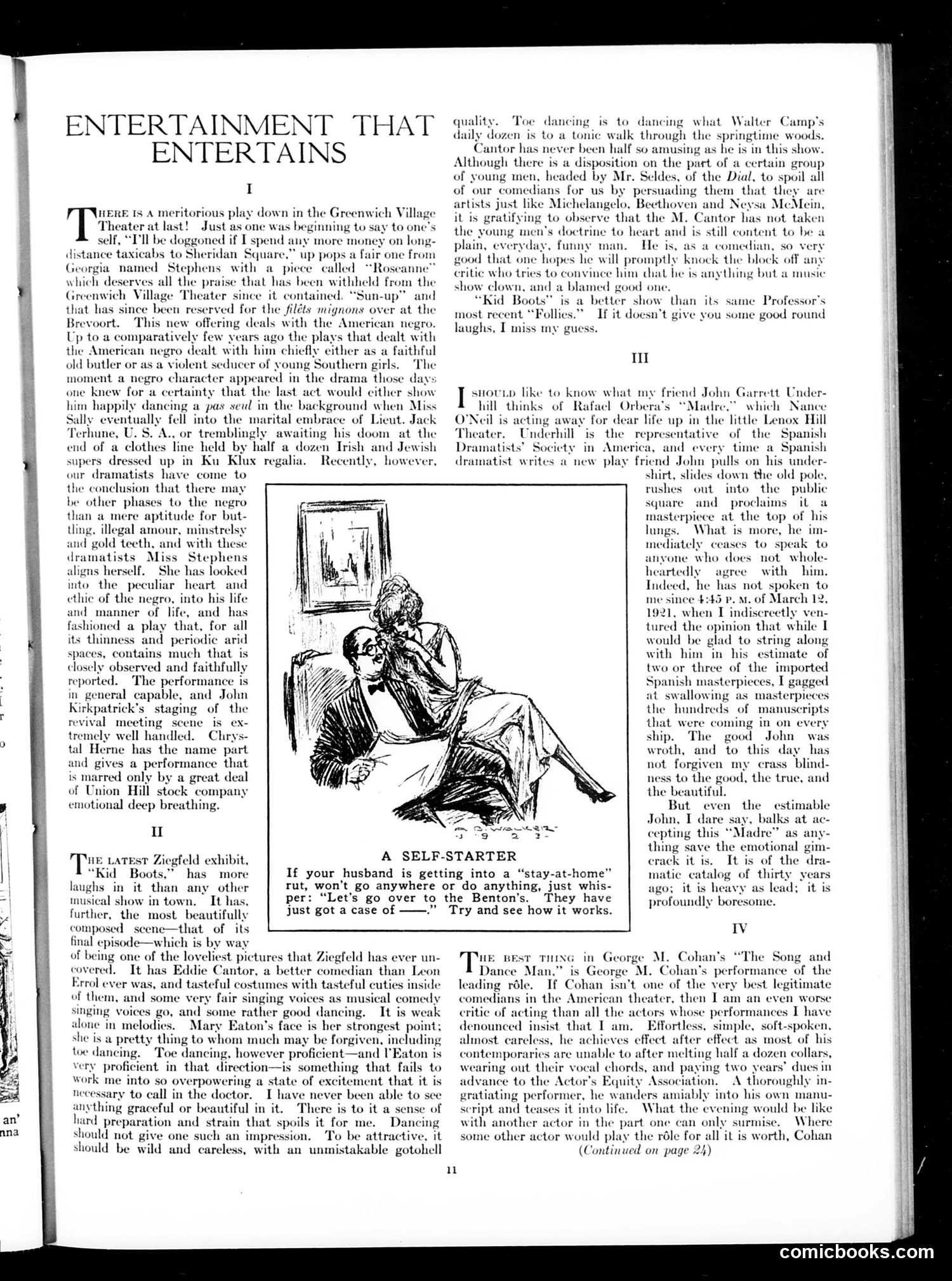
This is a theatrical review column praising recent Broadway productions. The main points: **"Roseanne"** (Greenwich Village Theater): A play by Georgia-born author Stephens is celebrated for moving beyond stereotypical depictions of African Americans in drama—previously shown only as faithful servants or violent criminals (the review references how Black characters would either dance happily in background scenes or face lynch mob violence). This play is praised for exploring authentic Black life and character with depth. **"Kid Boots"** (Ziegfeld production): Praised for comedy and beautiful staging, featuring Eddie Cantor. The reviewer admires Mary Eaton's dancing despite criticizing toe-dancing generally as mechanically strained rather than naturally graceful—comparing it unfavorably to Walter Camp's exercise routines. The accompanying illustration shows a couple in an intimate domestic scene, accompanying an advertisement about rekindling a "stay-at-home" husband's interest in going out. The tone is sophisticated theater criticism typical of Judge's urbane, educated readership.
📄 Transcribed text from this page (OCR, searchable)
Machine-transcribed from the original scan — historical spelling and the odd misread are preserved.
ENTERTAINMENT THAT ENTERTAINS I HERE Is A meritorious play down in the Greenwich Village | Theater at last! Just as one was beginning to say to one’s “T'll be doggoned if I spend any more money on long- distance taxicabs to Sheridan Square,” up pops a fair one from Georgia named Stephens with a piece called “Roseanne” which deserves all the praise that has been withheld from the Greenwich Village Theater since it contained. “Sun-up” and that has since been reserved for the filéls mignons over at the Brevoort. This new offering deals with the American negro. Up to a comparatively few years ago the plays that dealt with the American negro dealt with him chiefly either as a faithful old butler or as a violent seducer of young Southern girls. The moment a negro character appeared in the drama those days one knew for a certainty that the last act would either show him happily dancing a pas seul in the background when Miss Sally event fell into the marital embrace of Lieut. Jack Terhune, U A., or tremblingly awaiting his doom at the end of a clothes line held by half a dozen Irish and Jewish supers dressed up in Ku Klux regalia. Recently, however, our dramatists have come to the conclusion that there may be other phases to the negro than a mere aptitude for but- tling, illegal amour, minstrelsy and gold teeth, and with these dramatists Miss Stephens aligns herself. She has looked into the peculiar heart and ethic of the negro, into his life and manner of life, and has fashioned a play that, for all its thinness and periodic arid spa contains much that is closely observed and faithfully reported. The performance is in general pable, and John Kirkpatrick's staging of the revival meeting scene is ex- tremely well handled. Chrys- tal Herne has the name part and gives a performance that is marred only by a great deal of Union Hill stock company emotional deep breathing. II es? Ziegfeld exhibit, Boots,” has more laughs in it than any other musical show in town. It has, further, the most beautifully composed scene—that of its final episode—which is by way of being one of the loveliest pictures that Ziegfeld has ever un- covered. It has Eddie Cantor, a better comedian than Leon Errol ever was, and tasteful costumes with tasteful cuties inside of them, and some very fair singing voices as musical comedy singing v go, and ‘some rather good dancing. It is weak alone in melodies. Mary Eaton's face is her strongest point; she is a pretty thing to whom much may be forgiven, including toe dancing. Toe dancing, however proficient—and "Eaton is very proficient in that direction—is something that fails to work me into so overpowering a state of excitement that it is necessary to call in the doctor. I have never been able to s anything graceful or beautiful in it. There is to it a sense of hard preparation and strain that spoils it for me. Dancing should not give one such an impression. To be attractive, it should be wild and careless, with an unmistakable gotohell just got a case of eo A SELF-STARTER If your husband is getting into a “stay-at-home” rut, won't go anywhere or do anything, just whis- per: “Let’s go over to the Benton's. quality. Toe dancing is to dancing what Walter Camp's daily dozen is to a tonic walk through the springtime woods. Cantor has never been half so amusing as he is in this show. Although there is a disposition on the part of a certain group of young men, headed by Mr. Seldes, of the Dial, to spoil all of ‘our comedians for us by persuading them that they are artists just like Michelangelo, Beethoven and Neysa McMein, it is gratifying to observe that the M. Cantor has not taken the young men’s doctrine to heart and is still content to be a plain, everyday, funny man. He is, as a comedian, so very good that one hopes he will promptly knock the block off any critic who tries to convince him chat he is anything but a music show clown, and a blamed good one. “Kid Boots” is a better show most recent ‘Follies.”” laughs, I miss my than its same Professor's If it doesn’t give you some good round ess. Tl I sHouLD like to know what my nd John Garrett Under- hill thinks of Rafael Orbera’s “Madre.” which Nance O'Neil is acting away for dear life up in the little Lenox Hill Theater. Underhill is the representative of the Spanish Dramatists’ Society in America, and every time a Spanish dramatist writes a new play friend John pulls on his under- shirt, slides down the old px rushes out into the public square and proclaims it. a masterpiece at the top of his lungs. What is more, he im- mediately ceases to speak to anyone who does not. whole- heartedly agree with him. Indeed, he has not spoken to me since 4:45 p. M. of March 12, 1921, when I indiscreetly ven- tured the opinion that while I would be glad to string along with him in his estimate of two or three of the imported Spanish masterpieces, I gagged at swallowing as masterpieces the hundreds of manuscripts that were coming in on every ship. The good John was wroth, and to this day has not forgiven my crass blind- ness to the good, the true, and the beautiful. But even John, I dare Iks at cepting this “Madre” as any- thing save the emotional gim- erack it is. It is of the dra- matic catalog of thirty years ago; it is heavy as lead; it is profoundly boresome. the estimable They have Try and see how it works. IV ue BEST THING in George M. Cohan’s “The Song and Dance Man,” is George M. Cohan’s performance of the leading réle. If Cohan isn’t one of the very best legitimate comedians in the American theater, then I am an even worse critic of acting than all the actors whose performances I have denounced insist that Iam. Effortless, simple, soft-spoken, almost careless, he achieves effect after effect as most of his contemporaries are unable to after melting half a dozen co wearing out their vocal chords, and paying two years’ dues in advance to the Actor's Equity Association, A thoroughly in- gratiating performer, he wanders amiably into his own manu- script and teases it into life. What the evening would be like with another actor in the part one can only surmise. Where some other actor would play the rdle for all it is worth, Cohan (Continued on page 24) comicbooks.com