
Judge, 1924-01-26 · page 26 of 37
Judge — January 26, 1924 — page 26: what you’re looking at
What you’re looking at
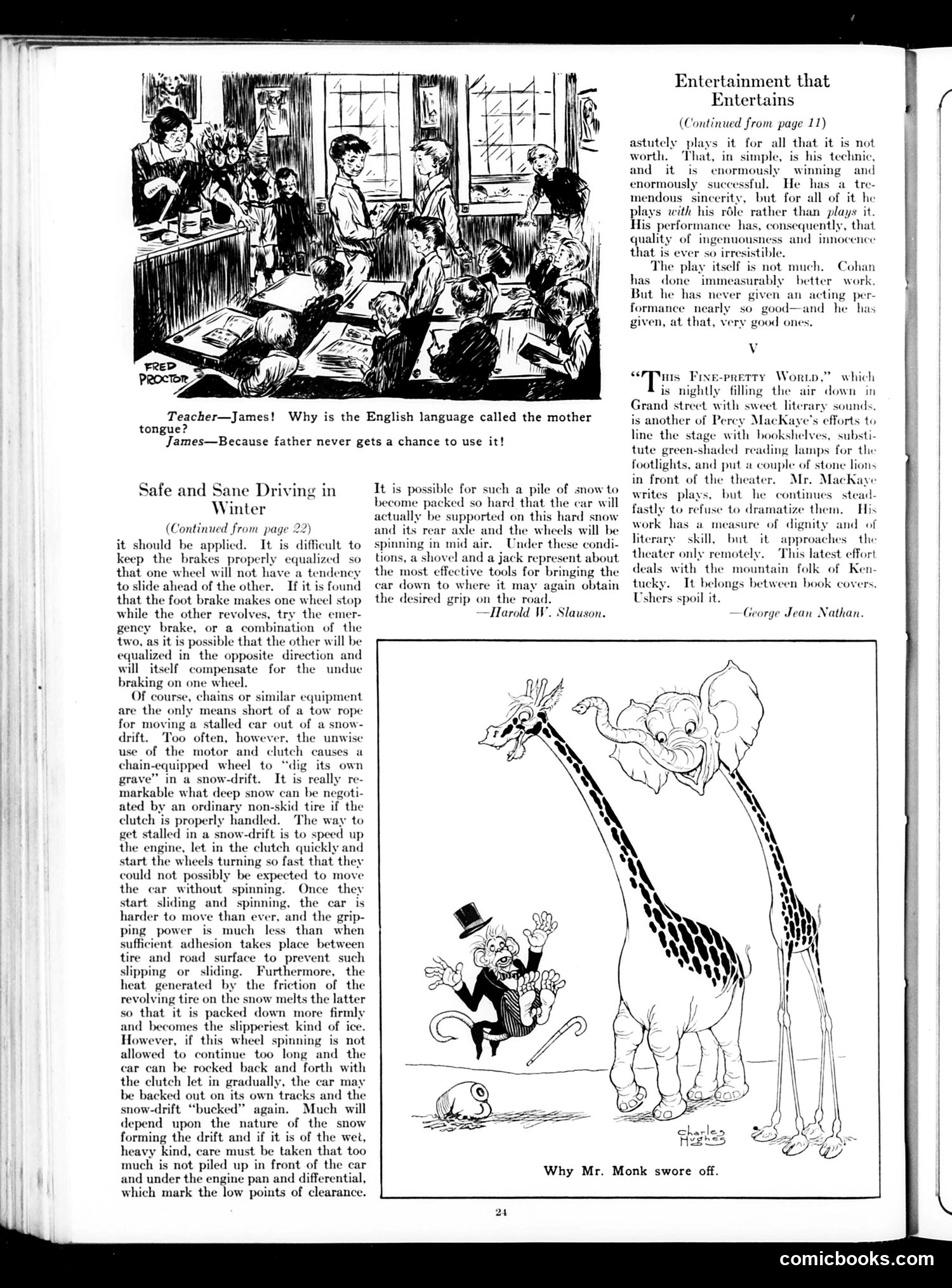
**The Classroom Joke:** A simple gag about gender dynamics: when asked why English is called the "mother tongue," James quips that fathers never get to speak because mothers dominate conversation. This reflects early 20th-century domestic humor playing on the stereotype of talkative wives. **"Why Mr. Monk swore off":** The cartoon shows a man being chased by an angry elephant and giraffe, apparently after some transgression. The humor lies in the absurd consequence—encountering wild animals—justifying his oath to reform. The cartoon is credited to Charles Briggs and appears to be generic comic relief rather than political satire. **Other Content:** The page includes practical advice on winter driving (chain use, brake technique) and theater reviews discussing actor George M. Cohan's performance style and playwright Percy MacKaye's literary approach to drama. The page reflects Judge's mix of light domestic humor, practical guidance, and entertainment criticism typical of the era's general-interest magazines.
📄 Transcribed text from this page (OCR, searchable)
Machine-transcribed from the original scan — historical spelling and the odd misread are preserved.
Teacher—James! tongue? Why is the English language called the mother James—Because father never gets a chance to use it! Safe and Sane Driving in Winter (Continued from page 22) it should be applied. It is difficult to keep the brakes properly equalized so that one wheel will not have a tendency to slide ahead of the other. If it is found that the foot brake makes one wheel stop while the other revolves, try the emer- gency brake, or a combination of the two, as it is possible that the other will be equalized in the opposite direction and will itself compensate for the undue braking on one wheel. Of course, chains or similar equipment are the only means short of a tow rope for moving a stalled car out of a snow- drift. Too often, however, the unwise use of the motor and clutch causes a chain-equipped wheel to “dig its own grave” in a snow-drift. It is really re- markable what deep snow can be negoti- ated by an ordinary non-skid tire if the clutch is properly handled. ‘The way to get stalled in a snow-drift is to speed up the engine, let in the clutch quickly and start the wheels turning so fast that they could not possibly be expected to move the car without’ spinning. Once they start sliding and spinning, the car is harder to move than ever, and the grip- ping power is much less than when sufficient adhesion takes place between tire and road surface to prevent such slipping or sliding. Furthermore, the heat generated by the friction of the revolving tire on the snow melts the latter so that it is packed down more firmly and becomes the slipperiest kind of ice. However, if this wheel spinning is not allowed to continue too long and the car can be rocked back and forth with the clutch let in gradually, the car may be backed out on its own tracks and the snow-drift “bucked” again. Much will depend upon the nature of the snow forming the drift and if it is of the wet, heavy kind, care must be taken that too much is not piled up in front of the car and under the engine pan and differential, which mark the low points of clearance. It is possible for such a pile of snow to become packed so hard that the car will actually be supported on this hard snow and its rear axle and the wheels will be spinning in mid air. Under these condi- tions, a shovel and a jack represent about the most effective tools for bringing the car down to where it may again obtain the desired grip on the roa —Harold ¥ Monk swore off. Entertainment that Entertains : (Continued from page 11) a= astutely plays it for all that it is not worth. That, in simple, is his technic, and it is enormously winning and enormously successful. He has a_tre- mendous sincerity, but for all of it he plays with his réle rather than plays it His performance has, consequently, that quality of ingenuousness and innocence that is ever so irresistible. The play itself is not much. Cohan has done immeasurably better work. y But he has never given an acting per- formance nearly so good—and he has given, at that, very good ones. Vv ins Fine-pretty Worep,” which is nightly filling the air down in Grand street with sweet literary sounds, is another of Percy MacKaye’s efforts to line the stage with bookshelves, substi- tute green-shaded reading lamps for the footlights, and put a couple of stone lions in front of the theater. Mr. MacKaye writes plays, but he continues stead- fastly to refuse to dramatize them. His work has a measure of dignity and of literary skill, but it approaches the theater only remotely. This latest effort deals with the mountain folk of Ken- tucky. It belongs between book covers. Ushers spoil it, George Jean Nathan. comicbooks.com