
A complete issue · 36 pages · 1923
Judge — December 15, 1923
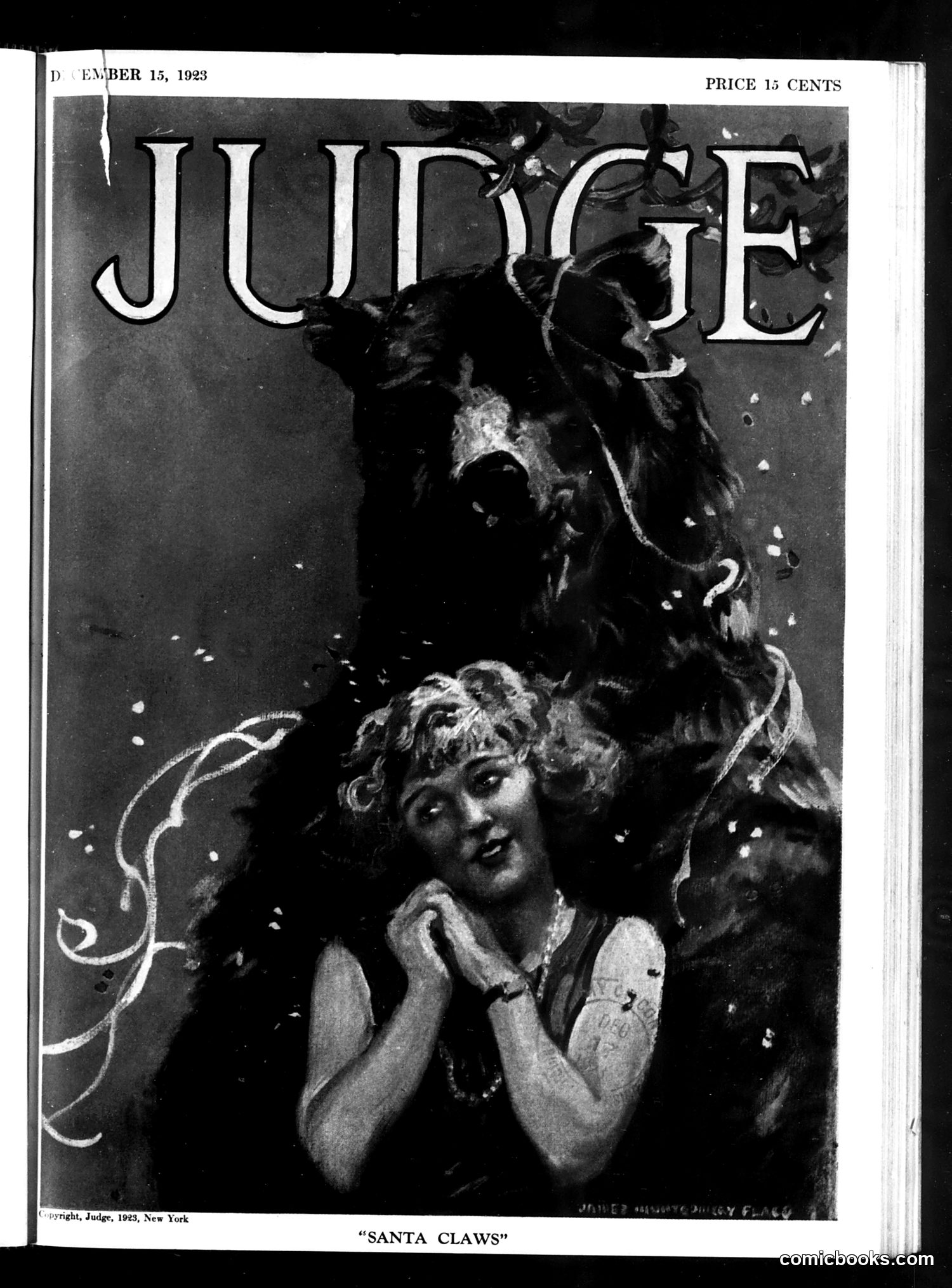
This cover depicts a young woman in an anxious pose with a large, menacing bear looming behind her. The title "Santa Claws" is a pun playing on "Santa Claus," replacing "Clause" with "Claws." The image appears to be a Christmas-themed cautionary illustration, likely warning about dangers—possibly predatory men or social threats—disguised in festive circumstances. The woman's fearful expression and defensive posture suggest vulnerability during the holiday season. Given 1923's context (Prohibition era), this may satirize the risks women faced in speakeasies or illicit social gatherings marketed as festive entertainment. The bear could represent hidden danger behind holiday merriment, serving as social commentary on women's safety during an era of rapid social change and loosening moral standards.
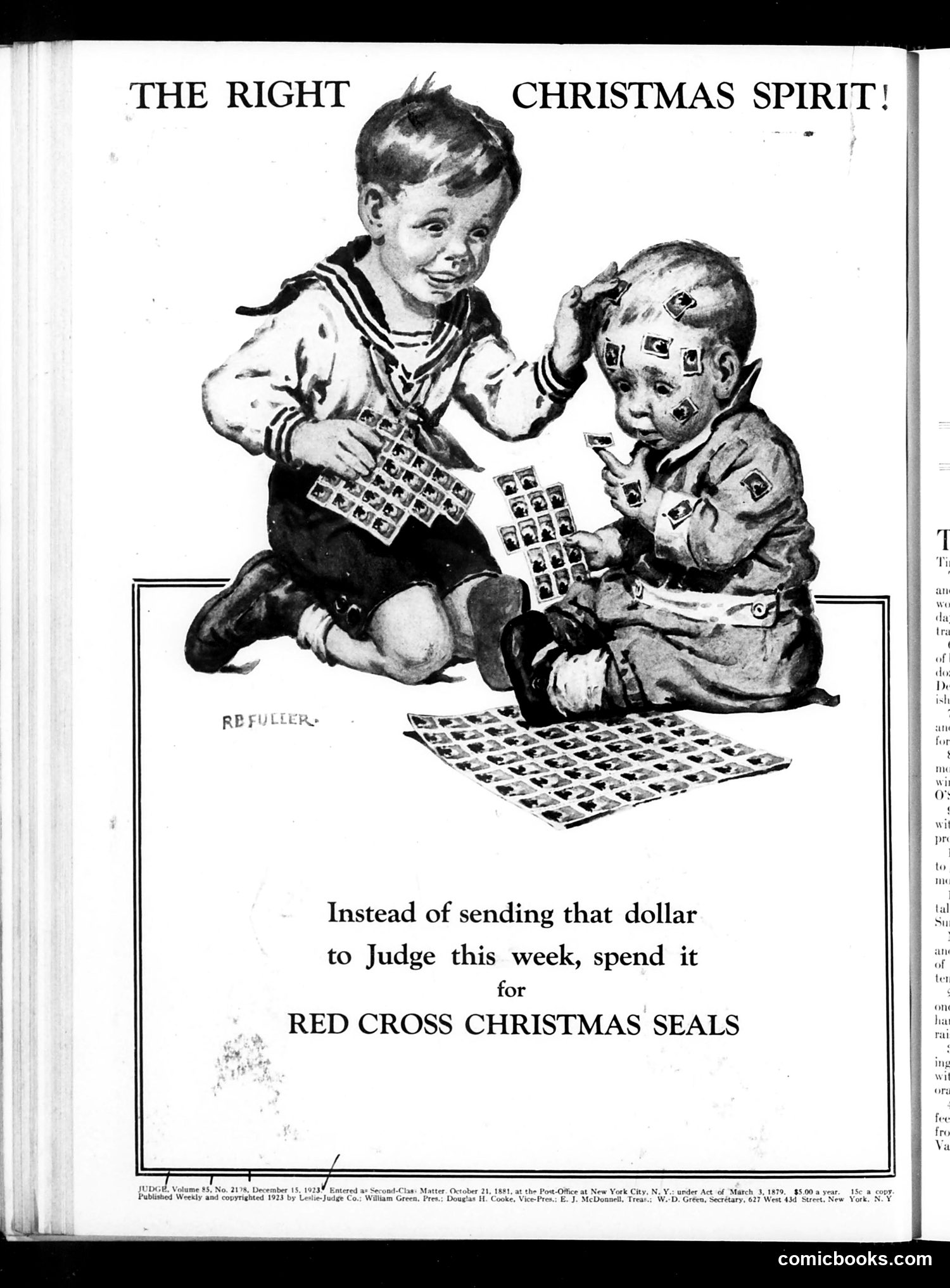
This 1920s charity advertisement depicts two young boys playing cards, advocating for Red Cross Christmas Seals instead of gambling activities. The cartoon appears to reference a contemporary concern about children's moral development and leisure activities during the post-WWI era. The satirical message criticizes redirecting money from judicial fines ("Judge this week") toward charitable causes. The artist, R. Fuller, uses the innocent image of children to promote the Red Cross campaign, suggesting that supporting tuberculosis prevention (what Christmas Seals funded) represents the "right" Christmas spirit—contrasting it with other, presumably less charitable uses of holiday money. The piece reflects Progressive Era values emphasizing moral reformation and social responsibility through organized charity.
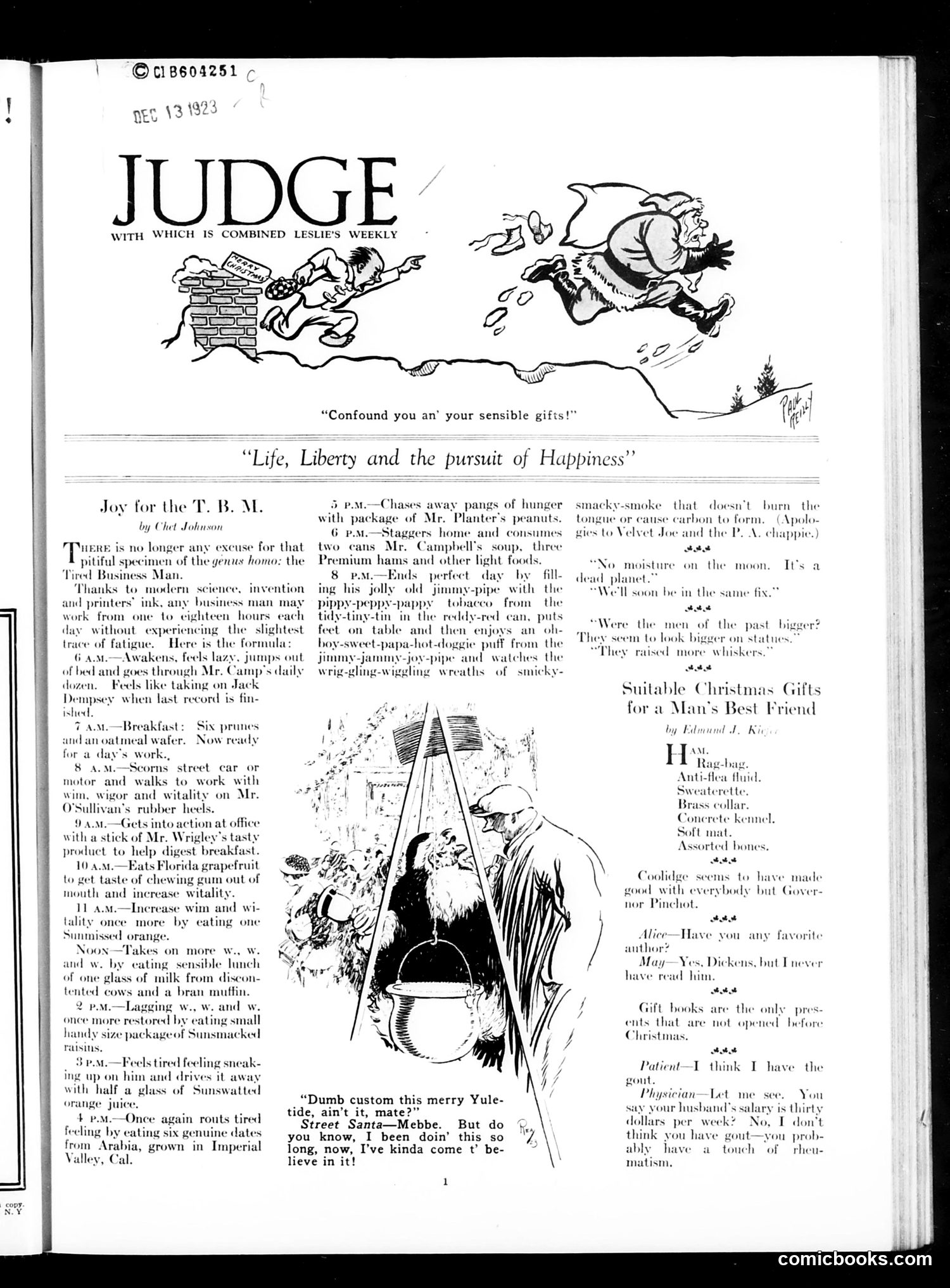
This page contains lifestyle content and humor rather than political cartoons. The main illustration depicts a humorous daily schedule for a businessman ("the genus homo"), satirizing the contradiction between health advice and actual urban life. The figure shown rushing with a briefcase illustrates the frenetic pace that makes following proper diet and exercise recommendations impossible. The accompanying text mocks modern business culture's demand for constant productivity—the "T.B.M." (Typical Business Man) cannot maintain sensible habits despite scientific evidence supporting them. The cartoon's message: industrialized work life is fundamentally incompatible with health, a critique of 1920s corporate culture and its toll on workers' wellbeing.
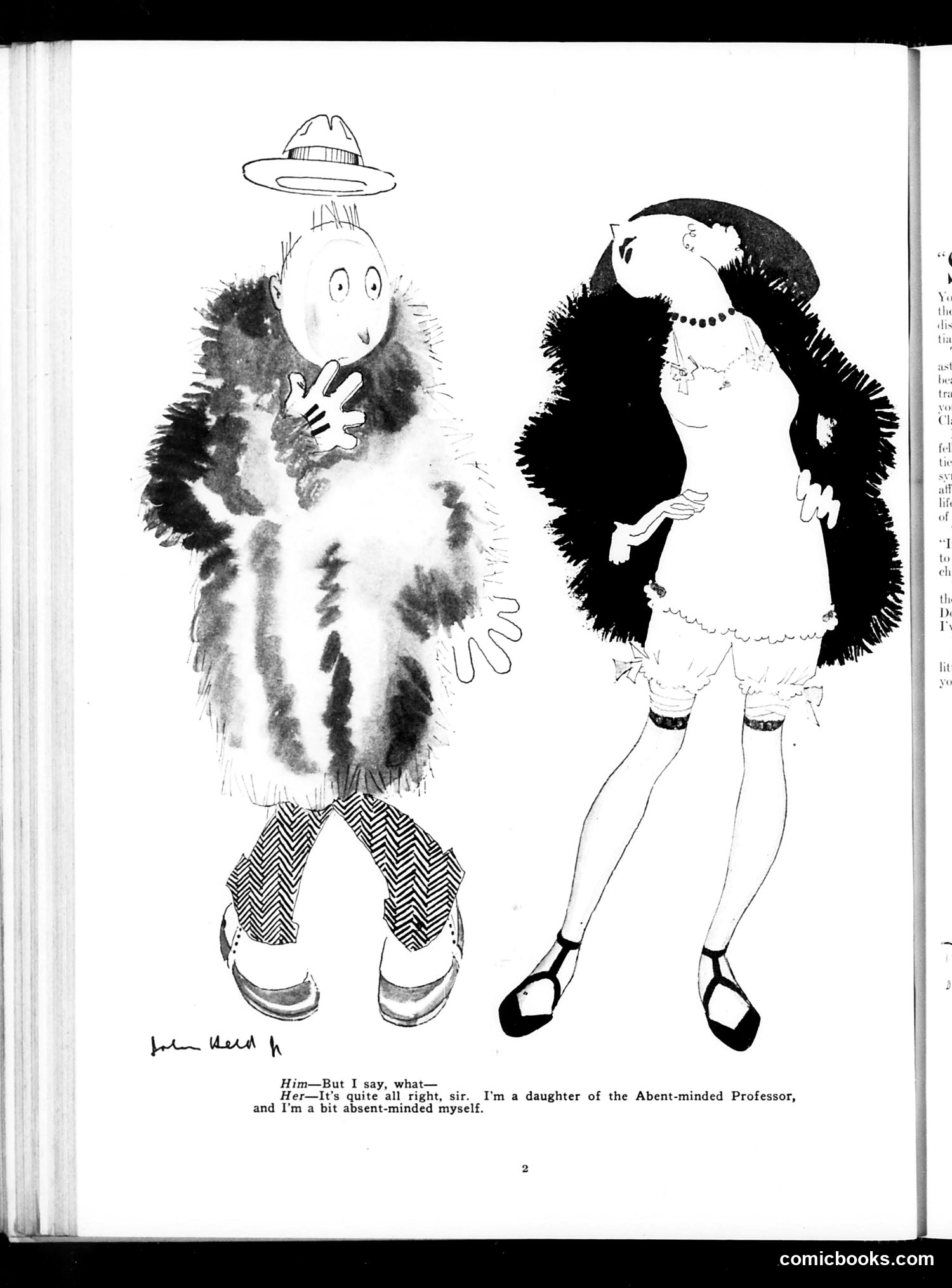
This page depicts a comedic interaction between two characters. The left figure—a disheveled man with wild hair, a halo, and patterned pants—appears startled or anxious. The right figure is a well-dressed woman with dark hair, pearls, and a fur stole, smiling confidently. The dialogue reveals the joke's premise: the man is apparently absent-minded (suggested by the halo, a visual gag for being "spaced out"), while the woman identifies herself as the daughter of an absent-minded professor—implying she inherits this trait. The humor plays on the social awkwardness of their encounter and the absurdity of both parties being characterized by mental distraction. This appears to be light domestic or romantic comedy rather than political satire—typical of early 20th-century Judge magazine's humor content.
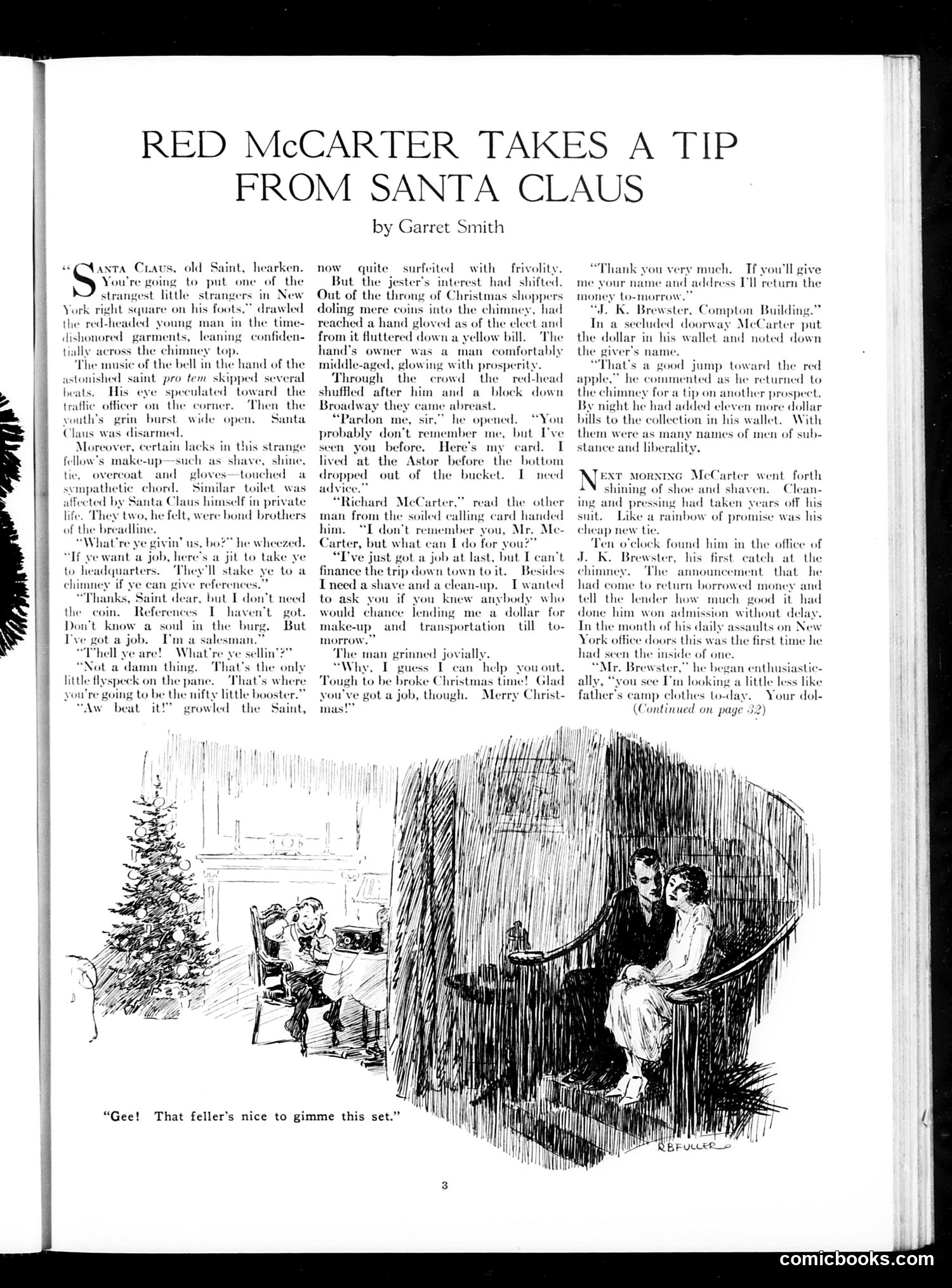
This is a humorous short story by Garret Smith about Red McCarter, apparently a character known to Judge's readers. The plot involves McCarter encountering Santa Claus in New York during Christmas season. Santa, initially appearing as a destitute beggar ("old Saint, hearken"), gives McCarter a tip about finding money—specifically directing him to a wealthy businessman's wallet at the Astor Hotel. The satire targets both Christmas charity pretense and get-rich-quick schemes. Santa's suggestion to steal from a rich man plays on ironic inversions of Christmas morality. The two illustrations show McCarter's Christmas encounter and a domestic scene, though the story continues on another page, so the full satirical point remains incomplete here.
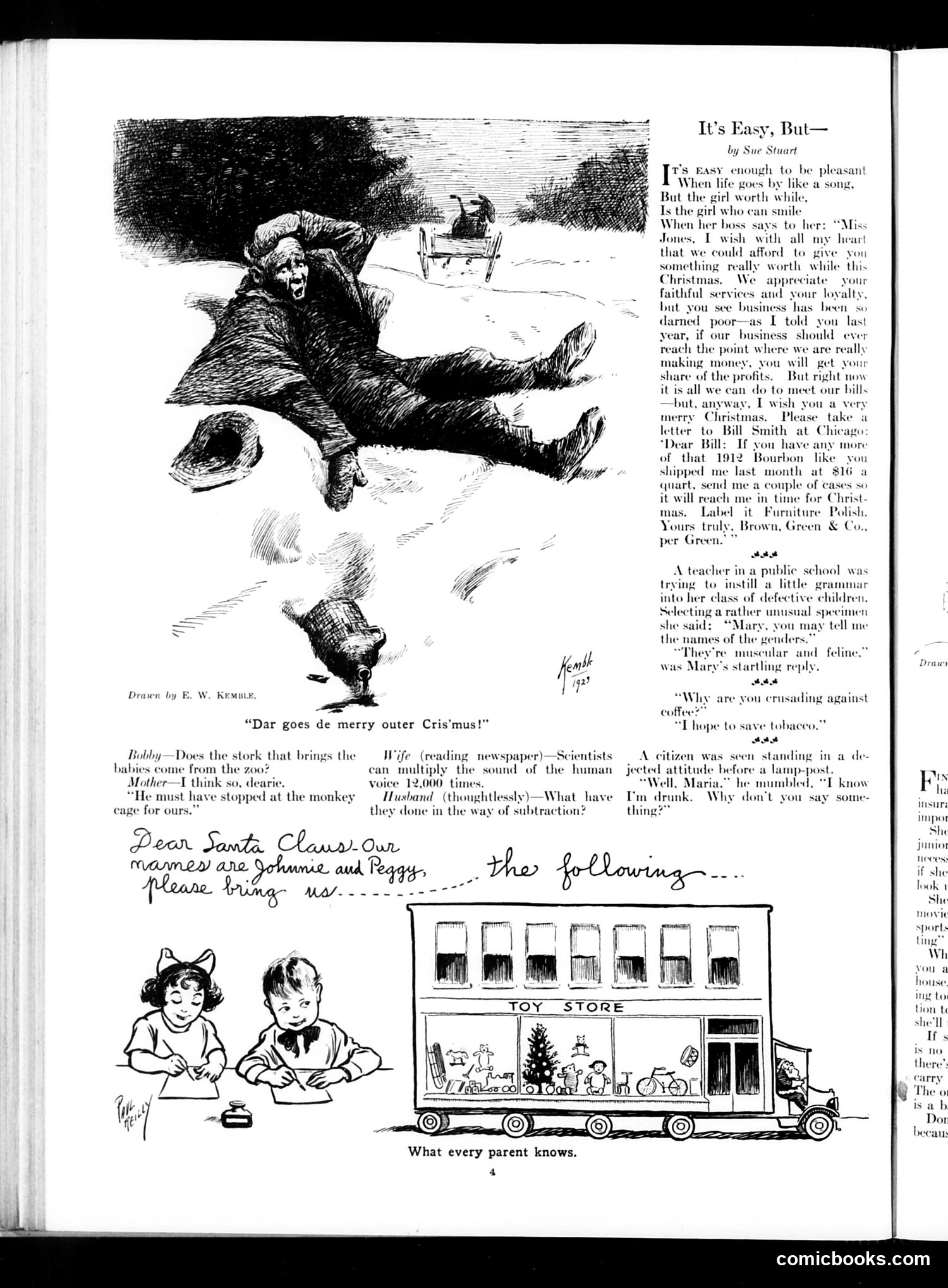
The top cartoon titled "Dar goes de merry outer Cris'mus!" depicts a person slipping on ice during winter, with a sleigh visible in the background. The accompanying dialogue joke plays on ethnic dialect humor, common to early 20th-century publications. Below is a handwritten letter to Santa Claus requesting toys named "Johnnie and Peggy," followed by an illustration showing two children writing, and a toy store depicted as a mobile storefront. The caption "What every parent knows" suggests the page is satirizing the commercial pressure of Christmas gift-giving and children's expectations—a timeless theme. The other content on the page consists of anecdotal humor pieces and a serious article titled "It's Easy, But—" addressing business ethics.
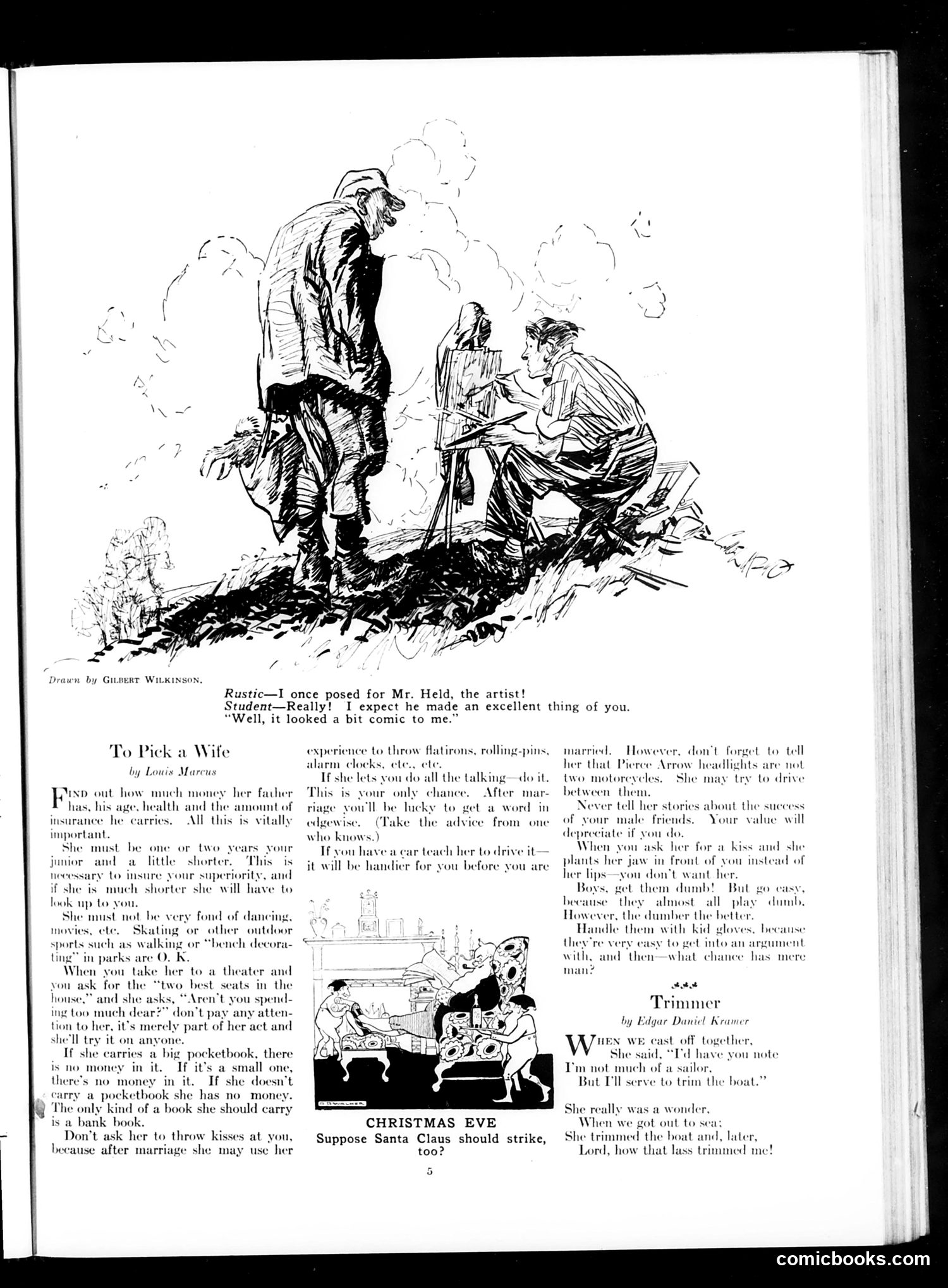
This page contains two distinct satirical pieces targeting gender relations and marital dynamics of the era. **"To Pick a Wife"** offers tongue-in-cheek "advice" that mocks both courtship conventions and women. It humorously prescribes controlling a wife through economic dependence, selecting younger/shorter women to maintain male "superiority," and discouraging her intelligence or independence. The final jab warns against asking for kisses, suggesting physical rejection indicates unsuitability—while simultaneously advising men to seek "dumb" women. The satire targets male insecurity and the era's patriarchal marriage expectations. **"Trimmer"** by Kramer presents a naval wordplay joke: a woman claims she'll "trim the boat," but the punchline reveals she instead "trimmed" her husband (cuckolded him), using "trimmed" as a double entendre for both nautical duty and emasculation. The top cartoon shows an artist's model, likely referencing popular illustrator John Held Jr., known for depicting modern figures—a nod to contemporary artistic culture. Overall, the page reflects early 20th-century anxieties about changing gender roles through humor that appears misogynistic to modern readers.
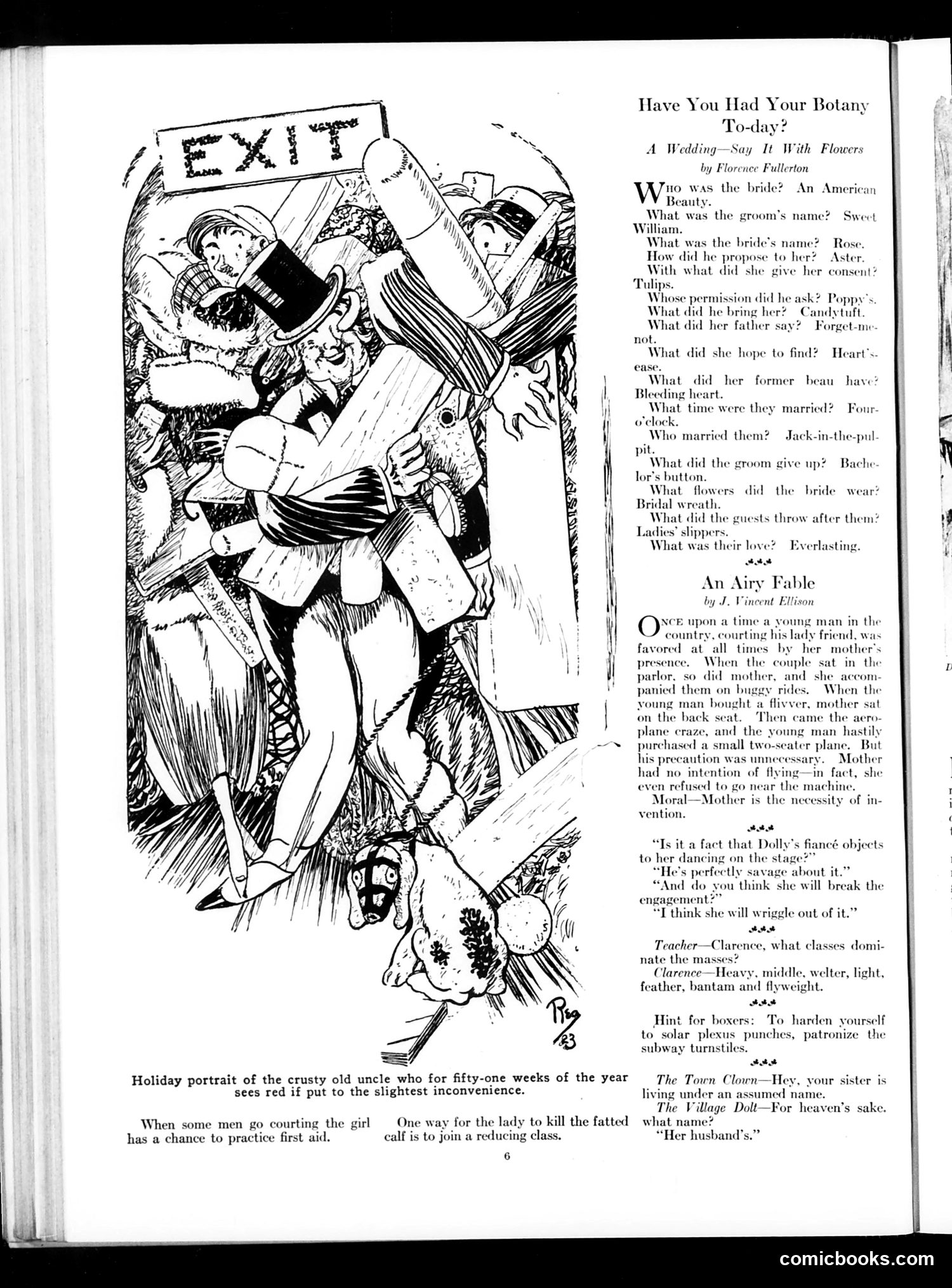
This Judge magazine page contains three satirical pieces: **The "Crusty Uncle" Cartoon** (left): A chaotic illustration depicting an irritable older man surrounded by people and chaos, captioned as someone perpetually angry except during holidays. It satirizes the stock figure of the ill-tempered relative who becomes temporarily pleasant only during festive seasons. **"A Wedding—Say It With Flowers"**: A playful Q-and-A riddle where wedding details are answered using flower names (Rose for bride, Sweet William for groom, etc.). This is wordplay satire, likely poking fun at the commercialization of weddings and the sentimental language surrounding them. **"An Airy Fable"**: A brief story mocking overbearing mothers-in-law who constantly intrude on couples' time together. When the young man buys a plane, the mother refuses to fly—satirizing how mothers find ways to remain central despite claims about "necessity" driving their involvement. The page also includes brief jokes about boxing classes, courtship, and social conventions of the era, reflecting early 20th-century American domestic humor.
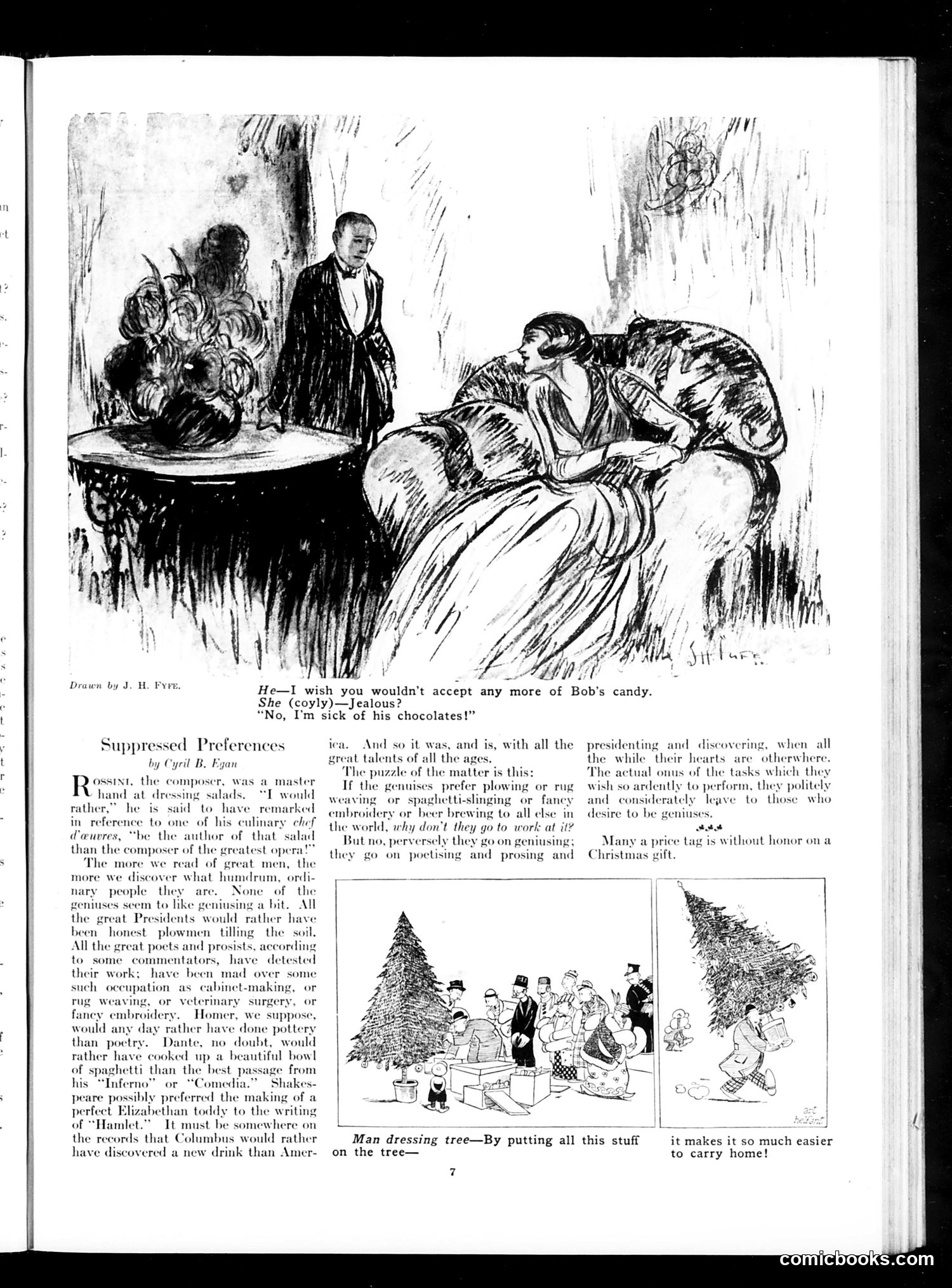
**"Suppressed Preferences"** is an essay satirizing great historical figures' supposed secret desires. The author facetiously argues that famous geniuses (composers, poets, presidents, explorers) would rather pursue mundane tasks—Rossini preferred making salads to composing operas; great poets wanted to do embroidery; Columbus wished he'd discovered a new drink instead of America. The satire's point: if these men truly hated their work, why didn't they stop? The implication critiques both the romanticization of genius and human self-deception about duty versus desire. **The cartoon by J.H. Fyfe** shows a domestic scene where a woman reassures a jealous man she's rejecting another man's candy—not from jealousy, but because "I'm sick of his chocolates." It's a mild joke about excess and insincerity in courtship gifts. **"Man Dressing Tree"** is a humorous Christmas cartoon: someone loads gifts and decorations *onto* a Christmas tree rather than carrying them separately, reasoning this makes the load "easier to carry home"—absurdist holiday humor about impractical problem-solving.
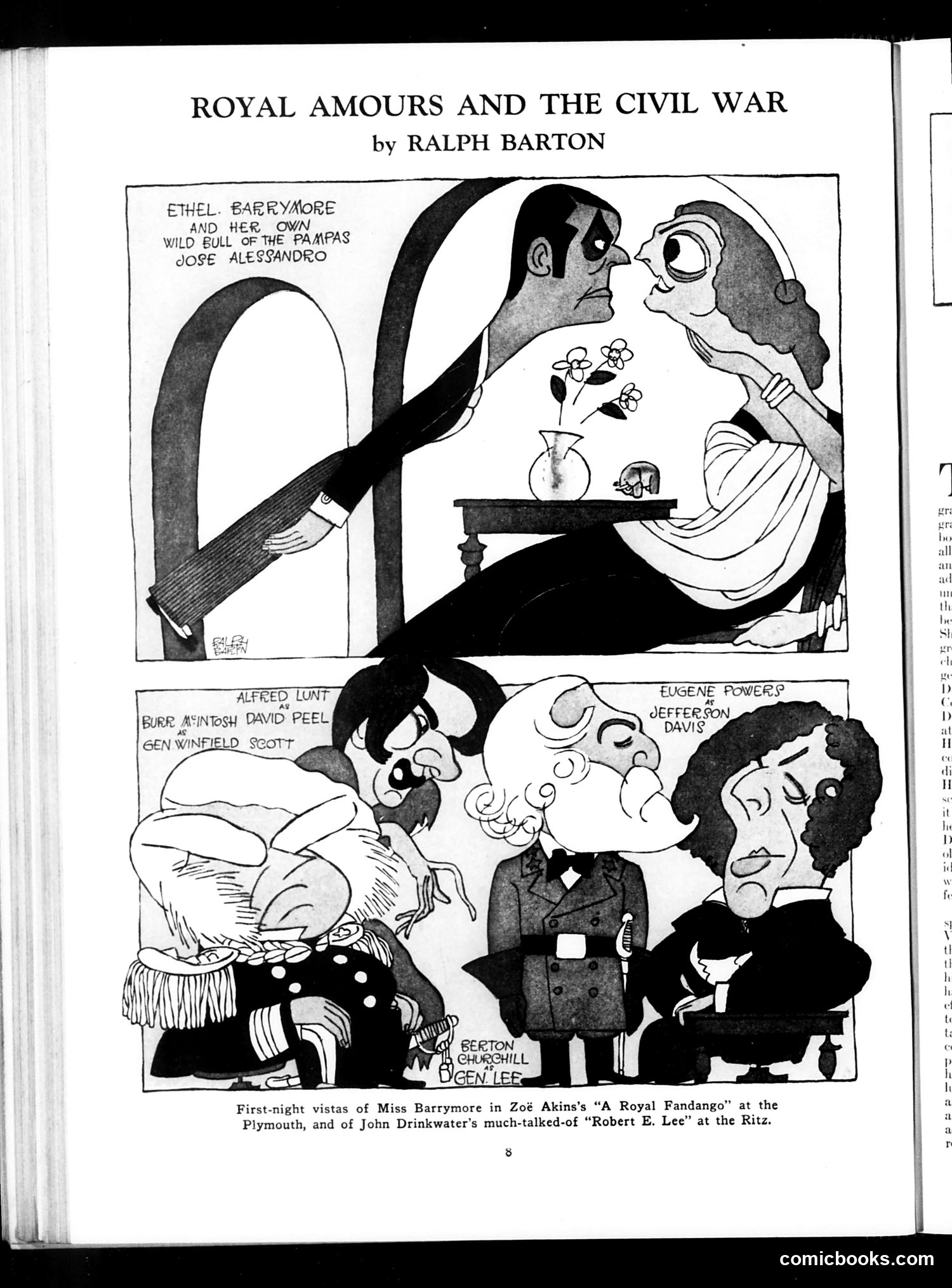
This satirical cartoon by Ralph Barton compares theatrical productions with Civil War history. The top panel depicts actress Ethel Barrymore with her co-star Jose Alessandro in "A Royal Fandango" (a romantic play), shown in an intimate romantic scene. The bottom panel caricatures actors in John Drinkwater's "Robert E. Lee" (a serious historical drama), labeling them as Civil War figures like General Winfield Scott and Robert E. Lee. The satire juxtaposes frivolous romantic theater against weighty historical drama, mocking how contemporary Broadway productions treat their respective subjects—one as bedroom farce, the other as serious historical reconstruction. The "civil war" reference is double: the actual conflict versus the contrast between entertainment genres popular in 1920s theater.
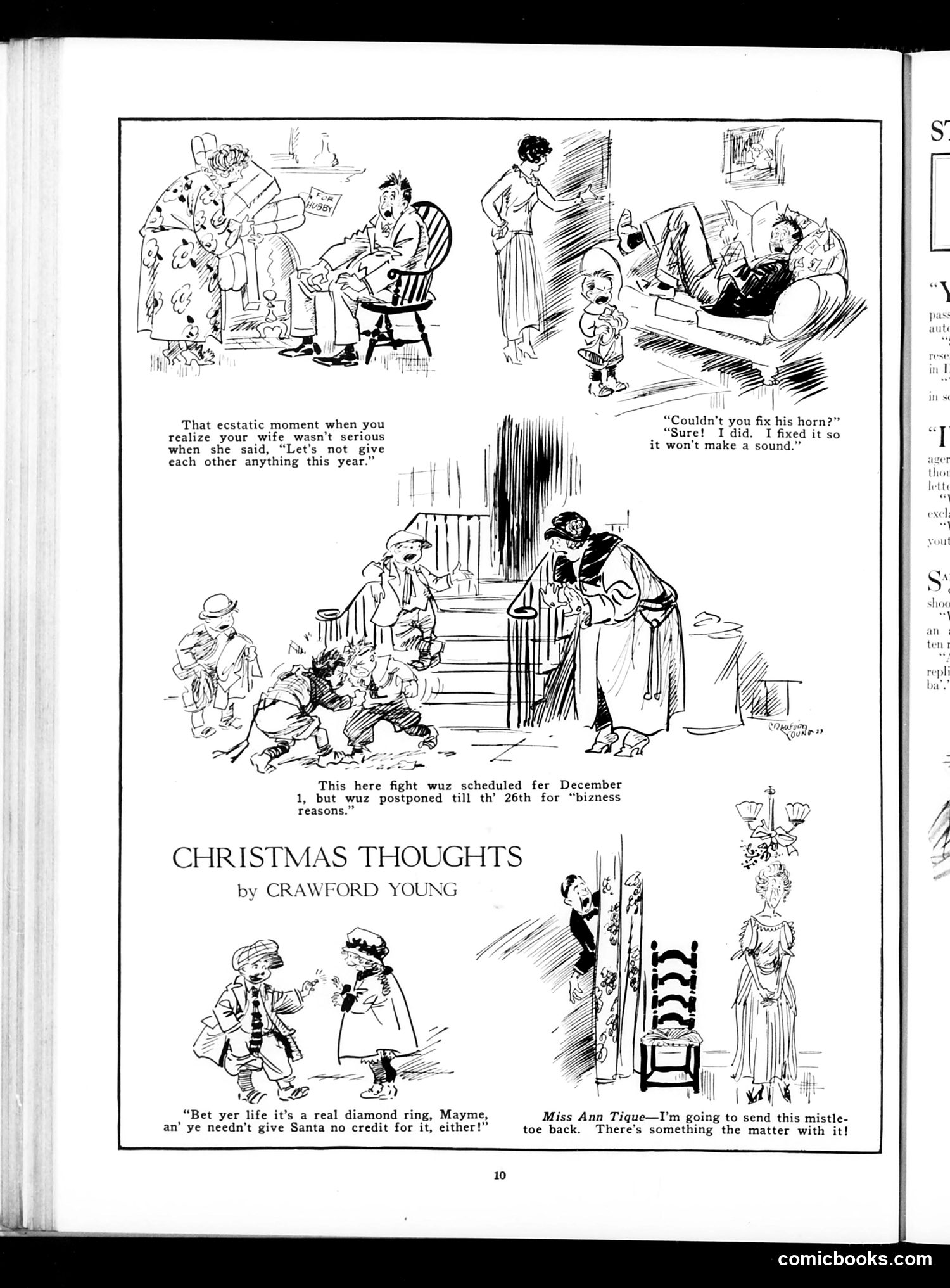
This humor page presents domestic holiday scenarios satirizing middle-class American attitudes circa the early 20th century. The cartoons mock various Christmas pretenses: a husband's relief that his wife's suggestion to skip gift-giving wasn't sincere; a child's broken toy horn "fixed" to be silent (practical parenting); a delayed fistfight rescheduled after Christmas for "business reasons"; a husband insisting a diamond ring deserves no credit to Santa (implying he paid for it himself); and a woman returning mistletoe due to defects—likely satirizing overly commercial or anxious approaches to holiday romance. The humor targets husbands protecting their financial contributions, children's chaos, and the gap between sentimental Christmas ideals and actual household behavior. The cartoonist captures the period's middle-class domesticity and gender dynamics through exaggerated situations and dialect ("wuz," "fer," "th'").
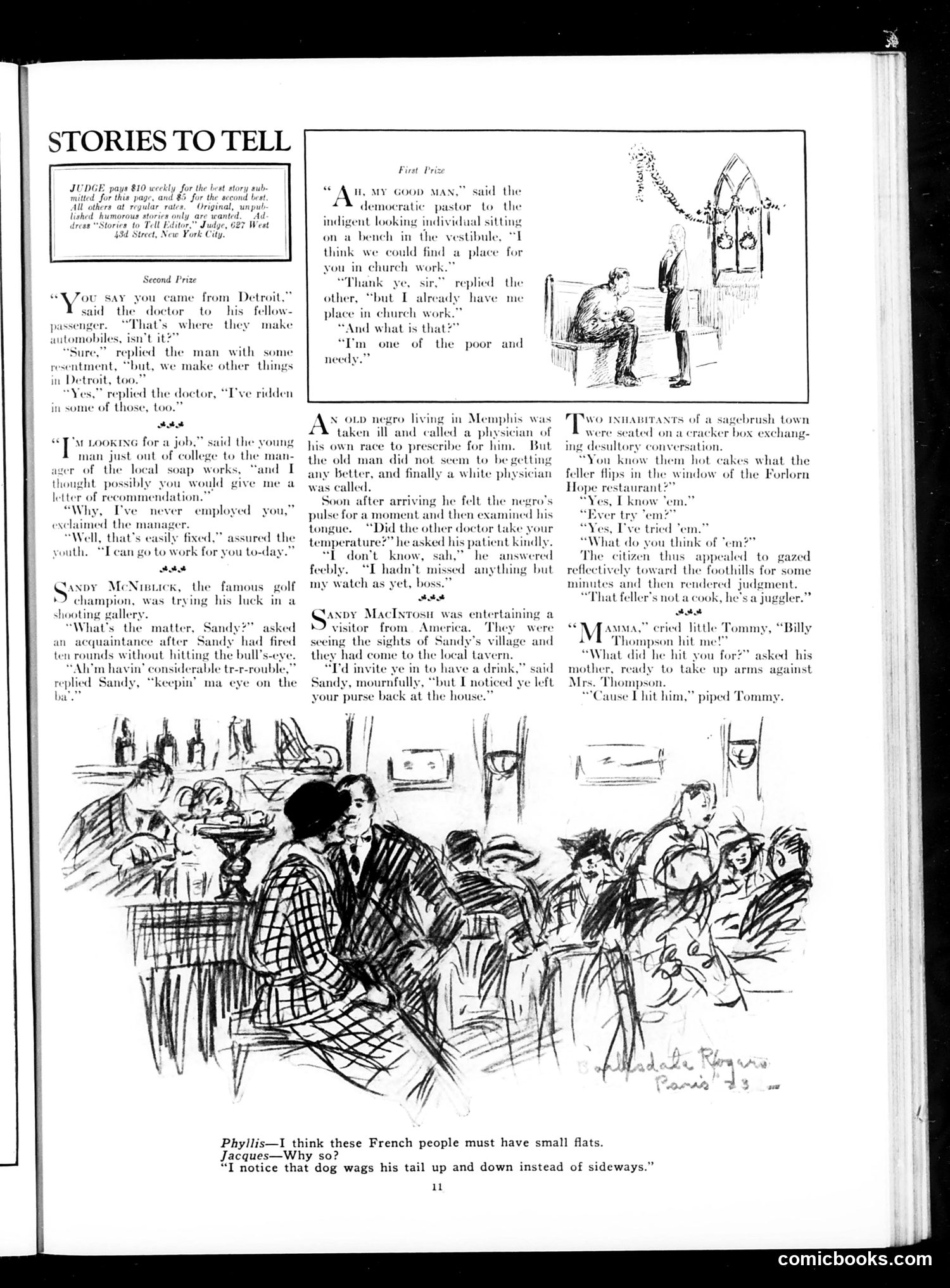
This page contains several short humorous stories typical of early 20th-century American humor magazines. **The cartoons satirize:** 1. **Class and poverty**: A democratic pastor offers church work to a poor man, who reveals he's already employed as "one of the poor and needy"—suggesting the church itself relies on poverty to justify its charitable mission. 2. **Medical incompetence**: A Black physician in Memphis examines a patient but the man only notices his watch is missing, implying the doctor was inattentive or negligent. 3. **Social stereotypes**: Stories feature rural characters, a young job-seeker, a golfer, Scottish visitors, and a child—all rendered through period dialect and exaggerated characteristics common to the era. 4. **The final joke** contrasts French and American life: A character notes a French dog wags its tail vertically rather than sideways, humorously "explaining" why French apartments must be small—lacking horizontal space. The humor relies on wordplay, dialect, character types, and mild social observation rather than sharp political satire, reflecting the magazine's general entertainment purpose.
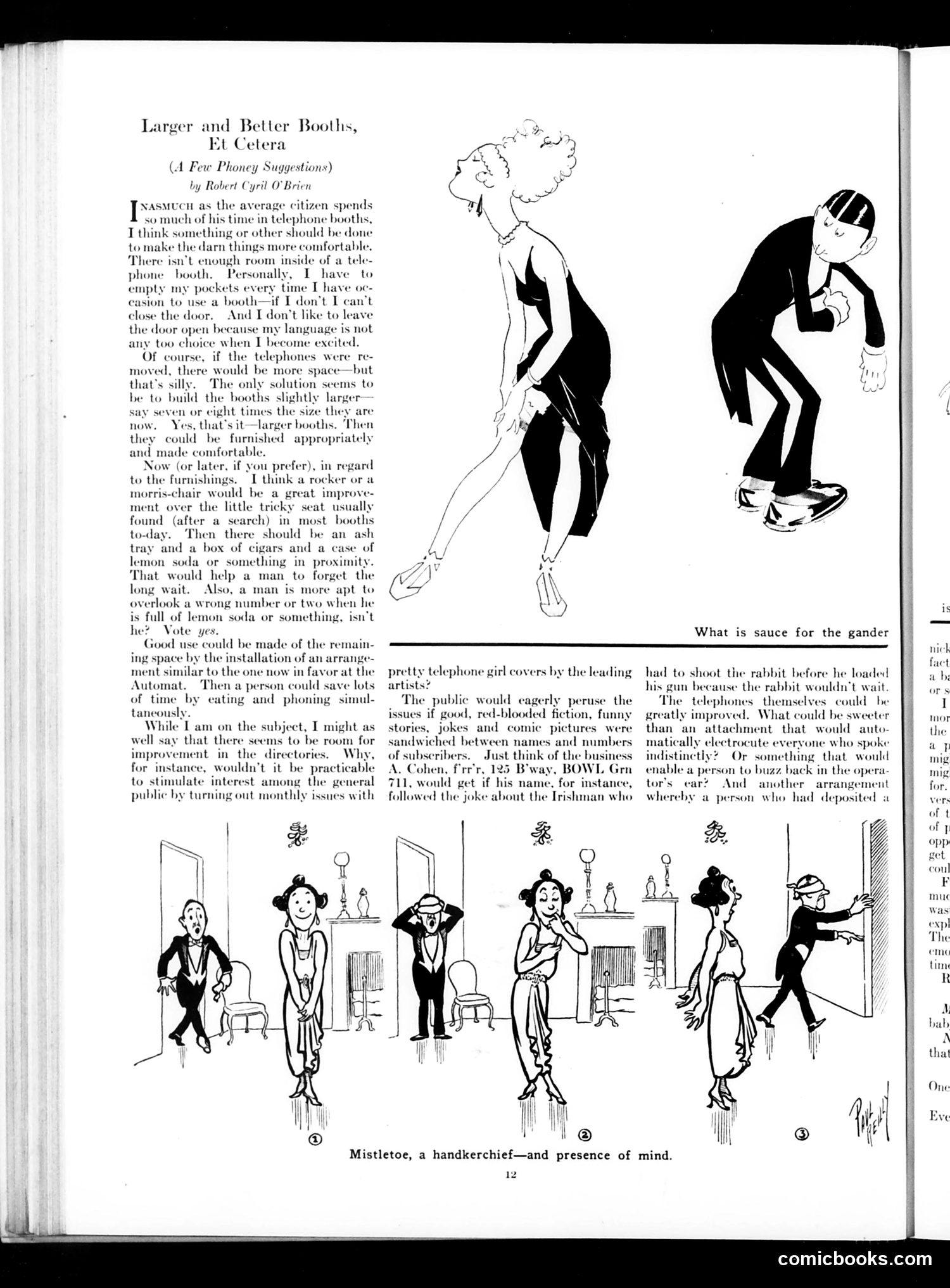
This satirical piece mocks the discomfort of public telephone booths—then ubiquitous in American life—by proposing absurdly elaborate "improvements." The author complains that booths are cramped, forcing users to empty their pockets to close the door. His tongue-in-cheek solutions escalate from reasonable (make booths bigger) to ridiculous: furnish them with rockers and Morris chairs, stock them with cigars and lemon soda, install Automat-style food dispensers, and print entertaining fiction in phone directories to amuse waiting callers. The accompanying comic strip illustrates increasingly desperate scenarios of people struggling in phone booths—standing awkwardly, contorting themselves, appearing flustered or embarrassed. The satire reflects early-to-mid 20th-century American life when public telephones were essential infrastructure. The joke's appeal lay in readers' shared frustration with genuinely cramped, uncomfortable booths. The humor punches at ordinary civic inconvenience rather than political targets, making this light social commentary rather than sharp satire.
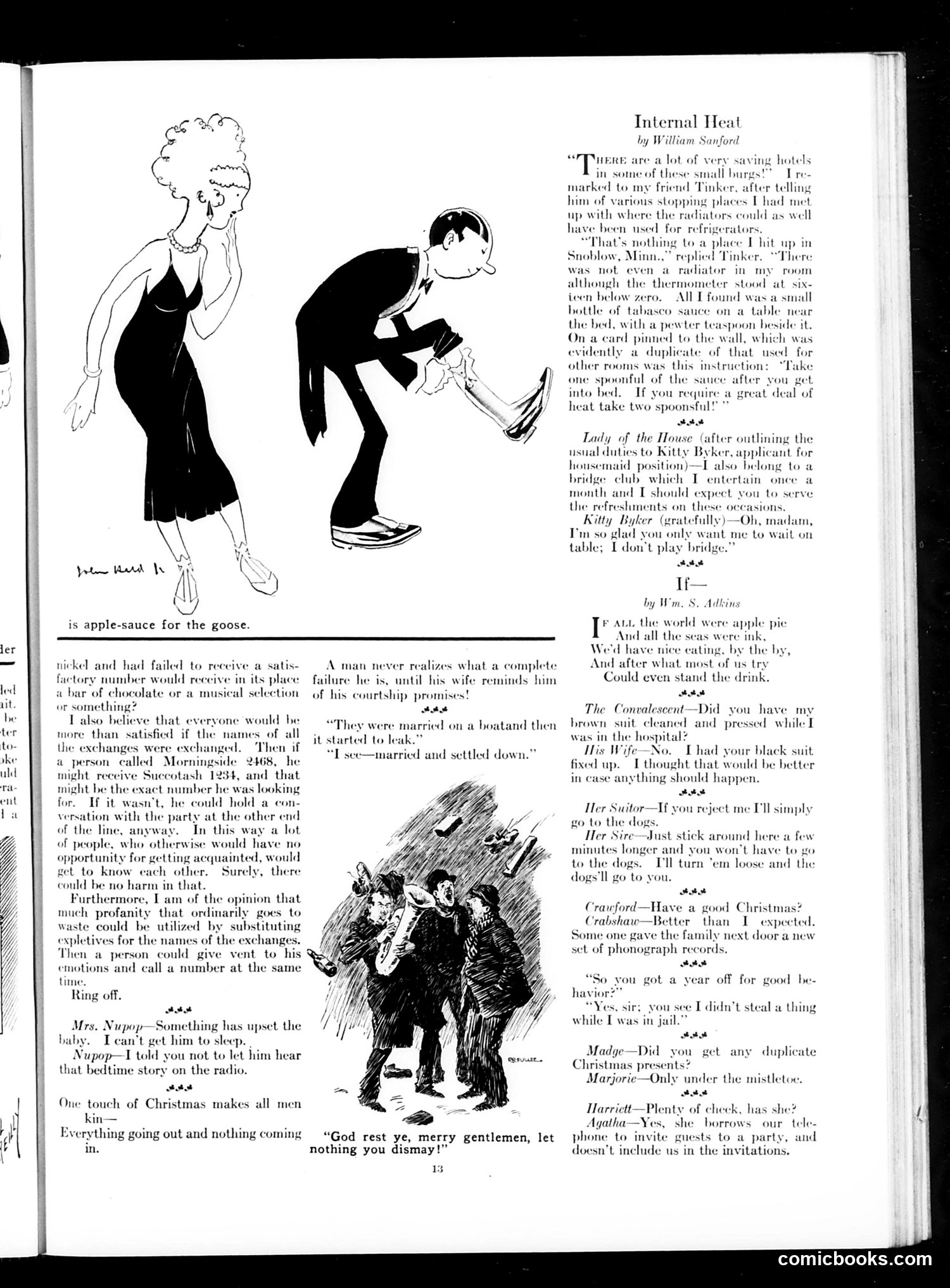
This Judge magazine page contains satirical vignettes about domestic life and social situations, circa early 20th century. **Top cartoon**: A man bends over awkwardly while a woman watches—illustrating the story "Internal Heat" about stingy hotels. A guest in a Minnesota hotel with no radiators receives only tabasco sauce as heating, with instructions to eat spoonfuls for warmth. The satire targets miserly hotel owners and absurd cost-cutting. **Lower cartoon**: Carolers outside a home, labeled "God rest ye, merry gentlemen, let nothing you dismay!"—a straightforward holiday illustration. **Text sections**: Short humorous anecdotes mocking everyday frustrations: telephone exchange confusion, radio bedtime stories keeping babies awake, wives reminding husbands of broken promises, and servants navigating employer expectations (the maid relieved she only serves at table, not play bridge). The humor is gentle domestic satire aimed at middle-class readers—poking fun at stinginess, miscommunication, and social pretension rather than serious political commentary.
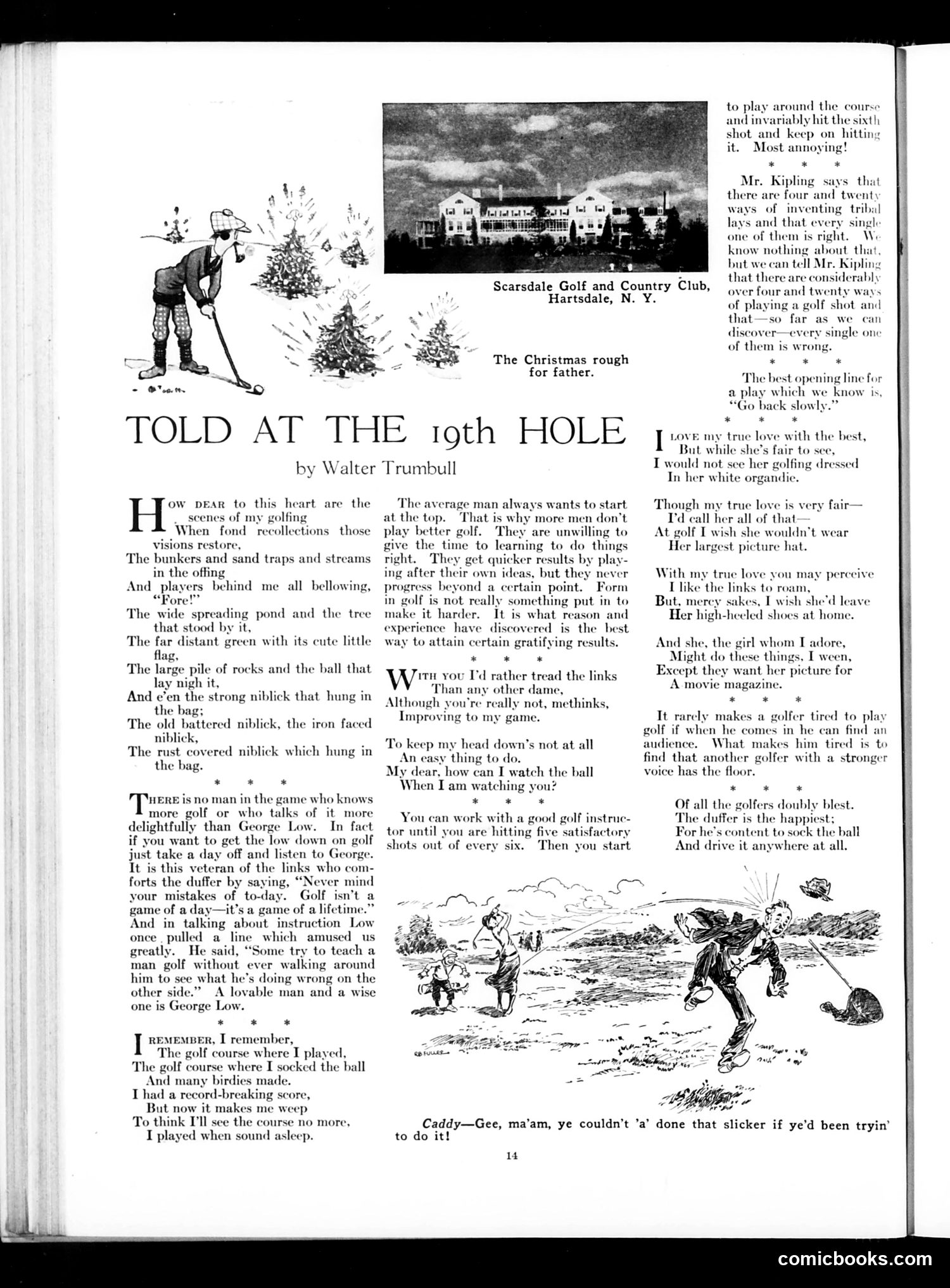
This page presents humorous golf sketches and poems by Walter Trumbull, typical of Judge magazine's satirical sports commentary. The content targets amateur golfers—"duffers"—and their common frustrations. The central joke mocks golfers' self-delusion: they blame external factors (rough terrain, weather, distractions) rather than their own poor technique. The piece quotes golf instructor George Low offering comfort to struggling players, while simultaneously critiquing how amateurs resist proper instruction, preferring quick results over disciplined practice. The illustrated cartoon at bottom shows a caddy complimenting a female golfer's shot in exaggerated fashion—likely satirizing how golfers seek external validation rather than honest assessment of their play. Recurring themes include the gap between golfers' pretensions and actual ability, the hazards of romantic distraction on the links, and the universal excuse-making that defines amateur golf culture. The humor relies on readers' familiarity with golf's frustrations.
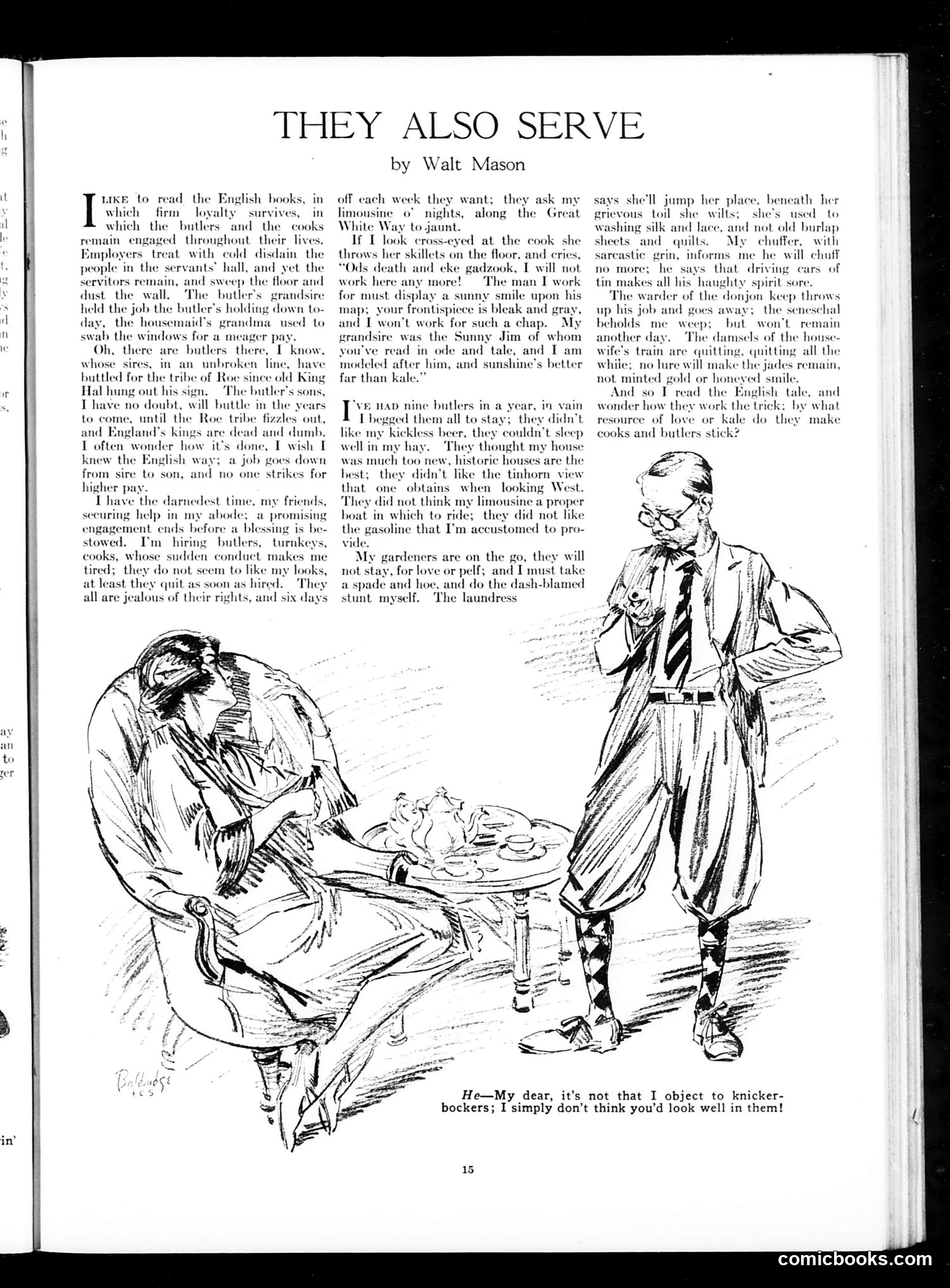
This Walt Mason satirical poem mocks American employers struggling to retain domestic servants during a period of labor unrest and changing social attitudes (likely post-WWI era, based on references to modern conveniences like limousines and automobiles). The cartoon illustrates the tension: a seated woman (employer) speaks to a standing man (servant or job applicant), with the caption revealing she objects to his knickerbockers—a trivial fashion complaint that ironically captures the piece's larger point. **The satire:** Mason contrasts romanticized English servant traditions—where butlers inherit positions across generations—with America's reality: servants now demand reasonable working conditions, decent employers, modern accommodations, and respect. They "quit as soon as hired." The humor lies in the employer's bewilderment that American workers won't accept the old hierarchical servitude model. Mason suggests employers' petty complaints (appearance, car quality, house age) drive away help, while workers now assert "jealous of their rights." The underlying social commentary: traditional servant culture is dead in democratic America; workers now have leverage and self-respect.
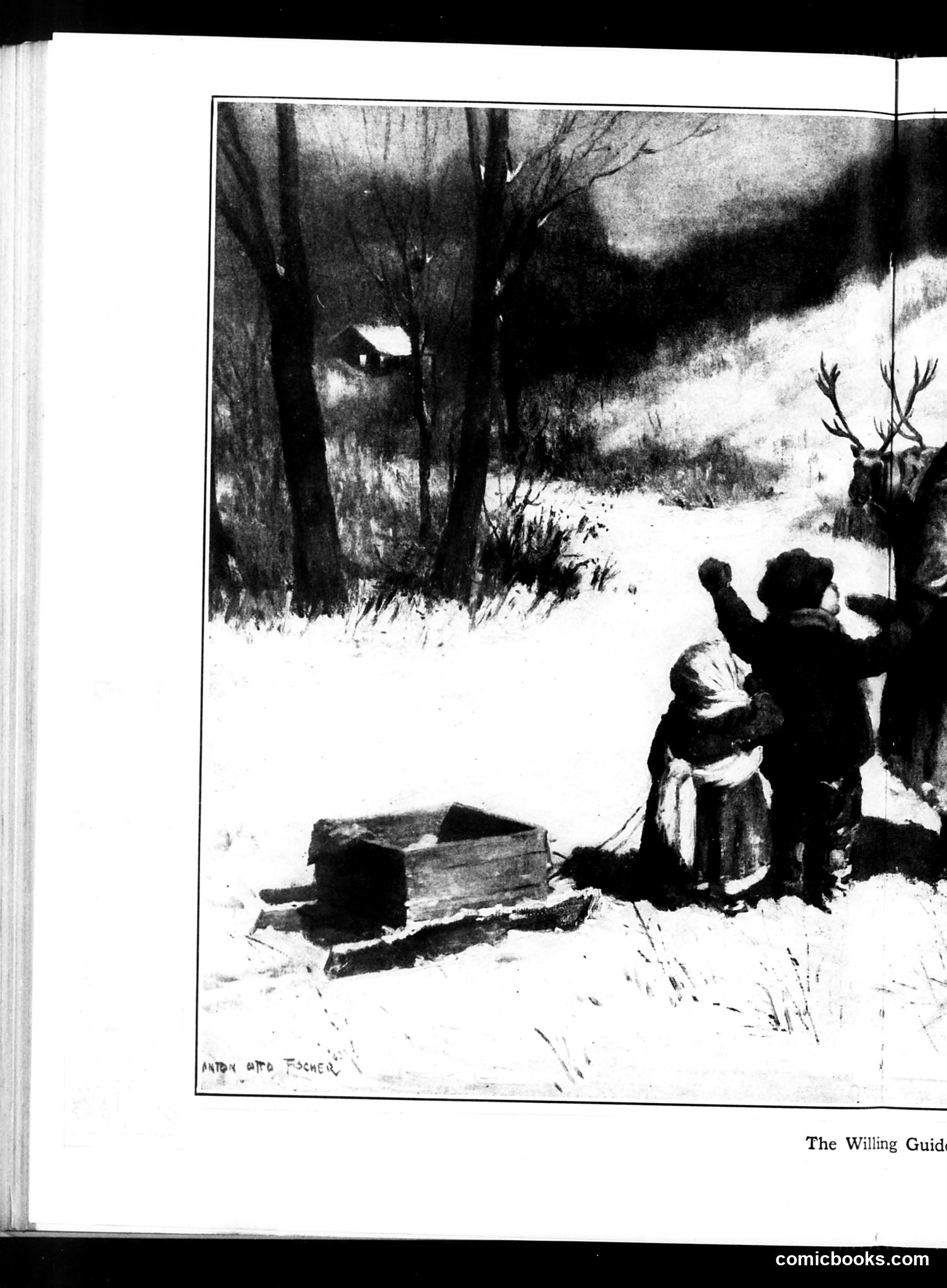
This appears to be an illustration (signed by Anton Otto Fischer) titled "The Willing Guide." The black and white artwork depicts a winter scene with bare trees, snow, and what appears to be a small cabin in the distance. In the foreground, two figures stand near a wooden box or sledge. The image's satirical meaning is unclear from the visual alone. The title "The Willing Guide" suggests commentary on someone acting as a guide, possibly with ironic intent—the "willing" guide may be leading others astray or into danger, though the specific political or social reference is not evident. Without additional context about Judge magazine's publication date or contemporary events, the precise satirical target cannot be determined. The snowy, isolated setting might suggest hardship or deception, but this remains speculative.
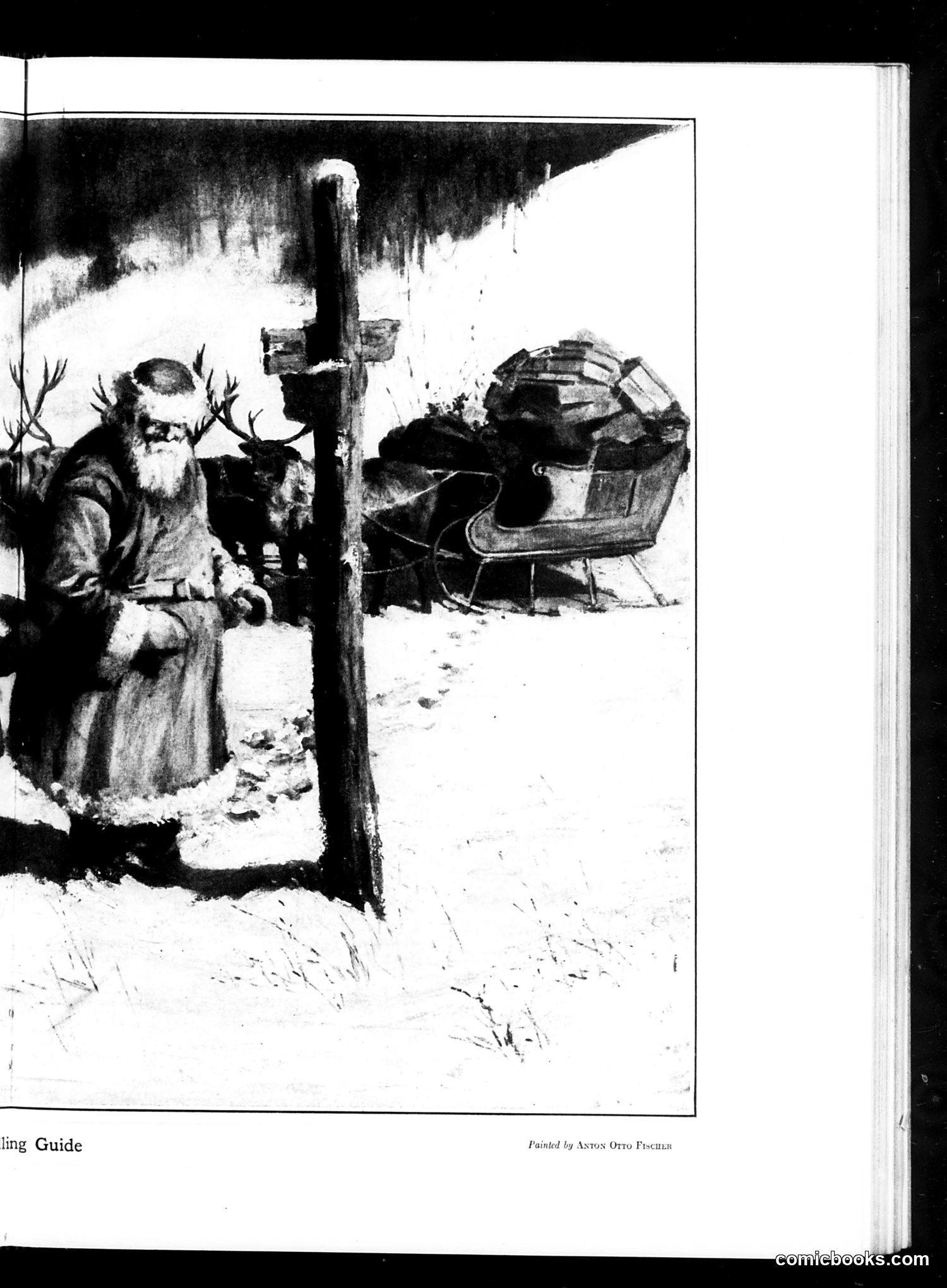
This appears to be a winter-themed illustration from Judge magazine, painted by artist Axtos Otto Fischun. The image shows a bearded figure in period dress standing near a wooden cross in a snowy landscape, with what looks like a sled or sleigh visible in the background. Without additional caption text visible on this page, the specific satirical point is unclear. However, given Judge's tradition of political and social satire, this likely comments on a contemporary issue—possibly relating to frontier life, immigration, winter hardship, or religious themes—though the exact reference cannot be determined from the image alone. The cross suggests possible commentary on faith or mortality in harsh conditions.
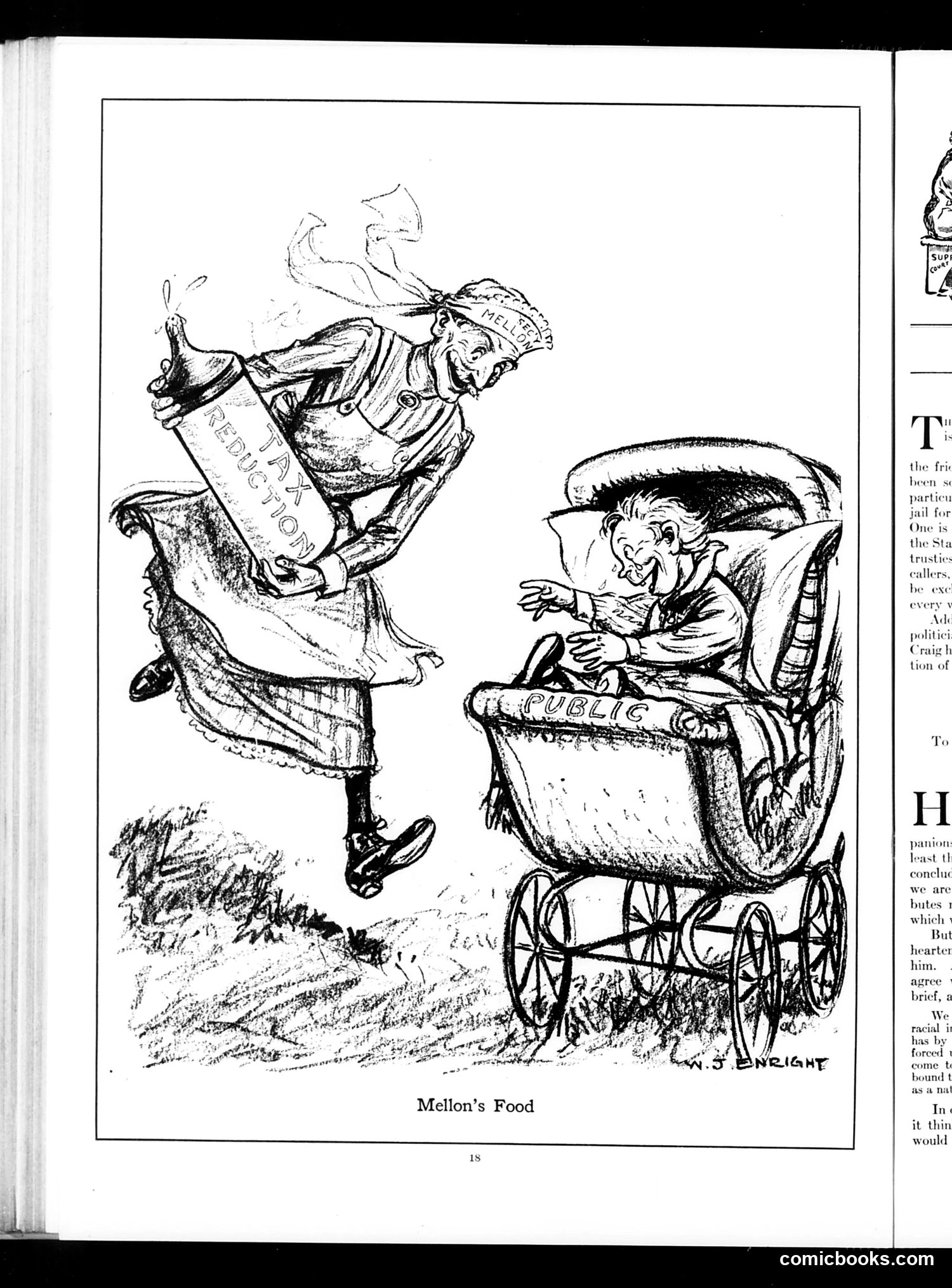
This cartoon satirizes Andrew Mellon, Secretary of the Treasury under Presidents Harding and Coolidge. The figure on the left, labeled "MELLON," holds a bottle marked "REDIRECT" while tossing coins upward gleefully. On the right, a baby labeled "PUBLIC" sits in a carriage, appearing to receive inadequate nourishment. The satire criticizes Mellon's fiscal policies—specifically his wealth redistribution approach favoring the rich and corporations while providing minimal public services. The "food" reference suggests the public receives only scraps while wealth is redirected upward to the wealthy. This reflects 1920s progressive criticism of Mellon's tax cuts for the wealthy during a period of economic inequality, depicting his policies as starving essential public needs while enriching elites.
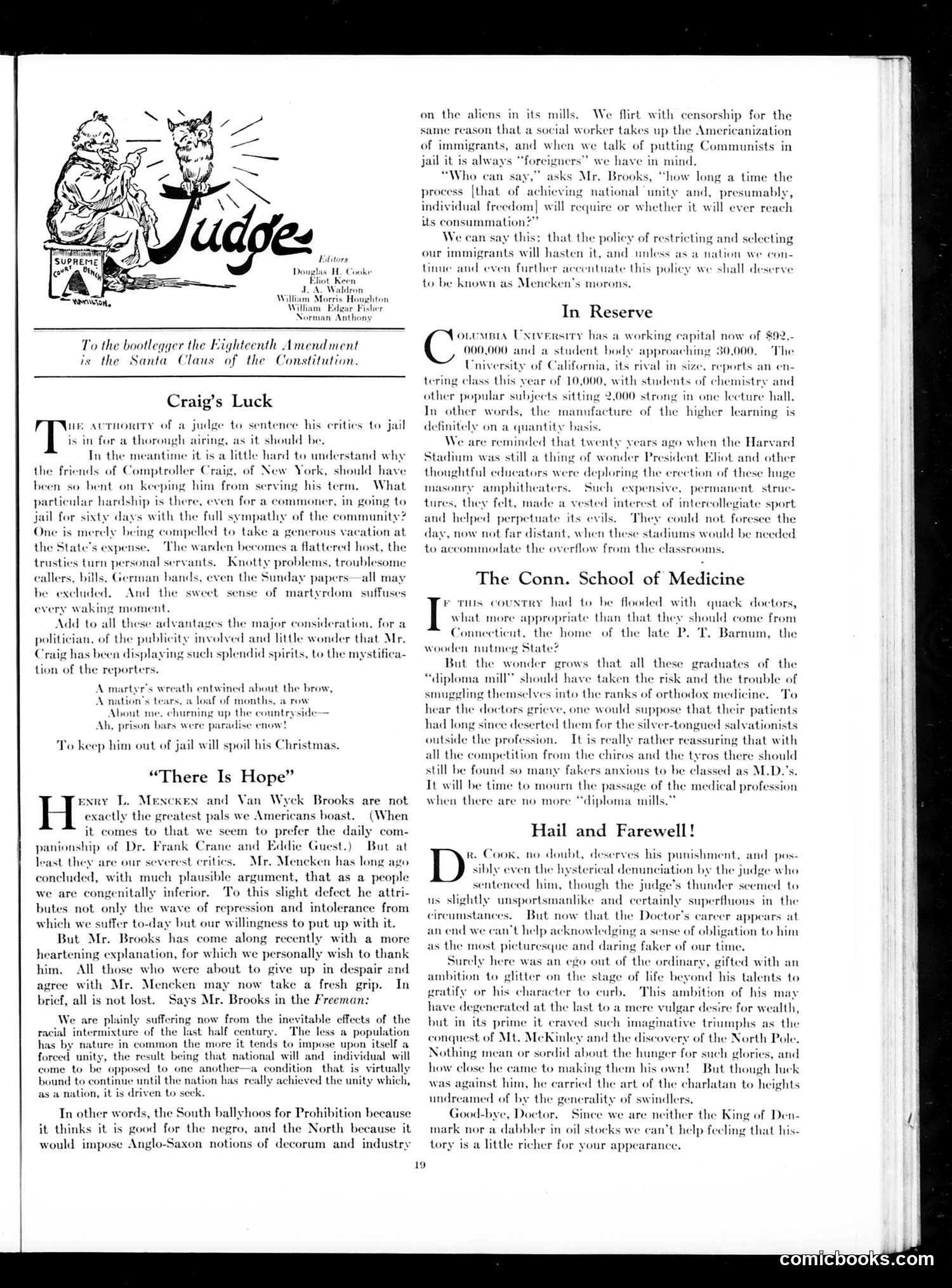
**The "Judge" Logo Cartoon:** The masthead illustration depicts an owl (representing wisdom/judgment) instructing a jester or fool figure—a visual pun on the magazine's name and satirical purpose. **"Craig's Luck":** This article sarcastically defends Comptroller Craig of New York's jail sentence for 60 days. The satire argues that prison is essentially a pleasant vacation—the warden becomes a "flattered host," one avoids bills and social obligations, and martyrdom brings publicity and sympathy. The piece mocks both Craig's supporters and society's sentimental treatment of jailed public figures. **"There Is Hope":** Responding to H.L. Mencken's pessimism about American inferiority, Van Wyck Brooks argues that restricting immigration will accelerate national unity. The satire criticizes this logic: the South supports Prohibition to control Black citizens; the North imposes it on immigrant factory workers; censorship and anti-Communist jailing target "foreigners." The piece suggests if America continues this discriminatory policy, it deserves to be called "Mencken's morons." The underlying satire targets nativist restrictions and their flimsy justifications.
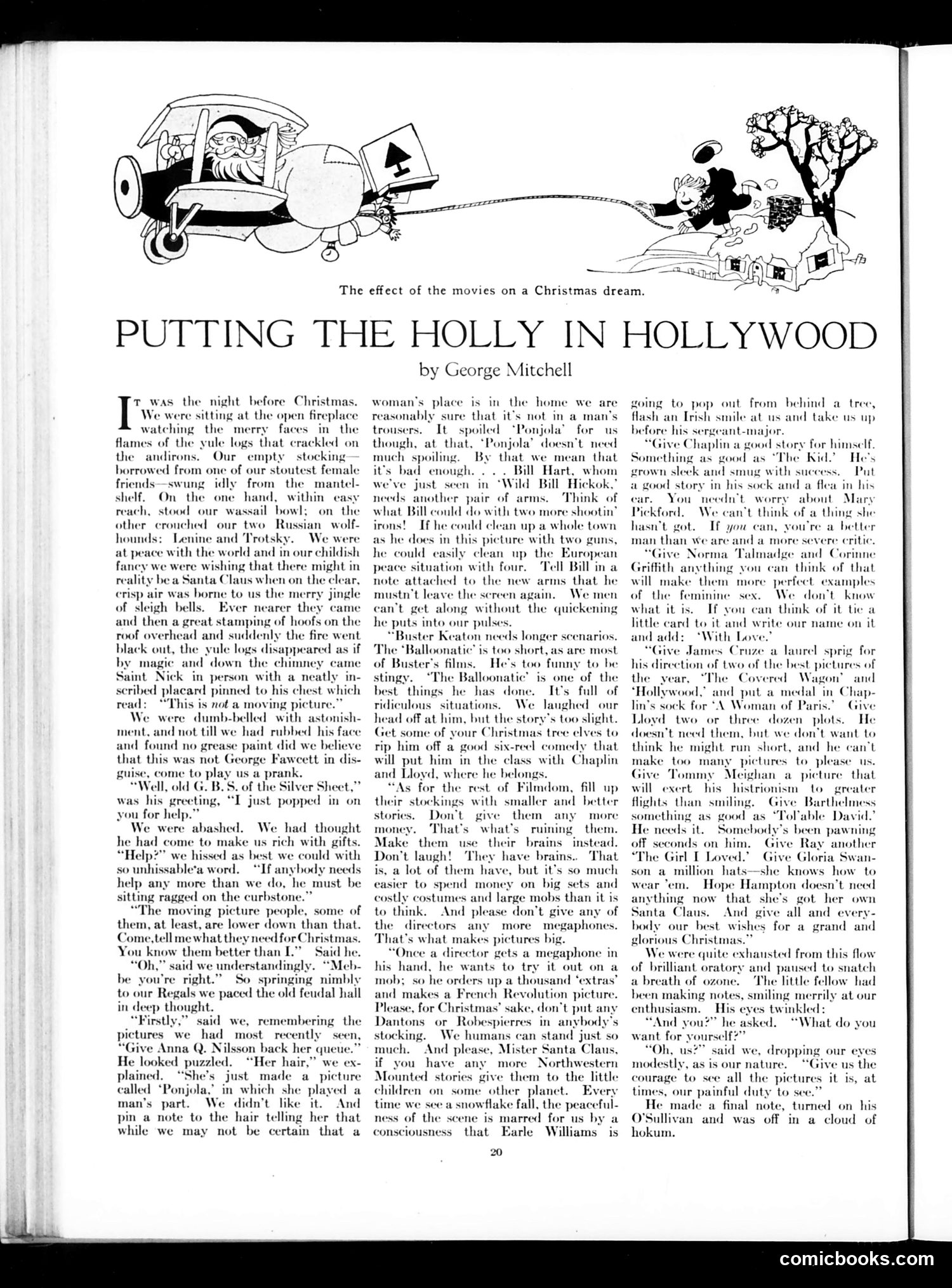
This is a satirical film-criticism piece disguised as a Christmas fantasy. Santa Claus visits the author to deliver harsh critiques of contemporary Hollywood movies. The satire targets: 1. **Anna Q. Nilsson** in "Ponjola"—mocked for playing a man's role, violating the author's belief that women belong in domestic roles 2. **Bill Hart** (western star)—joked that he needs extra arms to properly shoot up towns, implying his films are repetitive action vehicles 3. **Buster Keaton** in "The Balloonatic"—praised but criticized for making shorts instead of full-length features, wasting his comedic talent 4. **General Hollywood practices**: The author criticizes filmmakers for relying on expensive sets, costumes, and large casts rather than investing in quality scripts and storytelling The cartoon's satire is light but pointed—Hollywood prioritizes spectacle and production values over narratives and character development. The "not a moving picture" sign humorously signals this is social commentary, not entertainment.
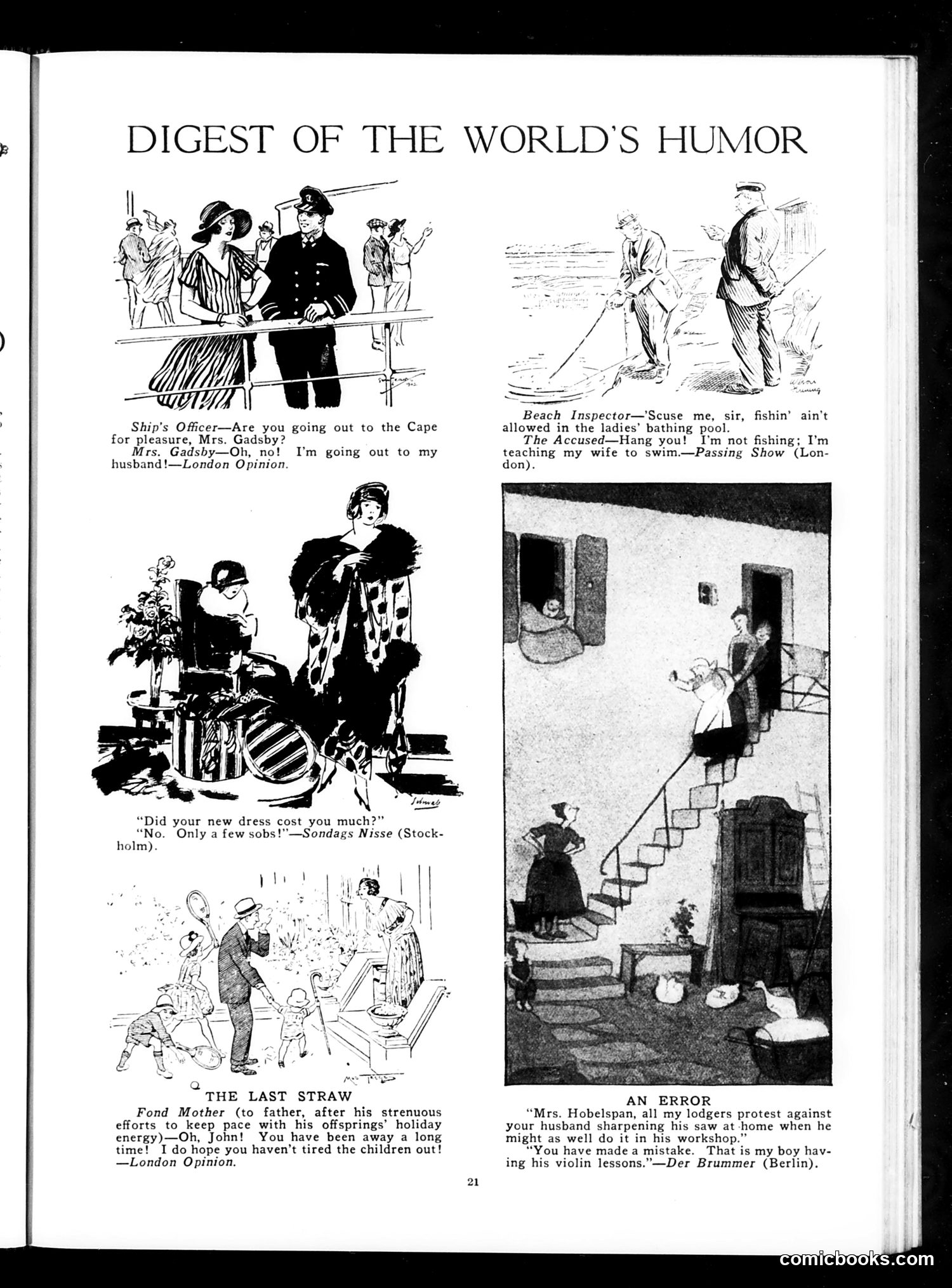
This page collects brief humorous anecdotes from international publications, illustrating early 20th-century domestic and social comedy. **Key jokes:** - **Mrs. Gadsby**: A wife prioritizes visiting her husband over leisure travel—humor from gender role expectations. - **Dress cost**: A woman's tears ("sobs") are the "price" of her dress, mocking frivolous spending and emotional female stereotypes. - **The Last Straw**: A father exhausted from managing children's holiday energy; the irony is the mother criticizes him for *not* tiring them out—satirizing parental expectations and energy demands. - **Beach Inspector**: A man teaches his wife to swim in a ladies' bathing pool, claiming innocence; the "fishing" metaphor suggests improper behavior. - **An Error**: A neighbor misidentifies saw-sharpening as violin lessons—absurdist humor about domestic noise complaints. These reflect period attitudes about marriage dynamics, class, parenting, and gender separation in public spaces. The international sourcing emphasizes humor transcends borders.
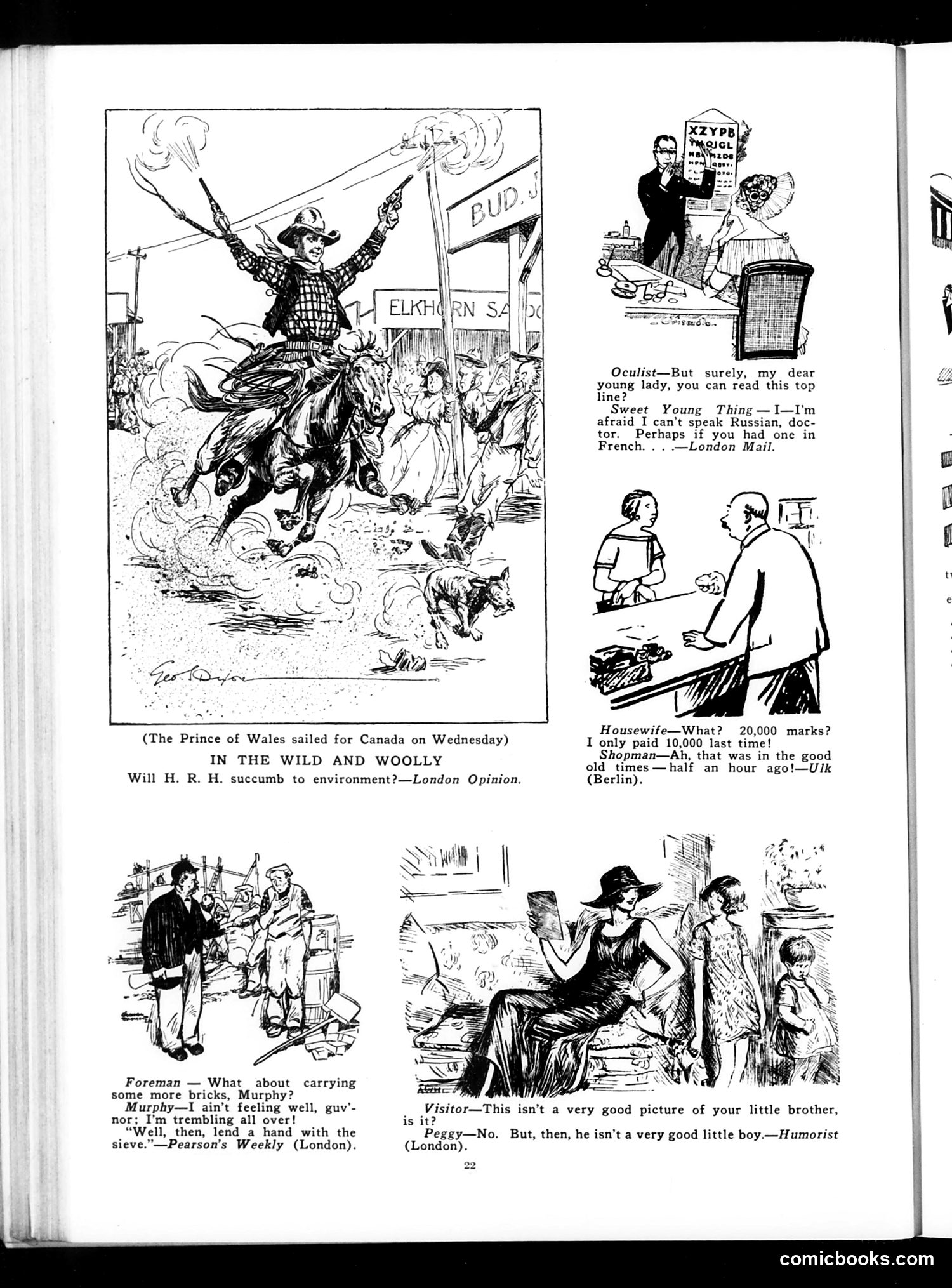
This page contains four separate satirical comics and jokes from various British and American publications, reflecting early 20th-century concerns: 1. **"In the Wild and Woolly"**: A large cartoon about the Prince of Wales traveling to Canada, satirizing whether he'll be corrupted by rough frontier culture. 2. **Eye exam joke**: A young woman mistakes an eye chart for Russian text—mocking linguistic confusion or perhaps post-WWI anxieties about foreign languages. 3. **Berlin inflation joke**: A housewife shocked that prices doubled in mere hours, reflecting the catastrophic German hyperinflation of the early 1920s. 4. **Two domestic humor sketches**: A worker feigning illness to avoid labor, and a girl's unflattering portrait of her brother—gentle domestic satire typical of British humor magazines. The page emphasizes international post-war economic turmoil and cultural anxieties of the 1920s-era readership.
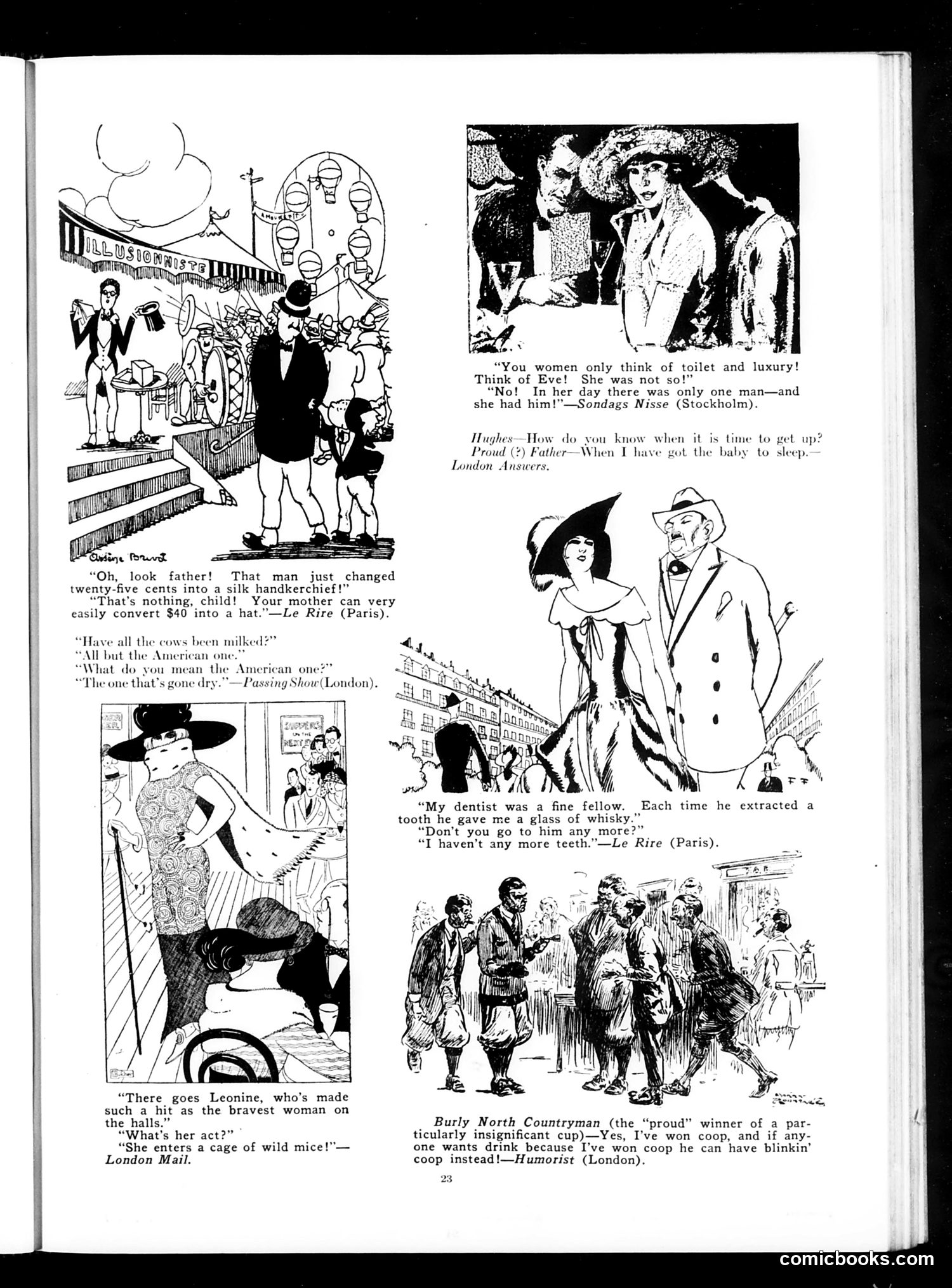
This page collects humorous one-liners and cartoons from various international publications, presented as cultural commentary. The jokes mock stereotypes and social behaviors of the era: **Key themes:** - **Gender roles**: Women criticized for materialism ("convert $40 into a hat"), yet the Adam and Eve joke inverts this, suggesting women's real complaint is lack of male attention. - **American materialism**: The "dried-up cow" joke implies Americans are commercially exploited or depleted. - **Class/consumption**: The magician converting coins to silk handkerchiefs represents consumer deception; the dentist joke satirizes pain tolerance through alcohol dependency. - **Masculine pride**: The "Burly North Countryman" boasts about a trivial trophy win, illustrating working-class vanity and drinking culture. The cartoons use exaggerated line drawings typical of early 20th-century satirical illustration. The page demonstrates Judge's practice of reprinting European humor to entertain American audiences with comparative cultural observation.
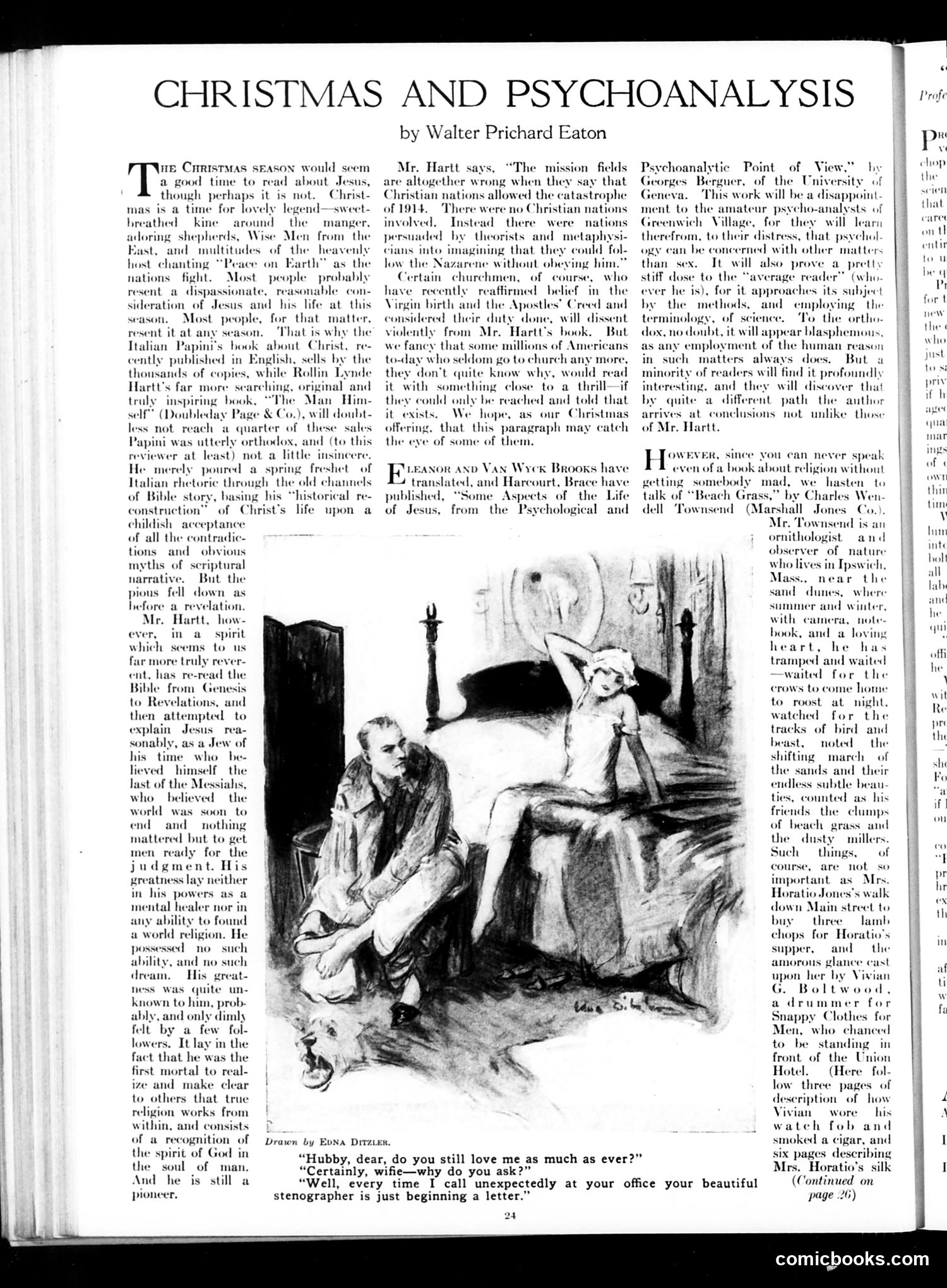
This page reviews religious books about Jesus through a modern, rational lens. Critic Walter Prichard Eaton praises Rollin Lynde Hartt's scholarly approach over Giovanni Papini's flowery, uncritical retelling—Hartt examines Jesus as a historical Jewish figure of his time rather than accepting biblical mythology. The accompanying cartoon (by Edna Dittler) satirizes modern marriage dynamics. A husband asks his stenographer-distracted wife why she questions his love. The joke: her "beautiful stenographer" is becoming the real focus of his attention, reflecting anxieties about workplace temptation and changing gender roles in the early 20th century. Together, the page advocates for rational, honest examination—whether of religion or relationships—over sentimentality and self-deception. The psychoanalytic framework (referencing Freud's influence) promises to expose uncomfortable truths beneath social convention.
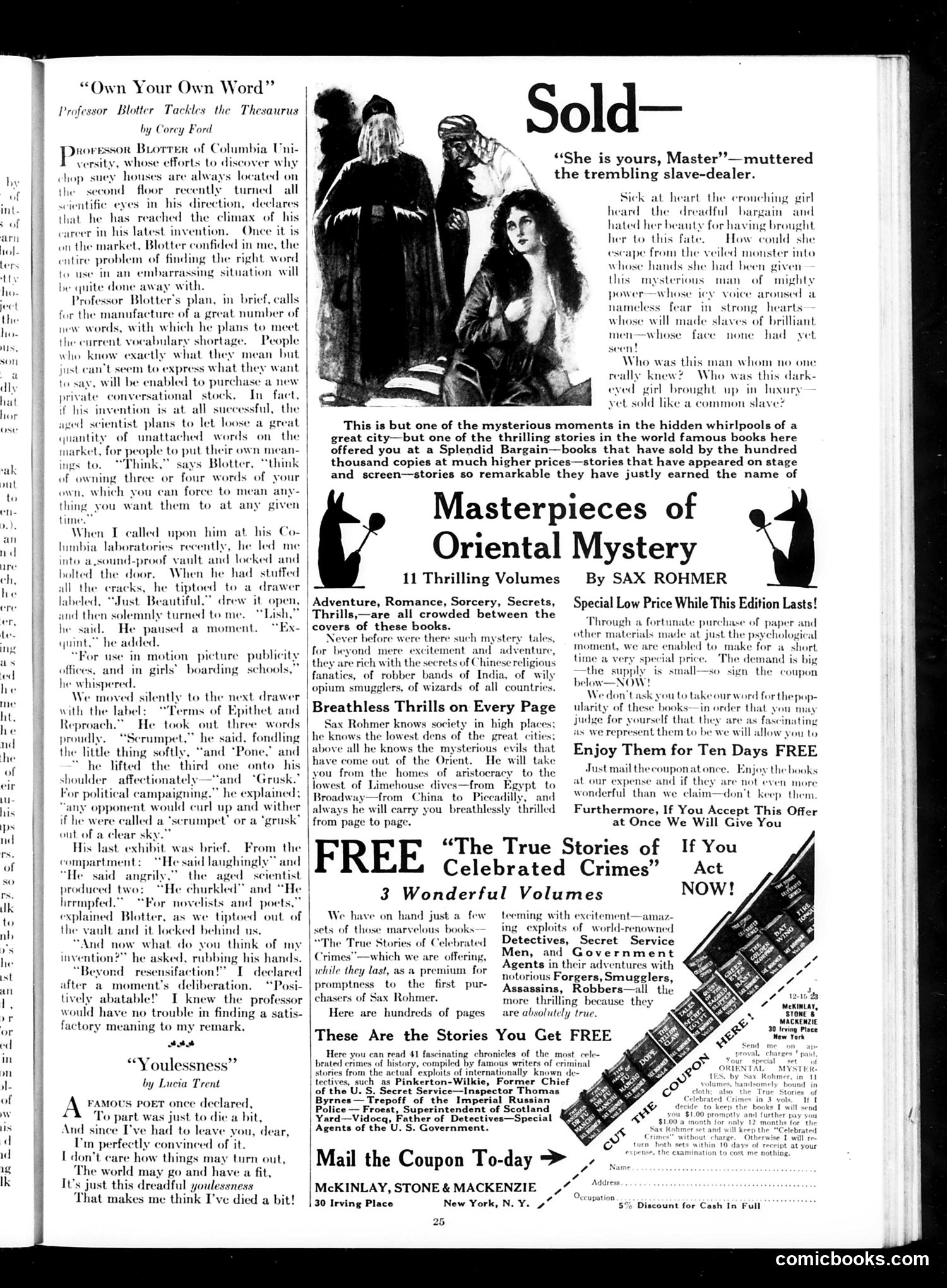
This page contains **two satirical pieces** plus advertisements: **"Own Your Own Word"** (top): A humorous article by Corey Ford mocking academic pretension. Professor Blotter, a Columbia scientist, invents manufactured words to solve vocabulary shortages. The satire targets how intellectuals overcomplicate language—Blotter creates absurd neologisms like "Serumpet," "Grusk," and "Resensifaction" as solutions. The joke is that inventing new words doesn't solve the problem of actual communication; it's self-parody of academic verbosity. **"Youlessness"** (bottom left): A sentimental poem by Lucia Trent about romantic separation, presented somewhat mockingly alongside the word-invention satire—another commentary on overwrought emotional language. **"Sold—"** (center/right): An advertisement for sensationalist mystery novels ("Masterpieces of Oriental Mystery"), using melodramatic descriptions of enslaved women to market exotic adventure stories. The page juxtaposes language satire with commercial exploitation of lurid fiction, suggesting how both academia and popular culture manufacture artificial emotional experiences through linguistic excess.
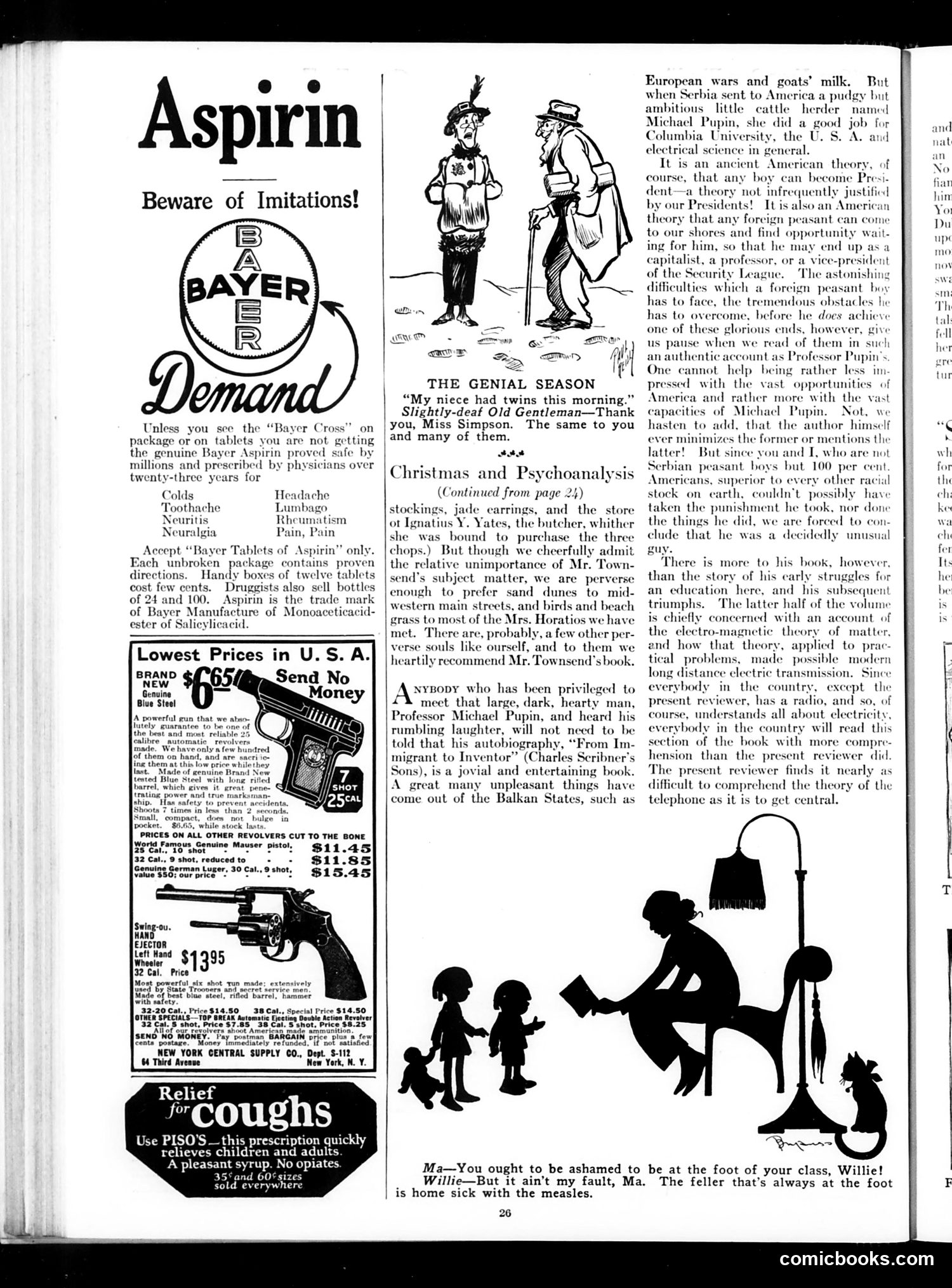
This Judge magazine page mixes advertisements with book reviews and humor. The main satirical content appears in the "Christmas and Psychoanalysis" review section and a dialogue cartoon at bottom. The cartoon depicts a mother scolding her son Willie for being at the "foot of his class," while Willie deflects blame by noting a classmate with measles is responsible. The satire targets childhood excuse-making and parental frustration. The book review discusses Michael Pupin's autobiography "From Immigrant to Inventor." The reviewer uses Pupin—a Serbian immigrant who became a Columbia University electrical engineer—to satirize American mythology. While Americans celebrate the "any boy can become president" narrative, the review ironically notes that Pupin's actual struggles reveal how unusually exceptional he was, contradicting the myth that opportunity automatically awaits foreign peasants in America. The satire critiques American self-congratulation about equal opportunity. The page also advertises Bayer Aspirin, emphasizing authenticity against imitators—itself a commercial sales pitch rather than editorial content.
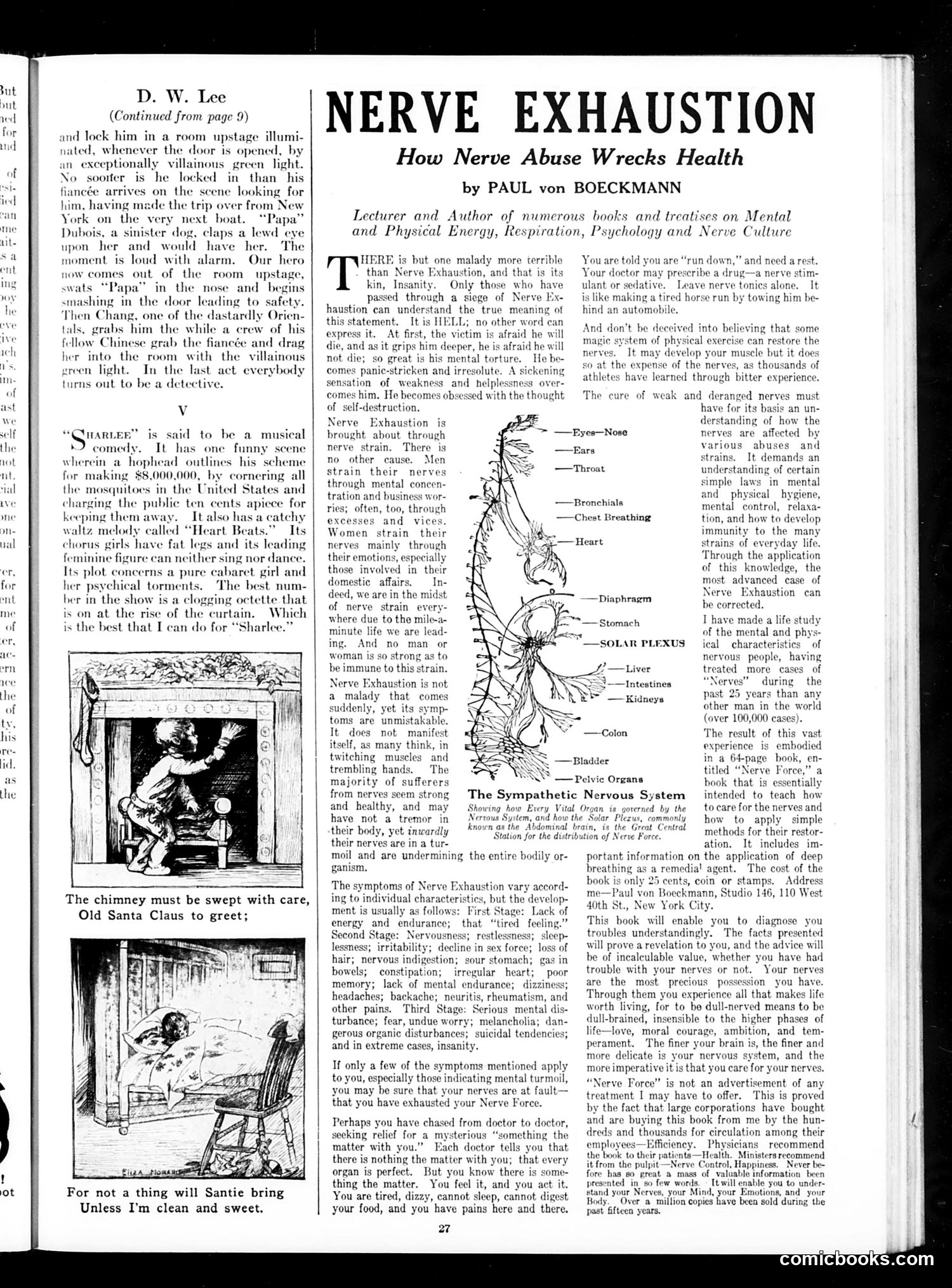
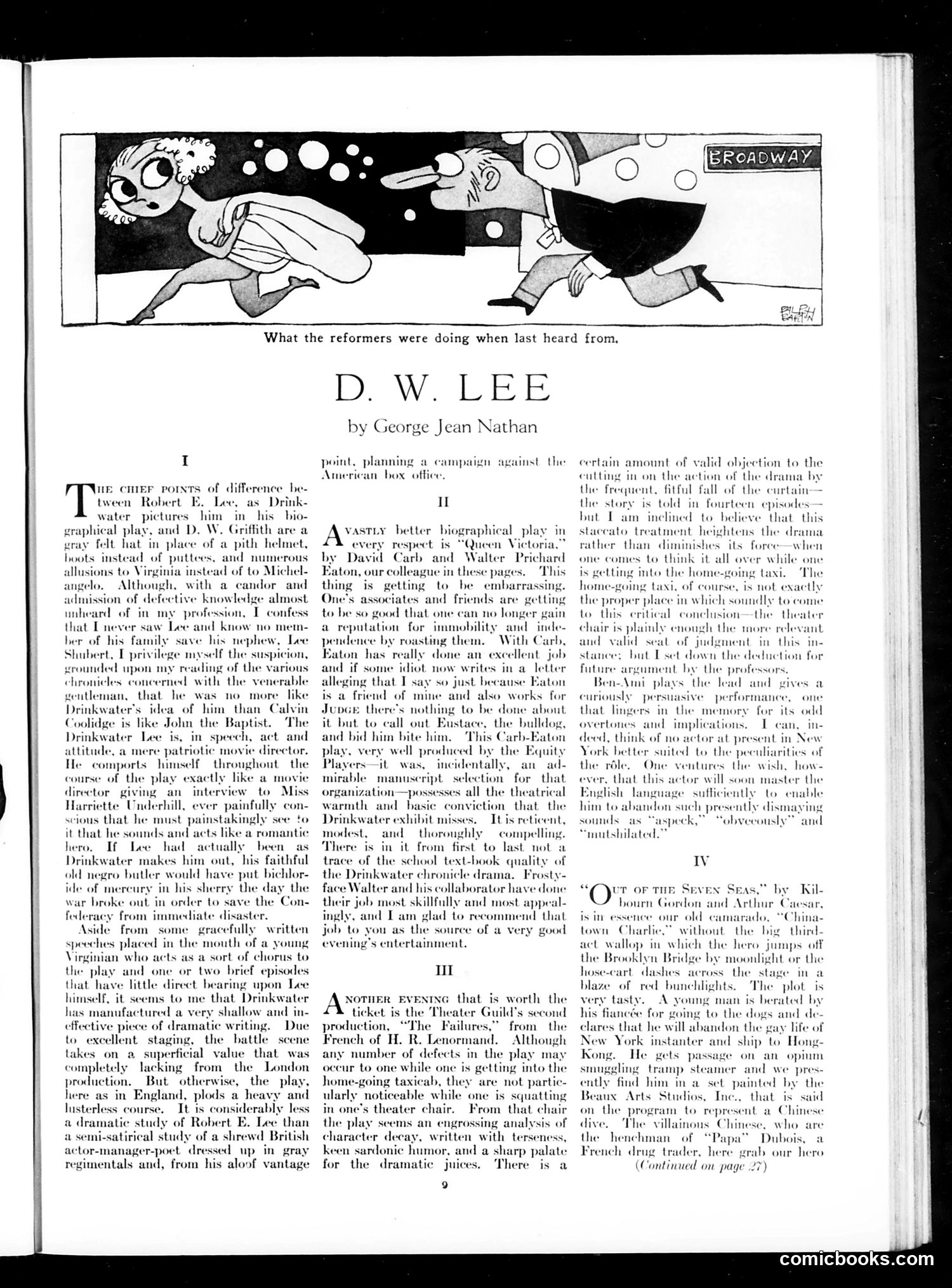
This page contains two distinct elements: theater reviews by D.W. Lee and an advertisement disguised as an article by "Paul von Boeckmann" about nerve exhaustion. **The Theater Reviews** mock two Broadway productions. "Sharlee" is ridiculed for its thin plot (involving opium dens and Chinese villains—typical orientalist melodrama tropes of the era), talentless chorus girls, and a lead actress who "can neither sing nor dance." The reviewer's backhanded compliment—that the best part is a clogging number—suggests the show is essentially worthless. **The "Nerve Exhaustion" Article** is actually promotional content for a health book. It exploits period anxieties about modern life's stress ("the mile-a-minute life") to frighten readers into purchasing the cure. The accompanying anatomical diagram and pseudo-medical authority establish false credibility. The emotional progression from fatigue to suicidal thoughts creates urgency. This represents early 20th-century medical quackery dressed in scientific language—a common advertising tactic targeting nervous, exhausted Americans. Both sections reflect Judge's satirical voice: mocking poor entertainment and fraudulent health claims.
This page is primarily **advertising and financial advice**, not political satire. The main cartoon shows a large hand dropping money into a piggy bank, illustrating the pitch: ordinary people can become wealthy through bond investments. The F.H. Smith Company promotes "First Mortgage Investments" at 6½-7½% returns, claiming investors can build wealth by investing $10-50 monthly. The accompanying article "Is It a Bull Market?" by Theodore Williams addresses skeptics who think the 1920s stock market recovery is artificial manipulation rather than genuine economic improvement. Williams argues that while some corporate claims may be exaggerated ("bluff"), underlying business conditions are genuinely improving—Secretary Mellon's tax policies support this. He concedes manipulation exists but claims it cannot succeed without solid economic foundation. The satire is gentle: the "coupon-clipping class" lifestyle represents the era's accessibility to investment, yet the very need to reassure readers suggests widespread doubt about market legitimacy.
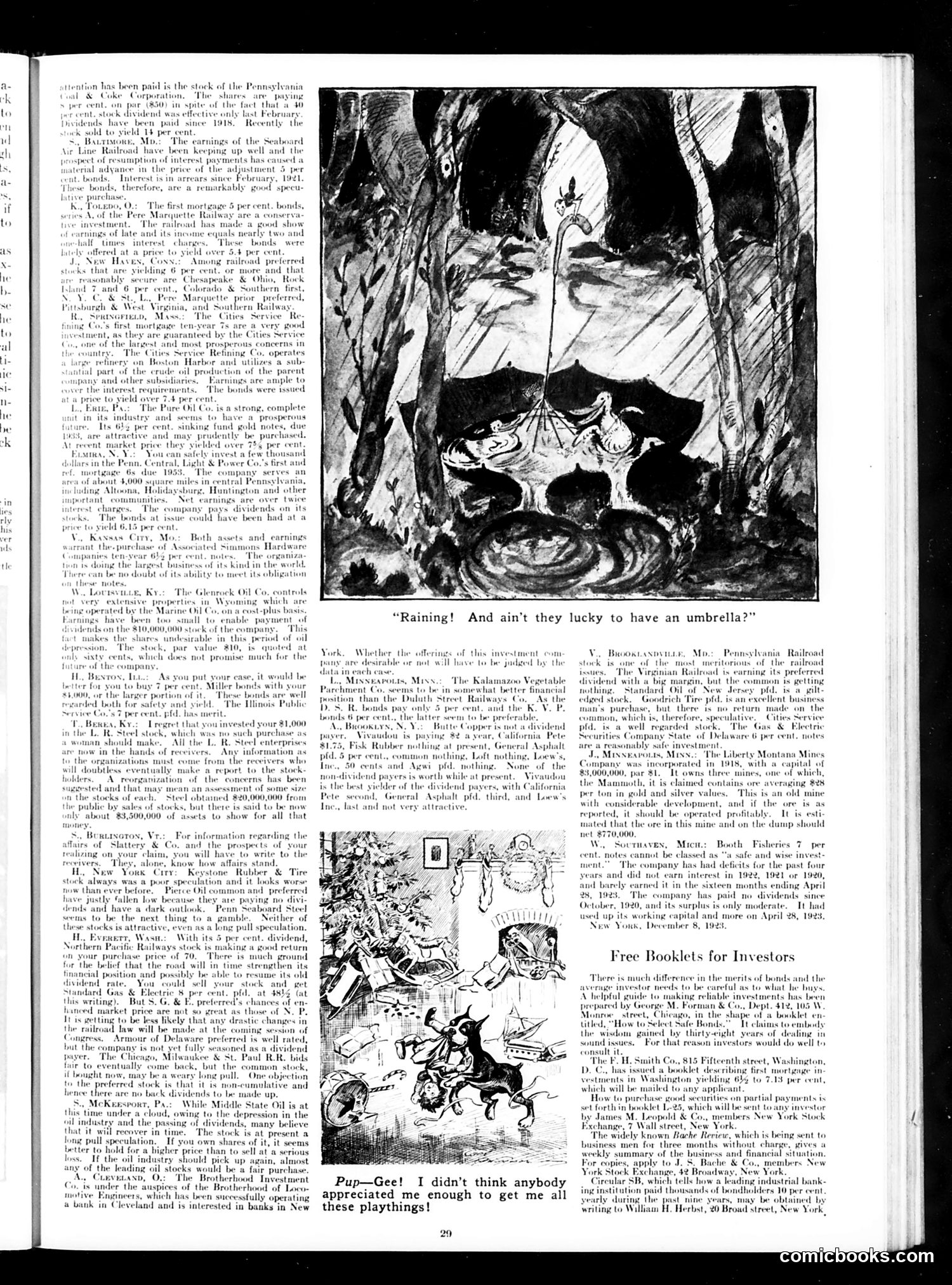
This page contains **investment advice columns** rather than political cartoons. The two illustrations are humorous asides within financial discussion: **Top cartoon:** Shows two figures sheltering in a cave during rain, with the caption "Raining! And ain't they lucky to have an umbrella?" This is a generic visual joke about seeking shelter—unrelated to the investment text. **Bottom cartoon:** Depicts a child being showered with gifts, captioned "Pup—Gee! I didn't think anybody appreciated me enough to get me all these playthings!" Again, a standalone joke. The **actual content** is straightforward financial guidance: readers write asking about various railroad bonds, petroleum stocks, and industrial securities (Pennsylvania & Coke Corporation, Seaboard Air Line, Pure Oil Co., etc.). Financial advisors respond with investment recommendations, discussing dividend yields, interest rates, and stock performance—typical 1920s investment column material. These illustrations appear to be filler content, unconnected to the investment advice that dominates the page.
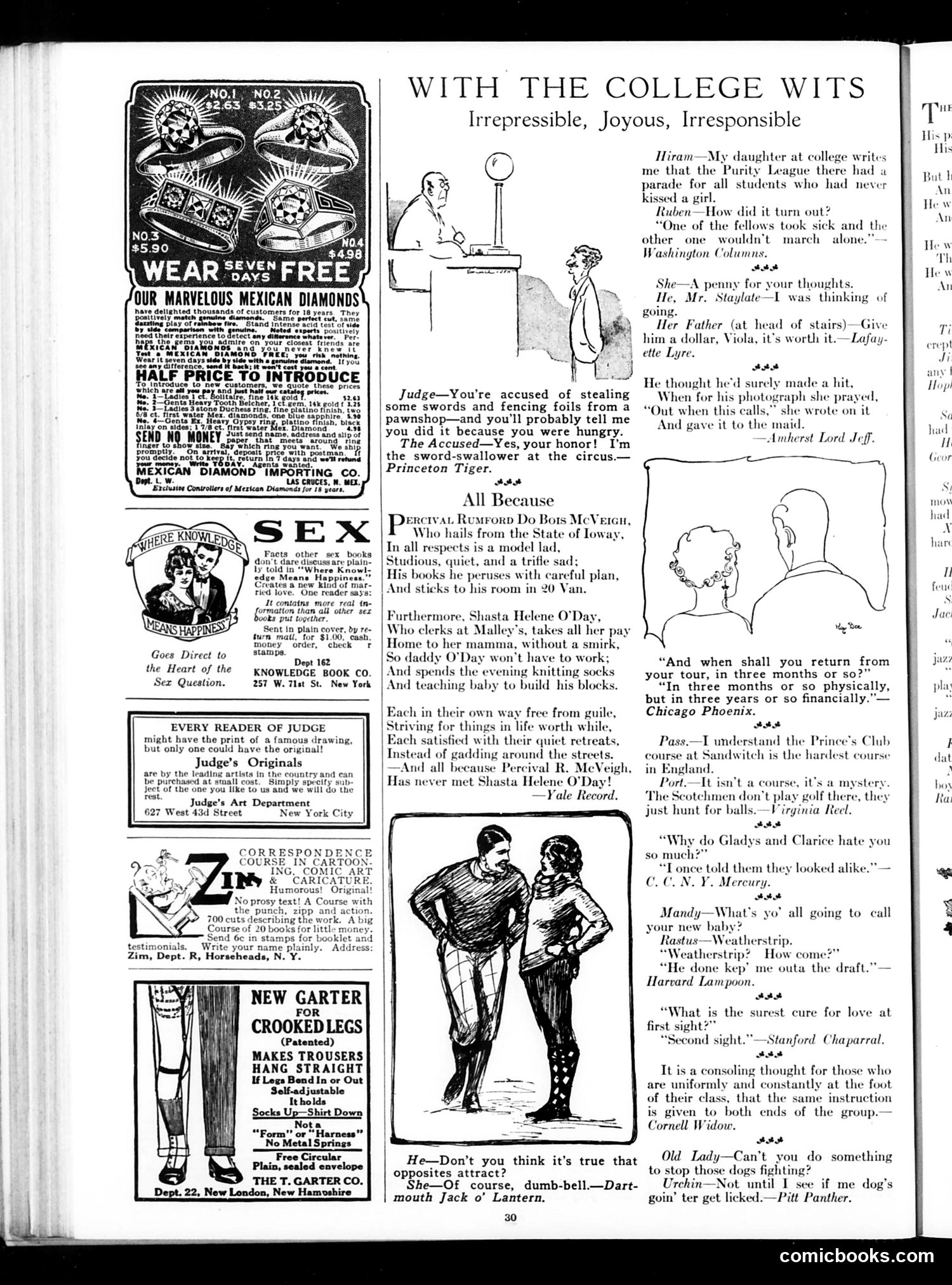
This page from *Judge* magazine consists primarily of **advertisements and college humor columns** rather than political cartoons. The main content is "With the College Wits"—a collection of brief jokes and anecdotes from college newspapers, featuring stock humor of the 1920s era: a girl who won't kiss (Purity League joke), romantic misunderstandings, and ethnic dialect humor (the "Rastus/Mandy" segment using racial caricature stereotypes common then but offensive today). One brief cartoon shows a judge sentencing a circus sword-swallower for stealing swords—a pun-based joke playing on the accused's profession. The advertisements include dubious products typical of the era: "Mexican diamonds" (likely fraudulent), sex education books marketed discreetly, and a garter device for men's trousers. The humor is **not political**—it's lighthearted college campus material reflecting 1920s social attitudes, including casual racism and gender stereotypes now considered inappropriate.
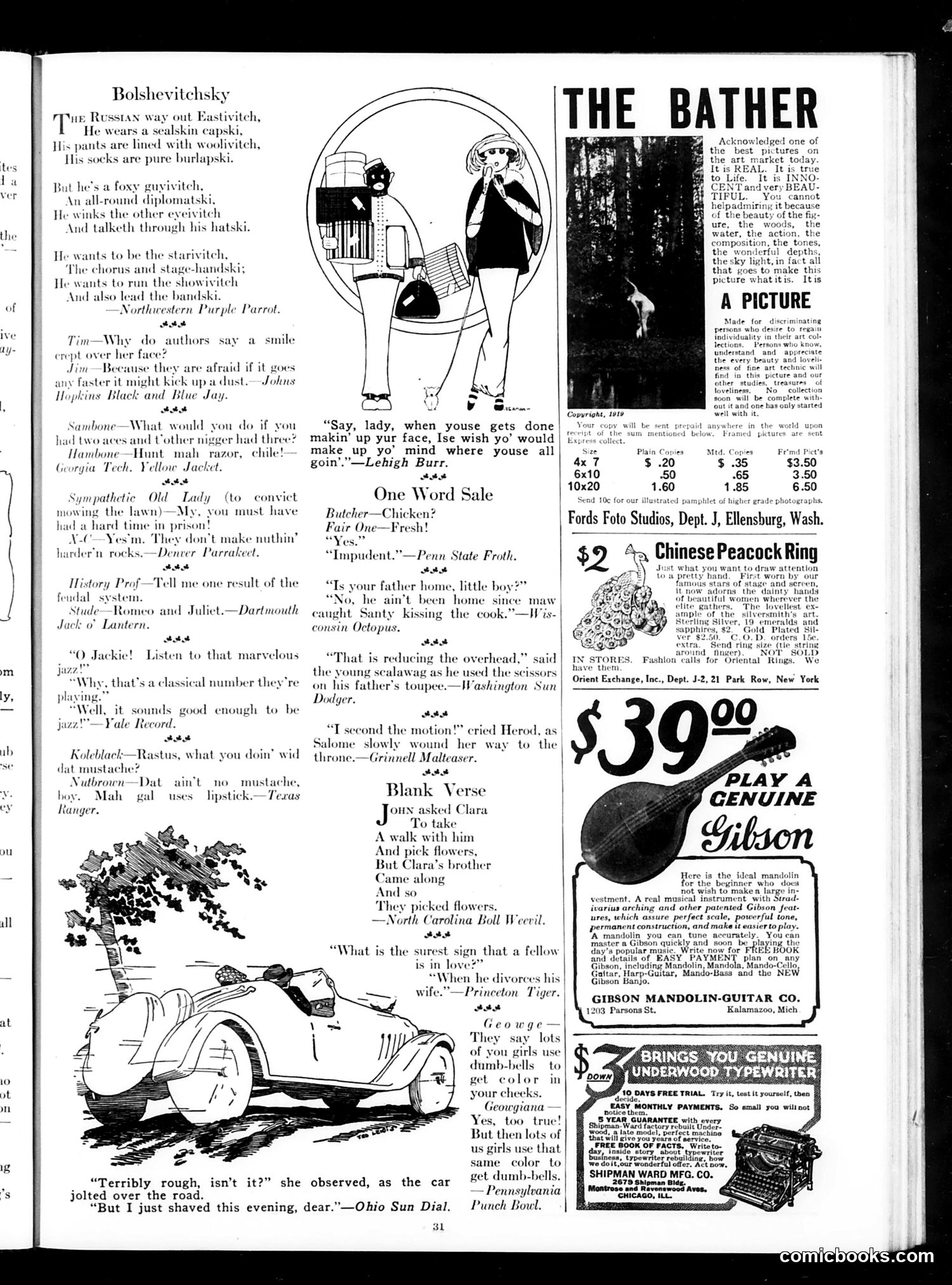
This page lampoons Russian Bolshevism through mock-Slavic linguistic caricature. The poem "Bolshevitchsky" (top left) mocks a Russian communist diplomat—adding "-ski," "-itch," and "-vitch" suffixes to English words to create absurdist "Russian" language. The figure wants power ("be the starivitch," "run the showivitch," "lead the bandski") while remaining deceptive ("foxy guyivitch," "winks the other eyeivitch"). The satire targets Soviet leaders' ambitions and perceived duplicity during the post-WWI period when Bolshevism was viewed with deep suspicion in America. The exaggerated dialect reduces Russian communists to ridiculous caricatures, mocking both their foreign otherness and their alleged desire for totalitarian control. The rest of the page comprises typical Judge humor—puns, jokes, and advertisements—unrelated to the political satire.
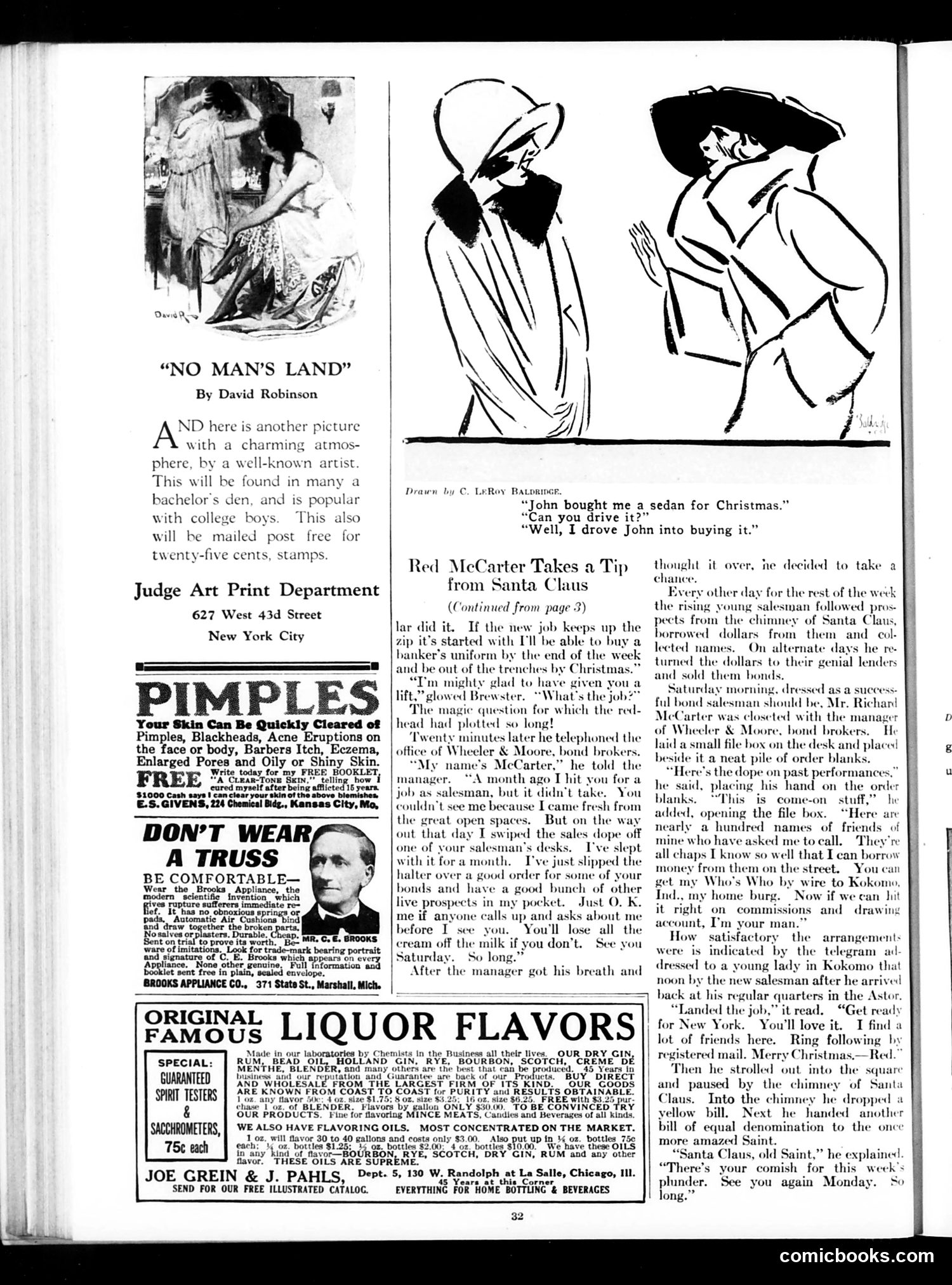
This page from the satirical magazine *Judge* contains mixed content: **The Cartoon (top right):** Drawn by C. LeRoy Baldridge, shows two fashionably dressed women in conversation. The caption reads: "John bought me a sedan for Christmas." / "Can you drive it?" / "Well, I drove John into buying it." The joke satirizes women's consumer power and persuasiveness—the humor relies on the implication that the woman manipulated her husband ("John") into an expensive purchase through feminine charm or persistence, then cannot actually operate the vehicle. It reflects early 20th-century gender stereotypes about women drivers and purchasing decisions. **"No Man's Land"** (top left) is an art print advertised for sale, appealing to "bachelor's dens" and "college boys"—suggesting suggestive or risqué content appropriate for unmarried male spaces. **The remainder** consists of period advertisements for medical/personal remedies (acne treatments, trusses) and liquor flavoring oils, typical of *Judge*'s commercial content.
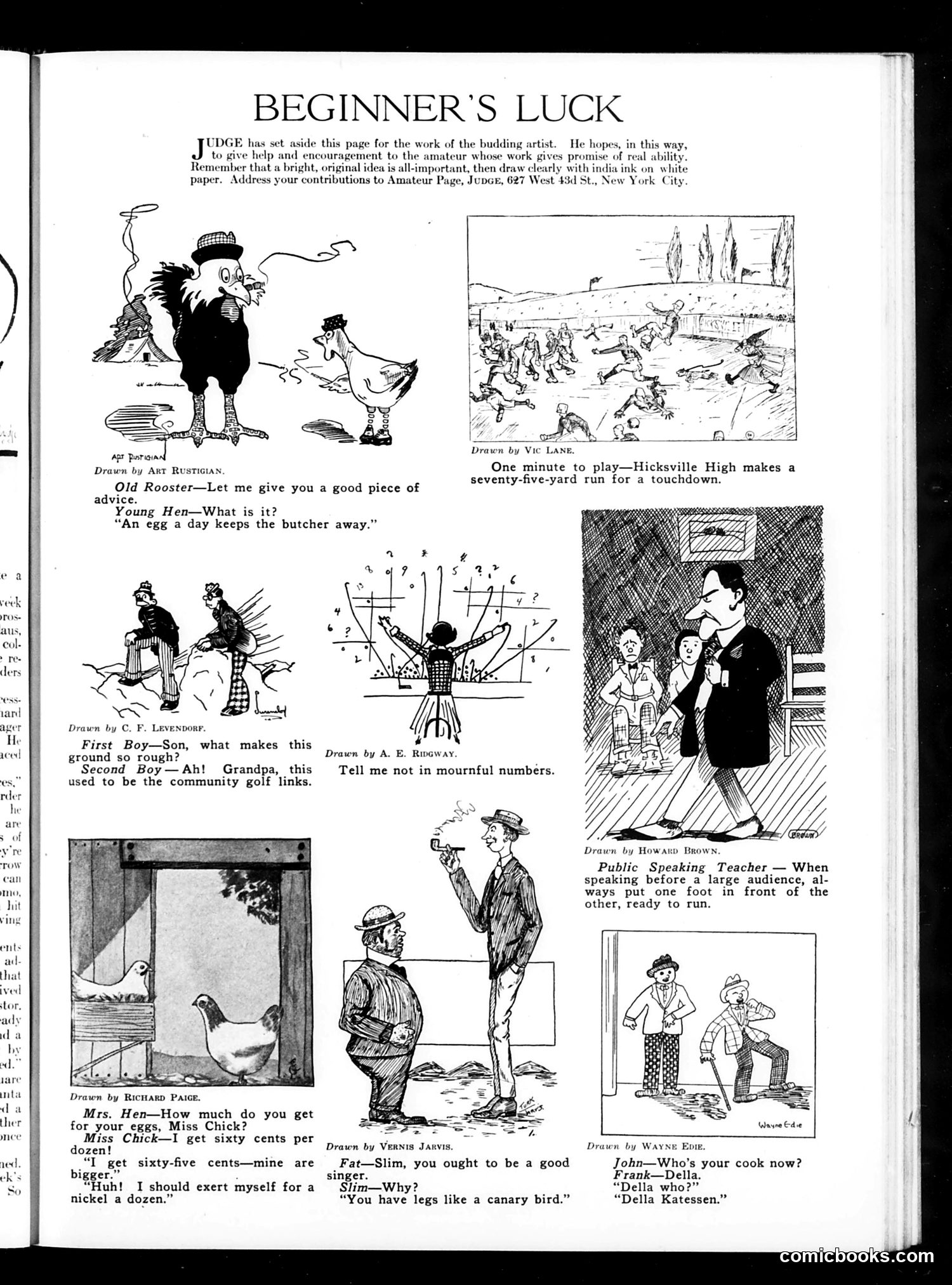
This is a humor page featuring multiple unrelated single-panel cartoons and comic strips, typical of Judge's format. The cartoons showcase various everyday American scenes with gentle, domestic humor: **Key cartoons include:** - An old rooster advising a young hen that "an egg a day keeps the butcher away" (playing on the proverb about apples and doctors) - A football scene referencing Hicksville High's gameplay - Two boys discussing why the ground is rough—their grandfather's old community golf links - Hens haggling over egg prices, competing for better rates - A fat man (named Fat) told by "Slim" he'd make a good singer because of his "legs like a canary bird" - A public speaking teacher giving absurd advice to stand with one foot forward, ready to run - A pun-based joke: "Della Katessen" (delicatessen) **The humor is largely physical comedy and wordplay**—typical early-20th-century American magazine humor aimed at general audiences. There's no obvious political satire; these are simply domestic, observational jokes meant to amuse readers.
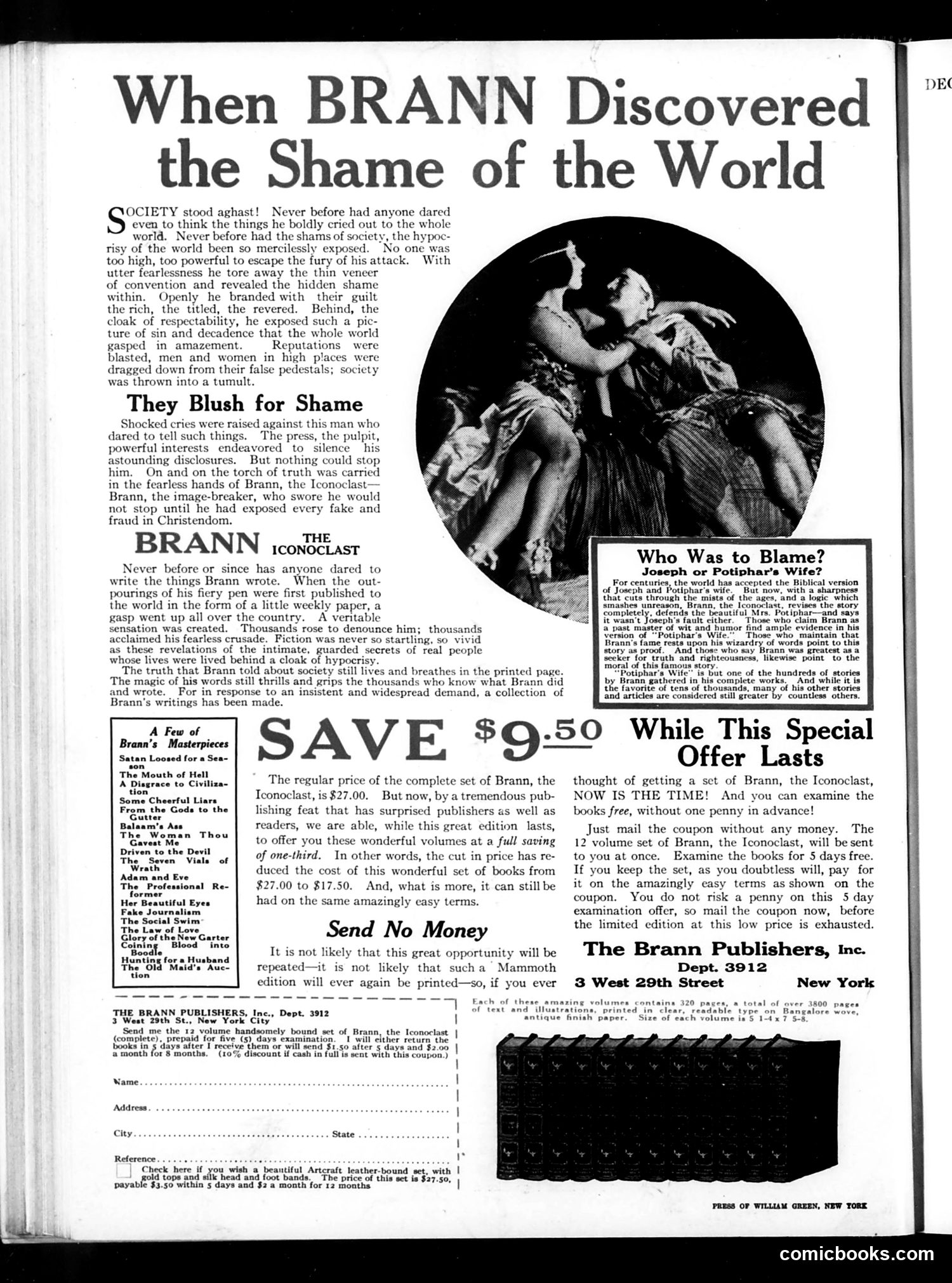
This page advertises *The Iconoclast*, a collection of writings by William Cowper Brann, an early 20th-century Texas journalist and social critic. The advertisement presents Brann as a fearless truth-teller who exposed hypocrisy among the wealthy and powerful—"the rich, the titled, the revered"—through his fiery weekly newspaper. The satire here is *pro-Brann*: Judge magazine celebrates his willingness to attack established institutions and respectable society, positioning him as a heroic "image-breaker" who revealed "guarded secrets" and "hidden shame." The piece suggests powerful interests (press, pulpit, business) tried to silence him, but he persisted. This reflects late-19th/early-20th-century populist sentiment attacking institutional hypocrisy. The publisher uses this anti-establishment appeal to sell the 12-volume set at a discounted price ($17.50 instead of $27.00), offering a five-day free examination period.